
"Kulikovo: Not a Russian Victory over the Mongols, but a Chapter in the Internal Crisis of the Golden Horde"
By Altanbagana Baatar
DBA Candidate| Independent Historian
ImperialGG Historical Research Seriers
01 July 2026
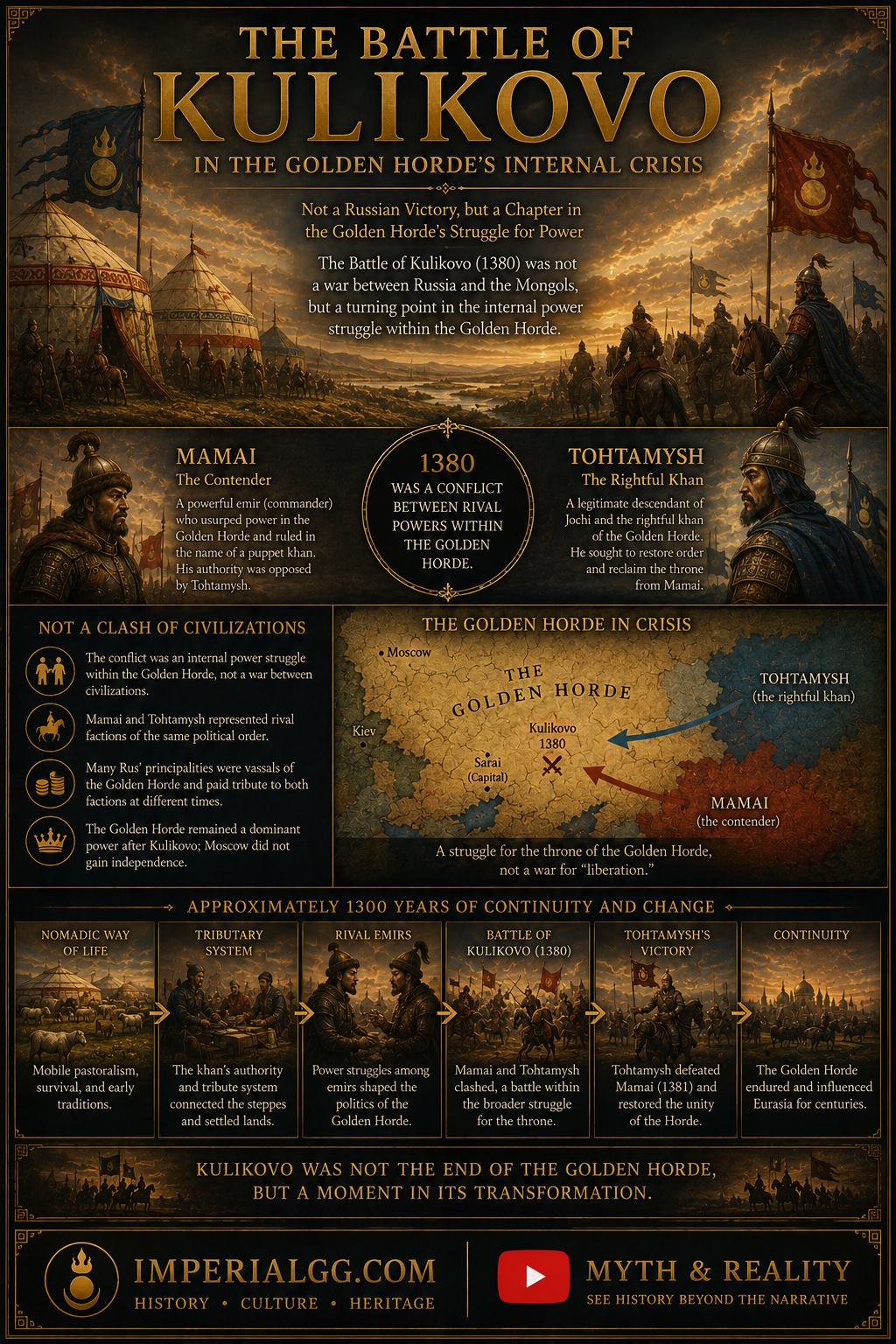
The Battle of Kulikovo in the Golden Horde’s Internal Crisis
Introduction
The Battle of Kulikovo of 1380 has traditionally been celebrated in Russian national historiography as the first great victory of Russia over the Mongols and the beginning of liberation from the so-called “Mongol yoke.” Such an interpretation, however, reflects later political memory more than the realities of the fourteenth century.
The rise of Moscow cannot be understood apart from the political order of the Golden Horde. For more than a century before Kulikovo, the princes of Moscow operated within the institutions created by the Jochid state, received their authority from the khans, collected tribute on behalf of the Horde, and accumulated wealth and political influence through their privileged position within that system. Likewise, the events of 1380 unfolded amid the dynastic struggle between Mamai and Tokhtamysh for control of the Golden Horde and should be interpreted within that broader context.
Moscow and the Institutions of the Golden Horde
Following the Mongol conquest of the Rus’ principalities between 1237 and 1240, the rulers of Rus’ became tributaries of the Golden Horde. Their authority depended upon the recognition of the khan and the granting of a yarlyk, or patent of rule.
The princes of Moscow proved particularly successful in adapting to this new political order. Under Ivan I Kalita, Moscow acquired the right to collect tribute from other Rus’ principalities on behalf of the khans of the Golden Horde. This privilege transformed Moscow from a relatively minor principality into the most powerful political center of northeastern Rus’.
The revenues that passed through Moscow enabled its rulers to purchase lands, strengthen their fortifications, expand their influence, and consolidate their authority over rival principalities.
Moscow and the Suppression of Tver
The relationship between Moscow and the Golden Horde is illustrated most clearly by the events of 1327.
When the inhabitants of Tver revolted against Mongol officials and killed representatives of the Horde, Ivan Kalita did not support the uprising. Instead, he cooperated with the khan and participated in the suppression of the rebellion.
The destruction of Tver dramatically altered the political balance of northeastern Rus’. Moscow’s principal rival was weakened, while the princes of Moscow strengthened their position within the political hierarchy of the Golden Horde.
Consequently, the expansion of Moscow was not achieved in opposition to the Horde but largely through cooperation with it.
The Crisis of the Golden Horde
The death of Berdi Beg in 1359 initiated a prolonged period of political instability within the Golden Horde. Numerous rulers claimed the throne, and central authority weakened considerably.
Among the leading figures of this period was Mamai, a powerful military commander who exercised effective authority over the western territories of the Horde. However, because he was not a descendant of Genghis Khan, he lacked the dynastic legitimacy necessary to claim the title of khan.
At the same time, Tokhtamysh, a Chinggisid prince from the eastern steppe, was consolidating support and seeking to restore unified rule over the Jochid Ulus. The conflict between Mamai and Tokhtamysh became one of the defining political struggles of the late fourteenth century.
Reconsidering the Battle of Kulikovo
The conventional interpretation of Kulikovo as a Russian victory over the Mongols oversimplifies the political realities of 1380.
At the time of the battle, Moscow remained an integral component of the political order of the Golden Horde. Dmitrii Donskoy ruled as the prince of a tributary state whose authority and legitimacy had developed within institutions created by the Horde itself.
The events of 1380 occurred during the struggle between Mamai and Tokhtamysh for supremacy over the Golden Horde. Therefore, the significance of Kulikovo lies less in the notion of national liberation and more in its place within the internal crisis of the Jochid state.
The subsequent course of events reinforces this interpretation. In 1382, Tokhtamysh captured and burned Moscow and restored the authority of the Golden Horde over the city.Tribute payments resumed, and Moscow continued to function within the political order of the Horde. Had Kulikovo represented the destruction of Mongol authority, such developments would be difficult to explain.
Conclusion
The rise of Moscow and the Battle of Kulikovo should be reconsidered within the broader context of Eurasian history.
Moscow was not an external opponent of the Golden Horde but one of the principal beneficiaries of its political and fiscal institutions. Through the collection of tribute and close cooperation with the khans, Moscow accumulated the resources that eventually enabled it to dominate the Rus’ principalities.
Likewise, the events of 1380 should not be reduced to a simple conflict between Russians and Mongols. They unfolded amid the dynastic struggle between Mamai and Tokhtamysh and formed part of the internal political history of the Golden Horde itself.
The rise of Moscow, therefore, was in many respects a product of the very imperial order that later Russian historical memory sought to portray as its principal enemy.
Bibliography
Favereau, Marie. The Horde: How the Mongols Changed the World. Cambridge, MA: Harvard University Press, 2021.
Halperin, Charles J. Russia and the Golden Horde: The Mongol Impact on Medieval Russian History. Bloomington: Indiana University Press, 1985.
Martin, Janet. Medieval Russia, 980–1584. Cambridge: Cambridge University Press, 2007.
Ostrowski, Donald. Muscovy and the Mongols: Cross-Cultural Influences on the Steppe Frontier, 1304–1589. Cambridge: Cambridge University Press, 1998.