
Great khans of the Mongol empire
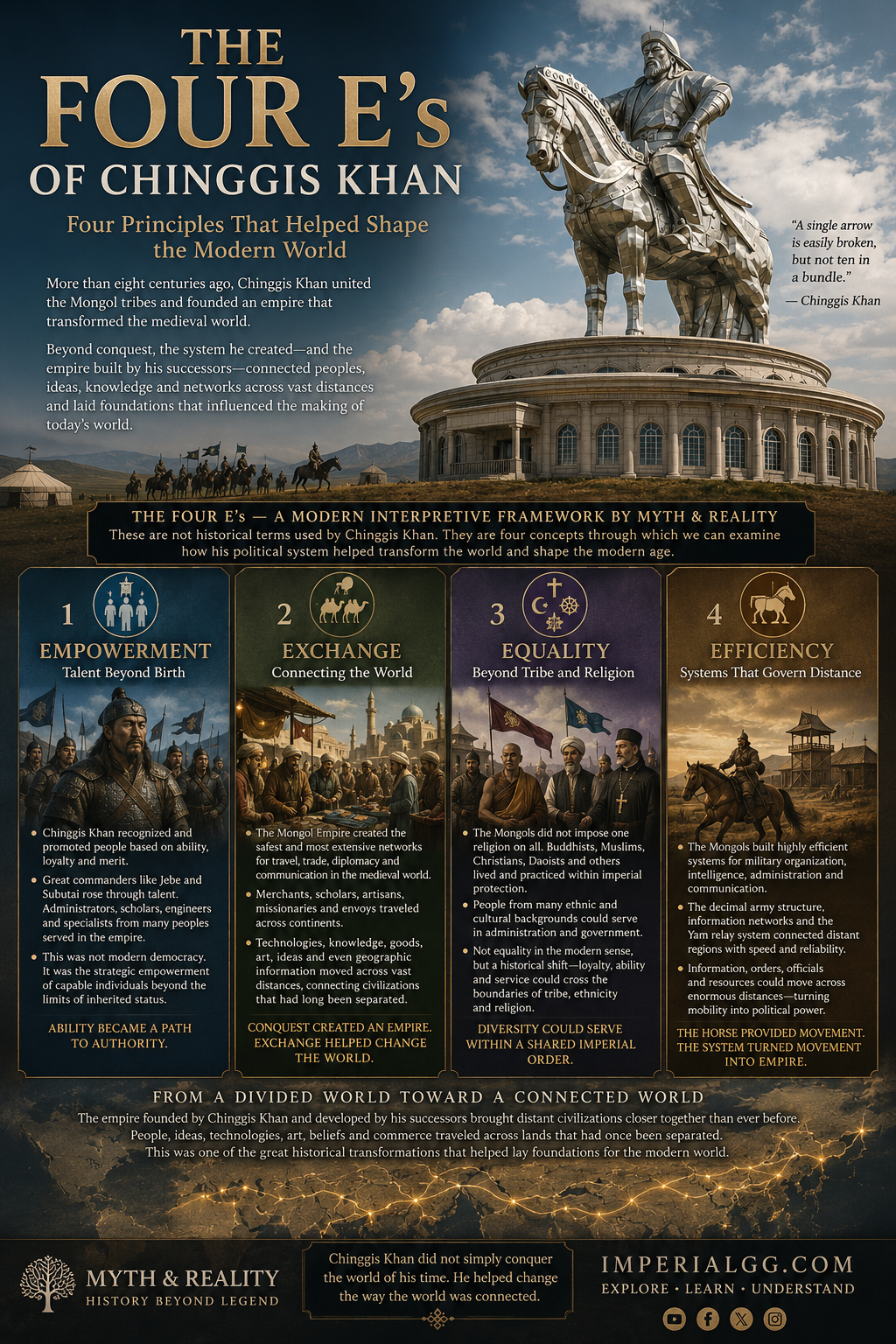
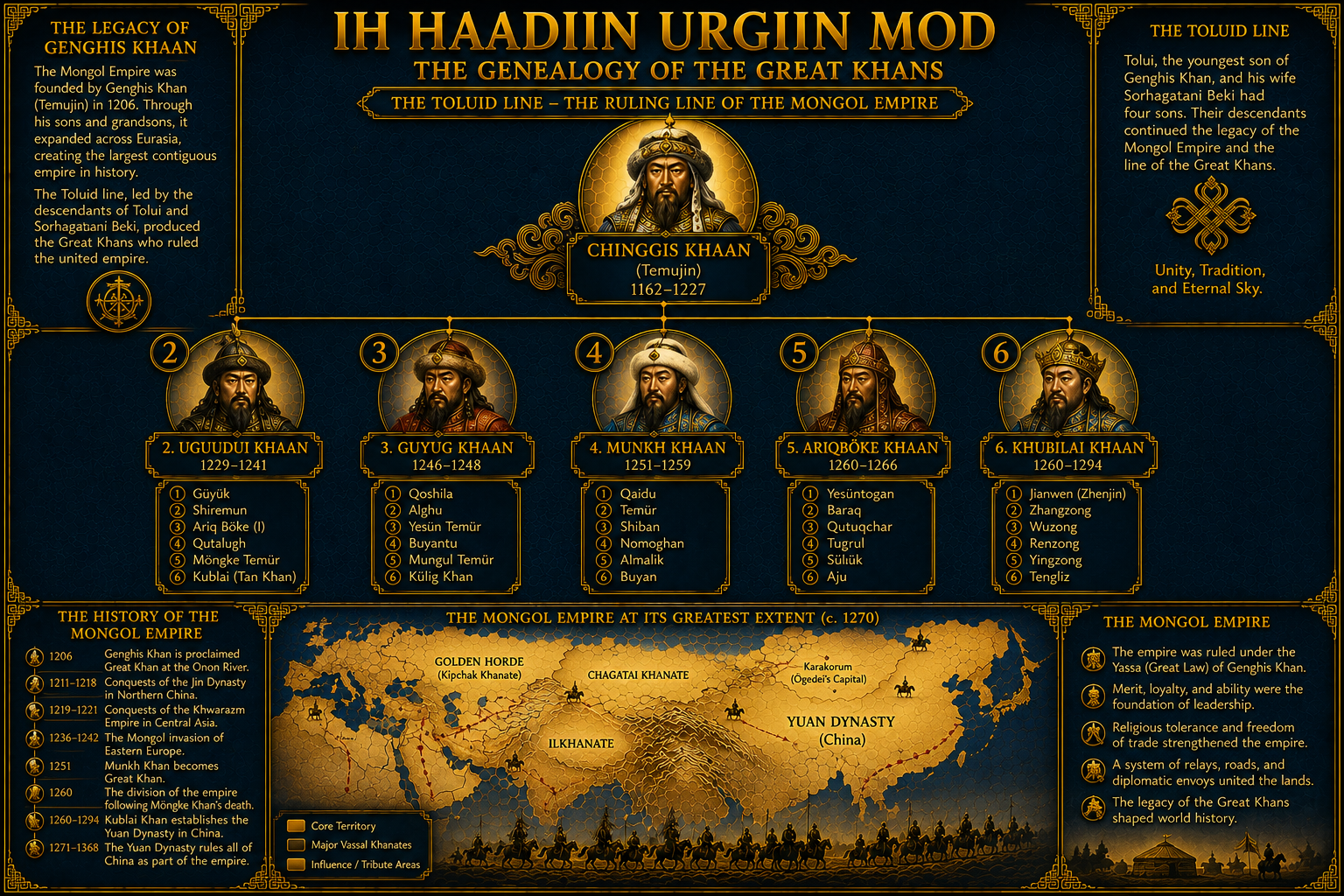
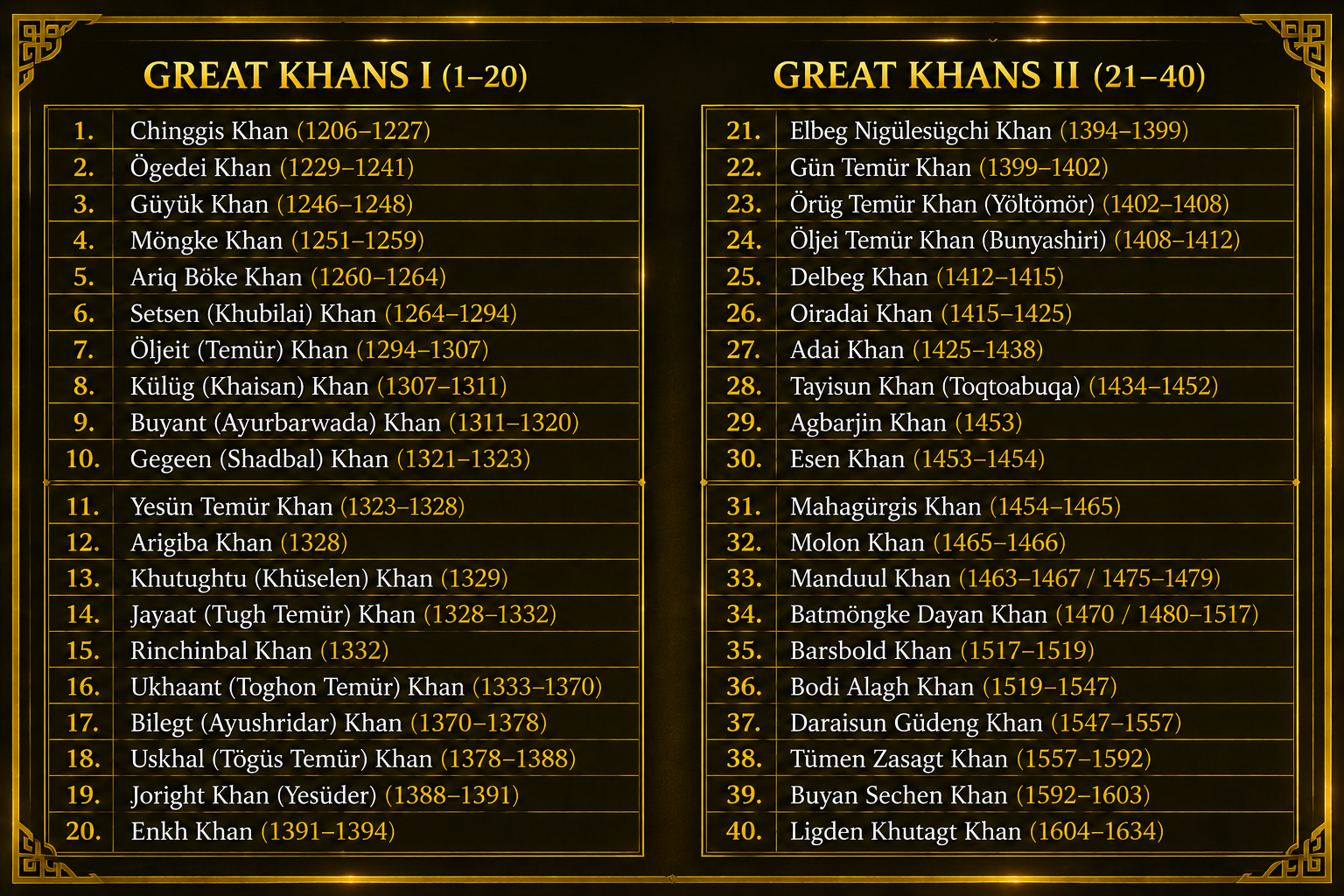
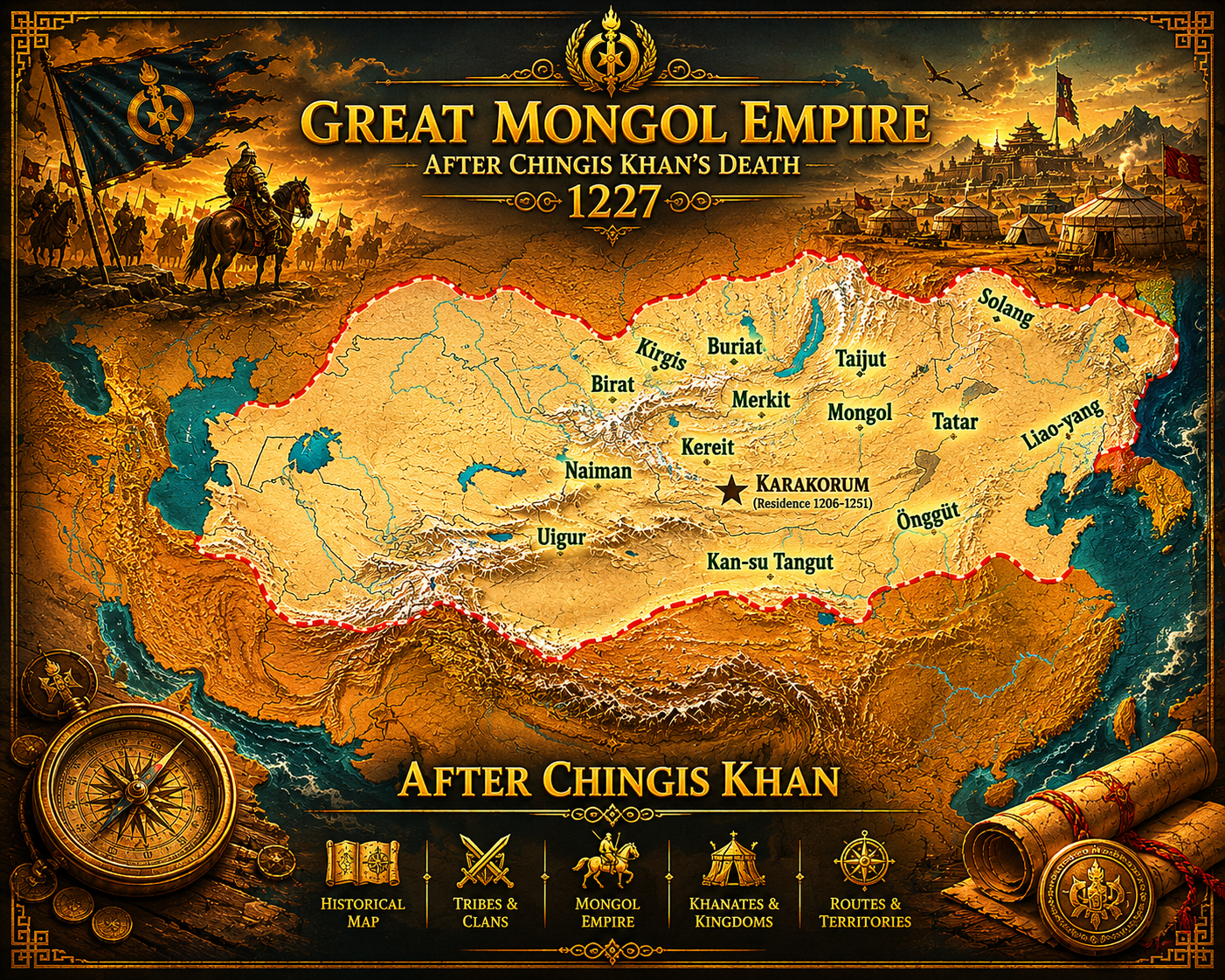
The lineage of the Great Khans extended from Chinggis Khaan (1162–1227), founder of the Great Mongol Empire, to Ligdan Hutagt Khaan (1588–1634), the last Great Khan.
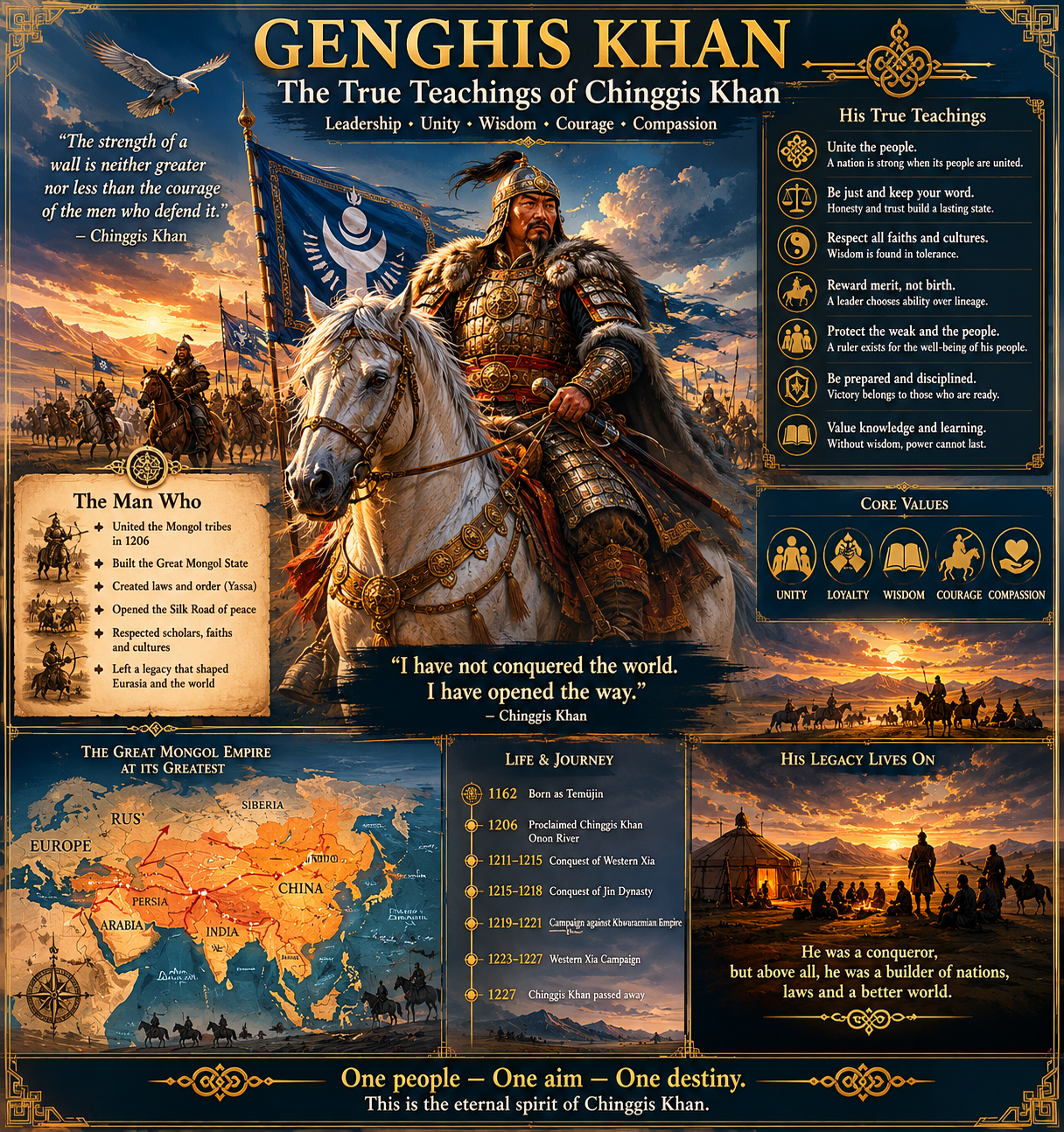
Genghis Khan (Chinggis Khan, 1162–1227) was the founder of the Great Mongol State and one of the most influential figures in world history. Born as Temüjin, the son of Yesükhei Ba’atur of the Borjigin lineage and Hö’elün, he emerged during a period when the Mongol tribes were divided by rivalry, warfare, and shifting alliances across the steppe.
After the death of his father, Temüjin’s family was abandoned by their followers and forced into hardship. Despite these circumstances, he gradually gathered allies and rebuilt his influence through diplomacy, military skill, personal loyalty, and strategic alliances. His rise was marked by conflicts with rival tribes including the Tatars, Merkids, Naimans, Kereyids, and Tayichiuds.
In 1206, following the unification of the Mongol tribes, a grand Khuriltai was held on the Onon River, where Temüjin was proclaimed Chinggis Khan, marking the foundation of the Great Mongol State. This event transformed the scattered nomadic confederations into a centralized imperial power.
Chinggis Khan introduced major political, military, and administrative reforms. He reorganized society through the decimal military system (arban, jaghun, mingghan, tümen), weakened tribal divisions, promoted merit-based leadership, and established a unified legal tradition commonly associated with the Yassa. His governance emphasized discipline, mobility, communication, and loyalty.
First Achievement in the North
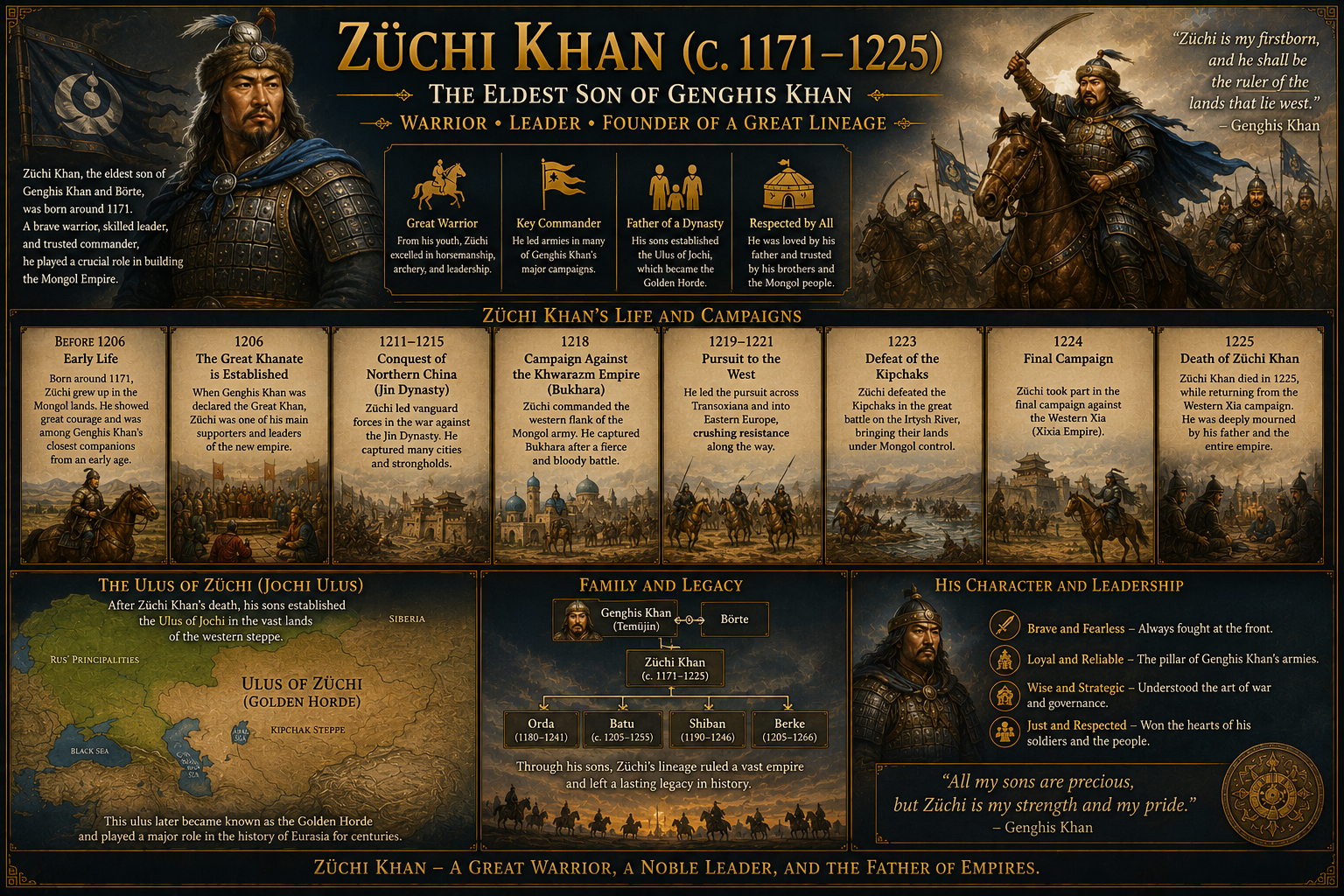
One of Jochi’s earliest achievements was the peaceful submission of the Forest Peoples, including the Sayan–Yenisei Kyrgyz and other northern tribes.
Rather than relying solely on military conquest, Jochi brought many of these peoples under Mongol authority through diplomacy, submission, and political integration, extending Mongol influence into the forests and river valleys of southern Siberia.
This marked one of his first major accomplishments as a commander of the Mongol Empire.
Founder of the Jochid Ulus
Although Jochi died before its full formation, his descendants established the Ulus of Jochi, which later became known as the Golden Horde.
The Jochid realm grew into one of the most powerful successor states of the Mongol Empire, ruling the western steppes and shaping the history of Eurasia for centuries.
Peaceful Submission of the Forest Peoples
Jochi secured the allegiance of the Sayan–Yenisei Kyrgyz and northern forest tribes, expanding Mongol influence without major warfare.
Legacy of the Golden Horde
His lineage founded the Jochid Ulus — later known as the Golden Horde, the great western branch of the Mongol world.
Founder of the Chagatai Ulus
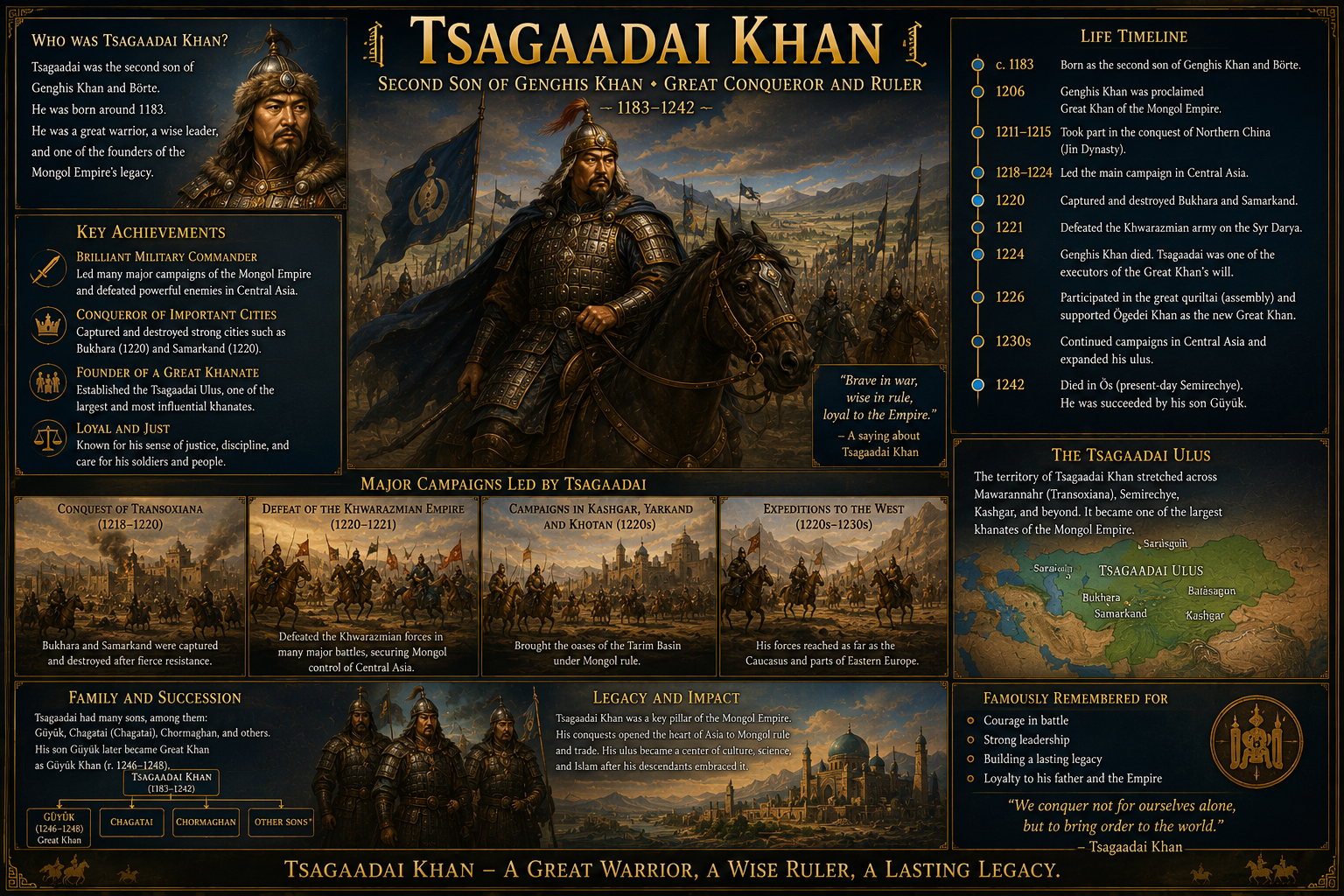
After the division of the Mongol Empire, Chagatai received the lands of Central Asia and established the Chagatai Ulus, which became one of the major successor states of the Mongol world.
His realm extended across Transoxiana, Semirechye, and parts of the Tarim Basin, forming a vital center of trade and administration along the Silk Road.
Guardian of the Great Yassa
Chagatai Khan was renowned for his strict adherence to the Great Yassa, the legal code established by Chinggis Khan.
He enforced discipline, protected imperial law, and became known as one of the strongest defenders of the legal and administrative order of the Mongol Empire.
Established the Chagatai Ulus
Founded the Chagatai realm in Central Asia, one of the principal branches of the Mongol Empire.
Protector of the Great Yassa
Strictly upheld the Great Yassa and maintained order through imperial law and discipline.
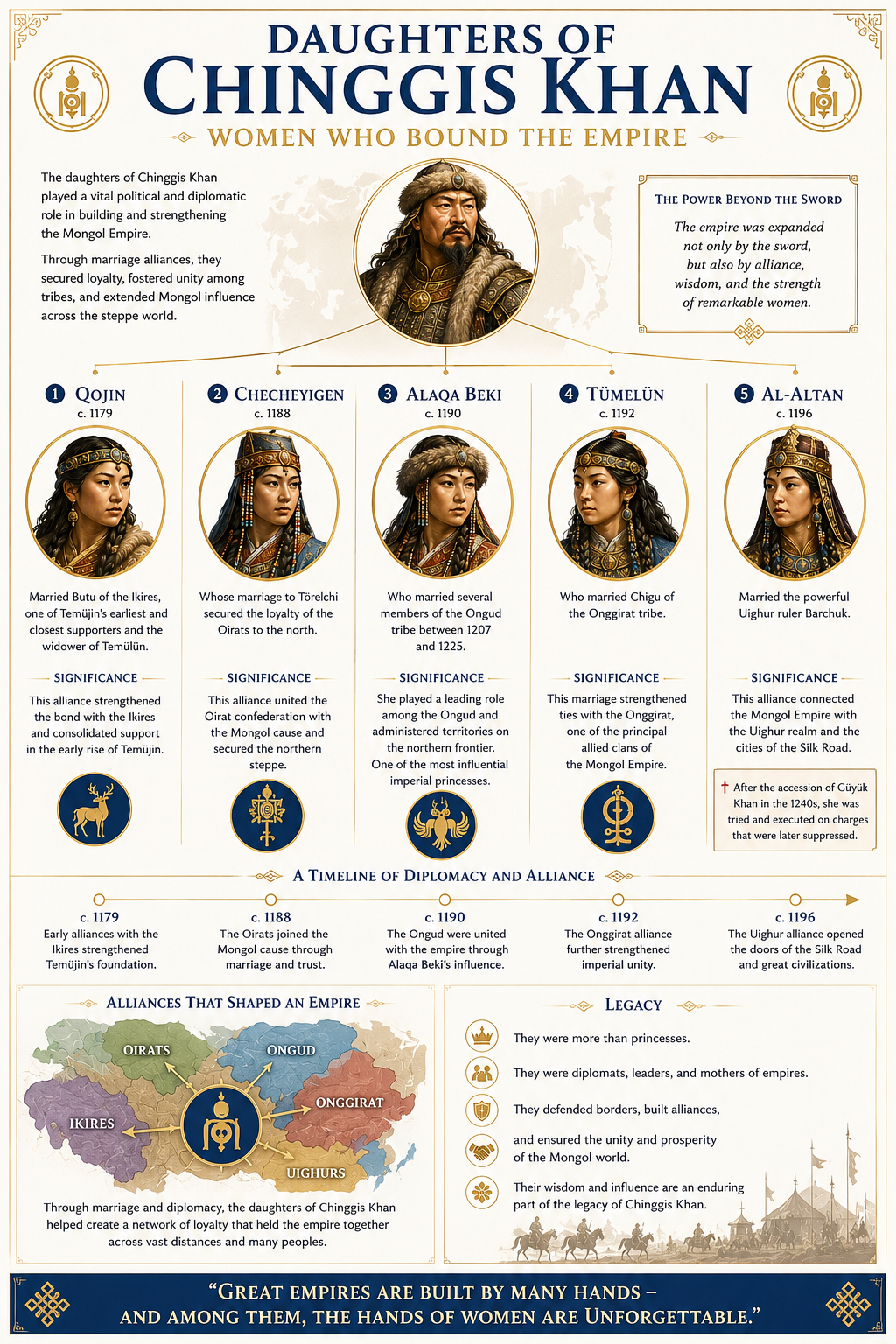
Daughters of Chinggis Khan – Guardians of the Empire
The daughters of Chinggis Khan played a major political and strategic role in the expansion of the Mongol Empire.
Rather than remaining only within the imperial court, many were married into powerful steppe kingdoms and frontier states, where they strengthened Mongol authority and secured alliances.
Their marriages helped extend imperial influence across the steppe world and formed an important part of Mongol statecraft.
Approximate Timeline
c. 1206–1210
The daughters of Chinggis Khan were integrated into imperial alliance networks following the establishment of the Mongol Empire.
Early 13th Century
Princesses were married into allied tribes and frontier rulers to secure loyalty and expand influence.
Al Altun
Married into the Onggirat lineage and helped strengthen eastern alliances.
Checheyigen
Married into the Oirat confederation and helped integrate western steppe groups into the empire.
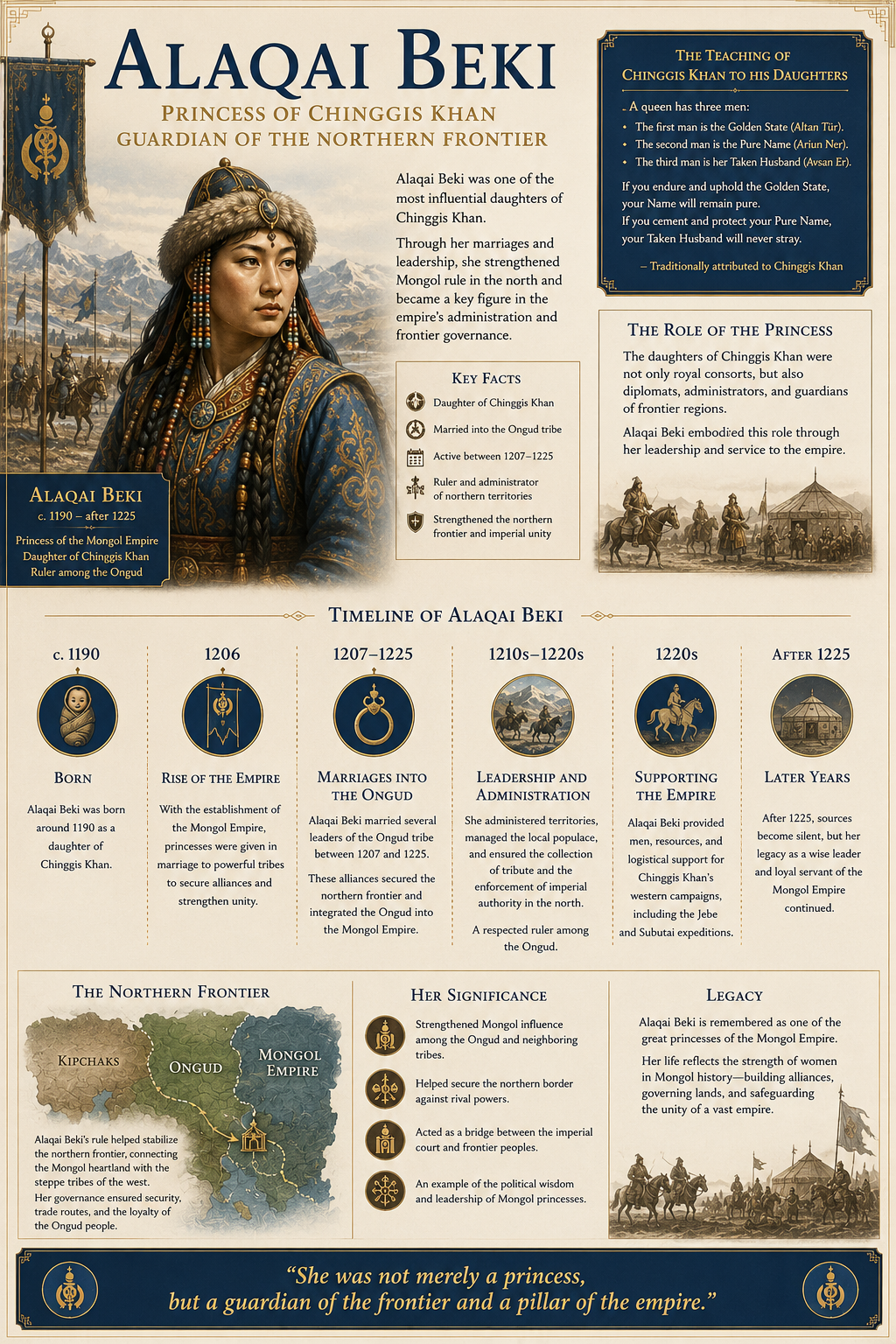
Alaqai Beki
Married into the Ongud and became one of the most influential women on the northern frontier, administering territory and supporting imperial authority.
Tumelun and other princesses
Participated in alliance networks linking the imperial family with steppe aristocracies.
Legacy
The daughters of Chinggis Khan were not merely royal consorts; they served as political leaders, diplomatic bridges, and guardians of frontier regions.
Their influence contributed to the stability and expansion of the Mongol Empire.
“The empire was expanded not only by sons and generals, but also by the daughters of Chinggis Khan.”
ÖGEDEI KHAN (1229–1241)
The Builder of the Mongol World Empire
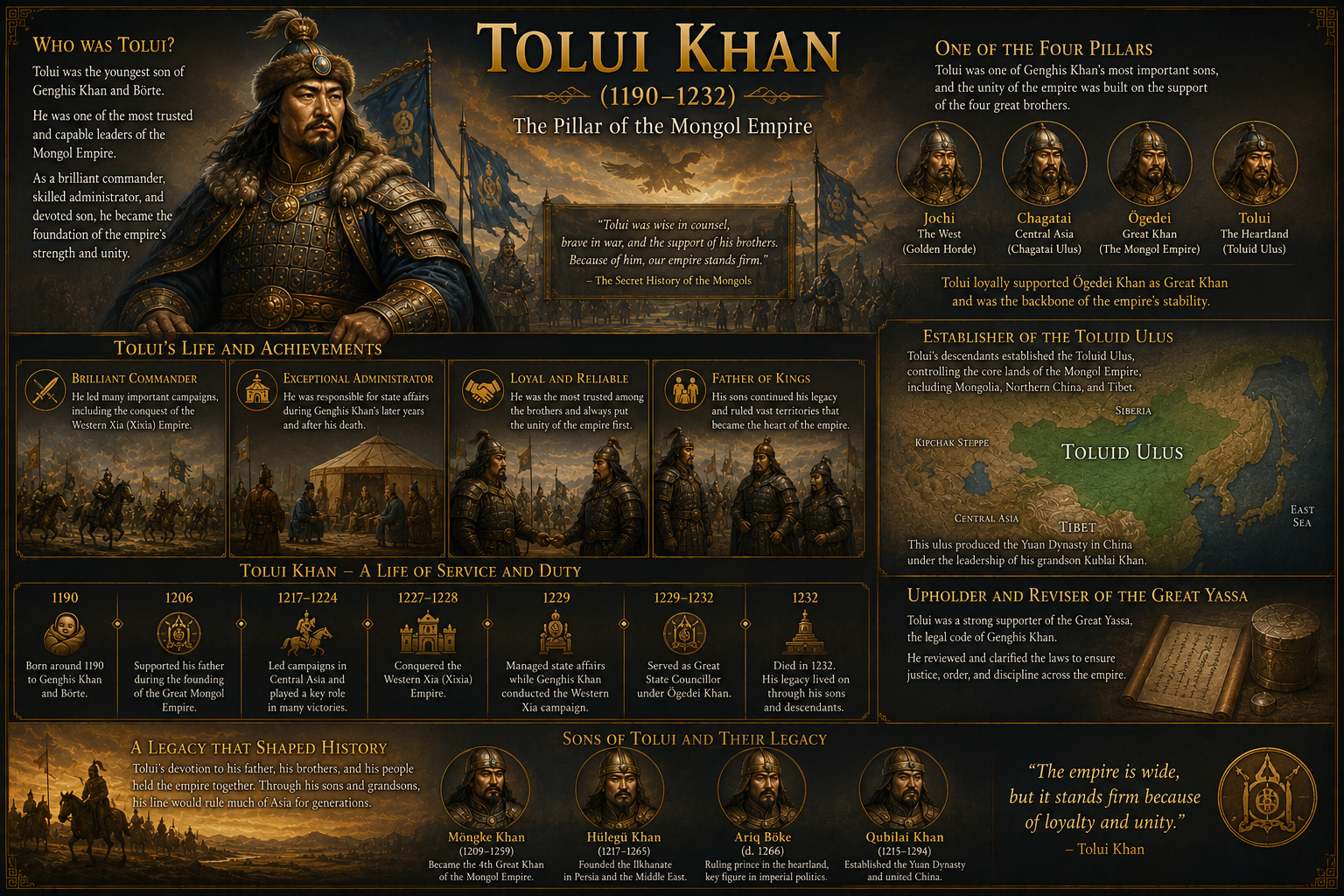
Ögedei Khan, the third son of Chinggis Khan, was proclaimed Great Khan in 1229 following the kurultai held after his father’s death. Chosen by Chinggis himself as successor, Ögedei inherited not merely a realm of conquest, but the responsibility of preserving and governing the largest land empire yet created.
Unlike his father, whose greatness lay in unification and conquest, Ögedei’s historical role was that of organizer, administrator, and empire-builder. During his reign the Mongol Empire transformed from a confederation forged by war into a functioning imperial system stretching across Eurasia.
Under Ögedei, Karakorum was developed as the imperial capital and became a center of administration, diplomacy, trade, and craftsmanship. He expanded the Yam relay-post system, creating roads and communication networks that connected distant provinces of the empire. Wells, stations, and supply points were established across the steppe to support both travelers and imperial administration.
His reign witnessed one of the greatest expansions in world history. The Mongols completed the destruction of the Jin Dynasty in North China, secured Persia and the Caucasus, campaigned into Korea, and advanced westward through the Eurasian steppe into Eastern Europe under Batu Khan and the princes of the imperial house.
Ögedei also promoted trade and long-distance exchange. The reopening and protection of Silk Road routes linked East and West more closely than ever before. Merchants, scholars, envoys, and artisans moved across the empire under Mongol protection, laying foundations for what later generations would call the Pax Mongolica.
Contemporary accounts describe Ögedei as generous, approachable, and pragmatic. He relied on capable administrators regardless of origin — Uyghur scribes, Khitan scholars such as Yelü Chucai, Muslim officials including Mahmud Yalavach, and many others served under his rule. This cosmopolitan administration helped stabilize the empire after the death of Chinggis Khan.
Key Achievements
1229 – Enthroned as Great Khan of the Mongol Empire
1235 – Development of Karakorum as imperial capital
1234 – Fall of the Jin Dynasty completed
1236–1241 – Western campaigns into Rus’ and Eastern Europe
Expansion of the Yam System – Imperial roads and relay stations established across Eurasia
Promotion of Trade – Strengthening of Silk Road connections
Legacy
Chinggis Khan forged the empire; Ögedei gave it structure.
His reign preserved the unity of the empire at its greatest moment of expansion and transformed conquest into administration, communication, and governance across continents. Through roads, cities, trade networks, and institutions, Ögedei helped shape the imperial order that connected Eurasia during the thirteenth century.
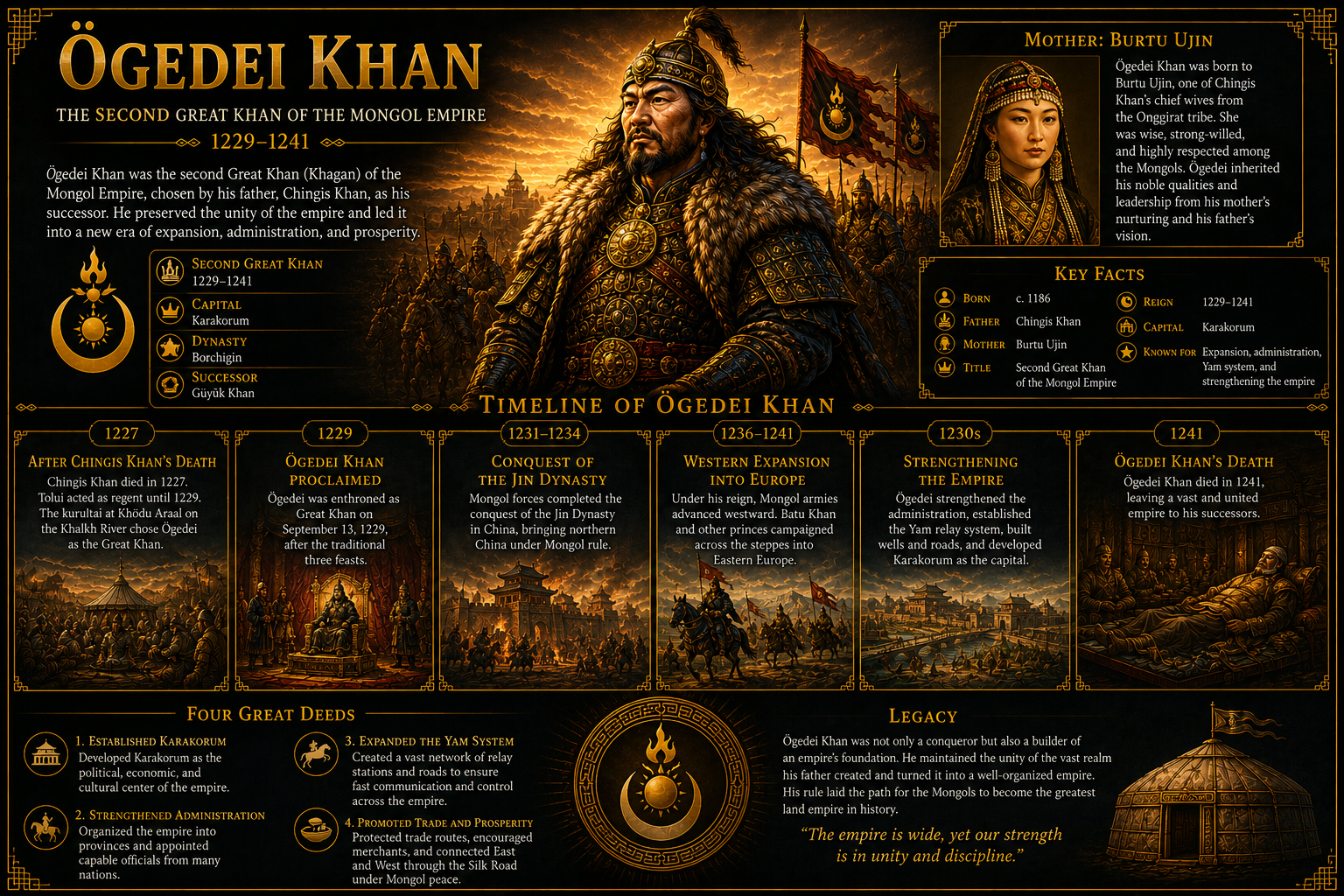
THE FOUR GREAT DEEDS OF ÖGEDEI KHAN
1. Completion of the Conquest of North China
“I completed the work left by my father and brought the Jin realm under our rule.”
Ögedei Khan completed the long struggle against the Jin Dynasty, fulfilling the campaigns initiated under Chinggis Khan. In 1234, the fall of Jin marked one of the decisive victories of the Mongol Empire and secured northern China under Mongol authority.
2. Establishment of the Yam Relay System
“I established relay stations and roads for the empire.”
Ögedei expanded the Yam postal relay network across the empire, creating roads, relay stations, supply depots, and communication routes stretching from East Asia toward Central Asia and the western frontiers. This became one of the administrative foundations of the Mongol world.
3. Construction and Development of Karakorum
“I built palaces and established Karakorum.”
Under Ögedei Khan, Karakorum was developed into the imperial center of the Mongol Empire. Palaces, workshops, administrative buildings, and diplomatic quarters were established, transforming the city into a political and commercial heart of Eurasia.
4. Wells and Support for the People
“I had wells dug and provided for the people.”
Ögedei ordered the construction of wells, stations, and infrastructure across the steppe routes. These projects improved water access, travel, administration, and the welfare of people living under imperial authority.
The Great Kurultai of 1235
In 1235, following the consolidation of the Mongol Empire under Ögedei Khan, a Great Kurultai was convened at Karakorum. The assembly brought together princes, generals, and nobles of the Borjigin lineage to determine the empire’s future campaigns and administrative direction.
At this kurultai, the decision was made to launch large-scale western expeditions under Batu and Subutai, leading to the Mongol advance into Eastern Europe, the Rus’ principalities, and the Pontic steppe. At the same time, further campaigns in China, Korea, and the Middle East were prepared.
The 1235 Kurultai marked the beginning of the empire’s greatest phase of expansion and demonstrated the collective political authority of the Mongol imperial house.
1235 Great Kurultai – Karakorum
- Convened under Ögedei Khan
- United princes and commanders of the empire
- Authorized the western campaigns of Batu and Subutai
- Initiated the largest phase of Mongol expansion
- Strengthened imperial administration and strategy
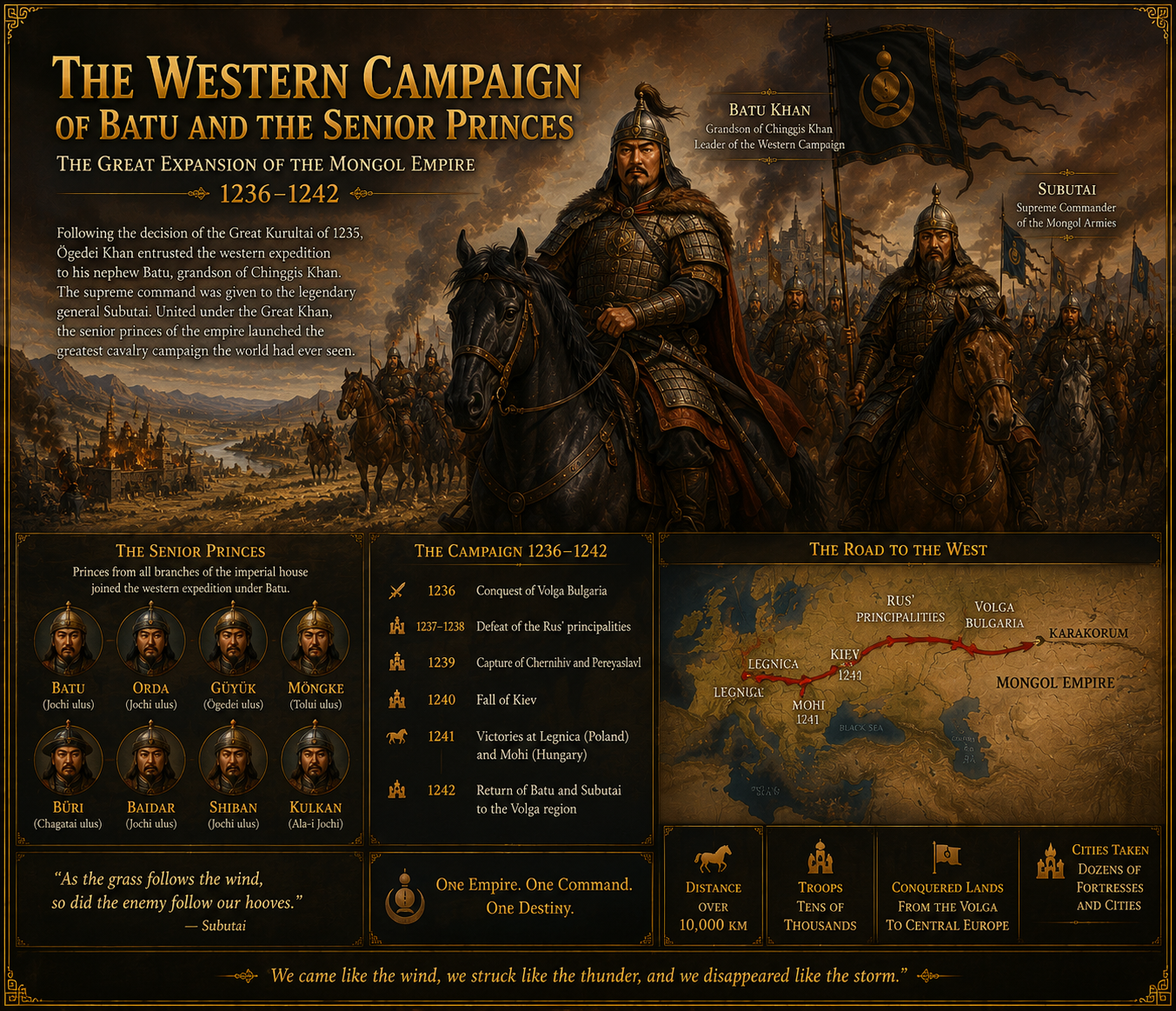
The Campaign of the Senior Princes (1236–1242)
Following the decision of the Great Kurultai of 1235, the Mongol Empire launched the great western campaign known as the Campaign of the Senior Princes (Elder Princes’ Campaign). The expedition was placed under the leadership of Batu, grandson of Chinggis Khan, while the supreme military command was entrusted to Subutai.
The campaign united princes from every branch of the imperial house, including the descendants of Jochi, Ögedei, Chagatai, and Tolui. Among them were Batu, Orda, Güyük, Möngke, Büri, Baidar, and others.
From 1236 to 1242, the Mongol armies conquered Volga Bulgaria, defeated the Rus’ principalities, captured Kiev (1240), and advanced deep into Eastern and Central Europe. Mongol forces defeated European coalitions at the Battle of Legnica (1241) and the Battle of Mohi (1241).
The campaign demonstrated the military coordination and imperial unity of the Mongol world at its height and marked one of the greatest cavalry expeditions in world history.
Campaign of the Senior Princes (1236–1242)
- Ordered by the Great Kurultai of 1235
- Led by Batu Khan and Subutai
- Included princes from all branches of the Borjigin house
- Conquered Volga Bulgaria and the Rus’ lands
- Captured Kiev in 1240
- Advanced into Poland and Hungary
- Victories at Legnica and Mohi
- One of the largest military campaigns in history
Why the Mongols Turned Away from Europe
Although the Mongol armies had broken the major military resistance of Eastern and Central Europe, the western lands did not possess the same economic and strategic value as the great commercial centers of Asia.
The wealth of the empire lay along the Silk Roads, the cities of China, Transoxiana, Persia, and the Middle East. Control of trade routes, taxation networks, and prosperous urban centers offered greater long-term value than continued expansion into Europe.
After the death of Ögedei Khan and the recall of the princes in 1242, Mongol strategic attention gradually shifted toward the wealthy regions of China and the Islamic world.
The Turning Point of 1242
By 1241, Mongol armies had shattered the major military resistance of Eastern and Central Europe. Victories at Legnica and Mohi destroyed the principal defensive coalitions, while the Rus’ lands had already fallen under Mongol domination.
In December 1241, however, Ögedei Khan, the Great Khan of the Mongol Empire, died unexpectedly. According to imperial tradition, the princes of the imperial house were required to return and participate in the election of a new Great Khan.
As a result, Batu Khan and the commanders of the western expedition halted their advance and withdrew eastward in 1242.
This withdrawal proved decisive for Europe. Later generations often viewed it as the moment Europe was spared from further Mongol expansion. Yet for centuries many Europeans did not fully understand why the seemingly unstoppable Mongol armies had suddenly disappeared from the continent.
Only later historical research connected the withdrawal to the succession crisis that followed the death of Ögedei Khan.
Товч poster хувилбар:
1242 – The Withdrawal from Europe
- European resistance had largely collapsed by 1241
- Ögedei Khan died unexpectedly in December 1241
- Imperial princes returned for the Great Kurultai
- Batu ended the western advance in 1242
- The withdrawal altered the future course of European history
“Europe was not conquered further—not because the Mongols were defeated, but because the empire turned east to choose its Great Khan.”
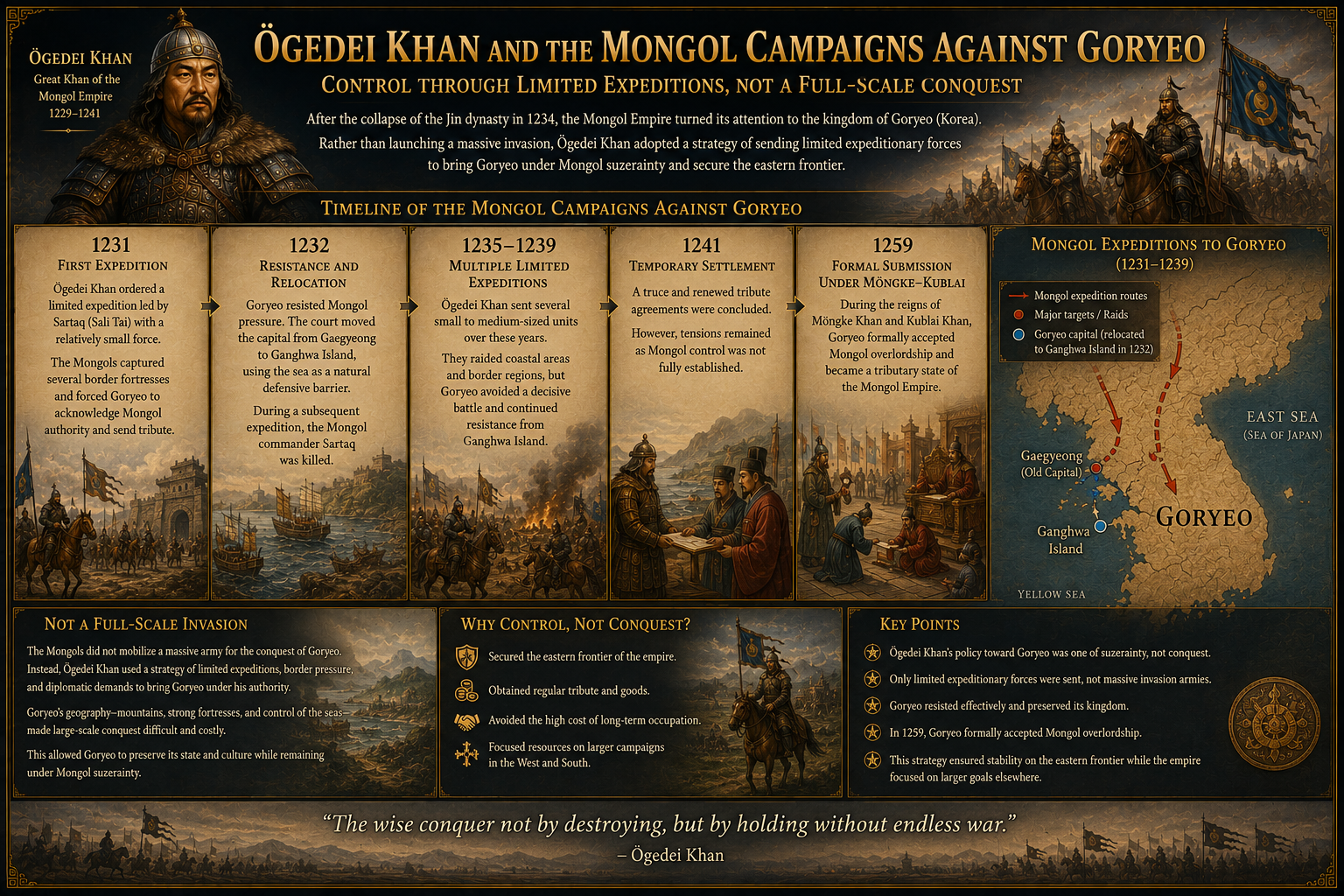
Ögedei Khan and the Mongol Campaigns Against Goryeo
After the fall of the Jin dynasty, the Mongol Empire turned its attention toward the Korean kingdom of Goryeo.
1231 – First Mongol Invasion of Goryeo
Ordered during the reign of Ögedei Khan, Mongol forces crossed into Korea under the command of Sartaq (Sali Tai). Several fortresses fell, and Goryeo agreed to submit and pay tribute.
1232 – Resistance and Relocation
The Goryeo court moved its capital from Gaegyeong to Ganghwa Island, using the sea as a defensive barrier. During the campaign, the Mongol commander Sartaq was killed.
1235–1239 – Renewed Campaigns
Ögedei ordered further expeditions. Mongol armies devastated parts of the peninsula, while Goryeo continued resistance from Ganghwa Island.
1241
A temporary settlement was reached, but conflict resumed later.
1259
Under Möngke–Kublai period developments, Goryeo formally accepted Mongol supremacy and became a tributary state of the Mongol Empire.
Timeline
1231 — First invasion of Goryeo
1232 — Capital moved to Ganghwa Island
1235–1239 — Major Mongol offensives
1241 — Temporary agreement
1259 — Goryeo accepts Mongol overlordship
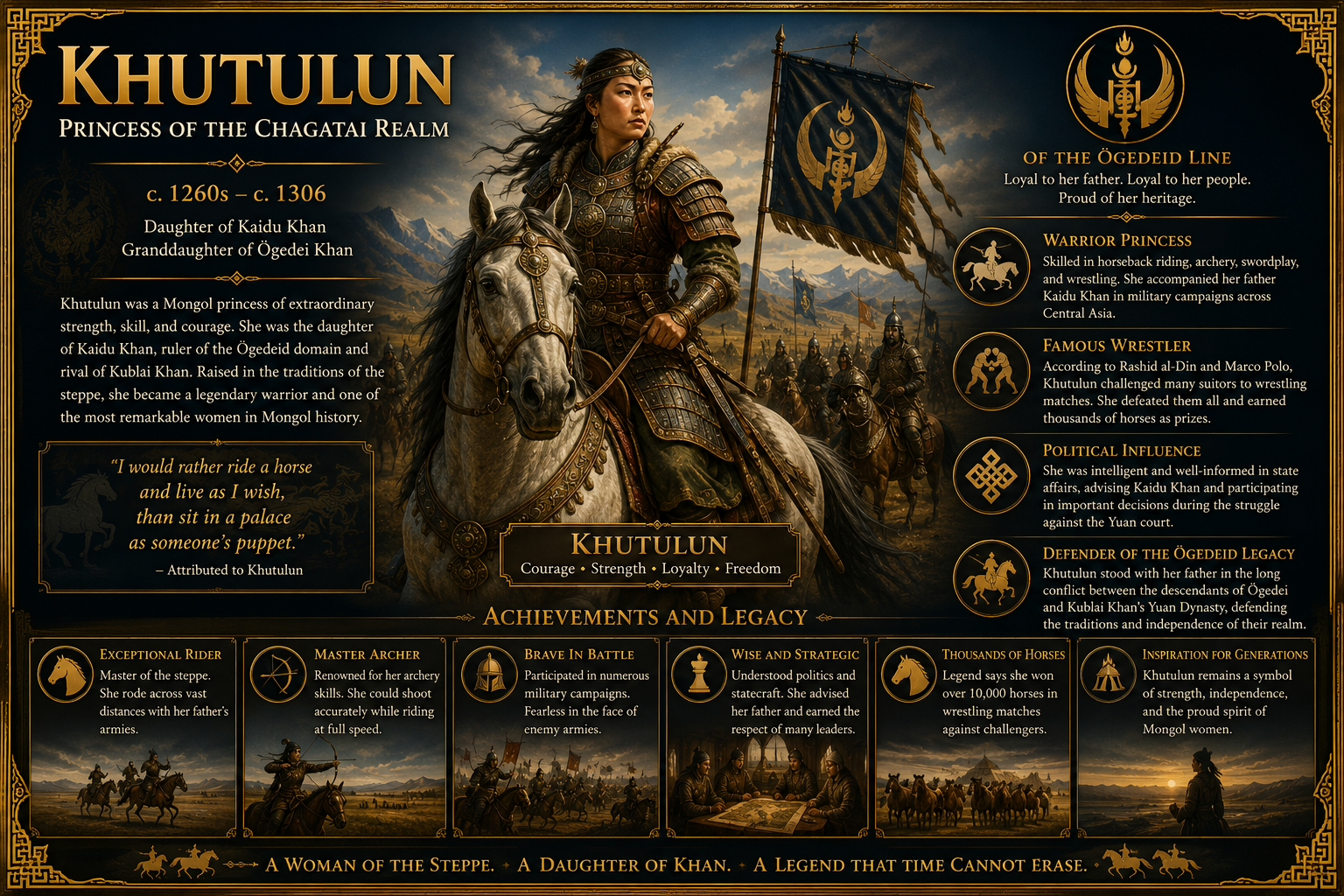
KHUTULUN
Princess of the Chagatai Realm
c. 1260s – c. 1306
Daughter of Kaidu Khan
Granddaughter of Ögedei Khan
Guardian of the Ögedeid Legacy
Khutulun was the daughter of Kaidu Khan, ruler of the Ögedeid domain and principal rival of Kublai Khan in Central Asia.
Raised among the armies of the steppe, she became renowned for her skill in horse riding, archery, and wrestling, accompanying Kaidu during campaigns across the Chagatai lands.
The Warrior Princess
Persian chronicler Rashid al-Din and later Marco Polo described Khutulun as a woman of exceptional strength and military ability.
Tradition holds that she challenged suitors to wrestling contests and defeated many opponents, earning horses as prizes.
According to later accounts, her victories brought her thousands of horses.
Campaigns and State Affairs
Khutulun frequently accompanied Kaidu in military expeditions and reportedly advised him on political affairs.
She supported the Ögedeid struggle for influence across Central Asia during the conflicts between the descendants of Ögedei and the Yuan court.
Legacy
Khutulun became one of the most celebrated women of the Mongol world — remembered as:
Warrior
Princess
Commander
Defender of the Ögedeid line
c.1260s — Birth
1270s–1290s — Campaigns with Kaidu Khan
1301 — Death of Kaidu Khan
c.1306 — Death of Khutulun
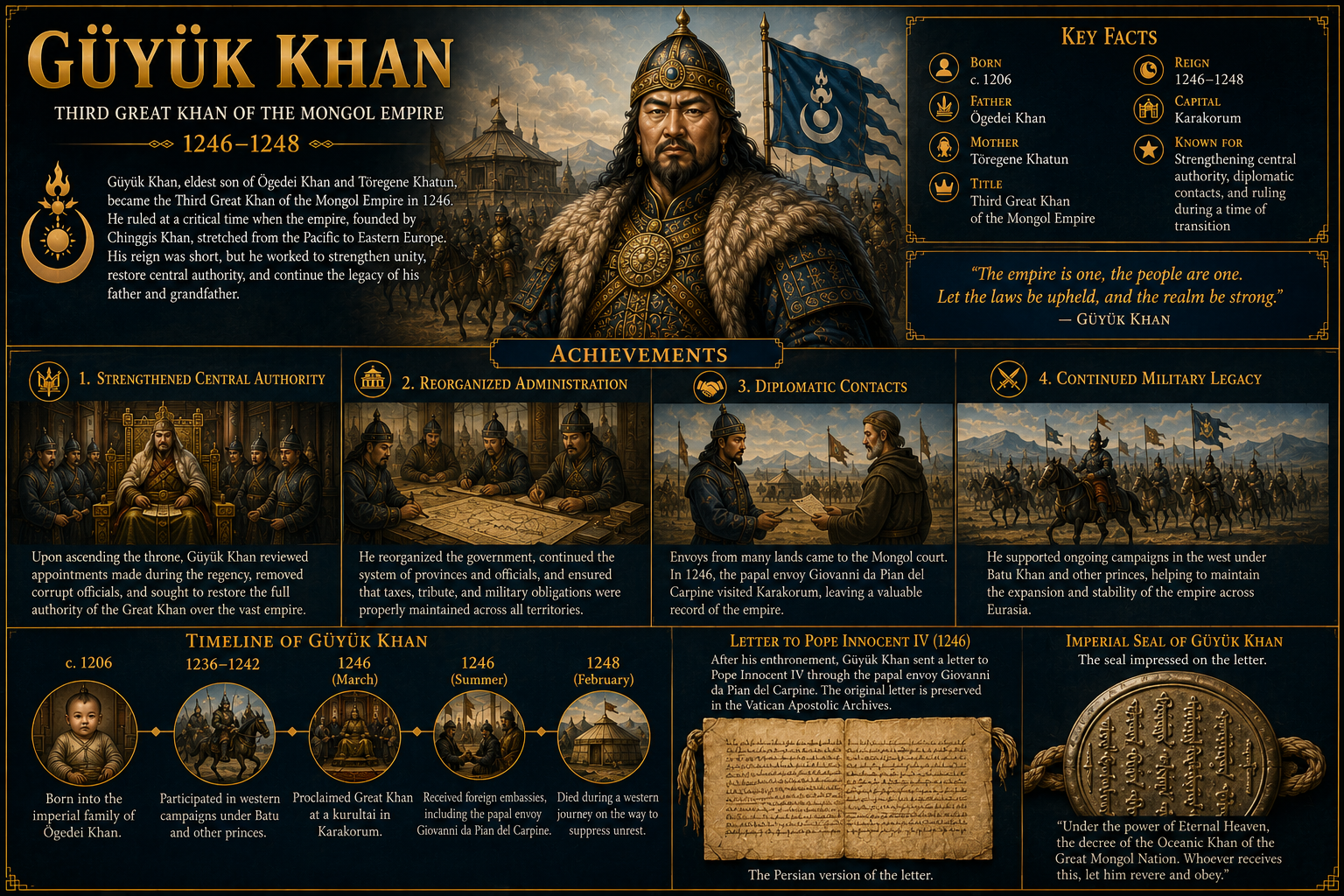
GÜYÜK KHAN (1246–1248)
The Third Great Khan of the Mongol Empire
Güyük Khan, the eldest son of Ögedei Khan and Töregene Khatun, became the Third Great Khan of the Mongol Empire in 1246. His enthronement came after years of political struggle following the death of Ögedei, marking a critical transition within the imperial house.
Raised during the age of Mongol expansion, Güyük participated in western campaigns under Batu and other princes during the great invasions into Rus’ and Eastern Europe. Though remembered as a military commander, his reign was largely devoted to consolidating imperial authority and restoring central control after the regency period.
Upon ascending the throne, Güyük sought to strengthen the authority of the Great Khan over the vast empire. He reviewed appointments made during the regency, reorganized administration, and attempted to reinforce the central government established under his father.
His reign also witnessed extensive diplomatic contacts. Envoys from many lands reached the Mongol court, including the mission of Pope Innocent IV, led by Giovanni da Pian del Carpine, one of the earliest European travelers to leave a written account of the Mongol Empire.
Although his reign lasted only two years, Güyük ruled at a time when the unity of the empire faced growing tensions among the descendants of Chinggis Khan. His sudden death in 1248 halted many of his political ambitions and opened the way for the later rise of Möngke Khan.
Key Timeline
1206 – Born into the imperial family of Ögedei Khan
1236–1242 – Participated in western campaigns
1246 – Enthroned as Great Khan
1246 – Received foreign embassies and papal envoys
1248 – Died during a western journey
Legacy
“Güyük Khan ruled briefly, yet his reign stood at the crossroads between the age of conquest and the struggle for imperial succession.”
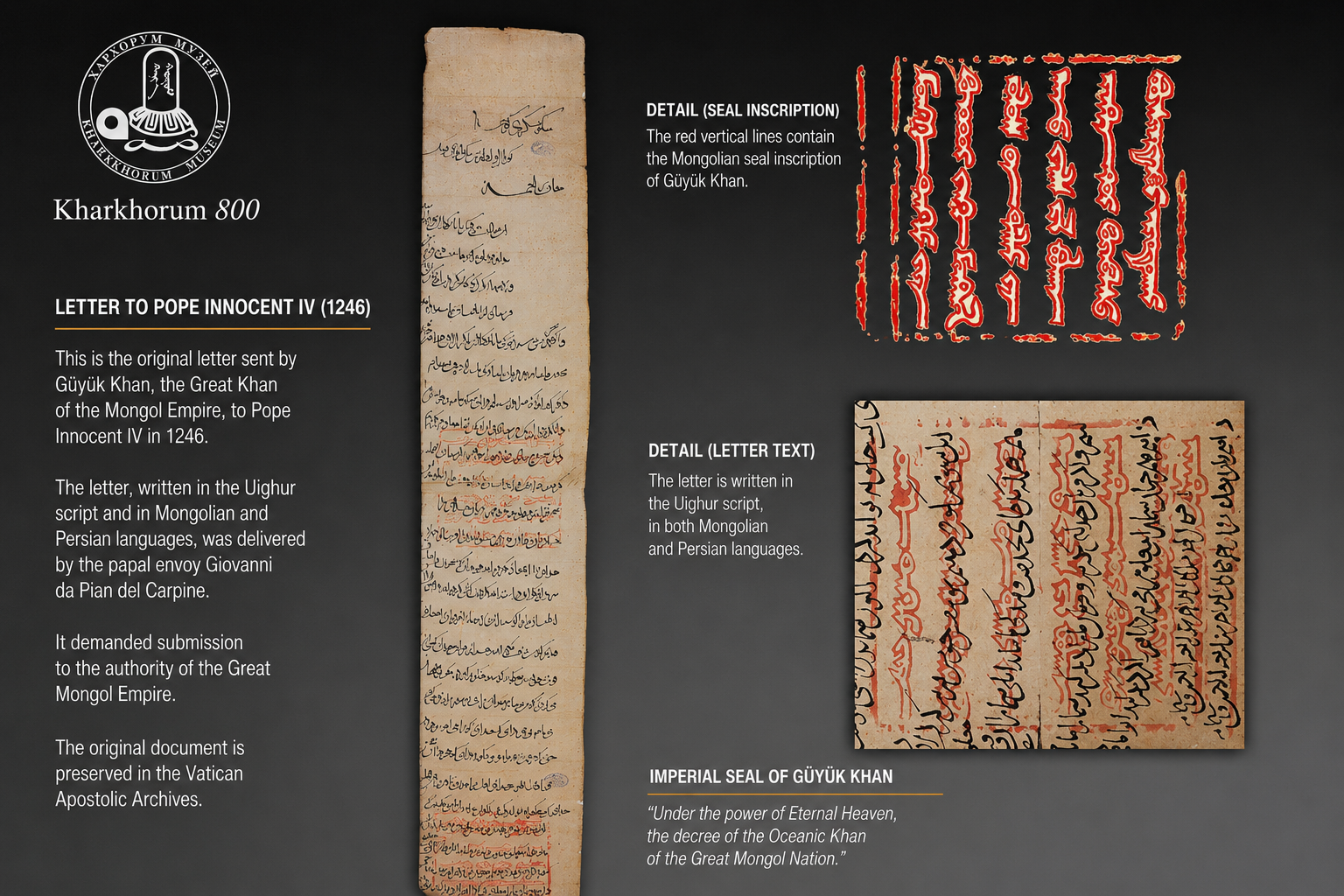
LETTER TO POPE INNOCENT IV (1246)
Sent from the court of Great Khan Güyük after his enthronement. The letter demanded submission to the authority of the Great Mongol Empire and survives today in the Vatican Apostolic Archives.
IMPERIAL SEAL OF GÜYÜK KHAN
“Under the power of Eternal Heaven, the decree of the Oceanic Khan of the Great Mongol Nation…”
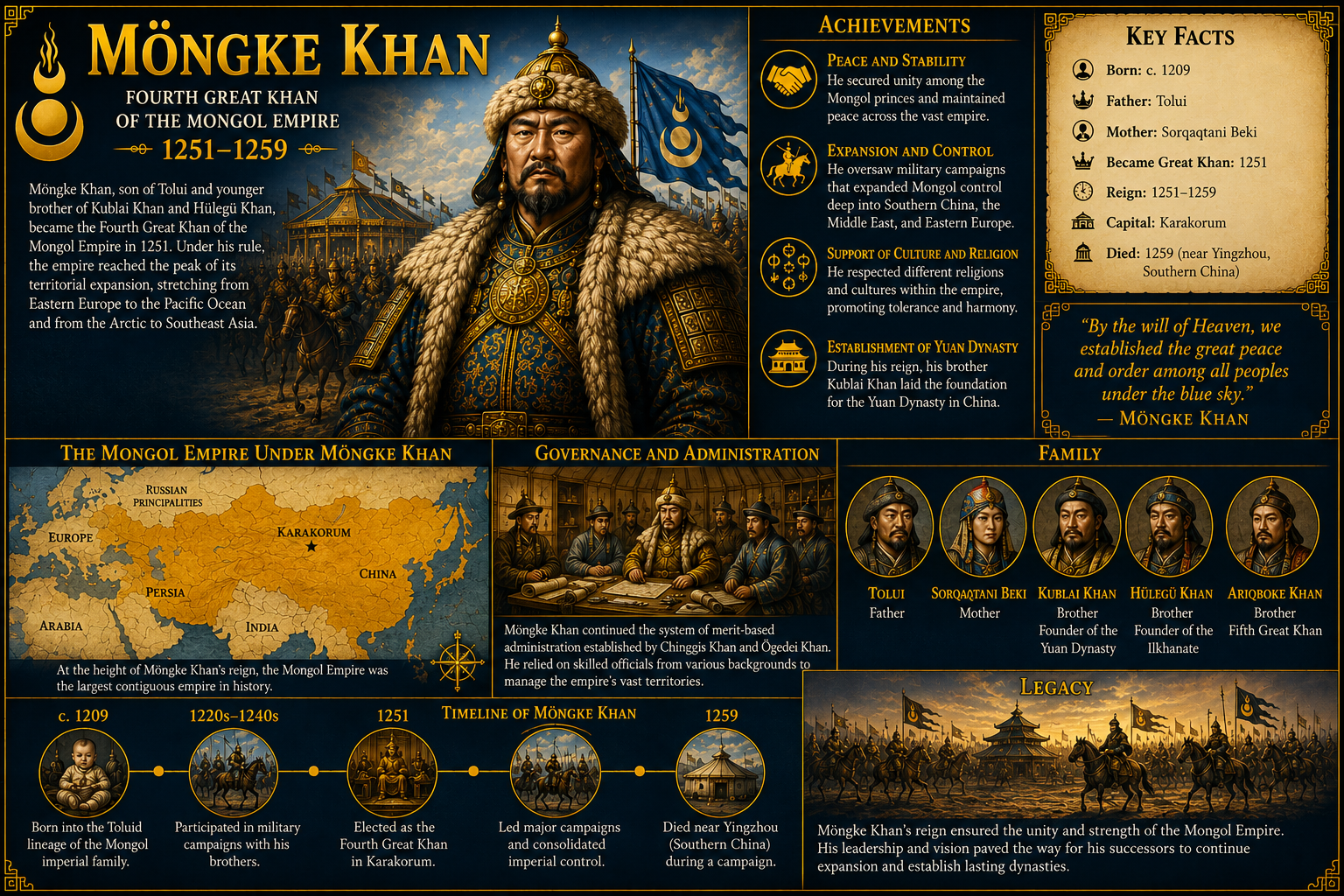
MÖNGKE KHAN (1251–1259)
Fourth Great Khan of the Mongol Empire
Möngke Khan, eldest son of Tolui and Sorghaghtani Beki, became the Fourth Great Khan of the Mongol Empire in 1251. A grandson of Chinggis Khan and elder brother of Ariq Böke, Khubilai, and Hülegü, he inherited an empire stretching across Eurasia and sought to restore unity and strengthen central authority.
His accession marked the rise of the Toluid line. Möngke reorganized the administration of the empire, conducted censuses, strengthened taxation and governance, and investigated corruption among officials. He emphasized merit, discipline, and imperial order.
Under Möngke Khan, the Mongol Empire reached one of the greatest stages of its expansion. He directed campaigns into Southern Song China, while his brothers carried Mongol arms into new regions: Hülegü advanced westward into the Middle East and founded the Ilkhanate, while Khubilai expanded operations in China.
Möngke maintained the Mongol tradition of religious tolerance. Buddhists, Muslims, Christians, and Daoists continued to live and serve within the empire. Scholars, merchants, and envoys moved freely across the vast imperial network.
In 1259, during the campaign against the Southern Song, Möngke Khan died near Diaoyu Fortress. His death led to the succession struggle between Ariq Böke and Khubilai Khan, shaping the future course of the empire.
The Empire Turns East Again
After the western campaign ended, the Mongol Empire redirected its strength under Möngke Khan.
Möngke reorganized imperial strategy and opened new fronts across Asia. He sent Hülegü westward into the Middle East, leading to the fall of Baghdad and the rise of the Ilkhanate. Kublai was entrusted with the conquest of China and the campaign against the Southern Song.
Thus, the empire that had reached Europe once again shifted its center of action toward the East.
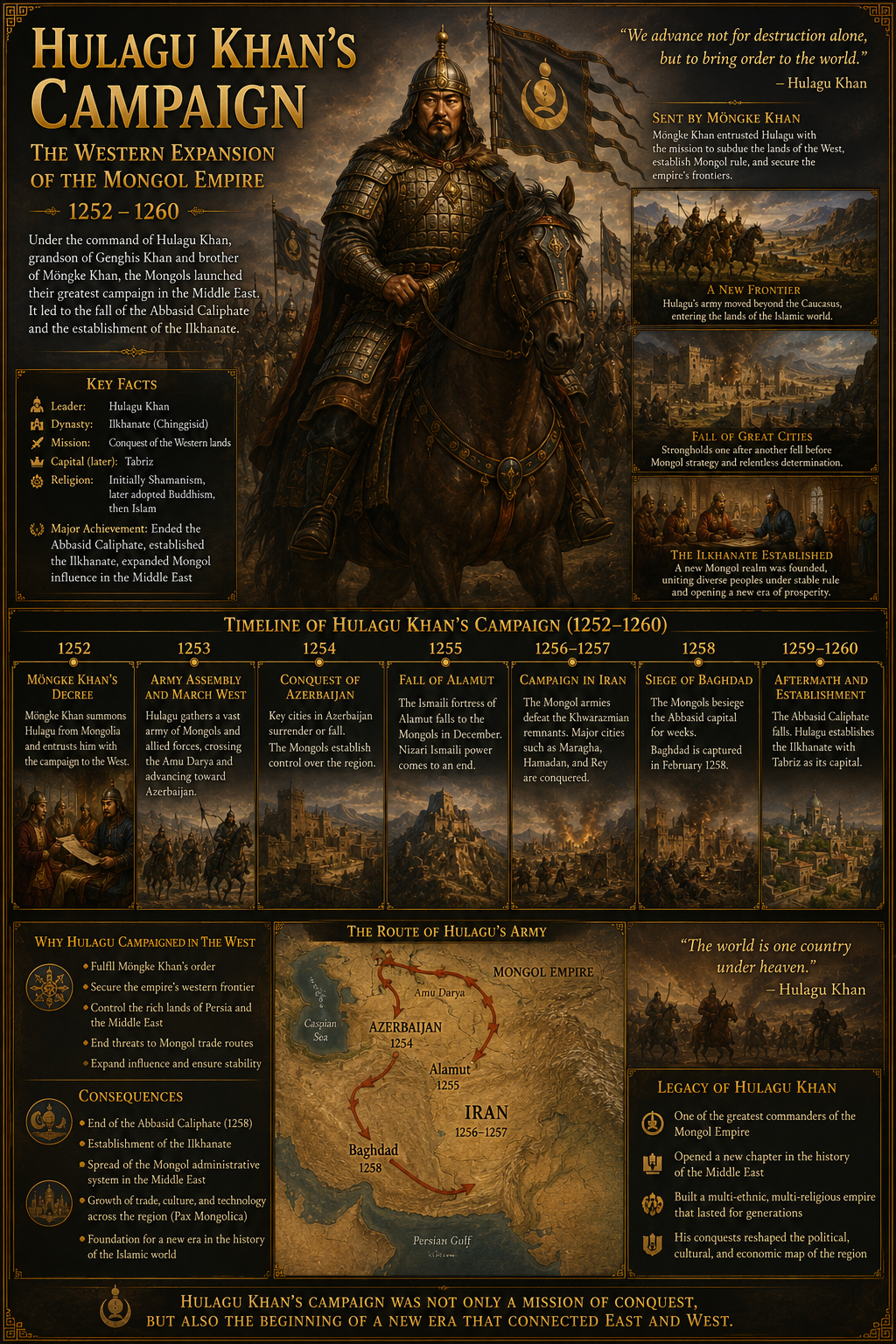
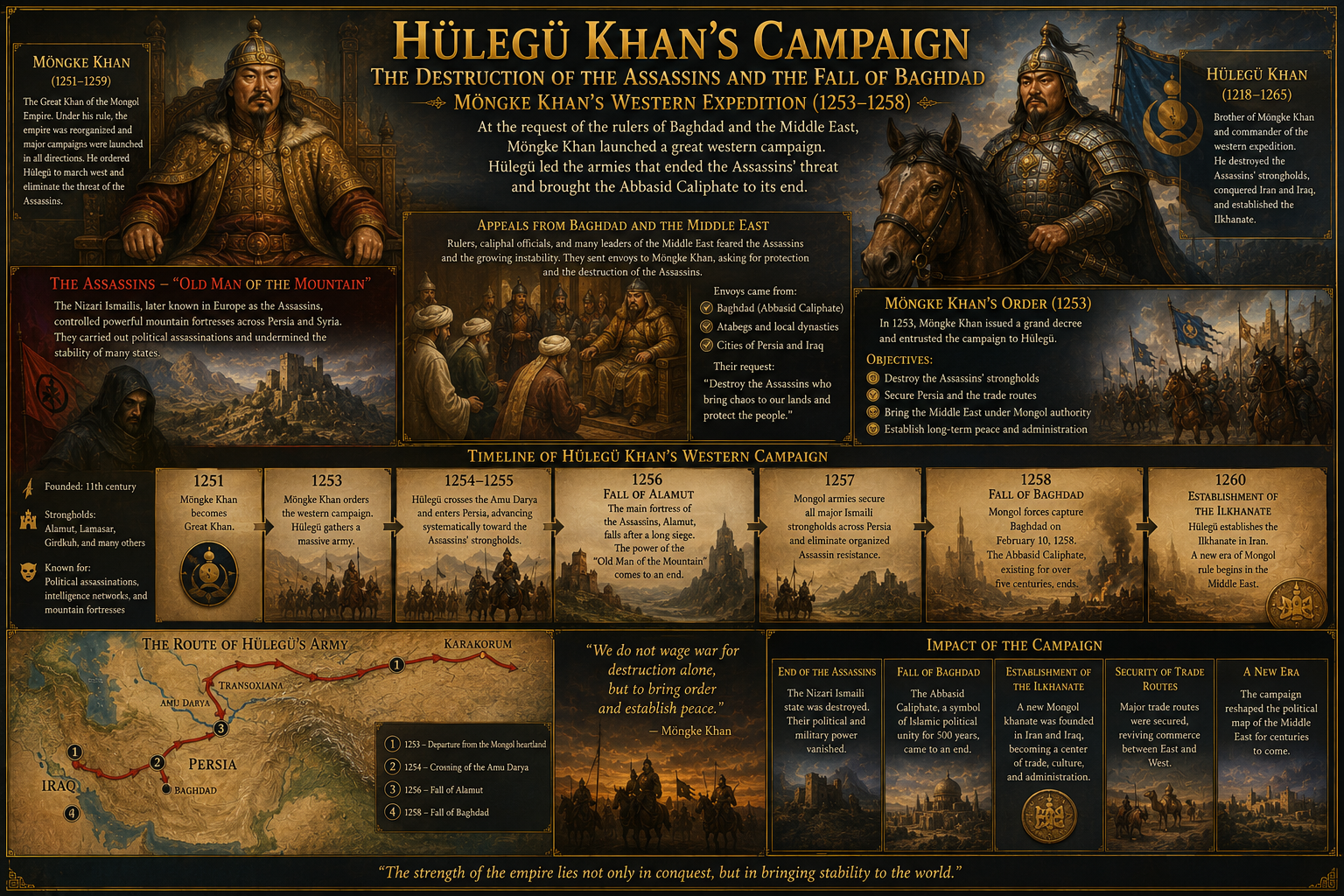
The Road to Hülegü’s Western Campaign
By the mid-13th century, many rulers and urban elites of the Middle East lived under the shadow of the Nizari Ismailis, known in later traditions as the Assassins. Their mountain fortresses in Persia and Syria had become centers of political influence and targeted killings.
Regional rulers, including leaders connected to Baghdad and neighboring states, sought protection against the growing power of the Assassins.
In 1253, Möngke Khan ordered a grand western campaign and entrusted its command to his brother Hülegü. The objectives were clear:
• Destroy the Nizari Ismaili strongholds
• Secure Persia and major trade routes
• Bring the western Islamic world under Mongol authority
Hülegü advanced westward with one of the largest armies assembled by the Mongol Empire.
In 1256, the fortress of Alamut fell, ending the power of the Assassins in Persia.
The campaign then turned toward Baghdad, culminating in the fall of the Abbasid capital in 1258.
1253 — Möngke Khan orders the western campaign
1256 — Fall of Alamut; destruction of the Assassins’ power
1258 — Capture of Baghdad
1260 — Establishment of Mongol authority in the Middle East
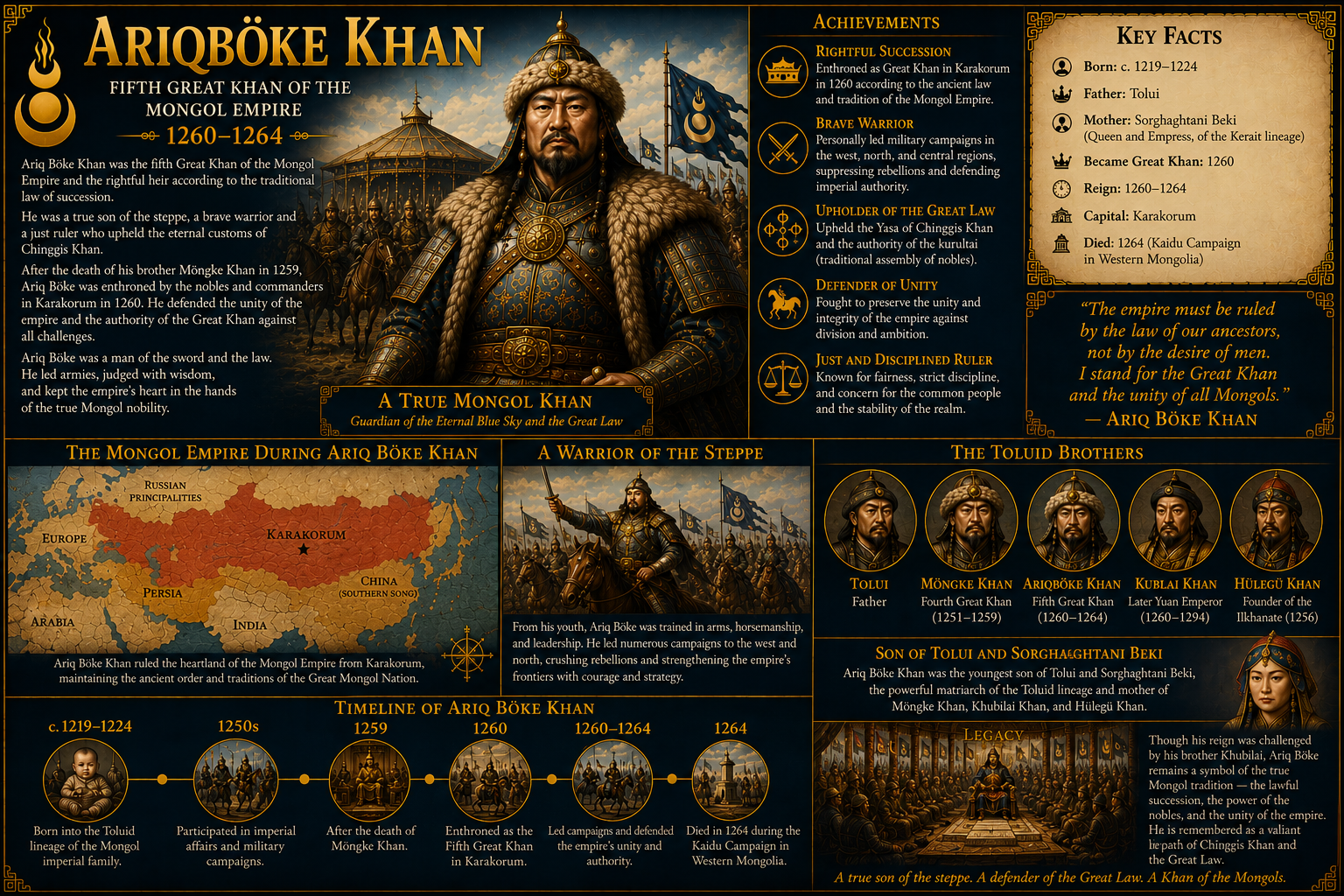
Ariq Böke Khan 1260-1264
“Enthroned in the heart of the Mongol homeland, Ariq Böke was proclaimed Great Khan through the Kurultai tradition of the steppe.”
When Möngke died in 1259, Ariq Böke was elected Khan in the absence of his brothers, and had the support of most of the ministers and powerful families in the capital of Karakorum, such as Möngke’s family, and other princes of the Golden Horde family along with other forces in the capital of Karakorum including Torguud royal bodyguards and White Horde elites, as well as the Oirats, who were allied with him as one of the Oirat leaders was married to his daughter. At the kurultai in Mongolia, the members of the families of Genghis Khan’s four sons, including the Blue Horde, Möngke’s wife and sons, the descendants of Genghis’ two brothers, and the Ilkhan Hülegü’s eldest son Jumqur supported Ariq-Böke’s election.[3] However, when Kublai and Hulagu received news of Möngke’s death, they aborted their own battles in order to return to the capital to decide the matter of succession. In May 1260, Kublai was elected khan by his own supporters, to rival the claim of Ariq Böke. A civil war subsequently broke out between the brothers for the leadership of the Empire.
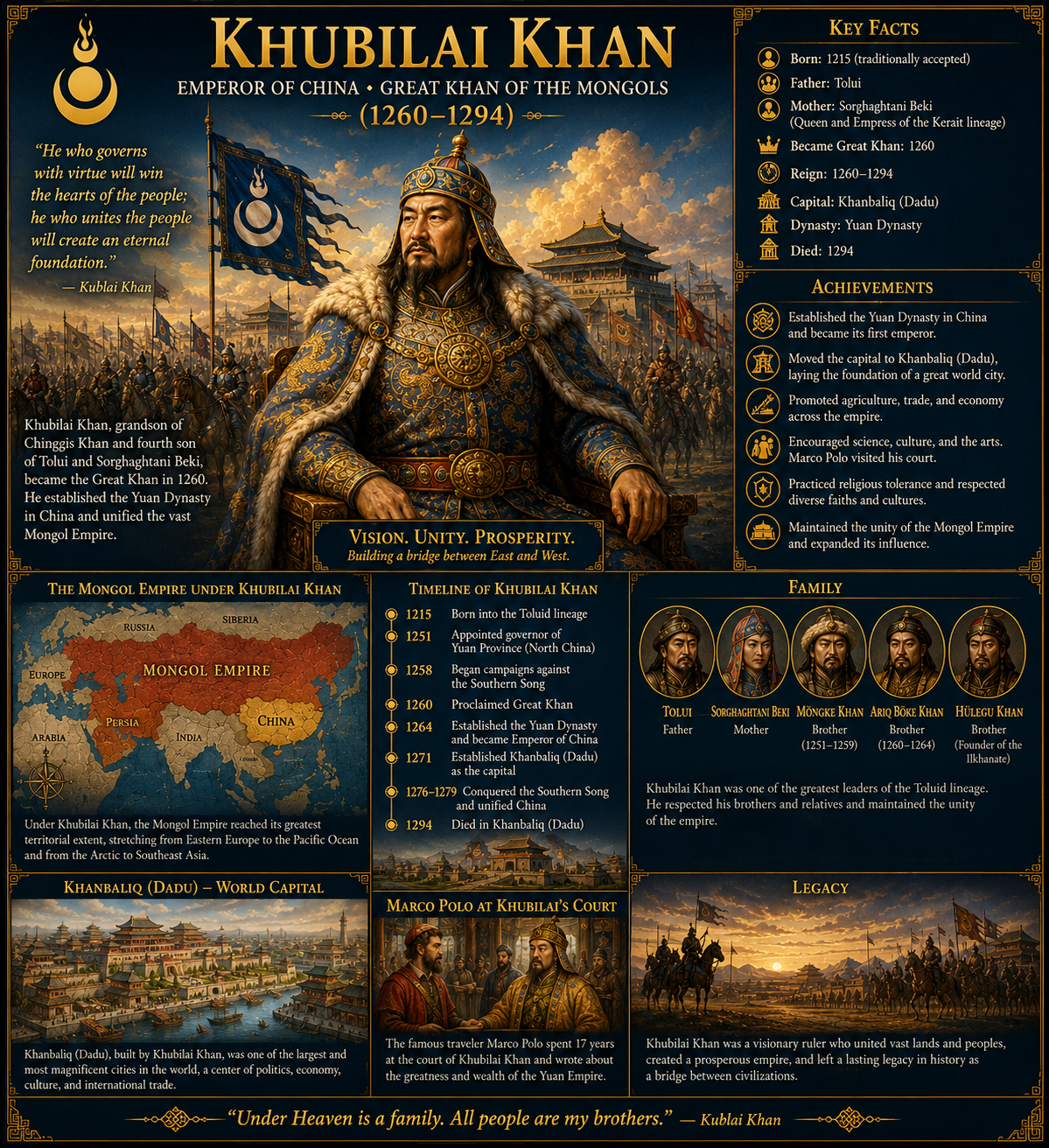
KUBLAI KHAN (SETSEN KHAN)
Founder of the Yuan Dynasty
Khagan of the Mongol Empire (1260–1294)
ASCENT TO THE THRONE (1260–1264)
After the death of his elder brother Möngke Khan in 1259, Kublai entered a struggle for succession against his younger brother Ariq Böke.
In 1260, Kublai was proclaimed Great Khan. The conflict developed into a civil war that ended with Ariq Böke’s surrender in 1264.
Although victorious, the war weakened the unity of the Mongol Empire and accelerated the political separation of the western khanates.
FOUNDATION OF THE YUAN DYNASTY (1271)
In 1271, Kublai formally established the Yuan Dynasty and reorganized imperial administration.
His authority extended across:
• Mongolia
• Tibet
• Xinjiang
• Yunnan
• Northern China
• Vast territories of the Mongol world
The empire stretched from the Pacific Ocean to the Danube frontier, becoming one of the largest land empires in history.
CONQUEST OF SOUTHERN SONG (1279)
Kublai completed the conquest of the Southern Song Dynasty in 1279.
This marked the first time that all of China came under the rule of a non-Han dynasty.
The victory unified China under Yuan rule and secured Mongol control over East Asia.
EXPEDITIONS TO JAPAN
Kublai launched two major naval expeditions against Japan:
First Invasion — 1274
Approx. 900 ships
Second Invasion — 1281
More than 100,000 troops and thousands of vessels
Both expeditions failed after severe storms destroyed large parts of the fleet — events remembered in Japan as “Kamikaze” (Divine Wind).
CAMPAIGNS IN VIETNAM AND SOUTHEAST ASIA
Kublai conducted campaigns against:
• Đại Việt (Vietnam)
• Champa
• Burma
• Java
Although some states accepted tributary relations, resistance in Vietnam prevented permanent conquest.
The Mongol fleet suffered major defeats at the Bạch Đằng River.
PAPER MONEY AND ECONOMIC REFORMS
Kublai expanded the use of paper currency (Chao) across the empire.
Taxation increasingly relied on paper notes rather than metal coinage.
He also:
• Expanded canals and roads
• Repaired infrastructure
• Encouraged trade networks
• Strengthened Silk Road commerce
These reforms reduced transport costs across the empire.
EUROPEAN CONTACTS
Under Kublai, East–West connections reached unprecedented levels.
Merchants, diplomats, missionaries, and travelers crossed Eurasia through Mongol routes.
Marco Polo visited the Yuan court and later introduced Kublai Khan to Europe through his travel accounts.
CULTURE AND ADMINISTRATION
Kublai combined Mongol imperial traditions with administrative institutions adapted for governing China.
He appointed Phags-pa Lama as imperial preceptor and sponsored the creation of the ’Phags-pa script in 1269.
He supported:
• Buddhism
• Scholarship
• Cartography
• Astronomy
• Trade and cultural exchange
LEGACY
Kublai Khan transformed the Mongol Empire into a continental imperial system and founded the Yuan Dynasty.
His reign connected East and West, expanded global exchange, and reshaped Eurasian history.
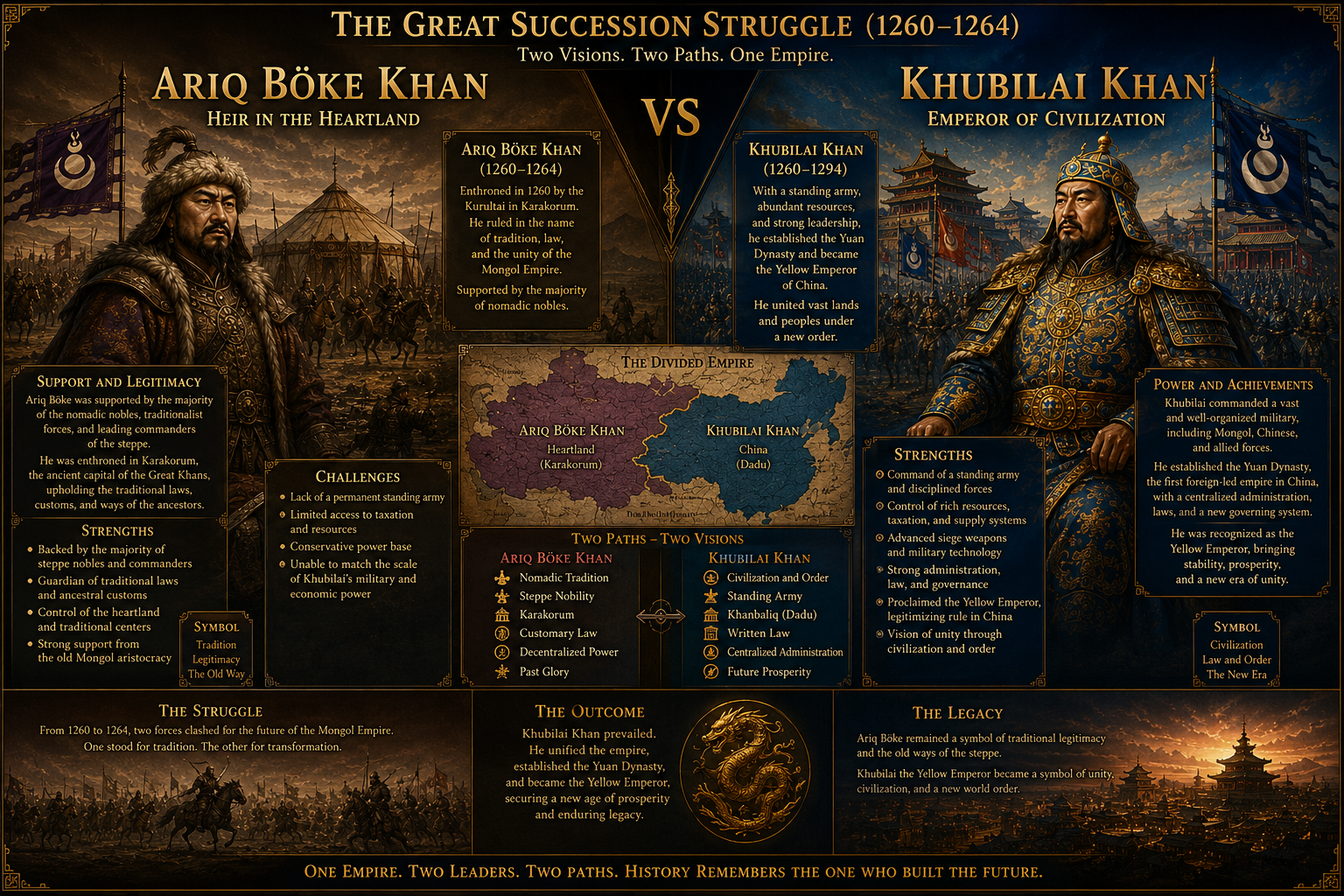
ARIQ BÖKE KHAN
Khagan of the Mongol Empire (1260–1264)
Ariq Böke (1219–1266) was a son of Tolui, the youngest son of Genghis Khan, and Sorghaghtani Beki of the Kereit lineage. He became the fifth Great Khan of the Mongol Empire and ruled between 1260 and 1264.
While his elder brothers Möngke and Khubilai campaigned in distant regions of the empire, Ariq Böke remained in the Mongolian heartland and maintained influence over the traditional imperial center at Karakorum.
THE SUCCESSION STRUGGLE
After the death of Möngke Khan in 1259, a struggle for succession emerged.
Supported by many princes, nobles, members of Möngke’s household, and traditional Mongol elites, Ariq Böke was proclaimed Great Khan at Karakorum through a formal Great Kurultai, convened according to long-established Mongol custom. The assembly reportedly lasted more than twenty days and included princes, commanders, and leading nobles.
Meanwhile, Khubilai convened a separate assembly at Kaiping (later Shangdu) and declared himself Great Khan.
Thus, in 1260, the empire witnessed:
• Two Kurultais
• Two Great Khans
• Two political centers
The succession dispute soon escalated into civil war.
CIVIL WAR (1260–1264)
The conflict developed into a prolonged struggle between the forces of Karakorum and Kaiping.
Ariq Böke repeatedly attempted to preserve the authority of the traditional Mongol center and restore control over Karakorum. However, Khubilai possessed greater military and economic resources.
Khubilai’s control over trade routes and supply networks gradually weakened Ariq Böke’s position.
After years of warfare and declining support, Ariq Böke surrendered in 1264.
THE FAMOUS EXCHANGE
After the surrender, Khubilai reportedly asked which of the two brothers had the rightful claim to the throne.
Ariq Böke answered:
“According to the ancient laws and customs of the Mongols, I was the one who should have sat upon the Great Throne. Yet now, it is you who sits there.”
LEGACY
Although defeated, Ariq Böke’s cause represented an effort to preserve Karakorum as the imperial center and maintain the traditional Mongol political order.
The conflict between Ariq Böke and Khubilai marked a turning point in imperial history and contributed to the gradual fragmentation of the Mongol Empire.
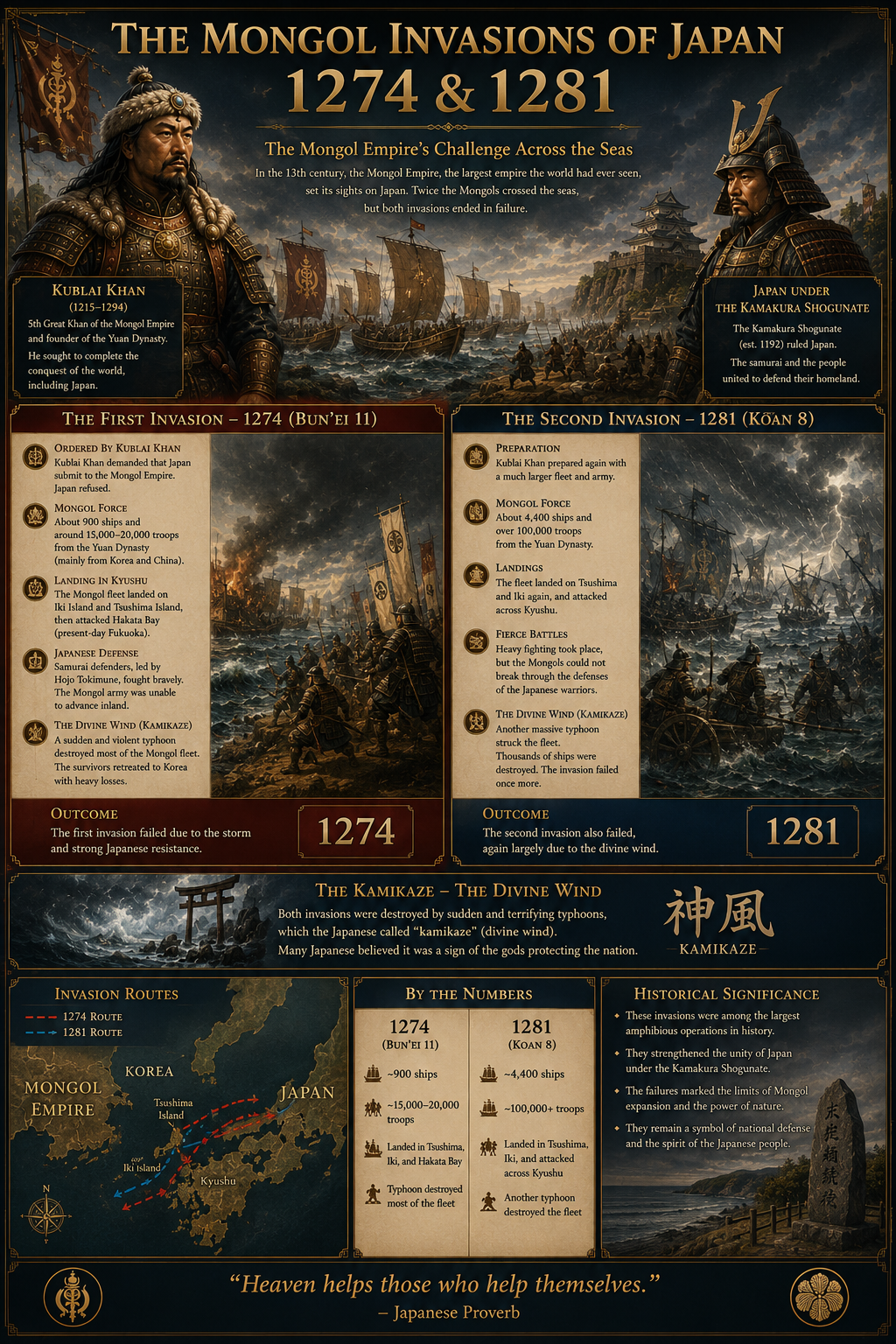
Kublai Khan’s Diplomatic Missions to Japan
1266 – First Mission
Kublai Khan sent envoys to Japan requesting diplomatic relations and recognition of Mongol authority.
The letter urged Japan to establish peaceful relations and avoid conflict.
1268 – Formal Diplomatic Letter
A second and more formal embassy arrived in Japan carrying Kublai Khan’s message.
The Kamakura Shogunate refused to respond and rejected Mongol demands.
1271–1273 – Continued Missions
Additional embassies were dispatched as Kublai Khan attempted to resolve the dispute through diplomacy before military action.
Japan continued its refusal.
The Execution of the Envoys
1275
Following the first Mongol invasion of Japan (1274), Japanese authorities executed several Yuan envoys.
1279 – Execution of Du Shixin (Tuushchin / Tuushin) and the Embassy
Kublai Khan dispatched another diplomatic mission led by Du Shixin (Tuushchin).
The embassy arrived in Japan seeking renewed negotiations.
The Kamakura Shogunate ordered the execution of the envoys at Hakata.
The deaths of Tuushchin and his companions became one of the major diplomatic incidents preceding the second invasion.
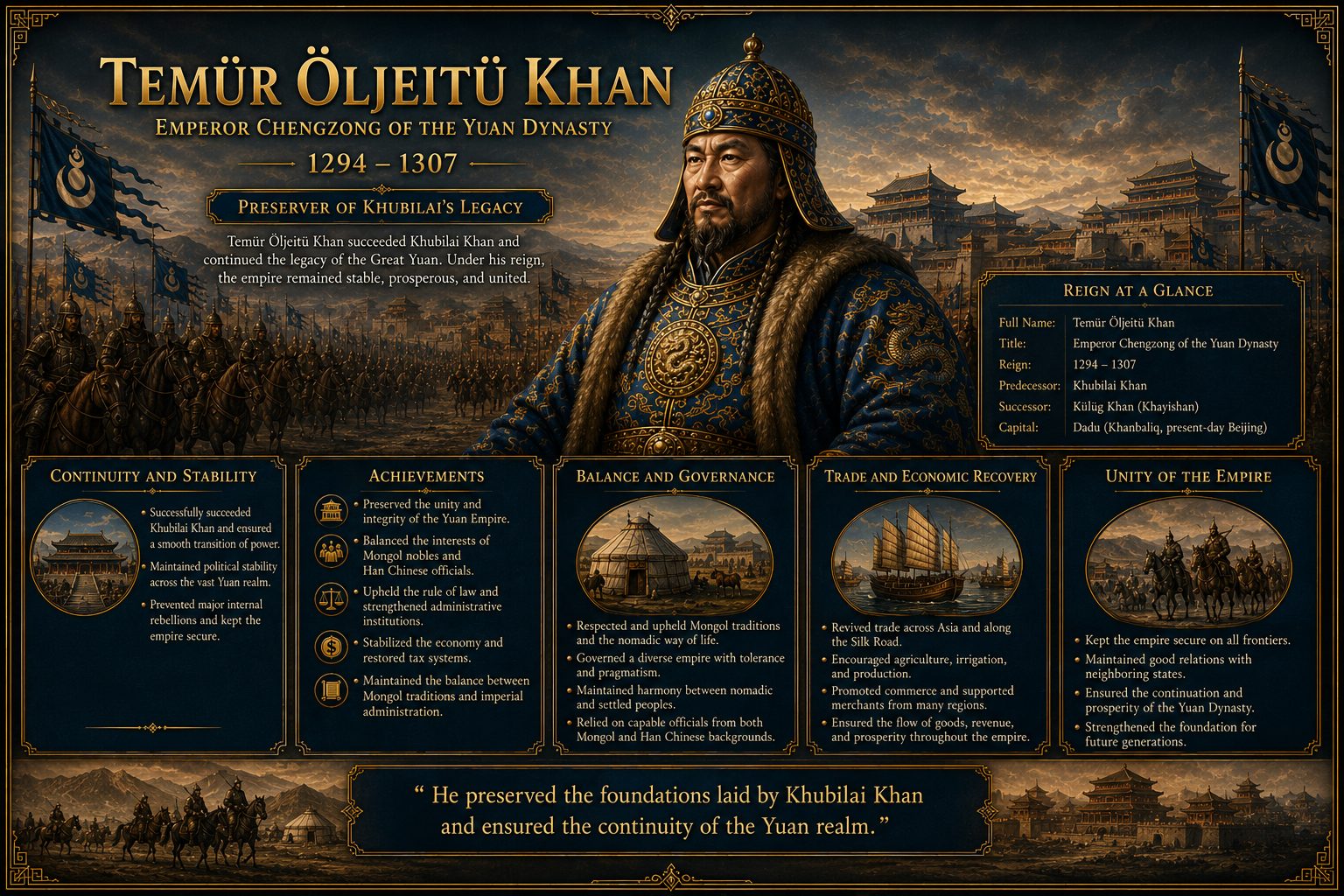
EMPEROR ÖLJEITÜ (TEMÜR KHAN)
Second Emperor of the Yuan Dynasty
Great Khan of the Mongol Empire (1294–1307)
ACCESSION TO THE THRONE
Temür Khan (1265–1307), known by his regnal title Öljeitü Khan, was the grandson of Khubilai Khan and the third son of Crown Prince Zhenjin.
Following the death of Khubilai in 1294, succession remained contested between Temür and his elder brother Gammala.
According to tradition, the final decision was determined through a test of knowledge concerning the sayings and legacy of Genghis Khan. Temür prevailed and ascended the throne.
REIGN OF STABILITY (1294–1307)
Temür inherited a vast empire and largely preserved the institutions established by Khubilai Khan.
His reign emphasized:
• Political stability
• Administrative continuity
• Fiscal moderation
• Imperial consolidation
The political order created during his rule shaped the Yuan state for decades.
RELATIONS WITH THE MONGOL KHANATES
During his reign, the Golden Horde, Chagatai Khanate, and Ilkhanate acknowledged the nominal supremacy of the Yuan court.
Around 1304, peace was achieved among the Mongol successor states after decades of conflict.
This marked one of the final moments of symbolic unity within the Mongol world.
RELIGION AND CULTURE
Temür respected Confucian scholarship while maintaining strong support for Tibetan Buddhism.
He expanded the role of Tibetan elites within the imperial administration and continued the religious policies established under Khubilai.
His court also supported:
• Buddhist institutions
• Confucian scholars
• Muslim administrators
• Multicultural governance
FOREIGN POLICY
Temür abandoned further invasions against:
• Japan
• Đại Việt (Vietnam)
Instead, he favored diplomacy and tributary relations.
Envoys and rulers from Burma, Cambodia, Siam, and Đại Việt maintained relations with the Yuan court.
ECONOMIC POLICY
Temür reduced taxation burdens and granted several tax exemptions.
He opposed excessive fiscal pressure upon the population and attempted to stabilize the empire’s finances.
However, corruption and administrative inefficiency remained major problems during his reign.
LEGACY
Temür Khan preserved the imperial system established by Khubilai and maintained relative stability across the Yuan realm.
His reign represented the transition from imperial expansion toward administrative consolidation within the Mongol Empire.
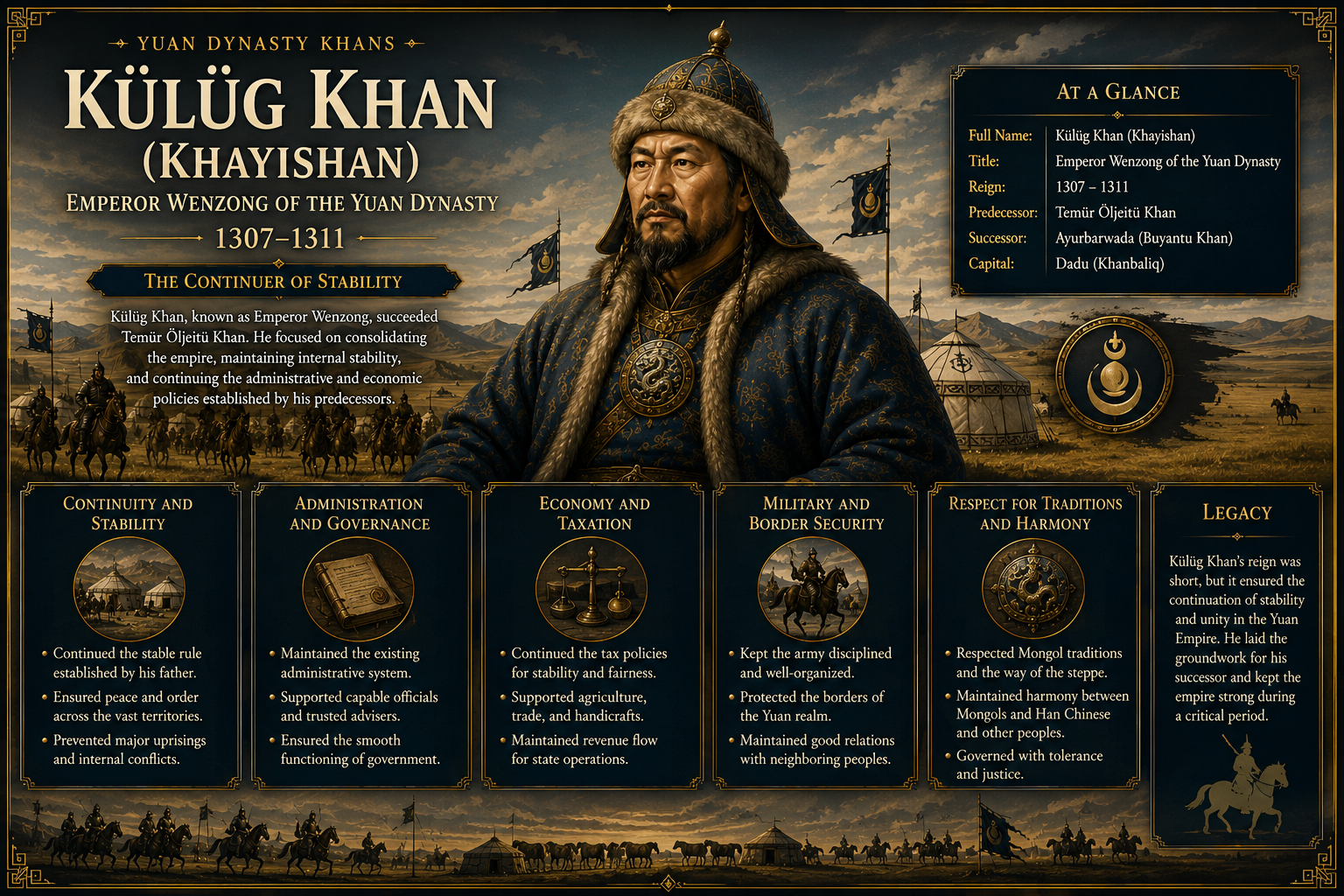
KÜLÜG KHAN (KHAYISHAN)
Great Khan of the Mongol Empire
Emperor of the Yuan Dynasty (1307–1311)
ACCESSION
Külüg Khan (Khayishan, 1281–1311) was the eldest son of Darmabala and grandson of Khubilai Khan.
Before ascending the throne, he commanded the western frontier armies and fought against Kaidu and rival princes of Central Asia.
He ascended the throne in 1307 at Shangdu through a formal Kurultai.
MILITARY CAREER
Khayishan gained prestige through campaigns against:
• Kaidu
• Chagatai forces
• Central Asian rivals
His victories strengthened Yuan authority along the western frontier.
GOVERNMENT AND ECONOMY
Külüg introduced major financial reforms:
• Reorganized state finance
• Issued new paper currency
• Expanded state control over revenue
However, inflation and financial instability became major challenges.
RELIGION
Külüg strongly supported Buddhism and sponsored religious institutions.
He ordered Buddhist texts to be translated and granted patronage to Tibetan clergy.
FOREIGN RELATIONS
During his reign:
• The threat from Kaidu’s successors ended
• Western Mongol princes submitted
• Yuan authority over Sakhalin was completed in 1308
LEGACY
Külüg Khan was remembered as a warrior ruler whose reign emphasized military authority and financial reform.
Despite his short reign, he helped stabilize the western frontier of the Yuan Empire.
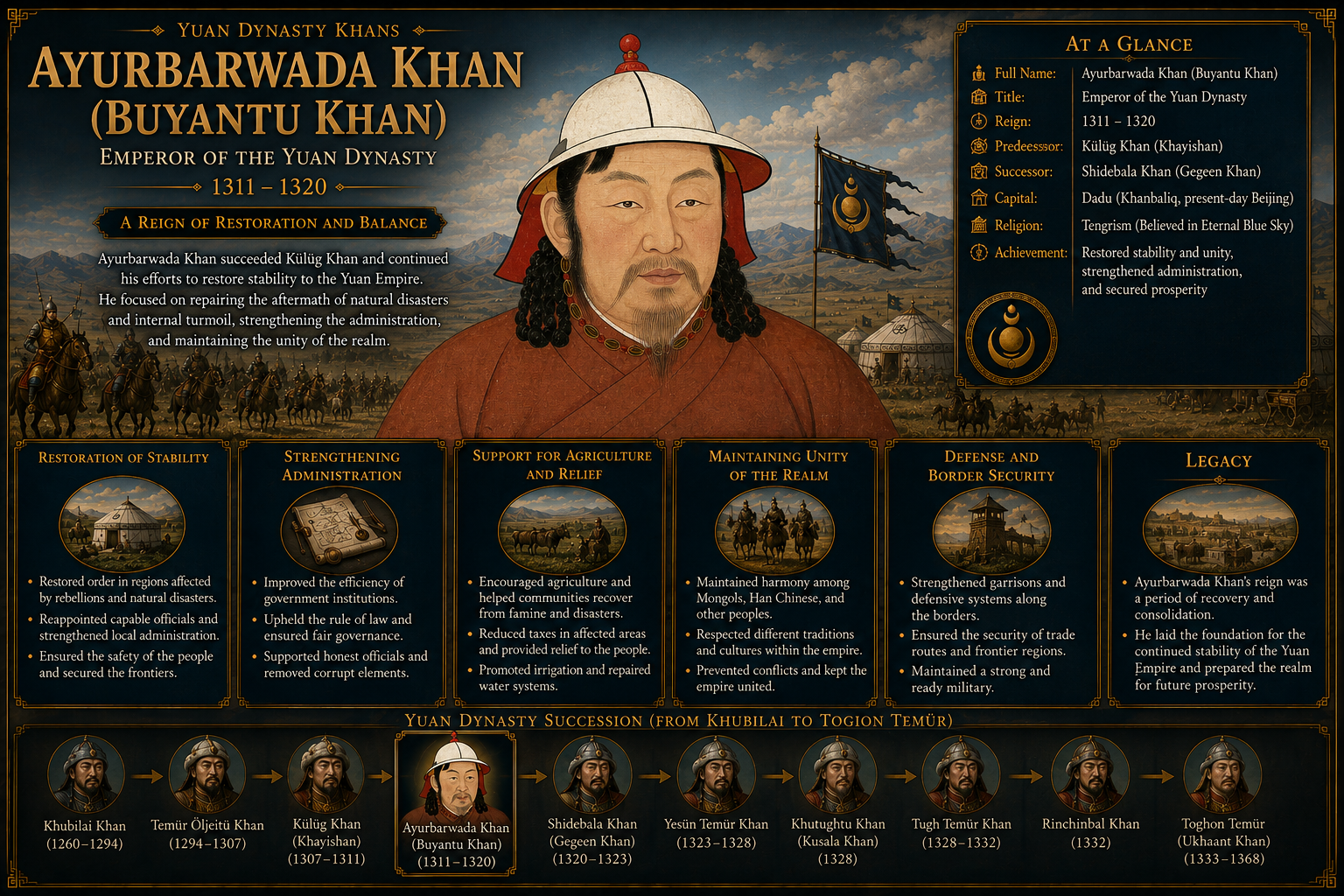
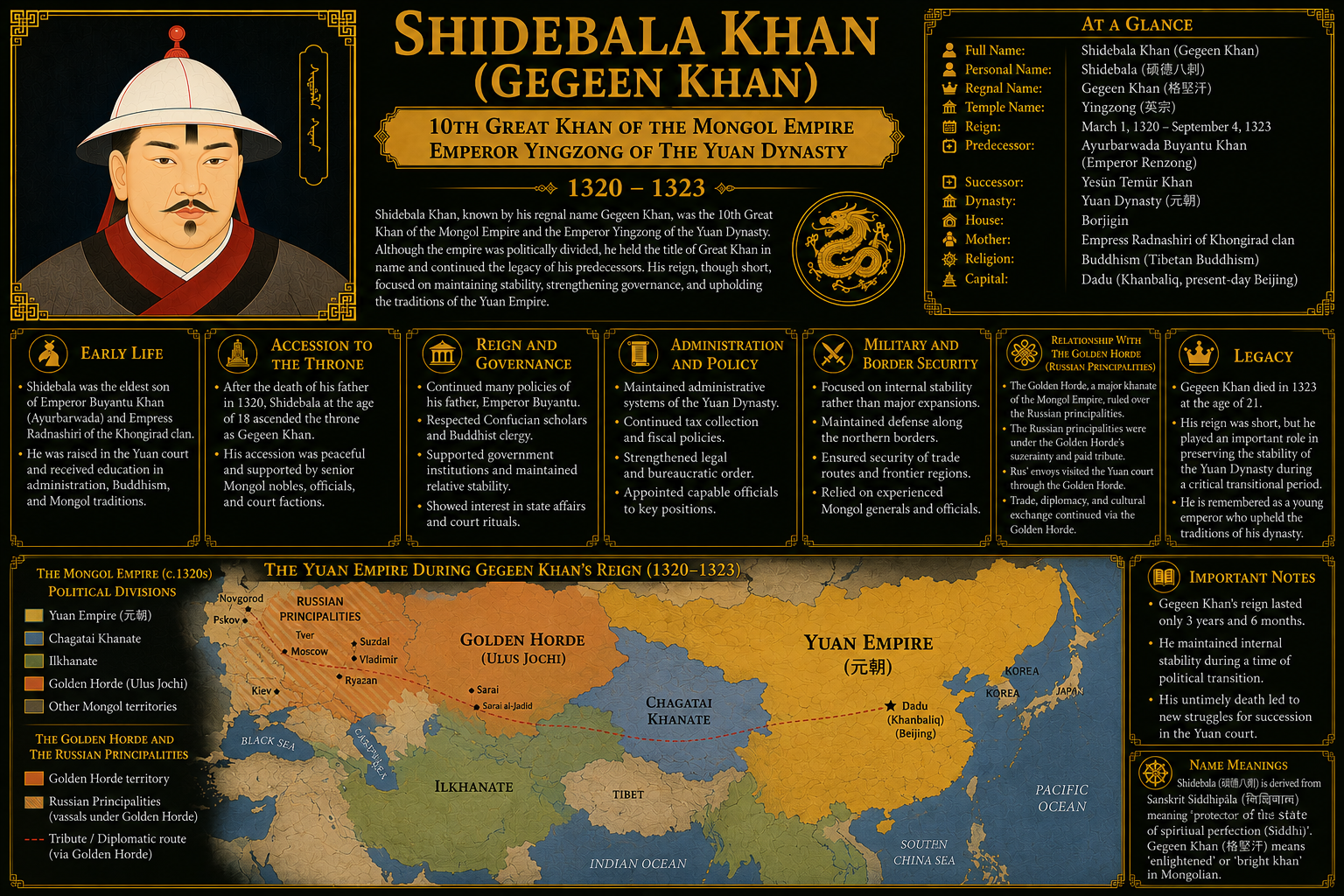
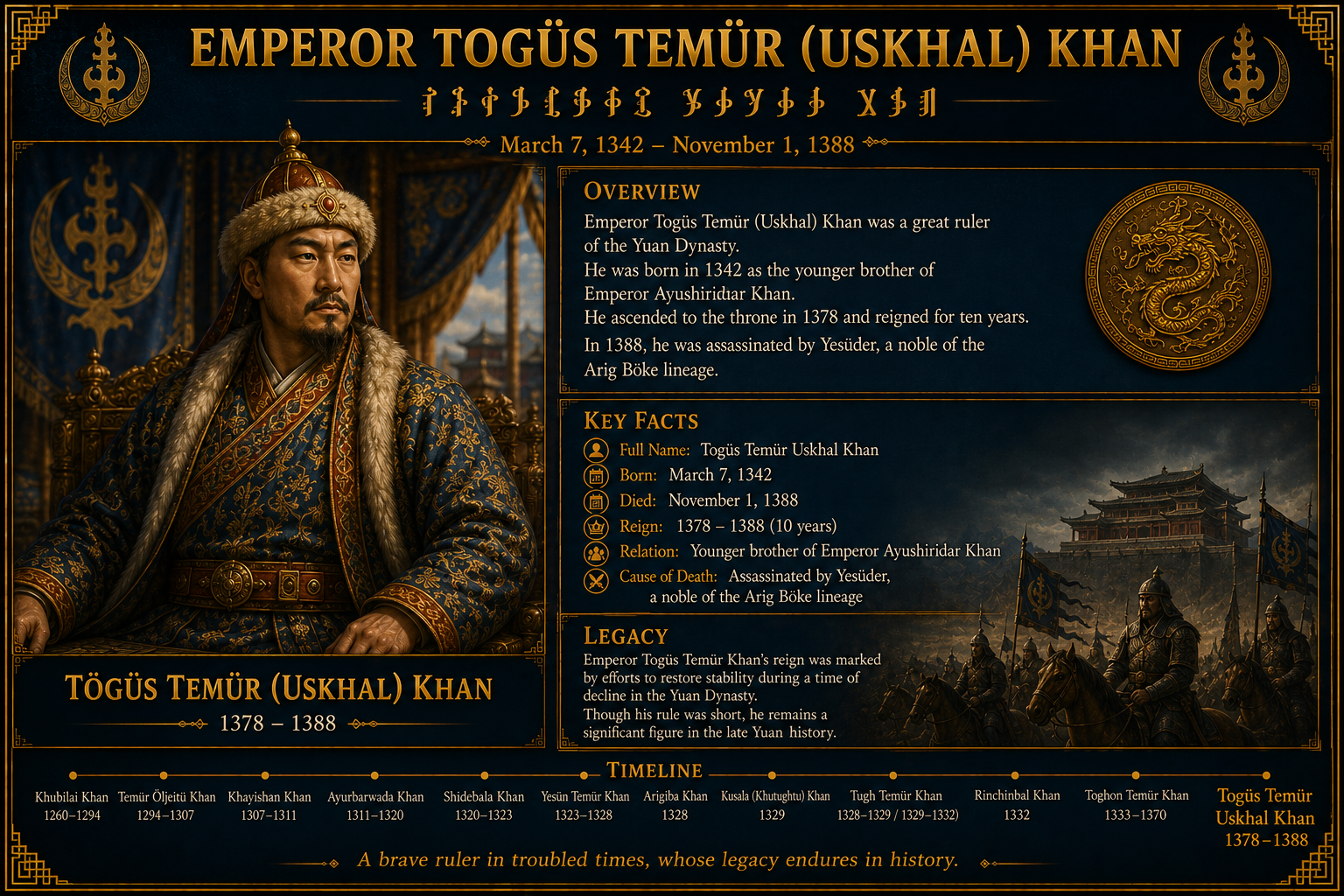
BUYANTU KHAN (AYURBARWADA)
Great Khan of the Mongol Empire
Emperor of the Yuan Dynasty (1311–1320)
Buyantu Khan (Ayurbarwada, 1285–1320) was the younger son of Darmabala and grandson of Khubilai Khan.
After the death of Külüg Khan in 1311, he ascended the throne peacefully and was proclaimed Buyantu Khan.
Buyantu Khan became the first Yuan ruler to actively integrate Confucian principles into imperial administration.
His reforms included:
• Promotion of Confucian scholarship
• Administrative restructuring
• Legal codification
IMPERIAL EXAMINATION SYSTEM (1315)
One of his greatest reforms was the restoration of the Imperial Civil Service Examination System.
For the first time under Yuan rule, officials were selected through examinations based on Neo-Confucian learning.
This reform profoundly influenced later East Asian governance.
ADMINISTRATIVE REFORM
Buyantu reversed many policies of Külüg Khan:
• Reorganized state administration
• Reduced bureaucracy
• Restored earlier Yuan institutions
• Reformed financial policies. He also ordered the compilation of Yuan legal codes.
His reign encouraged:
• Translation of Chinese classics
• Historical studies
• Confucian education
• Literary activity
Several major classical works were translated and published under imperial patronage.
FOREIGN RELATIONS
Buyantu maintained tributary relations with:
• Đại Việt
• Champa
• Malabar
• States near Yunnan
He also fought the Esen Buqa War against the Chagatai Khanate and secured victory alongside the Ilkhanate.
Buyantu Khan transformed the Yuan court from a conquest administration toward a more institutional state system.
His reign became one of the most reform-oriented periods of the Yuan Dynasty
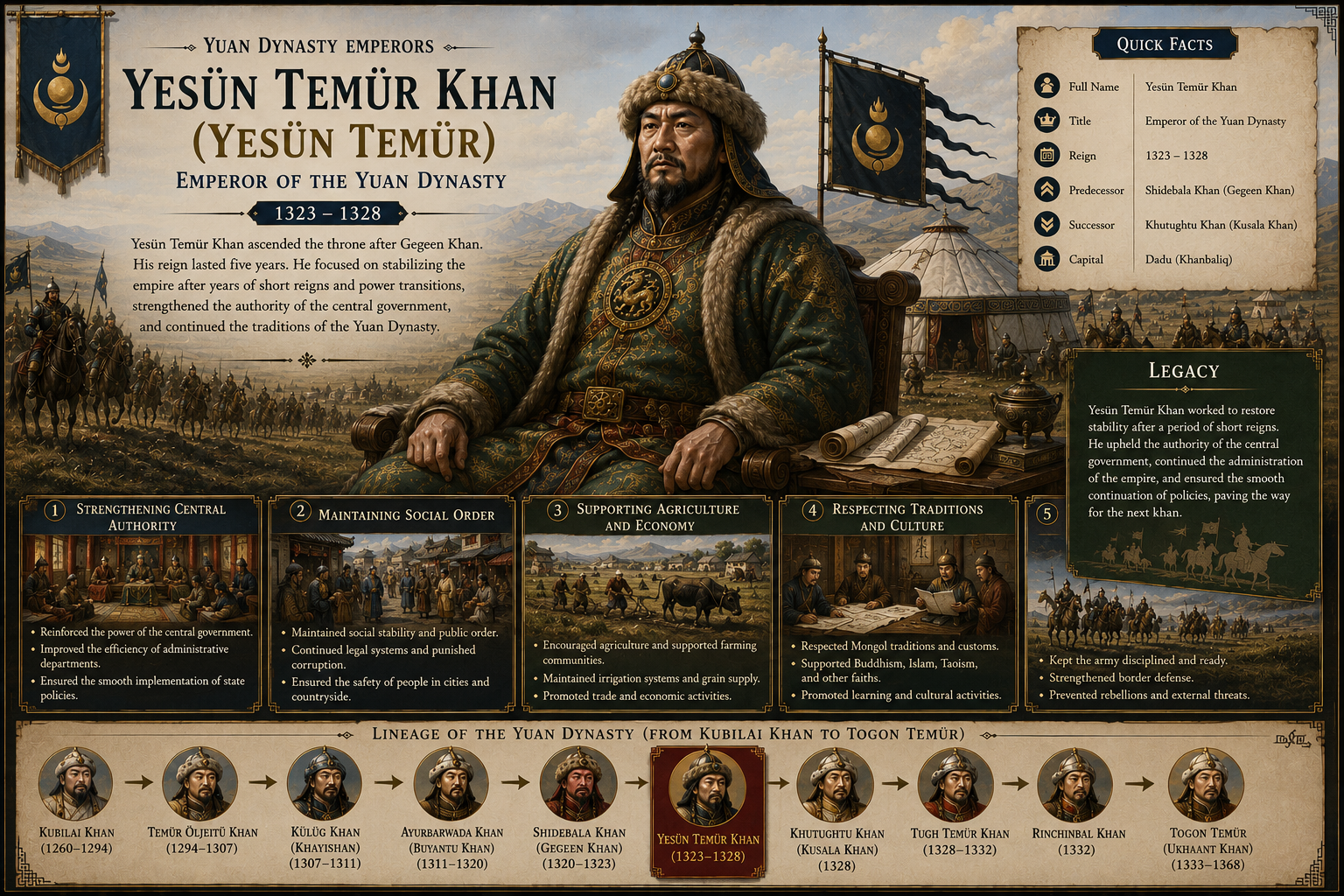
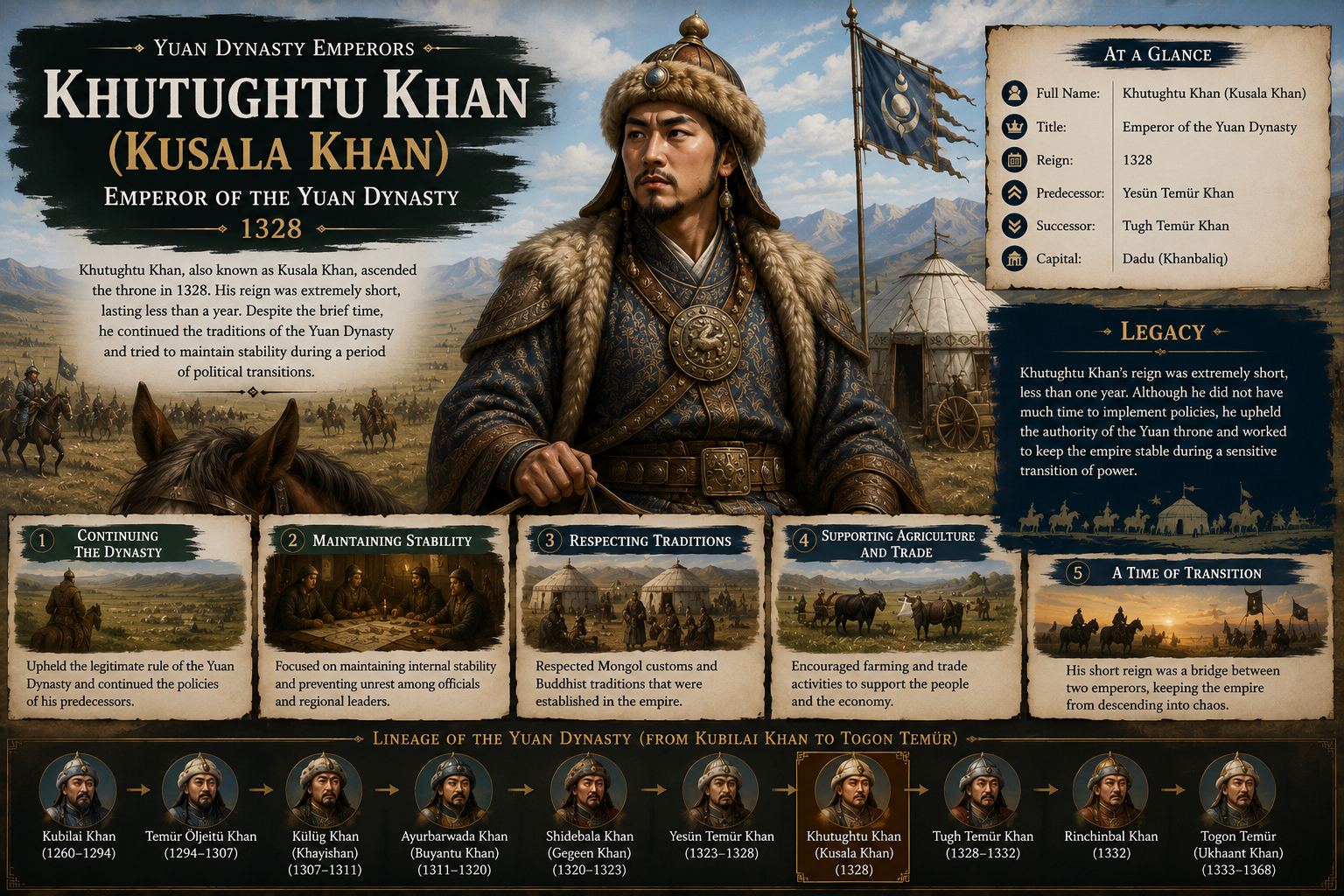
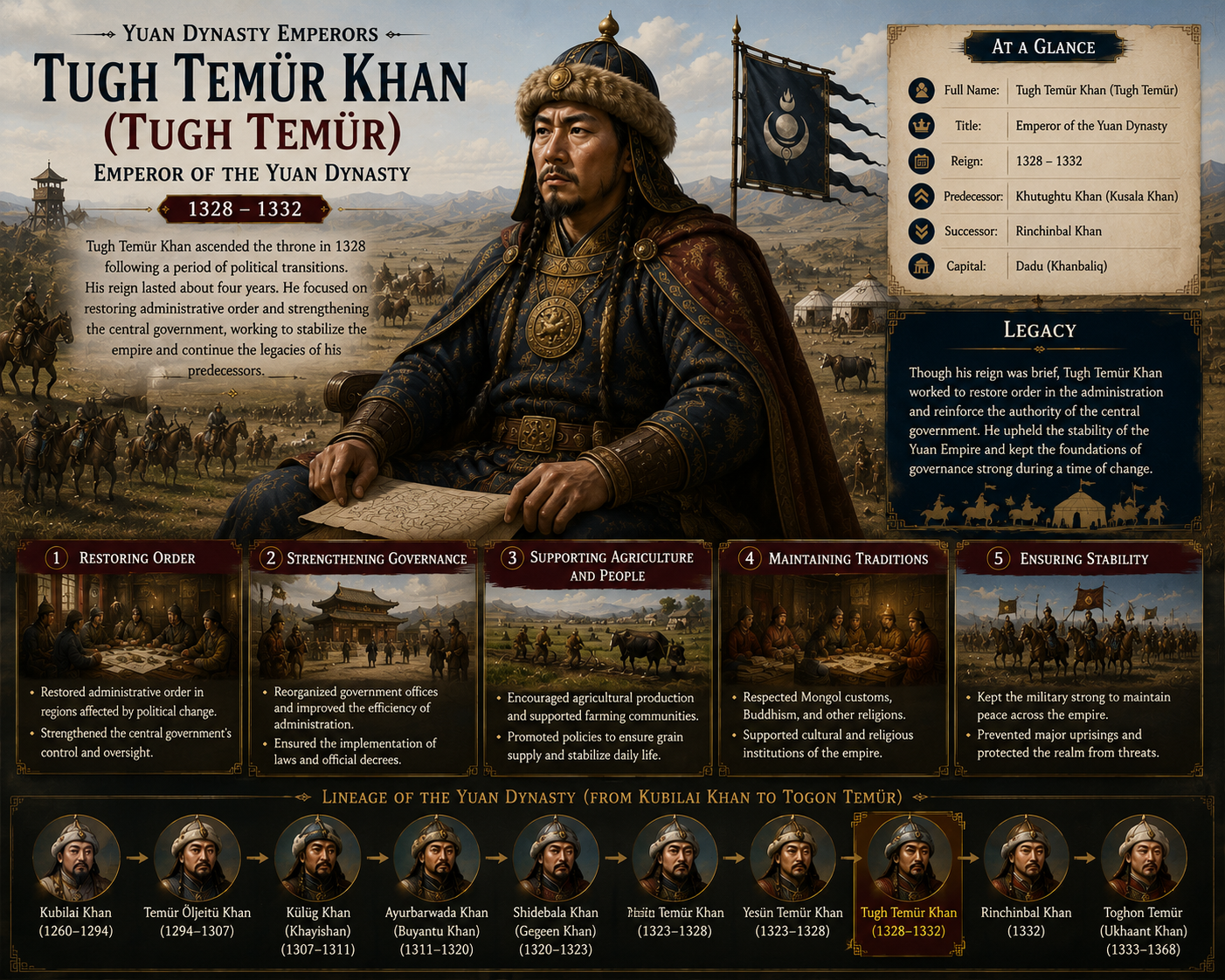
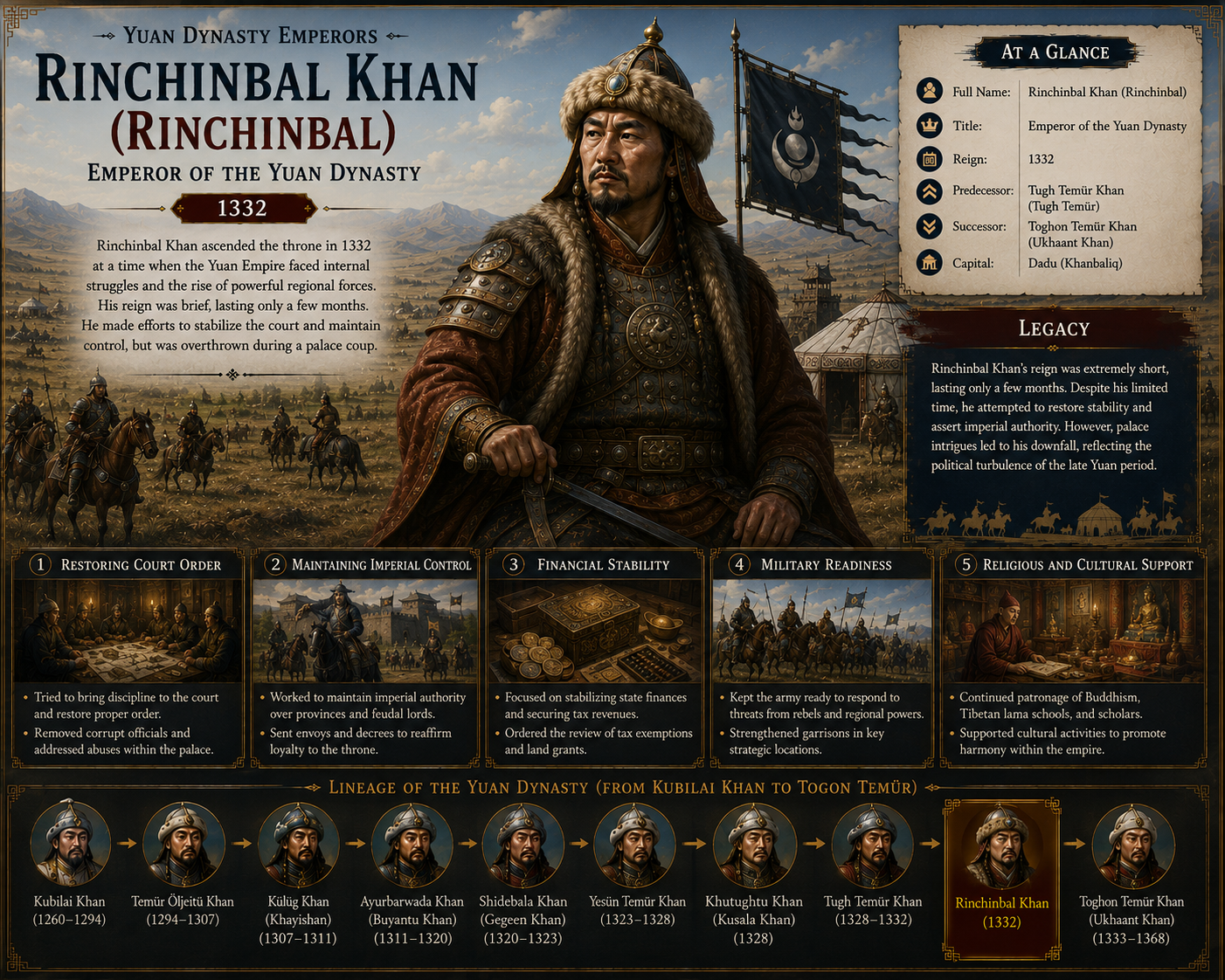
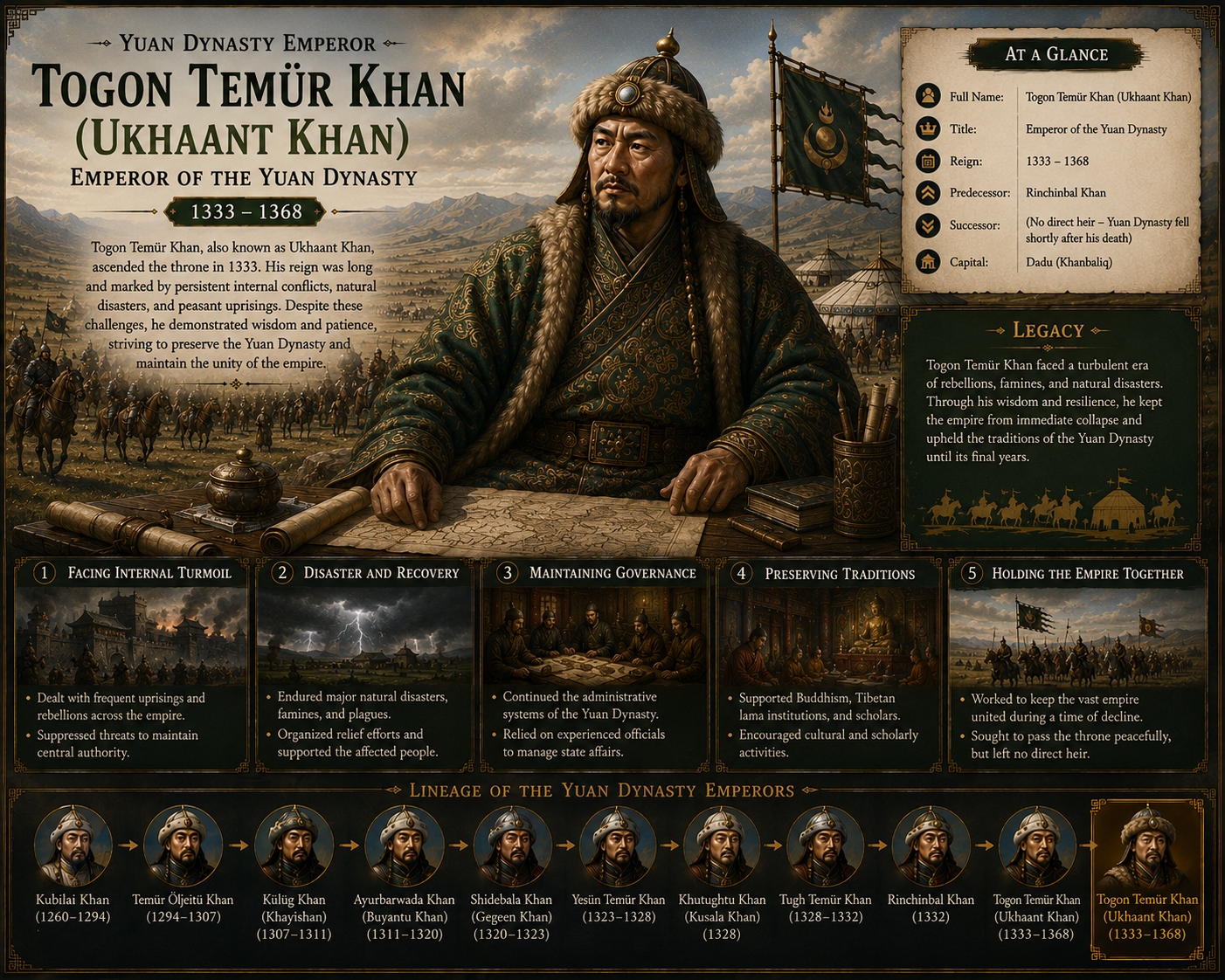
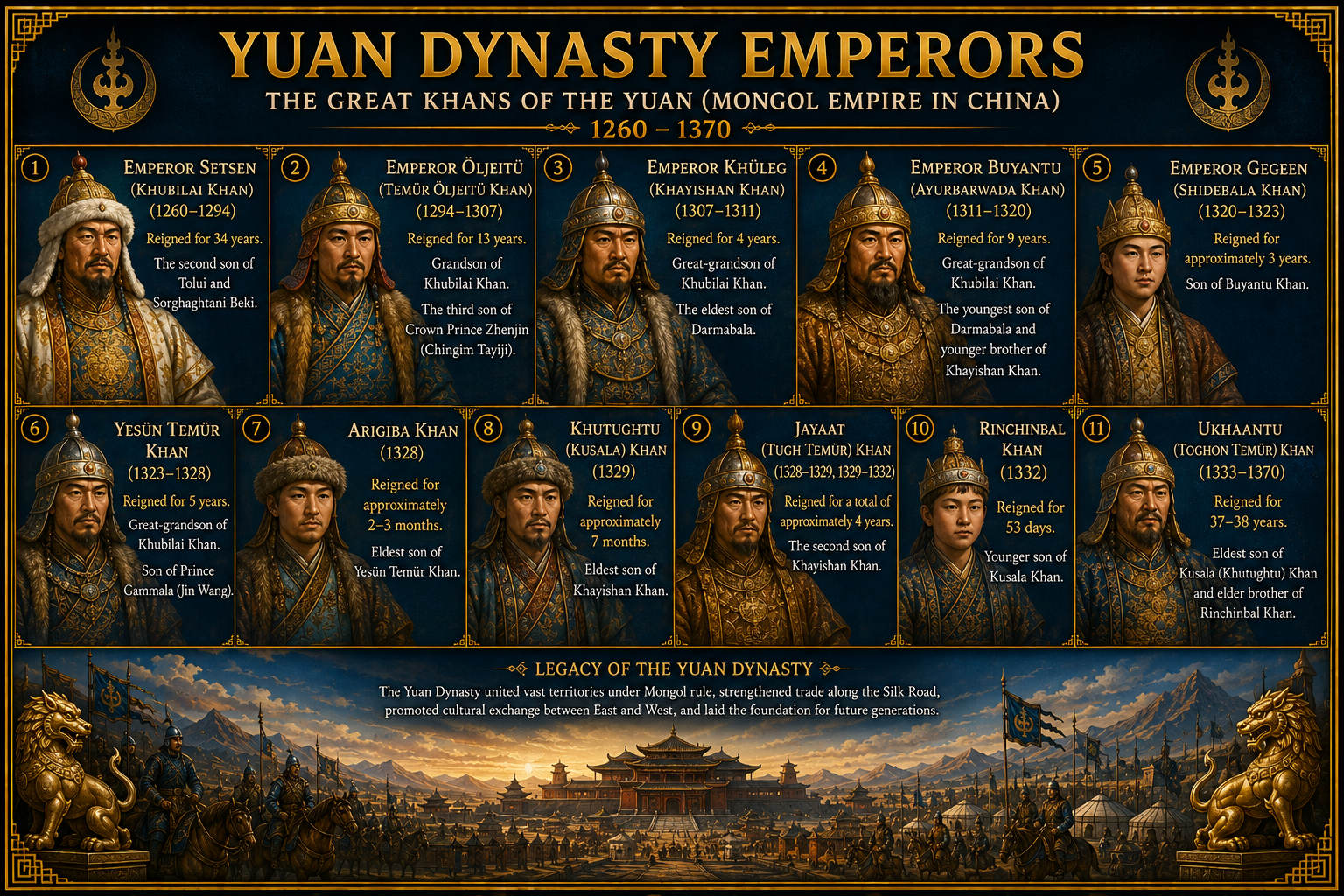
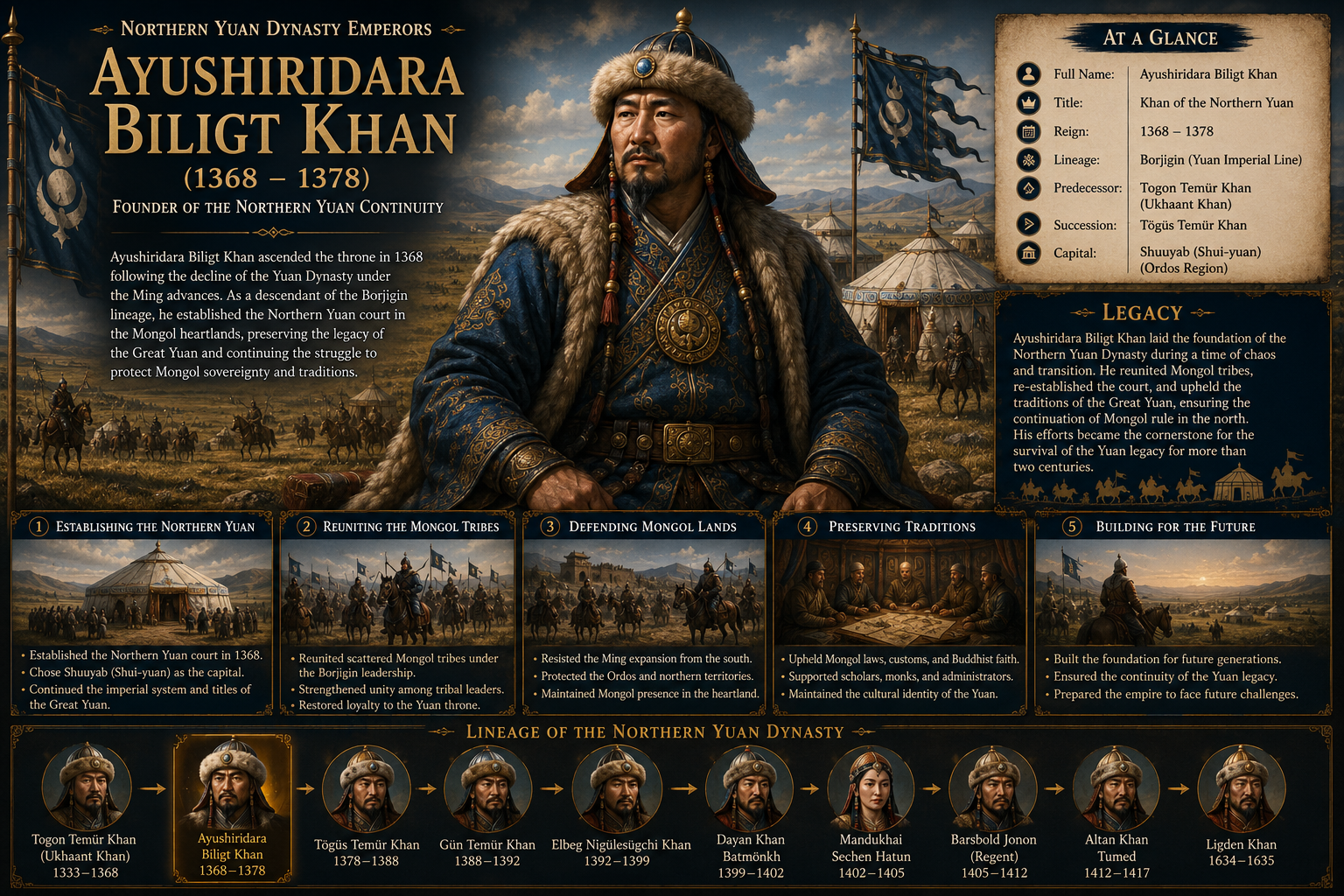
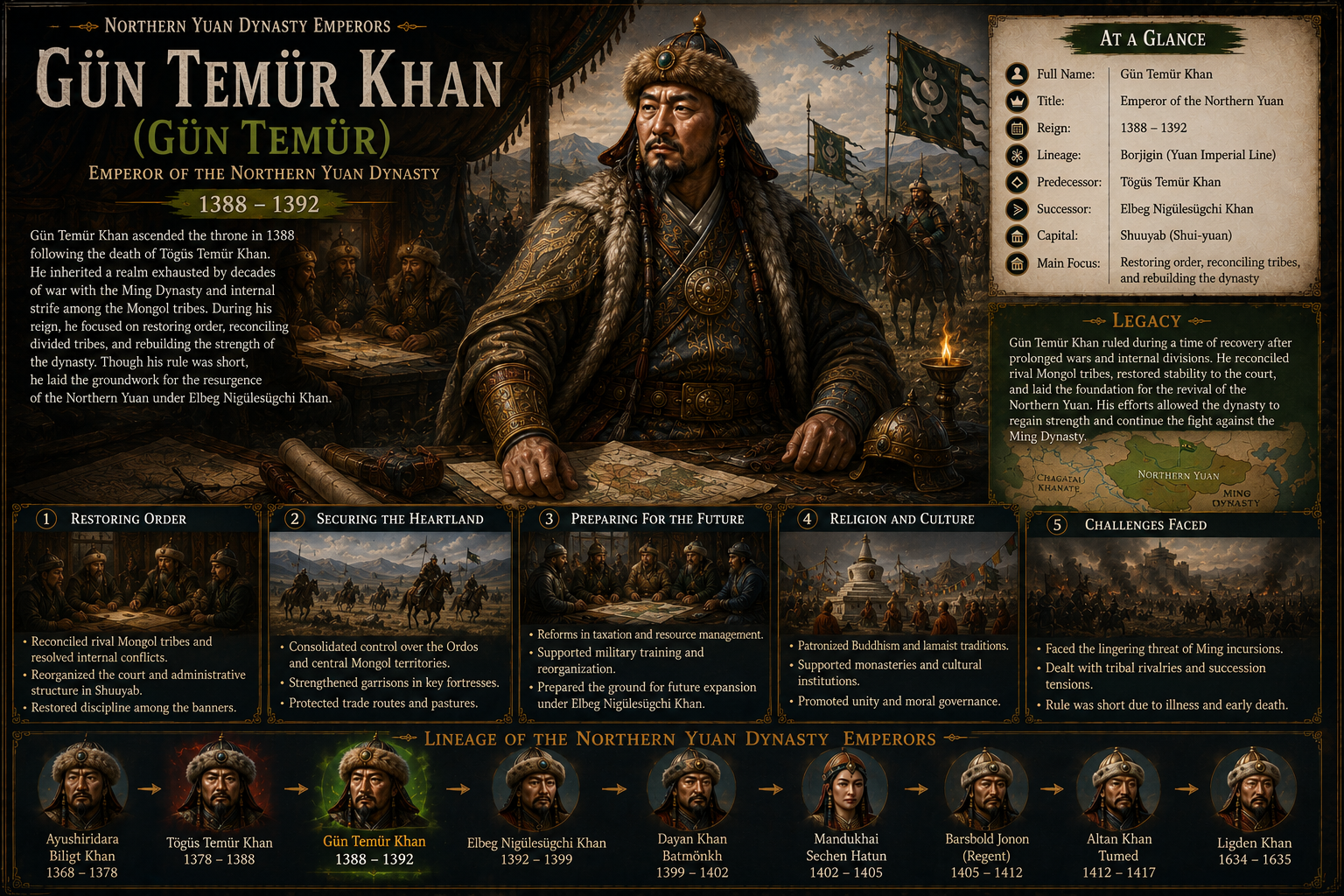
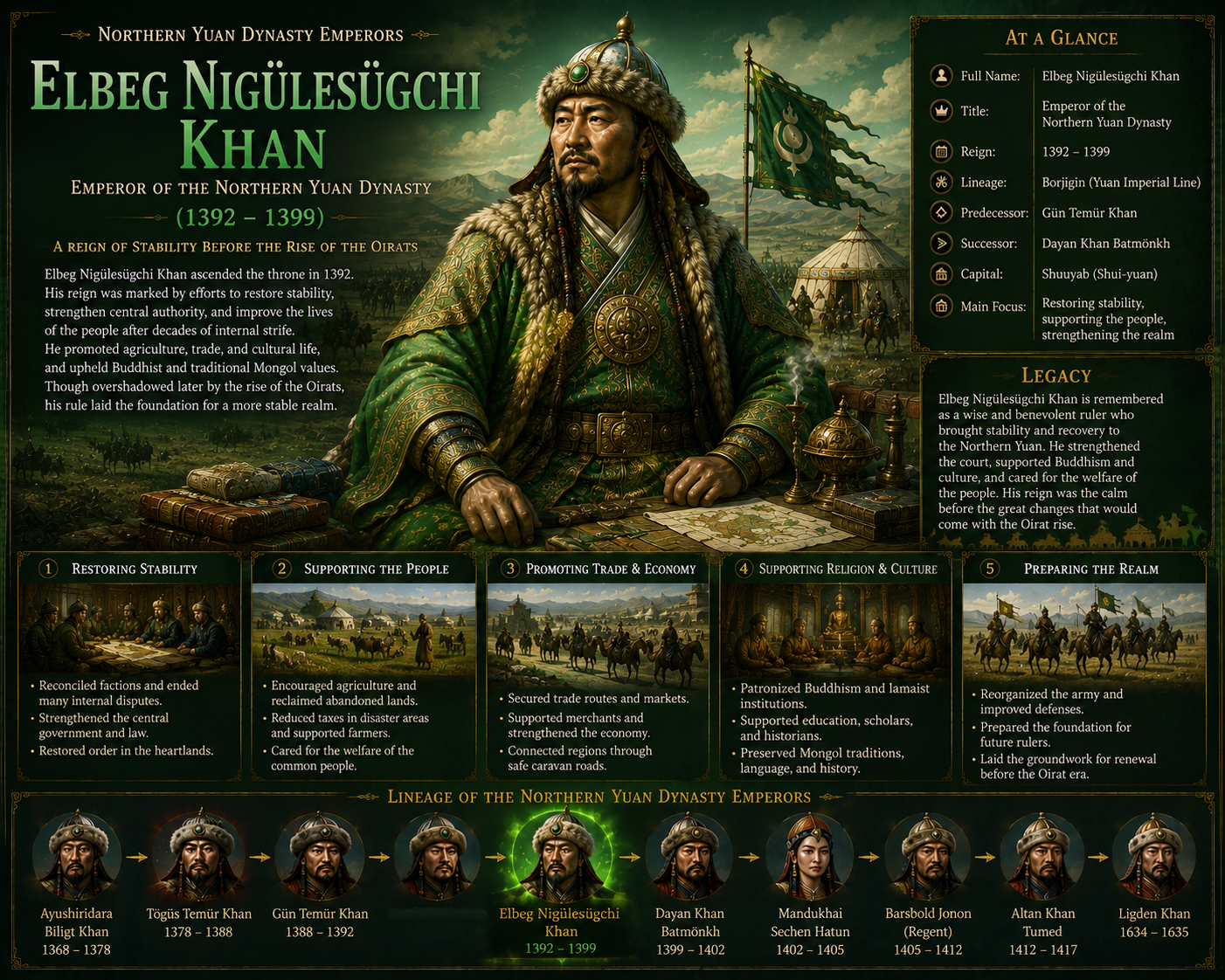
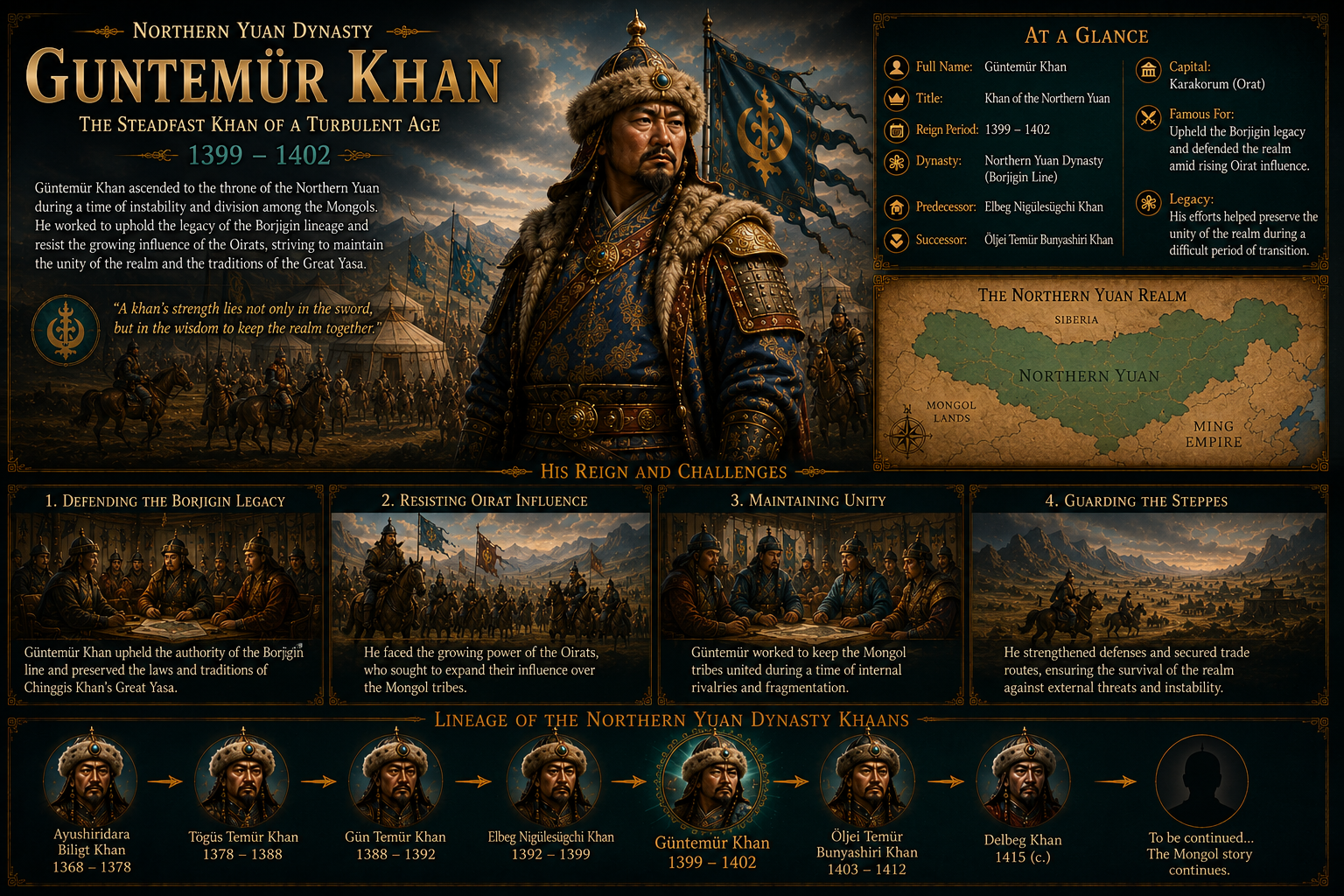
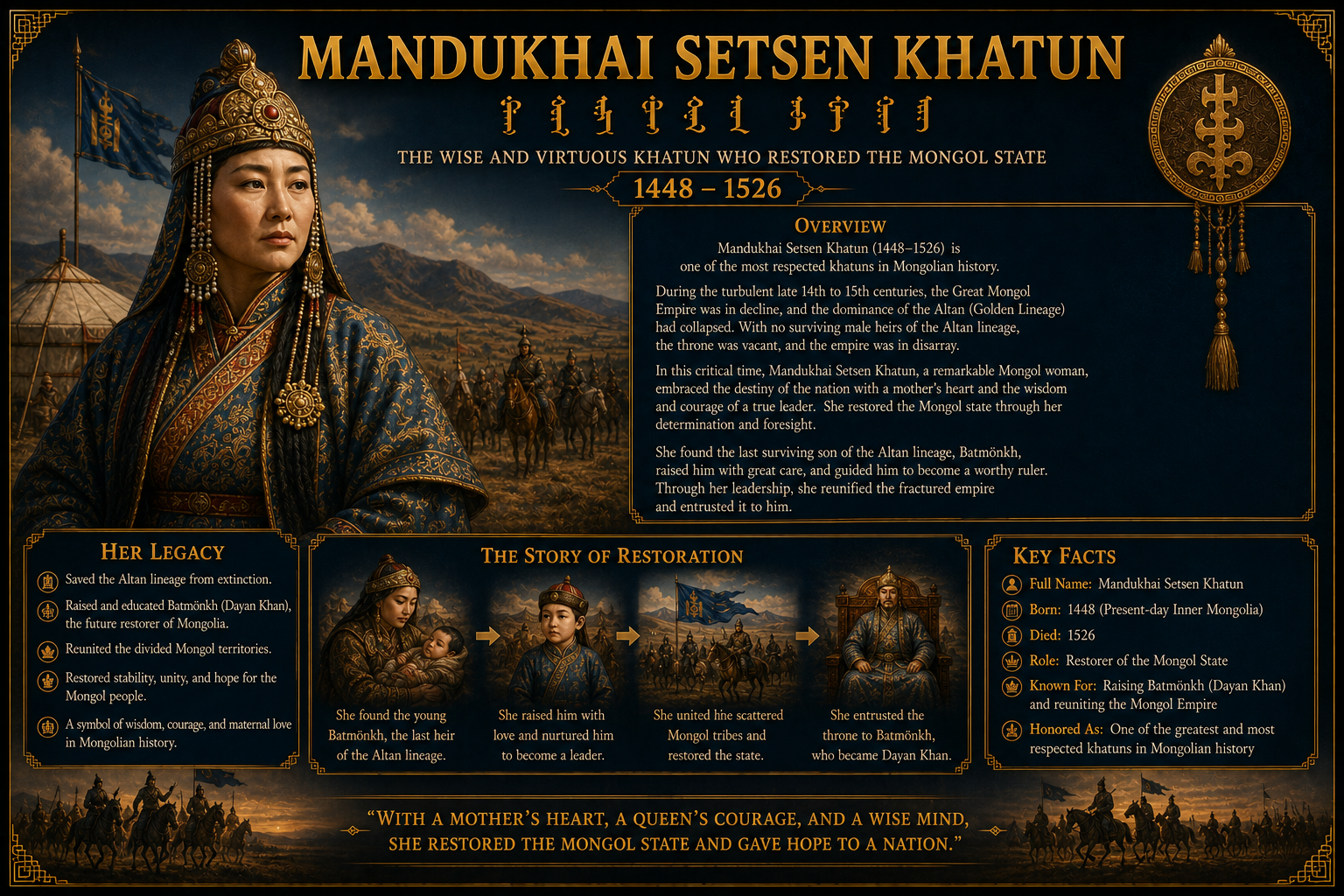
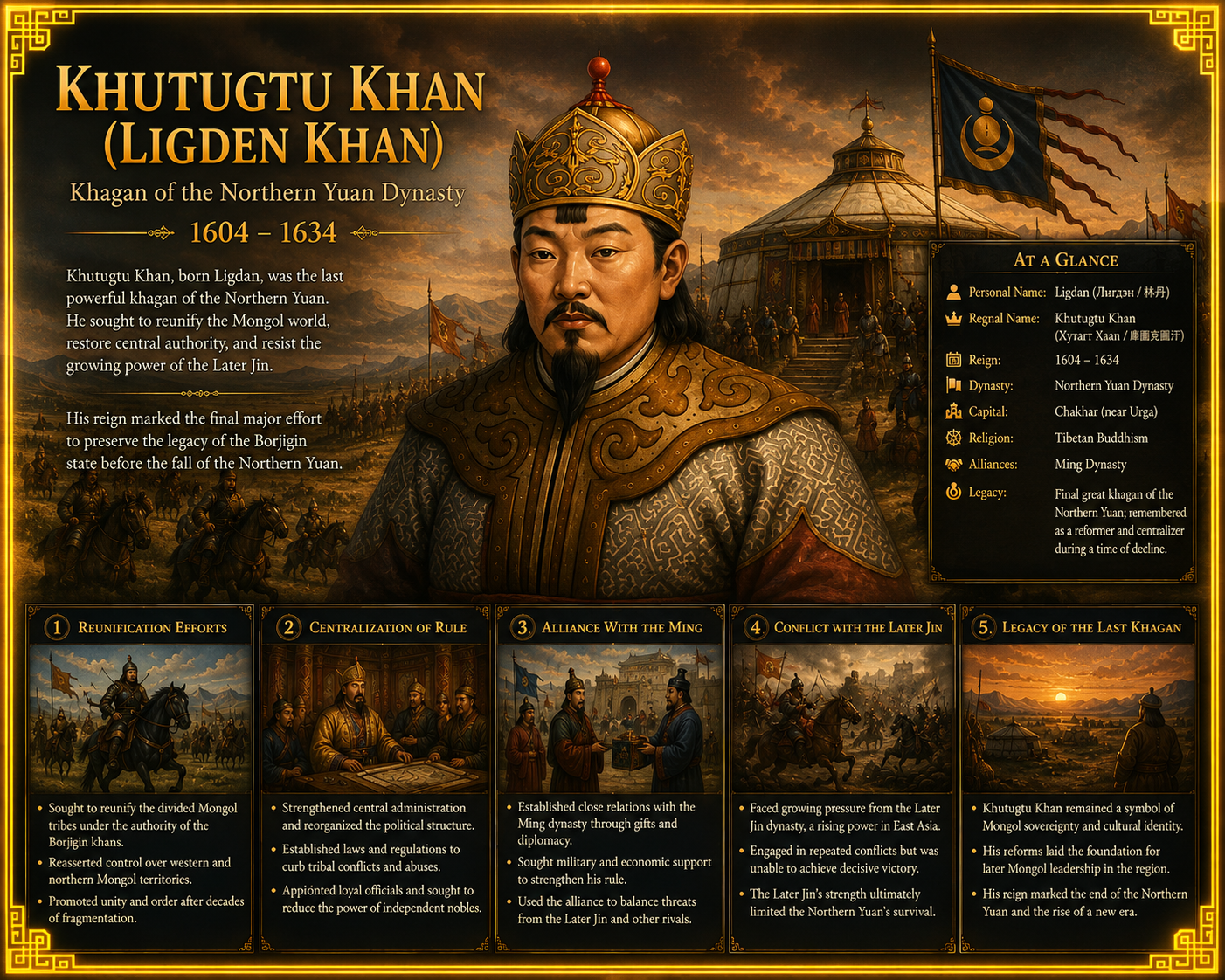
Khutugtu Khan (Ligden Khan) (1588–1634),
The Ligden, was the last powerful Khagan of the Northern Yuan Dynasty and ruled from 1604 to 1634. He was the son of Mangghus Mergen Taiji and grandson of Buyan Sechen Khan.
After the early death of his father, Ligden succeeded his grandfather and ascended the throne under the reign title Khutugtu Khan. The Chakhar Mongols, his principal domain, occupied the Sira Mören valley, and Ligden reorganized the realm by dividing the Chakhar into right and left wings while establishing Chaghan City near Abaga Khara Mountain.
In the early years of his reign, Ligden retained the loyalty of many Mongol tümens and sought to restore the authority of the Great Khagan. He attempted to reunify the fragmented Mongol world and re-establish centralized rule over the steppe.
To strengthen his authority, Ligden promoted Tibetan Buddhism, transferred the Mongol religious center to Chakhar, revived traditions associated with the Sakya order of Khubilai Khan’s era, and sponsored temples and monasteries.
In 1618, Ligden formed an alliance with the Ming Dynasty against the rising Later Jin (Manchu) state. However, as eastern Mongol tribes increasingly allied with the Manchus, Ligden’s position weakened.
Seeking to preserve imperial authority, he introduced administrative reforms, appointed officials over the tümens, organized a court nobility, and created an elite force of 300 baaturs.
During the 1620s–1630s, conflicts with the Manchus intensified. Several Mongol tribes abandoned Ligden and joined the Later Jin. Despite continued resistance, his power gradually declined.
In 1634, while campaigning toward Tibet, Ligden Khan died of smallpox at Sira Tala in present-day Gansu.
After his death, his son Ejei Khan submitted to the Qing, marking the final collapse of the Northern Yuan state in Inner Mongolia.
His title derives from “Ligden Khutugtu Khan” (Mongolian: Лигдэн Хутугт хаан). The title Khutugtu originates from Tibetan religious tradition and reflected both political and spiritual authority.
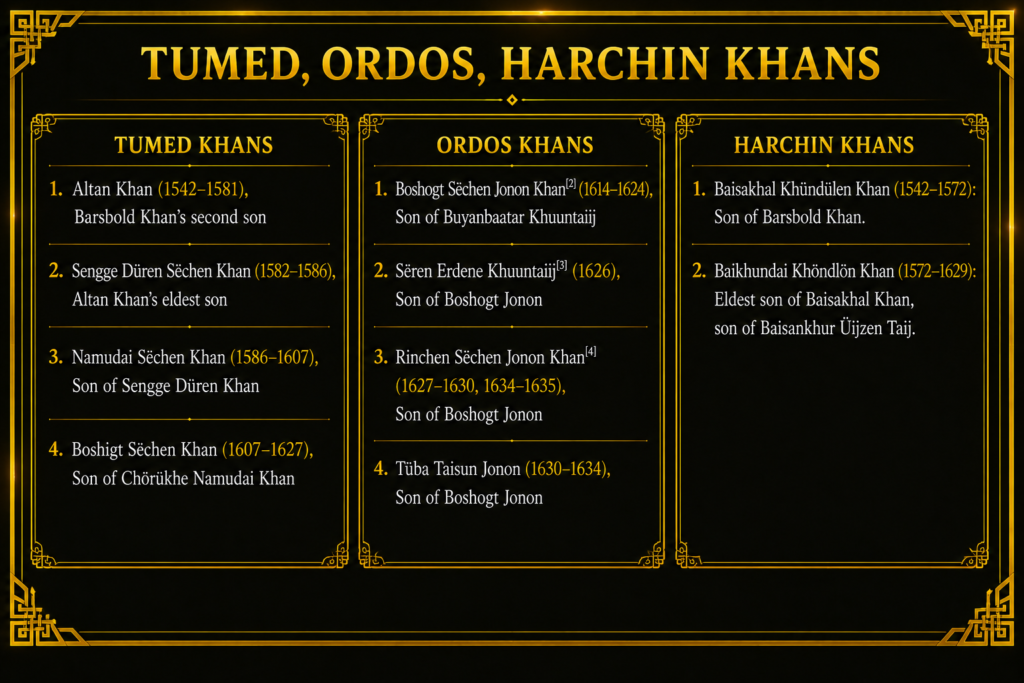
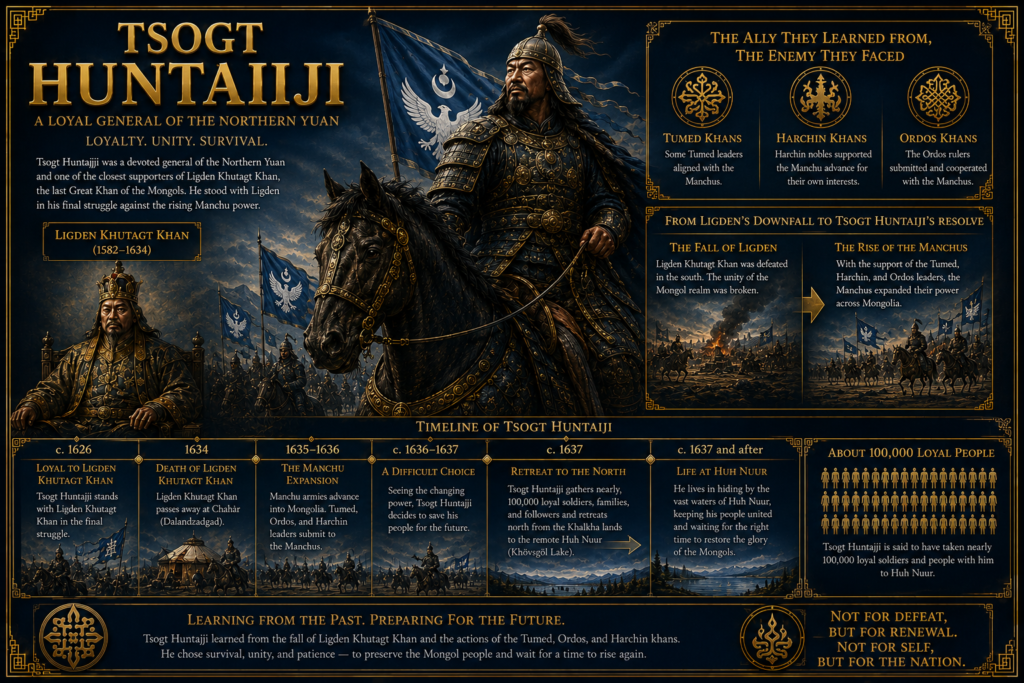
“The Khans of Tumed, Ordos, and Harchin carried a bitter legacy in history, aligning with the Manchu leader Nurhaci and ultimately standing against the last Great Khan, Ligden Khutagt Khan.”
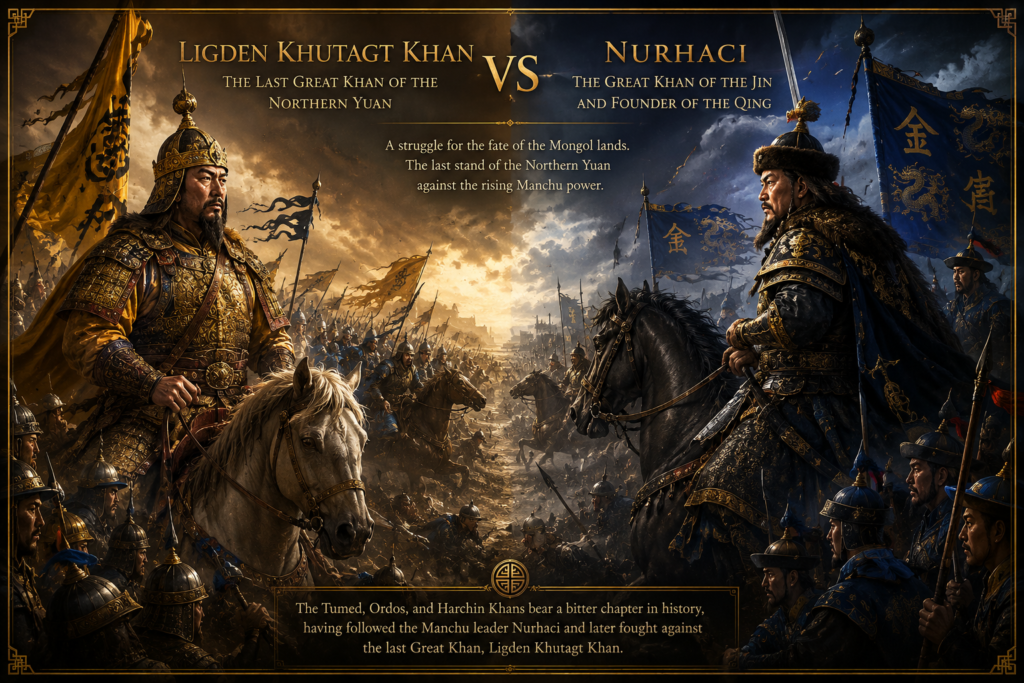
“Many Tumed, Ordos, and Harchin nobles aligned with the Manchus during the final struggle between the Northern Yuan and the rising Qing state under Nurhaci and his successors.”
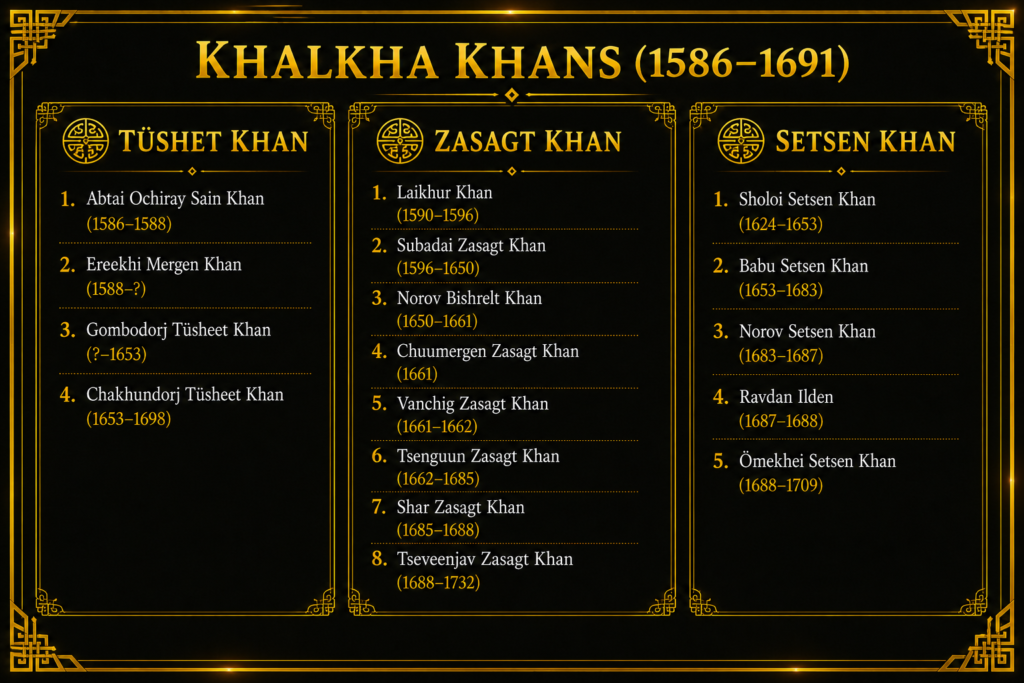
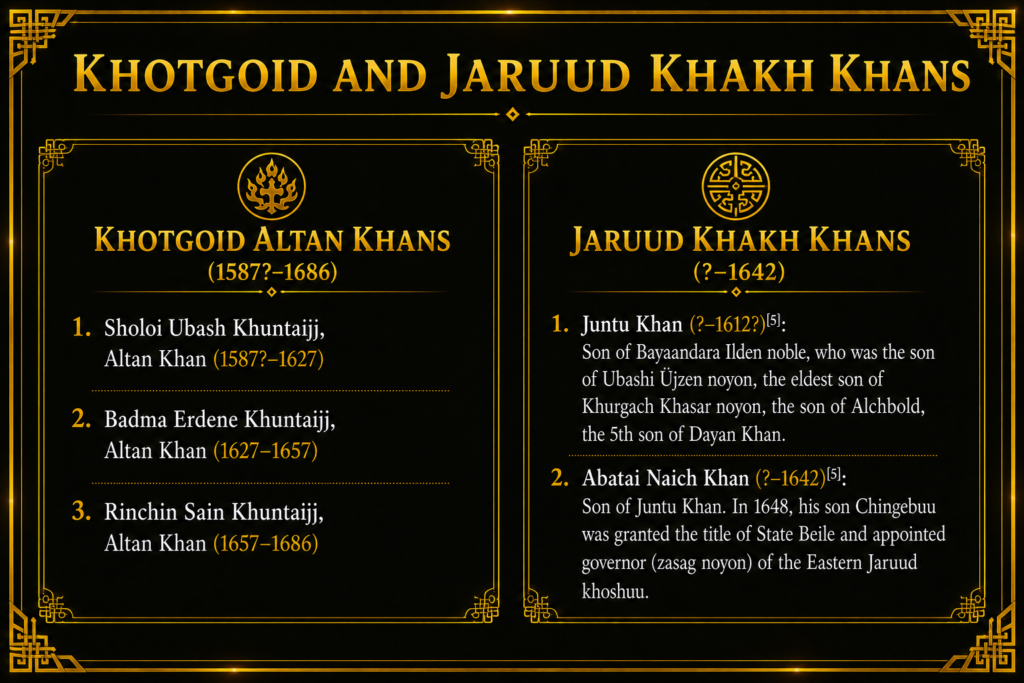
“The three Khalkha Khans — Tüsheet Khan, Zasagt Khan, and Setsen Khan — sought to preserve the unity and strength of the Mongol state during a time of growing external pressure and internal rivalry. Learning from the fall of Ligden Khutagt Khan in the south and the rise of the Manchus, supported by the Tumed, Ordos, and Harchin rulers, they pursued unity and vigilance. In this spirit, they recognized and enthroned Zanabazar as the First Jebtsundamba Khutuktu to strengthen the spiritual and political cohesion of the Khalkha Mongols.”
Tümengken Choghtu Khong Tayiji (Classical Mongolian: ᠲᠦᠮᠡᠩᠬᠡᠨ
ᠴᠣᠭᠲᠤ
ᠬᠤᠩ
ᠲᠠᠶᠢᠵᠢ, Tümengken čoγtu qong tayiǰi; modern Mongolian: Түмэнхэн Цогт Хунтайж, [ˈtumən.xɛŋ ˈt͡sɔx.tə ˈxuŋ.tæt͡ʃ], Tümenkhen Tsogt Khun Taij; Chinese: 綽克圖台吉; 1581–1637), was a noble in Northern Khalkha. He expanded into Amdo (present-day Qinghai) to help the Karma Kagyu sect of Tibetan Buddhism but was overthrown by Güshi Khan, who supported the rival Gelug sect. He is also known for writing a famous poem in 1621, which was transcribed on the surface of a rock in 1624, and still exists.[1]
He established a base on the Tuul river. Known as an intellectual, he embraced the Karma sect and built monasteries and castles. In 1601, he built the White Castle, or the White House of Choghtu Khong Tayiji.
He submitted himself to Ligdan Khan, last grand khan of the Mongols. He took part in Ligdan’s campaign to Tibet to help the Karma sect although Ligdan Khan died in 1634 before they joined together. But he pursued the campaign. In the same year, he conquered the Tümed around Kokonor (Qinghai Lake) and moved his base there. By request from Shamar Rabjampa, he sent an army under his son Arslan to central Tibet in 1635. However, Arslan attacked his ally Tsang army. He met the fifth Dalai Lama and paid homage to Gelukpa monasteries instead of destroying them. Arslan was eventually assassinated by Choghtu’s order.
The Geluk sect asked for help Törü Bayikhu (Güshi Khan), the leader of the Khoshut tribe of the Oirat confederation. In 1636, Törö Bayikhu led the Khoshuts and the Dzungars to Tibet. In the next year a decisive war between Choghtu Khong Tayiji and Törü Bayikhu ended in the latter’s victory and Choghtu was killed.
Descendants of Sutai Yeldeng, Choghtu’s grandson, succeeded the jasagh of a banner in Sain Noyon Khan Aimag.
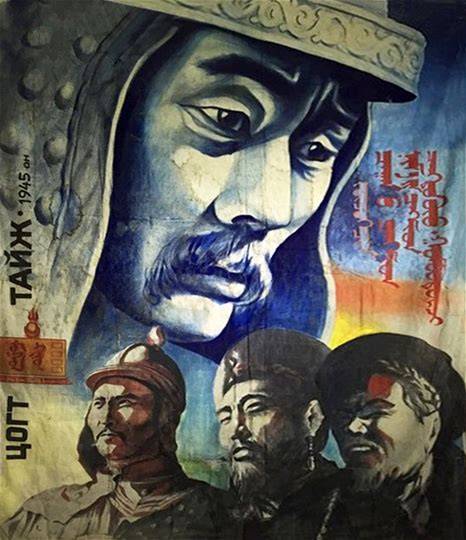
He has traditionally been portrayed as evil by the Geluk sect. On the other hand, the Mongolian movie Tsogt taij (1945) treated him as a national hero.
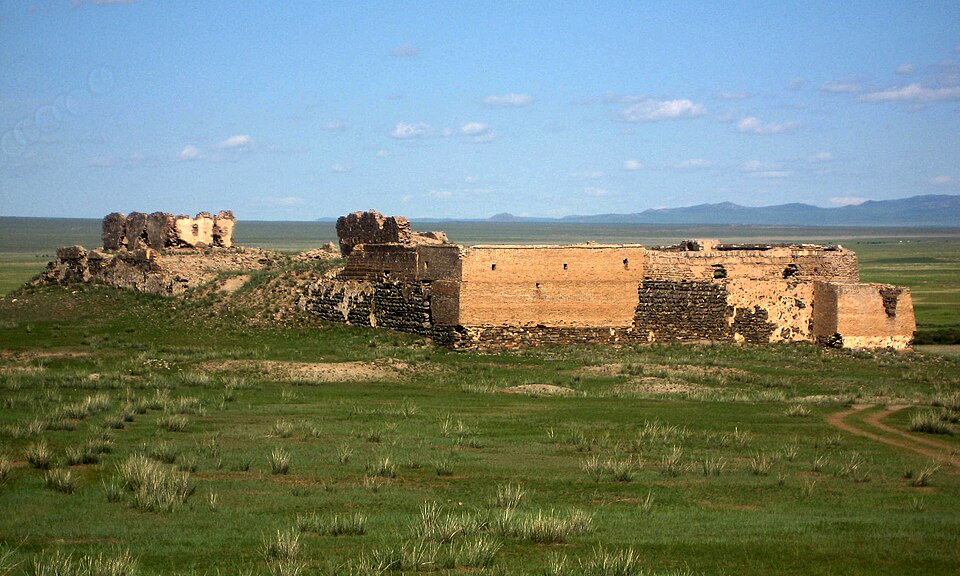
“Tsagaan Baalgas (White City) was the fortified residence and cultural center associated with Tsogt Taiji, located near present-day Dashinchilen in central Mongolia. Built in the early 17th century, it served as an important political, military, and cultural center. The site is remembered for its architecture, inscriptions, and its connection to Tsogt Taiji — a statesman, poet, and patron of learning.”
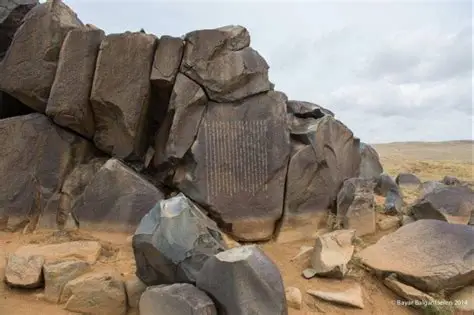
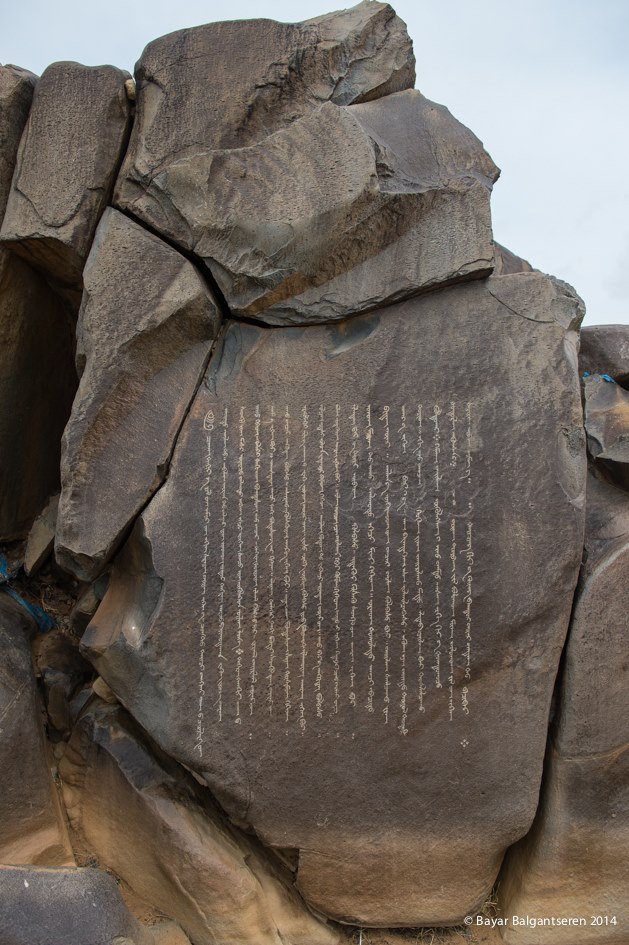
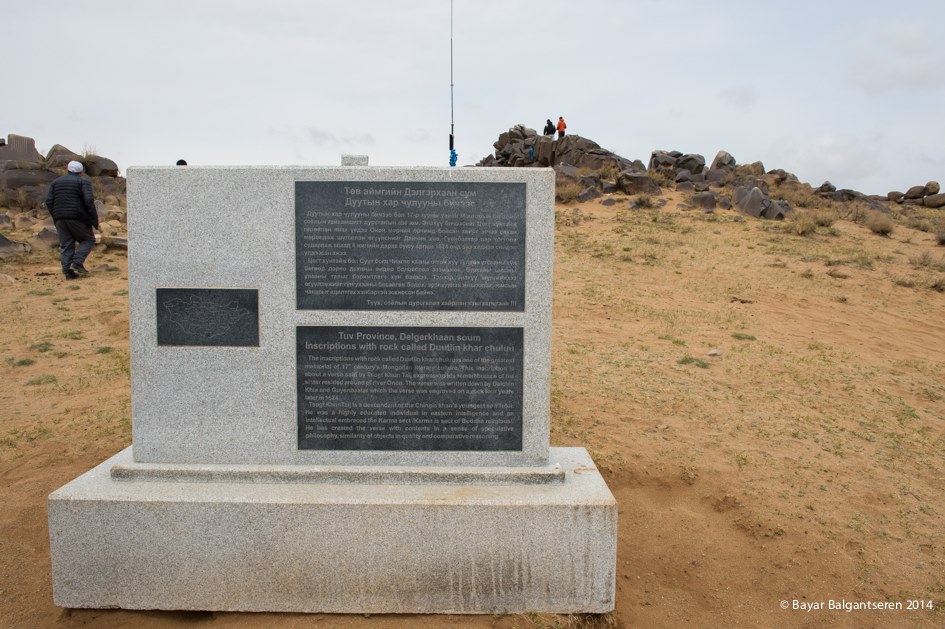
“The Stone Inscriptions of Tsogtu Khung-Taiji, Prince of Khalkha (Tsogtiin Khadnii Bichig), is regarded as one of the classical masterpieces of 17th-century Mongolian poetry. The inscription consists of seven stanzas carved onto the rock known as Duutyn Khad (‘Resonant Rock’), located near Tökhöm Mountain in present-day Delgerkhaan soum, Töv Province, about 300 km from Ulaanbaatar.
“The Stone Inscriptions of Tsogtu Khung-Taiji, Prince of Khalkha (Tsogtiin Khadnii Bichig), is regarded as one of the classical masterpieces of 17th-century Mongolian poetry. The inscription consists of seven stanzas carved onto the rock known as Duutyn Khad (‘Resonant Rock’), located near Tökhöm Mountain in present-day Delgerkhaan soum, Töv Province, about 300 km from Ulaanbaatar. The rock is notable for its unusual acoustic quality, producing a metallic sound when struck, while the inscription appears vividly against the dark stone surface as if written in white chalk.”
“The poem was composed by Tsogt Khuntaiji in 1621 while hunting in the northern hills of Khangai Khan’s domain. Looking eastward from the mountains, he remembered his beloved aunt Khaluut, who had married into a distant clan, and lamented his growing isolation. Tsogt Khuntaiji had become increasingly isolated politically due to his support for Ligden Khutagt Khan’s resistance against the expanding Manchu power, at a time when few nobles of Outer Mongolia openly supported the Chahar ruler.”
“The inscription reflects themes of heaven and earth, compassion, justice, kinship, separation, and enduring loyalty. Its final verses express Tsogt Khuntaiji’s deep affection for his aunt Khaluut and his wish that even if they could not meet again in this life, they might continue to aid one another in future rebirths.”
“The inscription was carved in 1624 by Daichin Khiya and Güyen Baatar. In recognition of its literary and historical significance, Mongolia nominated the monument to UNESCO’s Memory of the World Programme in 2021, and it was officially inscribed in 2023.”
“Upon reaching Huh Nuur with his people, Tsogt Taiji found that Ligden Khutagt Khan had already died of illness. While residing there, he was drawn into the Tibetan religious conflict and eventually faced Güüsh Khan in war. He also witnessed the betrayal of his son, Arslan Taiji. Yet beyond the battlefield, Tsogt Taiji left the legacy of a scholar, poet, and enlightened patron whose name endured in Mongolian history.”
“During the struggle between the Red Hat and Yellow Hat schools in Tibet, the conflict drew in Mongol leaders from the north. Tsogt Taij supported the Red Hat (Karma Kagyu) faction, while Güüsh Khan led the Khoshut forces in support of the Yellow Hat (Gelug) school. Their rivalry became intertwined with the political and religious conflicts of Tibet in the 17th century.”
The Stone Inscription of Tsogt Khuntaiji
Stanza I
Though Heaven above and
The realms of earthly kings lie apart,
Though high and low are set in distinction,
The breath of joy and affection remains as one.
Stanza II
Though the Bodhisattvas dwelling in the cave of Agnistai
And the compassionate souls upon this golden earth
Abide in different realms,
The spirit of mercy and benevolence is one.
Stanza III
Though the virtuous ministers of the Khans in this world
And the great lords of the Lord of Death beyond
Walk under different laws and appearances,
The spirit that discerns right from wrong is one.
Stanza IV
Though men who seek prey and sustenance
And the beasts roaming mountains and forests
Bear different forms of life,
The instinct to slay and feed is one.
Stanza V
Though the thief who comes from afar
And the wolf that circles the encampment by night
Wear different shapes and bodies,
Their desire to seize and consume is one.
Stanza VI
Though my aunt Khaluut dwells by the Onon River,
And I remain here between the Orkhon and Tuul, burdened in sorrow,
Though the lands of Khalkha and Onigud lie far apart,
The air of remembrance and affection remains one.
Stanza VII
Should we not meet again in this life,
Then in every life yet to come,
As a mother cherishes her only child,
May we aid and protect one another through all deed
“Though the lands of Khalkha and Onigud lie far apart, the air of remembrance and affection remains one.”
Lorem ipsum dolor sit amet, consectetur adipiscing elit. Ut elit tellus, luctus nec ullamcorper mattis, pulvinar dapibus leo.