
MYTH & REALITY
Exemining Historical Claims Through Sources, Archaeology, and Scholarship
By Altanbagana Baatar
DBA Candidate| Independent Historian
ImperialGG Historical Research Seriers
19 June 2026
Exploring historical claims, controversies, and popular narratives through primary sources, archaeology, historical maps, and academic research.
THE SECRET HISTORY OF THE MONGOLS
TSHoM — Genealogy, Memory & Historical Debate
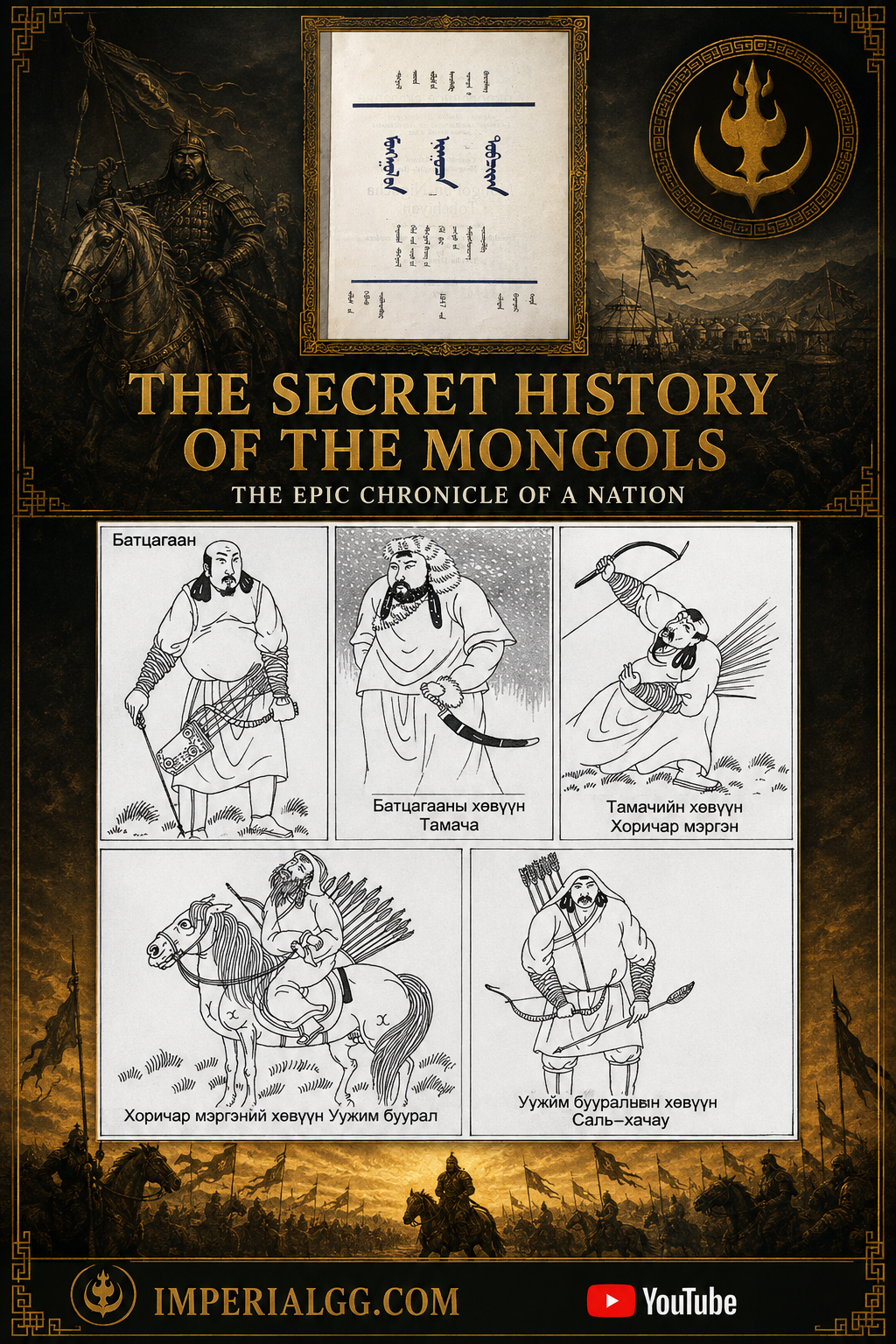
THE SECRET HISTORY OF THE MONGOLS: GENEALOGY, MEMORY, AND THE MAKING OF MONGOL POLITICAL IDENTITY
The Secret History of the Mongols (Mongγol-un Niγuca Tobča’an; hereafter TSHoM) occupies a unique position in the study of Mongolian history. It is not simply a biography of Chinggis Khan, nor merely a chronicle of the Mongol conquests. It is the earliest substantial surviving Mongolian literary narrative and the principal native source for understanding how the Mongols themselves remembered the origins of their ruling lineage, the formation of their political community, and the rise of Chinggis Khan.¹
Its importance lies precisely in this combination of history, genealogy, oral tradition, political memory, and literary composition.
The text begins long before Temüjin. It begins with ancestry. That decision is fundamental.
A HISTORY THAT BEGINS BEFORE CHINGGIS KHAN
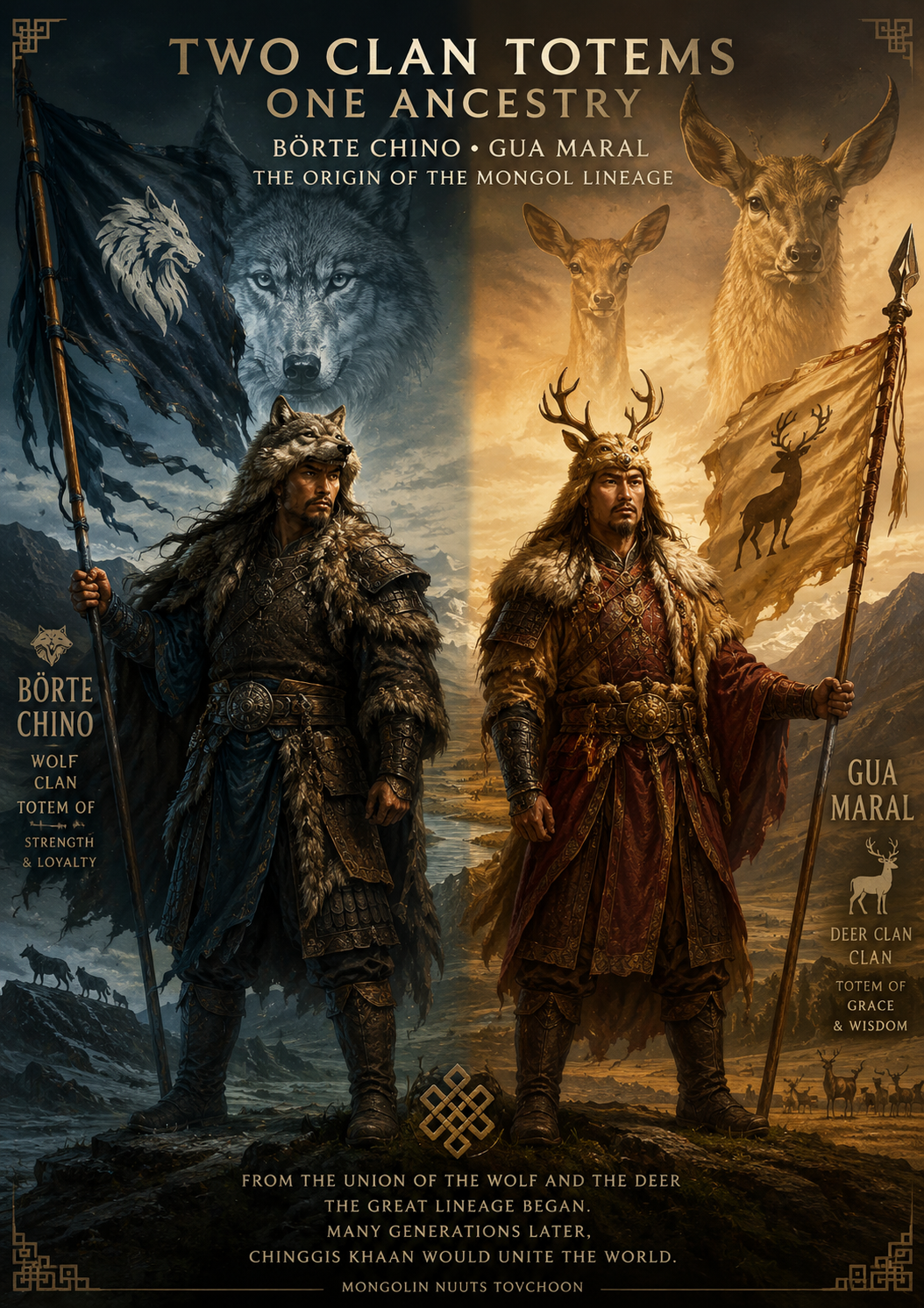
The Secret History opens with the famous ancestral pair Börte Chino and Gua Maral, the Blue-Grey Wolf and the Fallow Doe. Their descendants eventually lead to Dobun Mergen, Alan Gua, Bodonchar Mungqaq, and the later ruling lineage from which Chinggis Khan emerges.²
This structure immediately tells the reader that the story of Chinggis Khan cannot be understood independently from the history of the lineage that preceded him. The genealogy is therefore not merely an introductory list of names. It is an argument. The text establishes that political authority has a history before it has a ruler.
The ancestry proceeds through a series of generations until it reaches Alan Gua and her five sons. Here the character of the genealogy changes. The earlier imagery of wolf and deer gives way to the extraordinary account of light and Heaven. After the death of Dobun Mergen, Alan Gua bears three sons—Buqu Qatagi, Buqatu Salji, and Bodonchar Mungqaq. Her elder sons question their paternity. Alan Gua answers with the story of a radiant yellow man entering through the smoke-hole and departing along a ray of sunlight or moonlight, concluding that the three sons are **“sons of Heaven.”**³
The narrative is clearly symbolic, but symbolism does not make it historically irrelevant. On the contrary, it tells us something important about how legitimacy was imagined.
FROM ANCESTRAL SYMBOLISM TO SACRED LINEAGE
The transition from Börte Chino and Gua Maral to Alan Gua and the light deserves particular attention. The first pair represents ancestry through animal imagery. Alan Gua’s story introduces a different vocabulary: light, Heaven, radiance, and rulership.
The text itself connects the three younger sons with a future in which they will become rulers.⁴
Mongolian historiographical scholarship has long treated this episode as more than a simple supernatural birth story. Sh. Bira’s work on Mongolian historical writing is particularly important for understanding the development of Mongolian historical consciousness and the relationship between genealogy, political legitimacy, and sacred authority.⁵
This does not mean that the historian should simply accept the supernatural event as literal history. Nor should the episode be dismissed as meaningless mythology.
The more productive historical question is:
Why did the compilers of the tradition preserve this particular explanation of ancestry?
The answer may lie in the political function of genealogy itself. A ruling lineage required more than biological descent. It required a recognized justification for authority. Alan Gua’s story supplies precisely that.
THE FIVE ARROWS: POLITICAL EDUCATION IN THE GENEALOGY
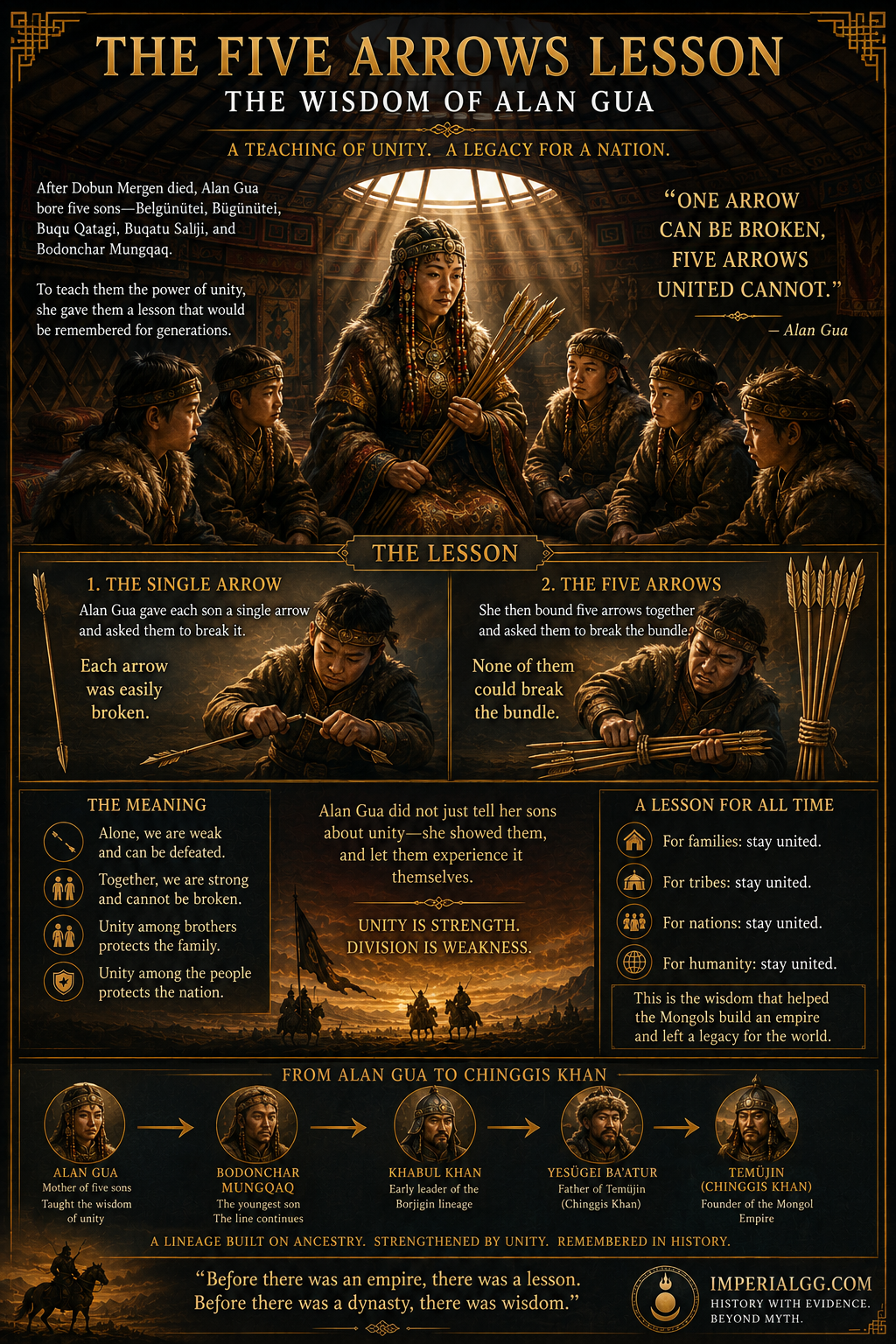
Alan Gua’s importance becomes even clearer in the famous five-arrow episode. She gathers her five sons and gives each of them a single arrow. Each arrow is easily broken. She then binds five arrows together and asks them to break the bundle. They cannot. Her lesson is that individually they can be overcome, but united they cannot easily be defeated.⁶
This is often reduced to the familiar phrase “unity is strength.” But the episode deserves closer attention.Alan Gua does not merely tell her sons to remain united. She demonstrates the principle. She makes them test it themselves. That is a remarkably concrete form of political education.
AUTHOR’S THESIS
The five-arrow episode can therefore be read as more than a moral lesson about family harmony.
Alan Gua is teaching the political technology of survival.
Her sons belong to one lineage, but lineage alone cannot guarantee its survival. If the brothers divide, their common ancestry becomes politically useless. If they remain united, their collective strength becomes greater than the strength of any individual member.
The lesson therefore moves from family → lineage → political community.
This is especially significant because the Secret History repeatedly returns to the problem of internal division. The later history of the Mongols demonstrates that political fragmentation could destroy even powerful ruling houses, while unity under an effective leader could transform dispersed groups into a larger political order. Alan Gua’s arrows therefore foreshadow one of the central political problems of the entire work:
How can many competing groups become one political people? That question will eventually be answered by Temüjin.
BODONCHAR AND THE CONTINUITY OF THE RULING LINE
After Alan Gua’s death, the five brothers divide their property. Bodonchar receives no share because his brothers regard him as foolish and marginal. Yet Bodonchar survives independently, establishes his own following, and becomes a crucial ancestor in the later genealogy.⁷
This is one of the most interesting reversals in the opening chapters. The man dismissed as insignificant becomes indispensable to the future lineage. The Secret History therefore does not present historical greatness as something that is always visible at birth. Bodonchar’s story introduces another recurring theme:
political potential may exist before political power becomes visible.
Through successive generations the genealogy moves toward Khaidu, Tumbinai Sečen, Khabul Khan, Ambaghai Khan, Qutula Khan, Bartan Ba’atur, and Yesügei Ba’atur. With these figures the text gradually moves from ancestral memory toward increasingly recognizable political history.⁸
This transition is one of the great structural achievements of the Secret History. The text begins in a world of mythic ancestry. It ends in the world of imperial administration. Between those two points lies the political formation of the Mongols.
KHABUL, AMBAGHAI, AND THE EMERGENCE OF POLITICAL COMMUNITY
With Khabul Khan, the genealogy begins to intersect more clearly with Mongol political history. After Khabul came Ambaghai Khan, and after Ambaghai, Qutula Khan. The Secret History records that Ambaghai’s message nominated both Qada’an and Qutula, after which the Mongols and Tayichi’ut gathered at Qorqonaq Valley and raised Qutula as khan.⁹
This is important because it demonstrates that succession was not represented as a simple automatic father-to-son inheritance. The political community itself appears in the narrative. The Mongols and Tayichi’ut gather, deliberate, and elevate a khan. Qutula then attempts to avenge Ambaghai and fights the Tatars thirteen times, but fails to achieve the desired revenge.¹⁰ The genealogy has therefore become political history.
AMBAGHAI’S TRAGEDY AND THE MEMORY OF POLITICAL FAILURE
Ambaghai’s story is especially important because it exposes the vulnerability of the Mongol political order. His capture and execution become part of the collective memory of the Mongols, while his final message becomes a command carried into the next generation.
Yet the deeper historical significance lies in the fact that the Mongols had not yet developed the political and economic structures that would later allow Chinggis Khan to impose durable unity.
They possessed lineage. They possessed warriors. They possessed political traditions. But they did not yet possess an enduring centralized state. This distinction is essential.
The Secret History should not be read backward as though the Mongol Empire already existed in embryonic form and Chinggis merely activated it. The political world of the twelfth century was much more fragmented. The emergence of the empire was a transformation, not simply the continuation of an already existing state.
YESÜGEI BA’ATUR: THE LAST GENERATION BEFORE TEMÜJIN
The transition from Qutula to Yesügei Ba’atur brings the narrative directly to Temüjin. The Secret History records that Yesügei captured the Tatar leaders Temüjin Üge and Qori Buqa. At the same time, Hö’elün was giving birth to her son. The boy was named Temüjin because his birth coincided with the capture of the Tatar Temüjin Üge.¹¹
The symbolism is unmistakable. A child who will eventually unite the Mongols is named after an enemy captured by his father. But the real rupture comes later.
When Temüjin is nine, Yesügei takes him to the Onggirat and leaves him with Dei Sečen after arranging his future marriage with Börte. On his journey home, Yesügei encounters Tatars at a feast. They recognize him and secretly poison his food. He survives for three days, reaches his camp, summons Mönglik, and orders him to care for the children and bring Temüjin back. Then Yesügei dies.¹²
This is the moment in which the genealogy becomes biography. And biography becomes catastrophe.
THE COLLAPSE OF THE GOLDEN LINEAGE
Immediately after Yesügei’s death, the political protection surrounding Hö’elün and her children collapses. The Secret History describes how the Tayichi’ut abandon Hö’elün, her children, and the mothers in the camp. Even the sacrificial distribution associated with the wider community is denied to Hö’elün.¹³
This is historically significant because the family that possessed elite ancestry suddenly loses the material power that made that ancestry politically effective. The distinction between genealogical status and actual power becomes brutally visible.
Hö’elün possesses the lineage. Her children possess the blood. But they possess neither the army nor the economic resources necessary to command obedience. They must survive. And this experience becomes the foundation of the next phase of the narrative.
THE SECRET HISTORY AS POLITICAL MEMORY
This is why the Secret History of the Mongols should not be treated simply as a medieval biography. It is a work of political memory. Its genealogy explains where the ruling lineage came from. Its legends explain why that lineage possessed special significance. Its stories of Alan Gua teach unity.
Its stories of Khabul, Ambaghai, and Qutula preserve the memory of political leadership and failure. Its account of Yesügei records the collapse of inherited protection. And the childhood of Temüjin demonstrates what happens when a member of the ruling lineage is forced to survive without the protection normally associated with that status. The result is a narrative architecture in which genealogy becomes political theory.
HISTORY, MEMORY, AND THE PROBLEM OF THE TEXT
There is, however, a fundamental methodological problem. We do not possess the original Mongolian manuscript of the Secret History. The surviving full textual tradition comes primarily through Chinese-character transcription and accompanying Chinese translation. The earliest Mongolian-script form has not survived, and the transmission history remains a major subject of scholarly investigation.¹⁴
This matters enormously. When we quote the Secret History, we are not reading an untouched thirteenth-century manuscript. We are working through a reconstructed textual tradition.
Igor de Rachewiltz’s monumental edition and translation remains one of the essential scholarly foundations for studying the text, while Christopher Atwood’s work has further emphasized questions concerning its dating, informants, sources, and historical composition.¹⁵
The date of composition itself is not as simple as it is sometimes presented. The traditional dating of the work to 1240 derives from interpretation of the colophon, but scholars have debated the meaning of the “Year of the Rat” and the relationship between the main narrative and the concluding material concerning Ögödei. Rachewiltz and Atwood have both revisited the dating problem in detail.¹⁶
Therefore, an academically responsible reading must distinguish:
WHAT THE TEXT SAYS
from
WHAT THE TEXT MAY PRESERVE
and from
WHAT WE AS HISTORIANS INFER FROM IT.
That distinction is particularly important when interpreting episodes such as Börte Chino and Gua Maral, Alan Gua’s heavenly conception, or the political meaning of the five arrows.
ORAL TRADITION AND HISTORICAL MEMORY
The Secret History is also important because it appears to preserve material derived from different kinds of memory and information. Christopher Atwood’s research on the informants and sources of the work has emphasized that the text should not be imagined as the product of a single modern-style historian sitting alone and recording events from written documents.¹⁷
The work contains genealogy, court memory, oral traditions, poetic passages, political speeches, military narratives, and highly literary scenes. This mixture is not a weakness. It is part of what makes the work historically valuable. The historian’s task is not to flatten all of these elements into one category called “fact.”
Instead, each layer must be interrogated differently. A genealogy can preserve political memory without providing a modern genealogical proof. A speech can preserve political ideology even if its exact wording cannot be independently verified. A supernatural story can reveal a society’s conception of legitimacy without requiring the historian to treat the supernatural event as empirical fact. This is precisely why the Secret History remains indispensable.
THE MONGOLS DESCRIBING THEMSELVES
Perhaps the greatest importance of the Secret History is that it allows historians to study the Mongols from within their own narrative tradition. Chinese dynastic histories, Persian chronicles, Armenian sources, Rus’ chronicles, and European accounts are indispensable for reconstructing Mongol history. But each describes the Mongols from a particular external position.
The Secret History is different. It gives us a Mongolian narrative of Mongolian political life. It preserves how rulers, brothers, mothers, wives, allies, enemies, warriors, servants, and political dependents were remembered within the Mongol world. The work therefore provides evidence not only for what happened, but for what the Mongols believed was worth remembering. That distinction is fundamental to historical research.
FROM GENEALOGY TO EMPIRE
The entire structure of the Secret History can ultimately be understood as a movement through several stages:
ANCESTRY
Börte Chino → Gua Maral
↓
SACRED LINEAGE
Alan Gua → Bodonchar
↓
DYNASTIC MEMORY
Bodonchar → Khabul
↓
POLITICAL STRUGGLE
Khabul → Ambaghai → Qutula
↓
COLLAPSE OF INHERITED POWER
Yesügei’s death
↓
SURVIVAL WITHOUT POWER
Temüjin’s childhood
↓
POLITICAL TRANSFORMATION
Temüjin becomes Chinggis Khan
The extraordinary feature of this structure is that the empire does not appear at the beginning. It is the conclusion of a long political process.
THE SECRET HISTORY AS A MONGOL POLITICAL TEXT
The Secret History of the Mongols should therefore be read on at least three levels. First, it is a historical source for the Mongol world of the twelfth and thirteenth centuries.
Second, it is a literary work, combining prose, poetry, genealogy, dialogue, symbolism, and dramatic narrative.
Third, it is a political memory text that explains how the Mongols understood lineage, leadership, loyalty, betrayal, unity, and legitimate rule.¹⁸
Its greatest achievement may be that it connects all three. The story begins with a wolf and a deer. It passes through Heaven and Alan Gua. It teaches unity through five arrows. It remembers khans who won and khans who failed. It records fathers who died before seeing their sons grow. It remembers a ruling family abandoned to poverty. And from that broken world emerges Temüjin. That is why the Secret History remains more than an old chronicle. It is a record of how a political civilization remembered the road by which it became itself.
CONCLUSION
The Secret History of the Mongols does not simply tell us that Chinggis Khan became powerful. It asks us to understand why his rise became possible. The answer is not found in one battle or one extraordinary individual.
It lies in the accumulated memory of generations:
ancestry created legitimacy;
unity created strength;
political failure created memory;
loss created necessity;
and necessity created transformation.
The great historical question of the Secret History is therefore not simply:
“Who was Chinggis Khan?”
It is the larger question:
“How did a fragmented lineage and a divided steppe become the political world that produced Chinggis Khan?”
The text’s answer begins centuries before the empire.
And that is precisely why its first pages matter as much as its final ones.
FOOTNOTES
1. Igor de Rachewiltz, The Secret History of the Mongols: A Mongolian Epic Chronicle of the Thirteenth Century, Vol. I (Leiden: Brill, 2004/2006), Introduction, pp. vii–xx; Christopher P. Atwood, trans. and intro., The Secret History of the Mongols (London: Penguin Classics, 2023). Rachewiltz describes the work as the major native source for Chinggis Khan and notes that it combines prose and epic poetry.
2. Secret History of the Mongols (SHM), §§1–22. See de Rachewiltz, Secret History, Vol. I, pp. 1–5. The genealogy begins with Börte Chino and Gua Maral and proceeds through successive generations to Dobun Mergen and Alan Gua.
3. SHM, §§17–21; de Rachewiltz, Secret History, Vol. I, pp. 3–5. Alan Gua’s three younger sons are Buqu Qatagi, Buqatu Salji, and Bodonchar; the “radiant yellow man” episode culminates in the declaration that they are “sons of Heaven.”
4. SHM, §21. The statement that the sons will eventually become rulers is part of Alan Gua’s explanation of their extraordinary ancestry.
5. Shagdaryn Bira, Mongolian Historical Writing from 1200 to 1700, 2nd ed., trans. John R. Krueger (Bellingham, WA: Center for East Asian Studies, Western Washington University, 2002). Bira’s work is a major study of Mongolian historiographical traditions.
6. SHM, §22; de Rachewiltz, Secret History, Vol. I, pp. 4–5. Alan Gua gives each son one arrow and then gives them five arrows bound together, using the demonstration to teach unity.
7. SHM, §23; de Rachewiltz, Secret History, Vol. I, pp. 5–6. After Alan Gua’s death, Bodonchar receives no share of the family property because his brothers regard him as foolish.
8. For the pre-Chinggisid genealogical tradition and its political implications, see Christopher P. Atwood, “Six Pre-Chinggisid Genealogies in the Mongol Empire,” Archivum Eurasiae Medii Aevi 19 (2012): 5–58. The Cambridge History of the Mongol Empire bibliography identifies this study as a major treatment of pre-Chinggisid genealogies.
9. SHM, §57; de Rachewiltz, Secret History, Vol. I, p. 12. The text states that Ambaghai’s message nominated both Qada’an and Qutula, after which the Mongols and Tayichi’ut gathered and made Qutula qa’an.
10. SHM, §58; de Rachewiltz, Secret History, Vol. I, p. 12. Qutula and Qada’an fought the Tatars thirteen times but failed to avenge Ambaghai.
11. SHM, §§59–60; de Rachewiltz, Secret History, Vol. I, pp. 12–13. The text connects Temüjin’s name with the capture of the Tatar Temüjin Üge.
12. SHM, §§61–69; de Rachewiltz, Secret History, Vol. I, pp. 14–16. Yesügei takes nine-year-old Temüjin to the Onggirat, leaves him with Dei Sečen, encounters the Tatars on his return, is poisoned, reaches his camp after three days, and asks Mönglik to bring Temüjin back.
13. SHM, §§70–73; de Rachewiltz, Secret History, Vol. I, pp. 16–18. The text describes Hö’elün’s exclusion from the sacrificial meal and the subsequent abandonment of the mothers and children by the Tayichi’ut.
14. T. H. Barrett, “The Secret History of the Mongols: Some Fresh Revelations,” Bulletin of the School of Oriental and African Studies 55, no. 1 (2009): 115–119. Barrett emphasizes that the surviving full tradition does not preserve the original Uyghur-script text but comes through Chinese-character transcription and Chinese translation.
15. Igor de Rachewiltz, The Secret History of the Mongols: A Mongolian Epic Chronicle of the Thirteenth Century, Vols. I–III. The ANU Mongolia Institute describes the work as the standard English annotated translation and notes the extensive historical and philological commentary.
16. Christopher P. Atwood, “The Date of the ‘Secret History of the Mongols’ Reconsidered,” Journal of Song-Yuan Studies 37 (2007): 1–48; Igor de Rachewiltz, “The Dating of the Secret History of the Mongols—A Re-Interpretation,” Ural-Altaische Jahrbücher 22 (2008): 150–184. The dating problem centers on the interpretation of the work’s colophon and its “Year of the Rat.”
17. Christopher P. Atwood, “Informants and Sources for the ‘Secret History of the Mongols’,” Mongolian Studies 29 (2007): 27–39.
18. Jun Pin Tay and Andrea Nanetti, “The Secret History of the Mongols: A Digital History Approach,” Journal of Digital History. The authors characterize the work as the earliest Mongolian written primary source and emphasize its evidence for Mongolian historiography, social structure, government, ideology, and tribal life.
SELECTED BIBLIOGRAPHY
Atwood, Christopher P. “Informants and Sources for the ‘Secret History of the Mongols’.” Mongolian Studies 29 (2007): 27–39.
Atwood, Christopher P. “The Date of the ‘Secret History of the Mongols’ Reconsidered.” Journal of Song-Yuan Studies 37 (2007): 1–48.
Atwood, Christopher P. “Six Pre-Chinggisid Genealogies in the Mongol Empire.” Archivum Eurasiae Medii Aevi 19 (2012): 5–58.
Atwood, Christopher P., trans. and intro. The Secret History of the Mongols. London: Penguin Classics, 2023.
Barrett, T. H. “The Secret History of the Mongols: Some Fresh Revelations.” Bulletin of the School of Oriental and African Studies 55, no. 1 (2009): 115–119.
Bira, Shagdaryn. Mongolian Historical Writing from 1200 to 1700. 2nd ed. Translated by John R. Krueger. Bellingham, WA: Center for East Asian Studies, Western Washington University, 2002.
de Rachewiltz, Igor. The Secret History of the Mongols: A Mongolian Epic Chronicle of the Thirteenth Century. Vols. I–III. Leiden: Brill, 2004–2013.
Tay, Jun Pin, and Andrea Nanetti. “The Secret History of the Mongols: A Digital History Approach.” Journal of Digital History.
By Altanbagana Baatar
DBA Candidate| Independent Historian
ImperialGG Historical Research Seriers
21 June 2026
BÖRTE CHINO AND GUA MARAL: TOTEMIC IMAGERY AT THE BEGINNING OF MONGOLIAN GENEALOGY
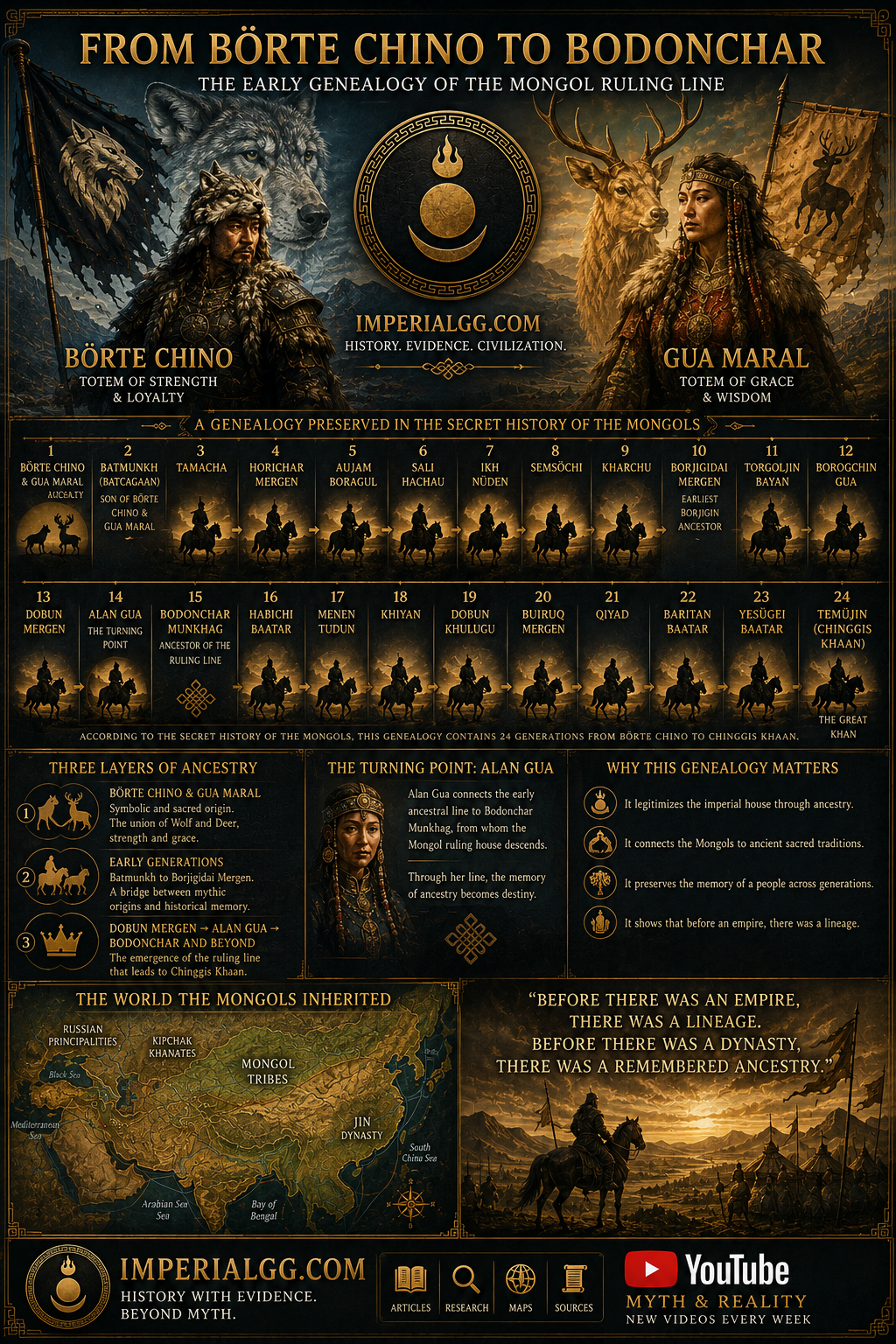
FROM BÖRTE CHINO TO BODONCHAR: THE EARLY GENEALOGY OF THE MONGOL RULING LINE
The Secret History of the Mongols does not move directly from the ancestral pair Börte Chino and Gua Maral to the historical Mongol rulers. Instead, it preserves a long chain of successive generations.
According to the opening genealogy, their son was Batmunkh (Batcaγan), followed by Tamacha, Horichar Mergen, Aujam Boragul, Sali Hachau, Ikh Nüden, Semsöchi, and Kharchu. The genealogy then reaches Borjigidai Mergen, one of the earliest figures explicitly associated with the Borjigin lineage.
This sequence is important because the Secret History presents ancestry not as an isolated legend, but as a continuous chain of descent. The early names form a bridge between the symbolic ancestral world of Börte Chino and Gua Maral and the later historical lineage of the Mongol ruling house.
With Borjigidai Mergen, the genealogy becomes more detailed. His wife is named Mongoljin Gua, and their son is Torgolj in Bayan. Torgoljin Bayan is then associated with Borogchin Gua, and their lineage continues toward Dobun Mergen and Alan Gua.
The appearance of Alan Gua is particularly significant. Her story marks another major transition in the genealogy: from the remembered ancestry of early generations toward the emergence of Bodonchar Munkhag, whose descendants eventually form the ruling line from which Chinggis Khan emerges.
Thus, the opening genealogy can be understood as a gradual movement through three layers:
BÖRTE CHINO & GUA MARAL
ancestral and symbolic origin
↓
EARLY GENERATIONS
Batcaγan → Tamacha → Horichar → … → Borjigidai
↓
DOBUN MERGEN → ALAN GUA → BODONCHAR
the emergence of the later ruling lineage
The significance of this structure is that Chinggis Khan’s legitimacy is presented through ancestry and continuity, rather than beginning with his own lifetime.
The Secret History therefore asks the reader to look backward before looking forward: before there was an empire, there was a lineage; before there was a dynasty, there was a remembered ancestry.
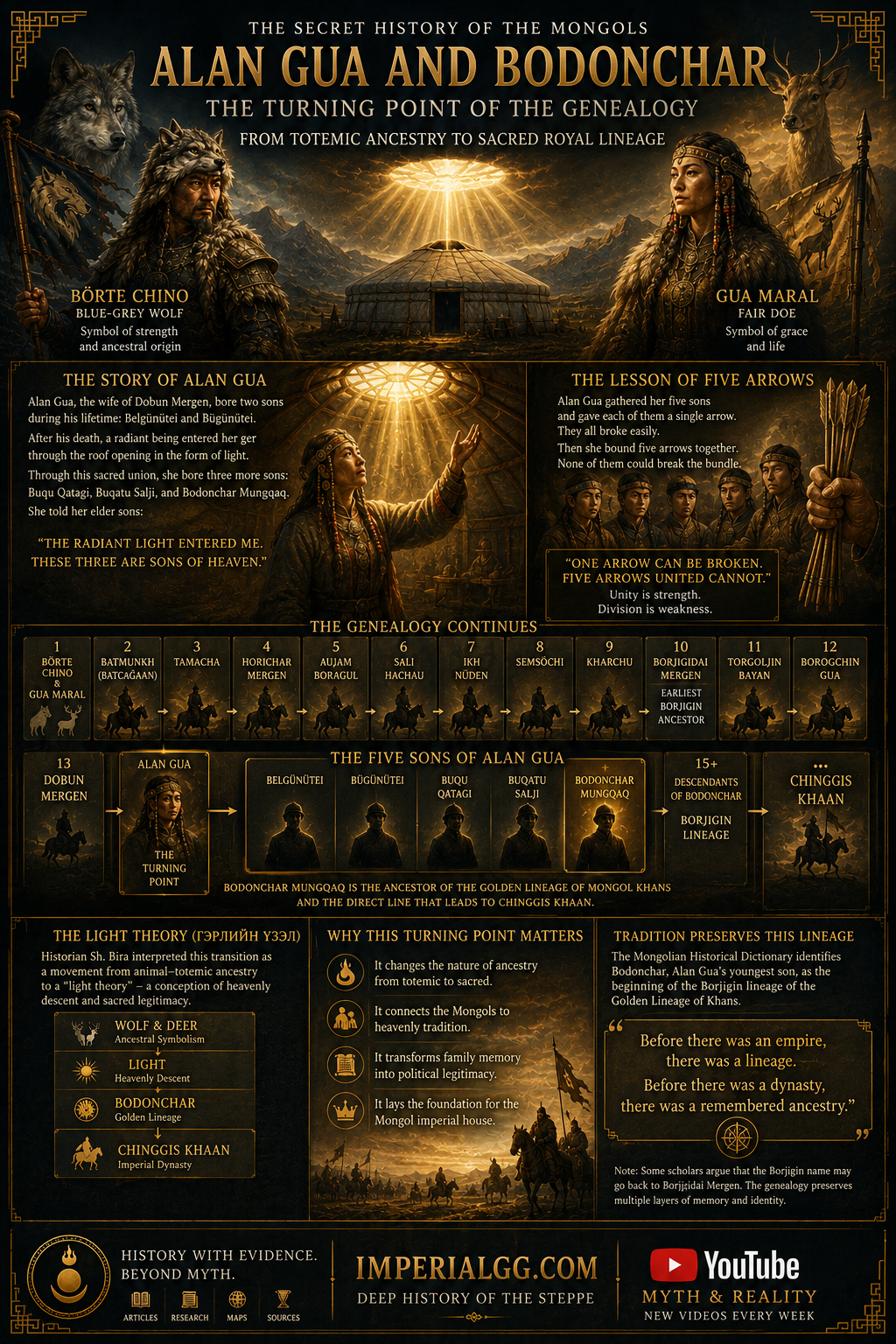
ALAN GUA AND BODONCHAR: THE TURNING POINT OF THE GENEALOGY
The genealogy of the Secret History of the Mongols reaches a decisive turning point with Alan Gua and her youngest son, Bodonchar Mungqaq.
Alan Gua was the wife of Dobun Mergen. During Dobun Mergen’s lifetime, she bore two sons, Belgünütei and Bügünütei. After his death, she gave birth to three more sons—Buqu Qatagi, Buqatu Salji, and Bodonchar. The two elder sons questioned the origin of their younger brothers, since their father was already dead. Alan Gua responded with the famous account of a radiant figure entering her ger through the roof opening and declared that the three younger sons were “sons of Heaven.”
Yet Mongolian scholarship has long recognized that this episode may preserve a deeper historical memory.
One interpretation holds that among early Mongolian aristocratic communities, when a man died and left a widow, an aristocratic male of the ruling or Golden Lineage could be designated to continue the deceased man’s lineage. Such a man was said to visit the widow discreetly, traditionally around dawn, so that the continuation of the lineage remained protected. This interpretation provides a possible social background for the otherwise mysterious conception of Alan Gua’s three younger sons.
This does not prove that a particular historical man was the father of Buqu Qatagi, Buqatu Salji, and Bodonchar. The Secret History deliberately preserves the father’s identity in symbolic language. What matters is that the narrative itself emphasizes that these sons were not ordinary descendants, but belonged to a special ancestral line.
Here the interpretation of academician Sh. Bira becomes important. Bira connected the story with the ancient steppe conception of heavenly rulership, noting that Xiongnu rulers were described as being “born of Heaven” and associated with Heaven, Earth, the sun, and the moon. He argued that the “theory of light” (гэрлийн үзэл) represented a more developed and abstract form of thought than earlier totemic concepts, and that it was closely connected with the idea of the ruler as the “Son of Heaven.”
This creates an important progression in the genealogy:
WOLF & DEER
totemic ancestry
↓
LIGHT & HEAVEN
sacred and aristocratic ancestry
↓
BODONCHAR
the emerging ruling lineage
↓
CHINGGIS KHAN
the imperial house
The story therefore may preserve two layers at once. On one level, it is a sacred genealogy explaining the heavenly origin of a royal lineage. On another, it may preserve a memory of an older social institution in which the continuation of an aristocratic bloodline was considered important enough to be protected even after the death of its male head.
Alan Gua’s story thus stands at the intersection of myth, social memory, and political legitimacy.
The Secret History does not tell us who the mysterious visitor actually was. But its choice of light, Heaven, secrecy, and royal ancestry is significant. By the time of Chinggis Khan, this ancestral memory had become part of the ideological foundation of the ruling house.
The wolf and deer represent the ancient language of ancestry.
The light represents the language of Heaven.
Bodonchar represents the lineage that carries that memory forward.
AUTHOR’S THESIS
What makes Alan Gua remarkable is not merely the lesson itself, but the way she taught it.
She transformed an abstract political principle—unity—into something her children could see, test, and experience for themselves. Rather than demanding obedience through authority, she created a simple physical demonstration that allowed her sons to discover the conclusion independently.
In this sense, Alan Gua appears not simply as an ancestral mother, but as a deliberate teacher of political intelligence.
Her lesson operates on several levels at once: family solidarity, protection of the lineage, cooperation among brothers, and the recognition that divided strength can be defeated while united strength becomes difficult to overcome.
This is particularly significant within the genealogy of the Mongol ruling house. The five sons were not merely children in a family story; they represented the potential branches of a future lineage. Alan Gua’s demonstration therefore functions as a lesson in how a lineage survives through unity.
The story of the radiant visitor and the story of the five arrows consequently belong together.
The first establishes sacred ancestry.
The second teaches social cohesion.
Together, they connect ancestry, legitimacy, and political intelligence.
Among her five sons, Bodonchar Mungqaq becomes especially important in the later genealogy. Through his descendants, the Secret History eventually reaches the ruling lineage associated with Chinggis Khan.
The genealogy can therefore be read as a progression:
BÖRTE CHINO & GUA MARAL
Wolf and Deer — ancestral symbolism
↓
ALAN GUA
Heavenly descent and political wisdom
↓
BODONCHAR
The lineage continues
↓
KHABUL KHAN
The emergence of political leadership
↓
YESÜGEI → TEMÜJIN
The historical Mongol ruling house
Alan Gua’s place in this genealogy is therefore unusually important. She does not merely give birth to another generation. She interprets ancestry, protects the continuity of the lineage, and teaches the principle of unity through an exceptionally concrete and memorable demonstration.
Whether read as historical memory, political allegory, or a combination of both, the five-arrow episode preserves an enduring image of Alan Gua as a woman who understood that a powerful lineage requires more than ancestry—it requires cohesion.
And perhaps that is the deeper meaning of her position in the Secret History:
A lineage may inherit blood.
A dynasty must learn how to remain united.
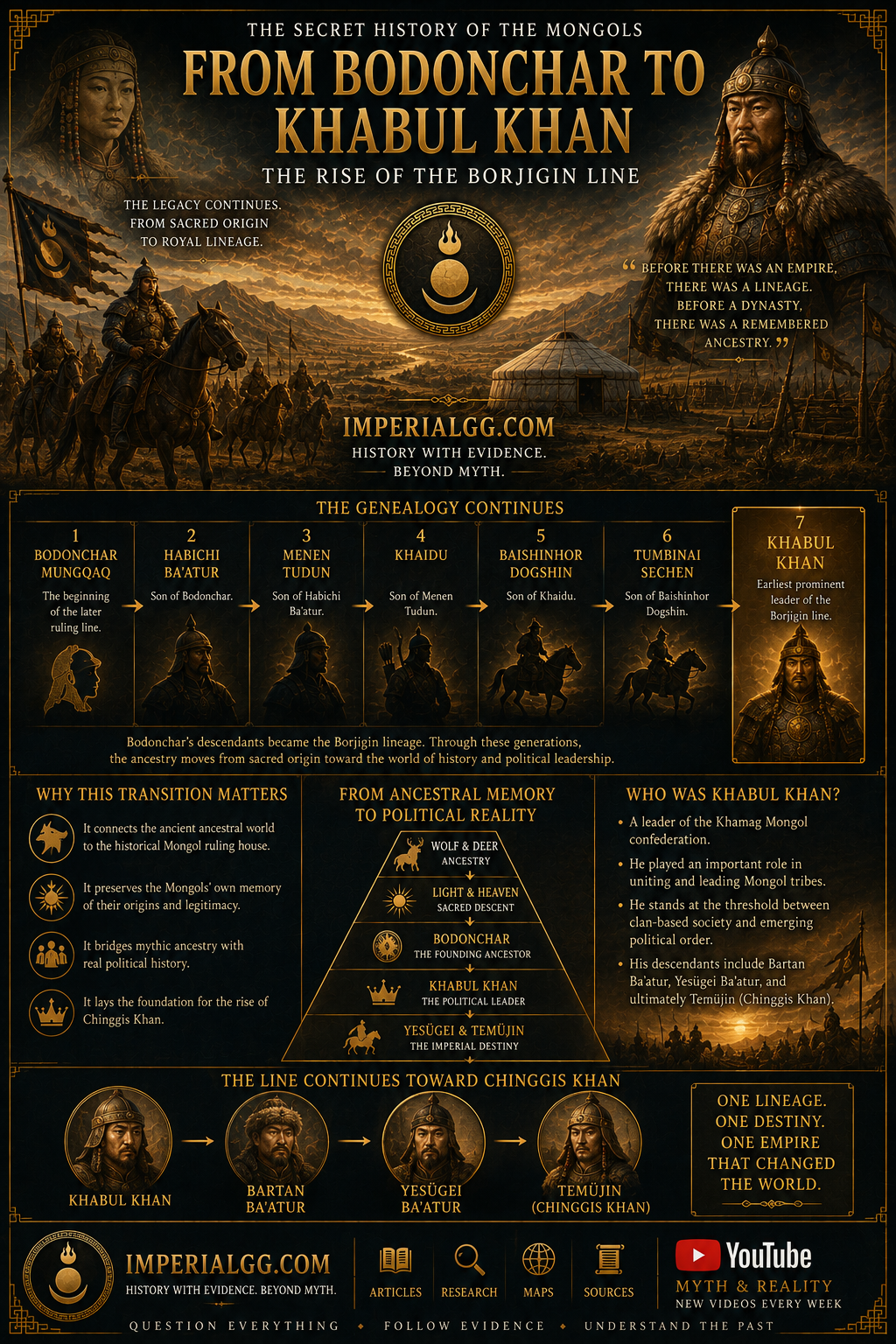
FROM BODONCHAR TO KHABUL KHAN: THE RISE OF THE BORJIGIN LINE
The story of Bodonchar Mungqaq marks the beginning of a new stage in the genealogy preserved by the Secret History of the Mongols. From this point onward, the narrative gradually moves away from the remote ancestral world and toward identifiable political ancestors of the Mongol ruling house.
The Secret History states that Bodonchar’s descendants became the Borjigin lineage. His son was Habichi Ba’atur, followed by Menen Tudun. Menen Tudun had several sons, and through one of these branches the genealogy continued through Khaidu, Baishinhor Dogshin, and Tumbinai Sechen.
With Tumbinai Sechen, the genealogy approaches a more recognizably political world. His descendants include Khabul Khan, who became one of the earliest historically prominent leaders of the Mongol ruling lineage. Khabul is traditionally associated with the Khamag Mongol confederation and stands much closer to the historical period in which the Mongol political order begins to take recognizable form.
The transformation can therefore be represented as:
BODONCHAR
ancestral foundation
↓
HABICHI BA’ATUR → MENEN TUDUN
the lineage continues
↓
KHAIDU → BAISHINHOR DOGSHIN → TUMBINAI SECHEN
the genealogy approaches the historical era
↓
KHABUL KHAN
the emergence of a political Mongol lineage
This transition is significant because the Secret History does not suddenly create the Mongol ruling house with Chinggis Khan. It constructs legitimacy through a long remembered chain of descent, gradually moving from ancestral and sacred narratives toward figures associated with actual political authority.
At the same time, the genealogy should not be treated as a modern genealogical register in which every generation can be independently verified. It is a medieval historical tradition that combines genealogy, oral memory, political legitimacy, and symbolic ancestry. The value of the sequence lies precisely in how it preserves the Mongols’ own understanding of their past.
By the time we reach Khabul Khan, the narrative is approaching the world immediately preceding the rise of Chinggis Khan.
From here, the line becomes much easier to follow:
KHABUL KHAN → BARTAN BA’ATUR → YESÜGEI BA’ATUR → TEMÜJIN
And this is where the ancestral narrative finally enters the historical life of Chinggis Khan.
The genealogy began with wolf and deer.
It passed through Heaven and Bodonchar.
It became a ruling lineage under Khabul Khan.
And one generation later, it reached Yesügei—and Temüjin.
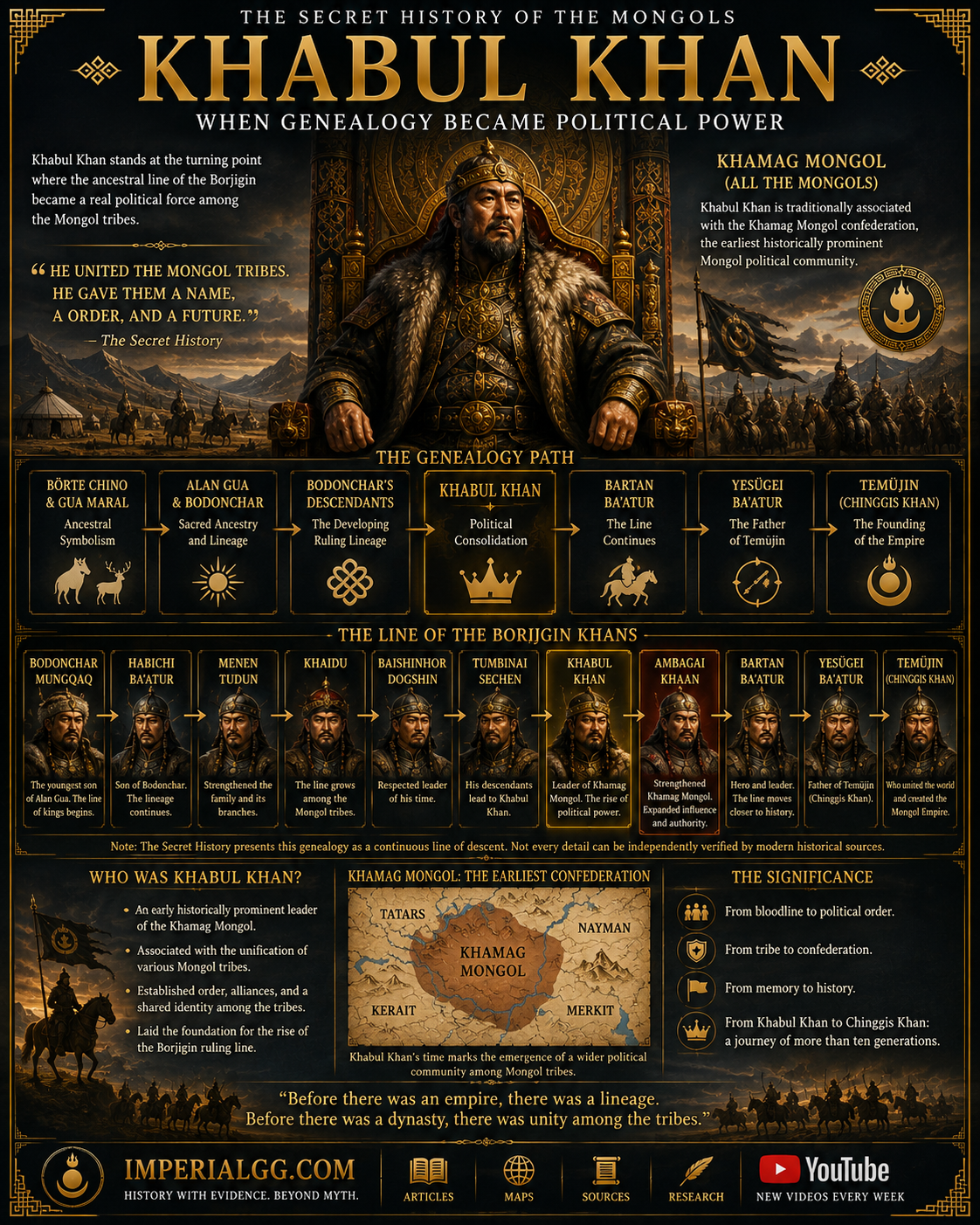
KHABUL KHAN: WHEN GENEALOGY BECAME POLITICAL POWER
The genealogy preserved in the Secret History of the Mongols gradually moves from ancestral memory into a world of identifiable political leaders. Khabul Khan stands at this important threshold.
According to the genealogical tradition, Khabul descended from Bodonchar Mungqaq through a succession of generations—Habichi Ba’atur, Menen Tudun, Khaidu, Baishinhor Dogshin, and Tumbinai Sechen. With Khabul, however, the genealogy is no longer concerned only with ancestry. It begins to describe a man associated with the political organization of the Mongol tribes.
Khabul Khan is traditionally associated with the Khamag Mongol (“All the Mongols”) confederation and is regarded as its earliest historically prominent khan. His importance lies not simply in his position within the Borjigin genealogy, but in the emergence of a wider political community around Mongol tribal groups.
This represents a fundamental transition:
BÖRTE CHINO & GUA MARAL
ancestral symbolism
↓
ALAN GUA & BODONCHAR
sacred ancestry and lineage
↓
BODONCHAR’S DESCENDANTS
the developing ruling lineage
↓
KHABUL KHAN
political consolidation
↓
BARTAN BA’ATUR → YESÜGEI BA’ATUR → TEMÜJIN
The importance of Khabul is therefore not that he suddenly “created” the Mongols. Rather, he represents a stage at which genealogical identity was becoming political organization.
The Secret History itself is particularly valuable here because it preserves a Mongol perspective on ancestry, leadership, social organization, and political legitimacy. Modern scholarship treats the work as the earliest surviving native Mongolian narrative source, while also recognizing that its genealogy combines historical memory with literary and ideological elements.
Khabul’s place in this sequence is consequently significant:
BODONCHAR gave the lineage continuity.
KHABUL gave the lineage political weight.
By the generation of Bartan Ba’atur and Yesügei Ba’atur, the genealogy is approaching the lifetime of the man who would transform that inherited political world: Temüjin.
And this is the final step before the story leaves genealogy behind and enters biography.
From Börte Chino to Khabul Khan, the story remembered where the lineage came from.
From Khabul to Yesügei, it began to show how that lineage exercised power.
With Temüjin, that lineage would become an empire.
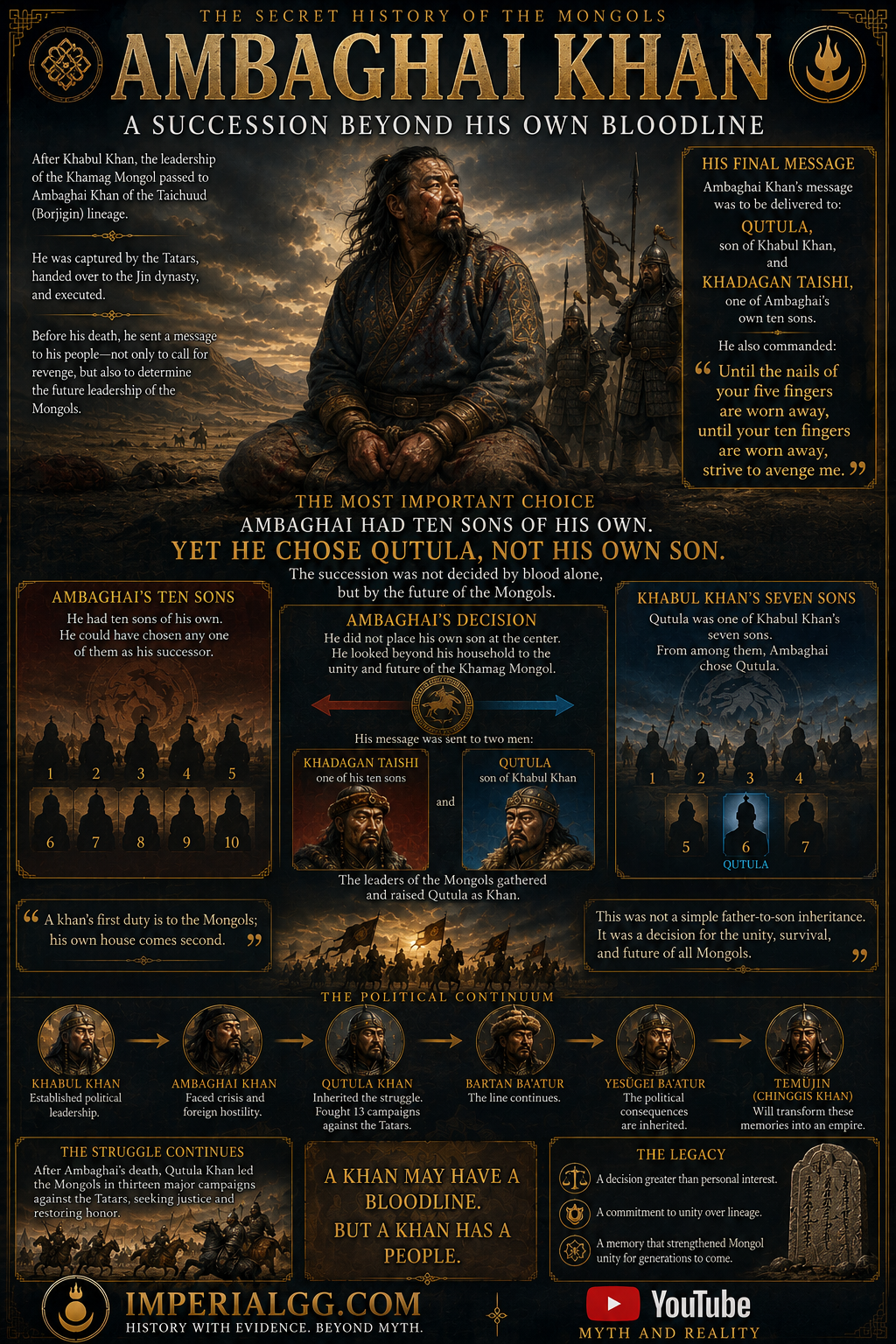
AMBAGHAI KHAN: WHEN A FATHER CHOSE THE NATION OVER HIS OWN SON
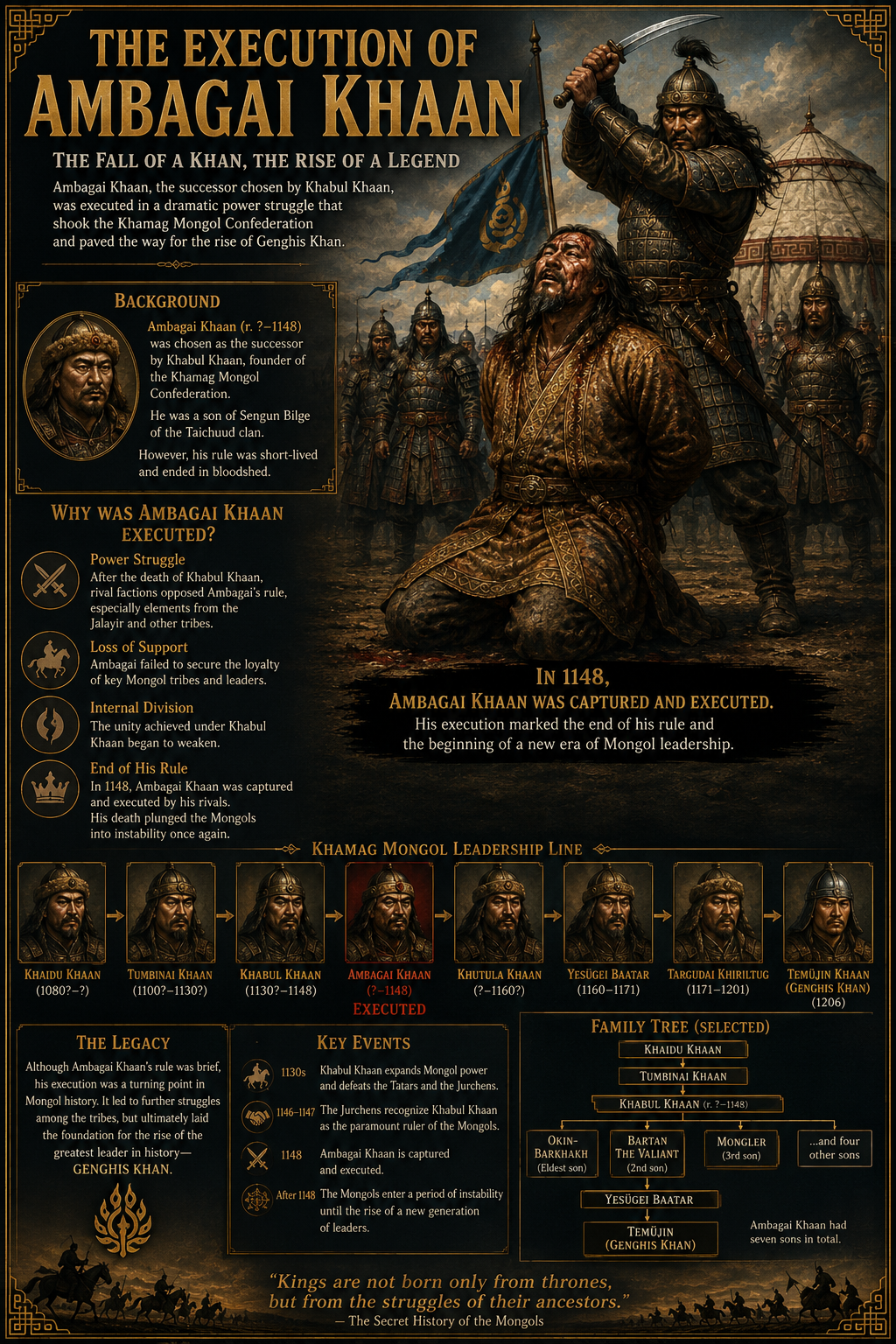
After Khabul Khan, the leadership of the Khamag Mongol passed to Ambaghai Khan, a member of the Taichuud branch of the ruling lineage. His reign ended tragically when he was captured by the Tatars, handed over to the Jin dynasty, and executed.
Before his death, however, Ambaghai sent an important message concerning the future of the Mongols. The Secret History of the Mongols records that his message was to be conveyed to Qutula, son of Khabul Khan, and Khadagan Taishi, one of Ambaghai’s own sons. The significance of this becomes clearer when we remember that Ambaghai had ten sons.
Yet the succession was not simply presented as the automatic inheritance of his position by one of those ten sons. Qutula, the son of the previous khan Khabul, stood alongside Khadagan in Ambaghai’s final instructions. This was followed by the gathering of the Mongol leaders, who eventually raised Qutula Khan to the khanship.
The episode reveals an important feature of early Mongol political organization. Leadership could operate through a combination of dynastic descent, aristocratic consensus, and the interests of the wider Mongol confederation, rather than through a simple father-to-son succession.
Ambaghai’s final words are therefore remembered in two connected contexts: the demand to avenge his execution by the Tatars, and the question of who would carry the political leadership of the Mongols forward.
His death did not end the struggle.
Khabul Khan → Ambaghai Khan → Qutula Khan
The lineage continued, but so did the political community that these khans represented. Qutula would become one of the principal leaders in the subsequent wars against the Tatars, carrying forward the memory of Ambaghai and the struggle of the Khamag Mongol. In this sense, Ambaghai’s final chapter occupies an important position between hereditary lineage and collective political authority. He belonged to one branch of the ruling family. He had ten sons.Yet the future khan was not simply determined by his own household.
The bloodline continued—but the khanship belonged to the Mongols.
AUTHOR’S THESIS
Ambaghai Khan’s final episode is one of the most tragic moments in the early history of the Mongols.
He had sent his daughter into marriage as a khan would normally do—seeking alliance, peace, and the continuation of his people. Yet the very political world in which that alliance was placed turned against him. He was deceived, captured by his enemies, handed over to the Jin authorities, and subjected to a cruel execution.
His personal tragedy, however, did not become merely a story of suffering.
Even in the face of death, Ambaghai’s final message looked beyond himself. He instructed his people to avenge his death, but his concern was also the future leadership and survival of the Mongols. He had ten sons of his own, yet the succession did not become simply a matter of preserving his own household.
This gives his final testament a deeper meaning.
The khan who had sent his daughter into a foreign marriage became the victim of the very political world he had trusted.
His death can therefore be read as a profound warning: a ruler may sacrifice personal happiness for diplomacy, but a people cannot survive if its political security depends upon the goodwill of its enemies.
In this sense, Ambaghai’s tragedy may have carried a final, unspoken lesson:
Let my death be the end of such trust.
Let the Mongols never again place their future in the hands of those who seek their submission.
The Secret History of the Mongols does not record these words as Ambaghai’s literal statement. They are an authorial interpretation of the meaning of his story. But the tragedy itself, his final command, and the succession that followed allow us to see Ambaghai as a figure standing at a critical moment between diplomatic marriage, political vulnerability, and the emerging consciousness of a wider Mongol community.
His body was destroyed by his enemies.
His lineage survived.
And his final command became part of the memory that was carried into the next generation.
Ambaghai did not live to see the Mongols united.
But his death became one of the memories through which that unity was forged.
QUTULA KHAN: THIRTEEN BATTLES FOR AMBAGHAI
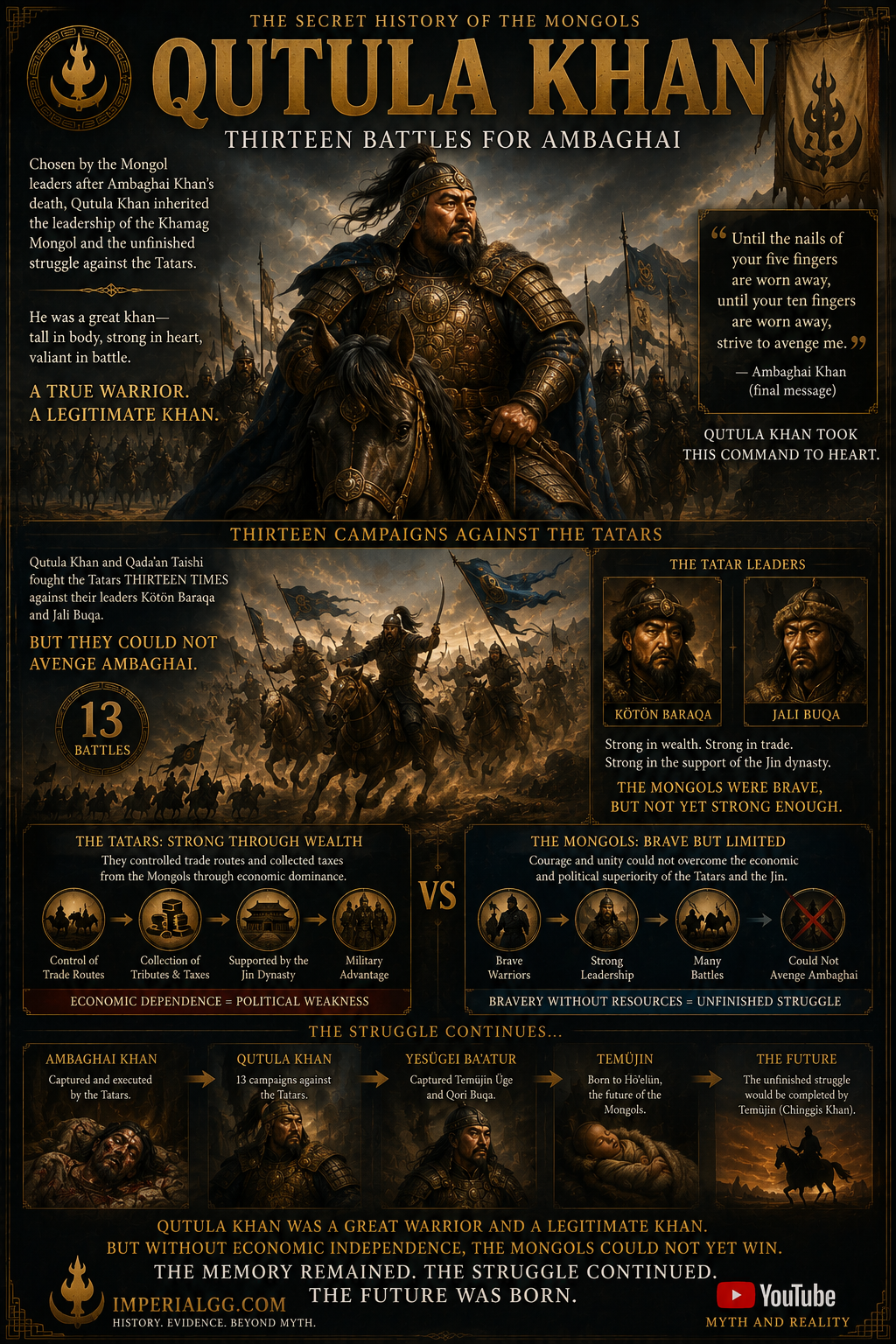
The death of Ambaghai Khan did not end the struggle he had commanded his people to continue. After Ambaghai was captured and executed, the Mongols and the Taichuud gathered at Qorqonaq Valley to determine their next khan. Ambaghai had named both Qutula, one of Khabul Khan’s sons, and Qada’an Taishi, one of his own ten sons. The assembled Mongol leaders ultimately raised Qutula Khan to the khanship.
Qutula therefore inherited more than a title. He inherited Ambaghai’s unfinished struggle. The Secret History of the Mongols records that Qutula and Qada’an went to war against the Tatars and fought them thirteen times, engaging the Tatar leaders Kötön Baraqa and Jali Buqa. Yet despite thirteen campaigns, they were unable to avenge the killing of Ambaghai. This makes Qutula’s reign one of the most tragic episodes in the early history of the Mongol political tradition.
He had inherited a united political cause, but not the power necessary to achieve it. The repeated campaigns reveal both the determination of the Mongols and the limits of their political and military organization at this stage. The Khamag Mongol was not yet the centralized empire that would emerge under Chinggis Khan; it remained a confederation whose political cohesion depended heavily upon the strength and authority of its leaders. Yet Qutula’s failure should not be understood simply as defeat.
The memory of Ambaghai continued. The struggle continued. And the political idea of a wider Mongol community acting together against a common enemy survived even when military victory remained out of reach.
The Secret History places another crucial event immediately after these campaigns: Yesügei Ba’atur captured the Tatar leaders Temüjin Üge and Qori Buqa, and around this same period Hö’elün gave birth to the child who would be named Temüjin.
Thus the narrative moves almost imperceptibly from one generation to another:
AMBAGHAI KHAN
Captured and executed
↓
QUTULA KHAN
Thirteen campaigns against the Tatars
↓
YESÜGEI BA’ATUR
The struggle enters a new generation
↓
TEMÜJIN
The child who would transform the unfinished struggle into an empire Qutula could not avenge Ambaghai. But the memory of Ambaghai did not disappear with him.
Thirteen battles failed to settle the old grievance.
The next generation would inherit the memory.
And eventually, Temüjin would inherit the world shaped by it.
BARTAN BA’ATUR: THE MAN BETWEEN QABUL AND YISÜGEI
LINEAGE, POLITICAL STATUS, AND THE HISTORICAL RECORD OF A PRE-CHINGGISID MONGOL NOBLE
By Altanbagana Baatar
DBA Candidate| Independent Historian
ImperialGG Historical Research Seriers
06 August 2026
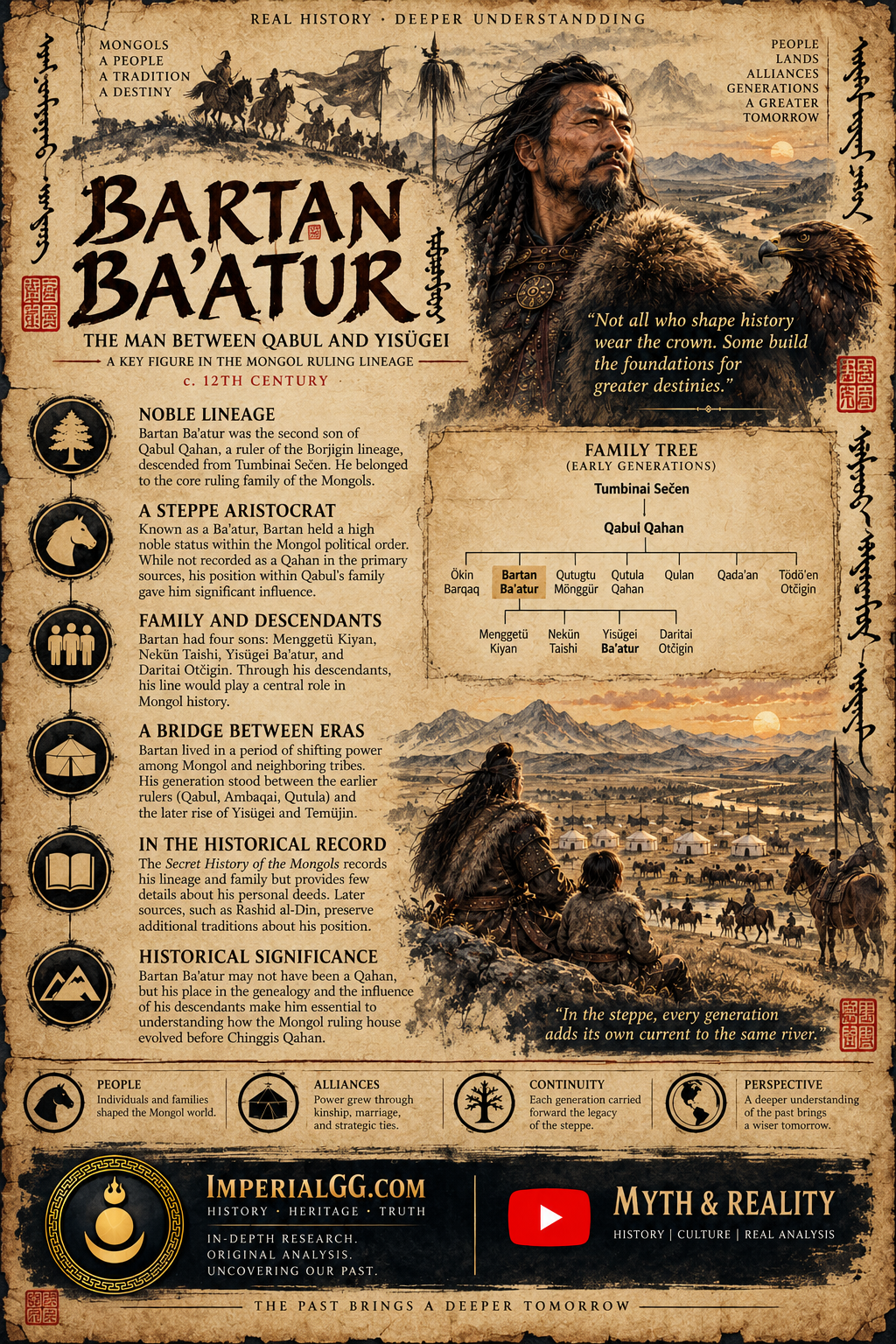
Bartan Ba’atur occupies an unusual position in the history of the pre-Chinggisid Mongols. He was neither a figure whom the Secret History of the Mongols presents as a Qahan nor a ruler whose deeds are narrated at length. Yet he cannot be omitted from the political history of the Mongols. His name stands within the ruling lineage descended from Qabul Qahan, and the surviving genealogical traditions place him at a critical point between the generation of Qabul and Qutula and the generation of Yisügei Ba’atur. The historical problem surrounding Bartan is therefore not that he is unimportant, but that the surviving sources preserve considerably more information about his position in the genealogy than about his individual actions.
For that reason, Bartan Ba’atur should be studied neither as a forgotten Qahan nor merely as “the grandfather of Chinggis Qahan.” He deserves examination as a political figure in his own right, with careful distinction between what the sources explicitly record, what later genealogical traditions claim, and what remains unknown.
EARLY LIFE AND FAMILY BACKGROUND
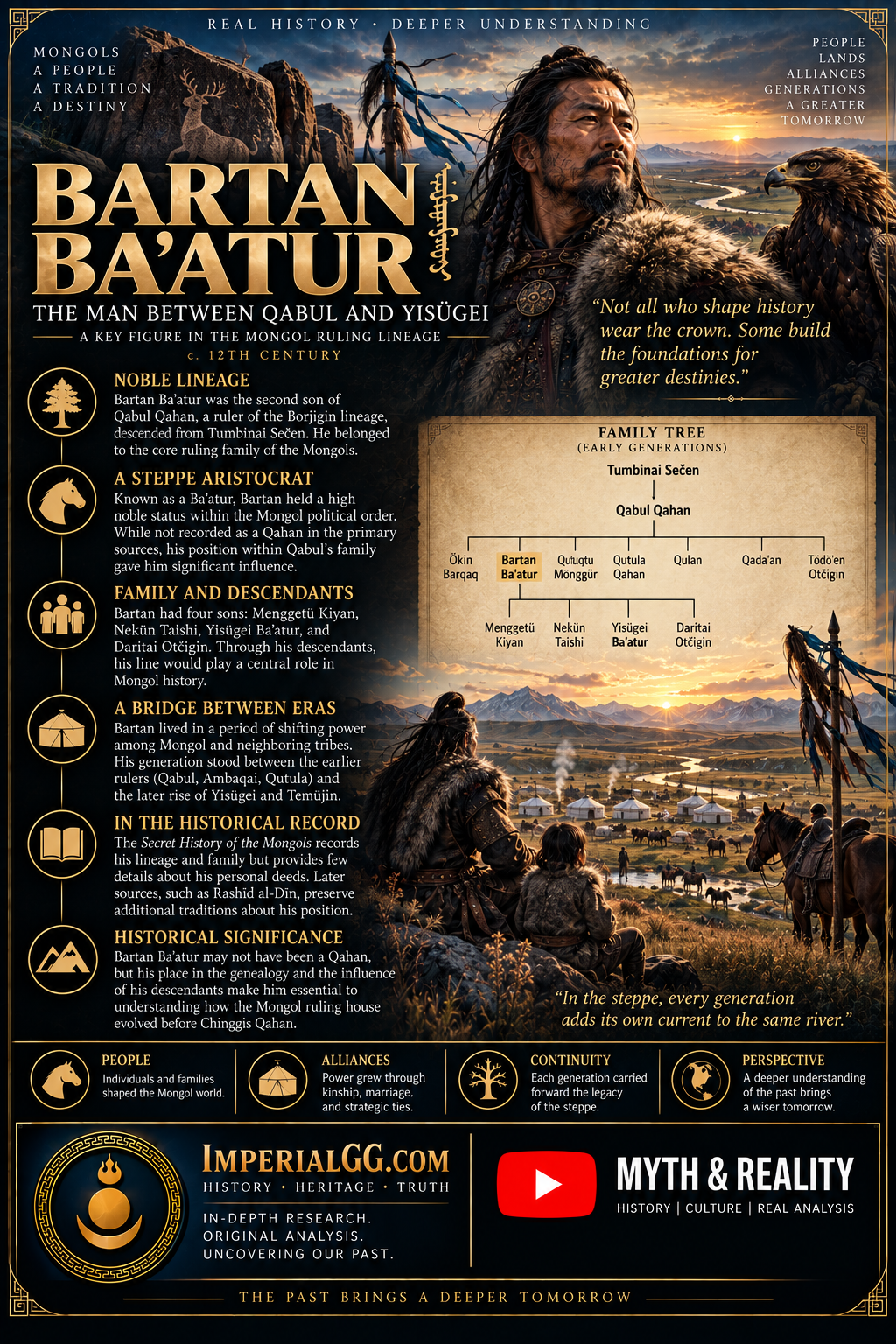
Bartan Ba’atur belonged to the Borjigin ruling lineage. The Secret History of the Mongols places him among the sons of Qabul Qahan, identifying Qabul as the son of Tumbinai Sečen. Qabul had seven sons, listed as Ökin Barqaq, Bartan Ba’atur, Qutuqtu Mönggür, Qutula Qahan, Qulan, Qada’an, and Tödö’en Otčigin. Bartan was therefore the second son of Qabul Qahan, not his successor in a simple father-to-son political sequence.¹
This distinction is fundamental. Qabul’s sons belonged to the same powerful ruling family, but their political positions were not identical. The Secret History explicitly identifies Qabul as Qahan and later identifies Qutula as Qahan, while Bartan is consistently called Ba’atur rather than Qahan. The surviving evidence therefore does not justify treating Bartan as another Qahan merely because he was Qabul’s son.²
The title Ba’atur itself is significant. It was an honorific associated with valor and martial distinction in the political culture of the steppe. In Bartan’s case, however, the source gives the title without narrating the particular military achievement through which he supposedly earned it. We should therefore preserve the title while resisting the temptation to manufacture a biography around it.³
BARTAN’S POSITION IN THE MONGOL POLITICAL ORDER
Bartan lived during a period in which political authority among the Mongols was already organized through a hierarchy of ruling lineages, aristocratic families, military leaders, and assemblies, but before Chinggis Qahan transformed that political order into a new imperial system.
His position must therefore be understood within the wider family of Qabul rather than through the later model of a strictly hereditary throne. Qabul had seven sons, yet after his death the Secret History does not say that Bartan, as the second son, automatically inherited the position of Qahan. Instead, §52 states that Ambaqai Qahan, son of Senggüm Bilge, became ruler of the Mongols according to Qabul’s will. After Ambaqai’s capture, the Mongols and Tayichi’ut gathered and chose Qutula Qahan.⁴
This political sequence is essential for understanding Bartan. His position within Qabul’s family gave him considerable genealogical importance, but seniority within the ruling family did not itself guarantee the Qahanate. Bartan consequently belongs to a generation in which political authority was negotiated among powerful lineages rather than transmitted automatically from father to eldest or second son.
This is one reason why Bartan should not be inserted artificially into the succession as though the political sequence were:
Qabul → Bartan → Qutula.
The sources do not support that reconstruction as a straightforward succession of Qahans.
THE HISTORICAL RECORD OF BARTAN
The most important characteristic of Bartan’s biography is the scarcity of direct narrative.
The Secret History provides his place in the genealogy and then records his four sons: Menggetü Kiyan, Nekün Taishi, Yisügei Ba’atur, and Daritai Otčigin. It does not preserve a long account of Bartan’s campaigns, political decisions, captivity, death, or speeches comparable to those preserved for Ambaqai, Qutula, or later Yisügei.⁵
This silence cannot be treated simply as evidence that Bartan accomplished nothing. The Secret History is not a modern biography and does not attempt to provide equal narrative coverage of every member of the ruling aristocracy. Its genealogical sections frequently preserve names and relationships that are not accompanied by individual biographies.
Indeed, the later historian Rashīd al-Dīn explicitly treated the descendants of Bartan as worthy of separate treatment. In the Jāmiʿ al-Tawārīkh, Bartan Bahādur is identified as a son of Qabul Khan, and the history announces a separate account concerning Bartan and his sons.⁶
That is important evidence. Bartan was not merely an accidental name preserved in a genealogy. By the Ilkhanid period, his lineage was recognized as a distinct and historically significant branch of the Chinggisid ancestral tradition.
BARTAN AS A FATHER
The clearest personal information concerning Bartan concerns his household. The Secret History records four sons: Menggetü Kiyan → Nekün Taishi → Yisügei Ba’atur → Daritai Otčigin. It also identifies their mother as Süjigil, described as the daughter of a Mongol Targut woman of the Tayichi’ut.⁷
This information gives Bartan a clearly identifiable position within the political genealogy of the Mongols. His household was not an incidental branch of the Borjigin family. Through his sons, particularly Yisügei, Bartan’s line became one of the principal surviving branches through which the later Chinggisid genealogy was remembered.
Yet even here caution is necessary. The importance of Bartan’s descendants should not be projected backward onto Bartan himself. We should not assume that because his grandson eventually became Chinggis Qahan, Bartan himself must have possessed the same political authority. Historical significance and political status are not the same thing.
THE QUESTION OF WHETHER BARTAN SUCCEEDED QABUL
One of the most important problems in Bartan’s biography emerges when different genealogical traditions are compared. The Secret History of the Mongols clearly presents Qabul → Ambaqai → Qutula as the major political sequence. Bartan is one of Qabul’s sons, but is not called Qahan in this sequence.⁸
Other traditions, however, preserve a different conception of the relationship between Qabul and Bartan. Christopher P. Atwood’s study of the pre-Chinggisid genealogical traditions demonstrates that multiple genealogies circulated within the Mongol imperial world and that they did not always agree. One such tradition presents Bartan as succeeding Qabul, while another genealogical tradition preserves the lineage Qabul → Bartan → Yisügei.⁹
This does not mean that Bartan should simply be declared the successor of Qabul. Rather, it demonstrates that different historical traditions remembered the political structure of the pre-Chinggisid Mongols differently. Some genealogies compressed political history into ancestral succession, while the Secret History preserves a more complicated political sequence in which Ambaqai and Qutula occupy the Qahanate.
This distinction is particularly important because later genealogical texts were often concerned with establishing legitimate lines of descent. Genealogy and political succession could therefore become intertwined, even when they were not originally identical.
BARTAN IN THE SOURCES OF THE MONGOL EMPIRE
The problem becomes even more interesting when the sources of the Mongol imperial period are compared. Atwood demonstrates that several different written genealogies of the pre-Chinggisid Mongols circulated during the Mongol Empire. In one tradition, Bartan appears as an ancestor directly between Qabul and Yisügei. Atwood also points out that the Shengwu qinzheng lu preserves evidence in which Bartan Ba’atur is associated with descendants who elsewhere are assigned differently, showing that genealogical traditions were not completely fixed.¹⁰
This has a direct implication for Bartan’s biography: the surviving sources tell us more securely who Bartan was related to than exactly what political office he exercised. That is not a weakness of the research. It is the historical evidence. A responsible biography therefore has to resist filling the silence with invented campaigns, invented titles, invented dates, or imagined political achievements.
BARTAN’S HISTORICAL SIGNIFICANCE
Bartan Ba’atur’s importance rests on three connected facts. First, he was a son of Qabul Qahan, one of the major pre-Chinggisid Mongol rulers. Second, he himself occupied a recognized aristocratic position marked by the title Ba’atur. Third, he became the father of a generation that included Yisügei Ba’atur, through whom the genealogy reached Temüjin.
The later historical memory of Bartan consequently became inseparable from the formation of the Chinggisid ancestral line. Rashīd al-Dīn explicitly describes Bartan as the grandfather of Chinggis and devotes a separate section to his branch of the family.¹¹
But the proper historical conclusion is more precise than simply calling him “the grandfather of Chinggis Khan.”
Bartan represents the political generation between the early Qabul-Ambaqai-Qutula order and the generation of Yisügei. His life belongs to a period in which the Mongol political community was already structured around competing but interconnected aristocratic lineages, in which Qahan authority was not necessarily inherited automatically, and in which individual Ba’atur figures could possess substantial standing without being Qahan.
His historical importance therefore lies not only in whom he descended from or whom he fathered, but in what his position reveals about the political organization of the Mongols before Temüjin.
WHAT WE CAN AND CANNOT KNOW ABOUT BARTAN
The evidence permits several conclusions with reasonable confidence. Bartan was a son of Qabul Qahan. He was the second of Qabul’s seven sons in the Secret History. He bore the title Ba’atur. He had four sons, among them Yisügei Ba’atur. His family constituted a significant branch of the ruling lineage later remembered by Mongol historians.¹²
What the evidence does not securely establish is equally important. We do not possess a reliable contemporary biography giving Bartan’s birth date, death date, major campaigns, territorial administration, or a definitive period during which he held the supreme Qahanate. Nor should his place in some later genealogies be converted automatically into proof that he politically succeeded Qabul.
The result is a biography that is necessarily more restrained than those of Qabul, Ambaqai, Qutula, or Yisügei. That restraint is not an omission. It is the correct response to the character of the sources.
CONCLUSION
Bartan Ba’atur was a member of the ruling Borjigin generation that stood between Qabul Qahan and the later generation of Yisügei Ba’atur. The Secret History of the Mongols preserves him primarily through genealogy: as the second son of Qabul and the father of four sons, including Yisügei. It does not give him the title Qahan, nor does it provide a detailed narrative of his political career.¹³
Later Mongol historical traditions, however, preserve a more complex memory of Bartan and his place in the ancestral succession. The existence of these divergent genealogies demonstrates that the political and genealogical history of the pre-Chinggisid Mongols cannot be reduced to a single uncomplicated line of succession.¹⁴
Bartan should therefore be remembered neither as a forgotten Qahan nor merely as an ancestor of a more famous man. He was Bartan Ba’atur, a member of the Qabulid ruling family and an important figure in the aristocratic political order from which the later Mongol Empire emerged. The limited nature of the surviving record is itself part of his history: we know his place, his lineage, and his family with considerable confidence, while the details of his individual political career remain largely beyond recovery.
That boundary between what the sources preserve and what they do not preserve is precisely where a serious history of the pre-Chinggisid Mongols must begin.
NOTES
1. The Secret History of the Mongols, §48. In Christopher P. Atwood’s recent translation, Qabul Qahan is identified as the son of Tumbinai Sečen, and his seven sons are listed with Bartan Ba’atur as the second. The same genealogical sequence is preserved in other translations of the Secret History.
2. The distinction is visible directly in the terminology of the Secret History: Qabul is Qahan, Qutula is Qahan, while Bartan is Ba’atur. The source therefore does not support silently upgrading Bartan’s title.
3. On the historical use of ba’atur/baghatur as an honorific associated with valor and martial status, see the discussion summarized in the reference material on the title. The existence of the title does not by itself establish a particular military achievement for Bartan.
4. The political sequence is given in The Secret History of the Mongols, §§52–58: Ambaqai becomes Qahan after Qabul; after Ambaqai’s capture, Qutula is made Qahan by the Mongols and Tayichi’ut. This is why Bartan should not be inserted into the sequence as an automatic Qahan.
5. Secret History of the Mongols, §§48–50. Bartan’s principal appearance in the early genealogy is his position among Qabul’s sons and his four sons.
6. Rashīd al-Dīn, Jāmiʿ al-Tawārīkh, section on Bartan Bahādur. The surviving translation explicitly introduces a separate account of Bartan Bahādur and his sons.
7. Secret History of the Mongols, §50. The text names Menggetü Kiyan, Nekün Taishi, Yisügei Ba’atur, and Daritai Otčigin as Bartan’s four sons and identifies their mother as Süjigil.
8. The Secret History is explicit about Ambaqai and Qutula as Qahans. This is the principal reason for distinguishing the political succession from the genealogical relationship among Qabul’s descendants.
9. Christopher P. Atwood, “Six Pre-Chinggisid Genealogies in the Mongol Empire.” Atwood’s central argument is that multiple written genealogical traditions circulated in the Mongol imperial period and that they cannot simply be collapsed into one supposedly immutable genealogy.
10. Atwood discusses the Shengwu qinzheng lu tradition in which Bartan Ba’atur appears in a genealogical context differing from the later Yuan shi version. He notes that the parallel in Rashīd al-Dīn preserves the form Bartān Bahādur, helping establish the reading Bartan rather than a later altered form.
11. Rashīd al-Dīn explicitly identifies Bartan as Chinggis’s grandfather and treats Bartan and his sons in a separate genealogical section.
12. For the genealogical structure, see the Secret History §§48–50 and the genealogy reproduced in modern scholarly editions.
13. This is an important methodological point: absence of a detailed narrative should not be converted into either an assertion of insignificance or an invented biography.
14. Atwood’s study is particularly useful here because it demonstrates that the pre-Chinggisid genealogical traditions were plural and sometimes contradictory. The existence of these variants is evidence for the historical development of Mongol genealogical memory itself.
YESÜGEI BA'ATUR: THE MAN BETWEEN TWO GENERATIONS
The death of Qutula Khan marked the end of another difficult chapter in the early history of the Mongols.Qutula had inherited the struggle left by Ambaghai Khan and fought the Tatars thirteen times. Yet the Mongols remained politically divided, and the long conflict had not produced a decisive victory. Into this unsettled world emerged Yesügei Ba’atur.
Yesügei belonged to the Borjigin lineage descending from Bodonchar Mungqaq. His father, Bartan Ba’atur, was a son of Khabul Khan. Through this lineage, Yesügei stood directly within the ruling ancestry that had produced Khabul and Qutula. But Yesügei’s historical importance was not simply genealogical.
He was a warrior and political leader operating in a period when the Mongol tribes were still organized through shifting alliances, rivalries, and personal loyalties. He participated in conflicts with neighboring peoples and captured the Tatar leaders Temüjin Üge and Qori Buqa. It was during this period that Yesügei’s own son was born.
According to the Secret History of the Mongols, Yesügei returned from his campaign after encountering the captured Tatar leader Temüjin Üge. At that moment, Hö’elün had given birth to a boy. Because the birth coincided with the capture of the Tatar leader, the child was named Temüjin. The coincidence is central to the narrative. A name associated with an enemy captured by Yesügei became the name of the child who would eventually transform the political world of the Mongols.
Thus the genealogy reaches another decisive transition:
BÖRTE CHINO & GUA MARAL
ancestral memory
↓
ALAN GUA & BODONCHAR
sacred ancestry and lineage
↓
KHABUL KHAN
political consolidation
↓
AMBAGHAI KHAN
crisis, sacrifice, and succession
↓
QUTULA KHAN
thirteen campaigns against the Tatars
↓
YESÜGEI BA’ATUR
the inherited political world
↓
TEMÜJIN
the beginning of a new era
Yesügei therefore occupies a unique position in the story. He did not create the Mongol Empire. He did not possess the political power that Temüjin would later command. But he inherited a fragmented political tradition and transmitted its lineage, memories, alliances, conflicts, and ambitions to the next generation. His life also reminds us that the rise of Chinggis Khan did not begin with the famous kurultai of 1206. It began much earlier—with generations of Mongol leaders struggling to maintain political unity in a world dominated by tribal competition, warfare, diplomacy, and economic pressure.
Yesügei was the last major link before that world passed into the hands of his son.
Khabul built political authority.
Ambaghai paid for it with his life.
Qutula fought to preserve it.
Yesügei carried its legacy.
Temüjin would transform it.
The next chapter is therefore no longer simply about genealogy.
It is about the childhood of the man who would turn this unfinished political tradition into an empire.
AUTHOR’S THESIS: TWO FATHERS, TWO TRAGEDIES
The tragedy of Ambaghai Khan was followed by an almost haunting repetition in the life of Yesügei Ba’atur.
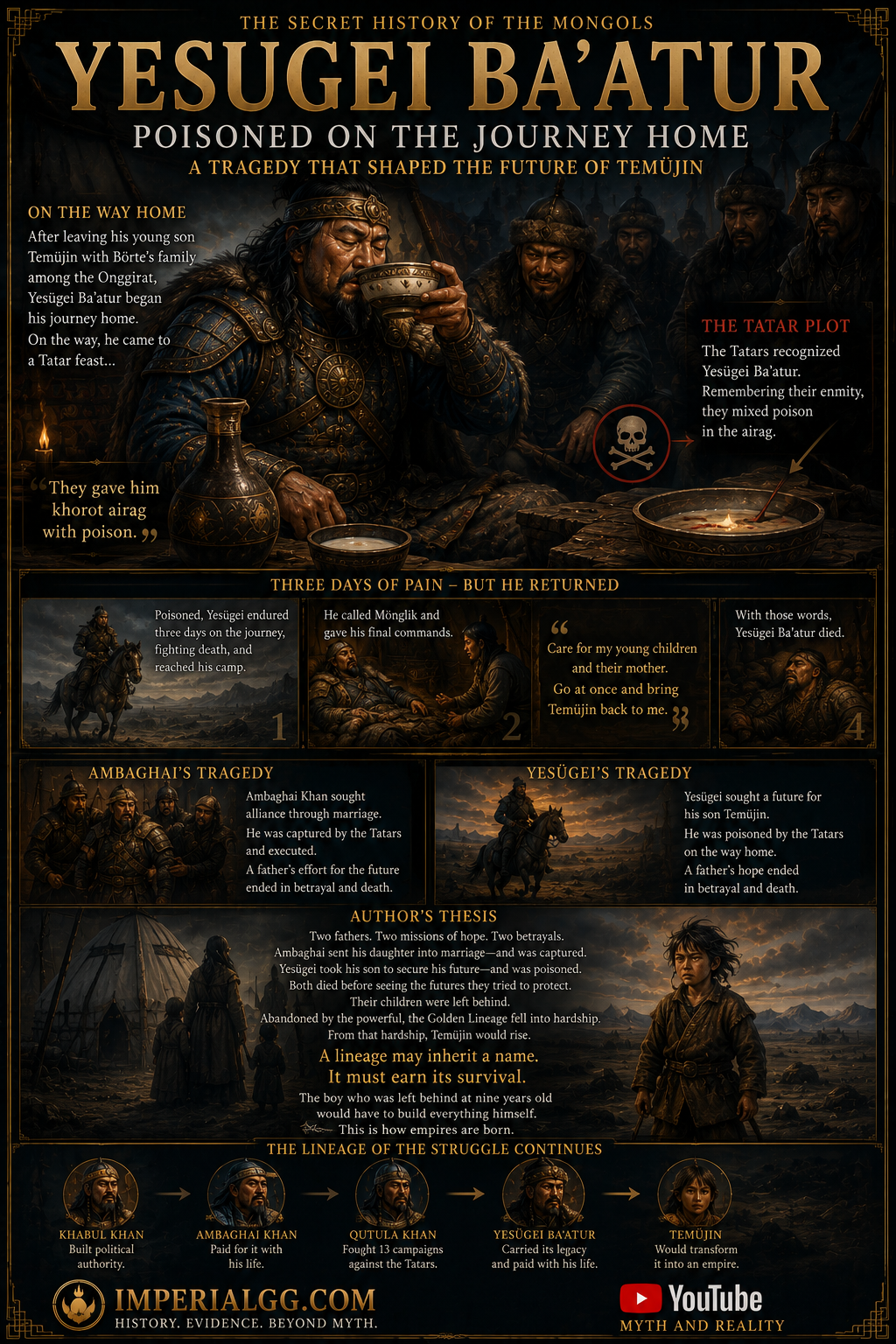
Ambaghai was captured by his enemies in the course of a marriage alliance and died a humiliating death at their hands. A generation later, Yesügei took his young son Temüjin to the Onggirat and arranged his future marriage with Börte, leaving the boy with his future in-laws before beginning the journey home. On the way, Yesügei encountered a Tatar feast. The Tatars recognized him, remembered their former enmity, and secretly mixed poison into his food.
Yesügei was able to survive the journey home for three days. But he would never see his son again. When he reached his camp, already dying, he called Mönglik and gave him his final command: care for his young children and their widowed mother, and go immediately to bring Temüjin back. With those words, Yesügei died.
This creates one of the most painful parallels in the early Mongol genealogy.
AMBAGHAI SENT HIS DAUGHTER INTO A MARRIAGE ALLIANCE —
AND WAS CAPTURED BY THE ENEMY.
YESÜGEI TOOK HIS SON TO ARRANGE HIS FUTURE —
AND WAS POISONED ON THE JOURNEY HOME.
Both men attempted to secure the future of their families and their political community through relationships beyond their immediate household. Both instead became victims of the hostile world in which those relationships operated. But Yesügei’s tragedy went even further. He did not die surrounded by his son. He died knowing that his children were still very young and that his wife would soon be left without him. His final concern was therefore not revenge alone. It was the survival of his family. Yet what followed was even more devastating.
After Yesügei’s death, his family lost the political protection of its patriarch. The wider group abandoned Hö’elün and her children, leaving them to survive with extremely limited resources. The family that had belonged to a ruling lineage was suddenly forced into poverty and isolation. This is where the tragedy becomes historically significant.
The Golden Lineage was no longer protected by the power of its own lineage.
The descendants of the great khans had to survive through their own strength, intelligence, endurance, and ability to build alliances. That experience would profoundly shape the world into which Temüjin grew. Ambaghai’s final lesson had been about the survival of the Mongols as a political community. Yesügei’s final command was about the survival of his children. Neither father lived to see the future they were trying to secure. But their deaths created the conditions in which a new generation had no choice but to learn one fundamental principle:
A lineage may inherit a name.
It must earn its survival.
And Temüjin would grow up in precisely that world—without the protection of a powerful father, without secure wealth, and without an established political army.
The boy who was left behind at nine years old would have to build everything himself.
YISÜGEI BA’ATUR: POLITICAL AUTHORITY, WARFARE, AND THE LAST YEARS OF A PRE-CHINGGISID MONGOL LEADER
By Altanbagana Baatar
DBA Candidate| Independent Historian
ImperialGG Historical Research Seriers
23 June 2026
LINEAGE, POLITICAL POSITION, FAMILY, AND DEATH IN THE HISTORICAL SOURCES
Yisügei Ba’atur occupies a central position in the history of the pre-Chinggisid Mongols, yet his historical identity requires careful separation from the later achievements of his son Temüjin. He was not Chinggis Qahan, nor does the Secret History of the Mongols consistently present him as a Qahan. He was Bartan Ba’atur’s third son, a member of the Borjigin ruling lineage, a military leader active during the struggles between the Mongols and Tatars, the husband of Hö’elün, and the father of Temüjin. His career ended abruptly when he was poisoned after leaving Temüjin with the Onggirat family as a prospective son-in-law.
The surviving sources allow a substantially clearer reconstruction of Yisügei than of his father Bartan, although they remain uneven. The Secret History provides several episodes from his adult life, while Rashīd al-Dīn and later Yuan-period traditions preserve additional genealogical and historical material. At the same time, some of the most memorable scenes in the Secret History—particularly the meeting with Dei Sečen—contain literary and epic elements that must be distinguished from the underlying historical event. De Rachewiltz specifically notes that this episode has no direct counterpart in Rashīd al-Dīn’s account and bears marks of later narrative enlargement.
EARLY LIFE AND LINEAGE
Yisügei was born into the Borjigin lineage descending from Qabul Qahan. The Secret History establishes the genealogy clearly: Qabul Qahan had seven sons, among them Bartan Ba’atur; Bartan in turn had four sons—Menggetü Kiyan, Nekün Taishi, Yisügei Ba’atur, and Daritai Otčigin. Yisügei was therefore the third son of Bartan.
This position is important because Yisügei did not emerge from an obscure branch of the Mongol aristocracy. His father belonged directly to the generation of Qabul Qahan’s sons, while his paternal uncles included Qutula Qahan and Qada’an. Yisügei consequently belonged to the same extended ruling house that had produced the principal pre-Chinggisid Qahans.
Yet genealogy should not be confused with political succession. The fact that Yisügei descended from Qabul did not automatically make him Qahan. The Secret History calls him Ba’atur, not Qahan. This distinction matters because some later traditions and modern histories have attempted to reconstruct a more formal political succession than the surviving evidence securely permits. A study of Mongol royal marriage traditions likewise notes that it is difficult to determine whether Yisügei should be described as the formal tribal chief of the Tayichi’ut, despite the frequency with which modern works give him that designation.
POLITICAL POSITION AND MILITARY ACTIVITY
Yisügei’s political importance is best understood through his military activity.
Following the capture of Ambaqai Qahan, Qutula Qahan and Qada’an led repeated campaigns against the Tatars in an attempt to avenge Ambaqai. The Secret History states that they fought the Tatars thirteen times without achieving their objective. Yisügei appears within this political-military environment as one of the important men of the Mongol side. His own subsequent actions demonstrate that he was not merely a genealogical member of the ruling family but an active participant in the warfare that characterized the Mongolian steppe during this period.
The most direct evidence comes in §59 of the Secret History, where Yisügei is described as having raided the Tatars and captured Temüjin-üge. It was during his return from this expedition that Hö’elün was pregnant with the future Chinggis Qahan. The text therefore links Yisügei’s military activity directly to the circumstances surrounding Temüjin’s birth.
This episode is historically important for another reason. It establishes that Yisügei’s relationship with the Tatars was not merely one of defensive warfare. The sources remember him as an active participant in raids and retaliatory violence. The later poisoning of Yisügei is explicitly connected in the Secret History with the Tatars’ memory of his previous raid against them.
HÖ’ELÜN AND THE FORMATION OF HIS HOUSEHOLD
Yisügei’s family life is closely connected with the political relationships of the eastern steppe. The Secret History records that Yisügei took Hö’elün after encountering her while she was travelling with her newly married husband, Čiledü. The episode belongs to the formative genealogy of the Borjigin family, although its literary presentation has generated considerable scholarly discussion. What can be established securely is that Hö’elün subsequently became Yisügei’s principal wife and the mother of Temüjin and his siblings.
By Hö’elün, Yisügei had four sons—Temüjin, Qasar, Qachi’un, and Temüge—and a daughter, Temülün. The Secret History gives their ages relative to one another when Temüjin was nine.
This household is historically important because Yisügei’s political position cannot be separated entirely from the alliances created through marriage. His marriage to Hö’elün connected his household to the Olqunu’ut, while his later arrangement concerning Temüjin connected his family with the Onggirat through Dei Sečen. Marriage in this context was not simply a private family matter. It could establish political relationships between communities.
THE JOURNEY TO FIND A WIFE FOR TEMÜJIN
One of the best-preserved episodes in Yisügei’s life concerns his decision to arrange a marriage for his nine-year-old son. When Temüjin was nine, Yisügei set out with him toward the Olqunu’ut, the maternal relatives of Hö’elün, intending to seek a bride for his son. On the journey they encountered Dei Sečen of the Onggirat between Chekcher and Chiqurgu. Dei Sečen persuaded Yisügei to consider his daughter Börte instead.
The Secret History presents the encounter in highly literary language, including Dei Sečen’s dream of a white gerfalcon carrying the sun and moon. De Rachewiltz warns that this section bears the marks of epic elaboration and has no direct counterpart in Rashīd al-Dīn’s account. This does not mean the underlying marriage arrangement is necessarily fictitious; rather, the narrative form must be distinguished from the historical core.
The historical core is clear: Yisügei agreed to leave Temüjin with Dei Sečen as a son-in-law, while Börte would later become Temüjin’s wife. Yisügei gave his spare horse as a pledge and departed alone. This decision was one of the final major acts recorded in Yisügei’s life.
THE LAST JOURNEY
The return journey from the Onggirat settlement transformed Yisügei’s life—and consequently the political circumstances of his family. At Šira Ke’er near Mount Čekčer, Yisügei encountered a group of Tatars celebrating a feast. He dismounted and joined them because he was thirsty. The Tatars recognized him as Yisügei Kiyan, remembering his earlier raid against them. According to the Secret History, they secretly mixed poison into his food. Yisügei subsequently became ill while travelling home. After three days he reached his own camp, where his condition deteriorated.
The Secret History then preserves one of the most important personal statements associated with him. Yisügei called Mönglik, son of Charaqa of the Qongqotat, and explained that he had small children and had left Temüjin as a son-in-law. He told Mönglik that the Tatars had secretly harmed him and instructed him to care for his children and his widowed sister-in-law, Hö’elün. Most importantly, he ordered Mönglik to bring Temüjin back quickly. He then died.
This final instruction is significant because it demonstrates what concerned Yisügei at the end of his life: his young children, his wife, and the son he had just left among the Onggirat.
It is therefore misleading to reduce Yisügei’s death simply to the statement that “the Tatars poisoned him.” The episode was simultaneously a military retaliation, a family crisis, and the sudden removal of an adult male leader from a household containing several young children.
THE DATE OF YISÜGEI’S DEATH
The chronology requires caution. The Secret History associates the conversation between Yisügei and Mönglik with the year 1170. De Rachewiltz consequently places Yisügei’s death in 1170 if Temüjin’s birth is dated to 1162, while noting that the chronology has been debated and that the death must in any case fall within a relatively narrow range.
The date should therefore not be presented as absolutely uncontested. For an academic biography, c. 1170 is safer than presenting 1170 as an indisputable modern chronological fact.
YISÜGEI’S STATUS: QAHAN, CHIEF, OR BA’ATUR?
One of the most important questions surrounding Yisügei is his political title. The Secret History of the Mongols calls him Yisügei Ba’atur. It does not call him Qahan. This distinguishes him from Qabul, Ambaqai, and Qutula, whom the text explicitly identifies as Qahans. Modern historical writing has sometimes described Yisügei as the chief or leader of the Tayichi’ut. Such terminology may capture his practical influence, but it should not automatically be converted into the formal title of Qahan.
This distinction is supported by the wider political context. After Ambaqai’s capture, the Mongols and Tayichi’ut assembled and selected Qutula Qahan. Yisügei was active in the subsequent warfare but was not described in the Secret History as replacing Qutula or holding the Qahanate.
The evidence therefore supports describing Yisügei as a prominent Borjigin military and political leader, while avoiding the unsupported assertion that he was formally Qahan.
THE DEATH OF YISÜGEI AND THE CRISIS OF HIS HOUSEHOLD
Yisügei’s death had consequences extending far beyond the individual. At the time of his death, Temüjin was approximately nine years old, while his younger brothers were still children. The Secret History immediately shifts from Yisügei’s death to the crisis surrounding Hö’elün and her children. The Tayichi’ut subsequently separated from the household, leaving Hö’elün and the children in a vulnerable position.
Modern scholarship has debated the precise historical interpretation of this episode. N. Chogt’s 2023 study specifically revisits the traditional account of the Tayichi’ut abandoning Yisügei’s widow and children, comparing the Secret History with Rashīd al-Dīn and other Yuan-period sources. The study argues that this episode deserves renewed source criticism rather than being accepted without examination.
That debate is important because the traditional narrative has often been treated as a straightforward factual report. A more careful approach distinguishes between the narrative preserved by the Secret History and the historical reconstruction possible through comparison with other sources.
YISÜGEI IN THE HISTORICAL MEMORY OF THE MONGOLS
Yisügei’s later historical importance was inevitably shaped by the extraordinary career of his son. This creates a methodological problem. Because Temüjin became Chinggis Qahan, later historians naturally interpreted Yisügei through the genealogy of the imperial founder. But Yisügei must first be reconstructed as a historical actor in his own period.
The surviving evidence shows a man belonging to the Borjigin ruling lineage, participating in warfare against the Tatars, forming marriage alliances, maintaining a household with several children, and attempting to establish a political marriage for his eldest son. His death occurred before Temüjin reached adulthood.
The later importance of Yisügei therefore does not depend upon attributing to him achievements that belong to Temüjin. His historical significance lies partly in the political and familial environment that existed before Temüjin became Chinggis Qahan.
HISTORICAL ASSESSMENT
Yisügei Ba’atur should be understood as a significant pre-Chinggisid Mongol leader whose political authority was substantial but whose exact formal status remains uncertain. The sources firmly establish his place in the Borjigin genealogy, his military activity against the Tatars, his relationship with Hö’elün, his children, his arrangement of Temüjin’s marriage with Börte, and his death after the Tatar poisoning episode.
The sources do not establish that Yisügei was Qahan. Nor do they permit us to reconstruct a complete political biography with precise dates for his campaigns, a clearly defined territorial domain, or a formal state apparatus under his personal command. That distinction is crucial.
Yisügei was important without necessarily being Qahan. He exercised authority without leaving behind the kind of institutional record associated with later imperial rulers. His world was one in which lineage, personal military reputation, marriage alliances, kinship, and shifting political coalitions were central to the exercise of power.
His death around 1170 removed an important adult leader at precisely the moment when his eldest son was still a child. The subsequent history of Temüjin cannot therefore be understood without recognizing the political position Yisügei had occupied before his death.
CONCLUSION
Yisügei Ba’atur was the third son of Bartan Ba’atur and a member of the ruling Borjigin lineage descended from Qabul Qahan. He belonged to the generation that followed Qutula Qahan and preceded the rise of Temüjin. The Secret History of the Mongols remembers him primarily as Ba’atur, a military and political figure rather than as Qahan.
His life was shaped by warfare with the Tatars, alliances among steppe aristocratic communities, and the responsibilities of maintaining a young household. His military activity included a raid against the Tatars and the capture of their leader Temüjin-üge. Later, while returning from arranging his son’s marriage to Börte, he was poisoned by Tatars who remembered his earlier hostility toward them.
His final words reveal the immediate human and political consequences of his death. He knew that his children were still young, that Temüjin had been left far from home, and that Hö’elün would be left without him. His last instruction was therefore not a proclamation of political ambition but a command concerning the survival of his family: bring Temüjin home and care for the children.
Yisügei’s historical importance should consequently be stated precisely. He was not the founder of the Mongol Empire, nor should he be retrospectively transformed into a Qahan. He was the pre-Chinggisid Mongol leader whose death left a young Temüjin in a fractured political world—and whose family line would, within a generation, produce the founder of the Mongol Empire.
That is sufficient to make Yisügei Ba’atur an indispensable figure in the history of how the Mongol political order developed before Chinggis Qahan.
SOURCES
- The Secret History of the Mongols, §§48–50, 59–68. The genealogy identifies Bartan’s four sons and the narrative records Yisügei’s military activity, Temüjin’s birth, marriage arrangement, poisoning, and death.
- Igor de Rachewiltz, The Secret History of the Mongols: A Mongolian Epic Chronicle of the Thirteenth Century, commentary to §§54, 62–68.
- Christopher P. Atwood, “Six Pre-Chinggisid Genealogies in the Mongol Empire,” for the problems surrounding pre-Chinggisid genealogical traditions and the Yisükei/Bartan lineage.
- N. Chogt, “A Question Related to the History of Genghis Khan’s Early Stage—Focused on the Comparison between the Records of The Secret History of the Mongols and Jami’ al-tawarikh,” Mongolian Studies 74 (2023): 123–135, DOI 10.17292/kams.2023.74.123.
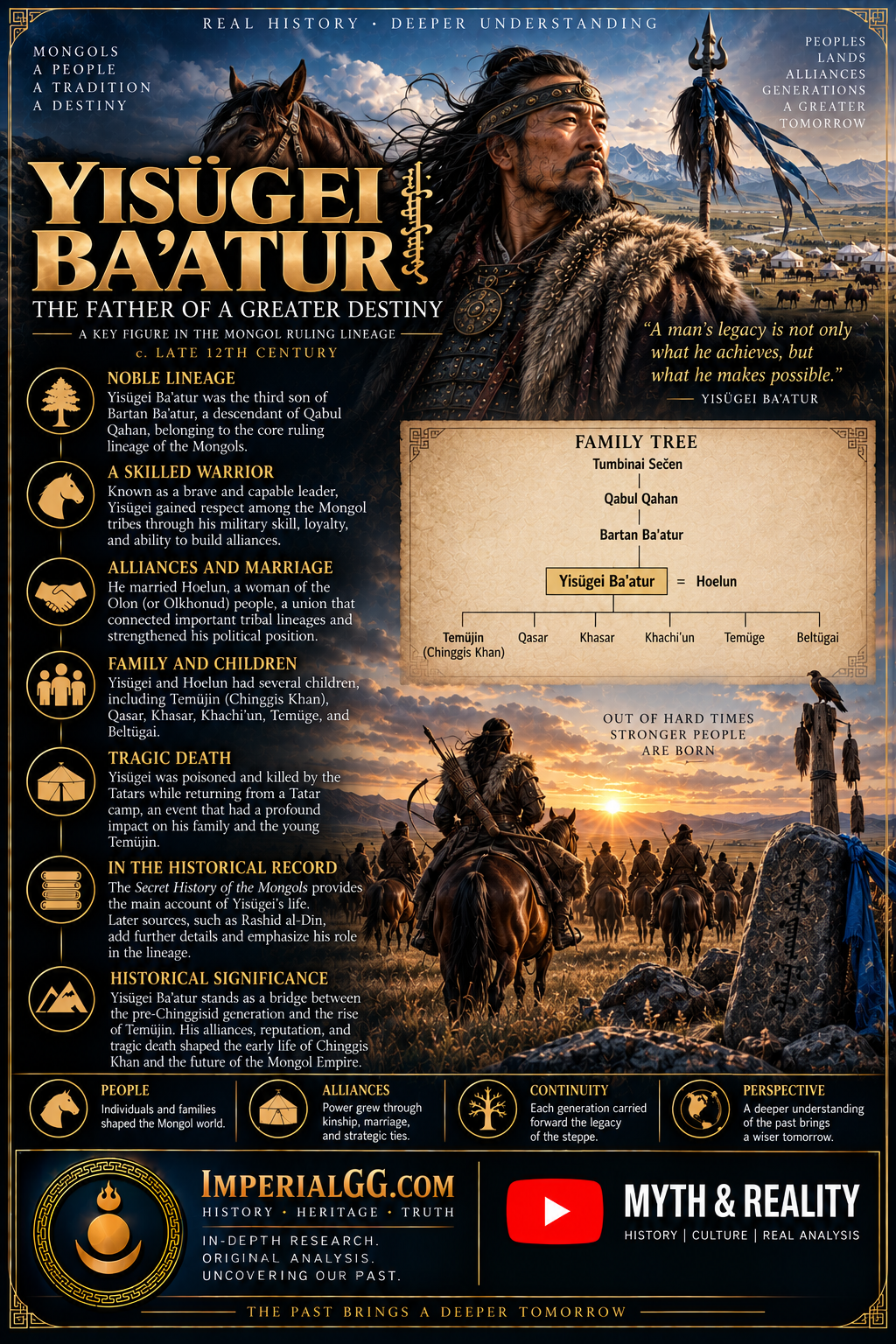
THE CHILDREN OF YISÜGEI BA’ATUR: HOUSEHOLD STRUCTURE, MATERNAL STATUS, AND CONFLICT IN THE PRE-IMPERIAL MONGOL WORLD
By Altanbagana Baatar
DBA Candidate| Independent Historian
ImperialGG Historical Research Seriers
07 August 2026
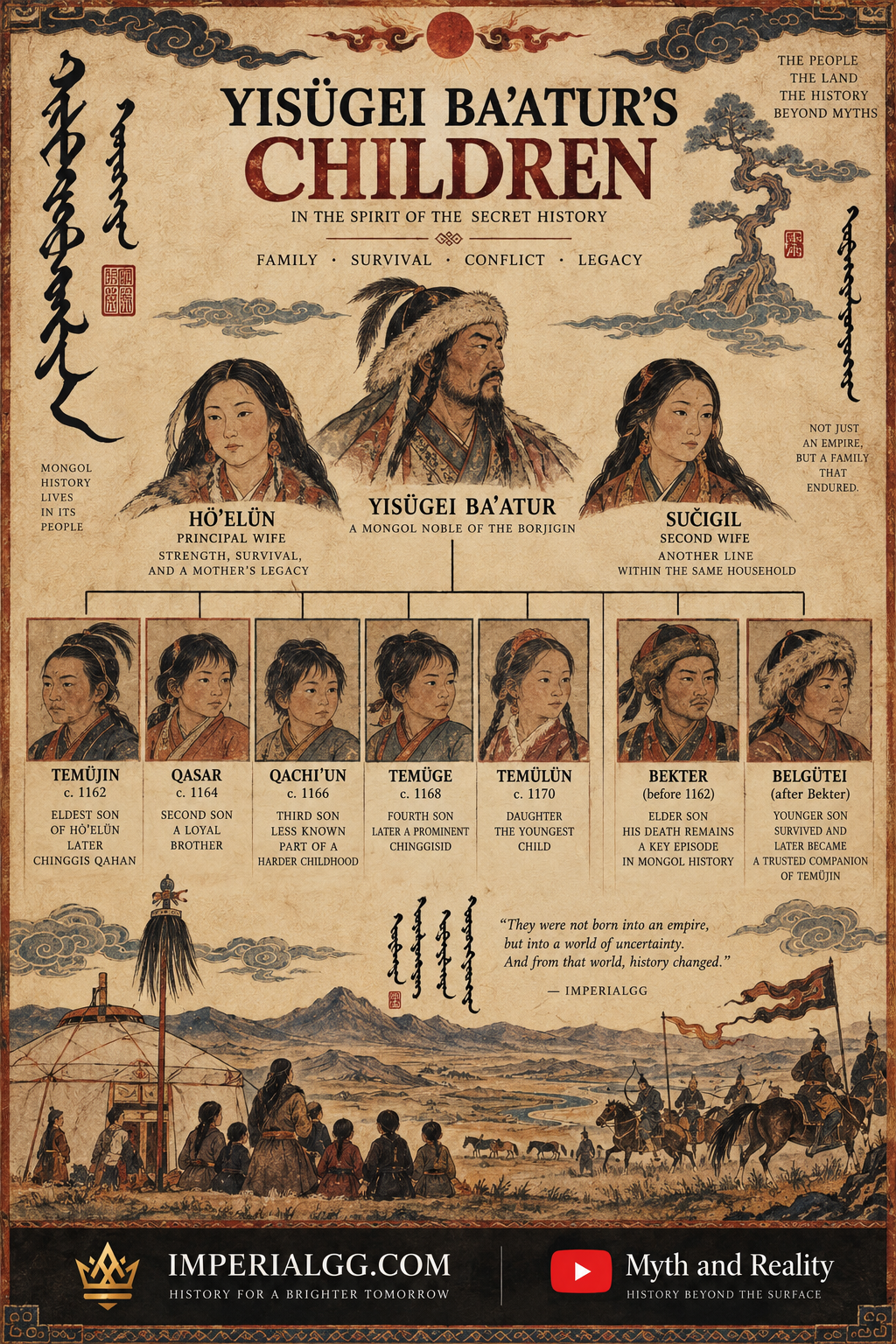
A SOURCE-CRITICAL STUDY OF BEKTER, BELGÜTEI, TEMÜJIN, QASAR, QACHI’UN, TEMÜGE, AND TEMÜLÜN
INTRODUCTION
The early history of the family of Yisügei Ba’atur has generally been reconstructed through the biography of his most famous son, Temüjin, who later became Chinggis Qahan. This emphasis is understandable, but it can obscure the structure and internal dynamics of the household into which Temüjin was born. The Secret History of the Mongols does not present Yisügei’s children as an undifferentiated group. It distinguishes between the children of Hö’elün and those of Yisügei’s second wife, Sučigil, and its account of the years immediately following Yisügei’s death reveals a household in which differences of maternal status, age, and position among the sons became increasingly consequential.¹ The resulting conflict between Temüjin and his half-brother Bekter has consequently been interpreted in different ways: as a dispute over food and hunting resources, as an expression of rivalry between half-brothers, and, in more recent scholarship, as a conflict that may also have involved the future organization of the fatherless household and the distribution of male authority within it.²
The purpose of this article is to examine Yisügei Ba’atur’s children as a family and social unit rather than treating them merely as the background to Temüjin’s childhood. The surviving evidence allows a reasonably clear reconstruction of the children born to Hö’elün: Temüjin, Qasar, Qachi’un, Temüge, and Temülün, while Bekter and Belgütei were born to Sučigil.³ The sources provide considerably more information about Temüjin and, subsequently, Belgütei than about Qachi’un, Temüge, and Temülün, while Bekter appears primarily in connection with the circumstances surrounding his death. This unevenness is itself important because the historical record reflects the later political significance of particular individuals rather than the relative importance of every child within the original household.
The central argument advanced here is that the conflict following Yisügei’s death should neither be reduced to the immediate dispute over food recorded in the Secret History nor transformed into an unsubstantiated claim that Bekter was formally designated as Yisügei’s successor. The available evidence instead indicates that Yisügei’s death removed the adult male authority around which the household had been organized, leaving a group of children whose relative positions were differentiated by age and maternal status. Temüjin was the eldest son of Hö’elün, while Bekter appears to have been older than Temüjin but belonged to the household through Sučigil. In the context of steppe practices concerning marriage, widowhood, household continuity, and succession, Bekter could therefore have represented a potential source of male authority after Yisügei’s death, although no source establishes that he actually intended to assume such a role.⁴
This distinction between what the sources establish and what can reasonably be inferred is essential. The Secret History is the principal narrative source for the episode, but it is a thirteenth-century work combining historical narrative, genealogy, literary composition, and oral traditions, and it must therefore be read critically rather than treated as an unmediated transcript of events. Igor de Rachewiltz emphasizes both its exceptional value as the earliest substantial native Mongolian account and its composite historical-literary character.⁵ The present analysis therefore combines the Secret History with modern scholarship on Mongol family organization, marriage, levirate, and succession, while keeping conjectural interpretations explicitly separate from primary-source evidence.
YISÜGEI’S CHILDREN AND THE STRUCTURE OF THE FAMILY
The family structure is stated explicitly in §60 of the Secret History. Yisügei Ba’atur and Hö’elün had four sons—Temüjin, Qasar, Qachi’un, and Temüge—and a daughter, Temülün. The same passage adds that Yisügei’s second wife, Sučigil, bore Bekter and Belgütei. When Temüjin was nine, Qasar was seven, Qachi’un five, Temüge three, and Temülün was still in the cradle.⁶ The passage therefore establishes the relative sequence of the children of Hö’elün, but it does not provide exact calendar years for their births. Modern chronological reconstructions commonly place Temüjin around 1162 and the younger children at approximately two-year intervals, but these dates remain reconstructions from relative ages rather than dates supplied directly by the primary source. Bekter and Belgütei are even less securely dated because the Secret History does not provide their ages in the same manner.⁷
The resulting family should therefore be represented as follows:
By Hö’elün: Temüjin (c.1162) → Qasar (c.1164) → Qachi’un (c.1166) → Temüge (c.1168) → Temülün (c.1170, approximate)
By Sučigil: Bekter (born before Temüjin; exact year uncertain) → Belgütei (younger than Bekter; exact year uncertain)
This distinction is more than genealogical. The children belonged to a polygynous household in which the status of the mother could affect the position of her children. Modern scholarship on Mongol society has emphasized that wives did not occupy identical positions within the household and that seniority among wives, their natal connections, and the status of their sons could have consequences for marriage, inheritance, and political succession.⁸ The Secret History itself does not provide a formal legal code establishing a universal hierarchy by which every son’s position could be determined, and later Mongol history demonstrates that succession could depend upon multiple competing principles rather than a simple rule of biological primogeniture.⁹ Consequently, neither Bekter’s apparent age advantage nor Temüjin’s position as Hö’elün’s eldest son should be treated as an automatic legal entitlement to succession.
This is particularly important because Temüjin is sometimes described imprecisely as Yisügei’s eldest or firstborn son. The primary source does not support that formulation without qualification. Temüjin was the first son of Hö’elün, but Bekter, the son of Sučigil, appears to have been older. Timothy May has consequently treated the relative age of Bekter as significant when examining the conflict that later developed between the half-brothers.¹⁰ The distinction between “eldest son of the principal wife” and “eldest son of the father” is therefore indispensable to any reconstruction of the family.
TEMÜJIN’S BIRTH AND YISÜGEI’S FAMILY BEFORE HIS DEATH
The Secret History introduces Temüjin’s birth in the context of Yisügei’s conflict with the Tatars. Yisügei had captured the Tatar leaders Temüjin Üge and Qori Buqa, and Hö’elün was pregnant when Temüjin was born at Deli’un Boldaq beside the Onon. The child was named Temüjin because he was born at the time when the Tatar Temüjin Üge had been brought captive.¹¹ Whatever literary elements are present in the account of his birth, the narrative establishes that Temüjin entered the world as one son within a politically active warrior household rather than as the predetermined founder of an empire.
The significance of the family becomes clearer when the narrative moves forward to Temüjin’s ninth year. Yisügei took him toward the Olqunu’ut, whom the source describes as the maternal relatives of Hö’elün, with the intention of obtaining a wife for his son. On the journey he encountered Dei Sečen of the Onggirat, and this meeting eventually resulted in Temüjin’s betrothal to Börte.¹² The episode is important for the present study because Yisügei’s choice of destination explicitly invoked Hö’elün’s maternal kin. Anne F. Broadbridge has argued that this choice may have provided an opportunity to reconnect Hö’elün with her natal relatives after the circumstances of her marriage to Yisügei, although the eventual bride, Börte, came from the Qonggirat rather than the Olqunu’ut.¹³
There is no evidence, however, that Yisügei took Temüjin to arrange the marriage because he feared Bekter or intended to establish Temüjin as the future head of the household in preference to his older half-brother. Such a claim goes beyond the evidence. What the source does establish is that Yisügei was actively arranging Temüjin’s future marriage and kinship relationships while his other children remained within the household. The episode consequently belongs to the broader organization of the family and should not be interpreted solely as the beginning of the Temüjin–Börte relationship.
YISÜGEI’S DEATH AND THE TRANSFORMATION OF THE HOUSEHOLD
The decisive transformation came with Yisügei’s death. On his return from leaving Temüjin with Dei Sečen, Yisügei encountered Tatars at Šira Ke’er. The Secret History states that they secretly poisoned him, after which he traveled for three days before reaching his camp in a weakened condition. He summoned Mönglik and instructed him to care for his young sons and his widowed sister-in-law and to bring Temüjin back. He then died.¹⁴
The importance of this episode lies in the fact that Yisügei’s death did not simply remove a father from a family; it removed the adult male around whom the household’s political and economic relations had been organized. The children who remained were not an equal group. Temüjin was nine, Qasar seven, Qachi’un five, Temüge three, and Temülün still an infant at the point when the ages in §60 are given. Bekter and Belgütei were older than at least some of these children, but their exact ages remain uncertain. The household therefore contained several levels of dependency and several possible sources of authority, but no surviving adult male equivalent to Yisügei.
The subsequent abandonment of the family by the Tayichi’ut made this structural problem considerably more severe. The Secret History depicts Hö’elün assuming responsibility for maintaining the children through hunting and gathering after the family was deprived of the support it had previously received. The narrative thereby places Hö’elün at the center of the household’s material survival, while the boys gradually became old enough to participate in obtaining food and defending the family.¹⁵
The importance of Hö’elün should consequently not be reduced to her later identity as the mother of Chinggis Qahan. At this stage she was the senior surviving adult within a household whose male head had disappeared, and the relations among her children and her stepchildren had to be renegotiated in circumstances of material scarcity.
BEKTER AND THE QUESTION OF MALE AUTHORITY
The position of Bekter becomes significant precisely within this transformed household. The Secret History identifies him as the son of Sučigil and the half-brother of Temüjin, but it does not designate him as Yisügei’s successor, nor does it state that he claimed such a position.¹⁶ Any interpretation that presents Bekter as an officially appointed successor must therefore be rejected unless supported by evidence outside the Secret History.
Nevertheless, the question of whether Bekter could have become an important male authority within the household is historically legitimate. His position combined several characteristics that distinguished him from Temüjin: he was older, he was Yisügei’s son, and he belonged to a separate maternal branch of the family. Temüjin, by contrast, was the eldest son of Hö’elün. These overlapping forms of seniority could create competition without requiring either boy to possess a formally defined office.
The question becomes more significant when considered alongside steppe practices of widowhood and levirate marriage. Broadbridge notes that among the Mongols a widow commonly entered a subsequent marriage with a junior male relative of her deceased husband, including a younger brother, nephew, or son of another wife. Such arrangements could provide protection for the widow while keeping children and property within the deceased husband’s family.¹⁷ This evidence does not demonstrate that Hö’elün was expected to marry Bekter, nor does it establish that such a marriage was being contemplated in this particular household. It does, however, demonstrate that the possibility of a deceased man’s widow remaining within his household through marriage to another male member of the family was part of the wider social repertoire of the steppe.
Timothy May has applied this broader social context directly to the Bekter episode. He argues that the possibility of Bekter marrying Hö’elün cannot be entirely excluded and that such a relationship could have allowed Bekter to assume a patriarchal position within the household.¹⁸ This interpretation is important but should remain explicitly hypothetical. The Secret History does not say that Bekter intended to marry Hö’elün, that Hö’elün desired such an arrangement, or that Temüjin killed Bekter specifically to prevent it.
What the evidence permits us to say is more restrained. Bekter occupied a position in which he could potentially have become an important male authority after Yisügei’s death, while Temüjin occupied a different position as the eldest son of the senior wife. The two forms of status did not necessarily produce conflict, but under conditions of deprivation and the absence of Yisügei they could become politically meaningful.
THE CONFLICT OVER FOOD AND THE KILLING OF BEKTER
The Secret History records the immediate cause of the conflict in concrete terms. Temüjin, Qasar, Bekter, and Belgütei were fishing together when a fish was caught. Bekter and Belgütei took it from Temüjin and Qasar. When Temüjin and Qasar complained to Hö’elün, she rebuked them for quarreling with their brothers at precisely the moment when the family had no allies other than itself.¹⁹ The source then records a second dispute involving a lark, after which Temüjin and Qasar attacked Bekter and killed him.²⁰
The importance of the passage lies partly in what it does not say. It does not explicitly mention succession, inheritance, widow remarriage, or a struggle for the position of household head. The source itself therefore does not authorize a reduction of the episode to a succession conflict.
At the same time, the immediate dispute over food need not be regarded as the complete historical explanation. Material scarcity was not incidental to the family’s condition. The household had been abandoned by the Tayichi’ut, and its members depended upon hunting, fishing, gathering, and other means of obtaining food. Control over food obtained by the young men consequently had direct implications for the welfare of the household. Bekter’s taking of food could be interpreted as an assertion of seniority or simply as individual behavior, but the source does not specify which interpretation is correct.
Hö’elün’s response is particularly revealing because she does not treat the incident as an ordinary quarrel between children. Her rebuke invokes the family’s vulnerability and emphasizes the necessity of solidarity among the brothers.²¹ The episode therefore occurred within a household in which internal cooperation was materially necessary, while differences in age and maternal status could nevertheless generate competition.
May’s interpretation takes this structural dimension further by arguing that the killing of Bekter prevented him from potentially occupying the patriarchal position of the family.²² That interpretation is plausible within the broader context of steppe levirate and household organization, but it should be presented as an inference rather than as a statement of fact. The safest historical conclusion is that the killing removed an older male member of the family at a moment when Yisügei’s authority had already disappeared and before Temüjin had reached political maturity.
TEMÜJIN AND QASAR
The role of Qasar in the killing is significant because the event was not undertaken by Temüjin alone. The Secret History presents Temüjin and Qasar as acting together against Bekter.²³ This indicates that the conflict involved more than an individual confrontation between an older and younger brother; it involved a division among the sons of Yisügei.
Qasar was the second son of Hö’elün and was two years younger than Temüjin according to the relative ages given in §60.²⁴ His participation demonstrates that the maternal branch of Hö’elün was not internally uniform in its relationship with Bekter and Belgütei. Belgütei, Bekter’s full brother, belonged to Sučigil’s branch and was on the opposite side of the immediate dispute, although he survived the subsequent killing.
The event therefore produced an asymmetrical division within the family: Temüjin and Qasar acted against Bekter, while Belgütei survived as the remaining male representative of Sučigil’s sons. The significance of this division would become clearer only later, when Belgütei remained within Temüjin’s political community rather than becoming a permanent opponent.
BELGÜTEI AND THE SURVIVAL OF SUČIGIL’S LINE
Belgütei’s later career is essential to understanding the consequences of Bekter’s death. If the killing had been part of an irreconcilable conflict between the two maternal branches, one might expect Belgütei to have become a permanent enemy of Temüjin. The surviving narrative does not show this. Instead, Belgütei became one of Temüjin’s important companions and remained associated with him throughout the later formation of the Mongol polity.²⁵
This development suggests that the conflict should not be understood as a permanent division between the descendants of Hö’elün and Sučigil. The killing of Bekter removed one individual who had occupied a potentially significant position, but Belgütei subsequently became incorporated into the political community formed around Temüjin.
The distinction between the two brothers is therefore historically significant. Bekter became the victim of an internal conflict at a moment of household instability, whereas Belgütei survived and eventually transformed his relationship to Temüjin from that of a half-brother within a divided household into that of a political subordinate and trusted associate. The later prominence of Belgütei also demonstrates that Temüjin’s rise did not require the complete elimination of his paternal half-brothers.
The Secret History later places Belgütei in connection with Bo’orču, one of Temüjin’s most important early companions, illustrating his integration into the emerging political network.²⁶
QACHI’UN, TEMÜGE, AND TEMÜLÜN
The historical record concerning Qachi’un, Temüge, and Temülün during the immediate aftermath of Yisügei’s death is considerably less detailed. This should not be mistaken for evidence that they were unimportant to the household. Their relative ages establish that they were still children when the family lost its father. Qachi’un was five and Temüge three when Temüjin was nine, while Temülün was still in the cradle.²⁷ Their dependence upon Hö’elün and the older children was therefore substantially greater than that of Temüjin, Qasar, or Bekter.
Temüge subsequently acquired significance in the later history of the Chinggisid family, but the evidence concerning his childhood does not justify reconstructing a political role for him that the sources do not record. The same caution is necessary with Temülün. She was the only daughter explicitly identified among Hö’elün’s children and was substantially younger than her brothers. Her limited appearance in the early narrative reflects the source’s concentration on later political actors rather than evidence concerning her actual importance within the household.
The family should therefore not be reconstructed according to the later fame of its members. At the moment of Yisügei’s death, these children formed a single dependent household, and the later political prominence of some of them should not be projected backward as though it had already been established.
MATERNAL STATUS AND THE PROBLEM OF SUCCESSION
The conflict between Bekter and Temüjin becomes more intelligible when age and maternal status are considered together. Bekter’s apparent seniority gave him one form of advantage, while Temüjin’s position as Hö’elün’s eldest son gave him another. The Mongol social system did not operate according to a single universally applicable rule of primogeniture, and later examples demonstrate that succession could be negotiated among sons, brothers, uncles, nephews, and other members of the ruling lineage.²⁸
This flexibility should not be interpreted as the absence of rules. Rather, several principles could operate simultaneously. Seniority mattered, but maternal status mattered as well; paternal designation could matter, but political support was also decisive. In later imperial history, succession disputes repeatedly demonstrate that biological relationship alone did not settle political authority.²⁹ The early family of Yisügei should therefore be examined within the same conceptual framework, while recognizing that the household was far smaller and politically weaker than the later imperial court.
The strongest formulation is consequently not that Bekter “was the heir” or that Temüjin “was the heir,” because neither proposition is directly established. Instead, the evidence indicates that the family contained competing bases of seniority and status that became more consequential after the death of Yisügei. The absence of an adult male authority increased the importance of those distinctions, while material deprivation made conflicts over food and household resources more serious.
THE LIMITS OF THE LEVIRATE HYPOTHESIS
The possibility that Bekter might have married Hö’elün deserves particular attention because it has the potential to explain why his position could have been threatening to Temüjin, but it is also the part of the argument most vulnerable to overinterpretation. Broadbridge establishes that levirate marriage was a widespread practice in Mongol society and that a widow could marry a male relative of her deceased husband, including a son by another wife.³⁰ May applies this evidence to Bekter and argues that the possibility of such a marriage could have enabled him to assume the patriarchal position of the household.³¹
The historical problem is that the Secret History does not connect Bekter’s murder explicitly to such a possibility. Nor does it state that Hö’elün was considering remarriage to Bekter. The source instead presents the conflict through disputes over food and the conduct of the brothers. Hö’elün’s reaction is one of anger at the destruction of family solidarity rather than an explicit statement about widow remarriage.
The levirate hypothesis should therefore be formulated as a structural possibility rather than a demonstrated motive. It helps explain why an older male son of another wife might possess a potential route to household authority, but it cannot establish that such a route was actually being pursued. The hypothesis becomes useful only when it is kept subordinate to the primary evidence.
This distinction also prevents a common analytical error: treating the existence of a social custom as proof that the custom was necessarily applied in a particular case. The existence of levirate does not prove that Bekter intended to marry Hö’elün any more than the existence of primogeniture in some societies proves that every eldest son inherited. Historical customs establish the range of possibilities within which individuals operated; they do not automatically establish individual intentions.
SOURCE CRITICISM AND THE HISTORICAL STATUS OF THE EPISODE
The Secret History of the Mongols is indispensable for reconstructing the family of Yisügei, but its character requires methodological caution. De Rachewiltz describes it as the earliest substantial literary monument of the Mongol-speaking peoples and emphasizes its combination of historical and literary elements.³² The narrative is chronological in broad structure, but its composition incorporates oral traditions, poetic passages, genealogical material, and literary shaping.³³
This is particularly relevant to the early life of Temüjin because the narrative is retrospective. The events surrounding Yisügei’s death and Bekter’s killing occurred decades before the political order associated with Chinggis Qahan was fully established, while the surviving Secret History was composed in a later political environment. The narrative therefore preserves early family traditions but presents them within a larger account of Temüjin’s rise.
The absence of Bekter from the later official histories also matters. The episode is especially prominent in the Secret History because it reveals a morally problematic act committed by the future Chinggis Qahan during his childhood.³⁴ This feature makes the source unusually valuable for reconstructing family tensions, but it also requires attention to the literary function of the episode. The narrative does not merely list events; it preserves episodes that illuminate Temüjin’s development and the values that the text wishes to emphasize.
For this reason, the strongest historical reconstruction does not ask simply, “What exactly happened?” but rather, “What does the earliest surviving Mongolian narrative tell us happened, what social structures make that account plausible, and which elements remain uncertain?”
THE FAMILY AS A UNIT OF SURVIVAL
The history of Yisügei’s children after his death demonstrates that the household was not simply a genealogical unit but a productive and political unit. Its members had to obtain food, maintain their camp, preserve social relationships, and protect one another at a time when the family’s former political support had disappeared.
Hö’elün’s role was therefore central. Her authority was not merely maternal in the modern domestic sense; she became responsible for maintaining a household whose economic survival depended on her labor and that of her children.³⁵ The sons gradually became participants in this economic system, and the distribution of food acquired significance precisely because food was scarce.
Under such circumstances, the behavior of Bekter could have had consequences beyond an isolated disagreement. If an older son exercised preferential access to food, this could be perceived by younger members as an assertion of status. Conversely, the actions of Temüjin and Qasar could be understood as resistance to that assertion. The Secret History does not provide an explicit sociological interpretation of the dispute, but the material conditions of the family make it possible to understand why disputes over hunting and fishing resources became serious.
The family’s vulnerability also explains Hö’elün’s reaction. Her concern was not simply that her children were fighting; it was that they were weakening the very group upon which their survival depended. Her admonition in §76 explicitly invokes the family’s lack of external allies and its need to remain united.³⁶
FROM YISÜGEI’S HOUSEHOLD TO TEMÜJIN’S POLITICAL COMMUNITY
The longer historical significance of the family lies in the transformation that followed. Yisügei’s household did not remain a static group of siblings. It gradually became part of the political community through which Temüjin accumulated followers and ultimately established a new political order.
Belgütei’s survival is especially important in this transition. He did not become an independent rival polity based upon Sučigil’s line. Instead, he became integrated into Temüjin’s political hierarchy. Qasar likewise remained one of Temüjin’s principal brothers. Temüge later became an important member of the Chinggisid ruling house. The family therefore survived the internal crisis, although in a restructured form.
The killing of Bekter can consequently be interpreted as one stage in the transformation from a paternal household into a political community organized increasingly around Temüjin. This does not mean that Temüjin consciously planned such a transformation as a child. It means that the death of Yisügei and the elimination of Bekter altered the distribution of male authority within the family, leaving Temüjin as the senior surviving male of Hö’elün’s branch and eventually allowing his authority to expand beyond the household.
This is where the early family history becomes relevant to the later formation of the Mongol Empire. The political community of Temüjin did not emerge independently of family relations. It developed through them, sometimes by cooperation and sometimes through conflict.
CONCLUSION
The children of Yisügei Ba’atur should be understood as members of a complex pre-imperial household rather than merely as supporting characters in the childhood of Temüjin. Yisügei’s children were divided between two maternal lines: Hö’elün was the mother of Temüjin, Qasar, Qachi’un, Temüge, and Temülün, while Sučigil was the mother of Bekter and Belgütei. The relative ages supplied by the Secret History establish that Temüjin was Hö’elün’s eldest son but do not establish him as Yisügei’s eldest son, since Bekter appears to have been older.³⁷
Yisügei’s death transformed this family structure. The household lost its adult male head while several children were still very young, and the subsequent abandonment by the Tayichi’ut placed the family under severe material pressure. Hö’elün became the central surviving adult, while the older sons increasingly participated in the acquisition and distribution of food. Under these conditions, differences of age and maternal status became more consequential than they had been while Yisügei was alive.
The conflict with Bekter should therefore be understood within this broader structural context. The Secret History directly records disputes over fish and hunting spoils and ultimately the killing of Bekter by Temüjin and Qasar. It does not directly state that Bekter was competing for succession or that Temüjin killed him to prevent him from assuming authority. Such claims exceed the primary evidence. Nevertheless, Bekter’s older position, his status as Yisügei’s son, and the existence of steppe practices permitting levirate marriage make it historically reasonable to consider whether he could have become an important male authority within the fatherless household. The possibility that he might have married Hö’elün and assumed a patriarchal role, discussed explicitly by Timothy May, remains a hypothesis rather than an established fact.³⁸
The more defensible conclusion is that Bekter and Temüjin represented different forms of seniority within a household whose previous organizing authority had disappeared. Bekter’s age and paternal descent gave him one potential source of status, while Temüjin’s position as the eldest son of Hö’elün gave him another. The conflict between them therefore existed within a wider system of family organization in which maternal rank, age, marriage practices, and household authority intersected.
Belgütei’s later career demonstrates that the killing of Bekter did not permanently divide the two maternal branches of Yisügei’s family. Belgütei survived and became an important member of Temüjin’s political community, while Qasar remained a close brother and Temüge eventually became a major member of the Chinggisid lineage. Qachi’un and Temülün appear less frequently in the sources because the surviving narrative is heavily weighted toward later political actors, but their presence is essential for reconstructing the household as it existed before the rise of Temüjin.
The historical significance of Yisügei’s children therefore lies not simply in their genealogical relationship to Chinggis Qahan but in the social transformation of their family after Yisügei’s death. The household passed from a structure organized around a living warrior-father to one in which authority had to be reconstructed among a widowed mother and several sons of different maternal lines. The conflict between Bekter and Temüjin occurred within that transformation. It should neither be romanticized nor reduced to a simple quarrel over food. Its historical importance lies precisely in the intersection between the immediate material circumstances recorded by the Secret History and the broader social structures that made questions of seniority, widowhood, household leadership, and kinship consequential.
The evidence does not permit us to reconstruct every intention of the individuals involved. It does, however, permit a more precise conclusion: before Temüjin became the founder of the Mongol Empire, he was one member of a divided but interdependent household whose internal organization was fundamentally altered by the death of Yisügei Ba’atur. The subsequent fate of Bekter, Belgütei, Qasar, Qachi’un, Temüge, and Temülün belongs to that history in its own right.
FOOTNOTES
1. The Secret History of the Mongols, §§59–60. Igor de Rachewiltz’s translation identifies the work as a thirteenth-century Mongolian historical-literary text and emphasizes its combination of historical narrative and literary composition.
2. Timothy May, Simply Chinggis: The Story of a Warrior Who Changed the World, discussion of Bekter and the early family of Temüjin. May explicitly argues that the episode involved more than ordinary sibling rivalry and connects it with the possible implications of levirate practice.
3. Secret History, §60. The source explicitly distinguishes the five children of Hö’elün from Bekter and Belgütei, whom it attributes to Yisügei’s second wife Sučigil.
4. On Mongol marriage, widowhood, levirate, and the differing status of wives, see Anne F. Broadbridge, Women and the Making of the Mongol Empire (Cambridge: Cambridge University Press, 2018), chap. 1, “Women in Steppe Society,” pp. 9–42. Cambridge identifies this chapter as treating bride price, levirate, and seniority among wives.
5. Igor de Rachewiltz, The Secret History of the Mongols: A Mongolian Epic Chronicle of the Thirteenth Century. The surviving edition describes the Secret History as the earliest major literary monument of the Mongolian-speaking peoples and explicitly discusses its mixture of historical and literary elements.
6. Secret History, §60. The passage gives Temüjin as nine, Qasar seven, Qachi’un five, Temüge three, and Temülün in the cradle, while identifying Bekter and Belgütei as sons of Sučigil.
7. The relative ages of the children are primary-source evidence; the conversion into approximate Gregorian birth years is a modern chronological reconstruction and should not be confused with explicit dates in the Secret History. De Rachewiltz’s discussion places the traditional birth of Temüjin around 1162 while noting the chronological character of the narrative.
8. Broadbridge, Women and the Making of the Mongol Empire, pp. 9–42. Broadbridge discusses polygyny, bride price, seniority among wives, and the implications of levirate for widows, children, and household property.
9. Broadbridge, Women and the Making of the Mongol Empire, chap. 4, “Women and the Guard, the Army, and Succession,” pp. 101–134. The book treats succession as a major institution in which women and household relationships were involved rather than assuming a single mechanical rule of inheritance.
10. May, Simply Chinggis. May treats Bekter as older than Temüjin and discusses the implications of this age difference for the family’s internal hierarchy.
11. Secret History, §59.
12. Secret History, §§61–66. Yisügei explicitly states that he is taking Temüjin toward the Olqunu’ut, the maternal relatives of Hö’elün, to seek a bride for him.
13. Broadbridge, Women and the Making of the Mongol Empire, chap. 2, “Hö’elün and Börte,” pp. 43–72. Broadbridge specifically discusses Yisügei’s intention to approach Hö’elün’s Olqunu’ut relatives and interprets this within wider patterns of maternal kinship and exchange marriage.
14. Secret History, §67–68. The narrative states that the Tatars poisoned Yisügei and that, after three days of travel, he reached his tent, summoned Mönglik, gave instructions concerning his children, and died.
15. Secret History, §§69–75. The post-Yisügei narrative describes the abandonment of the family and Hö’elün’s efforts to maintain the household under materially difficult conditions.
16. Secret History, §60 identifies Bekter and Belgütei as sons of Sučigil but does not call Bekter a qan, successor, or formally designated heir.
17. Broadbridge, Women and the Making of the Mongol Empire, pp. 9–42. Broadbridge states that widows generally entered levirate marriages with a junior male relative of the deceased husband, including a younger brother, nephew, or son of another wife, and explains the protective and economic functions of the institution.
18. May, Simply Chinggis. May specifically connects the Bekter episode with the possibility of levirate marriage and argues that this could have allowed Bekter to assume a patriarchal position within the family. This is May’s interpretation rather than an explicit statement of the Secret History.
19. Secret History, §76. The passage records the fishing dispute and Hö’elün’s rebuke, in which she emphasizes that the family has no allies and should not quarrel among itself.
20. Secret History, §§77–79. The same narrative records the subsequent confrontation and death of Bekter.
21. Secret History, §76. Hö’elün’s response is explicitly framed around the necessity of solidarity among brothers following the family’s abandonment.
22. May, Simply Chinggis. May interprets the killing as having removed the possibility of Bekter becoming the patriarchal head of the family, while acknowledging that Hö’elün’s actual position toward a possible levirate marriage cannot be known.
23. Secret History, §§77–79.
24. Secret History, §60.
25. Secret History, later passages concerning Belgütei’s service under Temüjin.
26. Secret History, §95, where Belgütei is associated with Bo’orču in the developing political community surrounding Temüjin.
27. Secret History, §60.
28. Broadbridge, Women and the Making of the Mongol Empire, chap. 4, pp. 101–134.
29. On the complexity of succession within the Mongol imperial family, see Broadbridge, Women and the Making of the Mongol Empire, especially the discussion of succession in chap. 4.
30. Broadbridge, Women and the Making of the Mongol Empire, pp. 9–42.
31. May, Simply Chinggis.
32. de Rachewiltz, Secret History of the Mongols. The modern scholarly edition explicitly characterizes the work as both historical and literary and discusses its composition and transmission.
33. De Rachewiltz notes that the Secret History is organized as a continuous chronological narrative but contains both historical and literary material; the text’s surviving form is itself the product of transmission and compilation.
34. May notes that the Bekter episode is recorded in the Secret History and not preserved in the same form in the later official historical traditions, making the Secret History especially important for this aspect of Temüjin’s childhood.
35. Broadbridge, Women and the Making of the Mongol Empire, especially chap. 2, “Hö’elün and Börte,” pp. 43–72. The study places Hö’elün within the wider social and economic functions of steppe women and household management.
36. Secret History, §76.
37. Secret History, §60.
38. May, Simply Chinggis. His interpretation should be distinguished from the primary source: the Secret History records the food dispute and killing but does not state that Bekter was killed to prevent a levirate marriage or succession.
BIBLIOGRAPHY
Broadbridge, Anne F. Women and the Making of the Mongol Empire. Cambridge: Cambridge University Press, 2018. DOI: 10.1017/9781108347990.
de Rachewiltz, Igor. The Secret History of the Mongols: A Mongolian Epic Chronicle of the Thirteenth Century. 2 vols. Leiden: Brill, 2004. Supplementary volume, 2013. The scholarly edition contains extensive philological and historical commentary.
May, Timothy. Simply Chinggis: The Story of a Warrior Who Changed the World. [Edition consulted for the discussion of Bekter and the early family.]
May, Timothy, ed. The Mongol World. London: Routledge, 2022.
The Secret History of the Mongols. §§59–60, 61–68, 76–79, 95.
Rashīd al-Dīn. Jāmiʿ al-Tawārīkh (Compendium of Chronicles).
Yuan Shi (元史).
Altan Tobči.
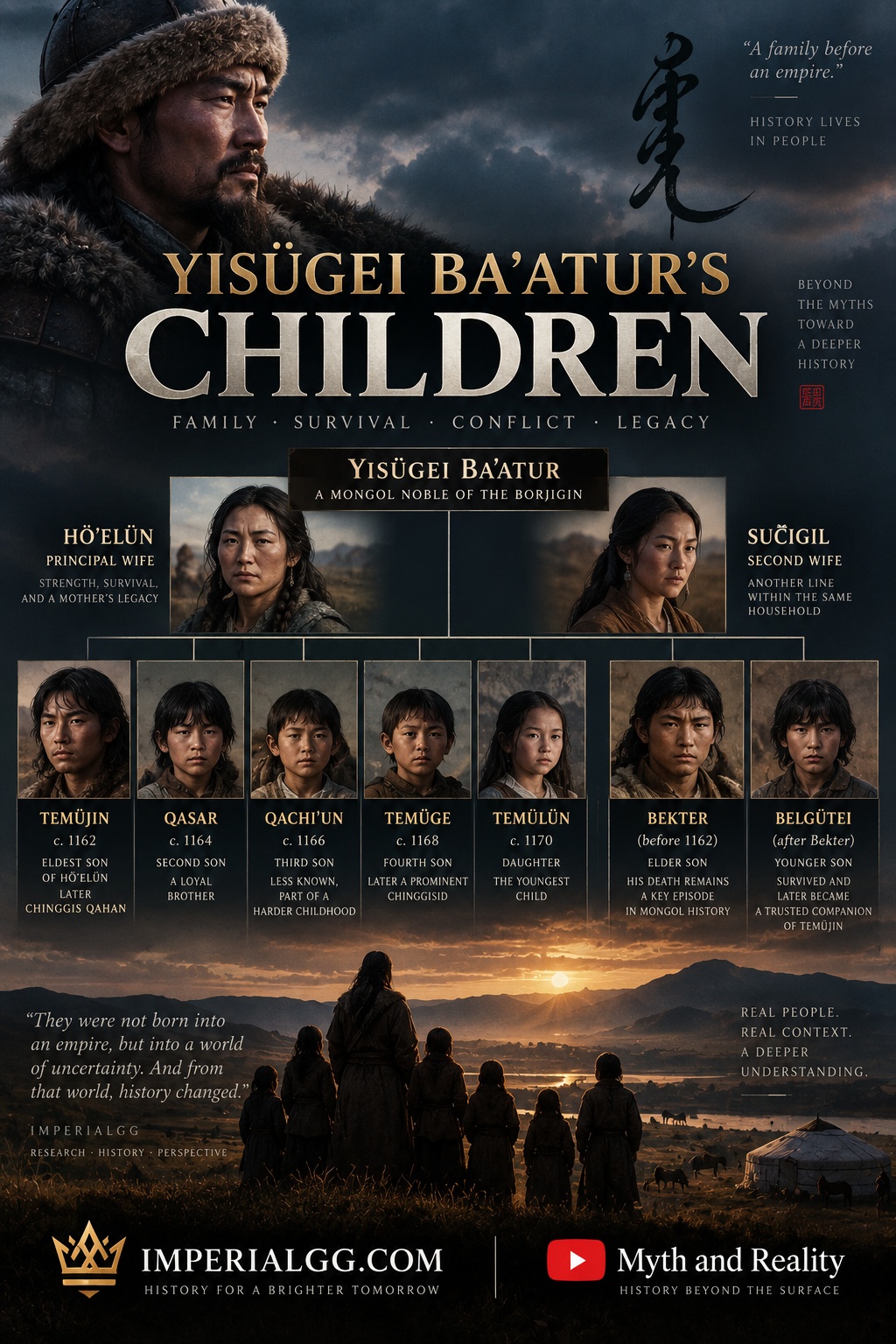
A SOURCE-CRITICAL READING OF THE KILLING OF BEGTER IN THE SECRET HISTORY OF THE MONGOLS
By Altanbagana Baatar
DBA Candidate| Independent Historian
ImperialGG Historical Research Seriers
23 June 2026
AUTHOR’S THESIS
THE HIDDEN DANGER BEHIND BEGTER
Begter’s killing should not be reduced to a simple quarrel between half-brothers over food. This article argues that Begter occupied a potentially dangerous position within the fractured household of Yisügei Ba’atur: as an older son, he represented a possible alternative center of authority at a time when the family had already been abandoned by the Tayichi’ud. Although the Secret History of the Mongols does not explicitly state that Begter maintained a secret connection with the Tayichi’ud, the possibility of such a political link deserves serious consideration. The subsequent capture of Temüjin by the Tayichi’ud, occurring soon after Begter’s death, does not prove such a connection, but it creates a significant chronological and political question. From this perspective, Temüjin and Qasar’s decision to kill Begter may be understood not merely as an act of personal conflict, but as a decisive attempt to eliminate a potential internal rival at a moment of extreme external vulnerability. The historical importance of the episode therefore lies not in the claim that Temüjin consciously foresaw his imperial future, but in the structural consequences of his decision: the removal of Begter transformed the balance of authority within the family and became part of the chain of events through which Temüjin’s later political trajectory emerged.
BEGTER WAS NOT MERELY A BROTHER TEMÜJIN KILLED; HE MAY HAVE BEEN A POTENTIAL RIVAL WHO STOOD AT THE INTERSECTION OF FAMILY SUCCESSION AND THE POLITICAL DANGER POSED BY THE TAYICHI’UD.
A SOURCE-CRITICAL READING OF THE KILLING OF BEGTER IN THE SECRET HISTORY OF THE MONGOLS
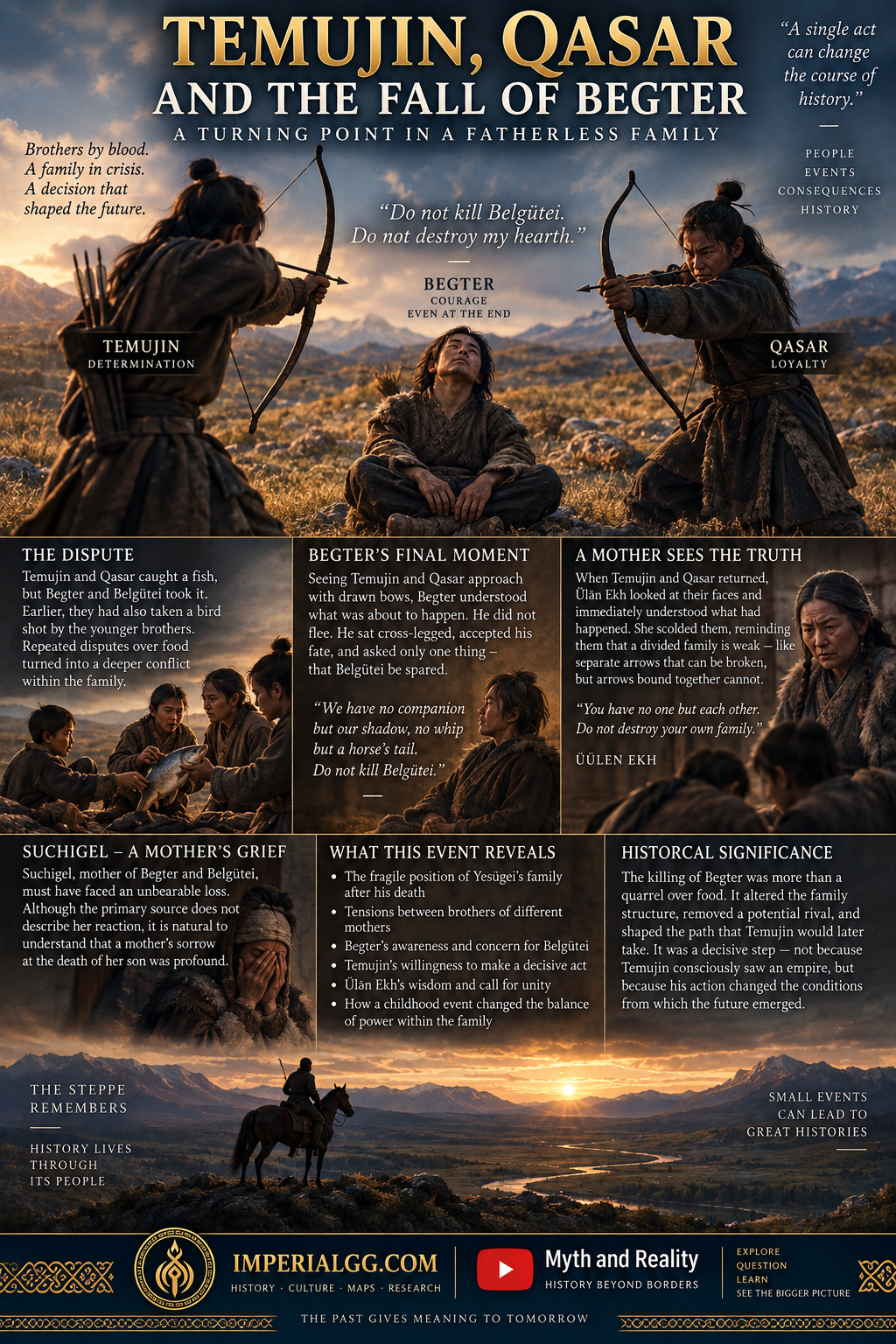
INTRODUCTION
Among the episodes describing the childhood of Temüjin, few are as consequential for understanding the internal structure of the Borjigin family as the killing of his elder half-brother Begter. The Secret History of the Mongols presents the event in the context of repeated disputes over food and hunting spoils following the death of Yesügei Ba’atur, when the family had been abandoned by the Tayichi’ut and was surviving under severe material conditions. The immediate narrative is comparatively brief: Temüjin and Qasar became angry after Begter and Belgütei took a fish that had been caught by the younger brothers; after a further dispute concerning a bird, Temüjin and Qasar armed themselves, approached Begter from opposite directions, and killed him.¹ Yet the episode contains a much more complex configuration of age, maternal status, household authority, political insecurity, and the developing character of Temüjin.
Begter was not simply another brother. He was the son of Yesügei and Suchigel, and therefore the elder half-brother of Temüjin, while Belgütei was his younger full brother.² Temüjin, by contrast, was the eldest son of Hö’elün, Yesügei’s principal wife. The death of Yesügei had removed the adult male authority that had previously organized these relationships, leaving a household in which the relative positions of the sons could become increasingly consequential. Modern scholarship has consequently considered whether Begter’s position involved more than an immediate dispute over food and whether the conflict may have reflected competing claims to authority within the fatherless household.³
The purpose of this article is not to replace the account of the Secret History with a speculative reconstruction, but to examine closely what the source actually says and what may reasonably be inferred from it. Particularly important is Begter’s final response. When Temüjin and Qasar approached him with drawn bows, Begter did not attempt to flee or fight. Instead, he sat cross-legged, recognized the danger, invoked the family’s weakness after the Tayichi’ut abandonment, and specifically asked his brothers not to kill Belgütei. He then accepted his own death.⁴ This final act has often been read simply as resignation, but it can also be examined as an expression of Begter’s awareness of the altered structure of the household and of the future vulnerability of his younger brother.
The episode should therefore be understood not merely as a story of adolescent violence, but as a critical moment in the transformation of Yesügei’s family.
THE FAMILY AFTER YESÜGEI
The Secret History explicitly distinguishes the children of Hö’elün from those of Yesügei’s other wife, Suchigel. Hö’elün bore Temüjin, Qasar, Qachi’un, Temüge, and Temülün, while Suchigel was the mother of Begter and Belgütei. When Temüjin was nine, Qasar was seven, Qachi’un five, Temüge three, and Temülün was still in the cradle.⁵ The exact ages of Begter and Belgütei are not supplied in the same passage, although modern reconstructions generally place Begter somewhat older than Temüjin.⁶
This distinction matters because the household was not organized solely by biological descent from Yesügei. Maternal status also formed part of the social structure. Hö’elün occupied the principal-wife position, while Suchigel belonged to a secondary marital relationship. Later Mongolian scholarship has argued that the different positions of the two women may have affected the status of their sons and that Begter could therefore have occupied an ambiguous position: older than Temüjin but born to a woman whose position within the household was inferior to that of Hö’elün.⁷
This ambiguity becomes especially important after Yesügei’s death. The Secret History describes the abandonment of the family by the Tayichi’ut and the subsequent struggle of Hö’elün and her children to obtain food through hunting, fishing, gathering, and other means.⁸ The family was no longer protected by the political authority that had existed during Yesügei’s lifetime. The children consequently had to negotiate their relationships with one another within a household in which resources were scarce and adult male authority was absent.
It is within this setting that the conflict over food must be interpreted.
THE FISH AND THE BIRD
The Secret History states that Temüjin, Qasar, Begter, and Belgütei were together fishing when a fish was caught. Begter and Belgütei took it from Temüjin and Qasar. When Temüjin and Qasar returned to Hö’elün and complained, she rebuked them rather than supporting their grievance. Her response is significant because she reminded them that the family had no companions beyond their own shadows and no whip beyond a horse’s tail, and she asked why they were acting against one another when the family already lacked allies.⁹
Temüjin and Qasar nevertheless remained resentful. They recalled that Begter and Belgütei had previously taken a lark that the younger brothers had shot with a bone-tipped arrow. Their complaint therefore concerned a repeated pattern of unequal access to the results of hunting rather than one isolated fish. They declared that they could not live together under such circumstances and left the tent.¹⁰
The immediate historical significance of this exchange lies in the fact that Hö’elün recognized the danger of internal division while Temüjin and Qasar rejected her warning. Her position was structurally different from theirs. She understood that the family had become dependent upon internal solidarity for survival, whereas the boys were increasingly experiencing their relationships through competition over resources and status.
This does not prove that Begter was consciously attempting to establish political supremacy. The Secret History does not say so. It does, however, show that Begter’s behavior was perceived by Temüjin and Qasar as an assertion of superiority, whether or not that was Begter’s intention.
BEGTER’S FINAL MOMENT
The narrative becomes remarkably precise when the brothers confront Begter. Begter was sitting on a hill watching the horses. Temüjin approached from behind while Qasar came from the front. They drew their bows and prepared to shoot. At that moment Begter saw what was happening and spoke.¹¹
His words are crucial. He recalled that the family had already suffered from the Tayichi’ut and asked why Temüjin and Qasar were now treating him as an obstacle. He reminded them that they had no companion except their shadow and no whip except a horse’s tail. Most importantly, he told them:
**“Do not destroy my hearth. Do not kill Belgütei.”**¹²
He then sat cross-legged and submitted to the attack.
The physical posture is significant. Begter did not attempt to escape, attack his brothers, or call for help. The Secret History presents him as recognizing the inevitability of the confrontation. His final concern was not his own survival alone but the survival of his younger full brother, Belgütei.
This is one of the reasons the scene deserves greater attention than it usually receives. Begter’s final words can be read as the statement of a young man who understood that his death would leave Belgütei exposed within a household already characterized by division. Whether or not Begter possessed a fully articulated political conception of succession cannot be known, but his concern for Belgütei indicates that he understood the family as a continuing social unit whose survival extended beyond his own life.
The source does not state that Begter foresaw the future political career of Temüjin. Any such claim would be anachronistic. Yet his final behavior demonstrates an awareness that the consequences of the brothers’ actions would extend beyond the immediate quarrel.
“DO NOT KILL BELGÜTEI”
Begter’s final request deserves special emphasis because it distinguishes the two brothers. If the dispute had been solely about the fish, there would have been no obvious reason for Begter to make Belgütei’s survival the central element of his final statement. The Secret History does not provide an explicit explanation, but the request suggests that Begter understood Belgütei to be the remaining vulnerable member of his maternal branch.
This interpretation is strengthened by what happened afterward. Belgütei survived and did not pursue a blood feud against Temüjin. Instead, he eventually became an important member of Temüjin’s political community and later one of his trusted commanders.¹³
Begter’s final concern for Belgütei can therefore be viewed retrospectively as historically significant. He could not have known the precise political future that awaited Temüjin or Belgütei, but his request effectively separated the fate of his younger brother from his own.
The irony of the episode is that Begter’s final act of concern toward Belgütei was eventually fulfilled: Belgütei survived and became integrated into the political order that Temüjin created.
TEMÜJIN’S DECISION
The decision to kill Begter was not a spontaneous act occurring in the absence of warning. Hö’elün had already explicitly told the boys not to quarrel. Temüjin and Qasar nevertheless left the household, armed themselves, and deliberately approached Begter from two directions.¹⁴
The Secret History therefore depicts a coordinated act rather than an accidental confrontation.
This distinction is important when considering Temüjin’s development. The killing cannot simply be described as an uncontrolled childhood outburst. Temüjin and Qasar made a decision, prepared their weapons, positioned themselves strategically, and executed the attack.
At the same time, it would be misleading to treat the act as evidence that Temüjin had already become the fully formed political strategist of his later life. He was still a youth, and the social world in which he acted was radically different from the imperial environment of his adulthood.
The historical significance of the act lies instead in the fact that Temüjin crossed a boundary within his own household. He did so against his mother’s explicit warning and against an older paternal half-brother.
That decision had consequences for the future organization of the family.
DID TEMÜJIN SEE THE FUTURE?
The proposition that Temüjin “saw the future” through the killing of Begter is attractive as an interpretation, but it must be formulated carefully. There is no primary source stating that Temüjin consciously killed Begter because he foresaw the creation of an empire decades later. Such a claim would turn retrospective historical knowledge into an alleged childhood intention.
A more defensible interpretation is that the killing represented an early political act in the structural sense, even if Temüjin did not yet possess a conscious imperial program. By removing an older half-brother who occupied a potentially important position within the fatherless household, Temüjin and Qasar altered the distribution of male authority among Yesügei’s surviving sons.
This interpretation has support in Mongolian scholarship. L. Baasandorj argues that the difference in maternal status between Hö’elün and Suchigel contributed to tensions between their sons and interprets Begter as a potential rival in relation to the position inherited from Yesügei. He further argues that traditions concerning succession among the sons of a principal wife and the status of sons from secondary wives created a background in which Begter could be perceived as a political rival.¹⁵
That argument should not be treated as an established fact. Baasandorj’s reconstruction goes beyond what the Secret History explicitly states. Nevertheless, it offers a historically plausible framework for understanding why the conflict could become lethal.
The killing of Begter may therefore be described as a decisive step in the consolidation of Temüjin’s position within his immediate family, without claiming that Temüjin consciously understood the imperial future that historians now know.
ÖELÜN’S REACTION
The response of Hö’elün is one of the strongest pieces of evidence preserved in the episode. When Temüjin and Qasar returned to the tent, the Secret History states that Hö’elün looked at the faces of her two sons and immediately understood what they had done. She then condemned them.¹⁶
Her speech is unusually severe. She reminded them of the condition in which the family had been left: they had been abandoned by their Tayichi’ut relatives and were living without external protection. She compared their internal destruction to the story of Alan Qo’a’s five sons, emphasizing the difference between isolated arrows that can easily be broken and arrows bound together that cannot easily be broken.¹⁷
The comparison is structurally important. Hö’elün’s argument is not simply that killing a brother is morally wrong. Her argument is that a divided family is vulnerable to destruction. She had already warned them of this before they left to confront Begter. After the killing, her reaction demonstrates that she understood its larger implications.
Her anger therefore provides an important counterpoint to the later political success of Temüjin. From Hö’elün’s perspective, the killing was not an achievement. It was a dangerous weakening of the family at precisely the moment when the family most needed unity.
THE FACE OF TEMÜJIN
The Secret History‘s description that Hö’elün understood what had happened from the faces of her sons is also significant as narrative technique. The source does not describe the psychological interior of Temüjin and Qasar at length. Instead, it allows the mother’s observation of their faces to reveal the consequences of their act. This is consistent with the broader narrative style of the Secret History, which frequently communicates moral and psychological information through speech, physical action, and brief visual details rather than extended interior narration.¹⁸
Hö’elün therefore becomes the first person within the family to confront Temüjin with the consequences of his action. The scene also demonstrates that the family knew one another intimately. Hö’elün did not need a confession. She saw the faces of her sons and understood. For historical reconstruction, however, one should resist turning this literary detail into a precise psychological claim about guilt or remorse. The source establishes recognition and condemnation; it does not provide a detailed account of Temüjin’s internal emotional state.
SUCHIGEL AND THE SILENCE OF THE SOURCE
The position of Suchigel requires particular caution. She was the mother of Begter and Belgütei, and §60 of the Secret History explicitly identifies her as Yesügei’s other wife.¹⁹ Yet in the surviving narrative of the killing of Begter, the mother who speaks is Hö’elün. The Secret History does not provide a scene in which Suchigel is shown weeping over Begter’s death.
It is therefore reasonable to recognize the obvious historical implication: Begter’s death must have affected his mother profoundly, and the death of a son within a household would have carried enormous personal consequences. But the specific scene of Suchigel crying and grieving is not directly preserved in the primary narrative. This distinction matters for an academic article. A historical reconstruction may acknowledge the emotional reality of the event without inventing a primary-source scene.
Later traditions and modern retellings sometimes elaborate Suchigel’s role, but these must be distinguished from the Secret History.²⁰ The source itself is remarkably sparse concerning her response at this particular moment. That silence is itself historically interesting. The Secret History gives extensive attention to Hö’elün because she occupies a central role in the narrative of Temüjin’s childhood. Suchigel, despite being the mother of two of Yesügei’s sons, appears much less prominently.
A MOTHER’S GRIEF AND A FAMILY’S POLITICAL CRISIS
Nevertheless, the historical structure permits us to understand why the death of Begter would have been especially significant for Suchigel. Her household branch had consisted of herself and her two sons, Begter and Belgütei. Once Begter was killed, Belgütei became the sole surviving male representative of that branch.
The request “Do not kill Belgütei” therefore had a direct familial meaning. It also had a political implication. The survival of Belgütei preserved the possibility that Suchigel’s line would remain represented within the family. This eventually became important because Belgütei did not become a permanent rival to Temüjin. Instead, he was incorporated into the emerging political order and became one of Temüjin’s senior companions. From the perspective of family history, therefore, Begter’s death did not eliminate Suchigel’s branch; it reduced it to Belgütei.
BEGTER AS A POTENTIAL RIVAL
The question of Begter’s potential political position remains the most controversial part of the interpretation.
L. Baasandorj argues that Suchigel’s lower position within the household and the different maternal status of her children created a background for conflict between Begter and the sons of Hö’elün. He further suggests that the question of which son might succeed Yesügei contributed to the tension and that some members of the aristocratic lineage may have regarded Begter as a possible successor.²¹
This interpretation is important because it places the killing within a wider political structure rather than treating it as a simple quarrel. However, it should not be presented as though the Secret History itself states that Begter was formally designated heir. It does not. Nor does the source explicitly state that Temüjin killed him to secure succession.
The strongest historical formulation is therefore that Begter may have represented a potential rival source of authority within the fatherless household, particularly because of his age and paternal descent, while Temüjin possessed the different advantage of being Hö’elün’s eldest son. The two positions could overlap without being formally defined as competing claims.
LEVIRATE AND THE POSSIBILITY OF A FUTURE HOUSEHOLD ORDER
The question becomes more complex when the institution of levirate marriage is considered. Steppe societies permitted forms of widow remarriage within the deceased husband’s family, including marriage between a widow and certain male relatives of the deceased. Anne F. Broadbridge has demonstrated that levirate functioned as a mechanism for protecting widows and children and maintaining family property and labor within the husband’s lineage.²²
Timothy May has applied this social context to the Begter episode and noted the possibility that Begter, as the son of another wife, could potentially have married Hö’elün and thereby assumed an important patriarchal position in the household.²³
The Secret History does not state that Begter intended to marry Hö’elün. It does not state that Hö’elün intended to marry Begter. It does not state that Temüjin knew of such a plan. But the existence of such a social possibility makes Begter’s position more historically significant. His age, his status as Yesügei’s son, and the structure of the household meant that his continued existence could have affected the future distribution of authority. This is one reason why the killing may have been more consequential than the immediate dispute over a fish and a bird suggests.
THE GREATNESS OF THE DECISION LIES IN ITS CONSEQUENCES, NOT IN FOREKNOWLEDGE
It is tempting to describe the killing as the moment when Temüjin “saw his future” and consciously removed an obstacle to becoming the leader of the Mongols. The evidence does not support such a psychological reconstruction. What can be established is more historically interesting.
Temüjin made a decision while still young that changed the internal hierarchy of his family. He acted against an older half-brother, did so together with Qasar, and survived the condemnation of his mother. Belgütei was spared and eventually joined Temüjin’s political community. The consequence was that Temüjin emerged from the episode with no older paternal half-brother occupying the same potential position of authority.
Thus the significance of the act lies not in the claim that Temüjin already knew he would become Chinggis Qahan, but in the fact that his action altered the conditions from which his later political career developed. Historical causation does not require conscious foreknowledge. A decision can become historically decisive because of its consequences even when the actor does not know what those consequences will be.
CONCLUSION
The killing of Begter represents one of the earliest documented internal crises of Temüjin’s family and one of the most revealing episodes in the Secret History of the Mongols. The immediate circumstances were material: the family had been abandoned by the Tayichi’ut, resources were scarce, and repeated disputes arose over the distribution of hunting and fishing spoils. Yet the participants occupied different positions within the household. Begter was the son of Suchigel and the older half-brother of Temüjin, while Temüjin was the eldest son of Hö’elün.²⁴ The death of Yesügei had removed the adult authority that had previously mediated these differences.
The final encounter demonstrates that Begter understood the seriousness of what was happening. Seeing Temüjin and Qasar approaching with drawn bows, he did not flee but sat cross-legged and asked them not to destroy his hearth and, above all, not to kill Belgütei.²⁵ His final concern was therefore directed toward the survival of his younger full brother. The Secret History does not allow us to reconstruct every thought behind his words, but it does preserve a striking moment in which Begter recognized that his own death and Belgütei’s survival were now connected.
Temüjin’s action was equally consequential. He and Qasar ignored Hö’elün’s warning, deliberately confronted Begter, and killed him. The act should not be transformed into proof that Temüjin already possessed an imperial vision, but neither should it be reduced to an accidental quarrel between children. It was a deliberate act that changed the internal distribution of male authority within the family.
Hö’elün immediately recognized what had happened from the faces of her sons and condemned them. Her reaction was grounded in the practical reality that the family had already lost its wider support and could not afford to destroy itself from within.²⁶ Her comparison of the brothers to Alan Qo’a’s arrows framed family unity as a condition of survival.
Suchigel’s position requires greater caution. She was unquestionably the mother of Begter and Belgütei, but the Secret History does not record her reaction to Begter’s death. Her grief can reasonably be inferred as a human and familial consequence, but an academic reconstruction should not turn that inference into a primary-source quotation or invented scene.
The historical importance of Begter’s death therefore lies not in an unsupported claim that Temüjin consciously foresaw his imperial destiny, but in the fact that he took a decisive step that altered the family structure from which his later political career emerged. The removal of Begter eliminated an older male member of the household who may have represented a potential alternative source of authority, while the survival of Belgütei allowed Suchigel’s line to remain within the family and eventually within Temüjin’s political order.
In this sense, the killing of Begter was not necessarily the moment when Temüjin “saw the empire.” It was something more historically defensible: the moment when a young Temüjin made a decision whose consequences extended far beyond the immediate quarrel and permanently changed the structure of the family from which the future Mongol Empire would emerge.
FOOTNOTES
1. The Secret History of the Mongols, §§76–79. The relevant narrative records the fishing dispute, the earlier lark dispute, Temüjin and Qasar’s decision to confront Begter, and the killing. The Cleaves translation preserves the sequence in considerable detail.
2. Secret History, §60. The text explicitly identifies Begter and Belgütei as sons of Yesügei’s “other wife,” Suchigel.
3. L. Baasandorj, “Монгол Нууц Товчоо дахь зарим асуудлыг дахин судалж авч үзэх нь,” Acta Mongolica 15 (2014). Baasandorj specifically examines the different household positions of Suchigel and Hö’elün and interprets the Begter–Temüjin conflict in relation to political authority and succession.
4. Secret History, §77. Begter’s speech and his sitting cross-legged before Temüjin and Qasar are preserved in the primary narrative. The passage explicitly includes his request that Belgütei not be killed.
5. Secret History, §60.
6. Modern reconstructions place Begter somewhat before Temüjin, but the Secret History does not give his exact age. The relative-age sequence explicitly supplied in §60 applies to Temüjin, Qasar, Qachi’un, Temüge, and Temülün.
7. Baasandorj argues that Suchigel’s lower position within the household and the different maternal status of her sons contributed to tension between Begter and Hö’elün’s sons. This is a modern scholarly interpretation and should not be presented as a direct statement of the Secret History.
8. Secret History, §§69–75, describing the abandonment of the family and Hö’elün’s efforts to sustain her children.
9. Secret History, §76. Hö’elün’s admonition invokes the family’s lack of companions and emphasizes the necessity of solidarity.
10. Secret History, §77. Temüjin and Qasar explicitly refer to the earlier incident involving the bird and state that they cannot live together under such conditions.
11. Secret History, §77. Begter is described as sitting on a hill watching the horses while Temüjin approached from behind and Qasar from in front.
12. Secret History, §77. The wording concerning Begter’s “hearth” and his request that Belgütei be spared is central to the episode.
13. Secret History, later passages concerning Belgütei’s service to Temüjin, especially §95 and subsequent references. Modern summaries also note his later position as a trusted follower of Temüjin.
14. Secret History, §§77–78. The narrative clearly depicts a coordinated approach by Temüjin and Qasar followed by their return to the tent.
15. Baasandorj argues that the differing status of Hö’elün and Suchigel and the question of succession contributed to the conflict, interpreting Begter as a potential political rival. This interpretation is not identical to the explicit wording of the Secret History and should therefore be treated as secondary analysis.
16. Secret History, §78. The text states that Hö’elün perceived the faces of her two sons and then understood what had happened.
17. Secret History, §78. Hö’elün’s comparison with Alan Qo’a’s five arrows provides the moral and political framework of her rebuke.
18. On the narrative technique and literary structure of the Secret History, see Igor de Rachewiltz, The Secret History of the Mongols: A Mongolian Epic Chronicle of the Thirteenth Century (Leiden: Brill, 2004–2013).
19. Secret History, §60.
20. Later traditions concerning Suchigel should be distinguished from the Secret History. Modern reference materials identify her as the mother of Begter and Belgütei, but the Secret History itself does not narrate her grief at Begter’s death.
21. Baasandorj, “Монгол Нууц Товчоо дахь зарим асуудлыг дахин судалж авч үзэх нь.”
22. Anne F. Broadbridge, Women and the Making of the Mongol Empire (Cambridge: Cambridge University Press, 2018), especially the discussion of marriage, widowhood, levirate, and household organization in the Mongol steppe society.
23. Timothy May, Simply Chinggis: The Story of a Warrior Who Changed the World. May discusses the possibility that levirate practice could have allowed Begter to assume an important patriarchal position within the household. This remains an interpretation rather than a statement found in the Secret History.
24. Secret History, §60.
25. Secret History, §77.
26. Secret History, §78.
SELECT BIBLIOGRAPHY
Baasandorj, L. “Монгол Нууц Товчоо дахь зарим асуудлыг дахин судалж авч үзэх нь.” Acta Mongolica 15 (2014).
Broadbridge, Anne F. Women and the Making of the Mongol Empire. Cambridge: Cambridge University Press, 2018.
de Rachewiltz, Igor. The Secret History of the Mongols: A Mongolian Epic Chronicle of the Thirteenth Century. Leiden: Brill, 2004–2013.
May, Timothy. Simply Chinggis: The Story of a Warrior Who Changed the World.
May, Timothy, ed. The Mongol World. London: Routledge, 2022.
The Secret History of the Mongols, §§60, 76–79, 95.
TEMÜJIN’S LOST WIFE AND CHILD: THE MERKIT RAID ON BÖRTE
By Altanbagana Baatar
DBA Candidate| Independent Historian
ImperialGG Historical Research Seriers
11 September 2026
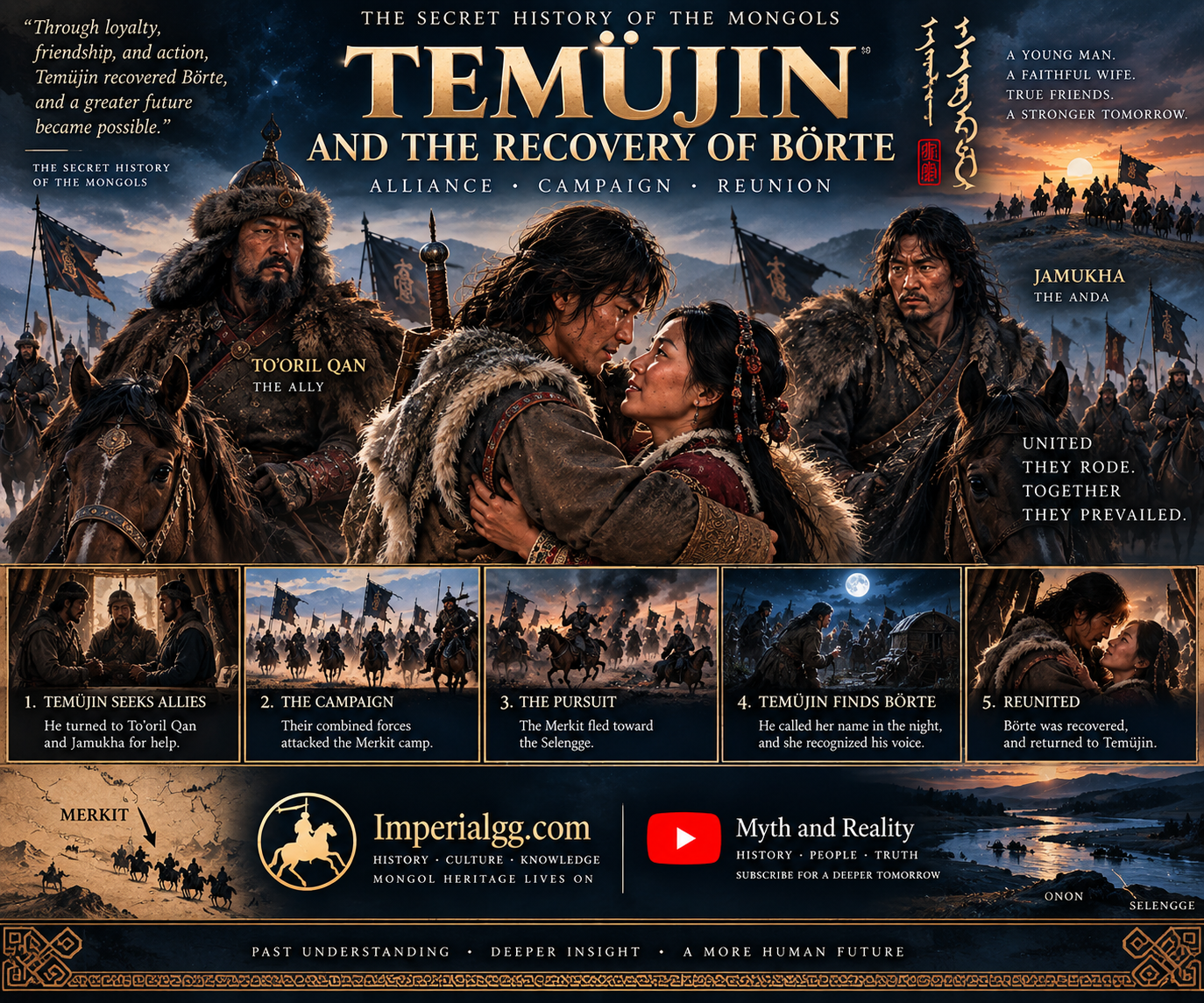
FLIGHT, THE CART OF QO’AQČIN, TEMÜJIN’S APPEAL TO TO’ORIL, AND THE EARLY HISTORY OF J̌OČI
AUTHOR’S THESIS
The Merkit seizure of Börte should not be reduced to the later dramatic image of Temüjin rescuing his wife from captivity. The earlier stage of the episode reveals a more vulnerable and materially constrained household. When the Merkits attacked, Temüjin and the other members of the camp attempted to flee in different directions, but there were not enough horses for everyone. The Secret History of the Mongols specifically records that there was no horse available for Börte. The elderly woman Qo’aqčin therefore attempted to conceal and transport her in a high covered cart drawn by an ox. The attempt failed when the cart’s axle broke, leaving Börte exposed to the pursuing Merkits.[1]
This episode is historically important for two reasons. First, it demonstrates that Börte’s capture was not the result of Temüjin deliberately abandoning her. The household was caught in a sudden raid and lacked sufficient mounts for an orderly evacuation. Second, the episode establishes the immediate circumstances behind Temüjin’s appeal to To’oril Qan. When Temüjin later went to To’oril, he described the loss not merely as the disappearance of his wife but, in de Rachewiltz’s reading of the difficult compound eme kö’ü, as the loss of his wife and unborn child. The expression has been translated differently by scholars, and the pregnancy should therefore be treated as a textual and chronological problem rather than as an unqualified fact.[2]
The later birth of J̌oči makes the question even more significant. J̌oči was not Börte’s first child. Modern scholarship drawing on the Secret History and Rashīd al-Dīn identifies Qojin-beki as an older daughter of Temüjin and Börte; Chih-Shu E explicitly notes that Rashīd al-Dīn describes Qojin-Beki as J̌oči’s elder sister, while Timothy May likewise places Qojin’s birth before the Merkit raid. J̌oči was therefore Börte’s second child, born after her return from the Merkit episode.[3]
The significance of the episode lies not only in the later rescue but in the vulnerability of a young steppe household when confronted by a sudden mounted raid. Börte’s inability to escape on horseback, the attempt of Qo’aqčin to save her by cart, the failure of that escape, and Temüjin’s subsequent appeal to To’oril together form a sequence in which a domestic crisis became the foundation for a wider military alliance.
THE MERKIT RAID AND THE FRAGILITY OF THE HOUSEHOLD
The Secret History places the Merkit attack within the wider history of retaliation surrounding Yisügei Ba’atur’s earlier seizure of Hö’elün from Yeke Čiledü. Much later in the narrative, the Merkit leaders themselves explain that their actions were intended as retaliation for what Yisügei had done to their kin.[4] The episode therefore belonged to a longer history of inter-group conflict rather than being an isolated raid against an otherwise unrelated household.
Yet the immediate circumstances described in the Secret History are strikingly practical. The attack occurred suddenly, and the household did not possess enough horses for all of its members. The available horses were distributed among Temüjin, Hö’elün, Qasar, Qači’un, Temüge, Belgütei, Bo’orču, and Jelme, while Temülün was carried by Hö’elün. One spare horse was prepared, but the text explicitly states that there was no horse for Börte.[5]
This detail should not be passed over as a minor logistical observation. In a mobile pastoral society, the horse was central to rapid movement and escape. A sudden shortage of mounts could determine who escaped and who remained exposed to the attackers. The narrative therefore shows that the vulnerability of Börte was partly created by the material conditions of the household itself.
It is also important not to convert the statement “there was no horse for Börte” into the stronger claim that Börte was physically incapable of riding. The Secret History does not explicitly say that she could not ride. It says that no horse was available for her in the emergency. Later evidence concerning her pregnancy makes the situation more complicated, but the source should be allowed to retain this distinction.[6]
QO’AQČIN’S ATTEMPT TO SAVE BÖRTE
The person who attempted to solve this problem was the elderly woman Qo’aqčin. The Secret History states that she thought she must hide Börte and placed her in a high covered wagon drawn by an ox with a speckled body. Qo’aqčin then drove the cart toward the Tenggelik Stream while the rest of the household moved away on horseback.[7]
This detail gives the episode an important social dimension. Börte was not simply left behind when the horses departed. Someone within the household recognized her vulnerability and attempted to create an alternative means of escape. Qo’aqčin’s decision demonstrates that the household’s response to the raid involved different forms of mobility: mounted flight for those with horses and cart transport for Börte.
The use of an ox-drawn covered cart also reflects the material culture of mobile pastoral life. Carts were not merely passive containers for possessions. They could transport people and household goods and could function as mobile spaces of concealment. Archaeological and historical scholarship on Mongol-period cart culture confirms the importance of carts in the movement of nomadic households, although evidence from later periods should not be projected mechanically onto the twelfth century.[8]
Qo’aqčin’s action should therefore be interpreted as an emergency adaptation to the household’s material circumstances rather than as evidence that Börte was simply abandoned by the fleeing group.
THE BROKEN AXLE AND BÖRTE’S CAPTURE
The attempt to escape failed for a mundane but decisive reason: the cart’s axle broke. According to the Secret History, Qo’aqčin encountered soldiers while traveling toward the Tenggelik Stream. She successfully misdirected their questions about Temüjin’s location, but when she urged the ox forward, the axle suddenly broke in two. At that moment the pursuing soldiers returned, and Börte was discovered.[9]
The importance of this passage lies precisely in its lack of heroic embellishment. Börte’s capture did not occur because the household intentionally surrendered her, nor because she simply chose not to flee. The immediate cause was a failed emergency evacuation. The cart was the household’s substitute for a missing horse, but the mechanical failure of the cart removed even that limited possibility of escape.
This makes Qo’aqčin’s attempt historically significant even though it failed. Her action demonstrates that the capture of Börte was contingent upon a sequence of material circumstances: insufficient horses, the decision to use an ox-drawn cart, the interception by patrolmen, and finally the broken axle.
TEMÜJIN’S APPEAL TO TO’ORIL QAN
After the household escaped and Börte had been taken, Temüjin sought assistance from To’oril Qan of the Kereyit. The Secret History states that Temüjin, accompanied by Qasar and Belgütei, went to To’oril at the Qara Forest beside the Tu’ula River.[10]
The wording of Temüjin’s appeal is especially important. In de Rachewiltz’s translation, Temüjin tells To’oril that the Three Merkit had taken his wife and his unborn child and asks the “Qan my father” to restore them to him. The underlying Middle Mongolian expression, however, is difficult: eme kö’ü can literally be read as something like “wife-child,” and translators have differed over whether this means simply “wife” or implies that Börte was pregnant.[11]
The pregnancy interpretation is strengthened by the subsequent birth of J̌oči shortly after Börte’s recovery. Nevertheless, it should remain an interpretation rather than a completely independent fact because the Secret History does not explicitly narrate Börte’s pregnancy during the Merkit raid itself. Broadbridge has emphasized this problem, noting that the Secret History does not explain the pregnancy during the dramatic rescue narrative and that the chronology raises medical as well as textual questions.[12]
Temüjin’s wording nevertheless reveals how he conceptualized the loss. Börte was not merely an individual woman who had been captured. If the eme kö’ü interpretation is accepted, Temüjin understood the raid as the loss of both his wife and the child she was carrying. His appeal to To’oril therefore had both familial and dynastic dimensions.
THE SABLE COAT AND THE OBLIGATION OF TO’ORIL
Temüjin’s appeal was also political. He reminded To’oril of the black sable coat that he had previously presented to him. To’oril had promised that in return for the coat he would reunite Temüjin’s scattered people and support him.[13]
To’oril now invoked that earlier exchange. He declared that, in return for the sable coat, he would crush the Merkits and recover Börte. He ordered a force of twenty thousand men and instructed Temüjin to summon J̌amuqa, who was to bring another twenty thousand.[14]
The political significance is substantial. Temüjin’s personal crisis activated an existing relationship of reciprocal obligation. The sable coat had created more than an emotional bond; it had established a framework through which assistance could be demanded and provided.
Thus, the loss of Börte became the immediate occasion for one of Temüjin’s earliest large-scale military coalitions. The rescue was made possible not because Temüjin possessed sufficient independent power, but because he had already begun constructing relationships that could be converted into military support.
JOCHI WAS NOT BÖRTE’S FIRST CHILD
The question of J̌oči’s birth requires another correction to the common simplified narrative.
Börte and Temüjin already had a daughter before the Merkit raid: Qojin-beki. Timothy May specifically identifies Qojin as a daughter born before the Merkit attack and J̌oči as the son subsequently born in J̌amuqa’s camp.[15]
Rashīd al-Dīn is even more explicit in his genealogy of J̌oči. He states that J̌oči was the eldest of Chinggis Khan’s children except for a daughter, Fujin Beki, who was older than him. Chih-Shu E identifies this older sister as Qojin-Beki and notes the relevant passage of Rashīd al-Dīn’s Jāmiʿ al-Tawārīkh.[16]
The Secret History itself later identifies Qojin-beki in the context of a proposed marriage alliance: Temüjin offered his daughter Qojin-beki to Tusaqa, the son of Senggüm, while seeking Cha’ur-beki, To’oril’s daughter or close descendant depending on the genealogy, as a bride for J̌oči.[17]
This establishes an important chronological distinction:
QOJIN-BEKI → J̌OČI → ČAγATAI → ÖGEDEI → TOLUI
with the caveat that exact birth years are reconstructed rather than directly supplied for every child.
Consequently, J̌oči should not be described as Börte’s first child. He was her first son, but an older daughter preceded him. This distinction becomes especially important when examining the question of Börte’s pregnancy at the time of the Merkit raid.
THE PROBLEM OF J̌OČI’S BIRTH
The chronology surrounding J̌oči is one of the most sensitive source-critical problems in the early history of the Chinggisid family.
If Börte was already pregnant when the Merkits captured her, as the eme kö’ü interpretation suggests, then J̌oči was conceived before the raid and born after her recovery. The Secret History later records J̌oči’s birth and subsequently preserves a controversy over his parentage.[18]
Rashīd al-Dīn presents a substantially different account. He states that Börte was pregnant when the Merkits captured her but gives an alternative narrative in which she was sent to To’oril, who treated her with respect because of his relationship with Temüjin’s father. Broadbridge notes that the two traditions differ significantly and that both create historical problems of their own.[19]
This divergence should not be artificially harmonized. The historian can establish several points with reasonable confidence: Börte was captured by the Merkits; she was later recovered; she gave birth to J̌oči after the recovery; and the circumstances of his birth subsequently generated questions concerning his paternity. The precise circumstances of Börte’s captivity and J̌oči’s conception remain contested because the major narrative sources do not agree.[20]
Temüjin nevertheless treated J̌oči as his son. The political history of the Mongol Empire subsequently demonstrates that J̌oči occupied a central position within the Chinggisid family despite the controversy preserved in the sources.[21]
FROM A FAILED CART ESCAPE TO A MILITARY COALITION
The significance of the episode becomes clearer when the individual events are considered as a single sequence.
The Merkit attack exposed the weakness of Temüjin’s household. There were insufficient horses. Börte had no mount. Qo’aqčin attempted to compensate by placing her in a covered cart drawn by an ox. The cart’s axle broke. Börte was captured. Temüjin then appealed to To’oril, invoking both their personal relationship and the political obligation established by the sable coat. To’oril responded by mobilizing a large force and instructing Temüjin to summon J̌amuqa.[22]
The transformation is historically significant:
HOUSEHOLD VULNERABILITY → BÖRTE’S CAPTURE → TEMÜJIN’S APPEAL → TO’ORIL’S OBLIGATION → JAMUQA’S PARTICIPATION → MILITARY COALITION
The rescue of Börte therefore became one of the earliest occasions on which Temüjin converted a private catastrophe into a broader political mobilization.
CONCLUSION
The Merkit raid on Börte should be understood first as a crisis of a young and materially vulnerable household. The Secret History does not present a household equipped with unlimited horses and the ability to evacuate everyone simultaneously. Instead, it gives an unusually concrete account of the constraints under which the family attempted to escape. Horses were distributed among the available riders, Temülün was carried by Hö’elün, and there was no horse for Börte. Qo’aqčin responded by placing Börte in a covered cart drawn by an ox, but the cart’s axle broke before she could escape the pursuing soldiers.[23]
This detail changes the interpretation of the episode. Börte was not simply left behind. An elderly woman actively attempted to save her, but the alternative means of transport failed. Her capture was therefore the result of a rapidly unfolding military crisis compounded by the material limitations of the household.
Temüjin’s subsequent statement to To’oril is equally important. The difficult phrase eme kö’ü may indicate that Temüjin regarded Börte as carrying his unborn child, although the textual problem prevents this from being stated without qualification. The subsequent birth of J̌oči supports the interpretation but does not remove the source-critical difficulties.[24]
J̌oči’s position within Börte’s family also requires precision. He was not Börte’s first child. Qojin-beki, an older daughter, preceded him; later genealogical evidence explicitly identifies her as J̌oči’s elder sister.[25] J̌oči was therefore Börte’s first son, not her first child.
The larger historical consequence of the episode was political. Temüjin lacked the independent military capacity to recover Börte. He therefore activated the relationship he had established with To’oril through the sable coat, and To’oril in turn called upon J̌amuqa. The personal loss of a wife—and, in Temüjin’s own formulation, possibly an unborn child—became the immediate catalyst for a military coalition.[26]
The historical importance of the episode thus lies in the connection between family vulnerability and political mobilization. Börte’s capture revealed how exposed Temüjin’s household remained; his response demonstrated that he had already begun to possess something equally important: relationships capable of being transformed into military power.
FOOTNOTES
1. The Secret History of the Mongols, §98, in Christopher P. Atwood, trans., The Secret History of the Mongols (Penguin Classics, 2023), and Igor de Rachewiltz, ed. and trans., The Secret History of the Mongols (Leiden: Brill, 2004–2013). The relevant passage explicitly states that there was no horse for Börte and that Qo’aqčin placed her in a high covered wagon drawn by an ox.
2. Secret History, §104. De Rachewiltz’s note identifies the difficult expression eme kö’ü and argues that it may mean “wife-child,” implying that Börte was pregnant. Other translators have rendered the expression simply as “wife.” The issue remains disputed.
3. Timothy May, “The Mongol World,” identifies Qojin as a daughter born before the Merkit attack and J̌oči as the son born in J̌amuqa’s camp. Chih-Shu E, Studies in the Career of Chinggis Qan, citing Rashīd al-Dīn, states explicitly that Qojin-Beki was J̌oči’s elder sister.
4. Secret History, §111. The Merkit leaders explain their action as retaliation for Yisügei Ba’atur’s earlier seizure of Hö’elün from Yeke Čiledü.
5. Secret History, §98. The passage lists the horses available during the flight and explicitly states that there was no horse for Börte.
6. Anne F. Broadbridge, Women and the Making of the Mongol Empire (Cambridge University Press, 2018), discusses the pregnancy problem and notes the medical and chronological difficulties involved in interpreting Börte’s condition during the raid and subsequent rescue.
7. Secret History, §98. Qo’aqčin places Börte in a high covered cart, yokes an ox to it, and travels toward the Tenggelik Stream.
8. On carts as an important component of Mongolian mobile culture and their use for transportation, see research on nomadic cart culture; such later evidence should be used cautiously when reconstructing the twelfth-century context.
9. Secret History, §98. The axle breaks, the soldiers return, and Börte is discovered.
10. Secret History, §104. Temüjin, Qasar, and Belgütei go to To’oril at the Qara Forest beside the Tu’ula River.
11. De Rachewiltz, commentary to §104, on eme kö’ü. The literal compound is problematic and has generated divergent translations.
12. Broadbridge, Women and the Making of the Mongol Empire, chapter 2. She emphasizes that the Secret History does not narrate Börte’s pregnancy during the rescue scene and examines the chronological and medical problems surrounding J̌oči’s birth.
13. Secret History, §104. Temüjin reminds To’oril of the black sable coat and the promise made in return for it.
14. Secret History, §104. To’oril promises to crush the Merkits and recover Börte and orders two tümen, while directing Temüjin to summon J̌amuqa.
15. May, The Mongol World, states that Qojin was born before the Merkit attack and that J̌oči was subsequently born in J̌amuqa’s camp.
16. Rashīd al-Dīn, Jāmiʿ al-Tawārīkh, as cited and discussed by Chih-Shu E, identifies Qojin-Beki as the elder sister of J̌oči.
17. Secret History, §165. The text identifies Qojin-beki as Temüjin and Börte’s daughter and records the proposed marriage exchange involving J̌oči and Qojin.
18. Secret History, §§104, 165. The chronology places J̌oči’s birth after the recovery of Börte, while the later narrative preserves questions concerning his parentage.
19. Rashīd al-Dīn’s account differs substantially from the Secret History in its treatment of Börte during captivity. Broadbridge discusses the competing narratives and their problems in detail.
20. On the disagreement between the Secret History and Rashīd al-Dīn, see also the discussion in Igor de Rachewiltz and modern scholarship concerning the composition and transmission of the early narrative.
21. Rashīd al-Dīn and the Secret History both preserve J̌oči as a major Chinggisid son, although the circumstances of his birth generated controversy. Temüjin nevertheless treated him as his son.
22. Secret History, §§98, 104–105. The sequence from Börte’s capture to Temüjin’s appeal to To’oril and To’oril’s call to J̌amuqa is explicit in the source.
23. Secret History, §98.
24. Secret History, §104; Broadbridge, Women and the Making of the Mongol Empire.
25. Chih-Shu E, Studies in the Career of Chinggis Qan, citing Rashīd al-Dīn, identifies Qojin-Beki as J̌oči’s elder sister; May places Qojin’s birth before the Merkit episode.
26. Secret History, §104.
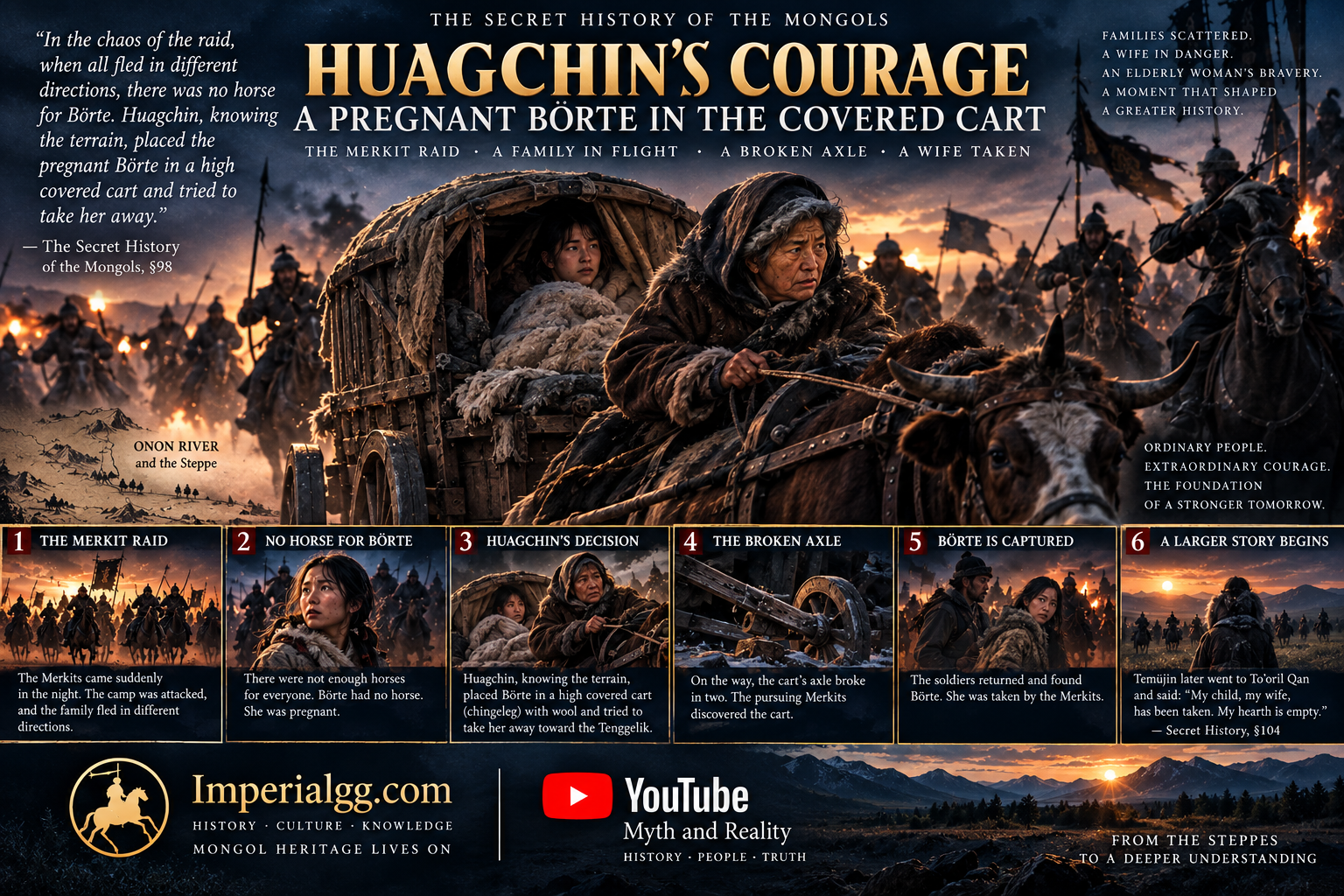
INTRODUCTION
The recovery of Börte Üjin from the Merkits was one of the decisive episodes in the early political career of Temüjin. The event is frequently remembered simply as the rescue of a kidnapped wife, but the Secret History of the Mongols presents a more complicated sequence involving an older intergenerational grievance, the vulnerability of a newly established household, Temüjin’s appeal to To’oril Qan, the mobilization of J̌amuqa and the Kereyit and Mongol forces, the defeat and dispersal of the Merkit camp, and finally Temüjin’s personal recognition and recovery of Börte during the night pursuit.[1]
The episode is particularly important because Temüjin did not possess sufficient independent military power to recover Börte by himself. His response was therefore political as well as personal. He appealed first to To’oril Qan of the Kereyit, whom he had recently established as an adoptive father through the exchange of the black sable coat, and To’oril in turn summoned J̌amuqa, Temüjin’s sworn anda. The rescue thus became one of the earliest documented examples in Temüjin’s career in which a personal crisis was transformed into a wider political and military coalition.[2]
At the same time, the sources surrounding Börte’s captivity are unusually problematic. The Secret History and Rashīd al-Dīn’s Jāmiʿ al-Tawārīkh agree on the broad fact that the Merkits seized Börte, but they differ substantially concerning her treatment during captivity, the circumstances of her pregnancy, and the manner in which she was returned to Temüjin.[3] A historical reconstruction must therefore distinguish what can be securely established from what belongs to competing narrative traditions.
THE MERKIT RAID AND THE MEMORY OF HÖ’ELÜN
The immediate background to Börte’s abduction was not an isolated dispute between Temüjin and the Merkits. According to the Secret History, the Merkit leaders themselves later explained that their action was connected with an earlier event in which Yisügei Ba’atur had taken Hö’elün from Yeke Čiledü, the younger brother of Toqto’a Beki.[4]
The connection is explicit in §111, where the three principal Merkit leaders—Toqto’a Beki of the Uduyit Merkit, Dayir Usun of the U’as Merkit, and Qa’atai Darmala of the Qa’at Merkit—state that they had acted to avenge the earlier abduction of Hö’elün. They also explain that they captured Börte while Temüjin was circling Burqan Qaldun.[5]
This later explanation is important because it gives the Merkit raid a logic of retaliation. The conflict therefore extended across generations: Yisügei’s seizure of Hö’elün had created a grievance that, according to the Secret History, remained politically meaningful after his death. The seizure of Börte was consequently presented as a form of reciprocal retaliation rather than as an entirely new conflict.[6]
Modern scholarship has treated this explanation as historically significant but has also warned against accepting the Secret History’s retrospective formulation without criticism. Christopher Atwood, for example, identifies the abduction of Börte as a violation that generated retaliation, connecting the Merkit attack to the earlier seizure of Hö’elün.[7] The broader historical pattern is therefore more accurately described as a cycle of inter-group retaliation than as a single act of unprovoked aggression.
BÖRTE’S VULNERABILITY AFTER MARRIAGE
Börte had entered Temüjin’s household through a marriage that itself carried political significance. Her father Dei Sečen of the Onggirat had agreed to the marriage when Börte was ten and Temüjin was nine, and Temüjin was left for a period in his prospective father-in-law’s household before returning to his own family after Yisügei’s death.[8]
The marriage connected Temüjin to the Onggirat and provided him with a wife from a socially important lineage. Yet the marriage did not provide absolute military security. Temüjin remained a young leader operating within a fragmented political environment, and his household was vulnerable to mobile raiding groups.
The Merkit attack therefore exposed a fundamental feature of steppe political society: marriage could establish relationships across communities, but a newly formed household remained dependent upon its ability to protect itself militarily. Börte’s abduction was consequently not merely a private domestic tragedy. It demonstrated the weakness of Temüjin’s political position at that stage of his career.
TEMÜJIN’S FLIGHT AND THE LOSS OF BÖRTE
The Secret History describes the Merkit attack as occurring suddenly. The household was awakened by the approach of the raiders, and the members of Temüjin’s camp attempted to escape. There were not enough horses for everyone. Temüjin and the other men fled, while Börte remained behind.[9]
The circumstances are important because the source does not portray Temüjin as deliberately abandoning Börte. The immediate problem was the unequal availability of horses during a surprise attack. The household was forced to disperse under military pressure.
The Secret History and later scholarship also indicate that Hö’elün and the other family members escaped, while Börte and other women were left vulnerable to capture. Anne Broadbridge emphasizes the importance of this episode in understanding the position of women and households during periods of violent inter-group conflict. The account records that Börte was among those unable to escape and that an elderly household woman, Qo’aqčin, attempted to conceal her in an ox cart.[10]
This detail deserves particular attention because it demonstrates that Börte’s survival initially depended not upon military force but upon the actions of members of her household. Qo’aqčin attempted to move Börte away from the raiders in a cart, but the cart’s axle broke, and the attempt failed.[11]
The Merkit therefore succeeded in capturing Börte.
THE CAPTIVITY OF BÖRTE
The precise circumstances of Börte’s captivity are among the most disputed aspects of the narrative.
The Secret History states that the Merkits entrusted Börte to Čilger Bökö, the younger brother of Čiledü, the man from whom Yisügei had taken Hö’elün.[12] Later in §111, Čilger Bökö himself speaks of having laid hands upon Börte and having brought calamity upon the Merkits. His subsequent flight from the Merkit camp is presented in connection with his fear of the consequences of what he had done.[13]
Rashīd al-Dīn presents a substantially different version. His account, based on the Altan Debter tradition, treats Börte’s situation much more cautiously and avoids the direct implication found in the Secret History that she became the wife of Čilger Bökö. Timothy May notes this major discrepancy, while Broadbridge examines it at length and argues that Rashīd al-Dīn’s version appears shaped by concerns surrounding Börte’s reputation and the later legitimacy of her son J̌öči.[14]
The historian therefore has to resist the temptation to merge the two narratives into one seamless story. The Secret History gives one account; Rashīd al-Dīn gives another. What can be established with confidence is that Börte was captured by the Merkits and that her recovery became the immediate objective of Temüjin’s subsequent appeal to To’oril Qan.[15]
TEMÜJIN TURNS TO TO’ORIL QAN
Temüjin did not attempt to assemble an army entirely on his own. He went with Qasar and Belgütei to To’oril Qan, the ruler of the Kereyit, who was staying beside the Tu’ula River.[16]
Temüjin’s appeal is revealing. He addressed To’oril as “Qan my father”, invoking the relationship established through their earlier exchange of the black sable coat. He reminded To’oril that the Kereyit ruler had previously promised to reunite Temüjin’s scattered people in return for the sable coat.[17]
To’oril responded by explicitly connecting the earlier promise to the present crisis. He declared that, in return for the sable coat, he would rescue Börte and crush the Merkit forces. He ordered that two tümen form his wing and instructed Temüjin to send word to J̌amuqa, who was to assemble another two tümen.[18]
This is one of the clearest examples in the early narrative of reciprocal political obligation. The sable coat was not simply a gift. It had become part of an exchange of loyalty and military assistance. To’oril now interpreted the rescue of Börte as the fulfillment of an earlier obligation.
The episode therefore demonstrates that Temüjin’s developing political network already depended upon relationships that combined kinship language, gift exchange, personal loyalty, and military obligation.
JAMUQA AND THE TRANSFORMATION OF PERSONAL LOSS INTO COLLECTIVE ACTION
Temüjin also sent Qasar and Belgütei to J̌amuqa. The message emphasized both the loss of Börte and the relationship between the two men. Temüjin described his bed as empty and his breast as torn apart, and appealed to J̌amuqa as someone of close kin-like relationship.[19]
J̌amuqa responded by accepting the obligation to participate in the campaign. He declared that the Merkit groups responsible for the abduction should be defeated and that Börte should be brought back.[20]
This exchange is significant because the rescue was not organized merely through a centralized command. It was assembled through overlapping relationships. To’oril was connected to Temüjin through an adopted father-son relationship; J̌amuqa was his anda; and the planned army was formed through these personal and political networks.
The campaign against the Merkits therefore represents an early example of Temüjin converting personal relationships into coordinated military power.
THE RENDEZVOUS AT BOTOQAN-BO’ORJI
The allies established a rendezvous at Botoqan-Bo’orji at the headwaters of the Onon.[21] The location and timing were important because the operation depended upon coordinating forces that were not under a single permanent command.
The sources preserve a revealing episode concerning To’oril’s delay. When To’oril arrived three days late, J̌amuqa criticized him for failing to appear at the agreed time. The exchange demonstrates that military coordination already required precise attention to pasture, provisions, movement, and timing.[22]
This detail is sometimes overshadowed by the emotional dimension of Börte’s rescue, but it is historically important. The campaign required logistical organization on a substantial scale. The forces of Temüjin, J̌amuqa, and To’oril had to converge before advancing against the Merkits.
The rescue was therefore not an improvised raid conducted by Temüjin alone. It was a coordinated military expedition.
THE ATTACK ON THE MERKIT CAMP
The combined forces advanced toward the Merkit encampment. The Secret History describes the Merkit leadership receiving warning of the approaching army and attempting to withdraw.[23]
The Merkit forces were caught in a difficult position. The allied army was sufficiently large to force the Merkits to retreat, and the Merkit leaders attempted to escape toward the Selenge River and into the Barqujin region.[24]
The campaign resulted in the collapse and dispersal of the Merkit camp. This was the military event that made Börte’s recovery possible.
Yet it is important not to describe the campaign as though the objective were simply the destruction of the entire Merkit population. The Secret History describes pursuit, plunder, flight, and the dispersal of the Merkit groups. The later history of the Mongol-Merkit conflict involved further campaigns, and the Merkit were not eliminated by this single operation.[25]
TEMÜJIN SEARCHES FOR BÖRTE
The most personal part of the campaign occurs after the Merkit camp begins to break apart.
At night, the fleeing Merkit moved down the Selenge while the allied forces pursued them. During the confusion of the retreat, Temüjin moved among the fleeing people calling repeatedly:
“Börte! Börte!”[26]
The Secret History then describes the moment of recognition. Börte heard Temüjin’s voice and recognized it. She descended from the cart and ran toward him. In the moonlight, Börte and Qo’aqčin recognized Temüjin’s reins and tether, while Temüjin recognized Börte. They then embraced.[27]
This is one of the rare passages in the Secret History in which a major political event is narrated through an intimate personal recognition rather than through formal political language.
Temüjin’s search did not end with the defeat of the Merkit forces. He personally moved through the fleeing population looking for Börte. The recovery therefore required both the military success of the coalition and Temüjin’s own identification of her among the displaced and fleeing people.
THE DECISION TO STOP THE PURSUIT
After finding Börte, Temüjin sent word to To’oril and J̌amuqa that he had found what he was looking for. He proposed that they stop traveling through the night and establish camp.[28]
This decision is historically revealing. Once Börte had been recovered, the immediate objective of the campaign had been achieved. The allied forces no longer needed to pursue the fleeing Merkits throughout the night solely for the purpose of recovering Temüjin’s wife.
The narrative thus separates two objectives: the recovery of Börte and the broader destruction or pursuit of the Merkit enemy. The first had been achieved. Temüjin’s decision to stop demonstrates that, at least at this moment, the rescue of Börte was the central objective that had brought the coalition into action.
The Secret History closes the episode with an explicit statement: This is how Lady Börte was rescued from the Merkit tribe, and how she was reunited with Temüjin.[29]
The source therefore itself defines the event as a rescue and reunion rather than simply as a military victory.
THE POLITICAL SIGNIFICANCE OF BÖRTE’S RESCUE
The significance of the episode extends beyond the recovery of one person. First, it demonstrated that Temüjin could mobilize external military support. He did not yet possess the independent power that he would later command. Nevertheless, he could activate relationships with To’oril and J̌amuqa and convert those relationships into a substantial military force.
Second, the episode strengthened the political relationship between Temüjin and To’oril. To’oril’s assistance was not simply an act of generosity. It fulfilled a previously stated obligation connected with the sable coat. The rescue therefore reinforced a relationship in which personal loyalty and political calculation were closely intertwined.[30]
Third, the episode reinforced Temüjin’s relationship with J̌amuqa. The two men were andas, and the crisis produced another expression of their mutual obligation. Their subsequent relationship would eventually deteriorate, but at this stage the rescue campaign demonstrates the practical military value of their alliance.[31]
Fourth, the episode placed Börte herself at the center of Temüjin’s political history. She was not merely a person recovered after a raid. Her abduction and return became connected with the formation of the alliance network that would shape Temüjin’s subsequent career.
BÖRTE, PREGNANCY, AND THE PROBLEM OF J̌OČI
One of the most difficult historical questions arising from the episode concerns Börte’s pregnancy. The Secret History does not explicitly mention Börte’s pregnancy during the narrative of her abduction and rescue. Yet §104 contains Temüjin’s statement to To’oril concerning the loss of his “wife-child”, and shortly after the rescue Börte gives birth to J̌oči.[32]
De Rachewiltz discusses the linguistic problem in detail and notes that the expression can plausibly be understood as referring to Börte and the child she was carrying.[33] Later sections of the Secret History also contain the famous controversy over J̌oči’s parentage.
Rashīd al-Dīn, however, presents the matter differently and explicitly makes Börte pregnant before the Merkit raid. Broadbridge argues that both traditions create serious chronological and narrative difficulties and that the later sources appear to have been shaped partly by the political sensitivity surrounding J̌oči’s legitimacy.[34]
The historian should therefore avoid stating as an established fact that J̌oči was biologically fathered by either Temüjin or Čilger Bökö. The sources do not permit that certainty.
What is historically certain is that Temüjin accepted J̌oči as his son and incorporated him into the ruling family, while later members of the Chinggisid family questioned his paternal legitimacy.[35]
This later controversy demonstrates that Börte’s captivity was not an isolated episode. Its consequences extended into the succession politics of the Mongol Empire.
CONCLUSION
The recovery of Börte was a decisive event because it brought together several elements that would become characteristic of Temüjin’s political career: personal loyalty, reciprocal obligation, military coalition-building, rapid mobilization, and the conversion of private crisis into collective political action.
The sequence begins with the Merkit raid and the capture of Börte, an event that the Secret History explicitly connects to the earlier abduction of Hö’elün by Yisügei Ba’atur. Temüjin was unable to recover Börte by his own resources and therefore appealed to To’oril Qan. To’oril accepted the obligation created by their earlier exchange of the sable coat and summoned J̌amuqa. J̌amuqa responded as Temüjin’s anda, and the three leaders assembled a substantial force.[36]
The resulting campaign defeated and dispersed the Merkit forces sufficiently for Temüjin to enter the fleeing population in search of Börte. His repeated call of her name, her recognition of his voice, and their reunion in the moonlight form the final personal moment of the campaign. Yet the historical significance of that moment rests upon the political structure that made it possible: Temüjin’s personal loss had been transformed into an alliance, and the alliance had become a military operation.
The rescue therefore marked an important stage in Temüjin’s development. It does not prove that he had already become a powerful independent ruler. Rather, it demonstrates something more historically precise: he had begun to learn how personal relationships could be transformed into political capacity.
Börte’s recovery was consequently both a family reunion and an early demonstration of coalition politics on the Mongolian steppe.
NOTES
[1] Igor de Rachewiltz, The Secret History of the Mongols: A Mongolian Epic Chronicle of the Thirteenth Century, §§98–111. The narrative of the Merkit raid, Temüjin’s appeal to To’oril and J̌amuqa, the campaign, and Börte’s recovery occupies the central portion of Chapter Three.
[2] On the political importance of the episode as an alliance involving Temüjin, To’oril and J̌amuqa, see de Rachewiltz, Secret History, §§104–110; Timothy May, The Mongol World, discussion of the Merkit episode and references to SHM §§100–112.
[3] The differences between the Secret History and Rashīd al-Dīn are discussed in Timothy May, Chinggis Khan: World Conqueror, and Anne F. Broadbridge, Women and the Making of the Mongol Empire, especially the discussion of Hö’elün and Börte.
[4] Secret History, §111. The Merkit leaders explicitly connect the capture of Börte with Yisügei Ba’atur’s earlier seizure of Hö’elün from Yeke Čiledü.
[5] Ibid. The same passage states that the Merkit leaders captured Börte while Temüjin was circling Burqan Qaldun.
[6] On the interpretation of the Merkit attack as retaliation for Yisügei’s earlier capture of Hö’elün, see Atwood, “The Rise of the Chinggisid Dynasty,” which describes the episode as a retaliatory violation that provoked the joint attack by Ong Qan, J̌amuqa and Temüjin.
[7] Christopher P. Atwood, “The Rise of the Chinggisid Dynasty: Pre-Modern Eurasian Political Order and Culture at a Glance,” International Journal of Asian Studies.
[8] Secret History, §§63–66. Börte was ten when Yisügei met Dei Sečen, while Temüjin was nine. The marriage arrangement was made between their families.
[9] Secret History, §§98–103. Broadbridge emphasizes that the household did not possess enough horses for everyone during the Merkit attack.
[10] Anne F. Broadbridge, Women and the Making of the Mongol Empire (Cambridge: Cambridge University Press, 2018), discussion of Hö’elün and Börte, pp. 58–63. The relevant discussion identifies Qo’aqčin’s attempt to conceal Börte in an ox cart.
[11] Secret History, §§100–103. The Altan Tobči tradition also preserves the episode of Qo’aqčin attempting to move Börte upstream in a cart and encountering pursuing soldiers.
[12] Secret History, §111. Börte was entrusted to Čilger Bökö, the younger brother of Čiledü.
[13] Ibid. Čilger Bökö’s lament explicitly refers to having laid hands upon Börte and connects his actions with disaster for the Merkits.
[14] Timothy May notes the substantial divergence between the Secret History and Rashīd al-Dīn’s account. Broadbridge examines the discrepancies at length and argues that Rashīd al-Dīn’s presentation is problematic in several respects, particularly concerning Börte’s pregnancy and treatment.
[15] Both traditions agree on the central fact that Börte was captured by the Merkits, although their accounts of what happened afterward differ.
[16] Secret History, §104. Temüjin, Qasar and Belgütei went to To’oril Qan at the Qara Forest beside the Tu’ula River.
[17] Secret History, §104. Temüjin addresses To’oril as “Qan my father” and recalls the earlier sable-coat exchange.
[18] Ibid. To’oril promises to rescue Börte and orders two tümen while instructing Temüjin to contact J̌amuqa.
[19] Secret History, §105. Temüjin sends Qasar and Belgütei to J̌amuqa with the message concerning his empty bed and wounded breast.
[20] Ibid. J̌amuqa accepts the call for revenge and the rescue of Börte.
[21] Secret History, §106. The rendezvous was established at Botoqan-Bo’orji at the headwaters of the Onon. The broader importance of this rendezvous is discussed by Atwood in his analysis of early Chinggisid political order.
[22] Atwood discusses the political significance of the rendezvous and To’oril’s three-day delay, including the importance of coordinated movement and the norms surrounding agreed rendezvous points.
[23] Secret History, §§107–109. The Merkit leaders receive warning of the allied advance and begin withdrawing toward the Selengge and Barqujin region.
[24] Ibid. The Merkit forces flee downstream along the Selengge as the allied forces pursue.
[25] Timothy May notes that the Merkits survived this defeat and continued to resist Temüjin in subsequent decades; the later campaigns against them should therefore not be conflated with the initial rescue of Börte.
[26] Secret History, §110. Temüjin moves among the fleeing Merkit population calling “Börte, Börte!”
[27] Ibid. Börte recognizes Temüjin’s voice, while Börte and Qo’aqčin recognize his reins and tether; Temüjin recognizes Börte in the moonlight, and the two embrace.
[28] Ibid. Temüjin immediately sends word to To’oril and J̌amuqa that he has found what he sought and proposes stopping for the night.
[29] Secret History, §110. The text explicitly concludes: “This is how Lady Börte was rescued from the Merkit tribe, and how she was reunited with Temüjin.”
[30] The political meaning of the sable-coat exchange and To’oril’s promise is explicit in §104.
[31] The relationship between Temüjin and J̌amuqa as andas is repeatedly emphasized in the Secret History, including their participation in the Börte rescue campaign.
[32] Secret History, §104. De Rachewiltz notes the unusual compound eme kö’ü and the possibility that Temüjin was referring to Börte’s pregnancy.
[33] Igor de Rachewiltz, commentary to Secret History, §104. The linguistic issue is significant because Börte later gives birth to J̌oči.
[34] Broadbridge, Women and the Making of the Mongol Empire, pp. 60–63; May, Chinggis Khan: World Conqueror. Broadbridge emphasizes the contradictions between the two traditions and questions several elements of Rashīd al-Dīn’s version.
[35] The later Secret History preserves the controversy surrounding J̌oči’s parentage, while Temüjin nevertheless consistently treats him as his son. The question subsequently became significant in Chinggisid succession politics.
[36] Secret History, §§104–110; Atwood, “The Rise of the Chinggisid Dynasty.”
SOURCE NOTE ON CHRONOLOGY
The exact dating of the Börte episode requires caution. Some modern reconstructions place the abduction around 1179–1180, while Timothy May and Paul Ratchnevsky have used a somewhat later reconstruction around 1184; the Secret History itself contains chronological problems and later editorial notes do not remove the disagreement. A recent overview places the episode broadly around 1180, plus or minus a year or two.
JOCHI’S BIRTH AND THE MERKIT CAPTIVITY: RECONSTRUCTING THE CHRONOLOGY
By Altanbagana Baatar
DBA Candidate| Independent Historian
ImperialGG Historical Research Seriers
13 September 2026
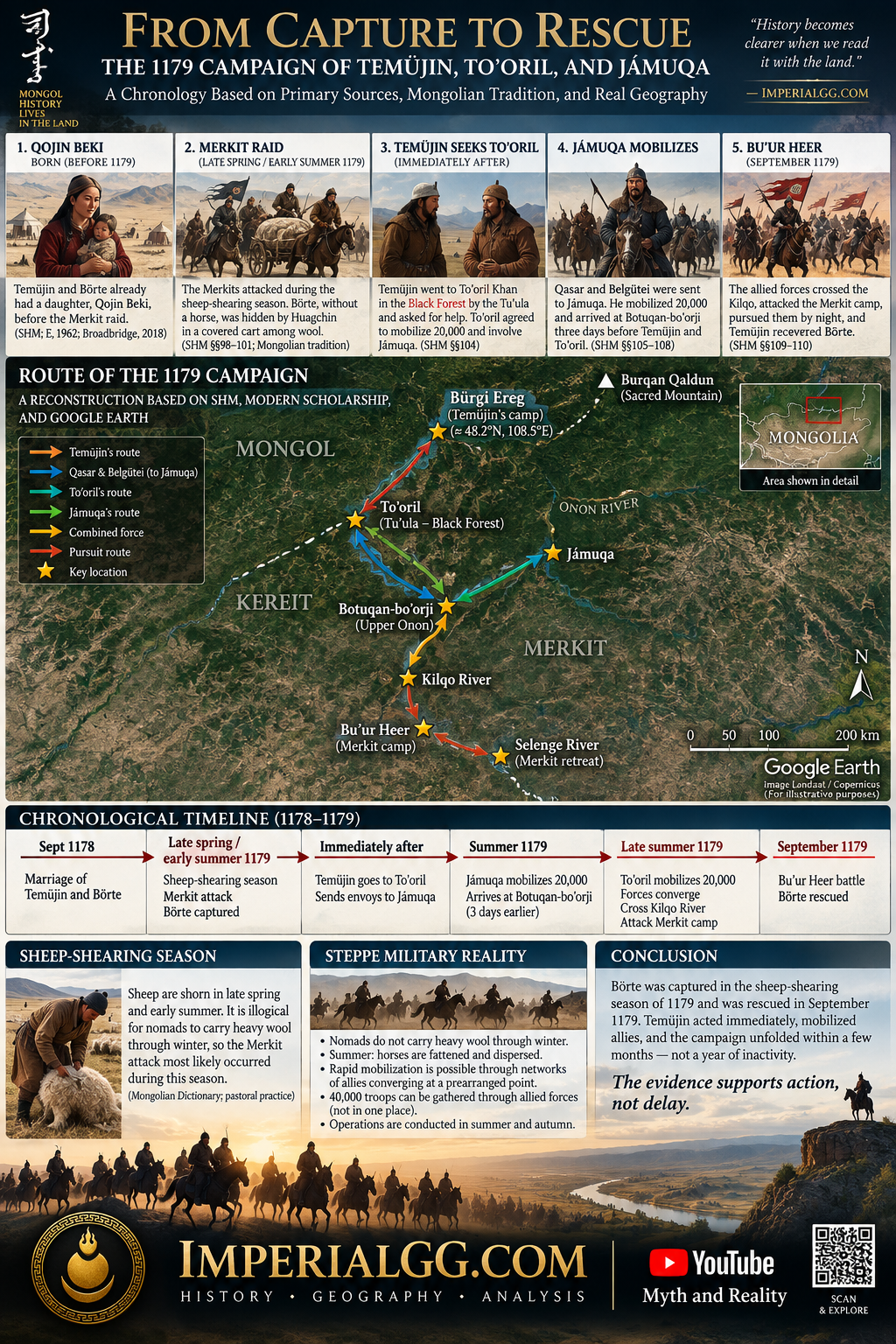
AUTHOR’S THESIS
The historical sources do not portray Temüjin as remaining inactive after Börte was seized. Quite the opposite. The sequence recorded in the Secret History of the Mongols is remarkably direct. After the Merkit attack, Temüjin descended from Burqan Qaldun and went with Qasar and Belgütei to To’oril Khan, who was then in the Black Forest by the Tu’ula River. There he asked for assistance in recovering his wife and kid.¹
To’oril responded immediately. Recalling the sable coat Temüjin had previously given him, he declared his willingness to restore what had been lost and proposed a major military expedition. He would mobilize two tümen, while J̌amuqa was to be brought into the operation with another two tümen.²
Temüjin then acted without delay. He returned to his camp and sent Qasar and Belgütei as messengers to J̌amuqa, conveying To’oril’s proposal and asking him to join the campaign.³
J̌amuqa responded. The rendezvous was established. And the subsequent narrative demonstrates that the mobilization was rapid enough for J̌amuqa to reach Botuqan-bo’orji at the headwaters of the Onon three days before Temüjin and To’oril arrived.⁴ This is not merely an inference from military theory. It is the operational sequence preserved by the primary source itself.
A MOBILE COALITION, NOT A STATIC ARMY
The significance of this sequence is easily missed if the campaign is imagined according to the logistical assumptions of a sedentary state. The forty thousand men mentioned in the campaign were not necessarily gathered at one location and then set in motion as a single centralized army.
Rather, the Secret History shows different forces moving through different channels toward a predetermined rendezvous:
Temüjin → To’oril
Temüjin → Qasar and Belgütei → J̌amuqa
To’oril → 20,000 men
J̌amuqa → 20,000 men
J̌amuqa → Botuqan-bo’orji
Temüjin + To’oril → Botuqan-bo’orji
This is precisely why J̌amuqa’s arrival three days before the others is so important.⁵
The evidence therefore supports a much more dynamic model of steppe mobilization: forces did not have to wait for one another in a single place before the campaign could begin. They could converge on a prearranged point. That makes a prolonged mobilization period unnecessary for explaining this particular campaign.
THE CHRONOLOGY BECOMES CLEARER
When this military sequence is combined with the seasonal chronology, the picture becomes even more compelling. The Mongolian historical chronology places the Merkit attack in the following year’s sheep-shearing season, after Temüjin and Börte’s marriage in September 1178, and dates the Bu’ur Heer battle and recovery of Börte to September 1179.⁶
Thus:
LATE SPRING / EARLY SUMMER 1179
Sheep-shearing season → Merkit attack → Börte captured
↓
IMMEDIATE RESPONSE
Temüjin → To’oril
↓
RAPID MOBILIZATION
To’oril → J̌amuqa → predetermined rendezvous
↓
BOTUQAN-BO’ORJI
J̌amuqa already waiting three days
↓
KILQO
River crossed by rafts
↓
BU’UR HEER
Surprise attack on the Merkit camp
↓
NIGHT PURSUIT
“Börte! Börte!”
↓
SEPTEMBER 1179
Börte recovered
This is why the assumption of a nearly year-long interval deserves reconsideration. The sources instead present an urgent rescue operation unfolding within a much shorter chronological window. And that matters directly to the question of J̌oči. If Börte was seized in the late-spring/early-summer sheep-shearing season and recovered in September, the captivity interval is approximately three to four months.
The question then changes from: Was J̌oči conceived during Merkit captivity?
to the more fundamental historical question: Was Börte already pregnant when the Merkits seized her?
That question can then be tested against the second body of evidence: the phrase eme kö’ü, the circumstances of Börte’s captivity, and the traditional account that J̌oči was born after her recovery.
Footnote:
- Secret History of the Mongols, §§103–110 — үйл явдлын дараалал.
- Монголын түүхийн тайлбар толь, “Буур хээрийн байлдаан” — sheep-shearing season + September 1179.
- de Rachewiltz — eme kö’ü болон chronology-ийн philological тайлбар.
- Pecchia Riba + Gerelbadrakh — Google Earth / geography reconstruction.
TEMÜJIN’S RESPONSE: NO YEAR-LONG DELAY
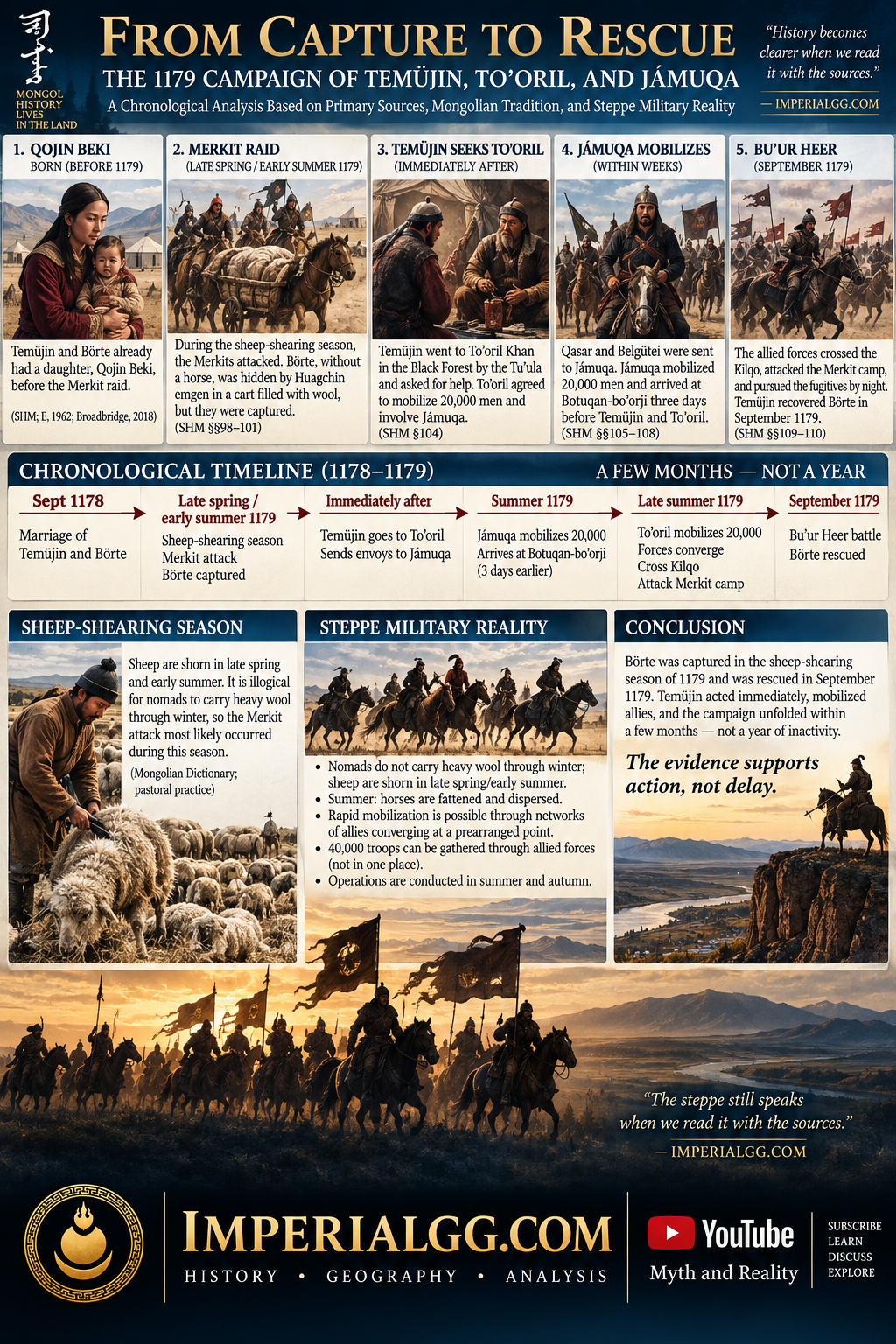
The historical sources do not portray Temüjin as remaining inactive after Börte was seized. Quite the opposite. The sequence recorded in the Secret History of the Mongols is remarkably direct. After the Merkit attack, Temüjin descended from Burqan Qaldun and went with Qasar and Belgütei to To’oril Khan, who was then in the Black Forest by the Tu’ula River. There he asked for assistance in recovering his wife.
The question of J̌oči’s birth has too often been approached as a question of paternity before the chronology of Börte Üjin’s abduction and rescue has been reconstructed. The more fundamental historical question is simpler: how long was Börte actually in Merkit captivity.
A close reading of The Secret History of the Mongols, combined with Mongolian historical chronology, traditional pastoral-season evidence, geographical reconstruction, and the military mobility described in the text, suggests a considerably shorter captivity period than a chronology that assumes a prolonged interval between abduction and rescue.
The Mongolian historical tradition places the Merkit raid in the sheep-shearing season of 1179 and the Bu’ur Heer campaign and recovery of Börte in September 1179. The Secret History itself then preserves an unusually compressed sequence of mobilization: Temüjin appeals to To’oril; To’oril immediately commits twenty thousand men; J̌amuqa is summoned; a rendezvous is established; J̌amuqa arrives at Botuqan-bo’orji three days before Temüjin and To’oril; the allied forces cross the Kilqo; and the Merkit camp is attacked.¹
This chronology does not require a year-long period of inactivity.
More importantly, it creates a coherent chronological framework in which Börte could already have been pregnant when the Merkits captured her. The difficult expression eme kö’ü in §104 has been interpreted by Igor de Rachewiltz as potentially meaning “wife-child,” or wife and unborn child, although other translators understand it simply as “wife.”² The question therefore remains philologically disputed. But the chronological evidence deserves to be examined before any conclusion about J̌oči’s paternity is drawn.
QOJIN BEKI: THE CHILD WHO CAME BEFORE JOCHI
J̌oči was not Börte’s first child. The later genealogy identifies Qojin Beki as an elder daughter of Temüjin and Börte. Chih-Shu E, discussing Rashīd al-Dīn’s genealogy, explicitly identifies Qojin-Beki as J̌oči’s elder sister.³
Anne F. Broadbridge likewise argues that the chronology requires Qojin to have been born before J̌oči and proposes moving Temüjin and Börte’s marriage earlier, to approximately 1178, in order to accommodate Qojin’s birth before the Merkit episode.⁴
This point is important because the Merkit raid did not interrupt the beginning of Temüjin and Börte’s family life. They already had a daughter. The Secret History later identifies Qojin Beki in the context of an attempted marriage exchange: Chinggis Qahan proposed Qojin for Tusaqa, Senggüm’s son, while seeking a bride from the same family for J̌oči.⁵
Thus the relevant family sequence is:
Qojin Beki → Merkit raid → Börte’s rescue → J̌oči
J̌oči was therefore Börte’s first son, but not her first child.
THE MERKIT RAID
The Secret History describes the Merkit attack in §§98–101. The attack was sudden. The people around Temüjin fled, but Börte and the elderly Qo’aqčin could not escape on horseback. The text specifically records that there was no horse for Börte. Qo’aqčin therefore concealed Börte in a covered cart with a wooden frame, harnessed an ox to it, and attempted to escape toward the Tenggelik stream. When the cart axle broke, the two women continued on foot toward the forest, where Merkit soldiers captured them.⁶
This detail is often treated merely as part of the dramatic narrative. It may also contain a chronological clue. The text places Börte among wool in the cart.⁷ The Secret History does not explicitly say that the wool had just been shorn. Therefore, the historian should not turn this into a certainty that the sheep had been shorn days earlier. But traditional Mongolian pastoral practice provides an important comparison.
Mongolian ethnographic sources describe sheep shearing as a late-spring/early-summer activity, when livestock have recovered from winter and the wool begins to loosen. The first summer shearing produces what is traditionally called urtyn noos, or the long/summer wool; autumn shearing produces akhryn noos.⁸ The Mongolian Dictionary likewise preserves the expression khavryn noos—spring wool—as wool taken from sheep in spring.⁹
The historical scene therefore fits naturally with:
late spring / early summer → sheep shearing → fresh seasonal wool → Börte concealed among wool. It is a seasonal consistency test.
The chronology becomes much more significant when combined with the date of the rescue.
THE 1179 CHRONOLOGY
A modern Mongolian historical chronology gives a particularly important sequence.
The Mongolian Historical Dictionary entry for the Bu’ur Heer battle states that Temüjin married Börte in September 1178, and that in the following year, at the time of sheep shearing, the Merkits suddenly attacked and abducted Börte, Belgütei’s mother, and Qo’aqčin. The same entry dates the Bu’ur Heer campaign to September 1179.¹⁰
This produces a striking seasonal sequence:
September 1178 — marriage
↓
late spring / early summer 1179 — sheep-shearing season and Merkit raid
↓
summer 1179 — captivity and rescue preparations
↓
September 1179 — Bu’ur Heer campaign and recovery of Börte
The interval is therefore measured in months, not approximately a year. The exact day of the raid is not supplied, so it would be excessive to claim an exact number of days. But if the raid occurred during the late-spring/early-summer shearing season and the recovery occurred in September, a captivity period of approximately three to four months is a reasonable chronological reconstruction. That is the central chronological proposition of this study.
TEMÜJIN DOES NOT WAIT A YEAR
The internal narrative of the Secret History is equally important. After the Merkits take Börte, Temüjin does not disappear from the narrative for months.
He acts.
In §104, Temüjin, Qasar, and Belgütei go to To’oril Khan, who is staying in the Black Forest beside the Tu’ula River. Temüjin asks him to recover his wife. In de Rachewiltz’s interpretation of the difficult phrase in this passage, Temüjin also asks for the recovery of his unborn child.¹¹
To’oril agrees.
He does not propose a campaign to be organized at some distant future date. He immediately announces his intention to mobilize two tümen and instructs Temüjin to summon J̌amuqa, who is to bring another two tümen and determine the time and place of their meeting.¹²
The next movement is equally direct. Temüjin returns and sends Qasar and Belgütei to J̌amuqa. J̌amuqa responds. The rendezvous is established.
To’oril moves. Temüjin moves. J̌amuqa moves. The armies converge. The narrative contains no indication of a year-long military preparation.
BOTUQAN-BO’ORJI: THE RENDEZVOUS
Section 108 provides perhaps the clearest evidence for the operational tempo of the campaign. Temüjin, To’oril, and Jaqa-gambu proceed together toward Botuqan-bo’orji, at the headwaters of the Onon. When they arrive, J̌amuqa has already been there for three days.¹³
This detail is easy to overlook, but it is fundamental to understanding steppe mobilization. The forty thousand men described in the campaign were not necessarily standing in one enormous stationary camp waiting for every participant to arrive. Rather, the forces were moving along separate lines toward a predetermined rendezvous.
The sequence was:
Temüjin appeals to To’oril
→
To’oril mobilizes
→
Temüjin sends messengers to J̌amuqa
→
J̌amuqa mobilizes
→
J̌amuqa reaches Botuqan-bo’orji
→
Temüjin, To’oril, and Jaqa-gambu arrive
→
the coalition continues toward the Merkits
The text even preserves J̌amuqa’s complaint that they had arrived late. He reminds them that they had sworn not to be delayed by rain or storm.¹⁴
That is not the language of an army that has spent months merely assembling. It is the language of a prearranged mobile rendezvous.
THE MILITARY GEOGRAPHY OF THE CAMPAIGN
The geography reinforces this interpretation.
Vito Pecchia Riba’s study of the geography of the Secret History explicitly examines the spatial and temporal relationships of the text using primary and secondary sources, satellite imagery, and field reconnaissance conducted in 2008, 2009, and 2010.¹⁵ His work demonstrates the value—and also the limitations—of reconstructing the campaign through the landscape itself.
Gerelbadrakh’s study of Bürgi Ereg is particularly relevant. He compares competing identifications and argues that Bürgi Ereg-II, near the Bürke river in modern Mungunmorit, better fits several details of the Secret History, including the proximity of forest and the Tenggelik/Terelj watercourse involved in Börte and Qo’aqčin’s escape. He gives the proposed location as approximately 48°13′30.7″ N, 108°32′36.7″ E, while emphasizing that the identification is a scholarly reconstruction rather than an uncontested fact.¹⁶
This matters because the campaign cannot be reconstructed merely from modern straight-line distances. A horseman does not move from point A to point B as a ruler on Google Earth.
He moves through:
- river valleys,
- mountain passes,
- forest edges,
- water sources,
- grazing areas,
- enemy observation zones,
- and established pastoral routes.
Therefore the proper question is not: “How many kilometers is the straight line?”
but: “How many operational days would a mounted force require to move between these historically proposed locations under urgent conditions?” That distinction is essential.
FROM BOTUQAN-BO’ORJI TO THE MERKIT CAMP
Section 109 records the next stage.
The allied army leaves Botuqan-bo’orji and reaches the Kilqo River. They lash rafts together and cross the river. They then reach the Bu’ur steppe and descend upon Toqto’a-beki’s camp.¹⁷
The operation is intended as a surprise attack. The text is explicit, however, that the Merkits were not completely without warning. Fishermen, sable-trappers, and hunters living along the Kilqo detected the approaching army and sent word to Toqto’a-beki during the night. Toqto’a-beki and Dayir-usun therefore escaped downstream along the Selenge toward Bargujin with a small group.¹⁸
This correction matters. It would be inaccurate to describe the Merkit camp as having no guards whatsoever.
The more precise conclusion is that the Mongol-Kereit-J̌amuqa coalition succeeded in approaching the Merkit territory sufficiently closely and rapidly that the main camp was placed under immediate pressure before the Merkits could organize a full defense.
The Secret History even says that Toqto’a could have been captured while asleep had the warning not reached him.¹⁹
That is evidence of an operation designed around speed, surprise, and exploitation of the landscape.
THE NIGHT PURSUIT
The Merkits fled. Section 110 states that they moved down the Selenge during the night and that the allied soldiers pursued them through the night. Then comes one of the most memorable scenes in the Secret History.
Temüjin called: “Börte! Börte!” Börte heard his voice. She recognized him. She came down from the fleeing cart. Qo’aqčin came with her. The two women reached Temüjin, and Börte took hold of his reins.²⁰
The rescue occurred at night, under moonlight. Temüjin then informed To’oril and J̌amuqa that he had found what he was seeking and proposed stopping for the night rather than continuing the pursuit.²¹
The sequence is therefore extraordinarily compact:
abduction → appeal → mobilization → rendezvous → march → river crossing → surprise attack → night pursuit → recovery.
Nothing in the surviving narrative requires this operation to have been delayed for a year.
HOW FAST COULD A NOMADIC ARMY MOVE?
This is where modern assumptions about military mobilization must be handled carefully. A sedentary state army and a pastoral military coalition do not necessarily possess the same logistical structure.
A sedentary army may need to:
- gather supplies,
- assemble transport,
- secure roads,
- concentrate troops,
- arrange depots,
- move infantry and animals,
- and coordinate a centralized departure.
A pastoral society already possesses a different infrastructure. Its population is geographically dispersed but mounted. Its principal transport animals are already part of household wealth. Its military units are drawn from communities accustomed to seasonal movement. And in the episode under examination, the commanders do not need to invent a campaign plan from nothing. They already possess political relationships, messengers, knowledge of the landscape, and a prearranged rendezvous.
The Secret History itself provides the clearest evidence: **J̌amuqa was already waiting at Botuqan-bo’orji three days before the arrival of Temüjin and To’oril.**²²
This does not prove that forty thousand men could always mobilize in a single day.
It proves something more modest—and more useful: The campaign did not require forty thousand men to assemble simultaneously at one location before movement began. They could converge. That distinction is critical.
A GOOGLE EARTH RECONSTRUCTION
A modern reconstruction can therefore be divided into phases rather than pretending to possess exact day-by-day measurements.
PHASE I — TEMÜJIN TO TO’ORIL
Temüjin travels from the Bürgi Ereg area toward To’oril’s Black Forest on the Tu’ula.
PHASE II — RETURN AND MESSAGE TO J̌AMUQA
Temüjin returns and immediately sends Qasar and Belgütei to J̌amuqa.
PHASE III — SEPARATE MOBILIZATION
To’oril mobilizes his two tümen. J̌amuqa mobilizes his two tümen. Temüjin joins To’oril’s movement.
PHASE IV — BOTUQAN-BO’ORJI
The forces converge. J̌amuqa is already there. He has been waiting three days.
PHASE V — KILQO
The combined army proceeds toward the Merkit territory and crosses the river using rafts.
PHASE VI — BU’UR HEER
The coalition strikes the Merkit camp.
PHASE VII — SELENGE PURSUIT
The fleeing Merkits are pursued through the night.
PHASE VIII — BÖRTE
Temüjin finds Börte.
This operational sequence is compatible with a rapid campaign lasting weeks rather than months. That conclusion must not be confused with the total length of Börte’s captivity. The two are different questions.
The Secret History does not tell us the exact number of days between the initial abduction and Temüjin’s appeal to To’oril. But once the Mongolian historical chronology places the abduction in the sheep-shearing season and the recovery in September, the total captivity window becomes approximately three to four months.²³
The sheep shearing
The wool in Börte’s cart deserves one further examination. Traditional Mongolian pastoral practice places the main summer sheep shearing in the period when the animals have recovered from winter, are well-fed on new grass, and their wool has begun to loosen. The first summer wool is traditionally distinguished from the autumn wool.²⁴
The Mongolian Dictionary likewise records khavryn noos—spring wool—and defines it as the long wool taken from sheep in spring.²⁵ This gives us an independent cultural calendar against which to test the historical narrative.
It says that Börte was hidden among wool.
The historical inference is therefore: The scene is compatible with the late-spring/early-summer shearing season.
That inference becomes much stronger because the Mongolian historical chronology independently says that the Merkits attacked **“at the time of sheep shearing.”**²⁶
We therefore have two different layers of evidence pointing in the same seasonal direction:
- the narrative image of Börte hidden among wool;
- the Mongolian chronological tradition explicitly placing the raid in sheep-shearing season.
Then comes the third point: September 1179 — rescue. Together they form a coherent seasonal sequence.
THREE TO FOUR MONTHS, NOT A YEAR
The chronology can now be expressed simply.
| Chronological stage | Approximate period |
|---|---|
| Temüjin and Börte married | September 1178 |
| Qojin already part of the family chronology | before J̌oči |
| Merkit raid | late spring / early summer 1179 |
| Börte hidden in wool cart | same seasonal window |
| Temüjin appeals to To’oril | shortly after abduction |
| J̌amuqa summoned | immediately within the narrative sequence |
| Forces converge at Botuqan-bo’orji | campaign phase |
| Kilqo crossed | campaign phase |
| Bu’ur Heer attack | campaign phase |
| Night pursuit | immediately after attack |
| Börte recovered | September 1179 |
| J̌oči | born after the recovery in the traditional chronology |
The important conclusion is not that we know the exact number of days. We do not. The important conclusion is that the available chronology does not require a year-long captivity.
A three-to-four-month captivity is entirely compatible with the Mongolian chronology that places the raid in the sheep-shearing season and the recovery in September.
THE PREGNANCY QUESTION
Only after establishing this chronology should we return to §104. Temüjin tells To’oril that the Merkits have taken his eme kö’ü. (wife – child)
De Rachewiltz notes that the expression is ambiguous. It can be understood as “wife” or potentially “wife-child.” His argument for the latter is that the expression is unusual and that J̌oči is subsequently born shortly after Börte’s recovery.²⁷
This is important evidence.
Other translators have rendered the passage simply as “wife,” and the philological problem should remain visible to the reader.²⁸
The strongest argument therefore does not rest on this single phrase.
It rests on the convergence of evidence:
Qojin precedes J̌oči in the family genealogy.
The Merkit raid is placed in sheep-shearing season.
Börte is physically concealed among wool.
The Mongolian chronology dates the rescue to September 1179.
The military sequence in §§104–110 unfolds rapidly.
The difficult eme kö’ü passage can plausibly refer to an unborn child.
J̌oči is born after Börte’s recovery in the traditional chronology. These facts do not provide modern genetic proof. They provide something different:
a chronological argument.
WHAT THE CHRONOLOGY CAN—and CANNOT—PROVE
The evidence allows us to make a strong historical argument, but not an unlimited one.
It can reasonably establish that:
- J̌oči was not Börte’s first child; Qojin Beki preceded him.
- Börte’s abduction is traditionally placed in the sheep-shearing season of 1179.
- The rescue is placed in September 1179.
- The captivity therefore fits approximately three to four months.
- Temüjin’s military response was organized through rapid mobilization and rendezvous rather than a year-long preparation.
- The chronology is compatible with Börte already being pregnant when the Merkits captured her.
- The chronology does not require conception during Merkit captivity.
What it cannot establish with absolute certainty is the exact day of conception, exact gestational age at capture, or biological paternity. Those are different questions. This distinction is essential if the argument is to withstand academic scrutiny.
THE LARGER HISTORICAL POINT
The significance of the chronology extends beyond J̌oči. The episode demonstrates something fundamental about the political world in which Temüjin lived. A household crisis could immediately become a military crisis. The loss of Börte activated Temüjin’s relationship with To’oril. To’oril activated J̌amuqa. J̌amuqa established the rendezvous.
Separate forces converged. The landscape became the operational framework. The army crossed rivers by improvised rafts. The coalition struck the Merkit camp. And the pursuit continued through the night until Börte was recovered. The speed of this sequence is itself historical evidence.
The steppe was not a space in which military power existed only after a long process of centralized assembly. Military power could emerge from relationships, mobility, animals, terrain, messengers, and rapid convergence. That is why the chronology of Börte’s captivity must be reconstructed before the question of J̌oči’s paternity is argued.
The first question is not: “Who was J̌oči’s biological father?”
The first question is: “What does the chronology actually allow?”
And when the chronology is reconstructed from the seasonal evidence, the Mongolian historical tradition, the Secret History’s internal sequence, and the geography of the campaign, the conclusion is clear enough to deserve serious consideration:
Börte’s captivity need not have lasted anything approaching a year. A late-spring/early-summer abduction followed by a September 1179 recovery produces a captivity window of approximately three to four months—and that chronology is entirely compatible with Börte having already been pregnant when the Merkits seized her.
FOOTNOTES
1. The Secret History of the Mongols (SHM), §§104–110; “Буур хээрийн байлдаан,” Монголын түүхийн тайлбар толь, which dates the battle and recovery to September 1179 and places the Merkit raid in the following year’s sheep-shearing season.
2. Igor de Rachewiltz, The Secret History of the Mongols: A Mongolian Epic Chronicle of the Thirteenth Century, commentary to §104. De Rachewiltz discusses eme kö’ü as an ambiguous expression that may literally suggest “wife-child.”
3. Chih-Shu E, Studies in the Career of Chinggis Qan, p. 69, citing Rashīd al-Dīn and identifying Qojin-Beki as J̌oči’s elder sister.
4. Anne F. Broadbridge, Women and the Making of the Mongol Empire (Cambridge: Cambridge University Press, 2018), chap. 2. Broadbridge notes that the earlier birth of Qojin creates chronological problems for later dating schemes and proposes an earlier marriage, around 1178, to accommodate Qojin’s birth before the Merkit raid.
5. SHM §165, where Chinggis Qahan proposes Qojin-beki in a marriage exchange involving J̌oči and Senggüm’s family.
6. SHM §§98–101. The narrative records Börte’s lack of a horse, Qo’aqčin’s use of an ox-cart, the broken axle, and their eventual capture.
7. SHM §§98–101. The cart and wool detail belongs to the narrative context of Börte’s attempted escape.
8. “Ноос хяргах,” Tourist Information Center of Mongolia: traditional Mongolian sheep shearing is described as occurring in late spring/early summer, with summer wool distinguished from autumn wool.
9. Монгол хэлний их тайлбар толь, entry “хавар,” which defines хаврын ноос as the long wool taken from sheep/goats in spring.
10. Монголын түүхийн тайлбар толь, “Буур хээрийн байлдаан.” The entry explicitly gives September 1179 for the battle and states that the Merkits attacked in the following year at sheep-shearing time.
11. De Rachewiltz, commentary to SHM §104.
12. SHM §104.
13. SHM §108. The Mongolian text states that when Temüjin, To’oril, and Jaqa-gambu reached Botuqan-bo’orji, J̌amuqa had already arrived and had waited three days.
14. SHM §108. J̌amuqa’s statement about not being delayed by rain or storms emphasizes the importance of keeping the agreed rendezvous.
15. V. Pecchia Riba, “Geography of ‘The Secret History of the Mongols’: Location of C13th Mongol Place Names and Topographical Features in Northeast Mongolia,” Mongolian Journal of Anthropology, Archaeology and Ethnology 6, no. 1 (2010): 98–125. The study explicitly combines historical sources, satellite imagery, and field reconnaissance.
16. J. Gerelbadrakh, “Where is the actual location of Bürgi ergi of ‘The Secret History of the Mongols’?” Acta Historica Mongolici XX (2019). Gerelbadrakh compares competing locations and proposes Bürgi Ereg-II near the Bürke river, while acknowledging the historiographical uncertainty.
17. SHM §109.
18. SHM §109. The text specifically names fishermen, sable-trappers, and hunters as the people who transmitted warning to Toqto’a-beki.
19. SHM §109. The narrative states that Toqto’a could have been seized while sleeping had the warning not arrived.
20. SHM §110. The Mongolian text records Temüjin calling “Börte, Börte” and Börte recognizing his voice.
21. SHM §110.
22. SHM §108.
23. This is a chronological reconstruction, not an exact medieval dating statement. It combines the sheep-shearing chronology and the September 1179 dating of the Bu’ur Heer campaign.
24. “Ноос хяргах,” Tourist Information Center of Mongolia.
25. Монгол хэлний их тайлбар толь, “хавар.”
26. Монголын түүхийн тайлбар толь, “Буур хээрийн байлдаан.”
27. De Rachewiltz, commentary to SHM §104.
28. The philological disagreement is explicitly acknowledged by de Rachewiltz, who notes that many translators render eme kö’ü simply as “wife.”
SELECTED BIBLIOGRAPHY
- Broadbridge, Anne F. Women and the Making of the Mongol Empire. Cambridge: Cambridge University Press, 2018.
- de Rachewiltz, Igor. The Secret History of the Mongols: A Mongolian Epic Chronicle of the Thirteenth Century. Leiden: Brill, 2004–2013.
- E, Chih-Shu. Studies in the Career of Chinggis Qan. SOAS University of London.
- Gerelbadrakh, J. “Where is the actual location of Bürgi ergi of ‘The Secret History of the Mongols’?” Acta Historica Mongolici XX, 2019.
- Pecchia Riba, V. “Geography of ‘The Secret History of the Mongols’: Location of C13th Mongol Place Names and Topographical Features in Northeast Mongolia.” Mongolian Journal of Anthropology, Archaeology and Ethnology 6, no. 1 (2010): 98–125.
- Монголын түүхийн тайлбар толь. “Буур хээрийн байлдаан.”
- Монгол хэлний их тайлбар толь. “Хавар,” including хаврын ноос.
FROM KHANHOOD TO POLITICAL ORDER
By Altanbagana Baatar
DBA Candidate| Independent Historian
ImperialGG Historical Research Seriers
15 September 2026
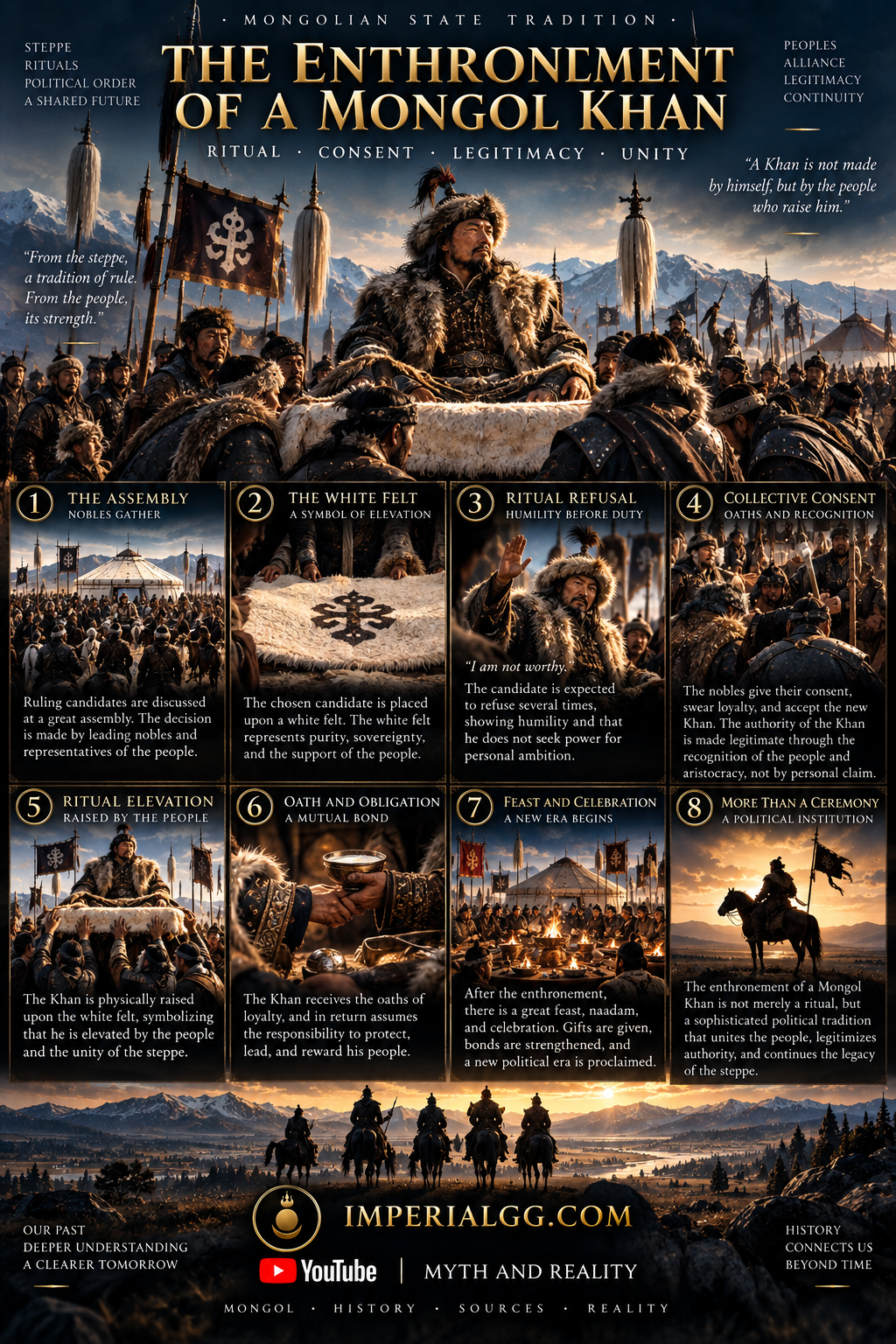
THE CORONATION OF TEMÜJIN AS CHINGGIS KHAN: THE 1206 ASSEMBLY, COLLECTIVE LEGITIMACY, AND THE EARLY ORGANIZATION OF MONGOL RULE
INTRODUCTION
The elevation of Temüjin as qan in the late twelfth century was more than a change in personal status. In the narrative of The Secret History of the Mongols, the decision to make Temüjin qan is immediately followed by the organization of people according to specific responsibilities, the recognition of his new position by To’oril Qan, and a politically revealing response from Jamuqa. Read together, §§123–127 preserve a remarkable picture of political formation: a ruler is not simply proclaimed by himself; his authority is collectively constituted, publicly recognized, and then translated into an organized structure of service and obligation.¹
This sequence deserves particular attention because it appears at a transitional point in the history of the Mongolian steppe. Temüjin was not yet the universal ruler of the Mongols who would be proclaimed in 1206 as Chinggis Khagan. The political community over which he exercised authority in this earlier period was still composed of competing lineages, tribal groupings, aristocratic houses, military followers, and alliance networks. Yet the Secret History does not portray his new position as an improvisation without precedent. Instead, it presents recognizable mechanisms of political legitimacy: prominent aristocrats deliberate, a candidate is elevated, obligations are mutually articulated, offices and responsibilities are distributed, allied rulers recognize the new authority, and political relationships are renegotiated around the new Khan.²
The significance of this episode becomes even greater when it is placed within the longer history of steppe political institutions. Modern Mongolian scholarship has repeatedly examined the development of political organization from the Xiongnu through subsequent steppe polities and into the Mongol period. Some scholars emphasize institutional continuity; others are more cautious about tracing specific institutions directly across centuries. The strongest historical position is therefore not that every Mongol institution of the twelfth century was an unchanged survival from the Xiongnu, but that the Mongol political order emerged within a much older Eurasian steppe tradition in which rulership, aristocratic participation, military organization, lineage legitimacy, and collective political decision-making had long been significant.³
The events surrounding Temüjin’s first elevation as Khan therefore deserve to be studied not simply as an episode in the biography of Chinggis Khan, but as evidence for the formation of political authority itself.
THE CORONATION OF TEMÜJIN: AUTHORITY WAS CONFERRED, NOT SELF-PROCLAIMED
The Secret History reaches the decisive moment in §123. Altan, Quchar, and Sača Beki agree among themselves and address Temüjin: “Let us make you Khan.”
They then formulate a series of obligations concerning military service, hunting, booty, loyalty, and punishment for disobedience. Only after this declaration does the narrative state that they named him Chinggis Qahan and made him Khan.⁴
The political sequence is important.
Temüjin does not appear in this passage declaring himself ruler and demanding recognition afterward. The initiative comes from politically significant men who deliberate among themselves and then elevate him. This does not mean that Temüjin lacked political power before 1189. On the contrary, the preceding narrative has already established the growth of his following, his military reputation, his relationship with To’oril, his alliance with Jamuqa, and the movement of groups and individuals toward his camp. His elevation was therefore the political recognition of an authority that had been developing through earlier relationships and achievements.
But recognition remained necessary. This distinction is fundamental. Military ability and personal prestige could create the conditions for rulership; they did not, by themselves, constitute the political act of becoming Khan.
The Mongolian Historical Dictionary places the elevation in 1189, at Khökh Nuur of Kharzurkh in the Senger stream area, and identifies Altan, Quchar, and Sača Beki as the figures who made the twenty-eight-year-old Temüjin Khan. It further connects these men to the descendants of Khabul Khan.⁵ Modern Mongolian historical works similarly describe the event as a gathering of influential Mongol aristocrats at which Temüjin received the title Chinggis and was elevated as Khan of Khamag Mongol.⁶
The evidence therefore allows a careful conclusion: the legitimacy of the Khan was constituted through collective political recognition. That principle is more significant than the particular identities of the three men who performed the act.
THE KHAN WAS BOUND BY OBLIGATION
The language surrounding the elevation in §123 is equally important.
Altan, Quchar, and Sača Beki do not merely say that they will obey Temüjin. They describe what they will do for him in war and peace and, crucially, what will happen if they fail. They promise military service, hunting assistance, the acquisition of women and tents, and obedience in the political order they are establishing. If they fail him in battle or peace, they accept severe consequences.⁷
This is not the language of unrestricted personal monarchy. It is the language of reciprocal political obligation. The Khan receives authority, but the men who elevate him also define the obligations that bind the new political relationship. The act is therefore simultaneously one of submission and contract. Temüjin becomes the central political authority, while the aristocratic supporters become participants in an ordered relationship in which military loyalty and service are explicitly articulated.
This feature is especially important when §123 is read together with §124.
The Secret History does not leave the new Khan sitting symbolically upon a throne. Immediately after the elevation, the narrative turns to the practical organization of his household and retinue. The transition is almost immediate:
elevation → obligation → organization. That sequence is one of the most revealing features of the passage.
§124: THE NEW KHAN IMMEDIATELY ORGANIZES HIS POLITICAL HOUSEHOLD
Section 124 contains a long list of individuals assigned particular responsibilities around Chinggis Qahan. Some are associated with the quiver and weapons; others with food, horses, carts, women and servants, messengers, or other functions.⁸
The passage should not be described as a fully developed imperial bureaucracy. That would impose the institutions of the thirteenth-century empire onto a much earlier stage. Nor should every named responsibility be assumed to correspond exactly to a later office. Nevertheless, the underlying principle is unmistakable.
The new Khan requires an organized body of people with differentiated responsibilities. This is the first important organizational consequence of the elevation. A ruler cannot exercise political authority through a title alone. He requires people who maintain his household, protect him, carry weapons, care for horses, provide food, transmit messages, and perform the practical functions through which authority operates. The Secret History therefore moves from the abstract recognition of Temüjin’s khanship directly into the organization of personnel.
This is why §124 is much more important than it might initially appear. The passage is not simply a list of servants. It preserves an early picture of political organization around the Khan.
Modern scholarship has recognized the importance of this development. Christopher Atwood’s work on Mongol political organization, as well as the broader scholarship surrounding the Secret History, treats the pre-Chinggisid Mongol political world as one in which kinship, military following, aristocratic leadership, and service relationships were already highly significant. The later imperial system did not emerge from an institutional vacuum; it transformed and greatly expanded structures that had existed in earlier Mongol political society.⁹
FROM PERSONAL LOYALTY TO POLITICAL OFFICE
Section 125 takes this process further. Here the Secret History presents a political relationship that is particularly characteristic of Temüjin’s rise: people who had demonstrated loyalty during his vulnerable years are now incorporated into the structure surrounding the Khan. This is especially visible in the treatment of his long-standing companions. Their loyalty had originally been personal and immediate. They stayed with Temüjin when his position was weak, when his household was small, and when his political future was uncertain.
Now that Temüjin has become Khan, those relationships acquire a new political meaning. The development can be expressed analytically as:
personal loyalty → recognized service → political responsibility.
This does not mean that personal loyalty ceased to matter. Quite the opposite. The Secret History repeatedly presents the bonds of companionship, anda relationship, household affiliation, and military loyalty as fundamental components of political life. What changes is their scale. A relationship that had once connected two individuals can now become part of the organization of a political community. That transformation is one of the foundations of Temüjin’s later success.
THE SIGNIFICANCE OF THE PREVIOUS STEPPE TRADITION
At this point the question of historical continuity becomes unavoidable. Was Temüjin inventing this political structure from nothing? The evidence does not support such an interpretation.
Long before the Mongol Empire, the societies of the eastern Eurasian steppe had developed complex political systems. The Xiongnu state, established in the late third century BCE, possessed a supreme ruler—the Chanyu—along with a hierarchy of aristocratic officials and military-administrative divisions. Mongolian scholarship has particularly emphasized the existence of differentiated offices and responsibilities under the Xiongnu and the subsequent development of such political traditions among the Xianbei, Rouran, Türk, Uyghur, Kyrgyz, and Khitan polities.¹⁰
One modern Mongolian study of the tradition of Mongolian state officials argues explicitly that the Xiongnu possessed a differentiated hierarchy of political and military officials, and that subsequent steppe states developed these traditions in their own forms.¹¹ Another study of Mongolian state and legal history similarly treats the political institutions of the Mongolian plateau as part of a much longer historical development rather than an institution created suddenly in the thirteenth century.¹²
This does not prove that every office described in §124 descended directly from a specific Xiongnu office. Such a claim would exceed the evidence. What the comparison does establish is a more defensible proposition: Temüjin’s political organization emerged within a steppe environment that already possessed a long history of differentiated rulership, military organization, aristocratic authority, and political service.
The Mongol achievement was therefore not the invention of organized steppe government out of nothing. Its historical importance lies in how Temüjin transformed existing political resources into a much more centralized and expansive order.
KHANHOOD AND THE POLITICAL COMMUNITY
The method by which Temüjin became Khan is equally important. The elevation involved politically influential members of the ruling aristocracy. The Secret History does not present the event as an accidental gathering of ordinary followers. Altan, Quchar, and Sača Beki belonged to important aristocratic lineages, and the Mongolian Historical Dictionary explicitly identifies them as descendants of Khabul Khan’s line in its account of Temüjin’s 1189 elevation.¹³
This makes the event significant for the history of succession and legitimacy. The Mongol political system recognized the importance of lineage. Yet lineage alone did not automatically place every aristocrat on the throne. This is one of the most important points that should be made carefully.
Being of prestigious lineage and possessing the political legitimacy to become Khan were related, but they were not identical.
The political community still had to recognize a candidate. The existence of a powerful aristocratic lineage therefore did not eliminate collective political action. Instead, lineage legitimacy, political reputation, military capacity, and collective recognition operated together. This helps explain why Temüjin’s elevation is historically important. He was not simply the strongest man who announced himself Khan. He was a politically successful member of a recognized ruling lineage whose elevation was undertaken by other politically significant aristocrats.
THE KURULTAI QUESTION
The later Mongol world is famous for the quriltai, the great assembly at which major political questions—including the selection of supreme rulers—could be decided.
The evidence from §123 should not be used to claim that a fully codified constitutional institution called the quriltai already existed in precisely the later form in 1189.
That would go beyond the source. But the event clearly demonstrates collective deliberation and political recognition. Modern Mongolian historical literature commonly describes the 1189 gathering as an aristocratic assembly at Khökh Nuur where influential nobles deliberated and elevated Temüjin as Khan.¹⁴ The language of the Secret History itself supports the essential point: Altan, Quchar, and Sača Beki “agree together,” address Temüjin collectively, formulate their obligations, and then make him Khan.¹⁵
Thus, even before the later institutional development of the Mongol imperial quriltai, the political principle is visible: supreme authority required recognition by a political community. This is fundamentally different from unrestricted self-proclamation. The Khan was not simply a man who called himself Khan. He had to be made Khan.
§126: TO’ORIL QAN AND THE RECOGNITION OF AUTHORITY
The significance of §126 becomes clearer when placed after this internal act of elevation. Temüjin sends envoys to To’oril Qan to announce: “They have made Chinggis Qahan Khan.”
To’oril responds that making his “son” Temüjin Khan is right and asks how the Mongols could fare without a Khan. He then warns them not to break the harmony they have established or undo the bond they have tied.¹⁶
This passage is politically important for two reasons. First, To’oril did not make Temüjin Khan. The elevation had already taken place. Second, however, Temüjin’s new authority was significant enough that it was immediately communicated to one of the most powerful rulers in his alliance network.
The new Khan therefore sought recognition within the wider political order. To’oril’s response supplies that recognition. His description of Temüjin as “my son” should be understood within the political and relational vocabulary of their alliance rather than treated automatically as biological terminology. The point is not genealogy but political relationship. To’oril’s acceptance demonstrates that Temüjin’s khanship was not necessarily incompatible with the existing alliance hierarchy. Indeed, To’oril presents the existence of a Mongol Khan as necessary.
§127: JAMUQA AND THE POLITICS OF SEPARATION
Jamuqa’s response is perhaps the most revealing part of this sequence. When Temüjin sends Arqai-qasar and Cha’urqan as envoys, Jamuqa does not simply reject the new Khan. Instead, he directs his criticism toward Altan and Quchar.
He asks why they came between himself and his anda Temüjin and, most importantly, why they had not made Temüjin Khan while the two sworn brothers were still together.¹⁷
This statement deserves close attention. Jamuqa’s complaint is not simply: “Temüjin should not be Khan.”
Rather, his complaint is: Why did you make him Khan only after separating us?
That distinction changes our understanding of the political moment.
Jamuqa still recognizes the relationship with Temüjin as an anda relationship. He asks Altan and Quchar to keep their word and to remain good companions to Temüjin.¹⁸
The passage therefore shows that the political crisis had not yet become an irreversible ideological confrontation between “Temüjin’s party” and “Jamuqa’s party.” The separation itself was becoming politically consequential. The new Khanhood was reorganizing relationships that had previously been centered upon the Jamuqa–Temüjin partnership. This is why Jamuqa’s response is so important. It reveals that political organization can alter the structure of personal alliances even when the legitimacy of the new ruler is not itself explicitly rejected.
KHANHOOD WAS ALREADY PRODUCING A NEW POLITICAL CENTER
Sections 123–127 can therefore be read as a single political process.
In §123, Temüjin is made Khan.
In §124, people are assigned differentiated responsibilities around him.
In §125, loyalty and service are incorporated into the new political order.
In §126, To’oril recognizes the new arrangement.
In §127, Jamuqa reacts to the political consequences of Temüjin’s elevation.
The sequence is remarkably coherent. It moves from: LEGITIMACY to AUTHORITY to ORGANIZATION to RECOGNITION to POLITICAL REALIGNMENT. This is why §124–127 should not be treated as an insignificant transitional passage. The Secret History is showing the reader how a political center begins to form around Temüjin.
FROM THE XIONGNU TO THE MONGOLS: CONTINUITY AND TRANSFORMATION
The larger historical question is whether this political organization should be understood as part of a much older steppe tradition. There is substantial reason to ask that question.
Mongolian scholarship has long examined the relationship between the political traditions of the Xiongnu and later Mongolian states. Some scholars have argued for broad institutional continuity across the steppe, while others have emphasized discontinuities and the danger of treating widely separated political systems as a single uninterrupted state tradition.¹⁹
The distinction is essential. We should not say: “Temüjin’s §124 offices were exactly the Xiongnu offices.” The evidence does not demonstrate that.
But we can say: The political culture in which Temüjin’s Khanhood emerged had deep precedents in the political history of the eastern Eurasian steppe.
The Xiongnu had a supreme ruler, aristocratic ranks, military divisions, and differentiated officials. Later steppe empires developed their own variations. The Türk and Uyghur polities likewise possessed elaborate political hierarchies. The Khitan Liao developed a highly complex imperial system that combined steppe and sedentary institutions. By the twelfth century, therefore, the Mongolian plateau was not a political blank space. Temüjin inherited a political world. His historical achievement was to reorganize and transform that world.
CHINGGIS KHAN AND THE MEMORY OF THE XIONGNU
This longer perspective also gives particular importance to the tradition that Chinggis Khan himself associated the Mongol polity with an older history of steppe rulership.
A tradition preserved in the account of his meeting with the Daoist master Changchun records Chinggis Khan referring to an ancestral political history reaching back to the Xiongnu. A modern Mongolian government publication likewise cites this tradition in discussing Mongolian historical memory and the Xiongnu past.²⁰
This testimony must be used carefully. It is not evidence that Chinggis Khan possessed a modern historian’s concept of an uninterrupted national state extending from the Xiongnu to the Mongols. It is evidence of something more limited and historically important: the Mongol imperial political tradition could situate itself within an older steppe genealogy of rulership. That distinction matters. Political continuity does not require institutional identity.
A later state may inherit:
- concepts of legitimate rulership,
- political vocabulary,
- aristocratic structures,
- military organization,
- assembly traditions,
- ideas of lineage,
- symbolic practices,
- and memories of earlier empires,
while transforming them into a new political order. This is a more historically defensible model for understanding the relationship between the Xiongnu and the Mongols.
THE MONGOL KHAN WAS NOT AN ABSOLUTE PERSONAL CLAIM
The events of §§123–127 also allow us to reconsider a common modern assumption about nomadic rulership. It is tempting to imagine a steppe ruler as an individual warrior who accumulated sufficient military power and simply declared himself king. The Secret History presents a more complicated political reality.
Temüjin’s military reputation mattered. His lineage mattered. His alliances mattered. His followers mattered. His relationship with To’oril mattered. His relationship with Jamuqa mattered. But none of these elements alone explains his elevation. The political act required recognition. And once recognized, the Khan immediately entered into a network of obligations.
This suggests that Mongol rulership was relational rather than purely personal. The Khan required followers. Followers required a legitimate center. Aristocrats required a ruler capable of rewarding and organizing them. Allied rulers required a recognized political counterpart. The political system therefore operated through reciprocal relationships.
THE FIRST FORM OF A KHANATE
This is why the term “state formation” must be used carefully but not avoided. The events of §§123–127 do not yet constitute the fully centralized empire of 1206 and after. But they do reveal an early form of political consolidation.
A political center has appeared. A ruler has been collectively recognized. His authority has been translated into differentiated responsibilities. His allies have been informed. His previous political relationships are being reorganized around him. And his followers are increasingly becoming participants in an ordered political structure. The process is therefore better described as the formation of an early Khanate than as the sudden creation of a fully developed empire. This distinction allows us to see the historical development rather than impose the final Mongol imperial system backward onto 1189.
CONCLUSION: BEFORE THE EMPIRE, THERE WAS A POLITICAL SYSTEM
The importance of §§123–127 lies precisely in their position between Temüjin’s earlier life as a rising steppe leader and his later emergence as Chinggis Khagan and founder of the Mongol Empire. In 1189, Temüjin did not yet possess the enormous territorial empire associated with his later name. But the political principles visible in this episode are already significant.
He was made Khan, rather than simply proclaiming himself Khan. His elevation involved politically influential aristocrats. The act generated reciprocal obligations. The new Khan immediately organized people according to differentiated responsibilities. His new status was communicated to To’oril Qan and received his recognition. Jamuqa’s response demonstrates that the new khanship was already reshaping the political relationships of the steppe. Taken together, these developments demonstrate that Temüjin’s rise was not merely a story of individual military success. It was a process of political institutionalization.
The evidence also invites a longer historical interpretation. The Mongol political order did not arise in an institutional vacuum. The eastern Eurasian steppe had already produced powerful states, aristocratic hierarchies, military-administrative systems, traditions of supreme rulership, and mechanisms of collective political recognition long before the rise of Temüjin. Mongolian scholarship has therefore been justified in examining the Mongol state within the wider history of steppe state formation, while remaining cautious about claiming an unchanged institutional continuity across a millennium.²¹
The significance of Temüjin’s 1189 elevation lies precisely here. He inherited a political world—but he transformed it. The Khanhood established at Khökh Nuur was not yet the Mongol Empire. It was the beginning of the political structure from which that empire would eventually emerge.
NOTES
1. The Secret History of the Mongols (SHM), §§123–127. For the critical study of the text and its political terminology, see Igor de Rachewiltz, The Secret History of the Mongols: A Mongolian Epic Chronicle of the Thirteenth Century, especially his commentary on §§123–127. Rachewiltz notes that from §124 onward the ruler is consistently designated Chinggis Qa’an and discusses the relationship between the conferral of the title qan and the name/designation Chinggis.
2. SHM §§122–127. The sequence from the movement of people away from Jamuqa, through the elevation of Temüjin, the organization of his followers, To’oril’s recognition, and Jamuqa’s reaction is particularly important for reconstructing the political process.
3. For the broader question of pre-Chinggisid Mongol political organization, see Christopher P. Atwood, The Mongol Empire: A Historical Encyclopedia (2004), and the broader discussion of socio-political organization in scholarship on the Secret History. The recent Penguin edition of the Secret History also includes a dedicated appendix on the socio-political organization of the pre-Chinggisid Mongols.
4. SHM §123. The text records Altan, Quchar, and Sača Beki agreeing together and declaring their intention to make Temüjin qan, followed by their articulation of obligations and the statement that they named him Chinggis Qahan and made him qan.
5. “Dalan Baljūd,” Mongolyn tüükhiin tailbar toli, which dates the elevation to 1189 and identifies Altan, Quchar, and Sača Beki as the figures who made the twenty-eight-year-old Temüjin Khan.
6. Mongol Ulsyn tüükh, the multi-volume national history produced under the auspices of the Institute of History of the Mongolian Academy of Sciences, is cited in later Mongolian historical materials as describing the 1189 assembly at Khökh Nuur and the elevation of Temüjin as Khan. A published excerpt gives the formulation that an “onц хуралдаан” of influential Mongol nobles took place in 1189.
7. SHM §123. The precise translation of the obligations differs among translators; the underlying structure of military service, reward, loyalty, and punishment is consistent across the major editions.
8. SHM §124. The section lists differentiated functions around Chinggis Qahan, including quiver-bearing, food provision, horses, carts, household service, weapons, and messenger functions. Rachewiltz’s commentary is particularly useful for identifying the terminology and institutional implications of these appointments.
9. On the transformation of personal followers, aristocratic networks, and military organization into the later Mongol political system, see David S. Sneath, The Headless State: Aristocratic Orders, Kinship Society & Misrepresentations of Nomadic Inner Asia (2007), and Christopher P. Atwood’s studies of Mongol political organization. The broader scholarship emphasizes the danger of interpreting nomadic political organization simply through sedentary-state categories.
10. On the political organization of the Xiongnu and later steppe states, see the discussion summarized in Mongolian scholarship concerning Xiongnu political officials and the development of institutional traditions through the Xianbei, Rouran, Türk, Uyghur, Kyrgyz, and Khitan periods.
11. The Mongolian Academy of Management’s study of Mongolian state-service traditions describes the Xiongnu hierarchy in terms of senior aristocratic officials, regional/military commanders, and officials responsible for conquered territories, while emphasizing subsequent development under later steppe states.
12. A Mongolian political-legal study argues that the early history of Mongolian statehood should be understood through the development of institutions on the Mongolian plateau and identifies the Khamag Mongol polity as an important stage between earlier steppe states and the unified Mongol state.
13. Mongolyn tüükhiin tailbar toli, “Dalan Baljūd.” The entry explicitly describes Altan, Quchar, and Sača Beki as descendants of Khabul Khan’s line in connection with the 1189 elevation.
14. Mongolian historical scholarship commonly characterizes the 1189 event as a gathering/assembly of influential aristocrats at Khökh Nuur. This terminology should be distinguished from assuming that every later institutional feature of the imperial quriltai was already fully codified in 1189.
15. SHM §123.
16. SHM §126. To’oril’s statement that making Temüjin Khan was “right” and that the Mongols could not be without a Khan is one of the strongest pieces of evidence for external recognition of the new political arrangement.
17. SHM §127.
18. SHM §127. Jamuqa continues to refer to Temüjin as his anda and directs Altan and Quchar to remain companions to him. This is why §127 should not be reduced to a simple rejection of Temüjin’s khanship.
19. For an example of the ongoing scholarly debate over Mongolian political origins and continuity, see Mongolian political-history scholarship that distinguishes between the Xiongnu as an early steppe state and the Khamag Mongol polity as an important stage in the development of Mongolian statehood.
20. A Mongolian government publication records the tradition that during Chinggis Khan’s meeting with Changchun, he referred to an ancestral political history reaching back to the Xiongnu/Chanyu period. This testimony should be treated as evidence of Mongol historical memory and political self-positioning, rather than as independent proof of uninterrupted institutional identity.
21. For the broader historiographical issue, see the literature on the Xiongnu, pre-Chinggisid Mongols, and the formation of the Mongol Empire. The recent Cambridge discussion of premodern Eurasian political order emphasizes that the Secret History is especially valuable for reconstructing the political culture of the Mongolian plateau rather than treating Mongol political development as an isolated phenomenon.
SELECTED BIBLIOGRAPHY
Primary Sources
- The Secret History of the Mongols. Translated and commented by Igor de Rachewiltz. Leiden: Brill, 2004–2013.
- The Secret History of the Mongols. Translated by Urgunge Onon. London/New York: RoutledgeCurzon, 2001.
- Rašīd al-Dīn. Jāmiʿ al-Tawārīkh (Compendium of Chronicles). Various editions and translations.
- Sagan Sečen. Erdeni-yin Tobči.
Mongolian Scholarship
- Ц. Дамдинсүрэн, Монголын Нууц Товчоо. Улаанбаатар.
- Ш. Нацагдорж, Чингис хааны цадиг. Улаанбаатар, 1991.
- Ч. Далай, Их Монгол улсын түүх. Улаанбаатар, 2006.
- Монгол Улсын түүх, Монгол Улсын ШУА-ийн Түүхийн хүрээлэн, II боть.
- Монголын түүхийн тайлбар толь, “Далан Балжуд.”
- И. Дашням, Монгол Улсын төр, эрх зүйн түүх. Улаанбаатар, 2011.
Modern International Scholarship
- Atwood, Christopher P. The Mongol Empire: A Historical Encyclopedia. 2004.
- Sneath, David S. The Headless State: Aristocratic Orders, Kinship Society & Misrepresentations of Nomadic Inner Asia. Columbia University Press, 2007.
- de Rachewiltz, Igor. The Secret History of the Mongols: A Mongolian Epic Chronicle of the Thirteenth Century. Brill, 2004–2013.
- Broadbridge, Anne F. Women and the Making of the Mongol Empire. Cambridge University Press, 2018.
- May, Timothy. The Mongol Empire. Edinburgh University Press.
- Allsen, Thomas T. Studies on Mongol imperial and Eurasian political institutions.
THE TAICHAR INCIDENT: HORSE RAID, POLITICAL TENSION, AND THE BREAK WITH JAMUQA
By Altanbagana Baatar
DBA Candidate| Independent Historian
ImperialGG Historical Research Seriers
18 September 2026
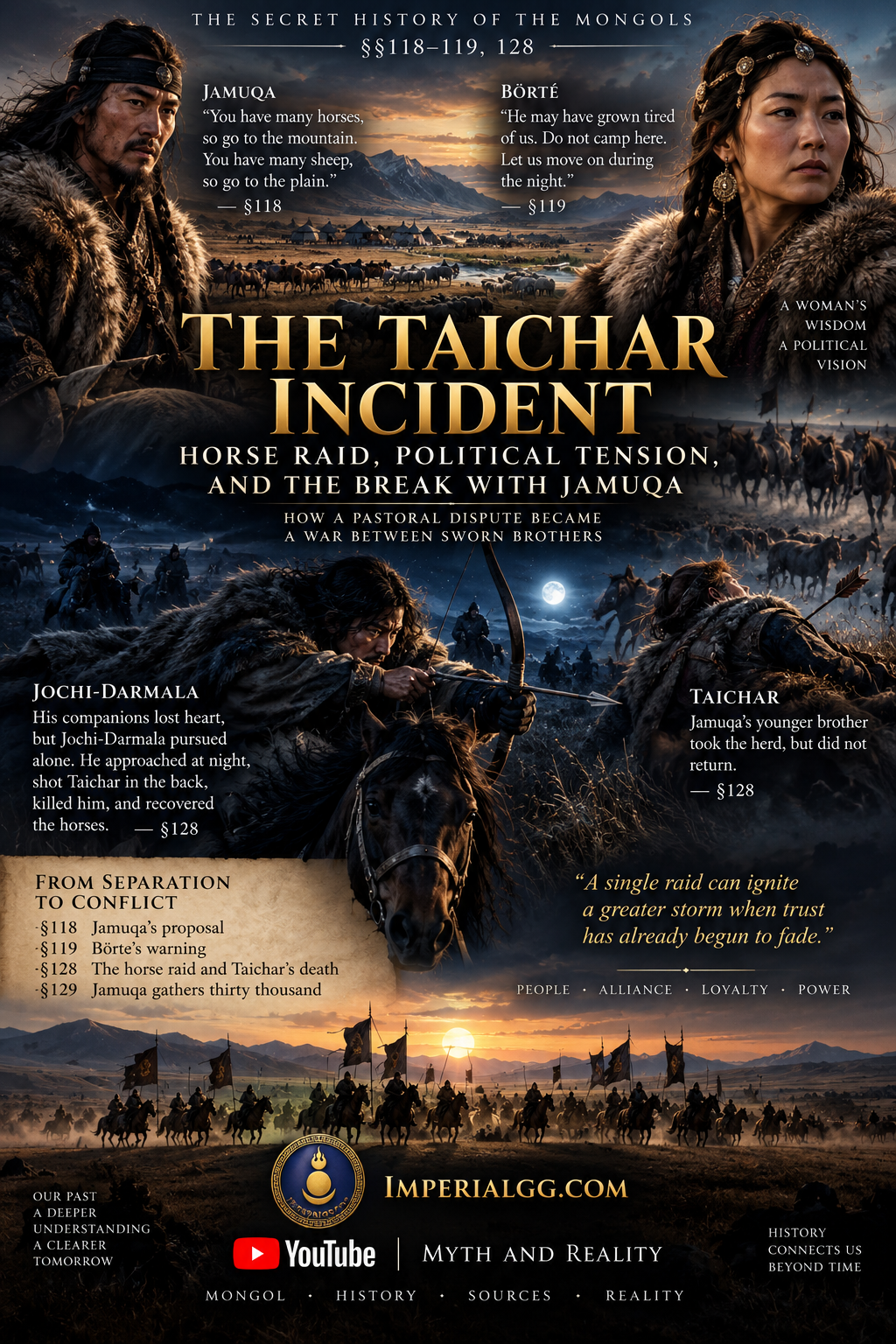
The Secret History of the Mongols, §§118–119, 127–129
INTRODUCTION
The events surrounding the separation of Temüjin and Jamuqa are often read as a straightforward sequence: the two sworn brothers gradually separated, Jamuqa’s younger brother Taichar stole a herd of horses belonging to Jochi-Darmala, Jochi-Darmala pursued him and killed him, and Jamuqa subsequently gathered an army against Temüjin. Yet the narrative of The Secret History of the Mongols allows a more careful reconstruction. The horse raid of §128 did not occur in an otherwise neutral political environment. It followed an earlier and increasingly significant transformation in the relationship between Temüjin and Jamuqa, one that the narrative had already begun to reveal in §§118–119.¹
The importance of §128 therefore lies not merely in the killing of Taichar. The episode provides a point at which pastoral practice, personal relations, household knowledge, political rivalry, and armed conflict intersect. The immediate cause was a horse raid, but the political circumstances surrounding that raid were considerably broader. Jamuqa had already proposed that the two groups separate; Börte had interpreted his words as indicating a desire to part company; Temüjin accepted her judgment and moved away during the night. Later, Jamuqa publicly declared that Altan and Quchar had driven a wedge between himself and Temüjin, even asking why Temüjin had not been made qan while the two sworn brothers were still together. Immediately thereafter, the Secret History records the horse raid by Jamuqa’s younger brother Taichar and his subsequent death.²
The surviving source does not establish that Jamuqa ordered Taichar to provoke Temüjin, nor does it state that the horse raid was deliberately planned as a pretext for war. Such a claim would go beyond the evidence. Nevertheless, the sequence raises a legitimate historical question: did the horse raid constitute an independent pastoral dispute, or did it become the immediate trigger through which an already deteriorating political relationship was transformed into open warfare? The distinction is important because the Secret History places the episode directly between Jamuqa’s expression of political grievance (§127) and his mobilization of thirteen tribal groups after Taichar’s death (§129).³
THE SEPARATION OF TEMÜJIN AND JAMUQA
Before examining Taichar, it is necessary to return to §118. Temüjin and Jamuqa had remained companions for a year and half of the following year. The Secret History then places their separation within a specific seasonal context: on the sixteenth day of the first summer month, they moved camp together. As they travelled ahead of the carts, Jamuqa proposed two different camping environments. Near the mountains, he said, the horse-herders could establish their tents; beside the river, shepherds and lamb-keepers could find food.⁴
At one level, this statement has a practical pastoral logic. Urgunge Onon’s commentary explains that horses, cattle, and camels consume taller grasses, whereas sheep and goats generally utilize shorter grass, making separation of the herds environmentally sensible. The statement therefore cannot simply be treated as a secret political message detached from the realities of nomadic pastoralism.⁵
Yet the narrative itself gives the words a second significance. Temüjin does not understand what Jamuqa means and asks Hö’elün about it. Before Hö’elün responds, Börte interprets the statement. According to the Secret History, she warns that Jamuqa is known to tire easily and that the time may have come when he had grown tired of them; she therefore advises Temüjin not to camp but to continue through the night and separate from Jamuqa.⁶
The importance of this passage is considerable. Börte is not presented merely as an observer of a private conversation. She recognizes that a seemingly ordinary discussion concerning pasture and camp location may also carry a social and political meaning. Temüjin himself does not initially understand the implication. Börte does.
This distinction deserves emphasis. The Secret History does not explicitly describe Börte as holding a formal political office, nor does §119 establish that Mongol women possessed political authority in precisely the same institutional sense as male aristocrats. It does, however, provide evidence that knowledge generated within the household—knowledge of people, movement, pastoral arrangements, behavior, and changing relationships—could become relevant to political decision-making. Börte’s advice directly influences Temüjin’s decision to leave the camp that night.⁷
BÖRTÉ AND THE POLITICAL KNOWLEDGE OF THE NOMADIC HOUSEHOLD
The significance of Börte’s intervention becomes clearer when placed within the wider representation of women in the Secret History. Hö’elün repeatedly participates in decisions affecting the survival and organization of the household. She raises not only her own children but also children incorporated into her household, as the later episode involving Kököchü demonstrates immediately after the night departure in §119. The text therefore does not confine the women of Temüjin’s family to a purely passive domestic role.⁸
Börte’s position is particularly revealing because her contribution in §119 is based neither upon military force nor upon formal command. It is based upon interpretation. She hears the same words Temüjin has heard, but she reads their social meaning differently.
Modern scholarship has increasingly emphasized that Mongol women participated in the economic, political, and military structures of steppe society, although the degree and form of that participation varied considerably across time and social status. Anne F. Broadbridge, for example, places Hö’elün and Börte within a wider history in which Mongol women contributed to the formation of political communities, alliances, households, and imperial institutions.⁹ A broader review of scholarship on Mongol women likewise emphasizes that elite women could control substantial economic resources and, in later periods, participate directly in councils, diplomacy, regency, and political factional struggles.¹⁰
For the twelfth-century episode under consideration, however, the evidence should not be inflated beyond what it can demonstrate. Börte’s intervention in §119 is one concrete case, not proof of a universal institutional system of female political authority. Its value lies precisely in its specificity: a woman within Temüjin’s mobile household recognizes a change in the behavior of a powerful male ally and advises her husband accordingly.
This is important for understanding nomadic political culture because the household itself was not isolated from political life. Camps moved together, herds constituted economic wealth, marriage created alliances, kinship structured obligations, and information circulated through people who accompanied the mobile community. In such an environment, practical household knowledge could overlap with political knowledge. Börte’s statement in §119 offers a rare narrative window into that intersection.¹¹
FROM SEPARATION TO POLITICAL RIVALRY
The separation does not immediately produce war. Instead, the Secret History records the movement of people between the two camps. Numerous groups gradually leave Jamuqa and join Temüjin. Among them are Qorchi and others who interpret signs as indicating that Heaven and Earth favor Temüjin. Eventually Sacha-beki, Quchar-beki, and Altan-otchigin also leave Jamuqa and join Temüjin.¹²
This development is essential to the interpretation of §128. The political relationship between Temüjin and Jamuqa was changing not simply because two individuals had chosen different camps, but because people and political constituencies were moving with them.
Section 123 then marks a decisive moment. Altan, Quchar, and Sacha-beki agree to make Temüjin qan. They promise military and material support and establish obligations concerning obedience in war and peace. Temüjin is then named Chinggis Qahan.¹³
Immediately afterward, §124–126 describe the organization of the new political order and To’oril Qan’s recognition of Temüjin’s khanship. Jamuqa’s response in §127 is therefore particularly revealing. He does not simply condemn Temüjin. Instead, he addresses Altan and Quchar and accuses them of having come between him and his sworn brother. He asks why they did not make Temüjin qan while the two men were still together. He then instructs them to remain companions to Temüjin.¹⁴
Jamuqa’s words preserve an important ambiguity. He recognizes Temüjin’s new political position while simultaneously expressing resentment over the circumstances under which it emerged. His statement therefore suggests that the separation was not yet represented by him as an irreversible personal break. The relationship of anda remained rhetorically important even as political realities were changing around it.
It is immediately after this statement that the Secret History introduces Taichar.
THE HORSE RAID OF TAICHAR
Section 128 is remarkably concise. Taichar, Jamuqa’s younger brother, is at Ölegei-bulaq south of Mount Jalama. He goes to steal the herd of horses belonging to Jochi-Darmala on the Sa’ari Steppe. Taichar takes the herd away. Jochi-Darmala pursues him. His companions lose heart and stop, but Jochi-Darmala continues alone. He approaches at night, lies flat along his horse’s mane, shoots Taichar in the back, kills him, and recovers the herd.¹⁵
The scene is important for several reasons.
First, the Secret History explicitly identifies Taichar as Jamuqa’s younger brother. The conflict therefore involves people connected to the two rival political camps through close personal relationships.
Second, the object of the dispute is not abstract property. It is a herd of horses. In a pastoral society, horses were simultaneously economic assets, means of transportation, military resources, and symbols of status. A horse raid could therefore have consequences considerably beyond the immediate material loss.
Third, the narrative emphasizes the courage and persistence of Jochi-Darmala. His companions lose heart, but he continues alone. He does not pursue Taichar in an open confrontation. Instead, he uses the darkness and the behavior of horses to approach his target. Onon notes that the posture described in the text would have allowed him to approach without being readily perceived, since the approaching horse could appear riderless.¹⁶
The episode is therefore presented not as a formal battle but as a pastoral raid followed by a highly calculated individual retaliation.
WAS THE HORSE RAID REALLY THE CAUSE?
Here the distinction between source and interpretation becomes essential.
The Secret History says that Taichar stole the horses. It does not say that Jamuqa ordered him to do so. It does not state that Jamuqa intended Taichar to provoke Temüjin. Nor does it explain Taichar’s own motivation. We should therefore resist turning an interpretive possibility into an established fact.
At the same time, the chronological placement of the episode deserves attention. Section 127 presents Jamuqa complaining that Altan and Quchar have caused the separation between him and Temüjin. Section 128 immediately records the raid by Jamuqa’s younger brother. Section 129 then states that, upon hearing of Taichar’s death, Jamuqa and the Jadarans allied with thirteen other tribes and formed an army of thirty thousand men against Chinggis Qahan.¹⁷
The sequence permits at least two historical readings.
The first is the pastoral-conflict interpretation. Taichar independently stole a herd. Jochi-Darmala retaliated by killing him. Jamuqa, shocked and angered by the death of his younger brother, mobilized his followers. Under this interpretation, the political conflict escalated because a relatively localized act of raiding produced an unexpectedly serious personal and political consequence.
The second is the provocation-or-pretext interpretation. The political relationship between Temüjin and Jamuqa had already deteriorated. Taichar’s raid may therefore have functioned as a deliberate provocation, or at least as an action undertaken within an environment in which a confrontation was becoming increasingly likely. Once Taichar was killed, the incident provided Jamuqa with a concrete grievance around which a larger coalition could be mobilized.
The surviving evidence does not allow us to decide conclusively between these explanations.
That uncertainty is not a weakness of the analysis. It is precisely where the source requires historical discipline.
TAICHAR MAY NOT HAVE EXPECTED TO DIE
One further possibility deserves consideration. Even if the raid contained an element of provocation, there is no reason to assume that Taichar expected the encounter to result in his own death.
The Secret History describes an asymmetrical situation: Taichar takes the herd, while Jochi-Darmala initially has companions who eventually lose heart and abandon the pursuit. Jochi-Darmala then continues alone and approaches at night. His final attack is therefore not a predictable battlefield confrontation. It is an individual act of pursuit and ambush.¹⁸
If Taichar intended merely to seize horses or test the resolve of Jochi-Darmala’s group, the actual outcome could have exceeded his expectations. The political consequences were even greater. His death transformed a pastoral raid into a blood grievance involving Jamuqa himself.
This possibility gives the episode a broader historical significance: political crises do not always begin with actors consciously deciding to start a war. A limited act of aggression can create consequences that its initiator did not anticipate.
That interpretation remains hypothetical, but it is consistent with the narrative sequence.
FROM TAICHAR’S DEATH TO DALAN BALJUT
The most important evidence for the seriousness of the incident is what follows.
Section 129 does not describe a period of prolonged negotiation after Taichar’s death. It states that Jamuqa and members of the Jadaran tribe allied with thirteen other tribes and assembled an army of thirty thousand. They moved against Chinggis Qahan, who in turn gathered thirty thousand from his thirteen camps. The two sides met at Dalan-baljut.¹⁹
The numerical symmetry of the narrative is striking, although the precise historical reliability of the stated troop numbers must be treated cautiously. The important point for the narrative is that the death of one man is followed almost immediately by large-scale political mobilization.
This is why §128 should not be isolated from §§118–127. The horse raid did not create the entire political conflict from nothing. By the time Taichar was killed, Temüjin and Jamuqa had already separated; groups had moved from Jamuqa to Temüjin; Temüjin had been made qan; To’oril had recognized his leadership; and Jamuqa had publicly expressed his grievance about the separation.²⁰
The Taichar incident therefore appears in the Secret History at the precise moment when personal rivalry, political realignment, and pastoral conflict converge.
THE SIGNIFICANCE OF BÖRTÉ’S WARNING
This is also why Börte’s words in §119 deserve to remain at the center of the analysis.
She did not predict Taichar’s raid. She did not predict the Battle of Dalan-baljut. Her statement concerned Jamuqa’s intention to separate from Temüjin. Yet the subsequent narrative shows that she had correctly recognized that the relationship between the two men had entered a different phase.
Her significance therefore lies not in prophetic foresight but in social perception.
The Secret History gives Temüjin the power to command warriors, form alliances, and fight battles. But it also gives Börte the ability to interpret the social environment surrounding the mobile household. Her advice changes Temüjin’s immediate behavior. In this respect, §119 provides evidence that political intelligence within a nomadic community was not necessarily generated only by warriors and male aristocrats.¹¹
The episode should therefore be read alongside the broader roles of Hö’elün, Börte, daughters, wives, and other women appearing throughout Mongol historical sources. Modern scholarship has increasingly rejected interpretations that reduce Mongol women to passive participants in a male-centered imperial story. Broadbridge’s study, for example, specifically places women within the processes through which Mongol political communities, alliances, warfare, and imperial structures were created.²¹
Yet the early twelfth-century evidence should still be treated carefully. The Secret History does not give us a formal doctrine of female political authority. What it gives us are episodes of demonstrated influence. Börte’s intervention in §119 is one of the clearest examples because the text explicitly connects her interpretation to Temüjin’s decision to leave Jamuqa’s camp.
AUTHOR’S THESIS
The Taichar incident should therefore be interpreted neither as an isolated horse theft nor as a proven conspiracy ordered by Jamuqa.
The evidence supports a more cautious but historically meaningful thesis:
The horse raid occurred within an already deteriorating political relationship between Temüjin and Jamuqa. The raid may have been an independent pastoral act, a deliberate provocation, or something between the two; the surviving Secret History does not allow us to determine which with certainty. What can be established is that Taichar’s death transformed the immediate dispute into a much larger political confrontation.
In this reading, the significance of §128 lies precisely in the gap between cause and consequence. A herd of horses was stolen. One man pursued another. Taichar was killed. Within the narrative, however, the result was an army of thirty thousand marching against Temüjin.
The episode demonstrates how fragile political relationships could become in a society where personal loyalty, kinship, pastoral wealth, and military alliances were closely interconnected.
It also gives §119 renewed importance. Before the conflict became military, Börte had already recognized that something fundamental had changed in Jamuqa’s relationship with Temüjin. Her observation reminds us that the political history of the steppe was not made only on battlefields. It was also read and interpreted within the moving household.
CONCLUSION
Sections 118–119 and 127–129 together present a gradual transformation rather than a single sudden rupture.
Jamuqa first proposes a different pattern of settlement. Börte recognizes that the proposal may signify separation. Temüjin leaves. People begin moving between the two camps. Temüjin is made qan. To’oril recognizes his leadership. Jamuqa publicly laments the separation. Then Taichar steals Jochi-Darmala’s horses, is pursued and killed, and the incident becomes the immediate prelude to Dalan-baljut.
The Secret History does not tell us that Jamuqa planned this sequence. It does not tell us that Taichar was ordered to provoke Temüjin. Nor does it tell us exactly what Taichar expected when he took the horses. Those questions remain interpretive.
What the source does show is that the political separation preceded the bloodshed. The horse raid therefore appears not at the beginning of the conflict, but at the point where an already developing political division acquired a violent trigger.
And that is what makes §128 historically important.
FOOTNOTES
1. The Secret History of the Mongols, §§118–119, 127–129. For the English translation used here, see Urgunge Onon, trans. and annot., The Secret History of the Mongols: The Life and Times of Chinggis Khan (London: RoutledgeCurzon, 2001), pp. 97–99, 107–109. The edition identifies §118 as the beginning of the separation sequence and §128 as the Taichar incident.
2. Onon, Secret History, §§118–129. The chronological relationship among these sections is especially important because §127 contains Jamuqa’s statement concerning the separation, while §128 immediately introduces Taichar’s raid and §129 records Jamuqa’s mobilization.
3. Secret History, §§127–129. Onon’s text records Jamuqa’s grievance in §127, Taichar’s raid and death in §128, and the formation of a 30,000-man army by Jamuqa and his allies in §129.
4. Secret History, §118. Onon, pp. 97–98.
5. Onon, commentary to §118, n. 245. The note explains the ecological basis for the distinction between horse-herding and sheep-herding camps.
6. Secret History, §119. Onon, p. 98. The text explicitly attributes the decision to continue through the night to Börte’s advice.
7. Ibid. This is an interpretation of the narrative function of Börte’s intervention; the text does not describe her role using a formal political title.
8. Secret History, §119. The text immediately records Kököchü, a boy taken from the Besüd Tayichi’ut camp, being presented to Hö’elün, who subsequently raises him.
9. Anne F. Broadbridge, Women and the Making of the Mongol Empire (Cambridge: Cambridge University Press, 2018). The book explicitly examines Hö’elün, Börte, Mongol women, and their participation in the formation of Mongol political and imperial structures.
10. Michal Biran, “Women in the Social, Political and Economic History of the Mongol Empire,” English Historical Review 136, no. 581 (2021): 986–1005. The review summarizes scholarship emphasizing that elite Mongol women could exercise economic, diplomatic, military, and political influence, while also stressing variation across time and social position.
11. For a study specifically examining Hö’elün and Börte through the Secret History, see María C. M. de? [This reference should not be used without verification.] More securely, Broadbridge, Women and the Making of the Mongol Empire, especially the sections on women in steppe society and Hö’elün and Börte.
12. Secret History, §§120–123. The text describes increasing numbers leaving Jamuqa and joining Temüjin, culminating in the decision of Altan, Quchar, and Sacha-beki to make Temüjin qan. Onon, pp. 99–102.
13. Secret History, §123. Onon records the oath and the naming of Temüjin as Chinggis Qahan in 1189.
14. Secret History, §127. Jamuqa explicitly blames Altan and Quchar for coming between himself and Temüjin and asks why Temüjin had not been made qan while they were still together.
15. Secret History, §128. Onon, pp. 107–108.
16. Onon, §128 commentary. The translator explains that Jochi-Darmala’s position lying flat along the horse’s mane allowed him to approach without being seen, since a riderless-looking horse would not necessarily alarm Taichar.
17. Secret History, §129. Onon records Jamuqa and the Jadarans joining with thirteen tribes and assembling 30,000 men, followed by Temüjin’s equivalent mobilization from thirteen camps. The source dates the episode to 1190 in Onon’s note.
18. Ibid., §128. The narrative emphasizes that Jochi-Darmala’s companions lost heart and that he continued alone, eventually approaching Taichar at night.
19. Secret History, §129.
20. §§122–127. The movement of groups away from Jamuqa, Temüjin’s elevation, To’oril’s recognition, and Jamuqa’s response all precede the Taichar incident in the narrative.
21. Broadbridge, Women and the Making of the Mongol Empire. Broadbridge’s study explicitly places women within the political, military, economic, and social processes involved in the making of the Mongol Empire.
SELECTED BIBLIOGRAPHY
Broadbridge, Anne F. Women and the Making of the Mongol Empire. Cambridge: Cambridge University Press, 2018.
Biran, Michal. “Women in the Social, Political and Economic History of the Mongol Empire.” English Historical Review 136, no. 581 (2021): 986–1005.
de Rachewiltz, Igor. The Secret History of the Mongols: A Mongolian Epic Chronicle of the Thirteenth Century. 3 vols. Leiden: Brill, 2004–2013.
Onon, Urgunge, trans. and annot. The Secret History of the Mongols: The Life and Times of Chinggis Khan. London: RoutledgeCurzon, 2001.
DALAN BALJUT: BETWEEN BATTLE, MEMORY, AND LEGEND
By Altanbagana Baatar
DBA Candidate| Independent Historian
ImperialGG Historical Research Seriers
18 September 2026
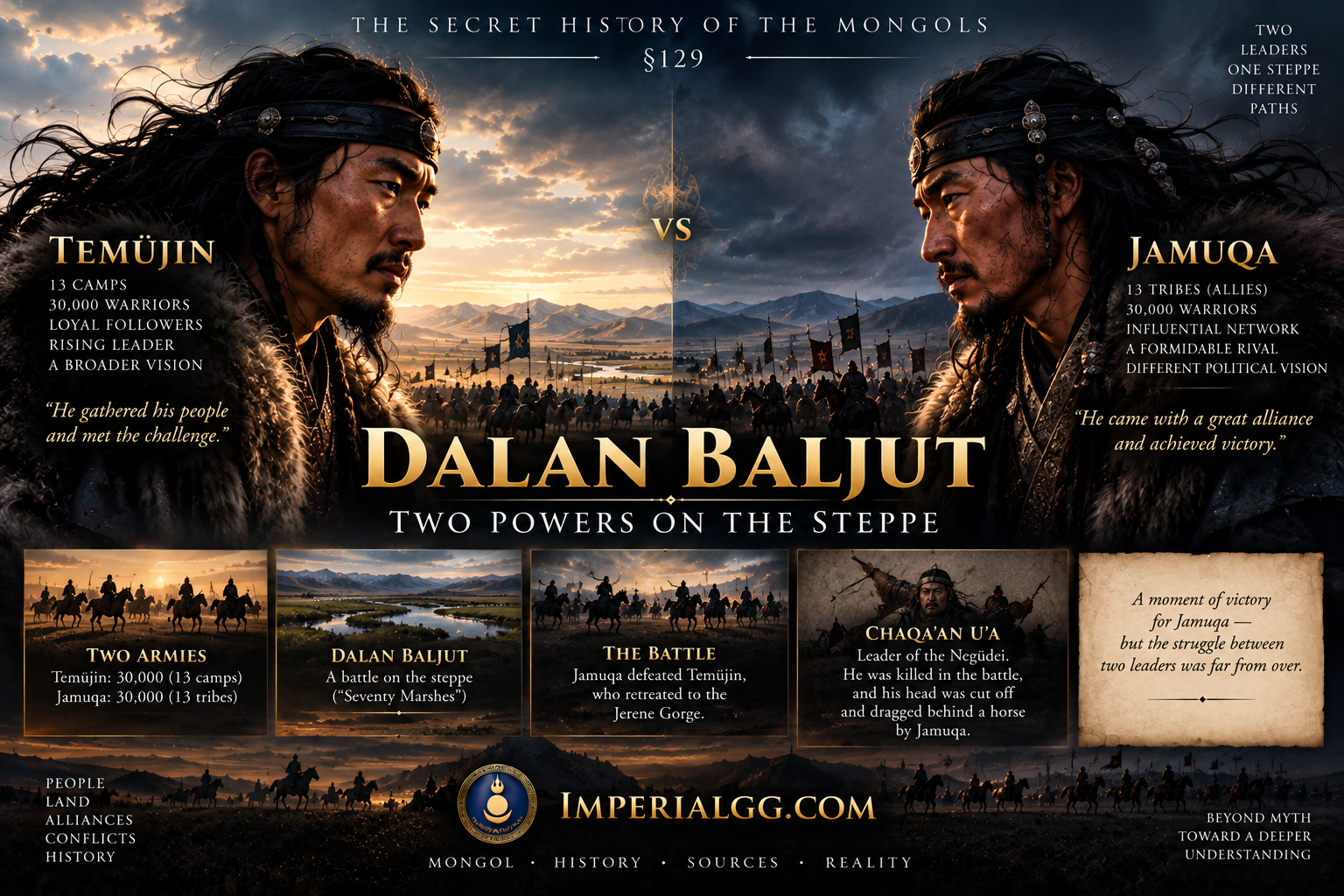
AUTHOR’S THESIS
The account of the Battle of Dalan Baljut in The Secret History of the Mongols deserves to be read with particular caution because one of its most famous passages may have been transmitted, translated, and subsequently interpreted in ways that obscure rather than clarify the historical event. The narrative itself is comparatively clear on the central military fact: after Taichar was killed, Jamuqa allied with thirteen tribes and assembled a force of thirty thousand; Temüjin likewise organized thirty thousand from his thirteen camps; the two forces met at Dalan Baljut; and Jamuqa defeated Temüjin, forcing him to retreat into the Jerene Gorge on the Onon River.
The difficulty begins immediately after the battle. The surviving text states that, while returning, Jamuqa had the Chinos subjected to what the standard translations render as being “boiled alive in seventy cauldrons,” and that he cut off the head of Chaqa’an U’a of the Ne’üs/Negüs and dragged it behind his horse. Yet this famous image should not automatically be treated as an independently established historical fact. Mongolian scholarship has long questioned whether dalan toqoga should necessarily be understood as “seventy cauldrons” at all. D. Tserensodnom raised doubts about the plausibility of the passage, while the scholar Huačai Dugarjav examined the underlying transcription and suggested that Dalan Toqoga may have been a place-name rather than a reference to seventy cooking cauldrons. The possibility has also been connected with the geographical terminology surrounding Dalan Baljut.
This article therefore does not seek to erase the passage from the Secret History, nor to replace one certainty with another. Its purpose is more limited and more historical: to distinguish what §129 actually records from what later translation and interpretation have made of it. Dalan Baljut was a real episode in the political and military rivalry between two rising steppe leaders. Jamuqa won the battle. Chaqa’an U’a was killed in the fighting. The fate and meaning of the Chinos passage, however, remain a question of textual interpretation. The historian should preserve that uncertainty rather than convert a disputed reading into spectacle.
1. TWO RISING POWERS ON THE STEPPE
By the time of Dalan Baljut, the relationship between Temüjin and Jamuqa had moved far beyond the intimate relationship of childhood companions and anda. The preceding narrative describes their separation, the increasing movement of followers toward Temüjin, and the subsequent Taichar incident. Jamuqa’s response to Taichar’s death was not a small-scale act of retaliation. According to §129, Jamuqa and the Jadaran allied themselves with thirteen other tribes and assembled thirty thousand men. Temüjin, receiving warning of their approach, likewise assembled thirty thousand from his thirteen camps.
This symmetry is historically significant. The narrative presents two political formations of approximately equal stated strength. The conflict was therefore no longer simply a personal dispute between two former sworn brothers. It had become a struggle between competing networks of allegiance on the steppe.
The Secret History gives no detailed tactical account of the battle itself. We are not told how the armies were deployed, where the decisive engagement occurred within the battlefield, or what maneuver produced Jamuqa’s victory. The source tells us only the result: “They fought at Dalan Baljut,” and Temüjin was defeated and forced into the Jerene Gorge by the Onon.
That brevity is itself important. Later historical writing has sometimes supplied a much more elaborate picture of the battle than the surviving Mongolian chronicle actually preserves. A source-critical reconstruction must therefore distinguish the known outcome from later reconstructions of the battlefield.
2. WHAT WAS DALAN BALJUT?
The name Dalan Baljut should first be treated as a geographical name, not as a description of the punishment that follows it.
De Rachewiltz translates the name in a note as “Seventy Marshes.” This does not mean that the “seventy” in Dalan Baljut explains the later reference to seventy cauldrons. The two expressions occur in different parts of the narrative and must not be conflated.
This distinction becomes particularly important because the later phrase traditionally translated as “seventy cauldrons” has itself been questioned by Mongolian scholars. The scholarly discussion summarized by D. Tserensodnom and Huačai Dugarjav proposes that Dalan Toqoga may instead preserve a place-name, potentially connected geographically with the Dalan Baljut region. In this interpretation, the phrase need not describe seventy cooking vessels at all.
This hypothesis is not established beyond dispute. It should therefore be presented as a philological and toponymic possibility, not as a replacement fact.
That distinction is precisely where historical scholarship differs from legend: the existence of an old textual reading does not automatically settle what the original historical event must have been.
3. THE CHINOS PASSAGE: HISTORY OR A PROBLEM OF TRANSMISSION?
The standard English translations give the passage in remarkably dramatic terms. Onon renders the text as Jamuqa, on his return, having the young men of the Chinos boiled in seventy cauldrons; he then cut off Chaqa’an U’a’s head and dragged it behind his horse. Atwood similarly translates the passage as the Chinos being boiled in seventy cauldrons.
Yet the existence of this translation does not end the question.
The Mongolian scholarly discussion is particularly valuable because it asks a basic philological question: is “dalan toqoga” necessarily a numerical phrase meaning “seventy cauldrons,” or could it represent a geographical name? D. Tserensodnom reportedly considered the traditional interpretation problematic and consulted Huačai Dugarjav concerning the geographical terminology. Dugarjav’s response, as reproduced in the scholarly discussion, raises the possibility that “Dalan Toqoga” was a place-name and that the structure of the transmitted text had been misunderstood in later translation.
There is also an important internal problem with interpreting the passage as the total destruction of the Chinos/Negüs. Much later in the Secret History, in §218, Chinggis Qa’an tells Narin To’oril that his father Chaqa’an Qo’a fought for him at Dalan Baljut and was killed by Jamuqa. Narin To’oril then says that his Negüs kinsmen had become scattered among other tribes, and Chinggis orders him to gather them.
This later passage does not prove that no Chinos/Negüs were killed at Dalan Baljut. It does, however, make a simplistic interpretation of complete extermination difficult. The group clearly survived as a dispersed community.
Thus the historical question remains open: Was the “seventy cauldrons” passage a literal record of mass execution, a distorted transmission of a place-name, or a later interpretation of a more complex episode?
The surviving evidence does not permit us to answer that question with certainty.
4. CHAQA’AN GU’A: THE MAN WHO DEFINITELY DIED IN THE BATTLE
The case of Chaqa’an U’a is considerably firmer. The Secret History explicitly states in §129 that Jamuqa cut off his head and dragged it behind his horse. More importantly, the chronicle returns to him much later.
In §218, Chinggis Qa’an addresses Chaqa’an Qo’a’s son Narin To’oril and recalls: “Your father Čaγan Qo’a was fighting zealously before me at the battle of Dalan Baljut when he was killed by Jamuqa.”
The same passage identifies this Chaqa’an Qo’a with the Chaqa’an U’a of §129.
This later recollection gives §129 an important retrospective confirmation. Chaqa’an U’a was not merely an incidental figure inserted into the story. He was remembered by Chinggis Qa’an as a man who fought on his side at Dalan Baljut and died there.
Therefore, when we ask why Jamuqa cut off his head, the strongest historical answer is also the simplest: Chaqa’an U’a was a leader who had fought for Temüjin and was killed in the battle.
The Secret History does not, however, give an explicit explanation for why Jamuqa subsequently cut off his head and tied it to his horse’s tail. Any interpretation beyond that must be marked as interpretation. The act may have served as a form of post-battle humiliation, vengeance, or political intimidation, but the source itself does not tell us which of these motives was decisive.
5. WAS JAMUQA PUNISHING HIS OWN PEOPLE?
This is where the traditional interpretation becomes especially difficult. If the Chinos passage means exactly what the conventional translation suggests, Jamuqa had, immediately after defeating Temüjin, subjected members of the Chinos leadership to an exceptionally brutal punishment. Yet the text does not explicitly tell us that they were punished for treason, nor does it state that they had defected from Jamuqa.
One later translation footnote proposes that they were killed because they might otherwise have helped Chinggis and notes that they had previously belonged to the Tayichi’ud. But that is an editorial explanation, not a sentence supplied by §129 itself. The distinction matters.
The primary text tells us: Jamuqa won. Chaqa’an GU’a was killed. The Chinos passage follows.
It does not explicitly tell us: “They betrayed Jamuqa, therefore he executed them.” That explanation should not be inserted into the source.
6. THE POLITICAL AFTERMATH IS MORE IMPORTANT THAN THE HORROR STORY
The next section, §130, may provide a more historically significant clue than the sensational image of the cauldrons. After Jamuqa’s return, Jürchedei of the Uru’ut, Quyuldar of the Mangqut, and Mönglik with his seven sons leave Jamuqa and join Temüjin. The Secret History explicitly says that Chinggis Qa’an rejoiced because people were coming over from Jamuqa’s side.
This is a crucial development. Dalan Baljut was a military victory for Jamuqa, but victory on the battlefield did not automatically translate into stable political allegiance.
The narrative immediately moves from Jamuqa’s victory to the movement of important groups away from him. We should not claim that §129’s alleged punishments directly caused these defections, because the source does not establish that causal relationship. Nevertheless, the chronological juxtaposition invites an important political question:
What sustains allegiance after victory—fear, kinship, reputation, justice, or the ability to integrate competing groups? That question is more historically productive than simply repeating the image of seventy boiling cauldrons.
7. DALAN BALJUT AND THE TWO POLITICAL MODELS
The deeper importance of Dalan Baljut lies not in the question of whether one should believe the most dramatic version of the cauldron story. It lies in the fact that two competing political centers had now emerged from the same steppe world. Jamuqa had the Jadaran and thirteen allied tribes and could mobilize thirty thousand men. Temüjin had thirteen camps and could mobilize a comparable force.
Both men possessed:
- followers,
- military commanders,
- tribal alliances,
- political legitimacy claims,
- and the ability to mobilize substantial pastoral populations.
The difference between them was therefore not simply personal character. Their rivalry had become a question of political organization and allegiance. This is why Dalan Baljut deserves to be treated as one of the formative political battles of Temüjin’s career. It was his defeat, but it was also the moment when the competition between the two former anda became unmistakably a struggle between alternative centers of power.
AUTHOR’S THESIS — REVISITED
The traditional image of Dalan Baljut has been dominated by three dramatic elements: Jamuqa’s victory, the seventy cauldrons, and the severed head of Chaqa’an GU’a. The first is firmly established by §129. The second remains a matter requiring philological scrutiny.
The third is firmly recorded, but its precise political purpose is not explained by the source. For this reason, Dalan Baljut should not be presented merely as a story of Mongol cruelty. It should be examined as a source-critical problem in the reconstruction of early Mongol political history. The question is not whether the Secret History should be believed or rejected as a whole. The proper historical question is more precise:
Which elements of §129 are independently reinforced by the wider narrative, which depend upon a disputed reading of the text, and which represent later interpretation?. On that basis, the battle itself can be treated as historical evidence, while the “seventy cauldrons” episode remains open to scholarly debate. That distinction is not a weakness in the history. It is the history.
CONCLUSION
Dalan Baljut marked the transformation of the Temüjin–Jamuqa rivalry from a dispute between former companions into an armed contest between two substantial political coalitions. The Secret History records thirty thousand men on each side, a Jamuqa victory, and Temüjin’s retreat to the Jerene Gorge.
The subsequent account of punishment, however, requires a different level of scrutiny. The traditional “seventy cauldrons” interpretation is present in major translations, but Mongolian scholars have questioned whether Dalan Toqoga should instead be understood as a place-name. That possibility cannot simply be dismissed, nor can it presently be promoted to an established fact.
Chaqa’an GU’a presents a firmer case: the text states that Jamuqa killed him, and §218 later confirms that he died fighting for Temüjin at Dalan Baljut. The result is a more complex picture than the familiar legend. Jamuqa won the battle, but the political consequences of his victory were not entirely under his control. Immediately afterward, important groups abandoned him and joined Temüjin.
Dalan Baljut therefore belongs not only to the military history of the Mongols but also to the history of political legitimacy: a battlefield victory could establish temporary superiority, but it could not by itself determine where the loyalty of the steppe would ultimately settle.
FOOTNOTES
1. The Secret History of the Mongols, §129. The standard Rachewiltz text records Jamuqa’s alliance of thirteen tribes, thirty thousand men, the battle at Dalan Baljut, Temüjin’s retreat to the Jerene Gorge, and the subsequent punishment passage.
2. Igor de Rachewiltz, The Secret History of the Mongols: A Mongolian Epic Chronicle of the Thirteenth Century, §129, note 2, translates Dalan Baljut as “Seventy Marshes.”
3. Urgunge Onon, The Secret History of the Mongols: The Life and Times of Chinggis Khan, §129, gives the conventional translation of the Chinos passage as the boiling of young men in seventy cauldrons.
4. Anne F. Broadbridge is among modern scholars who treat the Secret History as a source requiring attention to its narrative construction and transmission; for the present issue, however, the central philological question concerns the reading of §129 itself.
5. D. Tserensodnom’s commentary and the discussion attributed to Huačai Dugarjav question whether dalan toqoga should be understood literally as “seventy cauldrons.” The proposed alternative is that it may preserve a geographical name. This interpretation remains a scholarly hypothesis rather than a settled reading.
6. The same scholarly discussion notes that §218 preserves evidence that the Negüs community survived in dispersed form: Narin To’oril tells Chinggis Qa’an that his Negüs kinsmen are scattered among different tribes.
7. The Secret History of the Mongols, §218: Chinggis Qa’an recalls that Chaqa’an Qo’a fought for him at Dalan Baljut and was killed by Jamuqa.
8. The explanatory note attached to some translations says the Chinos were killed because they might otherwise have helped Chinggis and identifies them as having previously belonged to the Tayichi’ud. This should be treated as editorial interpretation rather than as an explicit explanation in the body of §129.
9. The “zād” episode belongs to §143, at Köyiten, where Quduqa-beki and Buyiruq Qan use a “magic stone” to summon a storm. The storm turns against them and is interpreted as evidence that Heaven does not favor them. It should not be assigned to Dalan Baljut.
10. The immediate aftermath is recorded in §130: Jürchedei, Quyuldar, Mönglik and Mönglik’s seven sons leave Jamuqa and join Temüjin. The Secret History explicitly presents Temüjin’s reaction as joy at people coming over from Jamuqa’s side.
WHEN POWER ATTRACTS PEOPLE
By Altanbagana Baatar
DBA Candidate| Independent Historian
ImperialGG Historical Research Seriers
17 September 2026
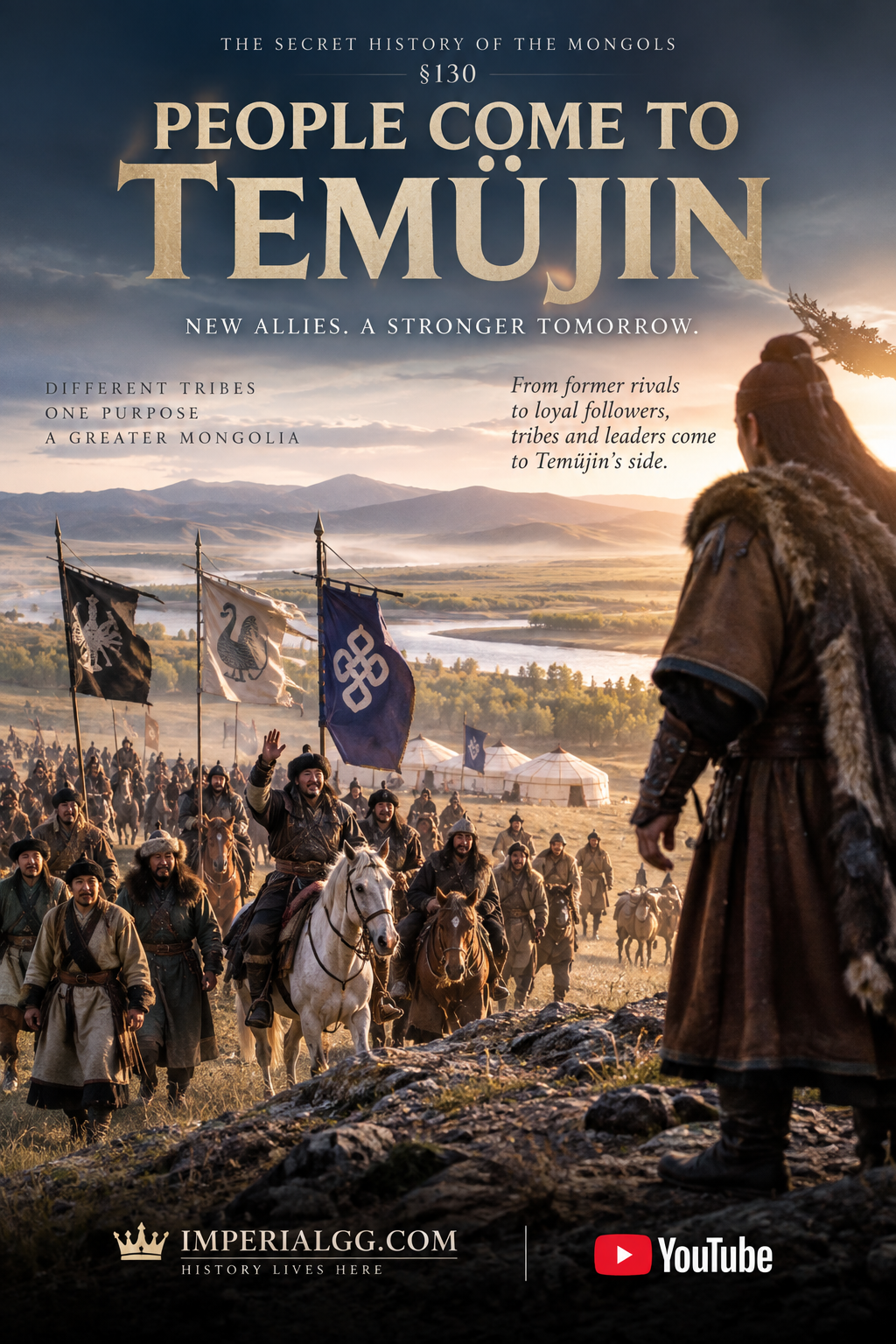
TEMÜJIN’S RISING COALITION AND THE POLITICS BEHIND THE AIRAG DISPUTE
AUTHOR’S THESIS
SHM §§130–131|
The events recorded in §§130–131 of the Mongolyn Nuuts Tovchoo (MNT), or The Secret History of the Mongols, occur at a significant moment in the political development of Temüjin. Following the battle of Dalan Baljut, individuals and groups who had previously stood with Jamuqa begin to move toward Temüjin: Jürčidai comes with the Uru’ut, Quyildar with the Mangqut, and Mönglik with his seven sons. The narrative presents these movements not simply as an increase in military manpower but as a widening of Temüjin’s political community. Temüjin himself interprets the movement in expansive terms, rejoicing that people are coming over to him from Jamuqa’s side.¹At precisely this moment of political expansion, however, the MNT places a seemingly minor dispute over the order in which kumiss is served. The dispute concerns precedence: who should be served first, and therefore who should receive recognition within the social hierarchy of the feast. The quarrel leads to the beating of the cook Shiki’ür, whose lament invokes the deaths of Yisügei Ba’atur and Nekün-taishi; the following section then moves from the feast to a much more serious confrontation between Belgütei and Büri Böke, culminating in the slashing of Belgütei’s exposed shoulder with a sword.²This article argues that the kumiss dispute should not be treated as an isolated quarrel over drink. The MNT does not explicitly state that the dispute arose because the old aristocratic elite opposed Temüjin’s emerging political principles, and such a statement would go beyond the evidence. Yet when §§130–131 are read together with the earlier §§123–125, a broader pattern becomes visible. Temüjin had begun to build authority around personal loyalty, demonstrated ability, and service, elevating men such as Bo’orču and Jelme within his political order. At the same time, members of the older aristocratic order—most notably Altan, Quchar, and Sača Beki—had themselves participated in making Temüjin Khan. The tension between these two political orientations may already have been developing into an actual conflict: not necessarily because the aristocratic figures rejected Temüjin from the beginning, but because his expanding coalition increasingly challenged established assumptions about precedence, authority, and political status.The kumiss dispute, therefore, may be read as the visible surface of a deeper political tension. The drink was the immediate occasion; the question of status was potentially much larger.
1. A POLITICAL COMMUNITY IN MOTION
Section 130 opens after the political rupture between Temüjin and Jamuqa. The significance of the passage lies in the people who now cross from one camp to the other. Jürčidai brings the Uru’ut, Quyildar brings the Mangqut, and Mönglik comes with his seven sons. The text does not describe these arrivals merely as individual acts of friendship. Each man appears with a social following, meaning that political allegiance is being transferred at the level of groups and households.³This distinction matters. In the political environment described by the MNT, a leader’s strength was inseparable from the people who followed him. Temüjin’s growing power was therefore not simply a matter of possessing more warriors; it depended upon his ability to attract and retain communities that could become part of his political order. The arrival of Jürčidai, Quyildar, and Mönglik demonstrates that the political balance was beginning to move.Mönglik’s arrival deserves particular attention. Earlier in the MNT, when Yisügei was dying after being poisoned by the Tatars, he summoned Mönglik and entrusted him with the care of his young sons and widowed wife.⁴ Thus, when Mönglik later comes to Temüjin with his seven sons, his appearance carries a significance extending beyond the simple addition of another group of fighting men. He represents a link between the household of Yisügei and the political community that Temüjin was now constructing.At the same time, the MNT does not name Mönglik’s seven sons individually in §130. The later identification of Kököchü Teb-Tenggeri as one of the seven, specifically the middle son, occurs in §244.⁵ It is therefore methodologically preferable not to introduce Kököchü by name into the §130 narrative as though he were identified there.Temüjin’s response to these arrivals is equally important. The narrative emphasizes his joy that people are leaving Jamuqa and coming to him. The political significance is therefore not merely that Temüjin has survived defeat; he is becoming a new center of attraction.⁶
2. TEMÜJIN’S EARLIER POLITICAL PRACTICE
The significance of this expanding coalition becomes clearer when §130 is read against §§124–125.After Temüjin had been made Khan, he began assigning people positions within his new political organization. Among those elevated were Bo’orču and Jelme, two men whose importance in the narrative derives not primarily from aristocratic genealogy but from their loyalty and service to Temüjin during periods when his political position was extremely weak. Temüjin recalls that when he had no companion other than his shadow, they had been his shadows, and when he had no nourishment beyond his tail, they had been his tail.⁷This language is important because it expresses the basis upon which Temüjin understood political loyalty. Bo’orču and Jelme were valuable because they had demonstrated loyalty at moments when loyalty carried real risk. Their political importance was therefore connected to service and proven allegiance, rather than merely to inherited status.This should not be described anachronistically as a fully developed meritocratic system. The MNT does not present Temüjin as abolishing aristocratic hierarchy. He remained deeply embedded within the Borjigin and wider aristocratic order. Nevertheless, the narrative reveals an important tendency: personal loyalty, competence, and demonstrated service could become sources of political advancement alongside lineage.That tendency becomes especially significant when placed beside the aristocratic figures who had earlier elevated Temüjin himself.
3. THE MEN WHO MADE TEMÜJIN KHAN
Section 123 records Altan, Quchar, and Sača Beki agreeing to make Temüjin their Khan. Their decision was politically consequential. They were not outsiders attacking the aristocratic order; they were themselves participants in the process through which Temüjin acquired Khanhood.⁸This point prevents an overly simple interpretation of the later conflict. It would be historically inaccurate to claim that Altan, Quchar, and Sača Beki were opposed to Temüjin from the beginning. On the contrary, the MNT explicitly records their participation in elevating him.The more interesting question is what happened after Temüjin became Khan.Once his political community began expanding beyond the original circle of aristocratic supporters, the basis of political influence could begin to change. Men such as Bo’orču and Jelme had demonstrated their importance through service. New groups were now abandoning Jamuqa and joining Temüjin. Temüjin’s authority was therefore becoming increasingly dependent upon a broader coalition rather than upon the small group of aristocratic men who had initially recognized him.The MNT does not state that Altan, Quchar, or Sača Beki opposed this transformation. But the subsequent narrative makes it possible to ask whether the interests of the established aristocratic order and Temüjin’s emerging political system had already begun to diverge.That is the interpretive problem at the center of §§130–131.
4. THE FEAST AT THE ONON
After the arrival of these new followers, the MNT describes a feast in the forest of the Onon. Temüjin, Hö’elün, Qasar, Sača Beki, and others participate. The feast therefore brings together different components of the emerging political community: Temüjin’s household, his followers, and the Jürkin aristocratic branch represented by Sača Beki.⁹
The Mongolian text likewise makes the issue explicit: they complain that they were not served first and ask why Ebegei was given the first serving.¹¹The immediate issue, therefore, is not simply whether kumiss was served. It is precedence.The order in which people are served at a formal feast can communicate social recognition. Consequently, the dispute may be read as a conflict over the public acknowledgment of rank within the gathering. The MNT does not provide a theoretical explanation of the etiquette, so one must be cautious. Nevertheless, the narrative itself makes the sequence unmistakable: the first act of conflict concerns who deserves precedence.
5. SHIKI’ÜR’S LAMENT AND THE MEMORY OF THE OLD ORDER
The response of Shiki’ür gives the scene an unexpectedly political dimension. After being beaten, the cook cries out that he is being beaten because Yisügei Ba’atur and Nekün-taishi are no longer alive.¹²The remark is easy to overlook, but it is one of the most revealing details in the episode. Shiki’ür is effectively saying that the people who once stood above him and protected his position are gone. His lament connects the immediate humiliation at the feast with the disappearance of an earlier generation of authority.The statement should not be turned into a theory that the MNT itself does not articulate. Yet it is significant that, at the moment when precedence becomes contested, the cook remembers Yisügei and Nekün-taishi—figures associated with an earlier political order.This creates a striking chronological contrast. Yisügei belonged to the generation before Temüjin’s political rise. Temüjin is now constructing a new political community in which men who proved their loyalty to him can receive important responsibilities. Meanwhile, older aristocratic relationships remain deeply embedded in the social structure.The feast therefore brings two political memories into the same space: the old order of established rank and the emerging order of Temüjin’s personal coalition.
6. FROM PRECEDENCE TO VIOLENCE
Section 131 transforms the atmosphere of the feast into physical confrontation.On Temüjin’s side, Belgütei is responsible for the feast and is holding Chinggis Qahan’s horses. On the Jürkin side, Büri Böke is responsible. A man of the Qadagin steals a tether from the place where Temüjin’s horses are tied. Belgütei catches him, but Büri Böke intervenes on behalf of the man.¹³The disagreement becomes personal.The MNT emphasizes Belgütei’s identity as a wrestler. He habitually removed his right sleeve, leaving his arm and shoulder exposed. When the confrontation occurs, Büri Böke slashes Belgütei’s naked shoulder with his sword. The Mongolian text is explicit: **Бэлгүтэй үргэлж барилдах тул баруун ханцуйгаа мулталж, гараа нүцгэн гаргаж явдаг байсан; Бэлгүтэйгийн нүцгэн мөрийг Бүри-бөх илдээр хаг цавчив.**¹⁴The significance of the detail is that the injury is not a vague accidental wound. The exposed shoulder is deliberately struck with a sword.Büri Böke himself was not an ordinary participant. Earlier genealogical material identifies him as the son of Qutuqtu Mönggür, and the MNT later remembers him as an exceptionally powerful wrestler among his people.¹⁵Thus the confrontation is symbolically appropriate to the political structure of the episode: two physically powerful men, each representing a different political camp, become the immediate agents through whom a larger tension becomes physical.
7. BELGÜTEI’S RESPONSE
Perhaps the most revealing element of §131 is not the wound itself but Belgütei’s response.Temüjin sees the blood and asks what has happened. Belgütei minimizes the injury. He tells Temüjin not to allow the incident to cause a quarrel with their kinsmen, because the two sides have only recently established peace.¹⁶This is politically significant.Belgütei has every personal reason to demand retaliation. He has been attacked with a sword. Yet he explicitly places the preservation of the relationship above his own injury.His position demonstrates that the MNT does not present every member of Temüjin’s side as eager for confrontation. Belgütei understands the political cost of allowing a personal injury to become a conflict between allied or related groups.Temüjin nevertheless rejects this restraint.
8. WHEN THE AIRAG DISPUTE BECOMES A POLITICAL CONFLICT
Section 132 records the consequence. Instead of following Belgütei’s advice, Temüjin and his people take branches from the trees and wooden kumiss paddles from the leather bags and fight the Jürkins. They defeat them and capture Qorijin-qatun and Qu’urchin-qatun. Later, however, they return the women and attempt to settle the dispute through negotiation.¹⁷The sequence is therefore remarkably clear:precedence at the feast → beating of Shiki’ür → dispute over the stolen tether → confrontation between Büri Böke and Belgütei → sword wound → armed conflict between Temüjin’s and the Jürkin sides.It would therefore be too simplistic to say that “the kumiss dispute caused the war.” The MNT gives us a much more complex chain of escalation.The kumiss dispute is better understood as the first visible expression of a tension that had already accumulated within the political community.This interpretation is supported by modern scholarship as well. L. Baasandorj has argued that the conflict between Belgütei and Büri Böke had deeper causes and should be considered in relation to the subsequent conflict between Temüjin and the Jürkin.¹⁸
9. THE DEEPER QUESTION: WHO DESERVES POLITICAL PRECEDENCE?
At this point, the earlier history of Temüjin’s political organization becomes essential.Temüjin’s political authority was increasingly supported by men whose importance derived from what they had done rather than simply from who their ancestors were. Bo’orču and Jelme are the clearest early examples. They had stood beside Temüjin when his political position was extremely weak, and he subsequently rewarded their loyalty with positions of responsibility.¹⁹This does not mean that lineage ceased to matter. It clearly did not. Temüjin himself depended upon the Borjigin lineage, and the men who helped make him Khan—Altan, Quchar, and Sača Beki—belonged to the aristocratic political world.The important development was instead the growing coexistence of two principles of political value.One was established lineage, aristocratic precedence, and inherited status.The other was personal loyalty, demonstrated service, and practical ability.As long as Temüjin remained one aristocratic leader among several, these principles could coexist without necessarily producing open conflict. But as more people moved toward Temüjin and his personal coalition expanded, the balance began to change.The evidence therefore permits a stronger historical question:Was the conflict between Temüjin’s emerging political order and the interests of the established aristocratic elite already beginning at this stage?The MNT does not answer this question explicitly. Yet §§130–131 provide material from which such an interpretation can reasonably be developed.
10. THE AIRAG AS A PRETEXT, NOT THE WHOLE CAUSE
The kumiss dispute should consequently be understood as a pretext or immediate trigger, rather than as the complete explanation for the conflict.The women’s complaint was precise: *Why was Ebegei served first rather than us?*²⁰ This is a complaint about precedence. The response was not a political declaration against Temüjin. It was a dispute over ceremonial order that escalated rapidly.But the political significance emerges from what follows.A question of precedence becomes an argument.
An argument becomes a physical confrontation.
A physical confrontation becomes a sword wound.
The sword wound becomes armed conflict.The escalation suggests that the political relationship was already sufficiently fragile for a seemingly small dispute to become dangerous.This is why the airag itself should not dominate our interpretation. The airag was the occasion; precedence was the immediate issue; the deeper question was the distribution of authority and status within a rapidly changing political community.
11. THE OLD ARISTOCRACY AND TEMÜJIN’S NEW COALITION
The most important interpretive possibility concerns the relationship between Temüjin and the aristocratic figures who had helped elevate him.Altan, Quchar, and Sača Beki had once recognized Temüjin as Khan.²¹ That fact must remain central. It prevents us from constructing an artificial opposition between “Temüjin” and “the aristocracy” from the very beginning.The situation may instead have changed as Temüjin’s political base expanded.His authority was no longer dependent solely upon the aristocratic men who had initially recognized him. People were now leaving Jamuqa and joining him. Bo’orču and Jelme had already become important because of their demonstrated loyalty and service. Jürčidai, Quyildar, and Mönglik were now bringing additional followers into his coalition.In such circumstances, the political meaning of aristocratic precedence could itself begin to change.This is where the events of §§130–131 become especially revealing. The dispute is not over whether Temüjin is Khan. That issue had already been settled politically. The more subtle question is how authority would operate within the Khan’s expanding political community.Would inherited status continue to determine precedence and influence?Or would the political value of personal loyalty, ability, and service increasingly determine who stood closest to the Khan?The MNT does not formulate the question in these terms. But its narrative allows us to see the tension developing.
CONCLUSION
MNT §§130–131 should therefore be read as more than an anecdote about a feast that descended into violence. Section 130 records the expansion of Temüjin’s political community: Jürčidai arrives with the Uru’ut, Quyildar with the Mangqut, and Mönglik with his seven sons. Their movement toward Temüjin demonstrates that his political strength was increasingly being created through the movement of people toward his camp.²²Immediately afterward, the MNT places this expanding coalition in the setting of a feast with the Jürkin aristocratic branch. The dispute over the order in which kumiss is served introduces the question of precedence. The beating of Shiki’ür, his invocation of the deceased Yisügei and Nekün-taishi, and the subsequent confrontation between Belgütei and Büri Böke gradually transform a ceremonial disagreement into physical violence.The significance of the episode lies precisely in this escalation.The kumiss was not the whole cause. It was the immediate occasion. The deeper issue was precedence within a political community whose structure was changing.Temüjin had already demonstrated a tendency to reward men such as Bo’orču and Jelme for loyalty and service. He was now attracting entire groups from Jamuqa’s side. Meanwhile, aristocratic figures such as Altan, Quchar, and Sača Beki remained important participants in the political order and had themselves been responsible for making Temüjin Khan. The evidence does not justify claiming that these aristocrats were already consciously opposed to Temüjin’s principles. It does, however, suggest that the tension between Temüjin’s emerging political order and the interests of the established aristocratic elite may already have been developing into an actual conflict.Seen in this light, the dispute at the Onon is an early episode in a larger transformation. Temüjin was no longer merely one aristocratic leader among others. He was becoming the center of an expanding coalition whose political value increasingly depended upon loyalty, service, and demonstrated ability. The old aristocratic order did not disappear, but it was being forced to operate within a political system whose center of gravity was moving toward Temüjin.The blood on Belgütei’s shoulder therefore marks more than the end of a quarrel at a feast. It is an early sign that the question of who deserved authority—and on what basis—was beginning to become a real political conflict.
FOOTNOTES
- The Secret History of the Mongols (MNT), §130. See Christopher P. Atwood, trans., The Secret History of the Mongols; the section records Jürčidai, Quyildar, and Mönglik with his seven sons leaving Jamuqa and joining Temüjin.
- MNT §§130–131. The Mongolian text records the kumiss dispute in §130 and the Belgütei–Büri Böke confrontation in §131.
- MNT §130.
- MNT §68, concerning Yisügei’s final instructions to Mönglik.
- MNT §244. The seven sons of Mönglik are discussed there, with Kököchü Teb-Tenggeri identified as the middle son. This information should not be retroactively inserted into §130.
- MNT §130.
- MNT §§124–125, concerning Temüjin’s appointments and his praise of Bo’orču and Jelme.
- MNT §123, where Altan, Quchar, and Sača Beki agree to make Temüjin Khan.
- MNT §130.
- Atwood, Secret History, §130. The passage renders Ebegei as Sača Beki’s “little mother” and records Qorijin-qatun and Qu’urchin-qatun’s complaint.
- MNT §130, Mongolian text.
- MNT §130. Shiki’ür’s lament invokes Yisügei Ba’atur and Nekün-taishi.
- MNT §131.
- Ibid.
- MNT §§50–51 and later §140. The genealogical passage identifies Büri as the son of Qutuqtu Mönggür; §140 describes him as the strongest wrestler among the Jürkin.
- MNT §131. Belgütei explicitly urges Temüjin not to quarrel with their kinsmen because the two sides have only recently reconciled.
- MNT §132. Atwood likewise records the subsequent fight and later attempt at reconciliation.
- L. Baasandorj, “Монгол Нууц Товчоо дахь зарим асуудлыг дахин судалж авч үзэх нь,” Acta Mongolica 15 (2014). The study specifically argues that the Belgütei–Büri Böke conflict had deeper causes.
- MNT §§124–125.
- MNT §130.
- MNT §123.
- MNT §130.
SELECTED BIBLIOGRAPHY
Atwood, Christopher P., trans. The Secret History of the Mongols. Penguin Classics.Baasandorj, L. “Монгол Нууц Товчоо дахь зарим асуудлыг дахин судалж авч үзэх нь.” Acta Mongolica 15 (2014).Cleaves, Francis Woodman, trans. The Secret History of the Mongols. Harvard University Press.Onon, Urgunge, trans. The Secret History of the Mongols: The Life and Times of Chinggis Khan. Curzon.de Rachewiltz, Igor, trans. The Secret History of the Mongols: A Mongolian Epic Chronicle of the Thirteenth Century. Brill.
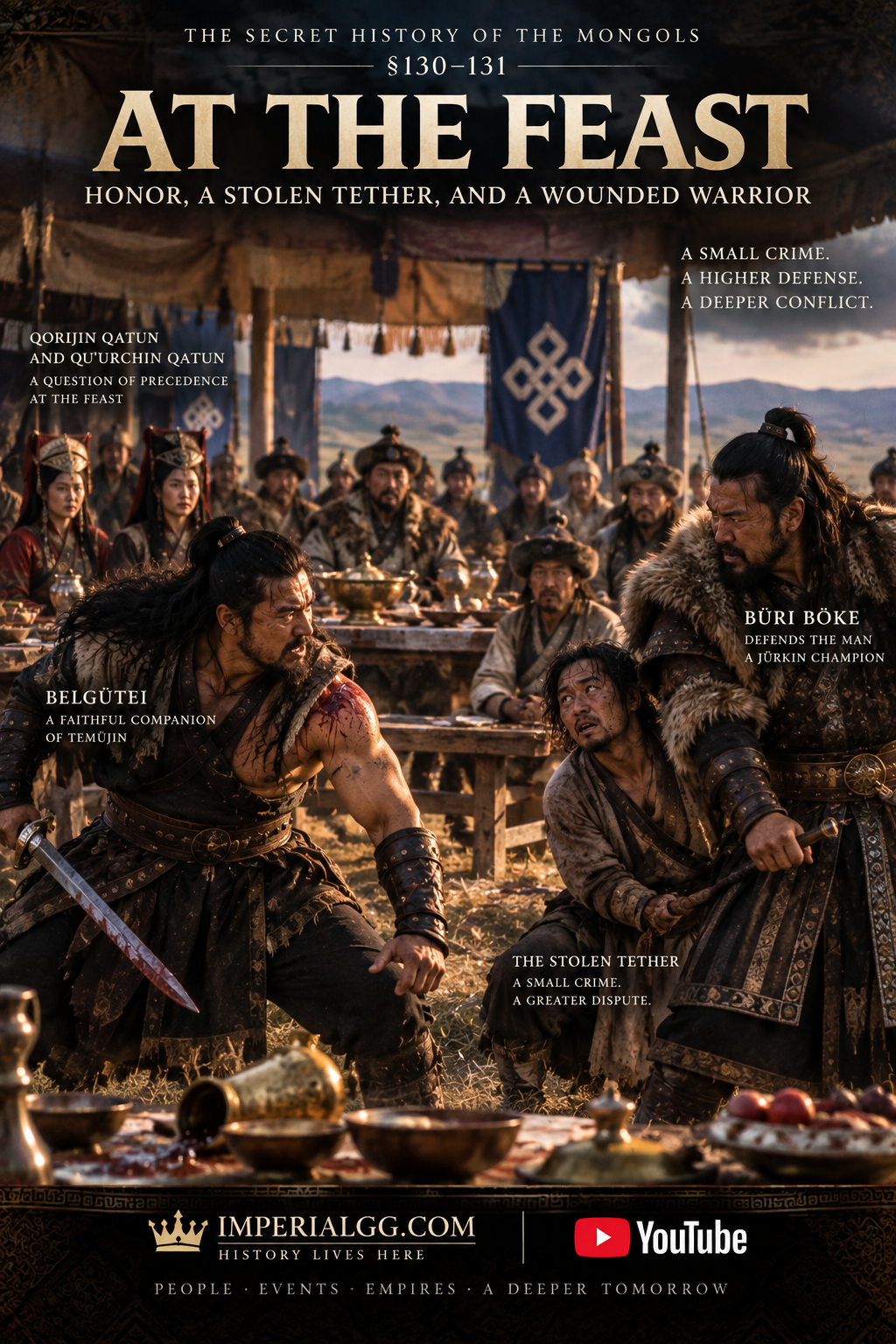
THE SECRET HISTORY OF THE MONGOLS §§132–135
By Altanbagana Baatar
DBA Candidate| Independent Historian
ImperialGG Historical Research Seriers
19 September 2026
AN OLD ENEMY, A NEW OPPORTUNITY
Temüjin, To’oril, and the Tatar Campaign
The episode recorded in §§132–135 of The Secret History of the Mongols occupies an important position in the development of Temüjin’s political career. It begins in the immediate aftermath of the confrontation with the Jürkin and ends with the incorporation of the young Šigi Qutuqu into Hö’elün’s household. Between these two points, however, the narrative records a significant military decision: Temüjin and To’oril Qan join forces against the Tatars at precisely the moment when a Jin military operation has driven Megüjin Se’ültü and other Tatar groups upstream along the Ulja River, together with their herds and provisions. The Secret History does not present Temüjin’s decision simply as participation in a campaign ordered by the Jin authorities. Rather, the initiative emerges from Temüjin’s own recognition that an external military movement had created an opportunity to confront an old enemy. His stated justification is historical and ancestral: the Tatars, he declares, had long been enemies of his people and had destroyed their ancestors and fathers.
This distinction is fundamental to understanding the episode. The Jin military operation created the immediate circumstances in which the Tatars became vulnerable. Temüjin and To’oril, however, determined to exploit that circumstance for their own purposes. The subsequent titles granted by the Jin commander belong to the aftermath of the campaign rather than to its original motivation. The episode therefore provides an early example of Temüjin responding to a rapidly changing political environment by identifying where the interests of different powers temporarily converged and turning that convergence into an opportunity for his own military and political objectives.
THE JÜRKIN CONFLICT AND THE ARRIVAL OF NEW NEWS
The episode opens while the dispute with the Jürkin is still being settled. After Belgütei had urged Temüjin not to allow his injury to destroy relations with their kinsmen, Temüjin nevertheless attacked the Jürkin. His forces defeated them and captured Qorijin-qatun and Qu’urchin-qatun. The women were subsequently returned when efforts were made to settle the dispute. It was during this exchange of envoys and negotiations for peace that Temüjin received information concerning the movements of the Tatars.
The timing is significant. The Secret History deliberately places the new information inside an already unsettled political environment. Temüjin had just demonstrated his willingness to use force against a neighboring Mongol group, yet the possibility of reconciliation remained open. At this moment the movement of an entirely different military force changed the strategic situation.
The Jin ruler had ordered Ongging Čingsang to mobilize troops against Megüjin Se’ültü and the Tatars after they had failed to reach an agreement with him. Ongging Čingsang was advancing upstream along the Ulja, driving Megüjin Se’ültü and the other Tatars before him with their livestock and provisions.
This detail deserves particular attention. The Tatars were not merely an army retreating from battle. They were moving with the material resources of their communities. Their herds and provisions accompanied them, while the Jin forces pushed them upstream. From Temüjin’s perspective, therefore, an enemy with whom his family and political community had a long history of conflict was being brought into a position where he could be attacked.
The Secret History immediately connects this information to Temüjin’s decision.
THE MEMORY OF AN ANCIENT ENEMY
Temüjin’s statement in §133 is the central piece of evidence for understanding his motive. After learning of the Tatars’ movement, he identifies them as enemies from the distant past and associates them with the destruction of his ancestors and fathers. He then concludes that there is now an opportunity to attack them jointly.
The order of events matters. The Tatars were already being driven by the Jin military forces. Temüjin did not initiate that movement. What he did was recognize its strategic significance and decide to act upon it.
This makes the episode different from a simple account of military service to Jin. The Secret History does not place a Jin command to Temüjin at the center of his decision. Instead, it places Temüjin’s own historical memory of conflict at the center of his explanation. The immediate military circumstance and the historical motive therefore come from two different directions: Jin pressure created the opening, while the inherited Mongol–Tatar conflict gave Temüjin a reason to use it.
The distinction is particularly important because the Tatars had already occupied a central place in the preceding generations of Mongol history as preserved in the Secret History. Their conflict with the Mongols was not presented as a new dispute arising in Temüjin’s lifetime.
AMBAGHAI KHAN AND THE UNFINISHED REVENGE
The most important earlier episode in this historical memory is the fate of Ambaghai Khan. The Secret History records that Ambaghai, who had assumed leadership of the Mongols after Khabul Khan, was captured by the Tatars while escorting his daughter. He was subsequently delivered to the Jin ruler and executed. Before his death, Ambaghai sent a message to Qutula and Qada’an instructing them to avenge him.
The subsequent narrative makes the connection between Ambaghai and the Tatar wars explicit. After Ambaghai’s death, Qutula was raised as qahan, and he went to war with Qada’an against the Tatars. The Secret History records thirteen battles against the Tatar leaders Kötön-baraqa and Jali-buqa but states that they failed to avenge Ambaghai.
Consequently, the Tatar conflict that Temüjin inherited was not simply a matter of personal hostility. It had already become part of a political memory extending across generations. Ambaghai’s capture and execution, Qutula’s succession, and the thirteen unsuccessful campaigns formed a continuous narrative of unfinished vengeance.
At the same time, historical precision requires that we distinguish between what the text states explicitly and what can reasonably be inferred from its wider structure. Temüjin does not name Ambaghai in §133. He speaks of the Tatars as those who had destroyed “our ancestors and fathers.” The identification of Ambaghai as an important referent within that inherited memory is therefore an interpretation based upon the preceding sections of the Secret History, not an explicit statement that Temüjin was specifically announcing “the revenge of Ambaghai.” The connection is nevertheless historically significant because the Secret History itself has already established Ambaghai’s death and the subsequent Tatar campaigns as part of the same inherited conflict.
YESÜGEI BA’ATUR AND THE TATAR CONFLICT
The memory of Yesügei Ba’atur adds another generation to this history. The Secret History records Yesügei’s encounter with the Tatar leaders Temüjin-üge and Qori Buqa and his capture of them. The circumstances of this encounter gave his son the name Temüjin. Later, after Yesügei had taken food with Tatars, he was poisoned and subsequently died.
Yesügei’s death therefore belongs to the same wider history of conflict with the Tatars, although it should not be represented as identical to Ambaghai’s fate. Ambaghai was captured and delivered to the Jin authorities; Yesügei was poisoned after an encounter with Tatars. The two episodes were different, but both became part of the historical inheritance surrounding Temüjin.
This distinction is important when interpreting the phrase “ancestors and fathers” in §133. The wording is collective rather than personal. Temüjin does not present the campaign merely as an act of private vengeance for one individual. He frames the Tatars as an inherited enemy whose conflict with the Mongols had extended across generations.
The political significance of the statement lies precisely in this collective memory. Temüjin was not merely reacting to an enemy army that happened to appear before him. He was placing the immediate military opportunity inside a much older history of conflict.
TEMÜJIN’S DECISION
Having learned that the Tatars were being driven upstream along the Ulja, Temüjin sent a messenger to To’oril Qan. He explained the movement of Megüjin Se’ültü and the other Tatars and proposed a joint attack. The appeal was framed through their shared historical memory of the Tatars and through the political relationship between Temüjin and To’oril. Temüjin addressed To’oril as “father,” while To’oril responded that his son was right and agreed to attack jointly. On the third day, To’oril assembled his forces and came in person.
The exchange reveals that the decision to attack was not imposed upon Temüjin by the Jin command. Temüjin identified the opportunity and sought the participation of To’oril.
This distinction also clarifies the character of Temüjin’s relationship with Jin at this point. The existence of a common enemy did not transform the Jin state into Temüjin’s political patron in any simple sense. Jin had its own reasons for acting against the Tatars. Temüjin had his own reasons for acting against them. The two interests happened to converge in the same military situation.
Such temporary convergence was politically useful precisely because it did not require the interests of the two sides to be identical.
THE JÜRKIN ARE INVITED
Temüjin and To’oril also sent word to the Jürkin, whose leaders included Sača Beki and Taichu, inviting them to participate in the campaign against the Tatars. The appeal is significant because it came immediately after the conflict between Temüjin and the Jürkin.
The Jürkin did not arrive promptly. Temüjin and To’oril waited six days, but eventually proceeded without them.
The episode illustrates the fluidity of political relationships on the steppe. A group could be a recent opponent in one political dispute and still be considered a potential participant in a larger military campaign. The Secret History does not explicitly explain Temüjin’s reasoning in inviting the Jürkin, so it would be inappropriate to assign a precise motive to him. The narrative nevertheless shows that the conflict with the Jürkin did not prevent him from attempting to mobilize them when a larger campaign against the Tatars presented itself.
The fact that the Jürkin failed to appear did not prevent Temüjin and To’oril from acting.
THE CAMPAIGN AGAINST MEGÜJIN SE’ÜLTÜ
Temüjin and To’oril advanced along the Ulja and joined the forces of Ongging Čingsang. Together they attacked the Tatars at Qusutu Šitü’en and Naratu Šitü’en on the Ulja. The campaign culminated in the defeat of the Tatar forces and the death of Megüjin Se’ültü.
The military episode should therefore be understood within the sequence established by the Secret History:
Jin military pressure drove the Tatars upstream; Temüjin learned of their movement; he interpreted them as an old enemy; he proposed a joint attack to To’oril; To’oril mobilized; and the two forces then joined Ongging Čingsang in attacking the Tatars.
The initiative and the circumstances should not be confused. The Jin military operation produced the immediate strategic opening, but Temüjin and To’oril independently chose to exploit it.
This is why the campaign can be understood neither simply as an autonomous war unrelated to Jin nor simply as a service performed on Jin’s behalf. It was a convergence of interests in which each side pursued its own objectives.
THE TITLES OF TEMÜJIN AND TO’ORIL
Only after the military success does the narrative turn to the titles granted by Ongging Čingsang.
Temüjin received the title ja’ut-quri, while To’oril received the title ong. The narrative subsequently explains the emergence of the name Ong Qan for To’oril.
These titles are historically important, but their position within the narrative must be kept clear. They appear after the decision to attack, after the joint mobilization, and after the defeat of Megüjin Se’ültü.
The titles therefore belong to the political consequences of the campaign rather than to the initial reason for entering it.
This distinction also prevents the episode from being reduced to a narrative in which Temüjin and To’oril fought simply to obtain recognition from Jin. The Secret History provides a different sequence. Temüjin already had a reason to fight the Tatars before any title was granted. To’oril accepted his proposal before any title was conferred. The military action preceded the Jin recognition.
The precise institutional meaning of the titles remains a separate historical question. Later scholarship has examined the relationship between ja’ut-quri and Jin terminology and cautioned against treating the title as a straightforward equivalent of a single Chinese office. Such questions are important for understanding Jin–Mongol relations, but they should not be confused with the immediate motivation for the campaign itself.
ŠIGI QUTUQU: THE HUMAN CONSEQUENCE OF THE CAMPAIGN
The campaign does not end with the death of Megüjin Se’ültü. Among the possessions taken from the Tatars, Temüjin’s forces encounter a young boy dressed in valuable clothing. The child is brought to Hö’elün, who takes him into her household. This child is Šigi Qutuqu, who later becomes an important figure in the Mongol imperial administration.
The Secret History thus transforms a military episode into a story of incorporation. The defeat of an external enemy produces not only booty and political recognition but also the absorption of a child into the household of Temüjin’s mother.
The later importance of Šigi Qutuqu makes this passage especially interesting. At the same time, the chronology of his childhood in the Secret History has been questioned by modern scholarship. Christopher P. Atwood has specifically noted the chronological problem created by the account of Šigi Qutuqu appearing as an orphaned infant in §§135 and 138 while subsequently occupying a major position in 1206. Atwood therefore treats the Secret History’s presentation of Šigi Qutuqu’s early life with caution.
For an academic treatment, the distinction is essential: the incorporation of Šigi Qutuqu is a fact of the narrative; the historical reliability of every chronological detail surrounding his childhood is a separate question.
CONCLUSION
Sections 132–135 present a military episode whose significance extends beyond the defeat of Megüjin Se’ültü. The immediate circumstance was created by Jin military action. Ongging Čingsang was already driving Megüjin Se’ültü and the Tatars upstream along the Ulja, and the Tatars were moving with their herds and provisions. Temüjin learned of this movement while the conflict with the Jürkin was still being settled. He recognized that an old enemy had suddenly become accessible and proposed to To’oril that they attack together.
His justification was not the promise of a Jin title. It was the history of conflict between the Tatars and his ancestors and fathers. That history reached back through the fate of Ambaghai Khan, whose capture and execution had produced an unfinished demand for vengeance and thirteen unsuccessful campaigns under Qutula and Qada’an. It also included the conflict surrounding Yesügei Ba’atur, whose encounter with the Tatars and subsequent poisoning formed part of Temüjin’s own inherited experience.
Accordingly, the campaign can be interpreted as an instance of strategic opportunism grounded in historical memory. The Jin state had created the immediate military circumstance, but Temüjin did not need Jin to tell him why the Tatars should be attacked. He already possessed a historical reason. What changed was the opportunity.
The subsequent Jin titles were consequences of the campaign. They did not create its original motive. The episode therefore reveals an important feature of Temüjin’s developing political practice: he could recognize when the movements of a larger power created an opening, mobilize his own relationships and military resources, and pursue an objective rooted in his own political memory. In §§132–135, the battlefield opportunity provided by the Jin offensive became, in Temüjin’s hands, an opportunity to confront an enemy whose conflict with his people extended across generations.
FOOTNOTES & PRIMARY SCHOLARLY SOURCES
- Igor de Rachewiltz, The Secret History of the Mongols: A Mongolian Epic Chronicle of the Thirteenth Century, §§132–135. De Rachewiltz’s edition is the principal scholarly English edition used here; the ANU describes it as a translation with extensive historical and philological commentary.
- The Secret History of the Mongols, §132: the Jürkin conflict, capture of Qorijin-qatun and Qu’urchin-qatun, subsequent negotiations, and news of the Jin operation against Megüjin Se’ültü.
- The Secret History of the Mongols, §133: Temüjin’s statement concerning the Tatars as an ancient enemy, his reference to ancestors and fathers, his proposal to To’oril, and To’oril’s mobilization.
- The Secret History of the Mongols, §§53, 57–58: Ambaghai’s capture and execution, his message to Qutula and Qada’an, Qutula’s accession, and the thirteen campaigns against the Tatars in an unsuccessful attempt to avenge Ambaghai.
- The Secret History of the Mongols, §§59–61: Yesügei Ba’atur’s encounters with Tatar leaders and his subsequent poisoning after an encounter involving Tatars.
- Francis Woodman Cleaves, The Secret History of the Mongols, §§132–135. Cleaves’ translation provides an important alternative rendering of the Middle Mongolian text and is particularly useful for comparison of the terminology surrounding the Tatar campaign.
- Urgunge Onon, The Secret History of the Mongols: The Life and Times of Chinggis Khan (Routledge, 2001), for comparative translation and historical presentation.
- Christopher P. Atwood, “The Date of the ‘Secret History of the Mongols’ Reconsidered,” especially the discussion of Šigi Qutuqu and the chronological difficulties surrounding §§135 and 138.
WHO INVENTED XANZI
ABSTRACT
The history of Chinese writing is conventionally presented as a continuous development from the inscriptions of the Shang dynasty to the standardized script of the Qin and Han periods and, ultimately, to modern Chinese characters. This developmental sequence is well established. Yet the broader history of writing in East and Inner Asia raises a more complicated question: to what extent should the history of the hanzi be understood within a wider Eurasian environment in which northern and Inner Asian peoples repeatedly created, adapted, and transformed logographic and phonetic writing systems?
This article does not claim that the Xiongnu or later Mongolic peoples can presently be demonstrated to have invented the earliest Chinese characters. Such a claim would exceed the surviving archaeological and palaeographic evidence. Instead, it proposes a broader historical hypothesis: the development of writing in eastern Eurasia cannot be adequately understood through a strictly Sino-centric model. The emergence of Khitan Large and Small Scripts, Tangut writing, and Jurchen writing demonstrates that peoples of the northern frontier repeatedly developed sophisticated writing systems adapted to their own languages and political institutions. These traditions existed within a complex network of interaction involving the Chinese, steppe, Manchurian, and Inner Asian worlds.
The Khitan monuments of Mongolia, including inscriptions preserved in present-day Khentii Province, are therefore important not because they constitute direct evidence for the invention of hanzi, but because they demonstrate the existence of a powerful indigenous tradition of script creation among the northern polities of Inner Asia. The article further examines the recurring political use of the name Xia, the relationship among Xianbei, Khitan, Tangut, and Jurchen political traditions, and the possibility that the history of East Asian writing should be reconsidered as a history of interaction rather than a single civilizational line.
Keywords: Hanzi, Xiongnu, Khitan, Tangut, Jurchen, Xianbei, Xia, Inner Eurasia, palaeography, Chinese writing, writing systems, Mongolian Plateau
INTRODUCTION: THE PROBLEM OF ORIGIN
Few writing systems have exerted an influence as extensive as the Chinese script. From the oracle-bone inscriptions of the late second millennium BCE to the standardized scripts of imperial China and the modern hanzi tradition, Chinese characters constitute one of the world’s longest continuously documented writing traditions.
Yet continuity should not automatically be confused with exclusivity.
The fact that the earliest securely decipherable corpus of Chinese writing appears in the Shang political sphere does not, by itself, answer the larger question of how writing developed across the societies surrounding the Central Plains. Nor does it establish that every intellectual, technological, and symbolic component of writing originated within a single ethnic or linguistic community.
This distinction is particularly important when examining the northern and northwestern frontiers of ancient China. The Mongolian Plateau, Manchuria, the Hexi Corridor, and the regions surrounding the Yellow River were not isolated cultural zones. They were interconnected through migration, warfare, trade, diplomacy, marriage alliances, technological transmission, and political competition.
Over the course of two millennia, peoples identified in historical sources as Xiongnu, Xianbei, Rouran, Khitan, Jurchen, Tangut, and Mongol established states across this enormous zone. Several of these polities developed or commissioned writing systems of their own.
The historical question therefore should not be reduced to:
“Who invented the Chinese characters?”
A more productive question is:
“How did the traditions of writing, political authority, linguistic representation, and symbolic inscription interact across the societies of East and Inner Asia?”
This formulation allows the evidence to be examined without imposing a modern ethnic category upon societies that existed thousands of years before the emergence of modern national identities.
THE SHANG INSCRIPTIONS AND THE EARLIEST HANZI
The earliest substantial corpus of Chinese writing is associated with the Shang dynasty, particularly with the oracle-bone inscriptions of the late Shang period. These inscriptions, found primarily at Anyang, record divination, royal activities, warfare, sacrifices, agriculture, weather, lineage, and other matters of political and religious importance. Their importance is enormous because they represent a mature writing system rather than a primitive collection of isolated signs. This observation creates an important chronological problem.
If the Shang inscriptions already display a highly developed writing system, the process by which the system emerged must have begun earlier. Archaeological discoveries from Neolithic and early Bronze Age sites across northern China have produced numerous symbols and graphic marks. Some resemble later Chinese characters, while others remain difficult to interpret. Their relationship to the mature Shang writing system remains one of the central problems of early Chinese palaeography.
The evidence therefore supports a developmental process rather than an instantaneous invention. But development does not necessarily imply that every stage occurred within precisely the same political or ethnic population. The Central Plains were situated within a much larger interaction zone.
WRITING, POWER, AND THE NORTHERN FRONTIER
Writing in ancient Eurasia was not merely a method of recording spoken language. It was also an instrument of political authority.
In early states, writing was closely associated with:
- royal legitimacy;
- ritual authority;
- divination;
- taxation;
- military administration;
- diplomatic communication;
- territorial claims;
- monumental commemoration.
This connection between writing and sovereignty becomes particularly visible among the states that arose north of the traditional Chinese heartland. The historical record shows repeated examples of northern powers adopting existing scripts while simultaneously creating new writing systems for their own languages. This phenomenon is especially significant in the cases of the Khitan, Tangut, and Jurchen.
THE KHITAN EXPERIMENT
The Khitan Liao dynasty (907–1125) represents one of the most important examples of independent script creation in medieval Inner Asia. The Khitans employed two principal writing systems conventionally known as the Khitan Large Script and Khitan Small Script.
The existence of two systems is itself significant. The Khitans did not simply abandon their linguistic identity in favor of the Chinese written language. Instead, they developed systems capable of representing their own political and linguistic world.
The Khitan Small Script is traditionally associated with Yelü Diela and the early tenth century, and historical accounts connect its creation with knowledge of the Uyghur script. This demonstrates an important principle in the history of writing:
script creation is often a process of adaptation rather than isolated invention.
A writing system can incorporate elements from several traditions while becoming an independent system once adapted to another language and political environment. The Khitan scripts therefore provide an important historical precedent for understanding writing as a technology that moved across cultural boundaries.
THE KHITAN INSCRIPTIONS OF MONGOLIA
Khitan monumental inscriptions preserved in Mongolia are especially valuable for reconstructing this history. The inscriptions found in present-day Khentii and other parts of Mongolia belong to a political world in which the Mongolian Plateau was not peripheral to civilization but one of the principal centers of imperial power in Inner Asia. The monuments are more than archaeological curiosities.
They demonstrate that political elites operating from the Mongolian Plateau possessed:
- a developed literary culture;
- monumental inscriptional practices;
- specialized writing systems;
- institutions capable of producing and preserving written texts;
- a political ideology expressed through writing.
This evidence does not prove that the Khitans invented the Shang characters. It does, however, undermine a simplistic assumption that sophisticated writing belonged exclusively to the Central Plains. The Khitan evidence demonstrates that script creation was repeatedly undertaken by northern imperial societies.
FROM KHITAN TO JURCHEN
The Jurchen case is even more revealing. During the Jin dynasty (1115–1234), the Jurchens developed their own writing system. The creation of Jurchen writing occurred within a multilingual political environment in which Chinese and Khitan traditions were already established. Historical sources describe the development of Jurchen writing in relation to existing scripts. This provides a remarkable example of cultural transmission.
The process was not simply:
Chinese writing → non-Chinese population
but rather:
Chinese + Khitan + indigenous linguistic requirements → new Jurchen writing tradition.
This distinction matters.
Writing systems should not be treated as fixed possessions belonging permanently to one ethnicity. They function historically as technologies that can be borrowed, transformed, standardized, and reinvented. The Jurchen experience therefore belongs to the same broader history as the Khitan and Tangut experiments.
TANGUT AND THE WESTERN XIA
The Tangut state, conventionally known as Western Xia (Xi Xia), provides another extraordinary example. The Tangut script was created in the eleventh century for the Tangut language and was deliberately designed as an elaborate graphic system. Its characters frequently resemble Chinese characters visually, yet the system was not simply Chinese writing. This distinction is crucial.
Visual resemblance does not establish identical linguistic structure. The Tangut script demonstrates that a society could take the visual and structural principles of a prestigious logographic writing tradition and transform them into an independent script serving another language and state. The existence of Tangut writing therefore strengthens the argument that the northern and northwestern political worlds of East Asia possessed their own traditions of script engineering.
THE RECURRING NAME “XIA”
The political history of the name Xia deserves separate attention. The term Xia is traditionally associated with the earliest dynastic tradition of China. Later political entities also employed the name, including Western Xia. The recurrence of dynastic names across different historical periods is not sufficient evidence of direct ethnic continuity. Nevertheless, it is historically meaningful because political communities frequently legitimized themselves by associating their regimes with earlier traditions.
The question becomes particularly interesting when examining the political traditions of the Xianbei and Khitan worlds. The Tuoba Northern Wei state, for example, was founded by a Xianbei ruling house and participated in the political culture of northern China. Later northern regimes repeatedly appropriated or reinterpreted older dynastic terminology.
The recurrence of Xia should therefore be investigated as a phenomenon of political memory and legitimacy, rather than treated automatically as proof that every polity using the name belonged to the same ethnic population. This distinction makes the argument stronger, not weaker.
XIANBEI, KHITAN, AND THE QUESTION OF CONTINUITY
The relationship between the Xianbei, Khitan, and other peoples of the northern frontier remains one of the most complicated problems in Inner Asian history. Historical sources preserve genealogical traditions, political affiliations, tribal names, and ethnonyms, but these categories do not necessarily correspond to modern concepts of ethnicity.
The Khitan world incorporated numerous groups, and the relationship between Khitans and the Kumo Xi was complex and changed over time. Similarly, later Jurchen and Mongol political structures incorporated populations with diverse linguistic and genealogical backgrounds.
Consequently, a direct equation such as:
Xiongnu = Xianbei = Khitan = Tangut = Jurchen = Mongol
cannot be established simply through the recurrence of political institutions or writing systems. Yet rejecting simplistic ethnic equations does not require rejecting historical continuity altogether.
Continuity may operate through:
- population movement;
- political institutions;
- elite traditions;
- marriage networks;
- military organization;
- religious practices;
- technological transmission;
- geographic continuity;
- political memory.
The history of Inner Eurasia is therefore better understood as a history of successive political formations interacting within a persistent geographic system.
THE XIONGNU QUESTION
The Xiongnu occupy a particularly important position in this discussion. The Xiongnu Empire, established in the late third century BCE, was the first large-scale steppe empire known from extensive written sources north of the Han state. Its political structure encompassed populations of diverse origins.
The Xiongnu controlled a vast territory extending across the Mongolian Plateau and surrounding regions. Their political institutions influenced subsequent steppe empires, although the exact mechanisms of institutional continuity remain debated. The major problem is documentary. Unlike the Shang, the Xiongnu have not left a securely identified indigenous corpus of monumental writing comparable to the oracle bones.
This absence is important. It means that the statement “the Xiongnu invented hanzi” cannot currently be demonstrated archaeologically.
However, the absence of a surviving Xiongnu writing corpus should not automatically be interpreted as proof that the Xiongnu lacked literacy or graphic traditions. Steppe societies could rely upon oral transmission, diplomatic documents written in other scripts, seals, symbols, administrative specialists, and neighboring writing systems. The archaeological record is therefore incomplete.
THE SEAL, THE MARK, AND THE STATE
One of the most promising directions for future research concerns the relationship between seals, marks, symbols, and writing.
Across ancient Eurasia, seals served multiple purposes:
- authentication;
- ownership;
- administrative control;
- political authority;
- ritual identity;
- elite status.
The Chinese tradition of seals eventually became deeply integrated with written characters. The broader Eurasian evidence, however, demonstrates that sealing practices are much older and geographically wider than the Chinese literary tradition alone. Mesopotamian cylinder seals, Indus seals, and other ancient sealing traditions demonstrate the antiquity of graphic communication associated with authority. But similarity should not automatically be transformed into genealogical descent.
The existence of ancient seals in Mesopotamia or the Indus Valley does not prove that Shang writing was imported from those regions. What it does demonstrate is something more general:
writing and political authority emerged repeatedly within societies where symbols, seals, ritual, and administration were already deeply interconnected.
This broader comparative framework is essential for understanding the origins of writing.
“HEAVENLY WRITING” AND SACRED AUTHORITY
In many early civilizations, writing possessed a sacred dimension. In the Shang world, writing was closely connected with divination and communication with ancestral powers. The oracle-bone inscriptions were not simply administrative documents. They formed part of a ritual system through which the Shang king sought knowledge concerning warfare, agriculture, weather, sacrifice, childbirth, illness, and other matters.
This provides an important conceptual bridge to later Inner Asian political traditions. Across the steppe, sovereignty was frequently legitimized through relations among heaven, ruler, ancestors, and cosmic order.
The Mongol concept of Tengri is a particularly famous later expression of this political-religious relationship. It would be historically irresponsible to claim that Shang divination and later Tengri traditions are identical. They are not. Yet comparative study of sacred authority + kingship + inscription + legitimacy may reveal structural similarities that deserve deeper investigation.
FROM DIVINATION TO ADMINISTRATION
The development of Chinese writing also illustrates a transition from sacred inscription to increasingly diverse administrative uses.
Over time, written characters became essential for:
- law;
- taxation;
- military administration;
- historical recording;
- literature;
- diplomacy;
- education.
The Qin and Han periods were particularly important in standardizing and expanding written administration. This process created what might be called a state-writing complex. The same phenomenon later appeared among the Khitan, Tangut, Jurchen, and Mongols.
The political lesson is significant:
states create writing systems not merely because they need language to be recorded, but because writing becomes an instrument through which sovereignty itself is organized.
THE GREAT INNER EURASIAN WRITING NETWORK
By the medieval period, Inner Eurasia contained a remarkable network of writing traditions.
Among them were:
- Chinese script;
- Old Turkic runiform writing;
- Sogdian and related Iranian scripts;
- Uyghur script;
- Khitan Large Script;
- Khitan Small Script;
- Tangut script;
- Jurchen script;
- later Mongolian script.
These systems were not isolated. Merchants, monks, diplomats, soldiers, scribes, translators, and imperial administrators moved between political worlds. The creation of a new writing system frequently involved adaptation from an existing one. This suggests that the history of writing in Eurasia should be modeled not as a tree with a single root, but as a network of transmission, adaptation, and innovation.
WHAT THE KHITAN EVIDENCE REALLY PROVES
The Khitan inscriptions are therefore important for a reason somewhat different from the strongest version of the proposed thesis. They do not prove that the Khitans invented hanzi.
They demonstrate something historically profound nonetheless:
A major imperial society of the Mongolian Plateau independently developed sophisticated systems of written representation adapted to its own political and linguistic requirements.
The same observation applies to Tangut and Jurchen. Once these examples are placed together, the conventional image of a single writing civilization radiating outward from China becomes inadequate.
A more accurate model is interactive:
Central Plains ↔ Mongolian Plateau ↔ Manchuria ↔ Hexi Corridor ↔ Central Asia
Within this system, writing technologies crossed political boundaries repeatedly.
A REVISED HYPOTHESIS
The strongest version of the Inner Eurasian hypothesis should therefore not claim that the Xiongnu invented the Chinese characters without direct evidence.
Instead, it should propose three propositions.
FIRST
The origins of East Asian writing must be investigated within the wider archaeological environment of northern China, Mongolia, Manchuria, and Inner Eurasia rather than through the history of the Central Plains alone.
SECOND
The later emergence of Khitan, Tangut, and Jurchen writing demonstrates that northern and Inner Asian political societies possessed sophisticated traditions of script creation and adaptation.
THIRD
The possibility of cultural, technological, and demographic interaction between northern populations and early Chinese states deserves much greater investigation than a simplistic division between “Chinese civilization” and “barbarian peoples” permits.
These propositions are historically defensible and open the door to a much more ambitious research program.
THE CENTRAL QUESTION
The central question, therefore, is not whether modern Mongolians can retrospectively be declared the inventors of Chinese writing.
The more important question is:
How much of the history of writing in East Asia has been obscured by treating political and ethnic categories of later periods as if they were fixed and homogeneous in antiquity?
The Shang state existed within a world of interaction. The Xiongnu emerged within a world of interaction. The Xianbei, Khitan, Tangut, Jurchen, and Mongols likewise emerged within interconnected political landscapes. Their histories cannot be reduced to a simple opposition between “Chinese” and “non-Chinese.”
CONCLUSION: FROM OWNERSHIP TO CIVILIZATIONAL INTERACTION
The history of hanzi remains one of the world’s great questions concerning the origins of writing. The available evidence does not currently justify the conclusion that the Xiongnu or their Mongolic descendants invented the Shang writing system. Nor does the existence of Khitan, Tangut, or Jurchen writing establish a direct genealogical descent from the earliest Chinese characters.
But these qualifications do not diminish the significance of the northern evidence. On the contrary, they point toward a more sophisticated historical model. The Mongolian Plateau and its surrounding regions repeatedly produced powerful states whose rulers recognized the political importance of writing and commissioned sophisticated scripts for their own languages and institutions.
The Khitan scripts are perhaps the clearest medieval demonstration of this phenomenon. Tangut and Jurchen writing reinforce it. The historical record therefore supports a fundamental revision in perspective:
The history of writing in East Asia was not the history of one people possessing writing while others merely borrowed it. It was the history of interconnected political societies continuously adapting, transforming, and reinventing technologies of written communication.
The Khitan inscriptions of Mongolia should consequently be read not merely as relics of a vanished empire but as evidence for a much larger intellectual history of Inner Eurasia.
The ultimate question is not simply:
Who owns the origin of the Hanzi?
It is:
What network of peoples, states, languages, and sacred-political traditions made the emergence and transformation of writing possible across East Asia?
That question remains open.
And it may ultimately prove more important than the search for a single inventor.
Before Yellowstone: Mongolia Protected Bogd Khan Mountain Centuries Earlier
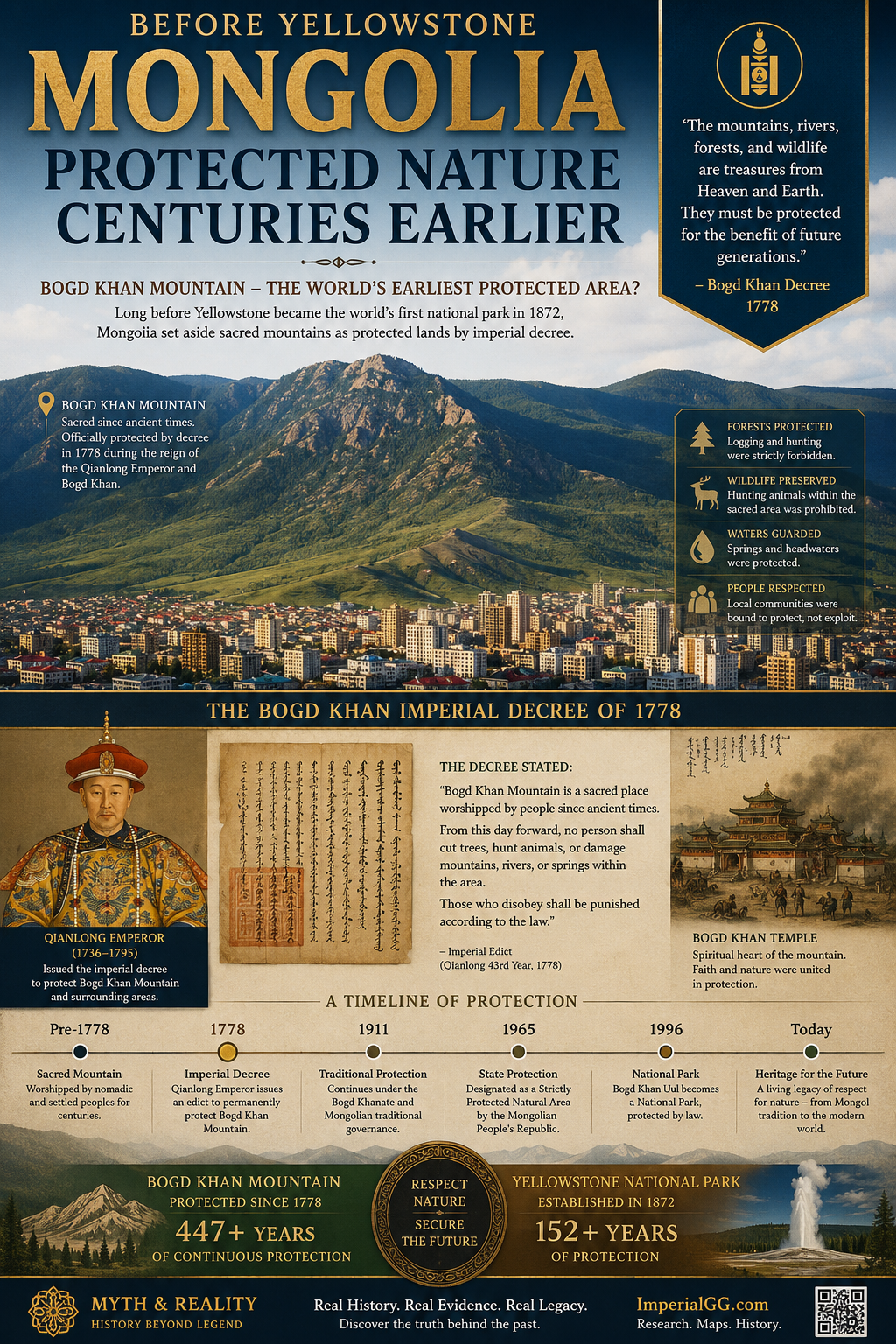
Before Yellowstone: Mongolia Protected Bogd Khan Mountain Centuries Earlier
One of the World’s Oldest Protected Landscapes
When the history of protected nature is discussed, one name usually dominates the story: Yellowstone.
Established in the United States in 1872, Yellowstone is widely recognized as the world’s first modern national park. Yet nearly a century before Yellowstone was created, a sacred mountain overlooking what is now Ulaanbaatar had already received formal protection.
That mountain was Bogd Khan Uul.
In 1778, Bogd Khan Mountain was officially sanctified and placed under protection. Its protected history, however, reaches even further into the past. The mountain had long been regarded as sacred, and traditions restricting hunting and the exploitation of its natural resources existed centuries before its formal eighteenth-century protection. UNESCO today describes Bogd Khan Uul as Mongolia’s first official protected area and one of the oldest protected areas in the world.
This history reveals something larger than the question of which country created the “first national park.”
It reveals an ancient Mongolian understanding of the relationship between human society, political authority, sacred geography, and the natural world.
A Sacred Mountain Before the Modern Environmental Movement
For the peoples of the Mongolian steppe, mountains were never merely geographical formations.
Certain mountains occupied a sacred position within the spiritual landscape. They were associated with ancestral memory, political legitimacy, the Eternal Heaven, local spirits, waters, forests, and the continuity of the community itself.
Protection of such places therefore did not arise from the modern concept of environmental conservation alone.
It emerged from a worldview in which nature possessed meaning beyond economic exploitation.
Bogd Khan Mountain became one of the clearest surviving examples of this tradition.
Historical accounts place traditions of protection considerably earlier than 1778, although the precise legal character of these early protections requires careful distinction from modern conservation law. What can be stated with greater certainty is that the mountain had acquired sacred and protected status long before the emergence of the modern national-park movement.
1778: Formal Protection
The year 1778 marks the crucial institutional turning point.
According to UNESCO, Bogd Khan Uul was officially sanctified and taken under protection that year through an initiative associated with Mongolian authorities in Khüree. This transformed an older sacred landscape into a formally recognized protected territory.
This occurred 94 years before Yellowstone National Park was established in 1872.
The comparison is historically fascinating, but an important distinction must be maintained.
Bogd Khan Uul in 1778 was not a “national park” in precisely the modern legal sense developed during the nineteenth and twentieth centuries. Its protection emerged from a different political, cultural, and spiritual tradition.
Yet this difference does not diminish its historical importance.
It makes the story more significant.
Long before the modern international conservation movement, Mongolian society had already developed mechanisms through which landscapes could be declared sacred, protected from unrestricted exploitation, and preserved across generations.
Protection as a Mongolian Historical Tradition
The history of Bogd Khan Uul challenges a common assumption that formal environmental protection is an exclusively modern idea.
Across Mongolia, sacred mountains and waters formed part of a much older cultural geography.
Mountains were worshipped.
Forests could be protected.
Hunting could be restricted.
Water sources carried sacred significance.
Communities inherited obligations toward particular landscapes.
These traditions were not identical to modern environmental law, but they performed an important conservation function.
The principle behind them was profound:
Human beings did not possess an unlimited right to exploit every part of the natural world.
Some landscapes belonged to a larger moral and spiritual order.
This idea survived through centuries of political transformation.
Bogd Khan Uul and Yellowstone
The comparison between Bogd Khan Uul and Yellowstone should therefore be made carefully.
Yellowstone occupies an extraordinary place in global conservation history because its establishment in 1872 helped define the modern legal institution known as the national park.
Bogd Khan Uul represents something different—and considerably older.
It represents a long tradition of sacred landscape protection that eventually received formal political recognition in 1778.
The two histories should not be forced into exactly the same institutional category.
Instead, they reveal two different paths toward the protection of nature.
One emerged from the modern nation-state and the nineteenth-century conservation movement.
The other grew from centuries of Mongolian sacred geography, customary restrictions, political authority, and reverence for the natural world.
In chronological terms, Bogd Khan Uul’s formal protection predates Yellowstone by nearly a century. Its broader tradition of sacred protection may be older still.
A Living Heritage
Bogd Khan Uul is not merely a monument to the past.
The mountain remains one of Mongolia’s most important protected landscapes, standing immediately south of Ulaanbaatar. UNESCO recognizes Bogd Khan Uul within its Man and the Biosphere Programme, emphasizing both its ecological importance and its exceptional historical relationship with human communities.
Its survival beside a rapidly expanding modern capital gives the story renewed significance.
For centuries, generations looked toward this mountain and understood that some places should remain beyond unrestricted human exploitation.
Today, as societies around the world confront environmental degradation, deforestation, biodiversity loss, and the pressures of urban expansion, the history of Bogd Khan Uul carries a message that is remarkably contemporary.
The protection of nature is not a new idea.
And its history does not belong to only one civilization.
Before Yellowstone, There Was Bogd Khan Uul
The familiar history of global conservation usually begins in the nineteenth century.
The history of Mongolia asks us to look further back.
Before Yellowstone became a national park in 1872, Bogd Khan Mountain had already been formally protected for nearly a century.
Before the modern language of conservation existed, Mongolian traditions had already recognized that mountains, forests, waters, and wildlife could possess a value greater than immediate human use.
Bogd Khan Uul therefore deserves recognition not merely as a beautiful mountain beside Ulaanbaatar.
It belongs to the deeper global history of humanity’s attempt to protect the natural world.
1778 — Bogd Khan Uul formally protected.
1872 — Yellowstone National Park established.
Two different historical traditions.
One universal idea:
Some places must be preserved for generations yet to come.
MYTH & REALITY — History Beyond Legend
Rediscovering the histories the world too often overlooks.
ImperialGG.com — Research. Maps. History.
Chi You, the Yellow Emperor, and the Earliest Frontier
For centuries, the conflict between Chi You and the Yellow Emperor has been remembered as one of the foundational legends of ancient China. According to traditional accounts, the Yellow Emperor emerged victorious and became a symbolic ancestor of Chinese civilization, while Chi You was portrayed as his powerful rival. The story is often presented as a simple struggle between order and chaos, civilization and barbarism. Yet the historical meaning of this legend may be far more complex.
Ancient myths frequently preserve distant memories of real social and political processes. Although Chi You cannot be identified with certainty as a historical individual, many scholars have suggested that the legend reflects an era when different cultural worlds competed for influence across the northern regions of East Asia. The Yellow River basin was gradually becoming the center of settled agricultural societies, while surrounding regions were inhabited by diverse tribal communities whose economies, lifestyles, and political structures differed significantly from those of the emerging agrarian states.
Viewed in this broader context, the struggle between Chi You and the Yellow Emperor may represent more than a single legendary battle. It can be understood as an early memory of a frontier that would shape East Asian history for millennia. Long before the rise of the Xiongnu, Turks, Khitans, Jurchens, and Mongols, interactions between sedentary and mobile societies were already influencing the development of the region. Trade, migration, warfare, alliance-building, and cultural exchange occurred across this frontier, creating a dynamic relationship rather than a simple division between opposing worlds.
Modern popular narratives often reduce the legend to a victory of civilization over outsiders. The historical reality is likely more nuanced. The societies beyond the agricultural heartland were not merely passive adversaries but active participants in the formation of East Asian history. Technologies, military traditions, cultural practices, and political ideas moved in multiple directions across the frontier. The development of early states cannot be understood without considering these interactions.
Whether Chi You and the Yellow Emperor were historical figures or symbolic representations, their story offers a glimpse into one of the oldest recurring themes in Eurasian history: the relationship between settled civilizations and the peoples of the frontier. Rather than marking the beginning of a single nation, the legend may preserve the memory of a long and complex encounter between different ways of life—an encounter whose echoes continued to shape the history of Eurasia for thousands of years.
Sources and Further Reading
- Shiji (Records of the Grand Historian), Sima Qian
- Classic of Mountains and Seas (Shan Hai Jing)
- Mark Edward Lewis, The Construction of Space in Early China
- Nicola Di Cosmo, Ancient China and Its Enemies: The Rise of Nomadic Power in East Asian History
- Yuri Pines, The Everlasting Empire: The Political Culture of Ancient China
Did Scientists Once Search for the Origins of Humanity in Mongolia?
Today, Mongolia is widely recognized as one of the world’s most important regions for dinosaur discoveries. However, few people realize that some of the most famous scientific expeditions to Mongolia were originally searching for something entirely different: the origins of humanity itself.
In the early twentieth century, a number of Western scholars believed that Central Asia might have been the birthplace of humankind. At the time, the fossil evidence available to science was still limited, and several researchers considered the vast landscapes of Mongolia and Inner Asia potential locations for discovering humanity’s earliest ancestors.
Between 1922 and 1930, the Central Asiatic Expeditions led by American explorer and scientist Roy Chapman Andrews traveled across the Gobi Desert in search of evidence that could help answer one of science’s greatest questions: Where did humans originate?
The results were unexpected.
Despite extensive exploration, the expeditions failed to uncover the ancient human ancestors they had hoped to find. Instead, they made discoveries that transformed paleontology. In the Flaming Cliffs of Mongolia’s Gobi Desert, the team uncovered remarkably preserved dinosaur fossils and the first scientifically documented dinosaur eggs ever discovered. These finds established Mongolia as one of the most important paleontological regions on Earth.
Myth
Scientists came to Mongolia and discovered evidence proving that humanity originated there.
Reality
Scientists did come to Mongolia partly to investigate theories that Central Asia may have been an early center of human origins. However, they did not find evidence supporting that hypothesis. Their greatest discoveries were dinosaur fossils, dinosaur eggs, and prehistoric animal remains, not the ancestors of modern humans.
As new discoveries emerged throughout the twentieth century, particularly from Africa, scientific consensus shifted toward the view that modern humans originated in Africa. Nevertheless, the Central Asiatic Expeditions remain a fascinating chapter in scientific history, reminding us that Mongolia once stood at the center of one of the world’s greatest searches for humanity’s beginnings.
Sources
- Roy Chapman Andrews, The New Conquest of Central Asia (1932)
- American Museum of Natural History Archives
- David J. Meltzer, The Great Paleolithic War
- Ian Tattersall, Masters of the Planet

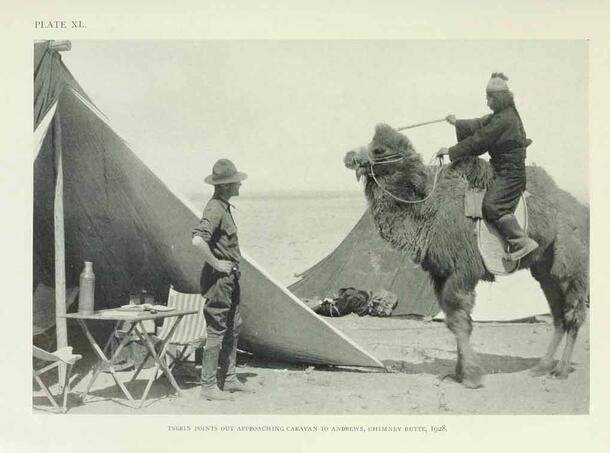

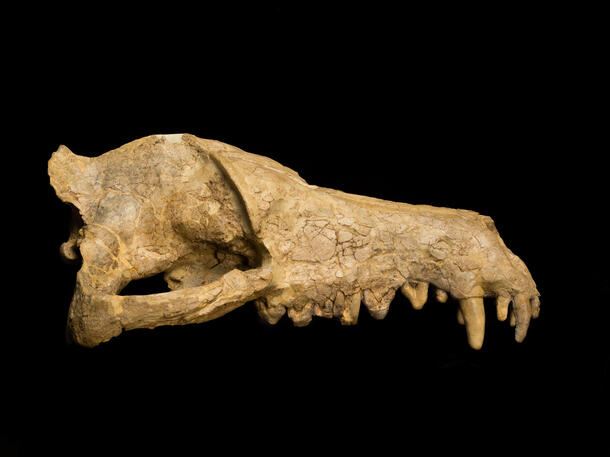
Did Mongolia Defeat China in the Battle of the Five Routes?
The Battle of the Five Routes (1913) remains one of the least known conflicts of modern Mongolian history. Following Mongolia’s declaration of independence in 1911, the Bogd Khanate sought not only to secure Outer Mongolia but also to support the aspirations of many Mongol banners and princes in Inner Mongolia who wished to unite with the newly independent Mongolian state. This led to a military campaign commonly known as the Battle of the Five Routes.
The popular narrative often presents the conflict in simple terms: Mongolia defeated China. The historical record, however, reveals a more complex reality.
In early 1913, Mongolian forces advanced into Inner Mongolia along several directions. Despite being significantly outnumbered, Mongolian commanders such as Manlaibaatar Damdinsüren achieved a series of battlefield successes. Mongolian forces captured territory, defeated multiple Chinese detachments, and gained the support of numerous Mongol banners across Inner Mongolia. By late 1913, large areas of western Inner Mongolia were under Mongolian influence or control.
From a tactical and operational perspective, many of the campaign’s major engagements favored the Mongolian side. Chinese forces frequently failed to achieve their objectives, and Mongolian troops demonstrated remarkable mobility and effectiveness despite limited resources.
However, military success did not translate into a lasting political outcome. Mongolia faced severe shortages of weapons, ammunition, and supplies. More importantly, the Russian Empire opposed a full-scale annexation of Inner Mongolia and pressured the Bogd Khanate to halt its advance. As Chinese forces regrouped and international diplomacy intensified, Mongolian troops gradually withdrew from Inner Mongolia. The process ultimately culminated in the Kyakhta Treaty of 1915, which recognized Mongolian autonomy but left Inner Mongolia under Chinese administration.
Myth
Mongolia completely defeated China and successfully united Inner Mongolia with the Bogd Khanate.
Reality
The military record tells a different story.
During the campaign, Mongolian and Inner Mongolian forces numbered roughly 10,000 men, while Chinese forces deployed in the theater reached approximately 70,000 troops supported by artillery and machine guns.
Despite this disparity in manpower and firepower, Mongolian forces won a series of engagements across Inner Mongolia. Chinese casualties significantly exceeded Mongolian losses in several documented battles, and Mongolian troops captured weapons, ammunition, artillery pieces, and prisoners.
The campaign demonstrated that the Bogd Khanate’s army could successfully challenge a numerically superior opponent on the battlefield.
However, military victory did not translate into political success. Russian diplomatic pressure, logistical limitations, and international negotiations prevented the permanent incorporation of Inner Mongolia into Mongolia.
The result was therefore not a military defeat, but a political compromise imposed by the geopolitical realities of the era.
The Five Routes Campaign remains one of the clearest examples in modern Mongolian history of a distinction between battlefield success and diplomatic outcome.
Mongolian forces won numerous battles and achieved significant military successes during the campaign. However, the broader political objective—the permanent incorporation of Inner Mongolia into the Bogd Khanate—was not achieved. Military victories were ultimately constrained by logistics, international diplomacy, and the geopolitical interests of the Russian Empire.
The Battle of the Five Routes therefore stands as a historical example of a campaign in which battlefield success and political success were not the same thing. Mongolia won many engagements, but the final settlement was determined as much by diplomacy and great-power politics as by events on the battlefield.
Sources
- Battle of the Five Routes overview and campaign summary.
- Discussion of the campaign’s objectives and outcome.
10,000 vs 70,000
Captured artillery, machine guns and ammunition
Multiple Mongolian victories
Political objective not achieved
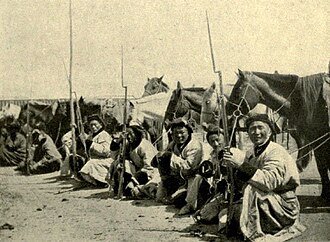
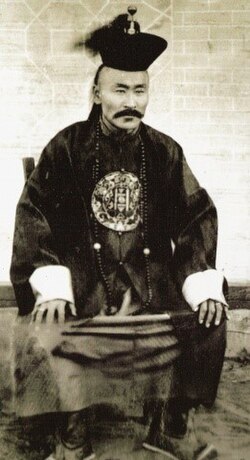
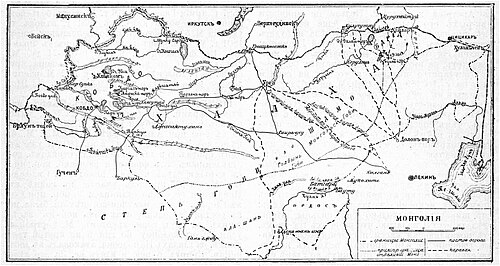
Did Qin Shi Huang Really Burn Books and Execute Scholars?
One of the most famous and controversial episodes in Chinese history is the event traditionally known as “Burning the Books and Burying the Scholars” (Fenshu Kengru, 焚书坑儒), associated with the reign of Qin Shi Huang, the founder of China’s first unified empire.
The Historical Record
The primary source for this event is Records of the Grand Historian, written by the historian Sima Qian approximately a century after Qin Shi Huang’s death.
According to Sima Qian, in 213 BCE the emperor’s chancellor, Li Si, proposed suppressing books that promoted alternative political philosophies, particularly those associated with the Confucian tradition. Historical records state that many privately held texts concerning history, philosophy, and rival schools of thought were confiscated and destroyed. Works related to practical subjects such as agriculture, medicine, and divination were reportedly exempt.
The following year, in 212 BCE, several hundred individuals accused of spreading dissenting ideas or misleading the emperor were allegedly executed. Traditional accounts describe approximately 460 scholars being buried alive, although the exact circumstances remain disputed.
What Do Modern Historians Think?
Most modern historians agree that:
- A state-sponsored destruction of certain books likely occurred.
- Intellectual and political repression under the Qin government was real.
- Some individuals were executed for ideological or political reasons.
However, many scholars question the traditional narrative in its entirety.
Several issues remain debated:
- The main account was written during the Han dynasty, which had political reasons to portray the Qin regime negatively.
- The victims may not have been exclusively Confucian scholars; some sources suggest they included court magicians, alchemists, fortune-tellers, and individuals accused of deceiving the emperor.
- The famous image of “460 Confucian scholars buried alive” may be a later simplification or exaggeration.
Historical Significance
Whether every detail of the traditional story is accurate or not, the episode became a powerful symbol of authoritarian control over knowledge and intellectual life.
Qin Shi Huang is therefore remembered in two contrasting ways:
- As the ruler who unified China, standardized weights, measures, currency, and writing.
- As a ruler associated with censorship, ideological repression, and the suppression of dissenting thought.
Conclusion
The claim that Qin Shi Huang ordered the destruction of books has strong support in the historical sources. The claim that hundreds of scholars were executed is also rooted in ancient records, though the exact number, identity of the victims, and method of execution remain subjects of scholarly debate.
In short, book burning is widely accepted as historical fact, while the traditional story of hundreds of Confucian scholars being buried alive is generally regarded as a more complex and less certain event than later generations often portrayed it.
The Ten Betrayals
Why Genghis Khan Executed the Men Who Captured His Greatest Rival
Among the many betrayals recorded in Eurasian history, few are as dramatic as the downfall of Jamukha, the sworn brother and greatest rival of Temüjin, the future Genghis Khan.
Unlike many defeated rulers, Jamukha was not captured by his enemies on the battlefield. Instead, he was betrayed by the very men who had sworn loyalty to him.
Brothers Turned Rivals
As young men, Temüjin and Jamukha formed an anda relationship—a sacred oath of brotherhood that carried deep significance in the culture of the Mongolian steppe.
For a time, the two men shared friendship, ambitions, and mutual respect. Yet as both sought leadership over the steppe tribes, their paths diverged.
Temüjin promoted loyalty based on merit and personal allegiance, while Jamukha defended the traditional aristocratic order. Their rivalry gradually developed into a struggle for supremacy across Mongolia.
By the beginning of the thirteenth century, Temüjin’s power was steadily growing, while Jamukha’s coalition was beginning to collapse.
The Final Betrayal
After years of warfare and political defeats, many of Jamukha’s supporters abandoned him. In 1205, several of his own followers seized him and delivered him to Temüjin.
The men expected to be rewarded.
From their perspective, they had removed Temüjin’s last great rival and proven their loyalty to the rising conqueror.
Instead, they received an unexpected response.
Genghis Khan’s Judgment
According to the Secret History of the Mongols, Temüjin condemned the men who had betrayed their master.
Although Jamukha had been his enemy for years, Temüjin reportedly viewed the betrayal itself as dishonorable.
The reasoning was simple:
A man who betrays his own lord cannot be trusted to remain loyal to another.
Rather than rewarding the captors, Temüjin ordered their execution.
The decision reflected one of the fundamental principles of steppe politics: loyalty was valued above convenience, and betrayal was regarded as a dangerous character flaw regardless of who benefited from it.
The Fate of Jamukha
After being brought before Temüjin, Jamukha reportedly requested a noble death without the shedding of blood, a privilege traditionally associated with aristocratic status among the steppe elite.
The exact details of his death remain debated by historians, but most sources agree that Temüjin granted his former blood brother an honorable end.
Thus, the long rivalry that had shaped the destiny of the Mongolian steppe came to a close.
Myth & Reality
Popular retellings often portray Jamukha’s defeat as simply the result of military failure.
The historical sources suggest a more complex story.
Jamukha’s final downfall came not from an enemy army, but from the collapse of loyalty within his own ranks. The men who delivered him hoped to secure favor and advancement. Instead, their actions became one of the most famous examples in steppe history of a ruler punishing betrayal—even when that betrayal worked in his favor.
More than eight centuries later, the episode remains a powerful reminder that in the political culture of the medieval steppe, loyalty was often considered more valuable than victory itself.
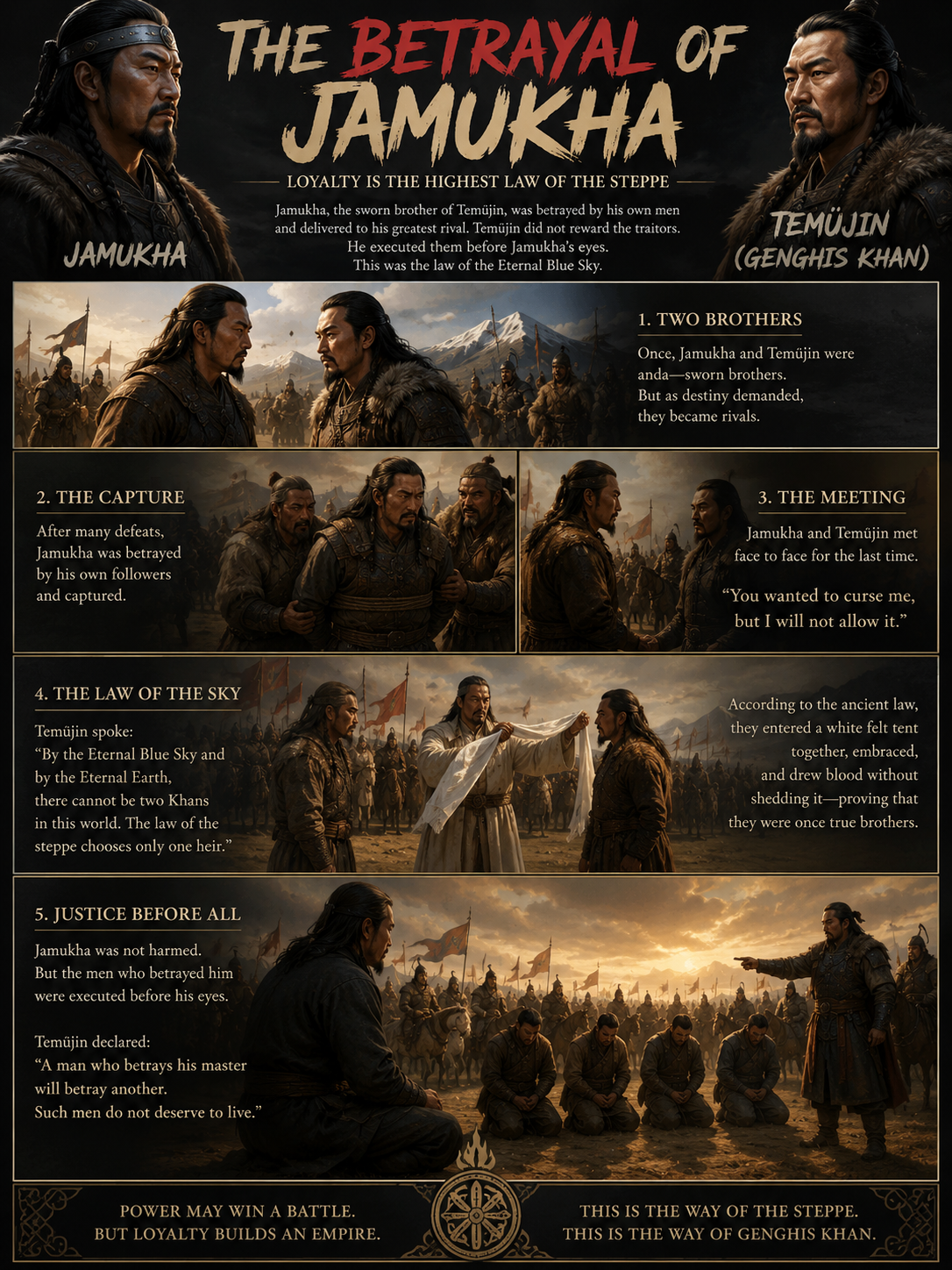
The Betrayal of Baghdad?
Myth and Reality Behind the Fall of the Abbasid Caliphate (1258)
On February 10, 1258, one of the greatest cities of the medieval world fell to the armies of Hulagu Khan.
For centuries, the fall of Baghdad has been remembered as a catastrophe that ended the power of the Abbasid Caliphate and transformed the political landscape of the Middle East.
Yet a question has persisted for more than seven hundred years:
Was Baghdad destroyed by Mongol military power alone, or was it betrayed from within?
The Accusation
Many later Muslim chroniclers blamed Ibn al-Alqami, the last Abbasid vizier, for the disaster.
According to these accounts:
- Ibn al-Alqami secretly communicated with the Mongols.
- He allegedly persuaded Caliph Al-Musta’sim to reduce the size of the army.
- He supposedly weakened Baghdad’s defenses before the Mongol invasion.
- Some writers even claimed he promised support to Hulagu in exchange for power after the conquest.
These stories spread widely and eventually created one of the most famous “betrayal narratives” in Islamic history.
The Historical Problem
There is one major issue.
The evidence is weak.
Most detailed accusations appeared in sources written after Baghdad had already fallen. Many of these accounts were influenced by political and sectarian tensions.
Ibn al-Alqami was a Shi’a official serving a Sunni caliph. After the catastrophe, some writers sought a human explanation for the empire’s collapse and found a convenient scapegoat.
Modern historians have found no contemporary evidence proving that he deliberately invited the Mongols or actively conspired to destroy Baghdad.
Why Baghdad Really Fell
Most modern scholarship points to several more significant factors:
1. Mongol Military Superiority
Hulagu’s army was among the most powerful military forces of the thirteenth century.
The Mongols brought:
- experienced commanders,
- advanced siege engineers,
- Chinese and Persian specialists,
- overwhelming numerical and technological advantages.
2. Abbasid Weakness
By 1258, the Abbasid Caliphate was only a shadow of its former power.
Its political authority had declined for centuries, and many regional rulers no longer obeyed Baghdad.
3. Strategic Mistakes
Caliph Al-Musta’sim underestimated the threat.
Unlike other rulers who submitted, negotiated, or prepared extensive defenses, he failed to organize an effective response before Hulagu arrived.
4. Internal Divisions
The Abbasid elite was divided by court rivalries, factional politics, and religious tensions.
These divisions weakened resistance, but division is not the same as betrayal.
Myth & Reality
Myth: Baghdad fell because Ibn al-Alqami betrayed the Caliph and secretly aided the Mongols.
Reality: While accusations of betrayal became widespread after the conquest, modern historians generally find insufficient evidence to prove that Ibn al-Alqami caused Baghdad’s fall. The city’s defeat is more convincingly explained by Abbasid political decline, strategic failures, and the overwhelming military power of Hulagu’s army.
The Verdict
The story of Ibn al-Alqami remains one of Eurasian history’s most famous alleged betrayals.
Yet the historical evidence suggests that Baghdad’s fall was not the result of a single traitor.
Empires rarely collapse because of one man.
More often, they fall when long-term political weakness, internal division, and external pressure converge at the same moment.
Myth & Reality:
Did a traitor destroy Baghdad, or did later generations create a traitor to explain a catastrophe they could not otherwise understand?
The Betrayal That Opened China
Wu Sangui, Shanhai Pass, and the Fall of the Ming Dynasty
Few decisions in Eurasian history changed the fate of an empire as dramatically as the choice made by Wu Sangui in 1644.
For centuries, he has been remembered as the man who opened the gates of China to the Manchus. To many, he was a traitor whose actions ended the Ming dynasty. To others, he was a commander trapped in an impossible situation, forced to choose between two enemies.
The debate continues nearly four hundred years later.
A Dynasty in Collapse
By the early seventeenth century, the Ming Dynasty was facing severe challenges.
Years of financial difficulties, natural disasters, famine, corruption, and military pressure had weakened the empire. Across northern China, large-scale rebellions erupted as public confidence in the government declined.
Among the rebel leaders, none became more powerful than Li Zicheng.
In April 1644, Li’s forces captured Beijing. The last Ming ruler, the Chongzhen Emperor, committed suicide as the capital fell.
After nearly three centuries of rule, the Ming dynasty had effectively collapsed.
The Man at the Frontier
At the northeastern frontier stood Wu Sangui, one of the Ming Empire’s most capable military commanders.
He controlled the strategic fortress of Shanhai Pass, the eastern gateway through the Great Wall separating China proper from Manchuria.
At that moment, Wu faced an extraordinary dilemma.
To the west stood Li Zicheng’s rebel forces.
To the northeast stood the Manchus, led by Prince Dorgon, successors to the state founded by Nurhaci and builders of what would become the Qing Empire.
Wu had to choose.
The Decision
Rather than submit to Li Zicheng, Wu Sangui entered into an alliance with the Manchus.
He opened Shanhai Pass and allowed Manchu armies to enter northern China.
Together, Wu and Dorgon defeated Li Zicheng at the Battle of Shanhai Pass.
The rebel regime quickly collapsed.
What followed, however, was far more significant.
The Manchus did not simply defeat the rebels and return home.
Instead, they occupied Beijing and established the Qing Dynasty, which would rule China until 1912.
Traitor or Realist?
For generations, Chinese historical tradition portrayed Wu Sangui as one of the greatest traitors in Chinese history.
The accusation was simple:
He opened the gates to a foreign power and helped it conquer China.
This interpretation became deeply embedded in popular memory, literature, and nationalist narratives.
Yet many historians argue that reality was more complicated.
By the time Wu made his decision:
- Beijing had already fallen.
- The Chongzhen Emperor was dead.
- The Ming government had effectively ceased to function.
- Rebel armies controlled large parts of the country.
From this perspective, Wu did not destroy the Ming dynasty.
The Ming dynasty had already collapsed.
His decision determined who would inherit the ruins.
The Legacy
Ironically, Wu Sangui later became dissatisfied with Qing rule.
Decades after helping the Manchus seize China, he rebelled against them during the Revolt of the Three Feudatories.
The rebellion failed, and Wu died before achieving his goal.
As a result, history remembers him in a paradoxical way:
- The man who helped create Qing rule.
- The man who later tried to destroy it.
Myth & Reality
Myth: Wu Sangui single-handedly betrayed China and caused the fall of the Ming dynasty.
Reality: The Ming dynasty had already collapsed when Wu opened Shanhai Pass. His alliance with the Manchus did not create the crisis, but it decisively shaped who would emerge victorious from it.
The Question
Was Wu Sangui the greatest traitor in Chinese history?
Or was he a frontier commander making the only choice he believed could restore order in a collapsing world?
The answer depends on whether one judges him by loyalty to a fallen dynasty—or by the consequences of his decision for the centuries that followed.
The Betrayal of Ligdan Khan
How Mongol Princes Helped the Rise of the Qing
In the early seventeenth century, Ligdan Khan emerged as the most powerful Mongol ruler since the decline of the Northern Yuan. As the last Great Khan recognized by many Mongol tribes, he sought to restore political unity among the Mongols and preserve their independence against the rapidly expanding Manchu state.
Yet Ligdan Khan’s greatest challenge did not come solely from external enemies.
It came from within.
The defection of numerous Mongol princes and tribes to the Manchus weakened his authority, fractured Mongol unity, and helped pave the way for the rise of the Qing Empire.
A Khan with a Vision
Ligdan Khan inherited a Mongolia divided among competing tribes, princes, and regional interests.
Determined to restore the authority of the Great Khan, he attempted to:
- Strengthen central authority.
- Reassert leadership over the Mongol tribes.
- Revive institutions associated with the legacy of Genghis Khan.
- Resist the growing influence of the Manchus in the east.
His goal was ambitious: the reunification of the Mongol world under a single supreme ruler.
However, many Mongol nobles viewed his policies as a threat to their own autonomy and privileges.
The Rise of the Manchus
While Ligdan sought unity, a new power was emerging beyond Mongolia’s eastern frontier.
Under Nurhaci, the Manchus established the Later Jin state and began consolidating their power.
His successor, Hong Taiji, expanded this strategy through diplomacy, military campaigns, marriage alliances, and political incentives.
Rather than confronting all Mongol tribes by force, the Manchus sought to win them over.
Many Mongol princes accepted.
The Defections
Throughout the 1620s and 1630s, several influential Mongol groups gradually shifted their allegiance from Ligdan Khan to the Manchus.
Among them were nobles from:
- The Khorchin.
- The Kharachin.
- The Tümed.
- Other Inner Mongolian tribes and banners.
These leaders entered alliances with the Manchus, accepted titles and privileges, and increasingly supported Hong Taiji’s expanding state.
From Ligdan Khan’s perspective, these defections represented a direct challenge to Mongol unity.
From the perspective of the defecting nobles, however, the decision was often driven by political survival, local interests, and opposition to Ligdan’s centralizing ambitions.
Why Did They Turn Away?
Several factors contributed to the growing division.
Political Rivalries
Many princes resisted Ligdan’s attempts to strengthen the authority of the Great Khan.
Regional Interests
Local rulers often prioritized the security and prosperity of their own tribes over broader Mongol unity.
Manchu Diplomacy
The Manchus offered titles, gifts, trade opportunities, and political recognition.
Military Reality
As Manchu power continued to grow, some nobles believed that cooperation offered a safer future than resistance.
The Consequences
The loss of support from key tribes had devastating consequences for Ligdan Khan.
His military resources declined.
His political influence weakened.
His ability to unite the Mongols diminished.
By the early 1630s, he found himself increasingly isolated.
In 1634, while campaigning toward the west, Ligdan Khan died. Shortly afterward, many remaining Mongol groups accepted Manchu authority.
Only a few years later, Hong Taiji proclaimed the Qing Dynasty, which would eventually rule China, Mongolia, Tibet, and vast regions of Inner Asia.
Myth & Reality
Myth: Ligdan Khan was defeated solely because the Manchus were militarily stronger.
Reality: Manchu military power was important, but internal divisions among the Mongols played a crucial role. The defection of numerous princes and tribes weakened Ligdan’s position long before the final collapse of his authority.
Legacy
The story of Ligdan Khan remains one of the most debated chapters in Mongolian history.
To some, the princes who allied with the Manchus were pragmatic leaders adapting to a changing political landscape.
To others, they were men whose choices contributed to the end of independent Mongol leadership and helped open the path for Qing domination.
What is beyond dispute is that the struggle was not simply a war between Mongols and Manchus.
It was also a contest over loyalty, authority, and the future of the Mongol world itself.
Myth & Reality
Did Mongol princes betray Ligdan Khan—or did they make the choices they believed necessary to survive in an age of rising empires? The answer remains a matter of historical debate.
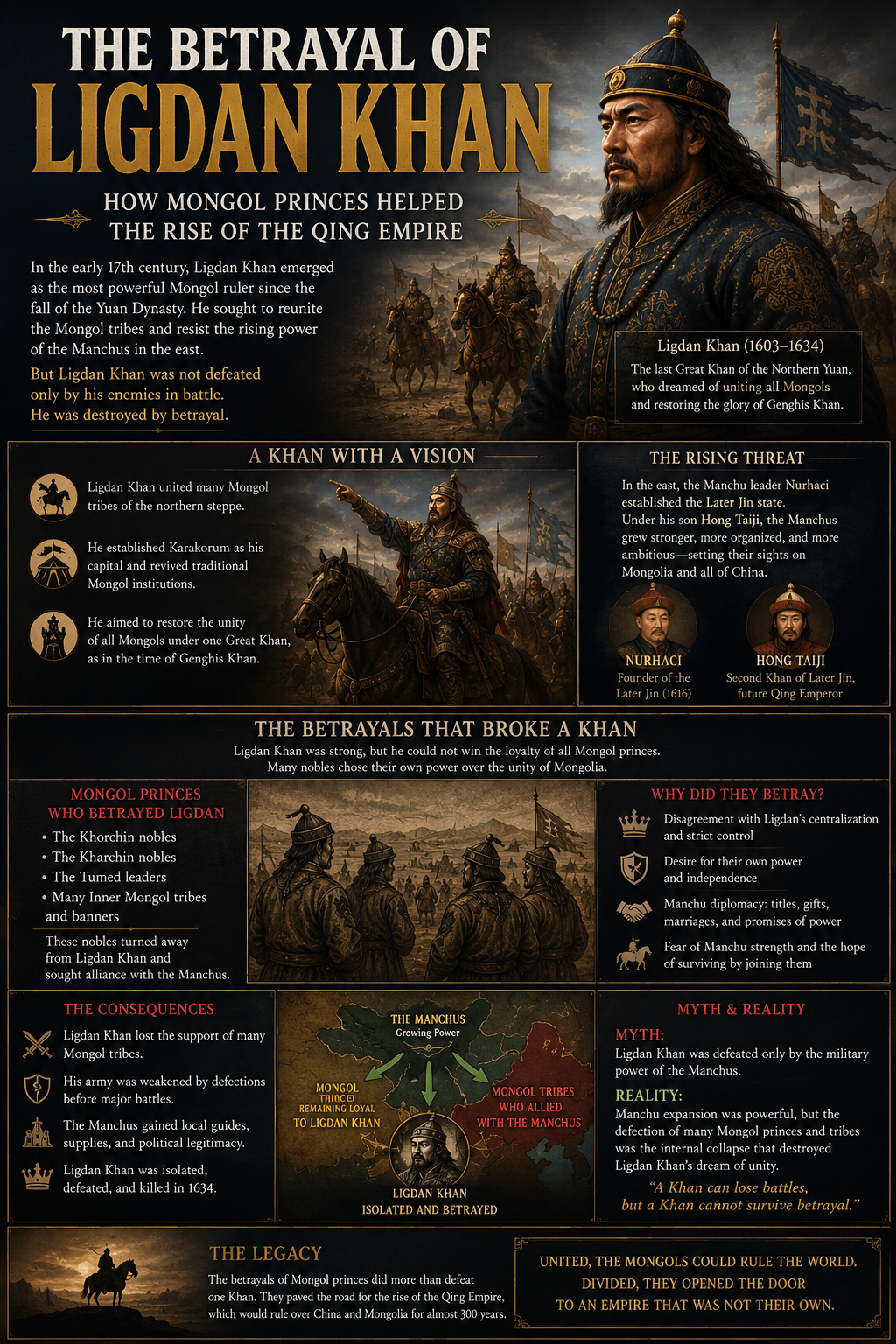
The Betrayal of Rus’?
How Moscow Rose as the Golden Horde’s Most Loyal Tax Collector
For centuries, Russian national history portrayed Moscow as the leader of resistance against Mongol rule. Yet the historical record reveals a far more complex story.
Long before Moscow challenged the Golden Horde, it rose to prominence by cooperating with it.
While other Russian principalities resisted, rebelled, or competed for influence, Moscow became one of the Horde’s most reliable partners. Through loyalty, service, and political calculation, the princes of Moscow gained wealth, power, and authority over their rivals.
To many contemporaries, this was not leadership.
It was betrayal.
The World After the Mongol Conquest
Following the Mongol invasions of the thirteenth century, the lands of Rus’ became subject to the authority of the Golden Horde.
Russian princes retained local control, but ultimate authority rested with the Khan.
To rule legally, princes required a yarlyk—a charter issued by the Khan granting the right to govern.
Competition for these charters became one of the defining political struggles of medieval Rus’.
Moscow’s Opportunity
In the thirteenth century, Moscow was not the strongest Russian principality.
Cities such as:
- Tver,
- Novgorod,
- Ryazan,
often possessed greater wealth, larger populations, or stronger political influence.
Moscow’s princes understood a simple reality:
Direct resistance against the Golden Horde was unlikely to succeed.
Instead, they pursued cooperation.
The Rise of Ivan Kalita
The most important figure in Moscow’s rise was Ivan I Kalita.
During the early fourteenth century, Ivan cultivated a close relationship with the Khans of the Golden Horde.
In return, he received privileges that transformed Moscow’s position.
Among the most important was the authority to collect tribute from other Russian principalities and deliver it to the Horde.
This arrangement gave Moscow enormous advantages:
- Increased wealth.
- Greater political influence.
- Favor with the Khan.
- Leverage over rival princes.
As Moscow gathered taxes, it also accumulated power.
The Fall of Tver
The most controversial episode occurred in 1327.
An anti-Horde uprising erupted in Tver.
Rather than supporting fellow Rus’ against the Mongols, Moscow sided with the Horde.
Moscow’s forces assisted the Khan in suppressing the rebellion.
Tver was devastated.
Moscow’s position became stronger than ever.
To many people in rival principalities, this was proof that Moscow had chosen the interests of the Horde over the interests of Rus’.
Why Other Princes Viewed Moscow as a Traitor
Critics accused Moscow of:
- Serving foreign rulers.
- Collecting tribute from fellow Rus’.
- Helping the Horde punish rival principalities.
- Growing wealthy through cooperation with Mongol power.
From the perspective of many rivals, Moscow was not defending Rus’.
It was enriching itself under Mongol protection.
Moscow’s Defense
The princes of Moscow would likely have offered a different explanation.
They understood that the Golden Horde was the dominant power of the region.
Open resistance often resulted in destruction.
Cooperation offered survival.
By serving the Horde, Moscow gained the time and resources needed to strengthen itself.
Eventually, that strategy succeeded.
The principality that had once served the Khans became powerful enough to challenge them.
From Servant to Successor
By the fifteenth century, Moscow had emerged as the leading power among the Russian lands.
Under Ivan III, Moscow gradually ended its dependence on the Golden Horde and laid the foundations for a centralized Russian state.
The irony was striking:
The city that later became the symbol of resistance to Mongol rule had first risen through cooperation with Mongol rule.
Myth & Reality
Myth: Moscow was always the heroic defender of Rus’ against the Mongols.
Reality: Moscow’s rise was closely tied to its cooperation with the Golden Horde. Its princes gained power through service to the Khans, tax collection, and political partnerships that often came at the expense of rival Russian principalities.
Legacy
The history of Moscow’s relationship with the Golden Horde remains controversial.
To some, Moscow’s princes were collaborators who advanced their own interests while others suffered.
To others, they were pragmatic statesmen who understood that survival required patience, diplomacy, and strategic compromise.
What cannot be denied is that Moscow’s path to power did not begin with rebellion.
It began with service.
Myth & Reality
Was Moscow the betrayer of Rus’, or was it simply the most successful strategist among the Russian principalities? The answer depends on whose history is being told.
The Betrayal of Sultan Bayezid
How Timur Broke the Ottoman Empire Through Defection
In 1402, two of the most powerful rulers of the medieval world met on the plains of Anatolia.
One was Sultan Bayezid I, the ruler who had transformed the Ottoman state into a rising empire stretching across both Europe and Asia.
The other was Timur, the conqueror whose armies had already crushed kingdoms from India to Persia and from Central Asia to the Caucasus.
The result was the Battle of Ankara, one of the most consequential conflicts in Eurasian history.
Yet Bayezid’s defeat was not caused by military force alone.
Many contemporary and later sources describe how several Turkic princes and contingents abandoned the Ottoman Sultan during the battle, turning a difficult struggle into a catastrophic defeat.
The Rise of Bayezid
Before Ankara, Bayezid appeared unstoppable.
Known as “Yıldırım” (The Thunderbolt) for the speed of his campaigns, he had:
- Expanded Ottoman territory across the Balkans.
- Defeated Christian coalitions.
- Subdued rival Anatolian principalities.
- Positioned the Ottomans as a major Eurasian power.
By the end of the fourteenth century, many believed Bayezid was on the path to creating a dominant empire.
Timur Arrives
As Bayezid expanded westward and eastward, his ambitions began to collide with those of Timur.
Many of the Anatolian principalities absorbed by Bayezid had former rulers who resented Ottoman control.
Some sought protection from Timur.
Timur used these grievances skillfully.
He presented himself not merely as an invader but as a restorer of rulers who had lost their lands to Ottoman expansion.
The Battle of Ankara
On July 28, 1402, the two armies met near Ankara.
The battle was fierce and closely contested.
However, as the fighting continued, serious cracks emerged within Bayezid’s coalition.
Several Anatolian contingents whose loyalty remained uncertain reportedly defected or withdrew from the battlefield.
Some joined Timur directly.
Others simply abandoned the fight.
The exact details remain debated, but the effect was undeniable.
Bayezid’s army began to collapse.
Timur seized the advantage.
The Fall of the Sultan
By the end of the battle, Bayezid’s forces had been shattered.
The Sultan himself was captured.
For the first time in Ottoman history, an Ottoman ruler had become the prisoner of a foreign conqueror.
The defeat stunned both Europe and the Islamic world.
Only a few years earlier, Bayezid had appeared invincible.
Now his empire stood on the edge of destruction.
Why Did They Defect?
The princes who abandoned Bayezid had several motivations.
Lost Independence
Many Anatolian rulers had been conquered by the Ottomans and wished to regain their autonomy.
Loyalty to Local Dynasties
Some soldiers felt greater loyalty to their traditional rulers than to the Ottoman Sultan.
Timur’s Promises
Timur offered former princes the possibility of recovering their territories and privileges.
Political Survival
Many believed Timur’s victory was inevitable and sought to secure their future by changing sides.
The Ottoman Crisis
The consequences were enormous.
Following Bayezid’s capture:
- The Ottoman Empire entered a period of civil war.
- Bayezid’s sons fought for succession.
- Central authority collapsed.
- Former principalities regained independence.
This period became known as the Ottoman Interregnum.
For more than a decade, the future of the Ottoman state remained uncertain.
Many contemporaries believed the empire would never recover.
Myth & Reality
Myth: Timur defeated Bayezid solely through military superiority.
Reality: Timur was undoubtedly a brilliant commander, but internal divisions within the Ottoman coalition played a crucial role. The defection and withdrawal of several Anatolian contingents weakened Bayezid’s army at a critical moment and contributed significantly to the Ottoman defeat.
Legacy
Despite the disaster, the Ottoman Empire eventually recovered and emerged stronger than before.
Yet the Battle of Ankara remains one of history’s most dramatic examples of how internal disunity can destroy even the most powerful armies.
For Bayezid, the greatest threat did not come only from the enemy across the battlefield.
It came from allies whose loyalty vanished when the empire needed them most.
Myth & Reality
Did Timur conquer the Ottomans through military genius alone, or did the divisions within Bayezid’s own ranks make victory possible? The answer may lie somewhere between conquest and betrayal.
Myth: The Mongol Empire only destroyed civilizations.
Reality: While Mongol conquests brought devastation and war, the empire also established an unprecedented era of connectivity known as the Pax Mongolica. Trade routes flourished, diplomatic missions crossed continents, and scientific and cultural knowledge moved between East and West on an extraordinary scale.
History is rarely black and white. The Mongol Empire was both a conqueror and a connector of civilizations.
#MythAndReality #MongolEmpire #WorldHistory #PaxMongolica #SilkRoad #HistoryMatters #SteppeEmpires #WorldMongol99