
Was Chagatai the Latin of Central Asia?
By Altanbagana Baatar
DBA Candidate| Independent Historian
ImperialGG Historical Research Seriers
30 June 2026
Reconsidering the Literary Lingua Franca of Early Modern Eurasia
Introduction
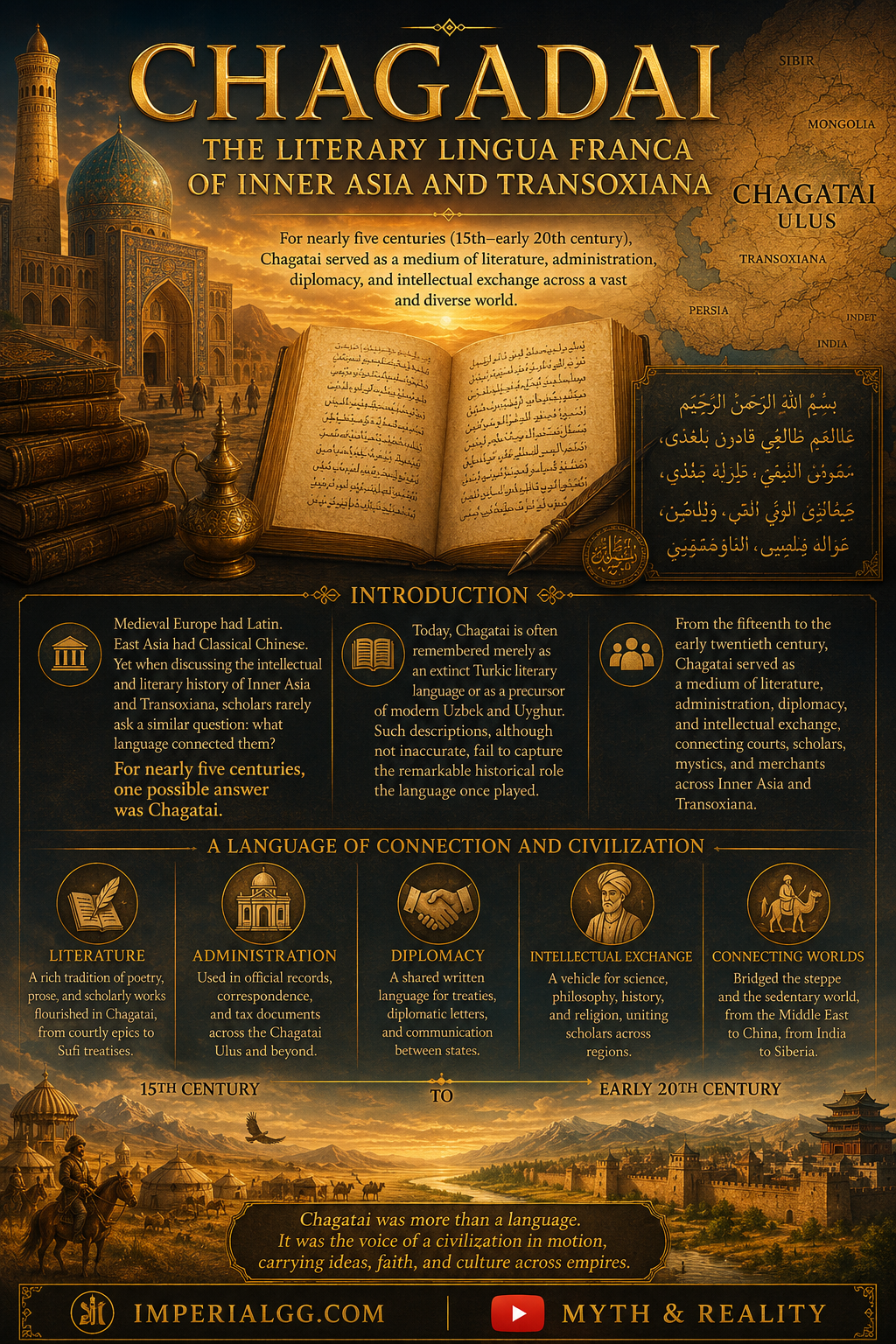
Chagadai occupied a distinctive place in the intellectual and literary history of Central Asia. Medieval Europe had Latin. East Asia had Classical Chinese. Yet when discussing the vast and diverse societies of Inner Asia and Transoxiana, scholars rarely ask a similar question: what language connected them? For nearly five centuries, one possible answer was Chagatai.
Medieval Europe had Latin. East Asia had Classical Chinese. Yet when discussing the intellectual and literary history of Central Asia, scholars rarely ask a similar question: what language connected the vast and diverse societies of Inner Asia and Transoxiana? For nearly five centuries, one possible answer was Chagatai.^1
Today, Chagatai is often remembered merely as an extinct Turkic literary language or as a precursor of modern Uzbek and Uyghur. Such descriptions, although not inaccurate, fail to capture the remarkable historical role the language once played. From the fifteenth to the early twentieth century, Chagatai served as a medium of literature, administration, diplomacy, and intellectual exchange across much of Central Asia.Its influence extended far beyond the political boundaries of the Chagatai Ulus and survived long after that polity itself had disappeared.
The history of Chagatai also challenges modern national narratives. The language belonged exclusively to no single modern nation, yet it formed a shared literary and intellectual heritage for numerous peoples of Central Asia. In this sense, Chagatai functioned as a transregional cultural medium that connected scholars, poets, rulers, and administrators across a vast geographical space.
This essay argues that although the comparison should not be taken literally, Chagatai fulfilled many of the functions that Latin performed in medieval Europe. Reconsidering its history therefore allows us to recover the deeply interconnected character of early modern Eurasia.
The Making of Chagatai
The term “Chagatai” derives from Chagatai Khan (1183–1242), the second son of Genghis Khan and ruler of the central territories of the Mongol Empire. Yet the language that later came to be known as Chagatai did not originate as a Mongolian language, nor was it spoken by the Chagatai Khan himself. Rather, it emerged from the Karluk branch of Turkic languages that had long been spoken in Transoxiana and the Tarim Basin.
The Mongol conquests of the thirteenth century fundamentally transformed the political landscape of Central Asia. By bringing diverse Turkic, Iranian, and Mongolian populations under a single imperial order, the Mongol Empire created new conditions for cultural and linguistic interaction. Over time, the Chagatai Ulus became increasingly Turkicized, while Persian and Turkic literary traditions flourished under successive dynasties that emerged from the Mongol world.
The designation “Chagatai” as a literary language appeared relatively late. By the fifteenth century, the term had come to denote the prestigious written Turkic language employed by poets, scholars, and administrators across much of Central Asia. It was not a vernacular of a single tribe or nation but a supraregional literary idiom that drew upon earlier Turkic traditions while incorporating Persian and Arabic vocabulary and literary conventions.
Thus, the emergence of Chagatai was not merely a linguistic development. It was the product of the political integration of Eurasia under Mongol rule and the subsequent formation of a shared intellectual and cultural sphere in Central Asia.
A Literary and Intellectual Language
By the fifteenth century, Chagatai had become one of the principal literary languages of the Islamic world. Its rise was closely associated with the cultural flowering of the Timurid period, during which courts in Herat, Samarkand, and other urban centers patronized poets, scholars, and men of letters. The language gradually acquired a prestige that allowed it to stand alongside Persian and Arabic as a medium of high culture.
No figure contributed more to this transformation than Alisher Navāʾī (1441–1501). In his celebrated treatise Muhakamat al-Lughatayn (“The Judgment of the Two Languages”), Navāʾī argued that Turkic possessed expressive and literary qualities equal, and in certain respects superior, to Persian.His literary works demonstrated that Chagatai was capable of sustaining sophisticated poetry, prose, and philosophical reflection.
The influence of Chagatai extended beyond literature. It became an important language of administration and court culture across much of Central Asia. Diplomatic correspondence, historical chronicles, and official documents were frequently composed in Chagatai, while merchants and educated elites employed it as a medium of communication across political frontiers. Even in Mughal India, the founder of the empire, Babur, composed his famous memoir, the Baburnama, in Chagatai rather than Persian, illustrating the language’s continued prestige among the Turco-Mongol elite.
Thus, Chagatai functioned not merely as a literary language but as a vehicle of intellectual exchange that linked diverse regions and communities throughout early modern Eurasia.
Was Chagatai the Latin of Central Asia?
Comparisons between historical languages are always imperfect. Chagatai was not the exact equivalent of Latin, nor did it possess the same institutional foundations as the language of medieval and early modern Europe. Nevertheless, the comparison is useful because both languages fulfilled remarkably similar cultural and intellectual functions.
Like Latin, Chagatai transcended political boundaries. It was not confined to a single state, dynasty, or ethnic community. Scholars, poets, administrators, and members of the educated elite across Central Asia employed it as a prestigious written language and a vehicle of learned communication. Its literary influence extended from Transoxiana and Moghulistan to Xinjiang and Mughal India.
Furthermore, both Latin and Chagatai became repositories of literary memory and intellectual authority. Mastery of these languages provided access to a shared body of texts, historical traditions, and cultural practices that connected geographically distant communities. In this sense, Chagatai helped create what may be described as a transregional cultural sphere within Central Asia and the broader Persianate world.
The comparison, however, has its limitations. Latin possessed an enduring ecclesiastical foundation through the Roman Catholic Church and remained the principal language of European scholarship for centuries after the emergence of vernacular literatures. Chagatai, by contrast, never acquired a comparable religious institution and gradually gave way to modern national literary languages during the nineteenth and early twentieth centuries.
Yet these differences should not obscure the broader historical reality. Although Chagatai was not literally the Latin of Central Asia, it performed many of the same functions as a prestigious literary and intellectual lingua franca, connecting peoples and cultures across the heart of Eurasia.
Conclusion
Languages do more than carry words; they create communities of memory, learning, and cultural exchange. For nearly five centuries, Chagatai served precisely such a function in Central Asia. It connected poets and rulers, scholars and administrators, and linked regions that are too often studied in isolation from one another.
The history of Chagatai also reminds us that the intellectual landscape of Eurasia cannot be understood solely through the lens of modern national languages and borders. Long before the emergence of contemporary nation-states, Central Asia possessed its own transregional literary and scholarly tradition, one that enabled the circulation of ideas across vast distances and among diverse peoples.
To describe Chagatai as the “Latin of Central Asia” is therefore not to suggest a perfect historical equivalence. Rather, it is to recognize its extraordinary role as a prestigious literary and intellectual lingua franca that helped shape the cultural history of Eurasia. Recovering the history of Chagatai ultimately allows us to recover a more interconnected vision of the Eurasian past—one in which languages served not merely as instruments of communication, but as bridges between worlds.
Author’s Note
This essay is part of an ongoing research project on the Chagatai language and its place in Eurasian history. A longer academic study is currently in preparation.