The Guifang: The Earliest Northern Power in Chinese Historical Memory
By Altanbagana Baatar
DBA Candidate| Independent Historian
ImperialGG Historical Research Seriers
02 July 2026
Reconsidering the First Recorded Peoples of the Eastern Eurasian Steppe
Introduction
Long before the rise of the Xiongnu and centuries before the emergence of the great nomadic empires of Inner Asia, the northern frontiers of ancient China were inhabited by powerful communities whose names survive only in fragmentary records. Among the earliest of these peoples were the Guifang (鬼方), a group mentioned in the oracle bone inscriptions of the late Shang dynasty and later remembered in early Chinese historical traditions as formidable adversaries beyond the northern frontier. The term “power” in this context does not imply a centralized state but rather a politically significant frontier confederation or regional force.
The Guifang occupy a unique place in the history of the eastern Eurasian steppe. They are among the first non-Chinese peoples to appear in Chinese written records and therefore constitute one of the earliest historically attested populations of the northern frontier world. Although the surviving evidence is limited and often ambiguous, it reveals a society capable of organizing sustained resistance against the Shang state and maintaining a political presence significant enough to be remembered for centuries.
Yet the identity of the Guifang remains one of the enduring mysteries of early Inner Asian history. Were they early pastoral communities of the Mongolian Plateau? Were they related to later peoples such as the Xianyun, the Rong, or the Di? Or were they simply one among many frontier societies that rose and disappeared long before the age of the great steppe empires? Modern scholarship has produced no consensus, and the Guifang continue to stand at the threshold between history and prehistory.
What is clear, however, is that the Guifang were not an isolated tribe living on the margins of civilization. Rather, they formed part of a dynamic frontier world that interacted with the Shang kingdom through warfare, exchange, and political rivalry. Their appearance in the earliest Chinese texts marks the beginning of a long and complex relationship between the agrarian states of East Asia and the peoples of the steppe—a relationship that would shape the history of Eurasia for more than two millennia.
Historical Sources and Background
The principal evidence concerning the Guifang comes from the oracle bone inscriptions of the late Shang dynasty, particularly during the reign of King Wu Ding (r. c. 1250–1192 BCE).These inscriptions, carved on turtle plastrons and animal bones for divinatory purposes, constitute the earliest known corpus of Chinese writing. Among their many references to warfare, tribute, and royal expeditions are several mentions of military campaigns against the Guifang.
According to the inscriptions, the Guifang were important enough to warrant repeated royal attention. Some records suggest that campaigns against them lasted for several years, indicating that these conflicts were not merely local border skirmishes but major military undertakings requiring considerable resources and manpower. Such evidence implies the existence of a politically organized frontier power capable of sustained resistance against the Shang kingdom.
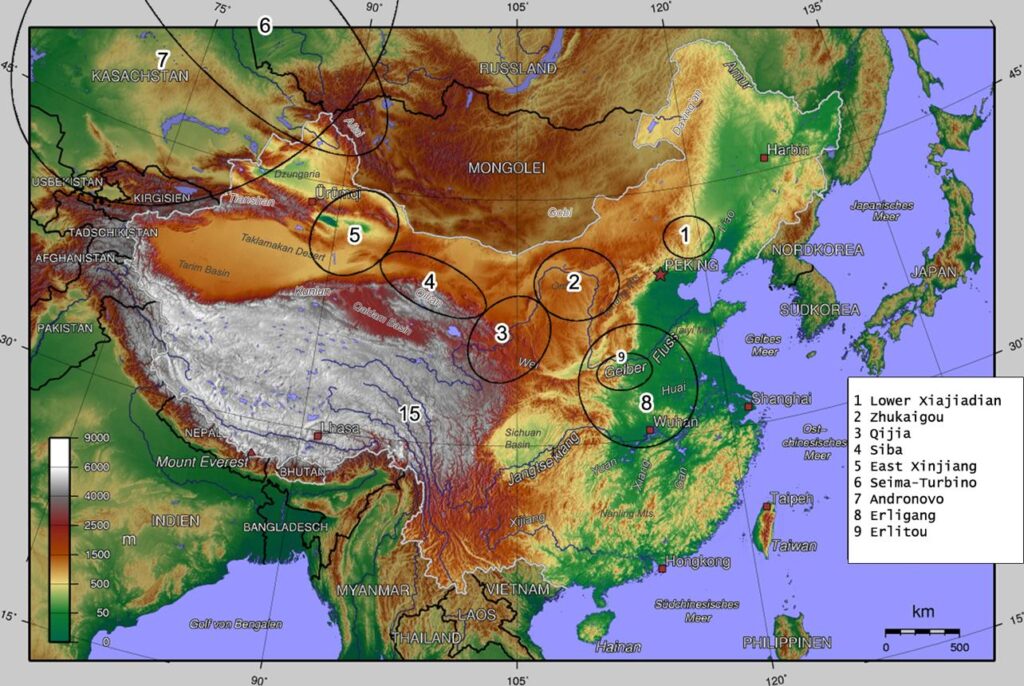
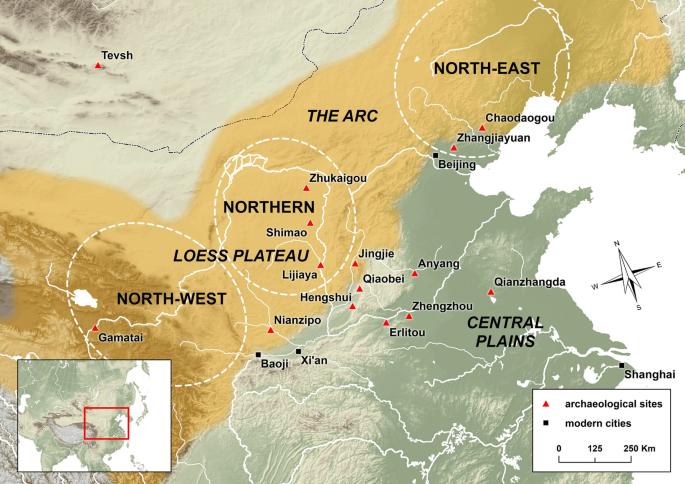
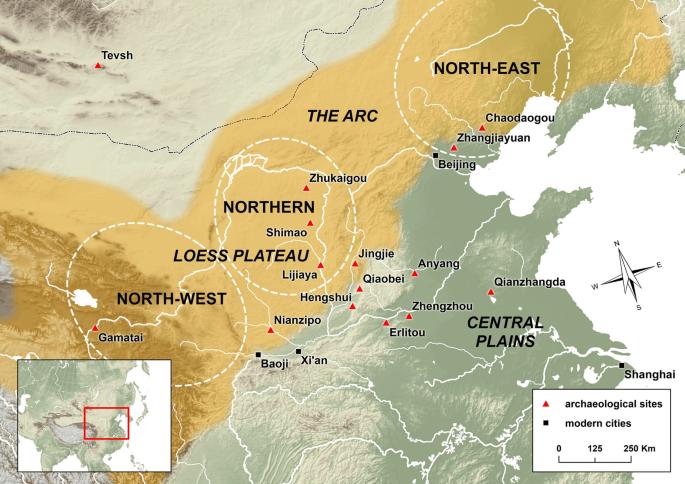
The geographical location of the Guifang remains uncertain. Most scholars place them somewhere north or north-west of the Shang realm, possibly in regions corresponding to present-day Inner Mongolia, northern Shaanxi, or southern Mongolia. Their territory likely consisted of a transitional zone of grasslands, river valleys, and semi-arid frontier environments that connected the agricultural societies of northern China with the broader steppe world of Inner Asia.
Archaeological evidence, however, does not permit the identification of a distinct “Guifang culture.” Instead, excavations across northern China, Inner Mongolia, and southern Mongolia reveal a mosaic of Bronze Age societies characterized by mixed economies that combined animal husbandry, hunting, and limited agriculture.These communities participated in extensive exchange networks involving bronze technology, livestock, and prestige goods, demonstrating that the northern frontier was already a dynamic and interconnected world during the late second millennium BCE.
Consequently, the Guifang are best understood not as an isolated tribe but as part of this broader frontier milieu. Whether they represented a single ethnic community or a confederation of several groups remains uncertain. Nevertheless, the historical and archaeological evidence strongly suggests that the northern frontier beyond the Shang realm was inhabited by politically significant populations whose influence extended well beyond their immediate territories.
The Guifang thus occupy a crucial place in the early history of the eastern Eurasian steppe. Although their precise identity remains elusive, they constitute one of the earliest historically visible powers of the northern frontier and provide our first documentary glimpse into the complex societies that inhabited the regions beyond the Central Plains.
Political and Military History
The historical significance of the Guifang derives primarily from their military encounters with the Shang kingdom. Unlike many frontier peoples who appear only briefly in early Chinese sources, the Guifang were repeatedly mentioned in connection with royal campaigns, suggesting that they represented a substantial political and military force on the northern frontier.
The most famous of these conflicts occurred during the reign of King Wu Ding, one of the most powerful rulers of the Shang dynasty. Oracle bone inscriptions record a series of military expeditions against the Guifang that appear to have extended over several years. Some inscriptions indicate that the campaigns lasted as long as three years before the Shang achieved success, an extraordinary duration by the standards of Bronze Age frontier warfare.Such a prolonged conflict implies that the Guifang possessed considerable manpower, territorial depth, and the ability to resist repeated military offensives.
The precise nature of Guifang political organization remains unknown. The surviving sources do not describe their rulers, institutions, or internal social structure. Nevertheless, the scale of the Shang campaigns indicates that the Guifang were more than a small tribal community. They appear instead to have constituted a politically organized frontier confederation, perhaps composed of several allied groups united by kinship ties, military cooperation, or shared economic interests. Such forms of political organization would later become a recurring feature of the eastern Eurasian steppe.
The economy of the Guifang is equally difficult to reconstruct. Their location along the northern frontier suggests a mixed economic system combining pastoralism, hunting, and limited agriculture. Archaeological evidence from northern China and southern Mongolia reveals communities that raised sheep, cattle, and horses while simultaneously participating in long-distance exchange networks that linked the frontier with the agricultural societies of the Central Plains. Although there is no direct evidence that the Guifang were fully nomadic pastoralists in the later Inner Asian sense, they likely possessed a degree of mobility that distinguished them from the more sedentary populations of the Shang realm.
Military confrontation between the Shang and the Guifang should not be understood solely as a struggle between “civilization” and “barbarism,” a characterization common in later historical traditions. Rather, these conflicts reflected competition over strategic frontiers, access to resources, and control of important exchange networks. The northern frontier of the late second millennium BCE was already a zone of interaction in which goods, technologies, and cultural practices moved in both directions.
The campaigns of Wu Ding appear ultimately to have weakened or dispersed the Guifang. Following the late Shang period, references to the Guifang become increasingly rare and eventually disappear from the historical record. Their disappearance, however, should not necessarily be interpreted as physical extinction. Throughout the history of the Eurasian steppe, tribal names frequently changed, political confederations fragmented, and populations were absorbed into new alliances and identities.
For this reason, some historians have suggested that elements of the Guifang may have survived among later frontier peoples, including the Xianyun and other northern groups mentioned during the Western Zhou period. Such hypotheses remain difficult to prove conclusively, yet they underscore an important historical reality: the peoples of the eastern Eurasian steppe existed within a long continuum of migration, political reorganization, and cultural transformation.
Society, Identity, and Scholarly Debates
The Guifang remain among the most enigmatic peoples of early Inner Asian history because the surviving sources reveal almost nothing about their language, social organization, or ethnic identity. Unlike later frontier powers such as the Xiongnu or the Turks, the Guifang left no known inscriptions of their own and are known exclusively through the writings of their southern neighbors. Consequently, every attempt to reconstruct their identity must proceed with considerable caution.
One of the principal debates concerns the meaning of the name Guifang itself. In early Chinese texts, the character fang (方) often denoted a foreign polity, regional power, or frontier people rather than a specific ethnic group. The term Guifang may therefore have referred not to a single tribe but to a confederation of communities occupying the northern frontier of the Shang world.
The question of whether the Guifang were pastoral nomads has also generated considerable discussion. Earlier scholarship often portrayed them as proto-nomads and direct predecessors of later steppe empires. More recent archaeological research, however, suggests a more complex picture. The frontier societies of the late second millennium BCE appear to have practiced mixed economies that combined animal husbandry, hunting, and limited agriculture rather than the fully developed pastoral nomadism characteristic of later Inner Asian confederations.
Another important debate concerns the relationship between the Guifang and later peoples of the eastern Eurasian steppe. Some scholars have proposed connections between the Guifang and the Xianyun, while others have suggested broader cultural continuities extending toward the Rong, the Di, and other frontier populations of the early Zhou period. Although no direct line of descent can presently be demonstrated, the recurrence of organized northern powers in successive historical periods suggests that the frontier world beyond the Central Plains possessed a considerable degree of long-term demographic and cultural continuity.
Indeed, the search for the “ancestors” of later peoples can easily become misleading. Ancient identities were fluid and constantly changing. Political confederations formed, fragmented, and reassembled under new names, while populations moved across vast regions of the steppe and borderlands. The disappearance of the name Guifang from the written record therefore does not necessarily imply the disappearance of the people themselves. Rather, it may reflect the dynamic character of frontier societies, whose identities evolved in response to changing political and environmental circumstances.
Modern scholarship increasingly emphasizes the Guifang’s place within a broader frontier world instead of attempting to identify them with a particular modern ethnicity or later historical people. Nevertheless, the possibility of long-term cultural and demographic continuities between the Guifang and subsequent frontier populations remains an important field for future research. The Guifang should therefore be understood both as one of the earliest historically visible communities of the northern frontier and as participants in the long historical processes that eventually gave rise to the great societies of the eastern Eurasian steppe.
Legacy and Historical Significance
Although the Guifang disappeared from the written record more than three thousand years ago, their historical importance extends far beyond the limited references preserved in Shang and Zhou sources. They represent the earliest identifiable northern power encountered by a Chinese state and, as such, occupy a foundational place in the history of relations between the agrarian civilizations of East Asia and the peoples of the steppe.
The conflicts between the Shang and the Guifang reveal that the northern frontier was already a politically dynamic region during the late second millennium BCE. Far from being an empty periphery inhabited by scattered tribes, the frontier contained organized communities capable of resisting one of the most powerful states of Bronze Age East Asia. In this respect, the Guifang foreshadow a pattern that would recur repeatedly throughout history: the emergence of powerful northern confederations able to challenge sedentary states through mobility, military organization, and control of frontier resources.
The Guifang also illuminate the deep antiquity of interaction between the steppe and the agricultural world. Technologies, goods, and cultural practices moved across the frontier in both directions, creating a zone of continuous exchange and adaptation. The history of Inner Asia did not begin with the Xiongnu in the third century BCE; rather, it was rooted in much older processes of interaction that can already be observed in the age of the Shang.
For scholars of the eastern Eurasian steppe, the Guifang are particularly significant because they offer one of the earliest glimpses into the human landscape from which later frontier polities emerged. Whether or not they were directly related to the Xianyun, the Rong, or the Di, they belonged to a broader frontier world that gradually gave rise to increasingly complex forms of political organization. Their story reminds us that the great powers of Inner Asia did not emerge suddenly but developed upon foundations laid by many earlier and often forgotten peoples.
The Guifang further challenge older historical narratives that portray frontier societies merely as peripheral “barbarians” standing outside civilization. Modern archaeology and historical research increasingly demonstrate that the peoples of the northern frontier possessed their own political structures, economic systems, and cultural traditions. They were active participants in the making of East Asian history rather than passive actors responding to developments in the Central Plains.
In a broader sense, the Guifang symbolize the beginning of a historical continuum that would eventually produce some of the most influential powers of Eurasian history. From the Guifang and Xianyun to the later confederations of Inner Asia, the eastern steppe repeatedly generated new political formations that transformed the history of Asia and beyond. The names changed, alliances shifted, and peoples migrated, but the frontier itself remained a fertile arena for the creation of new identities and new forms of power.
Conclusion
The Guifang remain one of the great mysteries of early Inner Asian history. Known only through fragmentary references in the earliest Chinese writings, they nevertheless occupy a position of extraordinary importance. They were among the first northern peoples to enter the historical record, one of the earliest powers to challenge the Shang kingdom, and a crucial component of the frontier world from which later steppe civilizations emerged.
Although their precise identity may never be known, the Guifang deserve recognition not merely as a footnote to Shang history but as one of the earliest actors in the long and interconnected history of the eastern Eurasian steppe. Their memory stands at the beginning of a historical tradition that would eventually produce the great frontier confederations and profoundly shape the history of Eurasia.
Author’s Thesis
This essay argues that the Guifang were not merely a marginal “barbarian” tribe preserved in Shang historical memory, but one of the earliest historically recorded powers of the eastern Eurasian steppe. Their repeated appearance in oracle bone inscriptions, the scale of the military campaigns directed against them, and the broader archaeological evidence from the northern frontier all suggest the existence of politically organized communities beyond the Shang realm long before the emergence of the later nomadic empires.
Furthermore, this study proposes that the history of the eastern Eurasian steppe should not be viewed as beginning abruptly with the Xiongnu in the third century BCE. Rather, the Guifang represent an earlier stage in a much longer historical continuum of frontier societies, political confederations, and patterns of interaction between the steppe and the agrarian states of East Asia. Although direct lines of ethnic descent cannot presently be demonstrated, the possibility of long-term cultural and demographic continuities between the Guifang and subsequent frontier populations deserves further interdisciplinary investigation.
By reexamining the Guifang within the broader context of Inner Asian history, this essay seeks to place the earliest recorded northern power back into the historical narrative of the eastern Eurasian steppe and to encourage renewed scholarly attention to the deep antiquity of steppe civilization.