
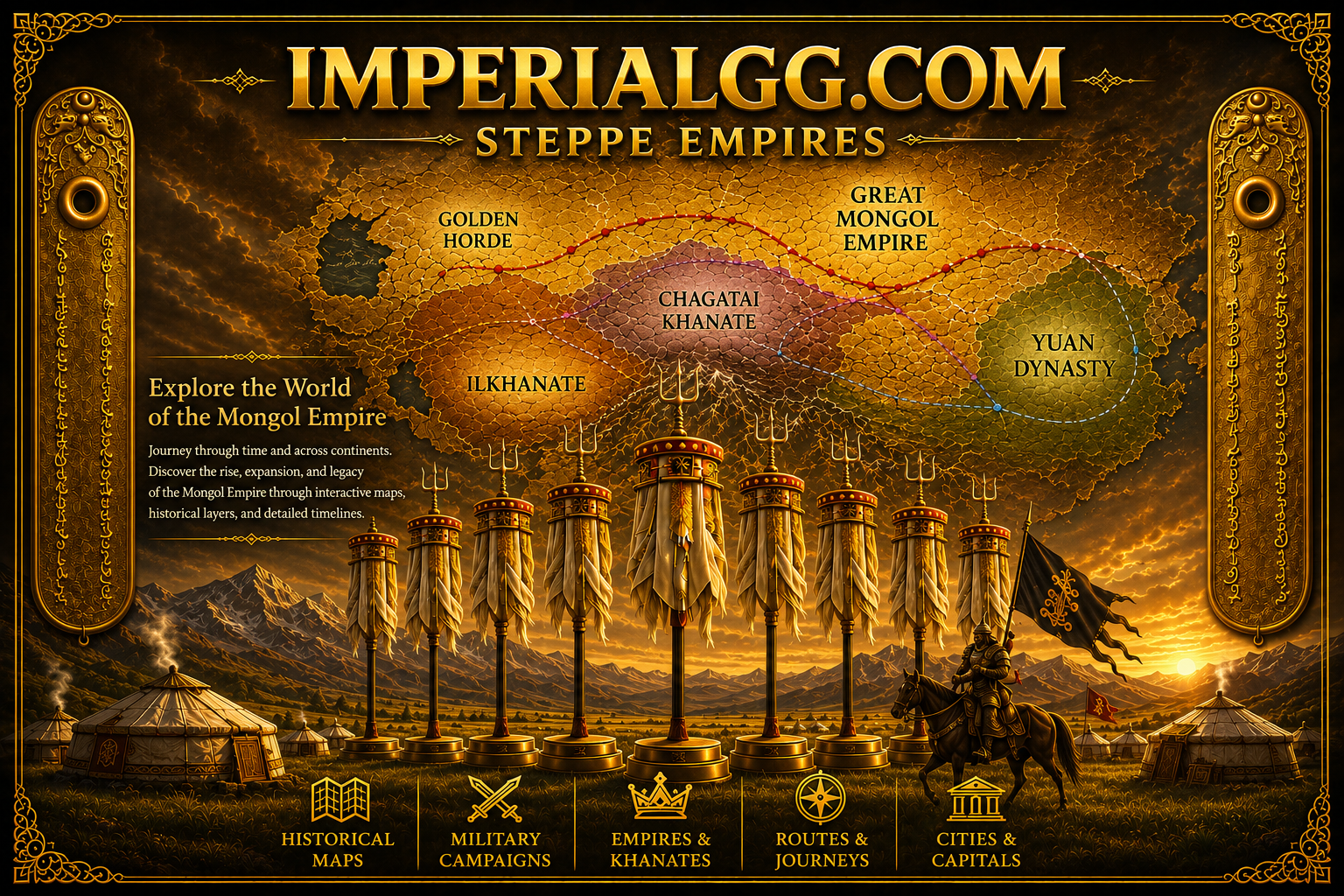
From the Heart of the Steppe to the Modern World
Preserving the Past. Inspiring the Future.
Imperial Golden Gerege is an independent research and educational platform dedicated to the history, cultures, and historical geography of the Eurasian Steppe through evidence-based scholarship, publications, maps, and digital media.
Our mission is to preserve and share overlooked historical perspectives through rigorous research, educational initiatives, and innovative media for a global audience.
BEYOND MODERN MONGOLIA
Documentary & Media Projects
KAMIKAZE THE ENDLESS END
Historical Novel (1281 Mongol Expedition)
HISTORICAL RESEARCH
Original Articles &Studies
Latest Research
FROM UNIFICATION TO GOVERNANCE
THE LAST DIALOGUE OF CHINGGIS KHAN AND JAMUQA
SÜBEGEDEI’S EXPEDITIONARY DECREE
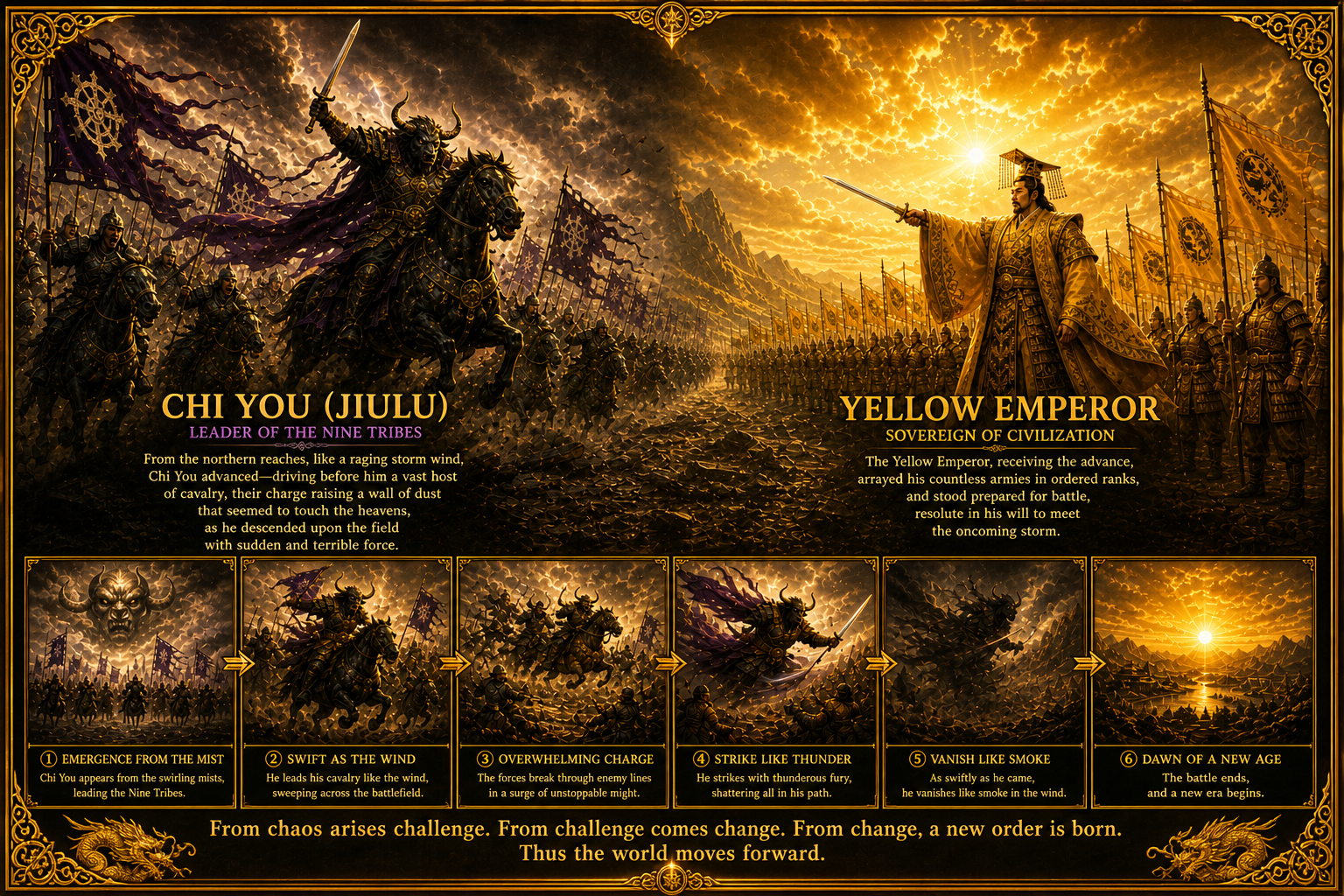
CHI YOU AND THE YELLOW EMPEROR
TRADITIONAL CHRONOLOGY: c. 2697–2598 BCE
The conflict between Chi You and the Yellow Emperor belongs to the mytho-historical traditions of ancient China and its northern Nomadic frontier. Traditional chronologies place the Yellow Emperor in the late 27th century BCE, although the exact date and historical circumstances of the conflict remain uncertain.
LATEST ARTICLES
- Ancient China (c. 27th century BCE) — The legendary conflict between Chi You and the Yellow Emperor (Huangdi) belongs to the mytho-historical traditions of ancient China and northern Nomadic frontier. Traditional chronology places it in the 27th century BCE, although the exact date cannot be historically established.
- Egypt (c. 11th century BCE) — New Kingdom of Egypt had declined after the Bronze Age collapse, and regional dynasties competed for power along the Nile.
- Mesopotamia (c. 11th century BCE) — The Assyrian Empire was entering a period of military revival, strengthening royal authority and expanding influence across the Near East.
- Eastern Mediterranean (c. 11th century BCE) — The Greek world entered the early phase of the Greek Dark Age, as many Mycenaean palace centers had fallen and smaller tribal societies emerged.
- Levant (c. 11th century BCE) — The Phoenician city-states, including Tyre and Sidon, expanded maritime trade networks across the Mediterranean.
- South Asia (c. 11th century BCE) — Early Vedic kingdoms were developing in northern India, where Indo-Aryan pastoral traditions gradually blended with settled agricultural society.
- Europe (c. 11th century BCE) — Much of Europe remained organized into tribal chiefdoms during the Late Bronze Age and early Iron Age transition, with Celtic cultures beginning to emerge in Central Europe.
- Northern Europe (c. 11th century BCE) — Scandinavian societies were still decentralized warrior and farming communities connected through Baltic amber and maritime trade routes.
- Sub-Saharan Africa (c. 11th century BCE) — Ironworking technologies were gradually spreading across parts of Africa, laying foundations for later regional kingdoms and trade systems.
- Nubia / Kush (c. 11th century BCE) — The Kingdom of Kush in the Upper Nile region preserved powerful cultural traditions after the weakening of Egyptian authority in Nubia.
- China (c. 11th century BCE) — The late Shang dynasty and early Zhou dynasty period witnessed expanding frontier warfare, bronze culture, and the rise of regional states.
- Mesoamerica (c. 11th century BCE) — Early agricultural civilizations in Mesoamerica continued developing ceremonial centers, long-distance exchange, and complex religious traditions before the rise of the Maya and Aztec worlds.
- North America (c. 11th century BCE) — Indigenous societies across North America developed diverse regional cultures based upon hunting, gathering, river settlements, and early agriculture adapted to local environments.
Chi You and the Yellow Emperor
Chi You and the Yellow Emperor represent one of the great mytho-historical conflicts of ancient East Asian tradition.
Chi You, traditionally associated with the Jiuli tribes, appears in early Chinese traditions as a formidable warrior leader connected with the northern nomadic frontier—the broad frontier zone beyond the settled Central Plains, where mobile tribal societies, pastoral communities, and settled agricultural states came into contact and conflict. In later traditions, Chi You came to symbolize the powerful and untamed forces associated with this frontier world, standing beyond the political and cultural order of the Central Plains.
Opposing him stood the Yellow Emperor (Huangdi), revered in Chinese tradition as a culture hero and legendary sovereign associated with political order, statecraft, ritual, and the consolidation of the Central Plains.
Their legendary confrontation therefore came to represent more than a struggle between two individual rulers. Within the later tradition, it reflects an enduring image of the encounter between the settled Central Plains and the northern nomadic frontier—between agricultural civilization and mobile pastoral societies, the walled settlement and the open steppe, political centralization and the autonomous tribal world beyond the frontier.
The Northern Nomadic Frontier in this context should not be understood as a fixed political boundary. It represents a changing zone of interaction across which peoples, technologies, warfare, cultural practices, and political traditions encountered one another. The story of Chi You and Huangdi became one of the earliest mytho-historical narratives through which this frontier relationship was remembered.
Though deeply embedded in mythology and legendary tradition, the story endured for millennia as a foundational memory of frontier conflict, cultural encounter, political transformation, and the formation of a new order beneath Heaven.
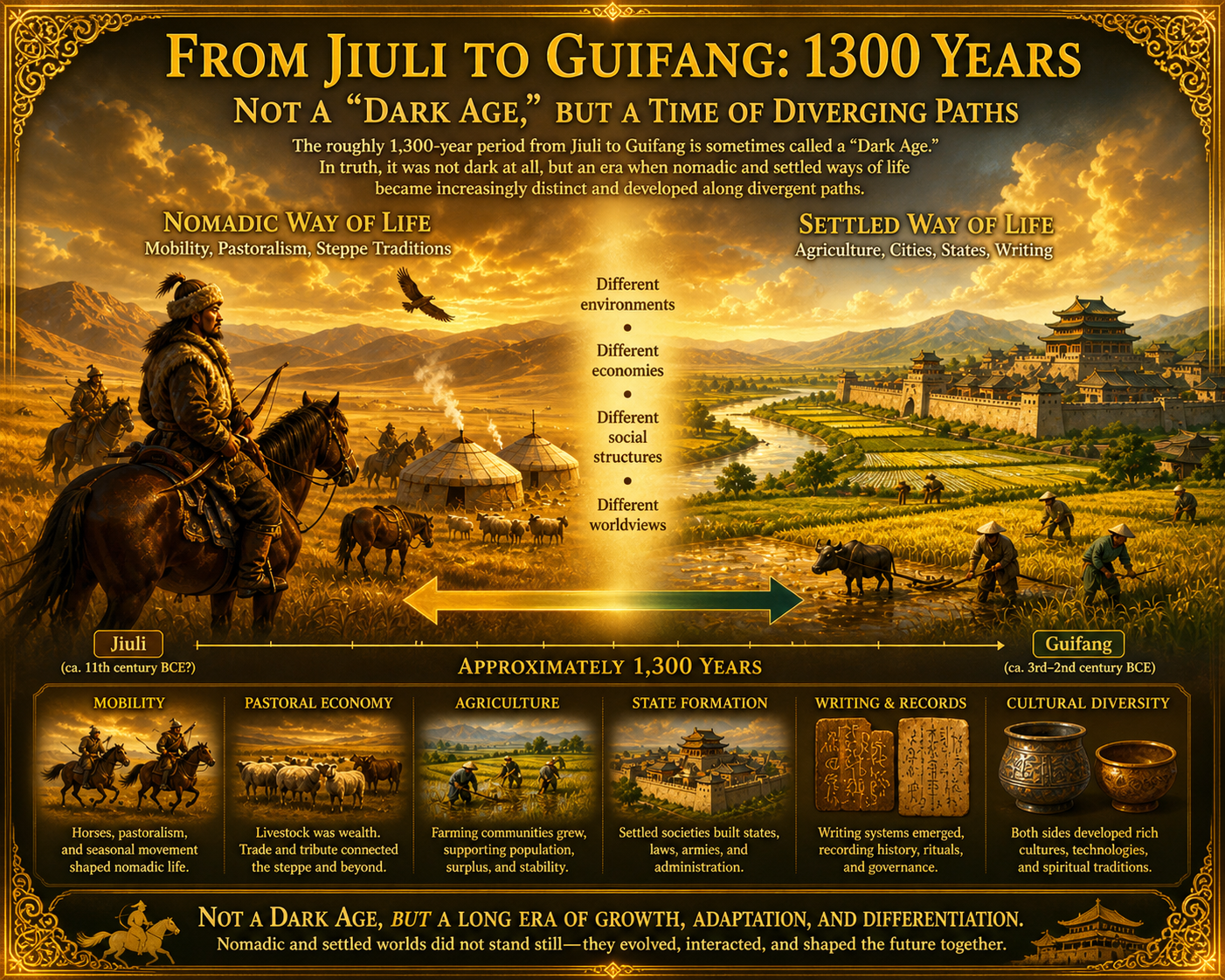
From Jiuli to Guifang
From Jiuli to Guifang traces the long transformation and continuity of the Northern Frontier world across roughly thirteen centuries of early East Asian history.
Guifang did not emerge from a historical vacuum. The frontier communities remembered in later traditions through figures such as Chi You and the Jiuli belong to an earlier layer of the same broad Northern Frontier world that, centuries later, appears under different names in the written records of the Shang period. The names, political formations, and social identities changed over time, and the surviving sources do not allow us to establish a simple direct ethnic continuity between the Jiuli and the Guifang. Yet the persistence of a northern frontier zone—where mobile communities, pastoral economies, warfare, exchange, and shifting tribal alliances interacted with the settled societies of the Central Plains—provides an important framework for understanding this long history.
Rather than representing a “Dark Age,” this era was a period of formation, transformation, and political differentiation. Across the northern frontier, communities developed and adapted traditions of mobility, pastoralism, mounted and chariot warfare, clan alliance, and regional political organization, while the Central Plains witnessed the expansion of agriculture, cities, ritual institutions, and written administration.
From the Jiuli and the legendary world associated with Chi You, through the changing frontier communities of the centuries that followed, to the Guifang recorded in Shang sources, the Northern Frontier should therefore be understood not as a static civilization or a single ethnic population, but as a long-lived zone of interaction and transformation.
It was an age not of darkness, but of formation—when the peoples of the Northern Frontier and the settled societies of the Central Plains developed along different, yet continually interacting, historical paths beneath the same Heaven.
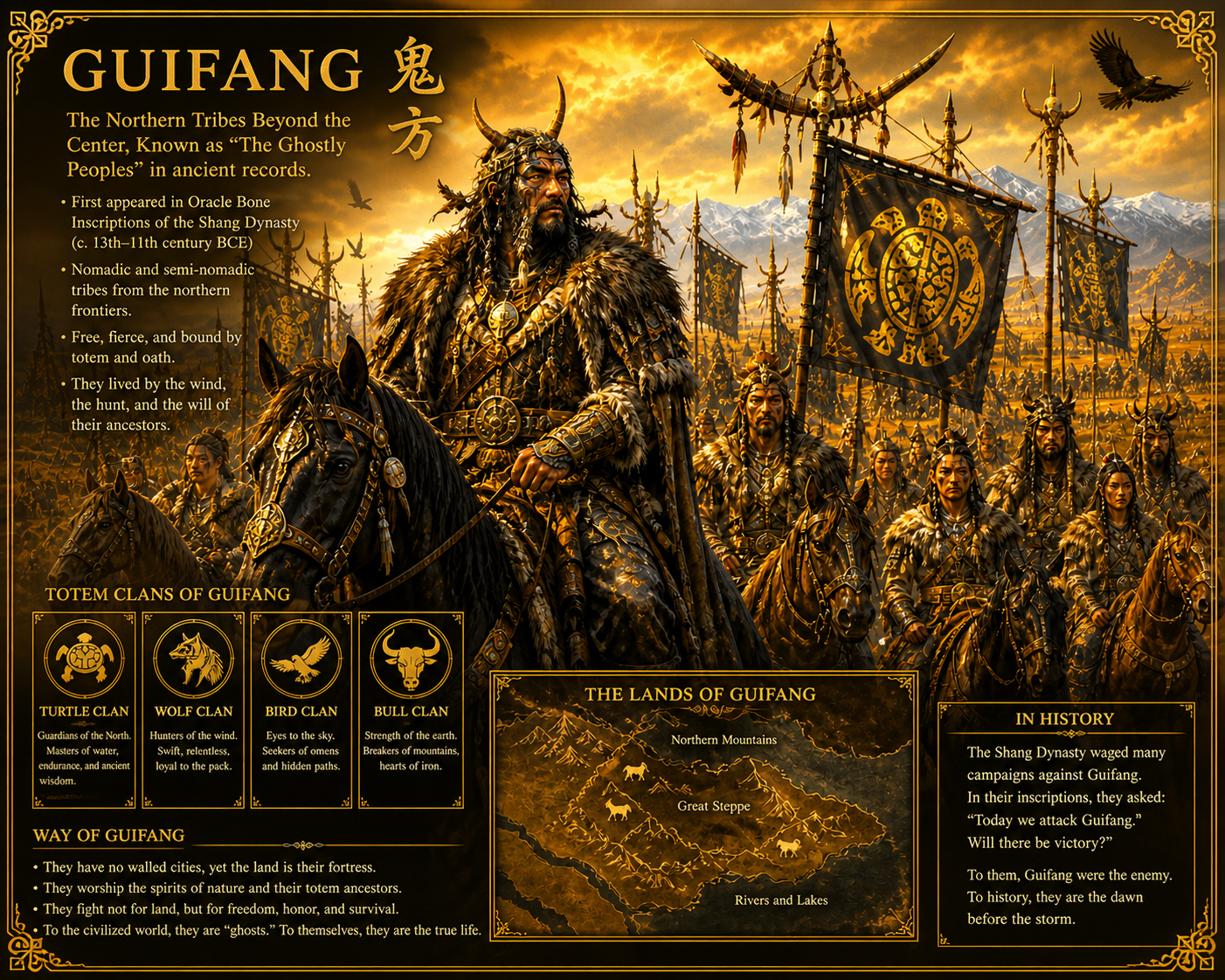
GUIFANG AND THE NORTHERN FRONTIER
Guifang (鬼方) appears in the written records of the late Shang period as one of the polities or frontier communities located beyond the core agricultural and political centers of the Shang realm, particularly during the late second millennium BCE. The term belongs to the Shang representation of its surrounding world, and the surviving oracle-bone inscriptions primarily record the Guifang in connection with warfare, military expeditions, threats, and other forms of interaction with the Shang court. These records therefore provide important contemporary evidence, but they must also be read critically: they preserve the perspective of the Shang royal court rather than an independent account produced by the people whom the Shang identified as Guifang.
Within this context, Guifang should be understood as part of the broader Northern Frontier world, rather than as an isolated or completely separate historical phenomenon. The Northern Frontier was not a fixed political boundary dividing two clearly defined civilizations. It was a changing zone extending across the northern regions beyond the Central Plains, encompassing steppe, forest, highland, and semi-arid environments in which different communities developed varied forms of mobility, pastoral production, hunting, warfare, exchange, and political organization. Modern scholarship has emphasized that this northern zone cannot be reduced to a simple line between “China” and an external nomadic world; it was instead a dynamic region of interaction in which political, economic, and cultural boundaries continually shifted.
The communities encountered by the Shang in this frontier environment should likewise not be treated as a single, homogeneous ethnic population. Their economies and social organizations varied according to ecological conditions, and the evidence does not justify assuming that every northern community was fully nomadic in the later historical sense. Some were mobile pastoral or mixed-economy communities, while others occupied more settled environments and participated in agriculture, exchange, craft production, or regional political networks. Archaeological evidence from the northern regions demonstrates the existence of distinctive Bronze Age cultural traditions and substantial interaction between northern communities and the Shang cultural sphere.
The significance of Guifang, therefore, lies not simply in its appearance as an enemy in Shang military records, but in what its appearance reveals about the historical development of the Northern Frontier itself. By the late Shang period, this frontier had already become a zone in which mobile communities, local polities, military alliances, pastoral and agricultural economies, and long-distance exchange interacted with the expanding political world of the Central Plains. The Guifang belongs to this wider historical process: not necessarily as a direct continuation of any single earlier population, but as one of the political formations through which the Northern Frontier became visible in the written record.
In this sense, the history of Guifang is part of the longer history of the Northern Frontier—a history that did not begin with the appearance of the term Guifang and did not end with the fall of the Shang. The names of frontier peoples changed, political formations emerged and disappeared, and patterns of mobility, alliance, warfare, and exchange were repeatedly reorganized. What persisted was not necessarily a single ethnic identity, but a broad northern zone of interaction in which communities followed different historical trajectories while remaining connected to the political and economic world of the Central Plains.
Thus, Guifang represents not the beginning of the Northern Frontier, but one of the earliest historically documented formations through which this much older frontier world enters the written record. The Guifang of the Shang inscriptions should consequently be situated within a longer sequence of transformation—from the earlier northern frontier communities remembered in later traditions to the increasingly visible frontier polities of the Bronze Age and, eventually, to the steppe confederations known from later periods. This approach allows continuity to be discussed without assuming a simple ethnic or genealogical identity between peoples separated by centuries.
AUTHOR’S THESIS: The importance of Guifang lies not only in identifying an ancient opponent of the Shang court, but in recognizing the existence of a long-duration Northern Frontier historical zone whose political communities changed over time while patterns of mobility, pastoralism, warfare, exchange, and interregional interaction continued to shape the relationship between the northern regions and the Central Plains. The Guifang were therefore one historical expression of a frontier world that was already much older than the name by which the Shang recorded it.
RONG AND THE NORTHERN FRONTIER
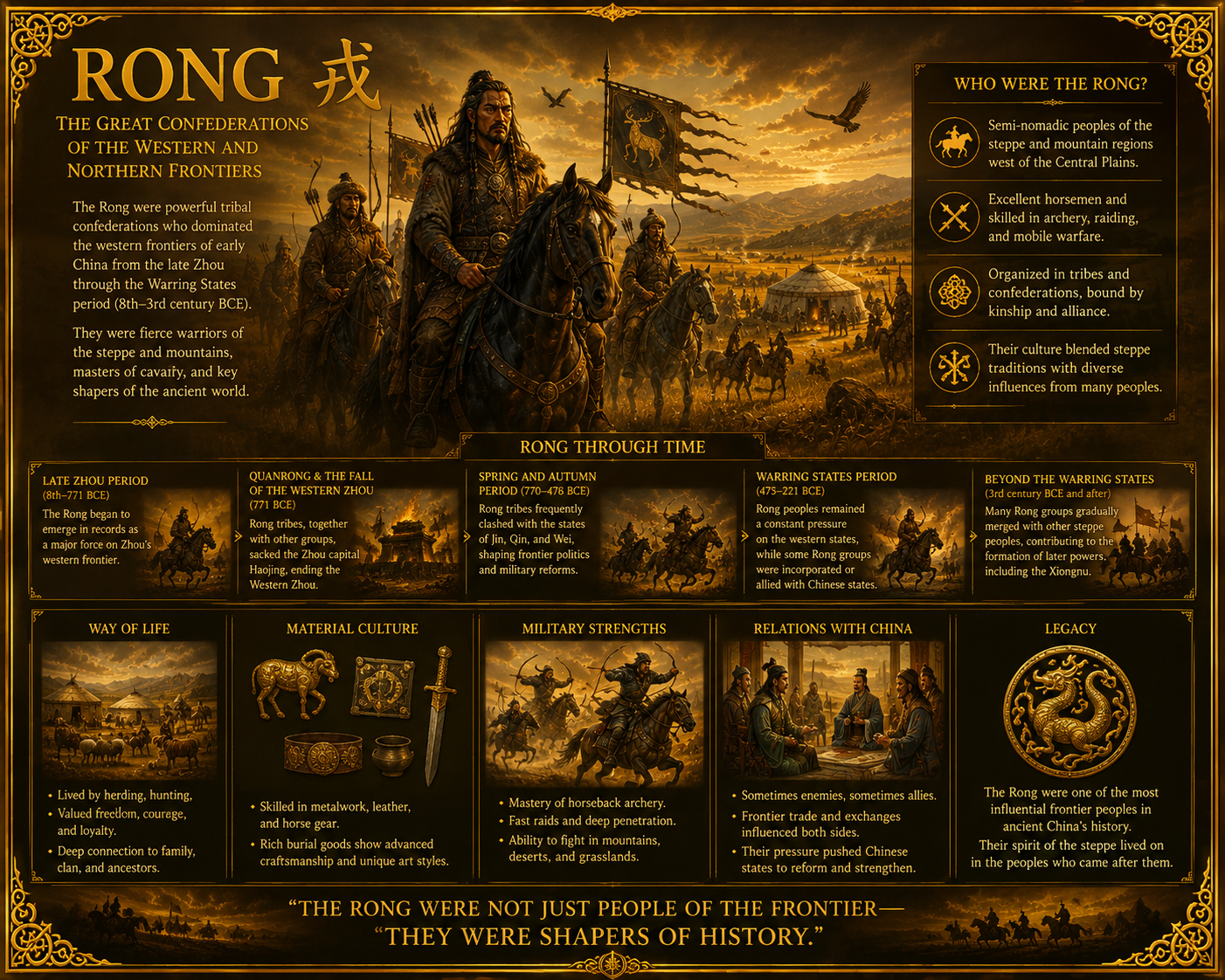
Rong (戎) was a broad and changing designation used in ancient Chinese historical traditions for a variety of peoples and political communities associated particularly with the western and northern frontier regions of the Zhou world. The term should not be understood as the name of a single tribe or unified ethnic population. Rather, it encompassed different groups whose political identities, economies, and relationships with the Central Plains varied across time and place. In this respect, the Rong belonged to the wider historical world of the Northern Frontier—a zone in which settled agricultural states, mobile and pastoral communities, highland societies, and other regional populations interacted through warfare, migration, exchange, alliance, and political competition.
The Northern Frontier of the Zhou period was not a fixed boundary separating a settled “Chinese” civilization from a single external nomadic world. It was a broad and changing region extending through the mountains, grasslands, highlands, and transitional environments surrounding the Central Plains. Communities living within this frontier operated under different ecological and economic conditions, and some combined pastoralism, hunting, agriculture, and other forms of production. Their mobility and military capabilities made them significant political actors, while their proximity to the Central Plains also created sustained channels of communication and exchange. Archaeological evidence increasingly demonstrates that the relationship between the Central Plains and northern societies involved not only warfare but also the movement of technologies, goods, artistic traditions, and cultural practices.
Within this larger frontier system, the various peoples designated as Rong became increasingly important during the Western Zhou period. Their interactions with the Zhou were frequently recorded through the language of warfare and political opposition, but such descriptions reflect the perspectives of states located within the Central Plains political order. Later Chinese historiography often portrayed peoples such as the Rong and Di through strongly negative cultural stereotypes, characterizing them as outsiders or barbarians. Modern scholarship has cautioned against accepting these descriptions as transparent representations of the societies themselves. The category “Rong” was partly a product of how Central Plains states classified populations beyond or at the margins of their political and cultural order.
The importance of the Rong therefore cannot be reduced to their role as military opponents. They were participants in a wider frontier political system whose boundaries were constantly changing. The history of the Western Zhou was shaped not only by the expansion and organization of royal authority within the Central Plains, but also by the dynasty’s continuing interaction with the peoples of the north and northwest. Li Feng’s study of the Western Zhou emphasizes that repeated conflicts with northern and northwestern peoples, particularly the Xianyun and later the Quanrong, formed part of the long-term strategic pressures confronting the Zhou state.
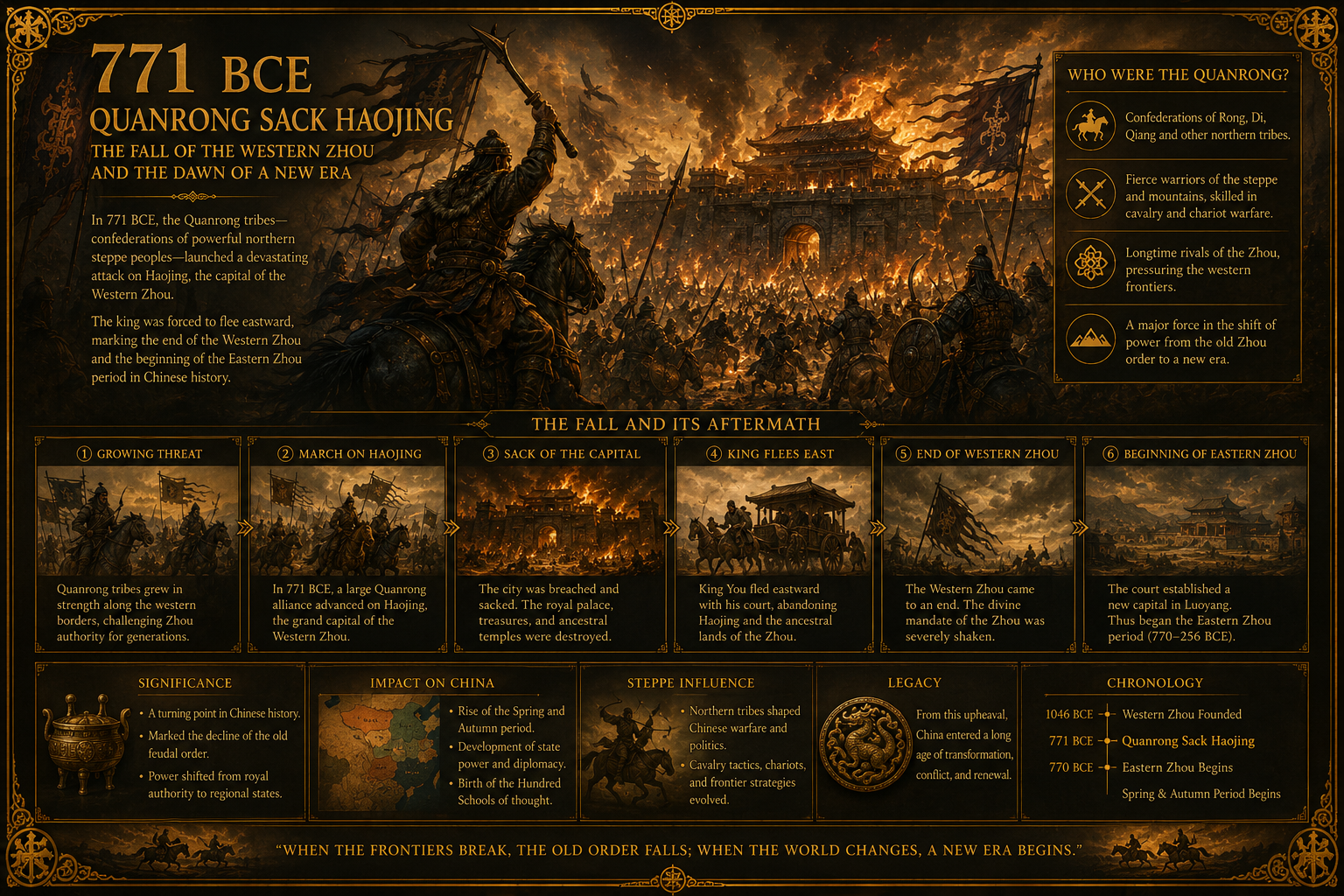
The crisis of 771 BCE illustrates the historical importance of this frontier relationship. In that year, the Quanrong entered the Wei River region, attacked the Zhou centers at Feng and Hao, and King You of Zhou was killed. The Western Zhou political order consequently collapsed, and the Zhou court was subsequently re-established farther east at Luoyi. The event was therefore not simply a military raid by an outside people; it became a major transformation of the geopolitical structure of early China. The relocation of the Zhou court marked the transition from the Western Zhou to the Eastern Zhou period and exposed the strategic vulnerability of the old Zhou heartland.
The relationship between the Rong and the Zhou should consequently be understood within the longer history of the Northern Frontier, rather than through the older opposition between “civilization” and “barbarism.” The frontier was a historical zone in which political communities were formed, transformed, divided, absorbed, and reconstituted over generations. Some groups disappeared from the written record under one name only to be represented later under another; others entered into alliances, migrated, intermarried, adopted new technologies, or became incorporated into expanding states. The evidence does not support treating the various Rong communities as a single continuous ethnic population, but it does reveal the persistence of a northern and northwestern frontier environment that repeatedly influenced the political development of the Central Plains.
In this broader perspective, Rong represents another stage in the long history of the Northern Frontier. Following the earlier frontier communities recorded under names such as Guifang, the peoples identified as Rong appear within a later political landscape in which the relationship between the Central Plains and its northern and western neighbors had become increasingly complex. The names and political formations changed, but the fundamental frontier dynamic remained: mobility, pastoral and mixed economies, warfare, exchange, alliance, and political negotiation connected the societies of the northern regions with the agricultural states of the Central Plains.
AUTHOR’S THESIS: The historical significance of the Rong lies not in the existence of a single “Rong people,” but in the emergence of a long-duration Northern Frontier political environment in which numerous communities interacted with the Zhou world. The Rong were therefore one of several historical expressions of this frontier system. Their appearance in Zhou history demonstrates that the Northern Frontier was not a peripheral space standing outside the development of early China; it was an active zone of political competition, cultural exchange, and historical transformation that could, at decisive moments, reshape the political order of the Central Plains itself.
THE FALL OF HAOJING: A CLASH BETWEEN TWO WORLDS
In 771 BCE, the political order of the Western Zhou reached a decisive crisis when forces associated with the Quanrong and their allies attacked the Zhou heartland, overran the royal centers of the Wei River valley, and killed King You of Zhou. The event brought the Western Zhou political order to an end and was followed by the eastward relocation of the Zhou royal court, marking the beginning of what historians call the Eastern Zhou period. Yet the significance of 771 BCE extended far beyond the destruction of a royal capital. It exposed a fundamental confrontation between the Central Plains political world, organized around settled agriculture, royal authority, ritual institutions, and territorial administration, and the diverse societies of the Northern and Northwestern Frontier, where mobility, pastoral and mixed economies, regional alliances, and different forms of political organization shaped social and military life.
The distinction, however, should not be understood as a simple opposition between two completely separate civilizations. The Northern Frontier was not a fixed border inhabited by a single “nomadic people,” just as the Central Plains was not a politically uniform territory. It was a broad zone of interaction in which mobile communities, regional states, highland societies, and agricultural populations encountered one another through warfare, migration, trade, alliance, and political negotiation. Modern scholarship increasingly emphasizes this complexity, treating the northern frontier as a historically dynamic region rather than merely the external margin of the Central Plains world.
What made 771 BCE particularly consequential was that this frontier pressure penetrated directly into the heartland of Zhou royal power. The Wei River valley had been the geographical and political center of the Western Zhou kingdom. When the royal capitals were attacked and King You was killed, the Zhou court could no longer maintain its previous position in the region. The subsequent movement of the royal court eastward was therefore not simply an administrative relocation. It represented the breakdown of the geographical foundation upon which Western Zhou royal authority had been organized.
The event can consequently be understood as a major historical encounter between two different political and ecological worlds. On one side stood the Zhou royal order of the Central Plains, whose power rested upon agricultural production, walled settlements, ritual hierarchy, hereditary political relationships, and the authority of the Zhou king. On the other stood the diverse peoples and political communities of the Northern Frontier, whose societies developed within environments where mobility, pastoralism, hunting, warfare, and shifting alliances could play a much greater role. These were not two completely isolated worlds: they had interacted for generations. But in 771 BCE, the relationship between them produced a military crisis powerful enough to overturn the established political geography of the Zhou realm.
The fall of Haojing therefore illustrates an important principle in the history of the Northern Frontier: the frontier was not merely a peripheral zone existing outside the history of the Central Plains. It was an active historical environment whose peoples could influence, disrupt, and reshape the political order of the states to their south and east. The Western Zhou collapse demonstrated that the balance between the settled political centers and the societies of the northern and western frontier was not permanently fixed.
At the same time, 771 BCE should not be interpreted as the moment when a unified “nomadic world” defeated a unified “Chinese civilization.” The evidence points instead to a complex political confrontation involving frontier forces and Zhou regional actors, within a broader process of internal political weakening that had already developed before the final crisis. The attack was therefore both a frontier conflict and a crisis within the Zhou political order itself.
AUTHOR’S THESIS: The fall of Haojing in 771 BCE represents one of the clearest early historical manifestations of the tension between the Central Plains political order and the Northern Frontier world. It demonstrates that the frontier was not an empty space beyond civilization, but a dynamic historical zone with its own political communities, economic systems, military capabilities, and networks of alliance. The collapse of the Western Zhou was consequently not simply the fall of a capital; it marked a profound reconfiguration of the relationship between the settled Central Plains and the mobile societies of the Northern Frontier, opening a new phase in the political history of East Asia.
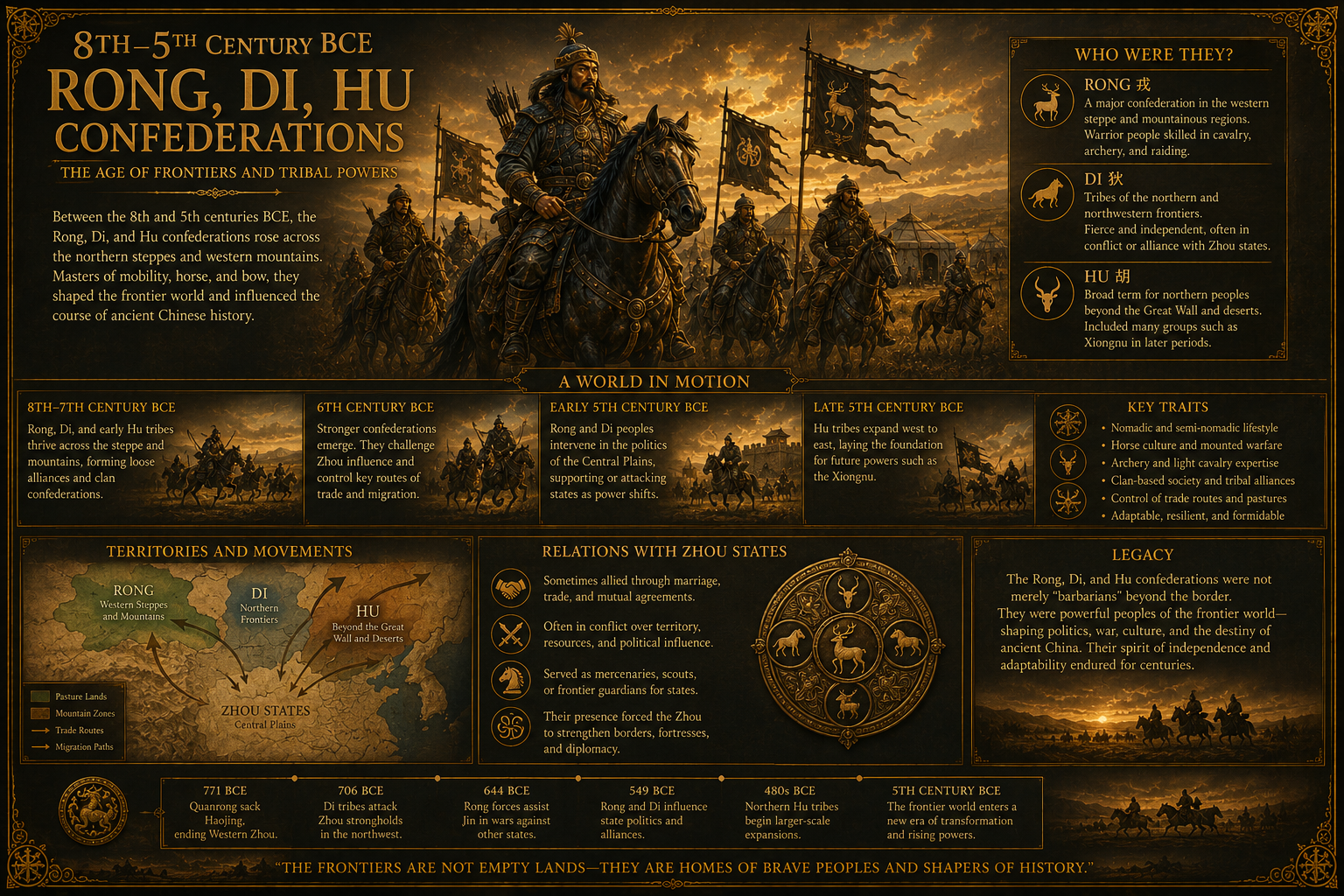
RONG, DI, AND HU: THE NORTHERN NOMADIC FRONTIER
Rong (戎), Di (狄), and Hu (胡) were not the names of three single and continuous ethnic peoples, but broad and changing categories through which ancient Chinese sources identified different communities living along the western, northern, and northeastern margins of the Central Plains. Their meanings changed across periods and regions, and the surviving written sources primarily preserve the perspective of the states that recorded them. Nevertheless, these terms provide important evidence for the emergence and transformation of the Northern Frontier, a broad historical zone in which agricultural states of the Central Plains interacted with mobile pastoral, agro-pastoral, highland, and steppe-oriented societies.
During the Eastern Zhou period, the Northern Frontier was not a fixed political boundary. It was a fluid zone of movement and interaction extending through grasslands, mountains, river valleys, and ecological transition zones north and west of the Central Plains. Communities within this world followed different economic strategies, including pastoralism, agro-pastoralism, hunting, and agriculture, while mobility and control of livestock, horses, and strategic corridors could provide important political and military advantages. The frontier therefore cannot be reduced to a simple line separating “China” from a unified nomadic world. It was instead a changing geographical and cultural environment in which different societies continuously encountered one another.
The Rong were particularly associated with the western and northwestern frontier. Ancient sources applied the term to numerous communities rather than to a single political or ethnic group. Archaeological and historical evidence indicates considerable diversity among these populations: some practiced pastoralism, others agro-pastoralism, and some lived in substantially agricultural communities. Certain western frontier societies nevertheless developed strong horse-breeding, chariot, and warrior traditions, demonstrating the close relationship between the frontier environment and the development of military cultures.
The Di, similarly, represented a range of northern frontier communities whose relationships with the Zhou states included warfare, diplomacy, migration, alliance, and political incorporation. Their history illustrates that the Northern Frontier was not simply a region from which enemies periodically entered the Central Plains. Frontier peoples could establish political relationships with Central Plains states, participate in regional power struggles, control territory, and influence the political development of the states with which they interacted. The distinction between “inside” and “outside” was therefore continually being negotiated rather than permanently fixed.
The term Hu (胡) belongs to a somewhat later stage in this historical development and eventually became a broad designation for peoples associated with the northern steppe. By the fifth and fourth centuries BCE, Chinese sources increasingly encountered societies characterized by pastoral mobility, mounted warfare, and archery. In this context, the Hu became particularly associated with the emerging horse-riding nomadic cultures of the Northern Frontier. Nicola Di Cosmo has emphasized that these mounted pastoral societies represented an important transformation in the military and political character of the northern frontier.
This development is particularly significant because pastoral nomadism and mounted warfare did not appear suddenly as a fully formed system. The Northern Frontier had already been a zone of interaction between mobile communities and settled agricultural societies for centuries. Over time, ecological adaptation, pastoral economies, horse breeding, technological change, warfare, and political organization contributed to the emergence of increasingly mobile and militarized steppe societies. Thus, the history of the Hu should be placed within the longer transformation of the Northern Frontier rather than treated as an entirely new phenomenon disconnected from the earlier histories of the Rong and Di.
The relationship between these frontier peoples and the Central Plains was consequently characterized by both conflict and exchange. Warfare was certainly fundamental, but archaeological evidence also demonstrates extensive movement of technologies, artistic forms, weapons, horses, metalworking traditions, and other cultural practices across the frontier. The boundary between the steppe and the agricultural world was therefore not impermeable. Ideas, technologies, goods, people, and political practices moved in both directions.
From this perspective, Rong, Di, and Hu represent successive and overlapping historical expressions of the Northern Frontier rather than three stages of a single ethnic lineage. The names changed because the political landscape changed. Communities divided and regrouped; new alliances emerged; populations migrated and interacted; and new forms of political organization developed. What provides historical continuity is therefore not necessarily a single people carrying one identity through the centuries, but the persistence of a broad Northern Nomadic Frontier in which mobile and pastoral societies increasingly became major political and military actors.
The Northern Nomadic Frontier should therefore be understood as more than a geographical margin. It was a historical system shaped by mobility, pastoral production, horse culture, warfare, kinship and clan organization, regional alliances, exchange networks, and interaction with the agricultural states of the Central Plains. Its peoples were not simply outsiders standing beyond the borders of early China. They were active participants in the formation of the political and military order of ancient East Asia.
AUTHOR’S THESIS: The history of the Rong, Di, and Hu reveals the gradual transformation of the Northern Frontier from a diverse zone of frontier communities into an increasingly powerful Northern Nomadic Frontier, where pastoral mobility, horse culture, mounted warfare, and steppe political organization acquired growing historical importance. The Central Plains and the Northern Frontier were therefore not two isolated worlds. They developed through continuous confrontation, adaptation, exchange, and mutual influence, and the political history of ancient East Asia cannot be fully understood without considering both sides of this frontier system.
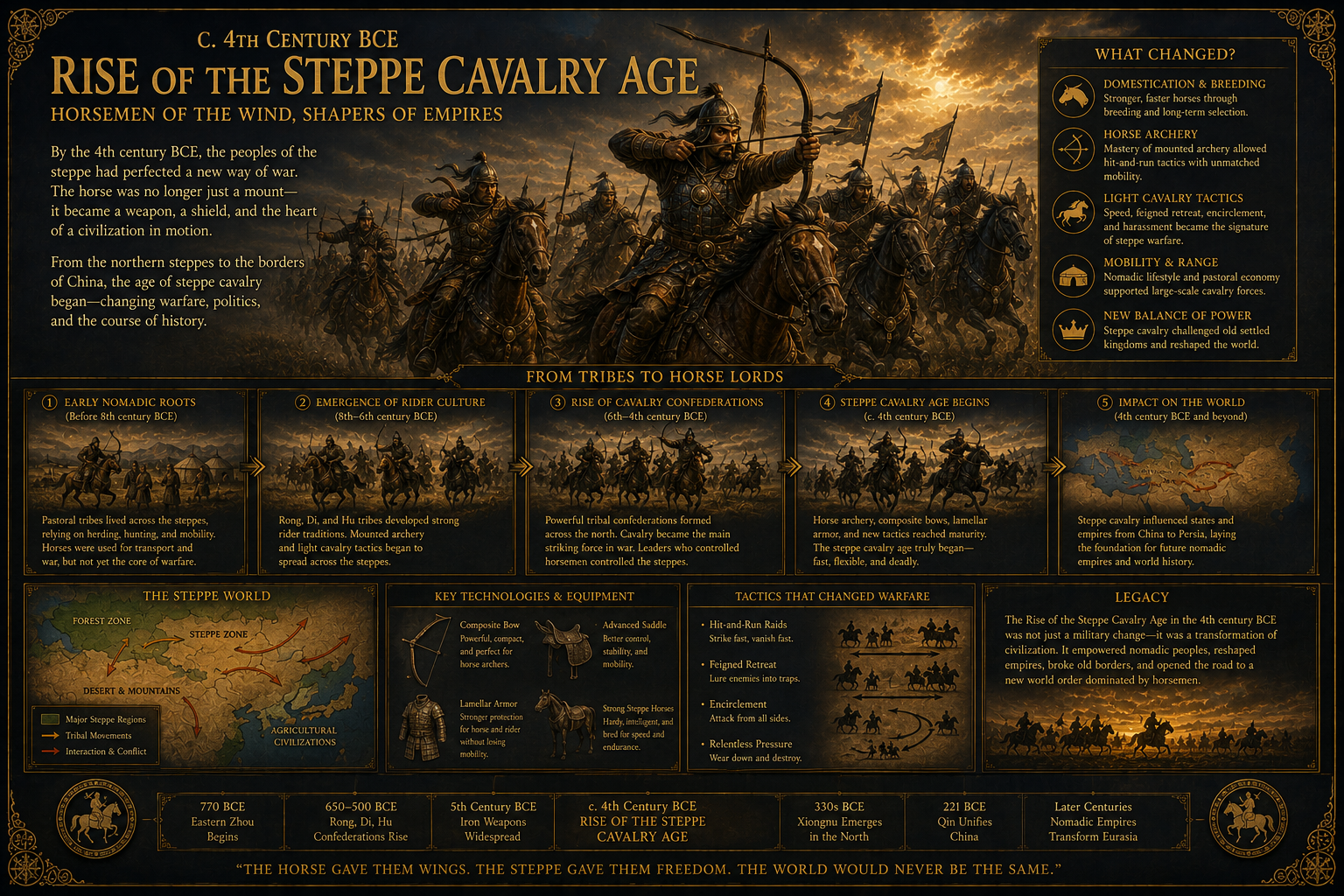
The Rise of the Steppe Cavalry Age.
By the fourth century BCE, the Northern Frontier had entered a new stage in its historical development. The horse was no longer simply an important element of pastoral life or transport; in many frontier societies it had become increasingly central to warfare, political authority, mobility, and the organization of power. The development of mounted warfare transformed the strategic possibilities of societies living across the northern steppe and its adjoining ecological zones. Mounted archers could move rapidly across great distances, sustain military operations beyond the reach of slower armies, and combine pastoral mobility with military organization. In this environment, the horse became not merely an instrument of war, but one of the material foundations upon which a distinctive Northern Nomadic Frontier political order could develop.
This transformation did not represent the sudden appearance of an entirely new people. The emergence of mounted nomadic societies in the fourth century BCE should instead be understood within a much longer history of interaction among the peoples of the Northern Frontier. Earlier communities identified in Chinese sources as Rong, Di, and Hu had already participated in frontier systems characterized by mobility, pastoral production, warfare, exchange, and political alliance. Archaeological evidence likewise demonstrates that the northern regions had long been a zone of interaction between mobile communities and the agricultural societies of the Central Plains. What changed during the Warring States period was the scale and political significance of these developments.
The rise of mounted warfare also altered the relationship between mobility and political power. A pastoral society possessing large herds of horses and experienced mounted warriors could mobilize military forces over distances that were difficult for predominantly infantry-based armies to match. Horsemanship, archery, knowledge of the steppe environment, and the ability to sustain people and animals through mobile pastoral economies created a distinctive combination of military and economic resources. The resulting military advantage was not simply tactical. It could be translated into political influence when military leaders were able to bring different clans, lineages, and local communities into larger alliances. The Northern Frontier thus provided an environment in which pastoral mobility and political organization could reinforce one another.
The political structures that emerged from this environment should not, however, be described as disorganized tribal societies standing outside the concept of statehood. The history of Inner Asia demonstrates that pastoral populations could develop hierarchical political institutions, military command structures, systems of allegiance, and large-scale confederations. Later steppe empires provide the clearest evidence of this development. In the Xiongnu case, for example, political authority operated at several levels, combining an imperial ruling lineage, regional commanders, and indigenous tribal leaders. Such arrangements allowed a large number of pastoral communities to retain local leadership while participating in a wider political and military system.
This distinction is important because nomadic society and political organization were not opposites. The mobility of pastoral communities did not prevent political centralization; under particular historical conditions, it could facilitate the creation of large military confederations. The political challenge was to transform numerous kin-based and clan-based groups, each possessing their own leaders and interests, into a coordinated military and diplomatic structure. Steppe political formations therefore developed mechanisms for distributing authority, organizing military forces, maintaining alliances, and incorporating subordinate groups. The resulting political systems were different from the territorial bureaucratic states of the Central Plains, but they were nevertheless capable of exercising authority over extensive territories and populations.
The Northern Nomadic Frontier, therefore, should not be understood merely as a geographical region inhabited by horse-riding peoples. By the late first millennium BCE, it had become an increasingly important political and military environment in its own right. Mobility, pastoral production, horse culture, mounted warfare, clan organization, and alliance-building provided the material and social foundations from which larger political formations could emerge. The frontier was consequently not simply reacting to the states of the Central Plains; it was developing its own forms of political power and its own strategies for managing internal cohesion and external relations.
The emergence of the Xiongnu in the late third century BCE represents the next major stage in this longer development. The Xiongnu did not simply appear from nowhere, nor can they be identified as the direct ethnic descendants of every earlier population known from the Northern Frontier. Rather, the Xiongnu emerged within a frontier environment that had already experienced centuries of political, economic, technological, and military transformation. By the time of their formation, steppe societies possessed traditions of pastoral mobility and mounted warfare that could be reorganized on a much larger political scale. The Xiongnu subsequently demonstrated that a pastoral-based political system could unite numerous communities into a powerful steppe confederation extending across a vast portion of Inner Asia.
Seen from this longer perspective, the Steppe Cavalry Age was therefore not a sudden military revolution detached from earlier history. It was a stage in the continuing transformation of the Northern Frontier. The horse connected economy, mobility, warfare, and political authority; mounted warriors provided the military force through which alliances could be enforced and expanded; and clan and lineage structures provided the social foundations from which larger confederations could be constructed. The result was a political environment in which nomadic mobility could coexist with highly organized military and state structures.
AUTHOR’S THESIS
The rise of steppe cavalry should be understood as a transformation in the political organization of the Northern Nomadic Frontier, not merely as an improvement in warfare. The horse gave mobile pastoral societies an exceptional combination of speed, military reach, and ecological adaptability, while clan and lineage structures provided the social foundations for organizing increasingly large military coalitions. Over time, these elements could be integrated into hierarchical political systems capable of governing extensive territories and diverse populations. The later emergence of the Xiongnu therefore represents not the beginning of steppe political organization, but a major historical culmination of processes that had developed across the Northern Frontier for centuries.
Mediterranean World (c. 3rd–2nd century BCE) — The Roman Republic expanded rapidly after the Punic Wars and became the dominant power of the Mediterranean.
Hellenistic World (c. 3rd–2nd century BCE) — The successor kingdoms of Alexander the Great continued ruling Egypt, Syria, and parts of Asia through Greek-influenced states.
Egypt (c. 3rd–2nd century BCE) — Ptolemaic Kingdom remained a major center of trade, scholarship, and Mediterranean politics.
Mesopotamia and Persia (c. 3rd–2nd century BCE) — The Parthian Empire rose in Iran and challenged Hellenistic influence across the Near East.
South Asia (c. 3rd–2nd century BCE) — The Maurya Empire reached its height under Ashoka and spread Buddhism across Asia.
Europe (c. 3rd–2nd century BCE) — Celtic tribes dominated large parts of western and central Europe while Rome gradually expanded northward.
Northern Europe (c. 3rd–2nd century BCE) — Germanic and Scandinavian tribal societies remained decentralized, relying upon farming, herding, and regional trade.
Africa (c. 3rd–2nd century BCE) — The Kingdom of Kingdom of Kush flourished along the Upper Nile and maintained regional power south of Egypt.
East Africa (c. 3rd–2nd century BCE) — Maritime exchange networks across the Red Sea and Horn of Africa expanded connections between Africa, Arabia, and India.
China (c. 3rd–2nd century BCE) — The Qin dynasty unified China in 221 BCE, followed by the rise of the Han dynasty and the emergence of the Xiongnu Confederation.
Mesoamerica (c. 3rd–2nd century BCE) — Early urban centers and ceremonial cultures expanded in Mesoamerica before the Classical Maya period.
North America (c. 3rd–2nd century BCE) — Indigenous societies developed regional trade systems, earthworks, and agricultural traditions across different ecological zones.
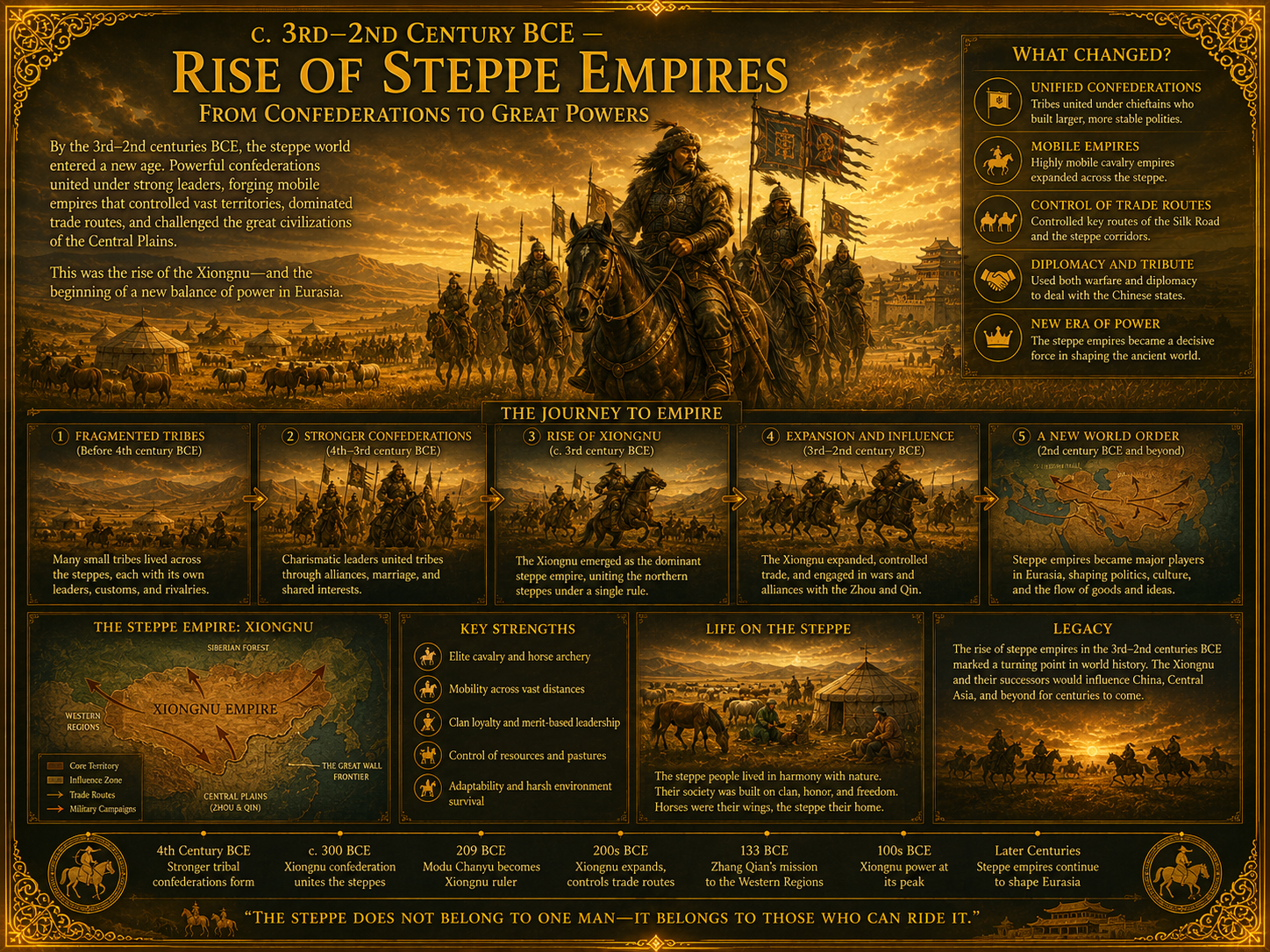
XIONGNU CONFEDERATION: THE EMERGENCE OF A STEPPE EMPIRE (HUNNU)
The emergence of the Xiongnu (匈奴) in the late third century BCE represents a decisive stage in the long historical development of the Northern Nomadic Frontier. The Xiongnu did not appear in an empty historical landscape, nor should their emergence be understood as the sudden arrival of a completely new people. Rather, the formation of the Xiongnu political order occurred within a Northern Frontier that had already undergone centuries of economic, technological, military, and political transformation. From the earlier frontier communities remembered in the traditions surrounding Jiuli and Chi You, through the peoples recorded in Shang sources as Guifang, and later through the diverse communities classified in Zhou-period sources as Rong, Di, and Hu, the northern regions had developed distinctive traditions of mobility, pastoral production, horse culture, warfare, alliance, and political organization. The identities and political formations of these populations changed over time, and the surviving evidence does not establish a simple ethnic or genealogical continuity between them. What persisted was the broader frontier environment in which mobile and pastoral societies interacted with the settled states of the Central Plains and gradually developed increasingly complex forms of political power.
By the late first millennium BCE, important transformations had taken place within this frontier environment. Horse-riding, mounted archery, pastoral mobility, and increasingly sophisticated military organization gave steppe societies strategic capabilities that could be translated into political power on a much larger scale. The Northern Frontier was no longer simply a zone populated by numerous small communities interacting individually with neighboring agricultural states. Under particular historical conditions, leaders could bring multiple clans, lineages, and regional groups into wider military and political alliances. The emergence of such larger formations represented a fundamental transformation in the relationship between mobility and political authority. The ability to move rapidly across the steppe, maintain mounted forces, control pasture and livestock, and coordinate military campaigns over considerable distances created the material foundations for political structures that differed from the sedentary territorial states of the Central Plains but were nevertheless capable of exercising authority over extensive regions.
It was within this historical environment that Modu Chanyu (Maodun) emerged as the central figure in the formation of the Xiongnu imperial confederation. Around the end of the third century BCE, Modu succeeded in consolidating a large political and military coalition on the eastern Eurasian steppe. The Xiongnu subsequently controlled a vast territory extending across Mongolia and neighboring regions, while establishing a sustained political relationship with the Han dynasty to the south. Modern scholarship describes the Xiongnu as the first historically documented imperial-scale polity of the eastern Eurasian steppe, although the precise terminology used to describe its political structure varies among scholars. Archaeological and historical evidence indicates that it was a complex, multiethnic political formation rather than a homogeneous nation or tribe.
The political organization of the Xiongnu is particularly significant for understanding the development of the Northern Nomadic Frontier. Their political system was not based upon the same institutional foundations as the territorial bureaucratic states of the Central Plains. Authority was instead organized through a hierarchy centered on the Shanyu, supported by an aristocratic ruling structure and a network of subordinate leaders and communities. Local and regional elites retained important authority while participating in a wider political system capable of coordinating military campaigns, diplomacy, external relations, and the distribution of resources. This demonstrates that pastoral mobility did not prevent the emergence of hierarchical political organization. On the contrary, under certain historical circumstances, the mobility of steppe society could be incorporated into a large-scale political structure.
The Xiongnu economy likewise demonstrates why the old opposition between “nomads” and “civilization” is historically inadequate. The Xiongnu economy was predominantly pastoral, but archaeological research has demonstrated that it was not exclusively dependent upon a simple mobile herding economy. Cultivation, craft production, settlement networks, long-distance exchange, and the acquisition of goods from neighboring regions formed part of the broader economic system. Excavations in Mongolia have revealed settlement hierarchies and evidence of agricultural activity, demonstrating that Xiongnu society was economically more complex than the traditional image of a completely mobile population might suggest.
The relationship between the Xiongnu and the Han dynasty further illustrates the political significance of the Northern Frontier. The Xiongnu were not simply a population living beyond the northern borders of China and occasionally attacking settled communities. They constituted a major political power whose rulers negotiated, fought, exchanged, and competed with the Han state. Their relationship with Han China formed part of a larger frontier system in which warfare, diplomacy, trade, tribute, and the movement of people and resources were closely interconnected. Thomas Barfield has emphasized that the imperial level of Xiongnu government was particularly concerned with foreign affairs, military organization, and maintaining political unity across the steppe, while considerable authority in domestic affairs remained with indigenous tribal leaders.
This political structure is important because it demonstrates how the clan-based organization of steppe society could become a foundation for imperial-scale political integration. The Xiongnu did not eliminate local identities and leadership structures in order to create political unity. Instead, the imperial system incorporated diverse communities while maintaining a hierarchy of authority above them. In this respect, the Xiongnu political model represents a significant stage in the historical development of Inner Asian state formation: political unity could be achieved without abandoning the mobility, pastoral economy, kinship structures, and regional leadership traditions that characterized steppe society.
The Xiongnu therefore represent both continuity and transformation within the Northern Frontier. They were not simply the same people previously identified as Guifang, Rong, Di, or Hu, and the surviving evidence does not justify constructing a single uninterrupted ethnic lineage from those earlier names to the Xiongnu. Yet neither were they historically disconnected from the earlier frontier world. Their political institutions, military capabilities, economic foundations, and cultural practices developed within a Northern Frontier environment that had been transformed over many centuries. The names changed, populations moved and mixed, political alliances were reorganized, and new forms of authority emerged, but the historical environment itself continued to generate new political formations. Modern archaeological and genetic research likewise emphasizes the heterogeneous composition of Xiongnu society rather than a single homogeneous population.
In this broader historical sequence, the Xiongnu mark a fundamental transition. Earlier Northern Frontier societies had demonstrated mobility, pastoral production, warfare, horse culture, and regional political organization. The Xiongnu brought many of these elements together within a large-scale imperial confederation capable of coordinating numerous communities across an extensive portion of Inner Asia. The result was not merely a stronger tribe or a larger alliance, but a new level of political organization in which steppe mobility itself became one of the foundations of imperial power.
The significance of the Xiongnu therefore extends beyond their conflict with Han China. Their emergence demonstrates that the Northern Nomadic Frontier had developed its own forms of complex political organization. The steppe was not merely a peripheral region responding to the expansion of agricultural civilizations. It could generate powerful political systems from its own ecological conditions, economic practices, social institutions, and military traditions. The Xiongnu became the clearest early historical expression of this process.
AUTHOR’S THESIS
The historical importance of the Xiongnu Confederation lies in the fact that it represents a major culmination of the long transformation of the Northern Frontier into a politically organized steppe world. From the distant frontier traditions associated with Jiuli and Guifang, through the changing communities designated as Rong, Di, and Hu, and through the development of horse-based pastoralism and mounted warfare, the Northern Frontier underwent a prolonged process of political differentiation and consolidation. The Xiongnu did not inherit a single ethnic identity from all of these earlier peoples; rather, they emerged from the historical environment created by centuries of frontier interaction and transformation.
With the rise of the Xiongnu, the peoples of the steppe entered the historical record at a new political scale: not merely as scattered frontier communities or military opponents of settled kingdoms, but as a large, organized, multiethnic steppe polity capable of exercising imperial power across Inner Asia. This was one of the decisive moments in the history of the Northern Nomadic Frontier, and it established a political tradition that would profoundly influence the subsequent history of the Eurasian steppe.
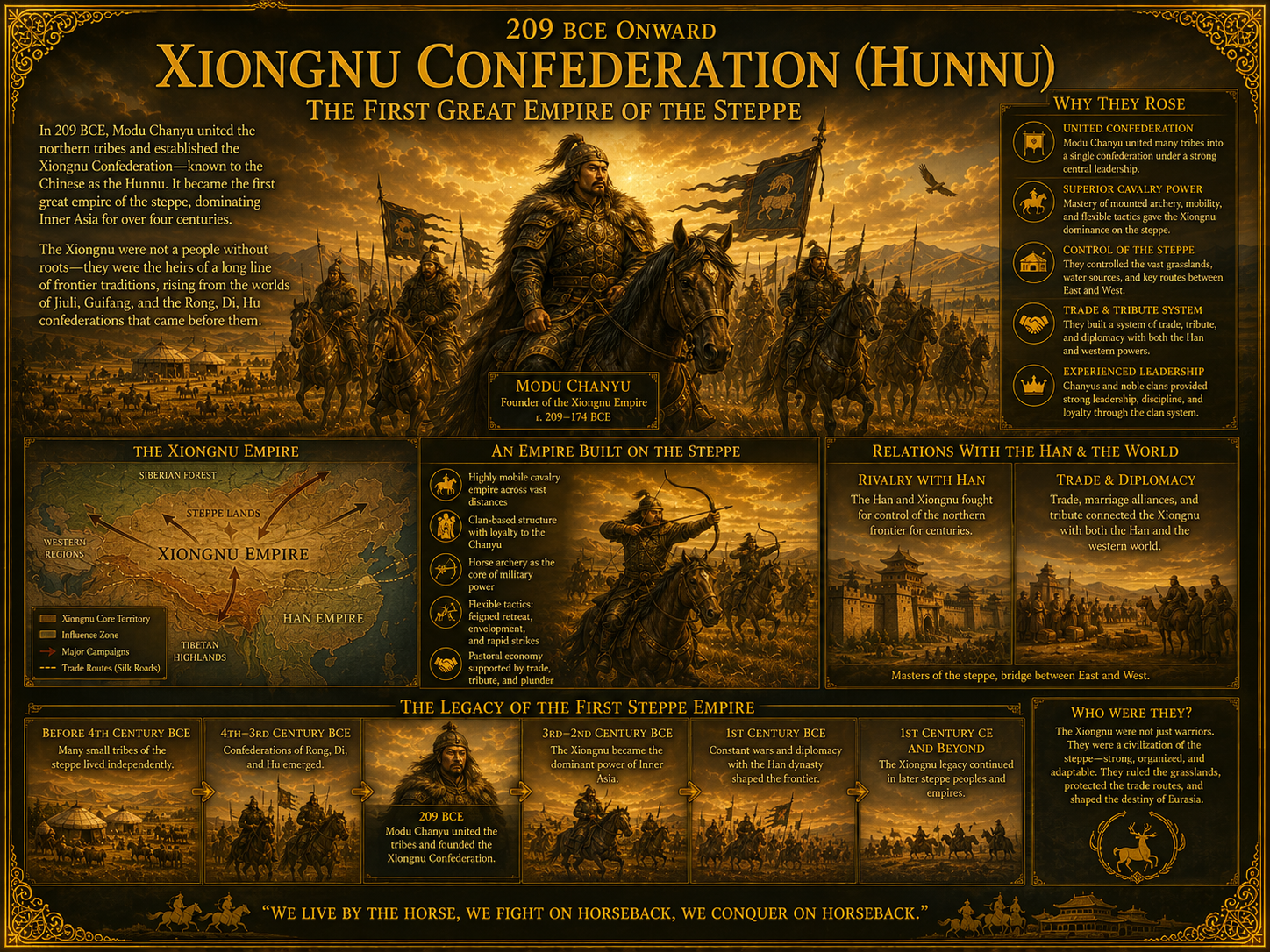
The Xiongnu–Han Wars
THE NORTHERN NOMADIC FRONTIER AND THE SETTLED WORLD
The Xiongnu–Han wars were not simply a prolonged confrontation between two civilizations that had only recently encountered one another. By the second century BCE, the relationship between the Northern Nomadic Frontier and the settled political world of the Central Plains already rested upon centuries of interaction involving warfare, migration, trade, diplomacy, tribute, marriage alliances, and the movement of people and technologies. The rise of the Xiongnu transformed this relationship by bringing a large and highly organized steppe polity into sustained competition with the Han dynasty. What followed was therefore not merely a border war, but an extended struggle between two different systems of political organization whose societies had already become deeply interconnected.
The Xiongnu and Han represented contrasting ecological and political environments, but the distinction between them should not be understood as an absolute separation. The Han state was based primarily upon settled agriculture, cities, territorial administration, taxation, fortified settlements, and large-scale bureaucratic institutions. The Xiongnu political order, by contrast, was rooted in pastoral mobility, livestock economies, horse culture, mounted warfare, clan and lineage relationships, and a hierarchical confederation capable of coordinating diverse communities across the steppe. These differences gave each power distinct strategic advantages. The Han could draw upon agricultural surpluses, densely populated territories, fortified positions, organized taxation, and large logistical systems, while the Xiongnu could exploit mobility, extensive pasturelands, mounted archery, dispersed settlement patterns, and the ability to concentrate or withdraw forces rapidly across enormous distances.
Yet these differences did not prevent sustained interaction. On the contrary, they created a system of mutual dependence as well as competition. The agricultural economies of the Central Plains produced grain, textiles, metal goods, and manufactured products desired by steppe elites, while the northern pastoral world possessed horses, livestock, hides, and access to wider networks of Inner Asian exchange. The frontier therefore functioned as an economic interface as much as a military boundary. Periods of warfare were repeatedly followed or accompanied by negotiations, exchanges, and arrangements intended to regulate the movement of goods and people. The famous heqin marriage arrangements between the Han court and the Xiongnu illustrate precisely this complexity: marriage diplomacy existed alongside military conflict and was part of a broader strategy of managing relations between the two powers rather than evidence of a simple division between permanent enemies.
The military conflict itself emerged from this wider frontier system. The Han court increasingly sought to reduce the strategic pressure created by Xiongnu power along the northern frontier, while the Xiongnu sought to preserve their political authority, economic access, and strategic position across the steppe. Neither side could simply eliminate the other. The Han’s agricultural and logistical infrastructure allowed it to sustain major military expeditions, construct and maintain defensive systems, and project power into frontier regions. The Xiongnu, however, possessed a fundamentally different military geography. Their forces could operate across open terrain without depending upon permanent roads, fortified supply stations, or densely settled agricultural bases to the same degree as Han armies. Their mobility made it possible to avoid unfavorable engagements, strike vulnerable targets, disrupt communications, and withdraw into the steppe when necessary.
This contrast illustrates a broader feature of the Northern Nomadic Frontier. Nomadic mobility was not merely a cultural characteristic or a consequence of pastoral subsistence. Under conditions of organized political authority, it could become a military and strategic system. The same horse that supported pastoral movement also provided the basis for reconnaissance, rapid concentration of forces, mounted archery, long-distance campaigning, and communication across enormous territories. Xiongnu political organization therefore connected economic mobility with military mobility and, ultimately, with political power.
At the same time, the Han state adapted to the military realities of the Northern Frontier. Han rulers increasingly expanded their cavalry capabilities, developed frontier settlements and military colonies, constructed defensive infrastructure, and sought access to regions that could provide horses and strategic routes. The interaction between Han and Xiongnu therefore produced mutual adaptation. The settled empire changed its military practices in response to the steppe power, while the Xiongnu political system likewise operated within an international environment shaped by the existence of powerful agricultural states to the south. The frontier was consequently not a one-directional encounter in which one civilization influenced the other; both political systems were transformed through prolonged interaction.
The conflict also demonstrates why the older distinction between “civilized” and “barbarian” is inadequate as a framework for understanding Inner Asian history. Han historical sources naturally described the Xiongnu from the perspective of the imperial state, just as earlier Zhou sources had described the Rong and Di from the perspective of the Central Plains. Such categories reflected political and cultural boundaries constructed by the settled states themselves. Historically, however, the Xiongnu possessed their own political hierarchy, diplomatic practices, economic networks, military institutions, and mechanisms for governing a vast and diverse population. They were not simply an external population living beyond the Chinese frontier; they were one of the major political powers of Inner Asia.
The relationship between the Xiongnu and Han also demonstrates that warfare and exchange were not mutually exclusive. The two powers could be military enemies while simultaneously maintaining diplomatic communication and economic relations. Raiding and negotiation, warfare and trade, marriage diplomacy and strategic competition could exist within the same political relationship. This pattern was characteristic of the broader Northern Frontier system, where settled states and mobile pastoral powers were connected through both conflict and cooperation. The frontier was therefore not simply a line of military confrontation but a zone through which political, economic, technological, and cultural processes continuously moved.
Seen from the longer perspective of the Northern Frontier, the Xiongnu–Han wars represented a new stage in an already ancient historical relationship. The frontier traditions associated with Jiuli and Guifang, followed by the changing communities identified as Rong, Di, and Hu, had developed over many centuries before the emergence of the Xiongnu. By the time the Xiongnu confronted the Han, the distinction between the steppe and the settled world was already an established political reality—but so too was their interdependence. The Xiongnu–Han conflict therefore did not create the relationship between nomadic and settled societies. It transformed an older frontier relationship into an interstate and imperial-scale struggle.
The significance of the conflict consequently extends far beyond the military history of Han China and the Xiongnu. It demonstrated that two fundamentally different ecological and political systems could develop sophisticated forms of diplomacy, economic exchange, warfare, and political adaptation while remaining competitors for strategic space and resources. The Xiongnu represented the political power of the Northern Nomadic Frontier at an unprecedented scale, while the Han represented one of the most highly organized agrarian states of ancient East Asia. Their interaction created a frontier system in which neither side remained unchanged.
AUTHOR’S THESIS
The Xiongnu–Han wars should be understood as a major transformation of an already ancient relationship between the Northern Nomadic Frontier and the settled civilizations of the Central Plains. By the second century BCE, these two worlds were not strangers. They had already been connected for centuries through migration, warfare, trade, diplomacy, and cultural exchange. The emergence of the Xiongnu converted this long-standing frontier interaction into a sustained contest between a large-scale steppe confederation and a powerful agrarian empire.
The importance of the Xiongnu–Han conflict therefore lies not simply in the fact that nomads fought a settled civilization, but in the way prolonged interaction forced both political systems to adapt. The Han developed new military and frontier strategies in response to steppe mobility, while the Xiongnu operated an extensive political system capable of negotiating, trading, fighting, and competing with a major agrarian empire. The result was one of the earliest large-scale historical encounters between an organized nomadic imperial system and a centralized agricultural empire, establishing a pattern of frontier interaction that would recur throughout the subsequent history of Inner Asia.
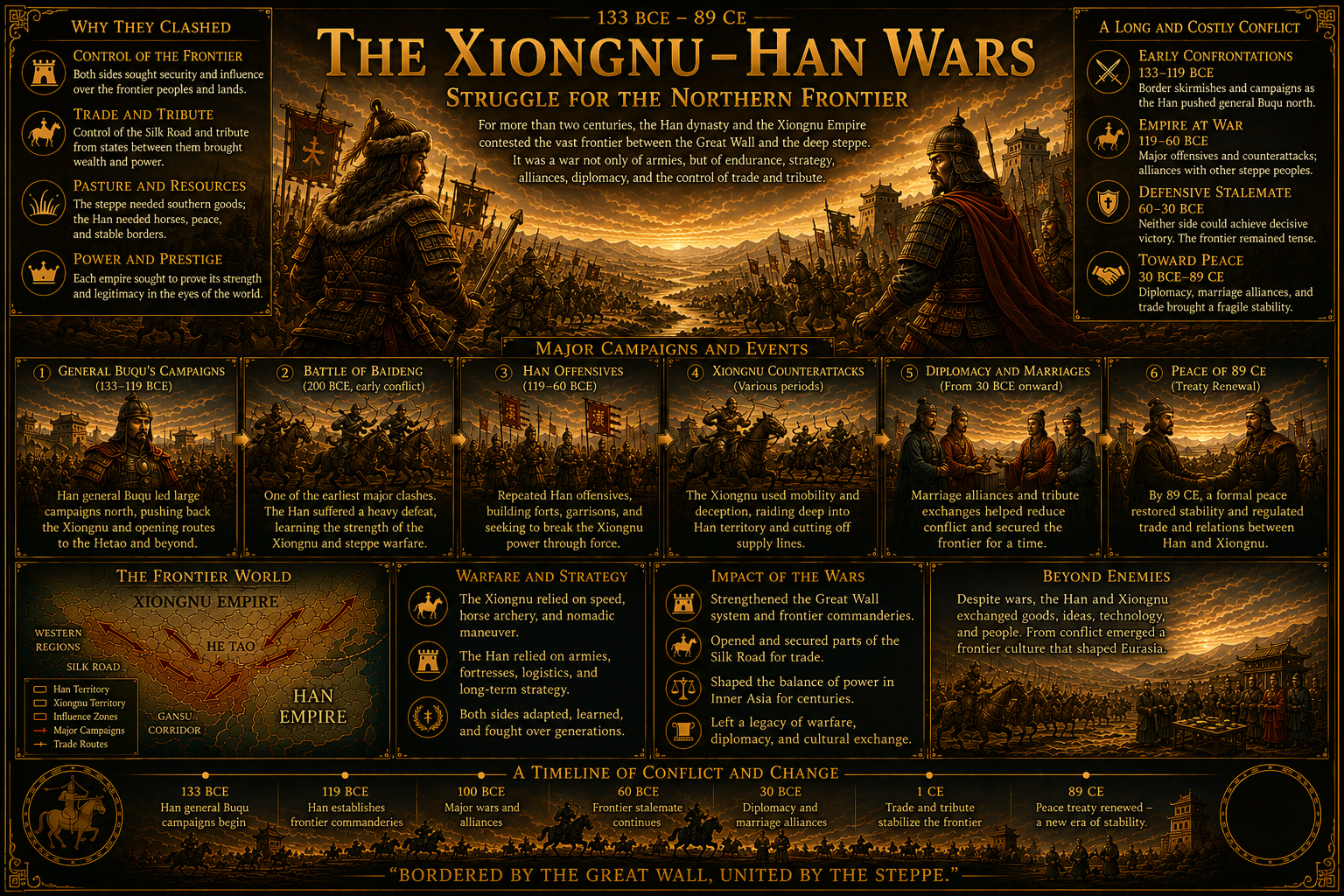
Two Worlds. Two Orders. THE XIONGNU AND HAN
The confrontation between Modu Chanyu and the Xiongnu Empire and the Han dynasty represents one of the defining encounters in the early history of Inner Asia. It is often presented as a conflict between the nomadic peoples of the northern steppe and the settled civilization of the Central Plains. Such a distinction captures an important ecological and political contrast, but the historical relationship was considerably more complex. By the time the Xiongnu emerged as a major imperial power in the late third century BCE, the peoples of the Northern Frontier and the agricultural states to their south had already interacted for centuries through warfare, migration, trade, diplomacy, and political negotiation. The Xiongnu–Han confrontation therefore brought together two different systems of political organization that were already deeply connected through a long history of frontier interaction.
The Han Empire was fundamentally rooted in the agricultural economies of the Central Plains. Its political power rested upon densely populated agricultural regions, taxation, cities, fortified settlements, written administration, and a centralized imperial government capable of mobilizing large quantities of labor, grain, weapons, and military supplies. The Han state could therefore sustain prolonged campaigns through an extensive logistical infrastructure. Its northern frontier was increasingly organized through fortified settlements, military colonies, administrative units, and defensive systems designed to protect agricultural territory and regulate movement across the frontier. Archaeological research on the northern zone of the Han Empire demonstrates the extensive settlement and fortification systems that developed in response to the pressures of the Xiongnu frontier.
The Xiongnu political order, by contrast, developed within the pastoral and mobile environment of the northern steppe. Its economic foundation was predominantly pastoral, although archaeological evidence demonstrates that agriculture, craft production, settlement, and exchange also formed part of Xiongnu society. The political structure was organized around a powerful ruling aristocracy headed by the Shanyu, who exercised authority over a diverse collection of communities and regional leaders. Recent archaeological research likewise describes the Xiongnu Empire as a politically integrated but culturally and genetically heterogeneous formation governed through a clan-based aristocratic hierarchy.
The difference between these two political systems was therefore not simply that one society was “civilized” and the other was “barbarian,” as some ancient Chinese sources represented the relationship. Rather, they embodied different solutions to the problems of political organization, economic production, mobility, and military power. The Han state concentrated political and economic resources through territorial administration and agricultural taxation. The Xiongnu political system coordinated mobile pastoral communities through aristocratic hierarchy, personal allegiance, military organization, and control over extensive steppe territories. Neither system can be adequately understood merely as an opposite of the other.
This difference became particularly important in warfare. The Han possessed large infantry and cavalry forces supported by agricultural taxation and extensive logistical networks. The Xiongnu, operating from the steppe, could mobilize mounted forces rapidly across enormous distances and exploit the mobility of horse archery. Their military system was closely connected with the pastoral economy itself: horses were simultaneously economic resources, means of transportation, instruments of communication, and foundations of military power. The geographical openness of the steppe also allowed Xiongnu forces to concentrate rapidly, withdraw from unfavorable engagements, and operate at distances that created serious logistical difficulties for agricultural armies.
The military relationship between the two powers was consequently shaped by different strategic geographies. The Han sought to defend settled territory, secure agricultural populations, control strategic corridors, and eventually project military power deep into the frontier and Central Asia. The Xiongnu sought to preserve their political dominance across the northern steppe, maintain access to economic resources and trade networks, and prevent the Han from permanently transforming the political geography of the frontier. The resulting struggle was therefore not simply a series of raids and retaliatory expeditions. It was a competition over the organization and control of the wider frontier system.
Yet warfare existed alongside sustained diplomacy. After the Han defeat at Baideng in 200 BCE, the relationship was reorganized through the heqin arrangements, which involved marriage alliances, exchanges of goods, and an agreed framework for maintaining peace. These arrangements demonstrate that the two powers recognized one another as major political actors capable of negotiation. The relationship could move from warfare to diplomacy and back again, depending upon changing strategic circumstances.
Trade and exchange further complicated the relationship. The Xiongnu required access to agricultural products and manufactured goods from the settled world, while the Han had strong interests in horses, livestock, and the political and commercial networks extending across Inner Asia. The frontier consequently functioned not only as a military boundary but also as an economic interface connecting different ecological zones. The interaction between the Xiongnu and Han contributed to the development of wider trans-Eurasian exchange networks; some scholarship has specifically connected the conflicts and diplomatic relations between the two powers with the development of organized trade across the early Silk Roads.
The relationship was therefore characterized by a persistent paradox: the two powers were enemies precisely because they were closely connected. Their strategic competition was intensified by their geographical proximity, economic interdependence, and overlapping interests in the frontier. Warfare could disrupt trade, while trade could create resources that strengthened military power. Marriage alliances could temporarily stabilize relations without eliminating political rivalry. Diplomacy could establish peace while each side continued preparing for renewed conflict.
The Han response also demonstrates that the influence between the two worlds was not one-directional. As the Xiongnu became a major military power, Han rulers adapted their own military and strategic policies. Under Emperor Wu, the Han abandoned the earlier emphasis on appeasement and launched major offensive campaigns against the Xiongnu. Han expansion into the northwestern regions and Central Asia was closely connected with this strategic transformation. Military garrisons and frontier settlements were established farther west, while diplomatic missions such as that of Zhang Qian opened new connections across Central Asia.
Thus, the Xiongnu–Han confrontation cannot be reduced to a simple opposition between “nomads” and “farmers.” The two political systems were distinct, but neither existed in isolation. The Xiongnu Empire was itself a complex political formation that incorporated diverse communities, while the Han Empire was also transformed by its interaction with frontier peoples and neighboring states. The frontier was not merely a line separating two civilizations. It was a zone in which political systems confronted one another, borrowed from one another, competed for resources, negotiated agreements, and repeatedly adapted to changing circumstances.
Seen within the longer history of the Northern Nomadic Frontier, the Xiongnu–Han confrontation represents a major stage in a much older historical process. From the earlier frontier communities remembered in traditions surrounding Jiuli and Chi You, through the Guifang recorded in Shang sources, and the changing peoples identified as Rong, Di, and Hu during the Zhou period, the northern regions had developed distinctive traditions of mobility, pastoral production, warfare, horse culture, and political organization. The Xiongnu did not simply inherit a single ethnic identity from these earlier populations, nor can a direct uninterrupted lineage be demonstrated. Rather, they emerged from a frontier environment that had undergone centuries of political and cultural transformation.
The Xiongnu–Han wars therefore marked a moment when the historical interaction between the Central Plains and the Northern Nomadic Frontier reached an imperial scale. The Xiongnu possessed the political organization necessary to unite diverse steppe communities into a powerful confederation, while the Han possessed the agricultural, administrative, and logistical resources of a centralized empire. Their confrontation demonstrated that neither system could simply ignore the other.
AUTHOR’S THESIS
The significance of the Xiongnu–Han confrontation lies in the encounter between two different political and ecological orders that had already been connected for centuries. The Han represented a highly centralized agricultural imperial system based upon territorial administration, taxation, cities, and bureaucratic institutions. The Xiongnu represented a large-scale steppe political system based upon pastoral mobility, horse culture, aristocratic hierarchy, clan alliances, and military organization.
Their relationship was consequently not a simple struggle between two isolated civilizations. It was a continuous process of warfare, diplomacy, trade, marriage alliance, adaptation, and political competition. Each power developed strategies in response to the capabilities of the other, and the resulting interaction reshaped both the Northern Frontier and the wider political geography of Inner Asia.
In this sense, “Two Worlds. Two Orders.” does not mean two completely separate worlds. It describes two distinct systems of political and economic organization that became historically inseparable through centuries of interaction. The Xiongnu–Han wars were therefore not merely a border conflict. They were one of the earliest great encounters in which a centralized agrarian empire and an organized nomadic steppe empire confronted, negotiated with, and transformed one another.
THE GOLDEN MAN OF THE XIONGNU
Huo Qubing’s Capture of a Sacred Symbol in 121 BCE
In 121 BCE, during the great Han campaigns against the Xiongnu, the cavalry general Huo Qubing conducted a deep expedition into the western territories of the Xiongnu. According to the Shiji and Hanshu, his forces advanced more than one thousand li beyond the Yanzhi Mountains and defeated the forces associated with the King of Xiutu (休屠王). Among the objects captured during the campaign was a remarkable ritual object described in the historical sources as a “golden man” used by the Xiutu King in sacrifices to Heaven (祭天金人).
The event is historically significant because the object was not described merely as ordinary treasure or military booty. The Hanshu explicitly identifies it as a golden figure associated with the sacrifice to Heaven, while a later commentary preserved in the same tradition explains that the Xiongnu had originally performed their heavenly sacrifices in the region of Yunyang and Ganquan, before the Qin conquest displaced the location of that ritual. The Xiutu King subsequently possessed the golden figure within his own territory and used it in the performance of the heavenly cult.
The importance of this object must therefore be understood within the religious and political structure of the Xiongnu world. Heaven was not simply a private religious concept detached from political authority. The Xiongnu sources preserved in Chinese historiography repeatedly associate the Chanyu and the Xiongnu political order with sacrifices to Heaven. Later evidence likewise records regular Xiongnu sacrifices to Heaven and describes the participation of political leaders and tribal groups in these rituals. Such practices suggest that heavenly worship formed part of the ideological framework through which political authority and collective identity were expressed.
For this reason, the capture of the golden figure had a significance beyond its material value. Huo Qubing had not merely taken gold from a defeated enemy. He had seized an object connected with the ritual authority of one of the major Xiongnu royal houses. The object was subsequently brought into the Han imperial sphere, where it became incorporated into the religious landscape of Emperor Wu’s court. A later historical account records that the Han emperor regarded the captured golden figure as a great deity and placed it at the Ganquan Palace.
This later Han treatment is particularly revealing. The Han court did not necessarily regard the object simply as an exotic curiosity. Its association with the worship of Heaven gave it a religious significance that could be appropriated within the imperial ritual world. In this sense, the capture of the golden figure formed part of a broader process through which Han imperial power encountered, appropriated, and reinterpreted sacred traditions originating beyond the Central Plains. The object crossed not only a military frontier but also a religious and political boundary.
The historical sources, however, do not provide sufficient information to determine exactly what the golden figure looked like. Modern retellings have sometimes described it as a “dragon totem,” a dragon emblem, or another specifically steppe animal symbol. Such interpretations may be visually attractive, but they should not be presented as established historical fact. Neither the Shiji nor the relevant passage of the Hanshu identifies the object as a dragon, nor do these accounts provide a detailed description of its iconography. What the sources establish is more precise and more significant: it was a golden human figure associated with the Xiutu King’s sacrifice to Heaven.
The distinction matters because the religious world of the Xiongnu should not be reconstructed from later artistic assumptions alone. The term 祭天金人 can be translated literally as a “golden man for sacrificing to Heaven,” and the Hanshu commentary explains that the figure functioned as an image or representation of the deity associated with the heavenly sacrifice. Later commentators attempted to interpret the figure through the religious categories familiar to their own period, demonstrating that the object continued to generate questions about the nature of Xiongnu religious practice long after its capture.
The capture also occurred at a critical moment in the strategic struggle between the Han and Xiongnu. Huo Qubing’s 121 BCE campaigns severely disrupted Xiongnu power in the Hexi Corridor. The western Xiongnu kings, including Xiutu and Hunye, suffered major military defeats, and the subsequent political crisis contributed to the surrender of Hunye and a large portion of his forces to the Han later that year. The capture of the golden figure therefore occurred within a much larger process of military and political transformation on the western frontier.
The episode illustrates an important characteristic of the Northern Nomadic Frontier. Political power in the steppe was not based exclusively upon military force or control of pasture. It was also expressed through ritual, ancestry, sacred geography, political legitimacy, and relationships with Heaven. The seizure of an object used in heavenly sacrifice therefore provides a rare glimpse into the ideological dimension of Xiongnu authority. Although the surviving Chinese sources describe this religious system from outside the Xiongnu world, they preserve evidence that ritual institutions were connected to the political order of the steppe.
The episode can also be viewed from the perspective of the Han imperial ideology. The Han had defeated a major Xiongnu power in the western frontier and acquired an object associated with that power’s heavenly worship. The object was then brought into the imperial domain and incorporated into Han ritual practice. This sequence—military conquest, seizure of sacred object, transfer into the imperial center, and ritual reinterpretation—gave the victory a significance extending beyond the battlefield.
It would nevertheless be too strong to conclude that the capture of the golden figure literally represented the destruction of all Xiongnu spiritual authority. The Xiongnu political and religious system did not disappear in 121 BCE, and the object belonged specifically to the ritual sphere of the Xiutu King, rather than necessarily representing the entirety of Xiongnu religion. The event is better understood as a symbolic episode within a much broader military struggle in which the Han increasingly penetrated the western regions of the Xiongnu political sphere.
THE GOLDEN MAN AND THE NORTHERN FRONTIER
The story of the golden man is significant precisely because it brings together three dimensions of the Northern Frontier: military power, political authority, and sacred tradition. The Northern Frontier was not merely a geographical space inhabited by mobile warriors. It contained political institutions, economic systems, religious practices, sacred places, and traditions of authority that were capable of being challenged and appropriated by neighboring empires.
Huo Qubing’s capture of the golden figure therefore provides an unusually clear example of how military conquest could become symbolic conquest. The Han army entered the western steppe, defeated Xiongnu forces, seized an object associated with the worship of Heaven, and transferred that object into the imperial religious sphere. The event did not erase the religious traditions of the steppe, but it demonstrated that the symbols of frontier political authority could themselves become objects of imperial appropriation.
AUTHOR’S THESIS
The Golden Man of the Xiongnu should be understood as more than an item of captured treasure. The Shiji and Hanshu preserve evidence that the object was directly associated with the Xiutu King’s sacrifice to Heaven, placing it within the religious and political world of the Xiongnu Northern Frontier. Its capture in 121 BCE occurred during one of Huo Qubing’s major western campaigns and coincided with a period of profound military disruption within the Xiongnu political order.
The surviving sources do not establish that the object was a dragon totem, and its exact visual form remains uncertain. What they do establish is historically more valuable: a sacred golden figure connected with the worship of Heaven was captured from a Xiongnu royal power and subsequently incorporated into the Han imperial religious sphere. The episode therefore illustrates how the struggle between the Han Empire and the Northern Nomadic Frontier extended beyond territory and military power into the realms of ritual, legitimacy, sacred authority, and the symbolic meaning of conquest.
THE XIONGNU CHANYU TIMELINE
By Altanbagana Baatar
DBA Candidate| Independent Historian
ImperialGG Historical Research Seriers
15 September 2026
SUCCESSION, POLITICAL AUTHORITY, AND THE TRANSFORMATION OF THE STEPPE EMPIRE
The history of the Xiongnu Chanyu is not simply a succession of rulers. It is the political history of one of the earliest large-scale imperial formations of the Eurasian steppe and of the changing institutions through which authority was exercised across a vast and diverse pastoral world. From the emergence of the Xiongnu confederation in the late third century BCE to the political transformations of the third century CE, successive Chanyu—the supreme rulers of the Xiongnu—presided over periods of expansion, consolidation, internal division, military conflict, diplomatic negotiation, and political reorganization. The succession of Chanyu therefore provides an important framework for understanding how steppe political authority could be maintained across generations while adapting to changing circumstances.
The Xiongnu emerged within a Northern Frontier that had already experienced centuries of political and economic transformation. By the fourth and third centuries BCE, mounted pastoral societies had become increasingly important across the eastern Eurasian steppe, and political communities in the northern regions were interacting intensively with the expanding states of the Central Plains. The Xiongnu were consequently not an isolated historical phenomenon. They developed within a wider frontier environment shaped by pastoral mobility, horse culture, warfare, exchange, and competition among regional political communities. Modern scholarship places the emergence of the Xiongnu within this broader development of early Inner Asian steppe societies.
The first great consolidation of Xiongnu power is associated with Modu Chanyu, who came to power around 209 BCE. Under Modu, the Xiongnu united numerous neighboring groups and established a political structure extending across much of Mongolia, Inner Mongolia, and adjoining regions of southern Siberia. The scale of this transformation was exceptional. What had previously been a collection of steppe communities became a large political confederation capable of coordinating military forces, diplomacy, tribute relationships, and relations with powerful settled states. Cambridge scholarship describes the Xiongnu as the first documented large-scale political formation of this kind in Inner Asia, while other scholars have emphasized its character as an imperial confederacy.
The title Chanyu was therefore more than a personal designation. It represented the highest level of political authority within the Xiongnu imperial system. The Chanyu stood at the center of a hierarchy that incorporated regional kings, aristocratic lineages, military leaders, and numerous communities with their own local identities and leadership structures. Recent archaeological research likewise characterizes the Xiongnu Empire as a culturally and genetically diverse political formation unified under a clan-based aristocracy headed by the Chanyu. This distinction is essential: the Xiongnu were not a homogeneous nation in the modern sense, but a multi-community political order whose unity depended upon institutions of hierarchy, allegiance, military organization, and diplomacy.
The early Chanyu period was characterized by remarkable expansion. Under Modu and his successor Laoshang, Xiongnu power extended far beyond the immediate northern frontier of the Han state. The Xiongnu defeated or subordinated neighboring peoples and established relations of political superiority across large areas of the eastern steppe and into Inner Asia. In 176 BCE, for example, Modu defeated the Yuezhi, while subsequent Xiongnu expansion brought additional Central Asian populations within their sphere of influence. The Chanyu thus became not merely the ruler of a regional tribal coalition but the head of a political system whose authority extended across multiple ecological and cultural zones.
The relationship with the Han dynasty became one of the defining features of the Chanyu system. The Xiongnu and Han possessed different economic and political foundations, yet neither existed independently of the other. Warfare alternated with diplomacy, trade, marriage alliances, and negotiated settlements. The Han defeat at Baideng in 200 BCE and the subsequent diplomatic arrangements demonstrated that the Chanyu could negotiate with the emperor of a major agricultural empire from a position of substantial political strength. The Xiongnu–Han relationship therefore elevated the Chanyu from a regional steppe ruler into one of the principal diplomatic actors of East Asia.
The succession of Chanyu also reveals the internal difficulties inherent in maintaining such a large confederation. The Xiongnu political system had to balance the authority of the central ruler with the power of regional aristocrats and local leaders. As long as the Chanyu could successfully coordinate military power, distribute resources, maintain alliances, and preserve the loyalty of subordinate elites, the confederation could operate across enormous distances. When these mechanisms weakened, however, rival claimants and regional interests could challenge the central authority.
This became particularly visible during the first century BCE, when succession disputes and competition among rival Chanyu contributed to the fragmentation of the confederation. By 57 BCE, the Xiongnu political order had fractured into several competing Chanyu, eventually consolidating into major northern and southern factions. Huhanye Chanyu ultimately submitted to Han authority in 53 BCE, while Zhizhi Chanyu established an independent power farther west. The resulting division demonstrates that the Chanyu system was not a permanently centralized monarchy. Its political cohesion depended upon continuing negotiation among ruling lineages and regional powers.
The history of the Chanyu after this division is therefore best understood not as a simple decline from a previously unified empire, but as a process of political transformation. Southern Xiongnu communities became increasingly integrated into the political structures of the Han Empire, while northern Xiongnu groups continued to exercise power across the steppe and western frontier. The distinction between “Xiongnu Empire” and “post-imperial Xiongnu” consequently requires chronological and geographical precision. Different Xiongnu political communities followed different trajectories after the great imperial unity of the early period.
The first century CE brought another major transformation. In 48 CE, the Xiongnu divided again into Southern and Northern Xiongnu. The Southern Xiongnu established themselves increasingly within the northern regions of China, while the Northern Xiongnu continued to operate from the steppe. The Han subsequently intervened militarily and politically against the Northern Xiongnu, while large numbers of Xiongnu groups entered Han-controlled territories. These developments fundamentally altered the geographical basis of Chanyu authority.
By the second and early third centuries CE, therefore, the political world represented by the Chanyu title had become considerably more fragmented than it had been under Modu. Northern Xiongnu power disappeared from the Chinese record as a unified political force, while Southern Xiongnu communities remained important actors within northern China. Their Chanyu institution survived into the period of the late Han and Three Kingdoms, although its political autonomy was progressively restricted. Around 216 CE, Cao Cao reorganized the Southern Xiongnu into several administrative divisions, effectively ending the Chanyu’s former position as the ruler of an autonomous Xiongnu state. This should be understood as a transformation of the political institution rather than the disappearance of the Xiongnu people. Xiongnu communities continued to exist and remained historically significant in northern China for centuries afterward.
The chronology of the Chanyu therefore illustrates an important characteristic of steppe state formation. Political unity did not require the disappearance of local clan and regional identities. The Xiongnu imperial system was able to integrate diverse communities precisely because it operated through layers of authority. The Chanyu occupied the highest level, while regional aristocrats and local leaders retained substantial influence. Such a system could expand rapidly across the steppe, but its cohesion was also vulnerable when succession disputes, regional competition, or external military pressure weakened the central authority.
For this reason, the Chanyu timeline should not be read merely as a list of names between two dates. It represents the institutional history of Xiongnu political authority: the rise of imperial unity under Modu, the consolidation of steppe power, the long confrontation with Han China, the fragmentation of the first Xiongnu empire, the emergence of competing Chanyu, the division between Northern and Southern Xiongnu, and the eventual transformation of the Chanyu institution within the political structures of northern China.
THE CHANYU AND THE NORTHERN NOMADIC FRONTIER
The significance of the Chanyu succession extends beyond the history of the Xiongnu themselves. The institution demonstrates that the Northern Nomadic Frontier could generate large-scale and durable forms of political organization. The Chanyu system combined pastoral mobility, horse-based military power, aristocratic hierarchy, clan relationships, diplomacy, and control over extensive territories. Its political structure differed fundamentally from the bureaucratic territorial state of the Han, yet it was capable of coordinating diverse populations and exercising power across an enormous geographical space.
The Xiongnu experience therefore challenges the older assumption that mobile pastoral societies were politically fragmented by definition. The historical evidence demonstrates instead that mobility could coexist with hierarchy and imperial organization. The Chanyu was able to rule through a network of subordinate elites rather than through the dense territorial bureaucracy characteristic of the Han state. This represented a different form of state organization, adapted to the ecological and social conditions of the steppe.
At the same time, the Chanyu system should not be projected backward onto every earlier Northern Frontier society. The Xiongnu represented a particular historical development rather than the inevitable endpoint of all earlier steppe communities. The Guifang, Rong, Di, and Hu belonged to different historical contexts, and the surviving evidence does not establish a simple uninterrupted political lineage connecting each of them directly to the Xiongnu. What can be traced more securely is the long transformation of the Northern Frontier, within which increasingly mobile pastoral economies, horse cultures, military organization, and political alliances created conditions for larger political formations.
AUTHOR’S THESIS
The Xiongnu Chanyu Timeline records more than four centuries of rulers. It records the transformation of political authority on the Northern Nomadic Frontier.
From the consolidation of power under Modu Chanyu around 209 BCE, through the great imperial expansion of the second century BCE, the long rivalry with Han China, the fragmentation of the first Xiongnu empire, the competing Chanyu of the first century BCE, the division into Northern and Southern Xiongnu in the first century CE, and the final transformation of the Southern Chanyu institution in the early third century CE, the history of the Xiongnu demonstrates that steppe political power could be organized on an imperial scale while retaining the social foundations of pastoral and clan-based society.
The Chanyu was therefore not simply the “king of nomads.” He stood at the center of a distinctive political system in which mobility, horses, pastoral wealth, military organization, aristocratic lineage, diplomacy, and regional allegiance were combined into a form of imperial governance suited to the Inner Asian steppe.
The end of autonomous Chanyu rule did not mean the disappearance of the Xiongnu. It marked the transformation of their political institutions and communities into new historical circumstances. In that sense, the Chanyu timeline is not simply a story of rise and fall. It is a record of continuity through political transformation—one of the defining characteristics of the long history of the Northern Nomadic Frontier.
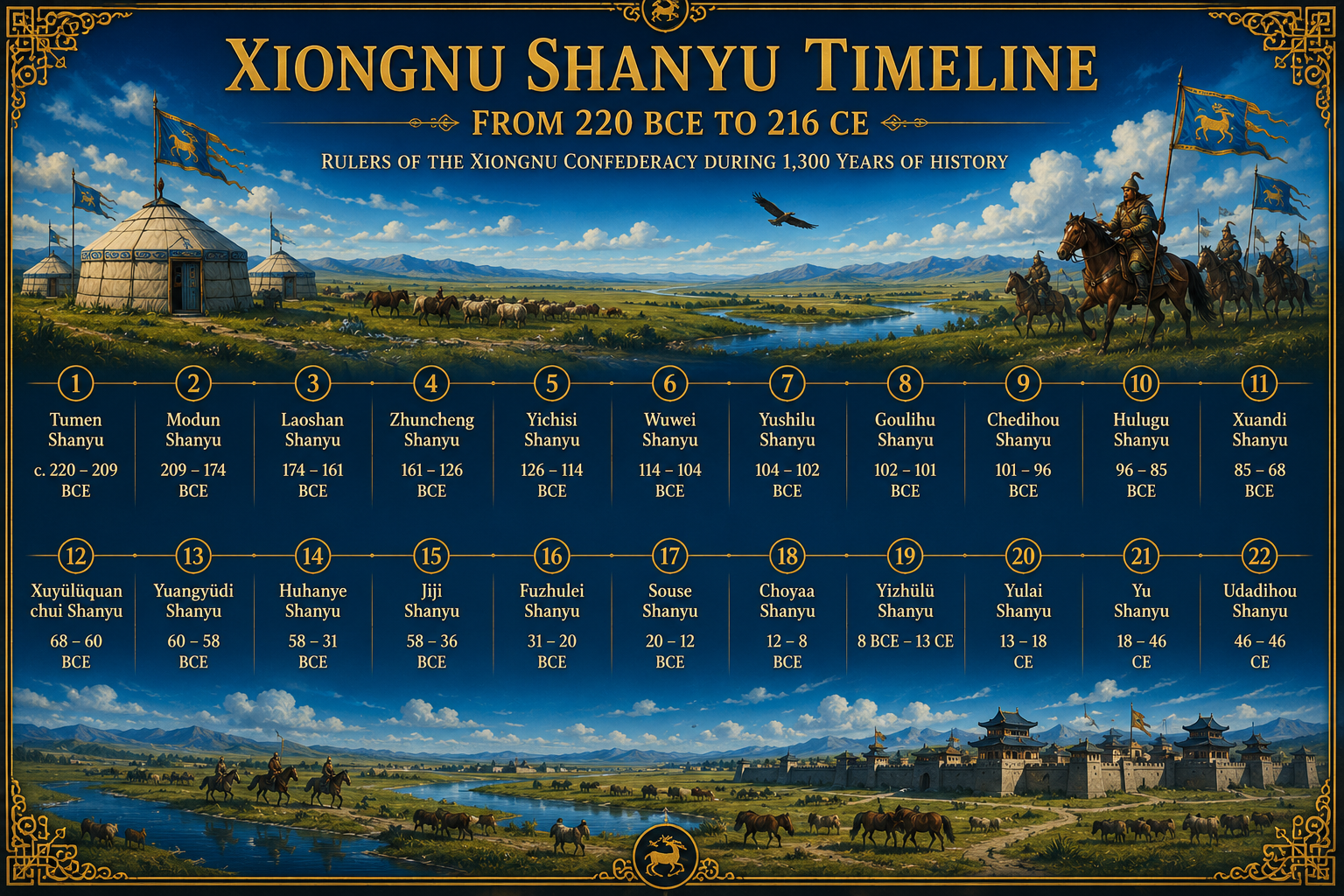
Roman World (c. 2nd–5th century CE) — The Roman Empire reached its height, later divided into eastern and western halves, and eventually faced decline amid migrations and invasions.
Europe (c. 2nd–5th century CE) — Germanic, Gothic, and steppe peoples reshaped Europe through migration, warfare, and the gradual collapse of Roman frontier systems.
Hunnic World (c. 4th–5th century CE) — The Huns emerged as a major steppe power and under Attila challenged both the Eastern and Western Roman Empires.
Persia (c. 2nd–5th century CE) — The Sasanian Empire became one of the great powers of Eurasia and Rome’s principal rival.
China (c. 2nd–5th century CE) — The fall of the Han dynasty led to the Three Kingdoms era and subsequent centuries of political fragmentation.
Eastern Steppe (c. 2nd–5th century CE) — After the decline of the Xiongnu Confederation, the Xianbei and other nomadic confederations dominated Mongolia and Inner Asia.
India (c. 2nd–5th century CE) — The Gupta Empire ushered in a period of cultural and scientific flourishing.
Arabia (c. 2nd–5th century CE) — Arabian trade kingdoms prospered by connecting the Mediterranean, Persia, East Africa, and India.
Africa (c. 2nd–5th century CE) — The Kingdom of Aksum flourished as a major commercial and maritime power.
Northern Europe (c. 2nd–5th century CE) — Scandinavian societies expanded maritime exchange and warrior traditions during the Roman Iron Age.
Mesoamerica (c. 2nd–5th century CE) — Teotihuacan became one of the largest urban centers in the ancient Americas.
North America (c. 2nd–5th century CE) — Indigenous societies expanded ceremonial centers, agriculture, and regional trade networks.
South America (c. 2nd–5th century CE) — Andean civilizations developed irrigation systems, terrace agriculture, and regional political structures.
THE DRAGON SYMBOL WAS TAKEN ?
HOW A SACRED STEPPE SYMBOL ENTERED A NEW IMPERIAL TRADITION
In 121 BCE, during the Han wars against the Xiongnu, the Han general Huo Qubing defeated the forces of the Xiongnu King of Xiutu. What he captured was not ordinary treasure. The Book of Han records that Huo Qubing seized a golden figure used by the King of Xiutu in worship of Heaven. This object represented something far more important than gold. It was connected to Heaven, ritual, and the authority of a steppe ruler.
BEFORE THE IMPERIAL DRAGON
The important question is not simply:
“Did the Xiongnu have a dragon?”
The deeper question is:
Who possessed the sacred symbols of political authority—and what happened to them when empires conquered one another? The Han sources do not call the captured golden figure a dragon. They call it a golden man used in the worship of Heaven. But the Xiongnu themselves had traditions involving Heaven and dragon-related ritual. Later Chinese historical texts record Xiongnu ceremonies connected with the worship of Heaven and dragon sacrifices. The symbol therefore belongs to a much broader Eurasian history of sacred rulership.
FROM CAPTURE TO IMPERIAL SYMBOL
The significance of the story lies in what happened after the conquest. The Han did not simply destroy the object. The captured sacred figure was brought into Han territory and became part of the Han imperial ritual world. The sources record its transfer to the Yunyang/Ganquan area, where it was associated with imperial ritual. A symbol connected with the defeated steppe power had therefore crossed the frontier. It had been taken. And once taken, its meaning could be transformed.
THE SYMBOL DID NOT DISAPPEAR
Over the centuries, dragon imagery became increasingly connected with imperial authority in China. By the Tang period, dragons were being used on imperial robes as symbols of political power, and later dynasties developed increasingly exclusive rules governing imperial dragon imagery. By the Yuan period, the imperial dragon had become part of a wider Mongol imperial visual language as well. This is where the historical story becomes much more interesting. The symbol did not simply belong to one civilization forever. It moved. It was adopted, transformed, and reinterpreted by successive imperial systems.
FROM THE STEPPE TO THE EMPIRES
The Xiongnu golden figure is therefore important not because we can prove that it was literally a dragon. We cannot. The surviving Han source does not give us that certainty. Its importance is that a sacred object associated with the authority of a Xiongnu ruler was physically captured and incorporated into the ritual world of the Han state. That is the evidence. The later history allows us to ask a much larger question:
How do symbols of power survive the fall of the political systems that created them? Sometimes they disappear. Sometimes they are destroyed. And sometimes— the conqueror takes them.
THE MYTH : The imperial dragon was always an exclusively Chinese symbol.
THE REALITY: The history of sacred symbols is far more complicated. The Han captured a Xiongnu ritual object associated with worship of Heaven, and over subsequent centuries dragon imagery became increasingly tied to imperial authority.
The evidence does not prove that the captured object was a dragon. But it does prove something fascinating:
A sacred symbol of a conquered steppe power crossed into the world of its conqueror.
And centuries of Eurasian empire-building would continue to transform the meaning of such symbols.
THE SYMBOL WAS TAKEN.
THE MEANING EVOLVED.
IMPERIALGG.COM
HISTORY WITH EVIDENCE. BEYOND MYTH.
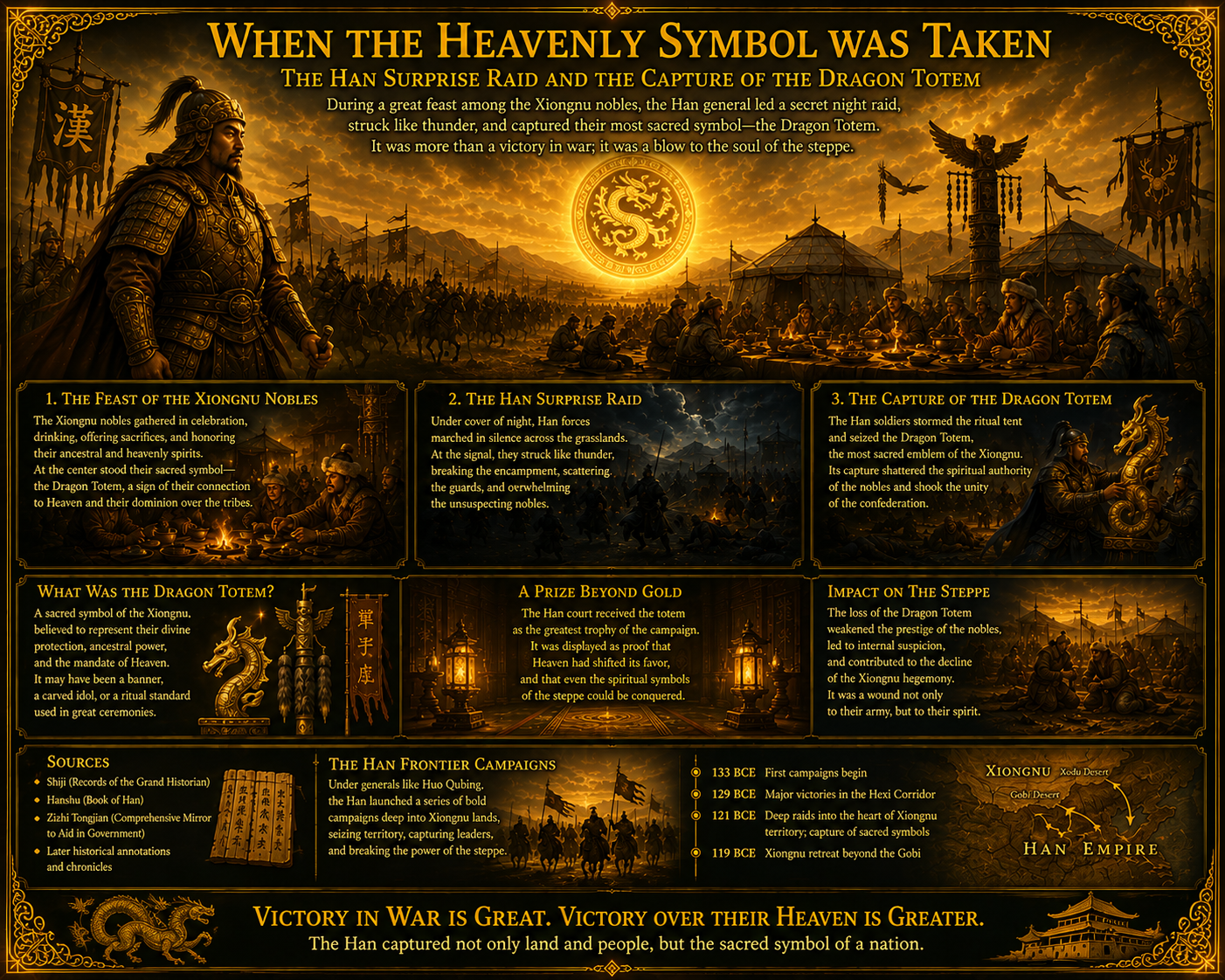
Modu Chanyu’s Letter to Empress Lü Zhi (192 BCE)
Modu Chanyu’s Letter to Empress Lü Zhi (192 BCE)
According to the Book of Han (Hanshu, Volume 94, “Account of the Xiongnu”), Modu Chanyu sent a famous letter to Empress Dowager Lü Zhi after the death of Emperor Gaozu of Han. The letter was interpreted by the Han court as both a marriage proposal and a political provocation.
A widely translated version reads:
“I am a lonely ruler, born among marshes and raised upon the plains of cattle and horses. I have often reached the borders and wished to visit China. Your Majesty now lives alone in solitude, and I too dwell alone. Since neither of us finds joy, I am willing to exchange what I possess for what you lack.”
The Han court was outraged. Some generals demanded immediate war against the Xiongnu, but the minister Ji Bu warned that the Xiongnu cavalry remained too powerful for the Han Empire to confront directly at that time. Empress Lü therefore answered diplomatically and avoided war.
Primary source: Hanshu (Book of Han), Volume 94 — Xiongnu Zhuan (“Account of the Xiongnu”)
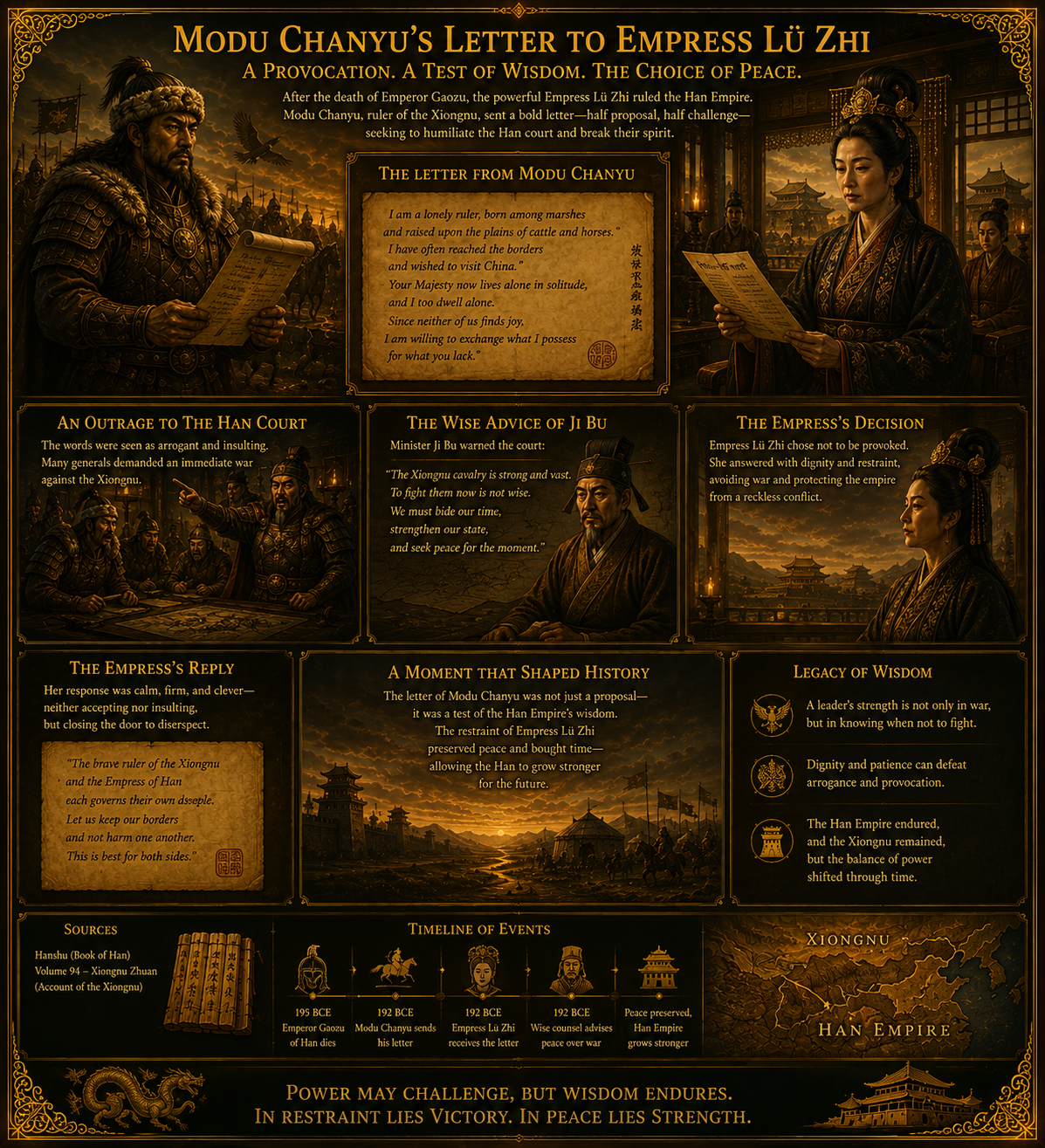
FROM THE RISE OF MODU CHANYU TO THE DIVISION OF THE XIONGNU WORLD
The Xiongnu emerged as the dominant political power of the eastern Eurasian steppe during the late third and early second centuries BCE. Under Modu Chanyu, the Xiongnu transformed from a regional confederation into a powerful imperial system that challenged the Han dynasty and controlled extensive networks across Inner Asia.
Their history was not simply a series of wars with China. It included state formation, diplomacy, trade, warfare, political succession, internal conflict, and competition for control of the steppe.
BEFORE THE XIONGNU EMPIRE
318 BCE — EARLY EVIDENCE
Chinese sources record the Xiongnu among the northern peoples involved in conflicts during the Warring States period. Their political organization at this stage was not yet the powerful confederation that would emerge under Modu.
214 BCE — QIN CAMPAIGN AGAINST THE NORTHERN STEPPE
Under Emperor Qin Shi Huang, the general Meng Tian led a major campaign against the northern peoples and pushed Xiongnu forces away from the Ordos region. The campaign demonstrated the strategic importance of the Yellow River frontier and the Ordos, a region that would remain central to later Han–Xiongnu competition.
209 BCE — MODU CHANYU TAKES POWER
Modu Chanyu seized power after the death of his father Touman. He rapidly consolidated the Xiongnu and defeated major neighboring powers, including the Donghu and the Yuezhi. His victories created a much larger political and military coalition across the eastern steppe.
THE RESULT:
The Xiongnu became one of the most powerful states of Inner Asia.
200 BCE — BAIDENG
Han Emperor Gaozu personally led a campaign against the Xiongnu.
Modu Chanyu surrounded the Han emperor at Baideng. Gaozu survived, but the confrontation demonstrated that the newly established Han dynasty could not simply impose its authority on the northern steppe.
This confrontation changed the relationship between the two powers.
198 BCE — HEQIN
Following the confrontation at Baideng, Han and Xiongnu reached a heqin agreement. The arrangement established a diplomatic relationship involving marriage alliances and regular exchanges of silk, grain, and other goods. Rather than destroying the Xiongnu, the Han dynasty negotiated with the northern power. The frontier became a zone of diplomacy as well as warfare.
174 BCE — THE DEATH OF MODU
Modu Chanyu died and was succeeded by his son Laoshang Chanyu. By this period, the Xiongnu had become the dominant steppe power surrounding the Han Empire. The political system created under Modu continued beyond his reign.
141–87 BCE — HAN COUNTERATTACK
The accession of Emperor Wu of Han marked a major change. The Han dynasty moved away from the earlier strategy of accommodation and began launching major offensive campaigns against the Xiongnu.
133 BCE — MAYI
A Han attempt to ambush the Xiongnu at Mayi failed. The episode marked an important breakdown in the earlier diplomatic relationship.
129–119 BCE — MAJOR HAN CAMPAIGNS
Han armies under commanders including Wei Qing and Huo Qubing launched repeated campaigns into Xiongnu territory.
The Han eventually pushed Xiongnu power north of the Gobi in major campaigns of 121 and 119 BCE.
121 BCE — THE GOLDEN RITUAL FIGURE
During Huo Qubing’s campaign, Han forces captured a remarkable ritual object belonging to the Xiongnu King of Xiutu. The Book of Han describes it as a golden figure used in sacrifices to Heaven. Its precise form is not securely identified in the surviving source. This episode is important because it demonstrates that warfare involved not only territory and livestock, but also ritual objects connected with political and sacred authority.
119 BCE — THE BATTLE OF MOBEI
The Han launched one of its largest campaigns against the Xiongnu. The battles pushed major Xiongnu forces farther north and seriously disrupted their control of the southern steppe. However, the Xiongnu political system did not disappear. The conflict entered a new phase.
60 BCE — XIONGNU INTERNAL CRISIS
After the death of Xulüquanqu Chanyu, the Xiongnu political system entered a severe succession crisis. Multiple claimants competed for the position of Chanyu. By 57 BCE, several rival Chanyu existed simultaneously. The crisis transformed the struggle from a primarily external conflict with Han into a major internal contest for control of the Xiongnu state.
53 BCE — HUHANYE SEEKS HAN SUPPORT
The struggle eventually narrowed primarily to Huhanye Chanyu and Zhizhi Chanyu. Facing military pressure from Zhizhi, Huhanye sought Han protection and submitted to Han authority. This did not mean that the Xiongnu disappeared. Instead, the political landscape became increasingly divided between competing Xiongnu centers of power.
36 BCE — ZHIZHI CHANYU FALLS
Zhizhi established his power farther west and came into direct conflict with the Han. Han forces eventually attacked his headquarters and defeated him. His death removed one of the major rivals to Huhanye and strengthened the southern Xiongnu relationship with Han.
33 BCE — WANG ZHAOJUN AND HUHANYE
Huhanye entered into a marriage alliance with the Han court. The famous story of Wang Zhaojun later became one of the best-known cultural memories of Han–Xiongnu diplomacy. The episode illustrates an important feature of the relationship: Marriage, diplomacy, trade, and warfare existed simultaneously.
9–25 CE — THE XIN DYNASTY CRISIS
The establishment of the Xin dynasty under Wang Mang disrupted the earlier diplomatic relationship. Political instability within China weakened Han authority along the northern frontier. The Xiongnu took advantage of the changing political situation and regained strength.
25–89 CE — THE LATER HAN AND THE XIONGNU
After the restoration of the Han dynasty, relations with the Xiongnu continued through warfare, diplomacy, tribute, and competing alliances.
The Xiongnu themselves became increasingly divided.
The southern and northern Xiongnu followed different political trajectories, with some groups entering the Han sphere while others maintained independence farther north.
89 CE — THE NORTHERN XIONGNU DEFEATED
Major Han campaigns, supported by allied steppe forces, severely weakened the Northern Xiongnu. By the end of the first century CE, the political order created by Modu centuries earlier had been fundamentally transformed. But the Xiongnu did not simply vanish. Their descendants and successor communities remained important participants in the political and cultural history of Inner Asia.
THE XIONGNU LEGACY
The history of the Xiongnu cannot be reduced to the question of whether they were “Chinese” or “Mongolian.” They belonged to the ancient political world of Inner Asia, where peoples, languages, technologies, religions, trade networks, and political institutions interacted across enormous distances.
The Xiongnu created one of the earliest large-scale political systems known from the eastern Eurasian steppe. Their relationship with Han China was not permanently one of domination or submission.It moved through war, negotiation, marriage, trade, tribute, rivalry, and political transformation. The story begins with Modu Chanyu. But it does not end with the fall of a single Xiongnu ruler. The Xiongnu political tradition became part of the longer history of Eurasian steppe empires.
XIONGNU TIMELINE — KEY DATES
| Date | Event |
|---|---|
| 318 BCE | Early Chinese record of northern peoples associated with the Xiongnu |
| 214 BCE | Qin campaign pushes Xiongnu forces from the Ordos |
| 209 BCE | Modu Chanyu takes power |
| 200 BCE | Xiongnu defeat Han forces at Baideng |
| 198 BCE | Han–Xiongnu heqin agreement |
| 174 BCE | Death of Modu Chanyu |
| 133 BCE | Mayi marks the breakdown of earlier diplomacy |
| 121 BCE | Huo Qubing campaigns against the Xiongnu |
| 119 BCE | Major Han victory at Mobei |
| 60 BCE | Major Xiongnu succession crisis |
| 57 BCE | Multiple rival Chanyu emerge |
| 53 BCE | Huhanye seeks Han protection |
| 36 BCE | Zhizhi Chanyu defeated |
| 33 BCE | Huhanye–Wang Zhaojun marriage alliance |
| 25–89 CE | Northern and Southern Xiongnu divisions deepen |
| 89 CE | Northern Xiongnu suffer a decisive defeat |
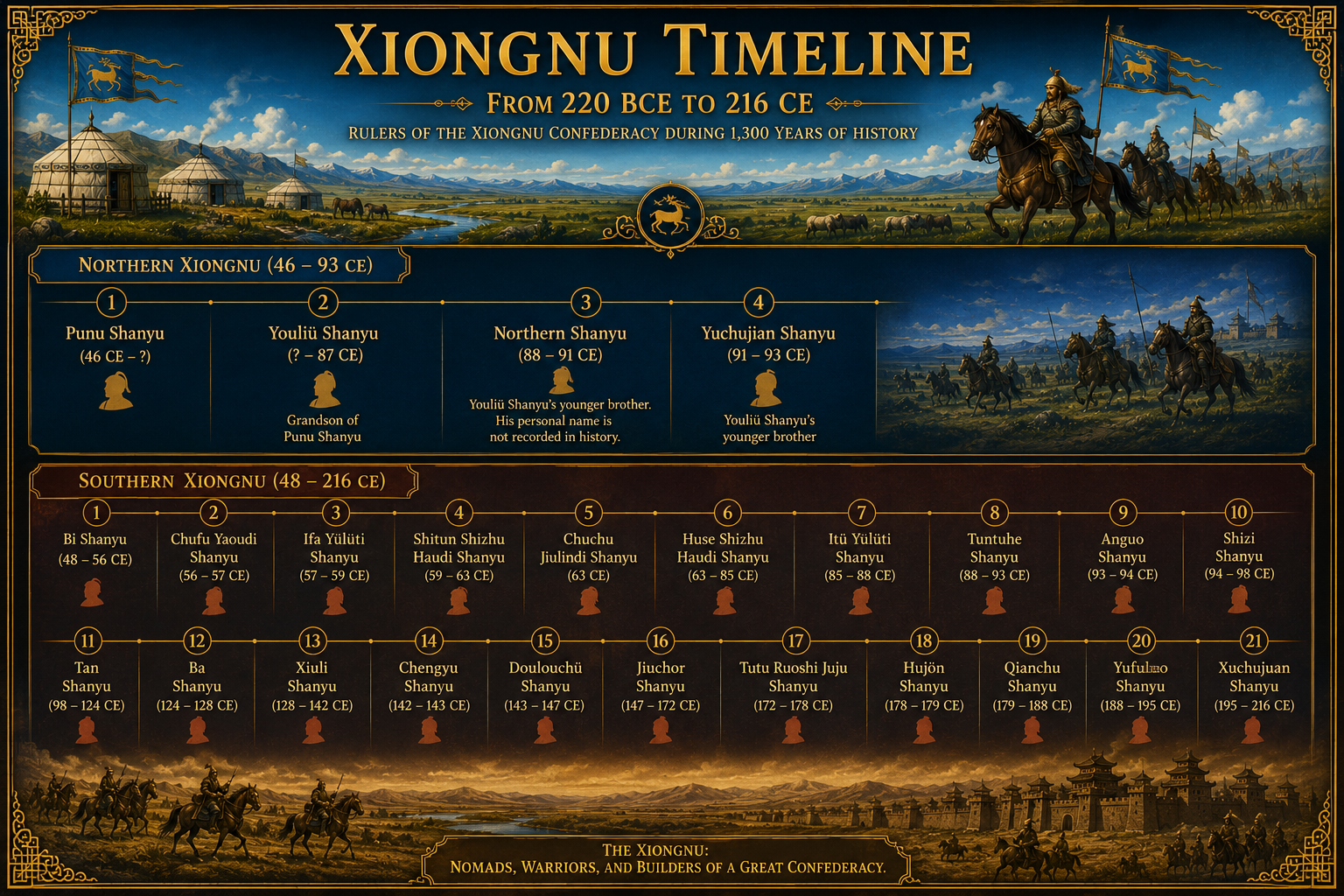
NORTHERN WEI: A FRONTIER EMPIRE OF THE STEPPE WORLD
From the Steppe Confederations to the Tuoba Xianbei State
The Northern Wei Dynasty (386–534 CE) was founded not by a settled Han ruling house, but by the Tuoba Xianbei (拓跋鲜卑), one branch of the broader Xianbei confederations that emerged across the northern steppe after the decline of the Xiongnu (Hun) Empire.
The Xianbei were among the major peoples who inherited the political and military landscape of Inner Asia following the fragmentation of the Xiongnu world.
Historical Development
Xiongnu Confederation
(c. 3rd century BCE – 1st century CE)
↓
Post-Xiongnu Steppe Successor Groups
↓
Xianbei Confederations
(c. 1st–3rd centuries CE)
- Tuoba Xianbei
- Murong Xianbei
- Yuwen Xianbei
- Duan Xianbei
- Tufa Xianbei
↓
Tuoba Xianbei State Formation
↓
Northern Wei Dynasty
386–534 CE
Steppe Heritage of Northern Wei
The early Northern Wei state retained many characteristics associated with steppe societies:
- Horse-based military organization
- Heavy cavalry traditions
- Frontier garrisons and mobile warfare
- Clan-centered political structures
- Strong northern pastoral heritage
Its ruling elite originated from the Tuoba Xianbei, who had developed within the northern frontier world rather than the agricultural centers of China.
Sinicization and Transformation
During the reign of Emperor Xiaowen (471–499 CE), Northern Wei adopted extensive reforms:
- Chinese administrative institutions
- Court dress reforms
- Chinese surnames and language policies
- Transfer of the capital to Luoyang
This marked the gradual transformation of a steppe-founded state into a more sinicized imperial system.
Historical Interpretation
Northern Wei may therefore be viewed as:
Steppe Confederation Heritage
+
Tuoba Xianbei Political Rule
+
Gradual Sinicization
rather than simply a conventional Han dynasty.
Historical Lineage
Xiongnu World
→ Xianbei Confederations
→ Tuoba Xianbei
→ Northern Wei
→ Sinicized Imperial State
Historical Background of Mulan
Hua Mulan is a legendary female warrior associated with the Northern Wei Dynasty (386–534 CE). The earliest surviving source concerning her story is the “Ballad of Mulan” (Mulan Ci), generally dated to the Northern Dynasties period.
The ballad tells of a young woman who took her aged father’s place in military service, disguised herself as a man, fought for many years, and returned home without revealing her identity.
Northern Wei Context
Mulan’s story is traditionally connected with the Northern Wei, a state founded by the Tuoba Xianbei, a steppe people who originated from the northern frontier and later established rule over northern China.
The Northern Wei military system relied heavily upon cavalry traditions and frontier warfare, reflecting strong steppe influences.
Because of this historical background, some scholars suggest that the cultural environment reflected in the Ballad of Mulan shows stronger frontier and nomadic characteristics than later Han literary reinterpretations.
The Ballad of Mulan
The original ballad does not describe Mulan as a princess or noblewoman.
Instead, she appears as:
- Daughter of a frontier military household
- Skilled rider and warrior
- Loyal to family and clan
- Veteran who served many years in war
The poem emphasizes filial duty, courage, and military service, rather than romance.
Xianbei and Steppe Interpretation
Several modern interpretations associate Mulan with the Xianbei frontier world because:
- Story placed during Northern Wei rule
- Northern Wei founded by Tuoba Xianbei
- Steppe cavalry culture appears in the setting
- Frontier military traditions dominate the narrative
However, no surviving historical source explicitly identifies Mulan’s ethnicity, and her historical existence remains uncertain.
Traditional Verse from the Ballad
“The male hare kicks and leaps,
the female hare’s eyes are dim and small.
But when both run side by side,
who can tell male from female?”This became the symbolic conclusion of Mulan’s legend,
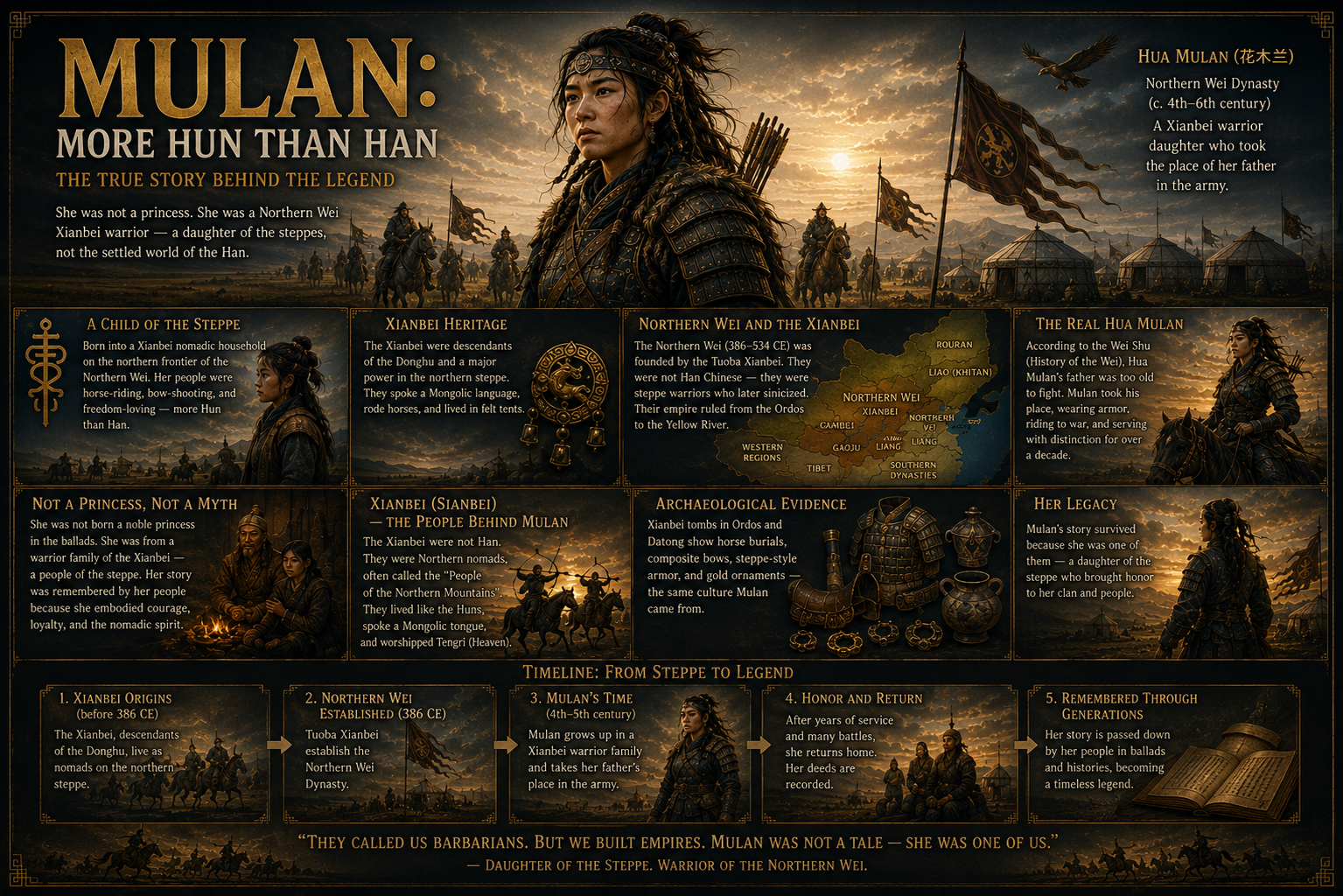
XIANBEI
The first great ruler traditionally associated with the rise of the Xianbei was Tanshihuai (Tan Shihuai, c. 136–181 CE), the legendary leader who transformed the scattered Xianbei tribes into a powerful steppe confederation.
According to the chronicles, Tanshihuai was born during a time when the northern tribes were divided and weak after the decline of the Xiongnu. From a young age, he was remembered as fierce, intelligent, and gifted in war and leadership. Steppe legends describe him as a man favored by Heaven, capable of uniting riders from distant lands beneath one standard.
Under Tanshihuai, the Xianbei expanded across the Mongolian steppe, Manchuria, and the northern frontier. He reorganized the tribes, strengthened cavalry warfare, and established authority over vast territories stretching from the eastern forests to the Altai regions.
Unlike the older Xiongnu imperial structure, the Xianbei confederation under Tanshihuai relied heavily on clan alliances, mobility, and military loyalty. His campaigns repeatedly challenged the Han frontier, and for a time the Xianbei became the dominant power of the northern steppe.
To later generations, Tanshihuai was remembered as the ruler who carried the spirit of the steppe forward after the age of the Xiongnu — a new horse lord rising beneath Eternal Heaven.
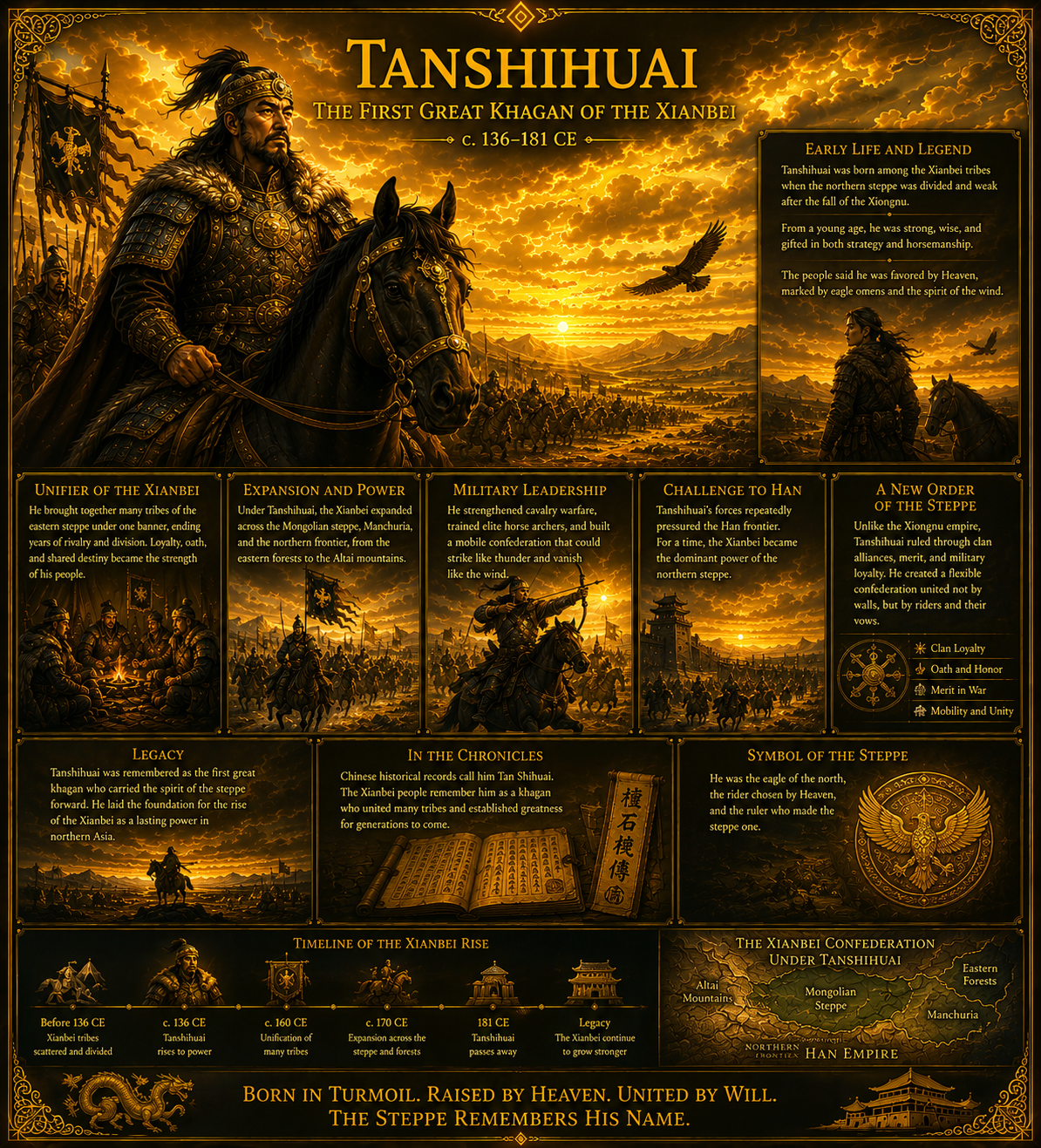
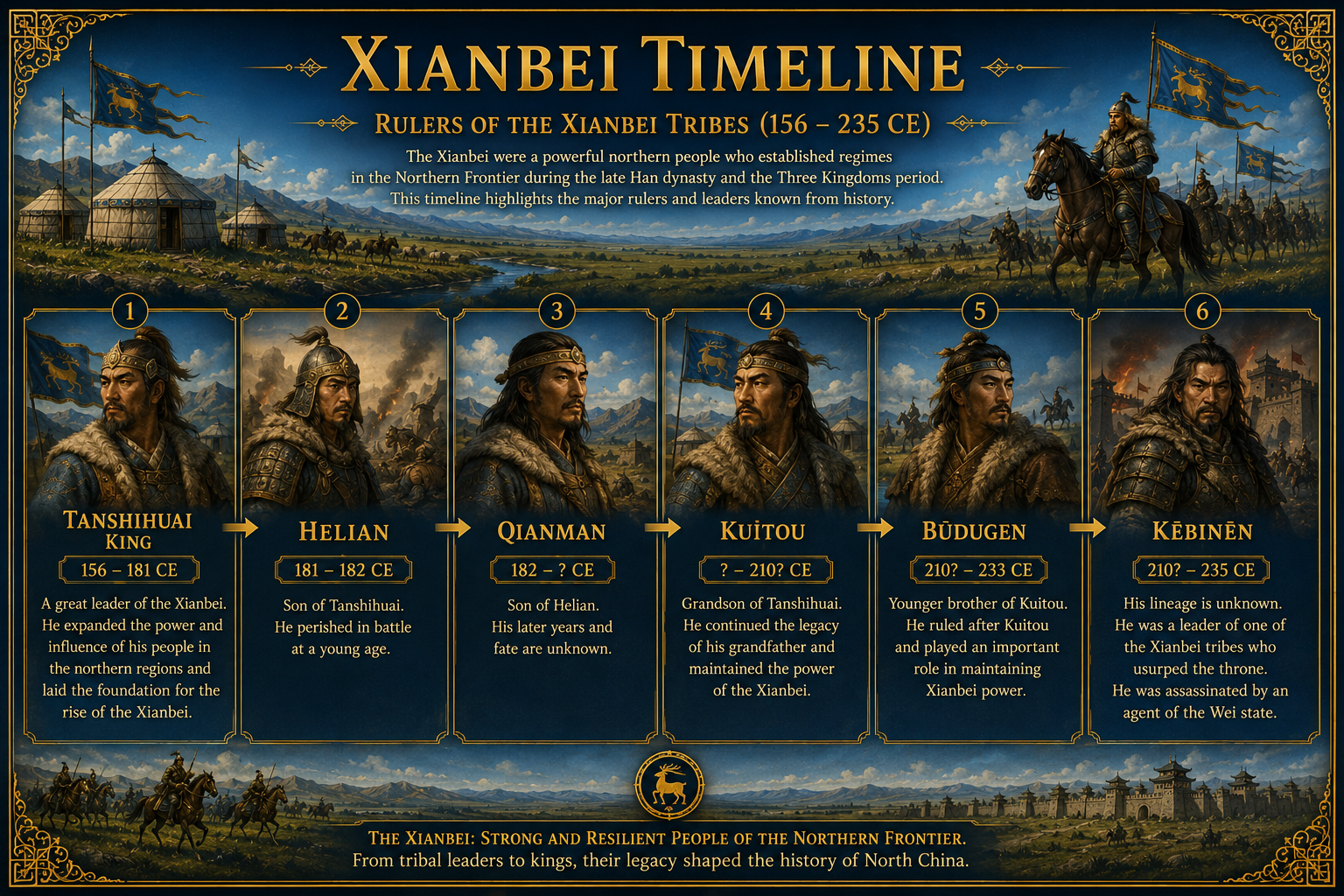
The Rouran Khaganate
After the rise of the Xianbei, the next great steppe empire was the Rouran Khaganate (c. 330–555 CE). The Rouran carried forward the imperial traditions of the northern steppe and became one of the most powerful nomadic empires of Inner Asia before the rise of the Göktürks.
The Rouran are especially important in steppe history because they were among the first to widely use the imperial title “Khagan”, a title that later became famous across the Turkic and Mongol worlds.
Under the Rouran Khagans: many northern tribes were united, cavalry power expanded across the steppe, trade and diplomacy connected Inner Asia, and the frontier states of northern China faced a new horse empire from the north.
Their dominion stretched across Mongolia and the eastern steppes, ruling through mobility, tribal alliances, military power, and the authority of the Khagan beneath Eternal Heaven. The Rouran age became a bridge between the older Xiongnu–Xianbei world and the later Göktürk empires that would transform Eurasia.
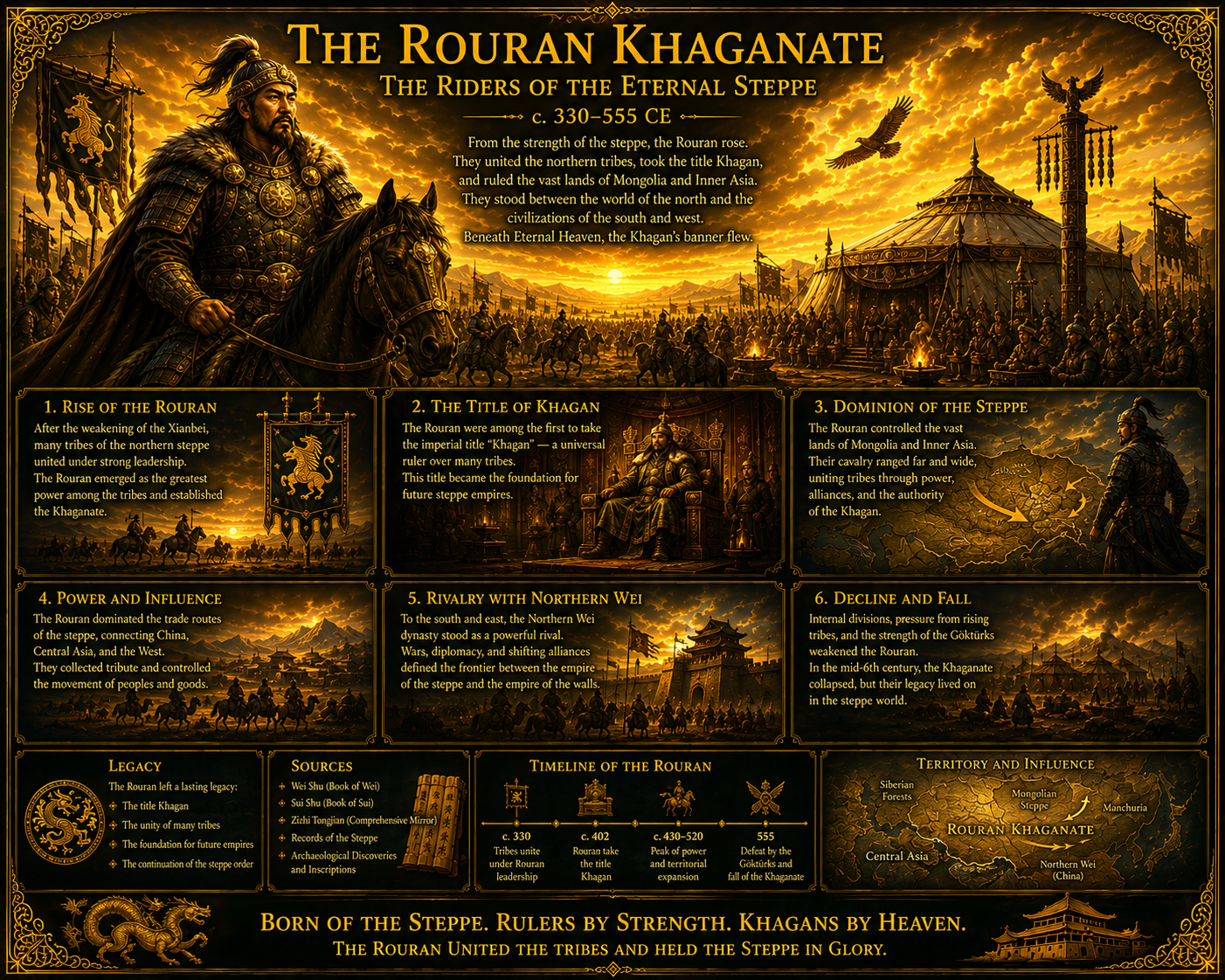
Yujiulü Shelun — First Great Khagan of the Rouran
Yujiulü Shelun was the founder and first great ruler of the Rouran Khaganate, which rose across the Mongolian steppe during the late 4th century CE. Emerging from the northern nomadic tribes after the decline of earlier steppe confederations, Shelun united many scattered peoples into a powerful horse empire.
He is historically significant for establishing one of the earliest steppe states to use the imperial title “Khagan,” a title later adopted by many Mongol and Turkic empires across Eurasia.
According to historical accounts, Shelun rose to power through years of tribal conflict, exile, and warfare. After securing leadership, he reorganized the Rouran tribes into a stronger military confederation built upon cavalry, mobility, loyalty, and centralized authority beneath the Khagan.
Under his rule, the Rouran expanded their influence across Inner Asia, dominated important steppe routes, and became a major power confronting the northern Chinese dynasties.
The rise of Yujiulü Shelun marked the beginning of a new imperial age on the steppe — an era in which nomadic confederations evolved into organized empires capable of shaping the history of Eurasia.
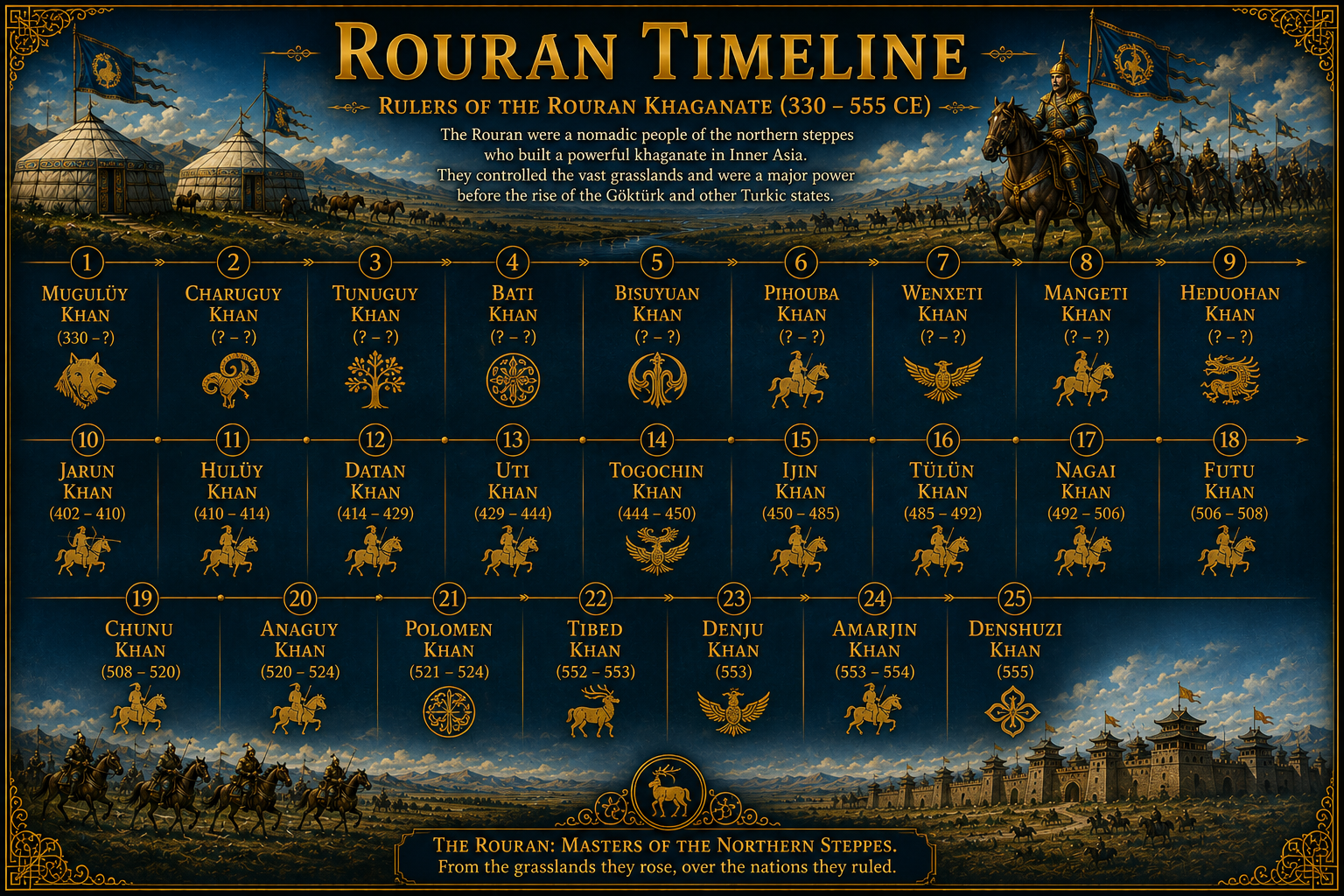
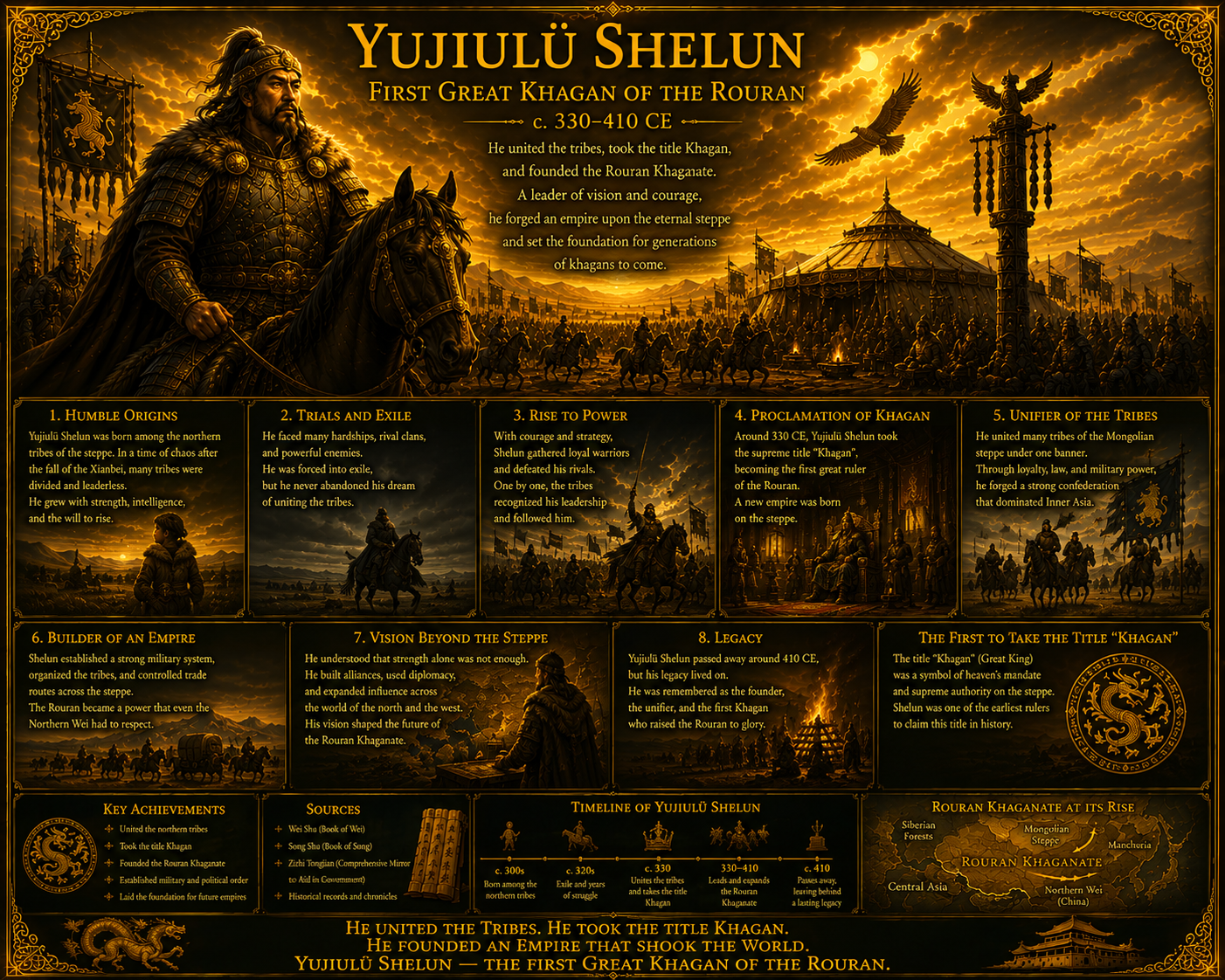
The term “Kök Türk” may be interpreted through a Mongolic linguistic perspective as related to Höh Tereg or Höh Türeg, meaning “Blue/Celestial Tureg.” In the wider Inner Asian tradition, the word kök/höh symbolized the Eternal Blue Sky, heavenly authority, and steppe sovereignty.
Mediterranean World (c. 300 BCE) — The Hellenistic kingdoms established after the death of Alexander the Great dominated much of the eastern Mediterranean and Near East.
Italy (c. 300 BCE) — The Roman Republic was expanding across the Italian Peninsula and emerging as a major regional power.
Egypt (c. 300 BCE) — Ptolemaic Kingdom ruled Egypt as one of the wealthiest and most influential states of the Mediterranean.
Mesopotamia and Persia (c. 300 BCE) — The Seleucid Empire controlled vast territories from Syria to Persia after the fragmentation of Alexander’s empire.
South Asia (c. 300 BCE) — The Maurya Empire unified much of the Indian subcontinent under centralized imperial rule.
Central Asia (c. 300 BCE) — Steppe tribes and oasis states maintained trade and migration networks linking Inner Asia with Persia and India.
Europe (c. 300 BCE) — Celtic peoples dominated large regions of western and central Europe through tribal confederations and warrior societies.
Northern Europe (c. 300 BCE) — Germanic and Scandinavian communities remained decentralized agricultural and maritime societies.
Africa (c. 300 BCE) — The Kingdom of Kush flourished south of Egypt and maintained regional influence along the Nile.
East Africa (c. 300 BCE) — Maritime trade across the Red Sea connected African coastal communities with Arabia and the Indian Ocean world.
China (c. 300 BCE) — The Warring States period continued as rival kingdoms competed for supremacy before the unification under Qin.
Eastern Steppe (c. 300 BCE) — The early Xiongnu tribes and other nomadic peoples of the steppe were consolidating under emerging tribal leadership before the rise of Modu Chanyu.
Mesoamerica (c. 300 BCE) — Regional ceremonial centers and agricultural societies expanded across Mesoamerica during the Late Preclassic period.
North America (c. 300 BCE) — Indigenous cultures developed regional exchange systems, mound-building traditions, and agricultural settlements adapted to diverse environments.
The Buman
The name “Buman” is notable because, in both ancient and modern Mongolian usage, it preserves the meaning of a great multitude or vast number — often associated with the idea of “one hundred thousand.” The name carries the symbolic sense of immense strength, abundance, and military power.
Historical traditions also connect the early Göktürks with the ironworking tribes of the Mongol Altai. Among Mongolian peoples, these groups were long remembered as türeg or steppe blacksmith clans — renowned for metalwork, weapons, cavalry equipment, and mastery of iron. From these frontier ironworking peoples emerged the ruling Ashina lineage that later built the Göktürk Empire.
Originally subjects of the Rouran, the Göktürks gained power through cavalry warfare, iron production, and control of the steppe trade routes. After conflict with the Rouran rulers, Bumin revolted and defeated them in 552 CE, proclaiming himself Qaghan and establishing the first great Turkic empire.
Under Bumin and his successors, the Göktürk Khaganate expanded across Mongolia and Central Asia, becoming one of the dominant powers of the Eurasian steppe. Their rise marked the beginning of a new imperial era beneath Eternal Heaven — an age of mounted empires, iron, mobility, and frontier power.
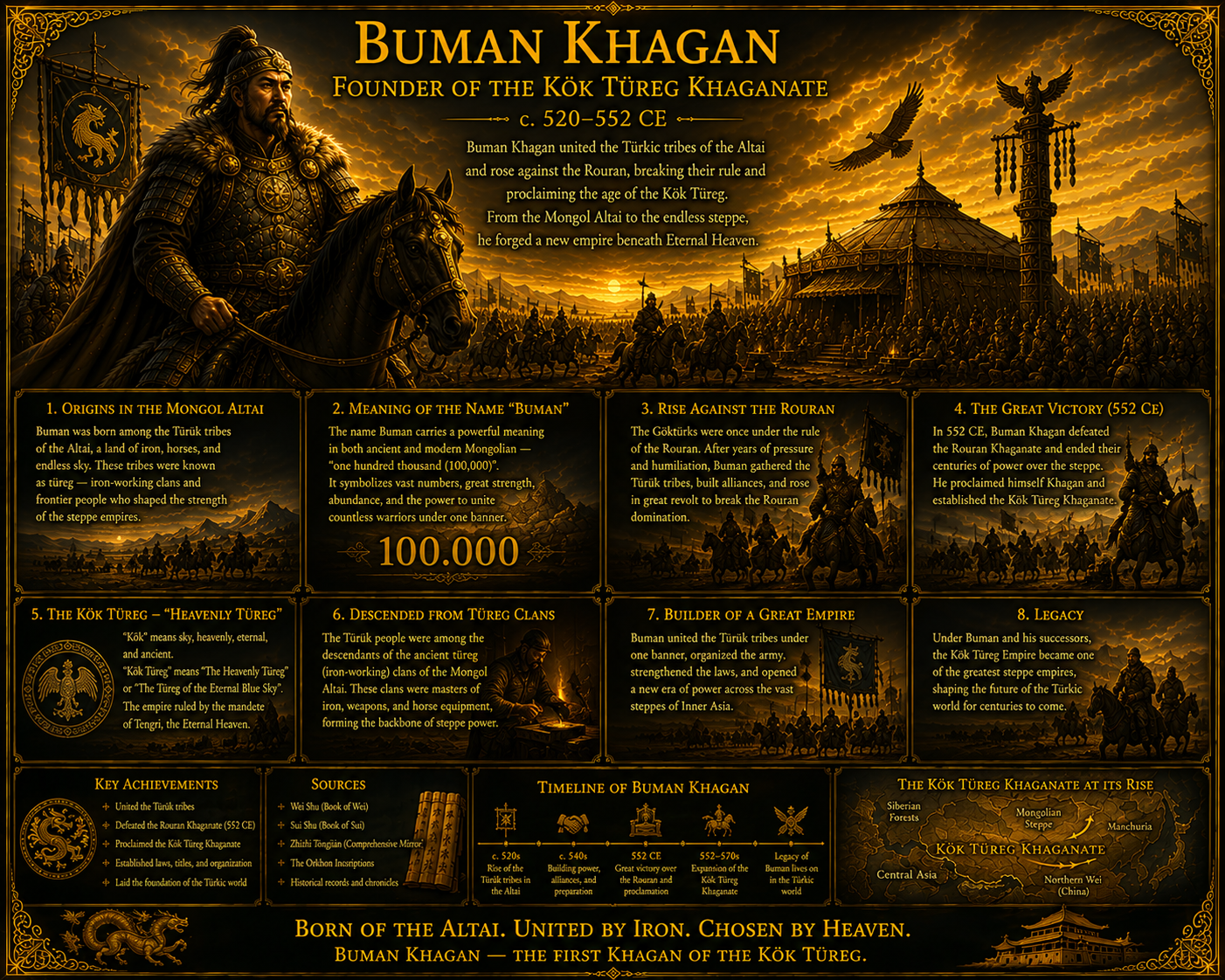
Bilge Khagan — The Wise Ruler of the Kök Türeg
Bilge Khagan (d. 734 CE) was the great Khagan of the Kök Türeg Empire and one of the most celebrated rulers of the Inner Asian steppe. He ruled from 716 CE until his death, leading the restoration of the Turkic Khaganate alongside his brother Kül Tegin and the renowned strategist Tonyukuk.
The name “Bilge” literally means “wise,” “intelligent,” or “possessing wisdom.” The word remains preserved in the Mongolian language today as bileg or bilig, referring to wisdom, intellect, knowledge, and a wise person. His title therefore carried the meaning of a ruler guided not only by military strength, but by understanding and statecraft.
Bilge Khagan is remembered through the great inscriptions of the Orkhon Valley, among the oldest surviving monumental texts of the steppe world. In these inscriptions, he honored his younger brother Kül Tegin, whose name is often interpreted through the idea of the heroic or mighty rider — a mounted warrior of extraordinary courage and loyalty.
The Orkhon monuments describe Kül Tegin as the shield and sword of the empire, a horse-mounted hero who fought to reunite the tribes beneath Eternal Heaven. Bilge Khagan’s inscriptions mourn his brother deeply, portraying him not merely as a commander, but as the defender of the people and the foundation of the Khaganate’s strength.
Within these stone records, Bilge Khagan warned the steppe peoples against division, foreign dependence, and the loss of ancestral traditions. He declared that when the tribes remained united beneath Tengri, the steppe prospered; when divided, they fell into weakness and subjugation.
Under Bilge Khagan, the Kök Türeg Empire once again became one of the dominant powers of Inner Asia — a realm of horsemen, iron, memory, wisdom, and Eternal Heaven.
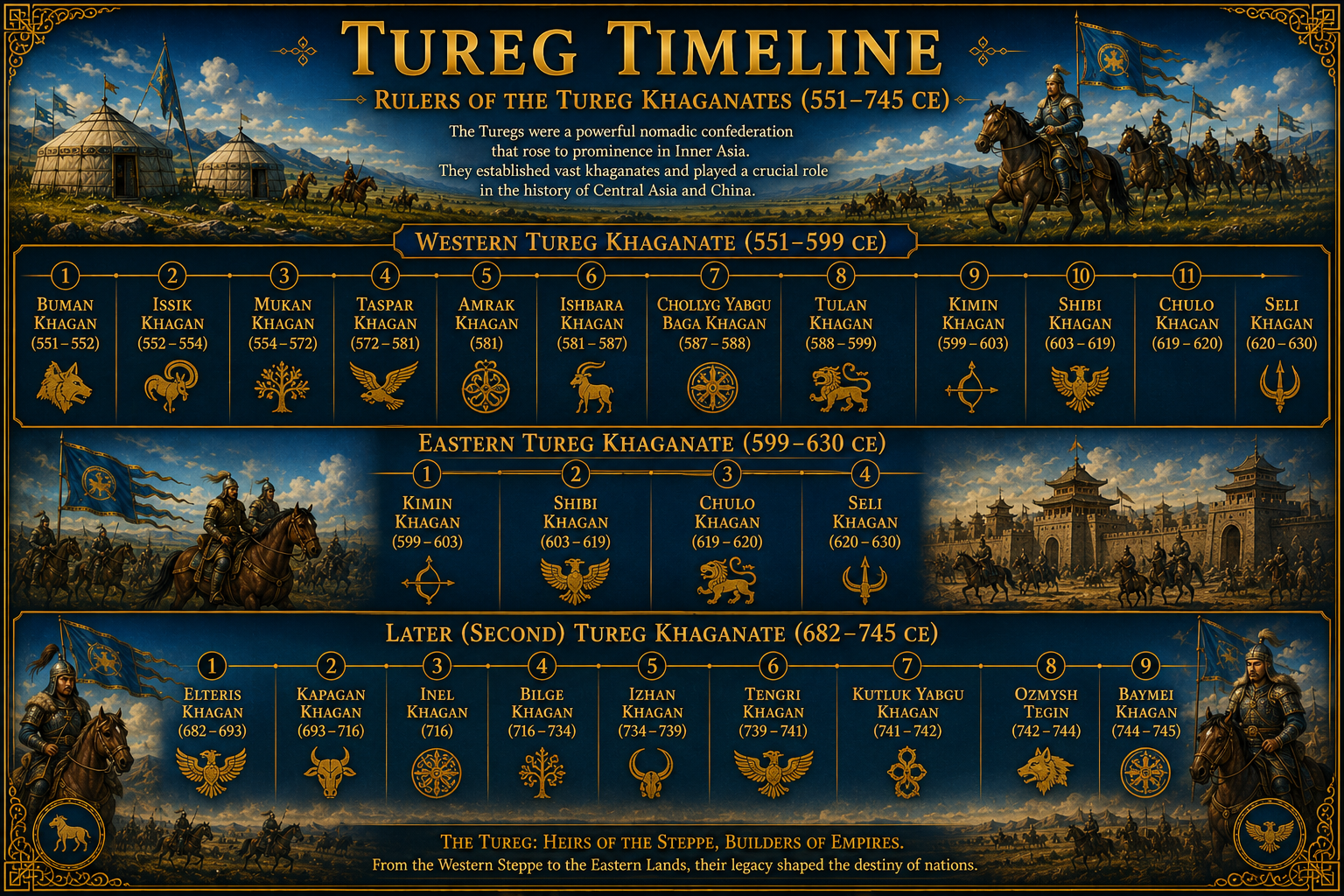
The Uyghur Khaganate (744–840 CE)
The Uyghur Khaganate emerged after the fall of the Kök Türeg Empire and became one of the greatest steppe empires of the 8th century. Founded by the Uyghur tribes under the Yaglakar ruling clan, the khaganate dominated Mongolia, the Orkhon Valley, and large parts of Inner Asia.
Unlike many earlier steppe confederations that relied mainly on conquest and cavalry warfare, the Uyghur Khaganate developed a more complex imperial system based on trade, diplomacy, literacy, and control of Silk Road networks. Their capital, Ordu-Baliq in the Orkhon Valley, became one of the largest and most sophisticated cities of the steppe world.
The Uyghurs inherited many traditions of the Kök Türeg empires: mounted warfare,
Tengri-centered steppe rulership, tribal alliances, and imperial authority beneath Eternal Heaven.
At the same time, they expanded relations with China, Sogdia, and Central Asia, adopting writing systems, urban administration, and new religious influences including Manichaeism and Buddhism.
The Uyghur Khaganate played a decisive role in Inner Asian politics, trade, and diplomacy during the Tang period. Their cavalry armies protected trade routes while their merchants connected the eastern and western worlds across Eurasia.
In later history, the collapse of the Uyghur Khaganate in 840 CE scattered many Uyghur groups across Central Asia and the Gansu region, where they continued to shape the cultural and political history of the Silk Road world.
The Uyghur age marked another transformation of the steppe empire tradition:
from purely nomadic imperial power toward a more urbanized and literate civilization of Inner Asia beneath Eternal Heaven.
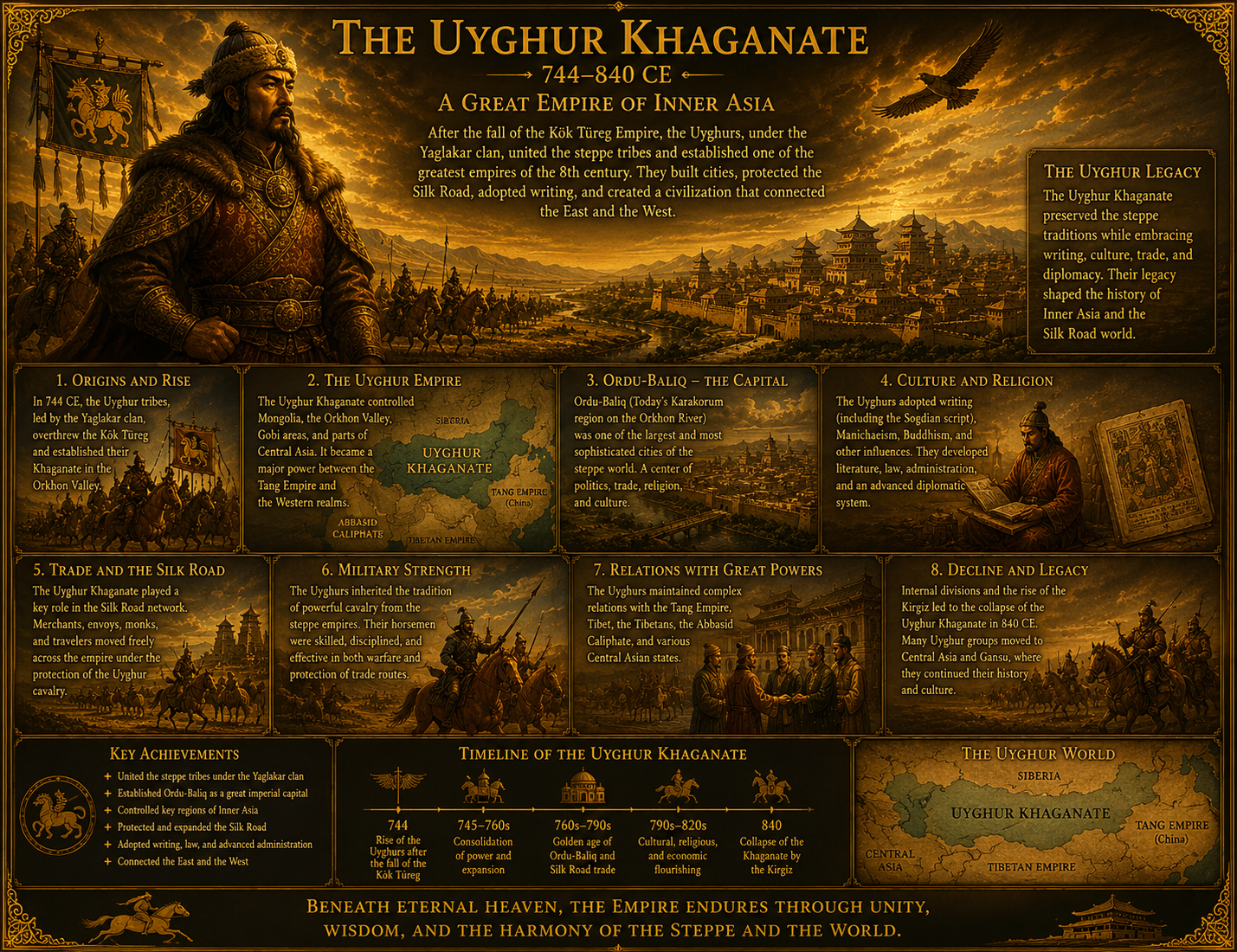
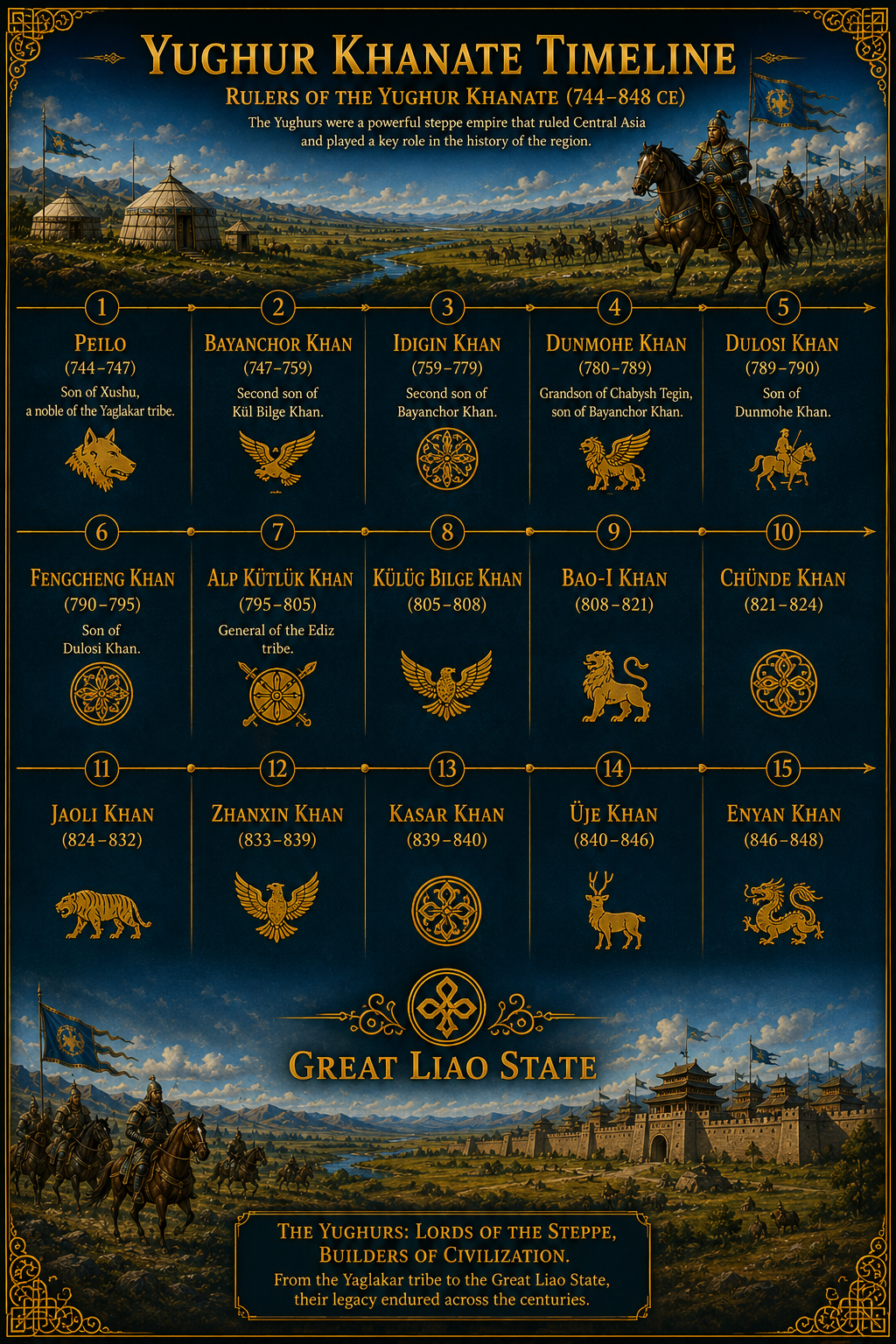
Yenisei Kyrgyz Khaganate - Sayan Uriankhai
The Yenisei Kyrgyz defeated the Uyghur Khaganate and briefly became the dominant steppe power after 840 CE. Their influence extended across Mongolia for a time, though they did not build a long-lasting centralized empire comparable to the Uyghurs or later Mongols.
The Yenisei Kyrgyz Khaganate emerged as one of the great powers of Inner Asia after the collapse of the Uyghur Khaganate in 840 CE. Their rulers, known as Khagans or Qağans, governed a powerful confederation centered around the upper Yenisei River and the Sayan Mountains.
The Kyrgyz Khagans were remembered in Chinese chronicles as fierce northern rulers who descended from the forest-steppe regions with sudden military force. When the Uyghur Khaganate weakened, the Yenisei Kyrgyz launched a decisive campaign that destroyed the Uyghur imperial capital in Mongolia. This transformed them from a regional Siberian power into masters of much of the eastern steppe.
Historically, the Kyrgyz rulers differed from many southern sedentary monarchs. Their authority rested not merely on cities or bureaucracy, but on:
- cavalry power,
- tribal alliances,
- control of northern trade routes,
- and sacred legitimacy connected to Tengri and ancestral tradition.
Chinese Tang records described the Kyrgyz elite as tall, often with lighter hair or reddish features compared with other steppe peoples, though such descriptions were likely exaggerated by frontier observers fascinated by distant northern tribes.
A historically fitting English text for your illustrated page could read:
YENISEI KYRGYZ KHAGAN
From the rivers of ice and the shadow of the Sayan Mountains,
the Kyrgyz Khagans descended upon the steppe.After the fall of the Uyghur Khaganate,
they rose as masters of the northern world,
carrying the strength of the forest, river, and eternal sky.Their banners rode with thunder.
Their horses crossed frozen earth and endless grasslands.The Yenisei Kyrgyz were not merely conquerors—
they were the power born from the river itself.
KHITAN - LIAO EMPIRE
Founded in 907 CE by the Khitan ruler Yelü Abaoji, the Khitan Liao Empire emerged as the dominant power of eastern Inner Asia after the decline of the Tang world and the fragmentation of the steppe. Originating from the forest-steppe regions of Manchuria and eastern Mongolia, the Khitan united nomadic cavalry traditions with imperial administration, establishing a dual political system that governed both steppe tribes and sedentary agricultural populations.
The empire controlled vast territories extending across Mongolia, Manchuria, and northern China, commanding major trade routes and frontier military zones. Known in Chinese records as the Liao Dynasty, the Khitan preserved their own language, customs, and aristocratic steppe identity while simultaneously adopting institutions of statecraft, taxation, urban administration, and diplomacy.
The Khitan Liao world became one of the principal imperial predecessors of later Inner Asian empires, particularly influencing frontier governance, cavalry warfare, and the political culture inherited by subsequent Jurchen and Mongol states.
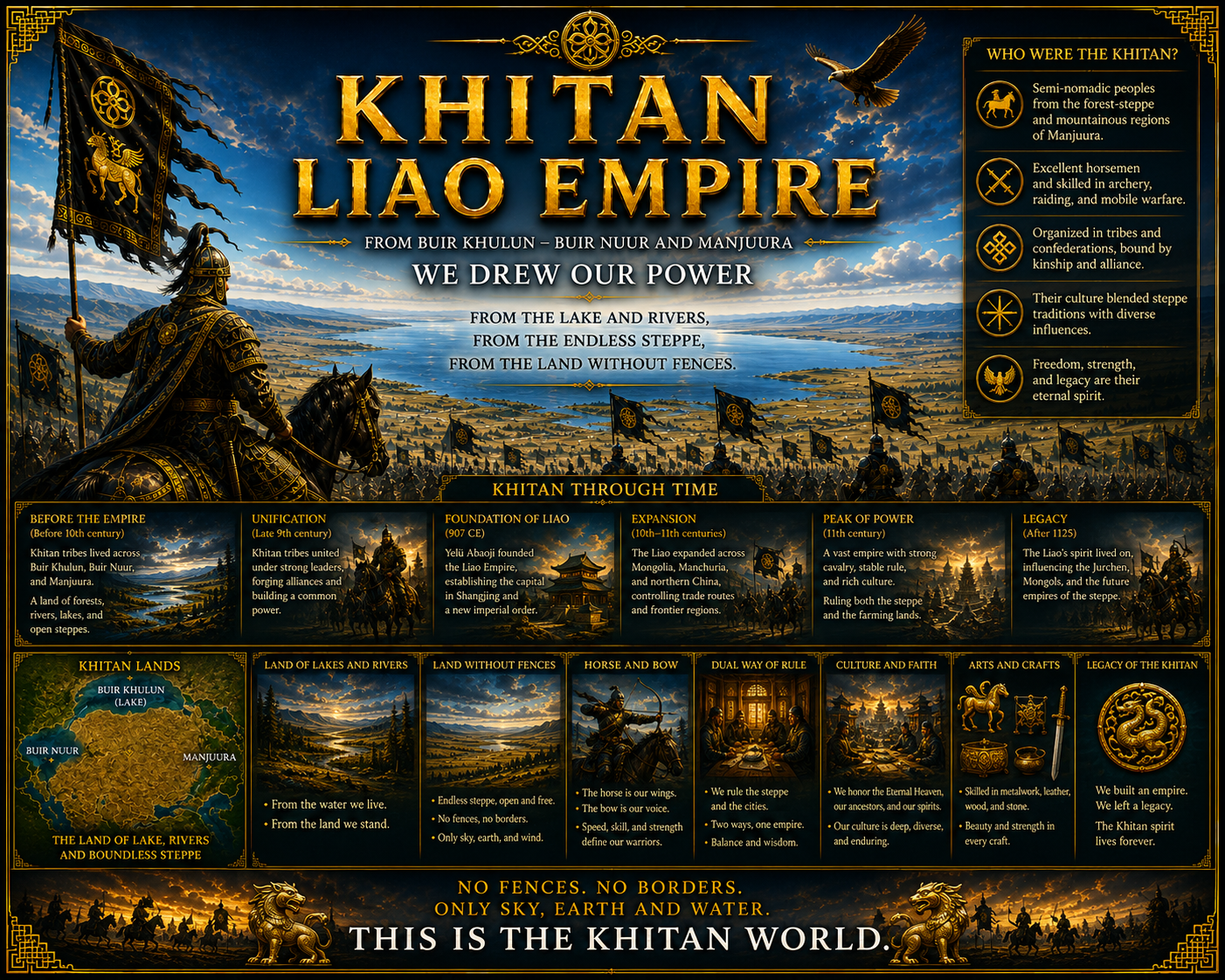
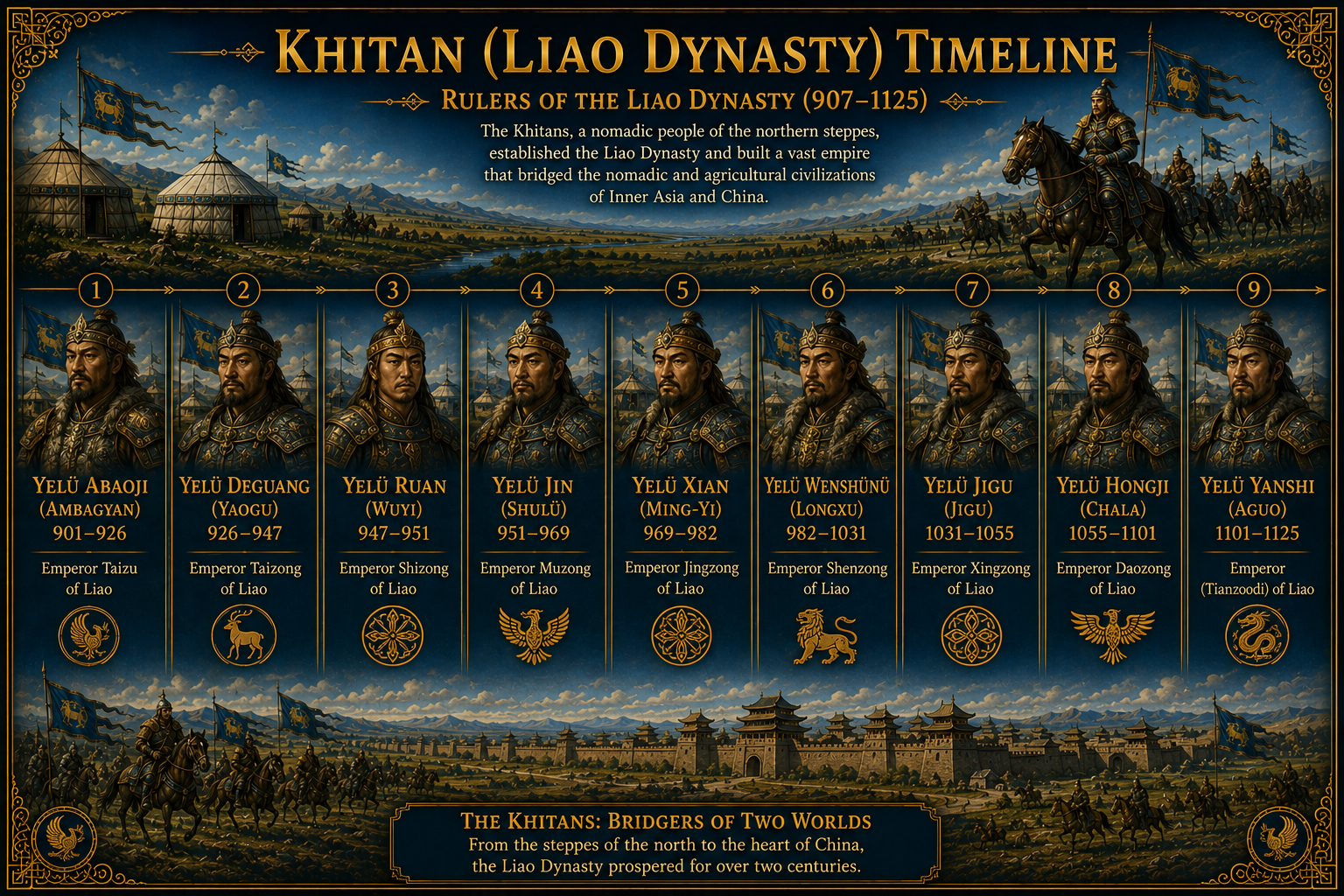
THE MONGOL EMPIRE
ONE SKY. ONE KHAN. ONE WORLD.
From the windswept steppe of Inner Asia arose the largest contiguous land empire in human history. Founded by Chinggis Khan in the early thirteenth century, the Mongol Empire united rival tribes beneath the Eternal Blue Sky and transformed the political order of Eurasia forever.
The Mongols were masters of mobility, discipline, and horse warfare. Their armies crossed deserts, mountains, forests, and frozen rivers with unprecedented speed, conquering territories from Korea and North China to Central Asia, Persia, the Middle East, and Eastern Europe.
Yet the Mongol Empire was not built by conquest alone. Under the Great Khans, vast trade routes were secured, merchants and scholars traveled safely across continents, and the Silk Road entered a new age of exchange. Ideas, technologies, religions, and cultures moved between East and West through the roads protected by Mongol power.
The empire developed sophisticated systems of communication, administration, taxation, and diplomacy. The Yam postal network connected distant regions of Eurasia, while merit, loyalty, and military ability often stood above noble birth.
The Mongol world was also remarkably diverse. Buddhists, Muslims, Christians, Daoists, and shamans lived within the same imperial sphere. From the courts of Karakorum and Khanbaliq to the caravan cities of Central Asia, the empire became a crossroads of civilizations.
After the death of Chinggis Khan, the empire expanded under his descendants and later divided into several great khanates, including the Golden Horde, the Ilkhanate, the Chagatai Khanate, and the Монголын Юань гүрэн.
Though the empire eventually fragmented, its influence endured across centuries. The Mongols reshaped warfare, commerce, diplomacy, and global connectivity, leaving a legacy that continued to influence the modern world long after the empire itself had faded.
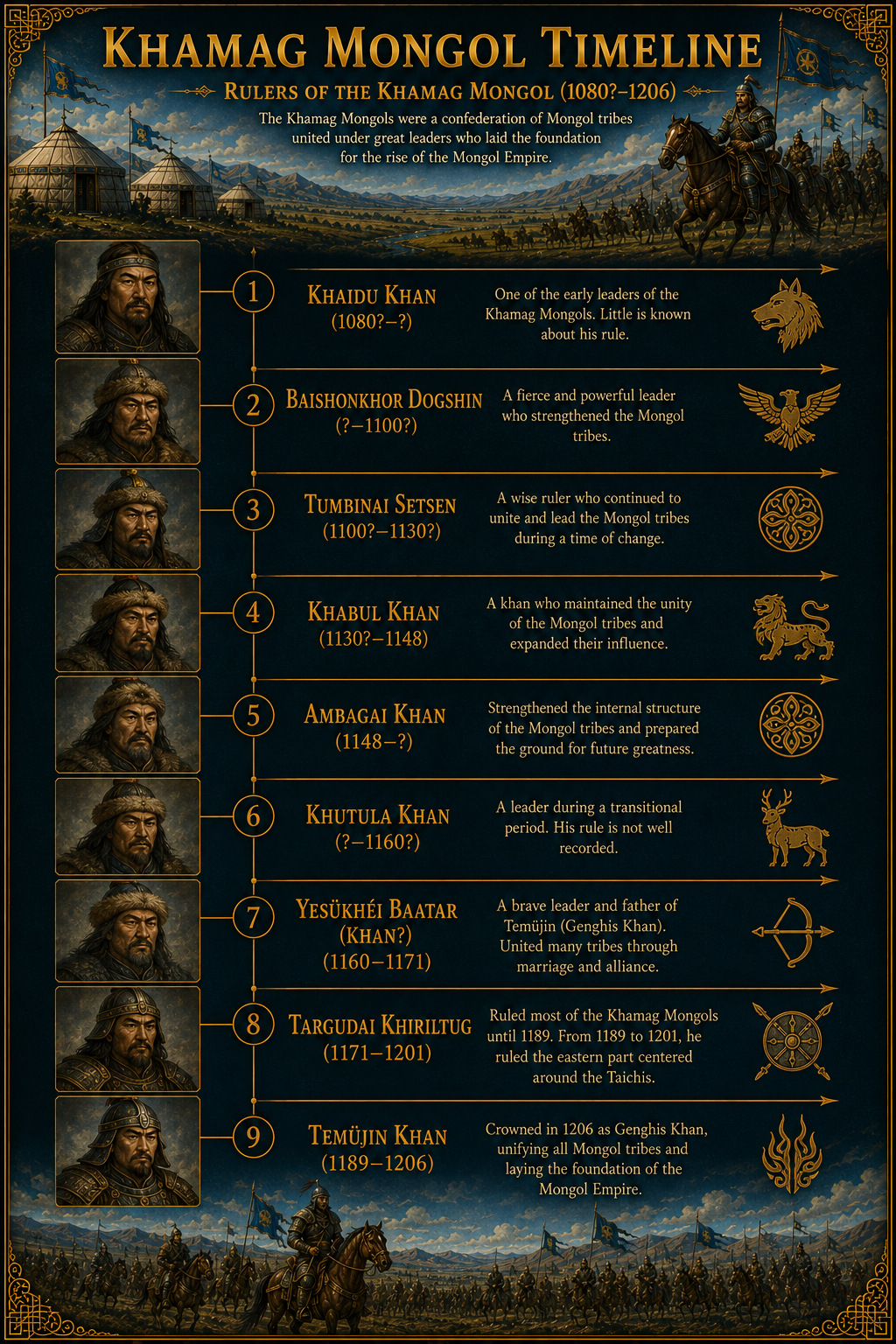
Khabul Khan, the First Known Khan of Khamag Mongol
Khabul Khan (Mongolian: Хабул хан; Chinese: 合不勒), also rendered as Qabul Khan, Kabul Khan, or Khabul Khagan (born c. 1090s–1100; died 1148 CE), was the founder and first known Khan of the Khamag Mongol Confederation. He was the great-grandfather of Genghis Khan, founder of the Mongol Empire, and the twin brother of Khaduli Barlas, who later became the ancestor of Timur (Tamerlane), founder of the Timurid Empire.
Family and Background
Khabul Khan was the son of Tumbinai Khan and a great-grandson of Khaidu. He belonged to and led the Borjigin clan (obog), which later became the ruling lineage of the Mongol Empire.
Campaigns and Political Rise
Khabul Khan became renowned for his conflicts with the Jurchens, a people of Manchuria who later founded the Jin Dynasty in 1115 CE.
The Jurchens, allied with the Song Dynasty, launched campaigns against the Khitan-led Liao Dynasty, capturing much of its territory by 1122 CE.
In 1135 CE, Khabul Khan was invited to the court of Emperor Taizong of Jin. According to tradition, he famously pulled the emperor’s beard during the audience. Jin forces pursued him into southern Mongolia, but he escaped capture and later returned with a larger force, conducting raids against Jin territories.
When Jin armies advanced into Mongolia during their expansion against the remnants of the Liao and the emerging Qara Khitai (Western Liao) under Emperor Dezong, Khabul Khan organized a united Mongol coalition and successfully resisted the invasion.
Foundation of the Khamag Mongol
Khabul Khan united several major tribes into the confederation known as Khamag Mongol (“Whole Mongol”), composed primarily of four core groups:
- Khiyad
- Taichuud
- Jalair
- Jurkhin
This confederation is often regarded as the direct political predecessor of the later Mongol Empire.
Following Mongol successes, the Jurchens recognized Khabul Khan as the paramount ruler of the Mongols around 1146–1147 CE, though they formally continued to regard him as a vassal.
Khabul Khan also expanded Mongol influence and achieved notable victories against the Tatars, aided by his son Yesügei. His reign marked one of the earliest attempts at political unification among the Mongol tribes.
Despite having seven sons, Khabul Khan selected Ambaghai of the Taichuud, son of Sengün Bilge, as his successor.
Descendants and Legacy
Khabul Khan had seven sons.
His eldest son was Okin-Barkhakh, while the second son was Bartan the Valiant (Bartan Baghatur).
Bartan fathered Yesügei Baghatur, who in turn became the father of Temüjin (Genghis Khan).
Khabul Khan’s third son was Mongler, father of Büri the Wrestler.
Khabul Khan’s legacy lies in establishing the first durable Mongol political confederation, creating the institutional and tribal foundation from which the Mongol Empire would eventually emerge.
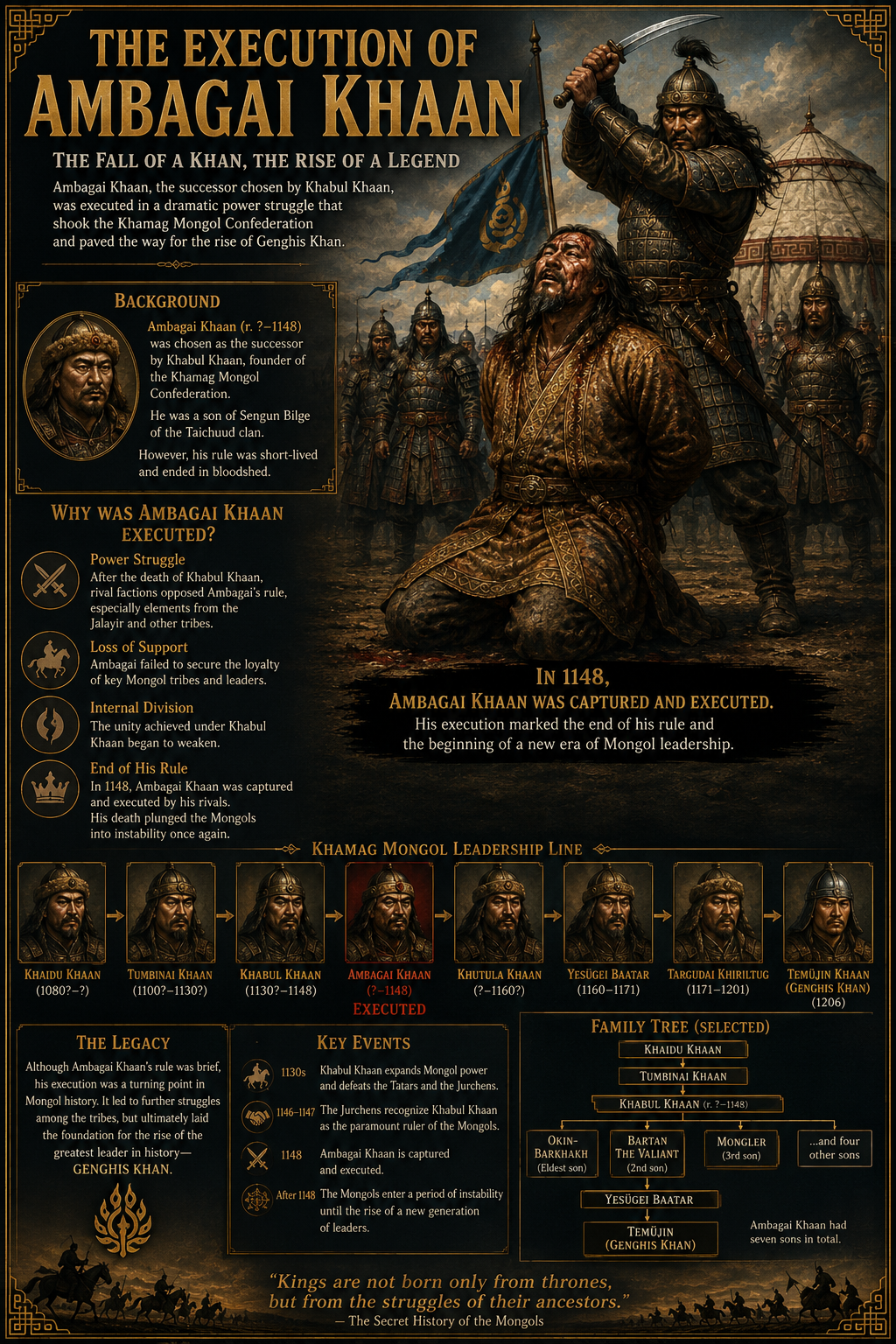
Khan of the Khamag Mongol Confederation
AMBAGHAI KHAN
(Mongolian: ᠠᠮᠪᠠᠭᠠᠢ; d. c. 1156 CE)
Ambaghai Khan succeeded his cousin Khabul Khan as ruler of the Khamag Mongol Confederation during the mid-12th century. He was a great-grandson of Khaidu Khan, grandson of Charaqai Lingqum, and leader of the Taichuud, a branch of the Borjigin lineage.
According to The Secret History of the Mongols, Ambaghai’s father was Senggüm Bilge (also identified as Sorqaduqtu Chino in other traditions). Because he was among the senior members of the Borjigin line, he was elevated to the position of Khan after Khabul.
Capture and Execution
Near the end of his reign, Ambaghai was captured by the Tatars while escorting his son Qadaan Taishi for marriage negotiations with the Airu’ut Tatars. Khabul Khan’s son Tödö’en Otchigin was seized with him.
The capture was reportedly carried out under the direction of the Jurchen Jin Dynasty, which sought to curb the growing power of the Mongols.
Ambaghai was taken to the Jin capital Zhongdu (present-day Beijing), where he was executed after being nailed to a wooden frame and put to death.
Modern estimates place his death around 1156 CE.
Legacy
Ambaghai’s death became one of the deepest grievances in early Mongol memory.
His son Qadaan Taishi later fought alongside Hotula Khan against the Tatars. Leadership among the Taichuud eventually passed to Targutai Kiriltuk, later one of the principal rivals of Temüjin (Genghis Khan).
In 1211, Genghis Khan launched the Mongol–Jin War, declaring vengeance for Ambaghai Khan’s capture and execution.
Known Sons
• Adal Khan
• Targutai Kiriltuk (d. 1201)
• Au’chu Baghatur
• Qadaan Taishi
• Quril Baghatur
• Töda’a
• Qodun Orchang
• Bakhachi
• Udor Bayan
“While journeying to establish a marriage alliance with the Tatars, I was betrayed and seized. Delivered to the Altan Ulus (Jin Dynasty), they bound me upon the wooden ass and put me to death with cruel torment. Carry this message to my people: avenge me until the nails of your ten fingers are worn away.”
— Ambaghai Khan (traditional account)
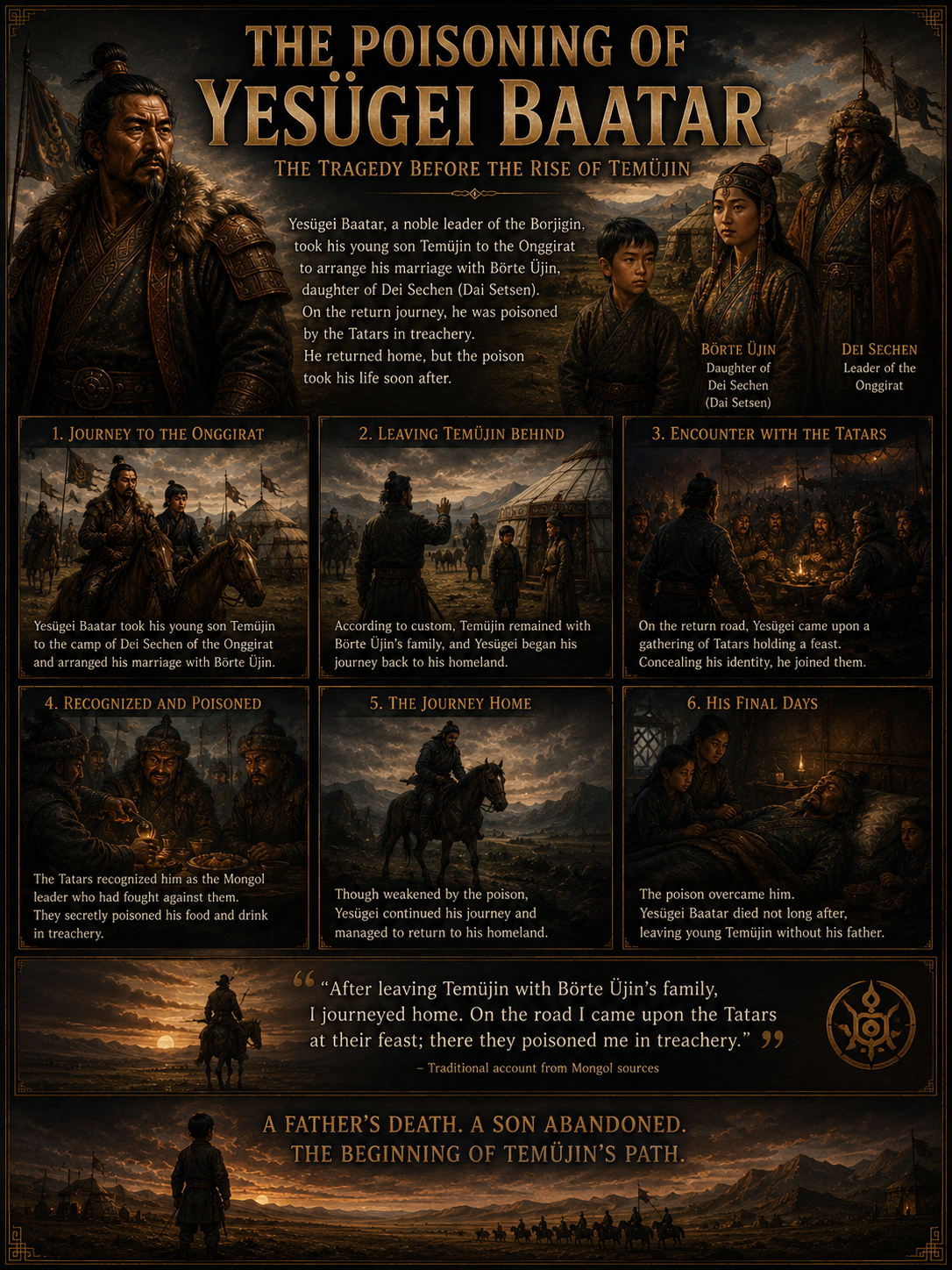
Yesügei Baatar
Yesügei Baatar took young Temüjin to the Onggirat to arrange his marriage with Börte Üjin, daughter of Dei Sechen (Dai Setsen). After leaving Temüjin there according to custom and beginning the return journey, he encountered Tatars holding a feast. Concealing his identity, he joined them, but the Tatars recognized him and secretly poisoned his food or drink. He managed to return home, yet the poison overcame him and he died soon after.
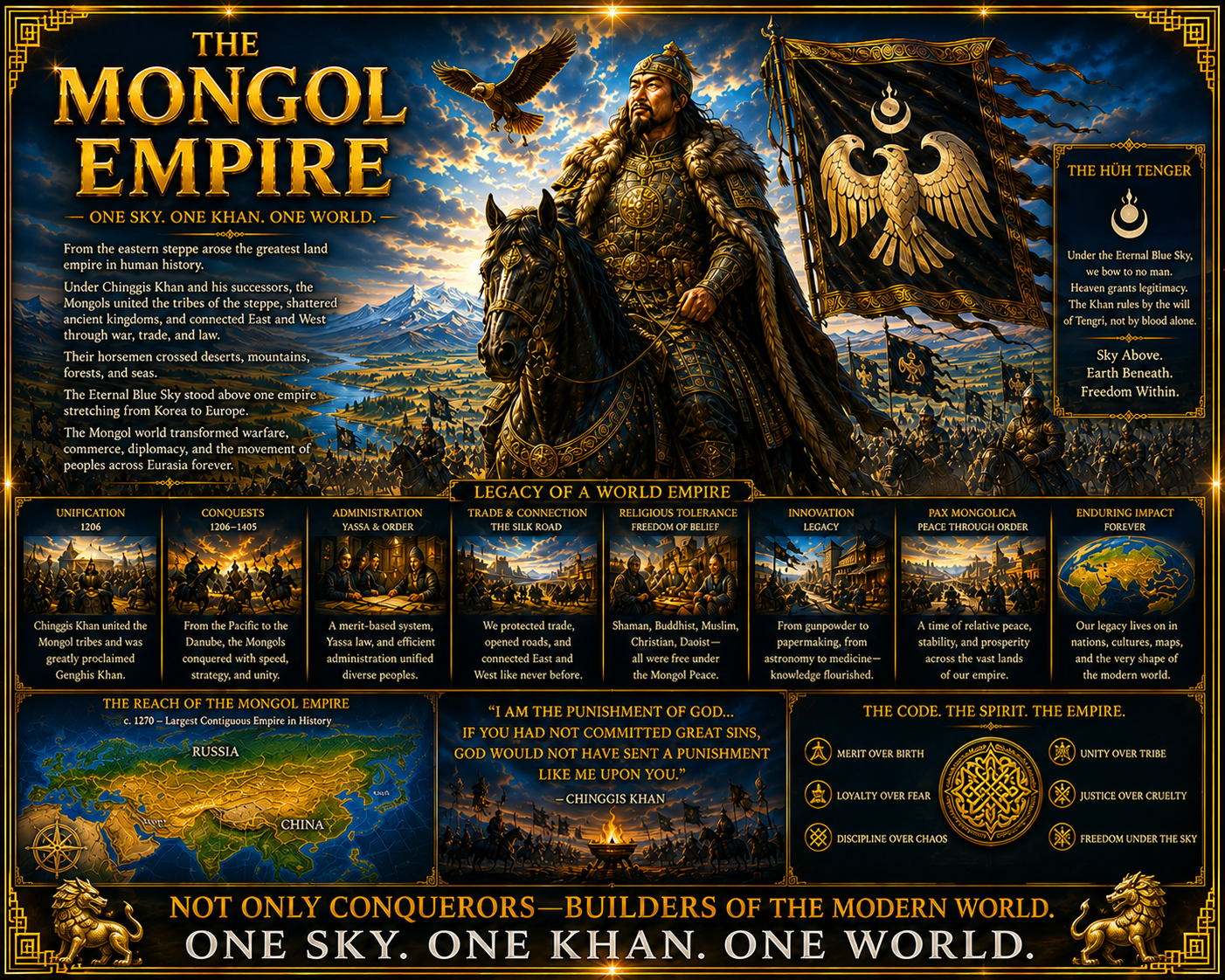
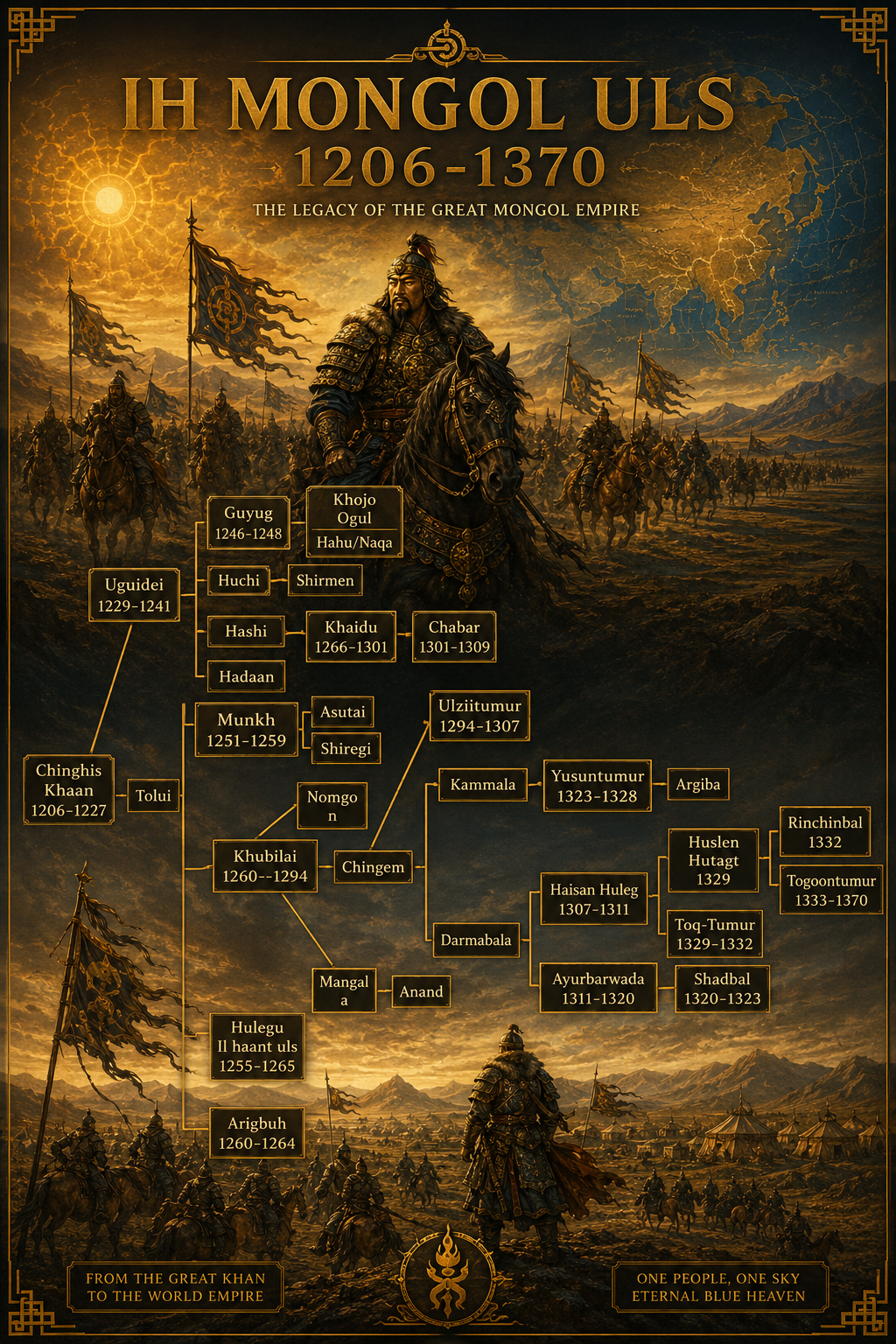
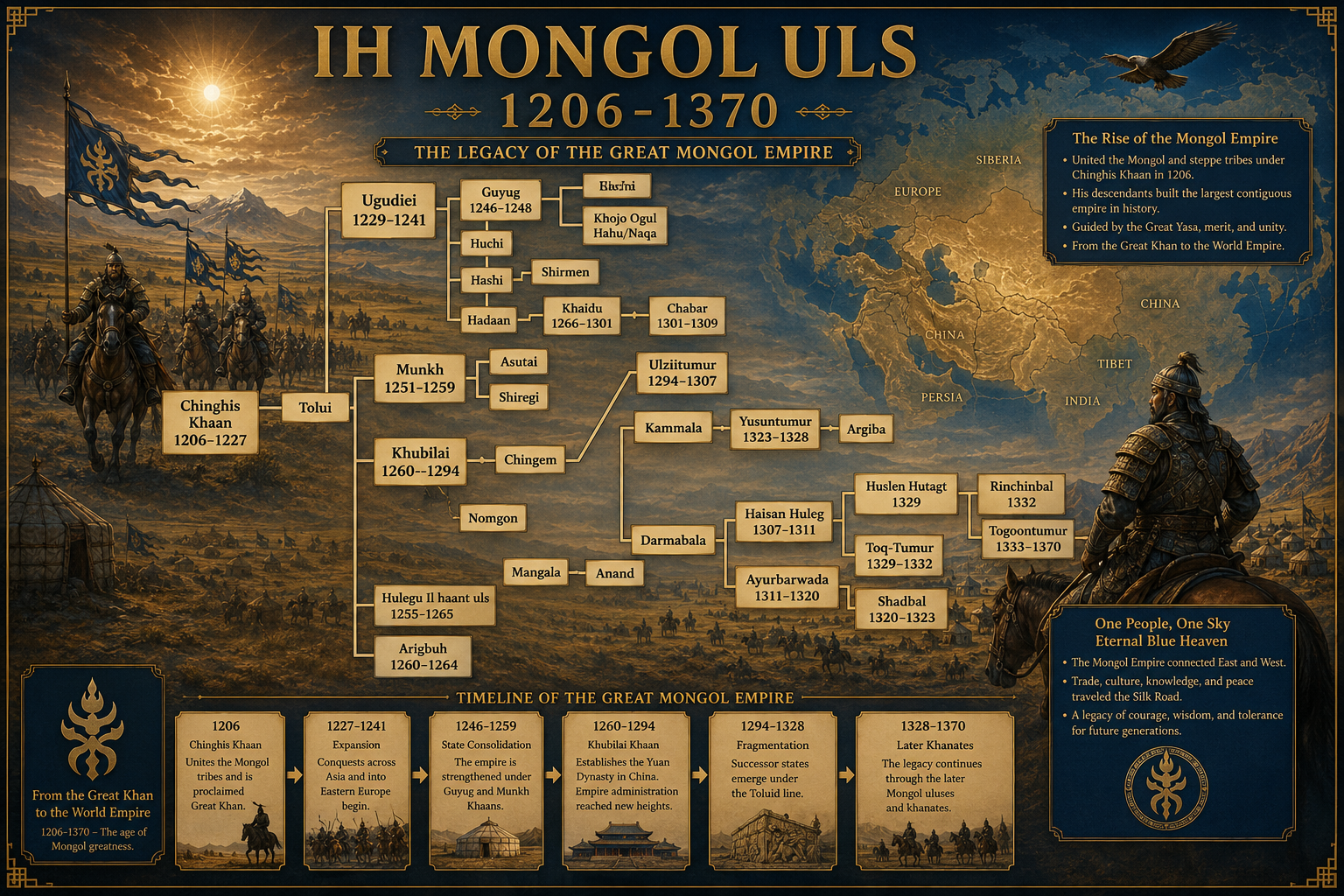
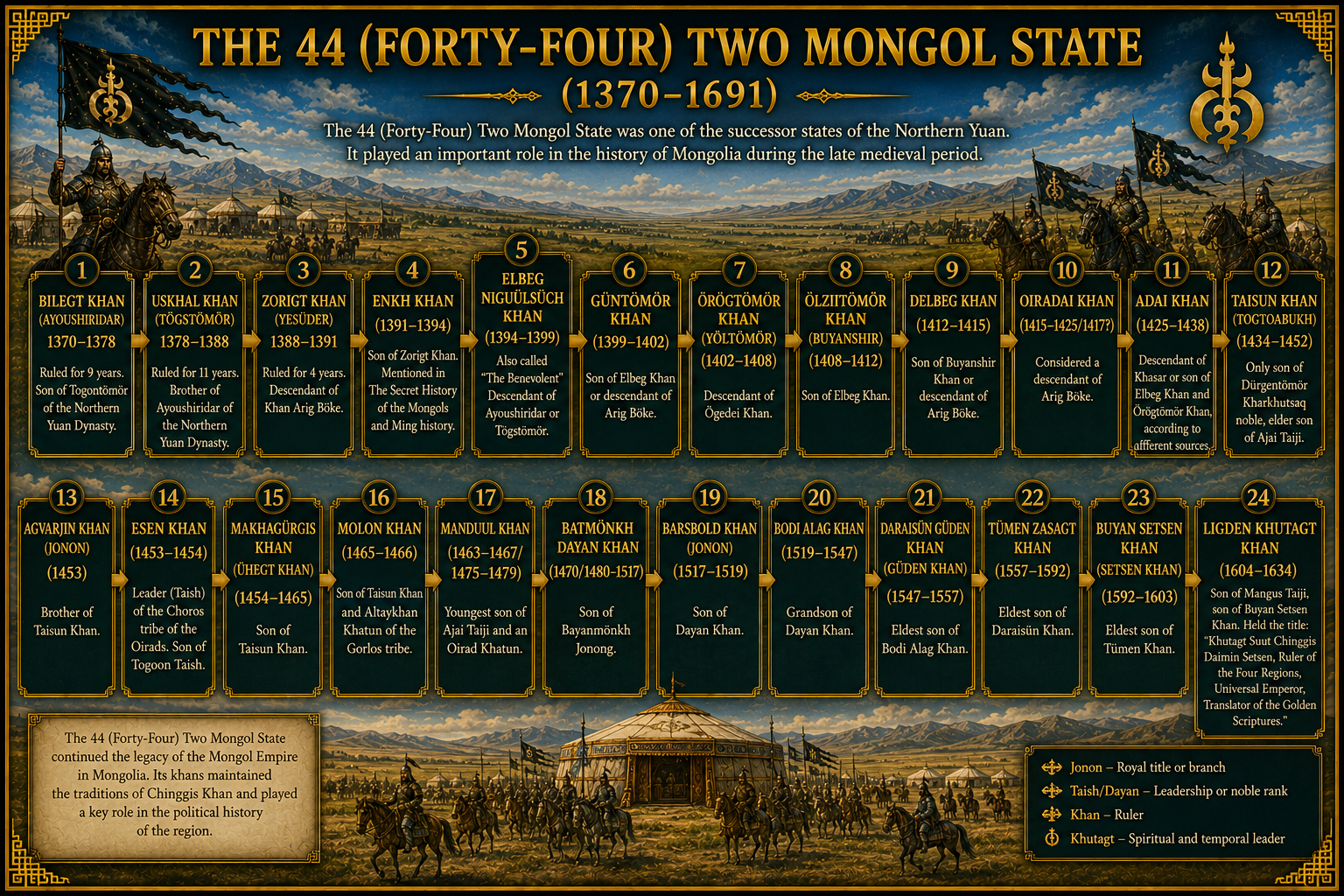
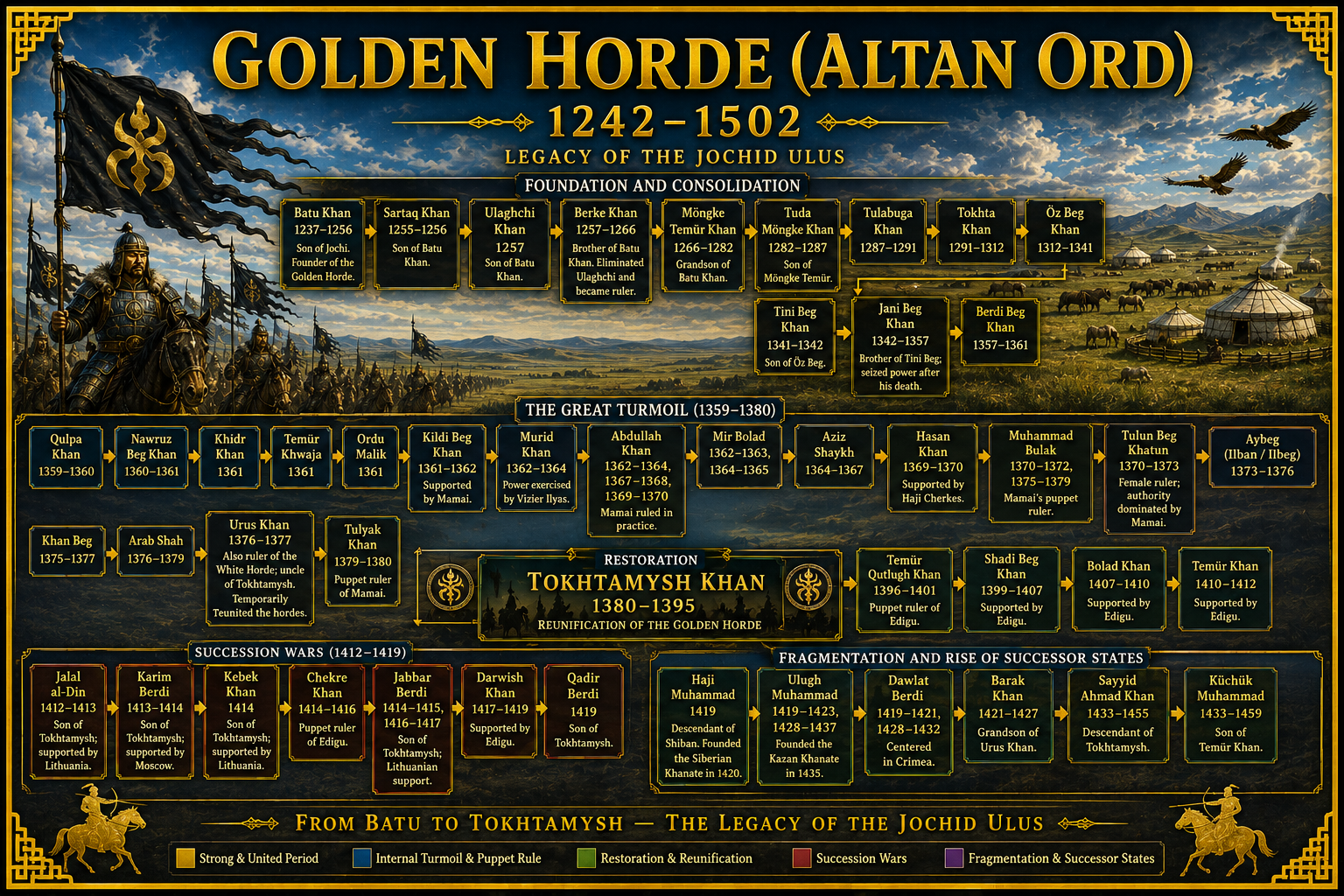
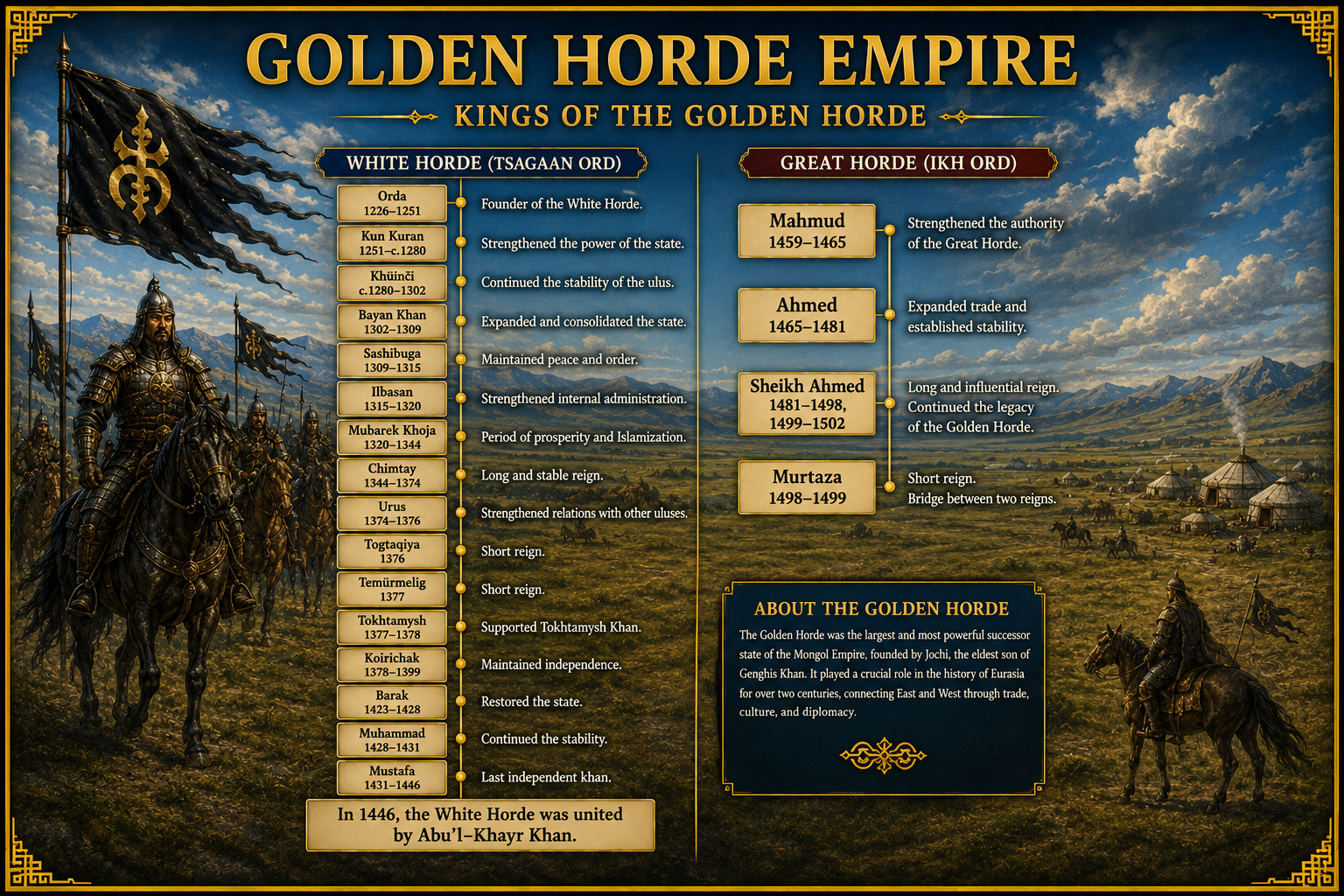
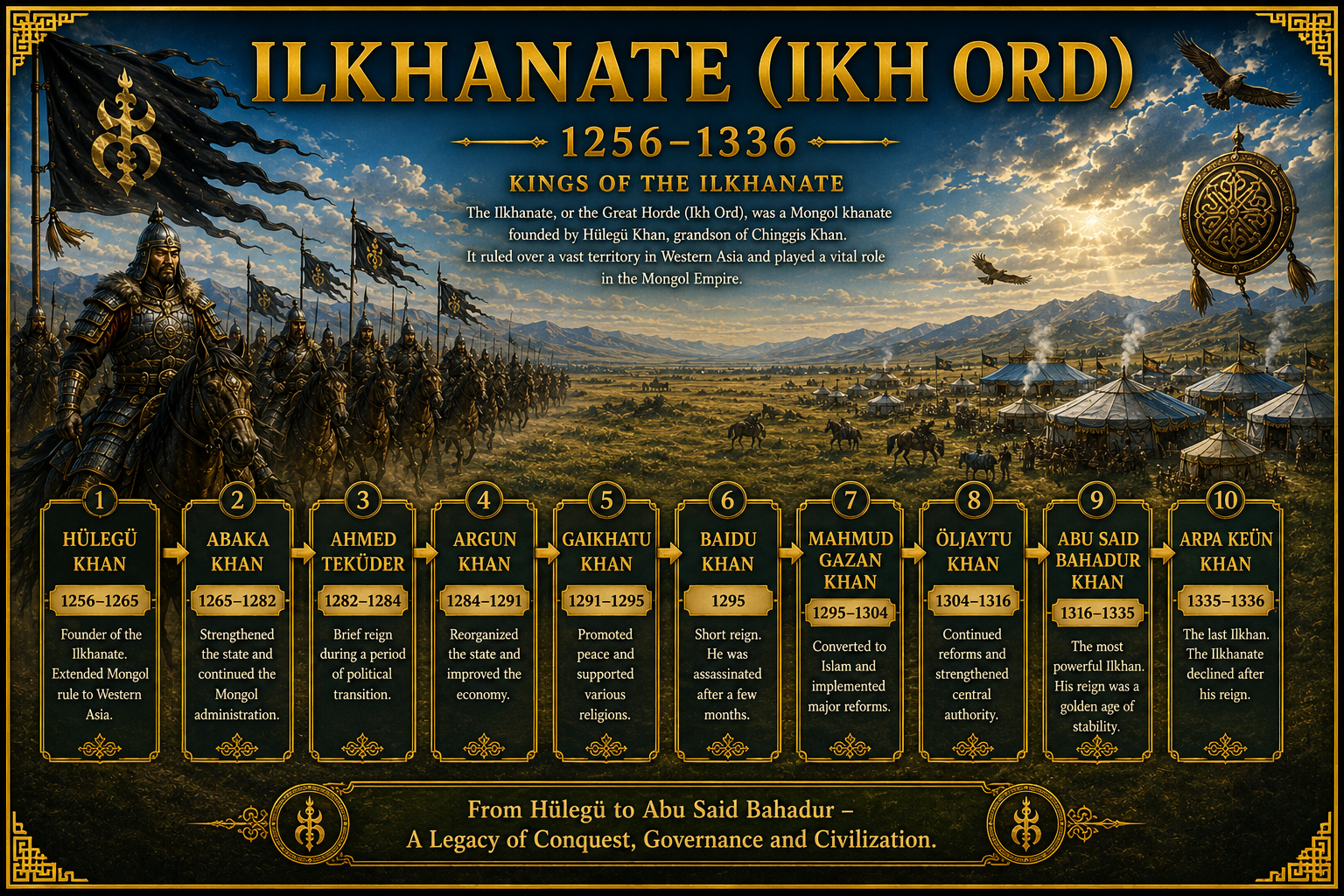
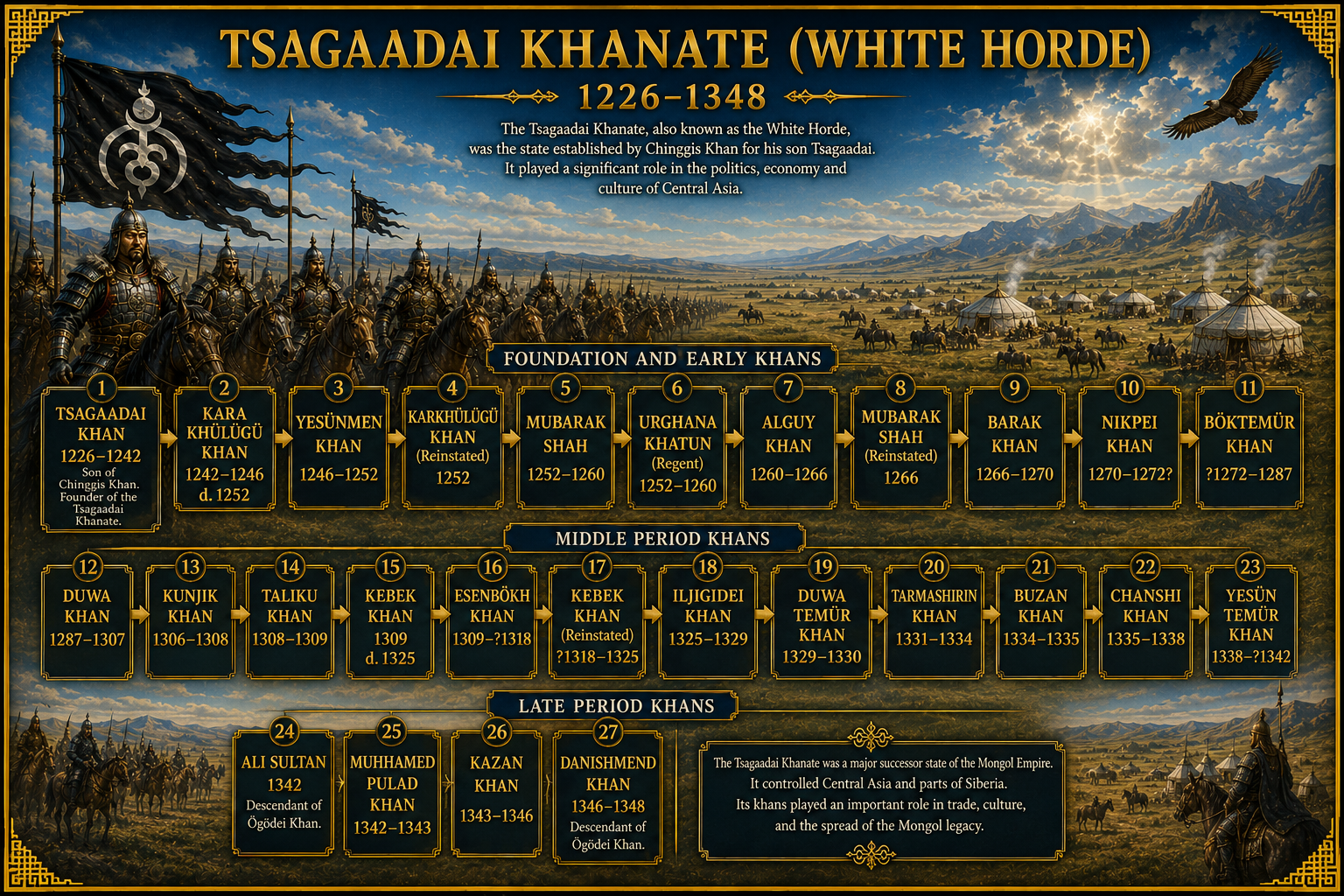
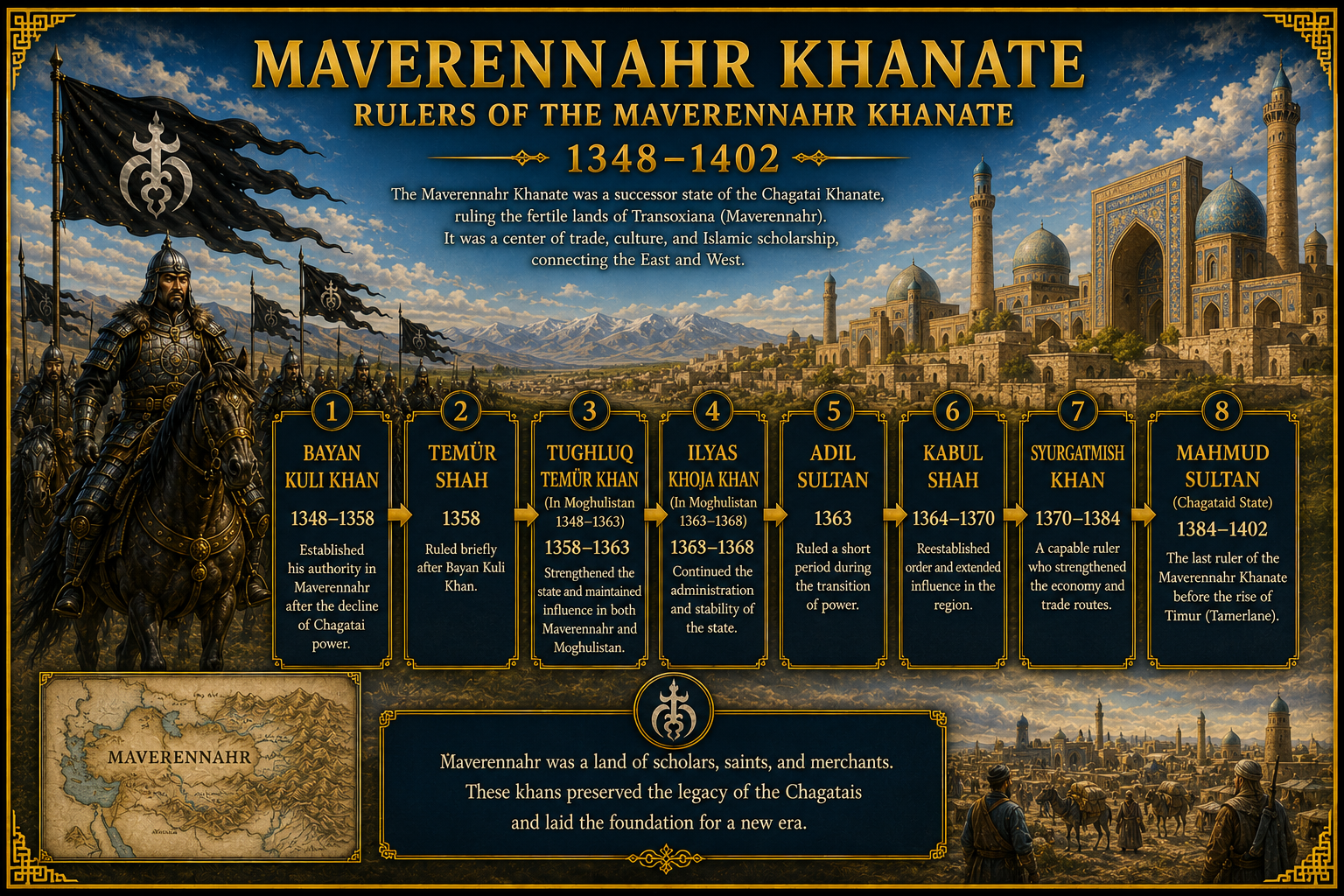
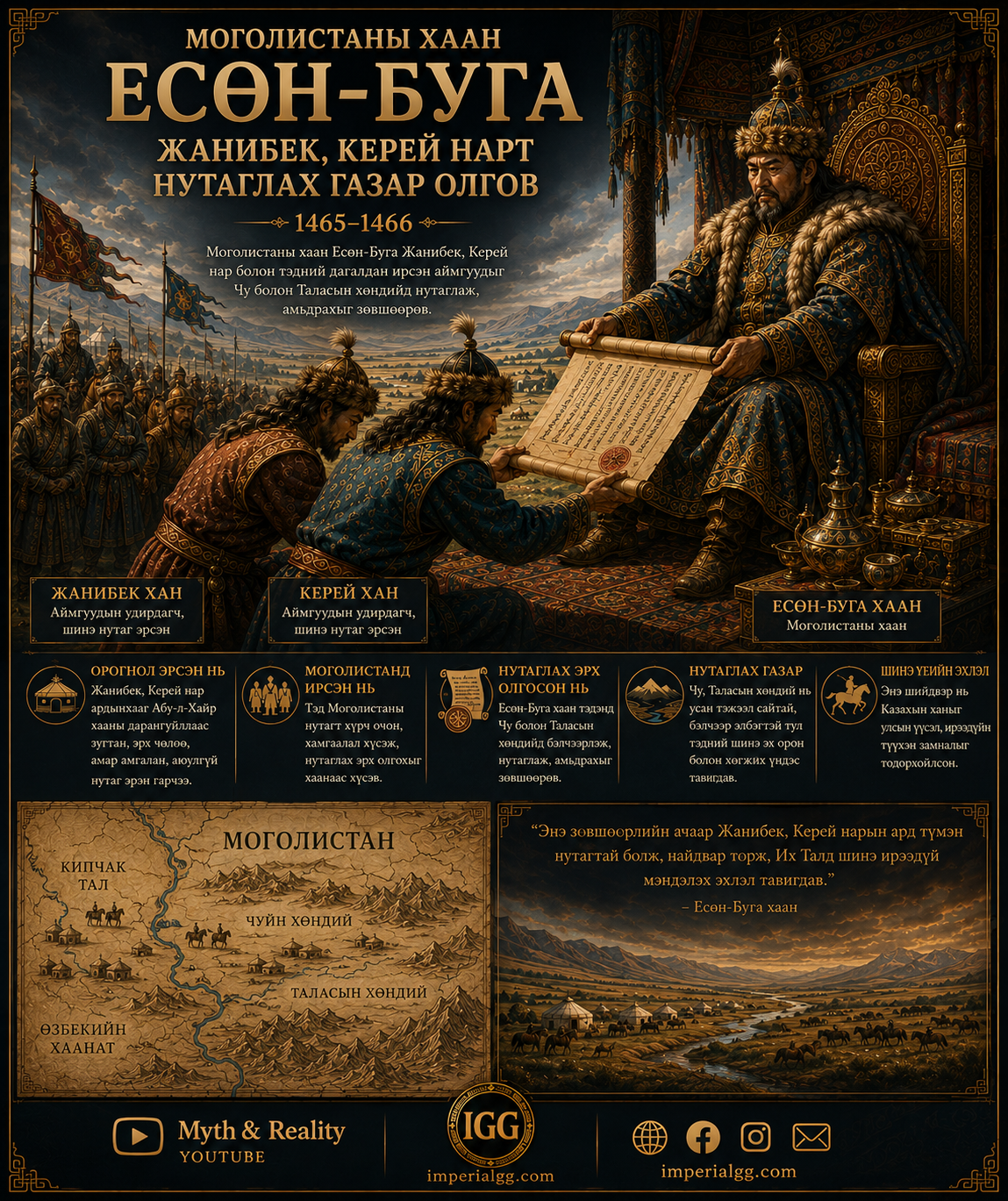
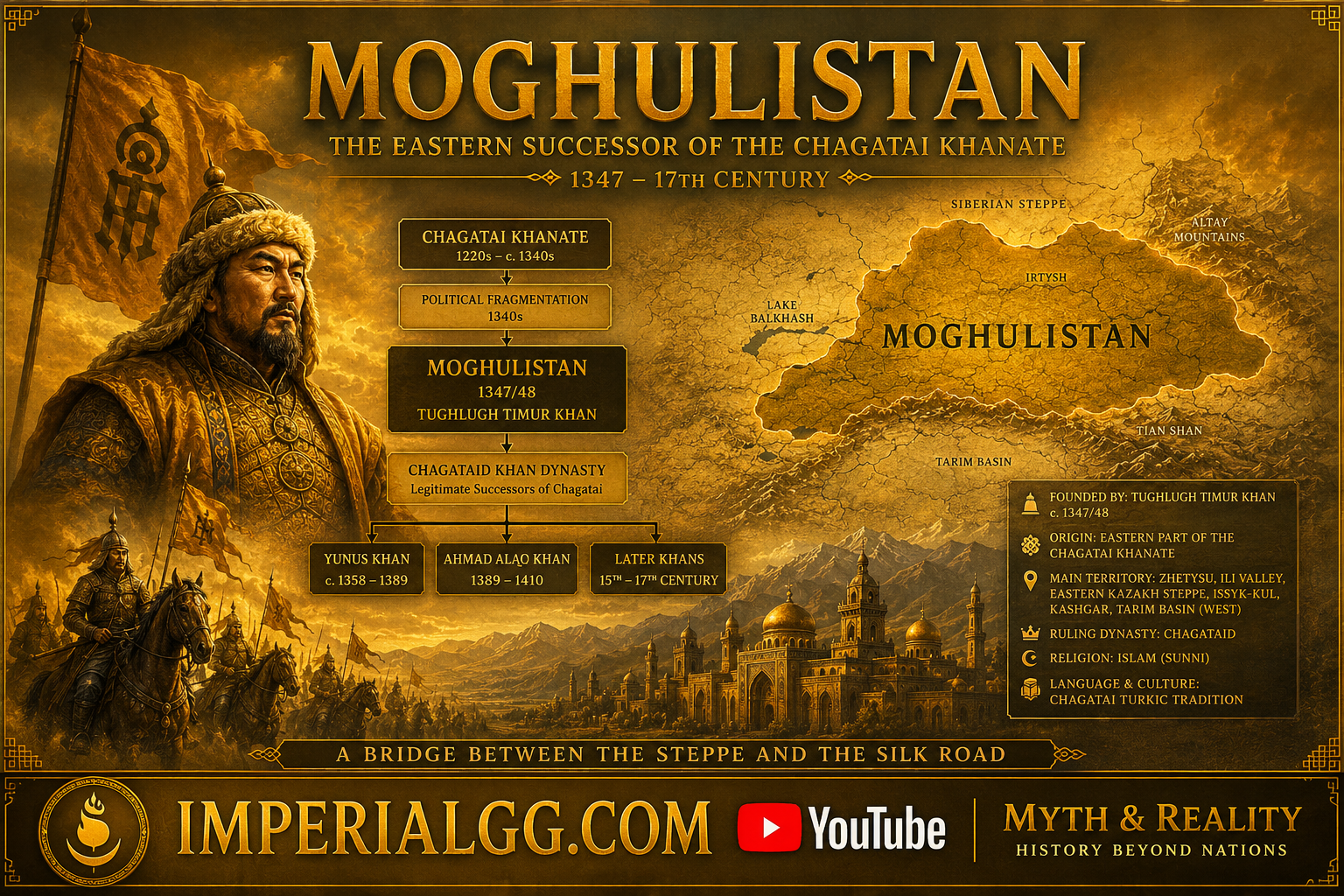
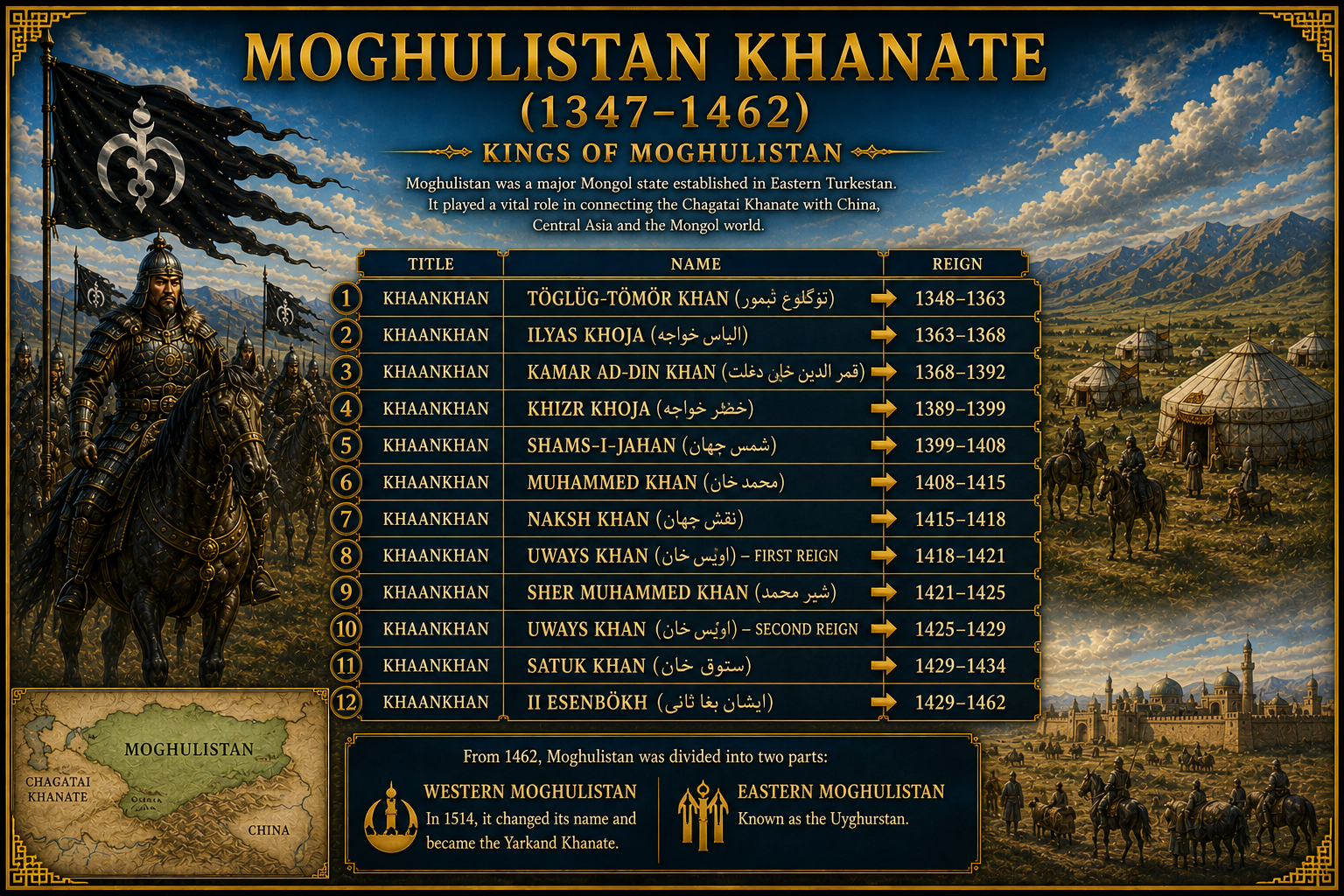

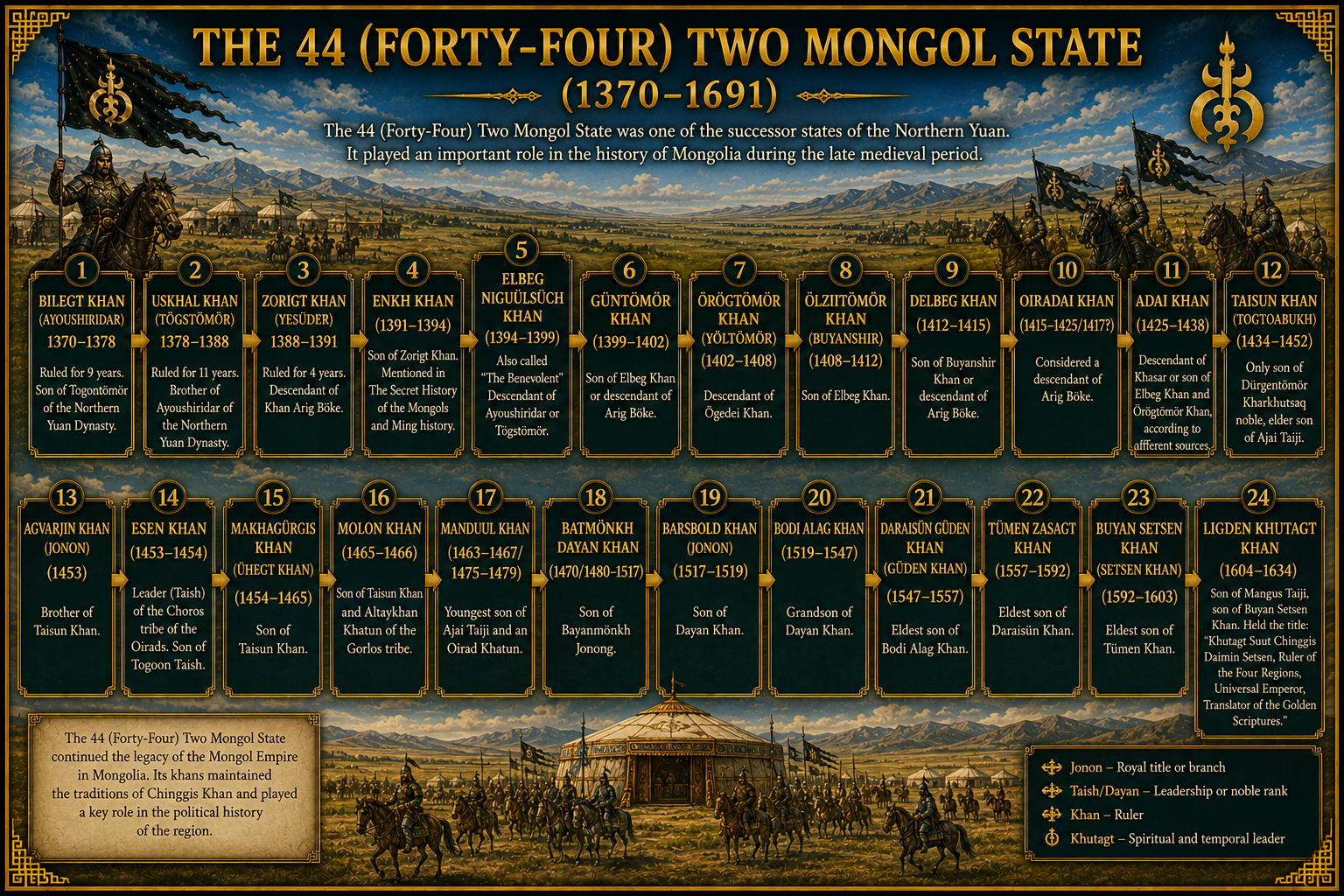
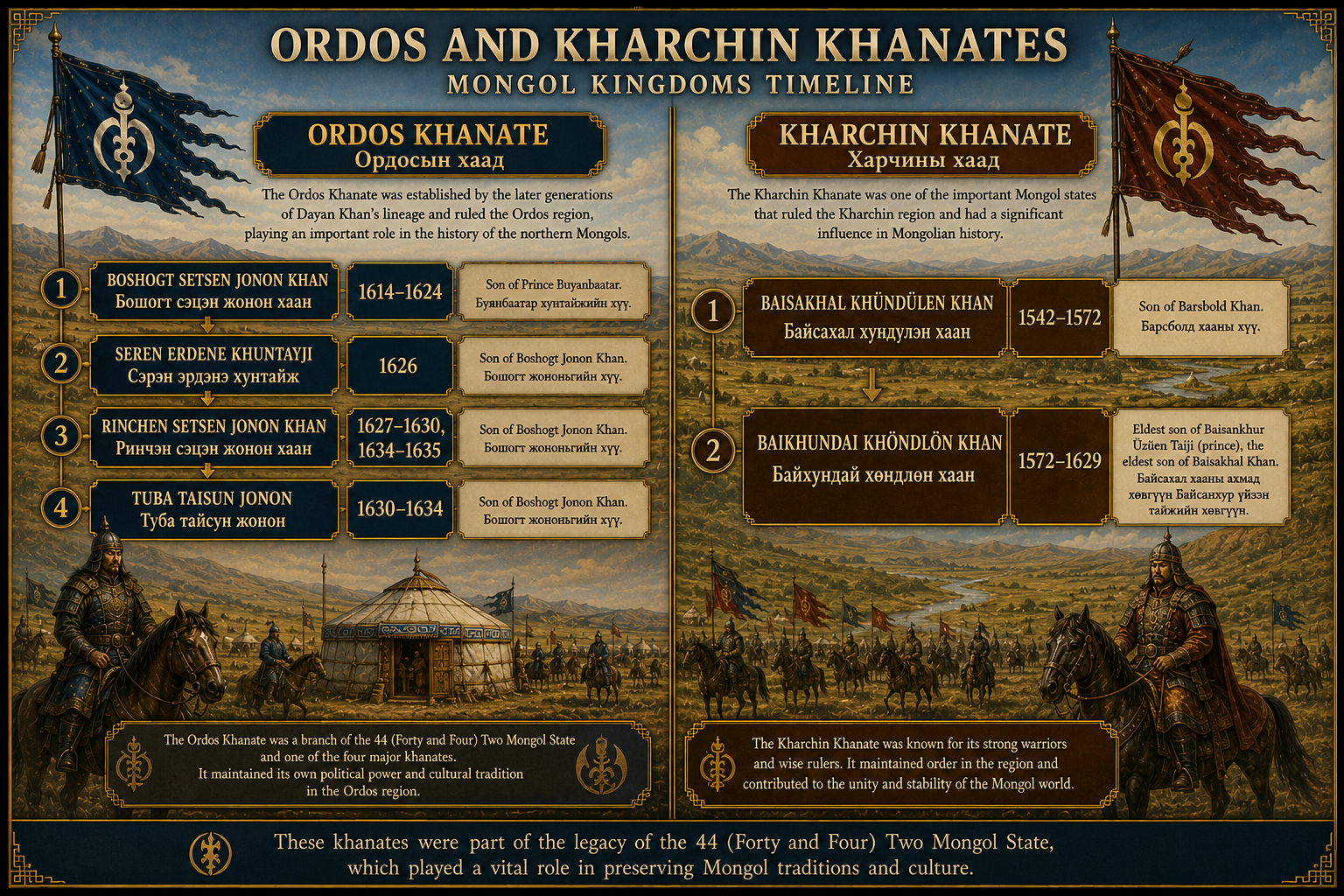
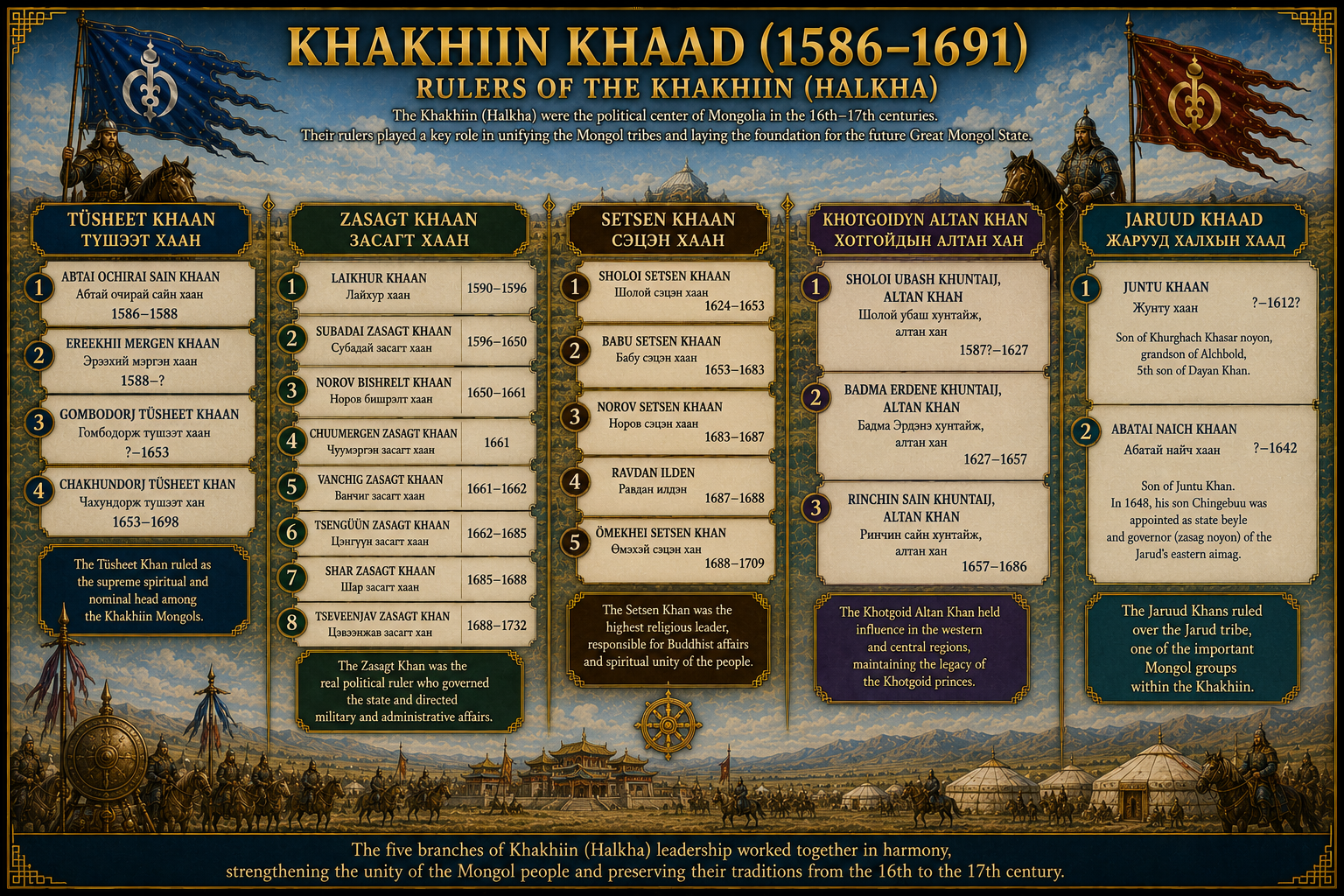
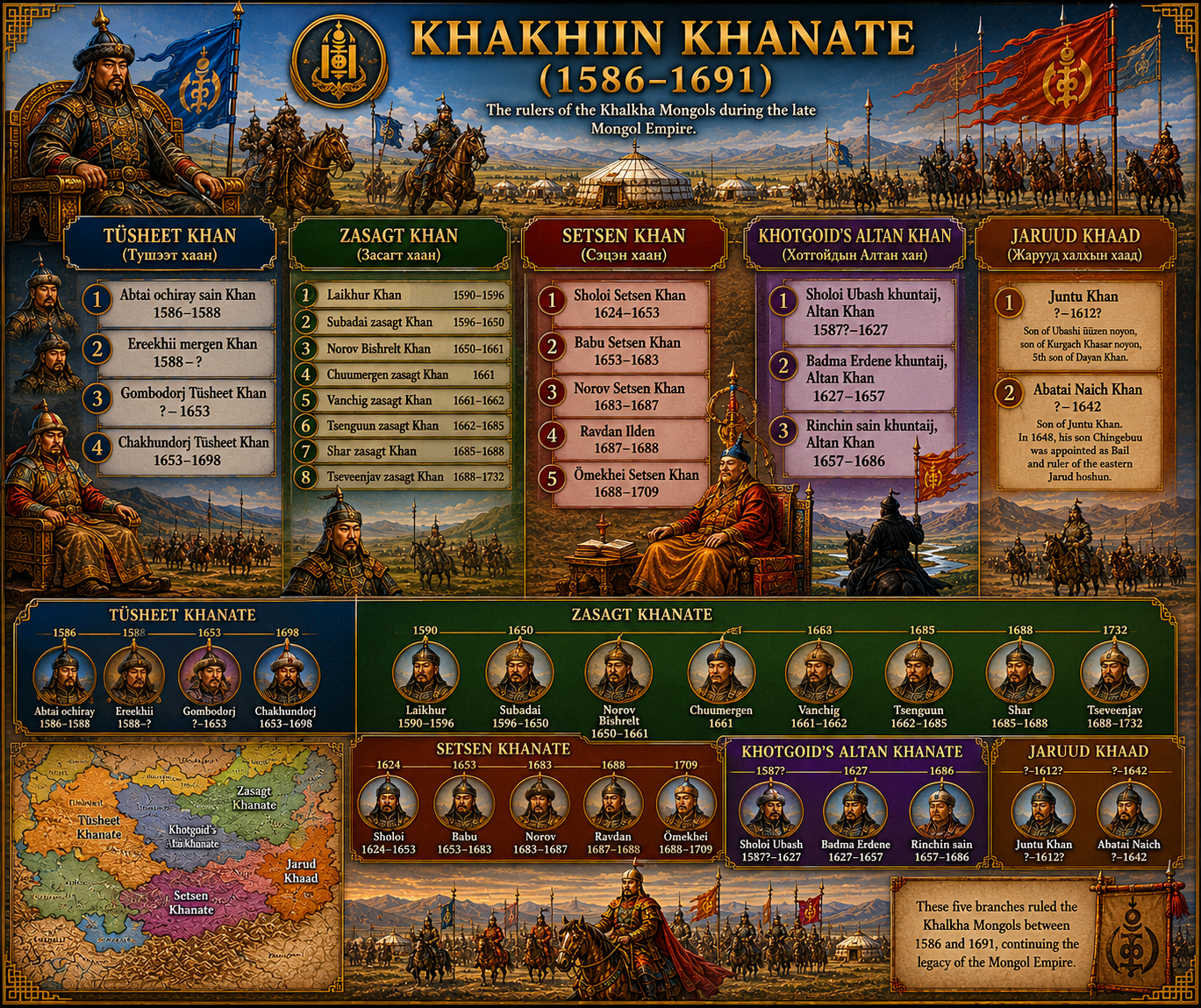
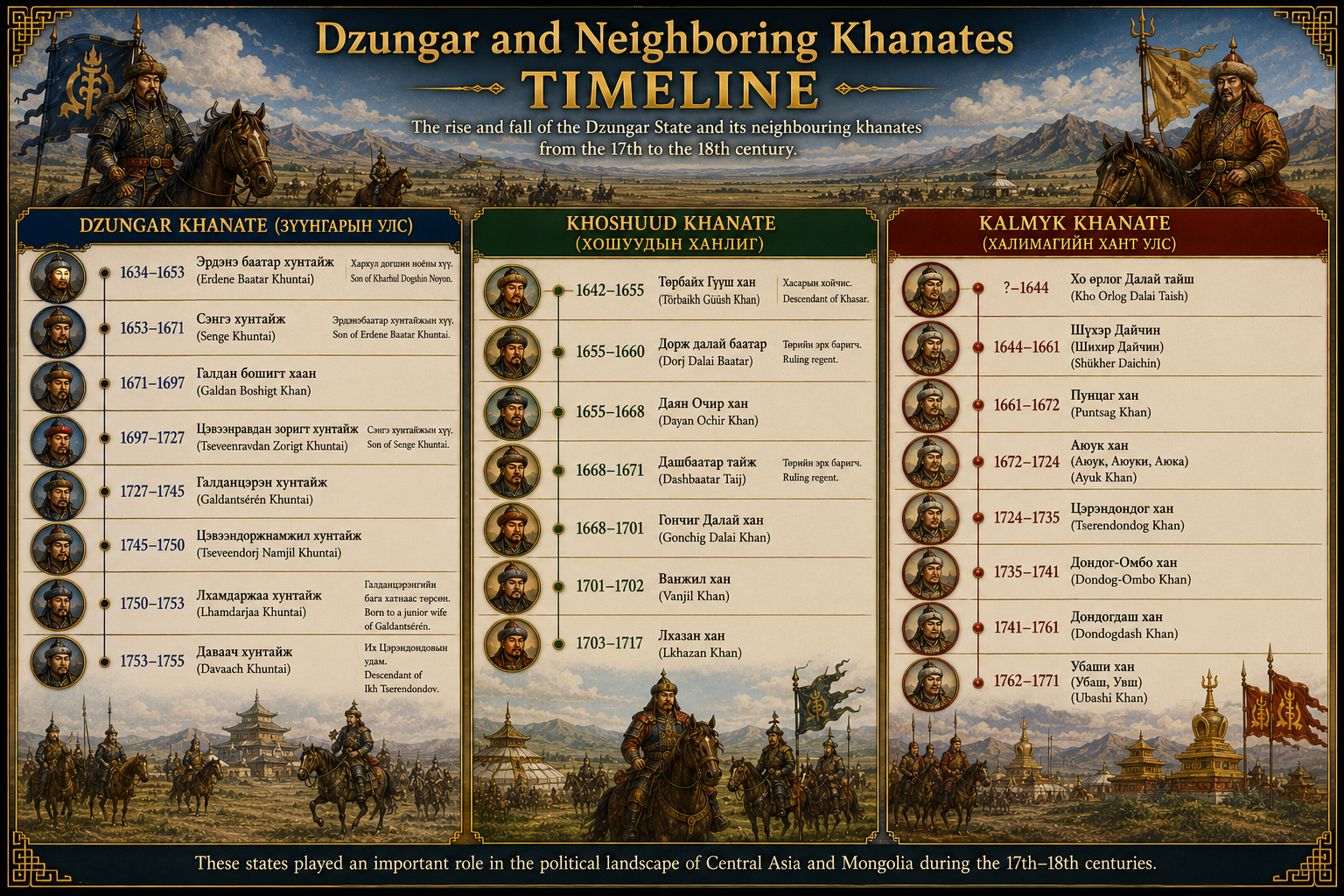
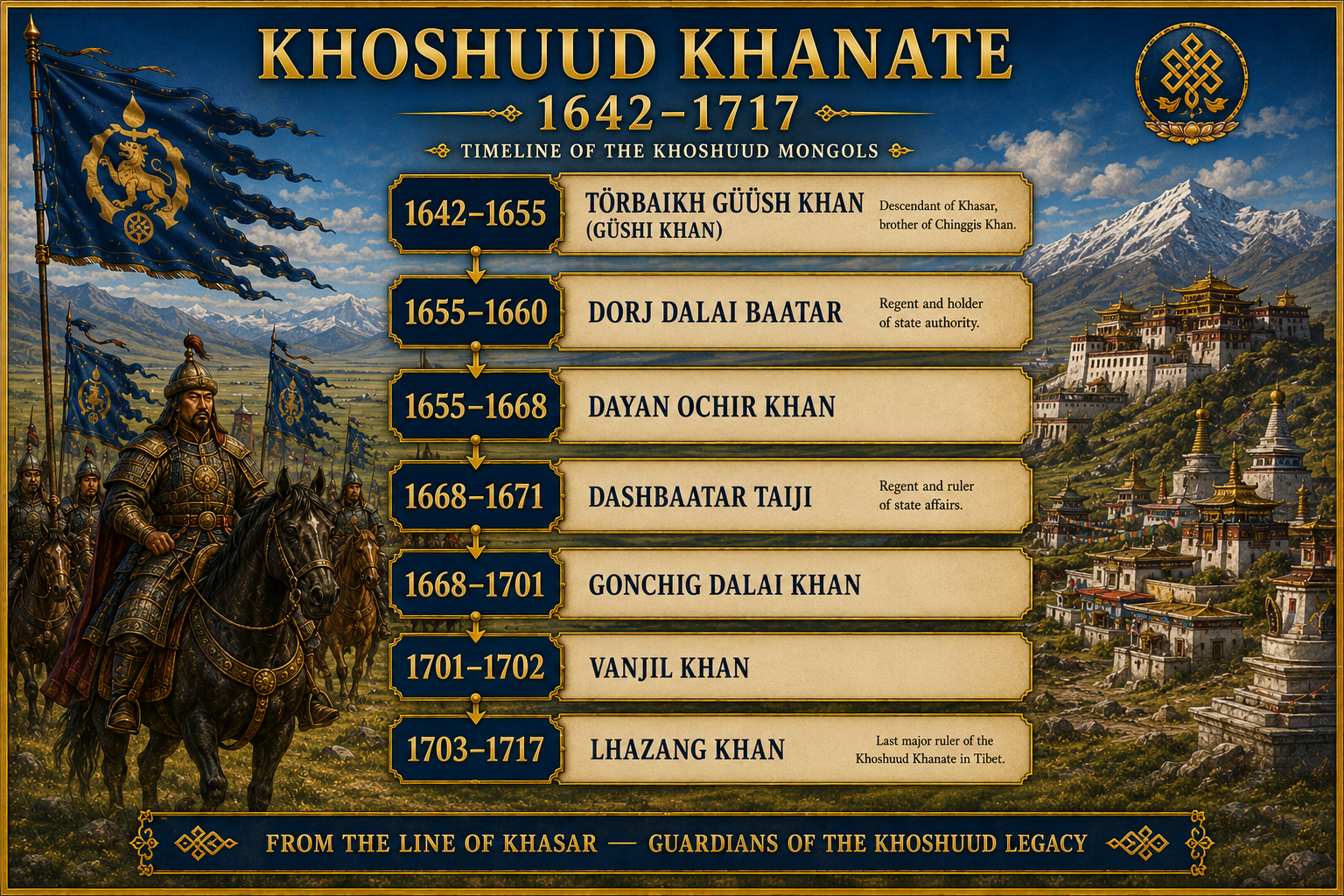
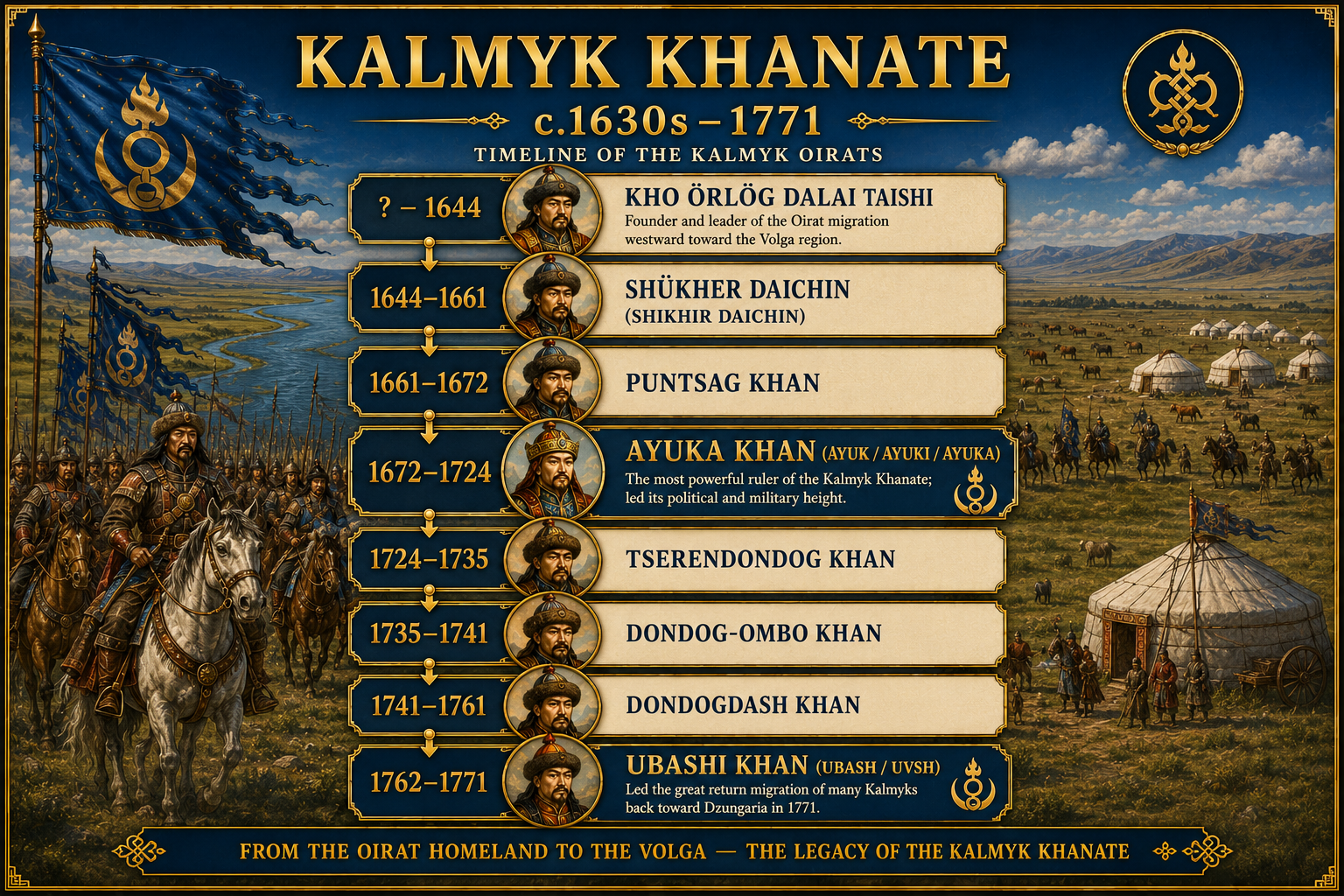
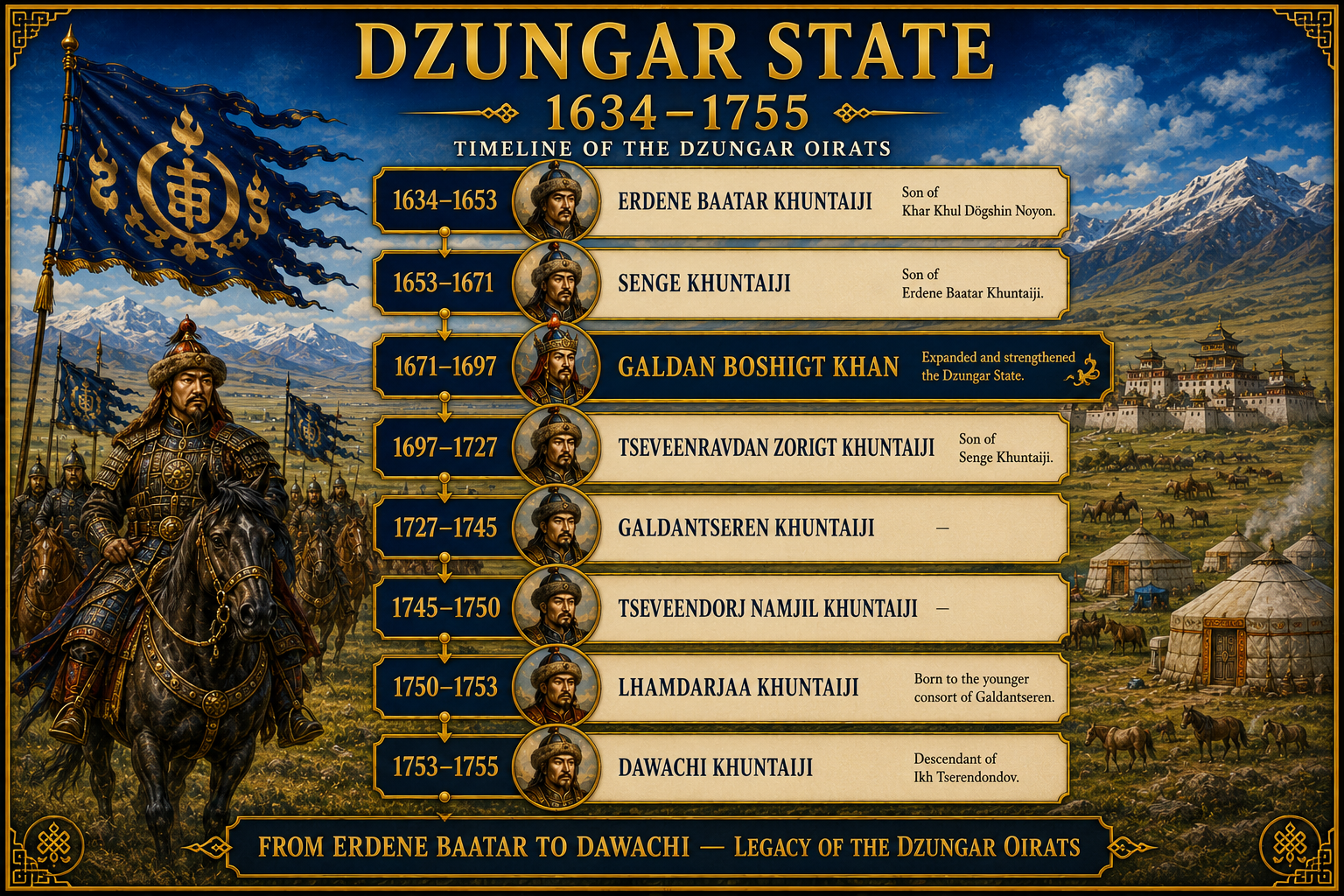
MONGOLIA UNDER THE QING EMPIRE AND THE ROAD TO INDEPENDENCE
With the death of Ligdan Khan, the last ruler of the Golden Lineage in Inner Mongolia, in 1634–1636, the Qing brought Inner Mongolia under their authority. Later, in 1691, the Khalkha Mongols submitted to Qing rule, bringing most Mongol lands — except the Oirats — into the Qing Empire.
However, the Dzungar Khanate in Western Mongolia remained independent. Although Galdan Boshigt Khan was defeated by Qing forces in 1696 and later died, the Dzungar State continued to exist until 1755.
Many historians regard 1691 as the date when Mongolia came under Qing domination. Yet this interpretation remains debated. The Oirat lands of present-day Western Mongolia retained characteristics of an independent state and continued to exist separately until the destruction of the Dzungar Khanate in 1755–1758.
Thus, another interpretation views the conquest of Mongolia as occurring in stages:
- 1636 — Inner Mongolia incorporated into the Qing Empire
- 1691 — Khalkha (Outer Mongolia) submitted to Qing rule
- 1755 — Western Mongolia (Dzungaria / Oirat State) conquered
Under Qing rule, Mongolia developed within a feudal-banner system, while the emergence of modern civic institutions and national political development remained restricted.
At the beginning of the 20th century, the Qing government introduced the “New Policies” reforms (Xinzheng). These measures were deeply resented by many Mongols and contributed to the revival of Mongolian national consciousness.
As the decline of the Qing Empire became increasingly apparent, Mongolian nobles, clergy, and leaders sought independence and united around Bogd Javzandamba Khutagt, aiming to restore a sovereign Mongolian state.
“1636 — Inner Mongolia. 1691 — Khalkha. 1755 — Western Mongolia. The conquest of Mongolia was not a single event, but a gradual process.”
“From division under Qing rule to reunification under the Bogd Khanate — the Mongol nation rose again.”
ÖNDÖR GEGEEN ZANABAZAR (1635–1723)
First Jebtsundamba Khutuktu and Spiritual Leader of Mongolia
Öndör Gegeen Zanabazar, born Eshidorji, was the First Jebtsundamba Khutuktu, the first Bogd Gegeen, and the supreme spiritual authority of the Gelug (Yellow Hat) school of Tibetan Buddhism in Mongolia.
Born as the son of the Tüsheet Khan of the Khalkha Mongols, he was proclaimed spiritual leader by an assembly of Mongol nobles in 1639, when he was only four years old. Later, the 5th Dalai Lama recognized him as the reincarnation of the Buddhist scholar Taranatha and bestowed upon him the Sanskrit name Jñānavajra (Zanabazar), meaning “Thunderbolt Scepter of Wisdom.”
For nearly six decades, Zanabazar strengthened the Gelug tradition among the Mongols and played a decisive role in the religious, social, and political life of seventeenth-century Mongolia.
His close relationship with the Khalkha rulers and the Kangxi Emperor would also influence the political destiny of Mongolia. After the submission of the Khalkha Mongols in 1691, Zanabazar remained for many years within Qing territory while the Qing Empire and the Dzungar Khanate fought for control of Mongolia between 1691 and 1701.
During this period he often stayed in Beijing during winter and accompanied the Kangxi Emperor in summer at Jehol (Chengde) as spiritual mentor. In 1698, the emperor granted him the title “Da Lama” (Great Lama) and invited him on pilgrimage to Mount Wutai.
Following the decisive Qing victory over Galdan Boshigt Khan at the Battle of Jao Modo (1697), Zanabazar returned permanently to Khalkha Mongolia in 1701 at the age of sixty-six. He supervised the restoration of Erdene Zuu Monastery and oversaw the construction of many Buddhist monasteries throughout Mongolia while continuing annual journeys to the Qing court.
When the Kangxi Emperor died on 20 December 1722, Zanabazar immediately travelled to Beijing to conduct Buddhist rites at the Yellow Monastery (Huangsi). He himself died in Beijing only weeks later on 18 February 1723, aged eighty-eight. Some later traditions alleged poisoning, though this remains debated.
His embalmed remains were returned to Mongolia and eventually enshrined at Amarbayasgalant Monastery, built by order of the Yongzheng Emperor in honor of Zanabazar and dedicated to Maitreya. Construction was supported with 100,000 liang of silver, and the monastery later became one of Mongolia’s greatest Buddhist centers.
In 1937, during the communist purges in Mongolia, Amarbayasgalant Monastery was attacked and looted. According to later accounts, Zanabazar’s remains were removed and allegedly destroyed.
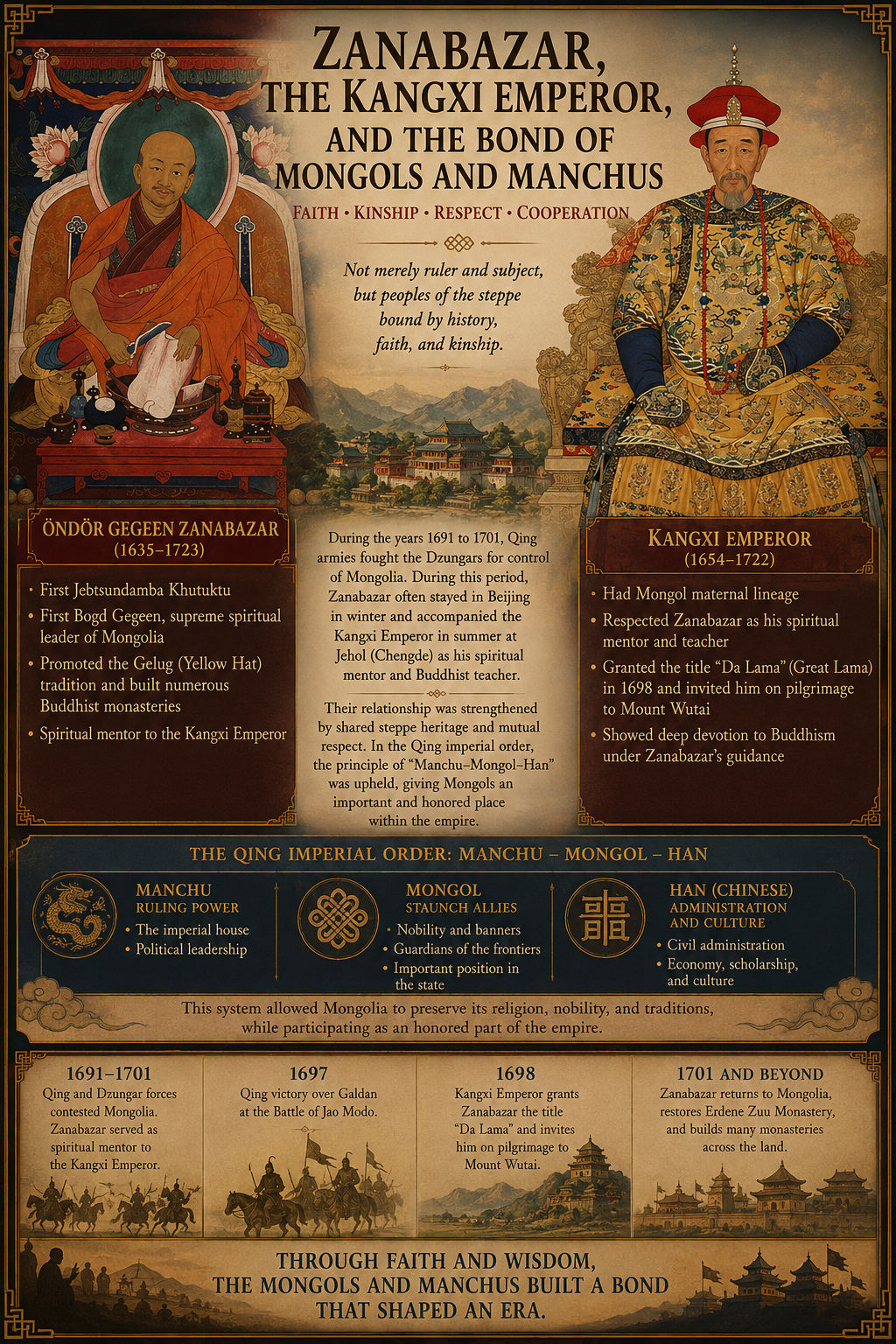
ZANABAZAR, THE KANGXI EMPEROR,
THE MONGOL–MANCHU RELATIONSHIP
During this period, Zanabazar often stayed in Beijing during winter and accompanied the Kangxi Emperor at Jehol (Chengde) during summer as spiritual mentor and Buddhist teacher.
The relationship carried additional significance because the Kangxi Emperor had a Mongol maternal lineage, and within Mongolian perceptions this strengthened the sense of kinship between the Mongols and the ruling house of the Qing Empire.
Zanabazar appears to have viewed the Manchu–Mongol relationship not simply as one between ruler and subject, but as a connection rooted in shared steppe origins and historical affinity.
Within the political order of the Qing Empire, precedence in the imperial hierarchy was often expressed as “Manchu–Mongol–Han”, reflecting the important position Mongols occupied within the state structure.
As a result, Mongol princes, banners, and Buddhist institutions retained a comparatively privileged status within the empire. The Qing court maintained close relations with Mongolian nobility and actively supported Buddhist institutions, monasteries, and the Jebtsundamba lineage.
For Zanabazar, preserving religion, maintaining internal stability, and safeguarding Mongolian society may have been inseparable from maintaining this relationship.
“Not merely ruler and subject — but peoples of the steppe bound by history, faith, and kinship.”
“From the Eternal Steppe arose two houses — Mongol and Manchu — joined beneath the Buddhist world.”
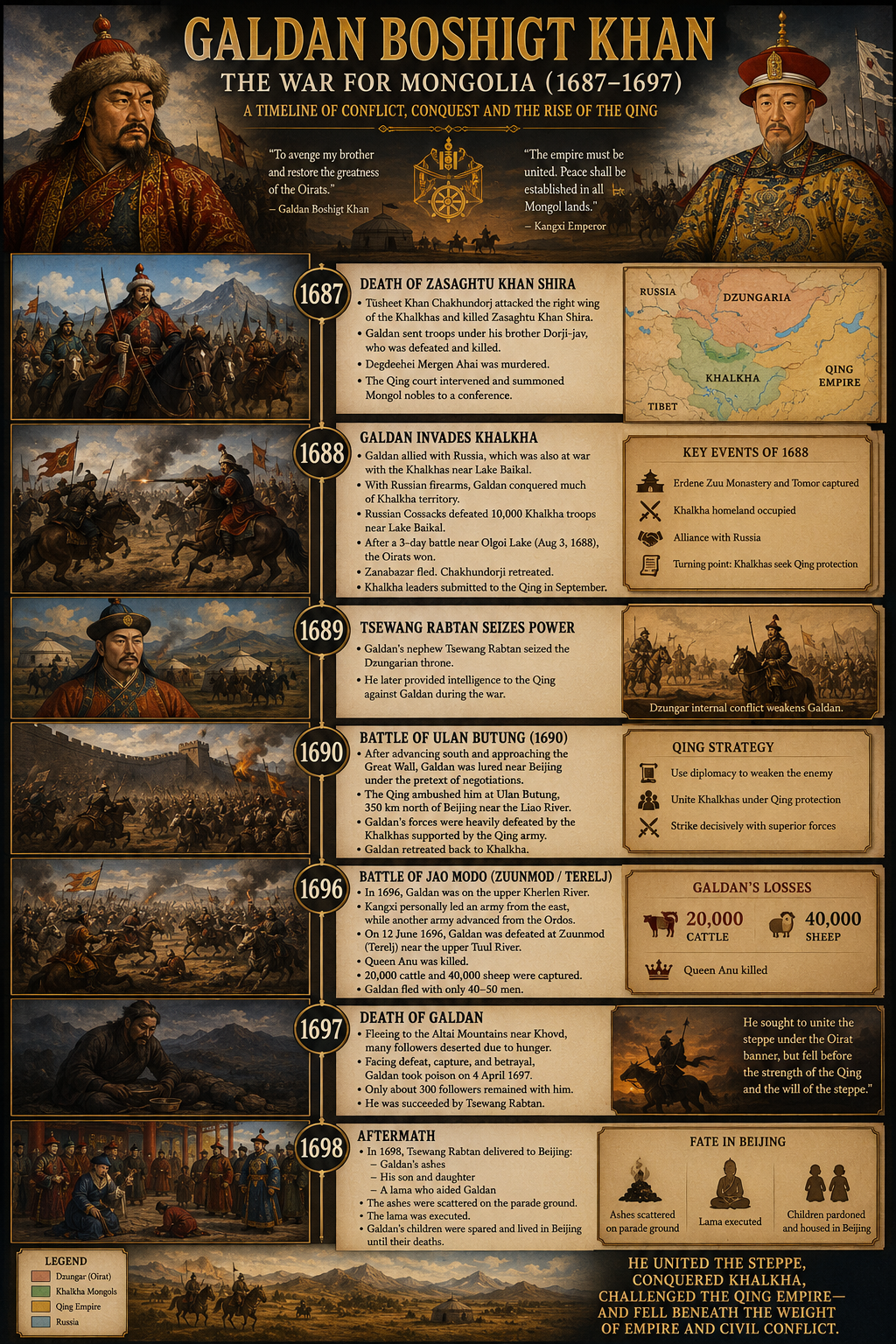
GALDAN BOSHIGT KHAN
1687 — Death of Zasaghtu Khan Shira
The Khalkha and Oirat Mongols had previously maintained relations under the Mongol–Oirat code, but tensions escalated after conflicts among the Khalkha rulers.
Tüsheet Khan Chakhundorj attacked the right wing of the Khalkhas and killed Zasaghtu Khan Shira. In response, Galdan Boshigt Khan sent forces under his younger brother Dorji-jav, who was later defeated and killed.
The killing of Degdeehei Mergen Ahai further intensified the crisis, while the Qing court attempted mediation by summoning Mongol nobles to conference.
1688 — Galdan Invades Khalkha
Seeking vengeance for his brother and greater influence over Mongolia, Galdan Boshigt Khan launched his campaign into Khalkha Mongolia.
At the same time, he established cooperation with Tsardom Russia, which was also in conflict with the Khalkhas around Lake Baikal.
Supported by Russian firearms, Galdan advanced into Khalkha lands. Russian Cossacks simultaneously attacked Khalkha positions near Baikal.
After battles near Erdene Zuu, Tomor, and finally Lake Olgoi, Galdan achieved victory after a three-day battle (3 August 1688).
The Khalkha homeland fell under Galdan’s control, while:
- Zanabazar fled
- Tüsheet Khan Chakhundorj retreated
- Khalkha leaders sought protection under the Qing Empire
This became a decisive turning point.
1689 — Internal Crisis in Dzungaria
While Galdan continued operations in eastern Mongolia, his nephew Tsewang Rabtan seized power in Dzungaria and challenged Galdan’s authority.
Tsewang Rabtan later provided intelligence to the Qing during the war.
1690 — Battle of Ulan Butung
After advancing southward through Mongolia and approaching the Great Wall, Galdan moved toward negotiations.
According to the account, the Qing lured him toward talks near Beijing and then engaged him at the:
Battle of Ulan Butung (1690)
Location: north of Beijing near the western Liao headwaters
Galdan suffered major losses against combined:
Khalkha + Qing forces
He withdrew back into Mongolia.
1696 — Battle of Jao Modo (Zuunmod / Terelj)
In 1696, Galdan was positioned near the upper Kherlen River.
The Kangxi Emperor personally led a large campaign:
- Main army advanced from the east
- Western army moved north from the Ordos
On 12 June 1696, near Terelj–Zuunmod, east of present-day Ulaanbaatar:
Battle of Juun Modo
Galdan suffered catastrophic defeat.
Major losses included:
- Death of Queen Anu
- Loss of 20,000 cattle
- Loss of 40,000 sheep
Only a small remnant remained with him.
1697 — Death of Galdan
Retreating west toward the Altai near Khovd, abandoned by many followers and facing threats from both:
- Qing armies
- Tsewang Rabtan
Galdan Boshigt Khan died on 4 April 1697, reportedly by poison.
Only about 300 followers remained.
He was succeeded by:
Tsewang Rabtan, 1698 — Aftermath
Tsewang Rabtan later sent:
- Galdan’s ashes
- His children
- A lama associated with him to Beijing.
The ashes were scattered during military ceremonies. The lama was executed, while Galdan’s surviving children were pardoned and remained in Beijing.
“He united the steppe, conquered Khalkha, challenged the Qing Empire — and fell beneath the weight of empire and civil conflict.”
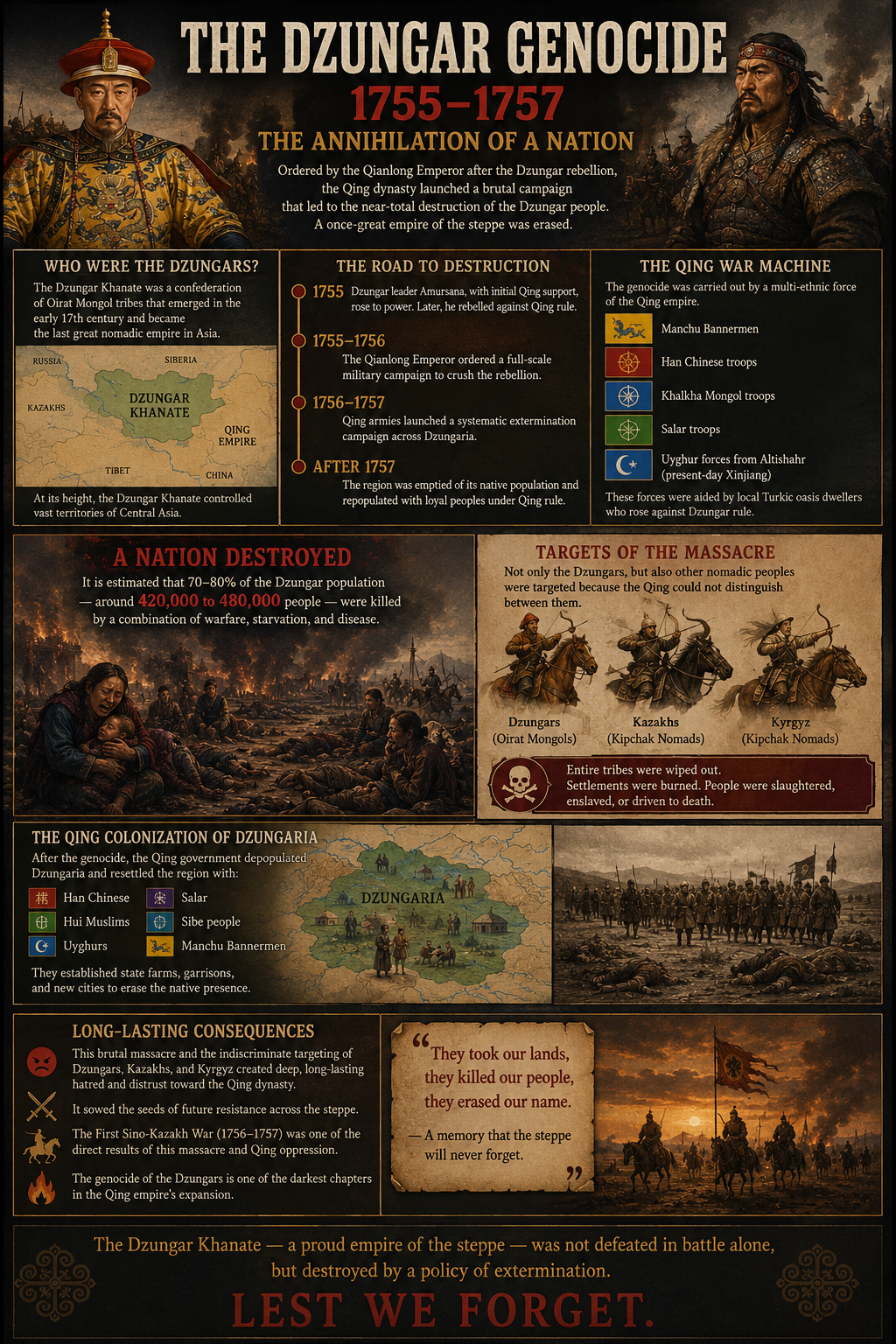
THE DZUNGAR GENOCIDE
1755–1758
The Destruction of the Last Great Nomadic Empire
WHO WERE THE DZUNGARS?
The Dzungar Khanate was a confederation of Oirat Mongol tribes and is widely regarded as the last great nomadic empire of Inner Asia.
At its height, it controlled much of Dzungaria, parts of Central Asia, and the western Mongolian world, remaining independent until the Qing conquest of the mid-eighteenth century.
THE CONQUEST AND REBELLION
After defeating the Dzungars in 1755, the Qianlong Emperor initially intended to divide the Dzungar realm into several tribal domains.
However, Amursana rejected this arrangement and rebelled, seeking to restore a unified Dzungar state.
Following the revolt, the Qing court abandoned accommodation and moved toward total destruction.
ORDER OF EXTERMINATION
The Qianlong Emperor issued direct orders against the Dzungars:
“Show no mercy at all to these rebels… Tell Tsengünjav to massacre these crafty Zunghars.”
Contemporary sources describe policies including:
- Mass killing of fighting-age males
- Forced enslavement of women and children
- Starvation policies
- Destruction of social identity and tribal structure
- Resettlement after depopulation
HUMAN COST
Estimated Dzungar losses:
420,000 – 480,000 dead
Scholars estimate that 70–80% of the Dzungar population perished between 1755–1758 through:
- warfare
- famine
- epidemics (especially smallpox)
- massacres
According to Wei Yuan:
- 40% died of disease
- 20% fled to Russian or Kazakh lands
- 30% were killed by Qing forces
AFTER THE DESTRUCTION
After depopulation, the Qing government resettled Dzungaria with:
- Han settlers
- Hui communities
- Uyghurs
- Sibe groups
- Banner forces and colonists
The original Dzungar population never recovered.
HISTORICAL ASSESSMENT
Historian Michael Clarke described the campaign as:
“The complete destruction not only of the Dzungar state but of the Dzungars as a people.”
The Encyclopedia of Genocide and Crimes Against Humanity classifies the destruction of the Dzungars as genocide under UN defininion
“The fall of Dzungaria was not only the destruction of a state — but the destruction of a people.”
эсвэл илүү товч:
1755–1758 — The Last Great Nomadic Empire Fell.
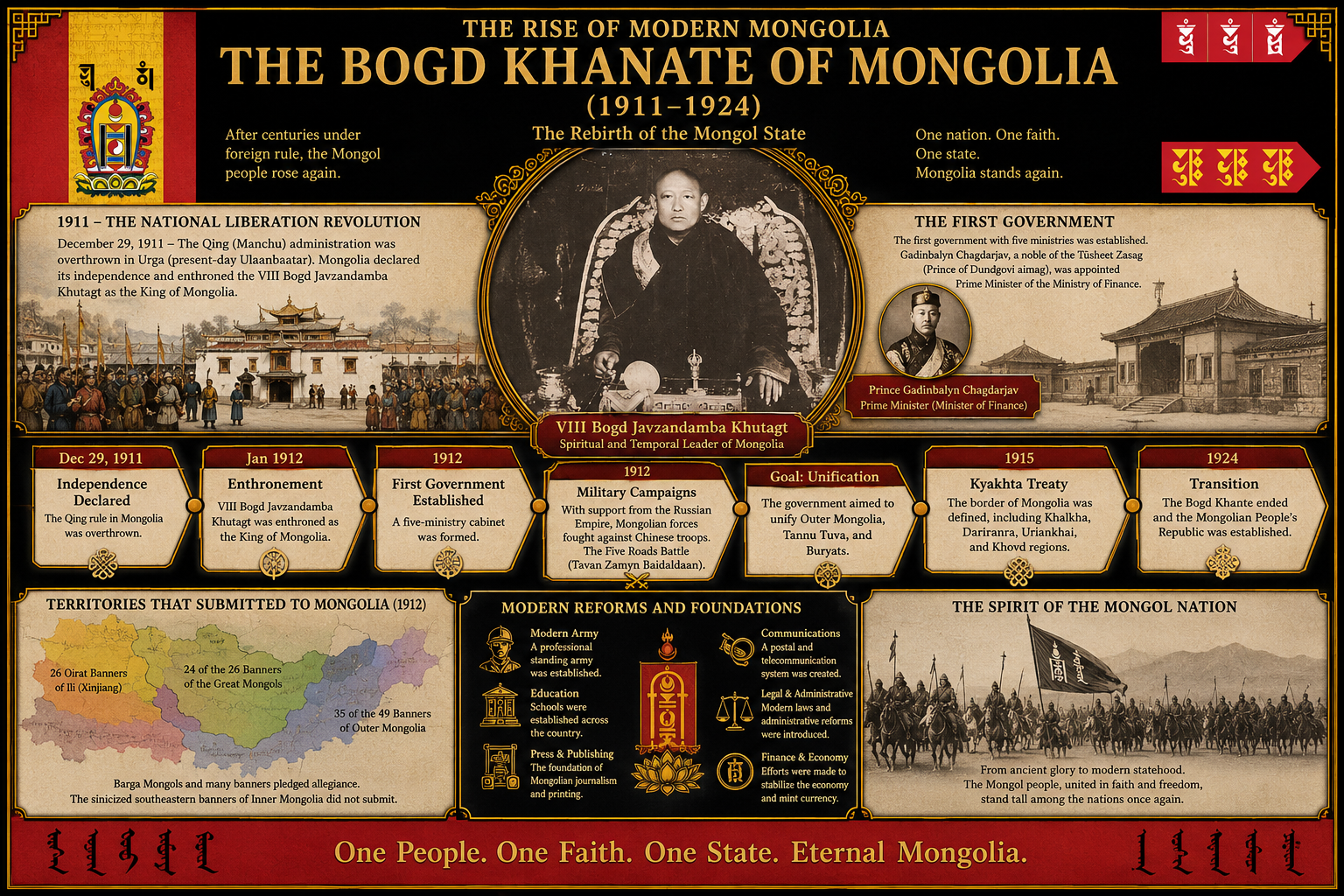
THE FIVE ROUTES WAR (1912–1915)
The Five Routes War refers to the Mongol–Chinese conflict fought between 1912 and 1915. The objective of the Bogd Khanate of Mongolia was to liberate Inner Mongolia from Chinese military control and reunify it with the restored Mongolian state. The Chinese side sought not only to retain Inner Mongolia but also to destroy the Bogd Khanate and occupy its territory.
In Chinese historiography, this conflict is sometimes referred to as the “Ox Year Disturbance.” The war remains relatively understudied in China, partly because many Chinese military operations ended unsuccessfully despite their overwhelming numerical superiority. Some Mongolian accounts argue that defeats were later presented as victories in certain records.
THE THREE ROUTES CAMPAIGN
During the Five Routes War, the Bogd Khan government also launched a separate military operation known as the Three Routes Campaign. Forces were dispatched westward in three directions with the aim of defending Khovd and liberating Western Mongolia / Xinjiang frontier regions from Chinese influence.
This campaign remains little studied, and only fragmentary information survives in historical sources. Because it was conducted separately from the Five Routes War, it is distinguished as the Three Routes War.
INNER MONGOLIAN SUPPORT FOR THE BOGD KHANATE
After the proclamation of the Bogd Khanate of Mongolia, many Mongol banners and leagues from Inner Mongolia expressed support and requested military assistance for liberation from Chinese rule.
Among them were the leagues of:
Juu Uda, Josotu, Jirim, Xilin Gol, Ulaanqab, and Yeke Juu, together with the Tümed banners of Hohhot, the Khulunbuir Bargu Mongols, Alshaa, Ar Khorchin, the Chahar banners of Ili, and banners of the Tarbagatai region.
Of the 49 banners of the Six Inner Mongolian Leagues, 36 declared support or allegiance to Mongolia. In addition, support reportedly came from:
- 24 banners of Kokonor (Qinghai)
- 8 Chahar banners
- 16 banners from the Ili and Tarbagatai regions
These groups formally expressed their intention to unite with Mongolia.
In July 1913, by decree of Bogd Khan, a Special Administration for Eastern Frontier Affairs was established. Galsandash, known as Egüzer Achit Zan Badarsan Erdene Mergen Khamba, was appointed to administer eastern affairs.
“One Nation Reborn — The Struggle for the Reunification of Mongolia (1912–1915)”
“From Independence to Reunification — The Mongol Struggle Beyond the Borders”
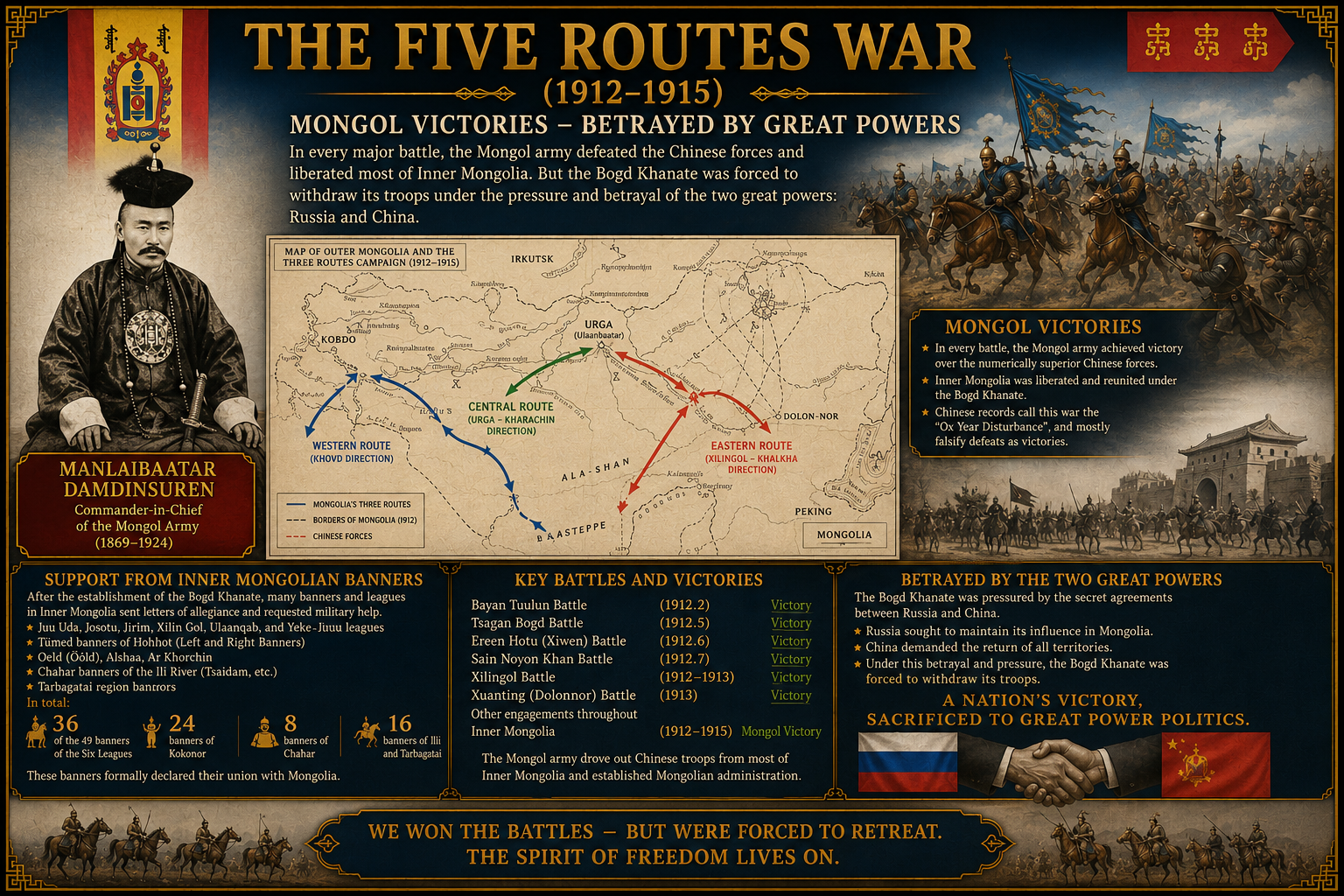
MORRISON’S OBSERVATIONS ON THE WAR (1913)
In a letter and memorandum dated 28 November 1913, written by George Ernest Morrison to Cai Tinggan, secretary to Yuan Shikai, Morrison sharply criticized contemporary Chinese reports claiming military victories:
“Those victories were merely the suppression of unarmed people in Inner Mongolia. Against Mongol military attacks, they were likewise unable to resist effectively.”
He further stated:
“The situation in Mongolia is even worse than I have described… The routes from Kalgan (Zhangjiakou) to Urga (present-day Ulaanbaatar), Dolonnuur, and Guihuacheng are truly difficult.”
This assessment reflected the reality that Chinese forces had failed to push Mongol troops back from several strategically important regions.
After analyzing the campaign, Morrison concluded that the harsh environment was one of the principal causes of Chinese military failures. He observed that:
“Mongol troops were adapted to the local climate, while Chinese troops were unfamiliar with the climate, water, and terrain, placing them at a severe disadvantage.”
Based on these conditions, Morrison warned the Chinese government:
“Unless the methods and morale of the Chinese army are changed promptly, there is also the danger that Inner Mongolia may achieve independence.”
Ariq Böke (Mongolian: Arigbukh, meaning “Strong Böke”)
Ariq Böke (Mongolian: Arigbukh, meaning “Strong Böke”) was a grandson of Genghis Khan and the youngest son of Tolui and Sorghaghtani Beki. Following the death of Möngke Khan in 1259, Ariq Böke emerged as a central figure in the succession struggle that reshaped the Mongol world.
In 1260, Ariq Böke was proclaimed Great Khan at the imperial capital of Karakorum by many princes, nobles, and traditional Mongol factions who favored preserving the steppe-centered governance of the empire. He defended the political importance of Mongolia and the authority of the ancestral homeland.
However, his elder brother Kublai Khan was separately proclaimed Great Khan in North China, leading to the Toluid Civil War (1260–1264). The conflict was not merely a dynastic struggle but also reflected differing visions for the empire: Ariq Böke represented the traditional Mongol steppe order centered on Karakorum, while Kublai increasingly relied upon Chinese administrative institutions and sedentary governance.
Ariq Böke controlled the Mongolian heartland and initially enjoyed support from important sectors of the empire. Yet prolonged warfare, supply difficulties, and the loss of allies gradually weakened his position. In 1264, he surrendered to Kublai Khan and later died in 1266 under uncertain circumstances.
Although official Yuan chronicles often portrayed him as a defeated rival, in Mongolian historical memory Ariq Böke has frequently been remembered as a defender of the Mongolian imperial center and the traditional character of the empire. Some Mongolian historians and writers therefore regard him as the fifth Great Khan of the Mongol Empire, succeeding Möngke Khan.
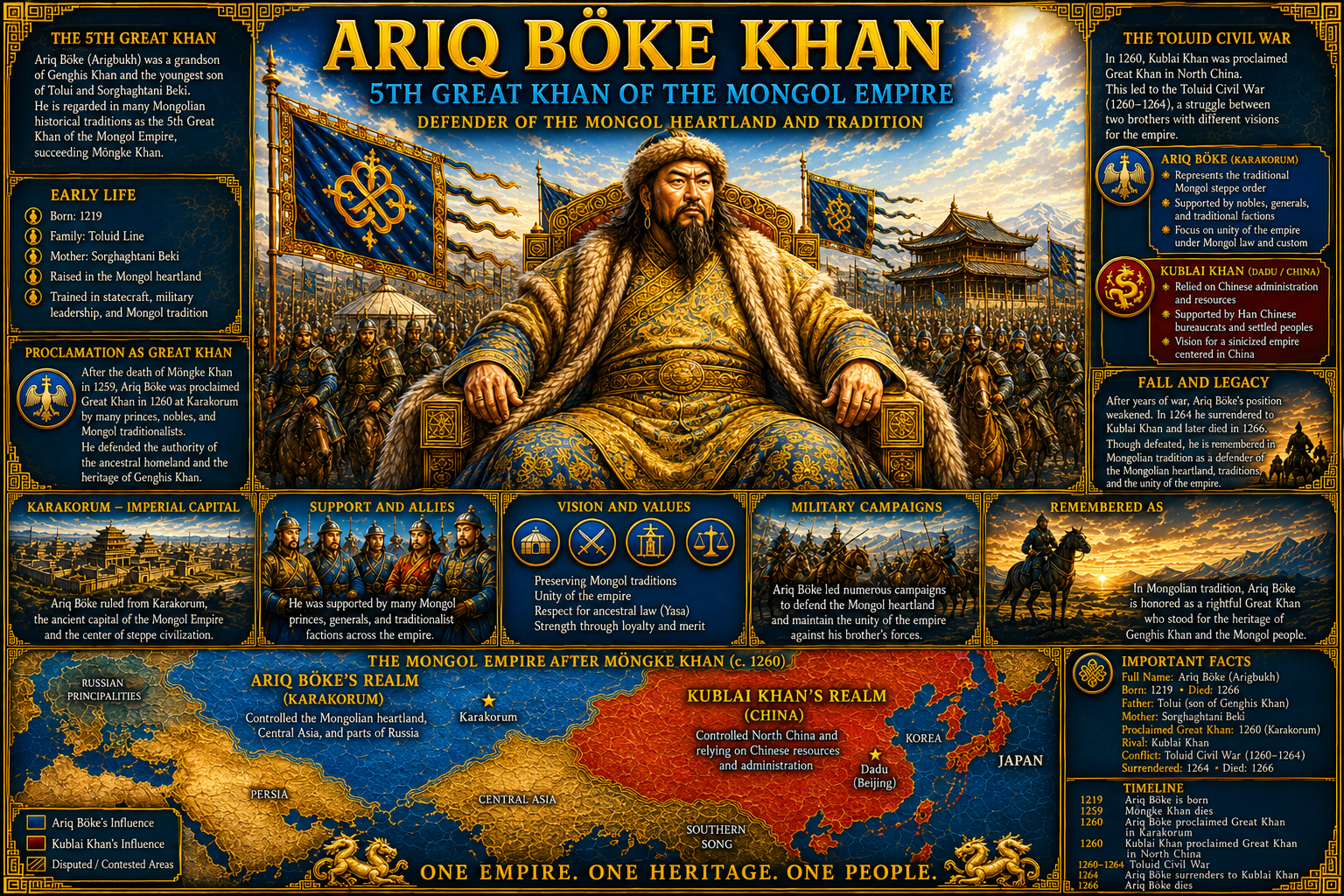
THE MONGOL YUAN DYNASTY
THE EMPIRE OF KHUBILAI QAAN
The Монголын Юань гүрэн was the imperial dynasty established by Khubilai Qaan in 1271, representing the eastern dominion of the greater Mongol world. From the courts of Khanbaliq to the ports of the eastern seas, the Yuan united steppe traditions with the administrative systems of China, creating one of the most powerful empires of the medieval age.
Under Khubilai Qaan, the Mongol Empire entered a new imperial era. The Yuan court governed vast territories stretching across East Asia while maintaining connections with the wider Mongol khanates of Central Asia, Persia, and the western steppes. Roads, canals, maritime routes, and the Yam relay system connected distant peoples beneath a single imperial order.
The Yuan dynasty was not merely a conquest regime. It became a cosmopolitan imperial civilization where Mongols, Han Chinese, Koreans, Central Asians, Persians, Uyghurs, and many other peoples served within the state. Administrators, astronomers, engineers, merchants, monks, and diplomats traveled across the empire under Mongol protection.
Khubilai Qaan strengthened trade, expanded agricultural administration, supported astronomy and cartography, and promoted large-scale maritime activity. Foreign travelers such as Marco Polo described the immense wealth, order, and global character of the Yuan capital.
The Mongol Yuan world also stood at the center of naval ambition. Massive fleets crossed the seas toward Japan, Southeast Asia, and beyond, reflecting the empire’s vision of universal authority beneath Eternal Heaven.
Though the dynasty eventually fell in 1368, the legacy of the Mongol Yuan endured across East Asia. Its institutions, trade networks, military organization, and multicultural administration profoundly shaped the later history of the region.
The Yuan dynasty was not the abandonment of the steppe world, but its transformation into a universal imperial order.
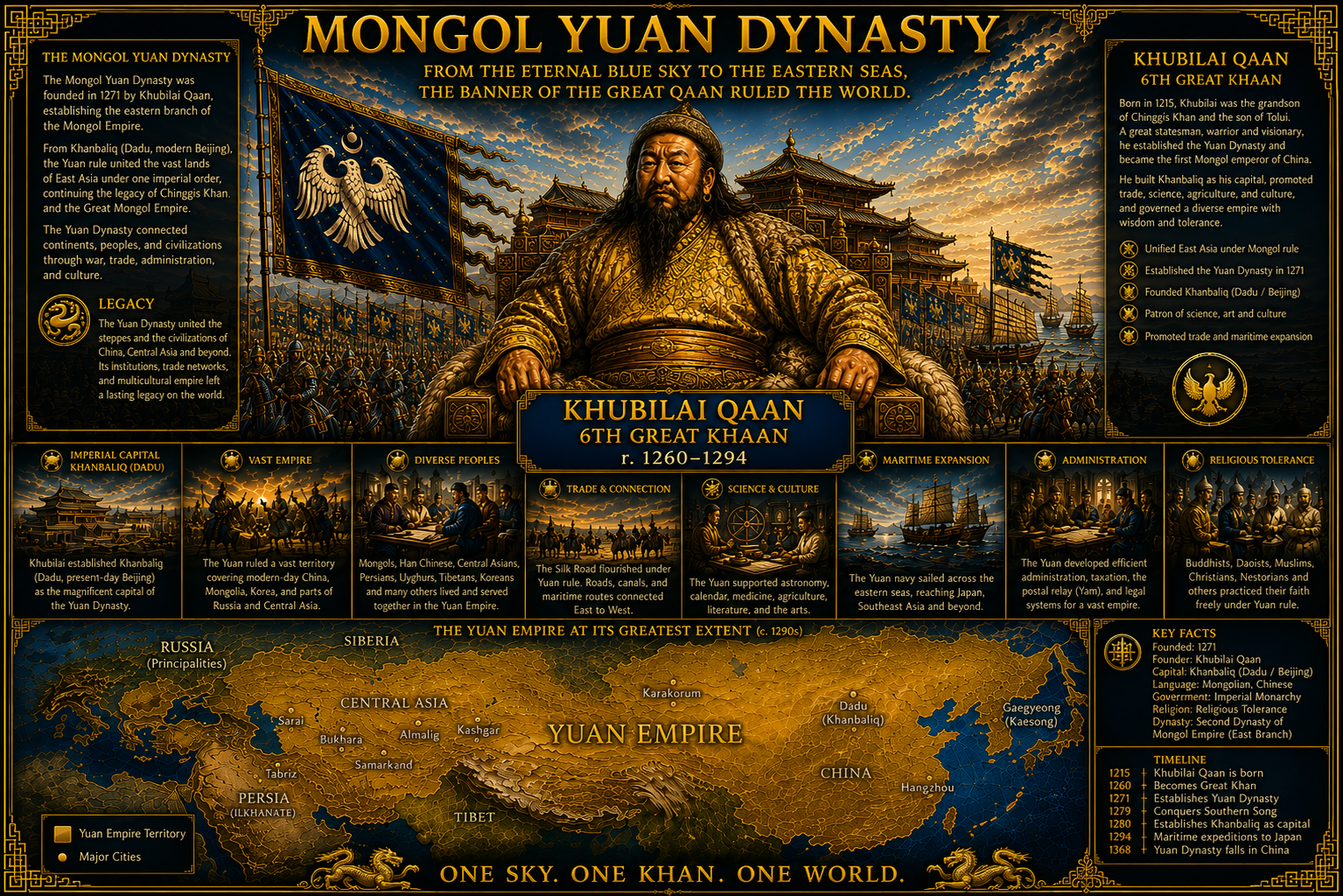
Mongol Empire (c. 1200–1400 CE) — The Mongol Empire unified the Eurasian steppe under Genghis Khan and created vast transcontinental trade, military, and diplomatic networks across Eurasia.
China (c. 1200–1400 CE) — The Yuan dynasty ruled China under Mongol authority, integrating East Asia into the wider Mongol imperial system.
Middle East (c. 1200–1400 CE) — The Ilkhanate governed Persia and Iraq while Persian science, art, and trade flourished under Mongol-era exchanges.
Central Asia (c. 1200–1400 CE) — The Chagatai Khanate controlled major Silk Road corridors linking China, Persia, and the western steppe.
Eastern Europe (c. 1200–1400 CE) — The Golden Horde dominated the western steppe and influenced the political rise of Muscovy and other Rus principalities.
Western Europe (c. 1200–1400 CE) — Feudal kingdoms such as Kingdom of France and Kingdom of England fought dynastic wars while trade cities and universities expanded.
Scandinavia (c. 1200–1400 CE) — The Viking Age had ended, and Nordic kingdoms consolidated into organized Christian monarchies connected to Baltic and North Sea commerce.
India (c. 1200–1400 CE) — The Delhi Sultanate became a major military and cultural power across northern India.
Japan (c. 1200–1400 CE) — The Kamakura shogunate and later samurai governments strengthened warrior rule while resisting Mongol invasions.
Southeast Asia (c. 1200–1400 CE) — Maritime kingdoms such as Majapahit expanded regional trade networks across the Indonesian archipelago.
Africa (c. 1200–1400 CE) — The Mali Empire controlled Saharan gold trade routes and became one of the wealthiest states of the medieval world.
East Africa (c. 1200–1400 CE) — Swahili coastal city-states prospered through Indian Ocean commerce linking Africa, Arabia, Persia, and India.
North America (c. 1200–1400 CE) — Indigenous civilizations such as the ancestral Pueblo societies and Mississippian cultures developed urban centers, trade systems, and monumental architecture.
Mesoamerica (c. 1200–1400 CE) — Powerful states including the Aztec Empire emerged in central Mexico through military expansion and tribute systems.
South America (c. 1200–1400 CE) — Andean civilizations expanded agricultural engineering, mountain trade networks, and imperial organization before the rise of the Inca Empire.
ANCESTORS OF HUMANITY
Lodongiin Tudev once said that the history of the Mongols should not begin only with the Xiongnu. It began many thousands of years earlier.
Archaeological evidence shows that as far back as 15,000 years ago, nomadic culture had already taken shape. Stone Age campsites, along with rock paintings depicting hunting culture, have been discovered in Bayankhongor, Govi-Altai, Khovd, and Arkhangai. These findings demonstrate that ways of life such as hunting, animal domestication, and seasonal migration existed in the Mongolian lands from very early times.
Therefore, the Xiongnu were a continuation of nomadic culture that had developed over thousands of years. We Mongols must not think of our history as something short or recent.
The peoples listed here were regarded by the ancestors of the Chinese as constant enemies—dangerous and formidable. They were often slandered and labeled as “barbaric” in historical records. Yet, those very enemies whom they feared were, in fact, the ancestors of our Xiongnu.
Although excavations of the Botai culture (around 3700 BCE) uncovered the remains of about 7,000 horses—proving the existence of mounted nomads—the history of that time remains too obscure. Therefore, I will begin slightly later, presenting a list from the period of the Jiuli tribal confederation up to the era of the Xiongnu.
Chronological List
1. Jiuli (Confederation of Nine Tribes)
2600 BCE – 2300 BCE
According to Chinese legends, they were described as nomadic hostile enemies.
2. 2300 BCE – 1300 BCE (Dark Age)
This period is historically unclear. Some historians mention a people called “Melkhi,” but this remains insufficiently studied.
3. Guifang State
1300 BCE – 900 BCE
A nomadic confederation. After their decline, groups such as the Scythians, Massagetae, and the one-eyed Arimaspi migrated westward toward Europe.
4. Xianyun
1000 BCE – 700 BCE
A state that united remnants of the Guifang along with the Run and Di tribes.
5. Di
900 BCE – 800 BCE
A confederation consisting of Northern Di, Red Di, White Di, and Long Di tribes.
6. Jung Run (Zhongrong)
800 BCE – 700 BCE
A confederation including Lu Zhong, Mountain Rong, Dog Rong, and Western Rong tribes.
7. Beidi (Northern Di)
700 BCE – 300 BCE
A union of seven tribes, including the Mon and Di.
8. Northern Xiongnu
340 BCE – 209 BCE
A confederation of 24 tribes that united parts of the Beidi and most of the Jung Run.
9. Xiongnu Empire
209 BCE – 93 CE
A great empire that unified 36 states, including the powerful Donghu (Eastern Hu) and the western Yuezhi.
1. Jiuli — Confederation of Nine Tribes
2600 BCE – 2300 BCE
In the dim twilight of the earliest ages, before the lines of history were firmly drawn, there arose the Jiuli—a confederation of nine tribes bound together by blood, oath, and the harsh will of survival.
They are remembered in ancient accounts as the people of Chi You, a warlike chieftain whose name echoes through legend as both feared and revered. Across the fertile yet contested lands of the Yellow River, they stood as relentless adversaries to Huangdi, clashing in battles that later generations would elevate into myth.
These lands—where river meets steppe, and where the winds of the north descend upon the plains—would in later ages become the southern sphere of the Xiongnu Empire, the very frontier where the steppe world pressed against the settled realms.
Though the records that speak of them are veiled in legend rather than grounded in firm archaeological proof, many scholars see within the Jiuli the shadow of early steppe-born peoples—proto-nomads whose lives were shaped by movement, conflict, and the open land.
👉 Key point: One of the earliest known large tribal confederations, possibly representing the proto-nomadic origins of steppe civilizations, in a region that later became part of the Xiongnu sphere.2. The Dark Age (Melkhi?)
2300 BCE – 1300 BCE
A long silence falls upon the written memory of this age—not because human life had diminished, but because no voices were preserved in script. This so-called “Dark Age” reflects not an absence of culture, but an absence of recorded history.
Archaeology, however, speaks where texts remain silent. Across the steppe and forest-steppe zones of Inner Asia, cultures such as the Afanasievo culture, Okunevo culture, and Andronovo culture reveal a dynamic and evolving world.
During this period, key developments took place:
The rise of early Bronze Age metallurgy
The expansion of pastoral nomadis
The establishment of seasonal migration pattern
Increasing social organization among steppe communities
In other words, by this time, the fundamental structures of nomadic life—herding, mobility, and adaptation to the степpe—were already firmly in place.
Some later interpretations refer to a people called the Melkhi, yet this name remains hypothetical and insufficiently supported by archaeological or textual evidence, existing only at the margins of scholarship.
Thus, this age was not a void, but a hidden continuum—an unbroken development of steppe culture that would later give rise to powerful tribal confederations, including those that preceded the Xiongnu.
 Key point: Not a true “dark age,” but a gap in written records—while nomadic civilization continued to develop steadily through archaeological cultures.
 3. Guifang — Lords of the Northern Frontier
1300 BCE – 900 BCE
From the silence of the preceding age, the Guifang emerge—not from myth alone, but from the earliest written records of neighboring civilizations. In the oracle bones and inscriptions of the Shang dynasty, their name appears as that of a persistent and formidable northern enemy.
They were not a single tribe, but a confederation of mobile steppe peoples, dwelling beyond the settled agricultural world. Their strength lay in movement: mounted warfare, seasonal migration, and the ability to strike swiftly across vast distances. To the Shang, they were both a threat and a constant presence along the northern frontier.
Archaeological and historical interpretations suggest that the Guifang belonged to the broader continuum of early steppe cultures that had been developing since the Bronze Age. Their way of life—pastoral, mobile, and war-oriented—reflects a mature form of nomadic society rather than an emerging one.
Following the decline of the Guifang, the steppe world did not fragment into silence. Instead, its peoples dispersed and transformed. Some scholars propose that elements of these northern groups contributed to the westward movements that would later be associated with the Scythians and the Massagetae, while others remained in Inner Asia, continuing the line of development that would lead toward later confederations.Thus, the Guifang stand not as an isolated people, but as a visible moment in a longer continuum—the steppe world beginning to enter the written record.
Key point: One of the earliest historically attested nomadic confederations, marking the transition from prehistoric steppe cultures to recorded history.---
1300 BCE – 900 BCE
From the silence of the preceding age, the Guifang emerge—not from myth alone, but from the earliest written records of neighboring civilizations. In the oracle bones and inscriptions of the Shang dynasty, their name appears as that of a persistent and formidable northern enemy.
They were not a single tribe, but a confederation of mobile steppe peoples, dwelling beyond the settled agricultural world. Their strength lay in movement: mounted warfare, seasonal migration, and the ability to strike swiftly across vast distances. To the Shang, they were both a threat and a constant presence along the northern frontier.
Archaeological and historical interpretations suggest that the Guifang belonged to the broader continuum of early steppe cultures that had been developing since the Bronze Age. Their way of life—pastoral, mobile, and war-oriented—reflects a mature form of nomadic society rather than an emerging one.
Following the decline of the Guifang, the steppe world did not fragment into silence. Instead, its peoples dispersed and transformed. Some scholars propose that elements of these northern groups contributed to the westward movements that would later be associated with the Scythians and the Massagetae, while others remained in Inner Asia, continuing the line of development that would lead toward later confederations.Thus, the Guifang stand not as an isolated people, but as a visible moment in a longer continuum—the steppe world beginning to enter the written record.
Key point: One of the earliest historically attested nomadic confederations, marking the transition from prehistoric steppe cultures to recorded history.---
1000 BCE – 700 BCE
As the memory of the Guifang fades from the record, another name rises in its place—the Xianyun. In the chronicles of the Zhou dynasty, they appear not as strangers, but as the continuing presence of the northern world: shifting, resilient, and ever beyond the reach of fixed borders.
The Xianyun were not a sudden people, but the inheritors of earlier steppe traditions. They are often understood as the successors to the Guifang, gathering together remnants of older groups—among them the Run and the Di—and forging new alliances upon the open grasslands.
Their way of life reflects a fully developed nomadic system. Mobility, pastoral wealth, and mounted warfare defined their strength. They did not build cities, yet they shaped the course of kingdoms. Their raids and pressures upon the Zhou frontier were not isolated events, but part of a long-standing dynamic between the settled south and the mobile north.
In this age, the pattern becomes clearer: tribal fragmentation followed by reunification, decline followed by resurgence. The steppe does not vanish—it reorganizes.
For this reason, many scholars view the Xianyun as part of the direct cultural and political lineage that would, in later centuries, give rise to the Xiongnu. Though the connection is not absolute, the continuity of structure, lifeway, and geopolitical role is unmistakable.
Thus, the Xianyun stand as a bridge between the early recorded nomads and the great confederations yet to come—a living link in the unbroken chain of steppe civilization.
Key point: A successor confederation continuing the steppe tradition, often regarded as a precursor within the broader lineage leading toward the Xiongnu.
900 BCE – 800 BCE
In the shifting tapestry of the steppe and its borderlands, the name Di does not belong to a single people, but to many. In the records of the Zhou dynasty, the Di appear as a broad designation—an assembly of tribes whose identities were as varied as the lands they roamed.
They were known in divisions: the Northern Di, the Red Di, the White Di, and the Long Di. Each bore its own character, yet all were bound by a shared lifeway shaped by movement, herding, and the demands of the frontier.
Unlike the fully nomadic confederations of later centuries, the Di often lived between worlds. Some practiced seasonal migration across the steppe, while others settled temporarily along river valleys and border regions. They traded, they raided, and at times, they entered into alliances with the states of the Zhou realm. Thus, they were neither wholly outside nor fully within the sphere of the agrarian civilizations to the south.
In this period, the boundary between steppe and settled land was not a fixed line, but a wide and shifting zone of interaction. The Di inhabited this frontier space, where cultures met, clashed, and intertwined.
Though divided into many branches, the Di represent a crucial stage in the evolution of steppe societies. From such diversity would later emerge stronger unions—confederations capable of uniting scattered tribes into a single political force.
Key point: A diverse and multi-branch group of frontier tribes, representing a transitional stage between fragmented peoples and later unified nomadic confederations.800 BCE – 700 BCE
Along the shifting edges of the known world, where the ordered lands of the south gave way to the vast and uncertain steppe, there arose the peoples known as the Jung Run—called Rong in the chronicles of the Zhou dynasty.
This name did not belong to a single tribe, but to many: the Lu Zhong, the Mountain Rong, the Dog Rong, and the Western Rong. To the scribes of the Zhou, they were grouped together as outsiders—yet in truth, they were diverse communities bound by a shared frontier existence.
The Jung Run lived in a world of movement and adaptation. Some roamed the highlands and valleys, others the open степpe, but all were shaped by a life that required strength, mobility, and resilience. Their society was not unified under a single ruler, but formed through loose alliances—temporary, shifting, yet capable of great force when brought together.
In this age, their presence was not merely peripheral. The pressure they exerted upon the Zhou realm grew steadily, and in time, their incursions would contribute to the weakening of the western order itself. The frontier was no longer a distant boundary—it had become a line of constant tension.
Yet, as with those before them, the Jung Run were not an isolated phenomenon. They were part of the same enduring pattern of the steppe: fragmentation and union, dispersal and return. From such peoples would emerge the conditions necessary for greater political consolidation.
Thus, the Jung Run stand as the keepers of the frontier—neither fully inside nor entirely beyond, but essential to the transformation of the steppe world
Key point: A broad frontier confederation of Rong tribes whose pressure on early states helped shape the political landscape and continued the evolution toward larger nomadic unions7. Beidi — The Northern Confederation
700 BCE – 300 BCE
From the many branches of the Di and the scattered peoples of the frontier, a greater formation began to take shape—the Beidi, known as the Northern Di. No longer merely divided tribes, they emerged as a broader confederation, gathering strength across the northern степpe and its borderlands.
In the turbulent era remembered as the Warring States period, the Beidi stood as a constant presence along the northern horizons of the competing states. Their movements were swift, their strikes sudden, and their knowledge of the land unmatched. To the settled kingdoms, they were not a distant threat, but an immediate and enduring challenge.
It was in response to such northern powers that the first great defensive measures began to rise—walls of earth and stone, built not as monuments, but as barriers against the степpe. These early fortifications, raised by various states, marked the beginning of a long struggle between mobility and permanence, between the open land and the enclosed realm.
Yet the Beidi were more than adversaries. They were the inheritors of a long lineage—drawing together elements of earlier Di and Rong groups, shaping them into a more cohesive force. The process of unification had advanced further: alliances grew stronger, leadership more defined, and the idea of a larger political entity began to take hold.
Thus, the Beidi stand at a turning point in steppe history. From their ranks, and from the patterns they embodied, would soon arise even greater unions—those capable of transforming confederation into empire.
Key point: A major northern confederation representing an advanced stage of tribal unification, directly preceding the emergence of the Xiongnu.
7. Beidi — The Northern Confederation
700 BCE – 300 BCE
From the many branches of the Di and the scattered peoples of the frontier, a greater formation began to take shape—the Beidi, known as the Northern Di. No longer merely divided tribes, they emerged as a broader confederation, gathering strength across the northern степpe and its borderlands.
In the turbulent era remembered as the Warring States period, the Beidi stood as a constant presence along the northern horizons of the competing states. Their movements were swift, their strikes sudden, and their knowledge of the land unmatched. To the settled kingdoms, they were not a distant threat, but an immediate and enduring challenge.
It was in response to such northern powers that the first great defensive measures began to rise—walls of earth and stone, built not as monuments, but as barriers against the степpe. These early fortifications, raised by various states, marked the beginning of a long struggle between mobility and permanence, between the open land and the enclosed realm.
Yet the Beidi were more than adversaries. They were the inheritors of a long lineage—drawing together elements of earlier Di and Rong groups, shaping them into a more cohesive force. The process of unification had advanced further: alliances grew stronger, leadership more defined, and the idea of a larger political entity began to take hold.
Thus, the Beidi stand at a turning point in steppe history. From their ranks, and from the patterns they embodied, would soon arise even greater unions—those capable of transforming confederation into empire.
Key point: A major northern confederation representing an advanced stage of tribal unification, directly preceding the emergence of the Xiongnu.
8. Northern Xiongnu — The Gathering of the Tribes
340 BCE – 209 BCE
From the long evolution of the steppe—through the Di, the Rong, and the Beidi—there emerged a new and more formidable unity: the early formation of the Xiongnu.
This was not yet the empire that would later shake the world, but its foundation—the Northern Xiongnu, a confederation of twenty-four tribes drawn together from the scattered peoples of the степpe. From the Beidi they inherited strength, from the Jung Run resilience, and from the deeper past the enduring patterns of nomadic life.
In this age, something fundamental began to change.
No longer were alliances merely temporary or fluid. Leadership grew more centralized, authority more defined, and the bonds between tribes strengthened under the pressure of both internal competition and external threat. The steppe, long a land of shifting unions, was beginning to move toward a more enduring political order.
Mounted warfare reached new levels of coordination. Communication across distances improved. The idea of unity—once fleeting—began to take root as necessity.
Though the name “Xiongnu” would later be known in its full power, here we witness its earliest formation: a gathering of tribes into a single will, a storm not yet unleashed, but already building across the horizon.
Thus, the Northern Xiongnu stand as the threshold between confederation and empire—the final transformation before the rise of a force that would reshape the balance between steppe and settled world.
Key point: The transitional phase in which fragmented steppe tribes united into a centralized confederation, laying the foundation for the Xiongnu Empire.
9. The Xiongnu Empire — Lords of the Eternal Steppe
209 BCE – 93 CE
At last, from the long gathering of tribes and the unbroken current of the степpe, there arose a power unlike any before it—the Xiongnu Empire.
Its true beginning is marked by the rise of Modu Chanyu, a ruler of iron will who transformed a fragile confederation into a unified empire. Through discipline, strategy, and relentless resolve, he brought the степpe under a single command, binding together tribes that had long stood apart.
Under his rule, and those who followed, the Xiongnu expanded into a vast dominion—uniting no fewer than thirty-six tribes and allied states. Their power stretched across the great grasslands, from the forests of the north to the edges of the desert, and from the rising lands of the east to the distant reaches of the west.
They were not merely raiders, as their enemies would later claim, but masters of a sophisticated system:
A structured political hierarchy under the Chanyu
A highly organized military based on mobility and speed
A diplomatic network balancing war, alliance, and tribute
Their greatest rival was the Han dynasty, with whom they waged both war and negotiation across generations. Around them stood other powerful peoples—the Donghu in the east and the Yuezhi in the west—yet the Xiongnu rose above them, forging dominance across Inner Asia.
Here, the long evolution of the steppe reached its first great culmination. What had once been scattered tribes became an empire; what had once been survival became strategy; what had once been movement became power.
And though the empire would, in time, divide and fade, its legacy would endure—echoing through the later peoples of the степpe, and shaping the very idea of nomadic empire for centuries to come.
Key point: The first great nomadic empire, representing the full political, military, and cultural maturation of the steppe tradition.A 4800-Year Continuum of Steppe Civilization
Rise of the Steppes
Khans and Commanders
From the legendary rulers of the Jiuli to Tumen Chanyu, Chinggis Khan, and modern Mongolia, steppe leadership evolved through unity, strategy, and conquest.
Neighbours and Rivals
From early tribal conflicts to encounters with China, Persia, and Rome, the steppe shaped Eurasia through war and exchange.
From Jiuli to Modern Mongolia
Tracing the political evolution of the steppe from early tribal confederations to the modern Mongolian state.
Early Conferderations
2600–700 BCE Jiuli, Guifang, Xianyun, Di Early tribal unions that shaped the foundation of steppe civilization.
Juilu Confederation
The Jiuli Confederation (also known as the “Nine Li Tribes”) was an ancient tribal alliance believed to have existed around 2600 BCE in early Chinese history and mythology.
👤 Leadership
The confederation is traditionally associated with Chiyou, a powerful tribal leader known for his strength and military skill.
⚔️ Historical Significance
- The Jiuli are best known for their conflict with the Yellow Emperor (Huangdi)
- This conflict culminated in the legendary Battle of Zhuolu, where the Yellow Emperor defeated Chiyou
- The event is often considered a foundational myth in the formation of early Chinese civilization
🏛️ Cultural Role
- The Jiuli are sometimes described as a distinct cultural or ethnic group in ancient China
- In later traditions, they are linked to southern tribes and occasionally to the ancestors of certain ethnic minorities
⚡ Quick Summary
- 📅 Around 2600 BCE
- 🧑🤝🧑 Tribal alliance known as the Nine Li (Jiuli)
- 👤 Led by Chiyou
- ⚔️ Defeated by the Yellow Emperor at the Battle of Zhuolu
- 🏛️ Important in early Chinese mytho-historical tradition
Proto-Steppe Horizon
- Jiuli Confederation (九黎)
2600 – 1300 BCE (legendary–protohistoric) - Guifang / Early Northern Groups
1300 – 1000 BCE - Xianyun Confederation
1000 – 700 BCE - Rong–Di Complex (incl. Beidi)
900 – 300 BCE Early Steppe State Formation
- Proto-Xiongnu Confederations
400 – 209 BCE - Xiongnu Empire
209 BCE – 93 CE
- Proto-Xiongnu Confederations
Steppe Empires
209 BCE – 1368 CE Xiongnu, Turkic Khaganates, Mongol Empire The rise of centralized power and the greatest nomadic empires.
Xiongnu Successor Complex (Critical Transitional Layer)
- Xianbei Confederation
93 – 234 CE - Tuoba / Tabgach Xianbei (proto-state phase)
~200 – 386 - Tuoba Wei (Northern Wei Dynasty)
386 – 534 - Steppe Imperial Continuity
- Rouran Khaganate
330 – 552 - Göktürk Khaganate
552 – 744 - Uyghur Khaganate
744 – 840
Para-Mongolic Transitional Empires
- Khitan (Liao Dynasty)
907 – 1125 - Kara Khitan (Western Liao)
1124 – 1218 - Khamag Mongol Confederation
1000 – 1206
Mongol Imperial System
- Mongol Empire
1206 – 1368 - Монголын Юань гүрэн
1271 – 1368
Modern
1368 CE – Present Post-imperial transition to modern Mongolia Continuation of steppe identity into the modern state.
Mongol Ulus System (Successor Khanates)
- Golden Horde (Алтан орд)
1240s – 1502 - Blue Horde (Хөх орд)
1240s – 1370s - White Horde (Цагаан орд)
1240s – 1428 - Chagatai Khanate (Цагаадайн улс)
1225 – 1680s - Ilkhanate (Ил хаант улс)
1256 – 1335
Turco-Mongol Continuity Layer
- Timurid Empire
1370 – 1507 - Moghulistan / Moghul Khanate
1347 – 1700s - Mughal Empire
1526 – 1857
Mongol Homeland Continuity
- Northern Yuan (Umard Yuan)
1368 – 1635 - Oirat Confederation (Dörvön Oirat)
1400s – 1758 - Eastern Mongol Khanates (Khalkha, Chahar)
1400s – 1635
Qing Period
- Qing Dynasty (Монгол дотор)
1636 – 1911
Modern Mongolia
- Bogd Khanate of Mongolia
1911 – 1924 - Mongolian People’s Republic
1924 – 1992- Mongolia (modern state)
1992 – Present
- Mongolia (modern state)