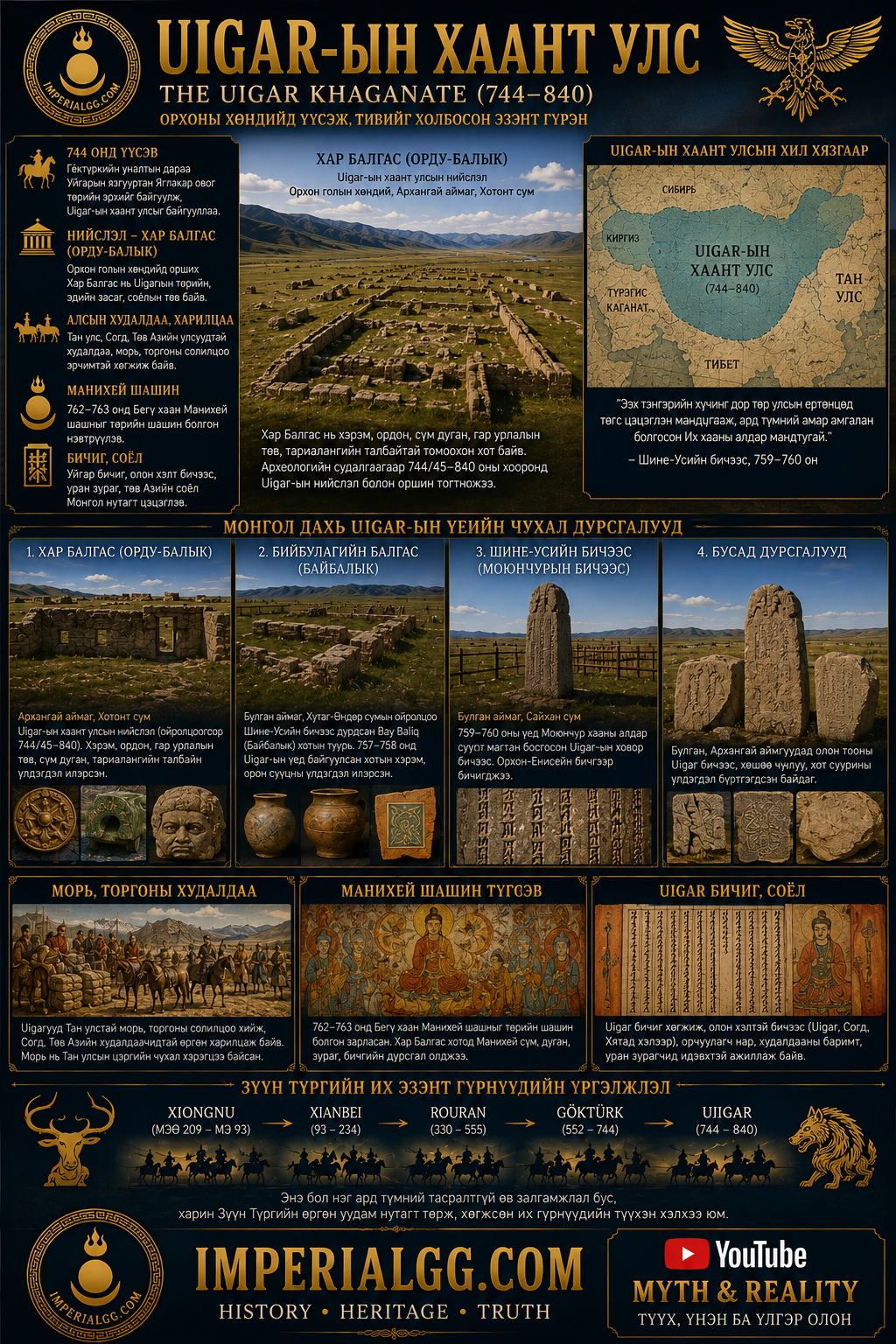
THE UYGHUR KHAGANATE
By Altanbagana Baatar
DBA Candidate| Independent Historian
ImperialGG Historical Research Seriers
27 August 2026
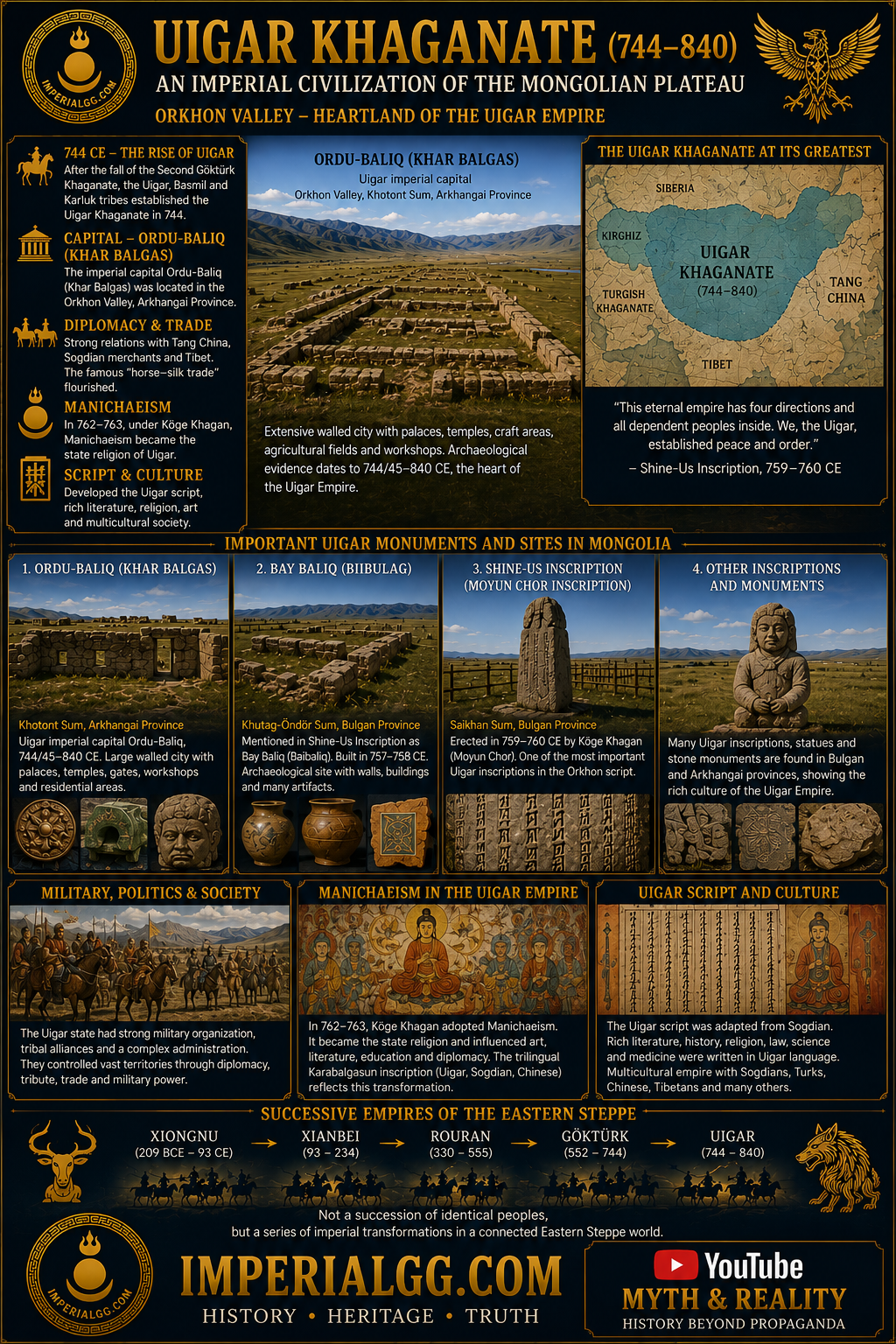
An Imperial Transformation of the Eastern Steppe, 744–840
Introduction
The establishment of the Uyghur Khaganate in the middle of the eighth century represents one of the most important political transformations in the history of the Mongolian Plateau. Emerging after the collapse of the Second Türk Khaganate, the Uyghurs did not simply occupy a political vacuum. They inherited, reorganized, and substantially transformed an already developed imperial environment in the Eastern Steppe.¹
The Uyghur Empire lasted from approximately 744 to 840 CE, with its political center in the Orkhon Valley of present-day Mongolia. At its height, its influence extended across a large portion of Inner Asia, while its rulers maintained complex diplomatic, military, and economic relations with Tang China, the Tibetan Empire, and Central Asian trading communities.²
The importance of the Uyghur period therefore lies not merely in the succession of one steppe dynasty after another. It demonstrates the capacity of the Mongolian Plateau to generate an imperial system combining pastoral power, military organization, urban development, long-distance commerce, agriculture, multilingual administration, and religious transformation.
1. FROM GÖKTÜRK TO UYGHUR
The rise of the Uyghur Khaganate followed the political crisis of the Second Türk Khaganate. In the early 740s, Uyghur, Basmil, and Karluk forces participated in the destruction of the existing Türk political order. By 744, the Uyghur leader became the dominant ruler of the Eastern Steppe and established a new khaganate. The ruling Yaglakar clan became the principal dynastic house of the new empire.³
This transition should not be interpreted as the disappearance of one population and the sudden appearance of another.
Rather, it represents a familiar pattern in Inner Asian history:
A new ruling coalition emerged within an already developed imperial environment.
The Uyghurs inherited political practices, titles, military institutions, territorial concepts, and monumental traditions that had been developed by earlier steppe empires, while simultaneously modifying them according to their own political requirements.
This makes the sequence
XIONGNU → XIANBEI → ROURAN → GÖKTÜRK → UYGHUR
historically meaningful not as a sequence of identical ethnic populations, but as a sequence of imperial transformations within the Eastern Steppe.
2. THE ORKHON VALLEY AS AN IMPERIAL CENTER
One of the most significant facts about the Uyghur period is the continued importance of the Orkhon Valley. The Uyghurs established their principal capital, Ordu-Baliq, in the Middle Orkhon Valley. Archaeological research demonstrates that this was a large walled urban center with monumental architecture, craft production, agricultural surroundings, and evidence of extensive interaction with peoples from across Inner Asia.⁴
The decision to establish an urban capital in the Orkhon Valley is historically significant. It demonstrates that the political importance of the region did not end with the Göktürks. Instead, the same geographical environment continued to serve as an imperial center under a new political dynasty. This continuity is particularly important for understanding the history of Mongolia. The Mongolian Plateau was not simply a territory repeatedly occupied by unrelated external powers. It was itself a political environment capable of generating and sustaining large-scale imperial systems.
3. ORDU-BALIQ AND THE DEVELOPMENT OF STEPPE URBANISM
The Uyghur capital represents one of the clearest examples of urban development within a steppe imperial system. Archaeological investigations at Karabalgasun have revealed extensive walled areas, monumental buildings, craft zones, gates, roof tiles, and other architectural remains. Research conducted by Mongolian and German archaeological teams has demonstrated that the city was substantially more complex than a temporary royal encampment.⁵
This is important because older historical models sometimes treated nomadic political systems as fundamentally opposed to urban civilization. The Uyghur case complicates such a dichotomy.
The empire remained deeply dependent upon pastoral mobility and steppe military power, yet its political center incorporated:
- permanent architecture,
- craft production,
- agriculture,
- long-distance trade,
- multilingual communities,
- religious institutions,
- and administrative structures.
The result was not a contradiction between “nomadic” and “urban.” It was an imperial synthesis of steppe and sedentary institutions.
4. BAY BALIQ: A SECOND URBAN CENTER
The archaeological record also indicates that Ordu-Baliq was not the only important urban settlement associated with the Uyghur Empire. The Shine-Us inscription, generally dated to approximately 759–760, records the construction of Bay Balïq, usually understood as “Rich City,” on the Selenga River. The site has been associated with the complex of walled remains at Bii Bulak, approximately 11 km west of present-day Khutag-Öndör sum in Bulgan Province.⁶
This is particularly valuable because the evidence combines:
written testimony + geographical information + archaeology.
Bay Balïq therefore provides a concrete example of the Uyghur state’s investment in permanent urban infrastructure beyond its main capital. The existence of such settlements challenges the simplistic assumption that the political economy of the Uyghur Empire depended exclusively upon mobile pastoralism.
5. THE SHINE-US INSCRIPTION
The Shine-Us inscription is one of the most important primary sources for the early Uyghur period. It was erected in honor of El Etmish Bilge Khagan (Moyun Chor) around 759–760 and was discovered in the Mogoin Shine-Us area of Saikhan sum, Bulgan Province. G. J. Ramstedt found the monument in 1909.⁷
Its importance extends beyond the information contained in its text. The location itself is significant. A major Uyghur royal inscription was erected not in Anatolia, not in China, and not in Central Asia, but in the territory of present-day Mongolia. The physical geography of the monument therefore reinforces the historical evidence that the political center of the Uyghur Khaganate was firmly located in the Mongolian Plateau. The inscription also provides evidence for the political and military activities of the Uyghur rulers and their relationship with neighboring populations.
6. UYGHUR–TANG RELATIONS
The Uyghur Empire developed an exceptionally important relationship with the Tang dynasty. This relationship was neither simple submission nor permanent warfare.
It involved:
military alliance, diplomacy, marriage, trade, horses, silk, and political bargaining.
When the An Lushan rebellion threatened the Tang state after 755, the Tang court sought Uyghur military assistance. Uyghur forces intervened in the conflict and played an important role in the restoration of Tang control over its capital regions.⁸ The relationship created a powerful economic dimension. The Tang state possessed enormous demand for horses, while the Uyghur Empire possessed access to the steppe horse economy. Silk therefore became an important medium of exchange.
The resulting silk-for-horses trade became one of the defining economic relationships between the two states. Modern scholarship has emphasized that this trade should not be understood simply as Uyghur demand for Chinese luxury goods. Tang military needs and the loss of important horse-breeding regions to Tibetan expansion also created substantial Chinese demand for steppe horses.⁹
Thus the relationship was economically interdependent. The Uyghurs supplied horses. The Tang supplied silk. Both sides used the exchange to support their wider political and military objectives.
7. A COSMOPOLITAN IMPERIAL ECONOMY
The Uyghur Empire therefore developed an economy that connected several different ecological and cultural zones.
The steppe supplied:
- horses,
- livestock,
- military manpower,
- and pastoral products.
Agricultural regions surrounding the cities provided food and other resources. Tang China supplied large quantities of silk. Sogdian merchants connected the empire to long-distance commercial networks across Central Asia. Archaeological evidence from Ordu-Baliq supports the existence of craft production and agricultural activity in and around the capital.¹⁰
The Uyghur state should therefore not be reduced to the image of a purely nomadic military confederation. It was a complex imperial economy in which pastoralism, agriculture, urban production, and international commerce interacted.
8. MANICHAEISM AND IMPERIAL TRANSFORMATION
Perhaps the most famous religious development of the Uyghur period was the adoption of Manichaeism by the Uyghur ruler Bögü Khagan around 762–763. According to Chinese sources and the later Karabalgasun inscription, Bögü encountered Manichaean clerics during the Uyghur intervention in China and subsequently adopted the religion.¹¹
The significance of this event was enormous. Manichaeism was not originally an Inner Asian steppe religion. It originated much farther west and had developed extensive missionary networks across Central Asia. Yet the Uyghur court transformed it into an imperial religion. The adoption of Manichaeism demonstrates the extraordinary geographical reach of the Uyghur state. The Mongolian Plateau was therefore not isolated from the intellectual and religious networks of Eurasia. Instead, the Uyghur Empire became one of the major conduits through which Central Asian religious and cultural traditions entered the Eastern Steppe.
9. THE KARABALGASUN INSCRIPTION
The later Karabalgasun inscription provides particularly important evidence for this transformation. Unlike the earlier Shine-Us inscription, the Karabalgasun monument was multilingual, incorporating Uyghur, Sogdian, and Chinese. Its content reflects the new religious and cultural environment created by the adoption of Manichaeism.¹²
The contrast between the two inscriptions is historically revealing.
Shine-Us, c. 759–760
and
Karabalgasun, early ninth century
belong to the same imperial tradition, yet they reflect a substantially transformed political and religious environment. The Uyghur Empire was therefore not static. It evolved rapidly through interaction with China, Central Asia, Sogdian merchants, and Manichaean institutions.
10. UYGHUR POLITICAL ORGANIZATION
The Uyghur state retained the Khagan institution inherited from the broader Inner Asian imperial tradition. The ruling Yaglakar clan occupied the dynastic center, while the wider Uyghur political system incorporated multiple tribal and military components.¹³ This again illustrates an important characteristic of Inner Asian empires.
The state was not necessarily based upon a centralized territorial bureaucracy comparable to later Chinese dynasties.
Instead, imperial power depended upon:
- dynastic authority,
- military organization,
- tribal alliances,
- control of strategic territories,
- tribute and trade,
- diplomatic relationships,
- and the personal authority of the Khagan.
Yet the Uyghurs simultaneously developed increasingly sophisticated administrative and urban institutions. The result was a political system that combined steppe imperial traditions with urban and sedentary institutions.
11. THE UYGHUR EMPIRE AND THE MONGOLIAN PLATEAU
The geographical evidence deserves special emphasis. Important Uyghur monuments and settlements are distributed across present-day Mongolia.
Among the most significant are:
Ordu-Baliq / Karabalgasun — Arkhangai Province, Orkhon Valley.
Shine-Us inscription — Bulgan Province, Saikhan sum.
Bay Balïq / Bii Bulak — near Khutag-Öndör, Bulgan Province.
These sites are not merely names in medieval Chinese texts. They are physical archaeological remains located within the territory of modern Mongolia.⁶
Their existence demonstrates that the Mongolian Plateau was not simply a geographic backdrop to Uyghur history. It was the core geographical environment of the Uyghur Empire.
12. THE END OF THE KHAGANATE
The Uyghur Empire survived for almost a century. By the ninth century, however, internal political problems and external military pressure weakened the state. In 840, the Kirghiz defeated the Uyghur imperial forces and the Orkhon-centered Khaganate collapsed.¹⁴
The collapse did not mean the disappearance of the Uyghur population or culture. Groups moved south and west, establishing new political centers, most famously in the Gansu corridor and the Turfan/Qocho region.
Thus the history of the Uyghurs continued beyond the fall of the Orkhon Empire. The imperial center disappeared. The historical community did not.
13. AUTHOR’S THESIS
The Uyghur Khaganate should therefore be understood as a major transformation of the Eastern Steppe imperial tradition, rather than merely the political successor of the Göktürks.
The sequence:
XIONGNU → XIANBEI → ROURAN → GÖKTÜRK → UYGHUR
does not necessarily represent five identical peoples continuing unchanged through two millennia. Rather, it represents successive political formations operating within a connected Inner Asian world characterized by:
continuity, incorporation, migration, linguistic interaction, institutional adaptation, and cultural transformation.
The Uyghurs inherited an imperial landscape. They did not create that landscape from nothing. But they transformed it. They built one of the largest urban centers ever created by a steppe imperial polity. They established additional settlements such as Bay Balïq.
They developed extensive relations with Tang China. They participated in the international horse–silk economy. They incorporated Sogdian commercial networks. They adopted Manichaeism as an imperial religion. And they left inscriptions and archaeological remains across the Mongolian Plateau that allow their history to be reconstructed independently of later national narratives.¹⁵ The significance of the Uyghur Khaganate is therefore much greater than the statement that “the Uyghurs ruled after the Göktürks.” It demonstrates something fundamental about Inner Asian history:
THE EASTERN STEPPE WAS NOT A PERIPHERY WAITING TO BE CIVILIZED BY SEDENTARY STATES.
It was itself a recurring center of imperial formation, political innovation, long-distance commerce, urban development, and cultural exchange. And the Uyghur Empire was one of its most remarkable manifestations.
Footnotes
1. Michael R. Drompp, “The Uyghur Empire (744–840),” Oxford Research Encyclopedia of Asian History (Oxford University Press, 2017). Drompp places the Uyghurs in the Selenga–Orkhon region and describes the empire as a major political and cultural power centered on the Mongolian Plateau.
2. Colin Mackerras, “The Uighurs,” in The Cambridge History of Early Inner Asia, ed. Denis Sinor (Cambridge University Press). The Uyghur Empire is dated 744–840 and its capital is identified as Karabalghasun on the High Orkhon.
3. Mackerras, “The Uighurs.” The sources describe the consolidation of the Yaglakar leadership and the Uyghur-Basmil-Karluk political coalition that displaced the Eastern Türk ruling order.
4. Hannah Renners and Christina Franken, “Ein Stadttor in Karabalgasun – historische Einordnung und archäologische Ergebnisse,” Zeitschrift für Archäologie Außereuropäischer Kulturen 7 (2017): 19–58. The article identifies Karabalgasun as the capital of the Uyghur Empire from approximately 744/45 to 840 and discusses archaeological investigations of its urban areas.
5. Ulambayar Erdenebat and Batbayar Tumur-Ochir, “Karabalgasun – The Uyghur capital in the Orkhon Valley, Mongolia.” The Mongolian-German Orkhon Expedition has investigated the urban remains since 2007.
6. Encyclopaedia Iranica, “Karabalgasun i. The Site.” The source identifies Bay Balïq mentioned in the Shine-Us inscription with the archaeological complex at Bii Bulak near Khutag-Öndör and dates its construction to 757–758.
7. Hatice Şirin, “On the Inscription Shine Us and Qarabalgasun,” Çukurova University Journal of Turkology Research 7, no. 2 (2022). The article dates Shine-Us to approximately 759–760, associates it with Eletmish Bilge Khagan/Moyun Chor, and records its discovery by G. J. Ramstedt in 1909.
8. Colin Mackerras, “Relations between the Uighurs and Tang China, 744–840.” The study emphasizes military, diplomatic, economic, and marital relations between the Uyghur state and Tang China.
9. Lee Wan-Suk, “A Study on the Silk-Horse Trade between Tang Dynasty and Uyghur,” Journal of Chinese Medieval History 28 (2012): 249–292. The study emphasizes the reciprocal economic interests behind Tang–Uyghur horse and silk exchanges, particularly after the An Lushan rebellion.
10. Encyclopaedia Iranica, “Karabalgasun i. The Site.” Archaeological evidence includes craft production, millstones, and agricultural activity surrounding the capital.
11. “Manicheism V. Missionary Activity and Technique,” Encyclopaedia Iranica. The source places Bögü Khagan’s conversion around 762/763 and connects it with Manichaean clerics encountered during the Uyghur intervention in China.
12. Hatice Şirin, “On the Inscription Shine Us and Qarabalgasun.” The Karabalgasun inscription is described as trilingual in Uyghur-Turkic, Sogdian, and Chinese and as an important source for the history of the Uyghur Empire and Manichaeism.
13. Ahmet Gökhan Ertürk, State Organization in the Orkhon (Ötükän) Uighur Qaghanate (744–840) (2020). The study examines Uyghur political organization, titles, Yaglakar dynastic leadership, and the relationship between Göktürk and Uyghur institutional structures.
14. Drompp, “The Uyghur Empire (744–840).” The empire’s duration and later Uyghur political developments in Gansu and the Tarim Basin are summarized in the Oxford Research Encyclopedia entry.
15. For the broader contrast between the Uyghur and earlier Türk imperial systems, including urbanization, agriculture, Sogdian involvement, and state-regulated horse–silk trade, see “Beyond Boom and Bust: Climate in the History of Medieval Steppe Empires,” which identifies the Uyghur Empire as significantly more urbanized and economically complex than the preceding Türk polity.
ImperialGG Series Thesis
XIONGNU → XIANBEI → ROURAN → GÖKTÜRK → UYGHUR
Not a succession of identical peoples, but successive imperial transformations within a connected Eastern Steppe world.