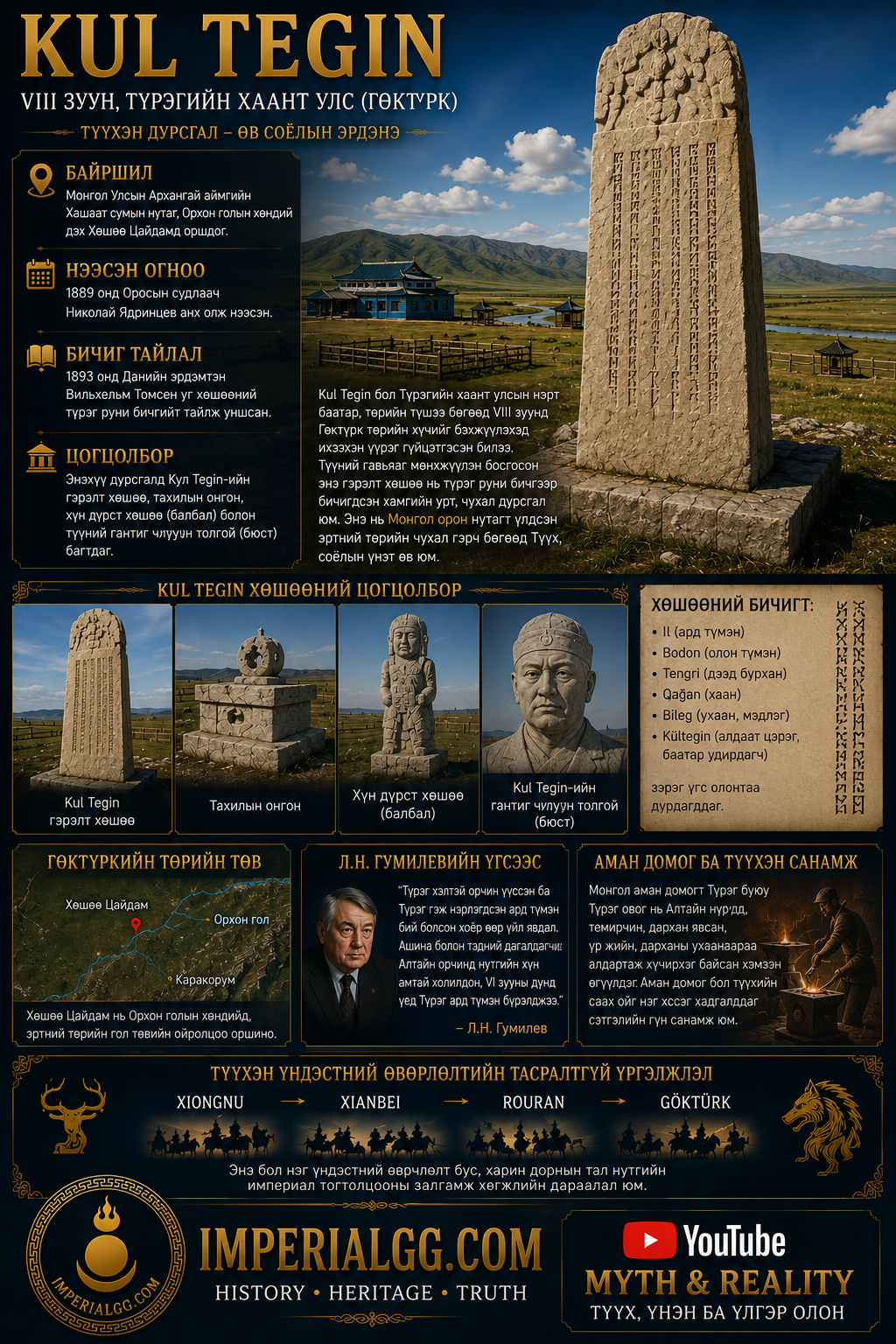
GÖKTÜRK - ТҮРЭГИЙН ХААНТ УЛС
By Altanbagana Baatar
DBA Candidate| Independent Historian
ImperialGG Historical Research Seriers
26 August 2026
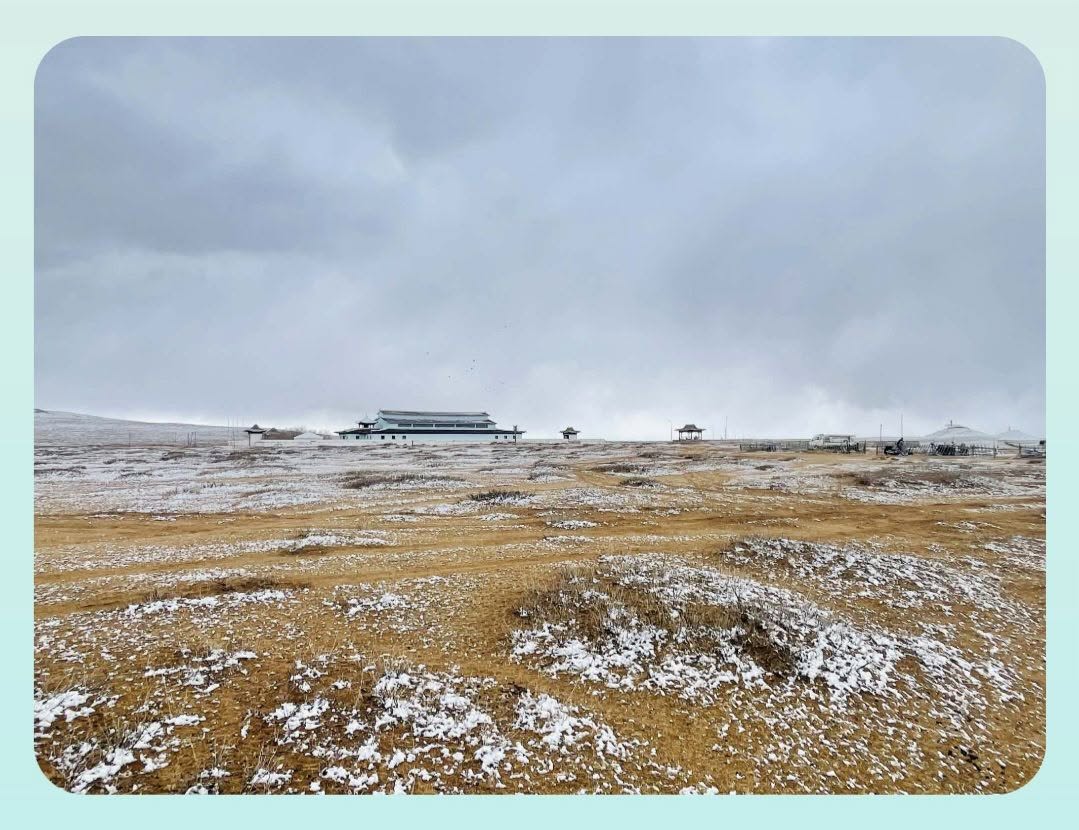
THE ORKHON INSCRIPTIONS, LINGUISTIC IDENTITY, AND THE PROBLEM OF RETROSPECTIVE NATIONAL HISTORY
Abstract
The Göktürk polity occupies a central position in modern narratives of Inner Asian history, particularly because of the monumental inscriptions associated with Kül Tegin, Bilgä Qaγan, and Tonyuquq in the Orkhon Valley of present-day Mongolia. These inscriptions are conventionally classified as Old Turkic and are widely treated as the earliest substantial written monuments of a Turkic language. This classification is supported by a long scholarly tradition extending from the decipherment of the inscriptions in the nineteenth century to modern grammatical studies.¹
Yet two different historical questions are frequently conflated. The first concerns the linguistic classification of the inscriptions. The second concerns the historical relationship between the sixth–eighth-century Türük political community and the much later population and nation-state of Anatolia known today as Türkiye.
This article argues that these questions must be separated. The existence of the Göktürk political order is not in doubt. Nor does the present study claim that the Orkhon inscriptions have already been demonstrated to be Mongolic. Rather, it proposes that the conventional linguistic classification should remain open to systematic comparative examination, particularly where lexical forms appear transparent or comparable within Mongolic languages. At the same time, the political name Türük cannot by itself establish a direct national continuity from the Inner Asian Khaganate to the modern Turkish Republic.
The article therefore proposes a methodological distinction between political continuity, linguistic continuity, and national continuity. These are related historical questions, but they are not interchangeable.
1. INTRODUCTION: THE PROBLEM OF “TURK” IN HISTORY
Few historical names have undergone as extensive a geographical and political transformation as Türk. The word appears in the political vocabulary of the sixth–eighth-century Inner Asian steppe, particularly in the inscriptions associated with the Türk Khaganate. The monuments of Kül Tegin and Bilgä Qaγan stand in the Orkhon Valley of present-day Mongolia and describe the political history, warfare, institutions, and worldview of the Türk ruling community.²
Centuries later, the same broad ethnolinguistic designation became associated with Turkic-speaking populations in Central Asia, Iran, the Islamic world, Anatolia, and eventually the Republic of Türkiye. The existence of this later history is unquestionable. The historical problem arises when these different periods are compressed into one uninterrupted national narrative. The sixth-century Türük political community was an Inner Asian imperial formation. The Republic of Türkiye is a modern nation-state established in Anatolia in the twentieth century. Between these two historical realities lie more than a millennium of migration, political transformation, linguistic change, religious change, imperial expansion, and population movement.
Consequently:
Göktürk history is not identical to modern Turkish national history.
This does not deny the importance of the Göktürks to the wider history of Turkic-speaking peoples. It simply requires historical categories to remain chronologically and geographically precise.
2. THE ORKHON MONUMENTS
The principal Orkhon monuments associated with the early Türk imperial tradition include the Kül Tegin inscription, the Bilgä Qaγan inscription, and the Tonyuquq inscriptions. The Kül Tegin monument is generally dated to 732, while the Bilgä Qaγan monument was erected in 735. They were located in the Orkhon region of present-day Mongolia, close to the political centers of the medieval steppe world.³
The monuments are remarkable for another reason. They contain both Inner Asian and Chinese elements. The western face of the Kül Tegin monument contains a Chinese inscription associated with the Tang imperial court, while the other surfaces contain the monumental script traditionally known as the Göktürk or Orkhon script.⁴
This bilingual environment demonstrates that the political world represented by the monuments was not isolated from China. The Türk Khaganate existed within an interconnected Inner Asian diplomatic system involving China, the steppe, Central Asia, and other neighboring political communities. The inscriptions therefore should be studied as documents of Inner Asian imperial history, rather than merely as early specimens of a later Anatolian national tradition.
3. HOW THE “OLD TURKIC” CLASSIFICATION WAS ESTABLISHED
The conventional classification of the Orkhon inscriptions as Old Turkic has a long scholarly history. Vilhelm Thomsen’s decipherment of the script at the end of the nineteenth century established the basic reading of the inscriptions and opened the way for systematic linguistic study. Subsequent scholars developed grammars, dictionaries, editions, and translations.
Talat Tekin’s A Grammar of Orkhon Turkic, originally published as a UCLA dissertation in 1965 and subsequently published in book form, became one of the foundational grammatical treatments of the corpus.⁵ Modern bibliographic and linguistic databases continue to catalogue the work under Old Turkic. Modern scholarship continues this tradition.
For example, recent research explicitly refers to the language of the Kül Tegin and Bilgä Qaγan monuments as Orkhon Turkic, while new studies continue to revise individual readings, grammatical interpretations, and textual reconstructions. Thus, the statement that the inscriptions are not currently classified as Old Turkic would be historically inaccurate. They are.
The more productive question is therefore:
How secure is every individual linguistic interpretation within that classification?
That is a very different question.
4. A LANGUAGE CLASSIFICATION IS NOT THE SAME AS A NATIONAL IDENTITY
The first methodological distinction is essential:
LANGUAGE ≠ POLITICAL COMMUNITY ≠ MODERN NATION
A language may be spoken by several political communities. A political empire may contain several languages. A language may survive after its original political state disappears. A political name may also be adopted by populations whose relationship with the original political community is indirect.
Therefore, even if the Orkhon inscriptions are correctly classified as Old Turkic, this alone cannot demonstrate that:
Göktürk Empire → Ottoman Empire → Republic of Türkiye
constitutes one uninterrupted national political history. The political structures were different. The territories were different. The populations changed. The religions changed. The imperial institutions changed. And the historical meaning of the word Türk itself changed across time. The modern nation-state therefore cannot simply be projected backward onto the sixth century.
5. THE QUESTION OF LEXICAL TRANSPARENCY
A more difficult question concerns individual words. Suppose that a word occurring in an ancient inscription has a form and meaning that remains recognizable in a modern Mongolic language. Does that automatically prove that the ancient inscription was written in Mongolic?
No.
But does it deserve investigation?
Absolutely.
This distinction is central to comparative historical linguistics.
A single similar word may result from:
- common inheritance;
- borrowing;
- prolonged language contact;
- parallel semantic development;
- coincidence;
- or a shared older linguistic stratum.
Therefore, lexical transparency should not be treated as conclusive proof. But neither should it be dismissed merely because the corpus has already been classified under another language. The correct procedure is comparison.
6. IL, TENGRI, BODUN, QAΓAN, BILGÄ
These are Mongolic words that have retained their meanings and are still used today. Several words are particularly important in this discussion.
Among the most recognizable forms are:
IL / EL
TENGRI
BODUN
QAΓAN / KHAN
BILGÄ
These are Mongolic words that have retained their meanings and are still used today.
These words are embedded in the political and religious vocabulary of the inscriptions. Their importance extends beyond simple vocabulary.
They represent concepts of:
- political community;
- sovereignty;
- heaven;
- collective population;
- rulership;
- wisdom and knowledge.
The question is therefore not simply whether a modern Mongolian speaker can recognize a word.
The question is:
What historical linguistic relationship explains the correspondence?
That requires systematic phonological and morphological comparison.
7. TENGRI AND THE PROBLEM OF SHARED STEPPE VOCABULARY
The word conventionally transcribed as Teŋri / Tengri provides a particularly important example. It is traditionally understood in the Orkhon corpus as the celestial deity or Heaven. Its presence is not limited to one historical language community. Forms related to Tengri occur across a broad Inner Asian linguistic and cultural sphere. Consequently, the word cannot by itself establish the linguistic identity of the inscriptions. At the same time, its enormous historical distribution demonstrates that the religious vocabulary of the steppe cannot easily be confined to one later national language. The concept belongs to a much wider Eurasian cultural history.
This is precisely why the Orkhon corpus should be studied within the Eastern Steppe cultural sphere, rather than retrospectively through a modern national boundary.
8. BODUN AND POLITICAL COMMUNITY
The term conventionally read as bodun is especially important because it concerns political society. The word appears in formulations concerning the Türk people or community. Here again, the issue is not whether a modern Mongolian speaker can recognize a semantic resemblance.
The historical question is whether the form belongs to:
- a shared ancient linguistic stratum;
- a borrowing relationship;
- a common ancestor;
- or another form of long-term contact.
The political meaning is equally important. The inscription’s bodun is a political community existing within a Khaganate.
It should therefore not automatically be translated as equivalent to the modern concept of “nation.” The semantic field of political identity in the sixth–eighth centuries was different from the nation-state concept that emerged much later.
9. BILGÄ QAGAN AND THE WORD “BILIG”
The name Bilgä Qaγan provides an especially interesting case for comparative study. The element bilgä is conventionally interpreted within Old Turkic scholarship in connection with wisdom, intelligence, or sagacity. At the same time, bilig is a well-established word in Mongolian with meanings related to knowledge, wisdom, or understanding. This correspondence deserves systematic investigation.
But the methodological rule must remain strict:
Lexical similarity is evidence for investigation, not proof by itself of linguistic identity.
The question should therefore be examined through:
phonology → morphology → semantics → historical distribution → comparative vocabulary.
If the correspondence survives all five tests, its evidentiary value becomes considerably stronger. If it fails them, the proposed connection must be rejected. That is how a genuine linguistic hypothesis should be tested.
10. KÜL TEGIN AND THE HÜLEGT HYPOTHESIS
The name Kül Tegin / Köl Tigin presents another interesting comparative question. A proposed comparison with the Mongolian form Хүлэгт (Hülegt) is potentially important because hüleg in Mongolian belongs to a semantic field associated with a distinguished or swift horse/rider. However, this comparison must not be presented as an established etymology without a full phonological demonstration.
The responsible academic formulation is:
The comparison Kül Tegin ~ Hülegt deserves examination as a hypothesis, but cannot by itself establish the linguistic identity of the inscription.
This distinction is essential. A serious article should not replace one untested assumption with another.
11. THE PROBLEM OF INTERPRETIVE CIRCULARITY
The most important methodological issue raised by this discussion is interpretive circularity.
Suppose scholars begin with the assumption:
“The inscription is Old Turkic.”
They then encounter an obscure word.
They reconstruct its meaning through Old Turkic lexical material. The resulting translation is then used as evidence that the inscription is Old Turkic. This can create a circular argument. The problem is not that the Old Turkic interpretation is necessarily wrong. The problem is that the interpretation must be independently testable.
The question should therefore be:
Can the same lexical and grammatical forms be demonstrated through comparative evidence rather than merely through the assumptions of the classification itself?
This is particularly important because modern scholarship continues to debate individual readings. Recent studies have proposed new readings for damaged passages and disputed expressions in the Bilgä Qaγan and Kül Tegin inscriptions. Therefore, the corpus is not a closed linguistic system in which every word has an uncontested meaning.
12. THE “OLD TURKIC” LABEL: USEFUL BUT NOT FINAL
The term Old Turkic is useful. It allows scholars to organize a large body of linguistic evidence. It identifies a recognizable grammatical and lexical tradition. And the existing comparative evidence gives substantial support to the conventional classification. But a classification is a scholarly model. It should not become an unquestionable historical identity.
The proper academic position is therefore neither:
“The Old Turkic classification is certainly false.”
nor:
“The Old Turkic classification can never be questioned.”
The appropriate position is:
“The classification is well established in current scholarship, but individual lexical, morphological, and etymological interpretations remain open to comparative testing.”
That distinction allows new evidence to be evaluated without abandoning established linguistic methodology.
13. GÖKTÜRK AND MODERN TÜRKİYE
The second major issue is political rather than linguistic. The Göktürk Khaganate existed in Inner Asia during the sixth–eighth centuries. Its major political centers were in the steppe world of Mongolia and Central Asia.The Orkhon monuments were erected in what is now Mongolia. Modern Türkiye, by contrast, is a twentieth-century nation-state centered in Anatolia. The historical connection between Turkic-speaking peoples and Anatolia is real and important. But it developed through centuries of migration, conquest, settlement, language shift, Islamization, and political transformation.
Therefore:
Göktürk history is part of the broader history of Turkic peoples, but Göktürk political history cannot simply be equated with the history of modern Türkiye.
This is a basic chronological distinction rather than an ideological argument.
14. THE GEOGRAPHY OF THE ORKHON CORPUS
The geographical problem deserves particular emphasis. The most famous Göktürk monuments are not located in Anatolia. They stand in the Orkhon Valley of Mongolia. The Kül Tegin monument lies near the Kocho-Tsaidam area, south of the later Mongol imperial capital Karakorum and within the historical heartland of Inner Asian imperial politics.¹⁰ This geographical fact does not determine linguistic identity. But it does determine the historical context. The monuments belong to the Inner Asian steppe world. Their history therefore must be studied first within that world. Only afterward can their later significance for Turkic-speaking populations farther west be examined.
15. FROM ROURAN TO GÖKTÜRK
The rise of the Göktürks also connects directly with our previous Rouran study. The Göktürk Khaganate did not emerge in an empty political landscape. The Rouran Khaganate had dominated much of the Eastern Steppe before the rise of the Turks. In 552, the Türks defeated the Rouran political order and established a new imperial system. The continuity is therefore best understood institutionally rather than ethnically.
The Khagan title remained. The steppe imperial model remained. The political geography remained important. The military traditions remained adaptable. But the ruling coalition changed.
Thus:
XIONGNU → XIANBEI → ROURAN → GÖKTÜRK
should be read as a sequence of successive imperial formations, not as proof that four historical populations were one unchanged ethnic group. This distinction is fundamental to the entire ImperialGG research series.
16. POLITICAL CONTINUITY WITHOUT NATIONAL CONTINUITY
The Eastern Steppe provides numerous examples of political continuity without modern national continuity. An empire can disappear while its institutions survive. A dynasty can disappear while its population survives. A language can change while cultural vocabulary remains. A political title can travel thousands of kilometers. And a historical name can acquire a new meaning in a later geographical environment. The Khagan title itself illustrates this process. Its use expanded beyond the Rouran and Göktürk worlds and became part of a much broader Eurasian political vocabulary. Thus, historical transmission does not require a single uninterrupted ethnic lineage.
17. WHAT WOULD ACTUALLY PROVE A MONGOLIC ORIGIN?
If the hypothesis that the Orkhon language belongs to an early Mongolic linguistic environment is to be taken seriously, it must meet demanding criteria.
At minimum, researchers would need to demonstrate:
1. REGULAR PHONOLOGICAL CORRESPONDENCES
Not isolated similarities, but systematic sound correspondences.
2. MORPHOLOGICAL CORRESPONDENCES
Case endings, plural formation, verbal morphology, possessive forms, and derivational structures would need comparison.
3. BASIC VOCABULARY
The comparison must extend beyond politically important words.
Words such as:
- body parts;
- kinship;
- numbers;
- natural phenomena;
- common verbs;
- pronouns;
are much more diagnostically valuable than titles.
4. SYNTAX
Sentence structure must be examined independently.
5. HISTORICAL CHRONOLOGY
The proposed relationship must be historically possible.
6. CONTACT EXPLANATIONS
Borrowing and long-term contact must be considered before common ancestry is claimed. This is the standard required for transforming an interesting hypothesis into a defensible linguistic argument.
18. WHY TEN RECOGNIZABLE WORDS MATTER — AND WHY THEY ARE NOT ENOUGH
The presence of several recognizable words is nevertheless important.
If a modern Mongolian speaker encounters:
TENGRI
KHAN
BILGÄ / BILIG
IL / EL
BODUN
and other forms and recognizes meaningful correspondences, that observation should not simply be dismissed. It is evidence.
But it is lexical evidence, not yet proof of genetic linguistic identity.
The proper scholarly response is to ask:
How many such correspondences exist?
Are they systematic?
Do the morphology and syntax support them?
Could they be ancient borrowings?
Could they represent a shared Eastern Steppe linguistic stratum?
Only after these questions are answered can the larger hypothesis be evaluated.
19. THE GREATER HISTORICAL QUESTION
The linguistic problem ultimately raises a larger historical question. For more than a century, scholarship has often organized Inner Asian history through ethnic labels:
XIONGNU
XIANBEI
ROURAN
TÜRK
MONGOL
But these labels were political identities as much as linguistic or ethnic ones. The historical reality was more fluid. Communities were incorporated into empires. Ruling houses changed. Languages interacted. People migrated. New political identities emerged. The same population could participate in different political communities over several generations.
Consequently, the history of Inner Asia should not be reconstructed as a simple chain of modern ethnic nations projected backward. It should be reconstructed through political institutions, populations, languages, geography, and historical change.
CONCLUSION
The Orkhon inscriptions remain among the most important sources for the study of early Inner Asia. They provide direct evidence of a powerful steppe political community that called itself Türük, possessed a Khagan, maintained diplomatic and military relations with neighboring states, and monumentalized its political memory in the Orkhon Valley.
Their conventional classification as Old Turkic is deeply established in modern scholarship and cannot simply be dismissed without a comprehensive linguistic alternative. But neither should linguistic classification be confused with modern national identity.
The Göktürk Khaganate was not the Republic of Türkiye.
The Orkhon Valley was not Anatolia.
And the sixth–eighth-century Inner Asian political community cannot be transformed into a modern nation simply by carrying the word Türk across thirteen centuries. At the same time, the possibility of deeper linguistic relationships between the language of the inscriptions and early Mongolic linguistic environments remains a question that can only be settled through systematic comparative research.
The most promising path forward is therefore neither denial nor unquestioning acceptance. It is comparative analysis. The forms must be examined. The sounds must be compared. The morphology must be reconstructed. The syntax must be tested. The vocabulary must be mapped. The historical chronology must be respected. And every proposed correspondence must survive the same standard of evidence.
Only then can the linguistic history of the Orkhon inscriptions be reconstructed with confidence. For the ImperialGG historical series, the broader conclusion is therefore clear:
THE EASTERN STEPPE DID NOT PRODUCE ONE UNCHANGING PEOPLE. IT PRODUCED SUCCESSIVE IMPERIAL WORLDS.
XIONGNU.
XIANBEI.
ROURAN.
GÖKTÜRK.
Each possessed its own political identity. Each inherited elements from an older world. Each transformed that inheritance. And none should be reduced to the modern national categories through which we view history today.
FOOTNOTES
1. Talat Tekin, A Grammar of Orkhon Turkic (Bloomington: Indiana University, 1968). Tekin’s work remains a foundational grammatical treatment of the Orkhon corpus; bibliographic catalogues classify it under Old Turkic.
2. E. Denison Ross, “The Orkhon Inscriptions: Being a Translation of Professor Vilhelm Thomsen’s Final Danish Rendering,” Bulletin of the School of Oriental and African Studies; the monuments are described as inscriptions honoring Kül-Tegin and Bilgä Kagan and containing extensive texts in the runic script alongside Chinese.
3. Mustafa S. Kaçalin, “Orhon Yazıtları,” TDV İslâm Ansiklopedisi. The Kül Tegin inscription is dated to 732 and the Bilgä Qaγan inscription to 735; both are located in the Orkhon region of present-day Mongolia.
4. On the combination of Chinese and Türkic texts on the Kül Tegin and Bilgä Qaγan monuments, see Tuba Yalınkılıç, “Bir Dönemin İki Farklı Anlatımı,” TEKE 2, no. 4 (2013).
5. Talat Tekin, A Grammar of Orkhon Turkic, UCLA dissertation, 1965; published version, Bloomington: Indiana University, 1968.
6. Yong-Sŏng Li, “On the Second Sentence of the 11th Line on the South Side of the Bilgä Kagan Inscription,” Journal of Humanities, Seoul National University 74, no. 4 (2017): 475–492. The article demonstrates that even within the conventional Old Turkic framework, damaged passages continue to require new readings and interpretation.
7. Erdem Uçar, “On the Reduplication är- bar- in the Orkhun Inscriptions,” Journal of Old Turkic Studies 3, no. 2 (2019). The article explicitly notes that detailed word-by-word investigation remains necessary and that problems of interpretation persist.
8. Kadir Yılmaz, “The Issue of the Writing Ş in Orkhon Inscriptions,” Uluslararası Türk Lehçe Araştırmaları Dergisi 5, no. 1 (2020). The study demonstrates continuing debate over orthographic and dialectal interpretation within the Orkhon corpus.
9. Chen Hao, “On the Authorship of the Old Turkic Inscriptions,” Journal of the Royal Asiatic Society (2020). The study analyzes textual layers and authorship in the Kül Tegin and Bilge Kağan inscriptions, demonstrating that even questions surrounding the composition and transmission of the texts remain active areas of scholarship.
10. Kaçalin, “Orhon Yazıtları.” The Kül Tegin monument is located near the Kocho-Tsaidam area, south of the later Karakorum region and within the Orkhon Valley.
11. Tekin, A Grammar of Orkhon Turkic; Yong-Sŏng Li, “On the Second Sentence…”; and the broader corpus of modern Orkhon linguistic studies. The continued use of the Old Turkic classification is documented in recent scholarship.
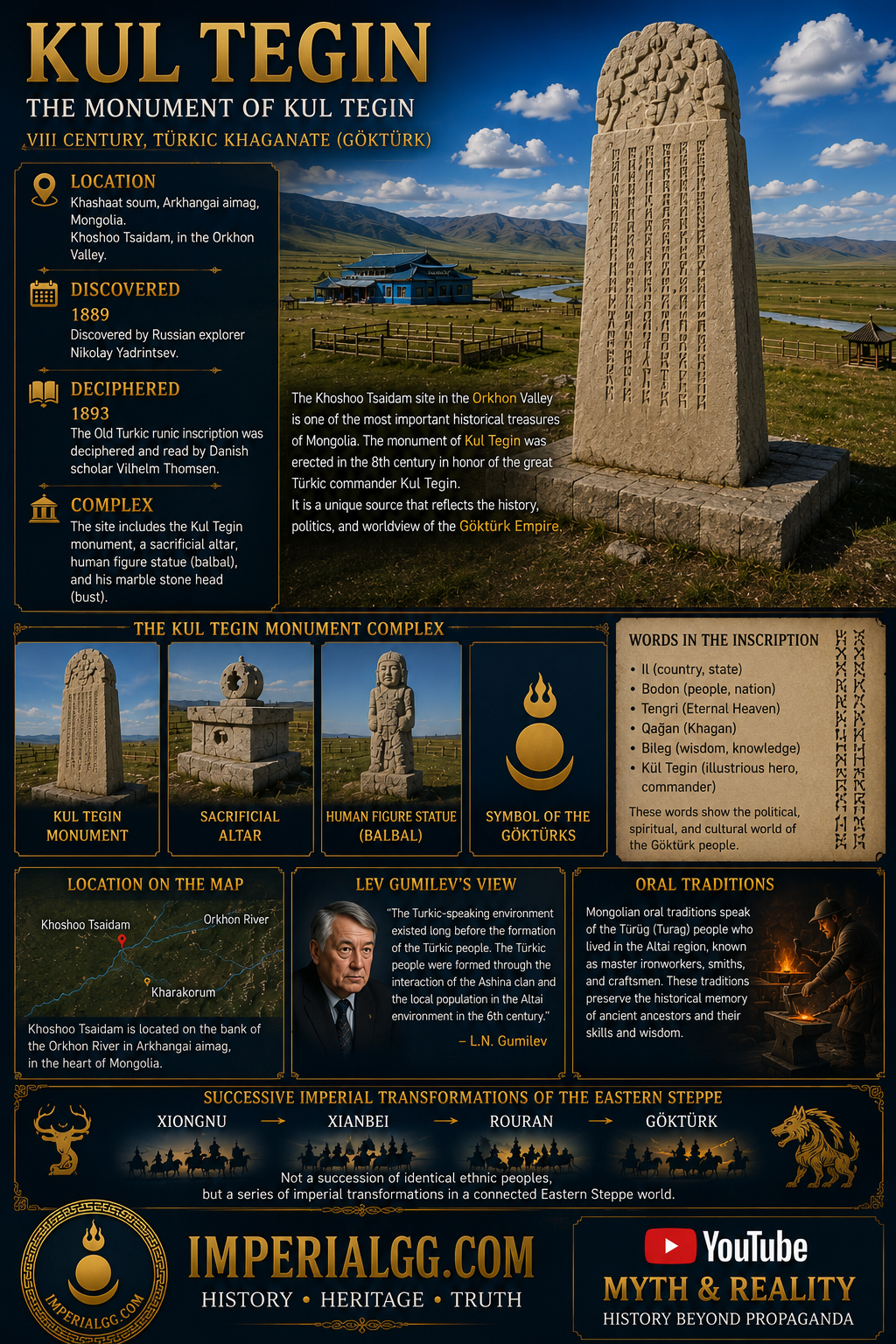
20. AUTHOR'S THESIS
The Göktürk Khaganate should therefore be understood as a major Inner Asian imperial formation of the sixth–eighth centuries, emerging from the political world of the Eastern Steppe and transforming an imperial tradition inherited from earlier steppe powers. The Rouran did not leave behind an empty Mongolia.
The Göktürks emerged within an already developed political environment. Their political organization, military institutions, use of the Khagan title, and monumental inscriptions represent a transformation of an existing Inner Asian imperial tradition rather than the sudden appearance of a completely disconnected civilization.
The geographical and historical context is equally important. The early Türk political community was associated with the Altai and the Inner Asian steppe, rather than with Anatolia. In the historical traditions surrounding the formation of the Türks, the Altai occupies an important place. Modern scholarship likewise places the early formation of the Türk political community within the Altai–Eastern Steppe environment.¹
This is also where the distinction between Türk political identity and modern Turkish national identity becomes essential.
Göktürk is an ancient Inner Asian political identity.
Türkiye is a modern Anatolian nation-state.
The two cannot simply be treated as interchangeable historical categories.
ORAL TRADITION AS HISTORICAL EVIDENCE
The Mongolian oral tradition preserves numerous stories concerning ancient Türüg / Türag groups, the Altai, smiths, craftsmen, ironworking, and the formation of powerful steppe communities. Such traditions should neither be accepted uncritically as literal historical chronicles nor dismissed simply because they were transmitted orally. Oral traditions preserve historical memory through transformed narratives.
Their value therefore lies not in treating every detail as a documentary fact, but in asking why particular geographical locations, occupations, ancestral groups, and political relationships continued to be remembered. The repeated association of the Türüg/Türag tradition with the Altai, and with ironworking and smithing, is consequently worthy of comparative investigation alongside Chinese historical accounts, archaeological evidence, and later Inner Asian traditions. To dismiss an entire body of oral historical memory simply because it is oral would itself be methodologically problematic. The correct approach is comparison, not dismissal.
THE LANGUAGE QUESTION
The linguistic question requires the same caution. Current scholarship overwhelmingly classifies the Orkhon corpus as Old Turkic, and this classification is supported by extensive grammatical descriptions, lexical analyses, textual editions, and generations of scholarship.² The Kül Tegin, Bilgä Qaγan, and Tonyuquq inscriptions are conventionally treated as the principal monuments of the Old Turkic corpus.
Therefore, the claim that the inscriptions have already been conclusively demonstrated to be Mongolic cannot responsibly be established merely because some words appear recognizable to modern Mongolian speakers.
But the reverse proposition must also be maintained:
A conventional linguistic classification should not prevent individual lexical, morphological, and grammatical correspondences from being independently tested.
This is particularly relevant to forms such as:
IL / EL
BODUN
TENGRI
QAĞAN / KHAGAN
BILGÄ / BILIG
and the proposed comparison:
KÜL TEGIN → HÜLEGT
These forms should not be treated as automatic proof of Mongolic linguistic identity. But neither should potentially significant correspondences be dismissed merely because the entire corpus has traditionally been placed under the label Old Turkic. Each correspondence must be tested through phonology, morphology, semantics, chronology, and comparative vocabulary.
The question is therefore not:
“Can we find ten similar words?”
but:
“Can a systematic linguistic relationship explain those correspondences better than borrowing, coincidence, or long-term contact?”
That is the question that a genuine comparative study must answer.
GUMILEV AND THE FORMATION OF THE TÜRK PEOPLE
The interpretation of Lev Gumilev is particularly relevant here because he made a distinction that is frequently lost in simplified narratives of Türk origins.
Gumilev argued that the emergence of the people who came to be known as the Türks/Türkuts and the formation of the Turkic-speaking linguistic environment were two different historical processes.
In his reconstruction, the Ashina group and its companions entered the Altai environment and interacted with the local population. He argued that, by the middle of the sixth century, this interaction had produced a coherent political-ethnic community conventionally identified as the ancient Türks or Türkuts. He further argued that the Turkic-speaking environment itself had already extended far beyond the Altai.
This distinction is extremely important for the present thesis. It means that even within a major twentieth-century interpretation of Türk ethnogenesis, “Türk” was not treated simply as an unchanged biological or ethnic population appearing fully formed in history. Rather, the historical formation of the Türk community involved interaction, incorporation, linguistic change, and ethnogenesis.
Gumilev’s interpretation itself remains debated and should not be treated as the final word. But its methodological value is considerable: it reminds us that language, political identity, and ethnogenesis are not identical processes.
THE MEANING OF “TÜRK”
The word Türk must therefore be studied historically rather than retrospectively. The sixth-century Türk political community was formed in Inner Asia. Its imperial center was associated with the Eastern Steppe. Its monumental political memory was recorded in the Orkhon Valley of present-day Mongolia. Its ruling institution was the Khaganate.
Its inscriptions repeatedly employ political and religious vocabulary including Tengri, bodun, and il, while names such as Bilgä Qaγan and Kül Tegin remain central to the corpus. None of this requires us to deny the later history of Turkic-speaking peoples.
But it does require us to distinguish:
ANCIENT TÜRK POLITICAL COMMUNITY
from
LATER TURKIC-SPEAKING POPULATIONS
and from
MODERN TÜRKİYE. These are connected through complicated historical processes, but they are not identical.
FROM XIONGNU TO GÖKTÜRK
The larger sequence developed throughout this ImperialGG series should therefore be understood as:
XIONGNU → XIANBEI → ROURAN → GÖKTÜRK
not as the uninterrupted existence of one unchanged ethnic population, but as a sequence of successive imperial transformations within a connected Eastern Steppe world. The populations changed. Political coalitions changed. Languages interacted. Ruling houses changed. New groups were incorporated. Old political institutions were transformed. And historical memories were carried forward through written and oral traditions.
The Göktürks therefore did not enter an empty Mongolia. They emerged from an already developed imperial world.
FINAL THESIS
The Göktürk Khaganate belongs first to the history of Inner Asia before it belongs to any modern national narrative. The ancient Türük political community should not be projected backward as though it were simply the modern Turkish nation transported into the sixth century.
At the same time, the linguistic evidence must be approached without predetermined conclusions. The conventional identification of the Orkhon corpus as Old Turkic is a substantial scholarly position and cannot simply be discarded. But neither should that classification make alternative comparative questions impossible.
If il/el, bodun, Tengri, qaγan, bilgä/bilig, or other forms demonstrate systematic relationships with Mongolic languages, those relationships deserve investigation.
If the proposed Kül Tegin → Hülegt comparison survives rigorous phonological and semantic analysis, it deserves consideration. If the comparisons fail, they should be rejected.
And if oral traditions preserve memories connecting Türüg/Türag, the Altai, ironworking, and ancient steppe political communities, those traditions should be examined alongside written and archaeological evidence rather than simply erased from the historical discussion.
The fundamental principle is therefore:
HISTORY SHOULD TEST THE EVIDENCE; IT SHOULD NOT FORCE THE EVIDENCE INTO A PREDETERMINED NATIONAL CATEGORY.
And the larger ImperialGG thesis remains:
XIONGNU → XIANBEI → ROURAN → GÖKTÜRK
not a succession of identical peoples, but successive transformations within a connected Eastern Steppe imperial world.
Footnotes
1. On the Altai-centered formation of the early Türk political community, see Lev N. Gumilev, Ancient Turks. Gumilev argues that the Ashina group and its companions became incorporated into an Altai environment and that the Türk community emerged through interaction with local populations. His interpretation is historically influential but remains debated.
2. The conventional Old Turkic classification is well established in the scholarly literature. See Talat Tekin, A Grammar of Orkhon Turkic (Bloomington: Indiana University, 1968), and subsequent Orkhon studies. The Kül Tegin, Bilgä Qaγan, and Tonyuquq inscriptions are routinely treated as Old Turkic monuments.
3. On continuing questions of textual interpretation, authorship, and reading within the conventional Old Turkic framework, see Chen Hao, “On the Authorship of the Old Turkic Inscriptions,” Journal of the Royal Asiatic Society (2020).
4. On the use of tengri in the Orkhon inscriptions and its religious-political significance, see Piotr Kwiatkowski, “The Noun ‘Tengri’ in the Old Turkic Inscriptions,” Przegląd Orientalistyczny 3–4 (2009).
5. On disputed readings within the Orkhon corpus, including the interpretation of individual lexical groups, see Yong-Sŏng Li, “On the Second Sentence of the 11th Line on the South Side of the Bilgä Kagan Inscription,” Journal of Humanities, Seoul National University 74, no. 4 (2017). The existence of continuing disputes over particular readings demonstrates why individual lexical correspondences require independent analysis.
6. On the historical geography of the monuments, Kül Tegin and Bilgä Qaγan were erected in the Orkhon region of present-day Mongolia, with the Kül Tegin monument dated to 732 and the Bilgä Qaγan monument to 735.
7. On Gumilev’s distinction between the formation of Turkic-speaking environments and the ethnogenesis of the historical Türks/Türkuts, see L. N. Gumilev, Ancient Turks, especially his discussion of the Ashina group and the Altai environment.
8. Gumilev’s interpretation should be treated as one scholarly model rather than settled fact. His reconstruction of Türk ethnogenesis has been criticized and remains part of a broader historiographical debate.
9. On the Orkhon corpus and the conventional identification of the inscriptions as Old Turkic, see Li, “B²ẄK²L²I in Old Turkic Inscriptions,” Mongolian Studies 51 (2017), pp. 107–145. The study also demonstrates that individual readings within the corpus continue to be debated.
10. On the Kül Tegin and Bilgä Qaγan inscriptions and their location in the Orkhon Valley, see Mustafa S. Kaçalin, “Orhon Yazıtları,” TDV İslâm Ansiklopedisi.
11. The proposed Kül Tegin → Hülegt comparison is presented here as a research hypothesis, not as an established etymology. Establishing such a connection would require regular phonological, morphological, semantic, and chronological correspondences.
12. The broader sequence Xiongnu → Xianbei → Rouran → Göktürk is used here as a model of successive political formations in the Eastern Steppe, not as a claim of uninterrupted ethnic identity. This distinction is consistent with the need to separate political succession from ethnogenesis and linguistic history.