
WHO INVENTED THE HANZI?
By Altanbagana Baatar
DBA Candidate| Independent Historian
ImperialGG Historical Research Seriers
28 August 2026
Xiongnu, Khitan, and the Writing Traditions of Inner Eurasia
ABSTRACT
The history of Chinese writing is commonly presented as a continuous tradition beginning with the inscriptions of the late Shang dynasty and developing through the Zhou, Qin, and Han periods into the Chinese script known today as hanzi. The archaeological record, however, presents a more complex picture. Before the appearance of fully developed Shang writing, numerous graphic traditions existed across the Neolithic societies of northern and central China. Later, powerful states of the northern and Inner Asian world—including the Xianbei, Khitan, Tangut, and Jurchen—created, transformed, or institutionalized sophisticated writing systems of their own.
This article examines whether the history of Chinese writing can be understood adequately without considering the wider political and cultural environment of the Mongolian Plateau and northern East Asia. It focuses particularly on the Khitan Large and Small Scripts and the 1084 Khitan inscription preserved in Khentii Province, Mongolia. The article argues that these monuments do not, by themselves, prove that the Xiongnu or another Inner Asian population invented the earliest Chinese characters. Such a conclusion is not presently supported by direct archaeological evidence. They do, however, provide important evidence for a broader proposition: writing in East Asia developed within an interconnected political world in which northern societies repeatedly adapted, transformed, and created writing technologies for their own languages and states.
The article therefore proposes a revised research question. Rather than asking simply whether the Hanzi were “Chinese” or “Inner Asian,” scholarship should investigate the extent to which the emergence and transformation of writing were products of interaction among the Central Plains, the Mongolian Plateau, Manchuria, and the wider Inner Asian world.
Keywords: Hanzi; Chinese writing; Xiongnu; Xianbei; Khitan; Khitan Large Script; Khitan Small Script; Tangut; Jurchen; Xia; Inner Eurasia; Mongolian Plateau; palaeography; state formation
1. INTRODUCTION: A QUESTION OF ORIGIN
Few writing traditions have a longer documented history than the Chinese script. The earliest securely readable Chinese texts are generally associated with the late Shang dynasty, particularly the inscriptions carved on turtle plastrons and animal bones at the royal center of Yinxu near modern Anyang. These texts already display a remarkably sophisticated writing system capable of recording personal names, royal activities, ritual questions, warfare, agriculture, calendrical information, and grammatical elements. Modern scholarship therefore treats Shang writing not as a primitive beginning but as a mature system whose development must have preceded the surviving corpus.
This creates an important historical problem. If the Shang script was already highly developed by approximately the thirteenth century BCE, where and through what processes did the preceding stages of writing develop?
The answer cannot simply be “the Shang invented writing.”
Archaeological discoveries demonstrate that graphic signs existed centuries, and in some cases millennia, before the mature Shang inscriptions. Late Neolithic communities in several regions of what is now China produced signs on pottery, jade, stone, and other objects. Paola Demattè’s recent synthesis emphasizes that these traditions occurred across multiple regions and that interaction, trade, and population movement probably contributed to their development. Yet an equally important question has received less attention in popular historical narratives:
What was happening north of the Central Plains?
The Mongolian Plateau, Manchuria, the Liao River basin, the Ordos, and the Hexi Corridor were not empty frontiers. They were major zones of human mobility, political competition, metallurgy, pastoralism, agriculture, trade, and state formation. By the first millennium BCE, the Xiongnu created an enormous imperial formation across Inner Asia. Centuries later, the Xianbei, Khitan, Tangut, Jurchen, and Mongol states repeatedly transformed the political geography of northern East Asia. Several of these states also created their own writing systems. That fact deserves to be placed at the center of the discussion.
2. THE EARLIEST HANZI: MATURE WRITING, NOT A SUDDEN INVENTION
The oracle-bone inscriptions of the Shang are the earliest large corpus of readable Chinese writing. They were associated with royal divination. Questions concerning warfare, sacrifice, agriculture, weather, childbirth, illness, and other state concerns were inscribed on turtle shells and animal bones. The inscriptions therefore reveal an intimate relationship between writing, ritual, kingship, and political authority. But the archaeological record preceding the Shang is increasingly important.
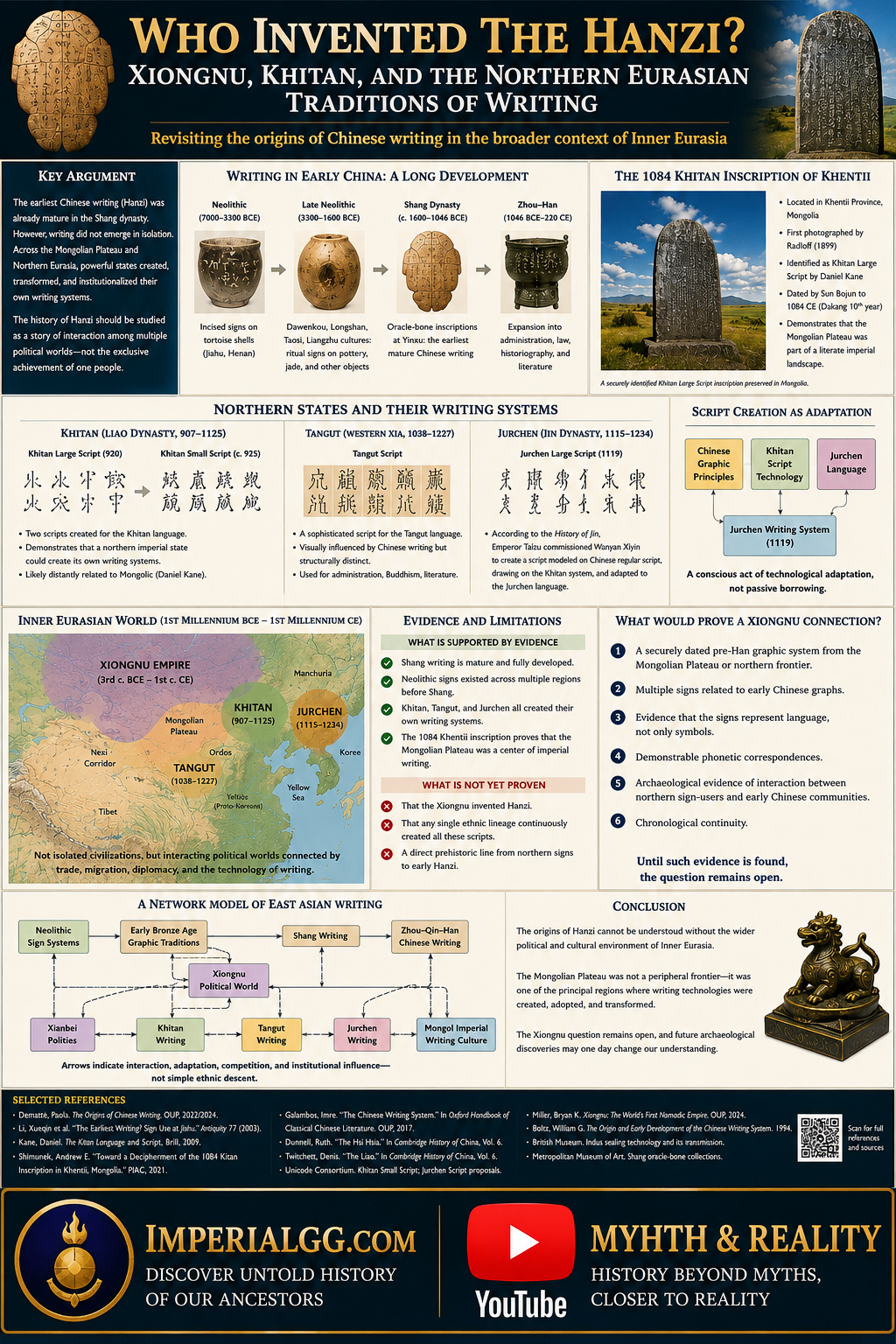
Jiahu, for example, has yielded incised signs on tortoise shells dating to the seventh millennium BCE. The excavators and interpreters who studied these signs did not conclude that Jiahu possessed a fully developed writing system equivalent to later Chinese writing. Rather, the signs represent an early stage in a much longer history of symbolic communication.
By the Late Neolithic, the evidence becomes considerably more complex. Signs associated with Dawenkou, Longshan, Taosi, Shijiahe, Liangzhu, and other traditions display structural similarities to later Chinese graphic forms. Some of these signs appear in ritual contexts associated with emerging elites and increasingly complex political institutions. Demattè argues that the growth of political centralization, social stratification, ritual organization, and interregional interaction formed part of the environment in which writing eventually emerged.
The transition remains unresolved. Some Neolithic signs may have been symbols rather than writing. Others may have represented words, names, quantities, or ritual concepts. In many cases, there is simply not enough contextual material to determine their function. This distinction is critical.
Similarity between an ancient sign and a later Chinese character does not automatically establish direct genealogical descent.
The responsible historical conclusion is therefore that Chinese writing emerged through a long developmental process whose prehistoric stages remain incompletely documented.
3. THE NORTHERN EURASIAN QUESTION
The conventional history of Chinese writing is often presented as if the Central Plains constituted the principal center from which writing subsequently spread to surrounding peoples.
This model is partly correct. Chinese writing unquestionably became enormously influential beyond the Central Plains. Japan, Korea, Vietnam, and other societies adopted and transformed the Chinese script. Medieval East Asia produced numerous adaptations and new Sinoform scripts. But influence did not move exclusively in one direction.
Northern and Inner Asian states repeatedly transformed political institutions, military organization, administrative technologies, religious practices, and writing systems. The most dramatic medieval examples are the Khitan, Tangut, and Jurchen. These cases demonstrate that the political peoples of Inner Asia were not merely passive consumers of Chinese civilization.
They were also producers of written civilization.
4. THE XIONGNU: THE MISSING WRITTEN CORPUS
The Xiongnu Empire emerged in the late third century BCE and became the first large-scale imperial formation to unify much of Inner Asia. Modern scholarship characterizes the Xiongnu polity as multiethnic, multilingual, and geographically extensive, encompassing territories from Manchuria across Mongolia and into regions westward toward Central Asia.
This makes the Xiongnu relevant to the history of writing even though the archaeological record does not currently provide an indigenous Xiongnu script comparable to Shang oracle-bone writing or later Khitan inscriptions. The documentary problem is serious.
Most surviving historical descriptions of the Xiongnu were produced by their Han Chinese neighbors. The Xiongnu did not leave behind a large deciphered corpus of monumental texts that could establish an indigenous writing system.
Therefore, the proposition that “the Xiongnu invented the Hanzi” cannot presently be demonstrated. But this negative conclusion must be carefully stated. The absence of a surviving Xiongnu writing corpus does not prove that the Xiongnu had no graphic, administrative, or symbolic systems.
Steppe empires could communicate through multilingual scribes, seals, diplomatic documents, borrowed scripts, oral specialists, and neighboring administrative traditions. Moreover, the Xiongnu Empire controlled regions immediately adjacent to societies possessing established writing systems. The historical possibility of intellectual exchange is therefore entirely reasonable. What remains unproven is the direction and scale of that exchange.
5. FROM XIONGNU TO XIANBEI: POLITICAL SUCCESSION WITHOUT SIMPLE ETHNIC IDENTITY
The relationship between the Xiongnu and later northern peoples must not be reduced to a simple genealogical equation. The Xiongnu Empire was a political confederation containing diverse populations. Later Xianbei polities likewise incorporated multiple groups.
The Northern Wei dynasty provides a particularly important case.
Its ruling Tuoba house belonged to the Inner Asian Xianbei world. The surviving sources preserve many names and fragments of the ruling group’s language through Chinese transcription, but there is no surviving substantial corpus of Tuoba-language texts.
This creates a recurring methodological problem in Inner Asian history. A society can exercise enormous political power while leaving relatively little written material in its own language. Consequently, the surviving textual record may make the Central Plains appear culturally dominant even when political power was divided or controlled by northern regimes.
The historian must therefore distinguish between:
the language of the surviving archive
and
the language, ethnicity, or political identity of the society being described. This distinction becomes even more important when we reach the Khitans.
6. THE KHITAN REVOLUTION IN WRITING
The Khitan Liao dynasty was established in the early tenth century and became one of the major imperial powers of medieval East Asia.
The Khitans developed two distinct writing systems:
- Khitan Large Script
- Khitan Small Script
The Khitan Large Script was created in 920 under Emperor Taizu. The Khitan Small Script is conventionally dated to approximately 925 and is traditionally associated with Yelü Diela. The latter incorporated logographic and phonographic elements and was written vertically in a format visually compatible with the broader East Asian writing environment. The significance of this development cannot be overstated. The Khitans did not merely use Chinese writing. They created new scripts for the Khitan language.
Daniel Kane’s The Kitan Language and Script remains a major modern study of the language and its two writing systems. Kane notes that the Khitan language was very likely distantly related to Mongolic and that the two scripts represented a distinctive writing tradition of the Liao political world.
The Khitan example therefore demonstrates an important historical principle:
A politically powerful Inner Asian society could adopt elements of an established graphic tradition while simultaneously creating a distinct written system for its own language.
This is not evidence that the Khitans invented the Shang script. It is evidence that script creation was not monopolized by the Central Plains.
7. THE 1084 KHITAN INSCRIPTION OF KHENTII
The most important monument for the present argument is the Khitan inscription located in Khentii Province, Mongolia. Its importance has been underestimated in comparison with the better-known Khitan inscriptions discovered in China.
The inscription was first photographed and published by Friedrich Wilhelm Radloff in 1899. Radloff initially misidentified it as a Chinese inscription. Later scholars debated whether it was Khitan or Jurchen. Mongolian archaeologist Kh. Perlee was among the first to argue that it was Khitan rather than Jurchen.
Daniel Kane subsequently demonstrated that the text was definitely written in Khitan Large Script.
Sun Bojun’s work established the inscription’s date as the tenth year of the Dakang era, corresponding to 1084 CE.
Andrew Shimunek later revisited the monument and conducted new photographic and palaeographic work, emphasizing that the inscription had suffered from the limitations of earlier photographs and rubbings.
This monument therefore gives us something exceptionally important:
a securely identified Khitan Large Script inscription physically preserved in the Mongolian Plateau.
It is not merely evidence of Khitan political presence in Mongolia. It is direct evidence that the Mongolian Plateau itself formed part of a literate Khitan imperial landscape. The inscription therefore deserves to be treated as a central monument in the history of Inner Asian writing.
8. WHAT THE KHENTII INSCRIPTION DOES — AND DOES NOT — PROVE
The Khentii inscription cannot prove that Khitan created the Shang script. The chronological gap is enormous. The Shang writing tradition was already mature more than two thousand years before the Khitan scripts appeared.
The inscription nevertheless proves something highly significant:
The Mongolian Plateau was not merely a recipient of writing technologies. It was a center from which sophisticated written systems were produced, used, and monumentalized.
This changes the historical question.
If the Mongolian Plateau repeatedly produced states capable of creating sophisticated writing systems, then the intellectual history of the region cannot be written exclusively from Chinese-language sources.
The question becomes:
How far back does this tradition of political and graphic innovation extend? That question leads directly back to the Xianbei and Xiongnu periods.
9. TANGUT: ANOTHER NORTHERN WRITING SYSTEM
The Tangut state provides another powerful comparison. The Western Xia, or Tangut state, emerged as an independent political power in the tenth and eleventh centuries. The state formally proclaimed itself a dynasty in 1038 and survived until the Mongol conquest in 1227. Its territory encompassed the Ordos, Hexi Corridor, and adjacent regions. Its population was ethnically and linguistically diverse, including Tangut, Chinese, Tibetan, Uyghur, Khitan, and other groups.
The Tangut rulers created a sophisticated writing system for the Tangut language. The Tangut script was visually influenced by the Chinese graphic environment, yet it represented a distinct language and developed its own structural conventions. Modern scholarship continues to analyze its grammar, morphology, manuscripts, and writing system.
The significance is parallel to the Khitan case.
Chinese writing provided a powerful graphic model, but the Tangut state transformed that model into an independent written language.
Thus, by the medieval period, the northern and western political world contained multiple literate civilizations operating alongside the Chinese script tradition.
10. THE JURCHEN SCRIPT: THE MOST EXPLICIT CASE OF SCRIPT ADAPTATION
The Jurchen case provides perhaps the clearest documentary evidence for the process of script creation. When the Jin dynasty was founded by the Jurchens, the new state initially operated in a multilingual environment in which Khitan and Chinese writing were already available.
According to the History of Jin, Emperor Taizu commissioned Wanyan Xiyin to create a national script. The surviving account is unusually explicit: Xiyin modeled the new script on Chinese regular script, drew upon the Khitan script system, and adapted the resulting system to the Jurchen language. The Jurchen Large Script was promulgated in 1119.
This passage is extraordinarily important for the history of writing. It describes script creation as a conscious act of technological adaptation.
The formula can be represented as:
**Chinese graphic principles
- Khitan script technology
- Jurchen language
= Jurchen writing**
The Jurchen case therefore confirms that northern East Asian states were not merely borrowing writing passively. They were engineering writing systems.
11. KHITAN, TANGUT, AND JURCHEN: A WRITING TECHNOLOGY NETWORK
By placing the three traditions together, a striking pattern emerges.
KHITAN
A northern imperial state created two scripts for its own language.
TANGUT
A northwestern imperial state developed an elaborate script for its own language within a Chinese-influenced political environment.
JURCHEN
A new northern empire explicitly combined Chinese and Khitan graphic principles with its own language to create a new script. This suggests that medieval East Asia contained a network of script technologies.
The relationship was not simply:
China → barbarians
It was more accurately:
Chinese → Khitan → Jurchen
while other interactions involved:
Chinese ↔ Tangut
and
Uyghur → Khitan
among many other possible pathways.
The Oxford Handbook of Classical Chinese Literature similarly notes that Chinese writing was adopted for other languages in East and Central Asia and that new Sinoform scripts such as Khitan, Jurchen, and Tangut emerged from this environment.
The historical implication is profound:
Writing systems belonged to political worlds, not permanently to ethnic categories.
12. THE PROBLEM OF “MONGOL” AND “CHINESE”
The terminology itself requires caution. The peoples of the second and first millennia BCE cannot simply be divided into “Chinese” and “Mongolian” populations in the modern national sense.
The word “Mongol” refers historically to a political and ethnolinguistic formation that becomes clearly identifiable much later than the Shang period.
Likewise, “Chinese” has changed meaning over the course of history. The Shang political community should not automatically be equated with the modern Han Chinese nation. This is not merely a semantic issue. It is essential for reconstructing ancient history. If the Shang are defined retrospectively as a modern nation and every northern population is defined as a separate “foreign” nation, then historical interaction becomes invisible before the evidence is even examined.
The more productive approach is to study:
- population movement;
- language;
- political organization;
- material culture;
- technology;
- ritual;
- writing;
- elite networks;
- geographic continuity.
Only then can questions of ethnic continuity be responsibly addressed.
13. THE “XIA” PROBLEM
The recurring use of the name Xia provides another potentially important field of research. The earliest Xia tradition occupies a foundational position in later Chinese historical memory. Much later, the Tangut state adopted the dynastic name Xia, becoming known in modern scholarship as Western Xia.
The Western Xia state was formally proclaimed as a dynasty in 1038 and occupied a strategically important region between the Chinese Central Plains, Tibet, the Gansu corridor, and the northern steppe. The recurrence of Xia is historically interesting. But it must not be interpreted automatically as proof of ethnic identity between the ancient Xia and medieval Tangut.
A dynastic name can function as:
- political legitimacy;
- historical memory;
- territorial ideology;
- dynastic genealogy;
- symbolic appropriation.
The same principle applies to later northern regimes.
Therefore, the correct research question is not:
“Were all states called Xia the same people?”
but:
“Why did successive political regimes choose to associate themselves with the name Xia, and what historical memory did that name carry?”
This question may eventually reveal a more complex relationship between political memory and ethnic identity in northern East Asia.
14. SEALS, INSCRIPTIONS, AND THE AUTHORITY OF THE RULER
Another element of the proposed hypothesis concerns seals. This is an important direction, but it requires careful separation between parallel development and direct transmission. Ancient civilizations across Eurasia used seals as instruments of administration, ownership, authentication, and elite identity.
The Indus civilization, for example, employed stamp seals bearing inscriptions, while Indus-derived sealing technologies spread through long-distance trade networks in the Gulf region. The British Museum documents the movement of such administrative technologies between the Indus Valley and Dilmun during the third and early second millennia BCE.
Mesopotamia likewise developed a sophisticated relationship between sealing and writing. Cylinder seals were closely associated with the administrative environment in which cuneiform developed.
These comparisons are significant. They demonstrate that sealing, authority, administration, and writing frequently develop together. But they do not prove that Chinese writing originated from Mesopotamia or the Indus Valley. Nor does the existence of ancient western seals demonstrate that Shang writing was imported from western Eurasia.
The stronger argument is comparative:
the relationship between political authority and graphic inscription is a recurring phenomenon of early civilization. This provides an important framework for examining Chinese and Inner Asian traditions without forcing a single point of origin.
15. FROM SACRED INSCRIPTION TO STATE ADMINISTRATION
The Shang evidence is particularly revealing because writing initially appears in a highly ritualized political context. The king asked questions. The diviner prepared the bone or shell. The divination was performed. The result was interpreted. The question, interpretation, and sometimes outcome were recorded.
Writing therefore functioned as an instrument of communication between political authority, ritual specialists, ancestors, and the supernatural order. As Chinese civilization developed, writing expanded into administration, law, diplomacy, historiography, literature, taxation, and education. The same general transition occurred elsewhere.
Among the Khitans, writing served imperial commemoration, funerary monuments, administration, and elite identity.
Among the Tanguts, it served an imperial bureaucracy, Buddhist translation, literature, and state culture.
Among the Jurchens, the creation of an indigenous script formed part of the construction of an independent imperial state. Writing and state formation were therefore deeply connected.
16. THE STRONGEST FORM OF THE INNER EURASIAN HYPOTHESIS
The evidence assembled here permits a carefully defined hypothesis.
It can be expressed in five propositions.
PROPOSITION ONE
The Chinese writing system did not appear suddenly with the first Shang oracle bones. Archaeological evidence demonstrates a long prehistoric history of graphic signs across several regions.
PROPOSITION TWO
The earliest surviving mature Chinese writing belongs to the Shang political world, and its immediate developmental history remains incompletely documented.
PROPOSITION THREE
Northern and Inner Asian societies repeatedly developed sophisticated writing systems of their own, most clearly demonstrated by the Khitan, Tangut, and Jurchen traditions.
PROPOSITION FOUR
The Mongolian Plateau was not simply a recipient of written culture. The Khitan inscriptional record demonstrates that it was itself a setting in which an imperial writing system was used and monumentalized.
The 1084 Khentii inscription is particularly important evidence for this proposition.
PROPOSITION FIVE
Because the Xiongnu and earlier northern societies occupied the same broad interaction zone, their role in the development and transmission of graphic technologies deserves systematic investigation, even though direct evidence linking the Xiongnu to the invention of Hanzi has not yet been demonstrated. This fifth proposition is the most speculative—and therefore the most important target for future archaeological research.
17. WHAT WOULD ACTUALLY PROVE A XIONGNU CONNECTION?
If the hypothesis that the Xiongnu—or an earlier northern population ancestral to later Inner Asian societies—contributed directly to the development of early Chinese writing is to move beyond speculation, several categories of evidence would be required.
First, archaeologists would need to identify a securely dated pre-Han graphic system from the Mongolian Plateau or its immediate northern frontier.
Second, the system would need to contain multiple signs demonstrably related to early Chinese graphs, not merely isolated visual similarities.
Third, there would need to be evidence that the signs represented language rather than purely symbolic or ritual marking.
Fourth, phonetic correspondences would need to be demonstrated.
Fifth, archaeological evidence would have to establish interaction between the communities producing the northern signs and the communities producing early Chinese writing.
Sixth, chronological continuity would need to be established.
Only then could a direct contribution to the ancestry of Hanzi be argued with confidence. At present, that chain is incomplete.
18. WHY THE KHENTII MONUMENT STILL MATTERS
The absence of such evidence does not make the Khentii inscription unimportant. Quite the opposite. The 1084 inscription gives us an empirical starting point for a larger research program. It establishes that a sophisticated writing culture associated with a major Inner Asian empire existed physically on the Mongolian Plateau.
It also demonstrates that the history of written civilization in Mongolia cannot be reduced to the later adoption of the traditional Mongolian script. Centuries before the Mongol Empire, the region was already incorporated into an imperial world of monumental writing. The Khitan inscription therefore represents a bridge between archaeology, palaeography, political history, and the study of Inner Asian state formation.
19. A NEW MODEL OF EAST ASIAN WRITING
The traditional model can be visualized as:
Shang → Zhou → Qin → Han → Chinese writing
This sequence is real.
But it is incomplete.
A broader model would look more like:
NEOLITHIC EAST ASIAN SIGN SYSTEMS
↓
EARLY BRONZE AGE GRAPHIC TRADITIONS
↓
SHANG WRITING
↕
NORTHERN AND EASTERN INTERACTION NETWORKS
↓
XIONGNU / XIANBEI POLITICAL WORLDS
↓
KHITAN WRITING
↘
TANGUT WRITING
↘
JURCHEN WRITING
↓
MONGOL IMPERIAL WRITING CULTURE
This should not be interpreted as a single genealogical tree.
It is a network model.
The arrows represent possible transmission, adaptation, competition, and institutional influence—not automatic biological or ethnic descent.
20. CONCLUSION
The question “Who invented the Hanzi?” appears at first to demand a single answer. The archaeological record suggests that such an answer is unlikely to be sufficient.
The mature Chinese writing system is securely documented in the Shang world. Yet its prehistoric background reaches into a much wider landscape of graphic experimentation and social transformation. Neolithic societies across northern and central China developed diverse sign traditions before the emergence of fully grammaticalized writing.
The later history is equally revealing.
The Khitans created two writing systems.
The Tanguts created an elaborate script for their own language.
The Jurchens explicitly constructed a national script by combining Chinese and Khitan models with their own language.
These were not marginal experiments. They were products of powerful states.
The 1084 Khitan inscription in Khentii is particularly important because it places this written imperial tradition directly on the Mongolian Plateau. Its existence demonstrates that Inner Asia was not merely a recipient of civilization generated elsewhere. It was itself a region of script creation, political innovation, and monumental literacy.
The evidence does not yet prove that the Xiongnu invented the Hanzi. Nor does it prove that the Shang, Xianbei, Khitan, Tangut, Jurchen, and Mongols constituted a single uninterrupted ethnic lineage.
But it does establish a much more defensible and potentially more important proposition:
The history of writing in East Asia cannot be fully understood as the exclusive history of one people. It must be studied as the history of interaction among multiple political societies occupying the Central Plains, the Mongolian Plateau, Manchuria, the Hexi Corridor, and Inner Asia.
The Khitan, Tangut, and Jurchen examples demonstrate that northern states repeatedly transformed the technology of writing into instruments of their own sovereignty. The Xiongnu question therefore remains open. And perhaps that is precisely where the most important research begins. The decisive discovery would not be another medieval inscription.
It would be an early, securely dated inscriptional or proto-writing tradition from the northern Eurasian frontier that could be demonstrated—through archaeology, palaeography, phonology, and chronology—to have participated in the formation of the early Chinese writing tradition. Until such evidence is found, the responsible conclusion is neither that the Xiongnu invented Hanzi nor that the northern peoples had no role in the history of writing.
The correct conclusion is more demanding:
the origins of East Asian writing remain a transregional problem, and the Mongolian Plateau must be treated as one of the principal regions in which that problem is investigated.
SELECTED SCHOLARLY REFERENCES
- Demattè, Paola. The Origins of Chinese Writing. Oxford University Press, 2022/2024.
- Demattè, Paola. “The Origins of Chinese Writing: The Neolithic Evidence.” Cambridge Archaeological Journal 20 (2010).
- Demattè, Paola. “Characteristics of Shang Writing.” In The Origins of Chinese Writing, Oxford University Press.
- Boltz, William G. The Origin and Early Development of the Chinese Writing System. American Oriental Society, 1994.
- Galambos, Imre. “The Chinese Writing System.” In The Oxford Handbook of Classical Chinese Literature. Oxford University Press, 2017.
- Kornicki, Peter Francis. “Scripts and Writing.” In Languages, Scripts, and Chinese Texts in East Asia. Oxford University Press, 2018.
- Serruys, Paul L.-M. “Graphic Identification, Semantic Interpretation and Phonological Implications in the Oracle Writing of Shang.” Early China.
- Li, Xueqin et al. “The Earliest Writing? Sign Use in the Seventh Millennium BC at Jiahu, Henan Province, China.” Antiquity 77 (2003): 31–44.
- Kane, Daniel. The Kitan Language and Script. Brill, 2009.
- Shimunek, Andrew E. “Toward a Decipherment of the 1084 Kitan Inscription in Khentii, Mongolia.” Permanent International Altaistic Conference, 2021.
- Unicode Consortium. “Khitan Small Script.” The Unicode Standard, Chapter 18.
- ScriptSource. “Khitan Large Script.”
- Dunnell, Ruth. “The Hsi Hsia.” In The Cambridge History of China, Vol. 6. Cambridge University Press.
- Franke, Herbert, and Denis C. Twitchett, eds. The Cambridge History of China, Volume 6: Alien Regimes and Border States, 907–1368. Cambridge University Press.
- Twitchett, Denis, and Klaus-Peter Tietze. “The Liao.” In The Cambridge History of China, Vol. 6.
- Pearce, Scott. “Northern Wei.” In The Cambridge History of China. Cambridge University Press, 2019.
- Kim, Hyun Jin. “The Xiongnu.” Oxford Research Encyclopedia of Asian History. Oxford University Press, 2017.
- Miller, Bryan K. Xiongnu: The World’s First Nomadic Empire. Oxford University Press, 2024.
- “Towards an Encoding of the Jurchen Script.” Unicode Consortium Working Group document.
- “Proposal to Encode Jurchen Small Script Characters.” Unicode Consortium Working Group document.
- The Tangut Language and Manuscripts: An Introduction. Brill.
- “The Tangut Verbal Template from a Cross-West Gyalrongic Perspective.” Bulletin of the School of Oriental and African Studies 88 (2025).
- Barnard, Noel. “A New Approach to the Study of the Clan-Sign Inscriptions of Shang.” Early China 9.
- British Museum. Documentation on Indus sealing technology and its transmission through the Gulf.
- Metropolitan Museum of Art. Shang oracle-bone collections and documentation.
AUTHOR’S THESIS
THE MONGOLIAN PLATEAU AS A GRAPHIC LABORATORY
The Mongolian Plateau possesses a long and diverse record of graphic expression predating the emergence of the historically documented Khitan and Mongol writing traditions. Rock art, engraved signs, Bronze Age petroglyphs, clan marks, animal brands, seals, and other forms of symbolic marking demonstrate that visual communication was deeply embedded in the social and political life of Inner Asian communities.
The crucial question is whether some of these traditions were merely symbolic or whether certain forms participated in the gradual development of systems capable of representing language.
This distinction is fundamental. A mark is not automatically a writing system. Nevertheless, writing does not emerge from an intellectual vacuum. The transition from symbol → conventional sign → semantic representation → phonetic representation → writing system may involve long periods of experimentation that leave fragmentary archaeological traces.
The Mongolian Plateau therefore deserves to be investigated not simply as the homeland of later steppe empires, but as a graphic laboratory of Inner Eurasia.
Particularly important are three categories of evidence:
ROCK INSCRIPTIONS AND PETROGLYPHS.
Bronze Age and earlier engraved signs demonstrate the repeated use of standardized visual forms in the landscape.
ANIMAL BRANDS AND CLAN MARKS.
The persistence of distinctive marks associated with livestock, ownership, lineage, and identity represents an important form of conventionalized graphic communication.
SEALS AND AUTHORITY MARKS.
The association between graphic symbols, ownership, elite status, political authority, and authentication provides a potential conceptual bridge between marking practices and later administrative writing.
None of these categories should automatically be called “writing.” Their importance lies instead in the possibility that they represent earlier stages of graphic standardization and symbolic communication.
The hypothesis can therefore be represented as:
EARLY GRAPHIC MARKING
↓
ROCK SIGNS / PETROGLYPHS
↓
STANDARDIZED SYMBOLS
↓
IDENTITY & OWNERSHIP MARKS
↓
SEALS / ADMINISTRATIVE SYMBOLS
↓
SEMANTIC & PHONETIC WRITING
↓
MATURE WRITING SYSTEMS
This is a research model, not an established genealogy.
The decisive task for future research is to determine whether particular signs can be demonstrated to persist across these stages and whether any such continuity intersects with the earliest Chinese writing tradition.
AUTHOR’S CENTRAL QUESTION
Could the origins of Hanzi represent not an isolated invention within the Central Plains, but the culmination of a much older and wider East–Inner Asian tradition of graphic communication in which the Mongolian Plateau played a previously underestimated role?
AUTHOR’S THESIS II
This study proposes that the origins of East Asian writing should be investigated not exclusively through the archaeological record of the Central Plains, but within the wider graphic and inscriptional environment of Inner Eurasia. In particular, the ancient rock inscriptions and other early inscriptional traditions of the Mongolian Plateau deserve systematic comparison with the prehistoric sign systems that preceded the mature Shang writing tradition.
The chronological question is fundamental. The Late Shang oracle-bone inscriptions, generally dated to approximately 1250–1045 BCE, constitute the earliest securely readable corpus of Chinese writing. They already represent a sophisticated writing system capable of recording the structure of an ancient language. Yet modern scholarship itself recognizes that such a mature system could not have appeared without earlier developmental stages; Late Neolithic and Early Bronze Age sign traditions preceded the Shang corpus.
The present study therefore asks whether the northern graphic and inscriptional traditions of the Mongolian Plateau may represent an overlooked component of this wider developmental environment. Ancient engraved inscriptions, standardized signs, marks of identity and ownership, and later monumental writing traditions demonstrate that graphic communication was deeply embedded in the political and cultural history of Inner Eurasia. The existence of later sophisticated writing systems on the Plateau—including the Old Turkic inscriptions and, subsequently, the Khitan, Tangut, Jurchen, and Mongolian traditions—further demonstrates that the region was not merely a passive recipient of writing technologies developed elsewhere.
The term “runic,” as applied to the Old Turkic inscriptions of Mongolia, should also be understood as a modern scholarly designation referring principally to the visual form of the script. It does not imply a connection with the Scandinavian runic tradition. The major Orkhon monuments are eighth-century inscriptions written in Old Turkic, and therefore postdate the Shang oracle-bone corpus by more than a millennium. Their importance to the present thesis lies not in chronological priority over Shang writing, but in demonstrating the long-standing capacity of the Mongolian Plateau to sustain sophisticated indigenous inscriptional cultures.
The central hypothesis of this article is consequently more specific than the claim that “the Mongols invented Hanzi.” It proposes that the emergence of Chinese writing should be examined against a much wider northern Eurasian background of graphic communication, inscription, symbolic marking, political authority, and early state formation. The possibility that ancient inscriptional traditions of the Mongolian Plateau contributed—directly or indirectly—to the broader graphic environment from which early East Asian writing developed remains an open historical question requiring archaeological, palaeographic, linguistic, and chronological investigation.
If future research can establish securely dated pre-Shang inscriptional traditions on the Mongolian Plateau that are demonstrably linguistic, structurally continuous, and chronologically connected with early Chinese graphic forms, the conventional history of Hanzi would require substantial revision. Until such evidence is established, the northern contribution must remain a hypothesis rather than a demonstrated genealogy.