THE TAICHAR INCIDENT: HORSE RAID, POLITICAL TENSION, AND THE BREAK WITH JAMUQA
By Altanbagana Baatar
DBA Candidate| Independent Historian
ImperialGG Historical Research Seriers
16 September 2026
The Secret History of the Mongols, §§118–119, 127–129
INTRODUCTION
The events surrounding the separation of Temüjin and Jamuqa are often read as a straightforward sequence: the two sworn brothers gradually separated, Jamuqa’s younger brother Taichar stole a herd of horses belonging to Jochi-Darmala, Jochi-Darmala pursued him and killed him, and Jamuqa subsequently gathered an army against Temüjin. Yet the narrative of The Secret History of the Mongols allows a more careful reconstruction. The horse raid of §128 did not occur in an otherwise neutral political environment. It followed an earlier and increasingly significant transformation in the relationship between Temüjin and Jamuqa, one that the narrative had already begun to reveal in §§118–119.¹
The importance of §128 therefore lies not merely in the killing of Taichar. The episode provides a point at which pastoral practice, personal relations, household knowledge, political rivalry, and armed conflict intersect. The immediate cause was a horse raid, but the political circumstances surrounding that raid were considerably broader. Jamuqa had already proposed that the two groups separate; Börte had interpreted his words as indicating a desire to part company; Temüjin accepted her judgment and moved away during the night. Later, Jamuqa publicly declared that Altan and Quchar had driven a wedge between himself and Temüjin, even asking why Temüjin had not been made qan while the two sworn brothers were still together. Immediately thereafter, the Secret History records the horse raid by Jamuqa’s younger brother Taichar and his subsequent death.²
The surviving source does not establish that Jamuqa ordered Taichar to provoke Temüjin, nor does it state that the horse raid was deliberately planned as a pretext for war. Such a claim would go beyond the evidence. Nevertheless, the sequence raises a legitimate historical question: did the horse raid constitute an independent pastoral dispute, or did it become the immediate trigger through which an already deteriorating political relationship was transformed into open warfare? The distinction is important because the Secret History places the episode directly between Jamuqa’s expression of political grievance (§127) and his mobilization of thirteen tribal groups after Taichar’s death (§129).³
THE SEPARATION OF TEMÜJIN AND JAMUQA
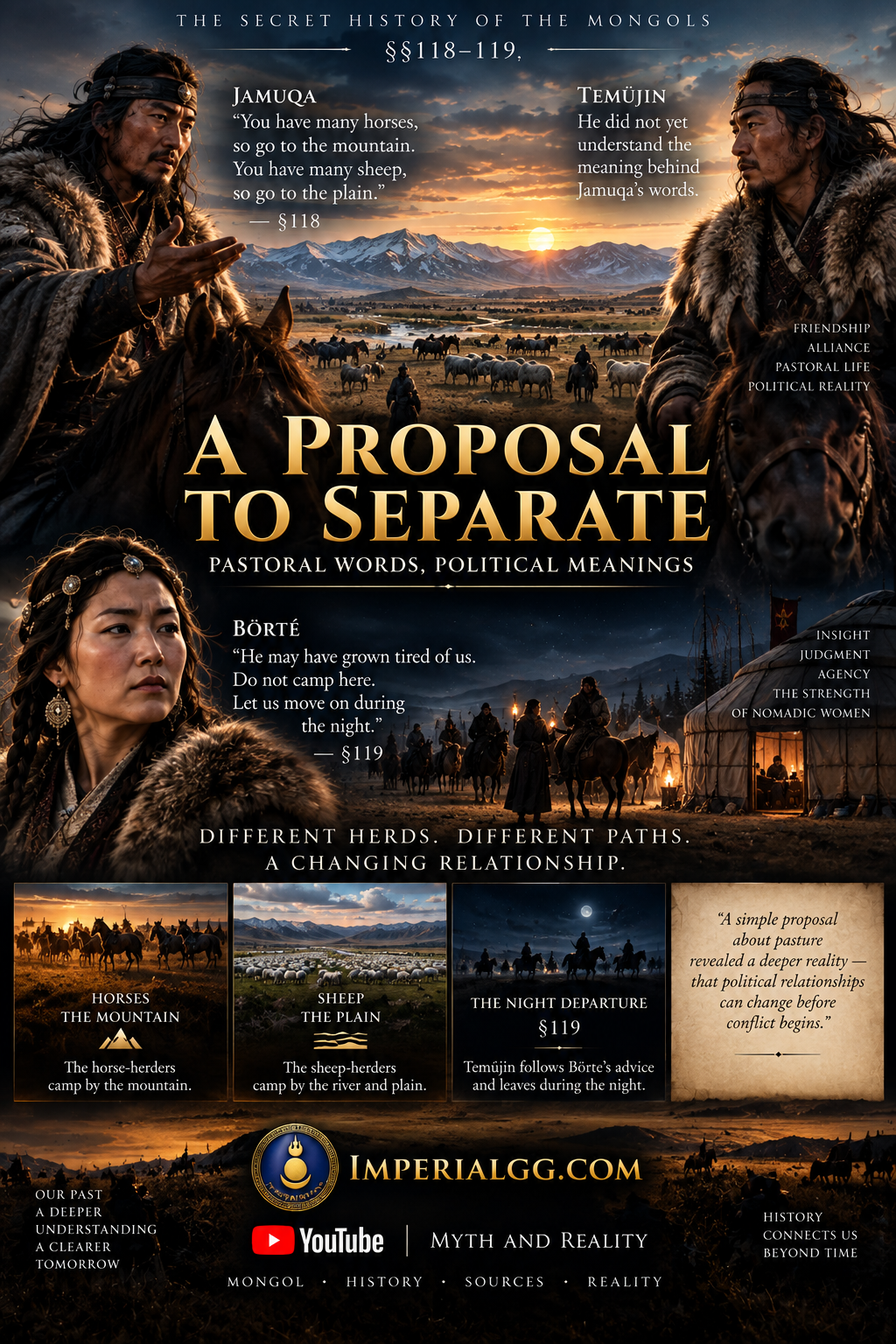
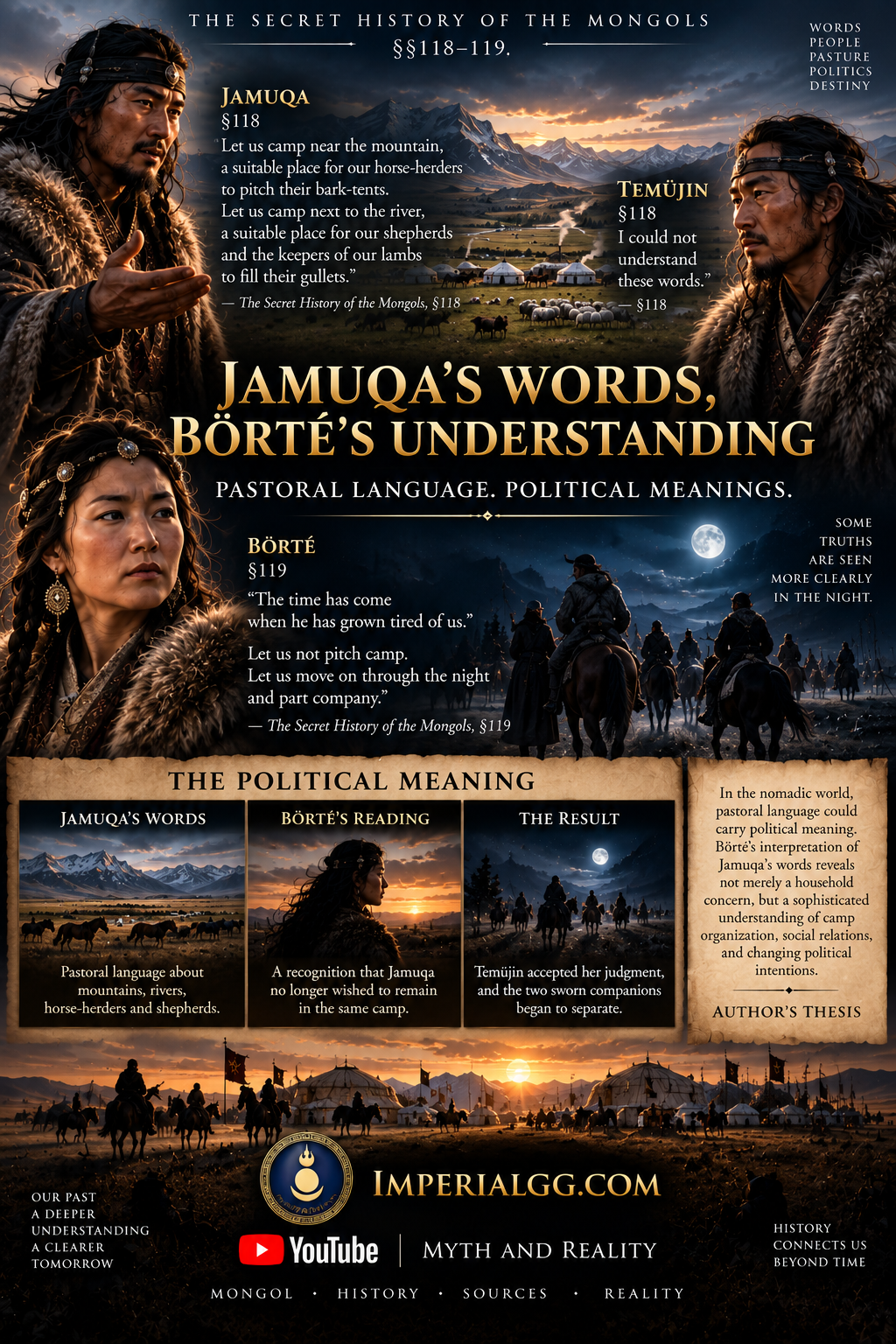
Before examining Taichar, it is necessary to return to §118. Temüjin and Jamuqa had remained companions for a year and half of the following year. The Secret History then places their separation within a specific seasonal context: on the sixteenth day of the first summer month, they moved camp together. As they travelled ahead of the carts, Jamuqa proposed two different camping environments. Near the mountains, he said, the horse-herders could establish their tents; beside the river, shepherds and lamb-keepers could find food.⁴
At one level, this statement has a practical pastoral logic. Urgunge Onon’s commentary explains that horses, cattle, and camels consume taller grasses, whereas sheep and goats generally utilize shorter grass, making separation of the herds environmentally sensible. The statement therefore cannot simply be treated as a secret political message detached from the realities of nomadic pastoralism.⁵
Yet the narrative itself gives the words a second significance. Temüjin does not understand what Jamuqa means and asks Hö’elün about it. Before Hö’elün responds, Börte interprets the statement. According to the Secret History, she warns that Jamuqa is known to tire easily and that the time may have come when he had grown tired of them; she therefore advises Temüjin not to camp but to continue through the night and separate from Jamuqa.⁶
The importance of this passage is considerable. Börte is not presented merely as an observer of a private conversation. She recognizes that a seemingly ordinary discussion concerning pasture and camp location may also carry a social and political meaning. Temüjin himself does not initially understand the implication. Börte does.
This distinction deserves emphasis. The Secret History does not explicitly describe Börte as holding a formal political office, nor does §119 establish that Mongol women possessed political authority in precisely the same institutional sense as male aristocrats. It does, however, provide evidence that knowledge generated within the household—knowledge of people, movement, pastoral arrangements, behavior, and changing relationships—could become relevant to political decision-making. Börte’s advice directly influences Temüjin’s decision to leave the camp that night.⁷
BÖRTÉ AND THE POLITICAL KNOWLEDGE OF THE NOMADIC HOUSEHOLD
The significance of Börte’s intervention becomes clearer when placed within the wider representation of women in the Secret History. Hö’elün repeatedly participates in decisions affecting the survival and organization of the household. She raises not only her own children but also children incorporated into her household, as the later episode involving Kököchü demonstrates immediately after the night departure in §119. The text therefore does not confine the women of Temüjin’s family to a purely passive domestic role.⁸
Börte’s position is particularly revealing because her contribution in §119 is based neither upon military force nor upon formal command. It is based upon interpretation. She hears the same words Temüjin has heard, but she reads their social meaning differently.
Modern scholarship has increasingly emphasized that Mongol women participated in the economic, political, and military structures of steppe society, although the degree and form of that participation varied considerably across time and social status. Anne F. Broadbridge, for example, places Hö’elün and Börte within a wider history in which Mongol women contributed to the formation of political communities, alliances, households, and imperial institutions.⁹ A broader review of scholarship on Mongol women likewise emphasizes that elite women could control substantial economic resources and, in later periods, participate directly in councils, diplomacy, regency, and political factional struggles.¹⁰
For the twelfth-century episode under consideration, however, the evidence should not be inflated beyond what it can demonstrate. Börte’s intervention in §119 is one concrete case, not proof of a universal institutional system of female political authority. Its value lies precisely in its specificity: a woman within Temüjin’s mobile household recognizes a change in the behavior of a powerful male ally and advises her husband accordingly.
This is important for understanding nomadic political culture because the household itself was not isolated from political life. Camps moved together, herds constituted economic wealth, marriage created alliances, kinship structured obligations, and information circulated through people who accompanied the mobile community. In such an environment, practical household knowledge could overlap with political knowledge. Börte’s statement in §119 offers a rare narrative window into that intersection.¹¹
FROM SEPARATION TO POLITICAL RIVALRY
The separation does not immediately produce war. Instead, the Secret History records the movement of people between the two camps. Numerous groups gradually leave Jamuqa and join Temüjin. Among them are Qorchi and others who interpret signs as indicating that Heaven and Earth favor Temüjin. Eventually Sacha-beki, Quchar-beki, and Altan-otchigin also leave Jamuqa and join Temüjin.¹²
This development is essential to the interpretation of §128. The political relationship between Temüjin and Jamuqa was changing not simply because two individuals had chosen different camps, but because people and political constituencies were moving with them.
Section 123 then marks a decisive moment. Altan, Quchar, and Sacha-beki agree to make Temüjin qan. They promise military and material support and establish obligations concerning obedience in war and peace. Temüjin is then named Chinggis Qahan.¹³
Immediately afterward, §124–126 describe the organization of the new political order and To’oril Qan’s recognition of Temüjin’s khanship. Jamuqa’s response in §127 is therefore particularly revealing. He does not simply condemn Temüjin. Instead, he addresses Altan and Quchar and accuses them of having come between him and his sworn brother. He asks why they did not make Temüjin qan while the two men were still together. He then instructs them to remain companions to Temüjin.¹⁴
Jamuqa’s words preserve an important ambiguity. He recognizes Temüjin’s new political position while simultaneously expressing resentment over the circumstances under which it emerged. His statement therefore suggests that the separation was not yet represented by him as an irreversible personal break. The relationship of anda remained rhetorically important even as political realities were changing around it.
It is immediately after this statement that the Secret History introduces Taichar.
THE HORSE RAID OF TAICHAR
Section 128 is remarkably concise. Taichar, Jamuqa’s younger brother, is at Ölegei-bulaq south of Mount Jalama. He goes to steal the herd of horses belonging to Jochi-Darmala on the Sa’ari Steppe. Taichar takes the herd away. Jochi-Darmala pursues him. His companions lose heart and stop, but Jochi-Darmala continues alone. He approaches at night, lies flat along his horse’s mane, shoots Taichar in the back, kills him, and recovers the herd.¹⁵
The scene is important for several reasons.
First, the Secret History explicitly identifies Taichar as Jamuqa’s younger brother. The conflict therefore involves people connected to the two rival political camps through close personal relationships.
Second, the object of the dispute is not abstract property. It is a herd of horses. In a pastoral society, horses were simultaneously economic assets, means of transportation, military resources, and symbols of status. A horse raid could therefore have consequences considerably beyond the immediate material loss.
Third, the narrative emphasizes the courage and persistence of Jochi-Darmala. His companions lose heart, but he continues alone. He does not pursue Taichar in an open confrontation. Instead, he uses the darkness and the behavior of horses to approach his target. Onon notes that the posture described in the text would have allowed him to approach without being readily perceived, since the approaching horse could appear riderless.¹⁶
The episode is therefore presented not as a formal battle but as a pastoral raid followed by a highly calculated individual retaliation.
WAS THE HORSE RAID REALLY THE CAUSE?
Here the distinction between source and interpretation becomes essential.
The Secret History says that Taichar stole the horses. It does not say that Jamuqa ordered him to do so. It does not state that Jamuqa intended Taichar to provoke Temüjin. Nor does it explain Taichar’s own motivation. We should therefore resist turning an interpretive possibility into an established fact.
At the same time, the chronological placement of the episode deserves attention. Section 127 presents Jamuqa complaining that Altan and Quchar have caused the separation between him and Temüjin. Section 128 immediately records the raid by Jamuqa’s younger brother. Section 129 then states that, upon hearing of Taichar’s death, Jamuqa and the Jadarans allied with thirteen other tribes and formed an army of thirty thousand men against Chinggis Qahan.¹⁷
The sequence permits at least two historical readings.
The first is the pastoral-conflict interpretation. Taichar independently stole a herd. Jochi-Darmala retaliated by killing him. Jamuqa, shocked and angered by the death of his younger brother, mobilized his followers. Under this interpretation, the political conflict escalated because a relatively localized act of raiding produced an unexpectedly serious personal and political consequence.
The second is the provocation-or-pretext interpretation. The political relationship between Temüjin and Jamuqa had already deteriorated. Taichar’s raid may therefore have functioned as a deliberate provocation, or at least as an action undertaken within an environment in which a confrontation was becoming increasingly likely. Once Taichar was killed, the incident provided Jamuqa with a concrete grievance around which a larger coalition could be mobilized.
The surviving evidence does not allow us to decide conclusively between these explanations.
That uncertainty is not a weakness of the analysis. It is precisely where the source requires historical discipline.
TAICHAR MAY NOT HAVE EXPECTED TO DIE
One further possibility deserves consideration. Even if the raid contained an element of provocation, there is no reason to assume that Taichar expected the encounter to result in his own death.
The Secret History describes an asymmetrical situation: Taichar takes the herd, while Jochi-Darmala initially has companions who eventually lose heart and abandon the pursuit. Jochi-Darmala then continues alone and approaches at night. His final attack is therefore not a predictable battlefield confrontation. It is an individual act of pursuit and ambush.¹⁸
If Taichar intended merely to seize horses or test the resolve of Jochi-Darmala’s group, the actual outcome could have exceeded his expectations. The political consequences were even greater. His death transformed a pastoral raid into a blood grievance involving Jamuqa himself.
This possibility gives the episode a broader historical significance: political crises do not always begin with actors consciously deciding to start a war. A limited act of aggression can create consequences that its initiator did not anticipate.
That interpretation remains hypothetical, but it is consistent with the narrative sequence.
FROM TAICHAR’S DEATH TO DALAN BALJUT
The most important evidence for the seriousness of the incident is what follows.
Section 129 does not describe a period of prolonged negotiation after Taichar’s death. It states that Jamuqa and members of the Jadaran tribe allied with thirteen other tribes and assembled an army of thirty thousand. They moved against Chinggis Qahan, who in turn gathered thirty thousand from his thirteen camps. The two sides met at Dalan-baljut.¹⁹
The numerical symmetry of the narrative is striking, although the precise historical reliability of the stated troop numbers must be treated cautiously. The important point for the narrative is that the death of one man is followed almost immediately by large-scale political mobilization.
This is why §128 should not be isolated from §§118–127. The horse raid did not create the entire political conflict from nothing. By the time Taichar was killed, Temüjin and Jamuqa had already separated; groups had moved from Jamuqa to Temüjin; Temüjin had been made qan; To’oril had recognized his leadership; and Jamuqa had publicly expressed his grievance about the separation.²⁰
The Taichar incident therefore appears in the Secret History at the precise moment when personal rivalry, political realignment, and pastoral conflict converge.
THE SIGNIFICANCE OF BÖRTÉ’S WARNING
This is also why Börte’s words in §119 deserve to remain at the center of the analysis.
She did not predict Taichar’s raid. She did not predict the Battle of Dalan-baljut. Her statement concerned Jamuqa’s intention to separate from Temüjin. Yet the subsequent narrative shows that she had correctly recognized that the relationship between the two men had entered a different phase.
Her significance therefore lies not in prophetic foresight but in social perception.
The Secret History gives Temüjin the power to command warriors, form alliances, and fight battles. But it also gives Börte the ability to interpret the social environment surrounding the mobile household. Her advice changes Temüjin’s immediate behavior. In this respect, §119 provides evidence that political intelligence within a nomadic community was not necessarily generated only by warriors and male aristocrats.¹¹
The episode should therefore be read alongside the broader roles of Hö’elün, Börte, daughters, wives, and other women appearing throughout Mongol historical sources. Modern scholarship has increasingly rejected interpretations that reduce Mongol women to passive participants in a male-centered imperial story. Broadbridge’s study, for example, specifically places women within the processes through which Mongol political communities, alliances, warfare, and imperial structures were created.²¹
Yet the early twelfth-century evidence should still be treated carefully. The Secret History does not give us a formal doctrine of female political authority. What it gives us are episodes of demonstrated influence. Börte’s intervention in §119 is one of the clearest examples because the text explicitly connects her interpretation to Temüjin’s decision to leave Jamuqa’s camp.
AUTHOR’S THESIS
The Taichar incident should therefore be interpreted neither as an isolated horse theft nor as a proven conspiracy ordered by Jamuqa.
The evidence supports a more cautious but historically meaningful thesis:
The horse raid occurred within an already deteriorating political relationship between Temüjin and Jamuqa. The raid may have been an independent pastoral act, a deliberate provocation, or something between the two; the surviving Secret History does not allow us to determine which with certainty. What can be established is that Taichar’s death transformed the immediate dispute into a much larger political confrontation.
In this reading, the significance of §128 lies precisely in the gap between cause and consequence. A herd of horses was stolen. One man pursued another. Taichar was killed. Within the narrative, however, the result was an army of thirty thousand marching against Temüjin.
The episode demonstrates how fragile political relationships could become in a society where personal loyalty, kinship, pastoral wealth, and military alliances were closely interconnected.
It also gives §119 renewed importance. Before the conflict became military, Börte had already recognized that something fundamental had changed in Jamuqa’s relationship with Temüjin. Her observation reminds us that the political history of the steppe was not made only on battlefields. It was also read and interpreted within the moving household.
CONCLUSION
Sections 118–119 and 127–129 together present a gradual transformation rather than a single sudden rupture.
Jamuqa first proposes a different pattern of settlement. Börte recognizes that the proposal may signify separation. Temüjin leaves. People begin moving between the two camps. Temüjin is made qan. To’oril recognizes his leadership. Jamuqa publicly laments the separation. Then Taichar steals Jochi-Darmala’s horses, is pursued and killed, and the incident becomes the immediate prelude to Dalan-baljut.
The Secret History does not tell us that Jamuqa planned this sequence. It does not tell us that Taichar was ordered to provoke Temüjin. Nor does it tell us exactly what Taichar expected when he took the horses. Those questions remain interpretive.
What the source does show is that the political separation preceded the bloodshed. The horse raid therefore appears not at the beginning of the conflict, but at the point where an already developing political division acquired a violent trigger.
And that is what makes §128 historically important.
FOOTNOTES
1. The Secret History of the Mongols, §§118–119, 127–129. For the English translation used here, see Urgunge Onon, trans. and annot., The Secret History of the Mongols: The Life and Times of Chinggis Khan (London: RoutledgeCurzon, 2001), pp. 97–99, 107–109. The edition identifies §118 as the beginning of the separation sequence and §128 as the Taichar incident.
2. Onon, Secret History, §§118–129. The chronological relationship among these sections is especially important because §127 contains Jamuqa’s statement concerning the separation, while §128 immediately introduces Taichar’s raid and §129 records Jamuqa’s mobilization.
3. Secret History, §§127–129. Onon’s text records Jamuqa’s grievance in §127, Taichar’s raid and death in §128, and the formation of a 30,000-man army by Jamuqa and his allies in §129.
4. Secret History, §118. Onon, pp. 97–98.
5. Onon, commentary to §118, n. 245. The note explains the ecological basis for the distinction between horse-herding and sheep-herding camps.
6. Secret History, §119. Onon, p. 98. The text explicitly attributes the decision to continue through the night to Börte’s advice.
7. Ibid. This is an interpretation of the narrative function of Börte’s intervention; the text does not describe her role using a formal political title.
8. Secret History, §119. The text immediately records Kököchü, a boy taken from the Besüd Tayichi’ut camp, being presented to Hö’elün, who subsequently raises him.
9. Anne F. Broadbridge, Women and the Making of the Mongol Empire (Cambridge: Cambridge University Press, 2018). The book explicitly examines Hö’elün, Börte, Mongol women, and their participation in the formation of Mongol political and imperial structures.
10. Michal Biran, “Women in the Social, Political and Economic History of the Mongol Empire,” English Historical Review 136, no. 581 (2021): 986–1005. The review summarizes scholarship emphasizing that elite Mongol women could exercise economic, diplomatic, military, and political influence, while also stressing variation across time and social position.
11. For a study specifically examining Hö’elün and Börte through the Secret History, see María C. M. de? [This reference should not be used without verification.] More securely, Broadbridge, Women and the Making of the Mongol Empire, especially the sections on women in steppe society and Hö’elün and Börte.
12. Secret History, §§120–123. The text describes increasing numbers leaving Jamuqa and joining Temüjin, culminating in the decision of Altan, Quchar, and Sacha-beki to make Temüjin qan. Onon, pp. 99–102.
13. Secret History, §123. Onon records the oath and the naming of Temüjin as Chinggis Qahan in 1189.
14. Secret History, §127. Jamuqa explicitly blames Altan and Quchar for coming between himself and Temüjin and asks why Temüjin had not been made qan while they were still together.
15. Secret History, §128. Onon, pp. 107–108.
16. Onon, §128 commentary. The translator explains that Jochi-Darmala’s position lying flat along the horse’s mane allowed him to approach without being seen, since a riderless-looking horse would not necessarily alarm Taichar.
17. Secret History, §129. Onon records Jamuqa and the Jadarans joining with thirteen tribes and assembling 30,000 men, followed by Temüjin’s equivalent mobilization from thirteen camps. The source dates the episode to 1190 in Onon’s note.
18. Ibid., §128. The narrative emphasizes that Jochi-Darmala’s companions lost heart and that he continued alone, eventually approaching Taichar at night.
19. Secret History, §129.
20. §§122–127. The movement of groups away from Jamuqa, Temüjin’s elevation, To’oril’s recognition, and Jamuqa’s response all precede the Taichar incident in the narrative.
21. Broadbridge, Women and the Making of the Mongol Empire. Broadbridge’s study explicitly places women within the political, military, economic, and social processes involved in the making of the Mongol Empire.
SELECTED BIBLIOGRAPHY
Broadbridge, Anne F. Women and the Making of the Mongol Empire. Cambridge: Cambridge University Press, 2018.
Biran, Michal. “Women in the Social, Political and Economic History of the Mongol Empire.” English Historical Review 136, no. 581 (2021): 986–1005.
de Rachewiltz, Igor. The Secret History of the Mongols: A Mongolian Epic Chronicle of the Thirteenth Century. 3 vols. Leiden: Brill, 2004–2013.
Onon, Urgunge, trans. and annot. The Secret History of the Mongols: The Life and Times of Chinggis Khan. London: RoutledgeCurzon, 2001.