
Author's thesis
THE MONGOL KHAN’S ENTHRONEMENT: RITUAL, CONSENT, AND POLITICAL LEGITIMACY
By Altanbagana Baatar
DBA Candidate| Independent Historian
ImperialGG Historical Research Seriers
15 September 2026
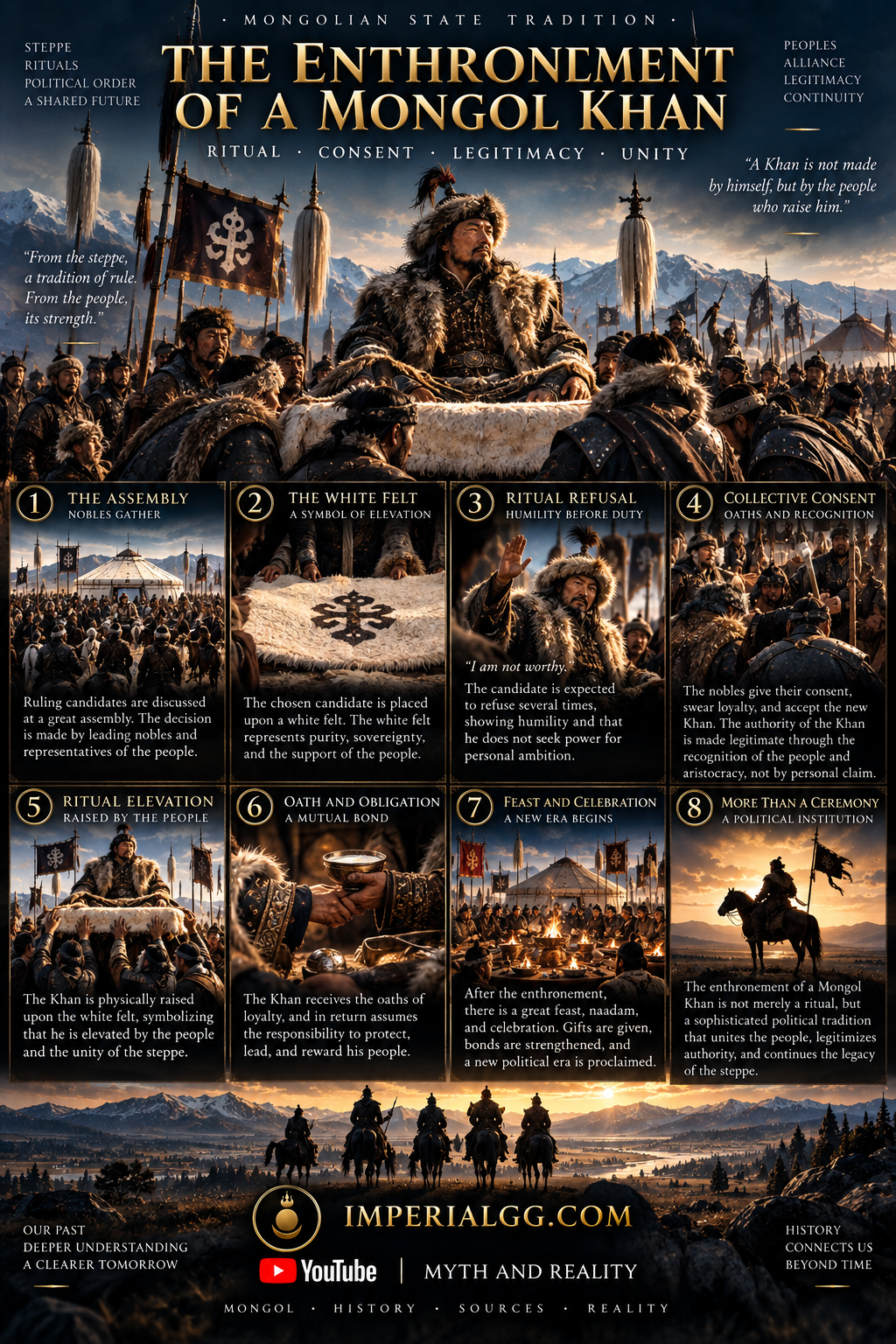
The Mongol enthronement was not merely the public announcement of a powerful man as ruler. It constituted a structured political and ceremonial process through which the authority of the new Khan was publicly recognized, ritually affirmed, and placed within a network of obligations between the ruler and the political community that elevated him. The surviving accounts of Mongol enthronement, read alongside the descriptions preserved by Rashīd al-Dīn and other medieval chroniclers, reveal a ceremony in which political legitimacy was expressed through collective consent, ritual submission, oath-taking, symbolic elevation, and public celebration.¹
One of the most distinctive elements associated with this tradition was the white felt. The new ruler was placed upon white felt and physically raised by those who participated in his elevation. The ritual was not simply a practical act of lifting the ruler; the felt itself possessed an established ceremonial significance in Mongol society. Igor de Rachewiltz notes that caγan toloγ, the large white felt carpet, appears in the Secret History in contexts associated with important Mongol ceremonial practices and that white felt had a longstanding role in Mongol enthronement, marriage, and funeral rites.² The symbolic importance of felt is also supported by the wider medieval evidence concerning Mongol royal tents and ceremonial spaces, in which white felt repeatedly appears as a material associated with high status and rulership.³
The ritual elevation therefore transformed political selection into a visible ceremonial act. The candidate did not simply stand before the assembly and announce his accession. He was placed upon a ritual surface and physically raised by others. In this respect, the ceremony embodied an important political principle: the ruler was elevated by the political community that recognized him. The physical act of raising the Khan thus corresponded to the political act of granting authority.
A second feature of the tradition was the ritual reluctance of the candidate. Accounts of Mongol enthronement describe the nominee as initially refusing or displaying reluctance before finally accepting the authority offered by the assembled nobles.⁴ This behavior should not be interpreted simply as personal modesty in the modern sense. Within the ceremonial logic of rulership, repeated refusal demonstrated that supreme authority was not supposed to appear as an arbitrary personal ambition. The prospective ruler publicly presented himself as one who did not seize power merely because he desired it; rather, he accepted a responsibility pressed upon him by those entitled to recognize him.
This ritualized refusal therefore had a political function. It separated personal ambition from legitimate accession. A man who simply declared himself Khan could demonstrate power, but the ceremonial refusal of the candidate followed by collective insistence established a different basis for legitimacy: the ruler was accepted because the political community had chosen him.
The third and perhaps most fundamental element was the collective consent of the nobles and political elite. The Mongol enthronement tradition did not reduce political legitimacy to the will of the candidate himself. The assembled aristocracy participated in the process through deliberation, recognition, oath, and ceremonial submission. Rashīd al-Dīn’s account of the enthronement tradition describes the assembled nobles performing formal acts of recognition and obeisance, including repeated prostration before the newly elevated ruler.⁵ Other medieval accounts preserve variations in the number and form of these acts, demonstrating that the precise ritual was not completely uniform across time and place.⁶
What remained constant was the underlying political principle: the ruler’s authority had to be recognized by others.
This distinction is essential for understanding Mongol political culture. The Khan’s authority was unquestionably hierarchical, but hierarchy did not eliminate the political role of the aristocracy. The ruler required recognition from the political community, while the political community received in return a legitimate center of command capable of maintaining order, distributing rewards, leading military campaigns, and protecting the interests of its constituent groups.
The ceremony therefore created a reciprocal relationship.
The nobles recognized the Khan.
The Khan assumed responsibility for ruling them.
The oath formalized this relationship.
In this sense, the enthronement ceremony was simultaneously a ritual of elevation and a political act of mutual obligation.
The importance of the oath should consequently not be underestimated. The Mongol political order depended heavily upon personal loyalty, military service, and reciprocal obligations. The enthronement ceremony gave these relationships a formal public expression. The ruler was not merely celebrated; he was placed within an acknowledged structure of political responsibility. The nobles demonstrated loyalty, while the Khan became the recognized center of authority around whom military and political organization could operate.⁷
The ceremony also possessed an important public dimension. Following the formal act of enthronement, celebration, feasting, and other forms of public rejoicing formed part of the ceremonial process. Medieval accounts of Mongol enthronements describe large celebrations accompanying the accession of the new ruler, while later descriptions emphasize the distribution of gifts and rewards to those who had participated in the political process.⁸
The feast was therefore not merely entertainment after the serious political business had concluded.
It was itself part of the political ceremony.
The new Khan’s accession was transformed from a decision made by a restricted political elite into a publicly recognized political event. Feasting and distribution reinforced social bonds, demonstrated the generosity of the ruler, rewarded political supporters, and made the new hierarchy visible to the wider community.
Thus the ceremony moved through several interconnected stages:
SELECTION → REFUSAL → COLLECTIVE CONFIRMATION → OATH → RITUAL ELEVATION → PUBLIC RECOGNITION → FEAST AND CELEBRATION.
The precise form of these stages varied across periods, but the underlying political logic remained remarkably coherent.
The significance of the white felt becomes clearer within this structure. Felt was not merely a convenient material available to a nomadic society. It was fundamental to Mongolian material culture, especially the construction of the ger, and white felt carried ceremonial and status associations. Medieval evidence repeatedly connects white felt with elite and royal contexts.⁹ Consequently, raising the Khan upon white felt can be understood as a ritual transformation of ordinary material culture into a political symbol: the new ruler was physically elevated above the ground by the community that had elevated him politically.
The ceremony therefore made an abstract principle visible.
The Khan was elevated because others elevated him.
This principle is particularly important for understanding the relationship between Mongol kingship and political legitimacy. The existence of a powerful aristocratic lineage did not mean that every individual possessing prestigious ancestry could simply declare himself Khan. Political legitimacy required recognition. Even where lineage constituted an important condition of eligibility, accession still required political acceptance and ceremonial confirmation.
This becomes particularly significant when the Mongol enthronement tradition is viewed as part of the broader political culture of Inner Asia. Similar patterns of collective election, ritual elevation, oath-taking, and ceremonial recognition are found in the political traditions of other steppe societies. Scholars have therefore examined Mongol enthronement not as an isolated ceremony but as part of a wider Turco-Mongol political culture in which the relationship between ruler, aristocracy, and political community was expressed through formal ritual.¹⁰
The white-felt ceremony, the candidate’s reluctance, the oath, the collective recognition, and the subsequent celebration should therefore be understood together rather than as isolated customs.
They formed a political grammar of legitimacy.
The candidate had to be acceptable.
The nobles had to recognize him.
The ruler had to accept the responsibility.
The relationship had to be publicly affirmed.
And the accession had to be celebrated and materially enacted.
This is why the Mongol enthronement ceremony should not be reduced to a picturesque nomadic custom. It was a mechanism through which political authority became legitimate in the eyes of the community that exercised and recognized it.
The ceremony expressed an important constitutional principle in premodern terms: supreme authority was not legitimate merely because an individual possessed force; it became legitimate through recognized political consent, ritual confirmation, and reciprocal obligation.
That principle helps explain why the Mongol political system could simultaneously maintain a powerful Khan and preserve a significant role for aristocratic political participation. The Khan stood at the center of the political order, but his accession was embedded within a collective process of recognition.
The white felt, therefore, was more than a ceremonial object.
It was the surface upon which political legitimacy was made visible.
The repeated refusal was more than modesty.
It was a ritual rejection of the appearance of self-seized authority.
The oath was more than a promise.
It transformed personal loyalty into publicly acknowledged political obligation.
The feast was more than celebration.
It completed the public transformation of a selected individual into a recognized ruler.
Taken together, these elements reveal a sophisticated political culture in which authority, legitimacy, ritual, and collective consent were inseparable.
FOOTNOTES
1. On the political character of Mongol enthronement and the role of quriltai, see Elizabeth Endicott-West, “Imperial Governance in Yuan Times,” Harvard Journal of Asiatic Studies 46, no. 2 (1986): 523–549; Michael Hope, “The Transmission of Authority through the Quriltais of the Early Mongol Empire and the Ilkhanate of Iran (1227–1335),” Mongolian Studies 34 (2012): 87–115. The Secret History of the Mongols provides the fundamental narrative framework for the early Mongol political system.
2. Igor de Rachewiltz, The Secret History of the Mongols: A Mongolian Epic Chronicle of the Thirteenth Century, commentary on the relevant occurrence of caγan toloγ (“large white felt rug”). Rachewiltz specifically notes that the white felt rug had an important role in Mongol enthronement, marriage, and funeral ceremonies.
3. Zvezdana Dode, “The Golden Tent Paradigm: Between the Mongols and Islam,” Revue des mondes musulmans et de la Méditerranée 143 (2018): 133–148. The study brings together evidence from Juvaynī, Rashīd al-Dīn, Plano Carpini and other sources concerning the use and symbolic significance of white felt in Mongol royal contexts.
4. On the candidate’s ritual reluctance and repeated refusal in the enthronement procedure, see the discussion summarized from the Mongol imperial enthronement tradition in Ning Ya, “The Mongol Great Khan Gift Management,” drawing on Joseph Fletcher, Elizabeth Endicott-West, Michael Hope, Denis Sinor, and Ron Sela. The ceremony involved nomination at the quriltai, repeated refusal by the nominee, confirmation by the nobility, oath-taking, and subsequent ceremonial recognition.
5. Rashīd al-Dīn, Jāmiʿ al-Tawārīkh. The enthronement tradition recorded in the Persian chronicle includes formal acts of obeisance by the assembled political elite. Comparative scholarship notes Rashīd al-Dīn’s account of ninefold prostration in the enthronement ceremony.
6. On variations in the number of ritual prostrations, comparative scholarship records differences between Rashīd al-Dīn’s account, which gives nine, and Juvaynī’s account, which gives three. These variations are important because they demonstrate that the ceremony had a recognizable political structure without necessarily having a single immutable form throughout the Mongol period.
7. For the broader relationship between oath, military service, and the authority of the Mongol ruler, see the discussion of Mongol and earlier Turkic enthronement traditions in the comparative study of Turkic-Mongol rulership. The study emphasizes oath-taking and the reciprocal relationship between the ruler and those placed under his command.
8. On the public celebration following enthronement and the distribution of rewards, see the discussion of the Mongol enthronement ceremony and quriltai in Ning Ya, drawing on Endicott-West and Hope. The ceremony is described as moving from elite political selection to public ceremonial celebration and reward distribution.
9. For the cultural and ceremonial importance of white felt, see Berthold Laufer, “The Early History of Felt,” American Anthropologist 32 (1930), and the discussion of white felt in Mongol ceremonial contexts summarized by Rachewiltz and later scholarship. Rachewiltz specifically identifies the caγan toloγ as an important ceremonial felt rug.
10. Denis Sinor, “The Making of a Great Khan,” in Studies in Medieval Inner Asia (Aldershot: Ashgate, 1997), 241–258; Ron Sela, Ritual and Authority in Central Asia: The Khan’s Inauguration Ceremony (Bloomington: Research Institute for Inner Asian Studies, 2003). These works place Mongol enthronement within the wider political and ceremonial history of Inner Asia. Their inclusion here is particularly useful because the purpose of this thesis is to examine the structure and political meaning of the ceremony, rather than to reconstruct one particular enthronement.
AUTHOR’S THESIS — CORE ARGUMENT
The Mongol enthronement ceremony was a political institution expressed through ritual. Its white felt, repeated refusal, collective confirmation, oath, public recognition, and celebration transformed the accession of an individual into the legitimate accession of a Khan. The ceremony demonstrates that Mongol sovereignty was not conceived simply as personal possession of power: it required collective recognition and was constituted through reciprocal political obligation.