
DALAN BALJUT: BETWEEN BATTLE, MEMORY, AND LEGEND
AUTHOR’S THESIS
By Altanbagana Baatar
DBA Candidate| Independent Historian
ImperialGG Historical Research Seriers
17 September 2026
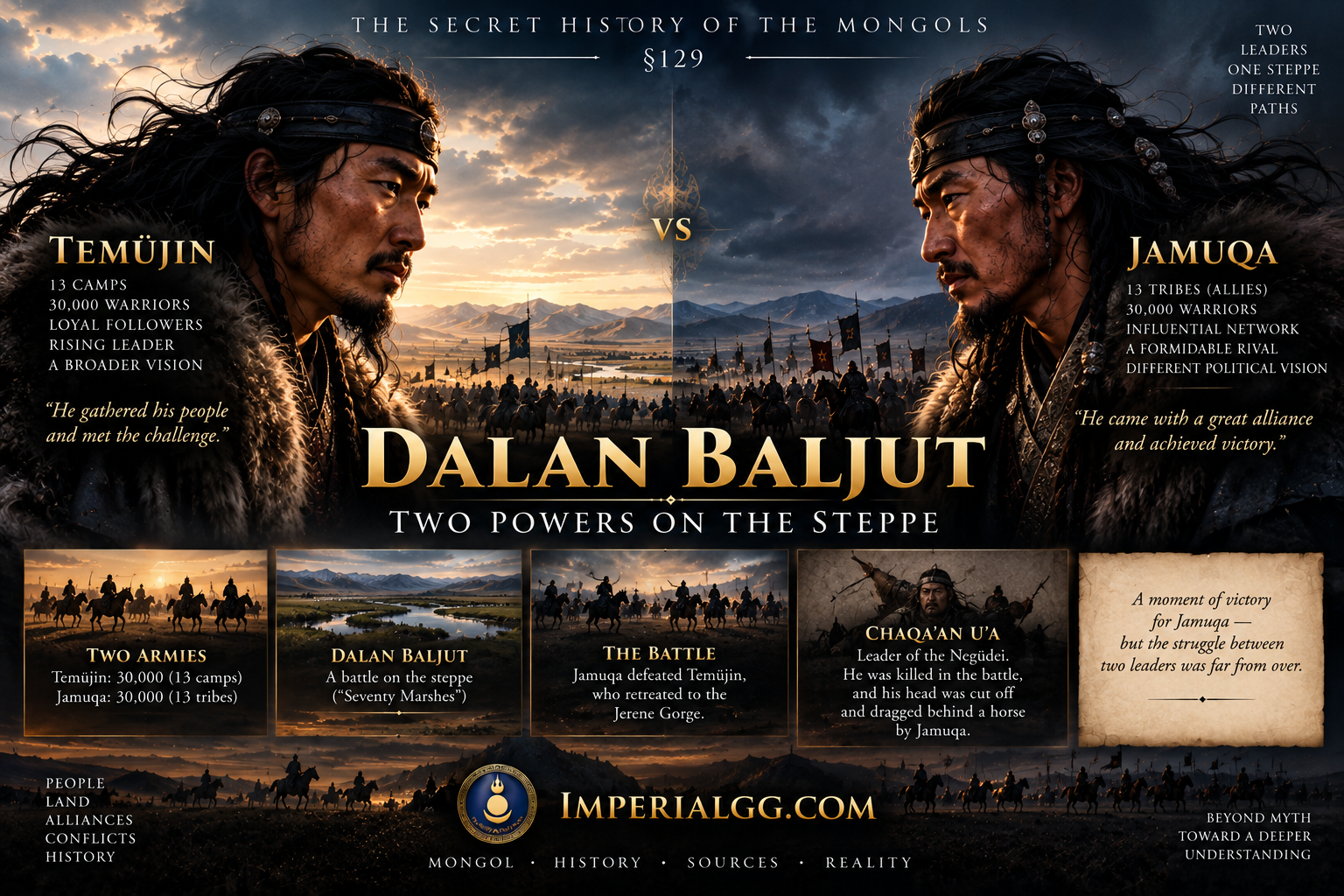
The account of the Battle of Dalan Baljut in The Secret History of the Mongols deserves to be read with particular caution because one of its most famous passages may have been transmitted, translated, and subsequently interpreted in ways that obscure rather than clarify the historical event. The narrative itself is comparatively clear on the central military fact: after Taichar was killed, Jamuqa allied with thirteen tribes and assembled a force of thirty thousand; Temüjin likewise organized thirty thousand from his thirteen camps; the two forces met at Dalan Baljut; and Jamuqa defeated Temüjin, forcing him to retreat into the Jerene Gorge on the Onon River.
The difficulty begins immediately after the battle. The surviving text states that, while returning, Jamuqa had the Chinos subjected to what the standard translations render as being “boiled alive in seventy cauldrons,” and that he cut off the head of Chaqa’an U’a of the Ne’üs/Negüs and dragged it behind his horse. Yet this famous image should not automatically be treated as an independently established historical fact. Mongolian scholarship has long questioned whether dalan toqoga should necessarily be understood as “seventy cauldrons” at all. D. Tserensodnom raised doubts about the plausibility of the passage, while the scholar Huačai Dugarjav examined the underlying transcription and suggested that Dalan Toqoga may have been a place-name rather than a reference to seventy cooking cauldrons. The possibility has also been connected with the geographical terminology surrounding Dalan Baljut.
This article therefore does not seek to erase the passage from the Secret History, nor to replace one certainty with another. Its purpose is more limited and more historical: to distinguish what §129 actually records from what later translation and interpretation have made of it. Dalan Baljut was a real episode in the political and military rivalry between two rising steppe leaders. Jamuqa won the battle. Chaqa’an U’a was killed in the fighting. The fate and meaning of the Chinos passage, however, remain a question of textual interpretation. The historian should preserve that uncertainty rather than convert a disputed reading into spectacle.
1. TWO RISING POWERS ON THE STEPPE
By the time of Dalan Baljut, the relationship between Temüjin and Jamuqa had moved far beyond the intimate relationship of childhood companions and anda. The preceding narrative describes their separation, the increasing movement of followers toward Temüjin, and the subsequent Taichar incident. Jamuqa’s response to Taichar’s death was not a small-scale act of retaliation. According to §129, Jamuqa and the Jadaran allied themselves with thirteen other tribes and assembled thirty thousand men. Temüjin, receiving warning of their approach, likewise assembled thirty thousand from his thirteen camps.
This symmetry is historically significant. The narrative presents two political formations of approximately equal stated strength. The conflict was therefore no longer simply a personal dispute between two former sworn brothers. It had become a struggle between competing networks of allegiance on the steppe.
The Secret History gives no detailed tactical account of the battle itself. We are not told how the armies were deployed, where the decisive engagement occurred within the battlefield, or what maneuver produced Jamuqa’s victory. The source tells us only the result: “They fought at Dalan Baljut,” and Temüjin was defeated and forced into the Jerene Gorge by the Onon.
That brevity is itself important. Later historical writing has sometimes supplied a much more elaborate picture of the battle than the surviving Mongolian chronicle actually preserves. A source-critical reconstruction must therefore distinguish the known outcome from later reconstructions of the battlefield.
2. WHAT WAS DALAN BALJUT?
The name Dalan Baljut should first be treated as a geographical name, not as a description of the punishment that follows it.
De Rachewiltz translates the name in a note as “Seventy Marshes.” This does not mean that the “seventy” in Dalan Baljut explains the later reference to seventy cauldrons. The two expressions occur in different parts of the narrative and must not be conflated.
This distinction becomes particularly important because the later phrase traditionally translated as “seventy cauldrons” has itself been questioned by Mongolian scholars. The scholarly discussion summarized by D. Tserensodnom and Huačai Dugarjav proposes that Dalan Toqoga may instead preserve a place-name, potentially connected geographically with the Dalan Baljut region. In this interpretation, the phrase need not describe seventy cooking vessels at all.
This hypothesis is not established beyond dispute. It should therefore be presented as a philological and toponymic possibility, not as a replacement fact.
That distinction is precisely where historical scholarship differs from legend: the existence of an old textual reading does not automatically settle what the original historical event must have been.
3. THE CHINOS PASSAGE: HISTORY OR A PROBLEM OF TRANSMISSION?
The standard English translations give the passage in remarkably dramatic terms. Onon renders the text as Jamuqa, on his return, having the young men of the Chinos boiled in seventy cauldrons; he then cut off Chaqa’an U’a’s head and dragged it behind his horse. Atwood similarly translates the passage as the Chinos being boiled in seventy cauldrons.
Yet the existence of this translation does not end the question.
The Mongolian scholarly discussion is particularly valuable because it asks a basic philological question: is “dalan toqoga” necessarily a numerical phrase meaning “seventy cauldrons,” or could it represent a geographical name? D. Tserensodnom reportedly considered the traditional interpretation problematic and consulted Huačai Dugarjav concerning the geographical terminology. Dugarjav’s response, as reproduced in the scholarly discussion, raises the possibility that “Dalan Toqoga” was a place-name and that the structure of the transmitted text had been misunderstood in later translation.
There is also an important internal problem with interpreting the passage as the total destruction of the Chinos/Negüs. Much later in the Secret History, in §218, Chinggis Qa’an tells Narin To’oril that his father Chaqa’an Qo’a fought for him at Dalan Baljut and was killed by Jamuqa. Narin To’oril then says that his Negüs kinsmen had become scattered among other tribes, and Chinggis orders him to gather them.
This later passage does not prove that no Chinos/Negüs were killed at Dalan Baljut. It does, however, make a simplistic interpretation of complete extermination difficult. The group clearly survived as a dispersed community.
Thus the historical question remains open: Was the “seventy cauldrons” passage a literal record of mass execution, a distorted transmission of a place-name, or a later interpretation of a more complex episode?
The surviving evidence does not permit us to answer that question with certainty.
4. CHAQA’AN GU’A: THE MAN WHO DEFINITELY DIED IN THE BATTLE
The case of Chaqa’an U’a is considerably firmer. The Secret History explicitly states in §129 that Jamuqa cut off his head and dragged it behind his horse. More importantly, the chronicle returns to him much later.
In §218, Chinggis Qa’an addresses Chaqa’an Qo’a’s son Narin To’oril and recalls: “Your father Čaγan Qo’a was fighting zealously before me at the battle of Dalan Baljut when he was killed by Jamuqa.”
The same passage identifies this Chaqa’an Qo’a with the Chaqa’an U’a of §129.
This later recollection gives §129 an important retrospective confirmation. Chaqa’an U’a was not merely an incidental figure inserted into the story. He was remembered by Chinggis Qa’an as a man who fought on his side at Dalan Baljut and died there.
Therefore, when we ask why Jamuqa cut off his head, the strongest historical answer is also the simplest: Chaqa’an U’a was a leader who had fought for Temüjin and was killed in the battle.
The Secret History does not, however, give an explicit explanation for why Jamuqa subsequently cut off his head and tied it to his horse’s tail. Any interpretation beyond that must be marked as interpretation. The act may have served as a form of post-battle humiliation, vengeance, or political intimidation, but the source itself does not tell us which of these motives was decisive.
5. WAS JAMUQA PUNISHING HIS OWN PEOPLE?
This is where the traditional interpretation becomes especially difficult. If the Chinos passage means exactly what the conventional translation suggests, Jamuqa had, immediately after defeating Temüjin, subjected members of the Chinos leadership to an exceptionally brutal punishment. Yet the text does not explicitly tell us that they were punished for treason, nor does it state that they had defected from Jamuqa.
One later translation footnote proposes that they were killed because they might otherwise have helped Chinggis and notes that they had previously belonged to the Tayichi’ud. But that is an editorial explanation, not a sentence supplied by §129 itself. The distinction matters.
The primary text tells us: Jamuqa won. Chaqa’an GU’a was killed. The Chinos passage follows.
It does not explicitly tell us: “They betrayed Jamuqa, therefore he executed them.” That explanation should not be inserted into the source.
6. THE POLITICAL AFTERMATH IS MORE IMPORTANT THAN THE HORROR STORY
The next section, §130, may provide a more historically significant clue than the sensational image of the cauldrons. After Jamuqa’s return, Jürchedei of the Uru’ut, Quyuldar of the Mangqut, and Mönglik with his seven sons leave Jamuqa and join Temüjin. The Secret History explicitly says that Chinggis Qa’an rejoiced because people were coming over from Jamuqa’s side.
This is a crucial development. Dalan Baljut was a military victory for Jamuqa, but victory on the battlefield did not automatically translate into stable political allegiance.
The narrative immediately moves from Jamuqa’s victory to the movement of important groups away from him. We should not claim that §129’s alleged punishments directly caused these defections, because the source does not establish that causal relationship. Nevertheless, the chronological juxtaposition invites an important political question:
What sustains allegiance after victory—fear, kinship, reputation, justice, or the ability to integrate competing groups? That question is more historically productive than simply repeating the image of seventy boiling cauldrons.
7. DALAN BALJUT AND THE TWO POLITICAL MODELS
The deeper importance of Dalan Baljut lies not in the question of whether one should believe the most dramatic version of the cauldron story. It lies in the fact that two competing political centers had now emerged from the same steppe world. Jamuqa had the Jadaran and thirteen allied tribes and could mobilize thirty thousand men. Temüjin had thirteen camps and could mobilize a comparable force.
Both men possessed:
- followers,
- military commanders,
- tribal alliances,
- political legitimacy claims,
- and the ability to mobilize substantial pastoral populations.
The difference between them was therefore not simply personal character. Their rivalry had become a question of political organization and allegiance. This is why Dalan Baljut deserves to be treated as one of the formative political battles of Temüjin’s career. It was his defeat, but it was also the moment when the competition between the two former anda became unmistakably a struggle between alternative centers of power.
AUTHOR’S THESIS — REVISITED
The traditional image of Dalan Baljut has been dominated by three dramatic elements: Jamuqa’s victory, the seventy cauldrons, and the severed head of Chaqa’an GU’a. The first is firmly established by §129. The second remains a matter requiring philological scrutiny.
The third is firmly recorded, but its precise political purpose is not explained by the source. For this reason, Dalan Baljut should not be presented merely as a story of Mongol cruelty. It should be examined as a source-critical problem in the reconstruction of early Mongol political history. The question is not whether the Secret History should be believed or rejected as a whole. The proper historical question is more precise:
Which elements of §129 are independently reinforced by the wider narrative, which depend upon a disputed reading of the text, and which represent later interpretation?. On that basis, the battle itself can be treated as historical evidence, while the “seventy cauldrons” episode remains open to scholarly debate. That distinction is not a weakness in the history. It is the history.
CONCLUSION
Dalan Baljut marked the transformation of the Temüjin–Jamuqa rivalry from a dispute between former companions into an armed contest between two substantial political coalitions. The Secret History records thirty thousand men on each side, a Jamuqa victory, and Temüjin’s retreat to the Jerene Gorge.
The subsequent account of punishment, however, requires a different level of scrutiny. The traditional “seventy cauldrons” interpretation is present in major translations, but Mongolian scholars have questioned whether Dalan Toqoga should instead be understood as a place-name. That possibility cannot simply be dismissed, nor can it presently be promoted to an established fact.
Chaqa’an GU’a presents a firmer case: the text states that Jamuqa killed him, and §218 later confirms that he died fighting for Temüjin at Dalan Baljut. The result is a more complex picture than the familiar legend. Jamuqa won the battle, but the political consequences of his victory were not entirely under his control. Immediately afterward, important groups abandoned him and joined Temüjin.
Dalan Baljut therefore belongs not only to the military history of the Mongols but also to the history of political legitimacy: a battlefield victory could establish temporary superiority, but it could not by itself determine where the loyalty of the steppe would ultimately settle.
FOOTNOTES
1. The Secret History of the Mongols, §129. The standard Rachewiltz text records Jamuqa’s alliance of thirteen tribes, thirty thousand men, the battle at Dalan Baljut, Temüjin’s retreat to the Jerene Gorge, and the subsequent punishment passage.
2. Igor de Rachewiltz, The Secret History of the Mongols: A Mongolian Epic Chronicle of the Thirteenth Century, §129, note 2, translates Dalan Baljut as “Seventy Marshes.”
3. Urgunge Onon, The Secret History of the Mongols: The Life and Times of Chinggis Khan, §129, gives the conventional translation of the Chinos passage as the boiling of young men in seventy cauldrons.
4. Anne F. Broadbridge is among modern scholars who treat the Secret History as a source requiring attention to its narrative construction and transmission; for the present issue, however, the central philological question concerns the reading of §129 itself.
5. D. Tserensodnom’s commentary and the discussion attributed to Huačai Dugarjav question whether dalan toqoga should be understood literally as “seventy cauldrons.” The proposed alternative is that it may preserve a geographical name. This interpretation remains a scholarly hypothesis rather than a settled reading.
6. The same scholarly discussion notes that §218 preserves evidence that the Negüs community survived in dispersed form: Narin To’oril tells Chinggis Qa’an that his Negüs kinsmen are scattered among different tribes.
7. The Secret History of the Mongols, §218: Chinggis Qa’an recalls that Chaqa’an Qo’a fought for him at Dalan Baljut and was killed by Jamuqa.
8. The explanatory note attached to some translations says the Chinos were killed because they might otherwise have helped Chinggis and identifies them as having previously belonged to the Tayichi’ud. This should be treated as editorial interpretation rather than as an explicit explanation in the body of §129.
9. The “zād” episode belongs to §143, at Köyiten, where Quduqa-beki and Buyiruq Qan use a “magic stone” to summon a storm. The storm turns against them and is interpreted as evidence that Heaven does not favor them. It should not be assigned to Dalan Baljut.
10. The immediate aftermath is recorded in §130: Jürchedei, Quyuldar, Mönglik and Mönglik’s seven sons leave Jamuqa and join Temüjin. The Secret History explicitly presents Temüjin’s reaction as joy at people coming over from Jamuqa’s side.