
THE SECRET HISTORY OF THE MONGOLS, §§192–195
By Altanbagana Baatar
DBA Candidate| Independent Historian
ImperialGG Historical Research Seriers
20 October 2026
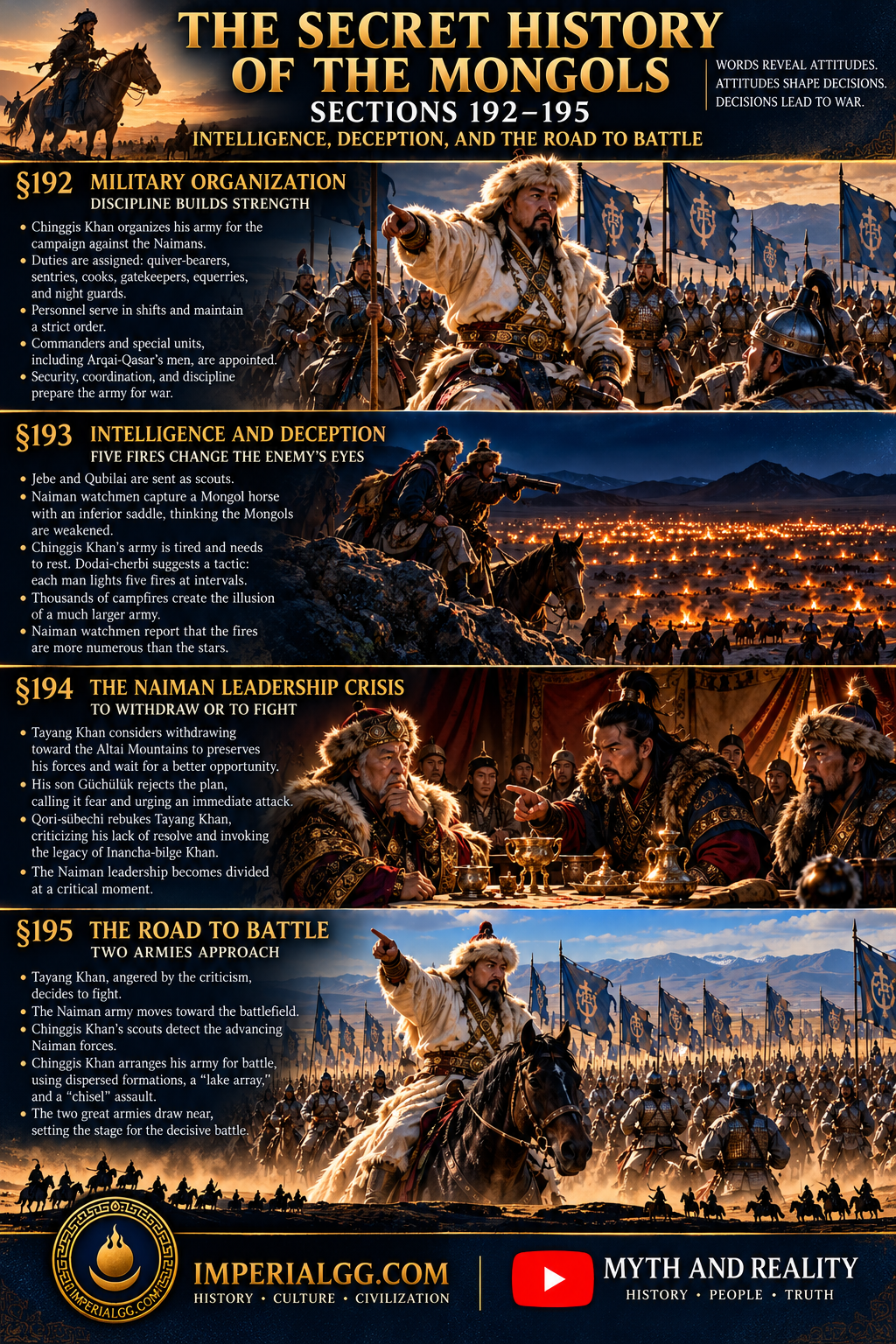
INTELLIGENCE, DECEPTION, AND THE STRATEGIC CRISIS OF THE NAIMAN CAMPAIGN
INTRODUCTION
Sections 192–195 of The Secret History of the Mongols present the Naiman–Mongol confrontation as more than a contest between two military forces. They reveal how intelligence, logistical conditions, command discipline, political disagreement, and the interpretation of an opponent’s strength shape decisions before battle begins. The narrative moves from Chinggis Khan’s internal military organization to the reconnaissance of Naiman positions, the deliberate manipulation of enemy perceptions, the disagreement between Tayang Khan and his son Güchülük, and finally the armies’ approach to the battlefield.
These passages are particularly valuable because they depict warfare as a process involving preparation and information management, not merely physical courage. The Naiman leadership receives reports about the Mongols, debates how to respond, and considers withdrawing toward the Altai Mountains to improve its logistical position. Meanwhile, Chinggis Khan’s forces employ scouts, establish a coordinated system of military duties, and use campfires to influence the enemy’s estimate of their numbers. The narrative therefore places military intelligence and political judgment at the center of the coming confrontation.
1. MILITARY ORGANIZATION AND THE LOGIC OF COMMAND (§192)
Section 192 continues the account of Chinggis Khan’s preparations following the decision to confront the Naimans. The text describes the allocation of responsibilities among quiver-bearers, sentries, cooks, gatekeepers, equerries, and night guards. Duties are organized into shifts, with personnel changing responsibilities according to an established schedule. The account also describes the organization of the commanders and the selection of a specially designated group of warriors under Arqai-Qasar.
These details matter because an army’s operational capacity depends on more than the number of men it can assemble. It also depends on whether personnel know their responsibilities, whether guard duties are performed consistently, and whether the leadership can maintain security while moving through unfamiliar territory.
The description does not establish that Chinggis Khan’s army was a modern bureaucratic institution in the contemporary sense. It does, however, portray a military system in which responsibilities were differentiated and coordinated. Command, surveillance, camp security, and the protection of the ruler were integrated into the preparation for a campaign.
The narrative’s emphasis on the routine of military service is analytically significant. Discipline is not represented solely as obedience during combat. It is also expressed through the repeated performance of ordinary duties before and during a campaign. In this sense, the text connects military effectiveness with organizational reliability.
2. RECONNAISSANCE AND THE CONTROL OF INFORMATION (§193)
In §193, Chinggis Khan advances toward the Naiman forces after making an offering to the military banner. He sends Jebe and Qubilai ahead as scouts. Their reconnaissance brings them into contact with Naiman watchmen near Mount Qangqarqan, where a confrontation between the opposing scouts results in the capture of a horse equipped with an inferior saddle.
The horse becomes an object of interpretation. The Naiman watchmen regard its condition as evidence that the Mongols’ horses are lean and potentially weakened. They report this observation to Tayang Khan.
This episode illustrates a distinction between collecting information and interpreting it correctly. The Naimans observe a real detail, but the meaning they assign to it remains uncertain. A horse’s condition may offer some information about the physical state of a force, yet it cannot by itself establish the strength, readiness, or tactical intentions of the entire army.
The Mongol leadership, by contrast, is portrayed as gathering information through scouts and discussing its position before deciding how to proceed. This does not mean that the Mongols possess perfect intelligence or that every Naiman assessment is necessarily mistaken. Rather, the episode shows that both sides operate within an environment of incomplete knowledge, where observations must be interpreted before they can guide action.
The narrative also makes clear that reconnaissance is reciprocal. Both armies watch one another, pursue opposing scouts, and report what they discover. The battlefield is therefore preceded by a struggle over information: each side attempts to understand the other while limiting the other’s ability to understand itself.
3. THE CAMPFIRES: DECEPTION AS A MILITARY INSTRUMENT (§193)
After reaching the Sa’ari Steppe, Chinggis Khan and his commanders discuss their situation. Dodai-cherbi acknowledges that the Mongol force is tired and that its horses need time to recover. He proposes that the army establish camp and that each able-bodied man light five fires at intervals. The fires are intended to create the impression that the Mongol force is larger than it actually is.
Chinggis Khan accepts the proposal. During the night, Naiman watchmen observe the numerous fires and conclude that the Mongols are far more numerous than previously believed. Their report to Tayang Khan emphasizes that the fires appear to multiply across the steppe.
The episode presents deception as an organized response to a logistical disadvantage. The Mongols need time for their horses to recover, but waiting without taking precautions could expose them to attack. The fires allow them to remain in place while influencing what the enemy believes about their strength.
The tactic does not physically increase the number of Mongol soldiers. It changes the visible evidence from which the Naiman watchmen estimate that number. The distinction is crucial: military deception works by shaping an opponent’s understanding of reality, not by altering reality itself.
The scene also demonstrates the importance of the horse in steppe warfare. The condition of the mounts affects mobility, endurance, and the ability to sustain an engagement. Dodai-cherbi’s proposal addresses this practical constraint while simultaneously creating psychological pressure on the enemy.
The episode should not be treated as proof that every Mongol deception succeeded or that the Naimans were incapable of sound observation. Its significance lies in the narrative’s presentation of a specific, purposeful tactic that combines rest, concealment of weakness, and manipulation of enemy perception.
4. TAYANG KHAN AND GÜCHÜLÜK: STRATEGIC DISAGREEMENT (§194)
When the Naiman watchmen report that the Mongol campfires are more numerous than the stars, Tayang Khan reassesses the situation. He recognizes the potential danger of a direct engagement and considers withdrawing across the Altai Mountains. His proposed strategy is to reorganize his forces, draw the Mongols farther from their current position, exhaust their horses, and then launch a counterattack under more favorable conditions.
This proposal is significant because it is not simply a refusal to fight. Tayang Khan identifies a logistical problem and considers how geography, distance, and the relative condition of the horses might influence the outcome. The strategy described in the text resembles a planned withdrawal intended to preserve strength and create a more favorable opportunity for combat.
Güchülük Khan, Tayang’s son, rejects this assessment. He ridicules his father’s caution, questions the reported size of the Mongol army, and interprets the proposal to withdraw as evidence of fear. His response transforms a military disagreement into a personal and familial confrontation.
The exchange reveals a serious problem of command: a ruler may recognize a genuine operational risk but still struggle to secure agreement from those whose cooperation is necessary to implement a strategy. The narrative depicts Tayang Khan’s proposal being challenged not through a detailed comparison of alternatives, but through language that questions his courage and authority.
It would be too simplistic, however, to conclude that caution is always correct and boldness always mistaken. A withdrawal can preserve an army, but it can also surrender initiative or undermine confidence. An advance can create an opportunity, but it can also expose a force to unfavorable conditions. The central issue in this episode is the relationship between strategic judgment, available information, and the ability of a leadership group to deliberate effectively.
The text portrays the Naiman leadership as divided at a moment when coordinated decision-making is especially important. That division becomes part of the strategic context in which the coming battle unfolds.
5. QORI-SÜBECHI’S REBUKE AND THE CRISIS OF COMMAND (§194)
The disagreement becomes more serious when Qori-sübechi, a prominent Naiman leader, rebukes Tayang Khan. He invokes the reputation of Tayang’s father, Inancha-bilge Khan, and criticizes what he perceives as an early loss of courage. His speech culminates in the claim that the Mongols’ destiny now favors them and that Tayang has already failed. He then departs in the opposite direction.
This passage exposes a further dimension of political authority. Tayang Khan is not merely deciding how to move troops; he is being judged against inherited expectations of leadership and martial reputation. Qori-sübechi’s appeal to the former ruler establishes a contrast between an idealized past and a present leadership that, in his view, has failed to meet its obligations.
The episode also suggests that military cohesion cannot be assumed simply because an army has a recognized ruler. Authority must be sustained through confidence, shared expectations, and the willingness of senior figures to cooperate. Publicly challenging a commander during a crisis can weaken collective resolve, even when the criticism arises from genuine concern about leadership.
At the same time, the historian must distinguish the narrator’s literary presentation from an independently verifiable record of private motives. The speeches are part of a crafted historical narrative. They reveal how the text represents the Naiman leadership crisis, but they do not provide direct access to every participant’s thoughts.
The passage is therefore most useful when read as evidence of the narrative’s concern with the relationship between command, reputation, and unity—not as sufficient proof that one individual’s personality alone determined the outcome of the campaign.
6. FROM DEBATE TO BATTLE: THE ARMIES APPROACH (§195)
Section 195 marks the transition from deliberation to direct confrontation. Tayang Khan, angered by the criticism and determined to proceed, declares that death and bodily suffering are common to all and that the armies should fight. He moves along the Tamir River, crosses the Orkhon, and approaches the area near Naqu-kun and Chakirma’ud.
Chinggis Khan’s watchmen detect the approaching Naiman force and report its movement. Chinggis Khan responds by advancing against the opposing scouts and arranging his army for combat. The text identifies three tactical concepts: a dispersed marching formation, a formation described as a “lake array,” and a direct attack described as a “chisel” assault. Chinggis Khan takes a position at the front, assigns Qasar responsibility for the main army, and places Otchigin-noyan in charge of the reserve horses.
The passage indicates that the Mongol deployment involved differentiated roles and a planned arrangement of forces. The terminology is important, but its exact military meaning requires caution. Urgunge Onon’s explanatory notes interpret these formations as involving dispersed groups, attacks from multiple directions, and a concentrated thrust through the enemy line. Such interpretations help explain the terms, although they should not be mistaken for complete technical manuals of Mongol battlefield practice.
The narrative also distinguishes between the actions of the scouts and the movement of the main armies. The Naiman watchmen withdraw and rejoin their main force, while the Mongol scouts pursue them. This movement brings the two armies into closer contact and leads to the encounter in which Jamuqa, now among the Naimans, becomes a source of information about the Mongol commanders.
The opening of the battle is thus represented as the culmination of reconnaissance, logistical calculation, political disagreement, and tactical organization. The armies do not meet in a vacuum: each arrives with prior assumptions about the opponent, and each must respond to information that remains incomplete.
7. HISTORICAL INTERPRETATION: INTELLIGENCE, LOGISTICS, AND POLITICAL COHESION
Read together, §§192–195 present several interconnected dimensions of steppe warfare.
First, intelligence is not merely the collection of reports. It requires interpretation. The Naiman watchmen correctly observe the Mongol campfires, but the conclusion that the Mongol force must be exceptionally large is shaped by a deliberate tactic. The Mongols, in turn, use scouts and discuss their own logistical limitations before advancing.
Second, logistics influence strategy. The condition of horses matters to both armies, and Tayang Khan’s proposal to withdraw toward the Altai is grounded in the possibility of exhausting the Mongol mounts while preserving the Naiman horses. Dodai-cherbi’s plan similarly acknowledges the need for rest. The text therefore depicts strategic decisions as inseparable from the physical requirements of a mobile army.
Third, political cohesion affects military decision-making. Tayang Khan’s disagreement with Güchülük and Qori-sübechi shows that the presence of a ruler does not automatically guarantee a unified command. The narrative emphasizes the consequences of a leadership dispute occurring under pressure.
Finally, the episode presents military effectiveness as a combination of organization, information, timing, and judgment. The Mongol force is not portrayed as relying on courage alone. It coordinates camp duties, sends scouts, manages fatigue, influences enemy perceptions, and organizes its formations before battle. The Naiman side, meanwhile, possesses its own strategic reasoning, but the narrative emphasizes the difficulty of reconciling competing judgments within its leadership.
AUTHOR’S THESIS
The central thesis of this analysis is that §§192–195 portray the approaching Naiman–Mongol battle as a contest of organizational systems and strategic perceptions as much as a contest of arms. Chinggis Khan’s campfire tactic is significant because it converts a logistical vulnerability—the need to rest tired horses—into an opportunity to influence enemy estimates. The Naiman debate, meanwhile, illustrates how intelligence becomes strategically useful only when leaders can evaluate it and translate it into coordinated action.
The text does not justify a simple opposition between a uniformly wise Mongol leadership and an inherently incompetent Naiman leadership. Tayang Khan’s proposed withdrawal reflects a recognizable concern with distance, endurance, and the preservation of military strength. The deeper problem represented in the narrative is that the Naiman leadership fails to resolve its disagreement at a moment when a shared response is essential.
The passage consequently invites a broader interpretation of political and military power: information must be interpreted, strategy must be coordinated, and authority must sustain collective action under uncertainty. In the account of the Naiman campaign, these elements form the strategic environment in which battlefield events become possible.
CONCLUSION
Sections 192–195 of The Secret History of the Mongols offer a detailed narrative of the preparations that precede a major confrontation. The organization of camp duties, the deployment of scouts, the use of campfires to influence enemy perceptions, the dispute between Tayang Khan and Güchülük, and the eventual deployment of the armies together reveal the many layers of pre-battle decision-making.
The account’s enduring analytical value lies in its attention to the conditions that shape combat before the first major engagement. Military strength is not measured only by numbers. It also depends on the ability to maintain discipline, interpret uncertain evidence, preserve mobility, and coordinate decisions across a leadership structure. In this narrative, the struggle between the Naimans and the Mongols is already underway before the armies fully engage: it is a struggle over knowledge, judgment, and the capacity to act collectively.
SELECTED REFERENCES
The Secret History of the Mongols, §§192–195.
Onon, Urgunge, trans. and annot. The Secret History of the Mongols: The Life and Times of Chinggis Khan. London and New York: RoutledgeCurzon, 2001.
Cleaves, Francis Woodman, trans. The Secret History of the Mongols: For the First Time Done into English out of the Original Tongue and Provided with an Exegetical Commentary. Cambridge, MA: Harvard-Yenching Institute, 1982.
Atwood, Christopher P., trans. The Secret History of the Mongols. Penguin Classics, 2023.
Editorial note: Personal names, place names, and tactical terminology should be checked against the Mongolian text and the specific translation used for publication. The English quotations in this article are paraphrased except where explicitly identified as brief translated phrases.