
RITUAL, CULTURAL IDENTITY, AND POLITICAL JUDGMENT IN THE SECRET HISTORY OF THE MONGOLS: SECTIONS 189–191
By Altanbagana Baatar
DBA Candidate| Independent Historian
ImperialGG Historical Research Seriers
19 October 2026
Abstract
Sections 189–191 of The Secret History of the Mongols present a revealing narrative of ritual practice, cultural identity, political rivalry, and military preparedness during the conflict between the Naimans and the rising Mongol power under Chinggis Khan. The episode begins with the arrival of the severed head of Ong Khan (To’oril, also known as Wang Khan) at the Naiman court. Giirbesu, the mother of Tayang Khan, orders a ceremonial offering to be performed. During the ritual, the head is reported to smile, prompting Tayang Khan to order it trampled. Kokse’u-Sabraq criticizes this act and questions Tayang Khan’s capacity to rule. The narrative then presents Giirbesu’s disparaging remarks about Mongolian appearance and clothing, Tayang Khan’s confidence that the Mongols can be defeated, the failure of his attempt to secure an alliance with the Onggüt ruler Alaqush Digit Quri, and Chinggis Khan’s subsequent military preparations.
This article interprets these episodes as a connected narrative about the relationship between ritual conduct, cultural prejudice, political judgment, and strategic action. It argues that the chronicle uses the treatment of Ong Khan’s head and the Naiman court’s contemptuous language to expose tensions between customary propriety, claims to political superiority, and the practical demands of leadership. The passage also preserves valuable representations of nomadic material culture, ceremonial practices, household relationships, and pastoral labor. Rather than treating its supernatural motif as independently verified historical fact or its hostile speech as objective ethnography, the article examines how these elements function within the chronicle’s historical and literary framework.
Keywords: The Secret History of the Mongols; Ong Khan; To’oril; Tayang Khan; Giirbesu; Kokse’u-Sabraq; Naiman; nomadic culture; ritual; political judgment.
1. INTRODUCTION
The Secret History of the Mongols is a foundational source for the study of Mongolian history, language, political culture, and social relationships during the rise of Chinggis Khan. Its narrative combines historical recollection, speeches, ritual episodes, genealogical traditions, and literary motifs. Sections 189–191 are particularly significant because they bring these elements together in an account of the Naiman court’s response to the death of Ong Khan and its subsequent confrontation with the Mongols.
The narrative begins with Giirbesu’s decision to have Ong Khan’s head brought before her for recognition and ceremonial offering. The reported smile of the head becomes a turning point: Tayang Khan orders it trampled, while Kokse’u-Sabraq challenges the propriety of the act. The subsequent dialogue reveals the Naiman leadership’s attitudes toward the Mongols, including assumptions about their appearance, clothing, and social position. The narrative then shifts from words to political action, describing an unsuccessful attempt to secure an alliance and Chinggis Khan’s response to the emerging threat.
These events can be read on several interconnected levels. The ritual episode reveals how the chronicle represents ceremonial obligations and the treatment of the dead. Giirbesu’s speech illustrates how cultural difference is transformed into a language of contempt. Tayang Khan’s declarations expose the relationship between confidence and strategic misjudgment, while Kokse’u-Sabraq’s warnings introduce an internal critique of leadership. Finally, the diplomatic exchange and military preparations show that political power depends not merely on claims of superiority but also on alliances, information, and organized action.
2. THE RITUAL TREATMENT OF ONG KHAN’S HEAD
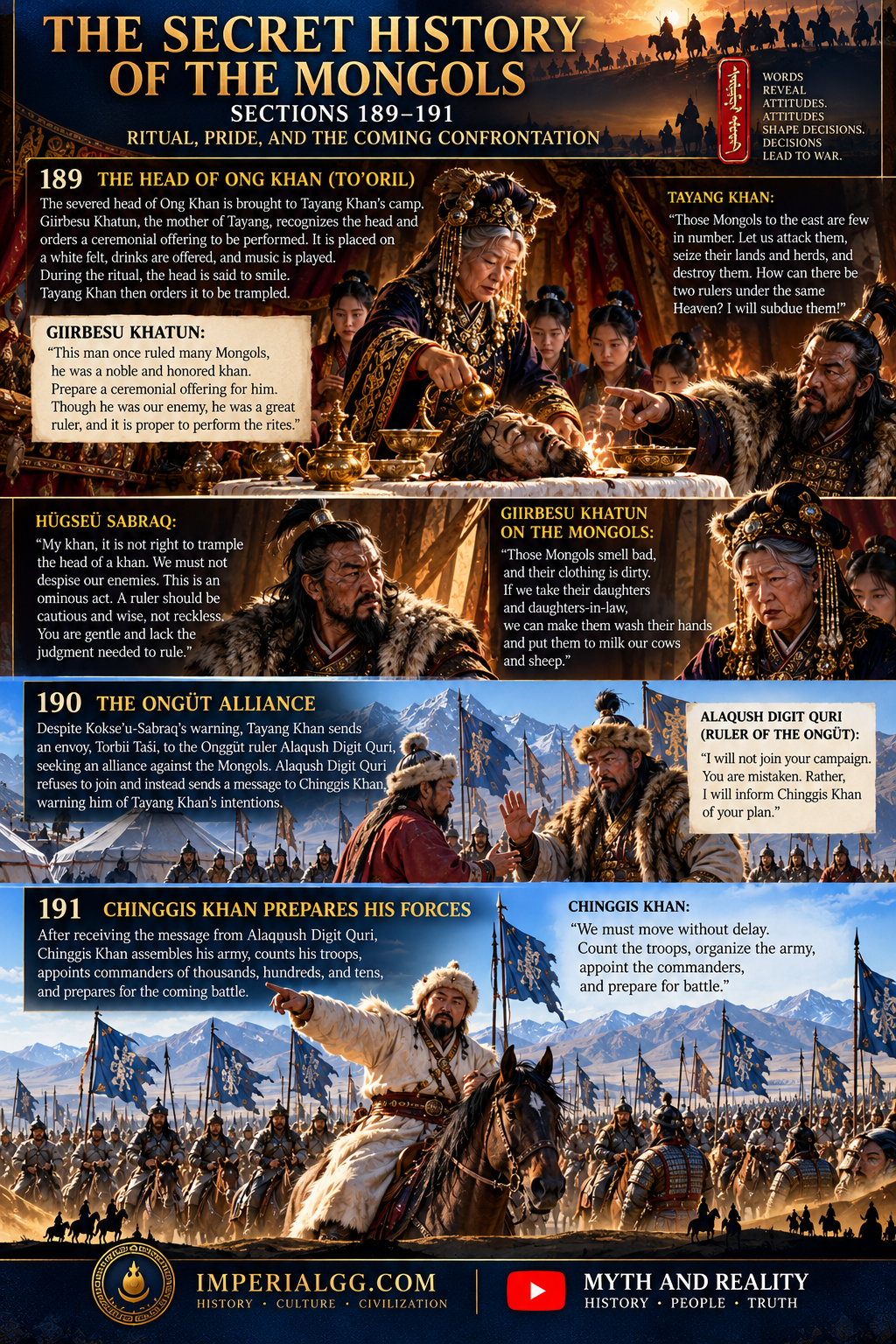
In section 189, Giirbesu declares that Ong Khan was once a great and venerable ruler and orders his head to be brought to her. After it is recognized, the head is placed on a white felt covering. Giirbesu directs her daughters-in-law to perform ceremonial rites, while drink is offered, a musical instrument is played, and a cup is presented as part of the ritual. During the offering, the head is said to smile. Tayang Khan responds by ordering it trampled.
The sequence is significant because the narrative describes the head not simply as the remains of a defeated enemy but as an object receiving formal ceremonial attention. The white felt, drink, music, cup, and participation of daughters-in-law establish a structured ritual setting. These details preserve a representation of material culture and ceremonial behavior that deserves attention in its own right.
White felt is especially notable in the context of pastoral life, where felt was an important material used in domestic and ceremonial settings. The offering of drink and the use of music further suggest that the episode is framed through practices familiar to the social world represented in the chronicle. The participation of daughters-in-law also indicates that ritual responsibilities are distributed through household and kinship relationships. Women appear as participants in a prescribed ceremony rather than merely as observers.
The passage does not, however, provide sufficient evidence to reconstruct an entire ritual system from this single episode. Its value lies in the particular details it preserves and the way these details are incorporated into a narrative about political authority and the treatment of the dead.
The reported smile of Ong Khan’s head introduces a supernatural or extraordinary motif. Within the story, the event disrupts the ceremony and provokes Tayang Khan’s violent reaction. It may function as an ominous sign, a literary device, or a representation of how unusual occurrences were interpreted within the narrative’s worldview. The text does not independently establish the occurrence as a verifiable supernatural event. A historically responsible interpretation should therefore distinguish the reported event from the cultural meanings attributed to it.
Tayang Khan’s decision to have the head trampled becomes the immediate subject of Kokse’u-Sabraq’s criticism. The narrative thereby transforms a ritual episode into a test of political judgment: the question is no longer only what happened during the ceremony, but whether the ruler’s response was appropriate.
3. GIIRBESU’S SPEECH: CULTURAL DIFFERENCE AND SOCIAL HIERARCHY
After the ritual episode, the narrative turns to the Naiman leadership’s assessment of the Mongols. Tayang Khan argues that the Mongols to the east are few in number and that they should be brought under his authority. Giirbesu responds by describing the Mongols as having an unpleasant odor and wearing dirty or stained clothing. She suggests that selected Mongolian daughters and daughters-in-law might be brought back, made to wash their hands, and assigned to milk cows and sheep.
This speech is not a neutral ethnographic description of Mongolian society. It is a hostile statement made within a political discussion about conquest and domination. Its significance lies in the way it constructs a cultural boundary between the Naimans and Mongols through judgments about bodily appearance, clothing, cleanliness, and domestic work.
Such details are revealing because cultural identity is expressed through ordinary material practices rather than through abstract political claims alone. Clothing and bodily cleanliness become signs through which Giirbesu marks the Mongols as inferior. Her language converts differences in perceived lifestyle into a hierarchy of social worth.
The reference to milking cows and sheep is equally important. Livestock and their products were central to the economic world of pastoral communities. Milking was part of the work through which households maintained their subsistence and productive resources. Giirbesu’s proposal to assign captured Mongolian women to this labor therefore expresses more than a casual reference to pastoral life. In the context of the speech, it imagines conquest as the appropriation of both people and their labor.
The passage also reveals a gendered dimension of warfare. Giirbesu speaks of taking daughters and daughters-in-law, washing their hands, and assigning them domestic tasks. Women are imagined as potential captives who could be incorporated into the household economy of the victors. The statement thus links military ambition with the subordination of families, the reorganization of household labor, and the exercise of power over women.
Nevertheless, Giirbesu’s words should not be generalized into a description of all Naiman attitudes or treated as objective evidence of Mongolian hygiene and dress. They are a particular character’s hostile remarks as represented by the chronicle. Their historical significance lies in what they reveal about the narrative’s portrayal of prejudice, status, and the language of domination.
4. TAYANG KHAN’S POLITICAL AMBITION AND KOKSE’U-SABRAQ’S WARNING
Tayang Khan’s declaration that he will defeat the Mongols follows his dismissive assessment of their numbers and capabilities. He argues that the Mongols are few, recalls their role in the downfall of Ong Khan, and questions how two rulers can exist under the same Heaven. He then announces his intention to bring the Mongols under his control.
The reference to the sun and moon introduces a cosmological dimension to his political claim. The existence of two celestial lights is contrasted with the supposed impossibility of two rulers on earth. Political authority is thus presented as singular and exclusive: Tayang Khan’s ambition requires the subordination of the Mongols.
The narrative, however, does not allow his confidence to pass without criticism. Kokse’u-Sabraq objects to Tayang Khan’s conduct during the ritual and questions his fitness to govern. He recalls the earlier doubts attributed to Inanch Bilge Khan about Tayang’s strength and capacity to manage the kingdom. He also refers to ominous barking and criticizes Tayang for being soft and possessing little skill beyond falconry and hunting.
Kokse’u-Sabraq’s intervention is important because it introduces a critical voice from within the Naiman political establishment. His words suggest that the danger facing the Naiman court is not simply the strength of the Mongols. It is also the inability of its ruler to evaluate the situation with sufficient seriousness.
Tayang Khan’s confidence is based on a view of the Mongols as an inferior and easily defeated group. Kokse’u-Sabraq, by contrast, warns against the ruler’s complacency and questions whether his behavior is appropriate for someone responsible for a kingdom. The contrast establishes a recurring theme in the chronicle: political authority requires judgment and self-restraint as well as status and ambition.
This episode should not be reduced to a simple moral opposition between a foolish ruler and a wise adviser. Its importance lies in the fact that disagreement exists within the Naiman leadership itself. The narrative portrays a political environment in which warnings are voiced but fail to prevent the ruler from pursuing his intended course.
5. DIPLOMACY AND THE FAILURE OF ASSUMED SUPERIORITY
Section 190 describes Tayang Khan’s attempt to secure cooperation against the Mongols. Despite Kokse’u-Sabraq’s warning, Tayang sends an envoy, Torbi Taši, to Alaqush Digit Quri, the ruler of the Onggüt. His proposal reflects his belief that the Mongols are weak and that their possessions can be seized. Alaqush Digit Quri refuses to join the proposed campaign and sends a warning to Chinggis Khan.
This diplomatic exchange demonstrates that the political landscape was more complex than a direct confrontation between the Naimans and Mongols. The Onggüt ruler makes an independent decision based on his own political calculations. Tayang Khan’s expectation of cooperation does not automatically translate into an alliance.
The episode also highlights the practical limitations of cultural contempt. Giirbesu’s disparaging speech and Tayang Khan’s confidence portray the Mongols as an inferior target, but such assumptions do not determine the decisions of other political actors. Alaqush Digit Quri’s refusal changes the information available to Chinggis Khan and helps shape the subsequent course of events.
The narrative thus connects diplomacy with strategic knowledge. Political power depends not only on military resources or declarations of supremacy, but also on the ability to secure allies, understand the interests of neighboring rulers, and respond to changing circumstances.
6. CHINGGIS KHAN’S MILITARY PREPARATIONS
Section 191 shifts attention to Chinggis Khan’s response to the warning. Rather than answering Tayang Khan’s declarations with a comparable boast, Chinggis Khan organizes his forces, counts his troops, and appoints commanders at the levels of thousands, hundreds, and tens.
This passage provides a practical contrast to the Naiman court’s rhetoric. Tayang Khan speaks confidently about the Mongols’ weakness, while Chinggis Khan responds to the threat through organization and preparation. The contrast suggests that effective leadership is demonstrated not simply through claims of legitimacy but through the ability to convert information into coordinated action.
The decimal structure of command is also historically significant. The narrative presents military organization as a means of assigning responsibility and coordinating forces. Although this short passage cannot by itself establish the entire history of Mongolian military administration, it shows how the chronicle represents the relationship between command structure and political power.
The juxtaposition of the two courts is therefore important. The Naiman leadership is shown debating the Mongols through cultural assumptions and declarations of superiority. Chinggis Khan’s response emphasizes the practical requirements of preparation. The narrative’s movement from ritual and speech to military organization creates a broader argument about the relationship between judgment and action.
7. AUTHOR’S THESIS
Sections 189–191 present a connected narrative in which ritual conduct, cultural prejudice, and political misjudgment expose the limits of assumed superiority. The treatment of Ong Khan’s head introduces a ceremonial setting marked by white felt, drink, music, and the participation of daughters-in-law. These details preserve a representation of nomadic material culture and household ritual, while the reported smile of the head gives the episode an ominous literary and cultural dimension. Its significance lies not in treating the extraordinary event as independently verified fact, but in examining how the narrative uses it to test the behavior of the ruling characters.
Giirbesu’s speech reveals how cultural boundaries are constructed through judgments about clothing, cleanliness, and domestic labor. Her contemptuous remarks depict the Mongols as inferior and imagine their women as captives whose work could be appropriated. The speech should not be accepted as objective ethnography; rather, it demonstrates how the narrative represents the language of hierarchy and domination.
Tayang Khan’s confidence grows out of this dismissive view of the Mongols. He assumes that their small numbers make them easy to defeat and frames his ambition through an exclusive claim to earthly rule. Kokse’u-Sabraq’s criticism challenges both his conduct and his capacity to govern. The subsequent failure to secure the Onggüt ruler’s cooperation demonstrates the limits of Tayang Khan’s expectations, while Chinggis Khan’s mobilization illustrates a practical response to the emerging threat.
The central argument is that the chronicle contrasts the political consequences of contempt and overconfidence with the importance of judgment, information, and preparation. The ritual episode and Giirbesu’s speech reveal cultural attitudes and social assumptions; the diplomatic exchange and military preparations show how political outcomes depend on decisions and organized action. Read together, these sections provide a historically valuable representation of nomadic life and political culture without requiring every reported event or speech to be treated as a literal transcript of historical reality.
8. CONCLUSION
Sections 189–191 of The Secret History of the Mongols combine ceremonial practice, cultural prejudice, political ambition, diplomatic calculation, and military organization. The ritual involving Ong Khan’s head preserves details of material culture and household participation. The reported smile introduces an extraordinary motif that shapes the narrative’s presentation of Tayang Khan’s conduct. Giirbesu’s disparaging remarks reveal how clothing, cleanliness, and domestic labor become instruments for constructing cultural hierarchy.
Tayang Khan’s confidence and Kokse’u-Sabraq’s warnings establish a conflict between ambition and judgment. The refusal of Alaqush Digit Quri to join the proposed campaign demonstrates the independence of neighboring political actors, while Chinggis Khan’s subsequent preparations emphasize the importance of information and organization.
Taken together, these episodes portray political rivalry as a contest involving more than military strength. Cultural assumptions influence how rulers perceive their opponents, but those assumptions can also distort strategic judgment. The narrative’s deeper significance lies in its connection between everyday cultural practices, the language of superiority, and the practical demands of leadership.
Future research should compare these passages in Bavuudai Tsend’s translation, Tsendiin Damdinsüren’s version, and other scholarly editions. A passage-by-passage comparison would clarify how ritual vocabulary, cultural insults, and political declarations have been rendered and whether translation choices affect historical interpretation.
References
Atwood, Christopher P., trans. The Secret History of the Mongols: A Mongolian Epic Chronicle of the Thirteenth Century. Penguin Classics, 2023.
Cleaves, Francis Woodman, trans. The Secret History of the Mongols: For the First Time Done into English out of the Original Tongue and Provided with an Exegetical Commentary. Harvard-Yenching Institute, 1982.
de Rachewiltz, Igor, trans. The Secret History of the Mongols: A Mongolian Epic Chronicle of the Thirteenth Century. University of Wisconsin Press, 2004; revised edition, 2013.
The Secret History of the Mongols, §§189–191. Mongolian text and modern translations.