THE HISTORY OF TRADEMARKS
By Altanbagana Baatar
DBA Candidate| Independent Historian
ImperialGG Historical Research Seriers
16 August 2026
From Ancient Marks to Coca-Cola, Kodak, Nike and the Modern Brand
Every day, we see thousands of names and symbols that we immediately recognize.
Coca-Cola. Apple. Nike. McDonald’s. Kodak.
We do not need to read an explanation to know what they represent. That is the power of a trademark.
A trademark is a word, name, symbol, design, or combination that identifies the source of goods or services and distinguishes them from competitors. It is not simply ownership of a word. Trademark rights are connected to the particular goods or services for which the mark is used or registered. But the idea behind trademarks is much older than modern corporations.
FROM ANCIENT MARKS TO MODERN TRADEMARKS
Long before governments created trademark offices, craftsmen used distinctive marks to identify their work. Potters marked vessels. Metalworkers marked tools and weapons. Craftsmen used signatures, symbols and other identifying marks to distinguish their products from those of others.
WIPO notes that trademarks have roots in ancient times, when artisans placed their own marks on products.
The underlying principle was remarkably simple:
“This product came from me.”
As trade expanded, that simple mark became economically more important. A recognizable mark could tell a buyer where a product came from, signal expected quality, and help distinguish genuine goods from imitations. By the nineteenth century, industrial production and mass commerce made this problem much larger. Companies were no longer selling only to people who personally knew the craftsman. They needed a recognizable identity. That was the beginning of the modern trademark system.
1876 — THE FIRST UK REGISTERED TRADEMARK
One of the most important moments in trademark history occurred in Britain. On January 1, 1876, the UK’s new trademark registry opened following the Trade Marks Registration Act 1875. The first registered UK trademark was not a famous modern technology company.
It was a red triangle belonging to Bass Brewery.
It became UK Trade Mark No. 1.
The Bass red triangle is particularly interesting because it demonstrates the basic purpose of a trademark. The symbol itself did not describe beer. It simply identified the source. A customer could see the mark and recognize the product as coming from Bass. Remarkably, the Bass mark remains part of British trademark history 150 years later. The UK Intellectual Property Office marked the 150th anniversary of the registry in 2026. Today, the UK register protects more than 2.5 million trademarks.
1870 — AMERICA’S FIRST FEDERAL TRADEMARK
The United States developed its own federal trademark system around the same period. Following the Trade Mark Act of 1870, the Averill Chemical Paint Company received the first U.S. federal trademark registration on October 25, 1870. It became U.S. Trademark Registration No. 1. The American system later evolved substantially. The Lanham Act of 1946 became the foundation of modern federal trademark law in the United States. The basic commercial problem, however, remained the same:
How does a customer know who made the product?
1888 — KODAK
One of the most fascinating examples of trademark history is Kodak. Unlike many traditional brand names, “Kodak” was deliberately created as a distinctive word. George Eastman introduced the Kodak camera in 1888, and the word Kodak was first registered as a trademark in 1888. The name had an important advantage. It was distinctive. It did not describe a camera. It did not describe photography. It became associated with photography because Kodak used it consistently.
This illustrates one of the fundamental principles of trademark strategy:
A distinctive name can become valuable because consumers learn what it represents.
1893 — COCA-COLA
Another famous example came only a few years later. The name Coca-Cola had already been used commercially since 1886. On January 31, 1893, it was registered in the United States Patent Office. As the company expanded, the protection of the name became increasingly important. Coca-Cola faced imitators and competing products using confusingly similar names and packaging.
The company therefore developed increasingly distinctive branding. Even the famous contour bottle eventually became a trademark. The Coca-Cola Company notes that the bottle’s shape received U.S. trademark registration in 1977, joining the Coca-Cola word mark registered in 1893 and “Coke,” registered in 1945.
The lesson is important:
A trademark does not have to be only a word.
It can be a name, symbol, design, shape, sound, or other distinctive sign, depending on the law of the jurisdiction.
McDONALD’S — WHEN A BUILDING BECAME A BRAND
McDonald’s provides another fascinating example. The famous Golden Arches did not begin as an abstract corporate logo. They began as architectural features.
The McDonald brothers’ restaurant design used large arches that could be seen from the road. The arches appeared in the early 1950s, and the familiar Golden Arches logo emerged later. McDonald’s identifies 1962 as the year the Golden Arches became the company’s logo. The transformation is significant.
An architectural element became a graphic symbol. The graphic symbol became a trademark. And the trademark became one of the most recognizable commercial symbols in the world.
NIKE — FROM $35 SKETCH TO GLOBAL SYMBOL
The history of Nike demonstrates another aspect of trademarks: a trademark can become much more valuable than its original creation cost. In 1971, a Portland State University student created the now-famous Swoosh for Nike’s predecessor, Blue Ribbon Sports. According to Nike’s own archives, the student was paid $35 for the design. At the time, the company was still small. The Swoosh was not immediately an iconic symbol. It became valuable through decades of consistent use, marketing and association with Nike products and athletes.
The lesson is profound:
A trademark’s value is not necessarily in the cost of creating the mark. Its value comes from the reputation built around it.
WHAT A TRADEMARK ACTUALLY PROTECTS
This is where many people misunderstand trademarks. Registering a trademark does not normally mean that you own a word in every possible context. For example, owning a trademark for a particular word in one category of goods does not automatically prevent everyone else from using that word for unrelated products or services.
The USPTO explains that trademark rights are tied to how the mark is used with specific goods or services. This is why trademark registration is organized around classes of goods and services.
A trademark might protect:
a word
a logo
a combination of words and images
a slogan
a product shape
and, in some legal systems, distinctive sounds, colors, motion or other non-traditional marks.
™ VS. ®
The symbols also have different meanings. ™ indicates that a business is claiming a trademark in connection with goods.
SM is used for services.
® indicates that the mark has been federally registered in the relevant jurisdiction. In the United States, the USPTO states that you can use ™ or SM without registration, but the ® symbol may be used only after registration and only for the goods or services covered by the registration. That small symbol therefore communicates something legally important.
WHY TRADEMARKS CAN LAST FOR GENERATIONS
Unlike patents, which are generally limited in duration, trademarks can potentially continue indefinitely. WIPO explains that trademark registrations are generally renewable, often in ten-year periods, provided the required fees are paid and the applicable requirements—including use where required—are satisfied. This explains something remarkable about trademark history.
A patent can expire.
A copyright eventually expires.
But a successful trademark can survive for generations.
Bass — 1876.
Kodak — 1888.
Coca-Cola — 1893.
And modern marks such as Nike and McDonald’s continue to evolve while preserving their core identity. The mark survives because the business continues to give that mark meaning.
FROM MARK TO ASSET
The history of trademarks reveals a fundamental transformation. At first, a mark simply answered a practical question:
Who made this?
Then it became:
Which company’s product is this?
Then:
What quality should I expect?
And eventually:
What does this brand mean to me? That is why a trademark can become one of the most valuable intangible assets of a company. The symbol itself may cost very little to create. The reputation behind the symbol can be worth billions.
FROM THE RED TRIANGLE TO THE DIGITAL AGE
The history of trademarks has therefore moved through several stages:
Ancient craftsman’s mark
↓
Medieval commercial identification
↓
Industrial-age brand
↓
Registered trademark
↓
Global corporate identity
↓
Digital and multimedia brand
The UK Intellectual Property Office notes that modern trademark systems now extend far beyond traditional names and printed logos, with contemporary registrations covering increasingly diverse forms of branding. The basic principle, however, has hardly changed.
A mark tells the market:
“This is who we are.”
And when that mark becomes trusted, remembered and protected, it becomes something much greater than a logo. It becomes an asset, an identity and part of commercial history.
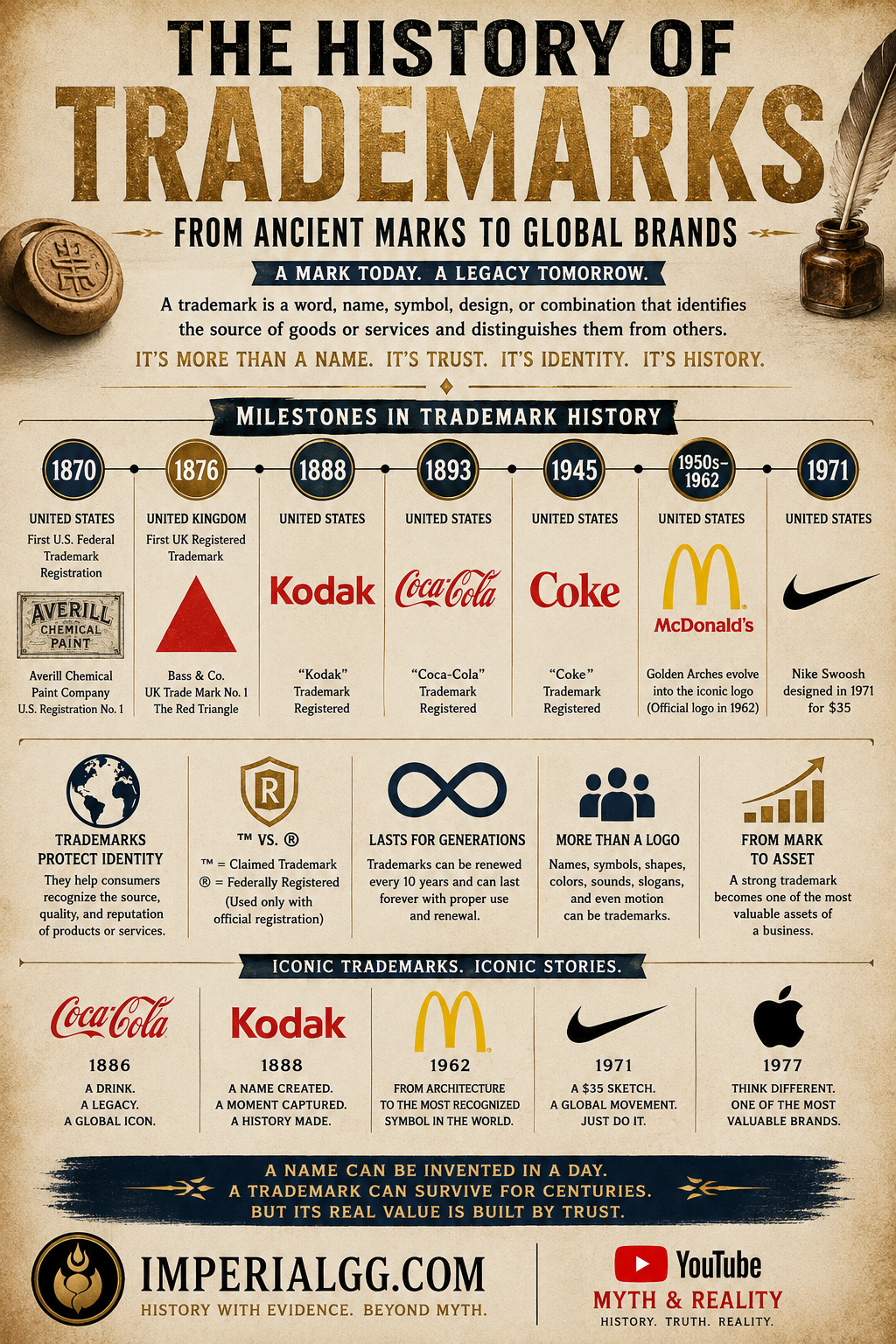
THE TRADEMARK TIMELINE
1870 — 🇺🇸 USA
Averill Chemical Paint Company
U.S. Registration No. 1
1876 — 🇬🇧 UK
Bass & Co.
UK Trade Mark No. 1 — Red Triangle
1888 — 🇺🇸
Kodak registered as a trademark
1893 — 🇺🇸
Coca-Cola registered
1945 — 🇺🇸
Coke registered
1950s–1962 — 🇺🇸
McDonald’s Golden Arches evolve into the company’s iconic logo
1971 — 🇺🇸
Nike Swoosh created
2026 — 🇬🇧
UK celebrates 150 years of trademark registration
From a brewer’s red triangle to global digital brands, the history of trademarks is ultimately the history of how commerce learned to turn identity into value.
A name can be invented in a day.
A trademark can survive for centuries.
But its real value is built by trust.
ImperialGG.com — History With Evidence. Beyond Myth.