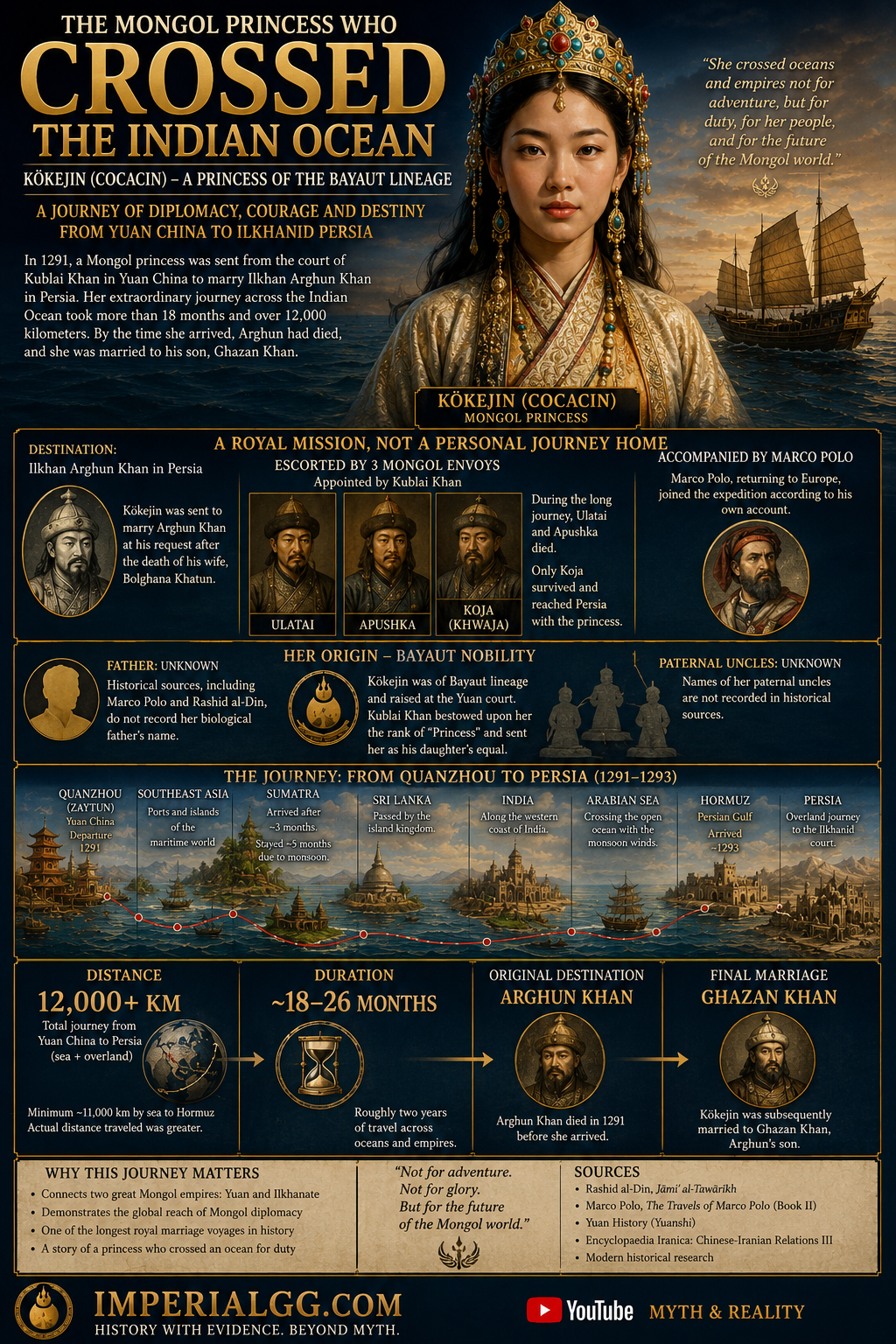
THE LONGEST JOURNEY OF A MONGOL PRINCESS?
By Altanbagana Baatar
DBA Candidate| Independent Historian
ImperialGG Historical Research Seriers
15 August 2026
Kökejin’s 12,000-Kilometer Journey from Yuan China to Persia 1291–1293
When we hear the name Marco Polo, we usually think of a Venetian traveller returning from China to Europe. But the most remarkable person on that journey was not Marco Polo. It was a Mongol princess.
Her name was Kökejin (Cocacin), a woman of the Bayaut lineage whom Kublai Khan sent from Yuan China to Persia for a dynastic marriage with the Ilkhan Arghun Khan. In 1291–1293, the party escorting Kökejin travelled by sea from Quanzhou (Zaytun) to Hormuz, crossing the maritime world of Southeast Asia and the Indian Ocean. Marco Polo, who was returning to Europe, accompanied the expedition according to his own account and later travelled onward through Persia.
The journey was extraordinary in both distance and duration. From Quanzhou to Hormuz, the principal maritime route through Southeast Asia, the Indian Ocean and the Persian Gulf represents a geographical minimum of roughly 11,000 kilometres when measured between the major waypoints. The actual distance sailed would have been considerably greater because medieval ships followed coastlines, islands, safe anchorages and seasonal monsoon routes rather than straight lines. The expedition also spent extended periods waiting for favorable winds.
This was therefore not simply a voyage across a sea. It was a journey across an entire oceanic world.
Quanzhou → Southeast Asia → Sumatra → Indian Ocean → India → Hormuz → Persia
The voyage lasted roughly two years, with the surviving accounts placing the expedition’s arrival in Persia around 1293. The length of the journey becomes even more striking when we remember that the travelers were not ordinary merchants. Kökejin was being transported as a diplomatic bride whose marriage was intended to strengthen the relationship between two distant branches of the Chinggisid imperial family.
A Royal Marriage Across the Mongol World
Kökejin had been selected after the death of Bolghana Khatun, who had been associated with the Ilkhanid ruling house. Arghun requested a woman from her lineage, and Kublai’s court organized the journey westward. Marco Polo names three envoys associated with the expedition—Oulatai, Apousca and Coja—and modern scholarship has noted that the names correspond closely with evidence from Yuan Chinese records.
The diplomatic mission was therefore much larger than the story of one Venetian traveller. The purpose was to carry a Mongol royal bride from one imperial court to another. And then history changed.
Arghun Khan died before Kökejin reached Ilkahanate.
The princess had travelled thousands of kilometres toward a husband who was already dead. Yet the diplomatic purpose of the journey did not disappear. Kökejin eventually married Ghazan Khan, Arghun’s son, thereby continuing the dynastic connection between the Yuan and Ilkhanid branches of the Mongol imperial family. Rashid al-Din records her arrival and marriage, while the Chinese-Persian evidence confirms the broader diplomatic context.
Marco Polo Was Not the Main Story
This distinction is important. Marco Polo’s account is one of the principal descriptions of the voyage, and he names the envoys who travelled with the princess. However, there is no independent Chinese or Persian record that names Marco Polo himself as a member of the embassy. Modern scholarship therefore treats his participation with some caution. What can be established securely is that the royal marriage mission existed, that Kökejin travelled from Yuan China to Persia by sea, and that Marco Polo claimed to have accompanied it while returning to Europe.
In other words:
Marco Polo was going home.
Kökejin was going to another Mongol court.
That difference completely changes the perspective of the story.
The Extraordinary Scale of the Journey
A European medieval princess travelling to another royal court might cross several kingdoms, mountain ranges and perhaps a sea channel. Kökejin’s journey was fundamentally different in scale. She crossed the maritime world between the Pacific and the Persian Gulf.
A conservative geographical reconstruction gives approximately:
Quanzhou → Java: ~3,700 km
Java → Sumatra: ~1,800 km
Sumatra → Sri Lanka: ~2,000 km
Sri Lanka → Western India: ~600 km
Western India → Hormuz: ~2,800 km
Minimum geographical distance to Hormuz: ~11,000 km
These figures represent straight-line distances between major waypoints, not the actual route sailed. The real voyage would have been longer because of monsoon navigation, coastal routes, port stops and detours. And Hormuz was not the final destination. From the Persian Gulf, Kökejin continued into the Iranian interior toward the Ilkhanid court.
Thus the complete journey from Yuan China to the Ilkhanid world can reasonably be described as more than 12,000 kilometres, depending on the exact route reconstructed.
A Journey Measured in Years
The distance alone does not tell the whole story. The expedition took roughly 26 months according to reconstructions based on Marco Polo’s chronology. The party had to wait for monsoon winds, cross dangerous seas and survive conditions that caused significant losses among the travelers. The voyage was therefore not simply long—it was extraordinarily slow by modern standards.
This is perhaps the most striking feature of Kökejin’s story. She was not travelling for a few weeks or even several months. She spent more than two years being transported from one end of the Mongol world to another. By the time she arrived, the political circumstances that had existed when she left China had changed completely.
Hormuz: The Gateway to Persia
Hormuz became the critical gateway between the Indian Ocean and the Persian world. Marco Polo had already visited Hormuz in 1272 and again in 1293, describing its flourishing commerce. At the time of Kökejin’s journey, Hormuz was an independent Persian Gulf principality rather than an Ilkhanid province. Nevertheless, its geographical position made it a crucial connection between maritime commerce and the Iranian interior.
For Kökejin, Hormuz marked the transition from the oceanic stage of the journey to the overland journey into Persia. It was the point where the maritime world of China, Southeast Asia and India met the continental world of Iran and the Mongol khanates.
More Than a Marriage
Kökejin’s journey reveals something fundamental about the Mongol Empire. The Mongol world was not connected only by armies and roads.It was connected by dynastic marriages, diplomatic missions, merchants, ships and women of the imperial house.
The Yuan and Ilkhanid states were separated by thousands of kilometres. Yet the Chinggisid dynastic system created political relationships that could move people across enormous geographical distances. Kökejin herself became the vehicle of that relationship.
Her journey connected:
Yuan China → Indian Ocean → Hormuz → Ilkhanid Persia
And the journey happened at a time when the Mongol imperial world was already divided into separate khanates. This makes the voyage especially significant. Political fragmentation did not eliminate the connections between the Chinggisid courts.
The Princess Behind Marco Polo’s Journey
For centuries, the story has been told as Marco Polo’s return from China.
But the historical perspective can be reversed.
Kökejin was crossing the world for a dynastic marriage. She was the Mongol princess whose journey made that voyage possible.
Marco Polo was returning home. He was the famous traveller whose account preserved part of the story.
From Quanzhou to Hormuz, the maritime journey alone covered a geographical minimum of approximately 11,000 kilometres. The complete journey into the Ilkhanid world exceeded 12,000 kilometres, and the expedition lasted roughly two years. Her original groom, Arghun Khan, died before she arrived.
Yet the mission ultimately succeeded in another form: Kökejin married Ghazan Khan, maintaining the dynastic relationship between two distant branches of the Mongol imperial family.
One princess.
One diplomatic mission.
More than 11,000 km across the sea.
More than two years of travel.
Two Mongol imperial worlds connected by a marriage.
That is the story behind Marco Polo’s famous journey home.