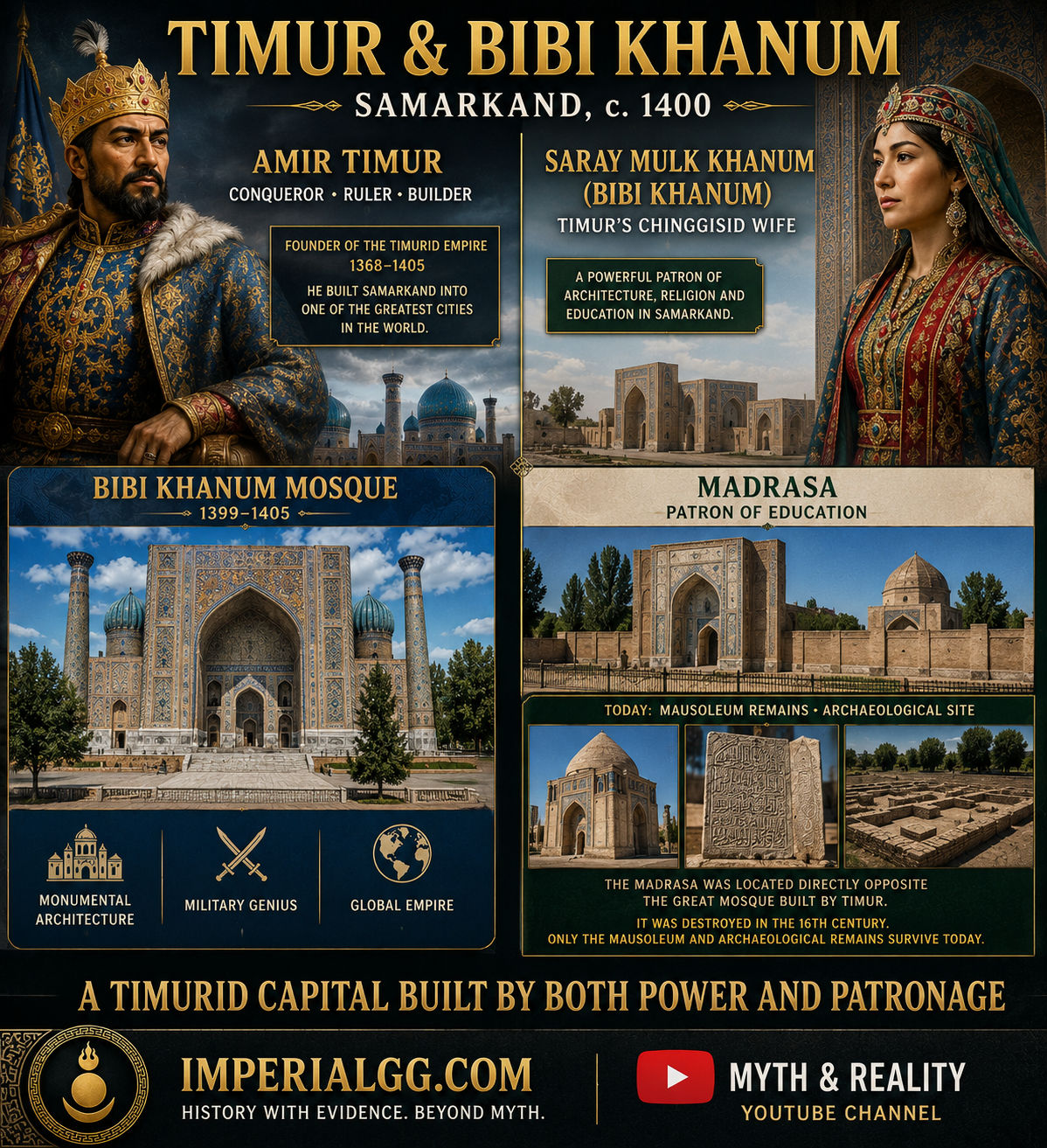
BIBI KHANUM — THE TIMURID QUEEN WHO PATRONIZED EDUCATION IN SAMARKAND
By Altanbagana Baatar
DBA Candidate| Independent Historian
ImperialGG Historical Research Seriers
16 August 2026
When people think of Timur’s Samarkand, they usually remember monumental mosques, palaces, mausoleums and the spectacular architecture of the Timurid age.
But behind some of these monuments stood an influential woman: Saray Mulk Khanum, Timur’s principal Chinggisid wife, better known as Bibi Khanum.
While Timur was away on his long military campaigns, Saray Mulk Khanum played an important role in the cultural and architectural life of Samarkand. Historical and architectural studies indicate that she commissioned a madrasa in Samarkand, situated directly opposite the great mosque associated with her name.
A MADRASA BUILT BY A TIMURID QUEEN
The madrasa stood across the road from the Bibi Khanum Mosque, forming an architectural relationship between the two institutions. The mosque served as one of the great religious monuments of Timur’s capital, while Saray Mulk Khanum’s madrasa functioned as a center of learning.
The madrasa itself has largely disappeared. It was destroyed in the late sixteenth century during the rule of the Shaybanid ruler Abdullah Khan II, leaving only its mausoleum structure. Archaeological and architectural studies have nevertheless allowed scholars to reconstruct aspects of the complex.
EDUCATION AND WOMEN’S PATRONAGE
The significance of Saray Mulk Khanum’s madrasa goes beyond architecture. Timurid royal women were not merely passive members of the court. Elite women could become patrons of scholarship, religious institutions, architecture and charitable foundations.
Recent scholarship on Timurid women emphasizes their role in the construction and patronage of madrasas. Saray Mulk Khanum’s institution in Samarkand represents one of the earlier examples of this tradition, later echoed by powerful Timurid women such as Gawhar Shad, who established her famous madrasa in Herat in the fifteenth century.
WAS IT A GIRLS’ SCHOOL?
This is where the historical claim needs to be handled carefully. Modern descriptions sometimes portray the Bibi Khanum madrasa as a school for girls, but the stronger academic evidence establishes that it was a madrasa founded and patronized by Saray Mulk Khanum. The surviving evidence does not allow us to confidently describe it as an exclusively female school.
That distinction actually makes the story more interesting. What we can say with confidence is that a powerful Timurid woman personally entered the sphere of educational patronage in the imperial capital. And this was happening in fourteenth–fifteenth-century Central Asia, centuries before modern concepts of women’s education emerged.
A DIFFERENT IMAGE OF THE TIMURID COURT
Saray Mulk Khanum’s story challenges a simplistic picture of medieval Muslim women as having no role in public intellectual or institutional life. Elite women in the Timurid world could possess wealth, influence political affairs, support scholars and sponsor major architectural projects. The evidence from Samarkand shows that education was among these areas of patronage.
The Bibi Khanum complex therefore represents more than Timur’s architectural ambition. It also reflects the power and cultural agency of a Timurid queen.
ROYAL EDUCATIONAL LANDSCAPE
By the early fifteenth century, Samarkand was becoming one of the great intellectual centers of the Timurid world. Saray Mulk Khanum’s madrasa formed part of this developing educational landscape. Later, Timur’s grandson Ulugh Beg would transform Samarkand into an even greater center of astronomy and mathematics, establishing his famous madrasa on the Registan.
The sequence is significant:
SARAY MULK KHANUM → EDUCATIONAL PATRONAGE
ULUGH BEG → SCIENCE AND ASTRONOMY
Together, they represent the growing intellectual ambitions of Timurid Samarkand.
So rather than saying simply that “Timur’s wife built a girls’ school,” the historically stronger statement is:
Saray Mulk Khanum, Timur’s principal wife, founded a madrasa in Samarkand and became one of the important female patrons of education in the Timurid world.
That claim is supported by the surviving architectural and historical evidence. And perhaps that is the more remarkable story.
A Mongol-Chinggisid princess became a Timurid queen.
A queen became a patron of education.
And her madrasa stood at the heart of Timur’s imperial capital.
SAMARKAND WAS NOT BUILT BY TIMUR ALONE.
It was also shaped by the women of the Timurid court.