
KHISHIGTEN: THE INSTITUTION OF ROTATIONAL SERVICE IN THE MONGOL EMPIRE
By Altanbagana Baatar
DBA Candidate| Independent Historian
ImperialGG Historical Research Seriers
05 November 2026
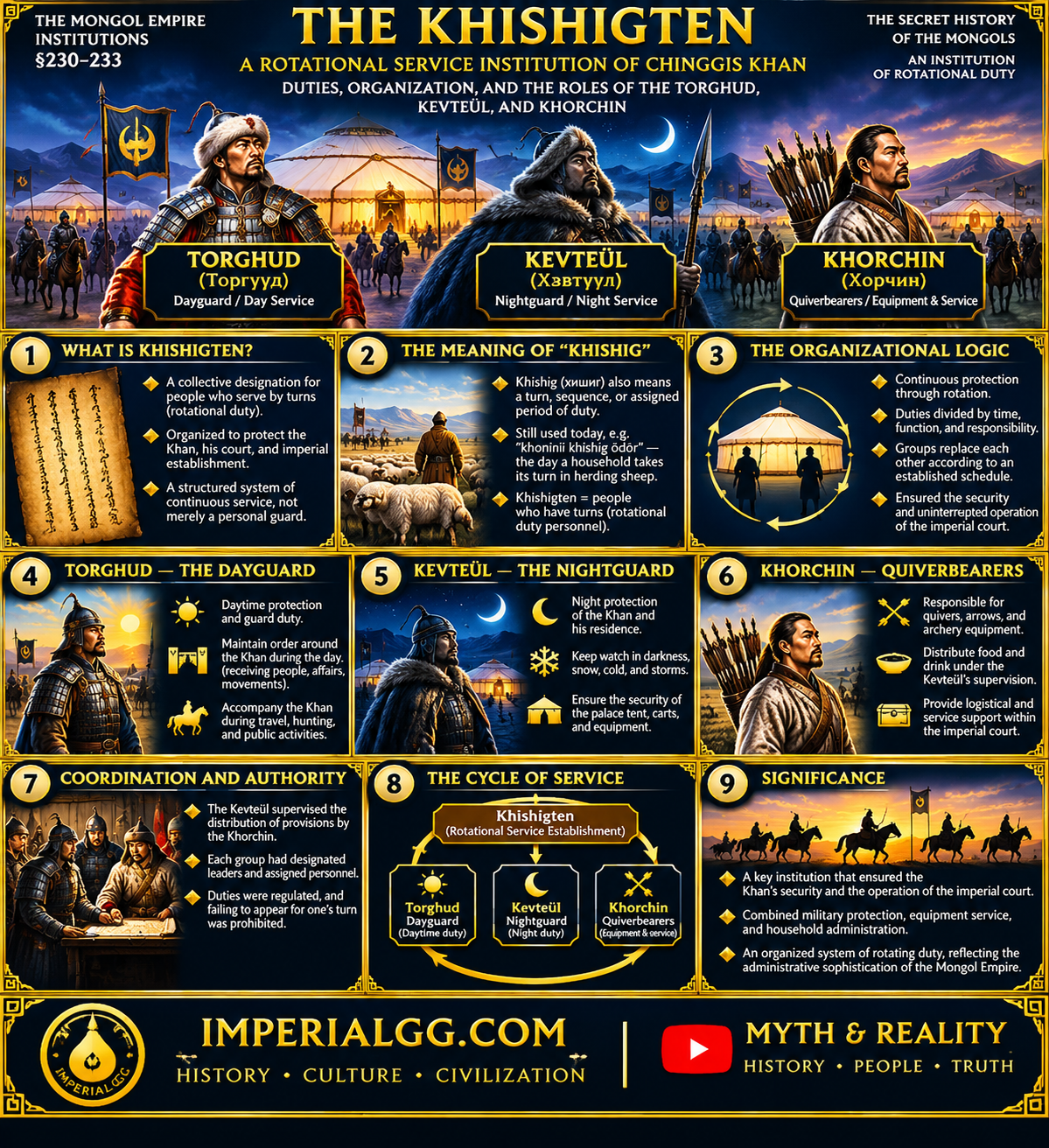
THE MEANING AND ORGANIZATION OF THE KEVTEÜL, TORGHUD, KHORCHIN, AND OTHER GUARD GROUPS UNDER CHINGGIS KHAN
An Institutional, Philological, and Historical Study of Rotational Service in the Mongol Imperial Court
ABSTRACT
The historical meaning of the Mongolian term Khishigten (Хишигтэн) has frequently been explained through its association with the ruler’s personal guard and, in some interpretations, with the idea of favour or privilege bestowed by the sovereign. Such explanations, however, do not adequately account for the term’s connection with the Mongolian word khishig (хишиг) in the sense of a turn, rotation, or assigned period of duty. In contemporary Mongolian usage, the expression khoninii khishig ödör (хонины хишиг өдөр) refers to the day on which a household takes its turn in herding sheep. This surviving usage provides important linguistic evidence for understanding khishig as a term associated with an allocated turn of work. The Mongolian Language Explanatory Dictionary explicitly records this meaning and defines khishigten as “people who have turns” (ээлж бүхий хүмүүс).
This article examines the proposition that Khishigten should be understood primarily as a collective designation for personnel organized through rotational service, rather than as a group defined by having received the ruler’s favour. It investigates the relationship between the terms Khishig, Khishigten, Kevteül, Torghud, and Khorchin, drawing upon the linguistic evidence of contemporary Mongolian, the institutional provisions of The Secret History of the Mongols, and modern historical scholarship. Particular attention is given to the distinction between the general principle of rotational service and the specialized functions performed by the different groups within the imperial establishment.
The analysis argues that the Khishigten institution should be understood as an organized system of service in which personnel were assigned duties according to established schedules and functional responsibilities. The Kevteül maintained night security, the Torghud performed daytime guard duties, and the Khorchin constituted a specialized group associated with quivers and archery equipment, while also appearing in provisions concerning the distribution of household supplies. These designations should not be treated as interchangeable titles or assumed to represent identical forms of service. Rather, they reveal the differentiated organization of a larger system in which the ruler’s security and the operation of the imperial court were maintained through coordinated service.
The article further examines the linguistic distinction between kesig as a portion or favour and kesig as a turn of duty. This distinction is essential because the two meanings have been discussed differently in Mongolian and Turkological scholarship. By separating the institutional meaning of rotational service from the semantic history of favour and benefit, the study proposes a more precise interpretation of the Khishigten as a service institution of the Mongol Empire.
Keywords: Khishigten, Khishig, Kevteül, Torghud, Khorchin, Turqa’ut, Mongol Empire, Chinggis Khan, rotational service, guard rotation, palace administration, Mongolian historical terminology.
1. INTRODUCTION: THE PROBLEM OF DEFINING THE KHISHIGTEN
The institutional organization of the Khishigten under Chinggis Khan is generally discussed in the context of the Mongol imperial army and the protection of the ruler. This approach is understandable because the surviving historical accounts describe the Khishigten as a body of selected personnel entrusted with guarding the Khan, protecting his residence, accompanying him during military campaigns, and maintaining the security of the imperial establishment. Nevertheless, identifying the institution exclusively as a royal or personal guard does not fully explain the meaning of its name or the organizational principle underlying its operation. The distinction between what the Khishigten did and how their service was organized is therefore essential to understanding the institution historically.
The central question of this study concerns the semantic and institutional relationship between khishig and khishigten. In present-day Mongolian, khishig has several meanings, but one particularly relevant usage refers to an assigned turn or sequence of work. The expression khoninii khishig ödör, literally the sheep-herding turn day, identifies the day on which a household is responsible for herding the community’s sheep. The responsibility is not necessarily a privilege or a benefit received from another person; it is an allocated obligation within a recurring arrangement of shared work. The person or household whose turn has arrived must perform the assigned task, after which responsibility passes to another participant according to the established order.
This usage is not merely an informal contemporary expression. The Mongolian Language Explanatory Dictionary records khishig in the meaning of “turn, sequence” and gives khoninii khishig ödör as an example, explaining it as the day on which a person or household takes its turn in herding sheep. The same dictionary lists khishigten as “people who have turns” (ээлж бүхий хүмүүс), alongside its historical definition referring to the guard protecting the person of a ruler. These definitions establish an explicit semantic connection between the words khishig and khishigten and the organization of work by turns. The dictionary entries can be consulted directly through the linked pages for ХИШИГ and ХИШИГТЭН.
The contemporary sheep-herding expression is especially important because it preserves the practical logic of the term. A household does not receive a special favour merely because its turn to herd sheep has arrived. It assumes a responsibility assigned within a system of rotation. The expression therefore illustrates a form of collective organization in which duties are distributed over time and performed in a predetermined sequence. This provides a meaningful point of comparison for the organization of the Mongol imperial guard, where the protection of the ruler and his court required personnel to serve at different times and under differentiated responsibilities.
The present study consequently approaches the Khishigten as a service institution organized through rotational duty. This interpretation does not deny that the guards occupied a privileged position in the imperial hierarchy, nor does it suggest that they lacked military functions. It distinguishes, rather, between the social and political status of the personnel and the organizational principle expressed by the institutional name. A group may enjoy exceptional status because of its proximity to the ruler while its name and internal organization refer to the rotation of assigned duties. The existence of privilege within an institution does not establish that privilege is the original or defining meaning of its name.
The argument must also distinguish between the general institution and the specialized groups within it. The Khishigten were not a single undifferentiated body whose members all performed identical work. The historical sources identify the Kevteül, Torghud, and Khorchin as groups associated with different responsibilities. The terms dayguard and nightguard describe the temporal organization of protective service, whereas quiverbearer identifies a more specialized equipment-related function. These categories may overlap within the wider institution, but they should not be collapsed into one another without textual evidence.
The analysis proceeds by examining the linguistic evidence first, then the institutional meaning of the Khishigten, and finally the individual designations of the Kevteül, Torghud, and Khorchin. The primary textual basis is The Secret History of the Mongols, particularly the provisions concerning the guard establishment and its operational duties. The text is examined alongside the work of I. Dashnyam, the research of Nobuhiro Uno, and other relevant scholarship. This comparative approach makes it possible to distinguish the meaning of the institutional name from later interpretations of its political status.
2. THE SEMANTIC FOUNDATION: KHISHIG AS AN ASSIGNED TURN OF DUTY
The interpretation of Khishigten requires attention to the different meanings associated with the word khishig. In modern Mongolian, the word is commonly understood in the sense of a benefit, blessing, favour, or allotted share. Such meanings are historically and linguistically relevant, but they do not exhaust the semantic range of the term. The meaning of khishig as a turn or sequence of duty is independently recorded in Mongolian lexicography and survives in everyday pastoral vocabulary. The distinction between these meanings is crucial because the institutional name Khishigten may derive from the latter sense when considered in the context of the guard’s organization.
The expression khoninii khishig ödör offers a particularly clear example. In a pastoral community, the responsibility for herding sheep may be distributed among households or families according to a recurring schedule. The household whose turn arrives assumes the work for the designated period, after which another household takes responsibility. The word khishig in this context does not mean that the household has been granted a special favour. It refers to its place in the sequence of assigned duties. The significance of the expression lies in the relationship between a recurring collective responsibility and the individual or household whose turn it is to perform that responsibility.
This distinction is supported by the Mongolian Language Explanatory Dictionary, which separates the meaning of khishig as an allocated portion or favour from its meaning as “turn, sequence.” The example of sheep-herding duty is not an incidental metaphor; it is a recorded lexical usage. Likewise, the dictionary’s definition of khishigten as “people who have turns” provides direct support for understanding the word as a designation of persons participating in a rotational arrangement. These definitions should be treated as linguistic evidence in their own right, although the historical application of the term still requires confirmation through medieval sources.
A particularly important contribution to this interpretation appears in I. Dashnyam’s Mongol Ulsyn Tör, Erkh Züin Tüükh (History of the State and Law of Mongolia), published in 2005. In his discussion of the Khishigten, Dashnyam explicitly rejects the explanation that the name means “those who have received favour” and instead connects it with the sequence and rotation involved in herding livestock. He interprets the Khishigten as a rotational guard force responsible for protecting Chinggis Khan and his imperial residence continuously, throughout both day and night. Dashnyam further describes the organization of the institution into Kevteül, Torghud, and Khorchin, whose responsibilities differed according to their functions. His discussion appears in the section on the military organization of the Mongol state, particularly the material printed around pp. 301–302 and the explanatory note on p. 409. The full work is available in the digitized edition of Dashnyam’s 2005 study.
Dashnyam’s interpretation is important because it connects the lexical meaning of the word with the actual organization of the guard. His explanation is not limited to the observation that the word khishig can mean a turn. He argues that the Khishigten were organized to protect the Khan and his court through a system of rotating service. The name therefore expresses the organizational principle of the institution rather than merely the status of the people who served within it. This interpretation is consistent with the contemporary pastoral usage, in which khishig refers to a scheduled obligation that passes among participants.
A further contribution comes from Nobuhiro Uno’s 2018 study of the Kešigten of the Mongol imperial court and the central mingghan associated with Chinggis Khan. Uno directly addresses the meanings of the Mongolian terms kešig and kešigten, arguing that the relevant meaning of kešig is not simply “imperial guard” but “turn,” “working in turn,” or a team that works in rotation. His argument is especially relevant because it addresses the tendency in modern scholarship to use keshik as though it were itself the name of the imperial guard, without distinguishing the institutional designation from the meaning of the underlying term. Uno’s article, published in Omon Ronso, volume 96 (2018), pp. 247–269, can be consulted through its academic record and abstract.
The significance of Uno’s argument is that it provides a scholarly basis for treating rotational service as a central semantic component of the term. It also demonstrates that this interpretation is not limited to modern Mongolian folk usage. It has been raised in the context of historical Mongolian and Turkic linguistic research and applied to the organization of the imperial court.
At the same time, the philological history of the term requires a careful distinction. Some scholarship has treated kesig in the sense of a portion or share, from which meanings such as favour, benefit, or good fortune developed. In a discussion of the term, an academic study available through the School of Oriental and African Studies repository distinguishes this semantic history from another form associated with Turkic käzig, meaning a guard, watch, or turn of guard duty. It notes that the two forms have sometimes been confused in lexicographical treatment. The relevant discussion is available in the SOAS-hosted study of Mongolian terminology, pp. 156–157.
This distinction is essential to the present argument. It would be linguistically imprecise to claim that every historical occurrence of kesig necessarily means a turn of duty, just as it would be historically inadequate to assume that every occurrence means favour or benefit. The two semantic histories must be examined in context. When the term is applied to the institution responsible for maintaining continuous protection through successive periods of service, the meaning of rotation is particularly relevant. The institutional evidence, the modern Mongolian usage, and the interpretations advanced by Dashnyam and Uno converge in supporting this reading.
The argument of this article is therefore not that the word khishig never carried the meanings of portion, favour, or benefit. Rather, it is that the name Khishigten, when used to designate the guard establishment of the Mongol court, is best explained through the principle of rotational service. The expression identifies the personnel who fulfil assigned duties in an organized sequence. Their privileged relationship with the ruler was a consequence of their institutional position, not necessarily the semantic foundation of the name.
3. KHISHIGTEN: THE GENERAL DESIGNATION OF PERSONNEL IN ROTATIONAL SERVICE
If khishig denotes an assigned turn or sequence of duty, khishigten can be understood as the collective designation for the people who participate in that arrangement. The suffix -ten forms a designation of persons associated with or possessing the quality expressed by the preceding word. In this institutional context, khishigten therefore refers to personnel whose service is organized according to assigned turns. The significance of this interpretation is that it places the emphasis on the organization of work rather than on the personal relationship between the individual and the ruler.
The Khishigten institution was not simply a group of men who happened to be near Chinggis Khan. It was a structured service establishment whose members were selected, assigned, supervised, and required to fulfil particular duties. The protection of the Khan and his court had to continue without interruption, even when individual guards were resting, eating, attending to other responsibilities, or being replaced by another group. The institution therefore required a system through which service could be divided and transferred while the overall responsibility remained continuous. The principle of rotation provided precisely this organizational mechanism.
The importance of this arrangement becomes clear when the protection of the ruler is considered as a continuous institutional responsibility rather than an occasional military task. A ruler’s residence required security during the day and throughout the night. Personnel had to monitor access to the palace, maintain the perimeter, protect transport equipment, accompany the ruler during movement, and ensure that the court remained secure when the ruler was absent from the main encampment. These duties could not be performed effectively by a single group working without a schedule. They required an organized division of labour and the transfer of responsibility between groups.
Dashnyam’s account of the Khishigten is particularly relevant in this regard. He describes the institution as divided into Kevteül, Torghud, and Khorchin and states that the personnel served in four shifts. He further explains that the shift leaders assembled their assigned Khishigten, placed them on duty, and arranged their replacement after three days. He also records that failure to appear for an assigned shift was prohibited. These details are important because they show that rotation was not merely a general principle inferred from the meaning of the word. It was reflected in an organized system of service, with designated leaders, assigned personnel, scheduled replacement, and disciplinary rules. Dashnyam’s discussion can be examined in the 2005 digitized edition, particularly the section around printed pages 301–302.
The existence of a rotation system also explains why the Khishigten should not be defined exclusively through the idea of a personal guard. A personal guard may be described by the person or institution it protects, but the name Khishigten points toward the organization of the service itself. The guards were attached to the Khan, but their service was structured through turns. The institutional name therefore expresses an operational principle: the protection of the ruler and his court was maintained through personnel whose duties were assigned and transferred according to an established sequence.
This interpretation also helps explain the distinction between the general name and the names of the constituent groups. Khishigten identifies the broader service establishment, while Kevteül, Torghud, and Khorchin identify differentiated groups or functions within it. The general designation should not be confused with the specific name of any one group. A Kevteül was not simply another word for Khishigten; rather, the Kevteül formed one specialized component within the wider institution. Similarly, the Torghud and Khorchin should be understood through their particular responsibilities and their relationship to the wider system.
The historical importance of the distinction is considerable. If the term Khishigten is translated simply as “imperial guard,” the organizational meaning of the name becomes less visible. The translation identifies the general function of the institution but does not communicate the principle of rotational service. A more explanatory translation would be “the rotational guard establishment” or “the personnel serving by turns in the imperial guard.” Such renderings preserve the connection between the institutional name and the organization of service. In an academic article, it is preferable to retain the Mongolian term Khishigten and explain its meaning rather than replace it with an English expression that obscures its linguistic structure.
4. KEVTEÜL: THE NIGHTGUARD AND THE CONTINUITY OF NIGHT SERVICE
The term Kevteül (Хэвтүүл) is associated with the nightguard function within the Khishigten establishment. In the English translation of The Secret History of the Mongols, Francis Woodman Cleaves uses the expression nightguards for the personnel whose duties are described in the relevant passages. The designation is significant because it identifies a particular form of service within the broader rotational arrangement. The Kevteül were responsible for maintaining the security of the ruler and the imperial establishment during the night, when the Khan’s personal protection required continuous vigilance and controlled access to his residence.
Section 230 of The Secret History of the Mongols provides an important description of this responsibility. Chinggis Khan recalls the guards who remained around his tent during cloudy and starry nights, who stood watch during snowstorms, cold, and rain, and who remained alert when enemies approached. The passage emphasizes their refusal to sleep while the Khan rested and their readiness to respond immediately to danger. The guards’ service is therefore presented as a continuous responsibility that protected the ruler during the period when he was most dependent upon the vigilance of others. The original text, its transliterations, and Cleaves’s English translation can be compared through the Monumenta Altaica collection of The Secret History of the Mongols, which provides access to the 1936 manuscript edition, the transliterations of Lajos Ligeti, Sergei Kozin, Paul Pelliot, and John Street, and several translations.
The significance of the Kevteül becomes even clearer in §§232–233, where the Khan defines their administrative responsibilities and restricts their independent deployment in warfare. The Kevteül were not merely stationed around the ruler’s sleeping quarters. They supervised household personnel, animal keepers, tent-carts, equipment, provisions, and access to the palace tent. They also accompanied the Khan during falconry and hunting, while leaving a portion of their contingent at the carts. Their nightguard function was therefore part of a broader responsibility for maintaining the security of the imperial establishment.
The connection between the nightguard and rotational service is particularly important. Night protection had to be maintained every night, but the same individuals could not remain continuously on duty without replacement. The institution required an arrangement through which responsibility passed from one group to another. The Kevteül therefore represented a specialized service function within the general system of rotation. Their name identified the duty they performed, while the broader designation Khishigten identified the personnel and institutional arrangement through which the duties were organized.
Dashnyam’s account supports this interpretation by describing the Kevteül as the group responsible for night protection and stating that they were organized into shifts. He also identifies commanders and officials associated with the nightguard organization. The text records that the Kevteül were supervised by designated leaders and that their duty was coordinated with the daytime service of the other groups. This demonstrates that night protection was not an informal practice carried out whenever individual guards were available; it was a regulated service with assigned personnel and leadership.
The role of the Kevteül should therefore be understood in two related but distinct ways. At the functional level, they were the nightguards responsible for the security of the Khan and his immediate establishment. At the institutional level, they formed a specialized component of the Khishigten system, whose service was organized through rotation and regulated by the Khan’s decrees. This distinction avoids reducing the Kevteül either to a mere time-of-day label or to a separate institution unrelated to the wider Khishigten organization.
5. TORGHUD: THE DAYGUARD AND THE DAYTIME SERVICE OF THE IMPERIAL COURT
The Torghud (Торгууд) are identified in the historical literature as the daytime guard group within the Khishigten establishment. Cleaves’s translation of The Secret History of the Mongols uses dayguards for the seventy men associated with Ögöle Čerbi in §230. The designation indicates a distinction between daytime and nighttime service, and this distinction is central to understanding the organization of the ruler’s protection. Whereas the Kevteül maintained the night watch, the Torghud were associated with the daytime guard function.
The distinction between the two groups should not be interpreted as evidence that one was more important than the other. Rather, it reflects the practical requirements of continuous protection. The ruler’s security could not be suspended during daylight, just as it could not be suspended during the night. The daytime guard had to maintain the security of the Khan while he received visitors, conducted official business, travelled, participated in hunting or other outdoor activities, and interacted with the personnel of the imperial establishment. The nightguard and dayguard functions were therefore complementary components of a continuous protective arrangement.
Section 230 records that the seventy dayguards associated with Ögöle Čerbi were given a distinguished designation. This detail is significant because it shows that the daytime guard was a formally recognized group associated with an identifiable official. The number seventy refers to the group described in this particular passage; it should not automatically be treated as the total number of Torghud throughout the later imperial organization. Dashnyam records a much larger figure for the Torghud in his reconstruction of the ten-thousand Khishigten establishment, describing them as the largest component of the three-part organization. The difference between the seventy mentioned in §230 and the later figures should be understood in relation to the historical development and expansion of the institution, rather than treated as a contradiction that can be resolved by assuming that the numbers refer to the same moment and organizational level.
Dashnyam describes the Torghud as responsible for daytime protection, while the Kevteül maintained night security. He further explains that the daytime personnel were replaced according to an established schedule and that the shift leaders were responsible for assembling and presenting their assigned members. This account supports the interpretation that the Torghud were not simply a group of warriors who happened to be active during the day. They formed a designated component of a larger service system in which the time of duty and the transfer of responsibility were regulated.
The distinction between daytime and nighttime service is also discussed in modern scholarship beyond Mongolian-language historiography. A. Poghosyan’s study in the Herald of Social Sciences of the National Academy of Sciences of Armenia describes the Mongol guard as maintaining twenty-four-hour supervision at the Khan’s residence and identifies the Torghud as the daytime subdivision and the Kevteül as the nighttime subdivision. This interpretation provides comparative support for understanding the two terms as designations of differentiated service periods. The relevant discussion appears on p. 95 of the journal issue and can be consulted in the 2019 journal PDF.
The Torghud should therefore be understood as the daytime guard component of the Khishigten system. Their designation is associated with the period during which they performed protective service, while their participation in the wider institution was organized through rotation. This distinction is important because it demonstrates that the Khishigten system was structured not only by the identity of the personnel but also by the time and sequence in which their responsibilities were performed.
6. KHORCHIN: QUIVERBEARERS, SPECIALIZED EQUIPMENT, AND SERVICE WITHIN THE IMPERIAL ESTABLISHMENT
The term Khorchin (Хорчин) requires a different kind of analysis because its functional designation is not identical to the temporal distinction represented by Kevteül and Torghud. In Cleaves’s translation of The Secret History of the Mongols, the group is identified as quiverbearers. The name is associated with the quiver and the equipment required for archery. It therefore refers to a specialized function connected with the weapons and equipment of the ruler’s establishment, rather than simply identifying a daytime or nighttime service period.
Section 230 associates the quiverbearers with Yesün Te’e and Bugidai. The passage gives them a formal designation and distinguishes them from the nightguards, the dayguards, and the ba’atud associated with Arqai. This differentiation is important because it demonstrates that the Khishigten institution contained groups whose identities were based on different functions. The Kevteül and Torghud are associated with the temporal organization of guard service, while the Khorchin are identified through their relationship to quivers and archery equipment.
The role of the Khorchin becomes more complex in §232, where Cleaves describes the quiverbearers distributing food and drink under the supervision of the Kevteül. They are instructed not to distribute provisions without permission from the guards responsible for supervising the supplies, and distribution must begin with the Kevteül. This provision indicates that the Khorchin participated in activities beyond the narrow function suggested by the English term quiverbearers. Their responsibilities within the imperial establishment included service associated with provisions and distribution. The passage also reveals an administrative relationship between the Khorchin and the Kevteül: the former carried out a particular task, while the latter exercised supervisory authority over the process.
This relationship is significant for understanding the wider organization of the Khishigten. The groups were not isolated units that performed unrelated activities. Their responsibilities could intersect within the operation of the imperial court. The Khorchin’s association with quivers and archery equipment did not necessarily prevent them from performing other service functions, while the Kevteül’s responsibility for night protection did not restrict their authority to matters of physical security alone. The decrees show that the imperial establishment required coordination between personnel whose primary designations reflected different functions.
Dashnyam’s reconstruction treats the Khorchin as one of the three principal components of the Khishigten and assigns them a defined place within the larger organization. He records that the Khorchin were fewer in number than the Torghud and that their responsibilities differed from those of the daytime and nighttime guard groups. In his account, the Khorchin were associated with the service and equipment functions of the imperial establishment. This interpretation should be considered alongside Cleaves’s translation and the original wording of the Secret History, rather than treated as a direct equivalent of the English word quiverbearer in every context.
The Khorchin therefore demonstrate that the Khishigten institution cannot be reduced to a simple two-part division between dayguards and nightguards. Although the temporal rotation of protection was central to the institution, the imperial court also required specialized personnel responsible for equipment and other forms of service. The Khorchin occupied such a position. Their inclusion within the wider Khishigten organization indicates that the institution combined rotational protection with differentiated household and equipment responsibilities.
7. TURQA’UT, KEVTEÜL, AND THE ORGANIZATION OF DAY AND NIGHT DUTY
The distinction between Turqa’ut and Kevteül is particularly important because it reveals how the temporal organization of the guard was expressed in institutional terminology. In the scholarly literature, Turqa’ut is commonly associated with the daytime guard, while Kevteül is associated with the nightguard. These terms identify differentiated service groups whose responsibilities corresponded to the continuous protection required by the ruler and his court.
Igor de Rachewiltz’s commentary on The Secret History of the Mongols discusses the guard as divided into dayguards (turqa’ut) and nightguards (kebte’ül), and refers to the extensive scholarly literature on the interpretation and organization of these groups. His commentary is particularly useful because it identifies the relevant terminology and points to earlier studies by scholars including Paul Pelliot, Francis Woodman Cleaves, Erich Haenisch, and others. The commentary is available in the digitized edition of de Rachewiltz’s The Secret History of the Mongols.
The relationship between the daytime and nighttime guard groups should be understood through the requirements of continuous service. The ruler’s residence required protection at every hour, but the personnel responsible for that protection had to be able to rest and perform other assigned duties. The organization therefore required a system in which one group assumed responsibility when another completed its period of service. The distinction between Turqa’ut and Kevteül reflects the division of responsibility according to time, while the wider Khishigten institution provided the organizational framework through which the service was maintained.
Dashnyam’s account provides further details of this arrangement. He describes the Khishigten as divided into four shifts and records that shift leaders assembled their assigned personnel, placed them on duty, and arranged replacement after three days. He also states that the shift could not be missed and that failure to fulfil the assigned duty was subject to punishment. This suggests that the daytime and nighttime distinction existed within a broader rotational system. The guard groups were not simply divided into two permanent bodies, one active during the day and the other during the night; they were organized through schedules and shifts that ensured the continuity of service.
The distinction between a functional group and a shift must therefore be maintained. Turqa’ut and Kevteül identify differentiated guard functions, while the four-shift arrangement described by Dashnyam concerns the scheduling and rotation of personnel within the institution. The two principles are related but not identical. One concerns the type or period of duty; the other concerns the sequence in which individual personnel assume that duty. This distinction is essential for reconstructing the organization of the Khishigten accurately.
8. THE INSTITUTIONAL LOGIC OF ROTATION: CONTINUOUS SERVICE, DIVISION OF LABOUR, AND DISCIPLINE
The principle of rotational service provides a coherent explanation for the relationship among the different groups within the Khishigten. The institution had to maintain the security of the ruler and the imperial court continuously, but the responsibilities involved were too extensive to be performed by a single group without interruption. The service therefore required both functional differentiation and temporal rotation. The Kevteül maintained night security, the Torghud performed daytime guard duties, and the Khorchin carried out specialized equipment-related and service functions. Within these broader responsibilities, personnel were organized through shifts and supervised by designated leaders.
The four-shift arrangement described by Dashnyam is particularly important because it reveals the institutional consequences of rotation. A rotational system requires a clear schedule, identifiable personnel, a designated leader, and a procedure for transferring responsibility. Without these elements, the continuity of service cannot be maintained. Dashnyam’s account describes the shift leaders as responsible for arranging the personnel under their authority and ensuring that the assigned members entered service. The requirement that the guard must not miss its turn indicates that the institution depended upon the reliability of each individual participant. The absence of one member or the failure of a group to appear could compromise the security arrangement as a whole.
The disciplinary provisions associated with the Khishigten further demonstrate the importance of the schedule. The service was not optional, nor could an individual decide independently when to appear or withdraw. The rules concerning missed shifts, unauthorized movement, and the conduct of guards indicate that the institution operated under a strict system of accountability. The guard’s responsibility was defined by the assigned service, and failure to fulfil it could result in punishment. The legal and administrative significance of these provisions lies in their recognition that the continuity of imperial protection depended upon the regular performance of rotational duties.
The organization also required coordination between groups performing different functions. The Kevteül supervised the distribution of provisions by the Khorchin, while the daytime and nighttime guard responsibilities had to be transferred according to the established schedule. The protection of the ruler could not be separated from the operation of the household, the security of equipment, and the movement of the imperial encampment. The system therefore combined a temporal division of duty with a functional division of labour.
The significance of this arrangement becomes particularly clear in §233 of The Secret History of the Mongols. Chinggis Khan prohibits the Kevteül from being sent independently to war when he himself does not campaign. The decree explains that the guards have multiple responsibilities: they protect the Khan’s person, accompany him during falconry and hunting, supervise the ordo, care for the carts, and maintain the night watch. The restriction is therefore closely connected with the preservation of the service system. If the guards were removed from their assigned duties and deployed elsewhere, the continuity of protection and administration could be disrupted.
The Khishigten institution should consequently be understood as a system of continuous service maintained through rotation, specialization, and discipline. Its military character was important, but its organization extended beyond the battlefield. The guards protected the ruler, supervised access to the palace, maintained the security of equipment and provisions, and supported the operation of the mobile imperial court. The principle of rotation made it possible for these responsibilities to continue without interruption.
9. THE HISTORICAL SIGNIFICANCE OF THE KHISHIGTEN AS A ROTATIONAL SERVICE INSTITUTION
Understanding the Khishigten through the principle of rotational service changes the way the institution should be situated within the history of the Mongol state. If the name refers to personnel who perform assigned duties by turns, the institution must be examined not only as a military formation but also as an organized system for maintaining the ruler’s security and the functioning of the imperial court. This interpretation brings the Khishigten into the broader history of Mongolian administrative organization, where collective responsibilities were distributed among groups and fulfilled according to established schedules.
The distinction is especially important in the context of a mobile imperial court. The residence of the Khan was not a permanently fixed palace whose security depended upon a stationary body of guards. The imperial establishment moved, and its personnel had to maintain protection while the court travelled, encamped, conducted official business, and participated in hunting or military activities. The continuity of these responsibilities required an organization that could distribute work among different groups and transfer responsibility without interrupting service. The rotational principle was therefore not merely a convenient arrangement for dividing labour; it was a fundamental requirement of the institution’s operation.
The designation Khishigten also helps explain the relationship between the collective institution and its specialized components. The Kevteül and Torghud were associated with night and daytime guard functions, while the Khorchin were connected with quivers, archery equipment, and other service responsibilities. Their functions were distinct, but they belonged to a wider institutional framework. This means that the Khishigten should not be understood as a simple synonym for any one of these groups. It was the general establishment through which different forms of service were organized and coordinated.
The institutional significance of rotation is also reflected in the relationship between service and authority. The shift leaders were responsible for ensuring that their assigned personnel appeared for duty, while the Khan’s decrees established restrictions on the use of the guards by other military commanders. The prohibition against deploying the Kevteül independently in warfare when the Khan himself did not campaign demonstrates that their assigned responsibilities took precedence over the immediate demands of other military formations. The guards were therefore protected not because they were merely favoured individuals, but because their continued availability was necessary for the operation of the institution.
The interpretation also has implications for the study of Mongolian political terminology. The meaning of Khishigten should not be determined solely through modern translations such as “royal guard” or “imperial bodyguard.” These expressions describe the institution’s general purpose but do not fully communicate the organizational principle expressed by the Mongolian term. Retaining Khishigten and explaining it as a rotational service establishment provides a more precise historical interpretation. It allows the term to retain its linguistic specificity while making its institutional meaning accessible to international scholarship.
10. AUTHOR’S THESIS: KHISHIGTEN AS THE GENERAL DESIGNATION OF ROTATIONAL SERVICE PERSONNEL
The central thesis of this article is that Khishigten was the general designation for personnel organized to perform assigned service by turns, and that the imperial guard of Chinggis Khan represented a historically developed form of this rotational service institution. Its defining organizational principle was not the receipt of favour from the ruler but the performance of duties according to a regulated sequence. The protection of the Khan and his court was the principal institutional responsibility, while the names Kevteül, Torghud, and Khorchin identified differentiated functions and service categories within the larger establishment.
This interpretation rests upon the convergence of three forms of evidence. First, contemporary Mongolian vocabulary preserves khishig in the sense of a turn or sequence of duty, particularly in the expression khoninii khishig ödör. The Mongolian Language Explanatory Dictionary explicitly records this meaning and defines khishigten as people who have turns. Second, Dashnyam directly interprets the Khishigten as a rotational guard force and describes its organization into specialized groups and shifts. Third, Uno’s research identifies the meaning of kešig in relation to turning, working in rotation, and a team performing duties by turns. These sources provide mutually reinforcing evidence for understanding the institutional name through rotational service rather than through the semantic category of favour.
The functions of the specialized groups reinforce this interpretation. The Kevteül maintained night security, while the Torghud performed daytime guard duties. Their responsibilities corresponded to the continuous protection required by the Khan and his court. The Khorchin, associated with quivers and archery equipment, occupied a differentiated position within the same establishment and also participated in other services recorded in the historical text. The institutional structure therefore combined temporal organization with functional specialization. The general system of rotation did not require every group to perform identical tasks; it required each group to fulfil its assigned responsibilities within the larger sequence of imperial service.
The importance of the Khishigten should consequently be understood in relation to the practical organization of the Mongol state. The institution ensured that the ruler’s security and the operation of his immediate establishment could be maintained continuously. It coordinated personnel, duties, schedules, equipment, access, and logistical responsibilities. The guards’ privileged position within the imperial hierarchy was a consequence of the importance of these responsibilities and their direct relationship with the Khan. It should not be confused with the semantic basis of the institutional name.
The article therefore proposes a distinction between the meaning of the institution’s name, the organization of its personnel, and the political status of its members. The name Khishigten expresses the principle of rotational service; the Kevteül, Torghud, and Khorchin represent differentiated groups and functions within that organization; and the institution’s privileged position reflects its importance to the security and administration of the imperial court. Keeping these dimensions separate provides a more accurate foundation for studying the Khishigten historically.
11. CONCLUSION
The examination of Khishig, Khishigten, Kevteül, Torghud, and Khorchin demonstrates that the terminology of the Mongol imperial guard should be interpreted through the relationship between language and institutional organization. The contemporary Mongolian expression khoninii khishig ödör preserves the meaning of khishig as an assigned turn of work, while the Mongolian Language Explanatory Dictionary explicitly defines khishigten as people who have turns. This linguistic evidence is consistent with the historical interpretation advanced by I. Dashnyam and the philological argument developed by Nobuhiro Uno.
The evidence supports the interpretation that the Khishigten represented a rotational service institution whose principal responsibility was to maintain the security of the Khan and the continuity of the imperial court. Its organization depended upon the assignment and transfer of duties among specialized groups. The Kevteül performed nightguard service, the Torghud were associated with daytime protection, and the Khorchin were identified through their specialized relationship with quivers and archery equipment, while also participating in other services within the imperial establishment. These groups were differentiated by their functions but connected through the larger organization of rotational service.
The distinction between the institution’s name and the status of its members is fundamental. The Khishigten occupied a privileged position because they served the Khan directly and performed responsibilities essential to the operation of the imperial court. Nevertheless, this privileged status does not establish that the word Khishigten originally meant “people who received the ruler’s favour.” The evidence examined here provides stronger grounds for interpreting the name in relation to assigned turns of duty. The meaning of favour or benefit belongs to a separate semantic development and should not be substituted for the institutional meaning without adequate philological justification.
The Khishigten should therefore be studied as an organized system of rotational service rather than defined exclusively as a royal bodyguard. Its historical significance lies in the way it connected military protection, household administration, logistical organization, and the continuous operation of the mobile imperial court. The institution demonstrates that the Mongol state relied not only on military strength and command hierarchy but also on regulated systems of service through which essential responsibilities were distributed and maintained.
The central conclusion is that Khishigten was the general designation of personnel performing assigned duties by turns; the Kevteül, Torghud, and Khorchin were differentiated groups within this wider organization, whose responsibilities together ensured the continuous protection and operation of the imperial establishment. This interpretation offers a more precise basis for understanding the institutional vocabulary of the Mongol Empire and for reconsidering the organization of Chinggis Khan’s guard within the broader history of Mongolian state administration.
12. TERMINOLOGICAL AND SOURCE-CRITICAL NOTES
The distinction between khishig as a turn of duty and kesig as a portion, favour, or benefit requires further philological investigation. Some scholars have treated the latter semantic history as primary, while others have connected the institutional term with a Turkic form meaning a turn or guard duty. The study hosted by SOAS explicitly distinguishes these meanings, noting that the Mongolian form associated with a turn of duty may be a different word from the form associated with a portion or share. Uno’s 2018 research, meanwhile, argues that the relevant institutional term should be understood through rotational service. These positions should be compared rather than collapsed into a single etymological claim. The present article adopts rotational service as the most convincing explanation for the institutional designation, while recognizing that the complete historical relationship between the forms requires further comparative linguistic work.
The terms Torghud and Turqa’ut also require attention. Cleaves and de Rachewiltz use the transcription turqa’ut for the dayguards, while Mongolian historical writing commonly uses торгууд. These forms should be compared against the original text and the relevant scholarly transcriptions before establishing a standardized transliteration for all periods. The article uses Torghud for the Mongolian institutional designation and identifies Turqa’ut when referring to the scholarly transliteration of the historical term.
The interpretation of the Khorchin should likewise remain distinct from the temporal division between dayguards and nightguards. The source identifies them as quiverbearers, and their duties should not be reduced to a simple daytime or nighttime shift. Their participation in the distribution of provisions in §232 demonstrates that their service could extend beyond the narrow function suggested by the English translation. A complete reconstruction of their institutional role requires comparison of the relevant provisions in The Secret History of the Mongols with later Mongolian and Chinese sources.
Finally, the numerical organization described by Dashnyam should be distinguished from the specific figures recorded in individual passages of the Secret History. The seventy dayguards associated with Ögöle Čerbi in §230 belong to a particular textual context and should not automatically be treated as the total strength of the Torghud at every stage of the institution’s development. The figures describing the ten-thousand establishment and its component groups reflect a broader institutional reconstruction and must be interpreted in relation to chronology and changes in organization.
BIBLIOGRAPHY
PRIMARY SOURCES
1. The Secret History of the Mongols. Chapter X and the provisions concerning the Khishigten. Original text in Chinese transcription, transliterations, and translations. Monumenta Altaica — The Secret History of the Mongols. The site provides access to the 1936 manuscript edition, the transliterations of Lajos Ligeti, Sergei Kozin, Paul Pelliot, and John Street, and the English translation by Francis Woodman Cleaves.
MONGOLIAN SCHOLARSHIP
2. Dashnyam, I. Монгол улсын төр, эрх зүйн түүх. Vol. I. Ulaanbaatar, 2005, especially pp. 301–302 and the explanatory note on p. 409. Digitized full text.
3. Монгол хэлний их тайлбар толь. Entries ХИШИГ and ХИШИГТЭН. ХИШИГ; ХИШИГТЭН.
INTERNATIONAL SCHOLARSHIP
4. Uno, Nobuhiro. “The Kešigten of the Palace of the Mongol Empire and the Central Mingghan of Ger-ün Kö’ün Belonging to Činggis Qan.” Omon Ronso 96 (2018): 247–269. Academic record and abstract.
5. de Rachewiltz, Igor, trans. and comm. The Secret History of the Mongols: A Mongolian Epic Chronicle of the Thirteenth Century. Leiden and Boston: Brill, 2004. Digitized edition.
6. Poghosyan, A. “The Keshig and Its Functions in the Mongol Empire.” Herald of Social Sciences, 1 (655), 2019, p. 95. Journal issue PDF.
7. “A Mongol Procedure for the Management of …” SOAS research repository, discussion of kesig, käzig, and the distinction between “portion” and “turn of duty,” pp. 156–157. Full text PDF.
IMPERIALGG.COM | HISTORICAL RESEARCH SERIES
EDITORIAL PRINCIPLE: The institutional term Khishigten is interpreted here through rotational service. “Imperial guard” is used only as a functional description, not as a complete translation of the term’s linguistic and organizational meaning.
Research qualification: The interpretation is supported by Mongolian lexicography, Dashnyam’s historical analysis, and Uno’s philological argument. A definitive etymological conclusion still requires a full comparison of the earliest Mongolian forms, Turkic cognates, and the relevant manuscript readings.