
THE KHISHIGTEN (ХИШИГТЭН) IN DAILY SERVICE
By Altanbagana Baatar
DBA Candidate| Independent Historian
ImperialGG Historical Research Seriers
04 November 2026
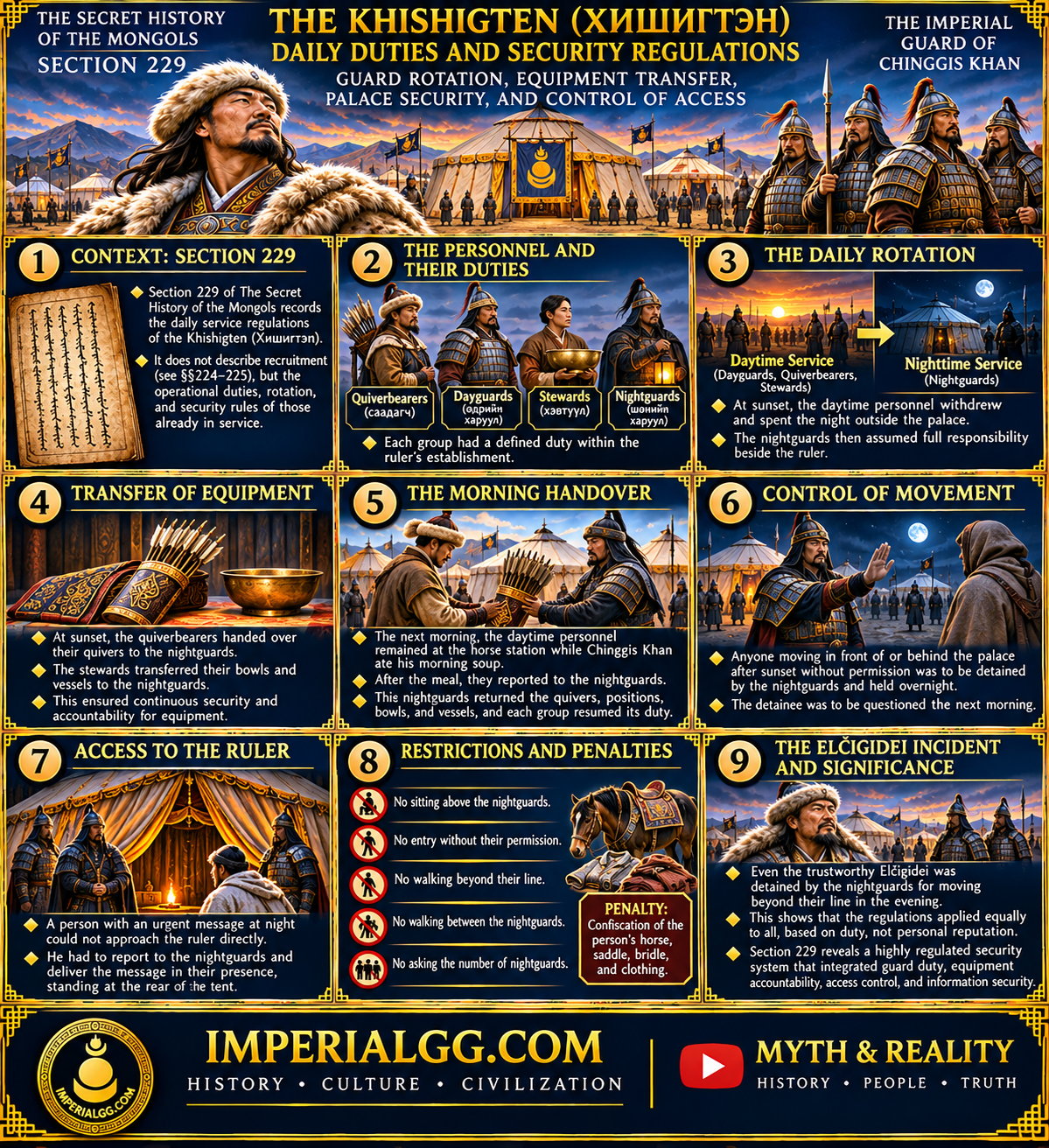
GUARD ROTATION, PALACE SECURITY, AND THE REGULATION OF ACCESS UNDER CHINGGIS KHAN
ABSTRACT
Section 229 of The Secret History of the Mongols provides an unusually detailed account of the daily operational regulations governing Chinggis Khan’s Khishigten (Хишигтэн). Rather than describing the recruitment or expansion of the guard, this section focuses on the practical organization of service: the division of daytime and nighttime responsibilities, the transfer of equipment, the replacement of guard shifts, the surveillance of the palace perimeter, the control of access, and the punishment of unauthorized movement.
The section identifies several distinct groups serving within the ruler’s establishment, including quiverbearers, dayguards, stewards, and nightguards. It establishes a coordinated system in which each group performs designated duties and transfers responsibility according to a prescribed daily schedule. Particularly significant are the regulations governing the nightguards, who controlled the approaches to the palace, monitored movement around the ruler’s tent, detained unauthorized individuals, and maintained strict control over information concerning their own numbers.
This article argues that §229 should be understood as an administrative and security regulation rather than simply a description of personal protection. It reveals a system in which the ruler’s immediate security depended on scheduled service, controlled access, equipment accountability, surveillance, and clearly defined chains of responsibility.
Keywords: Khishigten; Chinggis Khan; Kebte’ül (Хэвтүүл); nightguards; quiverbearers; palace security; military organization; guard rotation; The Secret History of the Mongols.
1. INTRODUCTION
The establishment of the Khishigten was an important part of Chinggis Khan’s political and military organization. Its function extended beyond protecting the ruler during military campaigns. It also involved maintaining security within the ruler’s immediate headquarters, regulating access to the palace, and organizing the daily activities of personnel serving around the khan.
Sections 224–228 of The Secret History of the Mongols describe the expansion of the guard, the selection of personnel, the appointment of commanders, the establishment of disciplinary rules, and the privileged status of guardsmen. Section 229 moves from these broader institutional arrangements to the practical operation of the guard.
Its subject is not primarily who could enter the Khishigten, but how those already assigned to service were expected to perform their duties.
The passage provides evidence of a carefully regulated system involving:
Daytime service by designated personnel.
Replacement by the nightguards at sunset.
The transfer and custody of equipment.
The morning return of personnel to their assigned positions.
The control of movement around the palace.
The detention and questioning of unauthorized individuals.
The regulation of entry, communication, and information.
These provisions reveal the operational structure of security within the ruler’s immediate establishment.
2. SECTION 229: THE ORGANIZATION OF DAYTIME AND NIGHTTIME SERVICE
The section begins with an order addressed to the commanders of the different guard companies.
Chinggis Khan establishes that quiverbearers, dayguards, and stewards must perform their daytime duties at their respective assigned positions. At sunset, they are to withdraw and make way for the nightguards. The daytime personnel then spend the night outside the palace, while the nightguards remain beside the ruler.
This arrangement establishes a clear division between daytime and nighttime responsibility.
The daytime personnel are not permitted to continue occupying their positions after sunset as though their service were uninterrupted. Instead, they must withdraw according to the prescribed schedule and allow the nightguards to assume responsibility for the ruler’s immediate security.
The regulation demonstrates that the protection of the palace was organized through successive periods of duty rather than depending on the continuous presence of one group.
The text also distinguishes the duties of the different personnel:
Quiverbearers: responsible for their quivers and the equipment associated with their assigned service.
Dayguards: responsible for their designated daytime guard positions.
Stewards: responsible for their bowls and vessels.
Nightguards: responsible for nighttime protection and security around the ruler and the palace.
These categories should not be treated as interchangeable. The chronicle identifies separate responsibilities and establishes a procedure through which the groups cooperate within the same security system.
3. THE TRANSFER OF EQUIPMENT: ACCOUNTABILITY AND CONTINUITY OF SERVICE
One of the most revealing aspects of §229 is the explicit regulation of equipment transfer.
When the daytime personnel withdraw at sunset, the quiverbearers must hand over their quivers to the nightguards. The stewards must similarly transfer their bowls and vessels.
This provision is more than a practical instruction concerning the storage of objects.
It establishes a formal transfer of responsibility between outgoing and incoming personnel. Equipment belonging to one service group is placed under the custody of another group during the hours when its original users are absent.
The quiver is particularly important because it is directly associated with the military function of the quiverbearers. Its transfer indicates that the nightguards assumed responsibility for maintaining control over equipment left within the ruler’s protected area.
The stewards’ bowls and vessels were also included in this procedure. Their transfer demonstrates that the regulation extended beyond weapons and military equipment to the practical requirements of the ruler’s daily household.
The text therefore reveals an integrated system in which military security and household administration were coordinated.
The transfer of equipment also reduced uncertainty concerning who was responsible for particular objects during each period of service. The incoming nightguards received the equipment, while the outgoing personnel were required to report back and resume their assigned responsibilities the following morning.
This arrangement may be interpreted as a form of institutional accountability: responsibility was attached to designated personnel and transferred according to an established procedure.
4. THE MORNING HANDOVER: RETURN TO DUTY AND THE REESTABLISHMENT OF POSITIONS
The chronicle provides a particularly detailed description of the following morning.
The quiverbearers, dayguards, and stewards who had spent the night outside the palace were instructed to remain at the horse station while Chinggis Khan ate his morning soup.
After the ruler had finished eating, these personnel were to report to the nightguards.
The nightguards then returned the quivers to the quiverbearers, the assigned positions to the dayguards, and the bowls and vessels to the stewards.
Each group subsequently resumed its own responsibilities.
This procedure reveals a sequence of operations:
First, the daytime personnel withdraw at sunset.
Second, the nightguards assume responsibility for the palace and retain the equipment transferred to them.
Third, the outgoing personnel remain outside during the night.
Fourth, they assemble at the horse station the following morning.
Fifth, after the ruler’s morning meal, they report to the nightguards.
Sixth, the nightguards return the equipment and the daytime personnel resume their assigned positions.
The significance of this arrangement lies in its regularity. The guard system was not based on informal arrangements made separately each evening and morning. Chinggis Khan ordered that every company taking its turn of duty follow the same procedure.
The morning meal also appears as a temporal marker in the daily routine. The text does not establish that the meal itself was a military ceremony; rather, it identifies the completion of the meal as the point after which the transfer and return of responsibilities took place.
The regulation thus connects the ruler’s daily household routine with the operational schedule of the Khishigten.
5. CONTROL OF MOVEMENT AROUND THE PALACE
The second part of §229 addresses the movement of individuals around the palace after sunset.
Chinggis Khan ordered that anyone moving without permission in front of or behind the palace after sunset should be detained by the nightguards and held overnight.
The following morning, the nightguards were to question the detained person.
This provision establishes three distinct responsibilities:
Detecting unauthorized movement.
Detaining individuals who violated the nighttime restrictions.
Questioning those individuals on the following morning.
The regulation indicates that the nightguards were responsible not only for standing watch but also for enforcing restrictions on movement within the protected area.
The requirement to hold a person overnight and question him in the morning is particularly significant. It shows that detention and questioning formed part of the guard’s assigned responsibilities.
The text does not specify a separate judicial procedure or explain what punishment necessarily followed questioning. It is therefore important not to interpret every detention as an automatic criminal conviction.
What the source clearly establishes is the nightguards’ authority to detain and question individuals who moved around the palace without permission after sunset.
6. THE NIGHTGUARDS AND THE SECURITY OF THE PALACE PERIMETER
Section 229 next describes the organization of the nightguards themselves.
The nightguards were required to position themselves around the palace. Those assigned to the entrance had a particularly serious responsibility: they were ordered to prevent unauthorized nighttime entry by force.
The severity of the language in the chronicle reflects the importance attached to preventing unauthorized access to the ruler’s immediate residence.
The passage also establishes a procedure for people arriving with urgent messages at night.
Such individuals were not permitted to approach the ruler independently. They first had to report to the nightguards and communicate their message in the presence of the guards, standing together with them at the rear of the tent.
This is a significant feature of the security arrangement.
The ruler’s access to urgent information was not unrestricted. Even a messenger carrying an important communication had to follow a prescribed procedure and pass through the nightguards.
The arrangement combined two responsibilities:
Protecting the physical security of the ruler.
Regulating the communication of information to the ruler.
The nightguards therefore functioned as both a physical security barrier and a controlled point of access to the sovereign.
7. REGULATING ACCESS, POSITION, AND INFORMATION
The final regulations in §229 establish restrictions concerning the position of individuals relative to the nightguards.
The chronicle specifies that:
No one was permitted to sit in a position above the nightguards.
No one could enter the protected precinct without first obtaining permission from them.
No one could walk beyond the line of the nightguards.
No one could walk between the nightguards.
No one was permitted to ask how many nightguards were present.
These restrictions demonstrate that the nightguards controlled more than the entrance to the palace.
They also controlled the spatial arrangement of the protected area, the movement of individuals around their positions, and access to information concerning the strength of the guard.
The prohibition on asking the number of nightguards is particularly noteworthy.
The chronicle establishes that a person who asked about their number could have his horse, together with its saddle and bridle, and the clothes he was wearing confiscated.
This punishment demonstrates that the numerical strength of the guard was treated as protected information.
The text does not explain the precise military intelligence concerns behind this regulation. Nevertheless, its inclusion among the palace security orders suggests that knowledge of the guard’s numerical strength was considered sensitive.
The nightguards were also ordered to arrest individuals who crossed beyond or between their positions.
The result was a controlled security perimeter in which movement and access were regulated by the guards themselves.
8. THE ELČIGIDEI INCIDENT: THE APPLICATION OF THE REGULATION
At the end of §229, the chronicle recalls an incident involving Elčigidei.
The narrator asks whether even the trustworthy Elčigidei was not detained by the nightguards when he happened to move beyond their line in the evening.
This example is important because it illustrates the application of the regulation to an individual described as trustworthy.
The passage suggests that the rules governing the nightguards were not intended to apply only to strangers, suspicious individuals, or known enemies.
Even a person regarded as reliable could be detained if he violated the prescribed limits of movement.
This indicates that the authority of the nightguards was based on the regulations governing their service, not merely on their personal judgment of an individual’s character.
The incident also reinforces the institutional nature of the security system: the rule was applied because the individual crossed the protected boundary, irrespective of his personal reputation.
The chronicle does not provide further details about the duration of Elčigidei’s detention or the consequences of the incident. Those details should therefore remain outside the interpretation.
9. THE HISTORICAL SIGNIFICANCE OF SECTION 229
Section 229 reveals several dimensions of the organization of the Khishigten that are not fully visible in the preceding regulations.
9.1. A continuous security system
The transition from daytime personnel to nightguards demonstrates that palace security was maintained through a scheduled succession of responsibilities.
The ruler’s protection did not depend on one group remaining permanently on duty.
9.2. A regulated system of accountability
The transfer of quivers, bowls, and vessels demonstrates that equipment was assigned to specific personnel and transferred according to a defined procedure.
The text thus records a system of responsibility extending beyond the physical act of standing guard.
9.3. Control of access to the sovereign
The nightguards controlled entry into the protected area and regulated how urgent messages could reach the ruler.
This placed them between the outside world and the ruler’s immediate personal space.
9.4. Protection of sensitive information
The prohibition against asking the number of nightguards demonstrates that the guard’s numerical strength was not treated as ordinary public information.
9.5. Authority based on institutional rules
The detention of Elčigidei demonstrates that even a trusted individual could be subject to the security regulations.
Taken together, these elements show that the Khishigten operated through a combination of military service, household administration, surveillance, access control, and institutional discipline.
10. SOURCE-CRITICAL CONSIDERATIONS
Several distinctions are necessary when interpreting §229.
First, the section does not establish recruitment qualifications. The requirements concerning the selection of guards, the participation of the sons of commanders and ordinary people, and the number of companions they were expected to bring are described in §§224–225. These provisions should not be attributed to §229.[1]
Second, the section distinguishes different categories of personnel. The quiverbearers, dayguards, stewards, and nightguards are assigned different functions. They should not all be described simply as nightguards or as interchangeable members of one duty group.[2]
Third, the terminology requires care. De Rachewiltz translates the nighttime guard personnel as “nightguards.” Kozin’s Russian translation uses kebteuls (кебтеулы), reflecting the Mongolian term kebte’ül. The historical Mongolian terminology should be retained when a precise institutional distinction is required.[3]
Fourth, the regulations represent normative orders. The chronicle records what Chinggis Khan commanded. It does not provide an independent administrative register proving how every order was implemented on every occasion.
Fifth, the confiscation of a horse, equipment, and clothing is specifically connected to asking the number of nightguards. It should not be generalized into a penalty for every violation of the nighttime regulations.[4]
These distinctions are essential for separating the direct evidence of the chronicle from broader historical interpretation.
11. CONCLUSION
Section 229 of The Secret History of the Mongols provides a detailed account of the daily security system surrounding Chinggis Khan.
It establishes a division between daytime and nighttime service, regulates the transfer of equipment, defines the morning return of personnel to their assigned positions, and gives the nightguards responsibility for monitoring movement around the palace.
It also regulates access to the ruler, controls the transmission of urgent messages, restricts movement around the nightguards’ positions, and protects information concerning their numerical strength.
The incident involving Elčigidei further demonstrates that the regulations applied even to individuals considered trustworthy.
The historical importance of §229 therefore lies in its evidence of a structured security institution operating through schedules, assigned responsibilities, controlled access, and enforceable regulations.
The Khishigten was not simply a collection of warriors protecting Chinggis Khan. It was an organized institution through which the ruler maintained the security of his immediate establishment and regulated the relationship between his personal space, his servants, military personnel, and those seeking access to him.
AUTHOR’S THESIS
Section 229 demonstrates that the Khishigten functioned as a highly regulated security institution in which military protection, household administration, access control, and information security were integrated into a single operational system. Its daily procedures reveal that imperial authority depended not only on the loyalty and strength of the guards but also on the precise regulation of their duties, the transfer of responsibility between shifts, and the strict control of access to the ruler.
FOOTNOTES
1. The Secret History of the Mongols, §§224–225. In §224, Chinggis Khan orders the recruitment of guards from the military units and specifies the participation of the sons of commanders of thousands, hundreds, and tens, as well as sons of ordinary people. The required numbers of companions differ according to the rank of their fathers. Section 225 then records the expansion of the nightguards and the appointment of their commanders. These are recruitment and organizational provisions; §229 concerns operational duties. See Igor de Rachewiltz, trans., The Secret History of the Mongols: A Mongolian Epic Chronicle of the Thirteenth Century, shorter version edited by John C. Street (2015), §§224–225, pp. 145–146.
2. Ibid., §229, pp. 148–149. De Rachewiltz distinguishes quiverbearers, dayguards, stewards, and nightguards in the daily service regulations. The distinction is essential because the text assigns each group a separate responsibility during the transfer between daytime and nighttime service.
3. S. A. Kozin, trans., Сокровенное сказание монголов, §229, Monumenta Altaica online edition. Kozin uses the term kebteuls (кебтеулы) for the nightguards. The term kebte’ül should be distinguished from the broader institutional designation Khishigten (Хишигтэн). See also de Rachewiltz, Secret History, §229, pp. 148–149.
4. de Rachewiltz, Secret History, §229, p. 149. The confiscation provision concerns the person who asks the number of nightguards. The listed property consists of the horse ridden that day, its saddle and bridle, and the clothes worn by the individual.
5. Ibid., §229, p. 149. The final example names Elčigedei, who was detained after crossing beyond the nightguards in the evening. The passage uses this incident to illustrate the enforcement of the guard regulations even in the case of a trusted individual.
PRIMARY SOURCES AND BIBLIOGRAPHY
de Rachewiltz, Igor, trans. 2004–2013. The Secret History of the Mongols: A Mongolian Epic Chronicle of the Thirteenth Century. 3 vols. Leiden: Brill.
de Rachewiltz, Igor, trans. 2015. The Secret History of the Mongols: A Mongolian Epic Chronicle of the Thirteenth Century. Shorter version edited by John C. Street. Western Washington University. Section 229, pp. 148–149.
Kozin, S. A., trans. Сокровенное сказание монголов. Russian translation, §229. Monumenta Altaica.
Onon, Urgunge, trans. 2001. The Secret History of the Mongols: The Life and Times of Chinggis Khan. Richmond: Curzon.