
THE KESHIGTEN OF GENGHIS KHAN
By Altanbagana Baatar
DBA Candidate| Independent Historian
ImperialGG Historical Research Seriers
06 November 2026
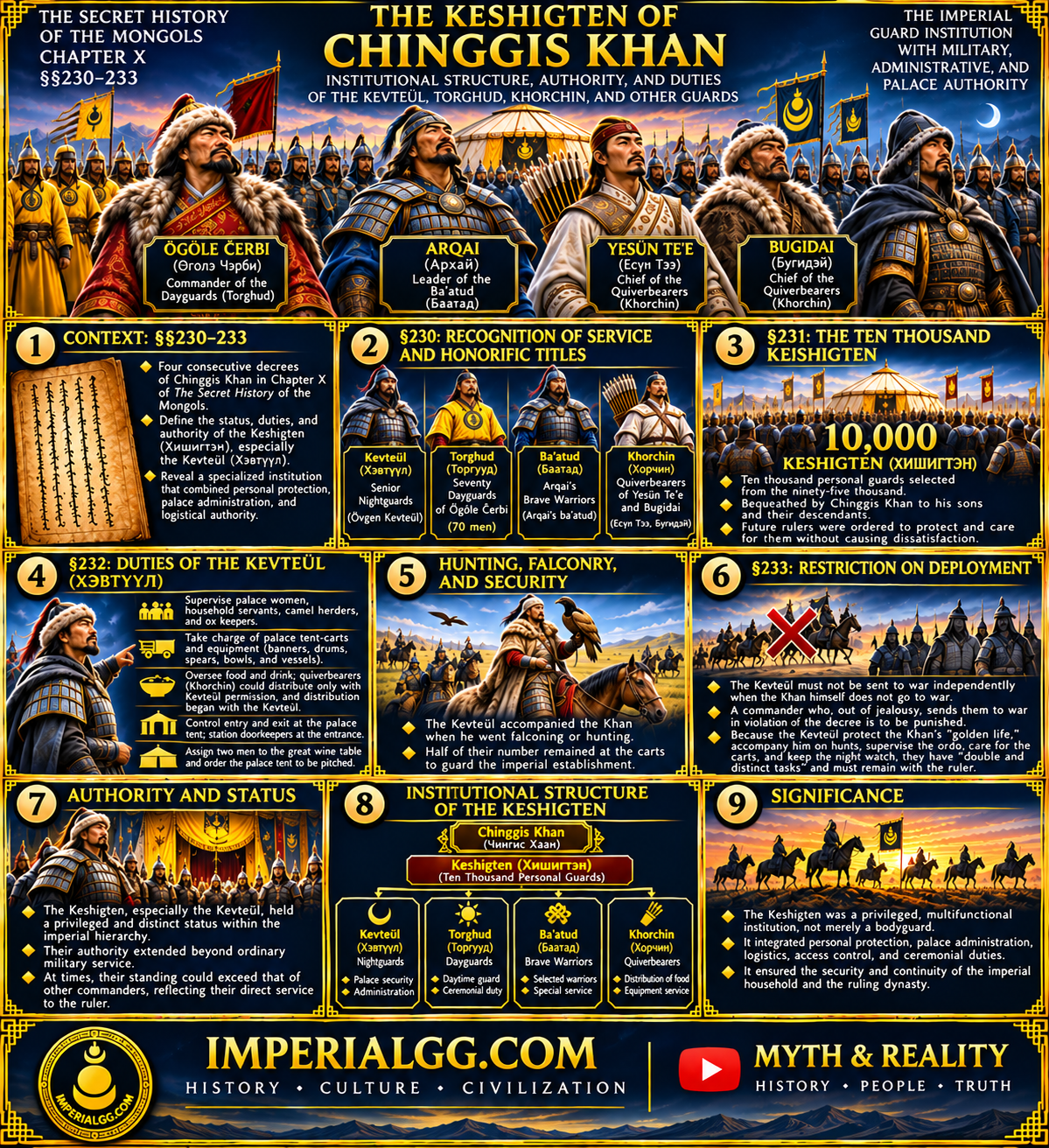
NSTITUTIONAL STRUCTURE, MILITARY HIERARCHY, PALACE ADMINISTRATION, AND THE LEGAL STATUS OF THE KEVTEÜL
From the Perspective of Foreign Scholars
An Institutional and Historical Analysis of The Secret History of the Mongols, Chapter X, §§230–233
ABSTRACT
The organization of the Kishigten under Chinggis Khan represents a significant dimension of the political and administrative development of the early Mongol Empire. Although the Kishigten are commonly approached through the history of military organization and the personal protection of the ruler, the provisions recorded in §§230–233 of The Secret History of the Mongols indicate that their institutional functions extended into the administration of the imperial household, the supervision of personnel and material resources, the regulation of access to the ruler, and the logistical security of the mobile imperial court. These passages are especially important because they preserve not merely a general description of the Khan’s guards but a sequence of decrees through which Chinggis Khan recognized distinctions among service groups, established obligations toward the ten thousand guards, assigned administrative responsibilities to the Kevteül, and restricted their independent deployment in warfare.
Section 230 records the Khan’s recognition of the nightguards whose vigilance and endurance had contributed to his security and political success. It then distinguishes the seventy dayguards associated with Ögöle Čerbi, the ba’atud of Arqai, and the quiverbearers associated with Yesün Te’e and Bugidai. Section 231 places the ten thousand guards within a larger framework of imperial organization by identifying them as selected from the ninety-five thousand and by imposing upon the Khan’s sons and descendants an obligation to preserve their position. Sections 232 and 233 are particularly revealing of the administrative and legal dimensions of the institution. The former assigns the Kevteül responsibility for supervising household personnel, livestock keepers, transport equipment, weapons, standards, drums, vessels, food supplies, palace access, and the organization of the imperial tent. The latter prohibits their independent participation in military campaigns when the Khan himself does not go to war, holding commanders accountable for violating the decree and explaining that the restriction derives from the guards’ multiple responsibilities toward the ruler and the imperial establishment.
The present study argues that these provisions reveal the Kishigten as a differentiated institution whose military, protective, administrative, and logistical functions were integrated into the operation of the Mongol imperial court. The evidence also demonstrates that the authority of military commanders was subject to restrictions established by the Khan in order to preserve the specialized responsibilities of the Kevteül. The significance of §§230–233 therefore lies not only in their description of the imperial guard but also in their contribution to understanding the institutional foundations of Mongol imperial government.
Keywords: Kishigten, Kevteül, Torghud, Khorchin, Chinggis Khan, Ögöle Čerbi, Arqai, Yesün Te’e, Bugidai, imperial guard, Mongol Empire, palace administration, military hierarchy, mobile imperial court.
1. INTRODUCTION
The formation of the Mongol Empire under Chinggis Khan involved the establishment of political and military institutions capable of maintaining authority across a vast territory and among populations organized through different tribal, military, and household structures. The development of the imperial army was indispensable to territorial expansion, but the consolidation of the new political order also required institutions that could preserve the ruler’s security, regulate access to his person, administer the imperial household, and maintain the operational continuity of the court while it moved between encampments. The Kishigten must be examined within this broader process of institutional formation rather than treated exclusively as a personal bodyguard or as an ordinary military formation.
The four provisions in Chapter X of The Secret History of the Mongols considered in this article offer unusually direct evidence of the relationship between the ruler and the specialized groups serving his immediate establishment. Their significance derives partly from their form: they are presented as decrees issued by Chinggis Khan, not simply as retrospective descriptions of military custom. Consequently, the passages preserve evidence of the normative arrangements through which the Khan sought to define duties, recognize service, regulate the distribution of responsibilities, and protect the continuity of the institution. They reveal how personal service was transformed into a regulated component of imperial government.
The distinction between the Kishigten as an institutional establishment and the particular groups identified within it is fundamental to interpreting these provisions. The text uses different designations for the nightguards, dayguards, ba’atud, and quiverbearers, while assigning specific administrative responsibilities to the nightguards. In the terminology adopted here, these groups are discussed through the Mongolian institutional names Хишигтэн (Kishigten), Хэвтүүл (Kevteül), Торгууд (Torghud), and Хорчин (Khorchin). Cleaves’s English translation employs the functional expressions nightguards, dayguards, and quiverbearers. These translations are useful for identifying the duties described in the text, but they do not remove the need to preserve the Mongolian institutional terminology. The names are not interchangeable: the Kevteül, Torghud, and Khorchin are distinguished by their respective functions and by the individuals associated with them in the source.
A second methodological consideration concerns the relationship between the four sections. Section 230 establishes distinctions among groups through the recognition of their service; §231 addresses the ten thousand guards as a collective body and connects their future protection with dynastic succession; §232 defines the administrative and logistical duties of the Kevteül; and §233 explains why those duties require restrictions on their independent military deployment. The sections therefore constitute a connected institutional account. Their sequence moves from recognition and status to continuity, administrative responsibility, and the regulation of military authority. The argument developed below follows this sequence in order to reconstruct the institutional logic of the decrees without attributing to any individual passage information that belongs to a different section.
The distinction between §§230–233 and the following §234 must also be maintained. The latter contains additional instructions concerning the positioning of different guard groups around the ordo during the organization of an encampment. Those spatial arrangements are relevant to the study of the mobile court, but they are not part of the four provisions analyzed here. The present article therefore examines the institutional responsibilities and restrictions established in §§230–233, while treating the detailed deployment arrangement of §234 as a separate subject requiring its own textual analysis.
2. SECTION 230: THE RECOGNITION OF SERVICE AND THE DIFFERENTIATION OF GUARD GROUPS
Section 230 opens with a decree in which Chinggis Khan recalls the service of his nightguards and formally recognizes their contribution to his political success. The passage is constructed as a sequence of poetic declarations. The Khan describes the guards who surrounded his tent during cloudy and starry nights, those who remained awake in snowstorms, cold, and rain, and those who stood watch when enemies approached. He emphasizes that their vigilance enabled him to sleep without fear and that their readiness to respond to danger contributed to the attainment of his throne. The language is not merely an expression of personal gratitude. It establishes a political relationship between the ruler’s authority and the service of the men entrusted with his immediate security.
The imagery of the tent is particularly significant. The guards are described as remaining around the Khan’s dwelling, including the tent with an upper opening and the tent surrounded by a felt covering. Their position was therefore directly associated with the physical space in which the ruler slept and conducted his immediate household life. The text emphasizes that they maintained this position under conditions that could make ordinary watch duty difficult: darkness, severe cold, snowstorms, rain, and the presence of hostile forces. The repeated references to their vigilance and their refusal to rest establish the continuous nature of their service. Their duty was not limited to ceremonial attendance or occasional protection during military movement; it required permanent readiness around the Khan’s person.
The passage also associates their vigilance with the detection of approaching enemies. Cleaves translates the relevant lines through references to the movement of enemy quivers made from birch bark and willow wood. The precise tactical significance of these references should not be exaggerated beyond the text, but they clearly convey the guards’ sensitivity to the smallest indications of hostile movement. The emphasis is on immediate response: the guards stand without delay when the enemy’s equipment begins to move. The poetic formulation thus presents the Kevteül as a protective force whose effectiveness depended upon observation, anticipation, and readiness rather than simply upon the ability to fight after an attack had begun. Their function was to prevent the ruler from being surprised and to maintain security during the most vulnerable periods, particularly at night.
At the conclusion of this encomium, Chinggis Khan orders that the nightguards henceforth be called the senior or elder nightguards. In the terminology used in this study, this designation is associated with the Övgen Kevteül. The recognition is significant because it gives a formal distinction to the guards whose service had been established over time. The title should be understood in relation to the preceding description of their experience and loyalty, rather than interpreted solely as a reference to biological age. The passage does not provide a complete rank structure or specify the precise criteria by which every member was included in this category. It does, however, show that the Khan regarded accumulated service as a basis for institutional recognition. The designation transforms the praise of their conduct into a distinction attached to their collective identity.
The decree then turns from the nightguards to three other groups. First, Chinggis Khan orders that the seventy dayguards associated with Ögöle Čerbi be called the great dayguards, identified in the Mongolian terminology of this study with the Ikh Torghud. The number seventy is explicitly recorded, and the association with Ögöle Čerbi is equally important. The passage does not simply mention an anonymous body of guards: it identifies a defined group through its numerical strength and its connection with a named individual. The title bestowed upon them distinguishes their position within the Khan’s establishment. The reference to dayguards also makes clear that the organization of the ruler’s protection involved differentiated service according to the time and nature of duty. The dayguards should not be conflated with the nightguards, whose functions are the central subject of the later decrees in §§232–233.
Second, the Khan orders that the ba’atud of Arqai be designated the elder ba’atud. The reference to Arqai establishes an identifiable association between this group and its leader or organizing figure. Cleaves retains the term ba’atud rather than translating it simply as warriors, which is important for source-critical interpretation. The designation suggests a recognized group whose service and identity were sufficiently established to receive a formal title. Although the precise institutional relationship between the ba’atud and every other component of the Kishigten cannot be reconstructed from §230 alone, the passage clearly distinguishes them from both the dayguards and the quiverbearers. Their inclusion demonstrates that the Khan’s immediate establishment was not composed of a single category of guards performing identical duties.
Third, Chinggis Khan orders that the quiverbearers associated with Yesün Te’e and Bugidai be called the great quiverbearers. The text names both individuals and connects them with this group. The designation is important because it identifies a specialized category through the equipment and function associated with its members. The quiverbearers were not simply another name for the nightguards or dayguards. Their distinct designation indicates a separate service responsibility within the larger organization. The association with Yesün Te’e and Bugidai also demonstrates that leadership and institutional recognition were attached to identifiable persons rather than being expressed only through collective labels.
The four designations in §230 therefore reveal a differentiated service structure: the senior Kevteül, the seventy Torghud associated with Ögöle Čerbi, the ba’atud of Arqai, and the Khorchin or quiverbearers associated with Yesün Te’e and Bugidai. The source does not provide a complete organizational chart showing the precise chain of command among all these groups. It would therefore be methodologically incorrect to infer a fully specified hierarchy from this passage alone. Nevertheless, the act of naming and distinguishing these groups is itself evidence of institutional differentiation. Chinggis Khan recognized separate bodies of service personnel, associated them with particular individuals, and assigned them formal designations. Section 230 should consequently be understood as an important record of the recognition of service and the organization of the ruler’s protective establishment, rather than merely as a poetic expression of gratitude.
Monumenta Altaica+1
3. SECTION 231: THE TEN THOUSAND KISHIGTEN AND THE CONTINUITY OF IMPERIAL SERVICE
Whereas §230 recognizes differentiated groups through their service and designations, §231 shifts the focus to the ten thousand guards as a collective establishment. Chinggis Khan describes these men as his personal servants who remain in his presence and states that they were selected from the ninety-five thousand. He then addresses his sons who would occupy the throne in the future, extending the obligation of protection to the descendants of those sons. The provision is significant because it places the Kishigten within a framework of imperial continuity rather than treating their position as dependent exclusively upon the lifetime or personal preference of the founding ruler.
The numerical relationship between the ninety-five thousand and the ten thousand requires careful interpretation. The text identifies the ten thousand as selected from the ninety-five thousand, thereby connecting the ruler’s personal establishment with the broader organization of the Mongol population and military order. The passage does not, however, supply a detailed list of the households from which the guards were recruited, nor does it specify the tribal composition of the ten thousand. It would therefore be unjustified to assume that every group mentioned in §230 contributed an equal proportion to the ten thousand or that the entire number consisted exclusively of one of the specialized guard categories. What the passage establishes directly is that the ten thousand were selected from the larger body of ninety-five thousand and were distinguished by their service in the immediate presence of the Khan.
The description of these men as personal servants should not be interpreted through the narrow meaning of domestic service in a modern household. In the political context of the Mongol court, personal service to the ruler encompassed military protection and a range of responsibilities connected with the operation of the imperial establishment. This becomes particularly clear when §231 is read together with §§232–233, which assign the Kevteül responsibility for the protection of the ruler, supervision of household personnel, regulation of provisions, control of palace access, and security of the transport equipment. The expression identifying the ten thousand as personal servants therefore describes their privileged proximity to the Khan, while the subsequent decrees reveal the institutional functions associated with that proximity.
The most consequential part of §231 is the instruction addressed to Chinggis Khan’s sons and their descendants. The Khan commands those who will sit upon his throne in the future to remember the ten thousand guards as a bequest left by him and to take excellent care of them without causing them to complain. The wording establishes an obligation that extends beyond the immediate relationship between the ruler and his guards. Their protection is transferred into the responsibilities of the succeeding dynasty. The institution is thus placed within the political inheritance of Chinggis Khan: the future ruler is not simply free to retain or dismiss the guards according to personal inclination but is instructed to preserve their position as part of the legacy entrusted to him.
This provision has implications for understanding the relationship between personal loyalty and institutional continuity in the early Mongol Empire. The Keshigten were closely connected with the person of Chinggis Khan, but the decree seeks to prevent their institutional existence from ending with his death. Their service had been rendered to the founder, yet their future status was to be protected by his successors. In this sense, the guards became part of the political inheritance of the ruling house. The command to prevent them from murmuring or becoming dissatisfied is also significant. It implies that the stability of the institution depended not only on the formal preservation of its name but also on the treatment of its members. The Khan’s sons were expected to maintain their position and ensure that their service was not met with neglect or arbitrary mistreatment.
The final rhetorical question in §231, in which Chinggis Khan asks whether the ten thousand guards should not be called his gods who bring happiness, further emphasizes the exceptional value he attached to them. Cleaves translates the expression as “my gods which bring happiness.” The phrase should be approached as a culturally situated expression of extraordinary esteem, not as evidence that the guards possessed a literal divine status. Its function within the decree is to elevate their significance and reinforce the obligation imposed upon future rulers. The guards are presented as a source of fortune and protection for the founder, and therefore as a group deserving special care from the dynasty that succeeds him.
The relationship between §§230 and 231 is consequently more substantial than a simple transition from one decree to another. Section 230 identifies groups whose service has earned formal recognition; §231 establishes the collective and dynastic significance of the ten thousand guards. The first passage emphasizes distinctions within the service establishment, while the second emphasizes the preservation of the establishment as a whole. Taken together, they show that Chinggis Khan’s concern extended both to the recognition of particular groups and to the long-term security of the institution to which the guards belonged. This is an important indication that the Kishigten had acquired a political position that required protection beyond the personal reign of its founder.
Monumenta Altaica+1
4. SECTION 232: THE ADMINISTRATIVE AUTHORITY OF THE KEVTEÜL WITHIN THE IMPERIAL ORDO
Section 232 provides the most extensive description of the operational responsibilities assigned to the Kevteül in the four passages under examination. Its importance lies in the range of activities placed under their supervision. The decree does not confine the nightguards to maintaining a perimeter around the Khan’s tent; instead, it assigns them responsibility for personnel associated with the ordo, the tent-carts, military and ceremonial equipment, food and drink, the regulation of access to the palace tent, the attendance of the great wine table, and the preparation of the imperial tent. These provisions reveal that the Kevteül occupied a position at the intersection of personal security and household administration. Their authority extended into the management of the people and material resources upon which the functioning of the ruler’s immediate establishment depended.
The first instruction orders the nightguards to look after the maids who served as stewards of the ordo, the “sons of the tent,” the keepers of camels, and the keepers of oxen. Cleaves adds a note explaining that the expression “sons of the tent” refers to menservants. The wording is important because it identifies several categories of personnel whose work was connected with the operation of the imperial household. The maids or female attendants, the male household servants, and the keepers of animals did not all perform the same duties, yet the decree places their supervision within the responsibilities of the Kevteül. This does not establish that these workers were themselves members of the guard. Rather, it shows that the Kevteül were assigned an overseeing function in relation to personnel who performed essential services for the ordo.
The inclusion of camel and ox keepers is especially relevant to the logistical organization of the mobile court. Camels and oxen were associated with the movement and transport of goods and equipment, and the animals’ care was necessary for the effective movement of the imperial establishment. By placing their keepers under the supervision of the Kevteül, the decree connects the security institution with the practical requirements of transport and encampment. The guards’ responsibilities therefore extended beyond the immediate space around the Khan’s person. They included the supervision of workers whose activities affected the mobility and material readiness of the court.
The same instruction requires the Kevteül to take care of the tent-carts belonging to the ordo. These carts were not incidental household possessions. They formed part of the physical infrastructure through which the ruler’s establishment could be transported and reassembled. The protection of the tent-carts was consequently essential to the continuity of the imperial court during movement. The decree’s placement of this duty alongside the supervision of household personnel and animal keepers indicates that the administration of the ordo was understood as an integrated responsibility. Personnel, animals, transport equipment, and the palace establishment were connected elements of a single operational system.
The following instructions concern the collection and safekeeping of weapons and other equipment. Cleaves translates the text as ordering the Kevteül to collect the spears at the foot of the standards and drums and also to collect the bowls and vessels. The precise grammatical relationship expressed by the phrase concerning the standards is discussed in Cleaves’s footnote, which records Antoine Mostaert’s suggestion regarding the interpretation of doro as a postposition. This philological issue matters because the translation describes the location at which the spears are to be collected. It should not be silently converted into a broader claim about the complete organization of the armoury or the chain of command over all imperial weapons. What the decree clearly establishes is that the Kevteül were responsible for collecting and supervising spears, standards, drums, bowls, and vessels.
The combination of these objects is institutionally revealing. Spears were weapons, while standards and drums had military and ceremonial significance; bowls and vessels belonged to the equipment necessary for the daily operation of the court. Their inclusion in the same administrative instruction suggests that the Kevteül were entrusted with the orderly custody of objects used in different aspects of imperial life. The decree does not separate military equipment from household equipment into wholly unrelated administrative spheres. Instead, it places their collection and supervision within the responsibilities of the guards. This is consistent with the broader role assigned to the Kevteül: maintaining the security and operational readiness of the Khan’s immediate establishment.
The next provision addresses the supervision of food and drink. Chinggis Khan orders the Kevteül to oversee the provisions and to supervise the preparation of what Cleaves translates as “the thick flesh and food.” If food and drink are insufficient, the Khan declares that he will seek an explanation from the nightguards who have been assigned to supervise them. The wording is important because it establishes not only a duty but also accountability for the fulfillment of that duty. The guards are not merely expected to be present while food is prepared or distributed; they are made responsible for overseeing the provision of essential supplies. A shortage therefore becomes an administrative matter for which the designated guards must answer.
The reference to the preparation of meat and food should be kept close to the wording of the source. The passage does not explicitly identify the food as sacrificial provisions, and it would be inaccurate to insert a sacrificial function into this particular instruction without evidence from the original text or a relevant commentary. Cleaves’s translation refers to the “thick flesh” and food, and the analysis should preserve that distinction. The administrative significance remains clear without adding an unsupported interpretation: the Kevteül were responsible for ensuring the supervision and preparation of food and drink required by the imperial household.
The relationship between the Kevteül and the Khorchin becomes particularly explicit in the following provision. When the quiverbearers distribute drink and food, they are not to distribute it without permission from the nightguards who have been appointed to supervise the provisions. Furthermore, when food is distributed, the distribution must begin with the nightguards. This arrangement demonstrates that the performance of a service and the authority to regulate that service were assigned to different groups. The Khorchin carried out the distribution, whereas the Kevteül exercised supervisory authority over the process. The decree therefore provides direct evidence of coordination between specialized groups within the imperial establishment.
The requirement that distribution begin with the Kevteül should not be dismissed as a minor ceremonial preference. It establishes a regulated order of distribution and confirms the privileged administrative position of the nightguards. The group responsible for supervising provisions was also given priority when food was distributed. This arrangement may reflect the importance of maintaining the guards’ readiness and ensuring that those charged with protecting the ruler were themselves properly supplied. However, the text does not explicitly explain the rationale for this priority, and it is therefore preferable to distinguish the direct evidence—the requirement of permission and priority—from the broader historical interpretation. What can be established securely is that the Khorchin did not possess unrestricted authority to distribute food and drink independently of the Kevteül’s supervision.
The next instruction turns from provisions to the regulation of movement into and out of the palace tent. Chinggis Khan orders the Kevteül to control entry and exit at the palace tent and requires the doorkeepers belonging to the guard to stand at the entrance. This is a clear provision concerning access control. The security of the ruler depended not only upon the guards stationed around the tent but also upon the regulation of who could enter the immediate palace space and who could leave it. The order places this responsibility directly within the administrative duties of the Kevteül and indicates that the entrance was to be supervised by designated members of the guard.
This provision is important when read in conjunction with the description of the nightguards in §230. The earlier passage emphasizes their vigilance around the Khan’s tent during the night, while §232 defines a more specific administrative responsibility concerning the entrance to the palace tent. The two provisions are complementary: one establishes the importance of continuous protection around the ruler’s dwelling, while the other regulates access through a designated entrance. Together, they demonstrate that the security of the Khan’s person involved both perimeter vigilance and controlled movement within the palace establishment.
The subsequent instruction is unusually specific: two members of the Kevteül are to enter and hold the great wine table. Cleaves translates the object as the “great wine table,” and the translation should be retained unless examination of the original text and commentary justifies a different rendering. The previous draft’s use of an unexplained term in place of this translation was not adequately supported. The provision appears to assign a particular ceremonial or service function to two designated guards. Its inclusion within the decree suggests that the Kevteül’s duties encompassed not only the security of the entrance and the supervision of household resources but also specific responsibilities connected with the ruler’s table. The text does not explain the full ceremonial procedure associated with the table, and its precise function should therefore remain a subject for further philological examination. Nevertheless, the instruction demonstrates that the guards could be assigned particular tasks within the internal operation of the palace tent.
The following provision concerns the keepers of the encampment drawn from among the Kevteül. They are ordered to go and pitch the palace tent. This instruction connects the guard directly with the physical establishment of the ruler’s residence. The palace tent was the central structure of the mobile court, and its preparation was essential whenever the imperial establishment moved to a new location. The designation of particular Kevteül as keepers of the encampment indicates functional differentiation within the guard itself. The decree does not state that every member of the Kevteül was responsible for pitching the tent; rather, it identifies a specific group from among them for this task. The distinction is important because it shows that the institution combined general responsibilities of protection and supervision with specialized assignments performed by designated personnel.
The final instruction in §232 concerns the Khan’s falconry and hunting. When Chinggis Khan goes falconing or hunting, the nightguards are ordered to accompany him. At the same time, they are instructed to divide their contingent and place half at the carts. This provision is central to understanding the practical organization of the mobile imperial court. The Khan’s participation in outdoor activities required the presence of guards, but the protection of the transport equipment and the encampment could not be abandoned while he was away. The decree therefore establishes a division of personnel: one portion accompanies the ruler, while the other remains with the carts.
The instruction demonstrates that the Kevteül’s service was organized according to the simultaneous requirements of personal protection and the security of the imperial establishment. The guards were not simply required to follow the Khan wherever he went; they were also responsible for maintaining the security of the property and transport infrastructure that remained behind. The division of the contingent is a practical response to the conditions of a mobile court, in which the ruler’s movement did not suspend the need to protect the encampment. The provision also anticipates the reasoning in §233, where Chinggis Khan explains that the nightguards have multiple and distinct responsibilities and must therefore not be deployed separately in war when he himself does not campaign.
Taken as a whole, §232 reveals a broad administrative role for the Kevteül. Their responsibilities included supervision of household personnel, oversight of animal keepers, care of the tent-carts, collection of weapons and equipment, management of food and drink, regulation of distribution by the Khorchin, control of access to the palace tent, attendance at the great wine table, preparation of the palace tent, and the division of the guard during falconry and hunting. These duties should not be interpreted as evidence that the Kevteül administered every aspect of the Mongol imperial state. The decree concerns the ruler’s immediate establishment and the ordo, not the entire machinery of imperial government. Within that sphere, however, their authority was extensive. The Kevteül functioned as a protective and supervisory body whose responsibilities were essential to the security and daily operation of the Khan’s court.
Monumenta Altaica+1
5. SECTION 233: THE RESTRICTION OF INDEPENDENT MILITARY DEPLOYMENT AND THE LEGAL POSITION OF THE KEVTEÜL
Section 233 provides the clearest explanation of why the Kevteül were assigned a distinct institutional position within the Mongol imperial establishment. Whereas §232 enumerates their administrative and logistical responsibilities, §233 establishes a restriction on their participation in military campaigns and identifies the authority responsible for enforcing that restriction. Chinggis Khan declares that if he himself does not go to war, the nightguards must not go to war separately from him. He then addresses the officials who command soldiers, warning that those who knowingly violate the decree by sending the nightguards into warfare out of jealousy are to be punished. The prohibition is therefore not simply a statement about the preferred use of a particular military unit. It is a binding instruction concerning the deployment of a specialized institution whose duties could not be suspended at the discretion of other commanders.
The opening provision establishes the principle that the military deployment of the Kevteül was connected directly with the Khan’s own participation in warfare. The wording does not establish an absolute prohibition against their involvement in campaigns. Rather, it prohibits their independent deployment when the ruler himself does not go to war. This distinction is essential. The Kevteül were not excluded from the military activities of the Mongol state; their participation was regulated according to their specific relationship with the Khan and the responsibilities assigned to them. When the Khan undertook a campaign, the guards could accompany him as part of his immediate establishment. When he did not campaign, however, they were not to be detached and employed separately by other commanders.
The distinction between accompanying the Khan and being deployed independently reflects the institutional purpose of the guard. The Kevteül were responsible for the security of the ruler and the continuity of the ordo. Their availability was therefore not simply a matter of military manpower that could be adjusted according to the needs of a particular campaign. Their service was tied to the person of the Khan and to the administrative establishment surrounding him. If they were removed from these duties and sent elsewhere, the ruler’s immediate security and the operation of the imperial court could be compromised. The restriction thus protected the institutional function of the guards against competing demands from the wider military command structure.
The second part of the decree is addressed to the officials who command soldiers. Cleaves translates the relevant designation as stewards or officials commanding troops. These commanders are warned that, having been informed of the Khan’s order, they must not violate it by sending the nightguards to war out of jealousy. The reference to jealousy is significant because it suggests that the special position of the guards could generate tension within the wider military hierarchy. The Kishigten enjoyed direct proximity to the ruler and a privileged institutional status. Such a position could provoke resentment among other officials, particularly if the guards were perceived as receiving advantages or recognition unavailable to ordinary military commanders. The decree addresses this potential conflict by preventing commanders from using their authority over soldiers to interfere with the duties of the imperial guard.
The wording also establishes that the prohibition was to be known and understood by those responsible for military command. The phrase translated by Cleaves as “having let themselves be told thus” indicates that the commanders were expected to have received the Khan’s instruction. The subsequent punishment therefore concerns a knowing violation of an established decree rather than an accidental failure to understand an informal preference. This is an important feature of the passage because it connects military authority with the obligation to comply with the ruler’s orders. The commanders possessed authority over the forces under their direction, but that authority did not permit them to disregard a specific decree protecting the Kevteül’s assigned responsibilities.
The use of punishment in this context demonstrates that the Khan sought to enforce the distinction between the specialized guard and the forces available for ordinary military operations. The decree did not merely request that commanders respect the Kevteül’s duties; it established consequences for those who knowingly violated the order. In this respect, §233 provides evidence of a regulated relationship between the ruler’s personal authority and the military command structure. The guards’ specialized position was protected through a direct command, and the commanders were made accountable for respecting it.
Chinggis Khan then anticipates an objection that might arise among military officials: why should the soldiers of the nightguards not be sent to war? His response is based on the multiple responsibilities assigned to them. He explains that the guards protect his “golden life,” accompany him during falconry and hunting, supervise the ordo during movement and encampment, care for the carts, and maintain the night watch around his person. These duties, he argues, are not simple or interchangeable. They constitute distinct obligations that require the continued presence of the guards. The final justification is expressed through the idea that they have “double and quite distinct tasks,” which is why they must not go to war separately from him.
The phrase “golden life” deserves particular attention. It places the protection of the Khan’s person at the center of the institutional justification for retaining the Kevteül. The ruler’s life is represented as an object of exceptional value, and the guards’ responsibility is directly associated with its preservation. The expression is not simply ornamental language. Within the structure of the decree, it provides the principal justification for maintaining the guards’ availability. Their service is necessary because the ruler’s personal security cannot be delegated to an ordinary military unit without changing the institutional arrangement established by the Khan.
The reference to falconry and hunting is equally important because it confirms that the guards’ responsibilities extended beyond formal military campaigns and the immediate space of the palace tent. During these activities, the Khan moved away from the central encampment and required a protective contingent to accompany him. Section 232 had already established that the guards were to accompany the Khan while leaving half of their number at the carts. Section 233 recalls this responsibility as part of the justification for restricting their independent military deployment. The two sections therefore complement one another: §232 gives the operational instruction concerning the division of the guard, while §233 explains why the duty is sufficiently important to prevent the guards from being assigned elsewhere without the Khan.
The supervision of the ordo during movement and encampment constitutes another central element of the justification. The text states that the nightguards oversee the ordo when it journeys and when it remains at rest, taking care of the carts. This wording demonstrates that the security of the imperial establishment was a continuous responsibility rather than a task performed only during travel. The court required protection while moving between locations, but it also required supervision after reaching an encampment. The carts and associated equipment remained essential to the operation of the ordo in both circumstances. The Kevteül’s responsibility therefore followed the imperial establishment through its successive stages of movement and settlement.
The reference to the “great a’uruy” in the same passage should be treated carefully. Cleaves retains this expression in his translation and connects it with the movement and stationary condition of the imperial establishment. It is therefore appropriate to discuss it in relation to the ordo and its tent-carts, but not to assume without further philological evidence that the term is identical in every context to a modern administrative headquarters or a permanent palace. The relevant point for the present analysis is that the decree identifies the movement and encampment of the central imperial establishment as circumstances requiring the continued care of the Kevteül. The guards’ responsibilities were not exhausted by protecting the Khan’s immediate person; they also included maintaining the security of the material infrastructure of his court.
Chinggis Khan’s rhetorical question concerning the difficulty of passing the night while watching over his person returns to the central theme of §230. The earlier decree had described the guards standing in cold, rain, snow, and darkness, maintaining vigilance around the Khan’s tent. Section 233 invokes the demanding nature of the same duty as a reason why the guards should not be diverted into independent military service. The repeated emphasis on night watch is therefore not incidental. It demonstrates that the protective function of the Kevteül required continuous attention and could not be treated as a temporary responsibility that commanders might suspend whenever additional troops were needed.
The final reference to the difficulty of caring for the tent-carts when the great a’uruy moves or remains stationary reinforces the logistical dimension of the institution. The Khan’s argument is cumulative: the guards protect his person, accompany him during hunting and falconry, supervise the ordo, care for the carts during movement and encampment, and maintain the night watch. These responsibilities are described as multiple and distinct because they involve different settings and forms of service. Their combination explains why the Kevteül cannot be regarded simply as a reserve force available for separate campaigns. Their institutional purpose requires them to remain attached to the ruler and the imperial establishment.
The legal significance of §233 lies in the relationship it establishes between the Khan’s decree, the authority of military commanders, and the protected responsibilities of the Kevteül. The passage does not provide evidence of a fully codified military legal system in the modern sense, and it should not be interpreted as such. It does, however, record a specific rule governing the deployment of a defined guard group, identify the officials expected to comply with that rule, and establish punishment for knowing violations. The provision therefore demonstrates that Chinggis Khan used direct decrees to regulate the boundaries of military authority and to preserve the specialized functions of the imperial guard.
The distinction is especially important for understanding the institutional position of the Kishigten within the broader Mongol military system. The guards were not simply subordinate soldiers who could be assigned to any commander for any military purpose. Their relationship with the Khan gave them responsibilities that took precedence over independent deployment when he was not campaigning. The decree protected those responsibilities by limiting the authority of other commanders. Section 233 thus provides evidence of both the privileged status of the Kevteül and the practical measures through which that status was enforced.
Monumenta Altaica+1
6. THE INSTITUTIONAL RELATIONSHIP BETWEEN THE KESHIGTEN, KEVTEÜL, TORGHUD, AND KHORCHIN
The combined evidence of §§230–233 demonstrates that the Kishigten should be understood as a differentiated establishment rather than as a homogeneous body in which every member performed the same duties. The text distinguishes the groups through their designations, their associated leaders, and the responsibilities assigned to them. This distinction is particularly important when examining the relationship between the Kevteül, Torghud, and Khorchin, since the four passages do not use these names as interchangeable terms.
Section 230 provides the clearest evidence of differentiation. The senior nightguards receive a distinct designation; the seventy dayguards associated with Ögöle Čerbi are recognized separately; the ba’atud associated with Arqai receive their own title; and the quiverbearers associated with Yesün Te’e and Bugidai are likewise distinguished. The source therefore presents the Khan’s establishment as containing several identifiable service groups. Their different designations indicate that the institution had developed beyond a simple division between armed men and household attendants. The groups possessed recognized identities and were associated with particular responsibilities or leaders.
Sections 232 and 233 then concentrate on the Kevteül, whose functions are described in greater detail than those of the other groups in the four passages. Their duties included the protection of the ruler, supervision of household personnel, oversight of provisions, custody of equipment, regulation of access to the palace tent, preparation of the imperial tent, and security of the carts. This concentration on the Kevteül should not be mistaken for evidence that the other groups lacked important responsibilities. Rather, it reflects the subject of the decrees: the Khan is explaining the administrative duties of the nightguards and the reason they must not be deployed separately in warfare.
The relationship between the Kevteül and the Khorchin is especially instructive because §232 explicitly describes an interaction between them. The quiverbearers are responsible for distributing food and drink, but they must obtain permission from the Kevteül appointed to supervise the provisions. Food distribution must also begin with the Kevteül. The passage thus records an arrangement in which one group performs a specific service under the supervision of another. It demonstrates administrative coordination and differentiated authority within the imperial establishment. It does not establish that the Kevteül exercised unrestricted command over every aspect of the Khorchin’s activities; the evidence concerns the distribution of food and drink.
The Torghud, meanwhile, are identified in §230 through the seventy dayguards associated with Ögöle Čerbi. Their designation as a distinct group should be preserved when interpreting the organization of the guard. The fact that §232 and §233 focus on the Kevteül does not justify treating the Torghud as another name for the nightguards. The distinction between day and night service is explicit in Cleaves’s translation and is reflected in the institutional differentiation preserved in the Mongolian terminology. The organization of the ruler’s protection therefore involved more than a single group maintaining continuous duty; it included distinct categories whose functions were differentiated within the broader establishment.
Section 231 adds a further dimension by referring to the ten thousand guards as a collective body selected from the ninety-five thousand. This collective designation should not be confused with the specific groups named in §230. The text does not provide sufficient information to calculate the exact composition of the ten thousand or to establish the numerical relationship between every named group and the total. It is therefore more accurate to understand the ten thousand as the larger personal guard establishment, within which the text recognizes differentiated groups and duties, while avoiding unsupported claims about their precise internal proportions.
The institutional relationship among these groups can consequently be understood through three connected principles: collective identity, functional differentiation, and regulated coordination. The Kishigten represented the larger establishment associated with the Khan’s personal service; the Kevteül, Torghud, and Khorchin possessed distinct designations and functions; and the decrees established relationships of supervision and cooperation among them. This structure enabled the imperial court to maintain personal protection, household administration, and logistical operations without collapsing all responsibilities into a single undifferentiated body.
7. THE KISHIGTEN AND THE ADMINISTRATION OF THE MOBILE IMPERIAL COURT
The administrative provisions of §§232–233 are particularly important for understanding the relationship between the Kishigten and the mobile character of Mongol imperial government. The imperial court was not dependent upon a permanently fixed palace whose personnel, equipment, and administrative services remained in one location. The ruler’s establishment moved, and its operation required the coordinated transport and protection of household personnel, animals, carts, equipment, and provisions. The ordo was therefore not merely the Khan’s dwelling. It was an organized imperial establishment whose continued operation depended upon the movement and management of a substantial body of people and material resources.
The instructions concerning the tent-carts reveal the importance of this logistical dimension. The carts were essential to the transportation of the palace establishment, and their protection was assigned to the Kevteül. The responsibility was not confined to the moment of departure or arrival: §233 explicitly refers to the care of the carts when the ordo was moving and when it was stationary. This distinction indicates that the security of the mobile court required continuity. The establishment had to be protected during travel, but its equipment also required supervision after the court had reached its destination. The guards’ responsibilities therefore extended across the entire process of movement and encampment.
The preparation of the palace tent further demonstrates the relationship between protection and logistical organization. The decree assigns members of the Kevteül the task of pitching the palace tent, while other instructions require the guards to supervise the personnel and equipment associated with the ordo. These provisions indicate that the establishment of the ruler’s residence was treated as an organized operation involving designated personnel. The tent was not simply erected whenever circumstances permitted; the Khan’s decree assigned responsibility for its preparation to members of the guard. The institutional significance of this arrangement lies in the integration of the ruler’s personal protection with the practical organization of his residence.
The supervision of camel and ox keepers must also be considered in this context. The animals were part of the material system through which the court could move, and the personnel responsible for their care performed services essential to the operation of the encampment. By assigning the Kevteül responsibility for supervising these keepers, the Khan connected the protective establishment with the management of the resources required for mobility. This does not mean that the Kevteül personally performed every task associated with animal husbandry or transport. The decree distinguishes between the keepers who performed the work and the guards who supervised them. The distinction reveals a system of administrative oversight rather than the direct execution of every service by the same group.
The provisions concerning food and drink likewise demonstrate that the operation of the court depended upon regulated supply and distribution. The Kevteül were assigned responsibility for supervising provisions and ensuring that shortages could be accounted for. The Khorchin were required to obtain permission before distributing food and drink, and the distribution was to begin with the guards. This arrangement suggests that the supply system was organized through a division between supervision and execution. Such an arrangement was particularly important for a mobile establishment, where the availability and orderly distribution of provisions were essential to the continued functioning of the court.
The security of the palace entrance provides another dimension of the same system. The Kevteül were instructed to regulate entry and exit and to station their doorkeepers at the tent entrance. In a mobile court, the physical location of the palace could change, but the principle of controlled access remained necessary. The guards therefore maintained a form of security that was attached to the ruler’s establishment rather than to a permanent architectural structure. This is an important distinction when considering the administrative organization of a nomadic imperial court: institutional continuity was maintained through personnel, orders, and designated responsibilities, even when the physical setting of the court changed.
The division of the guards during falconry and hunting provides perhaps the clearest illustration of the relationship between the ruler’s personal activities and the security of the mobile establishment. One portion accompanied the Khan, while another remained at the carts. The arrangement ensured that the ruler could move away from the encampment without leaving the entire establishment unprotected. It also demonstrates that the organization of the guard was sufficiently flexible to accommodate simultaneous duties. The guards were not required to choose between accompanying the Khan and protecting the carts; the decree established a division of personnel to fulfil both obligations.
These provisions collectively demonstrate that the Kishigten formed part of the administrative infrastructure of the mobile imperial court. Their role was not limited to the protection of the Khan during military campaigns. They contributed to the organization of the palace establishment, the supervision of household workers, the control of equipment and supplies, the regulation of access, and the protection of transport resources. The significance of this arrangement is that the security of the ruler and the continuity of the court were treated as interdependent responsibilities. The Keshigten, and particularly the Kevteül in the provisions examined here, helped maintain that relationship through a combination of protective and administrative duties.
8. AUTHOR’S THESIS: THE KISHIGTEN AS A MULTIFUNCTIONAL IMPERIAL INSTITUTION
The evidence in §§230–233 supports the thesis that the KIshigten under Chinggis Khan constituted a multifunctional institution whose military and protective responsibilities were integrated with the administration and logistical operation of the imperial court. The conventional description of the Kishigten as the Khan’s personal guard is not incorrect, but it is insufficient to explain the range of duties recorded in these provisions. The source demonstrates that the institution included differentiated groups, recognized service distinctions, obligations of dynastic continuity, administrative supervision, and restrictions on independent military deployment.
The first element of this institutional structure was the recognition of differentiated service. Section 230 does not describe the guards as a single body performing identical functions. Instead, it distinguishes the senior Kevteül, the seventy dayguards associated with Ögöle Čerbi, the ba’atud of Arqai, and the quiverbearers associated with Yesün Te’e and Bugidai. These designations demonstrate that the Khan recognized separate groups within his immediate establishment and attached formal distinctions to their service. The passage does not provide a complete hierarchy or a comprehensive list of ranks, but it establishes that institutional identity was differentiated according to service and association.
The second element was the dynastic protection of the institution. Section 231 places the ten thousand guards within the larger organization of the ninety-five thousand and instructs Chinggis Khan’s sons and descendants to preserve their position. The provision is particularly important because it moves beyond the immediate relationship between the ruler and his personal guards. It establishes an obligation that future rulers must fulfil. The Kishigten were thus incorporated into the political inheritance of the ruling dynasty, and their continued protection became a responsibility of succession rather than a matter dependent solely upon the personal preference of each new ruler.
The third element was the administrative authority of the Kevteül. Section 232 demonstrates that their responsibilities extended into the management of the ordo. They supervised household personnel and animal keepers, cared for tent-carts, collected weapons and equipment, oversaw food and drink, regulated the distribution of provisions by the Khorchin, controlled access to the palace tent, attended to the great wine table, and prepared the imperial tent. The range of these tasks indicates that the guards were embedded in the operational administration of the ruler’s establishment. Their responsibilities connected personal protection with the supervision of the personnel and resources necessary for the court’s functioning.
The fourth element was the regulation of military authority. Section 233 prohibits the independent deployment of the Kevteül when the Khan himself does not go to war and threatens punishment for commanders who knowingly violate the decree. The provision reveals that the guards’ specialized responsibilities were protected against the demands of other military officials. The Khan’s authority established a boundary within the military command structure: commanders could not treat the Kevteül as ordinary troops available for separate campaigns. Their deployment was governed by their institutional relationship with the ruler and the duties they performed for the ordo.
These four elements should be understood as parts of a single institutional arrangement. Recognition of service established the standing of differentiated groups; dynastic protection ensured continuity; administrative responsibilities connected the guards to the operation of the court; and restrictions on military deployment protected those responsibilities from being undermined by competing commands. The resulting institution cannot be adequately explained through the category of a conventional bodyguard. It combined the protection of the ruler with the maintenance of an organized imperial establishment.
The central argument of this article is therefore that the Kishigten constituted an essential institution of Mongol imperial government because they connected the personal security of Chinggis Khan with the administrative, logistical, and political continuity of his mobile court. Their importance derived not only from their ability to defend the ruler but also from their role in ensuring that the imperial establishment could function securely during movement, encampment, and the ordinary activities of the court. The decrees in §§230–233 reveal that Chinggis Khan recognized these responsibilities as sufficiently important to define them formally and to restrict the authority of other commanders in order to preserve them.
This interpretation also has implications for the broader study of the Mongol state. The development of imperial government should not be examined exclusively through the organization of field armies, territorial administration, or the authority of princes and military commanders. The ruler’s immediate establishment was itself an important component of political organization. The management of personnel, supplies, transport, access, and security formed part of the practical conditions under which imperial authority could be exercised. The Kishigten therefore deserve consideration within the history of Mongolian state institutions as well as within military history.
9. CONCLUSION
The four decrees recorded in §§230–233 of The Secret History of the Mongols provide a coherent account of the institutional position of the Kishigten under Chinggis Khan. Their significance lies in the combination of recognition, dynastic continuity, administrative regulation, and military restriction through which the Khan defined the responsibilities of his personal establishment. Section 230 preserves the recognition of the senior Kevteül, the seventy dayguards associated with Ögöle Čerbi, the ba’atud of Arqai, and the quiverbearers associated with Yesün Te’e and Bugidai. The passage demonstrates that the ruler’s immediate establishment contained differentiated groups whose service and institutional identity were formally recognized.
Section 231 extends the discussion from the status of particular groups to the continuity of the ten thousand guards. By identifying them as selected from the ninety-five thousand and instructing his sons and descendants to protect them, Chinggis Khan made the preservation of the institution part of the obligations of dynastic succession. This provision indicates that the Kishigten were not intended to disappear with the death of their founder. Their position was to be maintained by the ruling house as part of the political legacy of Chinggis Khan.
The administrative provisions in §232 demonstrate the extent to which the Kevteül were integrated into the operation of the imperial court. Their duties included supervising household personnel and animal keepers, caring for the tent-carts, collecting spears and other equipment, overseeing food and drink, regulating distribution by the Khorchin, controlling entry and exit at the palace tent, attending to the great wine table, pitching the palace tent, and accompanying the Khan during falconry and hunting while leaving a portion of the guard at the carts. These responsibilities reveal an institution whose protective role was inseparable from the administration of the ruler’s immediate establishment.
Section 233 explains the military consequences of this arrangement. Because the Kevteül were responsible for the protection of the Khan’s “golden life,” the supervision of the ordo, the care of the carts, and the night watch, they were not to be sent independently to war when the Khan himself did not campaign. Commanders who knowingly violated this order were subject to punishment. The decree therefore establishes both a restriction on the use of the guards and a limit on the authority of military officials to override the ruler’s instructions.
The combined evidence demonstrates that the Kishigten were neither simply a personal bodyguard nor an ordinary military formation. They formed a differentiated institution whose responsibilities linked the ruler’s security with the continuity of the imperial court. The Kevteül occupied a particularly important position within this arrangement because their duties extended across personal protection, palace supervision, logistical organization, and the security of the mobile establishment. The Torghud and Khorchin, meanwhile, appear as distinct groups whose separate identities and functions must be preserved in any reconstruction of the institutional structure.
The historical importance of these provisions is that they reveal the practical organization of imperial authority at the level of the ruler’s immediate establishment. They show how the Khan’s personal security was connected with the administration of personnel, the management of resources, the regulation of military deployment, and the preservation of institutional continuity across generations. The Kishigten should therefore be studied as an essential component of the political and administrative organization of the early Mongol Empire, not merely as a military formation attached to the person of Chinggis Khan.
10. TEXTUAL AND TERMINOLOGICAL CONSIDERATIONS
The interpretation of §§230–233 requires attention to the distinction between the terminology of the Mongolian institution and the functional vocabulary employed by individual translators. Cleaves uses nightguards for the group whose duties dominate §§230–233, dayguards for the seventy men associated with Ögöle Čerbi, and quiverbearers for the group associated with Yesün Te’e and Bugidai. These terms convey the functions expressed in his translation, but they should not be treated as substitutes for the Mongolian names in an institutional study. The present article therefore retains Kishigten, Kevteül, Torghud, and Khorchin as the principal terms, while using Cleaves’s English descriptions when discussing the specific wording of his translation.
The personal names also require care. Cleaves transcribes the name in §230 as Ögöle Čerbi, the individual associated with the seventy dayguards. He identifies Arqai in connection with the ba’atud, and Yesün Te’e and Bugidai in connection with the quiverbearers. These forms should be preserved when citing Cleaves, even where Mongolian editions or other scholarly transliterations employ different spelling conventions. A definitive standardization should be based on collation with the original Mongolian text and the relevant critical editions, rather than on an assumed equivalence among modern spellings.
The expression translated as “the great wine table” in §232 also requires further examination. Cleaves’s translation is explicit, and the article has therefore retained his rendering rather than substituting an unsupported alternative. Similarly, the phrase concerning the “great a’uruy” in §233 should be interpreted in the context of the movement and encampment of the imperial establishment, while avoiding a premature identification with a modern administrative institution. The passage’s central point is the responsibility of the Kevteül for the ruler’s person and the carts during both movement and stationary encampment.
Finally, §234 should be treated as a separate textual unit when examining the precise spatial deployment of the guard groups around the ordo. It records instructions concerning the right and left sides of the ordo, the position of Arqai’s ba’atud in front, and the location of the nightguards near the tent-carts. Those details are essential for a study of the spatial organization of the mobile court, but they should not be attributed to §§230–233. A separate analysis of §234 is necessary to reconstruct that arrangement accurately.
Monumenta Altaica+1
BIBLIOGRAPHY
PRIMARY SOURCE
Cleaves, Francis Woodman, trans. The Secret History of the Mongols: For the First Time Done into English out of the Original Tongue and Provided with an Exegetical Commentary. Vol. I: Translation. Cambridge, Massachusetts: Harvard-Yenching Institute, Harvard University Press, 1982. Chapter X, §§230–233, pp. 168–171.
SCHOLARLY TRANSLATIONS AND COMMENTARIES
de Rachewiltz, Igor, trans. and comm. The Secret History of the Mongols: A Mongolian Epic Chronicle of the Thirteenth Century. 2 vols. Leiden and Boston: Brill, 2004.
Onon, Urgunge, trans. The Secret History of the Mongols: The Life and Times of Chinggis Khan. Richmond: Curzon Press, 2001.
Palladius [Petr Ivanovič Kafarov]. “Старинное Монгольское сказание о Чингисхане.” In Труды членов Российской духовной миссии в Пекине, vol. IV. St. Petersburg, 1866.
TEXTUAL RESEARCH RESOURCES
Monumenta Altaica. The Secret History of the Mongols: Original text in Chinese transcription, scholarly transliterations, and translations. Monumenta Altaica — The Secret History of the Mongols.
Brill. The Secret History of the Mongols: Chapter and paragraph concordance. Brill — Chapter and Paragraph Concordance.
PRIMARY TEXTUAL BASIS: The Secret History of the Mongols, Chapter X, §§230–233. The English quotations and textual interpretations in this article are based principally on Cleaves’s 1982 translation. The Mongolian institutional terminology is retained separately from Cleaves’s functional English renderings.
IMPERIALGG.COM | HISTORICAL RESEARCH SERIES