
SERVICE, ANCESTRAL MERIT, AND HEREDITARY PRIVILEGE
By Altanbagana Baatar
DBA Candidate| Independent Historian
ImperialGG Historical Research Seriers
31 October 2026
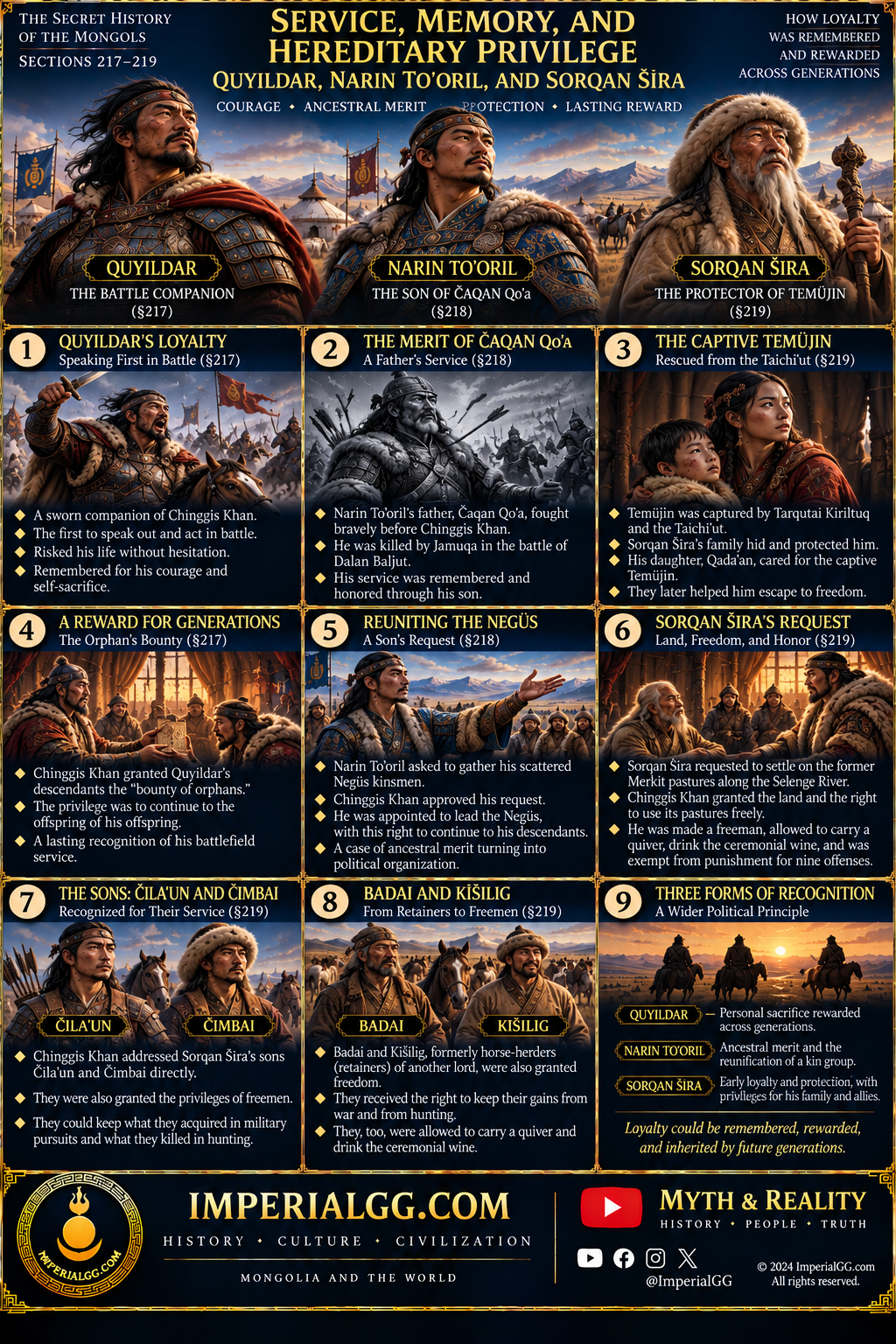
QUYILDAR, NARIN TO’ORIL, AND SORQAN ŠIRA IN THE SECRET HISTORY OF THE MONGOLS
Abstract
Sections 217–219 of The Secret History of the Mongols examine how Chinggis Khan recognized individual sacrifice, the services of deceased fathers, and acts of loyalty that had taken place before his rise to power. The accounts of Quyildar, Narin To’oril, and Sorqan Šira reveal three distinct forms of political recognition. Quyildar is remembered for his willingness to risk his life in battle, and his descendants are granted a privilege traditionally associated with orphans. Narin To’oril receives recognition for the military service of his deceased father, Čaqan Qo’a, and requests permission to reunite his scattered Negüs kinsmen under his authority. Sorqan Šira is rewarded for having protected the young Temüjin from the Taichi’ut, while his sons, Čila’un and Čimbai, also receive privileges in recognition of their family’s service. This article argues that these passages reveal a political system in which personal courage, ancestral merit, kinship organization, and hereditary privilege were closely connected. They also demonstrate that Chinggis Khan’s political memory extended beyond the moment of conquest: earlier acts of loyalty could be recognized long afterward and translated into continuing rights and responsibilities.
Keywords: The Secret History of the Mongols; Chinggis Khan; Quyildar; Narin To’oril; Sorqan Šira; Čaqan Qo’a; Čila’un; Čimbai; Negüs; hereditary privilege; Mongol political organization.
1. Introduction
The consolidation of Chinggis Khan’s authority involved more than the appointment of military commanders and the distribution of rewards among those who had participated in his campaigns. It also required the recognition of earlier sacrifices, the preservation of family obligations, and the incorporation of individuals and groups whose contributions had taken place before the establishment of the Mongol imperial order.
Sections 217–219 of The Secret History of the Mongols provide three important examples of this process. Quyildar is recognized for his personal courage and willingness to risk his life in battle. Narin To’oril receives recognition for the military service of his father, Čaqan Qo’a, and uses the opportunity to reunite his scattered Negüs relatives. Sorqan Šira is rewarded for having protected Temüjin during his captivity among the Taichi’ut, while his sons also receive privileges connected with their father’s earlier assistance.
These accounts are particularly valuable because they reveal different relationships between past service and later political recognition. Quyildar’s story concerns the extension of a personal sacrifice to future generations. Narin To’oril’s story demonstrates how the service of a deceased father could become the basis for the recognition and organization of his descendants. Sorqan Šira’s story shows how an act of protection performed during Temüjin’s vulnerable youth could remain politically significant long after he became supreme ruler.
The central argument of this article is that §§217–219 portray political loyalty as something that could extend beyond the lifetime of the individual. The chronicle connects service with the recognition of descendants, the preservation of kinship groups, and the granting of rights that could continue across generations.
2. Quyildar: Battlefield Sacrifice and the Recognition of Descendants
Section 217 begins with Chinggis Khan recalling the service of his sworn companion, Quyildar. The passage states that Quyildar had distinguished himself by being the first to speak out at the time of battle and by disregarding his own life. Chinggis Khan then orders that Quyildar’s descendants, extending to the offspring of his offspring, should receive the bounty traditionally granted to orphans.
The wording is concise, but its implications are important.
First, the chronicle emphasizes Quyildar’s conduct at the decisive moment of battle. His contribution is described not simply as obedience to an order but as an act of initiative and self-sacrifice. He was prepared to risk his own life when the situation demanded action.
Second, the narrative identifies Quyildar as a sworn companion. This relationship is significant because the recognition of his service is presented within the framework of personal loyalty and a bond that existed before the later consolidation of Chinggis Khan’s power.
Third, the reward extends beyond Quyildar himself. His descendants are to receive a recognized privilege through successive generations.
The phrase translated as the “bounty granted to orphans” requires careful interpretation. It should not automatically be understood as ordinary charitable assistance for children without parents. In the political and social context of the chronicle, it refers to a recognized category of support or privilege. The exact legal and economic content of this provision requires comparison with other sections in which the same expression appears.
The importance of §217 lies in the connection between an individual’s sacrifice and the continuing status of his descendants. Quyildar’s contribution is remembered as a service to the ruler, but the reward becomes a provision for his family line.
This suggests that the chronicle recognizes a form of political reciprocity extending beyond the immediate relationship between ruler and follower. The ruler’s obligation does not necessarily end with the death of the individual who performed the service.
Quyildar’s story therefore presents military courage as a source of lasting family recognition. His descendants inherit the benefit of a sacrifice that he made personally.
3. Narin To’oril: Ancestral Service and the Reunification of the Negüs
Section 218 turns from Quyildar’s personal sacrifice to the military service of a deceased father. Chinggis Khan addresses Narin To’oril, the son of Čaqan Qo’a. He recalls that Čaqan Qo’a fought energetically before him during the battle of Dalan Baljut and was killed by Jamuqa.
The reference is significant because the chronicle explicitly remembers the circumstances of the father’s death. Čaqan Qo’a is not simply identified as a deceased relative whose name is invoked to justify a reward. His military service is recalled in connection with a specific battle and a specific act of loyalty.
Chinggis Khan then declares that Narin To’oril should receive the bounty granted to orphans in recognition of his father’s service.
3.1 The son’s request: Reuniting a dispersed people
Narin To’oril responds by making a request that goes beyond personal compensation. He explains that his Negüs brothers are scattered among various tribes and asks Chinggis Khan to allow him to bring them together.
This request is central to the meaning of the passage. Narin To’oril does not simply accept the privilege offered to him. He uses the opportunity to restore the unity of a dispersed kinship group.
Chinggis Khan accepts the request and gives an additional instruction: after gathering his Negüs brothers, Narin To’oril is to take charge of them, and this arrangement is to continue to the offspring of his offspring.
The passage therefore establishes a connection between three elements:
The military service of Čaqan Qo’a.
The recognition granted to his son, Narin To’oril.
The reunification and continuing leadership of the Negüs group.
This is more than a personal reward. It is a political arrangement through which a dispersed group is brought together under a recognized leader.
3.2 Kinship as a basis for political organization
Narin To’oril’s request reveals the importance of kinship in the organization of the emerging Mongol political order. The Negüs were dispersed among different tribal groups. Their reunification required permission from the ruler and the recognition of someone who could exercise authority over them.
Chinggis Khan’s decision transforms Narin To’oril’s family connection into a political responsibility. He is not simply allowed to gather his relatives; he is appointed to lead the assembled group, with the arrangement extending to future generations.
This distinction is important. The chronicle does not present kinship as an entirely private matter. Under the conditions described in §218, kinship can become the basis for the formation of an organized military and political unit.
At the same time, the passage should not be interpreted as evidence that all Mongol political units were simply family groups. Rather, it provides a specific example of how a dispersed kinship community could be reorganized through the ruler’s authorization.
The case of Narin To’oril thus demonstrates how ancestral service could be transformed into a new form of political responsibility. His father’s military contribution becomes the basis for his own recognition, while his request turns that recognition into the reunification of a wider community.
4. Sorqan Šira: Protecting Temüjin and Preserving a Memory of Loyalty
Section 219 contains one of the most revealing accounts of loyalty in the early life of Temüjin. Chinggis Khan addresses Sorqan Šira and recalls the period when he was captured by Tarqutai Kiriltuq and the Taichi’ut. During this dangerous episode, Sorqan Šira, together with his sons Čila’un and Čimbai, and his daughter Qada’an, helped protect the young Temüjin.
The chronicle describes how Qada’an was entrusted with looking after Temüjin, while Sorqan Šira and his sons concealed him and eventually released him.
This episode is especially significant because Sorqan Šira’s assistance occurred before Temüjin had established the political authority that later made him Chinggis Khan. He was not protecting a supreme ruler or rewarding an already powerful patron. He was helping a vulnerable captive whose future position was uncertain.
4.1 Protection during captivity
The account recalls that Temüjin had been seized by Tarqutai Kiriltuq and his followers because of the jealousy of his Taichi’ut relatives. Sorqan Šira and his family did not immediately hand him over or abandon him. Instead, they took steps to protect him, conceal him, and eventually enable him to escape.
The participation of the entire family is important.
Sorqan Šira provided protection and direction.
His sons, Čila’un and Čimbai, assisted in concealing and releasing Temüjin.
His daughter Qada’an helped care for the captive.
The chronicle therefore preserves the episode as a family act of assistance rather than the isolated decision of one individual. This is a notable feature of the narrative. Temüjin’s survival depended on people who were not members of his immediate family or necessarily among his most powerful political supporters. Their actions nevertheless became part of the foundation of his later political memory.
4.2 The meaning of delayed recognition
Chinggis Khan explains that he had remembered Sorqan Šira’s earlier service, both in dreams during the night and in his thoughts during the day. The passage then acknowledges that Sorqan Šira came to Chinggis Khan’s side only after some delay, having remained among the Taichi’ut for a considerable period.
This detail is important. Chinggis Khan does not deny the earlier service simply because Sorqan Šira did not immediately join him after the escape. Instead, he distinguishes between the value of the original act and the later timing of Sorqan Šira’s arrival.
This suggests that the ruler’s memory of loyalty could extend across a long period and survive changes in political circumstances.
The passage presents Chinggis Khan as a ruler who remembered assistance received when he was powerless. The recognition of Sorqan Šira is therefore not merely a reward for recent military service. It is a response to an earlier act that had helped preserve Temüjin’s life and freedom.
5. Sorqan Šira’s Reward: Freedom, Grazing Rights, and Hereditary Privilege
When Chinggis Khan asks Sorqan Šira what favor he desires, Sorqan Šira makes a request concerning land and freedom of movement. He asks permission to settle on and freely use the grazing lands of the Merkits along the Selenge River.
Chinggis Khan grants the request. He authorizes Sorqan Šira to settle in the Merkit territory along the Selenge and to use its pastures freely.
The khan then grants him the status of a freeman, together with the privileges of carrying a quiver and drinking the ceremonial wine. These rights are extended to his descendants. He is also exempted from punishment for up to nine offenses. These rewards should be considered together.
5.1 Grazing rights and control of territory
The right to settle and use grazing grounds was an important economic privilege in a pastoral society. Access to pasture was directly connected with the ability to maintain livestock, support a household, and preserve a viable way of life. The grant of grazing rights therefore represented more than symbolic recognition.
The location is also significant. The territory in question is identified as former Merkit land along the Selenge River. The chronicle thus connects the reward with a specific geographical area rather than an abstract grant.
However, the text does not provide precise territorial boundaries or describe the administrative procedures through which the land was controlled. It would therefore be inappropriate to treat the passage as a complete land charter in the modern legal sense.
5.2 The privilege of freedom
Sorqan Šira’s recognition also includes the status of a freeman. The right to carry a quiver and drink ceremonial wine is particularly important because these privileges are associated with a recognized social and political standing.
The grant indicates that Sorqan Šira’s previous status had been different from the position now assigned to him by Chinggis Khan. The ruler’s favor transforms his social position and grants rights that can continue through his descendants.
The exemption from punishment for up to nine offenses adds another exceptional privilege. As in the cases of Jelme and Boroqul discussed in earlier sections, this provision demonstrates that the chronicle could preserve special protections granted to individuals whose service was considered extraordinary.
These privileges should not be interpreted as unlimited immunity from all law or as proof that the recipient could commit any offense without consequence. The text describes a specific royal concession, and its exact practical limits require examination alongside other passages and Mongol legal traditions.
6. Čila’un and Čimbai: The Recognition of the Sons
After granting privileges to Sorqan Šira, Chinggis Khan turns to his sons, Čila’un and Čimbai. He recalls their earlier words and invites them to state directly what they desire or lack. He specifically instructs them not to use intermediaries but to communicate their requests to him personally.
This instruction is revealing. The ruler does not simply assume that the father’s reward automatically satisfies the sons. He gives them the opportunity to express their own wishes.
The narrative then records a broader order concerning Sorqan Šira, Badai, and Kišiliq. These individuals, formerly retainers or horse-herders of other people, are now recognized as freemen.
The passage grants them the right to keep what they acquire during military pursuits and hunting. When pursuing enemies and obtaining booty, they may retain what they capture. When hunting wild animals, they may keep what they kill.
Chinggis Khan explicitly contrasts their former positions with their new status. Sorqan Šira had previously been a retainer of Tödege of the Taichi’ut, while Badai and Kišiliq had served as horse-herders of Čeren. The ruler now grants them the privileges of freemen, including the right to carry a quiver and drink ceremonial wine.
This episode expands the meaning of the recognition given to Sorqan Šira’s family. It is not simply an award to one man for a past act. It forms part of a wider process through which people of previously subordinate status are granted recognized freedom and privileges.
The sons’ direct access to the ruler is also significant. It demonstrates that the recognition of their father’s service could create an opportunity for the next generation to establish its own relationship with Chinggis Khan.
The passage therefore combines family memory with individual recognition. The sons benefit from the earlier service of their father, but they are also invited to speak for themselves and receive privileges within the new political order.
7. Three Forms of Recognition: Personal Sacrifice, Ancestral Merit, and Protective Loyalty
The three accounts in §§217–219 present different relationships between service and reward.
Quyildar represents personal sacrifice extended to descendants.
His willingness to risk his life in battle is remembered through a hereditary privilege for his descendants. The ruler’s obligation extends beyond the lifetime of the individual who performed the service.
Narin To’oril represents ancestral merit transformed into political organization.
His father’s death in battle becomes the basis for recognition, but Narin To’oril uses that recognition to reunite the scattered Negüs. The reward therefore produces a continuing leadership responsibility over a kinship group.
Sorqan Šira represents protective loyalty remembered across time.
His assistance to Temüjin during captivity is rewarded after Temüjin has become Chinggis Khan. The reward includes grazing rights, freedom, ceremonial privileges, and protection from punishment. His sons and other former retainers also receive recognition. Together, these accounts reveal that the political value of service was not restricted to one particular form.
The chronicle recognizes battlefield courage, the service of deceased ancestors, the protection of a vulnerable individual, the organization of kinship groups, and the advancement of people previously occupying subordinate positions.
This variety is important for understanding the consolidation of Chinggis Khan’s authority. The emerging political order did not rely exclusively on the promotion of established military commanders. It also incorporated people whose earlier contributions had been personal, familial, or protective.
8. Source Criticism and Historical Interpretation
A rigorous interpretation of §§217–219 requires attention to the differences between the surviving text and modern historical explanation.
First, the expression translated as the “bounty granted to orphans” appears in both §§217 and 218. Its precise institutional meaning should not be assumed from the English wording alone. The passage establishes that it was a recognized category of reward, but a fuller interpretation requires comparison with other occurrences and the original Mongolian terminology.
Second, the story of Narin To’oril’s Negüs relatives should not be used to claim that the entire Negüs population was reunited. The chronicle records Narin To’oril’s request and the ruler’s authorization, but it does not provide a complete demographic account of the group.
Third, Sorqan Šira’s reward should be distinguished from a modern land title or a comprehensive declaration of legal equality. The text records specific privileges concerning settlement, pasture use, freedom, ceremonial rights, and exemption from punishment. Their precise legal operation requires further contextual research.
Fourth, the story of Temüjin’s escape is preserved through a narrative that emphasizes the contribution of Sorqan Šira’s entire family. The role of Qada’an, Čila’un, and Čimbai should not be omitted when summarizing the event.
Finally, the chronicle’s presentation of Chinggis Khan’s memory and generosity is part of its political narrative. It records how the ruler’s authority is legitimized through the recognition of earlier loyalty. Historians should therefore distinguish between the events described and the narrative’s broader representation of royal virtue and reciprocal obligation.
These limitations do not diminish the historical importance of the passages. They clarify the evidence: §§217–219 explicitly preserve a pattern in which earlier service is recognized through privileges and responsibilities that may extend to descendants.
9. Conclusion
Sections 217–219 of The Secret History of the Mongols demonstrate how Chinggis Khan’s political order incorporated personal sacrifice, ancestral service, and protective loyalty into a system of recognition and privilege.
Quyildar’s battlefield courage is remembered through a continuing benefit for his descendants. Narin To’oril receives recognition for his father’s military service and transforms that recognition into the reunification and leadership of the Negüs. Sorqan Šira’s earlier protection of Temüjin becomes the basis for extensive privileges, while his sons and other former retainers are also recognized and granted freedom.
The three accounts reveal that political loyalty could have consequences extending far beyond the immediate act of service. A person who risked his life in battle, a father who died defending his ruler, or a family that protected a captive could all become part of the political memory of the new regime.
The chronicle thus presents the consolidation of Mongol authority as a process involving both military achievement and the recognition of obligations inherited from the past. Chinggis Khan’s political order was strengthened not only by those who fought beside him after his rise to power, but also by those who had helped him survive before that power existed.
The stories of Quyildar, Narin To’oril, and Sorqan Šira demonstrate a central principle of the political world represented in The Secret History of the Mongols: service could be remembered, rewarded, and transformed into enduring rights and responsibilities for future generations.
References
Cleaves, Francis Woodman, trans. 1982. The Secret History of the Mongols: For the First Time Done into English out of the Original Tongue and Provided with an Exegetical Commentary. Cambridge, MA: Harvard University Press.
de Rachewiltz, Igor, trans. 2004–2013. The Secret History of the Mongols: A Mongolian Epic Chronicle of the Thirteenth Century. 3 vols. Leiden: Brill.
de Rachewiltz, Igor, trans. 2015. The Secret History of the Mongols: A Mongolian Epic Chronicle of the Thirteenth Century. Shorter version edited by John C. Street. Western Washington University.
Onon, Urgunge, trans. 2001. The Secret History of the Mongols: The Life and Times of Chinggis Khan. Richmond: Curzon.
Primary source: The Secret History of the Mongols, §§217–219.
Source-critical note: This article follows de Rachewiltz’s translation in the 2015 shorter edition, with the section numbering of the standard text. The interpretation of the “orphan’s bounty,” the status of freemen, and the hereditary privileges is kept close to the wording of the chronicle. The text’s references to descendants are treated as explicit statements of continuing privilege, without assuming that every detail of later legal practice can be reconstructed from these sections alone.