
THE MORAL LIMITS OF LOYALTY AND THE ORGANIZATION OF POWER
By Altanbagana Baatar
DBA Candidate| Independent Historian
ImperialGG Historical Research Seriers
01 November 2026
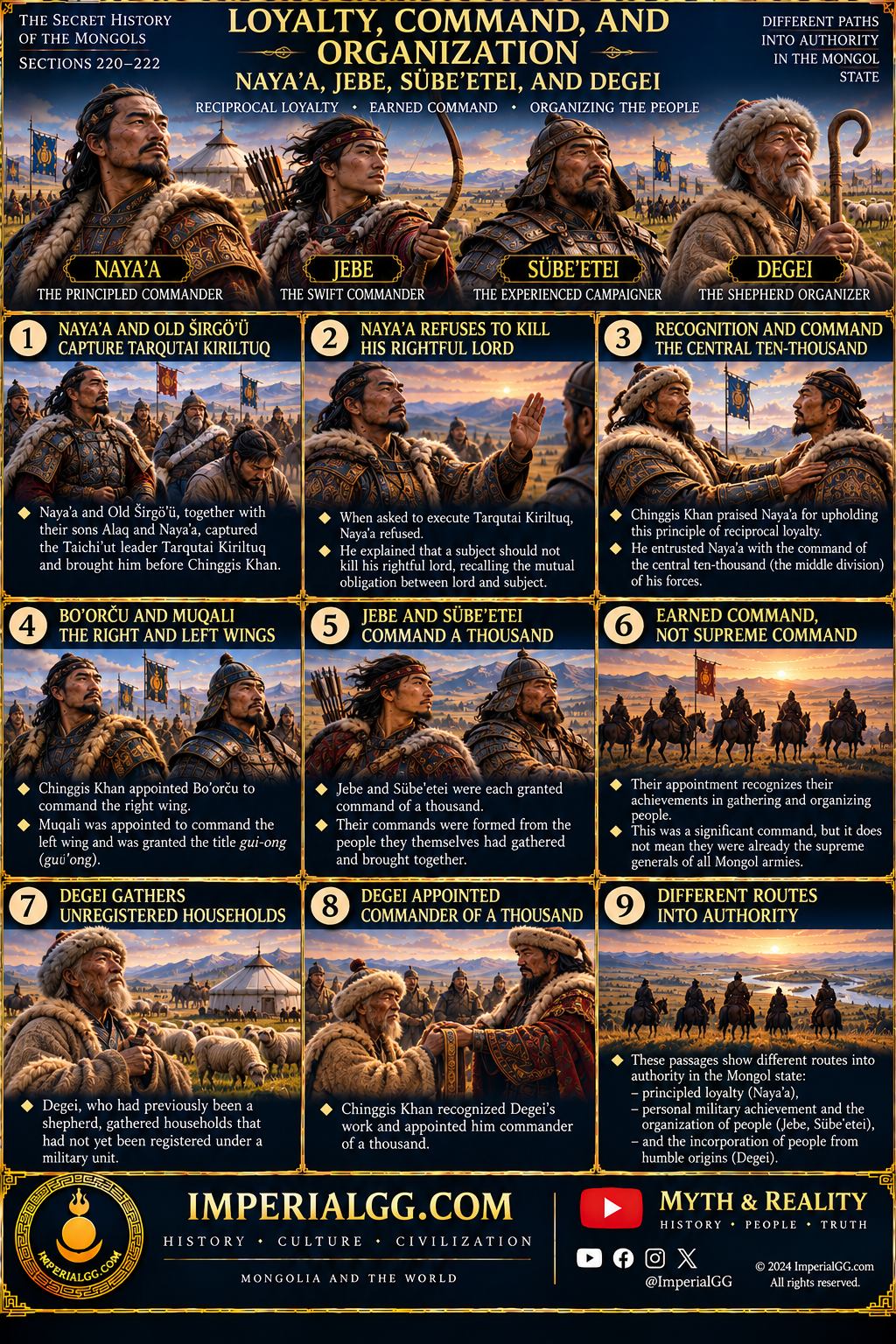
NAYA’A, JEBE, SÜBE’ETEI, AND DEGEI IN THE SECRET HISTORY OF THE MONGOLS
Abstract
Sections 220–222 of The Secret History of the Mongols illuminate three distinct dimensions of political and military organization under Chinggis Khan: principled loyalty, the formation of military units through personal achievement, and the incorporation of previously unregistered households into the new political order. Naya’a is recognized for refusing to kill his former lord, Tarqutai Kiriltuq, even after capturing him and bringing him under his control. Chinggis Khan interprets this decision as adherence to the principle of reciprocal obligation between lord and subject and appoints Naya’a to command the central ten-thousand-unit. Jebe and Sübe’etei receive authority over units of one thousand composed of people whom they themselves had gathered and organized. Degei, previously a shepherd, is entrusted with assembling unregistered households and placed in command of a thousand. This article argues that these passages reveal a political order in which authority was established through different forms of contribution: ethical consistency, military initiative, and the ability to organize people. Together, the three sections demonstrate that the consolidation of Mongol power involved not only the distribution of military rank but also the recognition of principles and practical abilities that sustained the emerging state.
Keywords: The Secret History of the Mongols; Chinggis Khan; Naya’a; Jebe; Sübe’etei; Degei; loyalty; reciprocal obligation; military organization; Mongol state formation.
1. Introduction
Sections 220–222 of The Secret History of the Mongols form part of the chronicle’s account of the distribution of military authority and the organization of the people under Chinggis Khan. The passages introduce four individuals whose contributions differ considerably: Naya’a, Jebe, Sübe’etei, and Degei.
Naya’a is recognized for an ethical decision made during a politically dangerous moment. Although he and his father and brother had captured Tarqutai Kiriltuq, Naya’a refused to kill the man who had formerly been his rightful lord. Jebe and Sübe’etei are appointed commanders of thousands formed from the people they themselves had gathered. Degei, whose earlier occupation was shepherding, is entrusted with bringing together households that had not yet been registered within the military organization.
These accounts should not be reduced to a simple list of appointments. They reveal different routes through which individuals could acquire recognized authority in Chinggis Khan’s emerging political order.
The central argument of this article is that §§220–222 present political authority as the outcome of three complementary qualities: adherence to reciprocal obligations, the ability to gather and organize followers, and the capacity to incorporate previously unregistered populations into a structured system. The chronicle thereby connects personal conduct with the practical construction of the Mongol state.
2. Naya’a: The Moral Limits of Loyalty
Section 220 begins with Chinggis Khan addressing Naya’a and recalling an incident involving Naya’a, his father, the elderly Širgöti, and his brother Alaq.
The three men had captured Tarqutai Kiriltuq, a leader of the Taichi’ut, and were bringing him toward Chinggis Khan. During the journey, however, Naya’a questioned whether they should proceed by killing their rightful lord.
The chronicle records Naya’a’s reasoning in direct speech. He asks how they could continue after laying hands on their legitimate lord and then make away with him. Although they had captured Tarqutai, they ultimately released him and allowed him to depart.
This decision is the central event of the passage.
2.1 A principle stronger than immediate political advantage
Naya’a’s decision was not an act of military incapacity. Tarqutai Kiriltuq was already in their hands, and the opportunity to deliver him to Chinggis Khan had presented itself. Instead, Naya’a considered the consequences of violating the relationship between a lord and his subject.
He reasoned that if they killed their rightful lord after having captured him, how could they be trusted in the future? Their conduct would establish a precedent that could undermine the credibility of their own future allegiance.
This is an important distinction. Naya’a did not argue that Chinggis Khan was unworthy of their service. Rather, he recognized that the legitimacy of a political relationship could not simply be discarded when circumstances changed. The chronicle therefore presents his decision as adherence to a principle of reciprocal obligation.
2.2 The great principle of lord and subject
Chinggis Khan explicitly recognizes the reasoning behind Naya’a’s action. De Rachewiltz’s translation includes an explanatory note identifying the principle as the mutual obligations between lord and subject. This clarification is especially important because it prevents the passage from being interpreted merely as a story of personal affection or hesitation.
Naya’a’s conduct reflects an understanding that a relationship of allegiance carries obligations. Even when a subject has the opportunity to gain advantage by abandoning or killing his former lord, the moral credibility of that relationship remains significant. The passage thus presents loyalty as something more complex than unconditional obedience to the strongest political authority.
It also reveals Chinggis Khan’s own understanding of political trust. He does not condemn Naya’a for releasing Tarqutai. Instead, he approves of his reasoning and declares that he will entrust him with an important responsibility. The khan’s decision is revealing: the very conduct that might have appeared politically inconvenient becomes the basis for recognizing Naya’a as a trustworthy commander.
2.3 Naya’a’s appointment to the central army
Following his recognition of Naya’a’s conduct, Chinggis Khan assigns him command of the central ten-thousand-unit.
This appointment is presented alongside two other major commands:
Bo’orču is placed in charge of the ten thousand of the right wing.
Muqali is placed in charge of the ten thousand of the left wing and receives the title of gui ong.
Naya’a is appointed commander of the ten thousand of the centre.
The arrangement is significant because it places Naya’a within the highest level of military command described in this passage. His appointment is not attributed to a single battlefield victory. Instead, the narrative connects it directly to his adherence to the principle of reciprocal obligation. This demonstrates that the chronicle recognizes moral reliability as a qualification for political and military authority.
Naya’a’s story therefore offers an important insight into the relationship between ethics and state formation. Chinggis Khan’s emerging political order required not only effective warriors but also individuals whose conduct demonstrated that their commitments could be trusted even under changing circumstances.
3. Jebe and Sübe’etei: Personal Achievement and the Right to Command
Section 221 turns to Jebe and Sübe’etei.
Chinggis Khan orders that each of them should become commander of a thousand over as many people as they themselves had acquired and assembled.
The wording is important. Their commands are connected to the people they personally gathered and organized. This is not simply a general appointment to an already established military unit. The passage recognizes the relationship between an individual’s ability to attract followers, organize them, and receive authority over the resulting group.
3.1 Command based on the gathering of followers
The appointment of Jebe and Sübe’etei illustrates a particular route to military authority. The chronicle does not describe them here as commanders of the entire Mongol army or as leaders of ten-thousand-units. It specifically assigns each of them command of a thousand based on the people they themselves had gathered.
This distinction matters because their later historical prominence should not be projected backward into every earlier appointment. Jebe and Sübe’etei would become among the most celebrated military commanders of the Mongol Empire. Their later campaigns across vast territories are central to the history of Mongol expansion. Yet §221 records a specific stage in their rise: the recognition of their capacity to assemble followers and exercise authority over them.
The passage therefore provides evidence of how military leadership could develop through demonstrated organizational achievement.
3.2 Personal initiative and military organization
The expression concerning the people they had gathered and constituted as their own patrimony also requires careful interpretation. The wording indicates that these commanders were recognized in relation to the followers they had personally acquired or assembled. It suggests a close connection between personal initiative and the formation of a military unit.
However, it should not be interpreted as proof that they possessed unrestricted private ownership over their soldiers in the modern legal sense. The important point is that the ruler recognized the organized group and assigned command over it to the person responsible for bringing it together.
This arrangement illustrates how Chinggis Khan could incorporate personal networks of followers into a larger military structure. Jebe and Sübe’etei thus represent a form of authority grounded in practical achievement: the ability to gather people, maintain their allegiance, and organize them into an effective unit.
4. Degei: From Shepherding to Military Administration
Section 222 introduces Degei, identified in the chronicle as a shepherd. Chinggis Khan orders Degei to gather the households that had not yet been registered and appoints him commander of a thousand. This is a particularly revealing passage because it connects an individual’s previous occupation with a new administrative responsibility.
4.1 The significance of the unregistered households
Degei’s task concerns households that had not yet been entered into the organized system. The translation uses the expression “unregistered households.” This wording should be preferred over interpretations that imply these people were necessarily hidden, rebellious, or deliberately concealing themselves. The passage does not explain why the households had not been registered. Their status may have resulted from the practical difficulties of organizing a large and changing population.
What the chronicle makes clear is that they were not yet incorporated into the relevant military-administrative structure. Degei is therefore assigned the task of bringing them together.
4.2 Recognition of organizational ability
The fact that Degei is described as a shepherd is significant. The chronicle does not present him as a famous battlefield commander or as a member of the highest-ranking aristocracy. Instead, it records his previous occupation before describing his appointment.
This contrast suggests that the emerging political order could recognize individuals whose value lay in their ability to organize people rather than in an established military reputation.
Degei’s task was practical and administrative. He had to assemble households that had not been registered and transform them into an organized unit under his command. The result was a thousand-unit, with Degei placed in charge.
This should not be interpreted as evidence of unrestricted social mobility across the entire Mongol Empire. The passage records a particular appointment and does not establish the complete social background of Degei or the general conditions under which all shepherds could become commanders.
Nevertheless, it demonstrates that the chronicle regarded organizational ability as a legitimate basis for military responsibility. Degei’s appointment reveals another dimension of state formation: the integration of populations that had not yet been incorporated into the formal military structure.
5. Three Routes to Authority in the Emerging Mongol State
Read together, §§220–222 reveal three different ways in which individuals could receive political and military authority.
Naya’a: Authority through principled loyalty
Naya’a’s recognition rests on his refusal to violate the reciprocal obligations between lord and subject. Chinggis Khan interprets his conduct as evidence of moral reliability and entrusts him with command of the central ten thousand.
Jebe and Sübe’etei: Authority through personal initiative
Their appointments recognize their ability to gather followers and organize them into military units. Each receives command of a thousand formed from the people he himself had assembled.
Degei: Authority through administrative organization
Degei is entrusted with gathering unregistered households and incorporating them into a military unit. His previous occupation as a shepherd does not prevent him from receiving this responsibility.
These three forms of recognition demonstrate that the political order described in the chronicle was not built exclusively through inherited rank or battlefield victories. It also depended on ethical consistency, personal initiative, and practical administrative ability.
6. The Broader Context: The Organization of the Mongol Military System
Sections 220–222 should also be read in connection with §224, which provides a broader statement about the organization of Chinggis Khan’s forces.
Section 224 explains that Chinggis Khan appointed commanders of thousands from among those who had established the state with him and suffered alongside him. He organized the population into units of thousands, hundreds, and tens, and appointed commanders at each level. This broader passage helps explain the significance of the individual appointments in §§220–222.
Naya’a’s central ten-thousand-unit, Jebe’s and Sübe’etei’s thousands, and Degei’s thousand were not isolated personal honors. They formed part of a larger process of military and administrative organization.
The chronicle presents this system as a combination of recognition and responsibility. Those who had contributed to the establishment of the political order received positions of command, while the organization of people into units created a structure through which the ruler could exercise authority.
The appointments also reveal different methods of incorporation:
Recognizing an individual’s established relationship of loyalty.
Allowing commanders to organize people they had personally gathered.
Assigning a trusted organizer to assemble previously unregistered households.
These methods were complementary. Together, they helped transform a broad population into a more clearly organized political and military structure.
7. Source Criticism and Interpretive Limits
Several distinctions are necessary when interpreting these sections.
First, Naya’a’s refusal to kill Tarqutai Kiriltuq should not be reduced to a simple claim that he remained politically loyal to the Taichi’ut. The passage presents his decision as adherence to the principle of reciprocal obligations between lord and subject. Chinggis Khan explicitly approves this reasoning.
Second, the appointment of Jebe and Sübe’etei in §221 concerns units of one thousand, not ten-thousand-units. Their later military achievements should not be confused with the specific rank recorded here.
Third, Degei is described as a shepherd, and the households assigned to him are described as unregistered. The text does not establish that they were rebellious or that they had deliberately concealed themselves from the authorities.
Fourth, the chronicle records a political and literary narrative rather than a complete administrative register. It does not provide the full size, ethnic composition, or geographical distribution of every group involved in these appointments.
Finally, the appointment of commanders should not be interpreted as proof that all military units were organized through identical procedures. These three sections preserve particular examples within a much larger process of political consolidation.
Such distinctions allow the historical significance of the passages to be examined without attributing to them more information than they actually contain.
8. Conclusion
Sections 220–222 of The Secret History of the Mongols reveal three distinct foundations of political and military authority under Chinggis Khan.
Naya’a demonstrates that principled loyalty could become a qualification for the highest level of military responsibility. His refusal to kill his former lord was recognized as adherence to the reciprocal obligations between ruler and subject.
Jebe and Sübe’etei demonstrate that military authority could be grounded in personal initiative and the ability to gather and organize followers. Their appointment as commanders of thousands recognized the groups they had personally assembled.
Degei demonstrates that practical organizational ability could also provide a basis for authority. His appointment transformed the task of gathering unregistered households into a formal military responsibility.
Together, these accounts show that the consolidation of Mongol power involved more than the distribution of titles and the recognition of battlefield victories. It required the integration of ethical principles, personal military initiative, and administrative organization.
The broader significance of these passages lies in their portrayal of a political order that recognized different forms of contribution. Naya’a, Jebe, Sübe’etei, and Degei did not reach positions of authority through identical paths. Their distinct services nevertheless became part of the same process through which Chinggis Khan organized people, established command relationships, and strengthened the foundations of the Mongol state.
References
Cleaves, Francis Woodman, trans. 1982. The Secret History of the Mongols: For the First Time Done into English out of the Original Tongue and Provided with an Exegetical Commentary. Cambridge, MA: Harvard University Press.
de Rachewiltz, Igor, trans. 2004–2013. The Secret History of the Mongols: A Mongolian Epic Chronicle of the Thirteenth Century. 3 vols. Leiden: Brill.
de Rachewiltz, Igor, trans. 2015. The Secret History of the Mongols: A Mongolian Epic Chronicle of the Thirteenth Century. Shorter version edited by John C. Street. Western Washington University.
Onon, Urgunge, trans. 2001. The Secret History of the Mongols: The Life and Times of Chinggis Khan. Richmond: Curzon.
Primary source: The Secret History of the Mongols, §§220–222.
Source-critical note: This article follows Igor de Rachewiltz’s translation in the 2015 shorter edition, with reference to the section numbering of the standard text. The distinction between commanders of thousands and commanders of ten thousands is retained. The term “unregistered households” follows the translation and is not interpreted as evidence of rebellion or deliberate concealment. The explanatory interpretation of reciprocal obligations between lord and subject follows de Rachewiltz’s note to §220.