
SERVICE BEYOND THE BATTLEFIELD
By Altanbagana Baatar
DBA Candidate| Independent Historian
ImperialGG Historical Research Seriers
30 October 2026
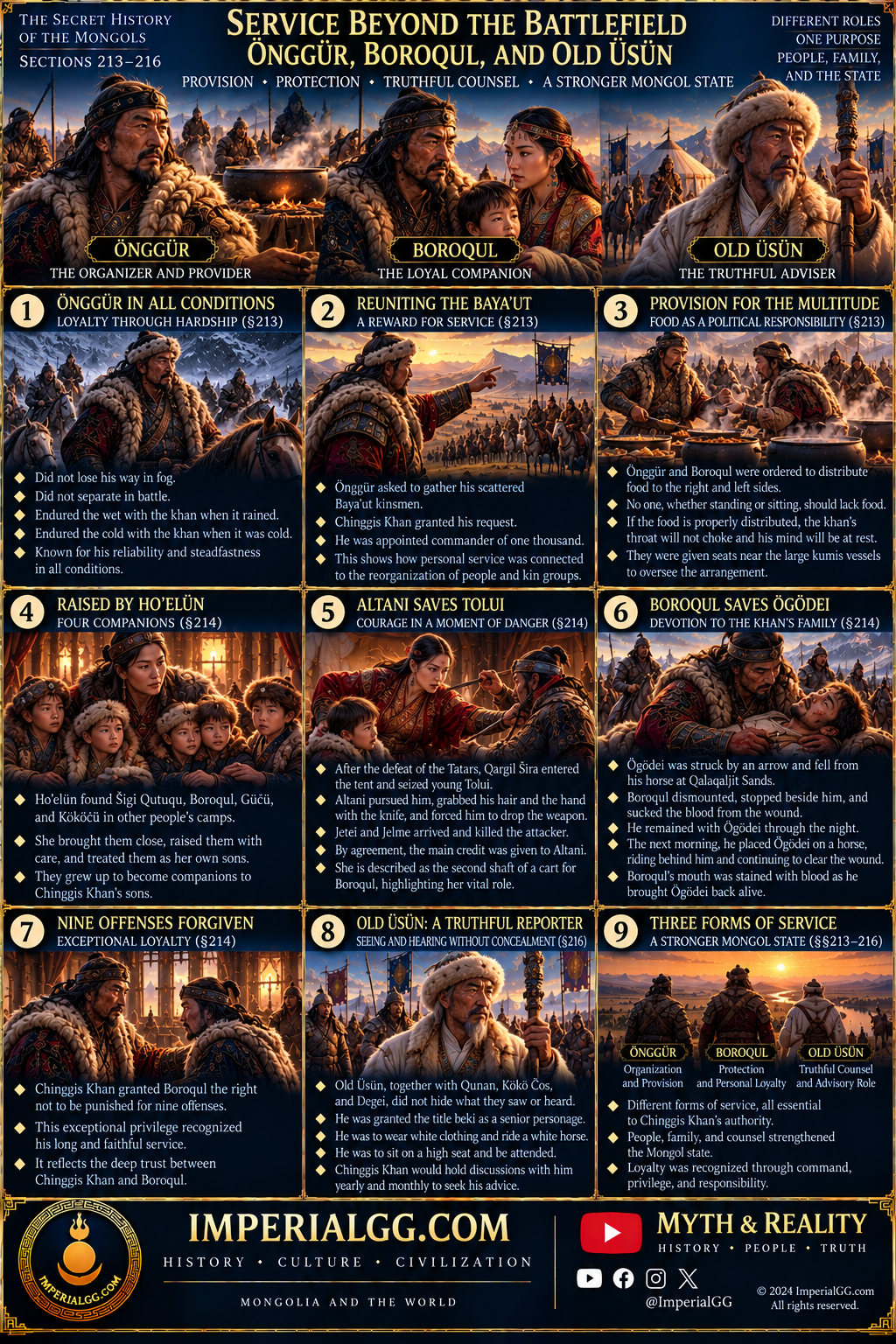
ÖNGGÜR, BOROQUL, AND OLD ÜSÜN IN THE SECRET HISTORY OF THE MONGOLS
Abstract
Sections 213–216 of The Secret History of the Mongols illuminate several dimensions of service within the political order established by Chinggis Khan. Through the accounts of Önggür, Boroqul, and Old Üsün, the chronicle moves beyond battlefield achievement to examine the organization of the ruling household, the distribution of provisions, the protection of the khan’s family, and the recognition of truthful counsel. Önggür is rewarded for enduring hardship alongside Chinggis Khan and is permitted to reunite his scattered Baya’ut kinsmen under his own command. Boroqul is remembered for his close companionship, his role in protecting Tolui and saving Ögödei, and the services of his wife Altani. Old Üsün is honored for his truthful reporting and receives the title of beki, together with ceremonial privileges and a continuing responsibility to advise the ruler. This article argues that these accounts reveal a conception of political service that encompassed logistical responsibility, household protection, personal loyalty, and informed counsel. The chronicle presents these contributions as complementary elements in the consolidation of Mongol authority.
Keywords: The Secret History of the Mongols; Chinggis Khan; Önggür; Boroqul; Altani; Old Üsün; Baya’ut; beki; Mongol political organization; loyalty; counsel.
1. Introduction
The establishment of Chinggis Khan’s political authority required more than successful military campaigns. A ruler commanding an expanding population also needed people capable of organizing provisions, maintaining the internal order of the camp, protecting members of the ruling household, and providing reliable information. Sections 213–216 of The Secret History of the Mongols preserve several examples of these responsibilities through the recognition of Önggür, Boroqul, and Old Üsün.
The three accounts differ considerably. Önggür’s story concerns endurance, the reunification of scattered kinsmen, and the practical organization of food distribution. Boroqul’s account emphasizes personal companionship, the protection of the khan’s family, and the intervention of his wife Altani during a moment of immediate danger. Old Üsün’s recognition rests on truthful communication and the provision of counsel to the ruler.
These individuals should not be understood simply as three military commanders. Their stories reveal a broader structure of service in which logistical, familial, and advisory responsibilities were also important to the operation of the emerging Mongol state.
The central argument of this article is that §§213–216 present political service as a combination of practical responsibility and personal trust. The chronicle recognizes not only those who fought beside Chinggis Khan but also those who sustained his camp, protected his family, organized people, and communicated information honestly.
2. Önggür: Endurance, Kinship, and the Organization of Provisioning
Section 213 begins with Chinggis Khan addressing Önggür, identified as a steward or cook and as the son of Mönggetü Kiyan. The passage also mentions the three Toqura’ut, the five Tarqut, and the Cangsi’ut and Baya’ut associated with Önggür. Together, these groups had formed one camp for Chinggis Khan.
The khan praises Önggür through a sequence of poetic statements:
He did not lose his way in the fog.
He did not separate from the others in battle.
When it was wet, he endured the wet with the khan.
When it was cold, he endured the cold with the khan.
These expressions describe more than physical endurance. They emphasize reliability under difficult conditions and the ability to remain with the ruler and his companions when circumstances became dangerous or uncomfortable. The imagery also recalls earlier passages in which shared hardship serves as evidence of loyalty.
Chinggis Khan then asks Önggür what reward he wishes to receive. Önggür does not request an individual privilege or personal wealth. Instead, he explains that his Baya’ut kinsmen are scattered among different tribes and asks permission to bring them together.
The khan accepts the request and authorizes Önggür to assemble his Baya’ut relatives and command a thousand. This decision is significant because the reward connects personal service with the reorganization of a dispersed kinship group. Önggür’s request is both familial and political: he seeks to reunite his people, while the khan incorporates that group into the emerging military-administrative structure.
The passage then turns to another responsibility shared by Önggür and Boroqul. Both are instructed to distribute food to the right and left sides of the assembly. Chinggis Khan emphasizes that provisions must not be insufficient for people standing or sitting, whether they are arranged in rows or not.
The khan explains the importance of this duty in personal terms: if the food is distributed properly, his throat will not choke and his mind will be at rest. He then orders the two stewards to distribute food to the multitude and assigns them seats near the large kumis vessels, where they can supervise the arrangement.
This episode reveals an important dimension of Mongol political organization. The distribution of food at the ruler’s camp was not a trivial domestic task. It required coordination, attention to the needs of a large gathering, and the ability to maintain an orderly distribution system. The khan’s explicit concern with sufficient provisions indicates that the welfare and management of the assembled people were matters of political importance.
Önggür’s account therefore presents three connected forms of service: enduring hardship with the ruler, reuniting a dispersed kinship group, and participating in the organization of provisions for the larger community.
3. Boroqul: Protection, Companionship, and the Preservation of the Ruling Household
Section 214 shifts from the organization of the camp to the protection of the ruling family. Chinggis Khan addresses Boroqul and recalls four individuals—Šigi Qutuqu, Boroqul, Güčü, and Kököčü—whom his mother Hö’elün had found in other people’s camps and raised as her own sons.
The chronicle uses powerful imagery to describe Hö’elün’s care. She found them on the bare ground, brought them close to her, raised them with affection, and transformed them into mature men. Chinggis Khan explains that his mother had raised them to become companions to her sons.
This passage is important because it presents the household of Hö’elün as a place where individuals of different origins could be incorporated into a close network of family-like relationships. The four men were not described as her biological sons, but the chronicle emphasizes the care and upbringing through which they became part of her household.
Chinggis Khan then turns specifically to Boroqul. He recalls that during rapid expeditions on rainy nights, Boroqul did not allow him to spend the night hungry. During battles against enemies, he likewise ensured that the khan did not go without soup.
These details may initially appear modest beside the chronicle’s accounts of major military victories. Their significance, however, lies in the conditions under which they occurred. Preparing food during difficult night movements or in the middle of military operations required practical skill, constant attention, and personal commitment. Boroqul’s service sustained the khan in circumstances when ordinary household arrangements were impossible.
3.1 Altani and the rescue of Tolui
The chronicle next recounts an incident in which Boroqul’s wife, Altani, played a decisive role in protecting the ruling household. Following the defeat of the Tatars, a man named Qargil Šira escaped and eventually returned to Hö’elün’s camp in a condition of extreme hunger. He entered the tent claiming to be a beggar and was allowed to sit near the entrance.
At that time, Tolui, who was five years old, entered the tent and then ran outside. Qargil Šira seized the child, held him under his arm, and attempted to draw his knife.
Hö’elün cried out that the child was in danger. Altani, who was nearby, immediately pursued the attacker. She seized his hair with one hand and the hand holding the knife with the other, pulling so forcefully that he dropped the weapon.
At that moment, Jetei and Jelme were nearby slaughtering an ox for provisions. Hearing Altani’s cry, they ran toward the scene carrying their axes. Together they killed Qargil Šira.
The chronicle then records a disagreement over who deserved the greatest credit for saving Tolui. Jetei and Jelme argued that they had killed the attacker and therefore deserved the principal recognition. Altani responded that without her pursuit, intervention, and seizure of the knife-bearing hand, the child might already have been killed before the two men arrived.
The narrative states that the principal merit was ultimately awarded to Altani by general agreement. It then describes her as the second shaft of a cart for Boroqul, emphasizing her importance in saving Tolui’s life.
This episode deserves particular attention. Although the passage is situated within a section recognizing Boroqul, it explicitly records the independent action of a woman whose intervention was decisive. The chronicle does not erase Altani’s contribution or attribute the rescue exclusively to the men who arrived afterward.
The episode also reveals that the security of the ruling household depended on people beyond the formal military command structure. A sudden threat could emerge inside the camp, and the ability to respond depended on the courage and immediate action of those present.
Altani’s role therefore expands the meaning of service in this section. The preservation of the ruling family was not solely a military responsibility; it also depended on the actions of household members and companions.
3.2 Boroqul and the rescue of Ögödei
The chronicle then recalls another episode involving Boroqul, this time during the battle against the Kereyid at Qalaqaljit Sands. Ögödei was struck by an arrow in the neck and fell from his horse. Boroqul dismounted, stopped beside him, and used his mouth to remove the clotting blood from the wound. He remained with Ögödei through the night.
The following morning, because Ögödei could not sit upright, Boroqul placed him on a horse and rode behind him, supporting him while continuing to clear the wound. The chronicle describes Boroqul’s mouth as stained with blood as he brought Ögödei back alive and safe.
Chinggis Khan interprets this service in connection with his mother’s earlier care for Boroqul. Because Hö’elün had raised him, Boroqul had now helped save the lives of two of her sons: Tolui, through Altani’s intervention, and Ögödei, through his own action.
The passage thus connects the care provided by Hö’elün with the later protection of her biological sons. It presents the relationship as one of reciprocal obligation, in which the affection and upbringing received in the past are answered through extraordinary service.
Chinggis Khan concludes by describing Boroqul as a companion who never delayed when summoned. He then grants Boroqul the exceptional privilege of not being punished for up to nine offenses.
This privilege is not merely a personal expression of affection. Within the narrative, it is a formal recognition of the exceptional services Boroqul had rendered. The chronicle thereby links personal loyalty, the preservation of the ruling household, and the granting of special legal or disciplinary protection.
4. Old Üsün: Truthful Reporting, the Rank of Beki, and Advisory Responsibility
Section 216 returns to the principle of truthful reporting previously encountered in §210. Chinggis Khan addresses Old Üsün and again names the four individuals—Üsün, Qunan, Kökö Čos, and Degei—who had consistently reported what they saw and heard without hiding or concealing information.
The repetition is significant. The chronicle does not present truthful communication as an incidental personal virtue. It returns to the same group and uses their conduct as the basis for a further political recognition.
Chinggis Khan explains that, according to Mongol custom, a senior-ranking personage could receive the title of beki. He identifies Old Üsün as a descendant of Elder Brother the Ba’arin and notes that Üsün is senior to him. On this basis, he grants him the rank of beki.
The chronicle then describes the privileges associated with this rank:
He is to wear white clothing.
He is to ride a white gelding.
He is to sit on a high seat.
He is to be attended and served.
These details indicate that the title carried visible ceremonial distinctions. White clothing and a white horse marked the recipient’s elevated status, while the high seat and attendance established a recognized position within the ruler’s assembly.
The most important aspect of the passage, however, comes after the description of these privileges. Chinggis Khan declares that he will hold discussions with Old Üsün yearly and monthly in order to seek his advice.
This instruction establishes a continuing relationship between rank and counsel. Old Üsün is not simply honored with a title and ceremonial privileges. He is also assigned an ongoing advisory role.
The passage does not specify the exact subjects of these discussions, nor does it provide a complete description of the institutional powers associated with the title of beki. It would therefore be inappropriate to equate the office directly with a modern ministerial or judicial position.
Nevertheless, the meaning of the passage is clear: Old Üsün’s seniority and reputation for truthful reporting are recognized through both ceremonial status and continuing access to the ruler’s decision-making process.
His account demonstrates that political authority in the chronicle was supported not only by military command but also by the recognition of seniority, reliable information, and counsel.
5. Three Forms of Service and the Consolidation of Political Authority
The accounts of Önggür, Boroqul, and Old Üsün reveal three distinct but interconnected forms of service. Önggür represents the organizational and logistical dimension. His endurance alongside Chinggis Khan is recognized through the reunification of his Baya’ut kinsmen under a command of one thousand. His work with Boroqul in distributing food demonstrates that the administration of the camp required planning and responsibility toward the assembled population.
Boroqul represents the protective and personal dimension. His service includes providing food during difficult military movements, while his own actions and those of his wife Altani help preserve the lives of Tolui and Ögödei. His special privilege reflects the exceptional trust placed in a companion whose service extended into the most vulnerable circumstances of the ruling household.
Old Üsün represents the advisory dimension. His recognition rests on truthful reporting, seniority, and the continuing obligation to provide counsel to the ruler. His title and ceremonial privileges demonstrate how political recognition could be expressed through status as well as responsibility.
These three accounts should not be treated as unrelated anecdotes. Together, they reveal a broader understanding of the requirements of political authority.
A ruler needed people who could organize the population and provisions, protect the household, and communicate information faithfully. These responsibilities were different, but each contributed to the stability of the emerging political order.
The chronicle also emphasizes reciprocity. Chinggis Khan remembers past service and responds with rewards, titles, privileges, and positions of responsibility. Önggür receives the opportunity to reunite his people; Boroqul receives exceptional protection from punishment; Old Üsün receives a distinguished rank and a continuing advisory role.
This pattern is consistent with the wider political logic of the chronicle: the ruler recognizes service, while those who receive his favor assume continuing obligations within the political order.
6. The Textual Gap in Section 215
A source-critical reading of this sequence must also address §215. The section contains a brief statement in which Chinggis Khan declares that the female members of his family should be rewarded. However, the surviving text contains a lacuna immediately after this statement.
De Rachewiltz notes that the missing passage probably concerned ordinances and instructions relating to grants and rewards for Chinggis Khan’s daughters and granddaughters. This reconstruction is a scholarly proposal, not surviving text.
A further complication occurs in §214. The shorter translation notes that a sentence following Boroqul’s nine-offense privilege repeats the statement found in §215 and should be deleted as a scribal error.
These details matter because they prevent the modern reader from treating §§213–216 as a completely uninterrupted sequence. The transition from Boroqul’s recognition to Old Üsün’s appointment includes a textual gap and a probable copying error.
The missing material should not be reconstructed as though its exact wording were known. Any discussion of the rewards granted to Chinggis Khan’s daughters and granddaughters must distinguish the surviving statement from the editor’s proposed explanation of the lost passage.
7. Conclusion
Sections 213–216 of The Secret History of the Mongols demonstrate that the consolidation of Chinggis Khan’s authority depended on a broad range of services beyond direct military achievement.
Önggür’s account highlights endurance, kinship organization, and the administration of provisions. Boroqul’s story reveals the importance of personal companionship and household protection, while preserving the decisive role played by his wife Altani in saving Tolui. Old Üsün’s recognition establishes truthful reporting and continuing counsel as qualities worthy of formal rank and ceremonial distinction.
The three men therefore represent different dimensions of political service: organization, protection, and advice. Their stories reveal a political order in which personal loyalty was translated into practical responsibility, while service was recognized through command, privilege, status, and continued participation in the ruler’s affairs.
The significance of these passages lies in their broader portrayal of state formation. The Mongol political order was not sustained by military force alone. It also depended on the organization of people and provisions, the protection of the ruling household, the preservation of trusted relationships, and the availability of reliable counsel.
By recording the contributions of Önggür, Boroqul, and Old Üsün, the chronicle preserves a conception of authority built through multiple forms of service. Their individual stories show how the emerging Mongol state relied on people whose contributions extended from the battlefield to the camp, the household, and the ruler’s council.
References
Cleaves, Francis Woodman, trans. 1982. The Secret History of the Mongols: For the First Time Done into English out of the Original Tongue and Provided with an Exegetical Commentary. Cambridge, MA: Harvard University Press.
de Rachewiltz, Igor, trans. 2004–2013. The Secret History of the Mongols: A Mongolian Epic Chronicle of the Thirteenth Century. 3 vols. Leiden: Brill.
de Rachewiltz, Igor, trans. 2015. The Secret History of the Mongols: A Mongolian Epic Chronicle of the Thirteenth Century. Shorter version edited by John C. Street. Western Washington University.
Onon, Urgunge, trans. 2001. The Secret History of the Mongols: The Life and Times of Chinggis Khan. Richmond: Curzon.
Primary source: The Secret History of the Mongols, §§213–216.
Source-critical note: This article follows the section numbering and translation of de Rachewiltz’s 2015 shorter edition, with comparison to the translations of Cleaves and Onon. The passage in §215 contains a lacuna, and the repeated sentence following §214 is identified by de Rachewiltz as a scribal error. The article does not reconstruct the missing text. The title beki is retained in transliteration because its precise institutional meaning requires further philological and historical discussion.