
FROM UNIFICATION TO GOVERNANCE
By Altanbagana Baatar
DBA Candidate| Independent Historian
ImperialGG Historical Research Seriers
26 October 2026
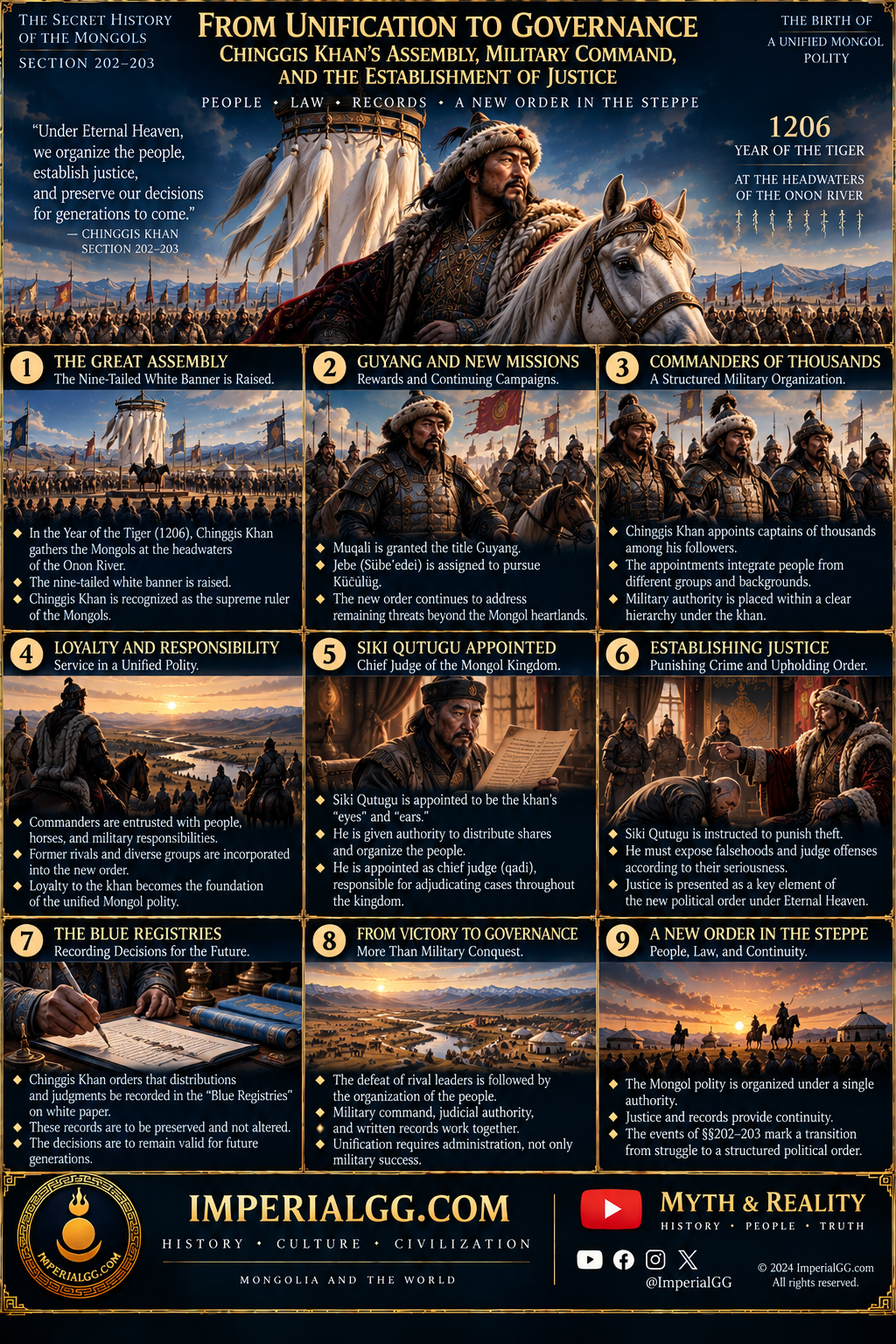
MILITARY ORGANIZATION, JUDICIAL AUTHORITY, AND RECORD-KEEPING IN THE SECRET HISTORY OF THE MONGOLS §§202–203
Abstract
Sections 202–203 of The Secret History of the Mongols describe a decisive transition in Chinggis Khan’s rule: the consolidation of political unity through military appointments, judicial authority, and the formal recording of decisions. Following the defeat of his principal rivals, Chinggis assembles his followers in the Year of the Tiger, conventionally identified as 1206, and establishes a hierarchy of commanders responsible for thousands of households. Section 203 then focuses on Siki Qutugu, whose appointment as chief judge and keeper of written records illustrates the relationship between political authority, adjudication, and administrative order. These passages show that unification was not complete merely because rival leaders had been defeated. It also required the organization of people, the distribution of responsibilities, the adjudication of disputes, and the preservation of authoritative records. This article examines §§202–203 as an account of the institutional foundations of the Mongol imperial state, while distinguishing the chronicle’s narrative from broader historical interpretation.
Keywords: Chinggis Khan; The Secret History of the Mongols; Mongol Empire; military organization; Siki Qutugu; judicial authority; written records; political consolidation.
1. Introduction
The conclusion of Jamuqa’s story in §201 marks the end of a prolonged struggle for supremacy among the Mongol political forces. Sections 202–203 turn from the fate of an individual rival to the organization of the political order that emerged from that struggle. The narrative describes Chinggis Khan’s enthronement, the appointment of military commanders, the establishment of judicial authority, and the preservation of decisions in written form.
This transition is fundamental. Military victory can remove competing centers of power, but it cannot by itself create a durable system of governance. A newly unified political community requires recognized command structures, procedures for resolving disputes, and mechanisms through which the ruler’s decisions can be communicated and preserved.
The central argument of this article is that §§202–203 present political consolidation as an institutional process. Chinggis Khan’s authority is expressed not only through the appointment of commanders but also through the organization of judicial power and the creation of an authoritative written record.
2. Section 202: The Assembly and the Organization of Military Authority
Section 202 places the reorganization of the Mongol polity in the Year of the Tiger, conventionally identified as 1206. The assembly takes place at the headwaters of the Onon River, where the nine-tailed white banner is raised and Chinggis Khan is recognized as ruler. The narrative also records the granting of the title Guyang to Muqali and the assignment of Jebe to pursue Küčülüg. These actions connect the recognition of supreme authority with the continuing responsibilities of military command.
The section then records the appointment of commanders of thousands. The list includes men who had contributed to Chinggis Khan’s rise, alongside leaders associated with different groups and political backgrounds. The appointments therefore represent more than a reward for individual military achievement. They place the forces of the newly unified polity within an ordered structure of command.
The organization by thousands also provides a means of integrating people into a broader political framework. Instead of leaving every group’s military organization entirely dependent on its previous leadership, the new regime identifies commanders and assigns them recognized responsibilities under the khan.
The list itself deserves close attention. It preserves the names of numerous commanders, allowing the chronicle to record the personnel through whom the new political order was established. At the same time, it should not be assumed that the list alone provides a complete account of the administrative realities of 1206. The text is a narrative and political record, and its presentation of appointments must be examined alongside other historical evidence.
The significance of §202 lies in the connection it draws between enthronement and organization. Chinggis Khan’s elevation is followed by the allocation of authority, demonstrating that the establishment of supreme rule required a corresponding structure of command.
3. Section 203: Siki Qutugu and the Institutionalization of Justice
Section 203 turns to Siki Qutugu, whom Chinggis Khan appoints to an exceptionally important administrative and judicial role. The khan declares that, with the kingdom being brought into order under the protection of Eternal Heaven, Siki Qutugu has become the ruler’s “eyes” and “ears.” The metaphor assigns him a position of responsibility in observing affairs, receiving information, and helping administer the kingdom.
Chinggis Khan instructs him to distribute shares and responsibilities among the relevant groups and to ensure that the allocation of the people is properly organized. He also appoints Siki Qutugu as chief judge, charging him with punishing theft, exposing falsehoods, and judging offenses according to their seriousness.
This appointment connects judicial authority directly to the consolidation of the state. The ruler’s power is not presented merely as the ability to command armies or punish opponents. It also entails the responsibility to establish judgments, distinguish offenses, and impose consequences.
The passage is particularly significant because the chronicle identifies Siki Qutugu as an official entrusted with duties extending beyond a single military unit or personal household. His jurisdiction is described in terms of the entire kingdom. The narrative thus portrays judicial responsibility as an institution of the emerging political order.
Nevertheless, the passage should not be treated as a complete legal code. It identifies responsibilities and principles, but it does not provide a comprehensive catalogue of offenses, procedures, evidentiary standards, or appeals. Its value lies in documenting the conception of judicial authority expressed in the chronicle, rather than demonstrating that every aspect of a fully codified legal system had already been established.
4. Written Records and the Authority of Decisions
One of the most consequential details in §203 is the order to record distributions and judgments in the “Blue Registries,” described as blue writing on white paper. Chinggis Khan commands that the records be preserved and not altered, extending the force of the instruction to future generations.
This passage introduces a crucial dimension of governance: the preservation of decisions beyond the moment in which they are issued. Oral commands can establish authority in a personal encounter, but written records make it possible to preserve information about allocations, judgments, and administrative decisions over time.
The order also implies that the distribution of people and the settlement of disputes were matters requiring an authoritative record. Such documentation could help establish what had been assigned, what had been decided, and which decisions were not to be arbitrarily changed.
The importance of this instruction should not be overstated. The passage does not establish that the entire Mongol administration operated through a uniform, comprehensive bureaucracy in the modern sense. It does, however, demonstrate that the chronicle associates legitimate governance with the recording and preservation of official decisions.
The connection between judicial authority and written records is especially important. A judge’s decision has broader institutional significance when it can be preserved and consulted rather than remaining solely in the memory of the people involved. The chronicle’s account therefore presents written documentation as one means through which the new political order sought continuity and consistency.
5. Political Consolidation and the Limits of Personal Rule
Sections 202–203 together reveal the relationship between personal authority and institutional organization. Chinggis Khan remains the central source of appointments and decrees, yet the execution of his decisions depends on commanders, judges, and the preservation of records.
The military appointments establish a hierarchy through which the ruler can organize forces and allocate responsibilities. Siki Qutugu’s appointment provides a designated authority for judging offenses and administering the distribution of the population. The written records, in turn, preserve decisions that might otherwise depend entirely on personal recollection or the continued presence of those who witnessed them.
These measures do not eliminate the personal nature of Mongol political authority. Rather, the chronicle presents the ruler’s authority as operating through appointed individuals and recognized responsibilities. The new order combines personal allegiance with administrative arrangements designed to endure.
The sequence is also historically meaningful. After the narrative of Jamuqa’s defeat and death, the text moves toward the organization of the kingdom. The transition suggests that the end of rival political leadership was followed by the challenge of establishing an order capable of governing the people brought under Chinggis Khan’s authority.
Unification, in this sense, was not simply a military achievement. It was also an administrative undertaking involving command, judgment, allocation, and documentation.
6. Conclusion
Sections 202–203 of The Secret History of the Mongols present the consolidation of Chinggis Khan’s rule as a process extending beyond the defeat of rival leaders. The assembly of 1206 and the appointment of commanders established a framework of military authority. The appointment of Siki Qutugu as chief judge extended the organization of the kingdom into the administration of justice. The order to preserve decisions in written records added a further dimension by linking political authority to documentation and continuity.
These passages do not provide a complete description of every institution of the early Mongol state, nor should they be read as proof that a modern bureaucratic or legal system already existed. They nevertheless offer important evidence of the principles through which the chronicle represents the new regime: authority organized through appointments, justice entrusted to a designated official, and decisions preserved for future generations.
The transition from §202 to §203 is therefore central to understanding the political significance of the chronicle. The establishment of Chinggis Khan’s rule required not only the defeat of competing powers but also the creation of structures through which a unified kingdom could be administered. Military command, judicial authority, and written records emerge as complementary elements in the narrative of Mongol political consolidation.
References
Atwood, Christopher P., trans. 2023. The Secret History of the Mongols. Penguin Classics.
de Rachewiltz, Igor, trans. 2004. The Secret History of the Mongols: A Mongolian Epic Chronicle of the Thirteenth Century. Leiden: Brill.
Onon, Urgunge, trans. 2001. The Secret History of the Mongols: The Life and Times of Chinggis Khan. Richmond: Curzon.
Primary textual basis: The Secret History of the Mongols, §§202–203. Specific translations of institutional terms—including “captain of a thousand,” “chief judge,” and “Blue Registries”—should be checked against the chosen edition before publication.