
THE LAST DIALOGUE OF CHINGGIS KHAN AND JAMUQA
By Altanbagana Baatar
DBA Candidate| Independent Historian
ImperialGG Historical Research Seriers
25 October 2026
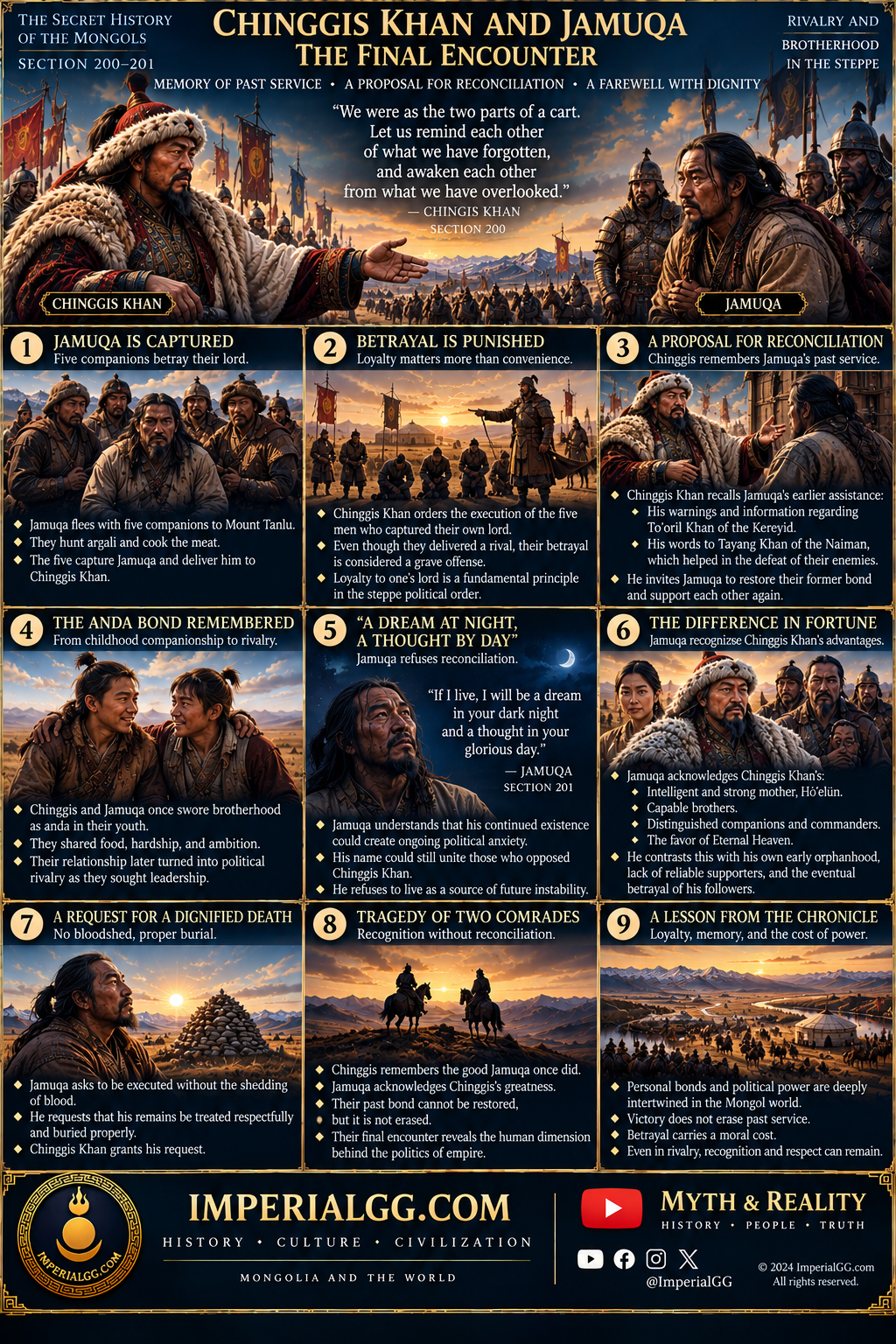
THE FINAL ENCOUNTER OF CHINGGIS KHAN AND JAMUQA IN THE SECRET HISTORY OF THE MONGOLS
Abstract
Sections 200–201 of The Secret History of the Mongols present one of the most emotionally complex episodes in the chronicle: the final encounter between Chinggis Khan and Jamuqa, his childhood anda and later political rival. The episode is not merely a narrative of defeat and execution. It is a meditation on political memory, loyalty, kinship, personal obligation, and the irreversible consequences of rivalry within the steppe political world. Chinggis’s message to Jamuqa recalls the latter’s earlier assistance during critical confrontations involving To’oril Khan and the Naiman ruler Tayang Khan. His willingness to remember these acts, despite their subsequent hostility, reveals a conception of political relationship in which past service retains moral significance even after conflict. Jamuqa’s refusal of reconciliation, particularly his statement that he would become a troubling presence in Chinggis’s dreams at night and thoughts by day, expresses not simply personal despair but a penetrating recognition that his continued existence could perpetuate political instability. His comparison between their respective backgrounds—Chinggis’s intelligent mother, capable brothers, distinguished companions, and heavenly fortune, contrasted with his own deprivation and the disloyalty of his followers—further illuminates his understanding of the unequal foundations of their political destinies. Read together, sections 200–201 portray both men as figures shaped by the tension between personal bonds and the demands of political consolidation.
Keywords: The Secret History of the Mongols; Chinggis Khan; Jamuqa; anda relationship; To’oril Khan; Tayang Khan; nomadic political culture; loyalty; political memory.
1. Introduction: Beyond the Defeat of a Rival
The final encounter between Chinggis Khan and Jamuqa in sections 200–201 of The Secret History of the Mongols should not be reduced to the conventional story of a victorious ruler eliminating his last major rival. The narrative contains a more profound tension: Chinggis remembers Jamuqa not only as an adversary but also as the man who had once stood beside him, advised him, and conveyed information during moments of extraordinary danger. Jamuqa, in turn, recognizes Chinggis’s political superiority while refusing to return to a relationship that has become irreparably damaged.
Their relationship had begun with the childhood bond of anda, a sworn brotherhood that carried obligations beyond ordinary friendship. Yet the two men eventually pursued competing claims to political leadership. Their conflict was therefore simultaneously personal and structural: it concerned not only their feelings toward one another but also the organization of allegiance, authority, and military power among the steppe peoples.
The narrative’s emotional force lies in the fact that neither man entirely erases the past. Chinggis does not forget Jamuqa’s earlier assistance simply because Jamuqa later opposed him. Jamuqa does not deny the significance of their childhood bond, even as he concludes that reconciliation is no longer possible. Their final dialogue thus preserves the memory of a relationship that political rivalry could destroy but not wholly erase.
2. Jamuqa’s Earlier Assistance: Memory Amid Political Hostility
Chinggis’s reconciliation message in section 200 recalls Jamuqa’s conduct during earlier confrontations involving To’oril Khan of the Kereyid and Tayang Khan of the Naiman. These references are essential to understanding why Chinggis’s words are so moving. He does not speak as though Jamuqa had always been his enemy. Instead, he recalls moments when Jamuqa’s words and actions had helped him understand the intentions and strengths of opposing powers.
The episode associated with To’oril Khan belongs to the period when Temüjin’s relationship with his former patron and ally deteriorated into open conflict. The wider narrative describes how political messages, accusations, and warnings circulated among the competing leaders. Jamuqa’s earlier disclosures and communications became part of the information through which Temüjin understood the danger confronting him. Chinggis’s later recollection of this episode indicates that he continued to regard Jamuqa’s past conduct as meaningful, despite their subsequent antagonism.
The Naiman episode carries a related but distinct significance. Jamuqa’s words to Tayang Khan are remembered in connection with the Naiman ruler’s assessment of Temüjin and his military following. Jamuqa’s description of Temüjin’s people and commanders contributed to the Naiman court’s understanding of the emerging power confronting it. In Chinggis’s retrospective account, Jamuqa’s words had helped bring about the destruction of his enemies.
These episodes should not be interpreted as proof that Jamuqa consistently acted with the deliberate intention of rescuing Temüjin. His political position changed over time, and his statements could serve different purposes in different circumstances. The decisive point in section 200 is that Chinggis himself remembers these earlier episodes as services rendered by Jamuqa. The historical and literary significance lies not only in what Jamuqa may originally have intended, but also in the meaning Chinggis assigns to those actions at the moment of their final separation.
This act of remembrance reveals an important dimension of the chronicle’s political imagination. Hostility does not necessarily erase earlier obligations. A person who has become an enemy may still be remembered as someone who once offered assistance at a decisive moment. Chinggis’s words are moving precisely because he acknowledges that Jamuqa’s history cannot be reduced to his eventual opposition.
3. The Offer of Reconciliation: The Persistence of the Anda Bond
After Jamuqa’s companions seize him and deliver him to Chinggis, the khan orders the execution of those who have captured their own lord. He then sends Jamuqa a message proposing the restoration of their former relationship. The sequence is striking: Chinggis punishes the men who have delivered his rival into his hands and then offers that rival reconciliation.
The juxtaposition is central to the meaning of the episode. The men who capture Jamuqa might appear, from the perspective of immediate military advantage, to have performed a useful service for Chinggis. Yet their action violates the relationship of loyalty that had bound them to their own leader. Their betrayal is treated as a more fundamental offense than the mere fact that they have helped defeat an enemy.
Chinggis’s subsequent message to Jamuqa invokes their earlier companionship and the possibility that they might once again support one another. Its language recalls the image of two complementary parts of a cart and the idea that companions should remind one another of what has been forgotten and awaken one another from sleep. The imagery transforms reconciliation from a simple act of political submission into a proposal to recover a relationship based on mutual counsel and support.
This is not evidence that Chinggis has forgotten their conflict. Rather, it demonstrates that he is willing to acknowledge a history larger than that conflict. He remembers Jamuqa’s former assistance and addresses him as someone whose past relationship with him still deserves recognition.
The emotional significance of Chinggis’s words lies in this refusal to treat political victory as a reason to erase personal memory. The victor has the power to determine the defeated man’s fate, but his message initially opens the possibility of restoring their bond. The chronicle therefore presents Chinggis not only as a ruler consolidating power but also as a person capable of recalling an earlier relationship with regret and affection.
4. “A Dream in the Dark of Night”: Jamuqa’s Political Foresight
Jamuqa’s refusal of reconciliation is among the most revealing moments in the narrative. He explains, in imagery of night and day, that he would become a disturbing presence in Chinggis’s dreams at night and in his thoughts during the day. The statement is not merely an expression of sadness. It identifies a continuing problem that personal reconciliation alone could not necessarily resolve.
Jamuqa had previously mobilized political and military support against Temüjin. His name carried the memory of rival leadership, competing allegiances, and repeated conflict. Even if he personally accepted Chinggis’s supremacy, his continued existence could offer a focal point for those dissatisfied with the new political order. Former followers, defeated allies, or ambitious leaders might invoke his name to renew opposition. His presence could therefore create uncertainty for the very ruler who had offered him reconciliation.
Jamuqa’s words suggest that he understands this danger. He recognizes that the relationship between them has acquired consequences beyond their individual feelings. The question is no longer simply whether two former companions can forgive one another. It is whether a man who has repeatedly stood at the center of opposition can live beside the ruler whose authority has finally prevailed without becoming a source of renewed anxiety.
The image of the night-time dream and the daytime thought captures the persistence of political memory. A defeated rival may disappear from the battlefield yet remain present in the imagination of the ruler. He may be absent physically but continue to exist as a possibility: the possibility of rebellion, renewed allegiance, or the reappearance of an alternative center of power.
Jamuqa’s refusal can therefore be read as an act of political foresight. He appears to understand that his survival could prolong the conflict between his own political identity and Chinggis’s emerging order. His decision is not simply a surrender to despair. It is also a recognition that their former relationship cannot be restored to its original condition merely because the victor is willing to offer reconciliation.
5. Unequal Foundations: Chinggis’s Mother, Brothers, Companions, and Fortune
Jamuqa’s final speech also compares the circumstances of their lives. He acknowledges Chinggis’s advantages, including an intelligent mother, capable younger brothers, distinguished companions, and the favor of Heaven. He contrasts these advantages with his own deprivation and the failure of those who should have remained loyal to him.
This comparison should not be dismissed as a conventional expression of defeat. It reveals Jamuqa’s understanding of how political leadership is formed. A ruler’s success depends not only on personal courage or military skill but also on the human relationships surrounding him: family, counsel, loyal companions, and the ability to preserve a dependable following.
The reference to Chinggis’s mother is particularly significant. In the chronicle’s broader narrative, Hö’elün is not a passive background figure. Her intelligence, determination, and capacity to preserve and guide her family are integral to Temüjin’s survival and development. By acknowledging the value of Chinggis’s mother, Jamuqa recognizes that the foundations of political power had been laid long before the final military victories.
The mention of Chinggis’s brothers and companions further broadens this recognition. Leadership is represented as a collective achievement sustained by relationships. Chinggis’s political ascent was supported by a family capable of enduring adversity and by men whose abilities and loyalty helped turn personal leadership into organized power.
Jamuqa’s comparison with his own circumstances is equally important. His failure is not attributed solely to a lack of courage or intelligence. The loss of dependable supporters and the betrayal of his immediate followers reveal the fragility of the network on which his authority rested. In section 200, five companions who should have remained loyal seize and deliver him to Chinggis. The contrast between Chinggis’s capable following and Jamuqa’s disloyal companions is therefore embodied in the action of the narrative itself.
Jamuqa’s final words thus offer a penetrating account of political success and failure. The difference between the two men lies not only in their personal qualities but also in the strength, loyalty, and continuity of the relationships that sustained them.
His acknowledgment of Chinggis’s advantages also carries the force of recognition. Jamuqa is not merely declaring himself defeated; he is identifying the foundations of the rival’s achievement. In doing so, he gives Chinggis a final form of acknowledgment from someone who knew him before he became the supreme ruler.
6. Loyalty, Betrayal, and the Moral Order of the Steppe
The execution of Jamuqa’s captors provides a necessary context for interpreting the final dialogue. Chinggis condemns those who seize their own lord, even though their action has delivered his rival into his hands. Their punishment demonstrates that immediate advantage does not automatically override the obligations of allegiance.
This episode should not be equated uncritically with a modern legal principle or a universal rule governing all Mongol political relationships. It is a specific narrative in which loyalty to one’s lord is treated as a defining moral obligation. Within the chronicle’s presentation, the men’s betrayal disqualifies them from the trust that political relationships require.
The episode also exposes the tragedy of competing loyalties. Jamuqa and Chinggis had once been bound by the anda relationship, but their competing political ambitions eventually brought them into conflict. Their followers, meanwhile, were expected to maintain their own obligations to their leaders. The narrative distinguishes between political rivalry itself and the dishonorable betrayal of an immediate lord.
Chinggis’s conduct toward Jamuqa is therefore especially meaningful. He condemns the betrayal of Jamuqa by his followers while remaining willing to remember Jamuqa’s past services to himself. Loyalty is not portrayed as a simple matter of supporting whichever side ultimately wins. It is embedded in relationships that retain moral significance even when the political landscape changes.
The episode consequently presents a political world in which personal memory, obligations between leaders, and the consolidation of authority remain inseparable. Chinggis’s power is strengthened not merely by defeating rivals but also by defining the forms of loyalty that should govern relationships within the emerging political order.
7. Death Without Bloodshed and the Preservation of Dignity
Jamuqa ultimately asks to be executed without the shedding of blood and requests that his remains be treated and buried appropriately. Chinggis grants the request. The ending is significant because it allows Jamuqa to retain a degree of agency at the moment when his political power has disappeared.
His request concerns not only the manner of his death but also the treatment of his remains. The distinction matters. Jamuqa’s body and burial become the final domain in which his wishes can still be acknowledged. His death does not erase the need to recognize the person he had been or the relationship he had once shared with Chinggis.
The chronicle does not present this ending as a reconciliation in the ordinary sense. Jamuqa refuses to resume his former place beside Chinggis, and his death closes the possibility of their relationship continuing in life. Yet the fulfillment of his final request preserves a form of recognition between them.
Chinggis does not restore Jamuqa’s political position, nor does Jamuqa accept a renewed political partnership. Instead, the relationship reaches its final expression through the manner in which Chinggis responds to Jamuqa’s request. The defeated rival is no longer a military threat, but he remains a person whose final wishes are heard.
This ending reinforces the central tension of sections 200–201: political rivalry has made their former relationship impossible to restore, but it has not entirely extinguished the memory and recognition that once sustained it.
8. Conclusion: The Tragedy of Two Men Who Could Not Recover Their Past
Sections 200–201 of The Secret History of the Mongols offer a profound account of the relationship between political power and personal memory. Chinggis Khan’s words to Jamuqa are moving because they recall assistance rendered during moments when their relationship was already strained by political conflict. The memories of To’oril Khan and Tayang Khan reveal that Chinggis did not interpret Jamuqa’s entire life through the lens of his eventual opposition.
Jamuqa’s response is equally revealing. His image of becoming a troubling dream at night and a burden upon Chinggis’s thoughts by day expresses the recognition that his continued existence could perpetuate political uncertainty. His comparison of their respective backgrounds acknowledges the importance of an intelligent mother, capable brothers, distinguished companions, and the loyalty necessary to sustain leadership.
Their final exchange is therefore more than a defeated rival’s farewell. It is a confrontation between two forms of political memory. Chinggis looks backward, recalling the assistance and companionship that once bound them together, and offers the possibility of restoring their relationship. Jamuqa looks toward the future, recognizing that their shared past can no longer provide a stable foundation for their political coexistence.
The tragedy lies precisely in this divergence. Chinggis is willing to remember the good that Jamuqa once did; Jamuqa believes that remaining alive would continue to burden the man he once called his anda. Their political rivalry has destroyed the conditions under which their earlier bond could be renewed, yet neither man completely denies its former significance.
In the chronicle’s final portrayal, the consolidation of political authority does not require the erasure of personal history. On the contrary, the narrative derives much of its force from the fact that the victorious ruler remembers the services of his defeated rival, while the defeated rival recognizes the strengths and relationships that enabled his former companion to prevail.
The final dialogue of Chinggis Khan and Jamuqa is thus a tragedy of remembered loyalty: two men who once shared a bond of brotherhood come to understand that the political world they have created no longer permits them to inhabit that bond together.
References
Atwood, Christopher P., trans. 2023. The Secret History of the Mongols. London: Penguin Classics.
de Rachewiltz, Igor, trans. 2004–2013. The Secret History of the Mongols: A Mongolian Epic Chronicle of the Thirteenth Century. 3 vols. Leiden: Brill.
Onon, Urgunge, trans. 2001. The Secret History of the Mongols: The Life and Times of Chinggis Khan. Richmond: Curzon.
Source-critical note: The analysis above distinguishes the chronicle’s explicit narrative from interpretive conclusions about Jamuqa’s political foresight and Chinggis’s emotional response. Exact wording concerning Jamuqa’s earlier messages, the scope of the punishment imposed on his captors, and the request for bloodless execution should be checked against the Mongolian text and the relevant notes in the cited translations before publication.