
LOYALTY, SERVICE, AND THE MAKING OF MONGOL POWER
By Altanbagana Baatar
DBA Candidate| Independent Historian
ImperialGG Historical Research Seriers
27 October 2026
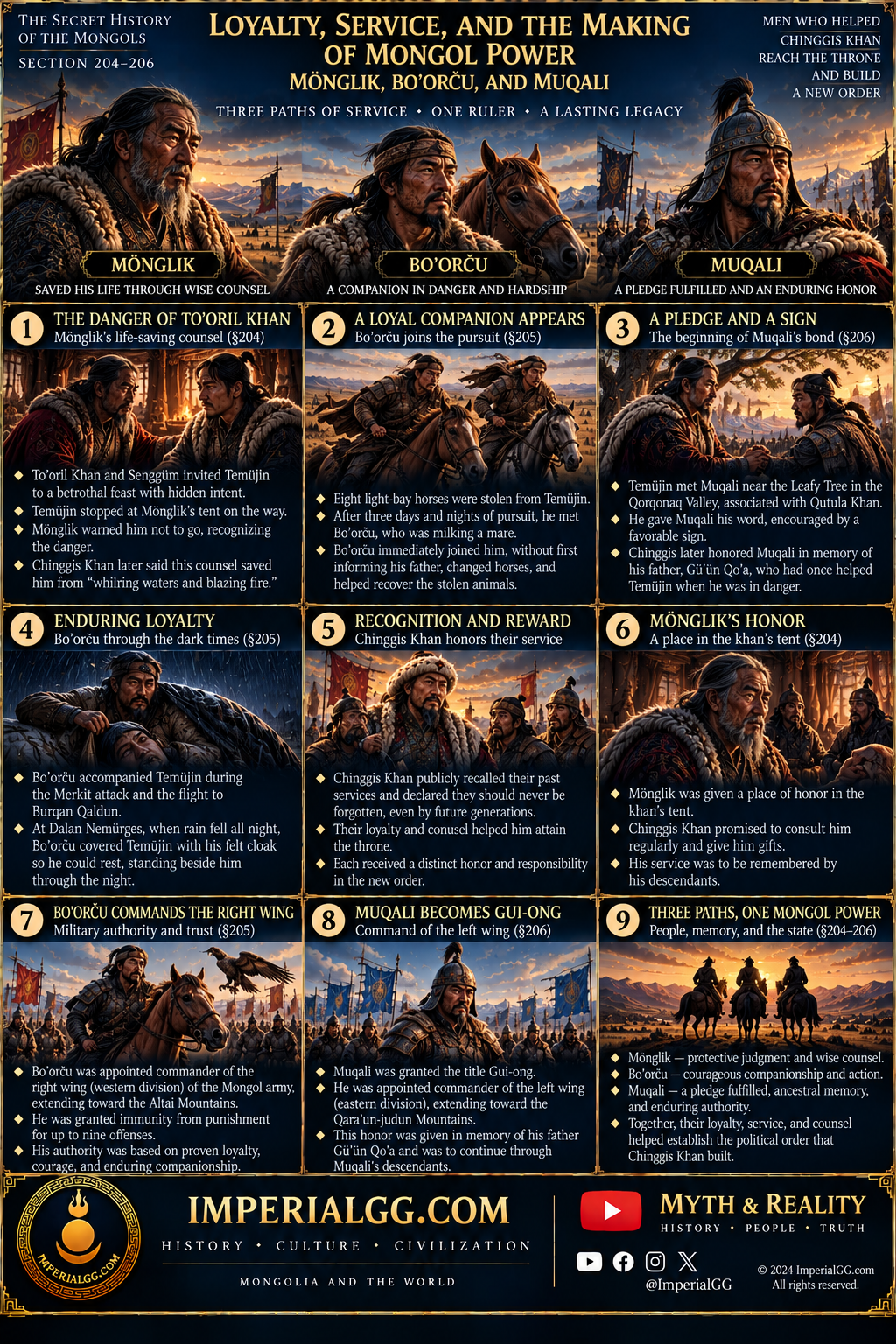
MÖNGLIK, BO’ORČU, AND MUQALI IN THE SECRET HISTORY OF THE MONGOLS §§204–206
Abstract
Sections 204–206 of The Secret History of the Mongols preserve Chinggis Khan’s retrospective recognition of three men whose contributions to his rise differed in character but proved essential to his political success: Father Mönglik, Bo’orču, and Muqali. Mönglik is remembered for protecting Temüjin from a potentially fatal trap arranged by To’oril Khan and Senggüm. Bo’orču is celebrated for his spontaneous assistance during Temüjin’s pursuit of stolen horses and for his enduring loyalty through subsequent campaigns. Muqali receives recognition for a relationship grounded in an earlier pledge, the memory of his father Gü’ün Qo’a, and a sign interpreted as favorable to his future. Their rewards extend beyond personal favor: Mönglik receives a lasting place of honor and continuing consultation, Bo’orču commands the right wing of the army, and Muqali receives the title gui-ong and command of the left wing. This article argues that these passages present loyalty not as a single virtue but as a range of political services—protection, companionship, military endurance, counsel, and the keeping of promises—through which Chinggis Khan’s authority was built and consolidated.
Keywords: The Secret History of the Mongols; Chinggis Khan; Mönglik; Bo’orču; Muqali; loyalty; Mongol political culture; military leadership; political memory.
1. Introduction
The establishment of Chinggis Khan’s rule required more than victory over rival leaders. It depended on individuals whose assistance had sustained Temüjin during periods when his future was uncertain. Sections 204–206 of The Secret History of the Mongols turn from the organization of the new political order to the personal histories of three prominent figures: Father Mönglik, Bo’orču, and Muqali.
The chronicle does not present their contributions as interchangeable. Mönglik’s defining service is protective counsel at a moment of danger. Bo’orču’s reputation emerges from immediate action, personal sacrifice, and years of companionship. Muqali’s recognition is framed through a pledge, the memory of his father, and the establishment of a position of authority intended to continue through his descendants.
These accounts illuminate the relationship between personal loyalty and state formation. Chinggis Khan’s authority was consolidated through military organization, but the chronicle explains his success partly through relationships established long before the imperial structure took shape. The rewards granted in §§204–206 transform remembered personal service into recognized political rank, responsibility, and hereditary honor.
2. Father Mönglik: Counsel That Preserved Temüjin’s Life
Section 204 begins with Chinggis Khan addressing Father Mönglik in language that emphasizes their long association. He recalls Mönglik’s repeated assistance and protection, singling out an episode in which To’oril Khan and Senggüm sought to deceive Temüjin by inviting him to a betrothal feast.
According to the chronicle, Temüjin stopped at Mönglik’s tent on the way. Mönglik dissuaded him from proceeding, warning him away from the danger that lay ahead. Chinggis later described the possible outcome through the imagery of being swept into whirling waters or consumed by blazing fire (The Secret History of the Mongols, §204). The passage identifies Mönglik’s intervention as an act that may have prevented Temüjin from falling into the hands of hostile leaders.
The importance of this service lies in its character. Mönglik did not defeat an enemy on the battlefield or recover stolen property. His contribution was the recognition of danger and the willingness to advise Temüjin against a course that could have ended his political career—or his life.
The episode also reveals the importance of information and judgment in steppe politics. Invitations, negotiations, kinship connections, and feasts could function within a political environment in which alliances were unstable and deception could have fatal consequences. In such circumstances, a trusted adviser’s ability to recognize danger could be as consequential as military strength.
Chinggis’s response in §204 is explicit. He declares that this service should not be forgotten even by future generations. He grants Mönglik a place of honor in his tent and promises to consult him regularly, providing gifts and favor to him and his descendants.
This reward establishes a distinction between ordinary gratitude and enduring political recognition. Mönglik is honored not merely for personal closeness to Temüjin but for a particular intervention whose consequences the ruler considers decisive. The promise of continuing consultation also indicates that his value extends beyond a past event: Chinggis intends to preserve his access to counsel within the new political order.
The episode therefore presents Mönglik’s principal achievement as the preservation of his future ruler through sound judgment at a critical moment. His contribution demonstrates that political loyalty could take the form of preventing a ruler from making a disastrous decision.
3. Bo’orču: Companionship Proven Through Action
Section 205 offers a different model of loyalty. Chinggis Khan recalls the theft of eight light-bay horses during his youth. Temüjin pursued the thieves for three days and nights before encountering Bo’orču, who was then occupied with milking a mare.
Bo’orču immediately recognized Temüjin’s distress and offered to accompany him. Without first informing his father, he concealed his leather bucket and milk pail, changed horses with Temüjin, and joined the pursuit. Together they tracked down the stolen animals and recovered them (The Secret History of the Mongols, §205).
The narrative emphasizes the spontaneous character of Bo’orču’s decision. At the time, Temüjin was not yet the supreme ruler of the Mongols. Bo’orču’s assistance was not presented as the calculated service of a man seeking a reward from an established sovereign. He joined a person in difficulty because he chose to become his companion.
This initial act establishes the moral foundation of their relationship. Bo’orču was willing to leave the immediate security of his household, interrupt his ordinary work, and commit himself to a dangerous pursuit. The chronicle presents his decision as an expression of courage and personal commitment.
Chinggis then recalls how Bo’orču continued to accompany him in later struggles. When Temüjin called him again, Bo’orču joined him. During the Merkit attack, he accompanied Temüjin in the flight toward Burqan Qaldun. Later, while the troops were encamped opposite the Tatars at Dalan Nemürges, rain fell throughout the night. Bo’orču covered Temüjin with his felt cloak so that he could rest without being drenched, while Bo’orču remained standing beside him.
This detail is particularly revealing. The chronicle does not define loyalty exclusively through spectacular battlefield achievements. It also remembers the physical hardship of guarding another person, the willingness to endure discomfort, and the practical care required to keep a companion safe. Bo’orču’s service is presented as continuous: he acts when Temüjin is vulnerable, stays with him during flight, and protects him during a difficult night.
Chinggis’s praise culminates in his acknowledgment that Bo’orču and Muqali encouraged him to do what was right and dissuaded him from doing what was wrong. He credits their counsel and companionship with helping him attain the throne. Bo’orču is then appointed commander of the right wing, extending westward toward the Altai Mountains, and receives immunity from punishment for up to nine offenses (§205).
His promotion reflects the transformation of personal trust into military responsibility. The man who once joined Temüjin in a search for stolen horses becomes a commander entrusted with a major division of the emerging imperial army. The continuity between these two roles is the central point of the narrative: Bo’orču’s authority rests on a record of demonstrated courage, reliability, and enduring companionship.
4. Muqali: A Pledge, Ancestral Memory, and Political Authority
Section 206 turns to Muqali, whose recognition differs from the accounts of Mönglik and Bo’orču. Chinggis recalls their encounter near the Leafy Tree in the Qorqonaq Valley, a place associated with Qutula Khan. He explains that he pledged his word to Muqali because of a favorable sign associated with him and in memory of Muqali’s father, Gü’ün Qo’a.
The passage connects Muqali’s elevation to three elements: a prior commitment, the memory of his father, and the interpretation of a sign as an indication of future significance. Unlike the account of Bo’orču, which begins with a practical act of assistance, Muqali’s recognition is presented through a pledge and a relationship extending beyond the individual to his family.
The reference to Gü’ün Qo’a is important because the chronicle associates Muqali’s family with a service remembered from the Naiman campaign. In the account cited in the commentary to §206, Gü’ün Qo’a helped Temüjin when the latter was in danger, offering him a horse after Temüjin’s mount had died and the pursuing enemy threatened the group. The precise details of this earlier episode should be cited to the relevant preceding passage and commentary in the edition used, but its function in the narrative is clear: Muqali’s recognition is linked to the memory of his father’s sacrifice.
Chinggis declares that Muqali will occupy a position of honor and bear the title gui-ong. He appoints him commander of the left wing, extending eastward toward the Qara’un-judun Mountains, and states that this honor should continue through Muqali’s descendants (The Secret History of the Mongols, §206).
The title gui-ong is a distinctive honorific whose exact institutional implications should not be equated automatically with a later, fully developed administrative office. Within this passage, however, it clearly marks Muqali’s exceptional standing. His position is not merely personal prestige: he is entrusted with command over a major military division.
The hereditary dimension of the reward is equally significant. Chinggis’s promise extends recognition beyond Muqali’s own lifetime, making the family’s service part of the political memory of the ruling house. The chronicle thus connects the preservation of a pledge with the continuity of rank and responsibility.
Muqali’s case demonstrates that the political order described in the Secret History rested on more than immediate battlefield performance. It also incorporated long-standing commitments, the remembrance of earlier sacrifices, and the ruler’s willingness to make personal obligations part of the structure of authority.
5. Three Forms of Service, One Political Order
Read together, §§204–206 distinguish three forms of service that contributed to Temüjin’s rise. Mönglik represents protective judgment. His intervention prevents Temüjin from proceeding into a trap and demonstrates the importance of trusted counsel in a dangerous political environment.
Bo’orču represents companionship expressed through action. His immediate assistance during the horse pursuit, his endurance during later campaigns, and his protection of Temüjin during the rainy night reveal loyalty maintained through practical sacrifice.
Muqali represents the continuity of pledged obligation and inherited recognition. His appointment recalls a promise made earlier, honors his father’s service, and establishes a position of military authority intended to continue through his descendants.
The differences matter. If the chronicle simply intended to list favored commanders, it could have recorded their titles and units without recounting these personal histories. Instead, it explains why their rewards were deserved. The narrative connects political rank to remembered conduct.
The appointments also show how the new state incorporated personal relationships into its military structure. Bo’orču and Muqali receive command over the right and left wings, respectively. Their authority is not detached from their past loyalty; it is justified through it. Mönglik’s honored position and continuing consultation similarly preserve the role of personal counsel within the new political order.
These accounts therefore reveal a political culture in which service, memory, and authority were mutually reinforcing. The ruler remembered the actions that had sustained him, rewarded those responsible, and transformed personal obligations into a more durable structure of command and honor.
6. Conclusion
Sections 204–206 of The Secret History of the Mongols preserve three distinct biographies of service within the broader narrative of Chinggis Khan’s rise. Father Mönglik is honored for recognizing danger and protecting Temüjin from a deceptive invitation. Bo’orču is remembered for joining a difficult pursuit without hesitation and remaining a steadfast companion through subsequent hardships. Muqali receives exceptional recognition through a prior pledge, the memory of his father Gü’ün Qo’a, and his appointment as gui-ong and commander of the left wing.
Their stories demonstrate that the consolidation of Mongol power depended on different but complementary forms of loyalty. Counsel could preserve a leader from disaster; companionship could sustain him through danger and hardship; and the keeping of promises could bind present authority to the memory of earlier service.
The chronicle’s portrayal of these men is also a statement about political legitimacy. Chinggis Khan’s authority is reinforced by his capacity to remember, distinguish, and reward service. The continuation of honors to descendants further presents loyalty as a contribution whose significance extends beyond the lifetime of the individual.
Ultimately, §§204–206 depict the making of Mongol power not as the achievement of one ruler alone but as the result of relationships sustained through judgment, courage, sacrifice, and trust. The political order that emerged under Chinggis Khan was built through conquest, but the chronicle insists that its foundations also lay in the people who protected him, stood beside him, advised him, and helped him reach the throne.
References
Atwood, Christopher P., trans. 2023. The Secret History of the Mongols. Penguin Classics.
de Rachewiltz, Igor, trans. 2004. The Secret History of the Mongols: A Mongolian Epic Chronicle of the Thirteenth Century. Leiden: Brill.
Onon, Urgunge, trans. 2001. The Secret History of the Mongols: The Life and Times of Chinggis Khan. Richmond: Curzon.
Primary source: The Secret History of the Mongols, §§204–206.
Source-critical note: The article distinguishes the events explicitly narrated in §§204–206 from broader interpretations of their political significance. The account of Gü’ün Qo’a’s assistance to Temüjin is drawn from the commentary associated with §206 and should be checked against the full annotated edition before publication. Transliteration of personal names and the precise rendering of the title gui-ong should follow one chosen edition consistently.