
BO’ORČU: THE KHAN’S TRUSTED COMPANION
By Altanbagana Baatar
DBA Candidate| Independent Historian
ImperialGG Historical Research Seriers
22 September 2026
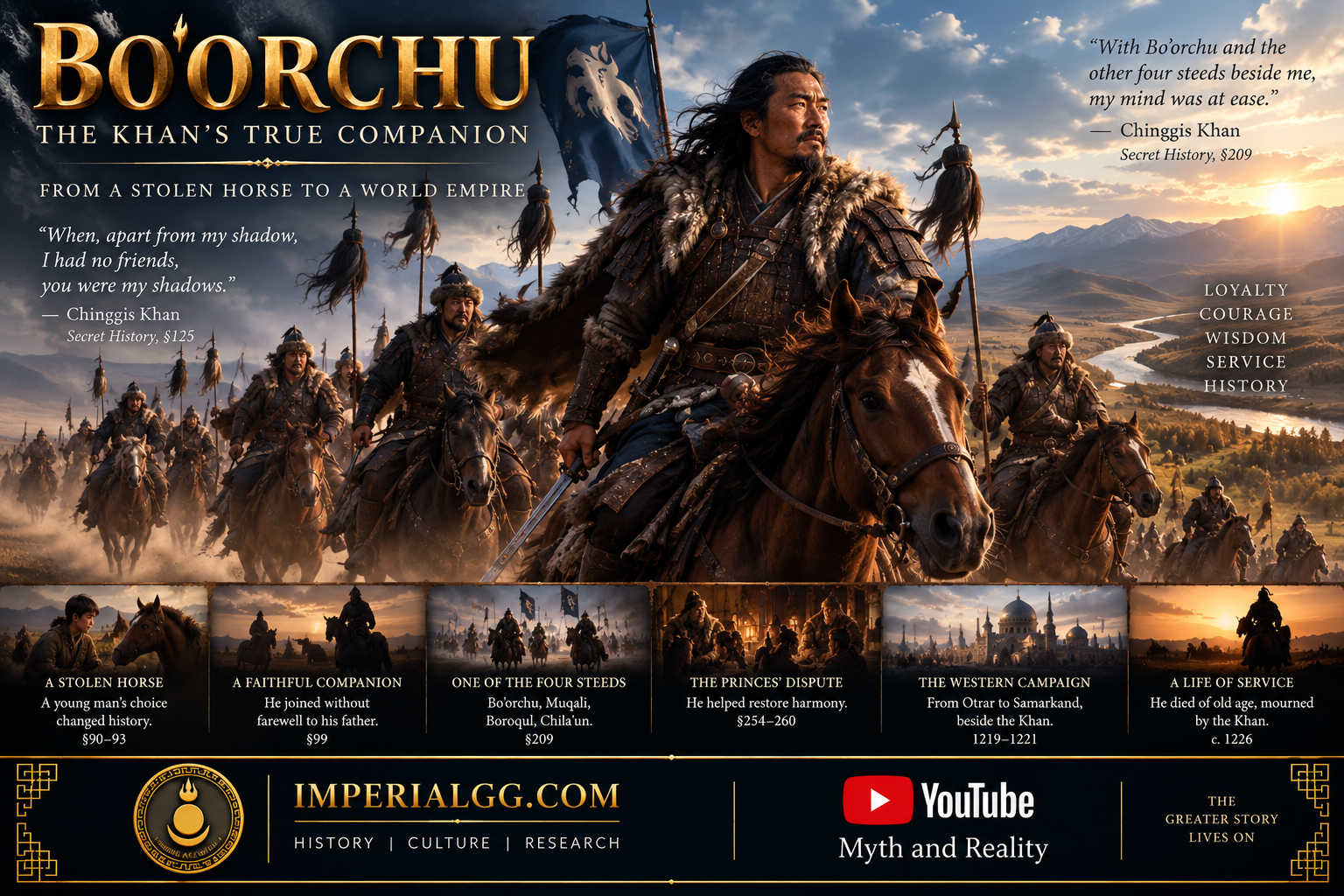
FROM TEMÜJIN’S FIRST FRIEND TO ONE OF THE FOUR STEEDS
AUTHOR’S THESIS
Among the many commanders, companions, and political figures who surrounded Chinggis Qahan, Bo’orču occupies a distinctive position. His importance was not created by a single battlefield victory or by hereditary rank alone. The narrative of The Secret History of the Mongols presents him as a man whose relationship with Temüjin began before the Mongol ruler possessed an empire, continued through the years of political struggle and military consolidation, and eventually extended into the most sensitive affairs of the imperial household. Bo’orču appears first as a young man who voluntarily helps Temüjin recover stolen horses; he then becomes a permanent companion, an early supporter of Temüjin’s political rise, one of the men whom Chinggis later describes as having stood beside him when he had almost no other friends, and eventually one of the four “steeds” whose presence gave the Khan confidence in battle. Most significantly, in the later narrative Bo’orču appears not merely as a commander but as a member of the inner circle able to speak directly to Chinggis about matters involving the imperial princes. The cumulative evidence therefore suggests that Bo’orču’s historical significance lies in the extraordinary continuity of trust between the two men: he was not simply a general who served a successful ruler, but one of the companions who helped create the political order that ruler eventually governed.
THE FIRST MEETING: EIGHT STOLEN HORSES
Bo’orču first enters the Secret History not as an aristocratic commander but as a young man encountered by Temüjin during a moment of personal hardship. Temüjin’s eight light-bay geldings had been stolen, and while pursuing their tracks he encountered Bo’orču, the son of Naqu Bayan. The young Bo’orču identified the direction taken by the stolen horses and, rather than merely providing information, gave Temüjin one of his own horses and accompanied him. They followed the tracks for three days and nights. When they finally reached the camp where the stolen horses were found, Temüjin told Bo’orču to remain behind while he drove the horses away. Bo’orču refused, answering in substance that he had come as a friend and could not stand aside. The two therefore entered together and recovered the animals.
This episode is important precisely because Bo’orču receives no immediate political reward for his action. The Secret History portrays his decision as voluntary. The relationship begins before Temüjin has become a powerful khan and before Bo’orču has any obvious reason to expect political advantage from association with him. The later tradition therefore had a narrative foundation for remembering Bo’orču as one of Temüjin’s earliest and most faithful companions.
The Yuan Shi preserves a parallel tradition and adds further details. Its biography of Bo’erchu identifies him as a member of the Arulat and the son of Nahu A’ralan. It describes him as skilled in warfare and military affairs and states that he served Taizu—Chinggis Khan—during his early years, sharing danger and hardship with him. The same biography places Bo’erchu at the age of thirteen during the episode involving the stolen horses and portrays him as already capable of tactical initiative.
The existence of parallel traditions in the Secret History and the Yuan Shi is significant. The two sources belong to different historiographical traditions, yet both preserve Bo’orču’s early association with Temüjin as an important element of his biography. This does not mean that every detail of the two accounts can be harmonized automatically. It does, however, demonstrate that the memory of Bo’orču as an early companion of Chinggis was not confined to one textual tradition.
FROM COMPANION TO NÖKÖR
The relationship became permanent. After Börte had returned to Temüjin, Belgütei was sent to invite Bo’orču to join him. Bo’orču came without even bidding farewell to his father. The Secret History explicitly concludes the episode by stating that this was the manner in which Bo’orču became Temüjin’s companion.
The importance of this passage lies in the choice involved. Bo’orču came from the household of Naqu Bayan, a wealthy and influential man. Yet he left that secure environment to join Temüjin, whose political position was still uncertain. The relationship was therefore not simply one of military recruitment. It was an early example of the personal bonds through which Temüjin gradually built a political following.
This distinction matters when interpreting the later Mongol political order. The rise of Temüjin cannot be explained only through inherited Borjigin genealogy. His political strength developed through relationships of personal loyalty, service, military ability, and reciprocal trust. Bo’orču is one of the earliest and clearest examples of this process.
“YOU WERE MY SHADOWS”: THE KHAN REMEMBERS HIS EARLIEST COMPANIONS
The most revealing statement concerning Bo’orču’s relationship with Chinggis appears after Temüjin has become qan. In §125, Chinggis addresses Bo’orču and Jelme and recalls the period when he had almost no friends:
“When, apart from my shadow, I had no friends, you were my shadows. You eased my mind, so in my mind you shall stay.”
He continues with another metaphor, comparing them to his tail when he had almost no fat, saying that they had eased his heart and therefore would remain in his breast. He then asks whether they will become senior among the others. This is one of the strongest pieces of primary-source evidence for understanding Bo’orču’s special position.
Chinggis is not merely saying that Bo’orču fought well. He is remembering a time before power, when the future Khan lacked a substantial political base. Bo’orču and Jelme are described metaphorically as parts of the Khan himself—his shadows, his tail, those who eased his mind and heart. The language is therefore relational rather than bureaucratic. It expresses a form of loyalty rooted in the formative period of Temüjin’s rise.
BO’ORČU IN THE FORMATION OF THE NEW POLITICAL ORDER
Bo’orču’s importance also appears in the reorganization of political authority that accompanied Temüjin’s rise. The Secret History repeatedly places him near the center of the emerging political structure.
At the great political settlement of 1206, Bo’orču and Muqali occupy an exceptional position among the commanders. Later scholarship describes the two as Chinggis’s earliest companions and notes that they stood at the top of the military hierarchy, commanding the western and eastern wings respectively.
The distinction between Four Steeds and Four Hounds is particularly revealing. In §209 Chinggis praises Qubilai, Jelme, Jebe, and Sübe’etei as his “four hounds,” the men whom he sent wherever he directed them to strike. He then contrasts them with his four war-horses: Bo’orchu, Muqali, Boroqul, and Chila’un-ba’atur, saying that when these men stood beside him in battle, his mind was at ease.
The metaphor is important. The “hounds” are associated with being sent outward to attack; the “steeds” are associated with standing beside the Khan himself. Bo’orču therefore belongs to a category that the Secret History defines through proximity to Chinggis as well as military service.
THE “FOUR STEEDS”
The designation of Bo’orču as one of the Four Steeds is not merely a later honorific invented by modern writers. It occurs directly in the Secret History. The four are:
- Bo’orču
- Muqali
- Boroqul
- Chila’un Ba’atur
Modern scholarship likewise identifies these four as an elite group of Chinggis Khan’s commanders. At the same time, we should distinguish this primary-source category from the later Mongolian tradition of the Nine Comrades / Nine Paladins (yisün örlüg). Modern scholarship has noted that the later nine-member tradition developed from the major companions represented in the Secret History, particularly the Four Steeds and Four Hounds, with Šigi Qutuqu subsequently incorporated into the remembered group. Thus Bo’orču’s place among the Four Steeds is an especially secure source-based claim.
THE MAN WHO COULD SPEAK TO THE KHAN
Bo’orču’s most remarkable importance, however, appears in the later political narrative—not simply on the battlefield, but in his relationship with Chinggis’s own household. Before the western campaign, Yisüi reminds Chinggis that the question of succession should be settled. Chinggis then acknowledges that his sons, his younger brothers, and Bo’orču, Muqali and others had not previously raised the matter. He turns to Jochi and asks him to speak.
This passage deserves careful reading. It does not mean that Bo’orču possessed a formal constitutional right to determine succession. The source does not say that. But it does demonstrate that Chinggis himself places Bo’orču among the senior men whose opinions could appropriately have been expressed on such a fundamental matter.
The ensuing dispute between Jochi and Chagatai becomes one of the most serious internal confrontations in the narrative. Chagatai challenges Jochi’s legitimacy, Jochi seizes Chagatai, and the dispute becomes physical. The passage therefore reveals how dangerous succession politics could become even within the imperial family.
Bo’orču’s significance is especially clear when this episode is read together with the next major example of his intervention in the affairs of the princes.
BO’ORČU AND THE KHAN’S SONS
In §260, Jochi, Chagatai, and Ögedei conquer Örünggeči and divide its people among themselves but fail to reserve a share for Chinggis Qahan. When they return, Chinggis reprimands them and refuses to grant them an audience for three days.
Then Bo’orču, Muqali, and Šigi Qutuqu approach Chinggis and petition him on behalf of the princes. They acknowledge that the sons have done wrong and are afraid. They ask Chinggis to teach them how to behave in the future and warn that excessive severity could damage the character of his sons. They ask whether granting them an audience and showing them favor would resolve the matter. Chinggis then calms down and grants the three princes an audience.
This passage is exceptionally important for understanding Bo’orču. He is not merely standing near the throne. He is participating in the management of a conflict between the Khan and his sons.
The source does not call this a formal office of guardianship over the princes. Nor does it establish that Bo’orču possessed an institutional “right” to discipline them. Such claims would go beyond the evidence. But the narrative clearly demonstrates something historically significant: Bo’orču possessed sufficient personal authority and access to Chinggis to intervene in a dispute involving the imperial princes and to counsel the Khan about their treatment. That is a different level of relationship from ordinary military service.
WHY THE SUCCESSION EPISODE MATTERS
The succession episode is particularly revealing because it places Bo’orču at the intersection of three levels of Mongol political life:
the Khan himself, the imperial princes, and the senior commanders.
Bo’orču belongs to none of these categories in the same way. He is not a son of Chinggis. He is not a member of the Borjigin royal household. Yet he is sufficiently trusted to appear within the political space occupied by all three.
This helps explain why his relationship with Chinggis should not be reduced to the modern phrase “best friend.” That phrase is emotionally understandable but historically imprecise. The evidence points instead toward a relationship combining early companionship, personal loyalty, military service, political counsel, and exceptional access to the ruler.
THE KHAN’S CONFIDENCE IN BO’ORČU
The Yuan Shi provides an unusually strong parallel to this picture. Its biography states that Bo’erchu served Chinggis in his early years, shared danger with him, accompanied him on campaigns, and repeatedly remained close to him. It describes Bo’erchu keeping night watch while Chinggis slept and states that the two sometimes discussed important matters of government until dawn. The biography explicitly compares their ruler-minister relationship to fish and water.
This is significant because the Yuan Shi was compiled within the Yuan historical tradition rather than being a modern interpretation of the Secret History. Its description therefore provides independent medieval testimony to a memory of Bo’erchu as both a military companion and a trusted political adviser.
The biography also describes several moments in which Bo’erchu protects or assists Chinggis under extreme battlefield conditions. In one episode, after Chinggis loses his horse and the army is scattered, Bo’erchu helps him through severe weather; the account emphasizes the physical endurance and loyalty of the commander.
BO’ORČU AND THE KHAN’S ANGER
Another revealing pattern in the Secret History is that Bo’orču and Muqali sometimes appear together when Chinggis is about to act in anger. When Boroqul is killed by the Tumads, Chinggis becomes furious and prepares to ride against them personally. Bo’orču and Muqali intervene and counsel him not to do so.
This pattern extends beyond military command. Modern scholarship has observed that Bo’orču, Muqali, and Šigi Qutuqu repeatedly appear together in the Secret History as members of Chinggis’s inner circle who counsel him and attempt to restrain his anger. This is important because an adviser who can tell a ruler not to act may demonstrate a different kind of trust from a commander who simply carries out orders.
THE KHAN’S “TRUSTED INTIMATES”
The final stages of the Secret History provide perhaps the most explicit terminology.
In §266, Chinggis grants favor to Bo’orču and Muqali and states: “Now, Bo’orchu and Muqali are my trusted intimates.” The passage comes after the destruction of the Jin forces and the redistribution of people and property. The language is therefore not simply a military title. It is a direct statement of personal trust from the ruler himself.
This gives us an unusually coherent progression: Bo’orču begins as a young stranger who helps Temüjin recover stolen horses.
He becomes his companion. He becomes one of the men who stood beside Temüjin before he possessed power. He becomes one of the Four Steeds. He becomes a senior commander. He appears among those whose counsel should have been heard concerning succession. He intervenes in disputes involving the imperial princes. He counsels Chinggis when the Khan is angry. And eventually Chinggis himself describes Bo’orču and Muqali as his trusted intimates. That sequence is more historically meaningful than any single title.
THE END OF BO’ORČU’S LIFE
The Secret History does not provide a full narrative of Bo’orču’s death. The Yuan Shi biography states that he died from old age and illness and records Chinggis’s grief at his death. The chronology of his death is generally placed around 1225–1226, shortly before Chinggis Khan’s own death in 1227; de Rachewiltz’s notes likewise place Bo’orču’s death in this period.
This chronology is significant in another sense. Bo’orču’s historical career spans almost the entire political life of Chinggis Khan: from the precarious years of Temüjin’s youth to the creation of the Mongol imperial state and the great western conquests. His career therefore mirrors the transformation of Temüjin himself. The young man whom Bo’orču met was pursuing eight stolen horses. The ruler at the end of Bo’orču’s life commanded an empire stretching across enormous regions of Inner Asia. Yet the relationship remembered by the sources remained rooted in that first encounter.
CONCLUSION: MORE THAN A GENERAL
Bo’orču should therefore not be understood merely as one of Chinggis Khan’s successful generals. The evidence presents something more complex. His importance began before the empire existed. He voluntarily entered Temüjin’s service when Temüjin had little political security. He remained with him through the years of conflict and political consolidation. Chinggis later remembered Bo’orču and Jelme as his “shadows” when he had almost no friends. The Secret History placed him among the Four Steeds, while the Yuan Shi remembered him as a commander who shared Chinggis’s dangers and discussed affairs of state with him.
Most importantly, Bo’orču’s relationship with Chinggis extended into the internal politics of the imperial household. He appears in the succession discussion and, in §260, directly participates in resolving the conflict between Chinggis and his sons. The source does not establish a formal office granting Bo’orču authority over the princes. But it demonstrates that his personal authority and access were sufficiently great for him to intervene in matters involving the Khan’s own children. This is perhaps the strongest way to understand Bo’orču’s historical position.
He was not simply a man who served Chinggis Khan after Chinggis became powerful. He was one of the men who stood beside Temüjin before he became Chinggis Khan—and whose trust remained valuable after Temüjin had become the ruler of an empire.
For that reason, Bo’orču belongs among the most important figures through whom the Secret History of the Mongols reveals the human and political foundations of Chinggis Khan’s power.
PRIMARY AND SECONDARY SOURCES
- The Secret History of the Mongols, especially §§90–95, 99, 123–125, 172–173, 209, 242, 254–255, 260, 266. For the English text and commentary, the translation of Urgunge Onon is useful; Igor de Rachewiltz’s annotated translation remains an essential scholarly reference.
- The Yuan Shi (History of the Yuan), Chapter 119, biography of Bo’erchu (博爾朮), for the independent Yuan-era account of his early service, military ability, night watch, political discussions, and death.
- Igor de Rachewiltz, The Secret History of the Mongols: A Mongolian Epic Chronicle of the Thirteenth Century, with historical and philological commentary. The ANU describes the three-volume work as the standard English annotated version.
- Urgunge Onon, The Secret History of the Mongols: The Life and Times of Chinggis Khan.
- The Cambridge History of the Mongol Empire, for the position of Bo’orču and Muqali at the top of the early Mongol military hierarchy and the Four Steeds/Four Hounds distinction.
ImperialGG Author’s Thesis: BO’ORČU’S GREATNESS WAS NOT CREATED BY CHINGGIS KHAN’S EMPIRE; HIS LOYALTY HELPED CHINGGIS BUILD IT.