
§142 — THE FIRST CONTACT | THE SECRET HISTORY OF THE MONGOLS
By Altanbagana Baatar
DBA Candidate| Independent Historian
ImperialGG Historical Research Seriers
23 September 2026
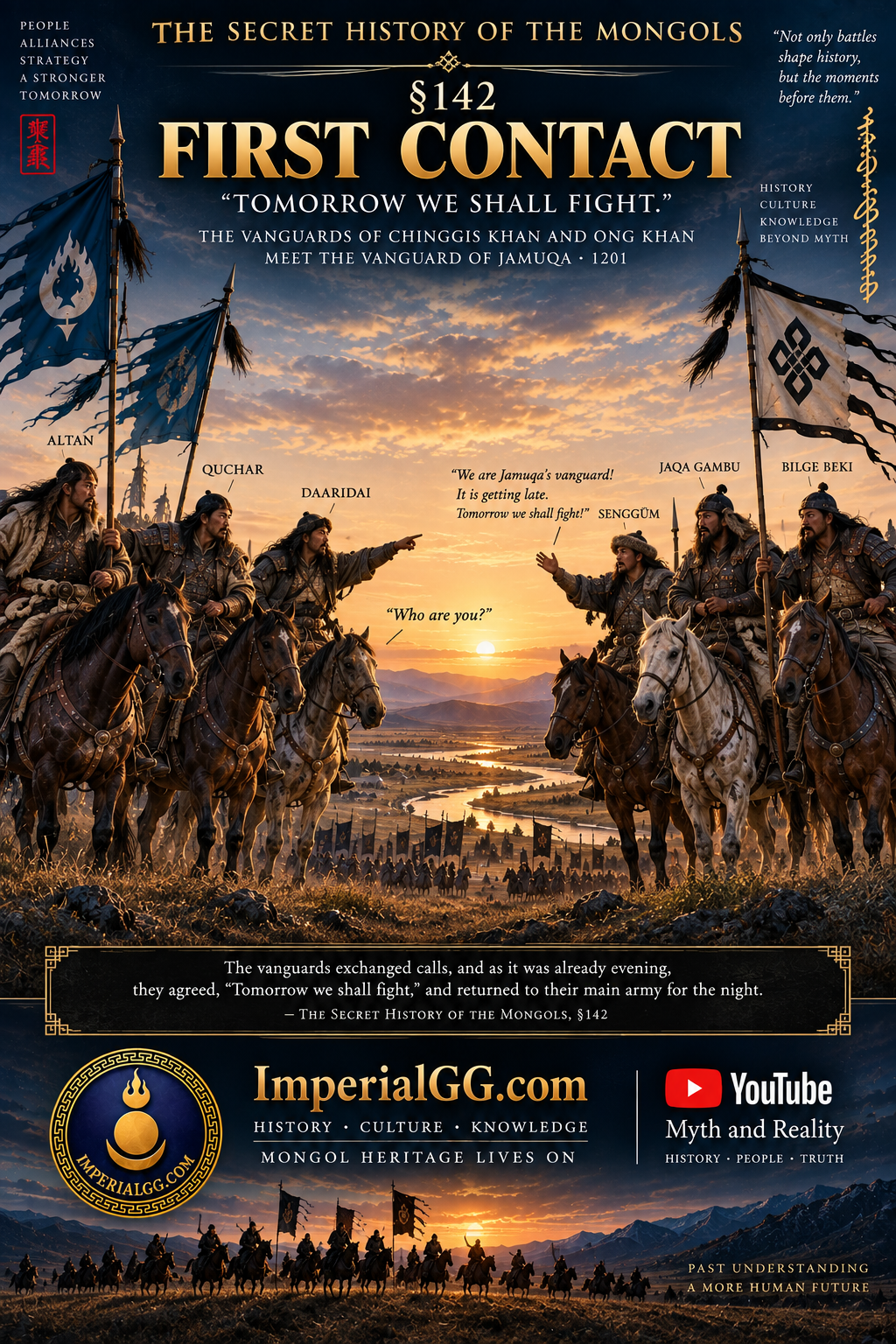
VANGUARDS, WATCH POSTS, AND RECONNAISSANCE IN THE 1201 CAMPAIGN
INTRODUCTION
Section 142 of The Secret History of the Mongols records the movement of Chinggis Khan and Ong Khan against Jamuqa following the formation of the broad political coalition described in §141. The section is situated at an important point in the political and military development of the Mongolian steppe in 1201: Jamuqa had been elevated as Gür Khan by a coalition of several major groups, while Chinggis Khan and Ong Khan now moved jointly against this emerging rival political center. Yet §142 does not describe the battle itself. Instead, it records the organization of the advancing forces, the deployment of vanguards, the establishment of fixed watch posts ahead of those vanguards, the transmission of a warning concerning the approaching enemy, and the subsequent attempt to obtain information before committing the forces to combat. The following section, §143, records the actual encounter at Köyiten. The distinction between these two sections is therefore essential. Section 142 concerns the movement and reconnaissance that preceded the battle, whereas §143 describes the battle itself. de Rachewiltz’s translation preserves this sequence clearly, while Timothy May has used §142 as an important source for examining the functions of the qara’ul and the manglai in Mongol military organization.
The Damdinsüren text provided for this study presents the same sequence in particularly useful terminology. It states that Chinggis Khan and Ong Khan moved together down the Kherlen River and that Chinggis Khan sent Altan, Quchar, and Dāritai as the manglai, while Ong Khan sent Senggüm, Jaqa Gambu, and Bilge Beki in the same capacity. It then states that additional kharuul, or watchmen, were sent farther forward and that fixed watch posts were established successively at Enegen Güiletü, Čekčer, and Čiqurqu. When the vanguard reached Utkiya and was considering whether to camp, a man from the watch post at Čiqurqu arrived with the warning that war was approaching. Rather than camp, the vanguard proceeded toward the approaching force in order to obtain information. The opposing force was then identified as Jamuqa’s vanguard, composed of Aγuču Ba’atur of the Mongols, Buyiruq Khan of the Naiman, Qutu, son of Toqto’a Beki of the Merkit, and Quduqa Beki of the Oirat. The two forces exchanged calls but did not engage that evening, and the Chinggis–Ong Khan vanguard returned to the main army for the night.
FROM COALITION TO MILITARY CONFRONTATION
The opening of §142 should be read in direct relation to §141. The previous section describes a large gathering at which Jamuqa was elevated as Gür Khan and a decision was made to oppose Chinggis Khan and Ong Khan. Section 142 begins when that political opposition has become a military operation. Chinggis Khan and Ong Khan agree to move together against Jamuqa and proceed downstream along the Kherlen River. The narrative therefore establishes a temporary military alignment between the Mongol and Kereit leaderships in response to the coalition assembled around Jamuqa. The political significance of this movement should not be underestimated. Jamuqa’s elevation in §141 created an alternative center of authority, while §142 demonstrates that the response from Chinggis Khan and Ong Khan was not limited to political negotiation but involved coordinated military movement. At the same time, the narrative preserves the separate identities of the two commanders by specifying that each appointed his own leading force.
This arrangement is especially visible in the appointment of the vanguard. Chinggis Khan sends Altan, Quchar, and Dāritai, while Ong Khan sends Senggüm, Jaqa Gambu, and Bilge Beki. The repeated use of the term manglai indicates the leading or vanguard element of the army. Timothy May notes that §142 provides an important example of the relationship between the manglai and the qara’ul, with the former functioning as the vanguard and the latter being placed farther forward to observe the enemy’s approach. The structure described in §142 therefore does not appear as an undifferentiated mass of warriors. The narrative distinguishes between the main force, the vanguard, and the watch positions deployed in advance of the vanguard. Such distinctions are important for understanding the practical organization of a moving steppe army.
THE FORWARD WATCH POSTS
The most significant military detail in §142 follows the appointment of the vanguard. The Damdinsüren text states that additional kharuul were sent forward and that a fixed watch post was established at Enegen Güiletü, another at Čekčer, and another at Čiqurqu. In this context, kharuul should be understood in its basic sense of watch or guard, while suurin kharuul indicates a stationed or fixed watch post. Scholarly translations and transliterations use different forms for these terms, and modern readers should therefore distinguish between the Mongolian wording of Damdinsüren’s edition and the Middle Mongolian transliteration used in philological scholarship. De Rachewiltz renders these positions as observation posts, while Timothy May discusses them as qara’ul positions placed ahead of the vanguard.
The geographical sequence of the watch posts is also significant. The text gives them in succession: Enegen Güiletü, then Čekčer, and then Čiqurqu. The narrative does not provide modern coordinates for these locations, and it would therefore be inappropriate to assign precise modern geographic positions without independent archaeological or geographical evidence. What the text does establish with confidence is their relative position within the military movement: the watch posts were placed ahead of the vanguard, and the most forward of the named positions, Čiqurqu, subsequently served as the point from which a warning was transmitted to the advancing force. The passage consequently provides direct textual evidence for the use of forward observation in the approach to battle.
Timothy May’s analysis strengthens this interpretation. He observes that §142 is the first occurrence of the term qara’ul in the Secret History and emphasizes that the passage demonstrates its practical function: the watchmen were placed ahead of the manglai to observe Jamuqa’s forces and to reduce the danger of the vanguard moving unknowingly into an ambush. May further notes the significance of the position at Mount Čekčer, where the terrain could provide an advantageous view for observing approaching forces.
THE SECRET HISTORY OF THE MONGOLS
The practical value of the forward watch posts becomes evident when the vanguard reaches Utkiya. According to the Damdinsüren text, Altan, Quchar, Senggüm and the others arrive at Utkiya and consider making camp. At this moment, a man from the watch post established at Čiqurqu comes rapidly to them and reports that “Дайн айсуй”, or that war is approaching. The importance of this passage lies not in the dramatic quality of the warning but in the transmission of information through the military formation. A forward position has detected the approaching enemy, and the information reaches the vanguard before the army establishes its camp.
The English translations make the same sequence explicit. Onon renders the passage as a scout from Chiqurqu arriving to warn that the enemy was approaching, after which the vanguard advances instead of establishing camp. De Rachewiltz similarly translates the movement as an advance undertaken in order to gain information about the enemy. The Mongolian source therefore supports a relatively precise reconstruction of the sequence: forward observation preceded warning; warning altered the immediate movement of the vanguard; and the vanguard then approached the enemy for further information.
This should not be described anachronistically as a modern intelligence system. The Secret History does not provide evidence for a bureaucratic intelligence institution in the modern sense. It does, however, provide concrete evidence that military information was actively collected in advance of an engagement and transmitted from forward positions to the advancing force. That distinction allows the passage to be interpreted without imposing modern institutional categories upon a thirteenth-century steppe army.
RECONNAISSANCE BEFORE ENGAGEMENT
The response to the warning is one of the most informative details in the entire section. The vanguard does not simply establish camp after receiving the information, nor does the text describe an immediate full-scale attack. Instead, it moves toward the approaching enemy in order to obtain information. The purpose of this movement is therefore explicitly informational. The commanders seek to determine the identity and composition of the opposing force before the main engagement.
The subsequent question, “Хэн буй?”, provides the answer. The approaching force is identified as Jamuqa’s vanguard, and the Secret History names four commanders: Aγuču Ba’atur from the Mongols, Buyiruq Khan of the Naiman, Qutu son of Toqto’a Beki of the Merkit, and Quduqa Beki of the Oirat. This list is historically significant because it demonstrates the multi-group character of the coalition that had been assembled in §141. The vanguard is not described as a homogeneous Mongol force. Instead, it contains representatives associated with several different political communities that had joined Jamuqa’s coalition.
The connection between §§141 and 142 is therefore particularly important. Section 141 establishes the political coalition; section 142 shows part of that coalition operating militarily. The Naiman, Merkit, Oirat, and Mongol elements named in the vanguard are not merely abstract names in a political list. Their representatives appear together in an advancing military formation. This provides concrete evidence for the military dimension of the coalition established in the preceding section.
THE TWO VANGUARDS
The composition of the opposing vanguards also reveals an important difference between the two sides. Chinggis Khan and Ong Khan are cooperating, but their vanguard is organized through two sets of commanders associated with the two leaders. Jamuqa’s vanguard, meanwhile, is composed of representatives from several political communities participating in the coalition against Chinggis Khan and Ong Khan.
This does not mean that the two sides possessed identical military structures, nor does §142 provide enough information to reconstruct the exact size of the units under each commander. Timothy May cautions that the Secret History expects the reader to understand the commanders named in the vanguard as leading their respective forces, but the passage itself does not provide detailed numerical information about these contingents. Any attempt to assign precise troop numbers to the vanguards from §142 alone would therefore go beyond the evidence.
What can be established is more limited but still important: the narrative distinguishes commanders, vanguard forces, forward watch positions, and the main army. It also identifies the political affiliations represented within the opposing vanguard. These details indicate that military organization and political organization were closely connected, while still leaving considerable uncertainty concerning the exact size and internal structure of the forces involved.
THE DECISION TO DELAY BATTLE
After identifying the opposing force, the two vanguards exchange calls. The Damdinsüren text explains unshildaj as loudly calling back and forth. The encounter therefore involves direct communication between the two forward forces, but it does not immediately develop into combat. The reason given in the text is the lateness of the hour. The men agree to fight the following day, withdraw, and rejoin the main army for the night.
This ending is important because it defines the chronological boundary of §142. The section does not contain the battle of Köyiten. That engagement belongs to §143, where the two armies meet the following day and are described as confronting one another directly. Consequently, the events of §142 should not be combined with the supernatural storm episode of §143 or with the subsequent dispersal of Jamuqa’s coalition. Those events belong to the following stage of the narrative.
The structure of the chronicle thus presents a clear progression. Section 141 records the formation of the opposing political coalition; §142 records the movement of the armies and their first contact; §143 records the battle. Maintaining these distinctions is essential for an accurate reconstruction of the chronology.
MILITARY ORGANIZATION AND POLITICAL COALITION
Section 142 is especially valuable because it allows political history and military history to be examined together without assuming that the two were identical. Jamuqa’s elevation as Gür Khan in §141 was a political act involving a wide range of groups. In §142, some of those groups appear through their military representatives. The presence of Buyiruq Khan of the Naiman, Qutu of the Merkit, and Quduqa Beki of the Oirat alongside Aγuču Ba’atur of the Mongols demonstrates that the coalition had acquired a military dimension by the time the opposing forces encountered one another.
On the other side, Chinggis Khan and Ong Khan were also operating through a political alliance that retained identifiable leadership structures. Their cooperation did not erase the distinction between Chinggis Khan’s and Ong Khan’s commanders. The result is a military encounter in which political alliances remain visible through the organization of the vanguard itself.
This is one reason why §142 should not be interpreted simply as another episode in the personal rivalry between Chinggis Khan and Jamuqa. The narrative places individual leaders within a wider field of political communities, military commanders, and allied forces. The conflict of 1201 was therefore simultaneously a struggle among leaders and a confrontation among competing coalition structures.
AUTHOR’S THESIS
FROM POLITICAL COALITION TO INFORMATION-BASED WARFARE
The evidence of §142 permits a more specific interpretation of the military transformation taking place in 1201. The section suggests that the confrontation between Chinggis Khan and Jamuqa had developed beyond the mobilization of large tribal coalitions into a military environment in which the detection, transmission, and verification of information preceded major engagement. The deployment of fixed watch posts ahead of the vanguard, the transmission of the warning from Čiqurqu, and the decision to approach the opposing force in order to obtain information demonstrate that the movement of the army depended upon advance observation and communication. This should not be understood as evidence of a modern intelligence institution, but it does demonstrate a practical military concern with reconnaissance and controlled contact.
The section also indicates that the political structure of the opposing coalitions remained embedded within their military organization. Chinggis Khan and Ong Khan retained distinct vanguard commanders despite operating together, while Jamuqa’s vanguard included representatives of Mongol, Naiman, Merkit, and Oirat forces. The military organization described in §142 therefore reflects a political landscape in which alliances were formed across different groups without necessarily eliminating their separate identities. The passage provides evidence not for a fully centralized army in the later imperial sense, but for a developing capacity to coordinate mobile forces, maintain forward observation, obtain information concerning an approaching enemy, and delay engagement until conditions were appropriate.
CONCLUSION
Section 142 occupies a precise position within the military and political narrative of The Secret History of the Mongols. Following Jamuqa’s elevation as Gür Khan in §141, Chinggis Khan and Ong Khan move jointly against the coalition associated with him. Their forces are organized through separate vanguard commands, while fixed watch posts are established ahead of those vanguards. When the watch post at Čiqurqu detects the approaching enemy, the information is transmitted to the advancing force at Utkiya. Rather than establishing camp, the vanguard proceeds toward the enemy to obtain information and identifies a multinational group of commanders representing Mongol, Naiman, Merkit, and Oirat forces. The encounter ends without battle, as the opposing vanguards agree to fight the following day and return to their respective main forces.
The value of §142 therefore lies in its unusually concrete description of military procedure. The passage does not provide troop numbers, detailed battlefield formations, or a complete account of command hierarchy, and those gaps should not be filled through speculation. It does, however, document a sequence of forward deployment, fixed observation, warning, reconnaissance, identification, and controlled withdrawal. Timothy May’s analysis of the qara’ul reinforces this reading by identifying §142 as an important early example of the relationship between forward watch positions and the vanguard in the military narrative of the Secret History.
Read in sequence with §§141 and 143, the historical structure is therefore clear: §141 records the formation of the rival coalition; §142 records its first military contact with the forces of Chinggis Khan and Ong Khan; and §143 records the battle at Köyiten. This division allows §142 to be understood not as a dramatic prelude but as an important source for reconstructing the practical organization of warfare on the Mongolian steppe at the beginning of the thirteenth century.
SELECTED BIBLIOGRAPHY
- Damdinsüren, Tsendiin. Монголын нууц товчоо. §142.
- de Rachewiltz, Igor. The Secret History of the Mongols: A Mongolian Epic Chronicle of the Thirteenth Century. Leiden: Brill, 2004–2013. The 2015 ANU edition provides the revised translation and commentary.
- May, Timothy. “Scouts and Vanguards in The Secret History of the Mongols.” In Mamlūk Studies Review, vol. XXVII, 2024, pp. 156 ff.
- Onon, Urgunge. The Secret History of the Mongols: The Life and Times of Chinggis Khan.
- Atwood, Christopher P. The Secret History of the Mongols. Penguin Classics, 2023.