
§141 — THE FORMATION OF AN ALTERNATIVE POLITICAL COALITION
By Altanbagana Baatar
DBA Candidate| Independent Historian
ImperialGG Historical Research Seriers
21 September 2026
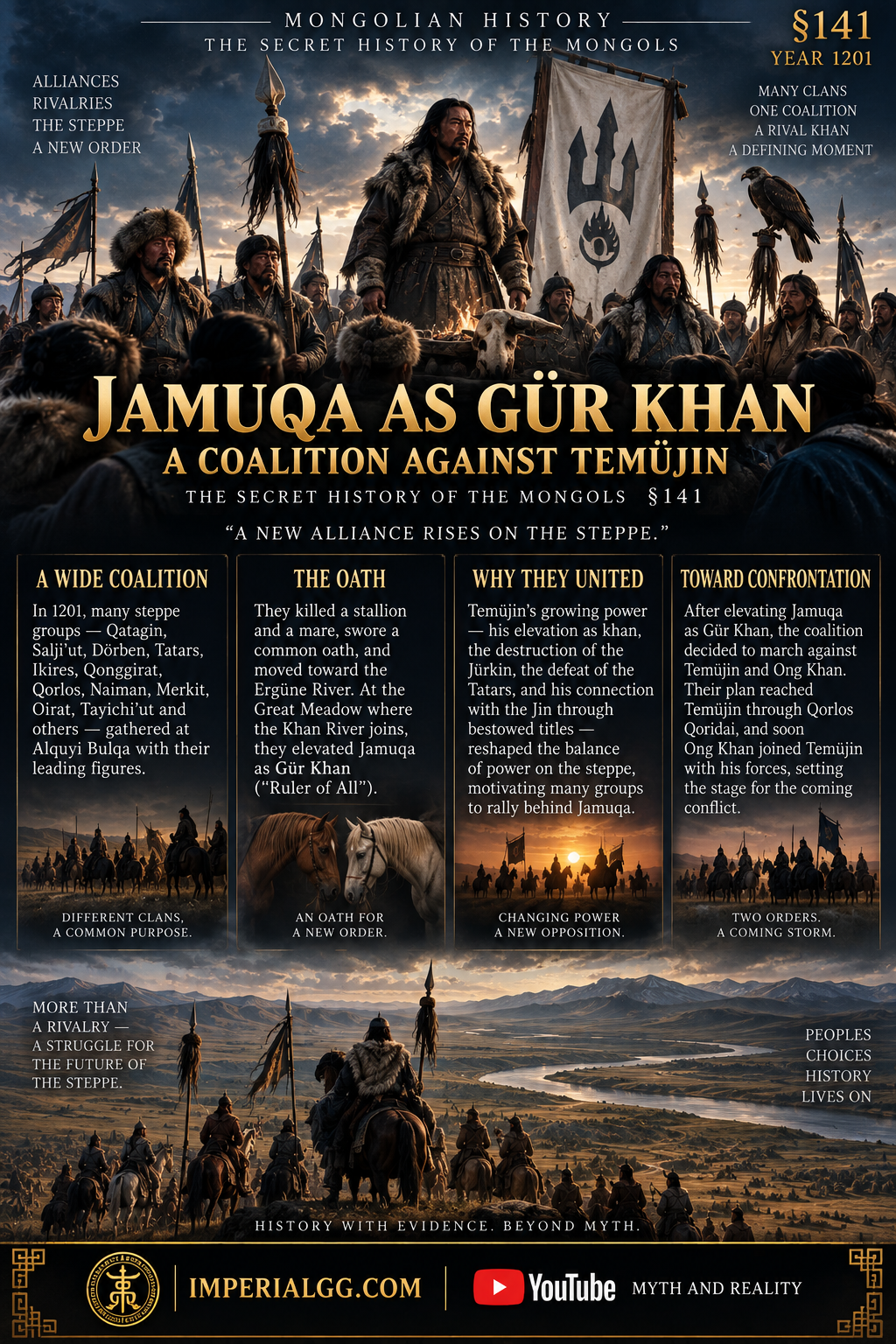
The Secret History of the Mongols, §141: Jamuqa’s Elevation as Gür Khan in 1201
INTRODUCTION
The year 1201 marks a significant turning point in the political history narrated by The Secret History of the Mongols. In §141, a remarkably broad coalition of steppe groups gathers at Alquyi Bulqa, performs a formal oath ceremony, and elevates Jamuqa of the Jajirat as Gür Khan, before declaring its intention to march against Temüjin and Ong Khan. The importance of this episode lies not merely in Jamuqa’s personal rivalry with Temüjin. The composition of the coalition suggests a much broader political reaction to the rapid transformation of power that had taken place on the steppe during the preceding years. The text names Qatagin, Salji’ut, Dörben, Tatar, Ikires, Qonggirat, Qorlos, Naiman, Merkit, Oirat, Tayichi’ut, and other groups, together with their leading figures. The assembly therefore represents an attempt to construct a political center capable of confronting the emerging Temüjin–Ong Khan alliance.
The immediate narrative context is essential for understanding why such a coalition could emerge. Temüjin had already been elevated as khan, had begun transforming his following into an increasingly organized political community, had destroyed the rival Jürkin leadership, and had incorporated Jürkin people and capable individuals into his expanding political order. Shortly before the events of §141, he had also participated with Ong Khan in the campaign against the Tatars that arose from a Jin military operation against Megüjin Se’ültü and his followers. The campaign itself was not presented as military service performed simply for the Jin state. Rather, the Jin advance created an opportunity that Temüjin and Ong Khan used against an old enemy of their own. Yet the subsequent granting of titles by the Jin authorities to Temüjin and Ong Khan created an additional political dimension to their relationship with the powerful northern Chinese state. These developments provide an important background against which the coalition of §141 can be interpreted.
The Secret History, however, does not explicitly state that the various groups assembled at Alquyi Bulqa because they opposed Temüjin’s cooperation with Jin, nor does it provide a single explanation for their decision. Such a causal reconstruction must therefore remain an interpretive argument, rather than a statement of explicit source fact. What the text does establish is that, by 1201, opposition to Temüjin had acquired a distinctly broader political form: several different steppe communities temporarily subordinated their separate interests to a common coalition, performed a collective oath, elevated Jamuqa to the title of Gür Khan, and prepared for war against Temüjin and Ong Khan. The significance of §141 therefore lies in the emergence of an alternative political order, rather than simply another episode in the personal history of two former anda.
1. FROM KHANHOOD TO A NEW POLITICAL ORDER
The background to §141 begins with Temüjin’s elevation as khan. His election did not immediately create the later Mongol Empire, nor did it eliminate the political autonomy of other steppe groups. Rather, it established a new center of authority around which men, families, and political communities increasingly gathered. The subsequent narrative shows that Temüjin’s power was strengthened not only through hereditary status but also through the incorporation of individuals and groups who transferred their allegiance to him.
This process became particularly visible in the conflict with the Jürkin. The destruction of the Jürkin political leadership in §§136–140 was therefore more consequential than an isolated feud between related groups. Sača Beki and Taiču were captured, their political community was incorporated, and individuals associated with the Jürkin were subsequently absorbed into Temüjin’s household and political structure. The appearance of Boro’ul among Temüjin’s foster sons and the transfer of Muqali and Buqa into his service demonstrate how conquest could be followed by incorporation. The Secret History repeatedly presents this combination of force and incorporation as one of the mechanisms through which Temüjin’s following expanded.
The killing of Büri Böke in §140 is particularly significant within this context. Büri was not simply an ordinary wrestler. The text describes him as the strongest man among his people and places him within the wider genealogy of Qabul Khan’s descendants. His death therefore illustrates the ability of Temüjin’s authority to prevail over a figure whose prestige derived from an older aristocratic and lineage-based political environment. The episode should not be reduced to a sporting contest: the wrestling match is embedded within a larger narrative concerning the subordination of an alternative political elite to the authority of the Qa’an.
It is precisely this transformation of political relationships that makes §141 so important. Temüjin’s opponents were no longer confronting merely an ambitious individual. They were confronting a political center whose authority was increasingly capable of absorbing rival groups.
2. THE TATAR CAMPAIGN AND THE JIN CONNECTION
The campaign against the Tatars in §§132–135 adds another dimension to this transformation.
The Secret History describes the Tatars as an old enemy of the Mongols. When news arrived that the Jin authorities had ordered their forces to move against Megüjin Se’ültü and other Tatars, the Tatars were driven upstream along the Ulja River together with their livestock and provisions. Temüjin recognized the opportunity. He reminded Ong Khan that the Tatars had long been enemies of their ancestors and fathers and proposed attacking them. Ong Khan accepted the proposal and joined Temüjin. The resulting campaign ended with the death of Megüjin Se’ültü. Only after the military action did the Jin commander bestow titles upon Temüjin and Ong Khan.
This sequence matters. The narrative does not present Temüjin as simply entering Jin service and carrying out a Jin command. The Jin military operation created circumstances that Temüjin could exploit for his own political and historical purposes. The Tatars were already embedded in the inherited conflict structure of the steppe, and Temüjin explicitly framed them as enemies of previous generations. His participation therefore had its own strategic rationale.
At the same time, the consequences of the campaign were politically significant. Temüjin received the title ja’ut-quri, while Ong Khan received the title ong, from which the latter’s subsequent designation as Ong Khan was derived. Thus, a campaign undertaken in the context of Jin military pressure produced a new form of political recognition for the two leaders.
This distinction is important. The campaign itself and the later titles should not be treated as identical phenomena. Temüjin’s immediate motive in §133 was directed toward the destruction of the Tatars, whereas the titles belonged to the aftermath of the campaign. Nevertheless, from the perspective of other steppe political communities, the episode demonstrated that Temüjin and Ong Khan could operate successfully in conjunction with the military power of Jin and emerge from that relationship with formal recognition.
The available evidence does not permit us to say that every participant in the 1201 coalition interpreted this relationship in the same way. Nor does §141 explicitly identify the Jin connection as the reason for the coalition. It is more cautious, and historically more useful, to suggest that the campaign and its aftermath may have contributed to perceptions that the political balance of the steppe was changing and that Temüjin and Ong Khan were becoming increasingly connected to the authority of an external imperial state.
That possibility becomes particularly significant when considered alongside the destruction of rival steppe leadership.
3. THE JÜRKIN CONFLICT AND THE MEMORY OF POLITICAL PRECEDENCE
The Jürkin episode provides another important part of the context.
The Jürkin were not an insignificant or newly created group. §139 traces their formation to Qabul Khan’s family and describes the selection of capable, courageous, and powerful men who were associated with Ökin-Barqaq and subsequently formed the Jürkin community. Their political identity therefore belonged to an older layer of steppe aristocratic organization.
Their destruction by Temüjin was consequently a confrontation between emerging and established forms of political authority.
Temüjin had already been recognized as khan by a coalition of leading men. Yet his subsequent actions demonstrate that recognition alone did not guarantee political stability. The new khan had to establish his authority over groups whose leaders possessed their own genealogical prestige, followers, military resources, and political traditions.
The Jürkin conflict therefore reveals a process of political consolidation in which Temüjin’s authority increasingly displaced competing centers of leadership. The incorporation of Jürkin people after their defeat further demonstrates that the objective was not simply destruction. Political communities could be defeated and then reorganized within a larger structure.
From this perspective, §141 can be read as a reaction to a continuing process: as Temüjin’s political center expanded, previously independent or semi-independent elites had increasing reason to consider what his success would mean for their own authority.
The coalition assembled at Alquyi Bulqa can therefore be interpreted as an effort to prevent the political balance from shifting irreversibly toward Temüjin.
4. THE EXTRAORDINARY COMPOSITION OF THE 1201 COALITION
The most striking feature of §141 is its list of participants. The text begins with the Qatagin and Salji’ut, then names the Dörben and Tatars, the Ikires, Qonggirat, Qorlos, Naiman, Merkit, Oirat, and Tayichi’ut, before adding “other” groups. The leaders are individually identified, including Baqu-Corogi, Irkidei Ba’atur, Qaci’un Beki, Jalin-Buga, Tiige-Maqa, Dergei Amal and Algui, Co’os-Cagan, Buyruq Khan, Godu, Qutuga Beki, and several Tayichi’ut leaders.
The list should not be interpreted as evidence that all these communities possessed identical political interests. They clearly did not. Their histories, genealogies, territories, and relationships with neighboring powers differed. The importance of the list lies instead in the fact that their differences could temporarily be subordinated to a common political objective.
This is one of the most important political characteristics of §141. The coalition was not based upon a single clan lineage. It was not simply an alliance of one branch of the Mongol aristocracy. Nor was it merely the personal following of Jamuqa. The text depicts a much broader gathering in which multiple political communities participated.
The decision to elevate Jamuqa as Gür Khan consequently transformed the meeting from a collection of grievances into an attempt to establish a competing political center.
Christopher Atwood identifies the 1201 election of Jamuqa as the first dated event in the Secret History and describes it as the election of Jamuqa as khan of an anti-Chinggis confederacy. The terminology is useful so long as “confederacy” is understood as a political coalition formed for a particular historical purpose, rather than as evidence of a permanently unified state.
5. THE OATH: FROM ASSEMBLY TO POLITICAL COVENANT
The ritual performed at Alquyi Bulqa is equally important. The assembled groups did not merely discuss their plans. According to §141, they killed a stallion and a mare and swore an oath before moving toward the Ergüne River and eventually to the Great Meadow at the mouth of the Khan River, where Jamuqa was elevated as Gür Khan.
The killing of the animals and the oath transformed political agreement into a ritualized covenant. This detail is significant because steppe political authority was not constituted solely through abstract territorial sovereignty. Political relationships were created and confirmed through personal allegiance, kinship, oath, exchange, ritual, military cooperation, and recognition. The oath in §141 therefore represents an attempt to give durability and legitimacy to a coalition that otherwise contained numerous independent political interests.
Jamuqa’s elevation as Gür Khan, conventionally understood as “Universal Khan” or “Khan of All,” further strengthened the symbolic dimension of this act. The title represented an aspiration toward comprehensive political authority rather than merely local leadership. In other words, the coalition was not simply saying that Jamuqa should command an army. It was creating an alternative source of supreme political legitimacy.
6. JAMUQA AS THE CENTER OF AN ALTERNATIVE ORDER
Jamuqa’s role in §141 should therefore be understood within the institutional logic of the coalition.
The text does not present a detailed program of government. It does, however, provide three unmistakable political acts:
- multiple steppe groups assemble;
- they perform a common oath;
- they elevate Jamuqa as Gür Khan and decide to march against Temüjin and Ong Khan.
Together these acts constitute an attempt to create an alternative center of authority. This is why the episode cannot be reduced simply to “Jamuqa versus Temüjin.” The personal history of the two men certainly forms part of the background, but the political reality represented in §141 is considerably larger. Jamuqa became the institutional and symbolic focus through which a collection of different groups attempted to resist the continuing concentration of political power around Temüjin and Ong Khan.
The coalition’s decision to march against both Temüjin and Ong Khan is especially important. The opposition was directed not only toward Temüjin as an individual but toward the political relationship that connected the emerging Mongol leader with the powerful Kereit ruler. The alliance between Temüjin and Ong Khan had become one of the major structures of power on the steppe, and §141 demonstrates that an opposing coalition had formed against it.
AUTHOR’S THESIS
The events of §141 can therefore be interpreted as the political reaction of a broad section of the steppe aristocratic and tribal world to the rapid transformation of political authority surrounding Temüjin and Ong Khan.
Temüjin’s elevation as khan had created a new political center; the subsequent destruction and incorporation of the Jürkin demonstrated that this center possessed the military capacity to subordinate rival leadership; and the campaign against the Tatars, undertaken in coordination with Ong Khan during a Jin military offensive, demonstrated that Temüjin’s political power had entered a wider regional system involving one of the great imperial states of East Asia. The titles subsequently bestowed upon Temüjin and Ong Khan by Jin further formalized that connection.
The Secret History of the Mongols does not explicitly state that these developments caused the coalition of 1201. It would therefore be excessive to describe §141 as a direct statement of anti-Jin sentiment or to claim that every participating group shared one identical political motive. Nevertheless, the sequence of events allows a broader interpretation: the coalition may represent an attempt by diverse steppe political communities to resist the accelerating concentration of authority around Temüjin and Ong Khan before that political transformation became irreversible.
Within this interpretation, Jamuqa’s elevation as Gür Khan was not merely a personal triumph over an old rival. It was an effort to provide the opposition with an alternative source of supreme political legitimacy. The oath at Alquyi Bulqa, the extraordinary geographical and genealogical diversity of the coalition, and the decision to march against Temüjin and Ong Khan together indicate an attempt to reconstruct the balance of power through collective political action.
The significance of §141 therefore lies in the emergence of two competing political projects on the steppe: one centered increasingly upon Temüjin and his expanding network of personal allegiance, military incorporation, and alliance with Ong Khan; the other centered upon Jamuqa, whose elevation as Gür Khan provided a symbolic and political focus for a coalition of groups seeking to prevent the further consolidation of Temüjin’s power.
The confrontation of 1201 was consequently not simply another tribal conflict. It represented a struggle over who possessed the authority to define the political order of the steppe.
CONCLUSION
§141 records the moment when opposition to Temüjin acquired a broad and formally organized political structure. The coalition included groups whose individual histories and interests were different, yet they were capable of acting together because the rapid expansion of Temüjin’s political authority had created a common strategic problem. Their gathering at Alquyi Bulqa, their ritual oath, and their elevation of Jamuqa as Gür Khan transformed dispersed opposition into an organized political coalition.
The preceding destruction of the Jürkin and the campaign against the Tatars provide essential context. The former demonstrated Temüjin’s growing ability to eliminate and incorporate rival political leadership; the latter demonstrated his ability to exploit the military pressure of Jin while simultaneously pursuing an inherited Mongol–Tatar conflict. The subsequent Jin titles given to Temüjin and Ong Khan added another layer to the changing political landscape.
Yet the surviving source does not give us a single manifesto explaining why every group joined Jamuqa. The historian must therefore distinguish clearly between what §141 records and what later analysis reconstructs. What the text records is sufficient, however, to establish that by 1201 the steppe had entered a new stage of political competition: Jamuqa’s coalition sought to create an alternative center of authority before Temüjin’s emerging political order could dominate the steppe.
In this sense, §141 is one of the clearest episodes in the Secret History of the Mongols showing that the rise of Chinggis Khan was not an uncontested process. His emergence produced not only followers and allies but also a counter-coalition capable of bringing together a remarkable range of political communities under a rival khan.
FOOTNOTES
1. Christopher P. Atwood, trans., The Secret History of the Mongols (Penguin Classics, 2023), §141. Atwood’s translation identifies the 1201 coalition and Jamuqa’s elevation as Gür Khan.
2. Urgunge Onon, trans., The Secret History of the Mongols: The Life and Times of Chinggis Khan (Routledge, 2001). Onon’s edition provides an English scholarly translation with extensive contextual commentary.
3. Igor de Rachewiltz, The Secret History of the Mongols: A Mongolian Epic Chronicle of the Thirteenth Century, 2 vols. (Leiden: Brill, 2004). De Rachewiltz’s edition remains one of the principal scholarly reference works for the Mongolian text and its historical interpretation. A bibliographic record of the scholarly textual tradition is also available through Monumenta Altaica.
4. Christopher P. Atwood, “The Date of the Secret History of the Mongols Reconsidered,” Journal of Song-Yuan Studies 37 (2007): 1–48. Atwood discusses the historical formation and transmission of the Secret History and its relationship to early Mongolian historical traditions.
5. For the broader interpretation of §141 as the formation of an opposing political coalition, see Atwood’s discussion of the 1201 election of Jamuqa as the first dated event in the Secret History.
BIBLIOGRAPHY
Atwood, Christopher P., trans. The Secret History of the Mongols. Penguin Classics, 2023.
Atwood, Christopher P. “The Date of the Secret History of the Mongols Reconsidered.” Journal of Song-Yuan Studies 37 (2007): 1–48.
de Rachewiltz, Igor. The Secret History of the Mongols: A Mongolian Epic Chronicle of the Thirteenth Century. 2 vols. Leiden: Brill, 2004.
Onon, Urgunge, trans. The Secret History of the Mongols: The Life and Times of Chinggis Khan. Routledge, 2001.