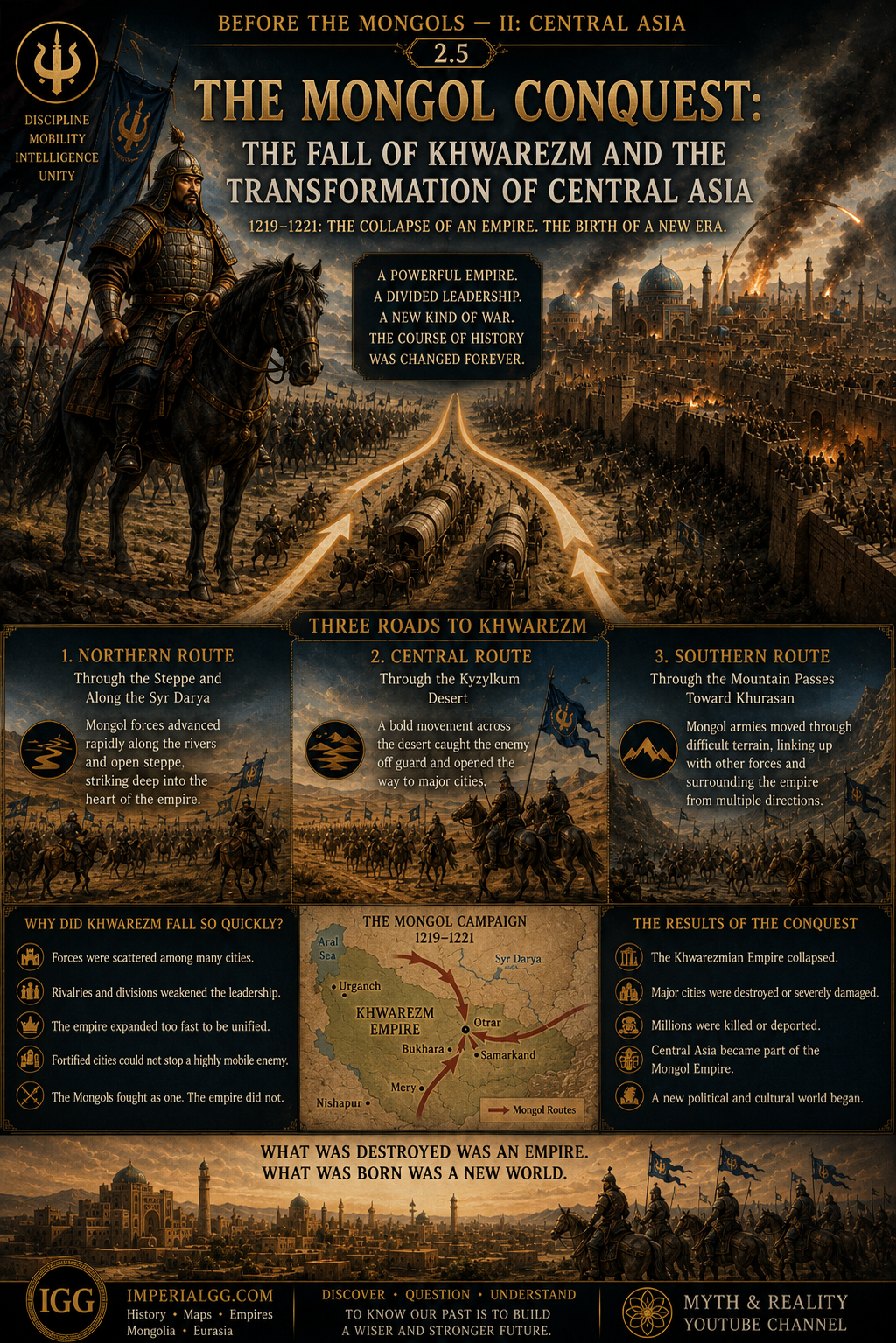
2.5 — The Mongol Conquest: The Fall of Khwarezm and the Transformation of Central Asia
By Altanbagana Baatar
DBA Candidate| Independent Historian
ImperialGG Historical Research Seriers
15 July 2026
In the early thirteenth century, the lands that today form Uzbekistan stood at the center of one of the most powerful states in Eurasia. Samarkand and Bukhara were among the great cities of the Islamic world, while the Khwarezmian Empire stretched across much of Central Asia and Iran. From the outside, it appeared to be a formidable imperial power capable of resisting almost any enemy that approached its frontiers.
Yet when the Mongols entered the region in 1219, the Khwarezmian Empire collapsed with extraordinary speed.
This collapse has often been explained simply as the result of overwhelming Mongol military power. The reality, however, was more complex. The Mongols possessed a highly disciplined army, exceptional mobility, sophisticated intelligence networks, and commanders capable of coordinating campaigns across enormous distances. But the weakness of the Khwarezmian political system was equally important. The empire controlled vast territories, yet its ruling structure remained divided, its military forces were dispersed among fortified cities, and relations between Sultan Muhammad II and powerful members of his own political elite were often strained.
The war itself also did not begin as an inevitable Mongol plan to conquer Central Asia.
After the conquest of the Jin territories and the consolidation of Mongol power across much of Inner Asia, Chinggis Khan sought commercial relations with the Khwarezmian Empire. A large Mongol-sponsored trading caravan arrived at Otrar in 1218. The governor of the city, Inalchuq, accused the merchants of espionage, seized their goods, and had members of the caravan killed. Chinggis Khan subsequently sent envoys to Sultan Muhammad II demanding that the governor responsible for the incident be surrendered.
The envoys were not treated according to the diplomatic expectations of the Mongol court. One was killed, while the others were humiliated and sent back. From the Mongol perspective, the conflict had now become more than a commercial dispute. The protection of envoys, merchants, and diplomatic agreements was closely connected to the political order that Chinggis Khan was attempting to establish across the expanding Mongol world. The destruction of the caravan and the mistreatment of the envoys therefore became the immediate cause of war.
In 1219, the Mongol armies crossed into the Khwarezmian Empire. What followed was not a simple frontal invasion. Chinggis Khan divided his forces and attacked across several directions, forcing the Khwarezmian leadership to defend multiple strategic centers simultaneously. Otrar was besieged, while other Mongol forces moved through routes that the defenders had not expected. Bukhara and Samarkand, two of the greatest cities of Central Asia, soon found themselves facing an enemy whose speed and operational coordination were fundamentally different from the warfare to which the Khwarezmian state had been accustomed.
The Khwarezmian Empire possessed large military resources, but Sultan Muhammad II did not concentrate them into a single field army capable of confronting the Mongols. Instead, substantial forces were distributed among individual cities and fortresses. This strategy allowed the Mongols to isolate major centers and defeat them separately.
The result was catastrophic for the Khwarezmian imperial system. But the Mongol conquest did not mean that the history of Central Asia ended in 1221. Nor did the peoples, cities, and cultural traditions of the region simply disappear.
What collapsed was a political order. What followed was the beginning of another.
The territories of Central Asia were gradually incorporated into the wider Mongol imperial system, and much of the region that includes present-day Uzbekistan became associated with the ulus of Chagatai, the second son of Chinggis Khan. Over the generations that followed, the Mongol ruling houses themselves became deeply connected with the societies they governed. Political traditions from the steppe interacted with the established urban, Islamic, Persianate, and Turkic cultures of Central Asia.
This transformation would eventually create a new historical world—one from which the Chagatai political tradition, the Timurid Empire, and later the Uzbek khanates would emerge.
The conquest of 1219–1221 was therefore not merely the destruction of Khwarezm. It was one of the great turning points in the history of Central Asia. And the history of modern Uzbekistan cannot be understood without understanding what came after it.