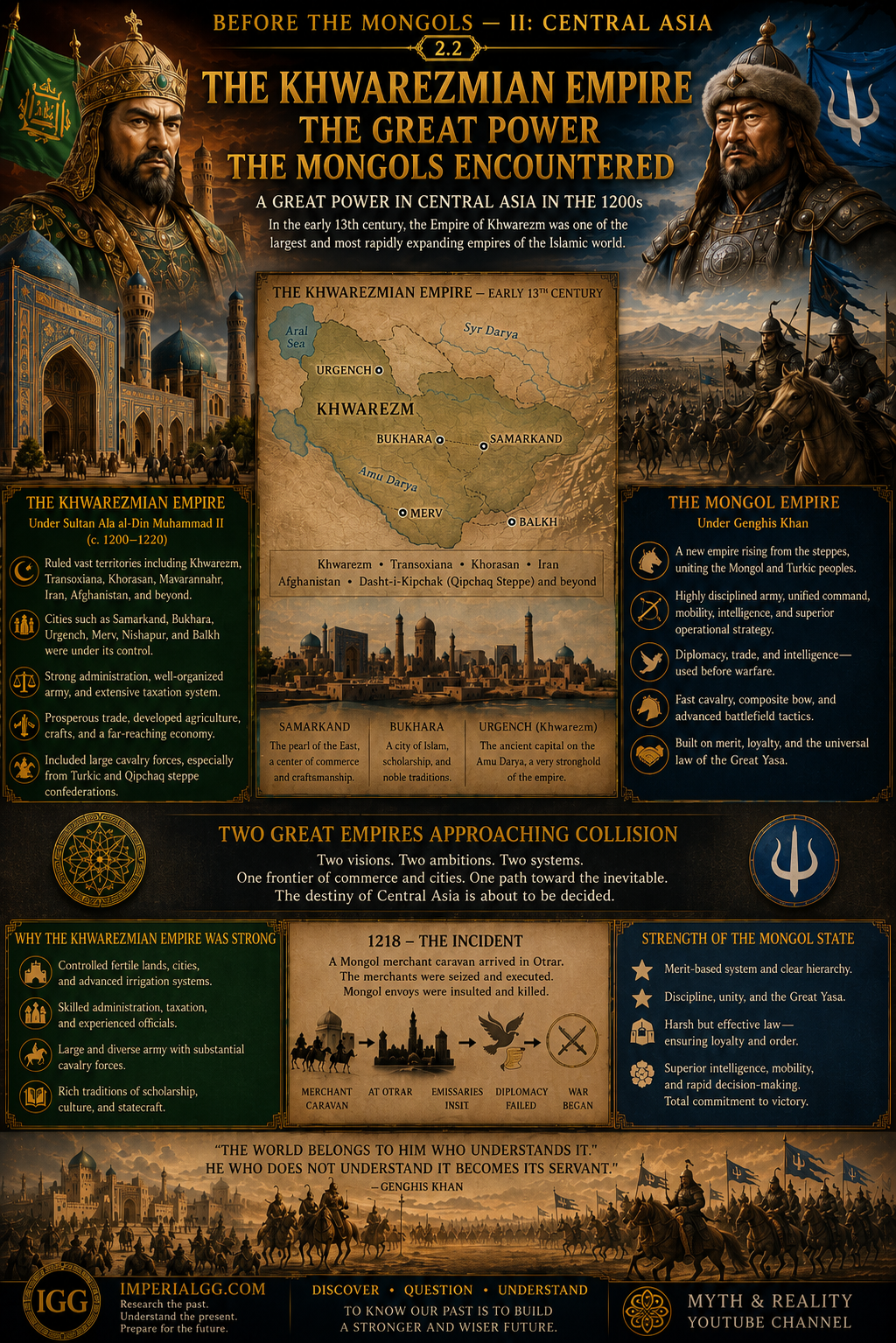
BEFORE THE MONGOLS — II: CENTRAL ASIA
2.4 — The Khwarazmian Empire: The Power the Mongols Encountered
By Altanbagana Baatar
DBA Candidate| Independent Historian
ImperialGG Historical Research Seriers
18 July 2026
When the Mongols Reached Khwarazm
When the Mongol Empire reached the borders of Central Asia in the early thirteenth century, it did not encounter a weak or insignificant state. It faced one of the largest and most rapidly expanding empires of the Islamic world.
The Khwarazmian Empire, ruled by Sultan Ala al-Din Muhammad II, stretched across a vast territory from Central Asia into Iran. Its authority encompassed many of the great cities of the region, including Samarkand and Bukhara, while its political influence extended across territories that today belong to Uzbekistan, Turkmenistan, Kazakhstan, Afghanistan, and Iran.
From the outside, the empire appeared formidable. Its armies were large. Its cities were wealthy. Its commercial networks connected some of the richest regions of Eurasia. Its ruler had defeated rivals and expanded his authority with extraordinary speed. Yet beneath this impressive surface lay a political structure far more complicated than the map of the empire suggested.
The Mongols would soon discover that Khwarazm was powerful—but its power was divided.
From a Regional Dynasty to an Empire
Khwarazm was an ancient region centered on the lower reaches of the Amu Darya, south of the Aral Sea. For centuries, its prosperity depended upon irrigated agriculture, urban settlements, and its strategic position between the Iranian world, Transoxiana, and the Eurasian steppe.
The dynasty that created the Khwarazmian Empire began its rise under the wider political order of the Seljuk Empire. The early Khwarazmshahs ruled as governors and subordinate rulers, but as Seljuk power weakened, they gradually expanded their independence.
During the twelfth century, Khwarazm became increasingly powerful. Under rulers such as Atsiz, Il-Arslan, and Tekish, the dynasty expanded beyond its original homeland. It competed with neighboring powers, intervened in the politics of Transoxiana and Iran, and gradually transformed itself from a regional state into an imperial power.
The decisive stage came under Ala al-Din Muhammad II, who ruled from 1200 until 1220. During his reign, Khwarazm expanded on an extraordinary scale.
But the empire Muhammad inherited and enlarged was not built upon a single homogeneous population or a completely centralized political system. It contained different regions, military groups, urban elites, tribal networks, and recently conquered territories. Expansion created power. It also created instability.
The Fall of the Qara Khitai Order
Before Khwarazm became the dominant power in Transoxiana, much of Central Asia had existed under the political supremacy of the Qara Khitai, or Western Liao.
The Khwarazmshahs themselves had at times recognized Qara Khitai overlordship. But by the beginning of the thirteenth century, the regional balance of power was changing rapidly. Muhammad II sought to break the old political order and establish himself as the dominant ruler of Central Asia.
In this struggle, Khwarazm was not acting alone. The Kuchlug crisis, the decline of Qara Khitai authority, and the movements of other Central Asian powers created an unstable political environment in which several rulers attempted to seize territory and influence.
The weakening of the Qara Khitai opened the way for Khwarazmian expansion into Transoxiana. Samarkand eventually came under Muhammad’s control. The old balance of power collapsed.
By the second decade of the thirteenth century, Khwarazm appeared to have emerged victorious. But almost simultaneously, another empire was expanding from the east.
The Mongols.
Muhammad II and the Dream of Imperial Supremacy
Ala al-Din Muhammad II did not see himself merely as the ruler of Khwarazm. His ambitions were imperial.
He expanded into Iran and challenged the political authority of other major powers. By the late 1210s, his empire controlled or claimed authority over an enormous territory. The scale of his achievements was remarkable.
Yet rapid conquest created a fundamental problem. Territory could be conquered faster than it could be politically integrated. Some regions had only recently submitted to Khwarazmian rule. Local elites retained their own interests. Military commanders possessed substantial independent influence. Different cities had different relationships with the central government.
The empire therefore looked more unified on a map than it necessarily was in political reality. This distinction would become decisive during the Mongol invasion.
A large empire is not automatically a unified empire.
Terken Khatun: Power Behind the Throne
One of the most important figures in Khwarazmian politics was Muhammad II’s mother, Terken Khatun. She was not simply a ceremonial member of the royal family.
She possessed her own political authority, court, supporters, and connections among powerful Turkic military elites. Her influence was so extensive that the Khwarazmian state effectively contained competing centers of power. Muhammad was the sultan. But his mother commanded enormous influence.
The relationship between their political networks complicated the internal administration of the empire. Officials and commanders could be connected to different factions within the ruling system.
This does not mean that the Khwarazmian Empire was permanently paralyzed by conflict. It remained capable of major military campaigns and territorial expansion. But when a crisis of unprecedented scale arrived, internal political divisions became far more dangerous.
The Mongols would not face a single command structure capable of coordinating every army and every city with complete efficiency.
The Qipchaq Connection
The political importance of Terken Khatun was closely connected to the broader role of Qipchaq and other Turkic military groups within the Khwarazmian Empire.
The northern steppe was not separate from Khwarazmian politics. For generations, the rulers of Central Asia had interacted with steppe confederations through warfare, diplomacy, marriage, migration, and military recruitment.
Qipchaq military forces became an important component of Khwarazmian power. This gave the empire access to formidable cavalry forces and strengthened its connections with the steppe world. But it also meant that military power was distributed among commanders and political networks whose loyalty could be shaped by dynastic, tribal, and personal relationships.
The Khwarazmian Empire therefore combined several different political traditions. It was an Islamic imperial state. It ruled major Persianate cities. Its ruling dynasty had Turkic origins. Its military system depended heavily upon Turkic steppe forces. Its population included diverse linguistic, ethnic, and regional communities.
Khwarazm was not simply a “Persian empire” or a “Turkic empire.” It was a Central Eurasian imperial system created through the interaction of both settled and steppe political worlds.
Samarkand: The Great Imperial Center
The conquest of Samarkand was one of Muhammad II’s most important achievements. Samarkand was not merely another city. Its location, population, commercial wealth, and historical prestige made it one of the greatest political prizes in Central Asia.
Muhammad invested heavily in its defense. By the time of the Mongol invasion, Samarkand possessed substantial fortifications and a large garrison. Contemporary accounts provide very different numbers for the forces defending the city, and the largest figures in medieval chronicles should be treated cautiously.
Nevertheless, there is little doubt that Samarkand was expected to be one of the strongest centers of resistance in the empire. Yet walls and soldiers alone could not solve the empire’s deeper strategic problem.
The Khwarazmian forces were distributed across numerous cities and fortresses. Instead of concentrating the main army for a decisive confrontation, Muhammad largely relied upon fortified urban centers to resist independently.
This decision would have enormous consequences.
An Empire of Powerful Cities
The Khwarazmian Empire possessed something the early Mongol Empire initially had in far smaller measure: a vast network of major cities.
Bukhara. Samarkand. Otrar. Urgench. Merv. Nishapur.
These were not minor settlements. They were centers of commerce, administration, craftsmanship, religion, and regional political power.
In theory, such cities represented enormous strength. Their walls could slow invading armies, their populations could supply defenders, and their wealth could support military forces.
But the same urban network could become a strategic weakness if the cities were isolated from one another. The Mongols excelled at mobility. If Khwarazmian forces remained divided among separate fortresses, Mongol armies could maneuver between them, isolate them, and attack them individually.
The Khwarazmian Empire possessed enormous resources. The central question was whether those resources could be coordinated.
Two Expanding Empires Meet
The confrontation between the Mongol and Khwarazmian empires was not initially inevitable.
By the late 1210s, both powers had expanded rapidly toward one another. Chinggis Khan had unified the Mongolian Plateau and defeated or subordinated major rivals across Inner Asia. His campaigns against the Jin dynasty had demonstrated the growing military capacity of the Mongol state.
Meanwhile, Muhammad II had built an enormous empire across Central Asia and Iran. For the first time, the two imperial systems now shared a political frontier.
Their relationship initially included diplomacy and commerce. From the Mongol perspective, commercial exchange with the wealthy cities of Central Asia offered obvious advantages. Merchants already moved across Inner Eurasia, carrying goods and information between different political worlds.
There was therefore no unavoidable historical law requiring immediate war between Chinggis Khan and Muhammad II. But relations between two rapidly expanding empires were inherently delicate. Each ruler possessed enormous ambitions. Each ruled a recently expanded political system. Each had reason to observe the other carefully.
Then a caravan arrived at Otrar.
Otrar: The Crisis Begins
In 1218, a large commercial caravan associated with the Mongol realm arrived at the Khwarazmian frontier city of Otrar. The governor of Otrar, commonly known as Inalchuq or Ghayir Khan, suspected the merchants of espionage. The caravan was seized. Its members were killed or executed according to the surviving historical traditions, though the precise details differ among the sources.
For Chinggis Khan, this was a serious incident. But his first response was not an immediate invasion. He sent envoys to Muhammad II demanding that the governor responsible for the incident be handed over.
The diplomatic mission ended disastrously. According to the principal narrative traditions, one envoy was killed and others were humiliated before being sent back. Whether every detail preserved by later chroniclers can be accepted literally requires caution. Yet the broader sequence is clear. A commercial dispute became a diplomatic crisis. The diplomatic crisis became an imperial confrontation.
Chinggis Khan began preparing for war.
The Strategic Problem Facing Muhammad II
Muhammad II now faced an enemy unlike the opponents he had defeated during his rapid rise.
The Mongol military system combined exceptional operational mobility with disciplined command structures and the ability to coordinate armies across enormous distances. The Khwarazmian Empire, by contrast, had larger urban resources but a more fragmented political structure.
Muhammad had several strategic possibilities. He could attempt to concentrate his forces and confront the Mongols in a major field campaign. He could use the rivers and geography of Transoxiana as defensive barriers. He could organize coordinated regional resistance. Instead, much of the Khwarazmian military strength was distributed among fortified cities. This decision allowed the Mongols to exploit one of their greatest advantages: movement.
Chinggis Khan did not simply advance along one predictable road. Mongol forces crossed difficult terrain, divided into multiple armies, approached cities from unexpected directions, and disrupted the strategic assumptions of the defenders. The empire that appeared enormous on the map was about to be attacked simultaneously at several critical points.
Powerful, but Not Prepared for This War
It would be misleading to describe the Khwarazmian Empire as simply weak. A weak state could not have conquered such enormous territories. A weak ruler could not have built one of the largest empires of the early thirteenth-century Islamic world. Muhammad II commanded substantial military resources. His empire possessed wealthy cities, experienced soldiers, powerful cavalry, extensive agricultural regions, and enormous commercial wealth. The problem was different. Khwarazm had expanded faster than its political institutions had consolidated. Its ruling elite was divided. Its military forces were dispersed. Many territories had only recently been incorporated. And its strategic system was about to confront an enemy capable of conducting war across continental distances with extraordinary coordination. The Mongol conquest was therefore not simply the destruction of a helpless civilization by an overwhelmingly superior force. It was the collision of two great imperial systems built in very different ways.
One was wealthy, urbanized, territorially vast, and politically complex. The other was highly mobile, increasingly centralized under Chinggis Khan, and organized for coordinated warfare on an unprecedented geographical scale. In 1219, these two worlds went to war. The result would transform the history of Central Asia