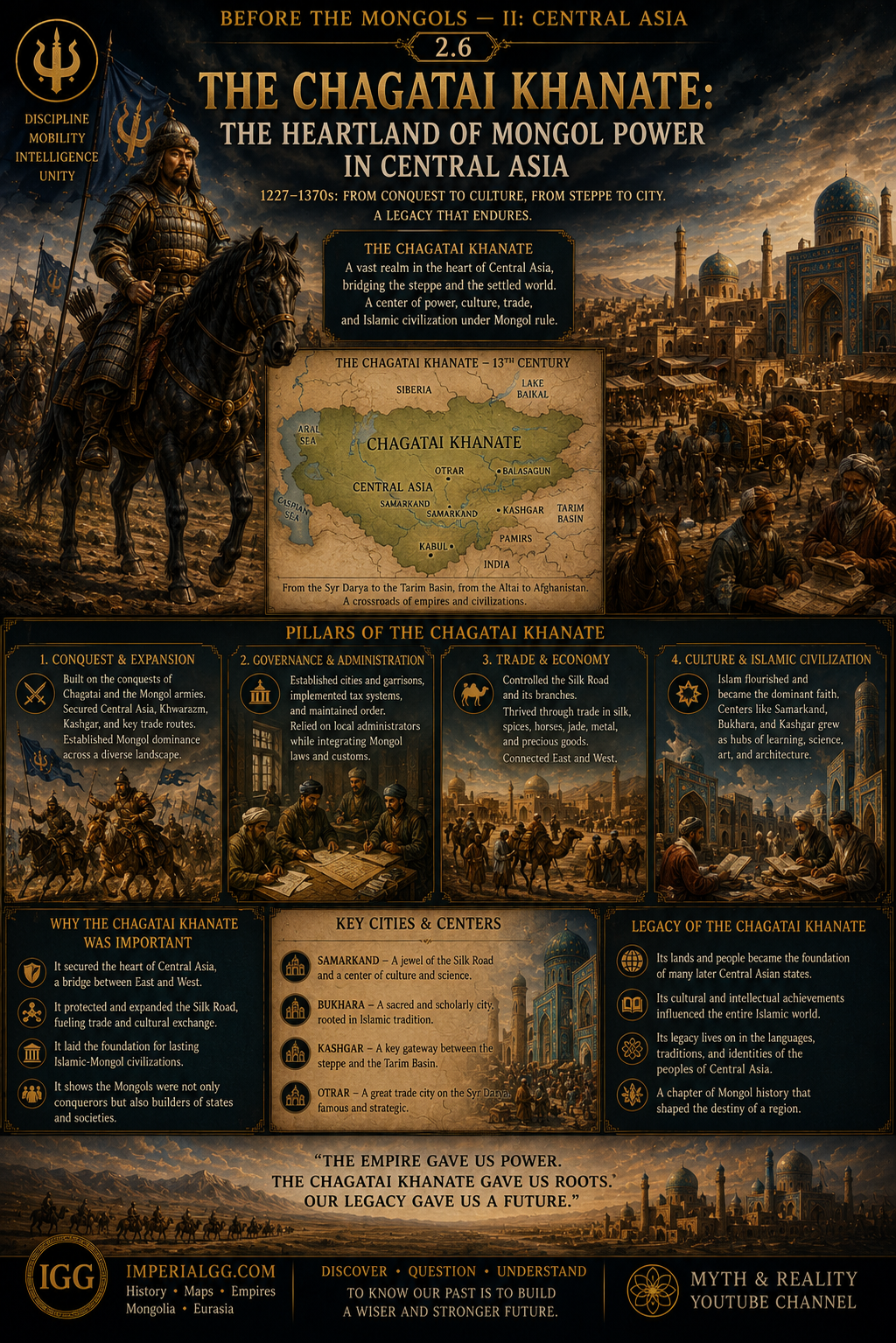
BEFORE THE MONGOLS – II: CENTRAL ASIA 2.6
2.6 — Central Asia Under the Chagatai Ulus: From Conquest to a New Political Order
By Altanbagana Baatar
DBA Candidate| Independent Historian
ImperialGG Historical Research Seriers
16 July 2026
The Mongol conquest of the Khwarezmian Empire did not bring the political history of Central Asia to an end. After the campaigns of 1219–1221, the region entered a new phase in which the territories of the former Khwarezmian state became integrated into the wider political system created by Chinggis Khan and his successors. For the lands that today form much of Uzbekistan, this transformation eventually placed the region within the political sphere associated with Chagatai, the second son of Chinggis Khan.
When Chinggis Khan divided responsibilities and territories among his sons, Chagatai received an ulus extending across much of Central Asia. The exact boundaries of this political inheritance changed over time and should not be understood as the fixed borders of a modern state. Nevertheless, the Chagatai ulus became one of the principal successor realms of the Mongol imperial world. Its territories included important parts of Transoxiana, known in the Islamic geographical tradition as Mawarannahr, as well as extensive steppe and mountain regions farther east.
This created a political structure unlike the Khwarezmian Empire that had preceded it. The Chagatai realm contained both major urban centers and vast pastoral territories. Cities such as Samarkand and Bukhara belonged to an old commercial and intellectual world connected with Iran, the Islamic Middle East, India, and the Eurasian trade routes. At the same time, the ruling dynasty emerged from the political and military traditions of the Mongolian steppe. The history of the region after the conquest was therefore shaped by the interaction between these different political, economic, and cultural traditions.
The early decades of Mongol rule were not simple or peaceful. The destruction caused by the initial conquest had severely affected many cities and agricultural districts, while questions of taxation, administration, land use, and political authority remained difficult. Mongol princes, military commanders, local administrators, merchants, religious communities, and established urban elites all had different interests. The relationship between the pastoral economy of the steppe and the agricultural economy of the oases also required constant political negotiation.
Yet the Mongol imperial system was not based solely on military occupation. The empire depended upon the movement of people, goods, information, officials, and diplomatic missions across enormous distances. Central Asia occupied a crucial geographical position within this network. The region stood between China and the eastern Mongol territories, Iran and the Middle East, the northern steppe, and the commercial routes leading toward India. As political conditions gradually stabilized, these connections contributed to the revival and expansion of long-distance exchange.
Samarkand and Bukhara therefore remained important centers rather than disappearing from history after the conquest. Their political circumstances had changed, but their geographical and economic significance remained. Merchants, administrators, scholars, craftsmen, and religious figures continued to play important roles in the region. Under the broader Mongol imperial order, Central Asian communities also became connected with regions that had previously belonged to separate political systems.
This period should not be described simply as the replacement of one people by another. The Mongol ruling houses did not remain culturally isolated from the societies they governed. Over generations, political interaction, marriage, religious conversion, administrative cooperation, and everyday contact transformed both the rulers and the ruled. In Central Asia, many members of the Chinggisid elite gradually adopted Turkic languages and became increasingly connected with the Islamic cultural world.
This transformation did not happen immediately. During the thirteenth and fourteenth centuries, different factions within the Chagatai political world held different attitudes toward urban life, Islam, taxation, and relations with the wider Mongol imperial tradition. Some rulers remained closely associated with the pastoral and political traditions of the eastern steppe, while others developed stronger relationships with the Muslim cities of Transoxiana. These tensions became one of the defining characteristics of the Chagatai ulus.
The conversion of important Chagatai rulers to Islam represented a major stage in this process. By the fourteenth century, Islam had become increasingly influential among sections of the ruling elite, although religious and political change remained uneven across the vast territories of the ulus. The result was not the disappearance of the Mongol political legacy. Instead, Chinggisid legitimacy continued to hold enormous importance even as the cultural environment of the ruling elite changed.
This point is essential for understanding the later history of Central Asia. The Mongol conquest created a new political framework, but that framework itself evolved. Steppe traditions of authority became intertwined with Turkic linguistic environments, Islamic institutions, Persianate administrative culture, and the established urban traditions of Central Asia. The political world that emerged from this interaction cannot be reduced to a single ethnic or cultural identity.
By the fourteenth century, the Chagatai ulus had become increasingly divided between its eastern and western regions. In Transoxiana, powerful military and tribal leaders gained greater influence, while the authority of individual Chagatai khans often depended upon shifting alliances. Political fragmentation weakened centralized control, but the principle of Chinggisid legitimacy remained powerful. A ruler who could claim descent from Chinggis Khan possessed a form of political authority that continued to matter across much of Eurasia.
This political tradition would directly shape the rise of one of the most important figures in Central Asian history: Timur.
Timur was not himself a descendant of Chinggis Khan and therefore could not simply claim the title of khan under the established political traditions of the region. Instead, he ruled through a political system that continued to recognize Chinggisid legitimacy. Chinggisid princes were maintained as nominal khans, while Timur exercised effective power as amir. His marriage into the Chinggisid royal line also allowed him to use the prestigious title of Güregen, meaning son-in-law of the royal house.
The rise of Timur therefore did not occur outside the political world created by the Mongol conquest. It emerged from within the transformed political landscape of the Chagatai ulus. The institutions, military traditions, concepts of legitimacy, networks of power, and geopolitical connections inherited from the Mongol period formed part of the historical foundation upon which the Timurid state was built.
For the history of modern Uzbekistan, the Chagatai period represents an essential bridge between the world before the Mongol conquest and the great political transformations of the fourteenth and fifteenth centuries. The cities of Transoxiana recovered and developed within a new Eurasian environment. The Mongol ruling elite became increasingly integrated into the Turkic and Islamic societies of Central Asia, while Chinggisid political traditions continued to influence the region long after the unified Mongol Empire had fragmented.
The history of Central Asia after 1221 was therefore not simply a story of destruction followed by recovery. It was a prolonged process of political and cultural transformation. The Mongol conquest dismantled the Khwarezmian imperial order, but the Chagatai ulus created the framework within which a new Central Asian world developed.
From that world would eventually emerge Timur and the Timurid Empire. And centuries later, another branch of the wider Chinggisid political tradition would give its name to the people and country known today as Uzbekistan.