
FROM KHANHOOD TO POLITICAL ORDER
By Altanbagana Baatar
DBA Candidate| Independent Historian
ImperialGG Historical Research Seriers
15 September 2026
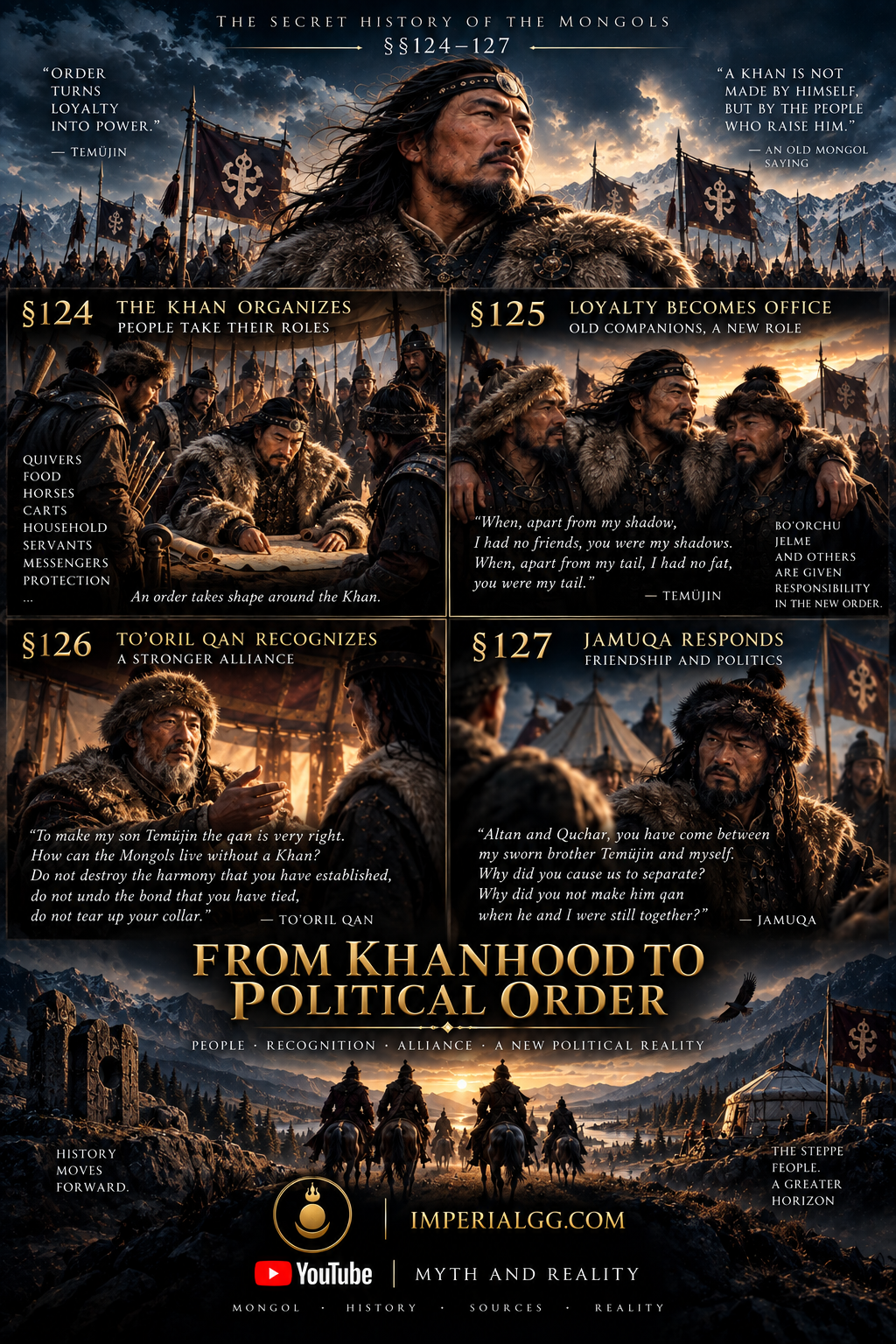
THE CORONATION OF TEMÜJIN AS CHINGGIS KHAN: THE 1206 ASSEMBLY, COLLECTIVE LEGITIMACY, AND THE EARLY ORGANIZATION OF MONGOL RULE
ImperialGG Historical Research Series | The Secret History of the Mongols
INTRODUCTION
The elevation of Temüjin as qan in the late twelfth century was more than a change in personal status. In the narrative of The Secret History of the Mongols, the decision to make Temüjin qan is immediately followed by the organization of people according to specific responsibilities, the recognition of his new position by To’oril Qan, and a politically revealing response from Jamuqa. Read together, §§123–127 preserve a remarkable picture of political formation: a ruler is not simply proclaimed by himself; his authority is collectively constituted, publicly recognized, and then translated into an organized structure of service and obligation.¹
This sequence deserves particular attention because it appears at a transitional point in the history of the Mongolian steppe. Temüjin was not yet the universal ruler of the Mongols who would be proclaimed in 1206 as Chinggis Khagan. The political community over which he exercised authority in this earlier period was still composed of competing lineages, tribal groupings, aristocratic houses, military followers, and alliance networks. Yet the Secret History does not portray his new position as an improvisation without precedent. Instead, it presents recognizable mechanisms of political legitimacy: prominent aristocrats deliberate, a candidate is elevated, obligations are mutually articulated, offices and responsibilities are distributed, allied rulers recognize the new authority, and political relationships are renegotiated around the new Khan.²
The significance of this episode becomes even greater when it is placed within the longer history of steppe political institutions. Modern Mongolian scholarship has repeatedly examined the development of political organization from the Xiongnu through subsequent steppe polities and into the Mongol period. Some scholars emphasize institutional continuity; others are more cautious about tracing specific institutions directly across centuries. The strongest historical position is therefore not that every Mongol institution of the twelfth century was an unchanged survival from the Xiongnu, but that the Mongol political order emerged within a much older Eurasian steppe tradition in which rulership, aristocratic participation, military organization, lineage legitimacy, and collective political decision-making had long been significant.³
The events surrounding Temüjin’s first elevation as Khan therefore deserve to be studied not simply as an episode in the biography of Chinggis Khan, but as evidence for the formation of political authority itself.
THE CORONATION OF TEMÜJIN: AUTHORITY WAS CONFERRED, NOT SELF-PROCLAIMED
The Secret History reaches the decisive moment in §123. Altan, Quchar, and Sača Beki agree among themselves and address Temüjin: “Let us make you Khan.”
They then formulate a series of obligations concerning military service, hunting, booty, loyalty, and punishment for disobedience. Only after this declaration does the narrative state that they named him Chinggis Qahan and made him Khan.⁴
The political sequence is important.
Temüjin does not appear in this passage declaring himself ruler and demanding recognition afterward. The initiative comes from politically significant men who deliberate among themselves and then elevate him. This does not mean that Temüjin lacked political power before 1189. On the contrary, the preceding narrative has already established the growth of his following, his military reputation, his relationship with To’oril, his alliance with Jamuqa, and the movement of groups and individuals toward his camp. His elevation was therefore the political recognition of an authority that had been developing through earlier relationships and achievements.
But recognition remained necessary. This distinction is fundamental. Military ability and personal prestige could create the conditions for rulership; they did not, by themselves, constitute the political act of becoming Khan.
The Mongolian Historical Dictionary places the elevation in 1189, at Khökh Nuur of Kharzurkh in the Senger stream area, and identifies Altan, Quchar, and Sača Beki as the figures who made the twenty-eight-year-old Temüjin Khan. It further connects these men to the descendants of Khabul Khan.⁵ Modern Mongolian historical works similarly describe the event as a gathering of influential Mongol aristocrats at which Temüjin received the title Chinggis and was elevated as Khan of Khamag Mongol.⁶
The evidence therefore allows a careful conclusion: the legitimacy of the Khan was constituted through collective political recognition. That principle is more significant than the particular identities of the three men who performed the act.
THE KHAN WAS BOUND BY OBLIGATION
The language surrounding the elevation in §123 is equally important.
Altan, Quchar, and Sača Beki do not merely say that they will obey Temüjin. They describe what they will do for him in war and peace and, crucially, what will happen if they fail. They promise military service, hunting assistance, the acquisition of women and tents, and obedience in the political order they are establishing. If they fail him in battle or peace, they accept severe consequences.⁷
This is not the language of unrestricted personal monarchy. It is the language of reciprocal political obligation. The Khan receives authority, but the men who elevate him also define the obligations that bind the new political relationship. The act is therefore simultaneously one of submission and contract. Temüjin becomes the central political authority, while the aristocratic supporters become participants in an ordered relationship in which military loyalty and service are explicitly articulated.
This feature is especially important when §123 is read together with §124.
The Secret History does not leave the new Khan sitting symbolically upon a throne. Immediately after the elevation, the narrative turns to the practical organization of his household and retinue. The transition is almost immediate:
elevation → obligation → organization. That sequence is one of the most revealing features of the passage.
§124: THE NEW KHAN IMMEDIATELY ORGANIZES HIS POLITICAL HOUSEHOLD
Section 124 contains a long list of individuals assigned particular responsibilities around Chinggis Qahan. Some are associated with the quiver and weapons; others with food, horses, carts, women and servants, messengers, or other functions.⁸
The passage should not be described as a fully developed imperial bureaucracy. That would impose the institutions of the thirteenth-century empire onto a much earlier stage. Nor should every named responsibility be assumed to correspond exactly to a later office. Nevertheless, the underlying principle is unmistakable.
The new Khan requires an organized body of people with differentiated responsibilities. This is the first important organizational consequence of the elevation. A ruler cannot exercise political authority through a title alone. He requires people who maintain his household, protect him, carry weapons, care for horses, provide food, transmit messages, and perform the practical functions through which authority operates. The Secret History therefore moves from the abstract recognition of Temüjin’s khanship directly into the organization of personnel.
This is why §124 is much more important than it might initially appear. The passage is not simply a list of servants. It preserves an early picture of political organization around the Khan.
Modern scholarship has recognized the importance of this development. Christopher Atwood’s work on Mongol political organization, as well as the broader scholarship surrounding the Secret History, treats the pre-Chinggisid Mongol political world as one in which kinship, military following, aristocratic leadership, and service relationships were already highly significant. The later imperial system did not emerge from an institutional vacuum; it transformed and greatly expanded structures that had existed in earlier Mongol political society.⁹
FROM PERSONAL LOYALTY TO POLITICAL OFFICE
Section 125 takes this process further. Here the Secret History presents a political relationship that is particularly characteristic of Temüjin’s rise: people who had demonstrated loyalty during his vulnerable years are now incorporated into the structure surrounding the Khan. This is especially visible in the treatment of his long-standing companions. Their loyalty had originally been personal and immediate. They stayed with Temüjin when his position was weak, when his household was small, and when his political future was uncertain.
Now that Temüjin has become Khan, those relationships acquire a new political meaning. The development can be expressed analytically as:
personal loyalty → recognized service → political responsibility.
This does not mean that personal loyalty ceased to matter. Quite the opposite. The Secret History repeatedly presents the bonds of companionship, anda relationship, household affiliation, and military loyalty as fundamental components of political life. What changes is their scale. A relationship that had once connected two individuals can now become part of the organization of a political community. That transformation is one of the foundations of Temüjin’s later success.
THE SIGNIFICANCE OF THE PREVIOUS STEPPE TRADITION
At this point the question of historical continuity becomes unavoidable. Was Temüjin inventing this political structure from nothing? The evidence does not support such an interpretation.
Long before the Mongol Empire, the societies of the eastern Eurasian steppe had developed complex political systems. The Xiongnu state, established in the late third century BCE, possessed a supreme ruler—the Chanyu—along with a hierarchy of aristocratic officials and military-administrative divisions. Mongolian scholarship has particularly emphasized the existence of differentiated offices and responsibilities under the Xiongnu and the subsequent development of such political traditions among the Xianbei, Rouran, Türk, Uyghur, Kyrgyz, and Khitan polities.¹⁰
One modern Mongolian study of the tradition of Mongolian state officials argues explicitly that the Xiongnu possessed a differentiated hierarchy of political and military officials, and that subsequent steppe states developed these traditions in their own forms.¹¹ Another study of Mongolian state and legal history similarly treats the political institutions of the Mongolian plateau as part of a much longer historical development rather than an institution created suddenly in the thirteenth century.¹²
This does not prove that every office described in §124 descended directly from a specific Xiongnu office. Such a claim would exceed the evidence. What the comparison does establish is a more defensible proposition: Temüjin’s political organization emerged within a steppe environment that already possessed a long history of differentiated rulership, military organization, aristocratic authority, and political service.
The Mongol achievement was therefore not the invention of organized steppe government out of nothing. Its historical importance lies in how Temüjin transformed existing political resources into a much more centralized and expansive order.
KHANHOOD AND THE POLITICAL COMMUNITY
The method by which Temüjin became Khan is equally important. The elevation involved politically influential members of the ruling aristocracy. The Secret History does not present the event as an accidental gathering of ordinary followers. Altan, Quchar, and Sača Beki belonged to important aristocratic lineages, and the Mongolian Historical Dictionary explicitly identifies them as descendants of Khabul Khan’s line in its account of Temüjin’s 1189 elevation.¹³
This makes the event significant for the history of succession and legitimacy. The Mongol political system recognized the importance of lineage. Yet lineage alone did not automatically place every aristocrat on the throne. This is one of the most important points that should be made carefully.
Being of prestigious lineage and possessing the political legitimacy to become Khan were related, but they were not identical.
The political community still had to recognize a candidate. The existence of a powerful aristocratic lineage therefore did not eliminate collective political action. Instead, lineage legitimacy, political reputation, military capacity, and collective recognition operated together. This helps explain why Temüjin’s elevation is historically important. He was not simply the strongest man who announced himself Khan. He was a politically successful member of a recognized ruling lineage whose elevation was undertaken by other politically significant aristocrats.
THE KURULTAI QUESTION
The later Mongol world is famous for the quriltai, the great assembly at which major political questions—including the selection of supreme rulers—could be decided.
The evidence from §123 should not be used to claim that a fully codified constitutional institution called the quriltai already existed in precisely the later form in 1189.
That would go beyond the source. But the event clearly demonstrates collective deliberation and political recognition. Modern Mongolian historical literature commonly describes the 1189 gathering as an aristocratic assembly at Khökh Nuur where influential nobles deliberated and elevated Temüjin as Khan.¹⁴ The language of the Secret History itself supports the essential point: Altan, Quchar, and Sača Beki “agree together,” address Temüjin collectively, formulate their obligations, and then make him Khan.¹⁵
Thus, even before the later institutional development of the Mongol imperial quriltai, the political principle is visible: supreme authority required recognition by a political community. This is fundamentally different from unrestricted self-proclamation. The Khan was not simply a man who called himself Khan. He had to be made Khan.
§126: TO’ORIL QAN AND THE RECOGNITION OF AUTHORITY
The significance of §126 becomes clearer when placed after this internal act of elevation. Temüjin sends envoys to To’oril Qan to announce: “They have made Chinggis Qahan Khan.”
To’oril responds that making his “son” Temüjin Khan is right and asks how the Mongols could fare without a Khan. He then warns them not to break the harmony they have established or undo the bond they have tied.¹⁶
This passage is politically important for two reasons. First, To’oril did not make Temüjin Khan. The elevation had already taken place. Second, however, Temüjin’s new authority was significant enough that it was immediately communicated to one of the most powerful rulers in his alliance network.
The new Khan therefore sought recognition within the wider political order. To’oril’s response supplies that recognition. His description of Temüjin as “my son” should be understood within the political and relational vocabulary of their alliance rather than treated automatically as biological terminology. The point is not genealogy but political relationship. To’oril’s acceptance demonstrates that Temüjin’s khanship was not necessarily incompatible with the existing alliance hierarchy. Indeed, To’oril presents the existence of a Mongol Khan as necessary.
§127: JAMUQA AND THE POLITICS OF SEPARATION
Jamuqa’s response is perhaps the most revealing part of this sequence. When Temüjin sends Arqai-qasar and Cha’urqan as envoys, Jamuqa does not simply reject the new Khan. Instead, he directs his criticism toward Altan and Quchar.
He asks why they came between himself and his anda Temüjin and, most importantly, why they had not made Temüjin Khan while the two sworn brothers were still together.¹⁷
This statement deserves close attention. Jamuqa’s complaint is not simply: “Temüjin should not be Khan.”
Rather, his complaint is: Why did you make him Khan only after separating us?
That distinction changes our understanding of the political moment.
Jamuqa still recognizes the relationship with Temüjin as an anda relationship. He asks Altan and Quchar to keep their word and to remain good companions to Temüjin.¹⁸
The passage therefore shows that the political crisis had not yet become an irreversible ideological confrontation between “Temüjin’s party” and “Jamuqa’s party.” The separation itself was becoming politically consequential. The new Khanhood was reorganizing relationships that had previously been centered upon the Jamuqa–Temüjin partnership. This is why Jamuqa’s response is so important. It reveals that political organization can alter the structure of personal alliances even when the legitimacy of the new ruler is not itself explicitly rejected.
KHANHOOD WAS ALREADY PRODUCING A NEW POLITICAL CENTER
Sections 123–127 can therefore be read as a single political process.
In §123, Temüjin is made Khan.
In §124, people are assigned differentiated responsibilities around him.
In §125, loyalty and service are incorporated into the new political order.
In §126, To’oril recognizes the new arrangement.
In §127, Jamuqa reacts to the political consequences of Temüjin’s elevation.
The sequence is remarkably coherent. It moves from: LEGITIMACY to AUTHORITY to ORGANIZATION to RECOGNITION to POLITICAL REALIGNMENT. This is why §124–127 should not be treated as an insignificant transitional passage. The Secret History is showing the reader how a political center begins to form around Temüjin.
FROM THE XIONGNU TO THE MONGOLS: CONTINUITY AND TRANSFORMATION
The larger historical question is whether this political organization should be understood as part of a much older steppe tradition. There is substantial reason to ask that question.
Mongolian scholarship has long examined the relationship between the political traditions of the Xiongnu and later Mongolian states. Some scholars have argued for broad institutional continuity across the steppe, while others have emphasized discontinuities and the danger of treating widely separated political systems as a single uninterrupted state tradition.¹⁹
The distinction is essential. We should not say: “Temüjin’s §124 offices were exactly the Xiongnu offices.” The evidence does not demonstrate that.
But we can say: The political culture in which Temüjin’s Khanhood emerged had deep precedents in the political history of the eastern Eurasian steppe.
The Xiongnu had a supreme ruler, aristocratic ranks, military divisions, and differentiated officials. Later steppe empires developed their own variations. The Türk and Uyghur polities likewise possessed elaborate political hierarchies. The Khitan Liao developed a highly complex imperial system that combined steppe and sedentary institutions. By the twelfth century, therefore, the Mongolian plateau was not a political blank space. Temüjin inherited a political world. His historical achievement was to reorganize and transform that world.
CHINGGIS KHAN AND THE MEMORY OF THE XIONGNU
This longer perspective also gives particular importance to the tradition that Chinggis Khan himself associated the Mongol polity with an older history of steppe rulership.
A tradition preserved in the account of his meeting with the Daoist master Changchun records Chinggis Khan referring to an ancestral political history reaching back to the Xiongnu. A modern Mongolian government publication likewise cites this tradition in discussing Mongolian historical memory and the Xiongnu past.²⁰
This testimony must be used carefully. It is not evidence that Chinggis Khan possessed a modern historian’s concept of an uninterrupted national state extending from the Xiongnu to the Mongols. It is evidence of something more limited and historically important: the Mongol imperial political tradition could situate itself within an older steppe genealogy of rulership. That distinction matters. Political continuity does not require institutional identity.
A later state may inherit:
- concepts of legitimate rulership,
- political vocabulary,
- aristocratic structures,
- military organization,
- assembly traditions,
- ideas of lineage,
- symbolic practices,
- and memories of earlier empires,
while transforming them into a new political order. This is a more historically defensible model for understanding the relationship between the Xiongnu and the Mongols.
THE MONGOL KHAN WAS NOT AN ABSOLUTE PERSONAL CLAIM
The events of §§123–127 also allow us to reconsider a common modern assumption about nomadic rulership. It is tempting to imagine a steppe ruler as an individual warrior who accumulated sufficient military power and simply declared himself king. The Secret History presents a more complicated political reality.
Temüjin’s military reputation mattered. His lineage mattered. His alliances mattered. His followers mattered. His relationship with To’oril mattered. His relationship with Jamuqa mattered. But none of these elements alone explains his elevation. The political act required recognition. And once recognized, the Khan immediately entered into a network of obligations.
This suggests that Mongol rulership was relational rather than purely personal. The Khan required followers. Followers required a legitimate center. Aristocrats required a ruler capable of rewarding and organizing them. Allied rulers required a recognized political counterpart. The political system therefore operated through reciprocal relationships.
THE FIRST FORM OF A KHANATE
This is why the term “state formation” must be used carefully but not avoided. The events of §§123–127 do not yet constitute the fully centralized empire of 1206 and after. But they do reveal an early form of political consolidation.
A political center has appeared. A ruler has been collectively recognized. His authority has been translated into differentiated responsibilities. His allies have been informed. His previous political relationships are being reorganized around him. And his followers are increasingly becoming participants in an ordered political structure. The process is therefore better described as the formation of an early Khanate than as the sudden creation of a fully developed empire. This distinction allows us to see the historical development rather than impose the final Mongol imperial system backward onto 1189.
CONCLUSION: BEFORE THE EMPIRE, THERE WAS A POLITICAL SYSTEM
The importance of §§123–127 lies precisely in their position between Temüjin’s earlier life as a rising steppe leader and his later emergence as Chinggis Khagan and founder of the Mongol Empire. In 1189, Temüjin did not yet possess the enormous territorial empire associated with his later name. But the political principles visible in this episode are already significant.
He was made Khan, rather than simply proclaiming himself Khan. His elevation involved politically influential aristocrats. The act generated reciprocal obligations. The new Khan immediately organized people according to differentiated responsibilities. His new status was communicated to To’oril Qan and received his recognition. Jamuqa’s response demonstrates that the new khanship was already reshaping the political relationships of the steppe. Taken together, these developments demonstrate that Temüjin’s rise was not merely a story of individual military success. It was a process of political institutionalization.
The evidence also invites a longer historical interpretation. The Mongol political order did not arise in an institutional vacuum. The eastern Eurasian steppe had already produced powerful states, aristocratic hierarchies, military-administrative systems, traditions of supreme rulership, and mechanisms of collective political recognition long before the rise of Temüjin. Mongolian scholarship has therefore been justified in examining the Mongol state within the wider history of steppe state formation, while remaining cautious about claiming an unchanged institutional continuity across a millennium.²¹
The significance of Temüjin’s 1189 elevation lies precisely here. He inherited a political world—but he transformed it. The Khanhood established at Khökh Nuur was not yet the Mongol Empire. It was the beginning of the political structure from which that empire would eventually emerge.
NOTES
1. The Secret History of the Mongols (SHM), §§123–127. For the critical study of the text and its political terminology, see Igor de Rachewiltz, The Secret History of the Mongols: A Mongolian Epic Chronicle of the Thirteenth Century, especially his commentary on §§123–127. Rachewiltz notes that from §124 onward the ruler is consistently designated Chinggis Qa’an and discusses the relationship between the conferral of the title qan and the name/designation Chinggis.
2. SHM §§122–127. The sequence from the movement of people away from Jamuqa, through the elevation of Temüjin, the organization of his followers, To’oril’s recognition, and Jamuqa’s reaction is particularly important for reconstructing the political process.
3. For the broader question of pre-Chinggisid Mongol political organization, see Christopher P. Atwood, The Mongol Empire: A Historical Encyclopedia (2004), and the broader discussion of socio-political organization in scholarship on the Secret History. The recent Penguin edition of the Secret History also includes a dedicated appendix on the socio-political organization of the pre-Chinggisid Mongols.
4. SHM §123. The text records Altan, Quchar, and Sača Beki agreeing together and declaring their intention to make Temüjin qan, followed by their articulation of obligations and the statement that they named him Chinggis Qahan and made him qan.
5. “Dalan Baljūd,” Mongolyn tüükhiin tailbar toli, which dates the elevation to 1189 and identifies Altan, Quchar, and Sača Beki as the figures who made the twenty-eight-year-old Temüjin Khan.
6. Mongol Ulsyn tüükh, the multi-volume national history produced under the auspices of the Institute of History of the Mongolian Academy of Sciences, is cited in later Mongolian historical materials as describing the 1189 assembly at Khökh Nuur and the elevation of Temüjin as Khan. A published excerpt gives the formulation that an “onц хуралдаан” of influential Mongol nobles took place in 1189.
7. SHM §123. The precise translation of the obligations differs among translators; the underlying structure of military service, reward, loyalty, and punishment is consistent across the major editions.
8. SHM §124. The section lists differentiated functions around Chinggis Qahan, including quiver-bearing, food provision, horses, carts, household service, weapons, and messenger functions. Rachewiltz’s commentary is particularly useful for identifying the terminology and institutional implications of these appointments.
9. On the transformation of personal followers, aristocratic networks, and military organization into the later Mongol political system, see David S. Sneath, The Headless State: Aristocratic Orders, Kinship Society & Misrepresentations of Nomadic Inner Asia (2007), and Christopher P. Atwood’s studies of Mongol political organization. The broader scholarship emphasizes the danger of interpreting nomadic political organization simply through sedentary-state categories.
10. On the political organization of the Xiongnu and later steppe states, see the discussion summarized in Mongolian scholarship concerning Xiongnu political officials and the development of institutional traditions through the Xianbei, Rouran, Türk, Uyghur, Kyrgyz, and Khitan periods.
11. The Mongolian Academy of Management’s study of Mongolian state-service traditions describes the Xiongnu hierarchy in terms of senior aristocratic officials, regional/military commanders, and officials responsible for conquered territories, while emphasizing subsequent development under later steppe states.
12. A Mongolian political-legal study argues that the early history of Mongolian statehood should be understood through the development of institutions on the Mongolian plateau and identifies the Khamag Mongol polity as an important stage between earlier steppe states and the unified Mongol state.
13. Mongolyn tüükhiin tailbar toli, “Dalan Baljūd.” The entry explicitly describes Altan, Quchar, and Sača Beki as descendants of Khabul Khan’s line in connection with the 1189 elevation.
14. Mongolian historical scholarship commonly characterizes the 1189 event as a gathering/assembly of influential aristocrats at Khökh Nuur. This terminology should be distinguished from assuming that every later institutional feature of the imperial quriltai was already fully codified in 1189.
15. SHM §123.
16. SHM §126. To’oril’s statement that making Temüjin Khan was “right” and that the Mongols could not be without a Khan is one of the strongest pieces of evidence for external recognition of the new political arrangement.
17. SHM §127.
18. SHM §127. Jamuqa continues to refer to Temüjin as his anda and directs Altan and Quchar to remain companions to him. This is why §127 should not be reduced to a simple rejection of Temüjin’s khanship.
19. For an example of the ongoing scholarly debate over Mongolian political origins and continuity, see Mongolian political-history scholarship that distinguishes between the Xiongnu as an early steppe state and the Khamag Mongol polity as an important stage in the development of Mongolian statehood.
20. A Mongolian government publication records the tradition that during Chinggis Khan’s meeting with Changchun, he referred to an ancestral political history reaching back to the Xiongnu/Chanyu period. This testimony should be treated as evidence of Mongol historical memory and political self-positioning, rather than as independent proof of uninterrupted institutional identity.
21. For the broader historiographical issue, see the literature on the Xiongnu, pre-Chinggisid Mongols, and the formation of the Mongol Empire. The recent Cambridge discussion of premodern Eurasian political order emphasizes that the Secret History is especially valuable for reconstructing the political culture of the Mongolian plateau rather than treating Mongol political development as an isolated phenomenon.
SELECTED BIBLIOGRAPHY
Primary Sources
- The Secret History of the Mongols. Translated and commented by Igor de Rachewiltz. Leiden: Brill, 2004–2013.
- The Secret History of the Mongols. Translated by Urgunge Onon. London/New York: RoutledgeCurzon, 2001.
- Rašīd al-Dīn. Jāmiʿ al-Tawārīkh (Compendium of Chronicles). Various editions and translations.
- Sagan Sečen. Erdeni-yin Tobči.
Mongolian Scholarship
- Ц. Дамдинсүрэн, Монголын Нууц Товчоо. Улаанбаатар.
- Ш. Нацагдорж, Чингис хааны цадиг. Улаанбаатар, 1991.
- Ч. Далай, Их Монгол улсын түүх. Улаанбаатар, 2006.
- Монгол Улсын түүх, Монгол Улсын ШУА-ийн Түүхийн хүрээлэн, II боть.
- Монголын түүхийн тайлбар толь, “Далан Балжуд.”
- И. Дашням, Монгол Улсын төр, эрх зүйн түүх. Улаанбаатар, 2011.
Modern International Scholarship
- Atwood, Christopher P. The Mongol Empire: A Historical Encyclopedia. 2004.
- Sneath, David S. The Headless State: Aristocratic Orders, Kinship Society & Misrepresentations of Nomadic Inner Asia. Columbia University Press, 2007.
- de Rachewiltz, Igor. The Secret History of the Mongols: A Mongolian Epic Chronicle of the Thirteenth Century. Brill, 2004–2013.
- Broadbridge, Anne F. Women and the Making of the Mongol Empire. Cambridge University Press, 2018.
- May, Timothy. The Mongol Empire. Edinburgh University Press.
- Allsen, Thomas T. Studies on Mongol imperial and Eurasian political institutions.