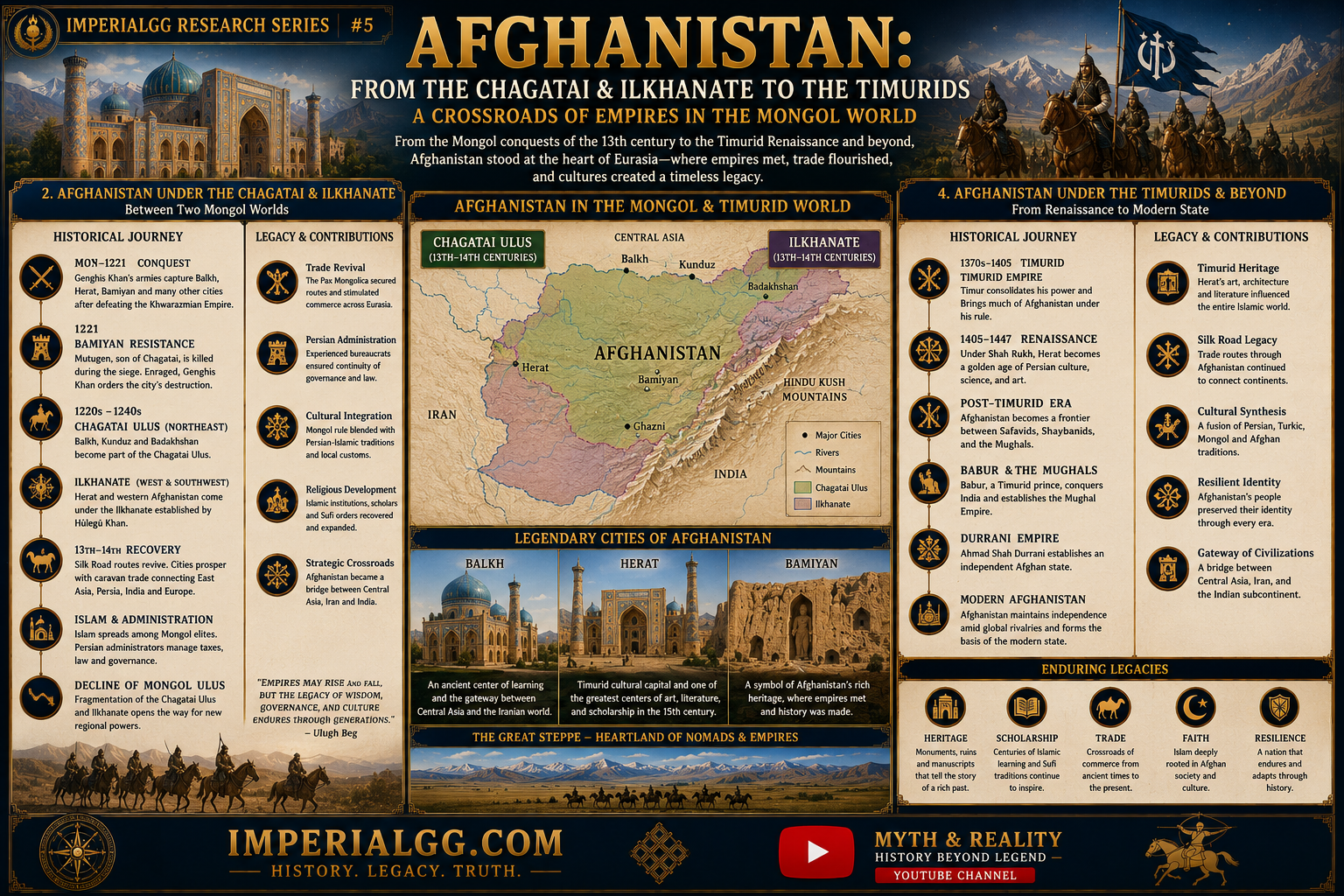
Afghanistan: From the Chagatai and Ilkhanate to the Timurids
By Altanbagana Baatar
DBA Candidate| Independent Historian
ImperialGG Historical Research Seriers
06 August 2026
Introduction
Modern Afghanistan has long occupied one of the most strategic locations in Eurasia. Positioned between the Iranian Plateau, Central Asia, the Indian subcontinent, and the Eurasian steppe, it has served for centuries as a meeting point of civilizations, trade routes, and imperial ambitions. Cities such as Balkh, Herat, and Ghazni became renowned centers of commerce, Islamic scholarship, and political authority long before the rise of the Mongol Empire.
The Mongol conquest of the thirteenth century profoundly reshaped Afghanistan’s political landscape. While the invasions brought widespread devastation to many urban centers, they also incorporated the region into an interconnected Eurasian empire stretching from the Pacific Ocean to Eastern Europe. Different parts of present-day Afghanistan came under the authority of the Chagatai Ulus and the Ilkhanate, linking the country to two major branches of the Chinggisid world.¹
In the following century, Timur united much of Central Asia, Iran, and Afghanistan under a new empire that revived trade, architecture, and scholarship. The Timurid capital at Herat became one of the greatest intellectual and artistic centers of the Islamic world. Afghanistan’s medieval history is therefore best understood as a succession of Mongol and Timurid political traditions that shaped the region long after the empire of Genghis Khan had fragmented.
Afghanistan Before the Mongols
Before the Mongol conquest, the territory of present-day Afghanistan formed part of several powerful Islamic dynasties. During the tenth and eleventh centuries, the Ghaznavids ruled an empire extending into northern India, making Ghazni one of the most influential cities in the Islamic world. They were later succeeded by the Ghurids, whose military campaigns carried Afghan influence deep into the Indian subcontinent.²
By the early thirteenth century, much of Afghanistan had been incorporated into the Khwarazmian Empire, although political control remained uneven across its mountainous terrain. Ancient cities such as Balkh, Herat, and Bamiyan flourished as centers of trade and learning, connected to both the Silk Road and the caravan routes leading toward India and Persia.³
Despite this prosperity, internal political divisions and the rapid expansion of the Mongol Empire placed the region in an increasingly vulnerable position.
The Mongol Conquest
The Mongol invasion of Afghanistan formed part of Genghis Khan’s wider campaign against the Khwarazmian Empire beginning in 1219. After the fall of Transoxiana, Mongol armies advanced into northern Afghanistan, capturing Balkh, Herat, and other strategic cities.
One of the most dramatic episodes occurred at Bamiyan, where fierce resistance led to prolonged fighting. During the siege, Genghis Khan’s beloved grandson Möngke? Actually correction: it was Mutugen, the son of Chagatai, who was killed. Enraged by his death, Genghis Khan reportedly ordered the destruction of the city, an event vividly described in Persian chronicles.⁴
Following the conquest, Afghanistan was divided between the Chagatai Ulus in the northeast and the Ilkhanate in the west and southwest. Although these political frontiers shifted over time, the region became firmly integrated into the wider Mongol world through trade, diplomacy, and military administration.
Footnotes
- David O. Morgan, The Mongols, 2nd ed. (Oxford: Blackwell, 2007), 95–122.
- C. E. Bosworth, The Ghaznavids (Edinburgh: Edinburgh University Press, 1963).
- Yuri Bregel, An Historical Atlas of Central Asia (Leiden: Brill, 2003), 42–58.
- Ata-Malik Juvaynī, The History of the World Conqueror, trans. John A. Boyle (Manchester: Manchester University Press, 1958), Vol. I, 121–138.
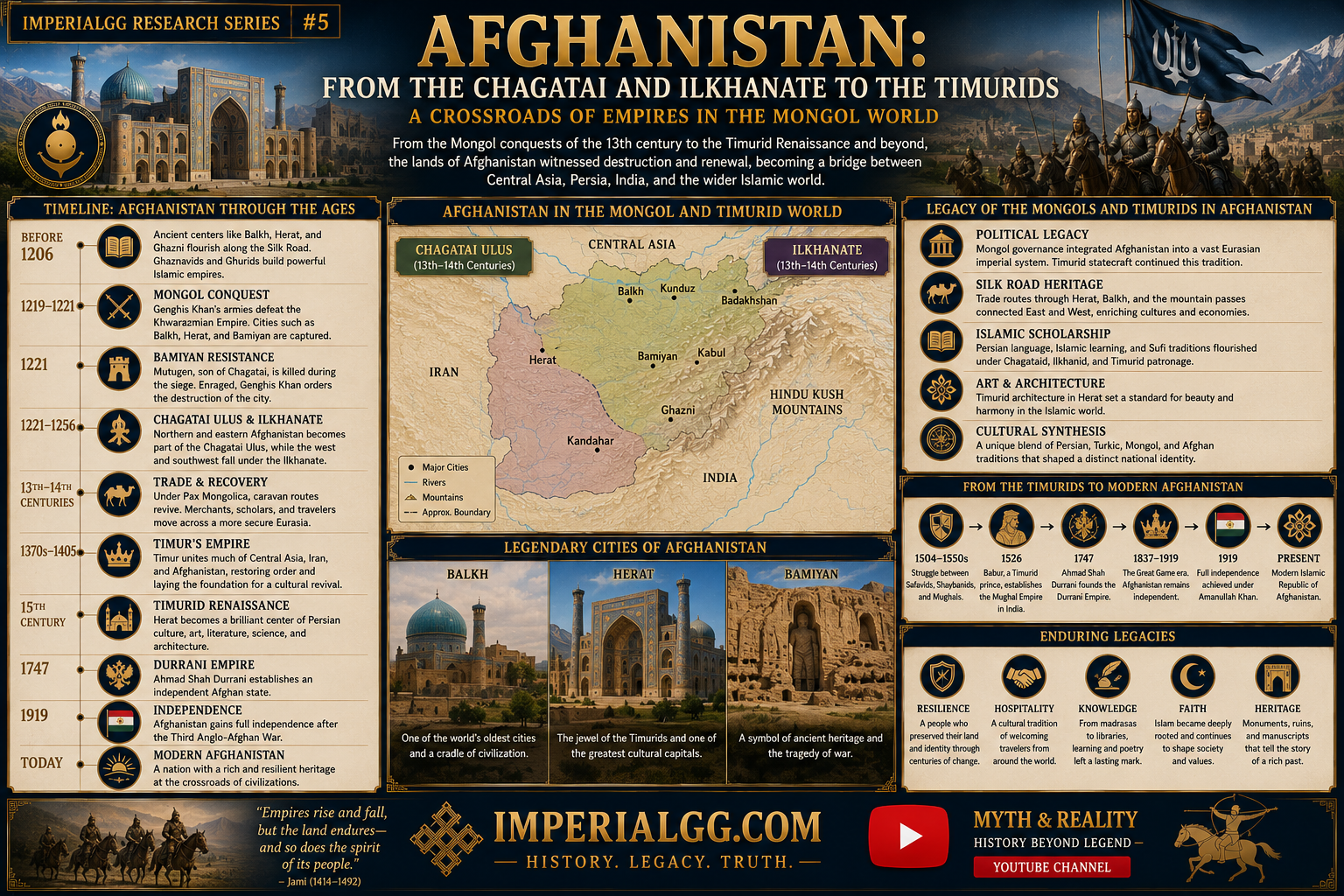
Afghanistan under the Chagatai Ulus and the Ilkhanate
Following the Mongol conquest, Afghanistan occupied a unique position between two major successor states of the Mongol Empire. The northeastern regions, including Balkh and Badakhshan, were generally incorporated into the Chagatai Ulus, while Herat and much of western Afghanistan came under the authority of the Ilkhanate, established by Hülegü Khan in 1256.⁵
Although the frontier between these states shifted over time, Afghanistan became an important bridge connecting Central Asia, Persia, and India. Caravan routes passing through Herat, Balkh, and the Hindu Kush once again flourished under the security of the Pax Mongolica. Merchants transported silk, horses, precious metals, paper, spices, and textiles across Eurasia, while diplomats, scholars, and religious travelers moved more freely than during the preceding century.⁶
The Mongol rulers generally relied upon experienced Persian administrators to govern cities and collect taxes. Islamic institutions gradually recovered after the devastation of the conquest, and by the late thirteenth century many Mongol elites themselves had embraced Islam. Rather than replacing local traditions, Mongol rule increasingly blended with Persian administrative practice and Islamic political culture.
The Timurid Renaissance in Herat
The decline of both the Chagatai Ulus and the Ilkhanate during the fourteenth century created opportunities for new regional powers. Among them, Timur (Tamerlane) established one of the greatest empires of the medieval Islamic world. Although Samarkand served as his imperial capital, Herat became the cultural jewel of the Timurid Empire during the reign of his successors.⁷
Under Shah Rukh and Gawhar Shad, Herat developed into one of the leading centers of Persian literature, miniature painting, architecture, theology, and science. Scholars such as Jami, together with artists including Kamal al-Din Behzad, transformed Herat into a city whose cultural influence reached across the Islamic world.
Magnificent mosques, madrasas, libraries, and gardens reflected the remarkable prosperity of the Timurid period. Persian remained the principal language of scholarship and administration, while Chinggisid political traditions continued to provide legitimacy for Timurid rule. Modern historians frequently describe fifteenth-century Herat as one of the greatest intellectual capitals of the Islamic Golden Age.⁸
From the Timurids to Modern Afghanistan
Following the decline of Timurid authority during the early sixteenth century, Afghanistan became a contested frontier between the Safavid Empire, the Shaybanids, and the emerging Mughal Empire, founded by Babur, a Timurid prince whose ancestry combined the lineages of Timur and Genghis Khan.⁹
Over the following centuries, Afghan dynasties gradually established greater political independence. The Durrani Empire, founded by Ahmad Shah Durrani in 1747, is widely regarded as the foundation of the modern Afghan state.
During the nineteenth century, Afghanistan became the focal point of the “Great Game” between the Russian and British Empires. Despite repeated foreign interventions, the country preserved its political independence, eventually becoming the modern Islamic Republic of Afghanistan before subsequent political transformations in the twenty-first century.
Legacy
Afghanistan’s historical identity reflects the interaction of Persian, Turkic, Mongol, and indigenous Afghan traditions.
The Mongol period connected Afghanistan to an unprecedented Eurasian political network, while the Timurid era transformed Herat into one of the greatest centers of Islamic civilization. Cities such as Balkh, Herat, and Bamiyan preserve memories of these successive civilizations, illustrating Afghanistan’s long-standing role as a crossroads between East and West.
The country’s medieval history demonstrates that periods of conquest were also followed by remarkable cultural recovery. The institutions, trade routes, and intellectual traditions developed under the Mongols and Timurids continued to influence Afghanistan long after both empires had disappeared.¹⁰
Conclusion
The history of Afghanistan cannot be understood solely through the lens of conquest or conflict. During the Mongol era, the country became a vital link between the Chagatai Ulus and the Ilkhanate, integrating Central Asia, Persia, and the Indian frontier into a wider Eurasian system.
The Timurid Renaissance subsequently transformed Herat into one of the greatest cultural capitals of the fifteenth century, demonstrating the resilience and creativity of the region after the upheavals of the Mongol conquest. Modern Afghanistan therefore stands at the intersection of multiple historical traditions, preserving a legacy shaped by Chinggisid statecraft, Persian scholarship, Islamic civilization, and the enduring importance of the Silk Road.
Footnotes
- Thomas T. Allsen, Culture and Conquest in Mongol Eurasia (Cambridge: Cambridge University Press, 2001), 102–138.
- David O. Morgan, The Mongols, 2nd ed. (Oxford: Blackwell, 2007), 143–160.
- Beatrice Forbes Manz, The Rise and Rule of Tamerlane (Cambridge: Cambridge University Press, 1989), 186–245.
- Maria Eva Subtelny, Timurid Iran and Central Asia (in The Cambridge History of Iran, Vol. 6), relevant chapters.
- Stephen F. Dale, The Garden of the Eight Paradises: Babur and the Culture of Empire in Central Asia, Afghanistan and India (1483–1530) (Brill, 2004).
- Yuri Bregel, An Historical Atlas of Central Asia (Leiden: Brill, 2003), 88–106.
References
- Allsen, Thomas T. Culture and Conquest in Mongol Eurasia. Cambridge University Press, 2001.
- Bosworth, C. E. The Ghaznavids. Edinburgh University Press, 1963.
- Bregel, Yuri. An Historical Atlas of Central Asia. Brill, 2003.
- Dale, Stephen F. The Garden of the Eight Paradises: Babur and the Culture of Empire in Central Asia, Afghanistan and India (1483–1530). Brill, 2004.
- Juvaynī, Ata-Malik. The History of the World Conqueror. Translated by John A. Boyle. Manchester University Press, 1958.
- Manz, Beatrice Forbes. The Rise and Rule of Tamerlane. Cambridge University Press, 1989.
- Morgan, David O. The Mongols. 2nd ed. Blackwell, 2007.
- Subtelny, Maria Eva. “Timurid Iran and Central Asia.” In The Cambridge History of Iran, Vol. 6.