
Kyrgyzstan: From Moghulistan to the Modern Kyrgyz State
By Altanbagana Baatar
DBA Candidate| Independent Historian
ImperialGG Historical Research Seriers
06 August 2026
The Chagataid Legacy in the Heart of the Tian Shan
Introduction
Nestled within the towering Tian Shan Mountains, modern Kyrgyzstan occupies one of the most strategic regions of Inner Asia. For centuries, its mountain valleys and highland pastures connected the great civilizations of China, the Eurasian steppe, and Central Asia. Caravans traveling along the Silk Road crossed its passes, while nomadic tribes migrated seasonally across its grasslands, shaping a distinctive political and cultural landscape.
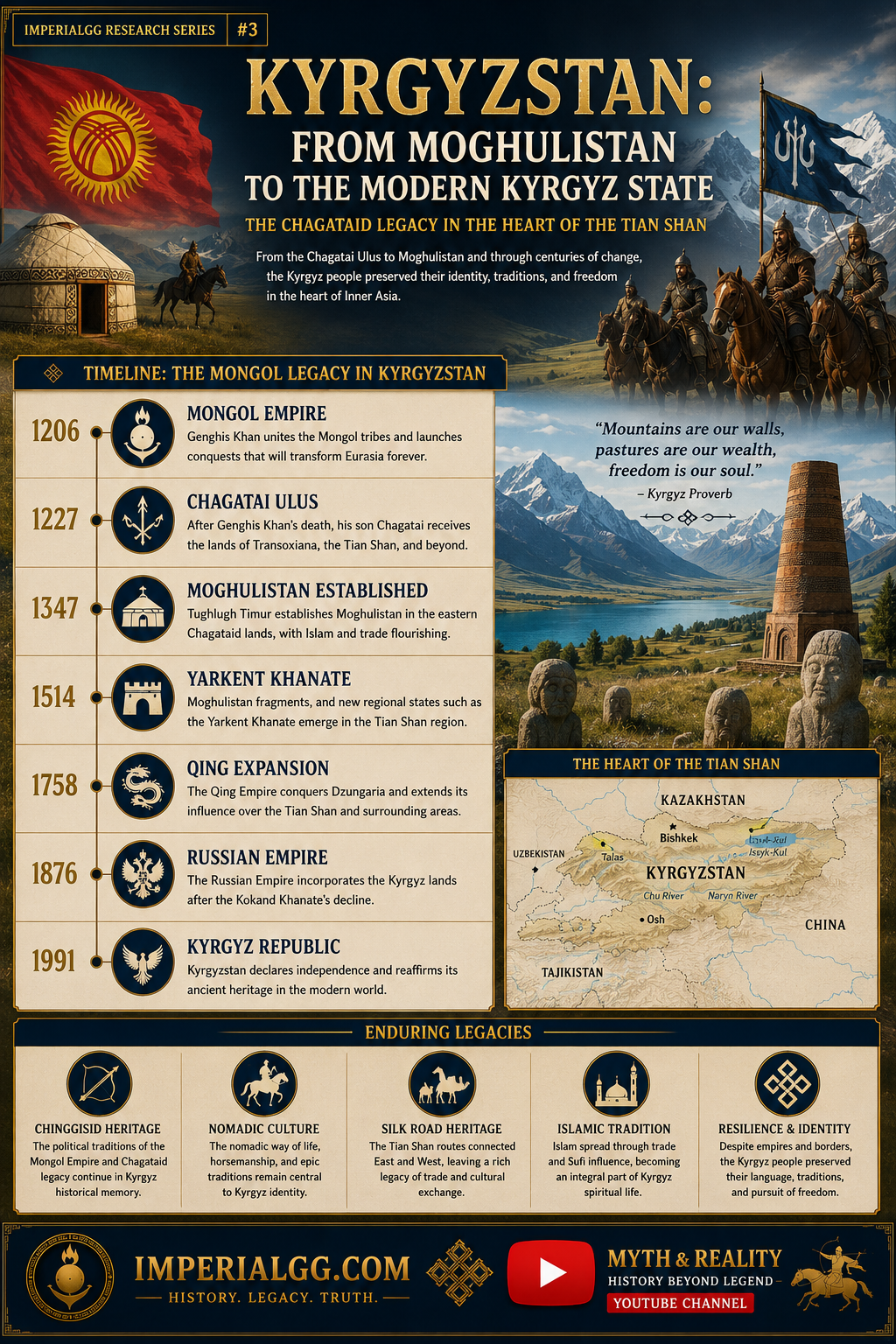
Although the Kyrgyz trace their history to the ancient Yenisei Kyrgyz of southern Siberia, the political foundations of medieval Kyrgyzstan were profoundly influenced by the Mongol Empire. Following the conquests of Genghis Khan, the region became part of the Chagatai Ulus, the second-largest division of the Mongol Empire. During the fourteenth century, the eastern territories of the Chagatai realm evolved into Moghulistan, a Chinggisid state that preserved Mongol political traditions while gradually embracing Islam and integrating Turkic-speaking populations.¹
The history of Kyrgyzstan is therefore inseparable from the history of the Chagatai Ulus and Moghulistan. Rather than representing isolated political entities, these states provided the institutional framework through which the Kyrgyz tribes developed into one of Central Asia’s enduring peoples.
The Kyrgyz Before the Mongols
Long before the Mongol conquest, the ancestors of the Kyrgyz were known as the Yenisei Kyrgyz, who established a powerful khaganate in southern Siberia during the ninth century. Chinese, Turkic, and Islamic sources describe them as skilled horsemen controlling important trade routes between the Siberian forests and the Central Asian steppe.²
By the eleventh and twelfth centuries, however, the political landscape had changed significantly. The Tian Shan region came under the influence of the Qarakhanids, followed by the Kara Khitai (Western Liao), whose rule extended across much of Central Asia. Although many Kyrgyz communities remained pastoral and politically decentralized, they maintained close contact with neighboring Turkic and Mongol tribes through trade, migration, and military alliances.³
Cities such as Balasagun, Kashgar, and Uzgen connected the mountain world with the Silk Road, while the fertile valleys of the Chu and Talas rivers became important centers of commerce and agriculture.⁴
The Mongol Conquest
In 1218–1221, Genghis Khan’s armies entered Central Asia during their campaign against the Khwarazmian Empire. The Tian Shan region, including present-day Kyrgyzstan, was gradually incorporated into the expanding Mongol Empire with comparatively limited resistance when compared with the heavily fortified cities of Transoxiana.⁵
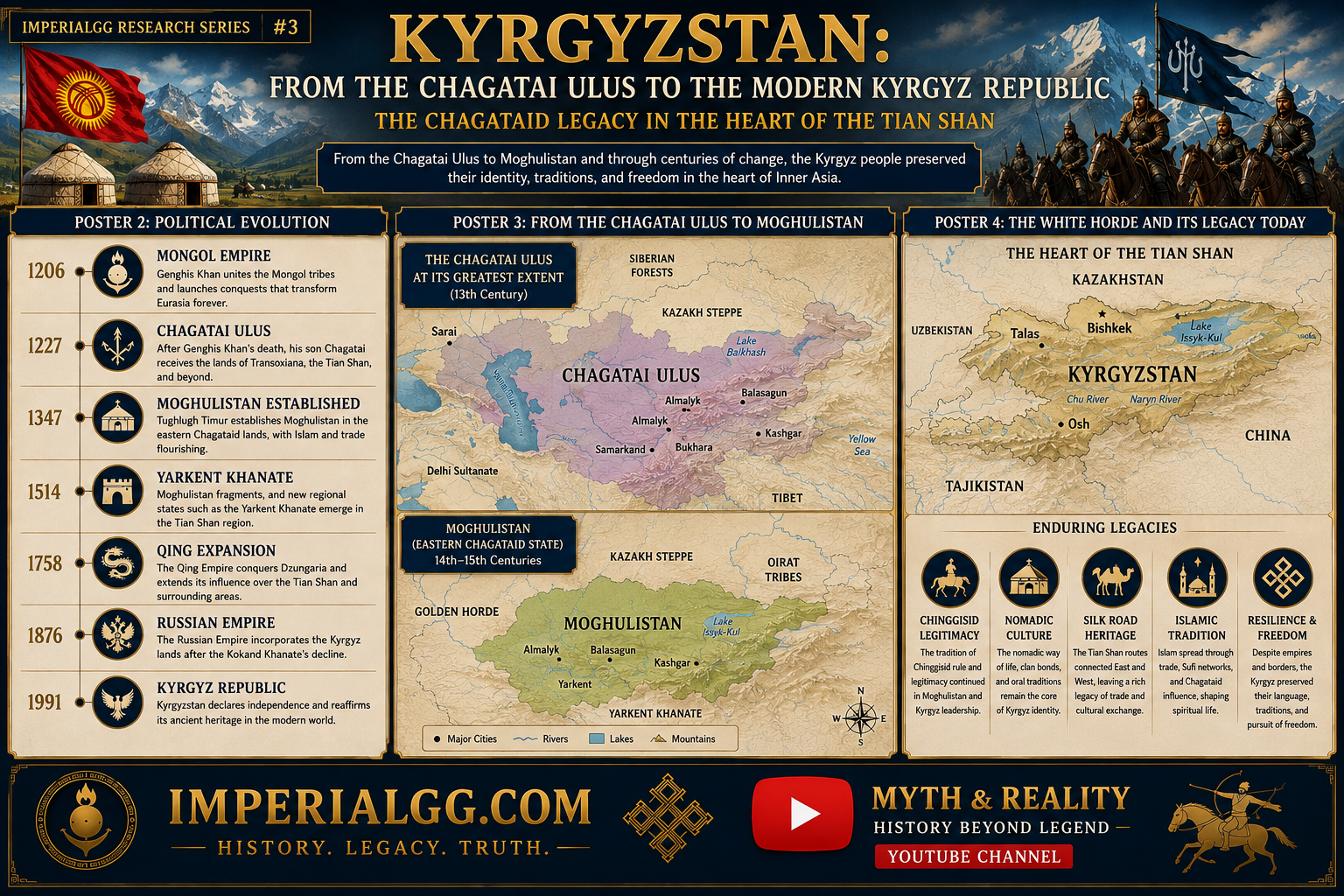
After Genghis Khan’s death in 1227, the region became part of the Chagatai Ulus, ruled by his second son, Chagatai. The ulus stretched from the Amu Darya to the Ili Valley and included much of present-day Kyrgyzstan, southeastern Kazakhstan, Uzbekistan, and Xinjiang.⁶
Under Mongol administration, caravan routes were restored, taxation became more systematic, and trade across Inner Asia flourished under the relative security of the Pax Mongolica. The mountain corridors of the Tian Shan became an essential link between East and West, reinforcing Kyrgyzstan’s long-standing role as a crossroads of Eurasian exchange.
Footnotes
- Peter B. Golden, Central Asia in World History (Oxford: Oxford University Press, 2011), 73–89.
- Peter B. Golden, An Introduction to the History of the Turkic Peoples (Wiesbaden: Harrassowitz, 1992), 165–180.
- Michal Biran, The Empire of the Qara Khitai in Eurasian History (Cambridge University Press, 2005), 89–142.
- Yuri Bregel, An Historical Atlas of Central Asia (Leiden: Brill, 2003), 28–40.
- Ata-Malik Juvaynī, The History of the World Conqueror, trans. John A. Boyle (Manchester University Press, 1958), Vol. I, 145–182.
- David O. Morgan, The Mongols, 2nd ed. (Oxford: Blackwell, 2007), 108–120.
Moghulistan
By the mid-fourteenth century, the Chagatai Ulus had fragmented into western and eastern domains. In 1347–1348, the eastern territories gave rise to Moghulistan, a Chinggisid state centered in the Tian Shan, Semirechye, and eastern Turkestan. Although the name “Moghulistan” literally means “Land of the Mongols,” its population was ethnically diverse, consisting of Mongol, Turkic, and other Inner Asian peoples who had long interacted across the steppe.⁷
The first prominent ruler, Tughlugh Timur Khan, strengthened the authority of the Chinggisid dynasty and adopted Islam, a decision that significantly influenced the religious development of the region. Despite this conversion, Moghulistan preserved many institutions inherited from the Mongol Empire, including Chinggisid legitimacy, nomadic military organization, and the tradition of ruling through alliances among tribal elites.⁸
Its strategic location enabled Moghulistan to control important sections of the Silk Road linking Transoxiana, Kashgar, and China. Mountain passes around the Tian Shan and the fertile Ili Valley became key routes for merchants, pilgrims, and diplomats traveling across Inner Asia.
The Kyrgyz under Moghulistan
Throughout the fifteenth century, many Kyrgyz tribes lived within or alongside the political sphere of Moghulistan. Rather than being governed through direct centralized administration, they maintained a considerable degree of local autonomy while recognizing the authority of Chinggisid khans when political circumstances required.⁹
Relations between the Kyrgyz, Moghulistan, the Oirats, and neighboring Central Asian states frequently shifted between alliance and conflict. These interactions strengthened the military traditions of the mountain nomads while encouraging the gradual spread of Islam through trade, Sufi networks, and regional political connections.
Although tribal identities remained strong, the political environment created by Moghulistan helped preserve stability across much of the Tian Shan for nearly two centuries.
From Moghulistan to the Modern Kyrgyz State
By the early sixteenth century, Moghulistan gradually fragmented into several regional successor states, including the Yarkent Khanate, while Kyrgyz tribes increasingly pursued their own political interests. During the seventeenth and eighteenth centuries, the expansion of the Dzungar Khanate profoundly affected the peoples of the Tian Shan, forcing many communities to migrate and reorganize.¹⁰
Following the Qing conquest of Dzungaria in 1758, the balance of power shifted once again. During the nineteenth century, the Kokand Khanate extended its influence over parts of present-day Kyrgyzstan before the Russian Empire incorporated the region during the 1860s and 1870s.
After the collapse of the Russian Empire, Kyrgyzstan became part of the Soviet Union, eventually achieving independence in 1991 as the Kyrgyz Republic.
Legacy
The legacy of the Chagatai Ulus and Moghulistan remains visible throughout modern Kyrgyzstan.
Many historic cities, trade routes, and cultural traditions originated during the Mongol and post-Mongol periods. The political importance of the Tian Shan, the enduring role of nomadic pastoralism, and the interaction between Turkic and Mongol traditions all contributed to the formation of Kyrgyz identity.
Rather than representing a break from earlier history, the Kyrgyz Republic emerged from centuries of political evolution that linked the ancient Kyrgyz, the Mongol Empire, Moghulistan, and the modern nation-state.¹¹
Conclusion
The history of Kyrgyzstan demonstrates the lasting influence of the Mongol Empire in the heart of Inner Asia. The Chagatai Ulus established a durable political framework that later evolved into Moghulistan, where Chinggisid legitimacy, nomadic governance, and expanding Islamic traditions coexisted for generations.
Although Moghulistan eventually disappeared as an independent state, its institutions, trade networks, and political culture continued to shape the peoples of the Tian Shan. Modern Kyrgyzstan therefore represents not only the homeland of the Kyrgyz people but also an important heir to the Chagataid world that connected East and West across the mountains of Central Asia.
Footnotes
- Michal Biran, The Empire of the Qara Khitai in Eurasian History (Cambridge: Cambridge University Press, 2005), 181–196.
- Peter B. Golden, Central Asia in World History (Oxford: Oxford University Press, 2011), 84–89.
- The Cambridge History of Inner Asia: The Chinggisid Age (Cambridge: Cambridge University Press, 2009), 372–391.
- René Grousset, The Empire of the Steppes (New Brunswick: Rutgers University Press, 1970), 322–351.
- Yuri Bregel, An Historical Atlas of Central Asia (Leiden: Brill, 2003), 92–101.
References
- Biran, Michal. The Empire of the Qara Khitai in Eurasian History. Cambridge University Press, 2005.
- Bregel, Yuri. An Historical Atlas of Central Asia. Brill, 2003.
- The Cambridge History of Inner Asia: The Chinggisid Age. Cambridge University Press, 2009.
- Golden, Peter B. An Introduction to the History of the Turkic Peoples. Harrassowitz, 1992.
- Golden, Peter B. Central Asia in World History. Oxford University Press, 2011.
- Grousset, René. The Empire of the Steppes. Rutgers University Press, 1970.
- Juvaynī, Ata-Malik. The History of the World Conqueror. Translated by John A. Boyle. Manchester University Press, 1958.
- Morgan, David O. The Mongols. 2nd ed. Blackwell, 2007.
Tajikistan: From Mongol Rule to the Timurid Renaissance
By Altanbagana Baatar
DBA Candidate| Independent Historian
ImperialGG Historical Research Seriers
06 August 2026
Persian Civilization under the Chinggisids and Timurids
Introduction
Modern Tajikistan occupies one of the oldest continuously inhabited regions of Central Asia. Nestled among the Pamir and Alay Mountains, it formed the eastern frontier of the Persian cultural world and served for centuries as a crossroads connecting Transoxiana, Afghanistan, China, and the Eurasian steppe. Cities such as Khujand, together with the historic centers of Bukhara and Samarkand, played vital roles in commerce, scholarship, and Islamic civilization long before the rise of the Mongol Empire.
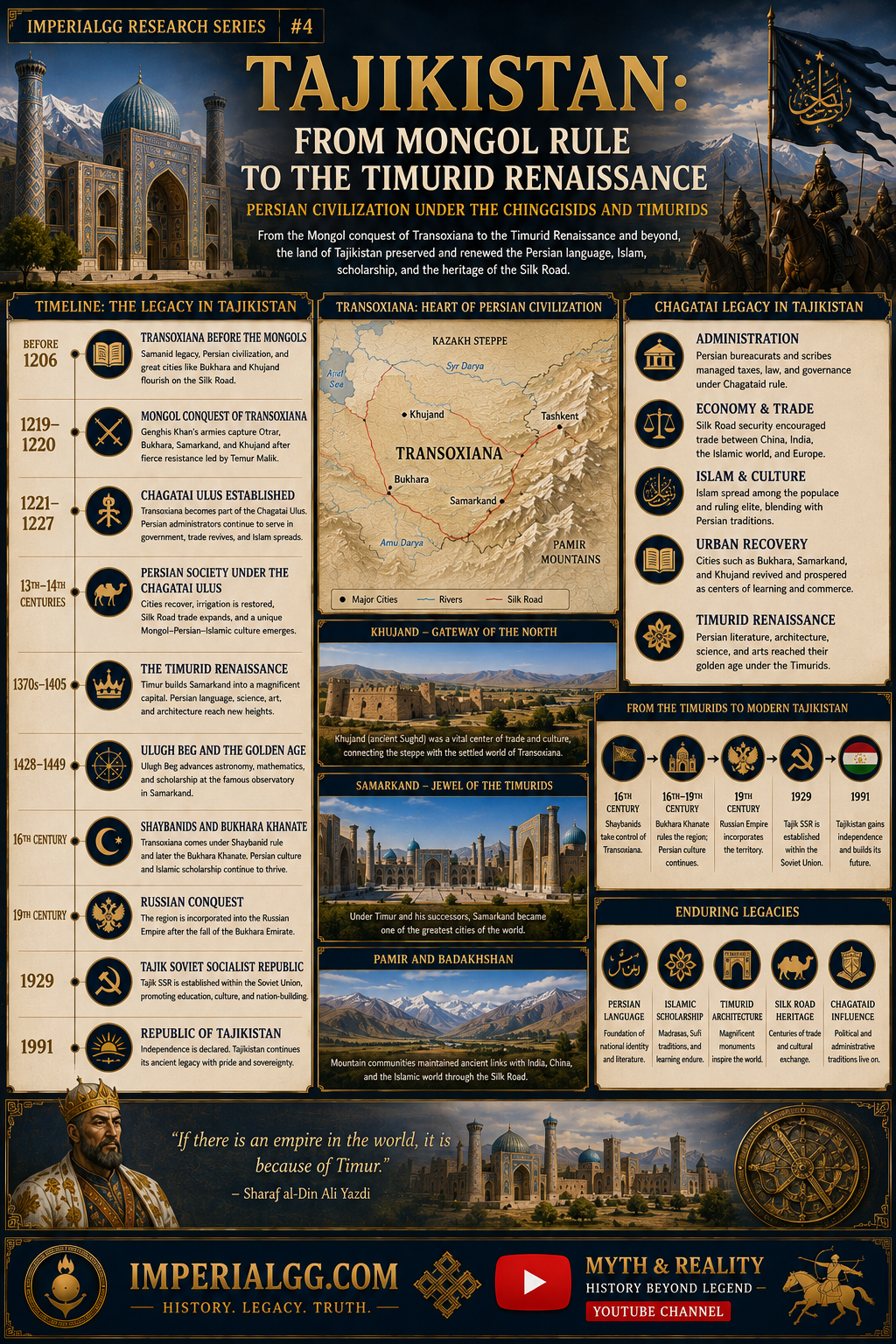
The Mongol conquest of the early thirteenth century brought profound political and social change to the region. Although the campaigns of Genghis Khan caused widespread destruction, they also incorporated Transoxiana into a continental empire that linked East Asia with the Islamic world. Under the Chagatai Ulus, Persian administrators, merchants, and scholars continued to play essential roles in government and commerce, while the Silk Road experienced renewed security and economic integration.¹
The political order established by the Mongols later provided the foundation upon which Timur built his empire during the late fourteenth century. Under the Timurids, Persian language, literature, architecture, and science entered a remarkable period of renewal often described as the Timurid Renaissance. The history of modern Tajikistan is therefore inseparable from both the Mongol and Timurid eras, which together reshaped the political and cultural landscape of Central Asia.
Transoxiana Before the Mongols
Before the arrival of the Mongols, the territory of present-day Tajikistan formed part of the prosperous Persian-speaking world of Transoxiana. Earlier dynasties such as the Samanids (819–999) transformed cities including Bukhara into leading centers of Islamic scholarship, Persian literature, and urban administration. Even after the fall of the Samanids, Persian language and culture remained deeply rooted under the Qarakhanids and later the Khwarazmian Empire.²
The fertile valleys of the Zerafshan and upper Amu Darya supported agriculture, while mountain communities in Badakhshan maintained commercial links with India, China, and the wider Islamic world. Khujand, located on the Syr Darya River, became one of the principal cities controlling trade between the steppe and the settled civilizations of Central Asia.³
By the early thirteenth century, however, political fragmentation and rivalry within the Khwarazmian Empire weakened the region, leaving it vulnerable to the approaching Mongol armies.
The Mongol Conquest
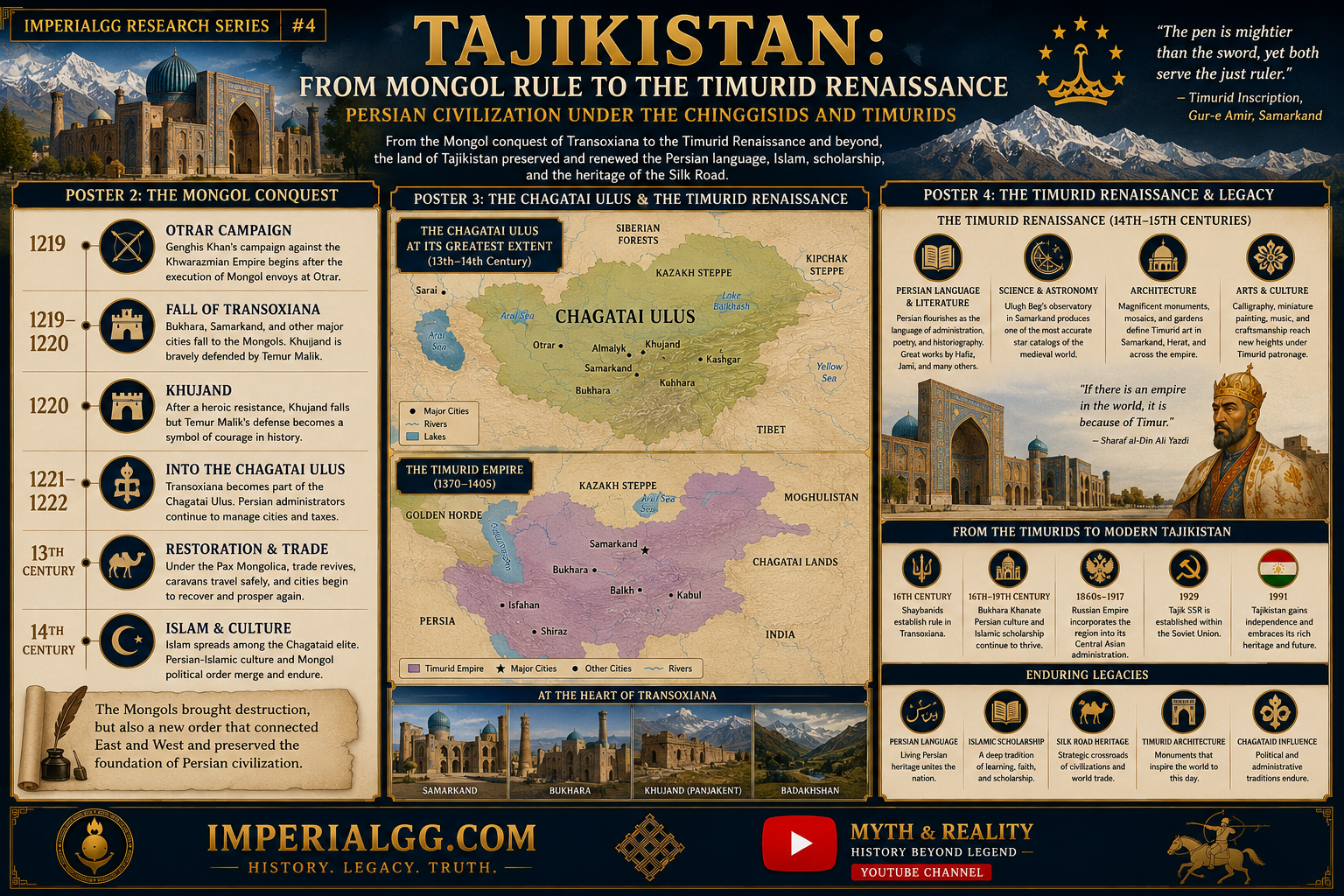
In 1219, Genghis Khan launched his campaign against the Khwarazmian Empire following the execution of Mongol merchants and envoys at Otrar. Over the next two years, Mongol forces captured the principal cities of Transoxiana, including Bukhara, Samarkand, and Khujand.⁴
The defense of Khujand under the leadership of Temur Malik became one of the most famous episodes of resistance recorded in Persian chronicles. Although the city eventually fell, his determined defense earned lasting recognition in Central Asian historical memory.⁵
After the conquest, the region became part of the Chagatai Ulus, where Mongol rulers relied heavily upon experienced Persian administrators to collect taxes, manage cities, and supervise commerce. Rather than replacing existing administrative traditions, the Chinggisid rulers incorporated many local institutions into their imperial government.
Footnotes
- Thomas T. Allsen, Culture and Conquest in Mongol Eurasia (Cambridge: Cambridge University Press, 2001), 58–84.
- C. E. Bosworth, The New Islamic Dynasties (Edinburgh: Edinburgh University Press, 1996), 165–182.
- Yuri Bregel, An Historical Atlas of Central Asia (Leiden: Brill, 2003), 30–44.
- Ata-Malik Juvaynī, The History of the World Conqueror, trans. John A. Boyle (Manchester: Manchester University Press, 1958), Vol. I, 89–134.
- David O. Morgan, The Mongols, 2nd ed. (Oxford: Blackwell, 2007), 74–90.
Persian Society under the Chagatai Ulus
Following the Mongol conquest, Transoxiana entered a new political era under the Chagatai Ulus. While Mongol princes exercised supreme authority, much of the day-to-day administration remained in the hands of experienced Persian officials who possessed generations of knowledge in taxation, irrigation, urban management, and diplomacy.¹
The Mongols generally avoided dismantling existing administrative systems when they proved effective. Persian scribes, judges, and merchants therefore continued to occupy important positions throughout the region. At the same time, the restoration of long-distance trade under the Pax Mongolica encouraged merchants from China, India, Persia, and the Mediterranean to travel across Central Asia with greater security than had been possible for decades.²
Khujand, together with nearby commercial centers, recovered gradually from the destruction of the conquest. Agricultural production expanded through restored irrigation networks, while caravan trade once again linked the upper Syr Darya and Amu Darya with the wider Silk Road.
During the fourteenth century, Islam became firmly established among the Chagataid ruling elite. Rather than replacing Persian culture, Mongol political authority and Persian-Islamic civilization gradually merged, creating a distinctive society that combined Chinggisid legitimacy with Persian administration and Islamic scholarship.³
The Timurid Renaissance
The decline of the Chagatai Ulus during the fourteenth century created the conditions for the rise of Timur (Tamerlane). Although Timur belonged to the Barlas tribe and was not himself a direct descendant of Genghis Khan, he ruled through Chinggisid legitimacy by governing in the name of puppet khans and marrying into the imperial family.⁴
From his capital at Samarkand, Timur transformed Central Asia into one of the greatest centers of architecture, science, literature, and Islamic learning. His successors continued this cultural revival, particularly under Ulugh Beg, whose observatory became one of the most advanced astronomical institutions of the fifteenth century.
Persian remained the principal language of administration, literature, and scholarship throughout the Timurid Empire. Poets, historians, architects, physicians, mathematicians, and theologians contributed to a remarkable intellectual flowering that modern historians often describe as the Timurid Renaissance.⁵
Although Samarkand and Herat stood outside the borders of present-day Tajikistan, their cultural influence extended throughout the Persian-speaking communities of Transoxiana, including Khujand and Badakhshan.
From the Timurids to Modern Tajikistan
Following the death of Timur and the gradual decline of Timurid authority, Transoxiana came under the control of the Shaybanids during the early sixteenth century. The region later formed part of the Khanate of Bukhara, where Persian-speaking populations continued to play central roles in administration, commerce, and religious scholarship.⁶
During the nineteenth century, Russian expansion into Central Asia fundamentally altered the political landscape. After the Russian conquest, the territory that now forms Tajikistan became integrated into the imperial administration and, following the Russian Revolution, into the Soviet Union.
In 1929, the Tajik Soviet Socialist Republic was established as a separate union republic. After the dissolution of the Soviet Union in 1991, Tajikistan emerged as an independent state, preserving a rich Persian linguistic and cultural heritage while embracing its own modern national identity.⁷
Legacy
Modern Tajikistan reflects the combined legacy of Persian civilization, Mongol political institutions, and Timurid cultural achievement.
The Persian language remains the foundation of national identity, while Islamic scholarship, traditional architecture, and the memory of the Silk Road continue to shape the country’s historical consciousness. At the same time, the Chagataid period left lasting political and economic influences by integrating the region into wider Eurasian networks of trade and diplomacy.
Rather than representing separate historical eras, the Mongol and Timurid periods formed successive stages in the development of Central Asia, linking the Persian-speaking communities of Transoxiana with the broader history of Eurasia.⁸
Conclusion
The history of Tajikistan demonstrates that the Mongol conquest was both a moment of destruction and a catalyst for political transformation. Under the Chagatai Ulus, Persian administrative traditions survived within a new imperial framework that connected Central Asia to an unprecedented Eurasian network.
The Timurid Renaissance built upon these foundations, producing one of the most remarkable cultural revivals in Islamic history. Modern Tajikistan therefore stands at the intersection of Persian civilization, Mongol statecraft, and Timurid intellectual achievement—a legacy that continues to define its place within the history of Central Asia.
Footnotes
- Beatrice Forbes Manz, The Rise and Rule of Tamerlane (Cambridge: Cambridge University Press, 1989), 186–232.
- Peter B. Golden, Central Asia in World History (Oxford: Oxford University Press, 2011), 95–109.
- The Cambridge History of Iran, Vol. 6, The Timurid and Safavid Periods (Cambridge: Cambridge University Press), relevant chapters on Timurid Central Asia.
- Yuri Bregel, An Historical Atlas of Central Asia (Leiden: Brill, 2003), 74–90.
- David O. Morgan, The Mongols, 2nd ed. (Oxford: Blackwell, 2007), 145–172.
References
- Allsen, Thomas T. Culture and Conquest in Mongol Eurasia. Cambridge University Press, 2001.
- Bosworth, C. E. The New Islamic Dynasties. Edinburgh University Press, 1996.
- Bregel, Yuri. An Historical Atlas of Central Asia. Brill, 2003.
- The Cambridge History of Iran. Vol. 6. Cambridge University Press.
- Golden, Peter B. Central Asia in World History. Oxford University Press, 2011.
- Juvaynī, Ata-Malik. The History of the World Conqueror. Translated by John A. Boyle. Manchester University Press, 1958.
- Manz, Beatrice Forbes. The Rise and Rule of Tamerlane. Cambridge University Press, 1989.
- Morgan, David O. The Mongols. 2nd ed. Blackwell, 2007.
Afghanistan: From the Chagatai and Ilkhanate to the Timurids
Introduction
Modern Afghanistan has long occupied one of the most strategic locations in Eurasia. Positioned between the Iranian Plateau, Central Asia, the Indian subcontinent, and the Eurasian steppe, it has served for centuries as a meeting point of civilizations, trade routes, and imperial ambitions. Cities such as Balkh, Herat, and Ghazni became renowned centers of commerce, Islamic scholarship, and political authority long before the rise of the Mongol Empire.
The Mongol conquest of the thirteenth century profoundly reshaped Afghanistan’s political landscape. While the invasions brought widespread devastation to many urban centers, they also incorporated the region into an interconnected Eurasian empire stretching from the Pacific Ocean to Eastern Europe. Different parts of present-day Afghanistan came under the authority of the Chagatai Ulus and the Ilkhanate, linking the country to two major branches of the Chinggisid world.¹
In the following century, Timur united much of Central Asia, Iran, and Afghanistan under a new empire that revived trade, architecture, and scholarship. The Timurid capital at Herat became one of the greatest intellectual and artistic centers of the Islamic world. Afghanistan’s medieval history is therefore best understood as a succession of Mongol and Timurid political traditions that shaped the region long after the empire of Genghis Khan had fragmented.
Afghanistan Before the Mongols
Before the Mongol conquest, the territory of present-day Afghanistan formed part of several powerful Islamic dynasties. During the tenth and eleventh centuries, the Ghaznavids ruled an empire extending into northern India, making Ghazni one of the most influential cities in the Islamic world. They were later succeeded by the Ghurids, whose military campaigns carried Afghan influence deep into the Indian subcontinent.²
By the early thirteenth century, much of Afghanistan had been incorporated into the Khwarazmian Empire, although political control remained uneven across its mountainous terrain. Ancient cities such as Balkh, Herat, and Bamiyan flourished as centers of trade and learning, connected to both the Silk Road and the caravan routes leading toward India and Persia.³
Despite this prosperity, internal political divisions and the rapid expansion of the Mongol Empire placed the region in an increasingly vulnerable position.
The Mongol Conquest
The Mongol invasion of Afghanistan formed part of Genghis Khan’s wider campaign against the Khwarazmian Empire beginning in 1219. After the fall of Transoxiana, Mongol armies advanced into northern Afghanistan, capturing Balkh, Herat, and other strategic cities.
One of the most dramatic episodes occurred at Bamiyan, where fierce resistance led to prolonged fighting. During the siege, Genghis Khan’s beloved grandson Möngke? Actually correction: it was Mutugen, the son of Chagatai, who was killed. Enraged by his death, Genghis Khan reportedly ordered the destruction of the city, an event vividly described in Persian chronicles.⁴
Following the conquest, Afghanistan was divided between the Chagatai Ulus in the northeast and the Ilkhanate in the west and southwest. Although these political frontiers shifted over time, the region became firmly integrated into the wider Mongol world through trade, diplomacy, and military administration.
Footnotes
- David O. Morgan, The Mongols, 2nd ed. (Oxford: Blackwell, 2007), 95–122.
- C. E. Bosworth, The Ghaznavids (Edinburgh: Edinburgh University Press, 1963).
- Yuri Bregel, An Historical Atlas of Central Asia (Leiden: Brill, 2003), 42–58.
- Ata-Malik Juvaynī, The History of the World Conqueror, trans. John A. Boyle (Manchester: Manchester University Press, 1958), Vol. I, 121–138.