Pakistan: From the Mongol Frontier to the Mughal Empire
By Altanbagana Baatar
DBA Candidate| Independent Historian
ImperialGG Historical Research Seriers
06 August 2026
The Chinggisid Legacy on the Northwestern Frontier of South Asia
Introduction
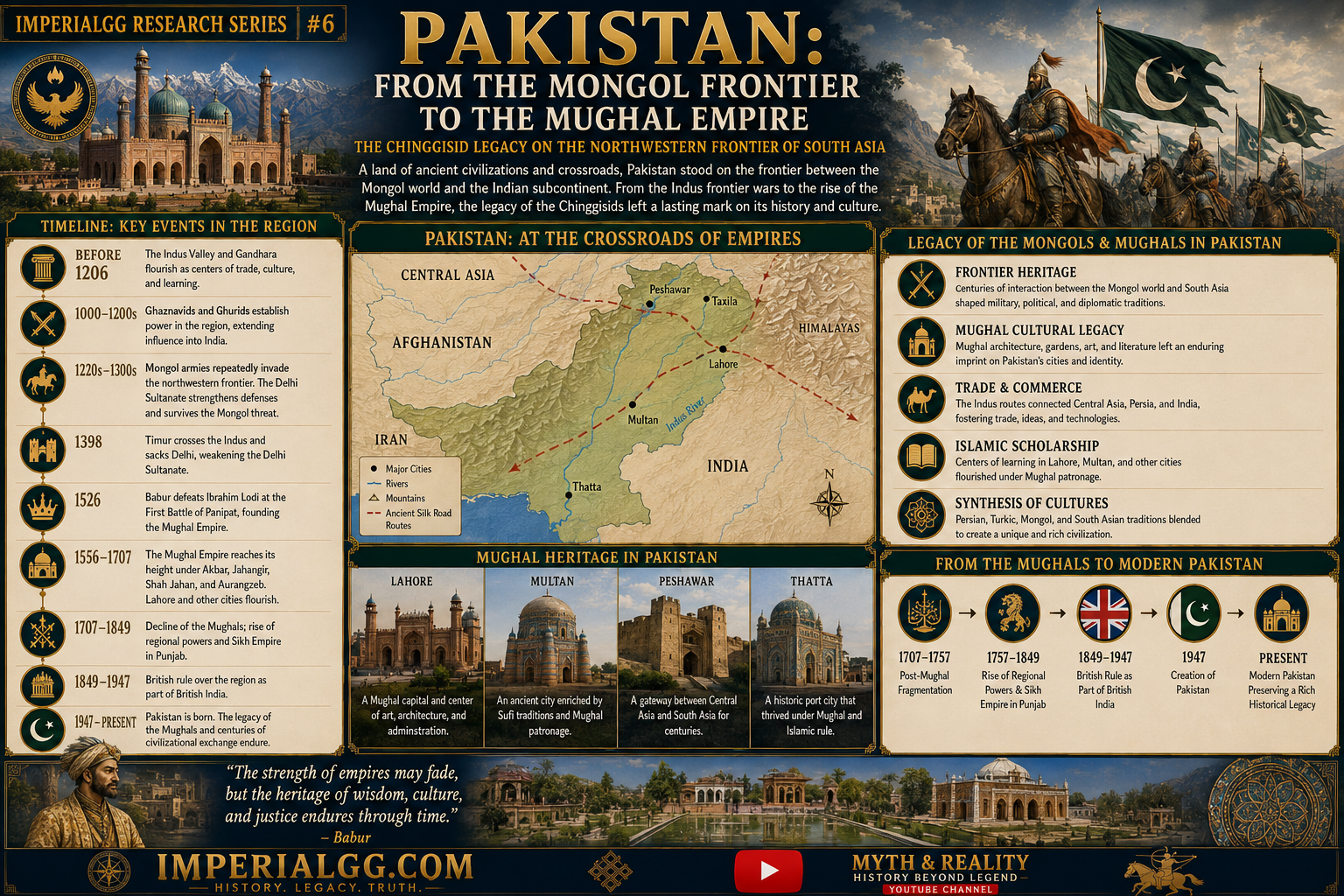
Modern Pakistan occupies one of the most strategically significant regions in South Asia. Situated at the crossroads of Central Asia, the Iranian Plateau, and the Indian subcontinent, its mountain passes and river valleys have long connected the civilizations of Inner Asia with the fertile plains of northern India. Throughout history, cities such as Lahore, Multan, Peshawar, and Taxila served as centers of commerce, learning, and imperial administration.
Unlike much of Central Asia, most of present-day Pakistan was not permanently incorporated into the Mongol Empire. Instead, it formed the frontier between the Chinggisid world and the Delhi Sultanate. During the thirteenth and fourteenth centuries, repeated Mongol campaigns crossed the Indus frontier, influencing the military organization, diplomacy, and politics of northern India.¹
The greatest long-term impact of the Mongol world emerged not through direct Mongol rule but through the rise of the Mughal Empire, founded in 1526 by Babur, a Timurid prince descended from both Timur and Genghis Khan. The Mughal state became one of the most powerful empires in South Asian history, leaving a legacy that profoundly shaped the historical development of present-day Pakistan.
The Indus Region Before the Mongols
Long before the Mongol era, the Indus Valley supported one of the world’s earliest urban civilizations. In the medieval Islamic period, the region came under the rule of the Ghaznavids and later the Ghurids, who expanded their authority deep into northern India.²
By the early thirteenth century, much of present-day Pakistan belonged to the Delhi Sultanate, although frontier regions such as Peshawar and the upper Indus remained closely connected to Central Asia through trade and migration.
The Khyber Pass, Bolan Pass, and other mountain corridors served as the principal gateways linking Afghanistan with the Indian subcontinent, making the region strategically vital for every major empire in Inner Asia.
The Mongol Frontier
Beginning in the 1220s, Mongol armies repeatedly entered the northwestern frontier of the Indian subcontinent. Several campaigns reached the Indus River, while others threatened Lahore and Punjab. Despite these incursions, the Delhi Sultanate successfully prevented permanent Mongol occupation of most of the region.³
Rather than creating a stable Mongol province, these conflicts transformed the frontier into one of medieval Asia’s most heavily fortified military zones. The Delhi Sultans strengthened frontier defenses, expanded cavalry forces, and developed administrative systems capable of responding to repeated steppe invasions.
Although direct Mongol rule remained limited, diplomatic contacts, commercial exchange, and population movements connected Pakistan’s frontier with the wider Mongol world.
Footnotes
- Peter Jackson, The Delhi Sultanate: A Political and Military History (Cambridge University Press, 1999).
- C. E. Bosworth, The Ghaznavids (Edinburgh University Press, 1963).
- Peter Jackson, The Mongols and the Islamic World (Yale University Press, 2017), chapters on the Delhi Sultanate and the Mongols.
Pakistan: From the Mongol Frontier to the Mughal Empire
The Chinggisid Legacy on the Northwestern Frontier of South Asia
Timur and the Road to the Mughals
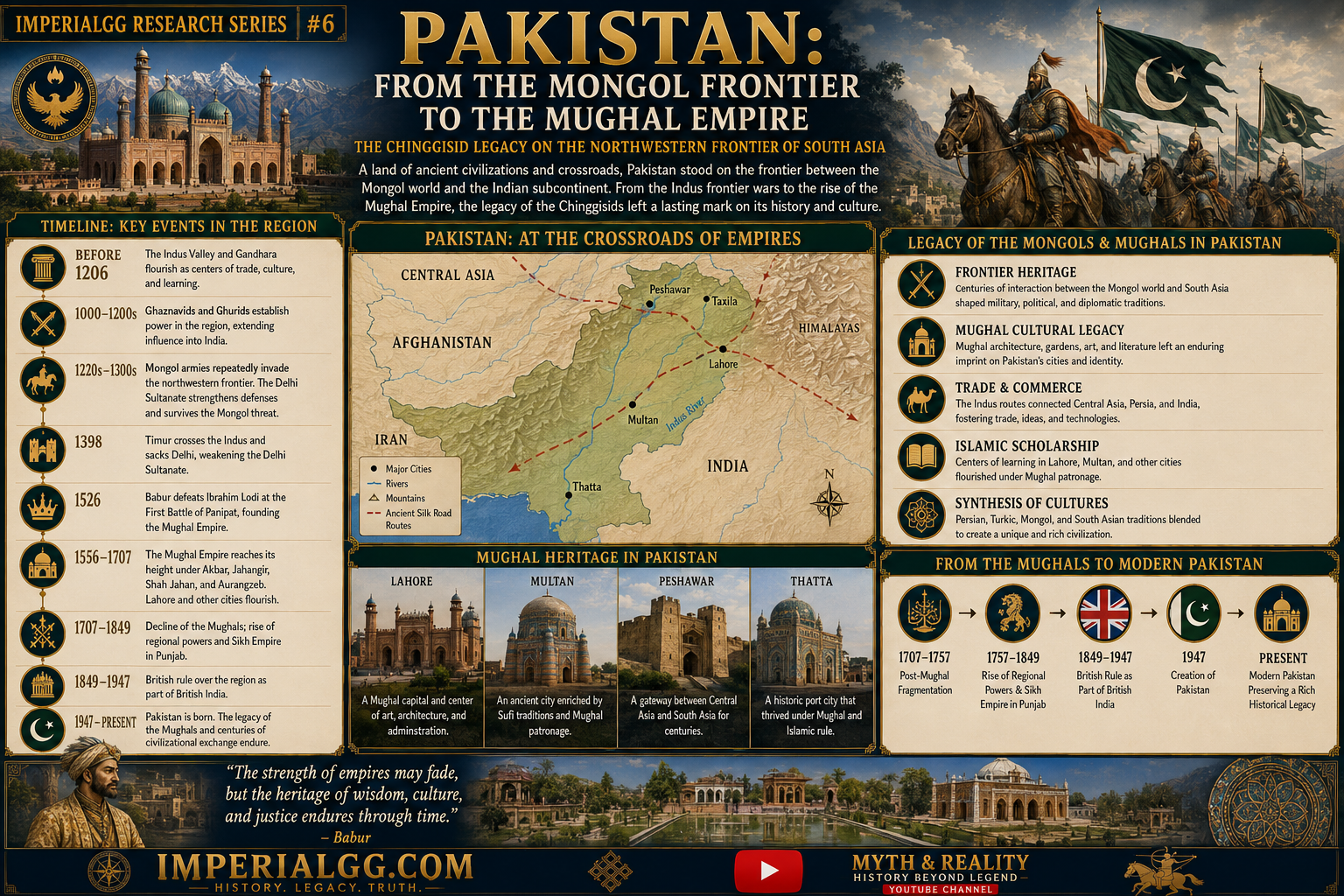
The relationship between the Mongol world and the Indian subcontinent entered a new phase with the rise of Timur during the late fourteenth century. Although Timur’s empire was centered in Transoxiana, his 1398 campaign into northern India demonstrated the continuing military influence of the Chinggisid political tradition. After crossing the Indus River, Timurid forces captured Delhi, leaving a profound impact on the political balance of northern India.⁴
Unlike the earlier Mongol raids, Timur’s campaign was intended as a major imperial expedition rather than a frontier incursion. Although he did not permanently occupy India, the expedition weakened the Delhi Sultanate and created conditions that later favored the rise of the Mughal Empire.
Timur’s descendants continued to rule Central Asia for more than a century. Among them was Zahir al-Din Muhammad Babur, whose ancestry linked him to Timur through his father and to Genghis Khan through his mother. This dual heritage provided Babur with both Timurid prestige and Chinggisid legitimacy, strengthening his claim to rule.
The Mughal Empire
In 1526, Babur crossed the Khyber Pass and defeated Sultan Ibrahim Lodi at the First Battle of Panipat, establishing the Mughal Empire. The term Mughal derives from the Persian word for “Mongol,” reflecting the dynasty’s historical origins in the Chinggisid and Timurid worlds, even though its rulers were culturally Persianate and spoke Chagatai Turkic before increasingly adopting Persian as the language of administration.⁵
Under emperors such as Akbar, Jahangir, Shah Jahan, and Aurangzeb, the Mughal Empire became one of the largest and wealthiest states of the early modern world. Cities including Lahore, Multan, and Thatta flourished as centers of trade, administration, architecture, and Islamic scholarship.
Lahore, in particular, became one of the principal capitals of the empire, where magnificent forts, gardens, and mosques reflected the artistic synthesis of Central Asian, Persian, and South Asian traditions. The Mughal administrative system, provincial governance, taxation, and military organization also drew upon institutions inherited from both the Timurid and broader Mongol political traditions.⁶
From the Mughals to Modern Pakistan
The Mughal Empire gradually declined during the eighteenth century due to internal succession struggles, regional revolts, and external invasions. As Mughal authority weakened, new political powers emerged across the Indian subcontinent, while the British East India Company steadily expanded its influence.
By the nineteenth century, most of present-day Pakistan had become part of British India. Despite colonial rule, the region retained its rich Islamic, Persianate, and Central Asian cultural heritage, particularly in architecture, literature, and education.
Following the partition of British India in 1947, the independent state of Pakistan was established. Many of its most celebrated historical monuments—including the Lahore Fort, Shalimar Gardens, and Badshahi Mosque—remain enduring symbols of the Mughal period and its Timurid legacy.⁷
Legacy
Pakistan’s historical identity reflects centuries of interaction between South Asia and Inner Asia.
Although most of the country was never fully incorporated into the Mongol Empire, the repeated encounters between the Mongols and the Delhi Sultanate transformed the northwestern frontier into one of medieval Asia’s most important military and commercial corridors. More importantly, the Mughal Empire transmitted many elements of the Chinggisid and Timurid political tradition into South Asia, where they evolved within an Islamic and Persianate cultural environment.
Today, Pakistan preserves this legacy through its architecture, historic cities, administrative traditions, and enduring connections with the wider history of Central Asia. The Mughal period remains one of the defining chapters in the country’s cultural and historical development.⁸
Conclusion
The history of Pakistan illustrates that the influence of the Mongol world extended beyond the boundaries of direct imperial rule. While the Mongols never permanently incorporated most of the Indus region into their empire, their military campaigns reshaped frontier politics, stimulated institutional change, and altered the balance of power in northern India.
The greatest expression of this legacy emerged through the Mughal Empire, founded by Babur, whose Timurid and Chinggisid heritage connected Central Asia with the Indian subcontinent. Through the Mughals, political institutions, artistic traditions, and cultural exchanges rooted in the Mongol world continued to influence the region for centuries. Modern Pakistan therefore occupies a unique place in Eurasian history—as both the frontier of the Mongol Empire and the heartland of one of its most enduring successor traditions.
Footnotes
- Beatrice Forbes Manz, The Rise and Rule of Tamerlane (Cambridge: Cambridge University Press, 1989), 170–198.
- Stephen F. Dale, The Garden of the Eight Paradises: Babur and the Culture of Empire in Central Asia, Afghanistan and India (1483–1530) (Leiden: Brill, 2004), 45–91.
- John F. Richards, The Mughal Empire (Cambridge: Cambridge University Press, 1993), 27–116.
- Catherine B. Asher, Architecture of Mughal India (Cambridge University Press, 1992), 165–290.
- Peter Jackson, The Mongols and the Islamic World: From Conquest to Conversion (New Haven: Yale University Press, 2017), 409–444.
References
- Asher, Catherine B. Architecture of Mughal India. Cambridge University Press, 1992.
- Bosworth, C. E. The Ghaznavids. Edinburgh University Press, 1963.
- Dale, Stephen F. The Garden of the Eight Paradises: Babur and the Culture of Empire in Central Asia, Afghanistan and India (1483–1530). Brill, 2004.
- Jackson, Peter. The Delhi Sultanate: A Political and Military History. Cambridge University Press, 1999.
- Jackson, Peter. The Mongols and the Islamic World: From Conquest to Conversion. Yale University Press, 2017.
- Manz, Beatrice Forbes. The Rise and Rule of Tamerlane. Cambridge University Press, 1989.
- Richards, John F. The Mughal Empire. Cambridge University Press, 1993.