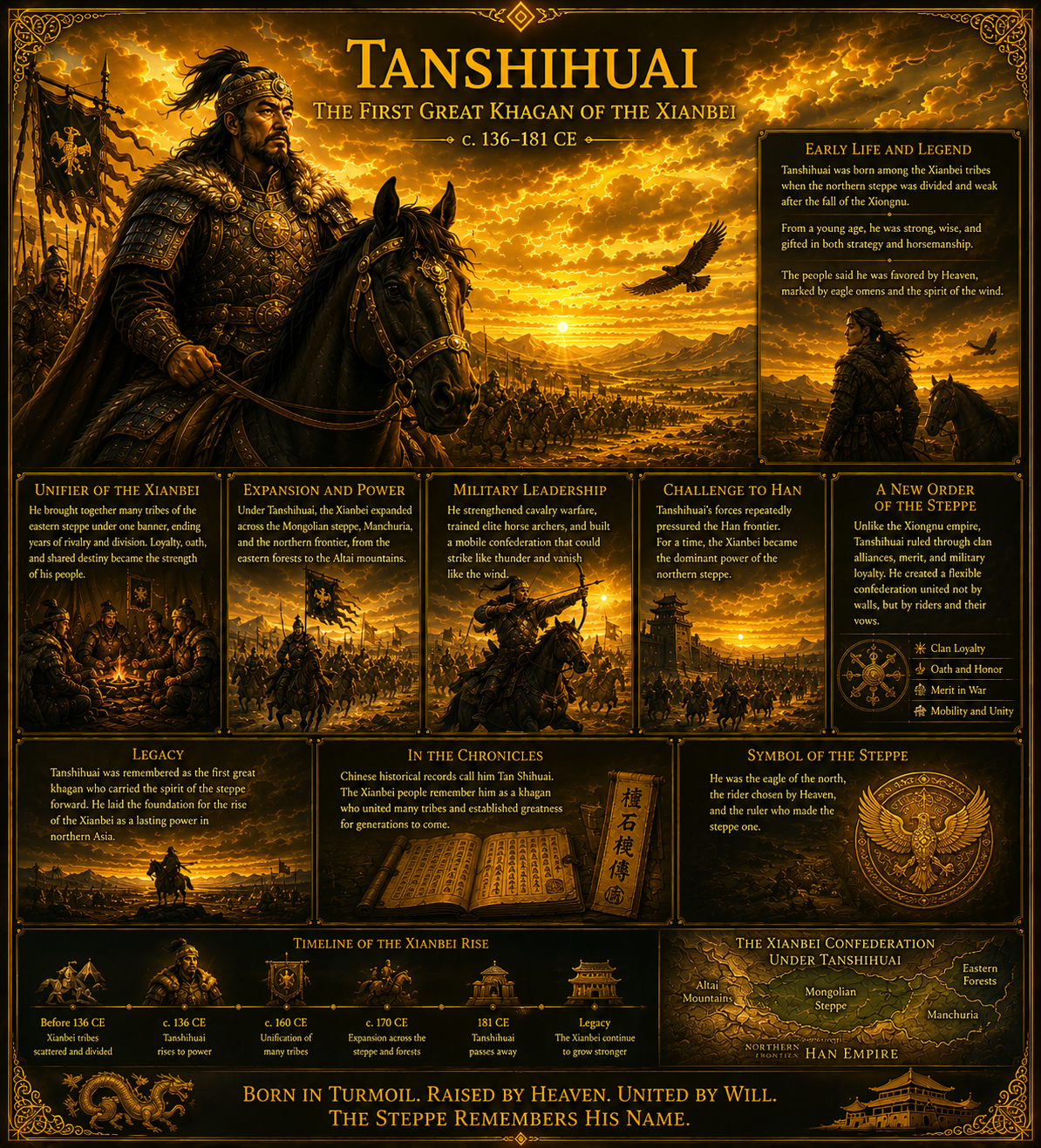
198 BCE: THE HAN–XIONGNU HEQIN TREATY
Marriage, Reciprocity, and the Diplomatic Recognition of Two Powers
By Altanbagana Baatar
DBA Candidate| Independent Historian
ImperialGG Historical Research Seriers
24 August 2026
Introduction
In 198 BCE, the Han dynasty and the Xiongnu concluded one of the most consequential diplomatic agreements in the history of early East Asia. Commonly described as heqin (和親), or “peace through marriage,” the agreement followed the military confrontation between Emperor Gaozu of Han and Modu Chanyu at Baideng in 200 BCE. It established a diplomatic arrangement involving marriage, regular deliveries of silk and other goods, and a relationship described in the historical sources as one of brotherhood.
The conventional label—“marriage alliance”—is accurate but incomplete. The agreement was not merely a matrimonial arrangement. It was a state-to-state settlement designed to regulate relations between two powerful political systems after Han had failed to impose a military solution upon the Xiongnu. The significance of the agreement therefore lies not simply in the marriage itself, but in what the marriage represented.
The Han court recognized that the Xiongnu could not easily be subdued by force. Modu, meanwhile, had created a political power sufficiently strong to force the Han court into a negotiated settlement. The resulting arrangement became the foundation of Han–Xiongnu relations for decades.
1. THE ROAD TO 198 BCE
The treaty cannot be understood without the events of 200 BCE. After the Xiongnu expansion under Modu Chanyu, Han forces confronted the Xiongnu in the region of Baideng. Emperor Gaozu personally led a major army northward. According to the Shiji, the Han emperor advanced ahead of his infantry and became surrounded by Modu’s elite cavalry. The encirclement lasted seven days before Gaozu managed to escape. The military consequences were profound.
The Han dynasty had only recently been established after years of civil war. Its army was exhausted, while the Xiongnu possessed a highly mobile cavalry force capable of operating effectively across the northern frontier. The defeat therefore demonstrated that the newly established Han Empire could not simply eliminate the Xiongnu threat through a single military campaign. After the withdrawal of the armies, Liu Jing was sent to negotiate. The diplomatic solution was heqin.
2. LIU JING AND THE LOGIC OF HEQIN
The Shiji presents Liu Jing’s argument in remarkably pragmatic terms. The Han state, he argued, had only recently emerged from prolonged warfare and could not immediately rely upon military force. Instead, Liu Jing proposed establishing a marriage relationship with Modu and using regular gifts and diplomatic influence to create a long-term relationship.
His proposal was therefore not simply:
“Send a woman to marry the Xiongnu ruler.”
It was a broader strategy. Marriage would establish kinship. Regular gifts would create material interdependence. Diplomatic communication would stabilize the frontier. And, from Liu Jing’s perspective, the descendants of the marriage might eventually create a political relationship favorable to Han. This last element is particularly revealing.
Liu Jing imagined that kinship could gradually transform the political hierarchy between the two states. His strategic objective was ultimately to bring the Xiongnu into a subordinate relationship without the cost of permanent warfare. But the historical development of heqin demonstrates that the Han court’s intended hierarchy was not necessarily accepted by the Xiongnu.
3. THE 198 BCE AGREEMENT
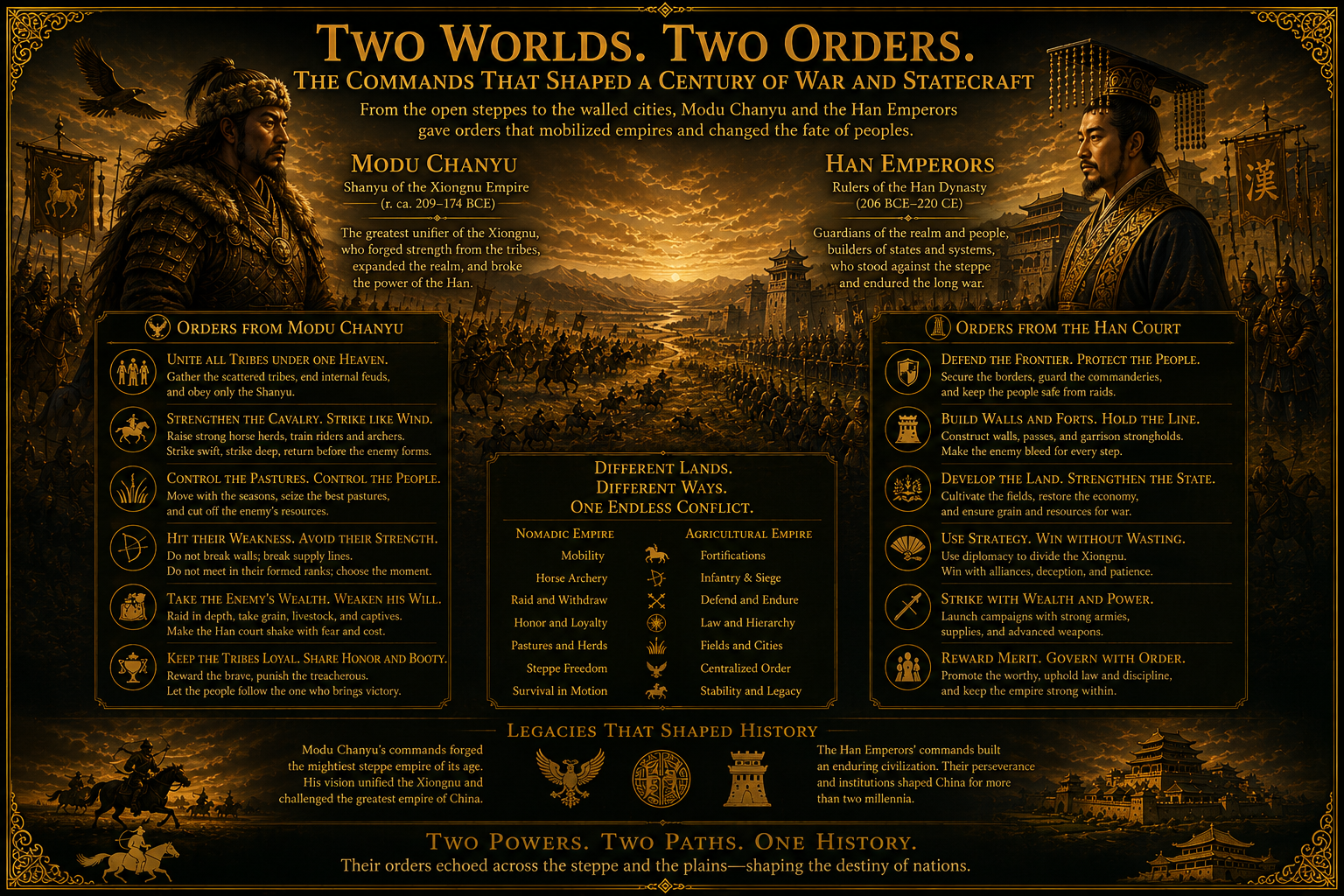
The Shiji records the essential terms of the settlement following Baideng. Emperor Gaozu sent Liu Jing to present a woman from the imperial clan as the Chanyu’s Yanzhi (閼氏), the title used for the Chanyu’s principal consort. The Han court also agreed to provide the Xiongnu annually with specified quantities of textiles, silk, wine, rice and other foodstuffs. The two sides established a relationship described as “brotherhood” through marriage, after which Modu reduced his raids for a time.
The agreement consequently contained several interconnected components:
MARRIAGE
ANNUAL MATERIAL DELIVERIES
BROTHERHOOD
FRONTIER PEACE
DIPLOMATIC RECIPROCITY
The treaty should therefore be understood as a comprehensive diplomatic mechanism rather than merely a royal marriage.
4. “BROTHERS” — AN EXTRAORDINARY DIPLOMATIC FORMULA
Perhaps the most important phrase in the historical record is the agreement to become “brothers” (kun-zhang, 昆弟). The Shiji explicitly states that the Han and Xiongnu established a brotherhood through heqin. This formulation deserves particular attention. A relationship between an emperor and a subordinate tribal chief would not normally require the two rulers to be constructed diplomatically as brothers. The language instead creates a relationship of political parity.
This does not mean that the two empires possessed equal military or economic resources. They did not. Nor does it mean that the Han court abandoned its own worldview concerning political hierarchy. It means that, within the diplomatic arrangement itself, the relationship was framed through reciprocal rulers rather than unilateral submission.
This is one reason why the 198 BCE agreement is so important for understanding the political status of the Xiongnu. The Xiongnu were not simply a population living outside the Han frontier. They were a political power with which the Han court had to negotiate.
5. THE MATERIAL DIMENSION OF THE AGREEMENT
The annual deliveries were another fundamental component.The Shiji records textiles, silk, wine, rice and other provisions among the goods supplied by Han to the Xiongnu. These deliveries have sometimes been interpreted simply as “tribute.” Yes, It was.
That terminology can be misleading. The historical sources indicate that these goods formed part of a negotiated diplomatic arrangement. Modern scholarship has accordingly emphasized that heqin involved much more than marriage: it included regular material transfers and a diplomatic relationship between the two political authorities.
The economic logic was straightforward. The Han possessed enormous agricultural and textile resources. The Xiongnu possessed military mobility, livestock, horses and strategic control over the northern frontier. The treaty therefore connected two complementary economic systems.
AGRICULTURAL EMPIRE ↔ STEPPE EMPIRE
The treaty transformed military confrontation into a structured system of exchange.
6. WAS IT A XIONGNU VICTORY OR A HAN VICTORY ?
This question has generated considerable historiographical debate. From the perspective of Han political ideology, Liu Jing’s original strategy envisioned marriage as a mechanism through which the Xiongnu might gradually be brought into a subordinate relationship.
But the immediate circumstances tell another story. The Han had just suffered the humiliation of Baideng. The Xiongnu army remained powerful. The Han therefore needed peace. The agreement provided that peace through material concessions and marriage. From this perspective, the treaty can reasonably be interpreted as a pragmatic Han accommodation to Xiongnu power.
Yet it would be equally misleading to describe the treaty simply as a Xiongnu “victory.” Modu also had reasons to accept peace. His empire required stable relations with the Han frontier, access to agricultural and manufactured goods, and a diplomatic framework that could regulate interaction with the world’s most populous imperial state. Thus both sides gained something. The treaty was not surrender. It was negotiated coexistence.
7. THE STATUS OF THE “PRINCESS”
One important correction is necessary when discussing the treaty. Later popular accounts frequently describe the woman sent to Modu as a straightforward daughter of Emperor Gaozu. The historical evidence is more complicated. Liu Jing originally proposed that Gaozu’s eldest daughter be married to Modu. Gaozu accepted the proposal, but Empress Lü opposed sending her daughter. Instead, a woman from the imperial clan was presented as a “princess” for the diplomatic marriage.
This distinction matters. The Heqin system subsequently used women of the imperial clan as diplomatic brides, but not every woman described as a “Han princess” was necessarily the biological daughter of the reigning emperor. The political status of the bride mattered more than her biological identity. She represented the Han imperial house.
8. THE TREATY AS A NEW INTERNATIONAL ORDER
The significance of 198 BCE extends beyond the immediate frontier. The agreement established a model for dealing with the Xiongnu that continued for generations. Later Han rulers repeatedly renewed or modified heqin arrangements. The Han Shu records subsequent marriage arrangements, material deliveries and continuing negotiations between the two sides.
This demonstrates that the 198 BCE settlement was not an isolated event. It became an institutionalized diplomatic strategy. The Han dynasty was forced to develop a long-term system for managing a powerful northern empire.
The Xiongnu, meanwhile, became an enduring factor in the strategic calculations of successive Han emperors.
9. THE TREATY DID NOT END CONFLICT
It is important not to romanticize heqin as permanent peace. The Han Shu explicitly states that Xiongnu raids continued during the reigns of Emperor Hui and Empress Dowager Lü, despite the continuation of the marriage-alliance system. Later, under Emperor Wen, the Han continued the policy while simultaneously dealing with renewed frontier violence. This reveals a fundamental characteristic of steppe diplomacy.
Marriage did not eliminate war.
Rather, marriage, trade, gifts, warfare and negotiation existed simultaneously. The frontier was not divided into two permanent states of “peace” and “war.” Instead, the relationship operated as a constantly changing system of:
RAID → NEGOTIATION → MARRIAGE → EXCHANGE → RENEWED CONFLICT → RENEGOTIATION
This is a more accurate model of Han–Xiongnu relations.
10. 198 BCE AND THE POLITICAL STATUS OF THE XIONGNU
The deepest historical significance of the treaty lies in what it reveals about the Xiongnu state. A political entity does not need to resemble the Han administrative system in order to qualify as an empire.
The Xiongnu possessed:
- a supreme ruler, the Chanyu;
- a large organized military;
- control over extensive territory;
- subordinate and allied populations;
- diplomatic representatives;
- marriage diplomacy;
- long-distance economic exchange;
- and the capacity to compel a neighboring empire to negotiate.
The 198 BCE settlement provides direct evidence for this political capacity. The Han did not simply issue orders to the Xiongnu. The Han negotiated with the Chanyu. That distinction is fundamental.
11. PRIMARY-SOURCE EVIDENCE
The central evidence for the treaty comes from two major early Chinese historical works. The Shiji, compiled by Sima Qian, records the Baideng confrontation and states that after the Han withdrawal, Liu Jing was sent to establish the marriage alliance. It then describes the imperial-clan woman sent to Modu, the annual deliveries of textiles, silk, wine and food, and the agreement of brotherhood.
The Han Shu, compiled later under Ban Gu and his collaborators, preserves a closely related account. It states that Gaozu sent Liu Jing to provide an imperial-clan woman to the Chanyu, that Han supplied specified annual goods, and that the two sides established brotherhood through heqin. The agreement is therefore not dependent upon a modern reconstruction. Its essential elements are explicitly preserved in the early textual record.
12. HISTORICAL INTERPRETATION
The 198 BCE treaty should consequently be interpreted on three levels.
First: A MILITARY SETTLEMENT
The Han had failed to destroy or subdue the Xiongnu militarily.
Second: A DIPLOMATIC INNOVATION
The two sides established marriage diplomacy and a formalized relationship of brotherhood.
Third: AN IMPERIAL RECOGNITION
The Han court was compelled to treat the Xiongnu Chanyu as a political counterpart whose power had to be managed through diplomacy rather than eliminated through a single campaign.
This third dimension is the most historically significant.
FOOTNOTES
1. Sima Qian, Shiji, ch. 110, “Xiongnu liezhuan.” The account describes the Baideng encirclement, Gaozu’s escape, and Liu Jing’s subsequent mission to establish the marriage alliance.
2. Ban Gu, Han Shu, ch. 94A, “Xiongnu zhuan.” The text records the imperial-clan woman sent as Yanzhi, annual supplies to the Xiongnu, and the establishment of brotherhood through heqin.
3. Sima Qian, Shiji, ch. 99, “Liu Jing Shusun Tong liezhuan.” Liu Jing’s original proposal envisioned marriage as a long-term strategy through which the Xiongnu ruling house might gradually be brought into a subordinate relationship.
4. On the distinction between the intended imperial daughter and the woman actually sent, see Shiji and later historical commentary concerning Gaozu’s proposal and Empress Lü’s refusal.
5. The term heqin (和親) literally conveys the establishment or restoration of harmonious relations through marriage. Its historical operation under the Han involved marriage, gifts and political negotiation rather than marriage alone.
6. The Han Shu records that the heqin arrangement did not eliminate Xiongnu raids and that the policy continued to be renegotiated under later Han rulers.
7. For the broader interpretation of the Xiongnu as a major imperial power rather than a peripheral tribal confederation, the diplomatic evidence of the Shiji and Han Shu is particularly important because it records direct negotiation between the Chanyu and the Han court.
8. A recent scholarly study of heqin emphasizes that the arrangement involved not merely marriage but also annual transfers and the political formulation of the two rulers as “brothers.”
9. The treaty’s immediate background was the 200 BCE Baideng confrontation, in which Gaozu was surrounded by Xiongnu cavalry for seven days before escaping.
10. The 198 BCE agreement subsequently became the template for repeated Han–Xiongnu marriage diplomacy, although the precise composition and status of the women sent under later agreements varied.
Author"s Thesis
198 BCE: THE HAN–XIONGNU HEQIN TREATY
Marriage, Political Parity, and the Division of the Frontier
Introduction
In 198 BCE, the Han dynasty and the Xiongnu established a diplomatic settlement that became the foundation of their relations for much of the early Han period. Known as heqin (和親), the arrangement is commonly translated as “peace through marriage” or “marriage alliance.” Yet the surviving historical evidence indicates that the agreement involved considerably more than a dynastic marriage. It established a framework of political reciprocity, territorial restraint, regular material transfers, and communication between two powerful ruling houses.[1]
The agreement followed the confrontation at Baideng in 200 BCE, where Emperor Gaozu of Han was surrounded by the forces of Modu Chanyu. The military encounter demonstrated the limits of the newly established Han state’s ability to impose a military solution upon the Xiongnu. The subsequent decision to negotiate with Modu was therefore not simply a cultural exchange or matrimonial arrangement. It was a response to a concrete balance of military and political power.[2]
The significance of the heqin system becomes even clearer in later correspondence preserved in the Han Shu. In one letter, Emperor Wen explicitly described the political geography established by his predecessors:
“North of the Great Wall, the nations that draw the bow are subject to the command of the Chanyu; within the Great Wall, the realm of caps and sashes is governed by me.”[3]
This statement is particularly important. It presents the frontier not simply as a military boundary, but as a division between two spheres of political authority.
The same diplomatic tradition repeatedly describes Han and Xiongnu as “brothers” and records the substantial annual transfers made by Han to the Chanyu.[4]
The central argument of this article is therefore that the 198 BCE heqin arrangement should be understood as a negotiated political order between two major powers, rather than simply as a marriage policy imposed by the Han upon a subordinate frontier population.
1. BAIDENG AND THE FAILURE OF A MILITARY SOLUTION
The origins of the 198 BCE settlement lie in the military confrontation at Baideng. Following the establishment of the Han dynasty, Emperor Gaozu sought to confront the Xiongnu directly. Modu Chanyu’s forces surrounded the Han emperor and his army, leaving the Han position in an extremely dangerous situation. The Shiji records that the encirclement lasted seven days before Gaozu was able to escape.[5]
The significance of this event extends beyond the battlefield. The Han dynasty had emerged from prolonged civil war and was still consolidating its political institutions. The Xiongnu, meanwhile, had developed under Modu into a powerful steppe empire capable of mobilizing large cavalry forces across the northern frontier. The Han therefore faced a strategic problem. Military victory was not immediately achievable. A negotiated settlement became necessary.
Liu Jing was subsequently dispatched to negotiate with Modu.[6] The HEGIN arrangement emerged from this diplomatic mission.
2. THE 198 BCE AGREEMENT
According to Sima Qian’s Shiji, the settlement included the marriage of a woman from the Han imperial clan to Modu Chanyu. The Han court also agreed to provide the Xiongnu with annual quantities of silk and other textiles, wine, grain and foodstuffs.[7]
The agreement further established a relationship of brotherhood between the two ruling houses. This is critical. The treaty did not consist of one isolated concession.
It combined:
- dynastic marriage;
- annual material transfers;
- political non-aggression;
- recognition of separate spheres of authority;
- and a diplomatic relationship expressed through kinship.
The Han Shu later summarizes the principle explicitly: “Han and Xiongnu agreed to be brothers.” It then explains that Han therefore supplied the Chanyu generously.[8]
The political meaning of the arrangement becomes clearer when the material and territorial elements are considered together.
3. THE GREAT WALL AS A POLITICAL FRONTIER
The most explicit statement concerning the territorial division appears in a later letter of Emperor Wen to the Xiongnu.
The text states:
先帝制,長城以北,引弓之國,受令單于;長城以內,冠帶之室,朕亦制之。
A close translation is:
“The late emperor established that north of the Great Wall, the bow-bearing nations were under the command of the Chanyu; within the Great Wall, the realm of caps and sashes was governed by me.”[9]
This passage is one of the most important pieces of evidence for interpreting the early Han–Xiongnu political order. The emperor does not describe the Xiongnu as simply an external group without legitimate political authority. He explicitly acknowledges the Chanyu’s authority over the populations north of the Great Wall. At the same time, he defines his own jurisdiction south of the wall.
The result is a conceptual division:
NORTH OF THE GREAT WALL — CHANYU
SOUTH OF THE GREAT WALL — HAN EMPEROR
This should not be mistaken for a modern international border in the contemporary legal sense. The frontier was porous, populations moved, and military incursions repeatedly occurred. Nevertheless, the text demonstrates that the Han court itself articulated a dual political geography. The Xiongnu had their own sphere of authority. The Han had theirs.
4. “BROTHERS” RATHER THAN SUBJECT AND SOVEREIGN
The language of heqin reinforces this territorial division. The Han Shu repeatedly describes the relationship as one of brotherhood.
In Emperor Wen’s correspondence, the Han emperor writes that:
“Han and Xiongnu agreed to be brothers.”[10]
The use of brotherhood is politically significant. The two rulers were not described simply as emperor and subordinate chief. They were placed within a kinship metaphor that presupposed reciprocal political relationships. This does not mean that Han ideology accepted the Xiongnu as culturally or institutionally identical to Han. Nor does it mean that the two states were equal in every material respect.
Rather, it means that the diplomatic relationship was constructed through reciprocity.
The Chanyu possessed his own political sphere. The Han emperor possessed his. Their relationship was therefore managed through negotiation rather than unilateral command.
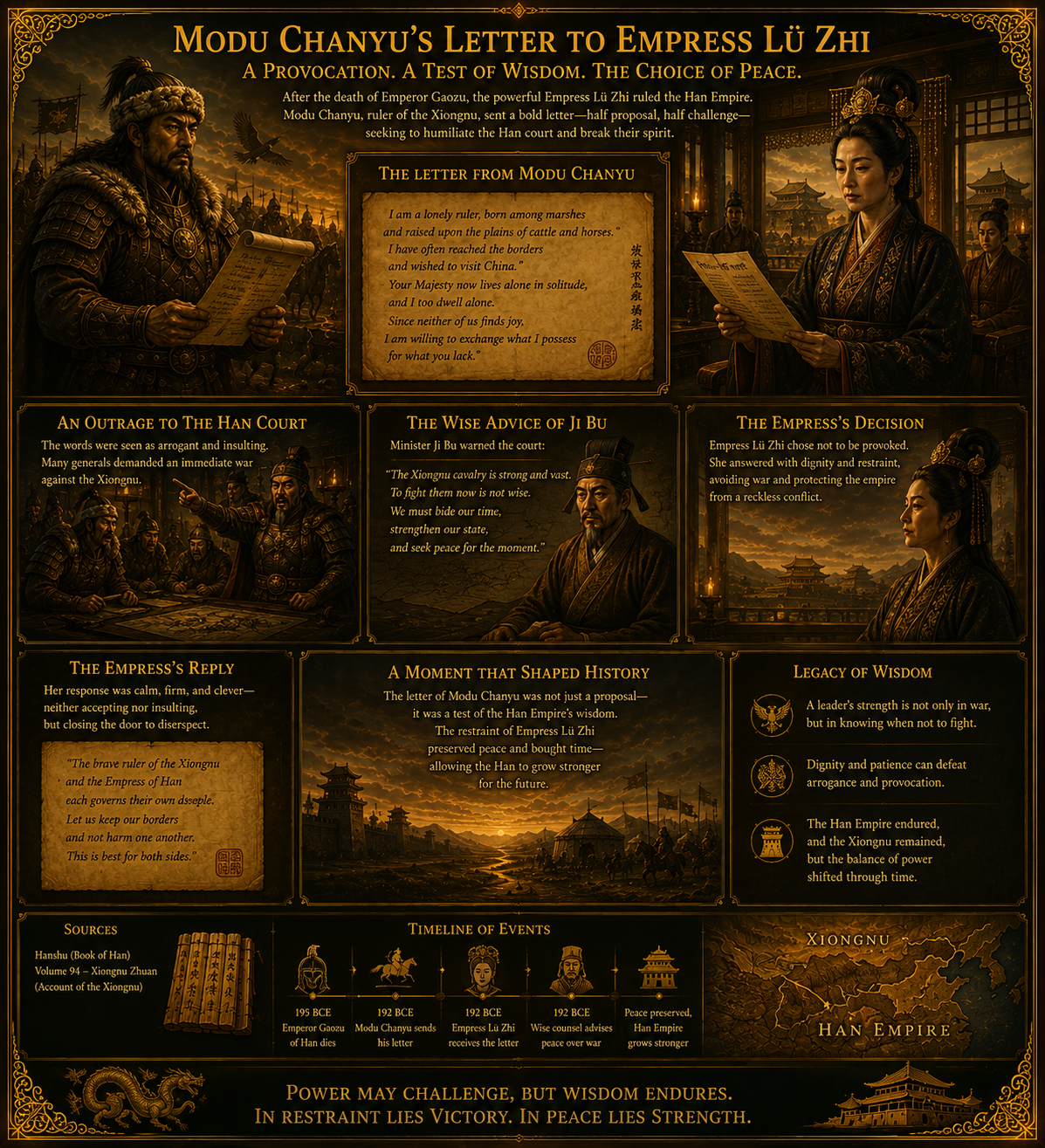
5. THE MODU–LÜ ZHI LETTER
The political reality behind this diplomatic formulation becomes particularly visible in the famous exchange between Modu Chanyu and Empress Dowager Lü Zhi.
After the death of Emperor Gaozu, Modu sent Lü Zhi a deliberately provocative letter. He described himself as a solitary ruler and referred to Lü Zhi in similarly personal terms. He then suggested that because both rulers were alone, each might provide what the other lacked.[11] The implication was a proposal of marriage. Lü Zhi was outraged.
According to the Han Shu, she summoned her senior commanders and considered military retaliation. Fan Kuai reportedly offered to lead a force of 100,000 men against the Xiongnu.[12]
But the court did not proceed with such a campaign. Ji Bu warned that Fan Kuai had not even rescued Gaozu during the earlier Xiongnu encirclement at Baideng. The court therefore recognized the danger of renewed war. Lü Zhi responded diplomatically rather than militarily.[13] This episode is crucial for interpreting the heqin system.
Modu’s letter was provocative, but the response demonstrates that the Han court could not simply compel the Chanyu to conform to Han political expectations. The military balance remained a serious constraint.
6. WHAT THE MODU–LÜ ZHI EXCHANGE REVEALS
The exchange is sometimes treated as an anecdote illustrating the arrogance of Modu. That interpretation misses its political importance. Modu was communicating directly with one of the most powerful figures in the Han court. His letter presupposed that the Chanyu possessed sufficient political standing to propose a dynastic relationship to the Han imperial house. More importantly, the Han response was shaped by the memory of Baideng.
The court could be offended. It could threaten war. But it could not ignore the military reality. The episode therefore provides indirect evidence of Xiongnu bargaining power. The Xiongnu did not control the Han court. But neither could the Han court simply dictate terms to the Xiongnu. The relationship was genuinely negotiated.
7. HAN “GIFTS” AND THE ECONOMIC REALITY OF HEQIN
The economic component of the agreement is equally important. The Han Shu explicitly states that because Han and Xiongnu had agreed to be brothers, the Han “gave the Chanyu very generously.”[14]
The records enumerate silk, brocade, embroidered textiles, grain, wine, gold ornaments and other goods among the materials transferred to the Xiongnu.[15]
The Han court described these transfers as gifts or annual provisions. From the perspective of political language, this distinction was important. If Han officially described these payments as tribute, it would imply that the Han emperor acknowledged a superior ruler to whom he owed submission. Calling them gifts allowed the Han court to preserve its imperial dignity.
Yet the political function of the payments was clear. They were connected directly to the maintenance of the heqin agreement.
The Han Shu records Emperor Wen stating that Han and Xiongnu had agreed to be brothers and that “therefore” the Han supplied the Chanyu generously.[16] Thus the annual transfers were not random presents. They were an institutional component of the diplomatic settlement.
8. WAS THIS “TRIBUTE”?
The term “tribute” should therefore be used carefully. If by tribute one means a payment made voluntarily to a superior sovereign, the surviving evidence does not justify such a simple interpretation. If, however, the term is used analytically to describe a regular material transfer made by Han in order to maintain peace with a militarily powerful Xiongnu state, then the economic function is undeniable.
The Han court itself avoided the politically humiliating terminology. It called the transfers gifts. This distinction between diplomatic terminology and political function is essential. The Han could maintain the language of imperial sovereignty while simultaneously making substantial annual transfers to the Xiongnu. The Xiongnu, meanwhile, possessed the military capacity that made continued accommodation necessary.
This produced a distinctive political arrangement:
FORMAL DIPLOMATIC LANGUAGE — BROTHERHOOD
TERRITORIAL PRINCIPLE — SEPARATE SPHERES
ECONOMIC MECHANISM — ANNUAL HAN TRANSFERS
MILITARY REALITY — XIONGNU LEVERAGE
9. THE TWO SPHERES OF GOVERNANCE
Emperor Wen’s statement concerning the Great Wall allows us to reconstruct the political geography more precisely. The Han emperor claimed authority over the 冠帶之室, literally the realm of people wearing caps and sashes, while recognizing the Chanyu’s authority over the 引弓之國, the peoples who “draw the bow.”[17]
The terminology is culturally loaded. It reflects Han perceptions of the difference between agrarian, settled society and the northern bow-bearing peoples. But beneath this ideological language lies an important political fact:
THE HAN COURT RECOGNIZED THE CHANYU’S AUTHORITY OVER A DISTINCT NORTHERN POLITICAL WORLD.
The Great Wall therefore functioned simultaneously as:
- a defensive structure;
- a frontier marker;
- a conceptual boundary;
- and a diplomatic reference point.
The agreement did not create an impermeable frontier. Rather, it established a political framework within which both sides could identify their respective spheres.
10. THE LIMITS OF THE FRONTIER
The political division did not prevent violations. The Han Shu records repeated Xiongnu incursions south of the frontier, including the activities of the Right Worthy King in the region south of the Yellow River.[18]
Emperor Wen explicitly stated that these actions violated the agreement because the Xiongnu had crossed into territory that the treaty framework recognized as Han’s sphere. This is important for interpreting the treaty. The existence of a recognized boundary did not mean the boundary was always respected.
Indeed, the repeated invocation of the agreement demonstrates the opposite. Both sides understood the political rule. Both sides sometimes violated it. And when violations occurred, diplomacy was used to renegotiate the relationship. That is characteristic of a functioning interstate order.
11. THE POLITICAL BALANCE OF 198 BCE
The heqin settlement therefore produced an unusual balance.
The Xiongnu possessed:
- extensive pastoral resources;
- mobile cavalry;
- strategic depth;
- control over the northern steppe;
- and the capacity to threaten the Han frontier.
The Han Empire possessed:
- enormous agricultural production;
- a large population;
- cities and administrative institutions;
- textile and manufacturing capacity.
Neither side could easily eliminate the other. The treaty therefore converted military confrontation into a system of managed coexistence. The Han obtained a degree of frontier stability. The Xiongnu obtained regular access to Han goods and diplomatic recognition of their northern sphere. This was not equality of resources. It was parity in the diplomatic necessity of negotiation.
12. WHY THE TERM “IMPERIAL PARITY” MATTERS
It is important to distinguish political parity from absolute equality. The Xiongnu and Han were not identical states.
Their economies were different. Their administrative systems were different. Their populations were different. Their political institutions were different. But the diplomatic evidence shows that neither ruler could simply treat the other as an ordinary subordinate official.
The Chanyu needed to negotiate with the Han. The Han needed to negotiate with the Chanyu.
Both sides maintained their own territories. Both sides could threaten military action. Both sides exchanged envoys. And the relationship was formally articulated through brotherhood. For this reason, “negotiated parity” is a more precise concept than “equal empires.”
13. THE SIGNIFICANCE OF THE ANNUAL PAYMENTS
The annual transfers also deserve reconsideration. The conventional Han-centered narrative can make these payments appear as benevolent gifts made by a superior emperor to pacify a troublesome frontier people. But the sequence of events suggests a different interpretation.
The Han suffered military pressure. The Han negotiated. The Han agreed to marriage. The Han agreed to annual transfers.
The Xiongnu reduced attacks when the agreement functioned. Later, when the Xiongnu violated the frontier, Han officials explicitly reminded them that the generous transfers were tied to the brotherhood agreement.[19]
The payments therefore functioned as part of a peace-maintenance mechanism. Calling them “gifts” was diplomatically useful. But their political function was closer to a negotiated cost of maintaining frontier stability.
14. THE 198 BCE AGREEMENT AND THE LONGER XIONGNU – HAN ORDER
The importance of 198 BCE is also demonstrated by the longevity of the system. The heqin arrangement did not end with Gaozu and Modu. It continued through subsequent reigns and was repeatedly renegotiated.
Emperor Wen repeatedly referred to the original brotherhood agreement and attempted to restore peace when frontier violations occurred.[20]
The diplomatic system therefore became institutional rather than personal. This is an important distinction. A purely personal marriage alliance would have disappeared with the death of the original rulers. Instead, the underlying principles survived:
BROTHERHOOD
FRONTIER NON-AGGRESSION
MARRIAGE
ANNUAL TRANSFERS
DIPLOMATIC CORRESPONDENCE
The system was therefore capable of surviving changes in rulers.
15. AUTHOR’S THESIS
The 198 BCE Heqin agreement should be interpreted as a negotiated settlement between two major political powers rather than as the unilateral pacification of a subordinate tribe. The later correspondence of Emperor Wen provides particularly strong evidence.
The Han emperor explicitly stated that:
north of the Great Wall, the bow-bearing peoples were under the authority of the Chanyu;
south of the Great Wall, the Han emperor governed the realm of caps and sashes.[21]
This is not the language of a state claiming that the northern political world possessed no legitimate ruler. It is a recognition of separate spheres of authority. The same correspondence repeatedly describes Han and Xiongnu as brothers, while acknowledging that Han supplied the Chanyu with substantial annual goods.[22]
The political significance of these “gifts” must therefore be understood in context. The Han court could preserve its imperial terminology by calling them gifts. But the payments were made within a diplomatic system whose continuation depended upon Xiongnu military power and Han willingness to pay for peace. The Modu–Lü Zhi correspondence reinforces this interpretation.
When Modu addressed Lü Zhi with a marriage proposal, the Han court could respond with outrage but could not simply impose its will. Its own officials remembered the catastrophe at Baideng and understood the military consequences of renewed war.[23]
The evidence therefore points toward a political relationship characterized by negotiated parity under unequal material conditions. The two empires were not equal in every respect. But they were sufficiently powerful that neither could simply absorb the other. The Heqin system was the diplomatic solution to that reality.
CONCLUSION
The significance of the 198 BCE Han–Xiongnu Heqin agreement lies beyond the marriage itself. It created a framework through which two different imperial systems could coexist. The Han emperor governed the agricultural south. The Chanyu governed the bow-bearing peoples of the north. The Great Wall served as the principal conceptual boundary between these spheres. The two ruling houses were described as brothers.
Han supplied the Xiongnu with substantial annual goods. And when Modu later challenged the Han court through his letter to Lü Zhi, the Han response demonstrated that military power remained the ultimate foundation beneath the diplomatic language. The treaty therefore reveals a fundamental feature of early Inner Asian international relations:
Diplomatic equality did not require economic equality.
Political parity did not require identical institutions.
And peace did not require the disappearance of rivalry.
The 198 BCE Heqin settlement was a mechanism through which two powerful states acknowledged the practical limits of their ability to destroy one another.
Its historical importance is therefore best understood as follows:
THE HAN AND THE XIONGNU DID NOT MERELY EXCHANGE BRIDES AND GIFTS. THEY NEGOTIATED THE POLITICAL DIVISION OF THE EAST ASIAN FRONTIER.
And in the words preserved in Emperor Wen’s correspondence, that political order was conceived as one in which north of the Great Wall the Chanyu commanded the bow-bearing peoples, while within the wall the Han emperor governed his own realm.[24] That statement makes the 198 BCE settlement far more significant than a simple “marriage alliance.” It was part of the formation of a dual political order between the Han Empire and the Xiongnu Empire.
FOOTNOTES
1. Sima Qian, Shiji, “Xiongnu liezhuan,” ch. 110; Ban Gu, Han Shu, “Xiongnu zhuan,” ch. 94A. Both sources describe the marriage arrangement, annual transfers, and the brotherhood established between Han and Xiongnu.
2. Sima Qian, Shiji, ch. 110. The diplomatic settlement followed the military confrontation between Gaozu and Modu and the subsequent mission of Liu Jing.
3. Han Shu, “Xiongnu zhuan”: “長城以北,引弓之國,受令單于;長城以內,冠帶之室,朕亦制之.” The passage appears in Emperor Wen’s letter to the Xiongnu.
4. Han Shu, “Xiongnu zhuan”: “漢與匈奴約為兄弟,所以遺單于甚厚” — “Han and Xiongnu agreed to be brothers; therefore we gave the Chanyu generously.”
5. Sima Qian, Shiji, “Xiongnu liezhuan,” account of the Baideng confrontation.
6. Shiji, “Liu Jing, Shusun Tong liezhuan,” and “Xiongnu liezhuan,” concerning Liu Jing’s diplomatic mission.
7. Shiji, ch. 110, records the imperial-clan marriage and the annual transfer of silk, textiles, wine, grain and other provisions.
8. Han Shu, “Xiongnu zhuan,” explicitly connects the brotherhood agreement with the generous annual transfers.
9. Emperor Wen’s letter: “先帝制,長城以北,引弓之國,受令單于;長城以內,冠帶之室,朕亦制之.”
10. Han Shu, “Xiongnu zhuan,” “漢與匈奴約為兄弟.”
11. Han Shu, “Xiongnu zhuan,” records Modu’s letter to Empress Dowager Lü and his proposal framed through the language of two solitary rulers exchanging what each lacked.
12. Han Shu, “Xiongnu zhuan,” records Fan Kuai’s proposal to send 100,000 troops against the Xiongnu.
13. The same passage records Ji Bu’s objection based upon the earlier Baideng defeat and the decision to avoid immediate war.
14. Han Shu, “Xiongnu zhuan,” explicitly links the annual transfers to the brotherhood established between Han and Xiongnu.
15. Emperor Wen’s correspondence lists embroidered clothing, brocade, gold ornaments, silk and other goods sent to the Chanyu.
16. Han Shu, “所以遺單于甚厚” — “therefore we gave the Chanyu very generously.”
17. Emperor Wen’s letter distinguishes the two spheres explicitly through “引弓之國” and “冠帶之室.”
18. Han Shu, “Xiongnu zhuan,” records the Right Worthy King’s movement into the southern region and Wen’s declaration that this violated the existing agreement.
19. Emperor Wen explicitly connects the generous transfers to the brotherhood agreement and identifies violations of the frontier as breaches of that political settlement.
20. Han Shu, “Xiongnu zhuan,” preserves multiple letters and declarations by Emperor Wen concerning restoration of the former agreement and continued peace through heqin.
21. Emperor Wen’s letter, Han Shu, “Xiongnu zhuan.”
22. The same correspondence explicitly combines “brotherhood” with generous material transfers.
23. Han Shu, “Xiongnu zhuan,” Modu’s letter to Lü Zhi and the subsequent debate among Han officials concerning renewed war.
24. Emperor Wen’s explicit formulation of the Great Wall as the division between Chanyu’s northern sphere and Han’s southern sphere.