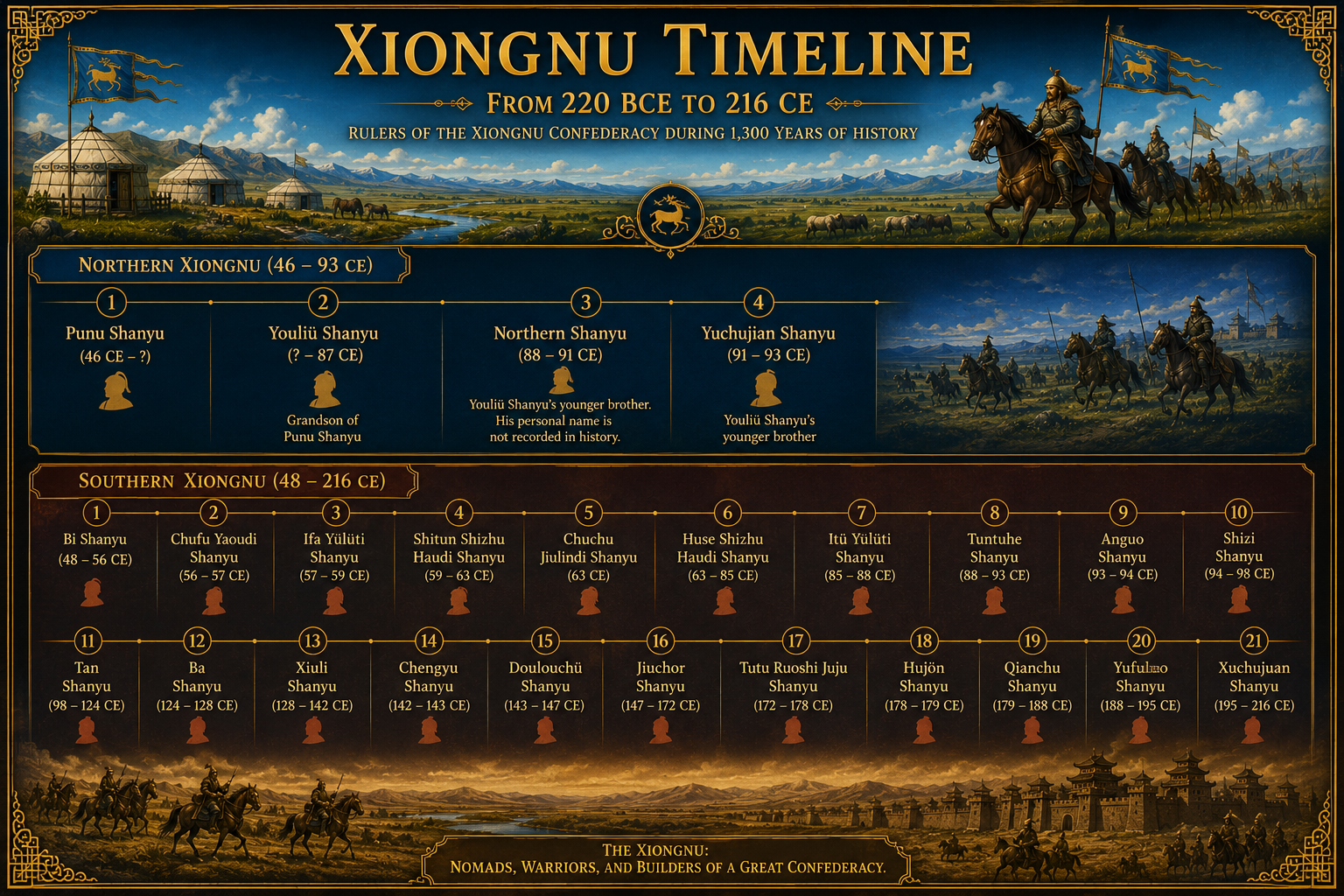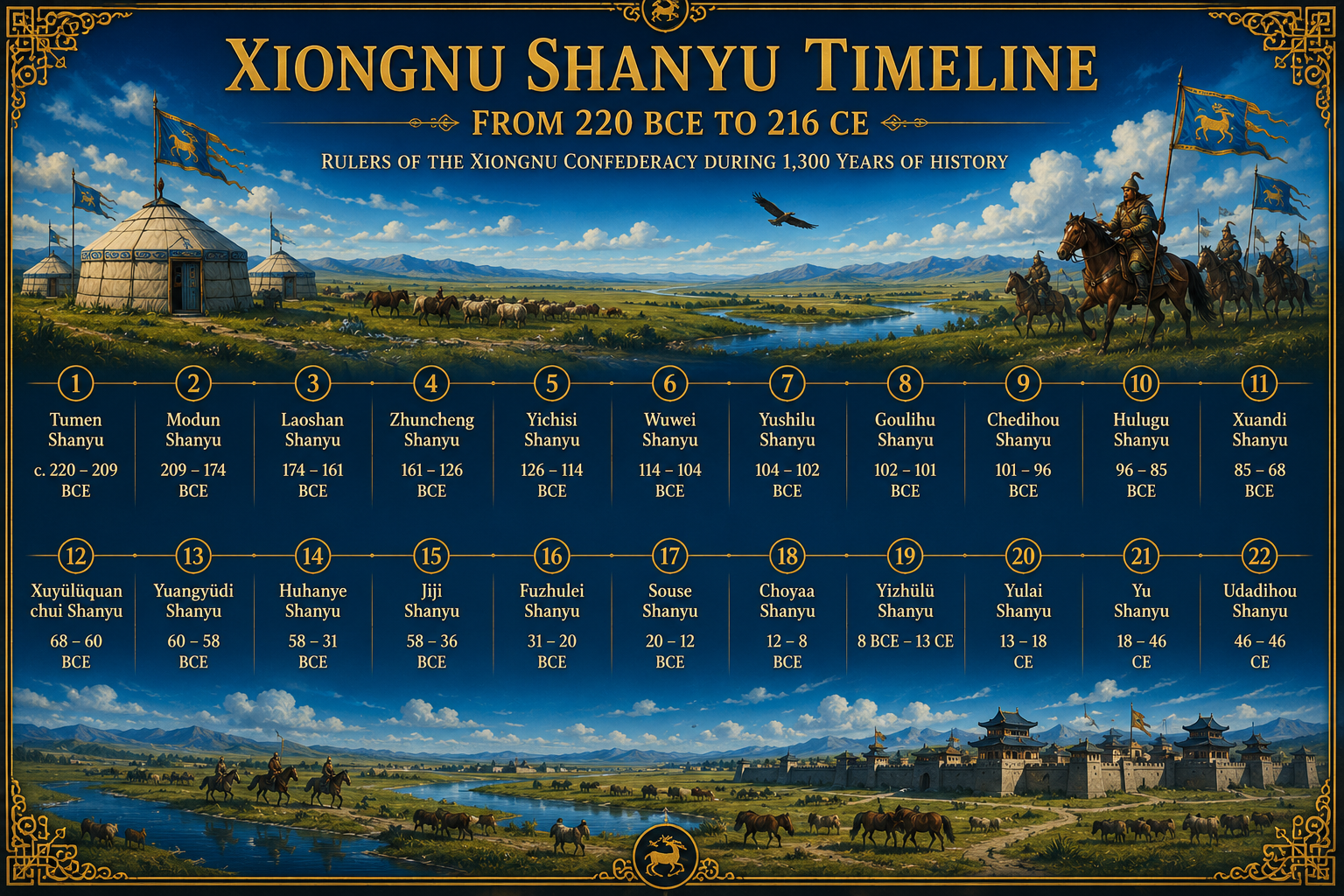
XIONGNU (匈奴)
By Altanbagana Baatar
DBA Candidate| Independent Historian
ImperialGG Historical Research Seriers
23 August 2026
THE FIRST STEPPE EMPIRE AND THE POLITICAL TRANSFORMATION OF THE EASTERN EURASIAN STEPPE
ABSTRACT
The Xiongnu (匈奴) established one of the earliest large-scale imperial political formations documented in Inner Asian history. Emerging in the late third century BCE under the leadership of Modu Chanyu, the Xiongnu rapidly transformed the political geography of the Eastern Eurasian Steppe and became the principal northern rival of the Qin and Han empires. Their political center lay in the territory of present-day Mongolia, while their sphere of influence extended across large portions of the Eastern Steppe, including southern Siberia, northern China, and regions toward Central Asia.[1]
The Xiongnu, however, should not be understood as the sudden appearance of a single homogeneous ethnic nation. Archaeogenetic research demonstrates that the population of the Xiongnu Empire was extraordinarily diverse and that the empire emerged through the integration and mixture of populations from Mongolia and surrounding regions.[2]
The central argument of this article is therefore that the Xiongnu Empire represented a new political synthesis of an older Eastern Eurasian steppe world. Its importance lies not merely in conquest, but in the creation of a durable imperial system capable of integrating pastoral communities, conquered populations, frontier societies, and long-distance exchange networks under the authority of the Chanyu.
1. THE PROBLEM OF THE XIONGNU
Few ancient peoples have generated as much historical debate as the Xiongnu. The difficulty begins with the sources. Almost everything known about the Xiongnu before the medieval period comes from neighboring civilizations, particularly Chinese historians. The most important surviving narrative is Sima Qian’s Shiji, especially chapter 110, the “Biographies of the Xiongnu.” Written around the end of the second century BCE, it provides the earliest extensive historical account of the Xiongnu political world.[3] This creates an obvious methodological problem.
The Xiongnu did not leave behind an indigenous imperial chronicle comparable to the Chinese dynastic histories. Their political history must therefore be reconstructed by combining Chinese textual records with archaeology, settlement evidence, mortuary archaeology, isotopic research, material culture, and ancient DNA. The result is substantially more complicated than the older image of the Xiongnu as a simple nomadic tribe.
The archaeological and genetic evidence increasingly suggests a large and heterogeneous political system whose population included people of different geographical origins and cultural backgrounds.[4]
2. BEFORE THE EMPIRE
The Xiongnu did not emerge from an empty landscape. Long before the formation of the Xiongnu Empire, the Mongolian Plateau and surrounding regions were occupied by communities practicing pastoralism, hunting, agriculture, metallurgy, and long-distance exchange. By the Late Bronze Age, populations across Mongolia were already geographically differentiated while sharing important economic practices, including dairy pastoralism.[5]
The archaeological transition from the Late Bronze Age into the Early Iron Age witnessed major changes in mobility, weaponry, horse use, social organization, and interregional interaction. Scholars have consequently emphasized that the Xiongnu should be understood within a much longer process of political and economic transformation on the steppe rather than as an isolated historical rupture.[6] This observation is fundamental for the Before the Mongols research series. The Xiongnu were not the beginning of complex political organization in the Mongolian Plateau. They were the first steppe imperial formation for which the historical record allows us to observe the process of large-scale political consolidation with unusual clarity.
3. THE DONGHU AND THE XIONGNU
The immediately preceding article in this series examined the Donghu. The relationship between the Donghu and Xiongnu is particularly important because Sima Qian presents them as two powerful neighboring political formations. When Modu became Chanyu, the Donghu were already described as strong and prosperous. Their subsequent destruction by Modu became one of the decisive events in the expansion of the Xiongnu state.[7]
This should not be interpreted as evidence that the Donghu and Xiongnu were simply the same people under different names. The textual evidence treats them as separate political powers. At the same time, archaeology and genetics indicate that both belonged to a much broader population environment of the Eastern Eurasian Steppe. The modern evidence therefore favors a model of related and interacting populations followed by political consolidation, rather than either complete ethnic separation or simple ethnic identity.[8] This distinction is essential. The Xiongnu Empire was a political formation, not a biological category.
4. MODU CHANYU AND THE FOUNDING OF THE EMPIRE
The decisive figure in the formation of the Xiongnu Empire was Modu Chanyu (冒頓單于). According to Sima Qian, Modu was initially placed in a dangerous position by his father, Touman Chanyu, who favored another son. Modu eventually returned to the Xiongnu, built a loyal military following, and ultimately killed his father and seized the position of Chanyu.[9]
The traditional chronology places the foundation of the Xiongnu imperial system around 209 BCE, although archaeological and historical discussions sometimes use slightly different chronological boundaries for the formation of the polity.[10] The significance of Modu was not simply that he became a successful military commander. He transformed a regional political system into an imperial one. His first major campaigns eliminated or subordinated competing powers around the Mongolian Plateau, allowing the Xiongnu to expand simultaneously toward the east, west, and south.[11]
5. THE DESTRUCTION OF THE DONGHU
The confrontation with the Donghu provides the clearest surviving description of Modu’s political strategy. The Donghu first demanded a famous horse associated with Touman. Modu surrendered it. They subsequently demanded one of his wives, and he surrendered her as well. Finally, they demanded territory lying between the two states. At this point Modu refused.
Sima Qian records Modu’s famous principle that land was the foundation of the state. He executed those who advised surrender and launched a sudden eastern attack against the Donghu.[12] The Donghu were defeated and their ruler killed.
Modu then turned westward against the Yuezhi and southward against the Loufan and Baiyang, before recovering territory previously seized by the Qin commander Meng Tian.[13] The sequence is historically important because it demonstrates that the Xiongnu state was not simply expanding in one direction. It was reorganizing the entire political geography of the steppe.
6. THE XIONGNU STATE
The Xiongnu political system was fundamentally different from the centralized bureaucratic state of Han China. Its strength rested upon a mobile pastoral population, military organization, political hierarchy, elite networks, tribute, diplomacy, and the ability of the ruling house to redistribute wealth and political privileges across a vast territory.
Thomas Barfield famously analyzed the Xiongnu as an imperial confederacy, emphasizing the relationship between steppe political organization and the wealth of sedentary agricultural states to the south.[14] More recent archaeological research has refined this model. The Xiongnu state was not simply a loose alliance of tribes.
Evidence from mortuary centers, settlement organization, isotopic mobility studies, and genetic analysis indicates a political system capable of organizing populations across enormous distances and incorporating people from different regions.[15] The Xiongnu therefore represent an important stage in the development of Inner Asian imperial statecraft.
7. THE CHANYU AND IMPERIAL AUTHORITY
At the center of this system stood the Chanyu (單于), the supreme ruler of the Xiongnu. The political authority of the Chanyu was not based solely upon territorial possession. It depended upon personal loyalty, dynastic legitimacy, military power, aristocratic alliances, redistribution of wealth, and the ability to maintain relationships between the imperial center and distant regional elites.
This explains why the Xiongnu Empire could encompass populations with different origins without requiring them to become culturally identical. Imperial unity was primarily political. The empire did not require every subject to abandon local identity. Instead, it incorporated difference into a larger political hierarchy. This characteristic would later become a recurring feature of Inner Asian imperial systems.
8. THE LEFT AND RIGHT WINGS
The Xiongnu political system was organized territorially and hierarchically around the Chanyu’s court and major aristocratic offices. Chinese sources describe powerful nobles associated with the Left and Right Worthy Kings, along with other offices and subordinate rulers. These divisions were not merely military commands but components of a broader political structure through which authority was distributed across the empire.
The division of the empire into major regional spheres allowed the Chanyu to govern territories far beyond the immediate range of the central court.
The system also reveals a characteristic feature of steppe empire:
political distance did not necessarily weaken imperial authority if local elites remained integrated into the imperial hierarchy.
9. THE ECONOMIC FOUNDATION OF THE EMPIRE
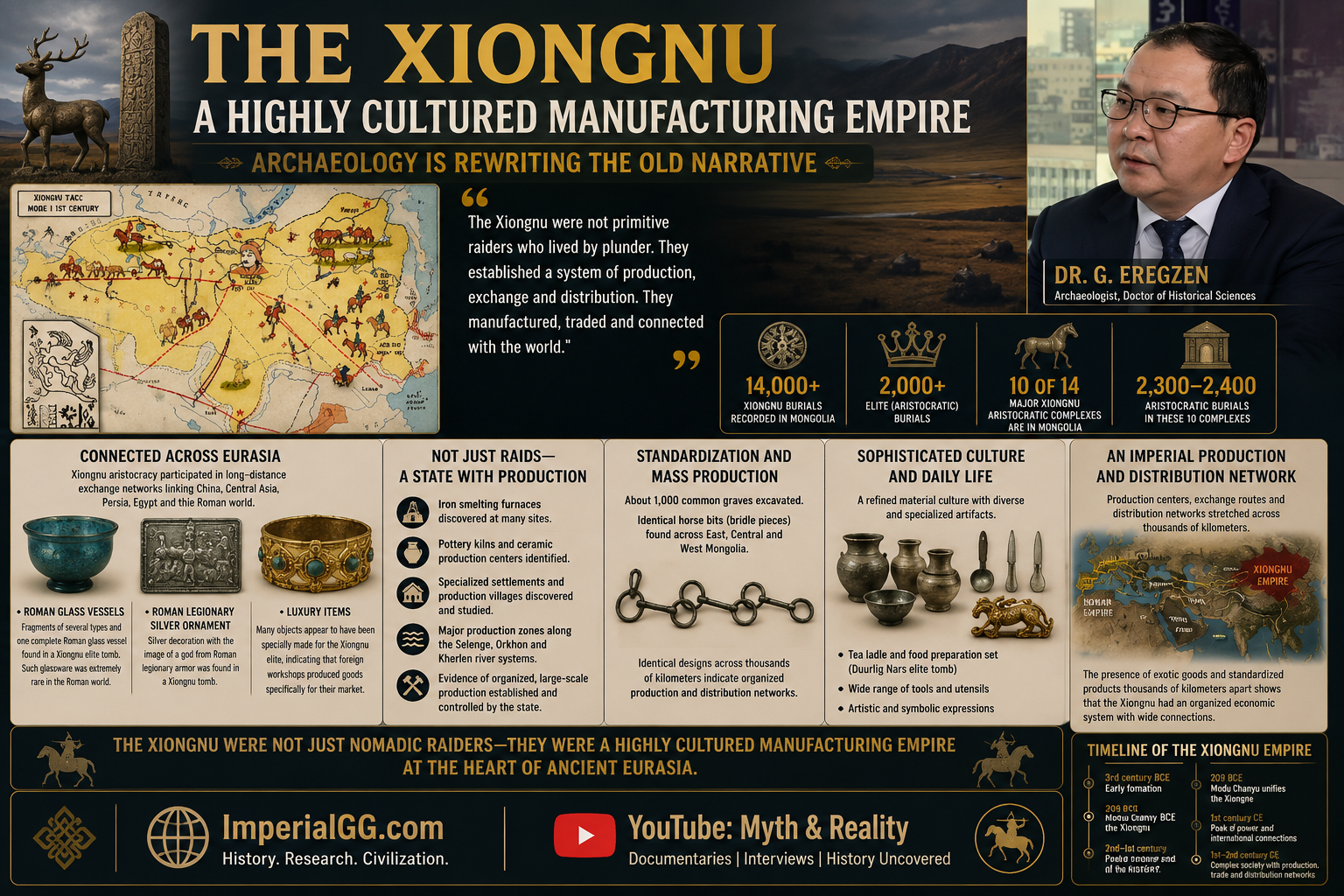
The Xiongnu economy cannot be reduced to the phrase “nomadic pastoralism.” Pastoralism was fundamental, particularly the management of horses, sheep, cattle, and other livestock, but the empire also depended upon agriculture, hunting, craft production, trade, tribute, and the acquisition of manufactured goods from sedentary societies.[16]
The Xiongnu controlled or influenced important exchange routes crossing the Eastern Eurasian Steppe.
Archaeological evidence demonstrates the movement of luxury and manufactured goods over enormous distances. Items originating in China, Central Asia, Iran and even farther west have been identified in Xiongnu contexts.[17]
The empire therefore functioned not merely as a military machine but as a regional economic system connecting pastoral and agricultural worlds.
10. THE XIONGNU AND HAN CHINA
The rise of the Xiongnu coincided with the consolidation of imperial China under the Qin and Han dynasties. This created one of the most consequential geopolitical relationships in ancient Eurasia. The Han possessed enormous agricultural resources, dense populations, fortified settlements, bureaucratic institutions, and taxable wealth.
The Xiongnu possessed mobility, cavalry, access to the northern frontier, and the ability to threaten agricultural settlements over enormous distances. Neither side could simply eliminate the other. The result was a complex combination of warfare, diplomacy, trade, marriage alliances, hostage exchange, tribute, and negotiated peace.
The famous heqin arrangements between Han rulers and the Xiongnu demonstrate that diplomacy was not secondary to warfare. nIt was one of the central mechanisms of imperial politics.
11. THE XIONGNU AND THE SILK ROAD
The Xiongnu are also essential to understanding the early history of trans-Eurasian exchange. Their empire occupied a geographical position connecting the Chinese world with Central Asia, Siberia, and the western steppe.
Archaeological discoveries from Xiongnu sites include imported glass, textiles, metals and other objects whose origins lie far beyond Mongolia.[18]
These discoveries demonstrate that the Eastern Eurasian Steppe was not an isolated cultural zone. The Xiongnu participated in networks through which objects, technologies, people and cultural practices moved across Eurasia. The empire therefore belonged to a much larger system of trans-Eurasian connectivity that preceded the later Silk Road in its fully developed medieval form.
12. ARCHAEOLOGY: THE XIONGNU LANDSCAPE
Archaeology has transformed our understanding of the Xiongnu. The empire contained large elite burial complexes, ordinary cemeteries, settlements, ritual sites, craft-production areas and regional centers.
The monumental tombs of Xiongnu aristocrats reveal enormous disparities in social status, while ordinary burials demonstrate that the empire incorporated communities with very different levels of wealth.[19] The archaeological landscape therefore reflects a stratified imperial society. The Xiongnu were not simply a mobile army moving across the grasslands. They possessed places of political authority, systems of production, elite centers and permanent or semi-permanent installations. This is one of the reasons why the term “empire” remains useful despite continuing debates about the precise nature of Xiongnu political organization.
13. THE GENETIC REVOLUTION
Ancient DNA has fundamentally changed the discussion.
The 2020 Cell study by Choongwon Jeong and colleagues analyzed genome-wide data from 214 ancient individuals spanning approximately 6,000 years of Eastern Steppe history. The study concluded that the Xiongnu emerged through the mixing of populations from Mongolia and surrounding regions rather than from a single homogeneous ancestral population.[20]
This is one of the most important findings for understanding Xiongnu history. The Xiongnu were genetically diverse from the beginning. Their empire was therefore not equivalent to a single biological population. Instead, political integration brought together populations with different ancestral histories. This finding is consistent with the historical evidence for conquest, alliance, migration, marriage, incorporation and long-distance movement.
14. THE XIONGNU WERE MULTIETHNIC
A 2023 Science Advances study examined genome-wide data from individuals at Xiongnu cemeteries on the western frontier of the empire. The researchers found extremely high genetic diversity not only across the empire but within local communities and even within extended family groups. Individuals of lower social status displayed particularly high genetic heterogeneity, while higher-status individuals showed more restricted ancestry patterns.[21]
This provides unusually strong evidence that the Xiongnu Empire was multiethnic and socially stratified. The political identity “Xiongnu” therefore cannot be equated with a single modern concept of ethnicity. It was an imperial identity capable of incorporating populations from different geographical and ancestral backgrounds. This distinction is critical when discussing later historical peoples.
15. XIONGNU AND THE MONGOLIAN PLATEAU
The political center of the Xiongnu Empire was located primarily within the territory of present-day Mongolia.
This is not simply a modern nationalist interpretation. Archaeological research places the core of Xiongnu imperial power within the Mongolian Plateau, while genetic and archaeological studies demonstrate the central role of Mongolian populations and landscapes in the formation of the empire.[22]
This geographical fact matters for the broader history of Mongolia.
The Mongolian Plateau was not merely one province of a distant Chinese historical system. It was the central political landscape from which one of the ancient world’s most important steppe empires emerged. The Xiongnu therefore belong fundamentally to the history of the Mongolian Plateau as well as to the wider history of East and Inner Asia.
16. XIONGNU AND THE EARLIER EASTERN STEPPE
The preceding articles in the Before the Mongols series have examined Guifang, Xianyun, Rong and Di, and Donghu. The Xiongnu should not be inserted into that sequence as if each name represented an identical ethnic population. The evidence does not permit such a conclusion.
Instead, the sequence represents changing political designations within a northern and eastern frontier world:
GUIFANG → XIANYUN → RONG & DI → DONGHU → XIONGNU
The archaeological record demonstrates long-term occupation and interaction across the region, while ancient DNA shows that population continuity and population movement occurred simultaneously.[23] The Xiongnu therefore represent a political transformation, not a biological beginning.
17. WHAT LANGUAGE DID THE XIONGNU SPEAK?
The language of the Xiongnu remains one of the most difficult questions in Inner Asian historical ( Mongolian) linguistics. No securely identified indigenous Xiongnu literary corpus survives.
Chinese transcriptions of Xiongnu personal names, titles and words provide important evidence, but their interpretation remains disputed. Over the last century scholars have proposed connections with Mongolic, Turkic, Yeniseian and other language families, while some researchers have proposed that the Xiongnu political system was linguistically heterogeneous.
The available evidence does not justify reducing the entire Xiongnu population to one securely identified language family. This is particularly important because political identity and linguistic identity were not necessarily identical. An empire could incorporate populations speaking several languages. The genetic evidence makes such a model especially plausible.[24]
18. WERE THE XIONGNU MONGOLS?
The question requires precision. The Xiongnu cannot simply be labeled “Mongols” in the modern ethnolinguistic sense. The modern Mongolian ethnolinguistic identity developed much later. At the same time, it would be equally misleading to treat the Xiongnu as completely unrelated to the later history of the Mongolian Plateau. Ancient DNA demonstrates deep population continuity across parts of the Eastern Steppe, while also showing repeated migration and admixture.[25]
The correct historical formulation is therefore:
The Xiongnu were not modern Mongols, but the Xiongnu Empire was a major political formation of the Mongolian Plateau whose populations and institutions formed part of the long-term history of Inner Asia.
This distinction allows historical continuity to be investigated without projecting modern ethnic categories backward into antiquity.
19. THE FALL OF THE XIONGNU EMPIRE
The Xiongnu Empire did not collapse because of a single military defeat. Its later history was shaped by internal succession struggles, factional divisions, relations with the Han Empire, military pressure, ecological and economic factors, and the emergence of rival political forces. By the first century BCE and first century CE, the Xiongnu political world had divided into competing factions.
The Eastern Han subsequently defeated and incorporated substantial portions of the southern Xiongnu, while the northern Xiongnu maintained political independence for a longer period before disappearing from the Chinese historical record as a major imperial power.[26] Yet political disappearance did not mean demographic disappearance. As with the Donghu, the destruction of an imperial state did not erase every community that had belonged to it.
20. THE XIONGNU AFTER THE EMPIRE
The legacy of the Xiongnu continued in multiple forms. Some populations entered the political systems of later Chinese dynasties. Others moved westward or became incorporated into new Inner Asian confederations. Still others remained within the broader populations of the Eastern Steppe.
The precise relationship between the Xiongnu and later peoples—including the Huns of the European and Central Asian worlds—remains debated. Some scholars have proposed connections, while others emphasize the chronological and geographical difficulties involved in establishing a direct identity.[27]
Therefore:
Xiongnu = European Huns
cannot currently be treated as an established fact. The relationship remains an important historical hypothesis requiring careful comparison of archaeology, chronology, genetics, linguistics and political history.
21. XIONGNU AS A MODEL FOR LATER STEPPE EMPIRES
The historical importance of the Xiongnu extends far beyond their own period. They established a political model in which a mobile ruling elite could dominate a vast territory containing populations with different economies, ancestries and cultural traditions.
Later steppe empires—including the Turkic Khaganates, Uighur Khaganate, Khitan Liao, Mongol Empire and others—developed their own political systems, but the Xiongnu provide one of the earliest documented examples of this broader phenomenon.[28]
The Mongol Empire, appearing more than a millennium later, should not be described as simply “the continuation” of the Xiongnu Empire. Yet both belonged to a long tradition of steppe imperial state formation, in which mobility, pastoral production, military organization, elite alliances, long-distance exchange and incorporation of diverse populations could produce political systems of continental scale.
22. THE XIONGNU AS A TURNING POINT
The historical importance of the Xiongnu can therefore be summarized in four transformations. First, they transformed the Mongolian Plateau from a landscape of competing regional communities into a large imperial political system. Second, they created a durable geopolitical counterweight to the Chinese imperial states. Third, they integrated populations and economic zones across a vast portion of the Eastern Eurasian Steppe.
Fourth, they demonstrated that political power in Inner Asia could be organized on a continental scale without reproducing the bureaucratic structure of a sedentary agricultural empire.[29]
The Xiongnu were therefore not merely a military threat to Han China. They were an independent imperial civilization of the Eastern Eurasian Steppe.
23. AUTHOR’S THESIS
The evidence considered here supports the following thesis:
THE XIONGNU EMPIRE DID NOT APPEAR SUDDENLY FROM AN EMPTY STEPPE. IT EMERGED FROM A LONG-DEVELOPING EASTERN EURASIAN POLITICAL, ECONOMIC, AND POPULATION WORLD, AND UNDER MODU CHANYU THIS WORLD WAS TRANSFORMED INTO THE FIRST LARGE-SCALE STEPPE EMPIRE RECORDED IN DETAIL BY CONTEMPORARY EAST ASIAN HISTORY.
The Xiongnu were neither a homogeneous biological population nor simply an enlarged tribe. They were a multiethnic imperial polity, centered on the Mongolian Plateau, that integrated populations from different parts of Inner Asia.[30]
The Donghu, Xiongnu and later northern peoples should therefore be studied through the concepts of political transformation, population continuity, migration, incorporation and cultural interaction, rather than through the assumption that every historical name corresponds to one unchanged ethnic group.
The Xiongnu represent the decisive moment when the Eastern Eurasian steppe became not merely a frontier between civilizations, but a center of imperial power in its own right.
CONCLUSION
The history of the Xiongnu is the history of a political revolution on the Eastern Eurasian Steppe. Before the Xiongnu, the Mongolian Plateau already contained complex pastoral communities, regional political formations, exchange networks and mobile warrior societies. The emergence of the Xiongnu did not create this world from nothing.
It unified and reorganized it.
Modu Chanyu’s campaigns against the Donghu, Yuezhi, Loufan, Baiyang and the northern territories previously occupied by the Qin transformed the political geography of Inner Asia.[31] The resulting empire was enormous, mobile, hierarchical and remarkably diverse. Ancient DNA now confirms what the historical record already suggested: the Xiongnu Empire incorporated people from many different populations, and this diversity existed even within individual communities and families.[32] The Xiongnu therefore challenge the modern assumption that an empire must correspond to a single ethnicity.
They demonstrate something more historically important:
An empire can create a political identity that is larger than any one population from which it emerged. For the history of Mongolia, this is particularly significant.
The Xiongnu Empire was centered on the Mongolian Plateau, and its emergence represents one of the earliest clearly documented moments when the peoples and landscapes of this region became the center of a continental imperial system.[33] The Mongol Empire would arise more than a thousand years later under entirely different historical circumstances. But the political geography of the steppe had already demonstrated its imperial potential.
THE HISTORY OF THE MONGOLIAN STEPPE DID NOT BEGIN WITH THE MONGOL EMPIRE.
THE XIONGNU WERE ONE OF ITS GREAT BEGINNINGS AS AN IMPERIAL POLITICAL WORLD.
FOOTNOTES
[1] Juhyeon Lee et al., “Genetic Population Structure of the Xiongnu Empire at Imperial and Local Scales,” Science Advances 9, no. 15 (2023): eadf3904. The authors characterize the Xiongnu as the first nomadic imperial power, centered on present-day Mongolia and active from approximately 200 BCE to 100 CE.
[2] Choongwon Jeong et al., “A Dynamic 6,000-Year Genetic History of Eurasia’s Eastern Steppe,” Cell 183, no. 4 (2020): 890–904.e29. The study analyzed 214 ancient individuals and concluded that the Xiongnu emerged through admixture among populations of Mongolia and surrounding regions.
[3] Sima Qian, Shiji, ch. 110, “Xiongnu liezhuan.” The Shiji constitutes the principal early textual narrative concerning the Xiongnu. Étienne de la Vaissière notes that the Xiongnu are known principally through archaeological evidence and this chapter of the Shiji.
[4] Lee et al. demonstrate extremely high genetic diversity within Xiongnu communities and across the empire, supporting the interpretation of the Xiongnu as a multiethnic political formation.
[5] Jeong et al. identify a pastoralist expansion into Mongolia around 3000 BCE and substantial population differentiation by the Late Bronze Age, while noting shared dairy-pastoral economies.
[6] De la Vaissière places the emergence of the Xiongnu within a wider transformation beginning in the fourth century BCE involving mounted warrior elites and earlier developments in pastoral economies.
[7] Sima Qian explicitly describes the Donghu as powerful when Modu came to power and records their subsequent defeat and destruction by the Xiongnu.
[8] Jeong et al. demonstrate that the Xiongnu emerged through the mixture of multiple populations, rather than from a single homogeneous ancestral population.
[9] Sima Qian’s account of Modu’s rise, including his conflict with Touman and seizure of the Chanyu position, appears in Shiji, ch. 110.
[10] Barfield dates the formation of the Xiongnu Empire to the beginning of the third century BCE, while current genetic and historical studies commonly place the imperial formation around the end of the third century BCE.
[11] The sequence of Modu’s campaigns is recorded in Sima Qian’s Shiji, including campaigns against the Donghu, Yuezhi, Loufan and Baiyang and the recovery of territories previously taken by Qin forces.
[12] Shiji, ch. 110. The famous statement concerning land as the foundation of the state occurs in the context of Modu’s refusal to surrender the disputed territory between the Xiongnu and Donghu.
[13] Sima Qian’s narrative places the Donghu campaign within a broader sequence of Xiongnu expansion.
[14] Thomas J. Barfield, “The Xiongnu Empire,” in Empires: Perspectives from Archaeology and History. Barfield’s influential model treats the Xiongnu as an imperial confederacy whose political economy was closely connected with the wealth of sedentary China.
[15] Christopher? The 2024 PLOS ONE study on elite mobility and political consolidation argues that the Xiongnu polity emerged from indigenous steppe-centered sociopolitical structures and examines mobility among commoners, intermediate elites and regional elites.
[16] Lee et al. and Jeong et al. demonstrate the economic and demographic complexity of the Xiongnu world, including pastoral production, mobility and interaction with surrounding regions.
[17] The Science Advances study notes archaeological evidence for imported Roman glass, Persian textiles, Egyptian faience, Greek silver, and Chinese bronzes, silk and lacquerware within the Xiongnu sphere.
[18] The movement of imported materials demonstrates the participation of the Xiongnu Empire in long-distance Eurasian exchange networks.
[19] Xiongnu mortuary archaeology reveals substantial differences in social status, while genetic evidence shows strong diversity within both elite and lower-status communities.
[20] Jeong et al., Cell 183 (2020): 890–904.e29. The study’s central finding is that the Xiongnu emerged through admixture among populations from Mongolia and surrounding regions.
[21] Lee et al., Science Advances 9 (2023). The authors found that genetic diversity within western Xiongnu communities was comparable to the diversity of the empire as a whole, including substantial variation within extended families.
[22] The 2020 and 2023 studies both emphasize the centrality of present-day Mongolia to Xiongnu imperial geography and population history.
[23] Jeong et al. emphasize that population continuity and migration occurred simultaneously across the Eastern Steppe.
[24] The absence of an indigenous Xiongnu literary corpus and the heterogeneity of the imperial population make the assignment of a single language to all Xiongnu problematic. The genetic evidence particularly supports caution against equating political identity with biological or linguistic uniformity.
[25] Jeong et al. distinguish the genetic history of Xiongnu populations from that of later Mongol populations while demonstrating long-term population interaction across the Eastern Steppe.
[26] De la Vaissière’s overview summarizes the long chronology of Xiongnu imperial power and its later fragmentation.
[27] The proposed relationship between the Xiongnu and later Huns remains a debated subject rather than an established historical identity. De la Vaissière discusses the possibility while noting the historical and geographical problems surrounding the question.
[28] The Xiongnu are widely treated as the first of a series of historically documented Inner Asian steppe empires.
[29] The combination of archaeological, genetic and historical evidence demonstrates that the Xiongnu political system operated across an enormous territory and incorporated diverse populations.
[30] Lee et al. provide especially strong evidence for the multiethnic character of the Xiongnu Empire at both imperial and local scales.
[31] Sima Qian’s Shiji remains the principal narrative source for Modu’s early expansion.
[32] Lee et al. demonstrate that genetic diversity existed not only between distant Xiongnu regions but within individual communities and family groups.
[33] Jeong et al. place the emergence of the Xiongnu directly within the long-term population history of Mongolia and the Eastern Eurasian Steppe.
AUTHOR’S THESIS
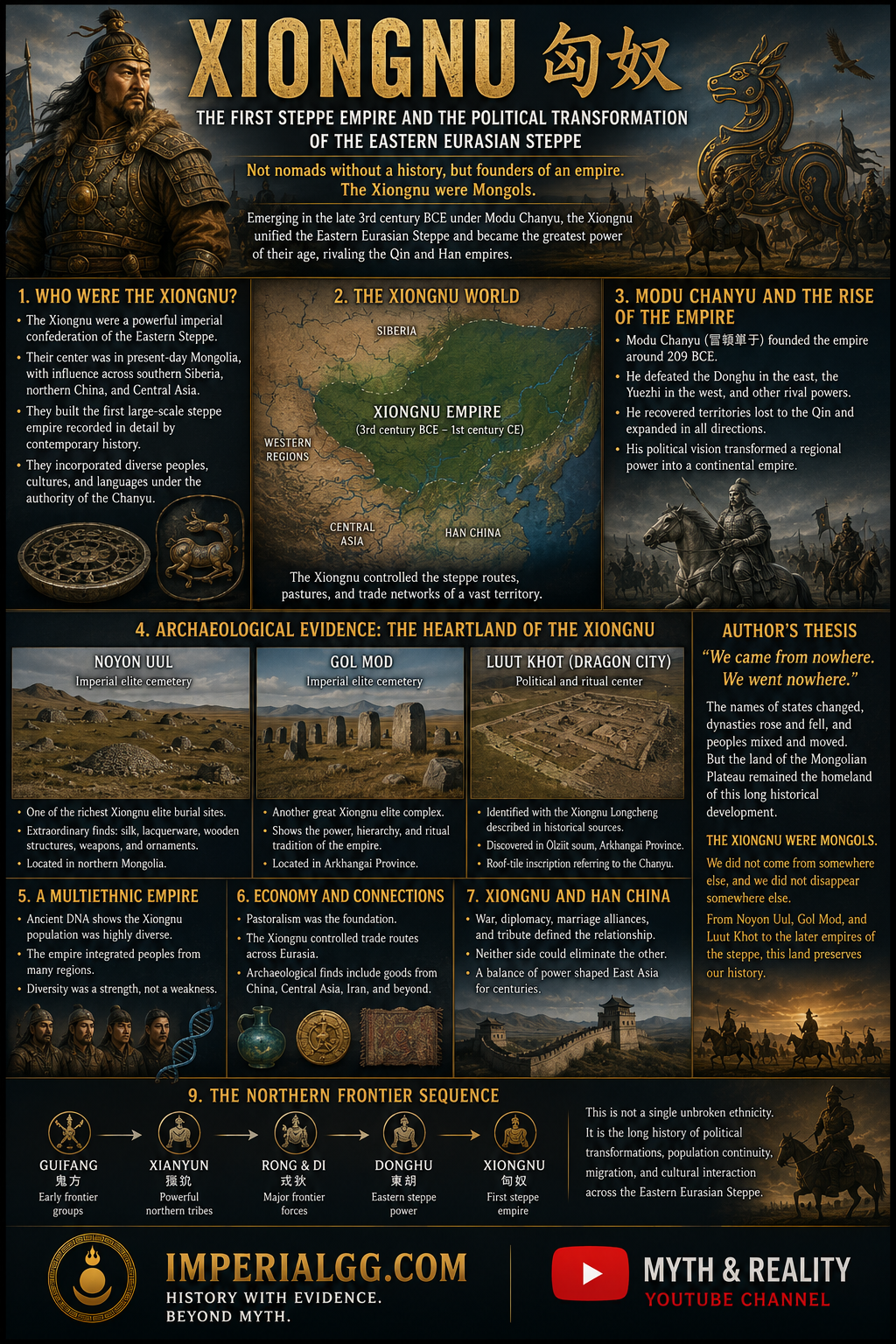
THE XIONGNU WERE MONGOLS: WE CAME FROM NOWHERE, AND WE WENT NOWHERE
The central thesis of this study is that the Xiongnu should not be treated merely as a mysterious nomadic people who appeared somewhere north of China in the third century BCE and subsequently vanished from history. They belonged fundamentally to the historical development of the Mongolian Plateau, and their imperial center, elite cemeteries, political landscapes, and substantial components of their population history are rooted in the same territory that later became the heartland of the Mongol world.
In this historical sense, the author’s position is explicit:
THE XIONGNU WERE MONGOLS. WE DID NOT COME FROM SOMEWHERE ELSE, AND WE DID NOT DISAPPEAR SOMEWHERE ELSE. THE POLITICAL NAMES CHANGED, THE EMPIRES CHANGED, AND POPULATIONS MIXED, BUT THE MONGOLIAN PLATEAU REMAINED THE CENTRAL HOMELAND OF THIS LONG HISTORICAL DEVELOPMENT.
This thesis does not require the claim that every individual within the Xiongnu Empire possessed a single ancestry, spoke one language, or belonged to an ethnicity identical to that of modern Mongols. Ancient-DNA research demonstrates precisely the opposite at the imperial level: the Xiongnu incorporated highly diverse populations. Yet the same research also shows that the empire arose through the integration of populations already present on the Mongolian Plateau with populations arriving from other parts of Eurasia. The 2020 genome-wide study of the Eastern Steppe reconstructed this history across 6,000 years and found both substantial continuity and repeated admixture rather than a simple sequence in which one population vanished and an entirely unrelated population replaced it.
NOYON UUL: THE IMPERIAL ELITE IN NORTHERN MONGOLIA
Noyon Uul is among the clearest archaeological demonstrations of the geographical reality of Xiongnu power. Located in present-day Mongolia, its monumental burials belonged to the Xiongnu elite and date principally to the first century BCE and first century CE. The extraordinary preservation of textiles, wooden burial structures, lacquerware and other objects also demonstrates the enormous geographical reach of Xiongnu exchange networks.
Noyon Uul is therefore more than a collection of spectacular tombs.
It is material evidence that the highest levels of Xiongnu political society were physically embedded in the landscape of Mongolia.
GOL MOD: ANOTHER IMPERIAL LANDSCAPE
The same pattern is visible in the great Xiongnu elite cemetery complexes of Arkhangai, including Gol Mod. Together with other monumental cemeteries distributed across Mongolia, these sites reveal that the Mongolian Plateau was not simply a peripheral grazing zone of an empire whose true center lay somewhere else.
It was the political and ceremonial core of the Xiongnu imperial world.
The concentration of monumental burials, political centers and archaeological landscapes within Mongolia is therefore central to the argument. The Xiongnu imperial geography must first be reconstructed from the Mongolian Plateau outward, rather than from the Chinese frontier northward.
LUUT KHOT: THE POLITICAL CENTER
The discovery identified by Mongolian archaeologists as Luut Khot—Dragon City or Longcheng adds an especially important dimension.
The site was discovered in the Orkhon region of Arkhangai Province and was publicly announced in 2020 after several years of archaeological investigation. Excavators associated it with the Xiongnu Longcheng, the ceremonial and political gathering place described in Chinese historical sources. Among the reported finds was a roof-tile fragment bearing an inscription referring to the Chanyu.
Here we need one geographical correction before publishing the article: the reported Luut/Longcheng discovery is associated with Ölziit soum of Arkhangai Province, not Bat-Ölzii soum. We should use Ölziit in the academic version so that this important argument cannot be challenged over a place-name error.
Taken together, these sites create an important archaeological triangle:
NOYON UUL — IMPERIAL ELITE
GOL MOD — IMPERIAL ELITE AND CEREMONIAL LANDSCAPE
LUUT KHOT — POLITICAL AND RITUAL CENTER
All are located within present-day Mongolia.
This geographical concentration cannot by itself prove a modern ethnic identity, but it demonstrates something fundamental: the territorial center of Xiongnu imperial civilization was the Mongolian Plateau.
“WE CAME FROM NOWHERE”
The expression “we came from nowhere” should therefore be understood as a challenge to migration narratives that require the ancestors of every historical Mongolian population to have entered Mongolia from some distant external homeland shortly before appearing in written history.
The archaeological record does not support such a simple model.
Human communities had occupied the Mongolian Plateau for millennia before Modu Chanyu. By the Bronze and Early Iron Ages, Mongolia already contained developed pastoral economies, extensive horse cultures, regional communities and long-distance networks. Ancient genomic evidence likewise demonstrates both deep local ancestry and repeated population mixture across the Eastern Steppe.
The Xiongnu Empire was therefore not founded by a people arriving suddenly on an empty plateau.
It was a political transformation of populations already deeply rooted in the Eastern Steppe, combined with populations incorporated through migration, alliance and conquest.
“WE WENT NOWHERE”
The second half of the thesis is equally important.
The collapse of an empire does not mean the biological disappearance of its inhabitants.
When Xiongnu imperial unity fragmented, millions of ordinary pastoralists, families and local communities did not simply vanish from the Mongolian Plateau because the name Xiongnu disappeared from dynastic chronicles. Political identities changed; populations moved and mixed; new confederations arose; but substantial demographic continuity remained possible and, in some datasets, demonstrable.
An earlier comparative ancient-DNA study of Xiongnu-period individuals from the Egyin Gol valley explicitly investigated continuity with present-day Mongolian populations and found evidence consistent with genetic continuity between the ancient and modern populations examined. Later genome-wide research has produced a more complicated picture—continuity accompanied by substantial admixture—which is precisely what should be expected across two millennia of steppe history.
Thus “we went nowhere” does not mean that Mongolia remained genetically isolated or ethnically unchanged.
It means something historically more defensible:
THE PEOPLE OF THE MONGOLIAN PLATEAU DID NOT DISAPPEAR EACH TIME AN EMPIRE FELL.
New peoples arrived. Others departed. Populations mixed. Political identities were reconstructed. Xiongnu, Xianbei, Rouran, Türk, Uyghur, Khitan and Mongol political systems successively transformed the steppe.
But the landscape and substantial elements of its population history persisted beneath changing imperial names.
FROM XIONGNU TO MONGOL HISTORY
For this reason, the question “Were the Xiongnu Mongols?” cannot be answered adequately by searching for a single Xiongnu word and attempting to classify an entire empire linguistically.
The Xiongnu were an empire.
Like the later Mongol Empire, they incorporated people of many ancestries and probably multiple languages. Genetic diversity therefore does not make them historically disconnected from Mongolia any more than the enormous ethnic diversity of the thirteenth-century Mongol Empire makes that empire non-Mongol.
Our argument operates at another level.
Where was the political heartland?
The answer is Mongolia.
Where are some of its greatest royal and aristocratic cemeteries?
Noyon Uul and Gol Mod are in Mongolia.
Where has the site identified by its excavators with the Xiongnu Dragon City been discovered?
In Arkhangai, Mongolia.
And what does ancient DNA show?
Not a racially “pure” Xiongnu population, but a dynamic Eastern Steppe population history characterized by local continuity, immigration, admixture and imperial integration.
These lines of evidence together provide the foundation for the author’s thesis.
THE XIONGNU WERE NOT FOREIGNERS PASSING THROUGH MONGOLIA. THEIR EMPIRE GREW FROM THE MONGOLIAN STEPPE, THEIR POLITICAL AND ELITE LANDSCAPES REMAIN BURIED IN MONGOLIAN SOIL, AND PART OF THEIR POPULATION HISTORY CONTINUED WITHIN THE LATER PEOPLES OF THE STEPPE.
Therefore, when this study states “THE XIONGNU WERE MONGOLS,” it does so as a thesis of historical homeland and long-term population-political continuity, not as the scientifically indefensible claim that a modern ethnic category existed unchanged more than two thousand years ago.
That distinction makes the thesis much harder to dismiss.
AUTHOR’S CENTRAL STATEMENT
WE CAME FROM NOWHERE. WE WENT NOWHERE.
THE NAMES OF STATES CHANGED, DYNASTIES ROSE AND FELL, AND THE PEOPLE OF THE STEPPE CONTINUALLY MIXED WITH THEIR NEIGHBORS. BUT FROM THE XIONGNU IMPERIAL LANDSCAPES OF NOYON UUL, GOL MOD AND LUUT KHOT TO THE LATER EMPIRES OF THE MONGOLIAN PLATEAU, THE LAND ITSELF PRESERVES A LONG HISTORY OF POLITICAL AND DEMOGRAPHIC CONTINUITY.
THE XIONGNU ARE THEREFORE NOT A FOREIGN PREFACE TO MONGOLIAN HISTORY. THEY ARE PART OF ITS DEEP HISTORY.