XIANBEI 鮮卑
By Altanbagana Baatar
DBA Candidate| Independent Historian
ImperialGG Historical Research Seriers
24 August 2026
FROM THE EASTERN STEPPE TO THE NORTHERN WEI EMPIRE
Introduction
The emergence of the Xianbei (鮮卑) after the decline of the Xiongnu Empire represents one of the most important political transformations in the history of the Eastern Eurasian Steppe. Traditional historical narratives often present the Xianbei as a new population appearing on the northern frontier of China after the collapse of Xiongnu power. Such a presentation, however, risks confusing the disappearance of a political name with the disappearance of the population and historical world that sustained that political system.
The archaeological and historical evidence suggests a more complex process. The Xianbei emerged from the eastern Inner Asian frontier during the centuries in which Xiongnu imperial power was weakening, and they subsequently developed several political confederations and dynasties. Among them, the Tuoba branch eventually established Northern Wei (386–534), one of the most important Inner Asian conquest dynasties in early medieval East Asia.
The central argument of this article is therefore that Xianbei history should be understood as a transformation within the wider political and demographic world of the Eastern Steppe rather than as the sudden replacement of one completely unrelated people by another.
1. THE XIANBEI AFTER THE XIONGNU
The Xianbei became increasingly prominent during the decline of the Xiongnu imperial system in the first centuries CE. This chronological relationship is significant.
The Xiongnu Empire had created a large political system across Mongolia and neighboring regions. When that system fragmented, the political vacuum did not remain empty. Various groups competed for power across the same frontier zones, and the Xianbei became one of the most successful of these emerging powers.
Modern scholarship describes the Xianbei not as a single, internally uniform nation but as a collection of groups that could unite, fragment and reorganize under powerful leaders. Scott Pearce, in his study of Northern Wei, emphasizes that the Xianbei—rendered in his reconstruction as *Serbi—were not originally a unified people. They consisted of numerous groups moving from the Khingan region toward the frontier highlands. This is important for understanding steppe political history.
A steppe confederation was not necessarily a biological nation.
It was a political structure capable of incorporating multiple communities. The same principle applies to the Xiongnu before them and to later steppe empires.
2. THE XIANBEI AND THE EASTERN STEPPE
The geographical background of the Xianbei is particularly important. Pearce places the early Xianbei world in the region of Manchuria and the Khingan Mountains, from which groups moved toward the frontier highlands between Inner Asia and the Chinese world. This eastern location connects the Xianbei to the broader historical geography of the Eastern Eurasian Steppe, rather than to an isolated Chinese historical sphere.
The Xianbei world extended across territories that today fall within Mongolia, Inner Mongolia, Manchuria and northern China. Their history therefore belongs simultaneously to the history of the steppe and to the history of northern East Asia. This geographical position also helps explain why the Xianbei became so influential after the weakening of the Xiongnu. The political center of gravity was shifting.
The empire changed. The frontier did not disappear.
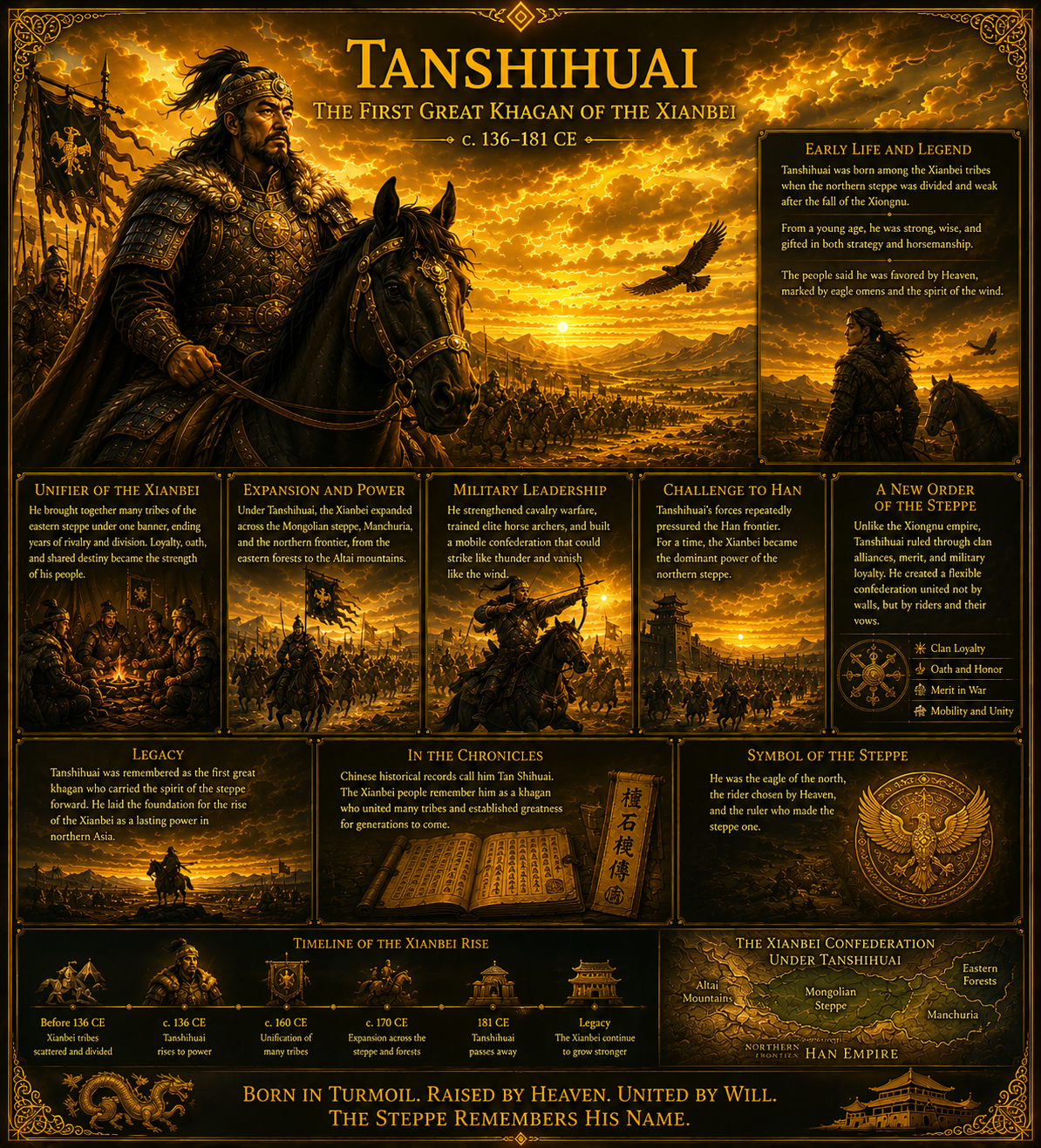
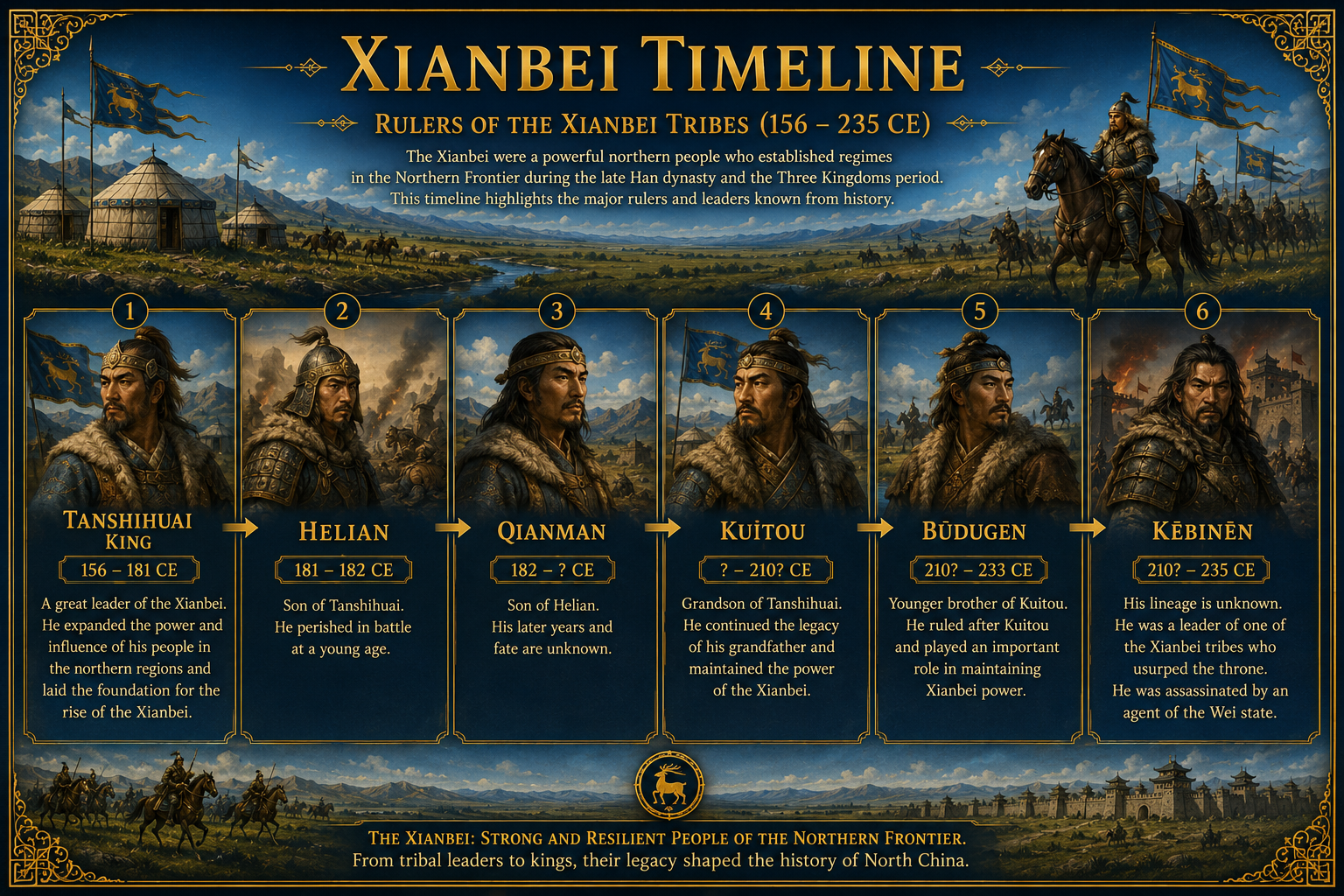
3. TANSHIHUAI AND THE GREAT XIANBEI CONFEDERATION
One of the most important Xianbei leaders was Tanshihuai, who lived during the second century CE. According to the historical tradition, Tanshihuai succeeded in bringing numerous Xianbei groups under his authority and created a powerful confederation. Yet the political unity he established did not permanently survive his death. Pearce notes that the Xianbei remained fragmented despite Tanshihuai’s attempt at unification.
This pattern deserves attention because it resembles a recurring political structure of the Eastern Steppe. A charismatic leader could unite numerous autonomous groups. After his death, the confederation could fragment. Later leaders could reconstruct political unity on a new basis. This was not necessarily political failure. It was one of the characteristic mechanisms through which steppe empires were repeatedly created.
4. FROM XIANBEI CONFEDERATIONS TO DYNASTIES
The greatest historical consequence of the Xianbei was not simply the existence of their second-century confederation. It was the emergence of dynastic states from the Xianbei political world. During the third century CE, several Xianbei dynasties appeared. One of these was the Tuoba, or Taghbach, lineage. Pearce argues that the Tuoba emerged in the highlands around the region historically known as Dai and subsequently developed into the ruling house of Northern Wei. This development represents a major transition. The political organization of the steppe was no longer limited to temporary tribal confederation.
A Xianbei ruling house developed:
- territorial administration,
- taxation,
- military institutions,
- aristocratic succession,
- permanent political centers,
- and eventually imperial institutions.
The Tuoba therefore demonstrate how an Inner Asian political tradition could develop into a durable territorial empire.
5. THE TUOBA AND NORTHERN WEI
In 386 CE, the Tuoba established the Northern Wei dynasty. Northern Wei eventually conquered much of northern China and became one of the most important states of the Northern and Southern Dynasties period. Modern scholarship therefore treats Northern Wei as a major example of an Inner Asian conquest dynasty—a state founded by people of Inner Asian origin that established political control over predominantly agricultural Chinese territories. This development is historically significant because it reverses a common assumption.
The movement was not simply:
“Chinese civilization expanding northward.”
It was also:
“Inner Asian political institutions moving southward and transforming the political order of East Asia.”
Northern Wei was consequently not an accidental interruption of Chinese history. It was one of the forces that created the political world from which later Chinese dynasties emerged.
6. LANGUAGE AND THE XIANBEI QUESTION
The linguistic identity of the Xianbei remains an important scholarly question. There is no surviving corpus of Xianbei texts comparable to later written Mongolian sources. Much of the evidence comes from Chinese transcriptions of personal names, titles and other terms. Scott Pearce describes the Xianbei language as belonging to a Mongolic relative, while noting the limitations of the surviving evidence. The Cambridge History of China similarly characterizes the language of the Tuoba as probably an early form of Mongolian, while emphasizing that the evidence is fragmentary.
This distinction is essential. It would be methodologically incorrect to claim that the Xianbei spoke exactly the same Mongolian language spoken in the Mongol Empire of the thirteenth century. But it is equally problematic to remove them entirely from the history of Mongolic-speaking Inner Asia simply because their language is preserved primarily through Chinese transcription. The evidence instead points toward a long linguistic continuum with substantial historical transformation.
7. XIANBEI AND THE QUESTION OF CONTINUITY
The most important historical question is therefore not:
“Were the Xianbei exactly the same people as the later Mongols?”
That formulation imposes a modern concept of ethnicity upon ancient societies.
The more productive question is:
What happened to the populations, institutions and cultural traditions of the Eastern Steppe as Xiongnu power declined and Xianbei power expanded?
The evidence indicates transformation rather than disappearance. The Xianbei arose in a region already occupied by populations with long histories of interaction. Their political expansion incorporated different communities, and their later dynasties themselves became increasingly complex.
The same process continued under Northern Wei. The ruling house changed political institutions and cultural practices while maintaining a strong Inner Asian military foundation. Pearce emphasizes that the Northern Wei state repeatedly changed its name, political character and geographic orientation, but continued to depend heavily on cavalry forces composed of people of Inner Asian origin. Thus political transformation did not mean demographic erasure.
8. THE MOVE TO LUOYANG
One of the clearest examples of this transformation occurred under Emperor Xiaowen. In 493 CE, Northern Wei moved its capital from Pingcheng to Luoyang. Xiaowen simultaneously introduced major reforms intended to reshape the ruling elite according to Chinese cultural and political norms. These included changes in language, clothing and elite practice.
This episode has traditionally been described as “Sinicization.”
But the concept requires caution. The movement to Luoyang did not mean that an Inner Asian ruling house suddenly ceased to exist. Rather, the Xianbei-derived ruling elite was adapting itself to govern a much larger and more densely populated political world. The result was not the disappearance of Xianbei political heritage. It was its transformation.
9. HISTORY WRITTEN BY THE CONQUERED
Another important methodological issue concerns the historical sources themselves. Most surviving written accounts of the Xianbei and Northern Wei were transmitted through Chinese historiographical traditions. Pearce stresses that the Tuoba rulers did not possess a surviving native written historical tradition comparable to that of their Chinese subjects. Consequently, the history of Northern Wei was recorded largely through Chinese scribes and textual conventions.
This creates a major historiographical problem. When a conquering Inner Asian dynasty is described primarily through the written tradition of the population it conquered, the resulting narrative can gradually reinterpret the conquerors according to the categories of the conquered.
That does not mean Chinese sources are false. It means they must be read critically. The historian must distinguish between:
what the Xianbei were,
and
how later historians chose to describe what they were.
10. FROM XIONGNU TO XIANBEI
The chronological sequence is therefore highly significant:
XIONGNU → XIANBEI → NORTHERN WEI
This sequence should not be interpreted as proof of a single unchanged ethnic population. But neither should it be interpreted as the complete disappearance of one people followed by the sudden appearance of an unrelated people. The Eastern Steppe was a dynamic political environment in which populations interacted, merged, separated and reorganized. The fall of one empire created opportunities for another.
The Xianbei inherited political space previously dominated by the Xiongnu, while simultaneously bringing their own eastern connections and political traditions into that world. The scholarly literature explicitly places the rise of Xianbei power within the weakening of both Xiongnu and Han imperial structures. Therefore, Xianbei history is best understood as transformation within the Eastern Steppe system.
AUTHOR’S THESIS
The Xianbei should not be treated as a historical interruption between the Xiongnu and the later peoples of Inner Asia. They represent one of the major stages through which the political traditions of the Eastern Steppe were transformed. The Xianbei inherited a world shaped by earlier steppe empires, developed new forms of confederation, produced powerful dynastic houses, and ultimately established Northern Wei.
Their history demonstrates a fundamental principle of Inner Asian history:
EMPIRES DISAPPEAR FASTER THAN THE WORLDS THAT CREATED THEM.
The Xiongnu Empire disappeared. The Eastern Steppe did not. Xianbei political power emerged. The Eastern Steppe did not begin again from zero.
Northern Wei conquered northern China. The Inner Asian political tradition did not disappear; it was transformed within a new imperial environment. For the larger historical argument of this series, the Xianbei therefore constitute a crucial bridge between the Xiongnu imperial world and the later Mongolic political traditions of Inner Asia.
The evidence does not justify describing every Xianbei person as a modern Mongol. But it does justify rejecting the idea that the Xianbei were an isolated population without connection to the long history of the Mongolian and Eastern Steppe world.
THE NAME CHANGED. THE POLITICAL ORDER CHANGED. THE PEOPLE MIXED. THE EMPIRE CHANGED.
THE STEPPE CONTINUED.
FOOTNOTES
1. Scott Pearce, Northern Wei (386–534): A New Form of Empire in East Asia (Oxford: Oxford University Press, 2023), especially chs. 3–5. Pearce traces the Tuoba as one branch of the Xianbei/*Serbi world and places their emergence within the political vacuum created by the decline of the Xiongnu and Han.
2. Albert E. Dien and Keith N. Knapp, eds., The Cambridge History of China, chapter on Northern Wei, by Scott Pearce, pp. 155–183. The chapter identifies the Tuoba as a branch of the Inner Asian Xianbei and discusses the linguistic evidence for an early Mongolian-related language.
3. Pearce, Northern Wei, ch. 3, pp. 23–46. The Xianbei/*Serbi are described as a non-unified collection of groups associated with the Khingan region and the northern frontier.
4. Pearce, Northern Wei, ch. 5, pp. 59–81. The rise of Liwei and the early Tuoba polity illustrates the political reconstruction that followed the disappearance of Xiongnu dominance.
5. Pearce, Northern Wei, ch. 7, pp. 93–113. The early Tuoba state developed cavalry organization and political structures that enabled it to challenge other Xianbei dynasties and eventually expand into northern China.
6. Pearce, Northern Wei, ch. 16, pp. 263–282. The relocation of the capital to Luoyang in 493 and Xiaowen’s cultural and institutional reforms are discussed as a major transformation of the Northern Wei state.
7. Pearce, Northern Wei, concluding chapter. Northern Wei is presented as an early example of an Inner Asian “conquest dynasty,” while its ruling house repeatedly changed its political and cultural form without losing its dependence on Inner Asian military power.
8. On the broader relationship between the Xiongnu and Xianbei worlds, see the interdisciplinary discussion in Early nomads of the Eastern Steppe and their tentative connections in the West. The authors emphasize that the Xiongnu themselves were a mixed population and caution against simplistic ethnic continuity models.
9. For the archaeological and socioeconomic complexity of the preceding Xiongnu world in Mongolia, see Joshua Wright, William Honeychurch and Chunag Amartuvshin, “The Xiongnu settlements of Egiin Gol, Mongolia,” Antiquity 83, no. 320 (2009): 372–387. Their work demonstrates that Xiongnu society included settlement hierarchies, agriculture and complex economic organization beyond a simple “nomadic” stereotype.
10. Ameline Alcouffe et al., “Genetic relatedness, social status and cemetery organisation: the Xiongnu Tamir necropolis, Mongolia,” Antiquity 100, no. 412 (2026): 1032–1049. The recent study further demonstrates the complexity of social organization and biological relationships within Xiongnu-period communities in Mongolia.