
§143–144 — THE BATTLE OF KÖYITEN (KHUITEN) AND THE FRAGMENTATION OF JAMUQA’S COALITION
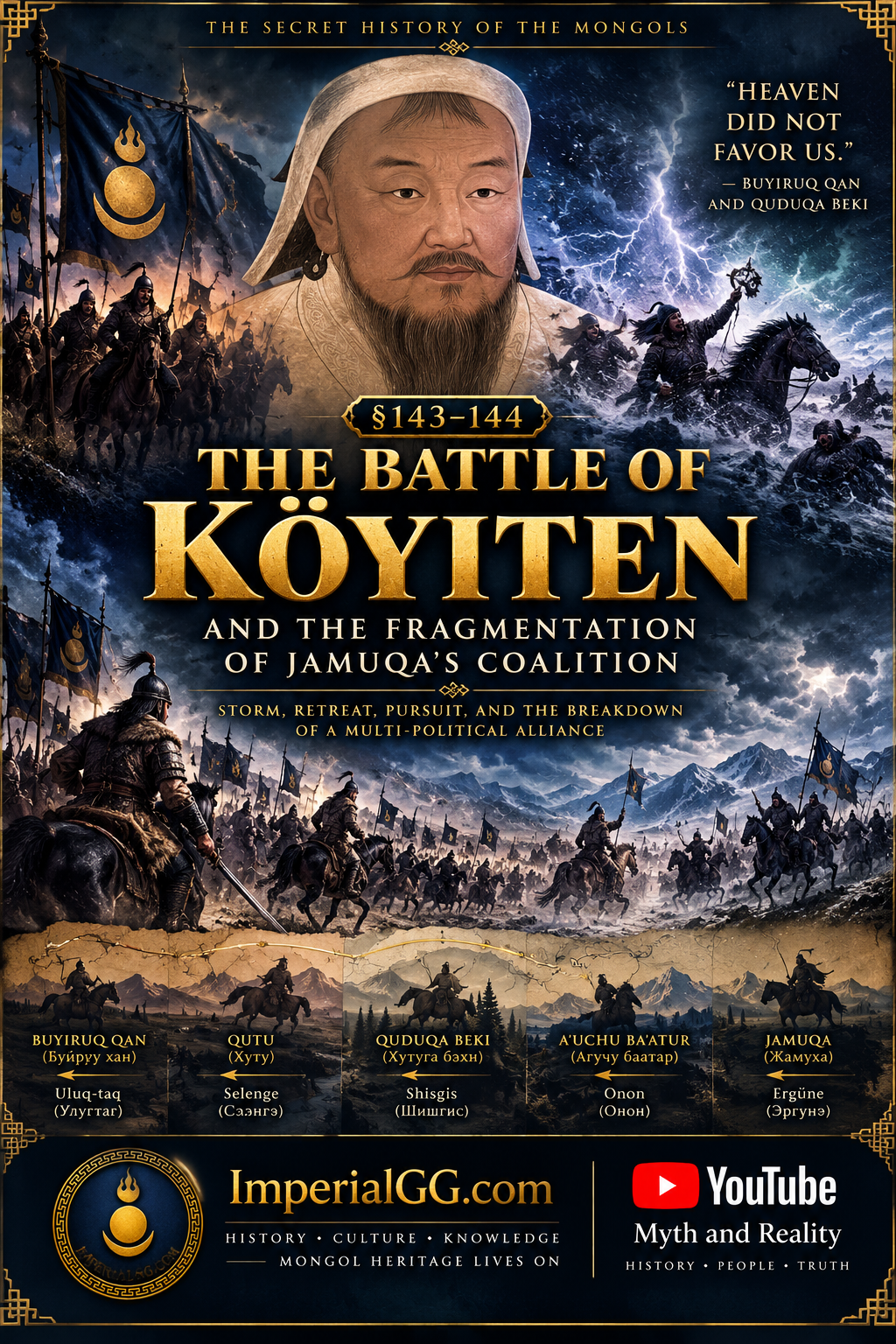
Storm, Retreat, Pursuit, and the Breakdown of a Multi-Political Alliance
By Altanbagana Baatar
DBA Candidate| Independent Historian
ImperialGG Historical Research Seriers
24 September 2026
THE SECRET HISTORY OF THE MONGOLS — IMPERIALGG HISTORICAL RESEARCH SERIES
INTRODUCTION
Sections 143–144 of The Secret History of the Mongols record a decisive phase in the confrontation between Temüjin and Ong Qan on one side and the coalition assembled under Jamuqa (Жамуха) on the other. The preceding section, §142, had brought the opposing forces into direct contact through a system of forward watch posts and vanguard commanders. At the first encounter, the two sides identified their respective commanders and withdrew for the night, agreeing that they would fight the following day. Section 143 begins with that promised engagement at Köyiten (Хүйтэн), where the armies are brought together and arranged against one another. The episode then takes an unexpected turn when Buyiruq Qan (Буйруг хан) of the Naiman and Quduqa Beki (Хутуга бэхи) of the Oirat employ a jada, described in the text as a means of producing a storm. The weather turns against them, and the two commanders interpret their misfortune through the language of Heaven. Section 144 follows immediately with the dispersal of the coalition and the separate movements of its principal leaders.
The importance of these sections lies not simply in the description of an unusual storm, nor even in the outcome of a single battle. Taken together, §§143–144 provide a rare view of how a large steppe coalition behaved when its military cohesion broke down. The alliance formed around Jamuqa had united politically distinct groups—including Naiman, Merkit, Oirat, Tayichi’ud, and Mongol elements—under a common opposition to Temüjin. Yet the narrative shows that these groups did not cease to possess their own leaders, territorial orientations, or political identities merely because they had entered into a common military alliance. Once the coalition encountered defeat and disorganization, its component forces separated and moved toward different regions. The episode therefore offers important evidence for distinguishing coalition-building from political integration.
THE BATTLE AT KÖYITEN
The narrative of §143 begins on the following day, when the two armies march toward one another and array themselves at Köyiten (Хүйтэн). The text describes the forces as facing each other while moving repeatedly downhill and uphill and reorganizing their troops as they proceeded. The description is concise, but it establishes that the engagement involved movement across uneven terrain rather than a simple stationary collision between two armies. The battlefield itself therefore forms part of the narrative’s military geography.
The precise historical location and character of Köyiten remain subjects of scholarly investigation. Jun’ichi Yoshida (吉田順一), for example, devoted a specific study to the historical reality of the Battle of Koyiten, published in 2009 in the Bulletin of the Waseda Institute for Mongolian Studies. The article’s existence is important because it demonstrates that the brief geographical and military description in The Secret History requires careful historical reconstruction rather than an assumption that the modern location of every place-name can be established directly from the text.
The source itself does not provide enough information to reconstruct a complete modern battlefield map. It does, however, preserve several important features: the opposing forces assembled at Köyiten; they faced one another; their formations moved over rising and descending ground; and both sides were actively maneuvering when the decisive environmental episode occurred. These details suggest that the narrative is concerned not merely with the fact of battle but with the changing physical and tactical circumstances under which the armies fought.
THE JADA (ЗАД) AND THE STORM
The most distinctive element of §143 is the intervention of Buyiruq Qan and Quduqa Beki. The text states that both men knew how to use a jada, and that they employed it to produce a storm. Yet the storm turned upon them. They became unable to continue moving, were driven into difficult terrain, and finally dispersed, declaring that Heaven had not favored them.
The jada should be understood within the cultural and religious world of Inner Asia rather than treated simply as a literary curiosity. The tradition associated particular stones or specialists with the production of rain, snow, wind, or storms. Modern scholarship has noted the existence of related practices among Turkic and Mongolic peoples, and the phenomenon has also been discussed in studies of Mongol warfare and military culture. A study of military integration in Mongol warfare, for example, specifically cites §143 as evidence for the use of jada and notes the importance of the episode in the historical traditions surrounding the Naiman and Oirat.
The crucial point, however, is that The Secret History does not present the event simply as a technical military operation. The storm acquires political and cosmological significance because it turns against those who summoned it. The narrative then records the reaction of the two commanders: they conclude that Heaven did not favor them. The statement is therefore part of the source’s own explanation of military fortune. It should not be converted into a modern claim that the storm was objectively caused by supernatural intervention; nor should the passage be stripped of its religious meaning by reducing it to an ordinary meteorological event. For the people represented in the narrative, weather, ritual power, military fortune, and Heaven’s favor could belong to the same explanatory framework.
HEAVEN, FAILURE, AND POLITICAL AUTHORITY
The phrase concerning Heaven is particularly important because it connects the battlefield episode with the wider political language of The Secret History of the Mongols. The defeat is not interpreted merely as a tactical failure. Buyiruq Qan and Quduqa Beki understand the disaster as evidence that Heaven did not favor them. The statement consequently transforms a battlefield reversal into a question of political and cosmological legitimacy.
This is significant in the context of §141. Jamuqa’s coalition had not emerged merely as an informal group of warriors. Its constituent leaders had participated in a collective political act through which Jamuqa was elevated as Gür Qan. The coalition therefore represented an alternative center of political authority. When its forces suffered defeat and its leaders interpreted the event through the language of Heaven, the consequences extended beyond immediate military loss. The political claim embodied by the coalition was placed under pressure.
At the same time, it is important to distinguish the narrative’s representation of Heaven’s favor from a historical claim about supernatural causation. The source tells us how the participants interpreted the event; it does not provide independent evidence by which a modern historian could verify that interpretation. This distinction is especially important in an academic treatment because The Secret History combines political history, oral tradition, cosmology, and literary narrative in a form that cannot be reduced to modern categories of military reporting.
THE COALITION BREAKS APART
The most consequential development comes in §144. After the defeat, the coalition does not retreat as a unified army under a single command. Instead, its principal leaders separate.
Buyiruq Qan of the Naiman moves toward Uluq-taq (Улугтаг), south of the Altai (Алтай). Qutu (Хуту), the son of Toqto’a Beki (Тогтоага бэхи) of the Merkit, moves toward the Selenge (Сэлэнгэ). Quduqa Beki of the Oirat moves through the forest toward Shisgis (Шишгис). A’uchu Ba’atur (Агучу баатар) of the Tayichi’ud moves toward the Onon (Онон). Jamuqa himself moves toward the Ergüne (Эргүнэ), after plundering the people who had raised him as their qan.
This geographical dispersal is one of the most revealing elements of the passage. The coalition had been politically united for the purpose of opposing Temüjin and Ong Qan, but its constituent leaders remained associated with their own peoples and regions. Once military cohesion disappeared, the coalition did not possess a single institutional structure capable of directing all of its members toward one common destination.
The distinction is important. A political coalition can be powerful without being a centralized state. The forces assembled under Jamuqa demonstrate substantial capacity for cooperation: multiple political communities could recognize a common leader, coordinate military action, and confront a rival alliance. Yet the dispersal recorded in §144 demonstrates that this cooperation did not erase the political autonomy of the participating groups.
Köyiten therefore provides an unusually clear example of the difference between political alliance and political integration.
THE GEOGRAPHY OF DISPERSAL
The directions recorded in §144 deserve particular attention because they preserve the geographical orientation of the coalition’s component groups. Buyiruq Qan returns toward the Altai region; Qutu moves toward the Selenge; Quduqa Beki heads toward the forested region of Shisgis; and A’uchu Ba’atur moves toward the Onon. Jamuqa, meanwhile, retreats toward the Ergüne.
These movements should not be treated as merely geographical details. They demonstrate that the members of the coalition possessed distinct political centers of gravity. Their military cooperation had been temporary and situational, whereas their relationships with their own peoples and territories remained durable.
The pattern also helps explain why the defeat at Köyiten did not immediately eliminate the political forces opposed to Temüjin. The coalition fragmented, but fragmentation produced multiple independent centers of resistance rather than one complete political collapse. This becomes particularly evident in the case of the Tayichi’ud.
JAMUQA AND THE PEOPLE WHO RAISED HIM
The passage concerning Jamuqa is among the most politically striking sentences in §144. The text states that Jamuqa, after plundering the people who had raised him as qan, moved toward the Ergüne.
The source does not explain why Jamuqa plundered these people. Consequently, a modern historian should not assign a specific motive without additional evidence. The action may be interpreted within the broader circumstances of a defeated coalition, but the text itself does not tell us whether Jamuqa acted out of desperation, retaliation, political calculation, or another motive.
What can be established is the stark contrast between elevation and subsequent plunder. The same political constituency that had participated in Jamuqa’s elevation as qan appears in the narrative as the object of his predation after the coalition’s military failure. The juxtaposition exposes the instability of political loyalty when a leader’s military position collapses.
The passage therefore offers an important counterpoint to §141. In §141, Jamuqa’s authority is created through collective political action. In §144, the same political order has broken apart so rapidly that its former leader is depicted plundering those who had elevated him. The narrative thus presents the rise and collapse of the coalition in remarkably compressed form.
FROM DEFEAT TO PURSUIT
The fragmentation of Jamuqa’s coalition immediately produces a new phase of military activity. Ong Qan pursues Jamuqa toward the Ergüne, while Chinggis Qan pursues A’uchu Ba’atur toward the Onon.
This division is significant because it shows that the defeat of the coalition did not end the campaign. Instead, the breakdown of a unified opposing force created separate military objectives. The former coalition was now being pursued according to its individual political components.
A’uchu Ba’atur provides the clearest example. Rather than continuing indefinitely in retreat, he reaches his people, causes them to move, and then reorganizes the Tayichi’ud forces beyond the Onon at Ülegüt Turas-tur. There the troops prepare to fight again. Chinggis Qan catches up with them, and another fierce engagement follows, lasting until evening. The combatants remain at the battlefield overnight.
The importance of this sequence is that it prevents us from describing Köyiten as the complete destruction of the anti-Temüjin forces. The coalition breaks apart, but its constituent groups retain the capacity to reorganize. The Tayichi’ud in particular remain capable of fielding troops and resisting Chinggis Qan after the initial disaster.
COALITION WARFARE AND POLITICAL FRAGMENTATION
Sections 143–144 therefore reveal a characteristic tension in steppe political organization. The political communities represented in Jamuqa’s coalition possessed the capacity to cooperate at a high level while retaining separate political identities. The coalition could concentrate military power against a common opponent, but its structure remained vulnerable when battlefield circumstances undermined the authority of its common leader.
This should not be understood as evidence of political primitiveness. On the contrary, the organization of the coalition required considerable political coordination. Its leaders had to agree upon a common center of authority, mobilize their respective forces, coordinate movement, and confront a rival alliance composed of Temüjin and Ong Qan. The failure at Köyiten therefore reveals not an absence of political organization but a particular form of political organization whose cohesion depended upon continued agreement among autonomous centers of power.
The distinction becomes particularly useful when examining Temüjin’s subsequent rise. His expanding political order increasingly depended upon transforming relationships with independent groups into more durable relationships of loyalty, service, incorporation, and command. The contrast between the coalition’s fragmentation and Temüjin’s later political consolidation is therefore historically significant, although the Secret History itself does not formulate the contrast in these modern analytical terms.
KÖYITEN IN THE LONGER DEVELOPMENT OF TEMÜJIN’S POWER
The Battle of Köyiten should consequently be placed within the larger sequence of Temüjin’s political development rather than isolated as a single dramatic victory. The preceding §§141–142 describe the formation of a rival political coalition and the first organized contact between its forces and those of Temüjin and Ong Qan. Sections 143–144 then show the coalition suffering battlefield reversal and fragmenting into its constituent political elements.
The immediate result was not the disappearance of opposition but a change in its structure. Temüjin and Ong Qan no longer confronted one unified coalition in the same form. Instead, they pursued individual leaders and political groups. The campaign thus shifted from confrontation with a coalition to confrontation with its dispersed components.
That transformation would have long-term consequences. The political struggle on the eastern steppe was increasingly determined not simply by who could assemble the largest temporary alliance, but by which political center could retain followers, absorb defeated groups, preserve military capability, and convert temporary allegiance into a more durable structure of authority.
The evidence of §§143–144 does not by itself prove that Temüjin consciously pursued such a strategy at this precise moment. It does, however, establish the political environment in which such consolidation became increasingly important.
THE JADA EPISODE AND THE LIMITS OF MODERN INTERPRETATION
The Köyiten episode also illustrates a broader methodological problem in the study of Mongolian history. Modern readers often encounter the jada episode and immediately ask whether the storm should be understood as supernatural, meteorological, symbolic, or legendary. Yet the categories themselves belong to different interpretive frameworks.
For the historical actors represented by the text, the ability of Buyiruq Qan and Quduqa Beki to manipulate weather belonged to a recognizable body of knowledge. The resulting storm was then interpreted according to the relationship between military fortune and Heaven. The narrative consequently preserves not merely a physical event but an historical worldview in which environmental conditions, ritual practice, military power, and political legitimacy were interconnected.
An academic reading therefore need not decide whether the storm was “really magical.” It is sufficient to establish that the source describes a jada, that the storm turns against its practitioners, and that the commanders interpret the result as evidence that Heaven did not favor them. The historian can then investigate the cultural history of jada without confusing the source’s worldview with a modern scientific explanation.
CONCLUSION
Sections 143–144 are among the most important passages for understanding the political consequences of the 1201 coalition against Temüjin. The Battle of Köyiten begins as a direct confrontation between two organized military alliances but ends with the fragmentation of one of them. The intervention of the jada, the reversal of the storm, and the declaration that Heaven did not favor the Naiman and Oirat commanders provide the narrative with a cosmological interpretation of defeat. Yet the political consequences are even more significant: Buyiruq Qan, Qutu, Quduqa Beki, A’uchu Ba’atur, and Jamuqa separate and move toward different regions, demonstrating that the coalition’s constituent political communities remain distinct despite their earlier common cause.
The subsequent pursuit of Jamuqa and A’uchu Ba’atur further demonstrates that the defeat of the coalition did not end resistance. Rather, the political landscape changed from a unified opposition into a series of separate military confrontations. The Tayichi’ud reorganized and fought again, while Jamuqa moved away with the remnants of his political position. The events therefore reveal both the strength and limitation of coalition politics: multiple steppe powers could unite sufficiently to challenge a rising political center, but maintaining that unity under military pressure proved more difficult.
Köyiten is consequently important not simply because a battle was won or lost, but because the episode exposes the political structure of the steppe itself. Alliances could create substantial military power without eliminating the autonomy of their constituent peoples. Defeat could therefore produce fragmentation rather than immediate submission. In the longer history of Temüjin’s rise, this distinction between temporary coalition and durable political integration becomes increasingly important.
AUTHOR’S THESIS
Köyiten was a turning point not because it destroyed Jamuqa’s political opposition in a single battle, but because it exposed the structural limits of a coalition composed of multiple autonomous political centers. The alliance could unite Naiman, Merkit, Oirat, Tayichi’ud, and other forces around a common political objective, yet the moment military cohesion failed, its leaders separated according to their own political and geographical orientations. The episode therefore demonstrates the difference between assembling power and integrating power.
In this sense, §§143–144 form an important stage in the wider transformation of the Mongolian steppe. Jamuqa’s coalition represented one model of political organization: several independent forces temporarily united around a common leader and common enemy. Temüjin’s later rise would increasingly be associated with another model, in which conquered, surrendered, allied, and incorporated groups became parts of an expanding political order. The Secret History of the Mongols does not state this theory explicitly, but the sequence preserved in these sections allows the historian to observe the difference between the two forms of political organization.
FOOTNOTES
1. The Secret History of the Mongols, §§142–144. For comparison of the relevant passages, see Igor de Rachewiltz, The Secret History of the Mongols: A Mongolian Epic Chronicle of the Thirteenth Century; Francis W. Cleaves, The Secret History of the Mongols. The section-number system is preferable to page numbers because pagination differs substantially between editions.
2. Urgunge Onon’s translation places §143 immediately after the initial vanguard encounter described in §142 and renders the episode as the armies meeting at Köyiten, followed by the storm produced by Buyiruq Qan and Quduqa.
3. Jun’ichi Yoshida, “On the Battle of Koyiten,” Bulletin of Waseda Institute for Mongolian Studies 5 (2009): 107–117. The bibliographic record confirms the publication and pagination.
4. On the jada episode, see The Secret History of the Mongols, §143. Cleaves translates the passage as Buyiruq Qan and Quduqa knowing how to make a jada, followed by the reversal of the storm and their declaration concerning Heaven.
5. Recent scholarship on Mongol military integration also cites §143 in connection with jada practices and discusses the Naiman and Oirat leaders’ subsequent dispersal from the battlefield.
6. The statement that Heaven did not favor them is presented here as the interpretation of the actors within the source, not as an independently verifiable supernatural explanation.
7. Section 144 records the separate movements of Buyiruq Qan, Qutu, Quduqa Beki, A’uchu Ba’atur, and Jamuqa. The geographic destinations are therefore treated as source-derived information rather than reconstructed modern territorial claims.
8. The continuation of the campaign in §144 demonstrates that the Tayichi’ud were not immediately eliminated after Köyiten. A’uchu Ba’atur reorganizes his forces near the Onon and fights Chinggis Qan again.
9. The present article intentionally ends its detailed analysis with §144. The subsequent wound of Chinggis Qan and Jelme’s intervention belong primarily to §145 and should be treated in the following article.
SELECTED BIBLIOGRAPHY
Cleaves, Francis Woodman, trans. The Secret History of the Mongols. Cambridge, MA: Harvard University Press.
de Rachewiltz, Igor, trans. The Secret History of the Mongols: A Mongolian Epic Chronicle of the Thirteenth Century. Leiden: Brill.
May, Timothy. The Mongol Art of War. Barnsley: Pen & Sword.
Onon, Urgunge, trans. The Secret History of the Mongols: The Life and Times of Chinggis Khan. London.
Yoshida, Jun’ichi. “On the Battle of Koyiten.” Bulletin of Waseda Institute for Mongolian Studies 5 (2009): 107–117.
IMPERIALGG AUTHOR’S THESIS
KÖYITEN DID NOT SIMPLY DEFEAT JAMUQA’S COALITION; IT REVEALED ITS STRUCTURAL LIMITS. A TEMPORARY ALLIANCE COULD CONCENTRATE GREAT MILITARY POWER, BUT ITS CONSTITUENT POLITICAL COMMUNITIES REMAINED DISTINCT. WHEN THE COALITION LOST COHESION, ITS LEADERS RETURNED TOWARD THEIR OWN POLITICAL AND GEOGRAPHICAL CENTERS. THE EVENTS OF §§143–144 THUS MARK AN IMPORTANT STAGE IN THE LONGER TRANSITION FROM TEMPORARY STEPPE COALITIONS TOWARD MORE DURABLE POLITICAL INTEGRATION UNDER TEMÜJIN.