
§145 — JELME’S COURAGE: LOYALTY, INGENUITY, AND RISK IN THE MIDST OF THE ENEMY
By Altanbagana Baatar
DBA Candidate| Independent Historian
ImperialGG Historical Research Seriers
25 September 2026
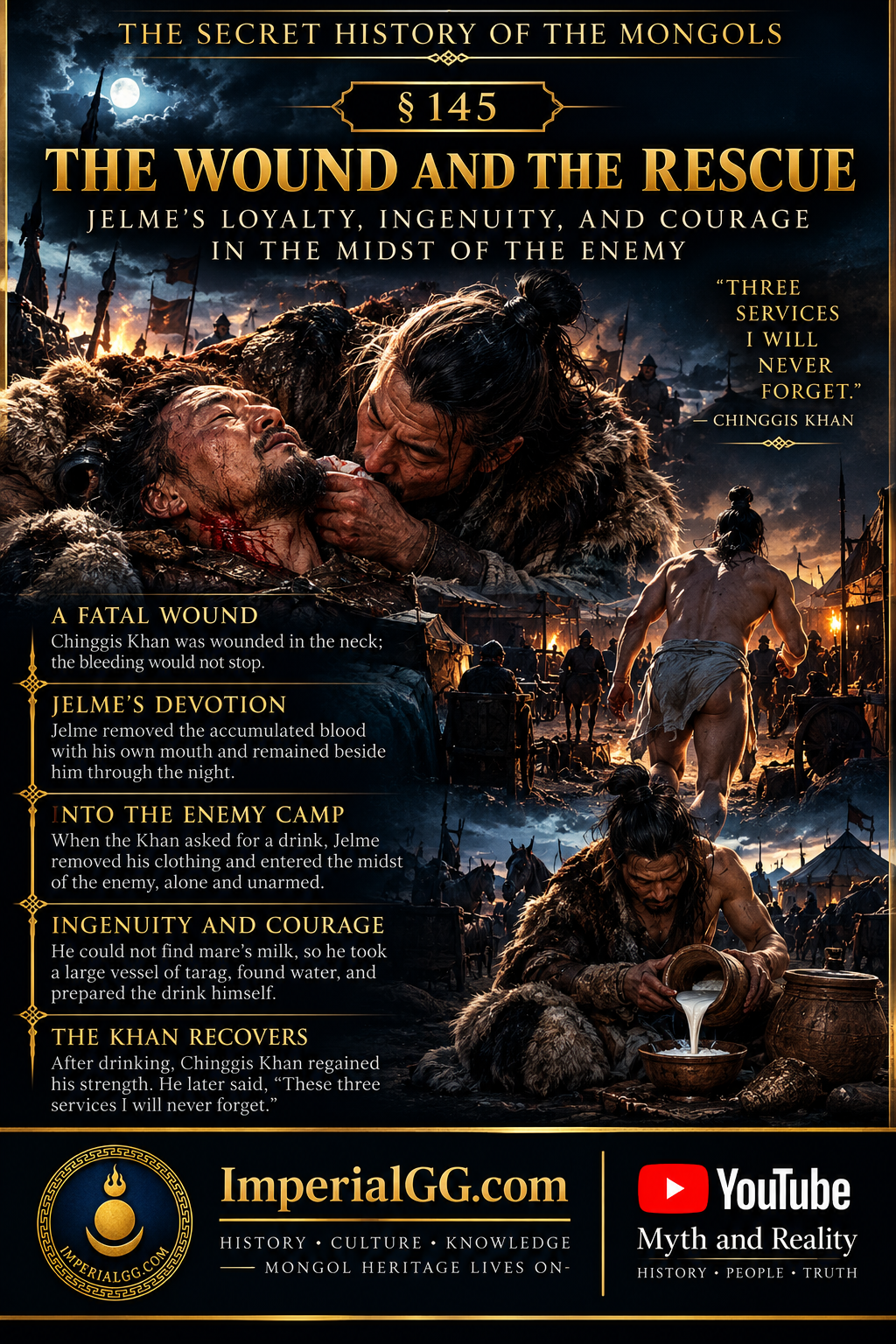
THE WOUND OF CHINGGIS KHAN AND THE ROLE OF JELME
Section 145 of The Secret History of the Mongols presents one of the most concentrated episodes in the chronicle concerning personal loyalty, battlefield initiative, and the practical responsibilities of a close companion. The episode follows the battle described in §144, where Chinggis Qan (Чингис хаан) is wounded in the neck. The text does not merely state that he was wounded; it emphasizes that the bleeding could not be stopped and that he was in severe difficulty. After sunset, the armies remain close enough that the wounded Chinggis Qan and the opposing forces are effectively encamped near one another. It is in this highly unstable battlefield environment that Jelme (Зэлмэ) assumes responsibility for preserving the life of his lord. The Secret History states that Jelme repeatedly sucked the blood that had accumulated in the wound, staining his own mouth with blood, and, “not trusting” another person, remained beside Chinggis Qan through the night. The narrative therefore establishes from the beginning that Jelme’s role is not simply that of an attendant carrying out an assigned task. He personally assumes responsibility for the wounded khan at a moment when the normal structures of command and protection have been disrupted by battle. Internet History Sourcebooks
Modern scholarship has drawn particular attention to the medical dimension of this episode. Igor de Rachewiltz notes that the removal of coagulated blood from the wound had a practical function: among steppe peoples, wounds caused by poisoned arrows were a recognized danger, and continued removal of clotted blood could reduce the danger associated with poison while also preventing other potentially fatal consequences of a deep neck wound. Timothy May similarly examines the episode as evidence for a form of battlefield medical practice that involved the repeated removal of coagulated blood by suction. These interpretations should nevertheless be distinguished from the chronicle’s own narrative. The Secret History does not present Jelme as a physician or provide a medical explanation of his actions; it simply records what he did. The medical interpretation belongs to modern scholarship, whereas the primary-source evidence establishes that Jelme repeatedly removed the coagulated blood and remained beside Chinggis Khan until his condition improved. Monumenta Altaica
WHEN THE KHAN SAID, “I AM THIRSTY”
The decisive moment comes after midnight. Chinggis Khan regains consciousness and tells Jelme that the bleeding has stopped but that he is thirsty. At this point, the problem confronting Jelme changes completely. The immediate danger is no longer only the wound itself; the wounded commander now requires something to drink, while the two forces remain in close proximity and the surrounding camps are confused by the aftermath of battle. The chronicle’s description of Jelme’s response is significant precisely because he does not wait for an order, call for assistance, or withdraw from the danger. Instead, he immediately devises a means of obtaining liquid for the wounded khan. Angkor Database
Jelme removes his hat, boots, and clothing, retaining only his undergarment, and enters the midst of the enemy. The unusual nature of this action should not be reduced merely to dramatic bravery. His decision combines concealment, improvisation, and calculated risk. The Secret History explicitly records that he later explains what he intended to do if he were captured: he would claim that he had wished to surrender, that Chinggis Khan’s people had discovered his intention, stripped him, and that he had escaped before they could remove his undergarment. Once given clothing and mounted on a horse, he intended to escape and return to Chinggis Khan. Thus the narrative gives us something more precise than a general statement that Jelme was courageous. It shows that he anticipated the possibility of capture and devised a plausible explanation that might allow him to survive it. His courage is therefore accompanied by tactical imagination. AnyFlip
INTO THE ENEMY CAMP
The most striking image in §145 is therefore not simply Jelme’s treatment of the wound, but his movement into the enemy’s midst while Chinggis Qan lies incapacitated nearby. He climbs onto a cart belonging to the neighboring camp and searches for eseg or tsэгээ, the mare’s milk drink sought for the thirsty khan. He cannot find it because the people fleeing from the battlefield have released their mares without milking them. The failure to find the expected drink could have ended the attempt, but Jelme immediately changes his plan. He takes a large vessel of tarag from one of the carts, carries it back, finds water himself, mixes the two, and gives it to Chinggis Qan. The sequence is important because it demonstrates that Jelme’s objective is not tied to one particular object. His objective is to restore the khan’s condition, and when the first solution proves impossible, he immediately creates another. Angkor Database
The narrative adds another remarkable detail: no one sees Jelme going or returning. The text then attributes his successful passage through the enemy camp to Heaven’s protection. This statement belongs to the narrative’s own cosmological framework and should not be transformed into a modern historical claim that supernatural intervention actually occurred. What the passage does demonstrate historically is that the chronicle interprets Jelme’s extraordinary escape within a broader conception of Heaven’s favor. His successful return therefore becomes not merely an act of individual skill but an event incorporated into the text’s larger understanding of Chinggis Qan’s destiny. Angkor Database
THE RETURN OF THE QAN’S STRENGTH
Jelme then gives the mixture to Chinggis Qan three times, with periods of rest between the drinks. The khan responds that his inner condition has become clear, and as he sits up, dawn begins to break. The narrative consequently connects Jelme’s actions with the restoration of Chinggis Qan’s consciousness and physical capacity. Yet the Secret History does not portray this as a miraculous instantaneous cure. Rather, the recovery is presented as the cumulative result of Jelme’s sustained intervention: removing the accumulated blood, remaining beside the wounded man, recognizing his thirst, entering the enemy camp, finding an alternative drink, bringing water, and administering it repeatedly. Internet History Sourcebooks
An especially revealing detail follows. Chinggis Qan notices that the blood Jelme had sucked from his wound and spat out has formed a muddy area around them. When he asks why Jelme did not spit it farther away, Jelme explains that he was afraid of moving too far from Chinggis Qan because he might become separated from him. He therefore swallowed what he could and spat out what he could, with some of the blood entering his own stomach. This exchange provides an important insight into Jelme’s priorities: even while performing the unpleasant and physically demanding task of removing the blood, he was concerned above all with remaining close enough to the wounded khan to continue protecting him. Angkor Database
COURAGE WITHOUT RECKLESSNESS
The conversation between Chinggis Qan and Jelme also prevents us from interpreting the episode as simple recklessness. Chinggis Qan asks why Jelme would run naked into the enemy camp while his commander lay wounded and helpless. The question identifies the central danger: if Jelme had been captured, he might have revealed the condition of Chinggis Qan. Jelme’s response demonstrates that he had already considered this possibility and prepared a deception that could preserve both his own life and the secrecy surrounding the khan’s condition. He explains that if captured, he would claim that he had intended to surrender and had escaped only after his own people discovered his supposed intention and stripped him. Once accepted by the enemy, he would obtain clothing and a horse and then escape. AnyFlip
This detail is central to understanding the character of Jelme as constructed by the Secret History. His courage does not consist merely in willingness to face danger. He enters danger with an objective, an alternative plan, and an understanding of what might happen if the first plan fails. The narrative therefore combines three qualities: unwavering loyalty to the khan, rapid practical judgment, and willingness to expose himself personally to extraordinary danger. These qualities are especially significant in a steppe military environment where survival depended not only upon physical strength but upon speed of decision, knowledge of the surrounding circumstances, and the ability to improvise under pressure.
“THESE THREE SERVICES WILL STAY WITH ME WITHIN MY HEART”
The final exchange gives the episode its political and moral significance. Chinggis Qan does not treat Jelme’s actions as an isolated act of assistance. He places them within the accumulated history of their relationship. He recalls an earlier occasion when the Three Merkits surrounded Burqan Qaldun (Бурхан Халдун), saying that Jelme had saved his life. He then identifies the removal of the coagulated blood as another restoration of his life, followed by Jelme’s entry into the enemy camp to obtain drink as a third service. He concludes that these three services will remain in his heart. Aziz Yardımlı
This formulation is particularly important because the Secret History does not merely praise Jelme’s character in abstract terms. It records specific services and remembers them cumulatively. De Rachewiltz’s commentary draws attention to the verbal structure of this passage: Jelme had earlier “taken out” Chinggis Khan’s life from danger; through removing the obstructing blood he effectively “made empty” or cleared his life; and by bringing the drink he restored what was missing. The three actions are therefore presented rhetorically as three interventions into the preservation and restoration of the khan’s life. Monumenta Altaica
LOYALTY AS DEMONSTRATED SERVICE
Section 145 can consequently be read as an important episode in the Secret History’s broader representation of the relationship between Temüjin/Chinggis Khan and his closest companions. Jelme’s value is demonstrated not through genealogy alone, nor through a formal title, but through what he actually does when the survival of his lord depends upon immediate action. The episode does not state a general political theory that merit replaces lineage, and it would be excessive to derive such a theory from §145 alone. Nevertheless, the narrative provides a concrete example in which personal service becomes visible, remembered, and explicitly acknowledged by the ruler.
This point is especially significant because Jelme’s actions are performed when there is no opportunity for public recognition, ceremony, or reward. He does not enter the enemy camp before an audience, and he does not know whether he will return. Indeed, the Secret History emphasizes that nobody sees him come or go. His service therefore precedes recognition. Only after the immediate danger has passed does Chinggis Khan articulate its value and place it within the accumulated history of Jelme’s loyalty. In this sense, §145 presents loyalty not as a declaration but as a form of demonstrated action under conditions in which the loyal companion receives no immediate advantage from performing it.
AUTHOR’S THESIS
Section 145 presents Jelme’s loyalty as an active form of political and personal service in which courage, intelligence, initiative, and calculated risk operate together. The defining feature of Jelme’s conduct is not simply that he is willing to die for Chinggis Qan, but that he repeatedly acts to preserve the khan’s life without waiting for instruction: he removes the obstructing blood, remains beside the wounded ruler, recognizes his thirst, enters an enemy camp almost naked, searches for the expected drink, improvises when it cannot be found, obtains an alternative source of nourishment, and returns without being detected. His actions therefore reveal a form of loyalty expressed through practical intelligence and personal responsibility. Chinggis Qan’s final recognition of these acts as three enduring “services” further demonstrates how exceptional personal service could become remembered political capital within the emerging Mongol order. The episode thus shows that the authority surrounding the future khan was sustained not only by kinship, military force, or formal allegiance, but also by a circle of individuals whose demonstrated loyalty under extreme conditions became part of the ruler’s remembered political foundation.
CONCLUSION
§145 is consequently much more than an anecdote about a wounded commander and a faithful companion. Its narrative structure moves from wounding, to blood loss, to thirst, to danger, to improvisation, to recovery, and finally to remembrance. At every stage Jelme responds directly to the changing condition of Chinggis Khan. The most extraordinary moment is his decision to enter the enemy’s midst almost naked in search of eseg, only to discover that the fleeing population had left no mare’s milk behind. Rather than abandon the mission, he takes tarag, finds water, prepares it himself, and returns. The episode thereby presents courage not as an isolated heroic gesture but as sustained action guided by practical judgment.
The final words of Chinggis Khan transform this private night of danger into part of the historical memory of his rise. Jelme’s services are remembered, counted, and incorporated into the relationship between ruler and companion. In the narrative logic of The Secret History of the Mongols, this is precisely how loyalty becomes historically consequential: a man acts when his lord’s life is in danger; the lord remembers the service; and that remembered service becomes part of the political memory of the emerging Mongol state.
FOOTNOTES
- Igor de Rachewiltz, trans. and ed., The Secret History of the Mongols: A Mongolian Epic Chronicle of the Thirteenth Century, §145. De Rachewiltz’s translation and commentary are especially important for the philological interpretation of Jelme’s actions. Internet History Sourcebooks
- Timothy May, “Spitting Blood: Medieval Mongol Medical Practices,” in Asian Medicine, vol. 4, no. 2 (2008), pp. 338–356. May discusses §145 in relation to Mongol battlefield wound treatment and the removal of coagulated blood. Brill
- F. W. Cleaves, trans. and ed., The Secret History of the Mongols, §145. Cleaves preserves the close textual structure of the episode, including Jelme’s entry into the enemy camp and the subsequent dialogue. Monumenta Altaica
- Urgunge Onon, trans. and ed., The Secret History of the Mongols: The Life and Times of Chinggis Khan (London: RoutledgeCurzon, 2001), §145. Onon’s translation likewise emphasizes Jelme’s risk and his explanation of the deception he would use if captured. Aziz Yardımlı
- The Secret History itself does not identify Jelme as a “doctor” in §145. The description of his actions as medical practice is a modern scholarly interpretation; the primary source records the actions without supplying that professional designation. Brill
SELECTED BIBLIOGRAPHY
- Cleaves, Francis W., trans. and ed. The Secret History of the Mongols. Cambridge, MA: Harvard-Yenching Institute, 1982. Monumenta Altaica
- May, Timothy. “Spitting Blood: Medieval Mongol Medical Practices.” Asian Medicine 4, no. 2 (2008): 338–356. Brill
- Onon, Urgunge, trans. and ed. The Secret History of the Mongols: The Life and Times of Chinggis Khan. London: RoutledgeCurzon, 2001. Google Books
- de Rachewiltz, Igor, trans. and ed. The Secret History of the Mongols: A Mongolian Epic Chronicle of the Thirteenth Century. Leiden: Brill, 2004. Internet History Sourcebooks