
THE JÜRKIN: THE DESTRUCTION OF A RIVAL POLITICAL ORDER
By Altanbagana Baatar
DBA Candidate| Independent Historian
ImperialGG Historical Research Seriers
20 September 2026
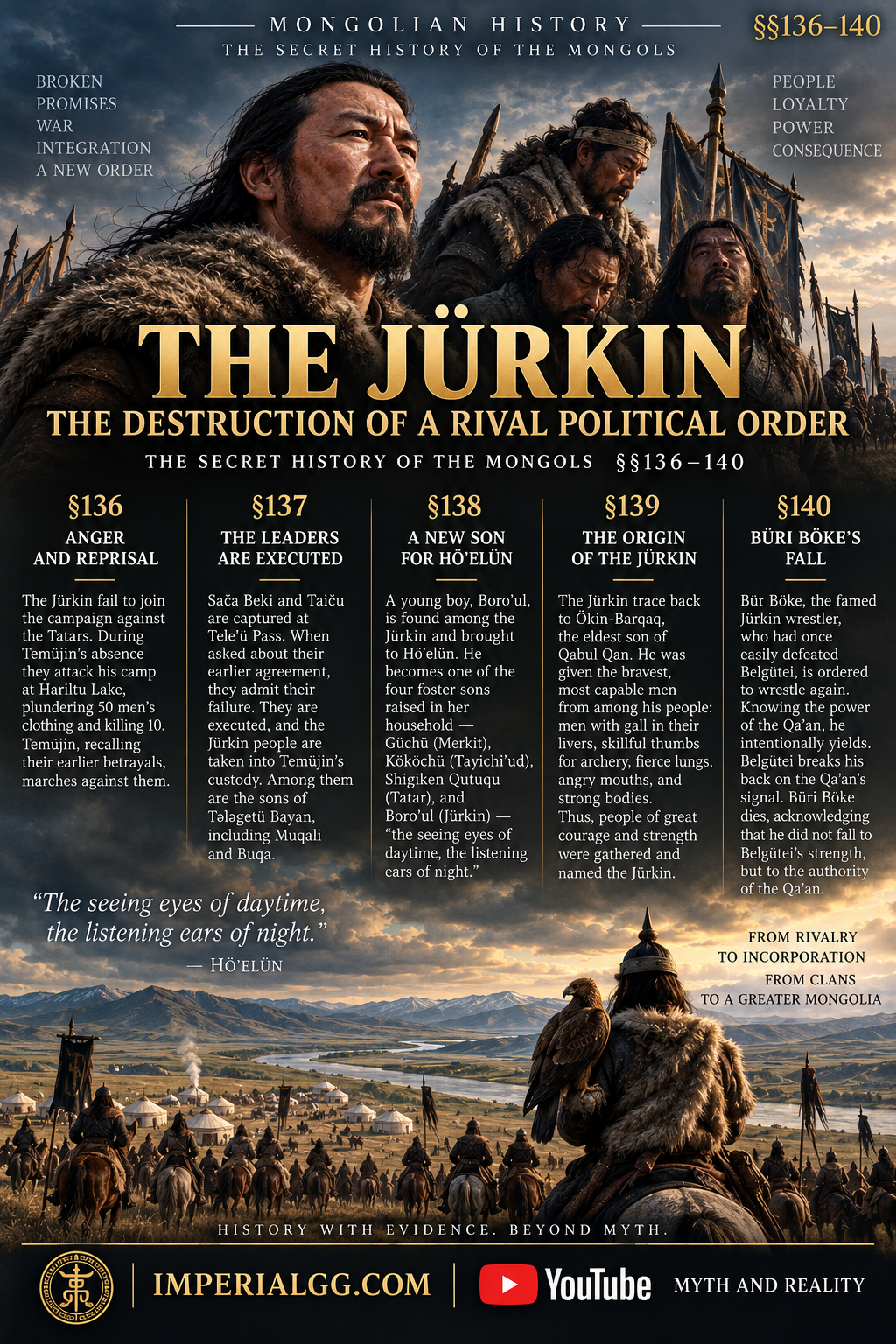
THE SECRET HISTORY OF THE MONGOLS §§136–140
The destruction of the Jürkin in §§136–140 of The Secret History of the Mongols should not be understood simply as another episode of inter-clan warfare in the career of Temüjin. The narrative presents the conflict as the culmination of accumulated political obligations, broken agreements, acts of violence, and competing claims to authority, while the subsequent incorporation of Jürkin people and the fate of their leading figures reveal a broader process through which Temüjin was reorganizing the political communities of the Mongolian steppe. The significance of the episode lies precisely in this combination of destruction and incorporation: the ruling structure associated with the Jürkin was eliminated, while people originating from that political community were redistributed into the expanding order centered upon Temüjin. In this respect, §§136–140 belong to the larger transformation already visible in the preceding sections, in which allegiance, military service, political obligation, and incorporation were becoming increasingly important mechanisms of political organization alongside genealogy and inherited aristocratic status.[1]
Section 136 provides the immediate cause of the campaign. When Temüjin had previously summoned the Jürkin to participate in the campaign against the Tatars, they did not come as expected. During his absence, moreover, they attacked the camp that had remained at Hariltu Lake, plundered the clothing of fifty men, and killed ten. The Secret History does not present this assault as an isolated incident. Temüjin recalls the accumulated grievances between himself and the Jürkin, including the earlier humiliation of Shiki’ür, the wounding of Belgütei, and their failure to participate in the Tatar campaign. The campaign against the Jürkin therefore emerges from a history of deteriorating political relations rather than from a single act of violence. The narrative logic is one of accumulated obligation: a group that had previously stood within the wider Mongol political community had repeatedly failed to honor its commitments and had ultimately attacked Temüjin’s own camp.[2]
This point becomes especially important when §137 describes the capture of Sača Beki and Taiču. After Temüjin pursued the Jürkin to the Qodo’a Aral on the Kherlen and captured their leaders at Tele’ü Pass, he did not simply execute them as defeated enemies. He first asked them to recall what they had previously agreed with him. Their answer acknowledges that they had failed to keep their word and effectively places their fate in Temüjin’s hands. The narrative consequently frames their execution through the language of broken agreement and political obligation. The death of Sača Beki and Taiču thus represents the destruction of the Jürkin leadership rather than the indiscriminate destruction of everyone associated with the Jürkin.[3]
This distinction becomes critical in understanding what follows. The people of the Jürkin are not simply erased from the narrative. They are incorporated into Temüjin’s political community. Among them were the sons of Tələgetü Bayan of the Jalayir, Gü’ün U’a and his sons Muqali and Buqa. The young Muqali would later become one of the most important commanders of the Mongol Empire, but his later career should not be projected backward into §137 as though the Secret History were already describing that future position. What §137 actually records is an act of submission and incorporation: a father places his sons in the service of Temüjin and entrusts them to his authority.[4] Their subsequent careers demonstrate the historical consequences of such incorporation, but the immediate significance of the episode lies in the creation of a political relationship between a conquered or subordinated community and the emerging ruler.
The same principle becomes even more visible in §138. From the Jürkin camp comes a young boy named Boro’ul, who is brought before Hö’elün. He joins three other boys whom she raises within her household: Güchü, obtained from the Merkit camp; Kököchü, obtained from the Besüt among the Tayichi’ud; and Shigiken Qutuqu, obtained from the Tatar camp. Hö’elün describes these four boys in terms of their future usefulness to her sons, as “the seeing eyes of daytime” and “the listening ears of night.”[5] The passage is important because it reveals an alternative mechanism of political incorporation. Conquest did not necessarily terminate the social existence of defeated communities; people could be detached from their previous political affiliations and incorporated into the household and service structure of the victorious ruler. The later prominence of these individuals makes the passage especially significant, but the fundamental evidence is already present in the narrative itself: the emerging political order was capable of absorbing people whose origins lay among former enemies and rivals.
Section 139 then turns from the destruction of the Jürkin to an explanation of how the Jürkin had originally become a distinct political group. This is one of the most analytically important passages in the entire sequence. The Secret History traces the group to Ökin-Barqaq, the eldest of Qabul Qan’s seven sons, and identifies Sorqatu-Jürki as his son. Qabul Qan, emphasizing Ökin-Barqaq’s seniority among his sons, selected from among his people men characterized by exceptional martial and personal qualities and placed them under Ökin-Barqaq. The text then explains the name Jürkin through a cluster of characteristics involving gall, archery, bodily vitality, anger, courage, and personal ability.[6]
Here the wording of the source deserves particular attention. In Cleaves’s translation, the men are described as having “gall in the liver,” the ability in the thumb to shoot arrows, “lungs full of heart,” and “mouths full of fury.”[7] de Rachewiltz renders the same sequence somewhat differently, referring to men with gall in their livers, strength in their thumbs for shooting arrows over great distances, hearty lungs, mouths full of anger, and strong men skilled in wrestling.[8] The differences between these translations are not merely stylistic. They remind us that the Mongolian text contains lexical and philological problems that require caution before a modern Mongolian expression is treated as an exact equivalent of the medieval wording. The safest conclusion is that §139 associates the Jürkin with a cluster of qualities—courage, aggression, martial competence, physical strength, and exceptional individual ability—and that the text itself uses those qualities to explain the group’s name.[9]
This passage also complicates any simple understanding of the Jürkin as a homogeneous biological or kin-based “tribe.” Christopher Atwood has drawn attention to the political character of such groups in the Secret History, arguing that the terminology traditionally translated as “tribe” can obscure the administrative and political relationships represented in the Mongolian text. His reading of §139 emphasizes that Qabul Qan himself selected capable men from his own people and placed them under Ökin-Barqaq. In this interpretation, the Jürkin were not merely an already-existing collection of kinsmen who happened to bear a common name; the passage describes the formation of a political constituency through the deliberate concentration of selected personnel under a particular aristocratic line.[10] This observation is particularly relevant to the sequence of §§136–140, because Temüjin’s later action against the Jürkin can then be understood as the destruction of a rival political structure, followed by the redistribution and incorporation of its people.
The final sentence of §139 makes this transformation explicit. After describing the Jürkin as courageous people, the Secret History states that Činggis Qahan subdued them, destroyed the Jürkin oboγ, and made their people and subjects his own people. The distinction between the ruling group and the people under its authority is significant. Atwood has specifically emphasized this passage as evidence that the Jürkin name could refer to the ruling lineage or political elite, while the text separately identifies the people and subjects who came under its authority.[11] The political result of the conquest was therefore not simply that “the Jürkin disappeared.” Rather, the Jürkin ruling structure was dismantled and its population was transferred into Temüjin’s political community.
This is where the possible semantic association between Jürkin and zürh, “heart,” becomes an interesting question for further Mongolian philological study. The Secret History itself creates an unmistakable semantic field around the Jürkin name: courage, fury, gall, martial ability, and finally the characterization of these people as possessing strong or courageous hearts. Yet this does not by itself establish that the ethnonym Jürkin historically derives from the modern Mongolian noun zürh. The text may preserve an older wordplay or explanatory etymology, and the precise interpretation of forms such as jirügetü and jörkimes remains a philological question. The academically defensible position is therefore to distinguish between the internal etymological explanation supplied by the Secret History and a historical linguistic derivation from the modern word zürh. The former is directly present in the source; the latter requires additional linguistic evidence.[12]
Section 140 completes the destruction of the Jürkin political order through the extraordinary episode of Büri Böke and Belgütei. Büri Böke had previously been renowned as an exceptionally powerful wrestler. The Secret History recalls that, when he was still associated with the Jürkin, he could seize Belgütei with one hand, trip him with one foot, throw him down, and hold him immobile. He is described as the strongest man among his people.[13] Yet when Činggis Qahan orders the two men to wrestle again, Büri Böke deliberately allows himself to be thrown. Belgütei looks toward the Qa’an, sees him biting his lower lip, and understands the signal. The subsequent breaking of Büri Böke’s spine ends the life of a man who had embodied the physical strength and prestige of the former Jürkin order.[14]
The scene should not be reduced to a simple demonstration of wrestling technique. The Secret History explicitly contrasts Büri Böke’s former physical superiority with the political authority of the Qa’an. Büri himself explains that he did not believe Belgütei could defeat him physically; rather, he deliberately yielded because he feared the Qa’an. The narrative therefore places two forms of power beside one another: the extraordinary physical power represented by Büri Böke and the political authority represented by Temüjin. The former could dominate an individual contest; the latter determined the political meaning and final consequence of the contest.[15] Whether the scene should be interpreted as a deliberately constructed literary representation of the passing of an older aristocratic order is a matter of interpretation rather than explicit statement by the source. Nevertheless, within the structure of §§136–140, the death of Büri Böke follows immediately after the destruction of the Jürkin leadership and provides a striking narrative image of the subordination of an older center of aristocratic prestige to the authority of Temüjin.
AUTHOR’S THESIS
The Jürkin episode should therefore be understood as a stage in the transformation of the Mongolian political landscape rather than merely as another feud between related groups. The Secret History of the Mongols presents the Jürkin as a politically constituted community whose strength had originally been assembled through the deliberate selection of capable and courageous men under the senior branch of Qabul Qan’s descendants. Their later destruction under Temüjin demonstrates the reversal of that political relationship: the former ruling group was eliminated, while its people, children, and capable men were incorporated into the expanding political community of Temüjin. The significance of §§136–140 lies precisely in this combination of destruction of a rival elite and incorporation of its human resources.
The episode also suggests a broader transformation in the meaning of political power. Genealogy remained fundamental: the conflict itself was rooted in the competing branches of Qabul Qan’s descendants. Yet genealogy alone no longer guaranteed political survival. The Jürkin possessed lineage, martial prestige, and powerful men, but their political autonomy depended upon continued loyalty and participation within the wider coalition. Once those political obligations were repeatedly broken, their separate authority became vulnerable to destruction. Conversely, individuals originating from defeated communities could enter the new order through submission, service, household incorporation, and personal loyalty. In this sense, §§136–140 document a transition in which lineage continued to provide political legitimacy, while service and incorporation increasingly determined how human allegiance was reorganized around Temüjin.
The Secret History therefore preserves something more complex than a simple story of conquest. It records the dismantling of one political constituency and the absorption of its people into another. The Jürkin were powerful because they had been deliberately constituted around courage, military ability, and aristocratic lineage; they were destroyed when their political relationship with Temüjin collapsed; and their people were nevertheless carried forward into the emerging Mongol political order. The history of the Jürkin thus becomes part of the larger process through which Temüjin transformed a landscape of competing aristocratic communities into a political structure increasingly centered on a single Qa’an.
NOTES
[1] Igor de Rachewiltz, The Secret History of the Mongols: A Mongolian Epic Chronicle of the Thirteenth Century, 3 vols. (Leiden: Brill, 2004–2013), §§136–140. The ANU describes de Rachewiltz’s edition as the standard English version, with Volume 3 providing revisions and supplementary commentary.
[2] Secret History of the Mongols, §136. The sequence of grievances connects the Jürkin’s absence from the Tatar campaign with their subsequent attack on Temüjin’s camp.
[3] Ibid., §137. The Secret History explicitly recalls the earlier agreement with Sača Beki and Taiču before describing their execution.
[4] Ibid., §137. Muqali’s later career should be treated separately from the immediate narrative of §137; the Secret History here records his incorporation into Temüjin’s service.
[5] Ibid., §138. The four boys are Güchü, Kököchü, Shigiken Qutuqu, and Boro’ul. See also de Rachewiltz, Secret History, §138.
[6] Secret History of the Mongols, §139. The section explicitly introduces itself as an explanation of how the Jürkin people received their name.
[7] Francis Woodman Cleaves, The Secret History of the Mongols, §139. Cleaves renders the relevant expressions as “gall in the liver,” “ability in the thumb to shoot arrows,” “lungs full of heart,” and “mouths full of fury.”
[8] de Rachewiltz, Secret History, §139. His translation uses “hearty lungs,” “mouths full of anger,” and emphasizes strength in the thumb for shooting arrows over great distances.
[9] For the underlying Mongolian text and the lexical sequence in §139, see John C. Street’s textual materials and the version reproduced by the Mongolian Studies Center.
[10] Christopher P. Atwood, “How the Mongols Got a Word for Tribe—and What It Means,” Studia Historica Mongolica 10 (2010): 63–89; revised discussion in “The Administrative Origins of Mongolia’s ‘Tribal’ Vocabulary,” Eurasia: Statum et Legem 1.4 (2015): 7–45. Atwood’s work challenges the uncritical use of “tribe” for Mongolian political units.
[11] Atwood’s interpretation of §139 distinguishes the Jürkin oboγ from the irgen and ulus under its authority. This distinction has also been discussed in scholarship on Mongolian political organization.
[12] The association should therefore be presented as a textual-semantic observation, not as an established historical etymology. The different translations of the relevant Middle Mongolian terms demonstrate why the linguistic question requires philological caution.
[13] Secret History of the Mongols, §140. Büri Böke is explicitly characterized as the strongest man among his people.
[14] Ibid., §140.
[15] Ibid. Büri Böke’s final statement explicitly distinguishes his physical ability from his fear of the Qa’an.
SELECTED BIBLIOGRAPHY
Atwood, Christopher P. “How the Mongols Got a Word for Tribe—and What It Means.” Studia Historica Mongolica 10 (2010): 63–89.
Atwood, Christopher P. “The Administrative Origins of Mongolia’s ‘Tribal’ Vocabulary.” Eurasia: Statum et Legem 1.4 (2015): 7–45.
Cleaves, Francis Woodman. The Secret History of the Mongols. Cambridge, MA: Harvard University Press.
de Rachewiltz, Igor. The Secret History of the Mongols: A Mongolian Epic Chronicle of the Thirteenth Century. 3 vols. Leiden: Brill, 2004–2013.
Street, John C. The Secret History of the Mongols: textual and philological materials. University of Wisconsin / Monumenta Altaica.