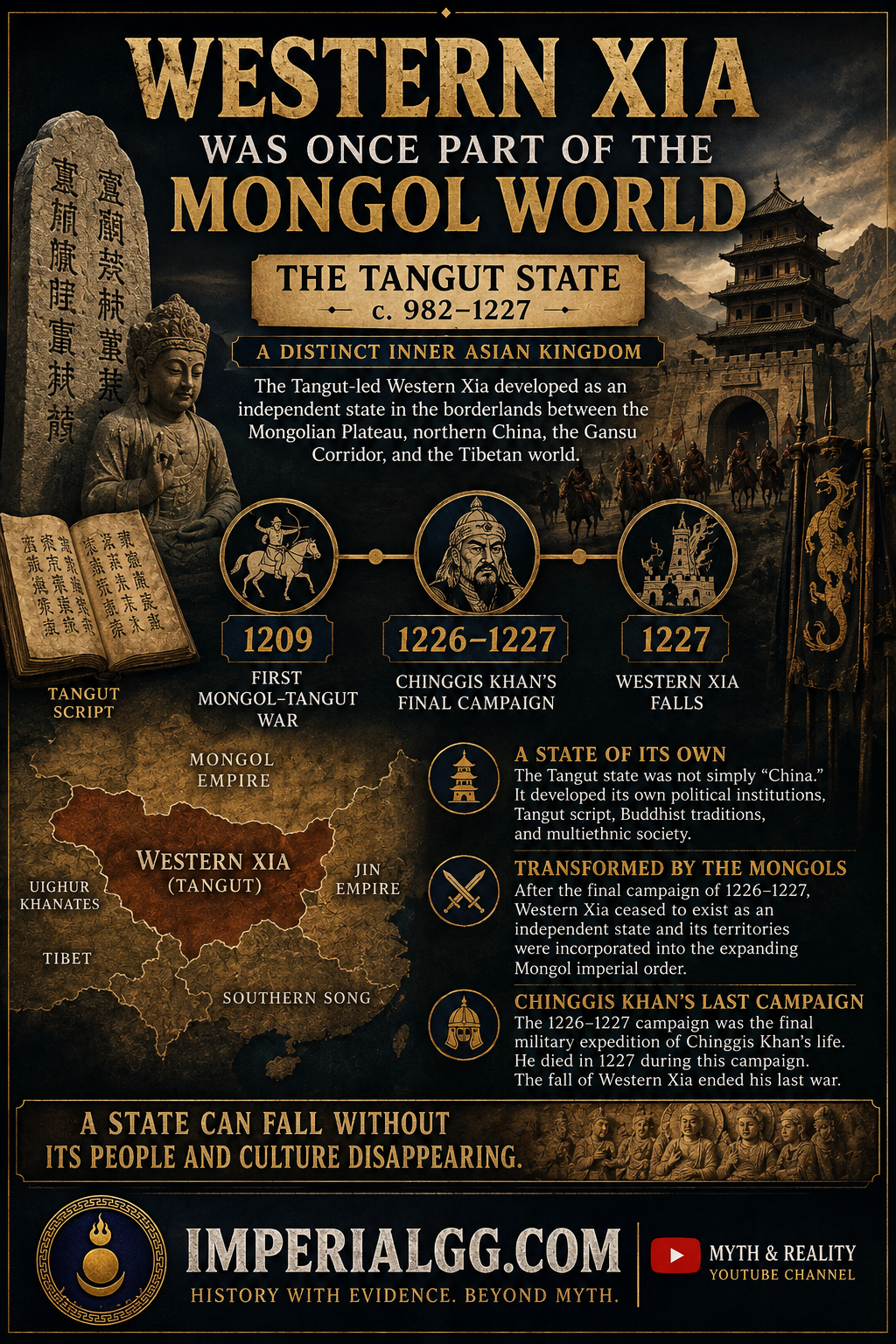
WESTERN XIA AND THE MONGOL WORLD
By Altanbagana Baatar
DBA Candidate| Independent Historian
ImperialGG Historical Research Seriers
10 August 2026
The Tangut State and Chinggis Khan’s Final Campaign
The history of the Mongol Empire cannot be understood solely through the conquest of China. Before the Mongols reached the Southern Song, they confronted a number of powerful states along the eastern and northern frontiers of Inner Asia. Among them was Western Xia (Xi Xia), the Tangut-ruled state that occupied a strategically important region along the Ordos, Gansu Corridor, and the northern approaches to the Tibetan Plateau.
Western Xia existed from approximately 982 to 1227 and developed its own political institutions, written language, Buddhist traditions, and complex multiethnic society. At its height, the state controlled territory extending across the Ordos and Gansu Corridor, with its capital at Zhongxing on the Yellow River. Its population included Tanguts alongside Chinese, Tibetans, Uyghurs, Khitans, and other groups.
The Tangut state was therefore not simply a peripheral Chinese province. It was an independent Inner Asian polity situated between several major political worlds: the Mongolian steppe, the Jin Empire to the east, the Uyghur territories to the northwest, and Tibetan regions to the south.
The Tangut State
The Tangut rulers established the Western Xia dynasty in 1038, although the state itself had emerged earlier. Its political and cultural system combined several traditions. Chinese-style administrative institutions existed alongside Inner Asian political practices. Buddhism was strongly patronized by the ruling house, while Tangut, Chinese, and Tibetan languages were used within the kingdom. The Tanguts also developed their own written script and produced an extensive literary and religious corpus.
The result was a distinctly multiethnic and culturally hybrid state, rather than a simple extension of any neighboring civilization.
Its geographical position was equally significant. Western Xia controlled important sections of the routes connecting northern China with Central Asia. Its territories included portions of the Gansu Corridor, one of the principal passages between the Chinese heartlands and the Inner Asian world. This made the Tangut state strategically important to the expanding Mongol Empire.
The First Mongol–Tangut War
After Temüjin was proclaimed Chinggis Khan in 1206, the Mongols increasingly turned their attention toward the sedentary states surrounding the Mongolian Plateau. Western Xia became one of the first major targets.
In 1209, Mongol forces invaded Western Xia and forced the Tangut ruler to submit. The state was reduced to a tributary relationship with the Mongol Empire, although it retained its own ruler and internal political structures. The settlement did not permanently resolve Mongol–Tangut relations. Western Xia continued to exist as a separate political entity, and the Tangut rulers did not simply disappear into the Mongol imperial structure. Their later decisions would eventually bring them into renewed conflict with Chinggis Khan.
A Changing Imperial Landscape
The Mongol relationship with Western Xia also needs to be viewed within the broader transformation of Inner Asia. In 1209, the Uyghur ruler submitted to Chinggis Khan, bringing another strategically important polity into the Mongol sphere. The Mongols subsequently expanded westward, defeating the Qara Khitai and launching the Khwarazmian campaign between 1219 and 1225. Western Xia therefore found itself surrounded by an expanding imperial system.
The Mongol Empire was no longer simply a steppe power. Within a few decades, it had become a transregional empire connecting the Mongolian Plateau with Central Asia and the states of northern China. The Tangut state occupied a critical position within this changing geopolitical environment.
The Final Conflict
The decisive confrontation came in 1226. Chinggis Khan launched a new campaign against Western Xia. The reasons for this renewed war have been debated, and medieval sources provide different explanations concerning Tangut resistance, political obligations, and the wider circumstances of the campaign.What is clear is that the campaign became the final major military operation of Chinggis Khan’s life.
The Mongols defeated the Tangut forces and captured the principal centers of Western Xia. In 1227, the Tangut state ceased to exist as an independent political entity. Encyclopaedia Iranica describes the destruction of Xi Xia in 1227 as Chinggis Khan’s last military action.
The chronology is significant:
1206 — Chinggis Khan becomes Great Khan
↓
1209 — First Mongol conquest of Western Xia
↓
1210s–1220s — Western Xia remains a separate tributary state
↓
1226 — Final Mongol campaign against Western Xia
↓
1227 — Western Xia falls
Chinggis Khan’s Final Campaign
The importance of the 1226–1227 campaign extends beyond the destruction of one state. It was the final military campaign personally undertaken by Chinggis Khan. His death occurred during this campaign in 1227, although the precise circumstances and chronology of his death remain subjects of historical discussion.
The Mongol armies nevertheless completed the destruction of Western Xia shortly afterward. The conquest also demonstrated the growing integration of military resources across the Mongol world. The Uyghurs, for example, had become important allies and participants in Mongol campaigns, including the war against the rebellious Tangut.
Thus, the destruction of Western Xia was not merely a conflict between “Mongols and Tanguts.” It occurred within a much larger imperial system in which different peoples, armies, administrators, and political elites were increasingly interconnected.
What Happened to the Tanguts?
The fall of Western Xia did not mean that every Tangut disappeared. The political state was destroyed, but Tangut people and cultural traditions continued to exist under Mongol rule. Tangut manuscripts and Buddhist materials survived well beyond 1227 and became important sources for understanding both Tangut civilization and the Mongol period. The Qara-Qoto collections, for example, contain Tangut materials dating beyond the fall of the Western Xia state.
This distinction is essential:
A state can disappear without its people and culture disappearing immediately.
The Mongol conquest therefore marked the end of Western Xia as an independent state, but not the instantaneous disappearance of Tangut society.
Western Xia and the Mongol World
Western Xia occupies an important position in the history of the Mongol Empire because it illustrates an early stage of Mongol imperial expansion. The Mongols did not encounter an empty political landscape. They confronted established states with their own governments, armies, economies, religions, and cultural traditions.
Western Xia was one of those states. Its incorporation into the Mongol imperial order illustrates a recurring pattern of the thirteenth century: a powerful local civilization was not erased simply because it was conquered; instead, its institutions, people, technologies, and cultural traditions became part of a new imperial environment.
The Mongol conquest of Western Xia therefore belongs simultaneously to Tangut history, Inner Asian history, Chinese history, Tibetan-borderland history, and the history of the Mongol Empire.
Why Western Xia Matters
Western Xia is often overshadowed by the better-known Mongol conquests of the Jin, Khwarazm, and Southern Song. Yet its history is crucial for understanding how the Mongol Empire developed.
The first Mongol campaigns against Western Xia demonstrated that the Mongols could defeat a fortified sedentary state. The later destruction of the kingdom in 1227 marked the completion of Chinggis Khan’s final campaign. The region itself also became part of the larger political and economic system created by the Mongol Empire.
Western Xia was therefore not simply “a kingdom conquered by the Mongols.” It was one of the states through which the Mongol Empire transformed the political geography of Inner Asia.
A historical sequence
WESTERN XIA — c. 982–1227
TANGUT DYNASTY — 1038–1227
MONGOL CONQUEST — 1209
FINAL CAMPAIGN — 1226–1227
FALL OF WESTERN XIA — 1227
The history of Western Xia reminds us that the Mongol Empire emerged through interaction with existing civilizations rather than in isolation from them.
The Mongols conquered the Tangut state.
They did not create Tangut civilization.
But the conquest transformed the Tangut world and incorporated its people, knowledge, and cultural traditions into the expanding Mongol Empire.
Notes & Sources
[1] The Cambridge History of China, “The Hsi Hsia.” The chapter describes Western Xia as a state existing approximately 982–1227, extending across the Ordos and Gansu Corridor, and emphasizes its multiethnic population and Buddhist culture.
[2] Peter Jackson, “The Mongol Age in Eastern Inner Asia,” The Cambridge History of Inner Asia. The chapter places Xixia alongside the major powers bordering the Mongolian steppe and identifies it as the Tangut-ruled empire of approximately 982–1227.
[3] Peter Jackson, “Mongols,” Encyclopaedia Iranica. Jackson notes that the Tangut state was reduced to tributary status in 1209 and that the destruction of Xi-Xia in 1227 constituted Chinggis Khan’s last military action.
[4] Morris Rossabi, “Chinese Turkestan iv. In the Mongol Period,” Encyclopaedia Iranica. This study discusses the Tangut state, the 1209 submission, the 1226 rebellion/campaign, the role of Uyghur forces, and the fall of the Tangut state in 1227.
[5] Ruth W. Dunnell, “Tangut Sources,” The Cambridge History of the Mongol Empire. Tangut textual and visual materials, particularly Buddhist sources from Qara-Qoto, remain important for reconstructing Tangut culture and its relationship with the Mongol and Yuan worlds.