CHINA AND THE MONGOL WORLD
By Altanbagana Baatar
DBA Candidate| Independent Historian
ImperialGG Historical Research Seriers
10 August 2026
The Yuan, the Southern Song, and the Transformation of East Asia
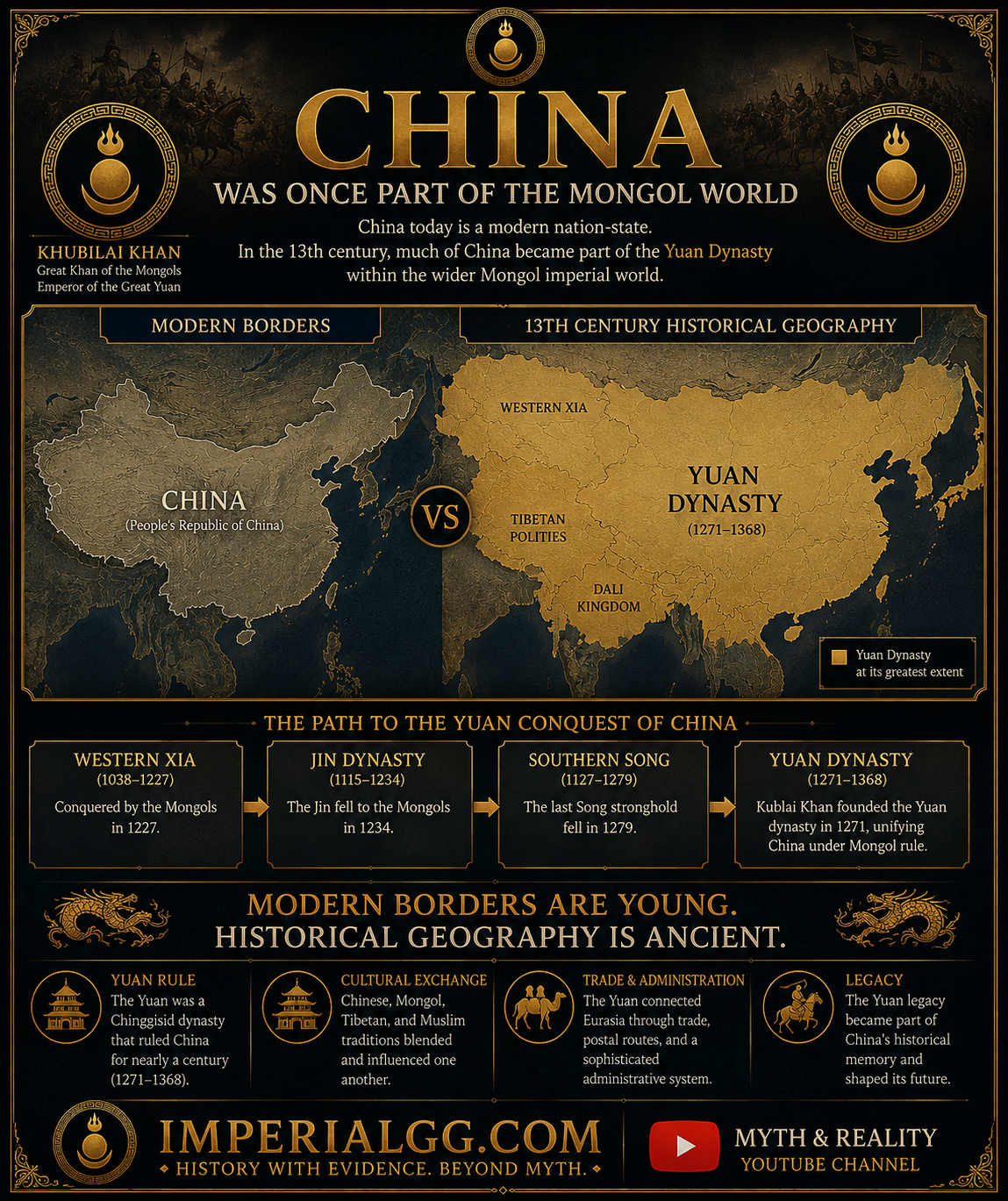
The Yuan, the Southern Song, and the Transformation of East Asia The Mongol incorporation of China was not a single act of conquest. It was a prolonged political and military process that unfolded across much of the thirteenth century.
Mongol armies first conquered the Western Xia in 1227 and defeated the Jin dynasty in 1234. The war against the Southern Song, however, continued for several decades and culminated in the Song defeat in 1279.
In 1271, Kublai Khan proclaimed the Great Yuan Dynasty (Da Yuan), establishing a Chinggisid imperial regime that eventually ruled the territories formerly controlled by the Song. The Yuan therefore occupies a distinctive position in East Asian history. It was simultaneously a Mongol imperial polity and a Chinese dynastic state.
A Mongol Dynasty in China
Kublai adopted many institutions associated with Chinese political tradition, including administrative structures, court rituals, bureaucratic practices, and the dynastic model of government. At the same time, the Yuan court retained important Mongol imperial traditions and remained part of the wider Chinggisid political world.
This combination makes the Yuan difficult to classify through a single modern category. The Yuan state was not simply a foreign regime imposed upon an unchanged China. Nor was it simply a continuation of earlier Chinese dynasties under a different ruling family. It was a new political formation created through the interaction of Mongol imperial institutions, Chinese administrative traditions, and the diverse peoples and political cultures of East and Inner Asia. The Yuan political world included Mongols alongside Chinese, Khitans, Jurchens, Uyghurs, Tibetans and many other communities. Their roles differed within the imperial administration, military, economy, and society.
The Mongols Did Not Create Chinese Civilization
Recognizing the scale of Mongol rule does not require claiming that the Mongols created Chinese civilization. China possessed sophisticated political institutions, urban centers, agricultural systems, literary traditions, technologies, and intellectual cultures long before the Mongol conquest. The significance of the Yuan period lies elsewhere.
Mongol rule entered an already highly developed civilization and transformed its political and economic environment. Conquest was followed by administrative reorganization, population movement, military restructuring, new patterns of taxation, expanded trade, and intensified connections between East Asia and other parts of the Eurasian world. The Yuan period therefore needs to be studied not only as a chapter in Chinese history, but also as part of the broader transformation of the Mongol Empire and the Chinggisid world.
Beyond Modern National Borders
The historical geography of thirteenth-century East Asia was considerably more complex than the map of modern nation-states suggests. The political landscape included Western Xia, Jin, Southern Song, Dali, Tibetan polities, and the Yuan, among others. These societies possessed their own political traditions, languages, religions, and historical identities.
They should not be collapsed into a single category. Yet they became increasingly interconnected through the expansion of Mongol power. The Mongol Empire connected political spaces that had previously operated within different regional systems. East Asian states became part of a much larger network extending across the Eurasian steppe, Central Asia, the Middle East, and Eastern Europe. This did not erase local civilizations. Instead, it created new forms of political interaction, mobility, commerce, administration, and cultural exchange.
The Yuan as Part of Two Histories
The Yuan can therefore be understood from two complementary perspectives. From the perspective of Chinese history, it was a dynastic state that ruled China and adopted important Chinese institutions.
From the perspective of Mongol imperial history, it was the eastern imperial center of a Chinggisid world whose political connections extended far beyond China. These perspectives are not mutually exclusive. The historical reality was more complex than the modern question of whether the Yuan was simply “Mongol” or simply “Chinese.”
The Question Is Not “Mongol or Chinese?”
The more useful historical question is:
How did Mongol imperial power, Chinese institutions, and the diverse peoples of East and Inner Asia interact to create the Yuan world?
That question allows us to examine conquest without reducing history to conquest alone. It allows us to recognize the achievements of earlier Chinese civilizations without ignoring the profound transformation brought by Mongol rule. And it allows the Yuan to be understood within both Chinese history and the wider history of the Mongol Empire.
MODERN BORDERS ARE YOUNG.
HISTORICAL GEOGRAPHY IS ANCIENT.
ImperialGG.com
History with Evidence. Beyond Myth.