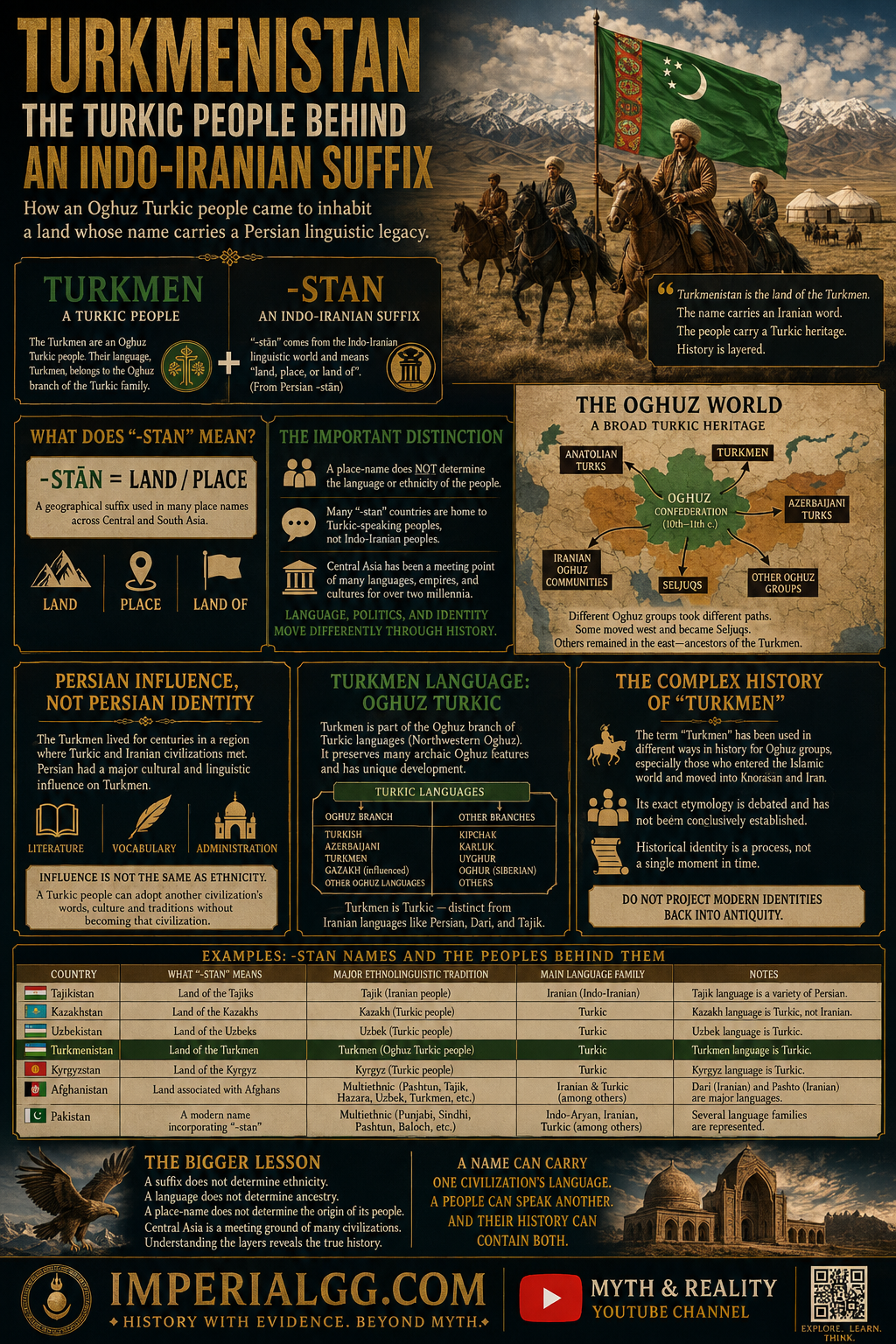
TURKMENISTAN: THE TURKIC PEOPLE BEHIND AN INDO-IRANIAN SUFFIX
How an Oghuz Turkic people came to inhabit a land whose name carries a Persian linguistic legacy
When we look at Turkmenistan, the name itself seems to contain two different historical worlds:
TURKMEN + ISTAN
The first refers to the Turkmen people.
The second, -stān, is a geographical element of Iranian linguistic history meaning approximately “land” or “place.” This combination is historically significant because the modern Turkmen are a Turkic-speaking people, while the geographical suffix belongs to a linguistic tradition deeply associated with the Iranian languages of Central Asia and Persia. The name therefore gives us a perfect example of why place-name, language, ethnicity, and ancestry must not be treated as the same thing.
1. WHO ARE THE TURKMEN?
The Turkmen are traditionally associated with the Oghuz branch of the Turkic peoples. Modern Turkmen belongs to the Oghuz group of Turkic languages, forming its own northwestern branch. Encyclopaedia Iranica notes that Turkmen preserves a number of relatively archaic Oghuz features and that its historical development took place in continuous contact with Iranian languages, particularly Persian.
This places Turkmen linguistically in the same broad Oghuz family as:
- Turkish
- Azerbaijani
- Turkmen
- several other Oghuz varieties of Central Asia and Iran
But that does not mean that these peoples are identical. Their histories diverged over centuries.
2. THE OGHUZ CONNECTION
The history of the Turkmen is closely connected with the medieval Oghuz world. The Oghuz were a major Turkic confederation inhabiting the regions around the Aral Sea and Central Asia. From the 10th–11th centuries onward, different Oghuz groups moved south and west. Some became associated with the Seljuq expansion into Iran and Anatolia. Others remained farther east around the Caspian and Central Asian regions.
Modern Turkmen are generally understood as descendants of Oghuz populations that remained in or returned to the eastern Oghuz zone rather than following the main westward Seljuq migration. This distinction is important. The history of the Oghuz was not a single migration by a single people. It was a long process involving tribal confederations, migrations, political alliances, warfare, settlement, and cultural transformation.
3. TURKMENISTAN WAS NOT “AN IRANIAN COUNTRY”
This is where the “-stan” question can easily create confusion. The suffix -stān has a long history in Iranian languages and means approximately:
land / place / land of
But the presence of this suffix does not mean that the people living in the country are Iranian. Turkmenistan is a particularly clear example.
Turkmen → Turkic
-stan → Iranian/Persian geographical vocabulary
Therefore:
Turkmenistan = the land of the Turkmen
The name contains linguistic layers from different historical traditions. That is normal in Central Asian history.
The Turkmen lived for centuries in a region where Turkic and Iranian civilizations met. Consequently, Persian had a major cultural and linguistic influence on Turkmen. Iranica notes that Turkmen has numerous Persian loanwords and that Persian influence was particularly significant in the development of Turkmen literary culture. This is an important historical distinction:
Influence is not the same thing as ethnic identity.
A Turkic language can borrow heavily from Persian.
A Turkic political elite can rule Persian-speaking populations.
A Persian word can become part of a Turkic language.
And a Persian geographical suffix can become part of the name of a Turkic country. None of these facts require the population to become ethnically Iranian.
5. THE TURKMEN WERE PART OF A MUCH LARGER OGHUZ WORLD
The medieval Oghuz world stretched far beyond modern Turkmenistan. Different Oghuz groups eventually contributed to the formation of several major peoples and political traditions across Eurasia.
The broad historical connections include:
Oghuz
↓
Turkmen
Seljuqs
↓
Iranian Oghuz communities
Azerbaijani Turks
Anatolian Turks
This does not mean that modern Turkmen, Turks and Azerbaijanis are simply “the same people.” It means that they share important Oghuz linguistic and historical ancestry while developing distinct identities over centuries. Encyclopaedia Iranica describes these distinctions and identifies Turkmen as an East/Northwestern Oghuz language, separate from Khorasani Turkish, Azerbaijani and Anatolian Turkish.
6. THE IRANIAN–TURKIC BORDER WAS NEVER A SIMPLE LINE
One of the most important lessons from Turkmen history is that Central Asia cannot be divided into neat modern ethnic boxes and projected backward into antiquity.
Turkic peoples and Iranian-speaking peoples interacted for centuries.
They traded. They fought. They migrated. They intermarried. They adopted one another’s vocabulary. They lived under one another’s political systems. They shared religious and literary traditions. The result was a layered civilization rather than a simple ethnic map. Scholarly work on Central Asian language contact explicitly describes extensive Turkish–Iranian interaction and Persian cultural influence on Central Asian Turkic languages.
7. EVEN THE WORD “TURKMEN” HAS A COMPLEX HISTORY
There is another reason to be careful. The historical term Turkmen did not always function exactly like the modern national identity. Medieval sources used the term in different contexts for Oghuz groups, particularly those who had entered the Islamic world and moved into regions of Khorasan and Iran.
The exact etymology of the ethnonym itself remains debated; Encyclopaedia Iranica explicitly notes that its precise meaning has not been conclusively established. So we should not take a modern national label and assume that everyone who carried a similar name at every period possessed the exact same identity.
Again:
Historical identity is a process.
8. TURKMENISTAN IS A PERFECT EXAMPLE OF “NAME ≠ PEOPLE”
This brings us back to the original question.
Does “-stan” mean that Turkmenistan is Indo-Iranian?
No.
Does Persian linguistic influence mean that Turkmen are Persian?
No.
Does Turkmen language being Turkic mean that Turkmen history had no Iranian influence?
Also no.
All three statements would oversimplify the evidence.
The more accurate picture is:
Turkmen identity developed within an Oghuz Turkic world that interacted deeply with the Iranian cultural and linguistic world of Central Asia.
And the modern name Turkmenistan preserves that layered history:
Turkmen — Turkic ethnolinguistic heritage
-stan — Iranian/Persian geographical linguistic heritage
Turkmenistan — a Central Asian historical synthesis
THE BIGGER LESSON
The story of Turkmenistan demonstrates why historical analysis should never rely on a single word. A suffix does not determine ethnicity. A language does not determine every aspect of ancestry. A place-name does not determine the origin of its population. And cultural influence does not erase linguistic identity.
Central Asia was—and remains—a meeting ground of Turkic, Iranian, Mongolic, Islamic, Persianate and other historical traditions. The fascinating part is not trying to force these layers into one category. The fascinating part is understanding how they came together.
HISTORY IS LAYERED.
A NAME CAN CARRY ONE CIVILIZATION’S LANGUAGE.
A PEOPLE CAN SPEAK ANOTHER.
AND THEIR HISTORY CAN CONTAIN BOTH.
ImperialGG.com
History With Evidence. Beyond Myth.
Encyclopaedia Iranica — Turkmens of Persia: Language
Encyclopaedia Iranica — Turkish-Iranian Language Contacts in Central Asia
Encyclopaedia Iranica — Oghuz (ḠOZZ)