THE STORY BEHIND “-STAN”
By Altanbagana Baatar
DBA Candidate| Independent Historian
ImperialGG Historical Research Seriers
08 August 2026
An Indo-Iranian Word Across a Turkic and Central Asian World
When we see names such as Kazakhstan, Uzbekistan, Turkmenistan, Kyrgyzstan, Afghanistan, Pakistan, and Tajikistan, it is tempting to assume that the peoples of these countries must share an Indo-Iranian ethnic origin. That conclusion, however, is historically incorrect. The key is to distinguish a place-name from the people who inhabit that place.
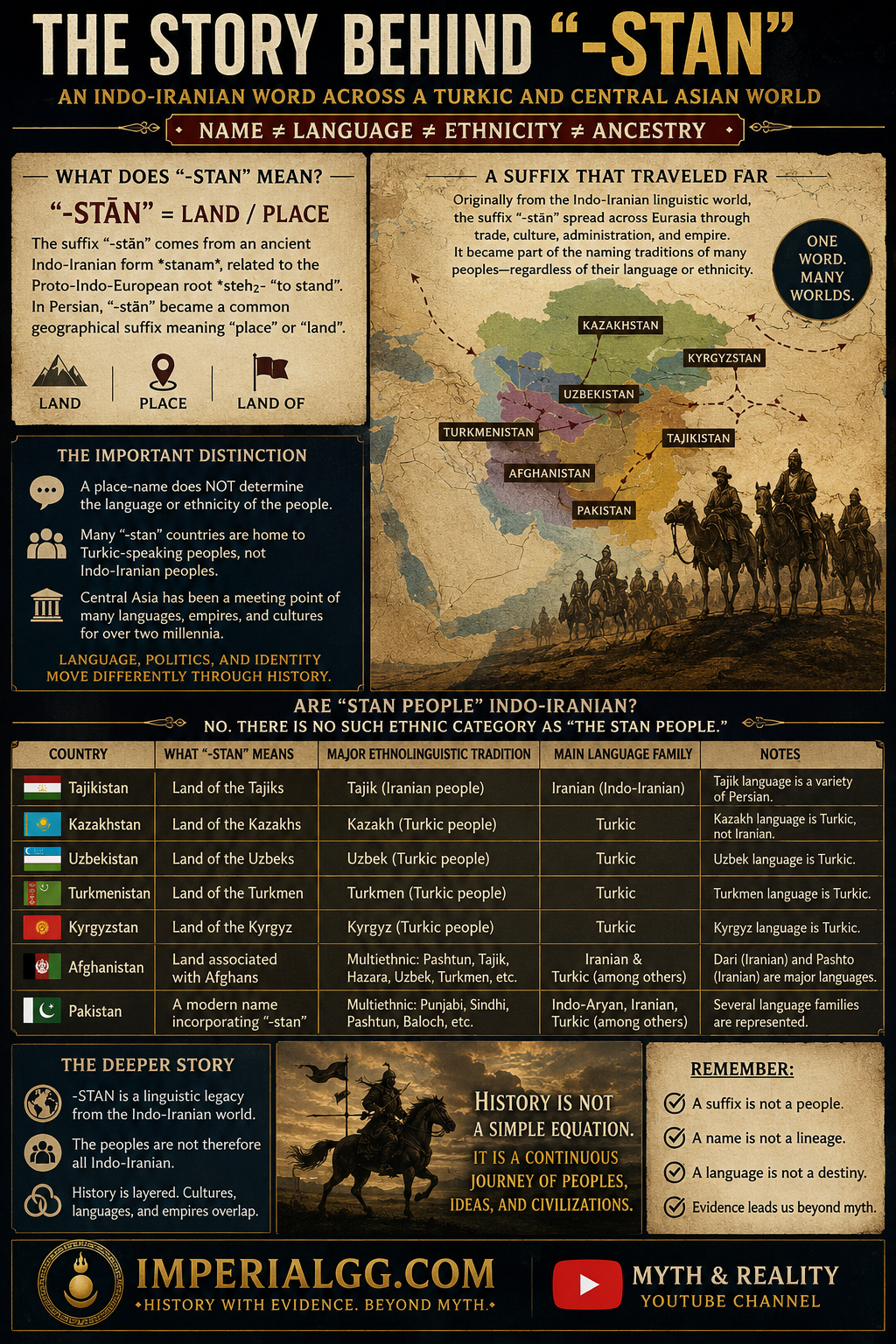
What does “-stan” actually mean?
The suffix -stān means approximately “place,” “land,” or “land of”.
Its history reaches deep into the Indo-Iranian linguistic world. It is related to an ancient Indo-Iranian form reconstructed as stanam, ultimately connected with the Proto-Indo-European root meaning “to stand.” Persian developed -stān as a productive geographical suffix meaning a place or land.
In other words:
-STAN = LAND / PLACE
So:
- Tajikistan → land of the Tajiks
- Kazakhstan → land of the Kazakhs
- Uzbekistan → land of the Uzbeks
- Turkmenistan → land of the Turkmen
- Afghanistan → land associated with Afghans
- Pakistan → a modern name incorporating -stan
The suffix itself does not tell us what language or ethnicity the population has.
THE IMPORTANT DISTINCTION: LANGUAGE ≠ PLACE-NAME ≠ ETHNICITY
This is where many discussions about Central Asian history go wrong.
The modern Tajiks are an Iranian people whose principal language is a variety of Persian. Tajik Persian belongs to the Iranian branch of the Indo-European language family.
But the Kazakh language is Turkic.
The Uzbek language is Turkic.
The Turkmen language is Turkic.
The Kyrgyz language is Turkic.
Therefore, the fact that these countries use the Persian-derived geographical suffix -stan does not transform their peoples into Iranian peoples.
It reflects something more interesting:
A shared historical linguistic and cultural sphere.
Persian became one of the great literary, administrative, and cultural languages of Central Asia and surrounding regions. Its geographical vocabulary consequently traveled far beyond communities that spoke Iranian languages as their mother tongue.
This is why a Turkic-speaking people could live in a country whose name contains a Persian suffix.
SO, ARE “STAN PEOPLE” INDO-IRANIAN?
No. There is no such ethnic category as “the Stan people.”
There is an Indo-Iranian linguistic history behind the suffix.
But the peoples whose names are attached to it can belong to very different linguistic and historical traditions.
| Country | Major ethnolinguistic tradition | What does “-stan” tell us? |
|---|---|---|
| Tajikistan | Iranian / Persian-speaking | Land of the Tajiks |
| Kazakhstan | Turkic | Land of the Kazakhs |
| Uzbekistan | Turkic | Land of the Uzbeks |
| Turkmenistan | Turkic | Land of the Turkmen |
| Kyrgyzstan | Turkic | Land of the Kyrgyz |
| Afghanistan | Multiethnic; major Iranian languages include Dari and Pashto | Land associated with Afghans |
| Pakistan | Multiethnic; several Indo-Aryan and Iranian languages among others | Modern political name incorporating -stan |
This distinction is essential when discussing the history of the Eurasian steppe.
THE DEEPER STORY
What makes -stan historically fascinating is precisely that it crossed linguistic and political boundaries. A geographical element with roots in the Indo-Iranian linguistic world became part of the naming traditions of peoples who later spoke Turkic languages.
That tells us something about Central Asia:
Languages, peoples, states, and cultural traditions did not always move together.
A Turkic-speaking population could adopt Persian vocabulary.
An Iranian-speaking population could live under Turkic political rule.
A Mongol ruling house could govern Persian-speaking populations.
And a political territory could retain a name originating from a completely different linguistic layer.
This is why historical analysis must avoid the simple equation:
Name = Language = Ethnicity = Ancestry
They are not the same thing.
History is layered.
Central Asia is one of the clearest places in the world where those layers can still be seen in modern names.
The suffix is Indo-Iranian in linguistic history.
The peoples are not therefore all Indo-Iranian.
The story is much more complicated—and much more interesting.
ImperialGG.COM
History With Evidence. Beyond Myth.