
THE QONGQOTAN CHALLENGE AND THE FALL OF TEB-TENGGERI
By Altanbagana Baatar
DBA Candidate| Independent Historian
ImperialGG Historical Research Seriers
11 November 2026
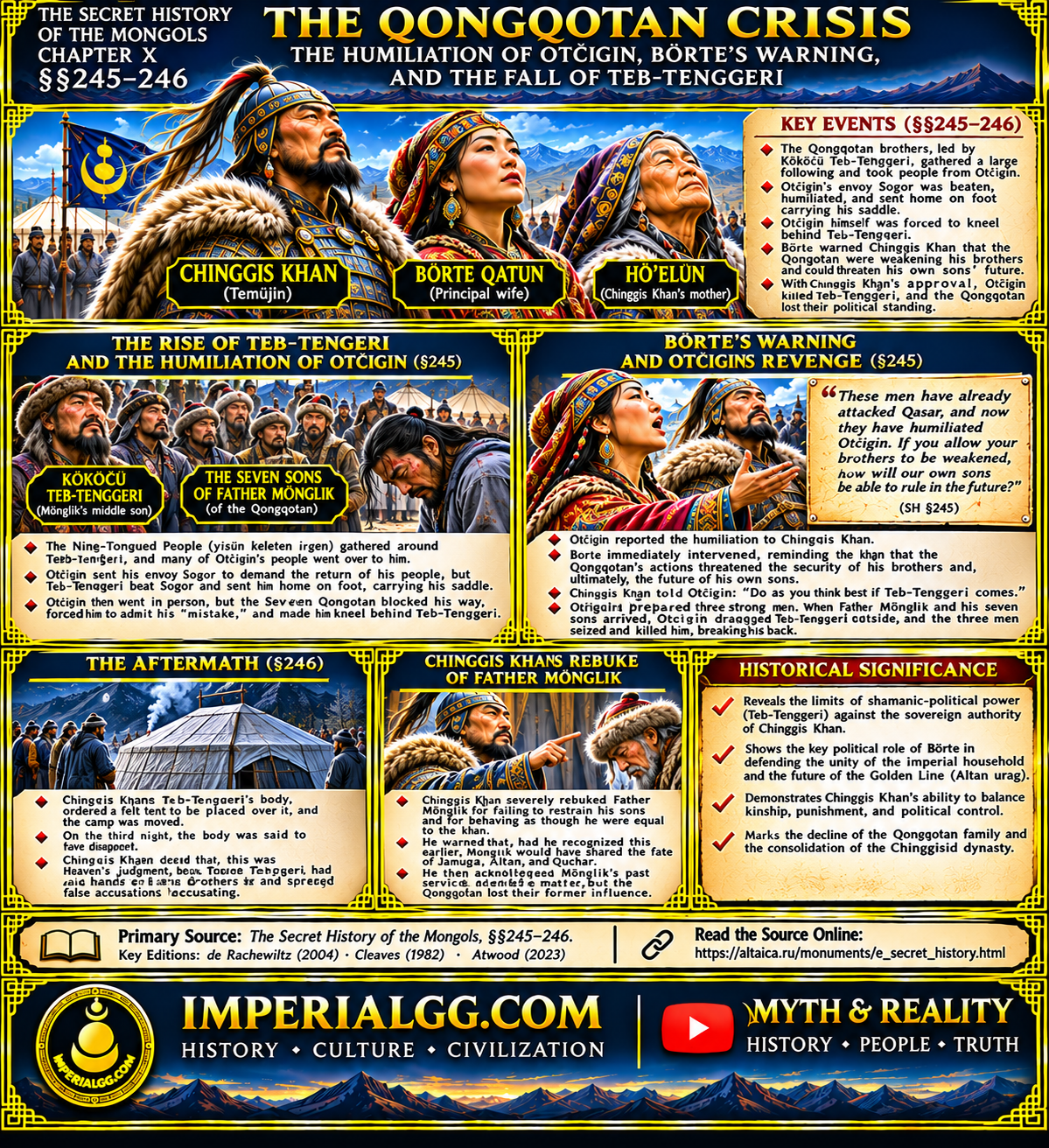
The Humiliation of Temüge Otčigin, Börte’s Intervention, the Killing of Kököčü Teb-Tenggeri, and the Decline of the Mönglik Household — The Secret History of the Mongols, §§245–246
IMPERIALGG.COM | ACADEMIC HISTORICAL RESEARCH
ABSTRACT
Sections 245–246 of The Secret History of the Mongols describe the escalation of the conflict between Chinggis Khan’s ruling household and the Qongqotan family of Father Mönglik. Following the earlier assault on Qasar, the Qongqotan brothers continued to expand their influence around Kököčü Teb-Tenggeri. Members of Temüge Otčigin’s following transferred their allegiance to Teb-Tenggeri, weakening Otčigin’s position and creating a direct challenge to his authority.
When Otčigin sent an envoy named Sogor to demand the return of his people, Teb-Tenggeri beat the envoy and sent him home on foot, carrying his saddle. Otčigin’s subsequent personal appeal was met by further humiliation: the Seven Qongqotan blocked his way, compelled him to admit that sending an envoy had been wrong, and forced him to kneel behind Teb-Tenggeri. The episode became a direct affront to the dignity of Chinggis Khan’s younger brother and to the authority of the imperial household.
Börte’s intervention transformed the incident into a matter of dynastic security. She reminded Chinggis Khan that the Qongqotan had already attacked Qasar and were now humiliating Otčigin, warning that if the ruler allowed his younger brothers to be weakened, the future of his own sons would also be endangered. Chinggis Khan then authorized Otčigin to decide how to respond. Otčigin prepared three strong men, confronted Teb-Tenggeri when Father Mönglik and his seven sons arrived, and had the shaman killed outside the tent.
Section 246 records the disappearance of Teb-Tenggeri’s body, Chinggis Khan’s public explanation of the event as Heaven’s judgment, his severe reprimand of Father Mönglik, and the subsequent decline of the Qongqotan family’s influence.
This article argues that the episodes reveal a struggle not merely between two families, but between an expanding shamanic-political network and the authority of the Chinggisid ruling household.
Primary source: The Secret History of the Mongols, §§245–246; Christopher P. Atwood, trans. (2023), pp. 125–128; Igor de Rachewiltz, trans. and commentary (2004), Chapter Ten, §§245–246. Atwood translation, Chapter Ten · de Rachewiltz, complete translation and commentary.
Studylib+1
I. §245 — THE GROWING POWER OF TEB-TENGGERI AND THE QONGQOTAN
THE NINE-TONGUED PEOPLE GATHER AROUND TEB-TENGGERI
Section 245 opens with a description of the growing following of Kököčü Teb-Tenggeri. The narrative states that the Nine-Tongued People gathered around him and that the number of people assembling at Teb-Tenggeri’s hitching post became greater than those gathering around Chinggis Khan.
This is a remarkable statement. It suggests that Teb-Tenggeri had become the center of a political and spiritual network whose following was, at least in the narrative’s representation, larger than the group gathered around the sovereign himself.
The phrase Nine-Tongued People (Yisün keleten irgen) requires caution. De Rachewiltz notes that it is not attested elsewhere and that its exact meaning remains uncertain. The number nine may have been used symbolically to signify completeness or a large collective, but the possibility that it referred to a particular group cannot be excluded. It should therefore not be translated as a securely identified tribe or ethnic confederation without further evidence.[1]
As Teb-Tenggeri’s influence expanded, people who had previously been attached to Temüge Otčigin began transferring to him. This was the immediate political problem confronting Otčigin: the loss of followers was not simply a reduction in household resources but a weakening of his authority within the imperial family.
THE TRANSFER OF OTČIGIN’S SUBJECTS
The narrative does not describe the movement of these people as an ordinary migration. It explicitly states that people attached to Temüge Otčigin went over to Teb-Tenggeri. This distinction matters because the people were part of Otčigin’s political and household following. Their transfer weakened the material basis of his authority and increased the power of Teb-Tenggeri.
The episode also connects directly with the preceding section. In §244, Qasar had been beaten by the seven sons of Father Mönglik, while Teb-Tenggeri’s prophecy had contributed to Chinggis Khan’s suspicion of his brother. In §245, the same Qongqotan network is shown humiliating another younger brother of the ruler, Temüge Otčigin.
The repeated targeting of Qasar and Otčigin is a central feature of the narrative. It is one reason Börte interprets the events not as isolated personal disputes but as a pattern of conduct directed against Chinggis Khan’s brothers.
II. THE ENVOY SOGOR: THE PUBLIC HUMILIATION OF OTČIGIN’S REPRESENTATIVE
OTČIGIN SENDS AN ENVOY TO TEB-TENGGERI
After losing members of his following to Teb-Tenggeri, Temüge Otčigin Noyan sent an envoy named Sogor to demand the return of the people who had transferred to Teb-Tenggeri. The identity of this envoy is important. The Secret History gives his name explicitly, and he must not be reduced to an unnamed messenger. Sogor represented Otčigin’s authority and carried a direct request concerning the recovery of his people.
Teb-Tenggeri responded with a sarcastic remark. He referred to a previous obligation involving a horse, saying that he was indebted to Sogor and Otčigin, but then beat Sogor and sent him home on foot, carrying his saddle. This was not simply a refusal to return the people. It was a deliberate humiliation of an official representative of the ruling family. By beating Sogor and forcing him to walk home while carrying his saddle, Teb-Tenggeri publicly degraded Otčigin’s authority.
The source’s wording makes the insult particularly significant: the envoy was not permitted to return in the ordinary manner on horseback. The physical treatment of the messenger communicated that Otčigin’s demand carried no authority in Teb-Tenggeri’s presence.[2]
OTČIGIN CONFRONTS TEB-TENGGERI PERSONALLY
The following day, Otčigin went to Teb-Tenggeri himself. He reminded him that he had sent Sogor as an envoy, that the envoy had been beaten and sent home on foot, and that he was now personally requesting the return of his people.
At this point, the Seven Qongqotan intervened. They blocked Otčigin’s way on both sides and sarcastically repeated the insult associated with Sogor’s mission. The source records their words: “How right you were to send your envoy Sogor.”
The seven men then demanded that Otčigin admit his mistake. Fearing that he might be seized and beaten, Otčigin replied that he had been wrong to send an envoy. The Qongqotan were not satisfied with this verbal admission. They demanded that he kneel and confess his wrongdoing. Otčigin was consequently forced to kneel behind Teb-Tenggeri, while his people were still not returned.[3]
The political meaning of this act is unmistakable. Otčigin was a younger brother of Chinggis Khan and a member of the ruling dynasty. Yet the Seven Qongqotan compelled him to kneel before Teb-Tenggeri and acknowledge that he had been wrong to seek the return of his own followers. The humiliation therefore extended beyond an individual dispute. It challenged the dignity and authority of the ruling family.
THE ROLE OF THE SEVEN QONGQOTAN
The narrative identifies the group collectively as the Seven Qongqotan, the seven sons of Father Mönglik. It does not repeat all seven personal names in §§245–246. The one whose identity is central to the episode is Kököčü Teb-Tenggeri, the middle son.
The distinction between the seven brothers and Teb-Tenggeri must be maintained. The brothers collectively used their physical presence to block Otčigin and force him to kneel; Teb-Tenggeri was the central figure around whom the growing political and spiritual following had gathered.
The source thus presents a combination of collective family power and individual religious-political influence. The Qongqotan brothers provided the immediate force behind the humiliation, while Teb-Tenggeri occupied the position of the central authority figure.
III. OTČIGIN’S APPEAL TO CHINGGIS KHAN AND BÖRTE’S INTERVENTION
OTČIGIN REPORTS THE HUMILIATION
Early the following morning, before Chinggis Khan had risen from his bed, Otčigin entered and knelt before him, weeping.
He reported the sequence of events in detail:
People who had belonged to his following had gathered around Teb-Tenggeri.
He had sent an envoy named Sogor to request their return.
Teb-Tenggeri had beaten Sogor and sent him home on foot, carrying his saddle.
When Otčigin went personally to make the same request, the Seven Qongqotan blocked his way.
They forced him to admit that sending the envoy had been a mistake and made him kneel behind Teb-Tenggeri.
The account is important because Otčigin did not merely complain that his people had been taken. He described how the Qongqotan had humiliated both his envoy and himself.
His kneeling before Chinggis Khan was a second act of submission, but this time it was an appeal to the sovereign for protection and intervention. The contrast between the two acts is significant: the Qongqotan had forced him to kneel as a sign of humiliation, whereas he now knelt before his elder brother to report an injustice.
BÖRTE’S RESPONSE: THE QONGQOTAN HAVE ALREADY ATTACKED QASAR
Before Chinggis Khan had even spoken, Börte Qatun sat up in the bed, covered her chest with the edge of her quilt, and began to weep. Her response is one of the most important political statements in this episode. She recalled that the Qongqotan had previously joined together to beat Qasar and now had gone further by forcing Otčigin to kneel behind Teb-Tenggeri.
Her argument was that the Qongqotan were not merely mistreating one individual. They were systematically weakening Chinggis Khan’s younger brothers.
In the poetic passage preserved by the source, Börte compares the younger brothers to cypresses and pines, suggesting that they were important pillars of the ruling household. She then warns that when Chinggis Khan’s own body, likened to a great tree or firm foundation, eventually falls, the future of the kingdom will depend on who remains capable of governing it.
The underlying meaning is clear: if the ruler allows his brothers to be humiliated and weakened, who will protect and govern the empire after his death?
Börte then turns the argument toward her own children. She asks whether people who plot against Chinggis Khan’s younger brothers would ever allow her three or four young sons to exercise authority when they grew up. Her argument is therefore both immediate and dynastic. She is defending Otčigin and Qasar, but she is also warning that the political power of the Qongqotan could eventually threaten the future position of Chinggis Khan’s own sons.[4]
THE POLITICAL IMPORTANCE OF BÖRTE’S WARNING
Börte’s speech should not be treated merely as an emotional reaction by a wife to the suffering of her husband’s brother. She identifies a structural danger: the growing power of a household outside the ruling lineage, supported by a large following and by the spiritual authority of Teb-Tenggeri, could undermine the political position of Chinggis Khan’s brothers and, eventually, his sons.
Her argument also connects §§242–246. In §242, Chinggis Khan distributed people among his mother, sons, and brothers. In §243, he appointed officials to administer those people. In §§244–245, the Qongqotan attacked the authority of Qasar and Otčigin and attracted people away from Otčigin’s following.
The narrative therefore presents a direct conflict between the sovereign’s effort to organize the imperial household and the emergence of a rival network around Teb-Tenggeri.
Börte’s warning made Chinggis Khan confront the consequences of allowing this rival power to continue.
IV. CHINGGIS KHAN’S DECISION: OTČIGIN IS GIVEN AUTHORITY TO ACT
After hearing Börte’s words, Chinggis Khan did not immediately announce a public judgment against Teb-Tenggeri or the Seven Qongqotan. Instead, he turned to Otčigin and told him:
“Should Teb-Tenggeri come, whatever you might be able to do, you decide.”
This instruction is a crucial moment in the narrative. Chinggis Khan effectively gave Otčigin responsibility for resolving the confrontation himself. The statement should not be interpreted as a formal written order to execute Teb-Tenggeri. The source records a permission or authorization to act, but does not describe a judicial sentence or an explicit command to kill him.
Otčigin rose, wiped away his tears, and went outside. He then prepared three strong men. The Secret History does not give the personal names of these three men. Their identities should therefore remain unspecified. What the source makes clear is that Otčigin prepared them in advance for the confrontation that was about to take place.[5]
FATHER MÖNGLIK AND HIS SEVEN SONS ARRIVE
A short time later, Father Mönglik arrived together with his seven sons. All seven entered the tent.
Kököčü Teb-Tenggeri sat down on the right side of the leather vessels containing esük, the fermented drink. At that moment, Otčigin seized Teb-Tenggeri by the collar and challenged him. He reminded Teb-Tenggeri that the previous day he had forced him to confess that sending an envoy had been wrong. Now, Otčigin said, he challenged him directly.
Otčigin pulled Teb-Tenggeri toward the entrance by his collar. Teb-Tenggeri seized Otčigin in return, and the two men grappled with each other. During the struggle, Teb-Tenggeri’s hat fell near the hearth. Father Mönglik picked it up, sniffed it, and placed it in his lap.
This detail is recorded explicitly in the narrative. It is not simply decorative description: the movement of the hat and Father Mönglik’s response form part of the scene in which the authority of the Qongqotan household is about to collapse.
THE THREE STRONG MEN KILL TEB-TENGGERI
Chinggis Khan then told them to go outside and test their strength.
Otčigin dragged Teb-Tenggeri toward the space between the entrance and the threshold, where the three men he had prepared were waiting.
The three strong men seized Teb-Tenggeri, dragged him outside, broke his back, and threw his body away at the far end of the wagons on the left-hand side. The source does not name these men, nor does it provide a detailed account of the precise technique by which they killed him. It is therefore important not to invent names or describe the death as a formally conducted wrestling contest with a recorded result.
Otčigin returned to the tent and reported that Teb-Tenggeri had failed to meet him as a proper wrestling opponent, instead collapsing in an unworthy manner.[6]
The sequence of events is significant:
Chinggis Khan authorized Otčigin to decide how to respond.
Otčigin prepared three strong men.
Father Mönglik and his seven sons arrived.
Otčigin seized Teb-Tenggeri and challenged him.
Chinggis Khan told them to test their strength outside.
The three prepared men seized Teb-Tenggeri, broke his back, and killed him.
Otčigin returned to the tent and reported the outcome.
This sequence makes clear that the killing occurred in the immediate presence of the ruling household and with Chinggis Khan’s knowledge. Nevertheless, the source does not explicitly state that Chinggis Khan personally ordered the three men to kill Teb-Tenggeri. The distinction between authorization to act and an explicit execution order must be preserved.
V. FATHER MÖNGLIK’S REACTION AND THE QONGQOTAN THREAT
When Otčigin returned and reported Teb-Tenggeri’s death, Father Mönglik understood what had happened and began to weep.
He spoke of his long-standing relationship with the ruling household, saying that he had been a friend to the khan from the time when the brown earth was only a small patch of soil and the broad sea was only a stream. The metaphor expressed the length of his service and the depth of his relationship with the ruling family. Father Mönglik was presenting himself as someone who had stood beside the khan from the earliest period of his rise.
The response of his remaining sons was immediate. Six Qongqotan sons rose at the doorway, formed a circle around the hearth, and rolled up their sleeves. This is a critical detail: Teb-Tenggeri had been killed, but the Qongqotan family had not yet accepted the loss. The six remaining brothers displayed a threatening posture, surrounding the hearth and preparing for a possible confrontation.
Chinggis Khan became anxious and felt surrounded. He ordered those present to make way and declared that he was leaving. As he exited, the dayguards and nightguards surrounded him and formed a protective circle.[7]
The episode demonstrates how dangerous the confrontation had become. Even after Teb-Tenggeri’s death, the Qongqotan still possessed sufficient collective presence to make the sovereign feel physically threatened inside the tent. The role of the guards is especially important. Chinggis Khan’s personal security depended upon the organized military personnel of his household. Their intervention prevented the confrontation from developing into an immediate attack upon the ruler.
WHY THIS WAS MORE THAN A FAMILY DISPUTE
The conflict had now passed through several stages:
The Qongqotan had beaten Qasar.
Teb-Tenggeri had used a prophecy to create suspicion around Qasar.
Members of Otčigin’s following had transferred to Teb-Tenggeri.
Sogor, Otčigin’s envoy, had been beaten and humiliated.
Otčigin himself had been forced to kneel.
Börte had warned that the Qongqotan were threatening the future of the ruling household.
Teb-Tenggeri had been killed through Otčigin’s action.
The six remaining Qongqotan brothers had openly displayed hostility.
The narrative thus describes a confrontation over the limits of authority. The Qongqotan family had accumulated influence through its association with Teb-Tenggeri, but its members had begun treating the sovereign’s brothers as people whom they could humiliate and subordinate.
The death of Teb-Tenggeri was the decisive turning point in this conflict.
VI. §246 — THE DISAPPEARANCE OF TEB-TENGGERI’S BODY AND THE DECLINE OF THE QONGQOTAN
THE BODY IS PLACED UNDER A FELT TENT
After Teb-Tenggeri’s death, Chinggis Khan saw the place where the body had been thrown, at the far end of the wagons on the left-hand side. He ordered a plain felt tent to be brought from the rear and placed over the body. He then ordered the wagons to be harnessed and the camp to be moved.
The body was covered by the tent, its smoke opening was closed, and its entrance flap was lowered. A guard was assigned to watch it. The source then describes an extraordinary event. Toward the third night, at sunset, the smoke opening of the tent opened, and Teb-Tenggeri’s body was said to have risen upward through it. When the people inspected the tent, they confirmed that the body was no longer inside.
This event is narrated as a supernatural occurrence. It should be reported as the account preserved in The Secret History, not presented as independently verified physical evidence of a supernatural disappearance.
CHINGGIS KHAN’S EXPLANATION: HEAVEN’S JUDGMENT
Chinggis Khan explained the disappearance by referring to Teb-Tenggeri’s treatment of his younger brothers. He stated that Teb-Tenggeri had laid hands and feet upon his younger brothers and had spread baseless slanders among them. Because of these actions, Heaven had become displeased with him and had taken him away together with his body.
This explanation is particularly important because it connects the supernatural disappearance directly to the political conflict described in §§244–245.
Chinggis Khan’s statement identifies two principal offenses:
Physical aggression against the ruler’s younger brothers. This refers to the violence and humiliation directed against Qasar and Otčigin.
The spreading of baseless accusations among the younger brothers. This refers especially to Teb-Tenggeri’s statements concerning Qasar and the prophecy that he might become ruler.
The sovereign thus presented Teb-Tenggeri’s fate as a consequence of violating the order of the imperial household. His explanation transformed a violent political killing into a narrative of heavenly punishment.[8]
CHINGGIS KHAN’S REBUKE OF FATHER MÖNGLIK
Chinggis Khan then turned directly to Father Mönglik and rebuked him severely. He accused Mönglik of failing to restrain his sons and of behaving as though he were equal to the khan. He declared that, had he recognized this conduct earlier, Mönglik himself would have suffered the same fate as Jamuga, Altan, and Quchar.
The comparison is significant. Jamuga, Altan, and Quchar had all been associated with political opposition or broken allegiance to Chinggis Khan. By invoking their names, the ruler reminded Mönglik that his position depended upon loyalty and that his family’s privileged relationship with the ruling household did not place him above the sovereign.
The source therefore identifies two reasons for Chinggis Khan’s anger:
Mönglik had not prevented his sons from behaving in an ambitious and disrespectful manner.
He had acted as though he possessed a status equal to Chinggis Khan.
The second accusation is particularly important. The conflict was not simply about the conduct of individual sons. It concerned the political position of the entire Mönglik household in relation to the imperial ruler.
CHINGGIS KHAN RELENTS AND RECOGNIZES MÖNGLIK’S FORMER SERVICE
After delivering this severe reprimand, Chinggis Khan changed his tone. He reminded Mönglik that a person who contradicts what he has said in the morning by evening, or reverses what he has said at night by morning, will become an object of shameful talk. He then declared that the matter should be considered finished.
Finally, he acknowledged Mönglik’s earlier service, stating that if the sons had restrained their ambitious behavior, no one would have been equal to the descendants of Father Mönglik.
This final statement is essential to the historical interpretation. Chinggis Khan did not erase Mönglik’s previous contribution to the rise of the Mongol ruling house. Instead, he distinguished between the father’s earlier service and the sons’ later conduct.
The ruler’s response therefore combined punishment, warning, and reconciliation. He reprimanded Mönglik for failing to control his sons, reminded him of the consequences of disloyalty, but also acknowledged the family’s earlier contribution and allowed the relationship to continue.
THE DECLINE OF THE QONGQOTAN
The final sentence of §246 states that after Teb-Tenggeri had been removed, the Qongqotan lost their standing and influence. This conclusion is the political outcome of the entire episode.
The Qongqotan had accumulated influence around Teb-Tenggeri, whose spiritual authority and growing following had begun to rival the political center of Chinggis Khan. Their conduct toward Qasar and Otčigin, the humiliation of Sogor, and their collective intimidation of Otčigin had brought them into direct conflict with the ruling household.
With Teb-Tenggeri dead, the network that had gathered around him lost its central figure. The source explicitly records the decline of the Qongqotan’s position. It does not, however, state that every member of the Qongqotan family was executed, expelled, or stripped of all property. The historically defensible conclusion is that their collective political influence declined following the death of Teb-Tenggeri.
VII. HISTORICAL INTERPRETATION — THE LIMITS OF SHAMANIC AUTHORITY AND THE SUPREMACY OF THE IMPERIAL HOUSEHOLD
The events of §§245–246 demonstrate the dangers that could emerge when spiritual authority became the foundation of an independent political network.
Teb-Tenggeri’s influence was not based solely on his position as a shaman. The narrative describes a growing following that included people formerly attached to Temüge Otčigin. His authority had become sufficiently influential that the number of people gathering around his hitching post was described as greater than those gathering around Chinggis Khan.
The Qongqotan family supported this growing position. Its seven sons had already demonstrated their willingness to use collective force against Qasar, and they subsequently humiliated Otčigin and his envoy Sogor.
The events therefore reveal a combination of three forms of power:
Spiritual authority: Teb-Tenggeri’s prophetic claims and religious influence.
Family and collective force: the Seven Qongqotan and their ability to intimidate Chinggis Khan’s brothers.
Control over followers: the transfer of people from Otčigin’s household to Teb-Tenggeri’s following.
These forms of power had begun to challenge the political organization established by Chinggis Khan.
THE ROLE OF BÖRTE AND THE IMPERIAL FAMILY
Börte’s intervention was central to the resolution of the crisis. She recognized that the humiliation of Qasar and Otčigin could not be treated as isolated incidents. She interpreted the attacks as evidence that the Qongqotan might eventually threaten the political future of Chinggis Khan’s sons.
Her argument persuaded Chinggis Khan to allow Otčigin to determine the response to Teb-Tenggeri. The subsequent killing was therefore carried out by Otčigin and the three men he had prepared, rather than being described as a direct execution ordered by Chinggis Khan.
The distinction matters. The source portrays Chinggis Khan as authorizing Otčigin to act, while Otčigin organized the physical confrontation that ended Teb-Tenggeri’s life.
THE SOVEREIGN’S RESPONSE: PUNISHMENT WITHOUT THE DESTRUCTION OF THE ENTIRE FAMILY
The treatment of Father Mönglik also reveals the political sophistication of Chinggis Khan’s response.
Although he severely reprimanded Mönglik, he did not destroy the entire household. Instead, he separated the father’s earlier service from the behavior of his sons. He reminded Mönglik that his family had once been highly valued, while making clear that such standing could not justify acting independently of the ruler.
This suggests that Chinggis Khan’s objective was not simply revenge. It was the removal of a competing center of authority and the restoration of the political hierarchy. The decline of the Qongqotan after Teb-Tenggeri’s death illustrates the result: the spiritual-political network lost its central figure, while the authority of the imperial household was reaffirmed.
VIII. AUTHOR’S THESIS — THE QONGQOTAN CRISIS AS A TURNING POINT IN IMPERIAL CONSOLIDATION
The central thesis of this article is that §§245–246 record the suppression of a powerful political network that had emerged around Kököčü Teb-Tenggeri and the Qongqotan household.
The earlier assault on Qasar and the subsequent humiliation of Otčigin reveal a pattern of conduct directed against the younger brothers of Chinggis Khan. The transfer of Otčigin’s people to Teb-Tenggeri weakened the authority of a member of the ruling family, while the beating of Sogor and the forced kneeling of Otčigin demonstrated an increasingly open disregard for the dignity of the imperial household.
Börte recognized the broader consequences. Her warning that the Qongqotan might eventually prevent the sons of Chinggis Khan from exercising authority demonstrates that the conflict was understood as a question of dynastic security.
The killing of Teb-Tenggeri removed the central figure around whom the competing network had gathered. The subsequent disappearance of his body was interpreted by Chinggis Khan as Heaven’s judgment, while the rebuke of Father Mönglik established that the father’s former service could not protect his sons from the consequences of their political conduct.
The author argues that the episode illustrates an important principle of early Mongol imperial government: spiritual prestige, personal following, and military influence could be tolerated only insofar as they remained compatible with the sovereignty of Chinggis Khan and the authority of his ruling household.
The Qongqotan crisis therefore marks an important stage in the consolidation of the Chinggisid political order. It demonstrates how the ruler responded when a powerful family, supported by religious authority and an expanding following, began to challenge the dignity and security of the imperial dynasty.
CONCLUSION
Sections 245–246 of The Secret History of the Mongols preserve a detailed account of the conflict between the Qongqotan household and the ruling family of Chinggis Khan.
The transfer of Otčigin’s people to Teb-Tenggeri, the mission of the envoy Sogor, the beating and humiliation of the envoy, and the forced kneeling of Otčigin demonstrate the extent to which the Qongqotan had begun to challenge the authority of the imperial household.
Börte’s intervention revealed the dynastic consequences of this conflict. She reminded Chinggis Khan that the Qongqotan had already attacked Qasar and were now humiliating Otčigin, warning that the future of the ruler’s own sons could also be endangered.
Chinggis Khan authorized Otčigin to decide how to respond. Otčigin prepared three strong men, confronted Teb-Tenggeri, and the three men killed him outside the tent. Father Mönglik’s reaction and the threatening behavior of his six remaining sons demonstrated that the confrontation had become a serious political crisis.
Section 246 records the disappearance of Teb-Tenggeri’s body, Chinggis Khan’s explanation of the event as Heaven’s judgment, his reprimand of Father Mönglik, and the subsequent decline of the Qongqotan family.
The historical significance of these events lies in the restoration of the supremacy of the imperial household over a competing spiritual and political network. The episode shows that the consolidation of Chinggis Khan’s authority required not only the defeat of external enemies, but also the control of internal networks whose influence threatened the unity and security of the ruling dynasty.
FOOTNOTES AND PRIMARY-SOURCE REFERENCES
[1] The Secret History of the Mongols, §245. Christopher P. Atwood, trans., The Secret History of the Mongols (London: Penguin Classics, 2023), pp. 125–126. Igor de Rachewiltz, The Secret History of the Mongols (Leiden: Brill, 2004), commentary on §245. De Rachewiltz notes that the expression Nine-Tongued People is not otherwise attested and that its precise reference is uncertain. Atwood translation; de Rachewiltz translation and commentary.
[2] The Secret History of the Mongols, §245; Atwood (2023), p. 125. The source names the envoy Sogor and records that Teb-Tenggeri beat him and sent him back on foot carrying his saddle. Read §245.
[3] Ibid. The Seven Qongqotan block Otčigin, force him to admit his mistake, and compel him to kneel behind Teb-Tenggeri. The source does not identify the seven brothers individually in this passage.
[4] The Secret History of the Mongols, §245; Atwood (2023), pp. 125–126. Börte’s speech compares Chinggis Khan’s younger brothers to cypresses and pines and warns that the future authority of the ruler’s sons may be endangered. Börte’s speech in §245.
[5] The Secret History of the Mongols, §245; Atwood (2023), p. 126. Chinggis Khan’s instruction to Otčigin is followed by Otčigin’s preparation of three strong men. Their personal names are not supplied.
[6] Ibid., pp. 126–127. The narrative describes the confrontation, the struggle, Teb-Tenggeri’s death, and Otčigin’s return to the tent.
[7] Ibid., p. 127. Father Mönglik’s six remaining sons surround the hearth; Chinggis Khan leaves the tent and is surrounded by the nightguards and dayguards.
[8] The Secret History of the Mongols, §246; Atwood (2023), p. 128. The body’s disappearance, Chinggis Khan’s explanation, his reprimand of Father Mönglik, and the decline of the Qongqotan are recorded in this section.
[9] Hidehiro Okada, “The Secret History of the Mongols, a Pseudo-Historical Novel,” Journal of Asian and African Studies 50 (2015), pp. 67–84. Read scholarly analysis.
BIBLIOGRAPHY
Atwood, Christopher P., trans. The Secret History of the Mongols. London: Penguin Classics, 2023. Digitized text.
Cleaves, Francis Woodman, trans. The Secret History of the Mongols. Cambridge, MA: Harvard University Press, 1982. Digitized translation.
de Rachewiltz, Igor. The Secret History of the Mongols: A Mongolian Epic Chronicle of the Thirteenth Century. 2 vols. Leiden–Boston: Brill, 2004. Full translation and commentary.
Okada, Hidehiro. “The Secret History of the Mongols, a Pseudo-Historical Novel.” Journal of Asian and African Studies 50 (2015). Academic article.
Monumenta Altaica. The Secret History of the Mongols: textual and transliteration resources. Digital primary-source repository.
IMPERIALGG.COM | Heavenlywind750.com — HISTORY • CULTURE • CIVILIZATIONMYTH & REALITY — HISTORY • PEOPLE • TRUTH