
THE APPOINTMENT OF IMPERIAL OFFICIALS AND THE QASAR CRISIS
By Altanbagana Baatar
DBA Candidate| Independent Historian
ImperialGG Historical Research Seriers
10 November 2026
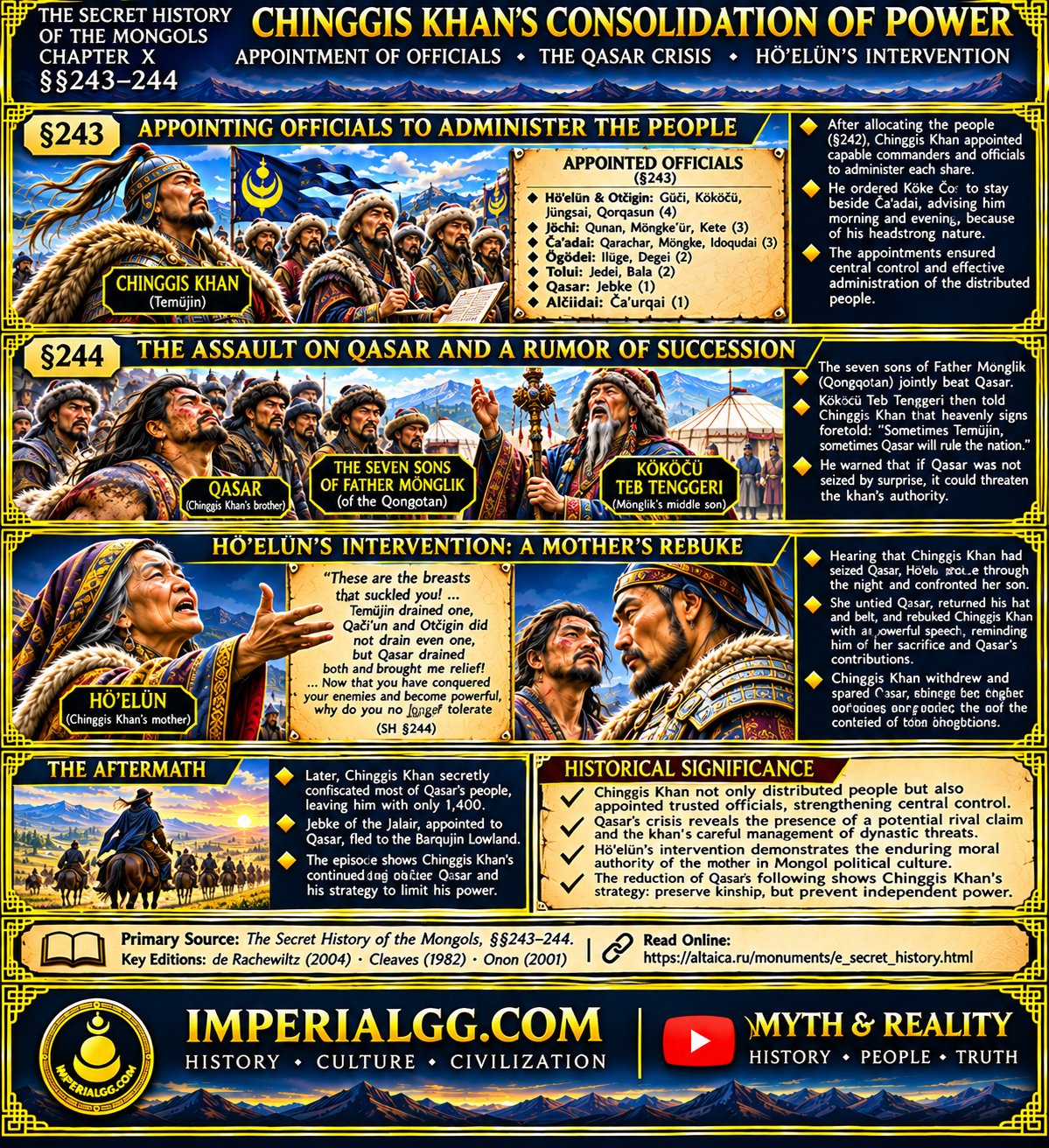
HÖ’ELÜN’S INTERVENTION AND THE CONSOLIDATION OF CHINGGIS KHAN’S AUTHORITY
A Historical and Source-Critical Study of The Secret History of the Mongols, §§243–244, with the immediate aftermath recorded at the end of §244
IMPERIALGG.COM | ACADEMIC HISTORICAL RESEARCH
ABSTRACT
Sections 243–244 of The Secret History of the Mongols describe a critical moment in the consolidation of Chinggis Khan’s authority. Following the allocation of subject populations among his mother, sons, and younger brothers, Chinggis Khan appointed named commanders and advisers to administer the groups assigned to each member of the imperial family. This arrangement demonstrates that the distribution of people was accompanied by the appointment of trusted officials who could supervise, organize, and advise the recipients.
The subsequent conflict involving Qasar, the seven sons of Father Mönglik of the Qongqotan, and Kököčü Teb Tenggeri reveals the political tensions underlying this new order. After Qasar was beaten by the seven Qongqotan brothers, Teb Tenggeri invoked heavenly prophecies suggesting that either Temüjin or Qasar might rule the Mongol people. Chinggis Khan interpreted this statement as a warning of a possible rival claim and moved to seize his younger brother.
The intervention of Hö’elün is the central event of the episode. Travelling through the night, she confronted Chinggis Khan, released Qasar from restraint, and delivered a powerful speech in which she recalled the nourishment she had given her sons and the different roles they had played in the survival of the family. Her words temporarily restrained Chinggis Khan. Nevertheless, after her departure, he secretly confiscated most of Qasar’s people, leaving him with only 1,400. Jebke of the Jalair subsequently fled to the Barqujin Lowland.
This article argues that the episode reveals both the political importance of maternal authority and the vulnerability of Chinggis Khan’s brothers within the emerging imperial order. It also demonstrates that the appointment of officials, the redistribution of populations, and the control of military resources were closely connected to the sovereign’s concern over possible succession challenges.
Primary text: Igor de Rachewiltz, The Secret History of the Mongols (2004), §§243–244, pp. 168–170, and commentary.
Monumenta Altaica+1
I. §243 — THE APPOINTMENT OF OFFICIALS: DISTRIBUTION OF PEOPLE AND THE ORGANIZATION OF AUTHORITY
Section 243 continues the account of the allocation of subject populations begun in §242. The passage is important because Chinggis Khan does not merely assign people to his mother, sons, and younger brothers; he also appoints named commanders and officials to serve each recipient. These appointments indicate that the distribution was intended to establish functioning structures of authority rather than simply to provide personal rewards.
The appointments recorded in the text are as follows:
Recipient | Appointed commanders or officials |
|---|---|
Hö’elün and Temüge Otčigin | Güči, Kököčü, Jüngsai, Qorqasun — four |
Jöchi | Qunan, Möngke’ür, Kete — three |
Ča’adai | Qarachar, Möngke, Idoqudai — three |
Ögödei | Ilüge, Degei — two |
Tolui | Jedei, Bala — two |
Qasar | Jebke — one |
Alčiidai | Ča’urqai — one |
The names are transcribed according to de Rachewiltz’s edition. Some forms vary between translations and textual traditions; they should not be silently standardized without checking the original transcription.
Monumenta Altaica+1
The appointment of these men is a significant feature of the imperial administrative structure. The people allocated to each member of the ruling family were accompanied by designated leaders, creating a chain of authority through which the population could be organized and governed. The appointments also indicate that Chinggis Khan retained a central role in determining who would exercise authority within the separate family domains.
THE SPECIAL APPOINTMENT OF KÖKE ČOS TO ČA’GADAI
One appointment receives additional explanation. Chinggis Khan describes Ča’gadai as headstrong and difficult in temperament, and orders Köke Čos to remain beside him morning and evening, advising him and communicating his thoughts.
This detail is particularly revealing. The appointment was not simply an administrative assignment. It was also a means of ensuring that a potentially difficult member of the ruling family remained under the guidance of a trusted adviser.
The text therefore presents two connected functions of the appointed officials: they were responsible for the organization of the allocated people, and in certain cases they were expected to provide political counsel to the dynastic recipient.
The appointment of Köke Čos to Ča’gadai demonstrates that Chinggis Khan did not regard the distribution of people as sufficient in itself. He also considered the character and conduct of the family members who would exercise authority over them.
THE POLITICAL SIGNIFICANCE OF APPOINTING OFFICIALS
The appointments in §243 should be understood within the wider process of imperial consolidation. Chinggis Khan was creating a system in which his mother, sons, and brothers received defined populations, but the authority exercised over those populations remained connected to appointments made by the supreme ruler.
This arrangement strengthened the imperial center in two ways. First, it enabled the ruling family to administer and mobilize the people assigned to its members. Second, it ensured that the commanders and advisers responsible for these groups were selected by Chinggis Khan rather than independently chosen by each recipient.
The episode therefore reveals a distinction between receiving a share of the population and possessing unrestricted political authority over it. The appointment of commanders and advisers allowed Chinggis Khan to maintain influence over the organization of the newly distributed groups.
Source: The Secret History of the Mongols, §243, de Rachewiltz (2004), pp. 168–169. Open the original translation and commentary.
II. §244 — THE SEVEN SONS OF FATHER MÖNGLIK AND THE ASSAULT ON QASAR
The following section introduces Father Mönglik of the Qongqotan and his seven sons. The narrative specifically identifies the middle son as Kököčü Teb Tenggeri, who would become an influential shamanic and political figure in the events that follow.
The seven brothers acted together and beat Qasar.
The text does not provide the names of all seven brothers in this paragraph; it identifies their father, their collective number, and Kököčü Teb Tenggeri as the middle son. It would therefore be incorrect to supply a complete list of their names without corroboration from another source.
The assault on Qasar was politically significant because he was not an ordinary member of the imperial household. He was Chinggis Khan’s younger brother, a prominent military figure, and one of the most powerful members of the ruling family.
When Qasar approached Chinggis Khan to report the assault, he knelt before him and explained that the seven Qongqotan brothers had joined together against him. However, Chinggis Khan was already angry about other matters. Instead of responding to the complaint by investigating the assault, he rebuked Qasar with a statement that challenged his reputation for strength.
In de Rachewiltz’s translation, Chinggis Khan says: “In the past you have done nothing but claim that you would not be vanquished by any living being. How is it that you have now been vanquished?”
Qasar began to weep, rose, and left. The narrative then records that he did not appear before Chinggis Khan for three consecutive days. [1]
The significance of this exchange lies in the contrast between Qasar’s established military reputation and his treatment at court. He had been known for his physical strength and archery, yet when he sought the ruler’s protection against an assault by the seven Qongqotan brothers, his complaint was met with humiliation rather than immediate support.
This episode suggests that the relationship between the sovereign and his brothers had become increasingly unequal. Although Qasar belonged to the ruling family and possessed a military following, his political position remained vulnerable to the decisions and suspicions of Chinggis Khan.
III. TEB TENGGERI’S PROPHECY: THE POSSIBILITY OF QASAR AS RULER
After Qasar’s withdrawal, Kököčü Teb Tenggeri approached Chinggis Khan and invoked the authority of Eternal Heaven. He claimed that heavenly signs had foretold two possible rulers: sometimes Temüjin, and sometimes Qasar.
De Rachewiltz translates Teb Tenggeri’s warning as follows: “Once they say that Temüjin will hold the nation, once that Qasar will.”
He then warned Chinggis Khan that if he did not strike at Qasar by surprise, the consequences could be unpredictable. [2]
This statement transformed the dispute from a complaint about a physical assault into a question concerning the succession and supreme authority of the Mongol nation.
It is important to distinguish between what the source records and what can be established independently. The Secret History does not demonstrate that Qasar had formally declared himself a claimant to the throne. Rather, it records Teb Tenggeri presenting a prophecy in which Qasar appeared as a possible alternative ruler. The political importance of the statement lies in its effect on Chinggis Khan.
Teb Tenggeri’s words were particularly dangerous because they invoked a source of legitimacy that stood above ordinary political authority: the decree of Eternal Heaven. If the heavens could designate either Temüjin or Qasar as ruler, then the possibility of an alternative succession claim could be presented as something more than a personal ambition.
The narrative therefore portrays Teb Tenggeri as introducing a spiritual and political challenge into an already tense relationship between the brothers.
WHY QASAR WAS A POTENTIAL SOURCE OF CONCERN
Qasar was not simply a younger brother whose influence could be ignored. His reputation as a powerful archer and warrior, his personal following, and his position within the ruling family made him an important political figure.
The episode suggests that Chinggis Khan was sensitive to any possibility that his brother could become an alternative center of authority. Teb Tenggeri’s prophecy provided a means of framing Qasar’s position as a potential threat to the unity of the empire.
However, the text does not prove that Qasar himself intended to overthrow Chinggis Khan. The prophecy is attributed to Teb Tenggeri, and its political purpose must be examined critically. It may have been an attempt to exploit the conflict between the brothers, to increase Teb Tenggeri’s own influence, or to weaken Qasar’s position. These possibilities should remain interpretations rather than established facts.
Source: The Secret History of the Mongols, §244; de Rachewiltz (2004), pp. 168–169. Read the full passage and textual commentary.
IV. HÖ’ELÜN’S INTERVENTION: A MOTHER CONFRONTS THE SOVEREIGN
THE NIGHT JOURNEY TO QASAR
After hearing Teb Tenggeri’s warning, Chinggis Khan rode out that very night with the intention of seizing Qasar. The narrative states that Güči and Kököčü informed Hö’elün of the ruler’s departure.
Hö’elün immediately prepared a white camel and a black covered cart and travelled throughout the night. She arrived at sunrise, when Chinggis Khan had already restrained Qasar: the openings of his sleeves had been tied, and his hat and belt had been removed while he was being questioned.
The detail of the restraints is important. Qasar was not merely being summoned for a conversation; he had been physically placed under the authority of the sovereign and was being interrogated. Hö’elün’s arrival interrupted this process.
The narrative says that Chinggis Khan was surprised and became afraid when he saw his mother arrive. Hö’elün herself dismounted, untied Qasar’s sleeves, and returned his hat and belt. She then confronted Chinggis Khan directly. [3]
THE SPEECH OF HÖ’ELÜN: THE TWO BREASTS AND THE SONS SHE RAISED
The most powerful passage in this episode is Hö’elün’s speech. The source describes her sitting cross-legged, taking out both breasts, and placing them over her knees as she addressed her son.
This gesture was not incidental. It was a deliberate appeal to the physical and moral authority of motherhood. She reminded Chinggis Khan that the same breasts had nourished him and his brothers, and that the survival of the family had depended upon her care.
In de Rachewiltz’s translation, the central part of her speech begins: “They are the breasts that suckled you…”
She then contrasts the different ways in which her sons had been nourished. Temüjin, she says, had drained one breast. Qači’un and Otčigin together had not drained even one. Qasar, by contrast, had completely drained both breasts and brought her relief.
The meaning of this imagery is central to the episode. Hö’elün was not merely reminding Chinggis Khan that she had given birth to him. She was invoking the unequal burden of motherhood and the particular place Qasar had occupied in her family.
She then described the different abilities of her sons in poetic language:
Temüjin possessed the ability of the mind.
Qasar possessed strength and exceptional skill in archery.
Qasar had pursued and subdued enemies through his powerful and long-range arrows.
Her speech culminated in a direct accusation against Chinggis Khan. She questioned why, after having destroyed his enemies and become powerful, he could no longer tolerate the sight of Qasar.
The full meaning of her argument can be understood in three connected parts:
Maternal sacrifice: she had nourished and raised the sons whose political and military power now defined the empire.
Recognition of different abilities: Temüjin and Qasar possessed different strengths, and the success of the family had depended upon those complementary abilities.
The moral contradiction of sovereign power: now that Temüjin had become powerful, he was turning against the very brother whose strength had helped the family and the Mongol cause.
The source preserves this speech in poetic form, and its wording should not be reduced to a simple statement that a mother defended her son. It is a direct confrontation between maternal authority and the coercive power of the sovereign. [4]
THE HISTORICAL SIGNIFICANCE OF HÖ’ELÜN’S WORDS
Hö’elün’s intervention is particularly significant because she did not appeal to an abstract principle of law. She appealed to the memory of childbirth, nourishment, family survival, and the contribution of each son.
Her speech also challenged the assumption that Chinggis Khan’s growing imperial power gave him unrestricted moral authority over his brothers. By reminding him of their childhood and of the physical sacrifices she had made, she brought the ruler back to the obligations of the family from which his own authority had emerged.
The episode reveals that Hö’elün continued to possess considerable moral authority even after Chinggis Khan had become the supreme ruler. Her authority was not based on command of the army or direct administration of the empire. It rested on her position as the mother who had preserved and raised the ruling family.
The contrast is striking: Chinggis Khan could order armies to move, distribute thousands of people, and restrain his brother, but he was unable to dismiss his mother’s accusation without responding to the force of her words.
CHINGGIS KHAN’S RESPONSE
The narrative records that Chinggis Khan eventually calmed down and acknowledged his fear and embarrassment before his mother. He withdrew from the confrontation and returned home. However, the account does not end with a complete restoration of Qasar’s former position. The final lines reveal a much more calculated political action.
Chinggis Khan secretly confiscated Qasar’s people without informing Hö’elün and left Qasar with only 1,400 people. This detail fundamentally changes the interpretation of the episode. Hö’elün had succeeded in preventing the immediate seizure of Qasar, but she had not prevented the reduction of his political and military strength.
The sovereign withdrew from the confrontation, but subsequently acted through the redistribution of people. In practical terms, Qasar survived, yet the resources that had supported his independent influence were drastically reduced. The distinction between saving a person and preserving his political power is essential to understanding this passage.
V. THE CONFISCATION OF QASAR’S PEOPLE AND THE FLIGHT OF JIBEKE TO BARQUJIN
The final part of §244 records the political consequence of Chinggis Khan’s decision. Although he had withdrawn after Hö’elün’s intervention, he secretly took away Qasar’s subject people, leaving him with only 1,400 people.
The original narrative is explicit: “He stealthily took away the subjects of Qasar and let Qasar have only one thousand four hundred people.” [5]
This is one of the most important details in the entire episode. Chinggis Khan did not execute Qasar, but he substantially reduced the resources upon which his brother’s political and military influence depended.
The action can be interpreted as a deliberate measure to prevent Qasar from retaining an independent power base. It is consistent with the suspicion raised by Teb Tenggeri’s prophecy, although the source does not explicitly state that Chinggis Khan confiscated the people for that precise reason. The connection is a historical interpretation based on the sequence of events.
JIBEKE OF THE JALAIR AND THE BARQUJIN LOWLAND
The text then states that JIbeke of the Jalair, frightened by what had happened, departed and fled into the Barqujin Lowland. This detail must be recorded accurately. The passage does not explicitly say that Jebke took all of Qasar’s people with him. It says that Chinggis Khan removed Qasar’s subjects, leaving him 1,400, and that Jebke of the Jalair subsequently fled to Barqujin.
The sequence is nevertheless significant. The reduction of Qasar’s following was followed by the flight of a person associated with his political and military circle. The Barqujin Lowland appears in the narrative as a place of refuge beyond the immediate center of the ruler’s authority.
The flight suggests that Chinggis Khan’s action had consequences extending beyond Qasar himself. It affected the position of people associated with his household and may have encouraged some of them to withdraw from the political center.
The source does not establish whether Jebke’s flight was an organized movement of Qasar’s followers or an individual act of escape. That distinction should be preserved until additional evidence is found.
Primary source: The Secret History of the Mongols, §244, de Rachewiltz (2004), p. 170. Open the original passage and commentary.
Monumenta Altaica+1
VI. HISTORICAL INTERPRETATION — THE CONTROL OF DYNASTIC POWER THROUGH PEOPLE, OFFICIALS, AND MILITARY FOLLOWINGS
Sections 243–244 reveal that the consolidation of Chinggis Khan’s authority involved more than the distribution of populations among members of the ruling family. It also required the appointment of commanders, the supervision of dynastic recipients, and the regulation of the military and political resources available to each member of the imperial household.
Section 243 shows that Chinggis Khan appointed trusted men to administer the people assigned to his mother, sons, and brothers. The appointment of Köke Čos beside Ča’adai further demonstrates that the sovereign was concerned with the conduct and political reliability of individual family members.
Section 244 then reveals the limits of the authority enjoyed by those recipients. Qasar possessed four thousand people according to the preceding allocation, but after the confrontation he was left with only 1,400. His position was therefore subject not only to his own military ability and family status, but also to the sovereign’s power to redistribute the population under his command.
The appointment of Jebke for Qasar in §243 is particularly relevant when read alongside his flight at the end of §244. The same passage first identifies him as an official assigned to Qasar and later records his escape to Barqujin. This connection places the flight within the administrative and political context of Qasar’s household rather than treating it as an unrelated geographical detail.
The episode therefore reveals a system in which Chinggis Khan could grant authority to his relatives while retaining the power to restrict that authority through the appointment of officials and the removal of followers.
VII. AUTHOR’S THESIS — HÖ’ELÜN’S MATERNAL AUTHORITY AND CHINGGIS KHAN’S STRATEGIC CONTROL OF QASAR
The central thesis of this article is that §§243–244 demonstrate the relationship between dynastic authority and the political management of military resources during the consolidation of the Mongol Empire.
The appointments in §243 show that Chinggis Khan did not simply divide the subject population among his family members. He placed named commanders and advisers within their respective groups, thereby maintaining influence over the organization and administration of the distributed people.
The assault on Qasar by the seven sons of Father Mönglik, followed by Teb Tenggeri’s prophecy, exposed a potential vulnerability within the ruling family. Qasar’s reputation, military ability, and political following made him a figure whose position could be presented as an alternative center of authority. The source does not prove that Qasar intended to claim the throne, but it clearly records that Teb Tenggeri used the possibility of his succession to influence Chinggis Khan.
Hö’elün’s intervention temporarily prevented the ruler from seizing his brother. Her speech is historically significant because it invokes the physical sacrifices of motherhood and the complementary abilities of her sons. She reminds Chinggis Khan that Temüjin’s intelligence and Qasar’s archery and strength had both contributed to the survival and expansion of the family.
Yet Chinggis Khan’s subsequent confiscation of Qasar’s people demonstrates that maternal intervention did not reverse the political decision to reduce his brother’s power. The ruler spared Qasar’s life while diminishing the material foundation of his independent influence.
The author interprets this as evidence of a calculated distinction between preserving dynastic kinship and limiting potential political rivalry. Chinggis Khan could respect his mother’s authority, preserve his brother’s life, and at the same time reduce the resources that might enable Qasar to become an alternative center of power.
The flight of Jebke of the Jalair to Barqujin further indicates that the consequences of this decision extended to individuals associated with Qasar’s household.
The episode should therefore be understood not as a simple family quarrel, but as a revealing account of how the early Mongol imperial state regulated the relationship between family membership, political appointment, and military strength.
CONCLUSION
Sections 243–244 preserve an unusually detailed account of the relationship between imperial administration, family authority, and the control of potential rivals.
The appointment of commanders and advisers in §243 demonstrates that Chinggis Khan maintained influence over the populations distributed among his mother, sons, and brothers. The special appointment of Köke Čos to advise Ča’adai reveals that the sovereign also sought to regulate the conduct of individual dynastic recipients.
The conflict involving Qasar and the seven sons of Father Mönglik exposed the political dangers of competing personal and spiritual authority. Teb Tenggeri’s prophecy presented Qasar as a possible ruler, and Chinggis Khan responded by attempting to seize him.
Hö’elün’s journey and speech temporarily interrupted this action. Her appeal to the memory of childbirth, maternal sacrifice, and the different abilities of her sons remains one of the most powerful expressions of maternal authority in The Secret History of the Mongols.
Nevertheless, Chinggis Khan subsequently reduced Qasar’s following to 1,400 people, and Jebke of the Jalair fled to Barqujin. These events reveal that the preservation of family relationships did not necessarily mean the preservation of independent political power.
The broader historical significance is that Chinggis Khan’s imperial authority depended not only on his right to command, but also on his ability to determine who could exercise power, which officials could administer the people, and how much military strength each member of the ruling family could retain.
FOOTNOTES AND PRIMARY REFERENCES
The Secret History of the Mongols, §244; Igor de Rachewiltz, The Secret History of the Mongols, vol. I (Leiden: Brill, 2004), pp. 168–169. Full scholarly translation and commentary.
Ibid., §244, p. 169. The prophecy is attributed to Teb Tenggeri, not to Qasar himself. The distinction is essential when evaluating whether Qasar actually claimed the throne.
Ibid., §244, pp. 169–170. The account of Hö’elün’s night journey, Qasar’s restraint, and her intervention.
Ibid., §244, p. 169. Hö’elün’s speech concerning the two breasts, the different nourishment received by her sons, and Qasar’s skill in archery. Compare Francis W. Cleaves, trans., The Secret History of the Mongols (Cambridge, MA: Harvard University Press, 1982), pp. 177–178. Cleaves translation (PDF).
De Rachewiltz, §244, p. 170. The reduction of Qasar’s following to 1,400 and Jebke’s flight to Barqujin.
De Rachewiltz, §243, pp. 168–169. The names of the appointed officials and the instruction concerning Köke Čos.
The Secret History of the Mongols, §242, for the preceding allocation of people, and §243 for the appointment of officials. Monumenta Altaica — Chinese-character text, transliterations, and translations.
Hidehiro Okada, “The Secret History of the Mongols, a Pseudo-Historical Novel,” Journal of Asian and African Studies 50 (2015), pp. 67–84. The author discusses the narrative arrangement of §§237–246 and the political role of Teb Tenggeri. Read the academic article (PDF).
BIBLIOGRAPHY
Cleaves, Francis Woodman, trans. The Secret History of the Mongols. Cambridge, MA: Harvard University Press, 1982. Digitized edition.
de Rachewiltz, Igor. The Secret History of the Mongols: A Mongolian Epic Chronicle of the Thirteenth Century. 2 vols. Leiden–Boston: Brill, 2004. Translation and historical-philological commentary.
Okada, Hidehiro. “The Secret History of the Mongols, a Pseudo-Historical Novel.” Journal of Asian and African Studies 50 (2015). Academic article.
Monumenta Altaica. The Secret History of the Mongols: Chinese-character text, transliterations, and translations. Digital source repository.
IMPERIALGG.COM — HISTORY • CULTURE • CIVILIZATIONMYTH & REALITY — HISTORY • PEOPLE • TRUTH