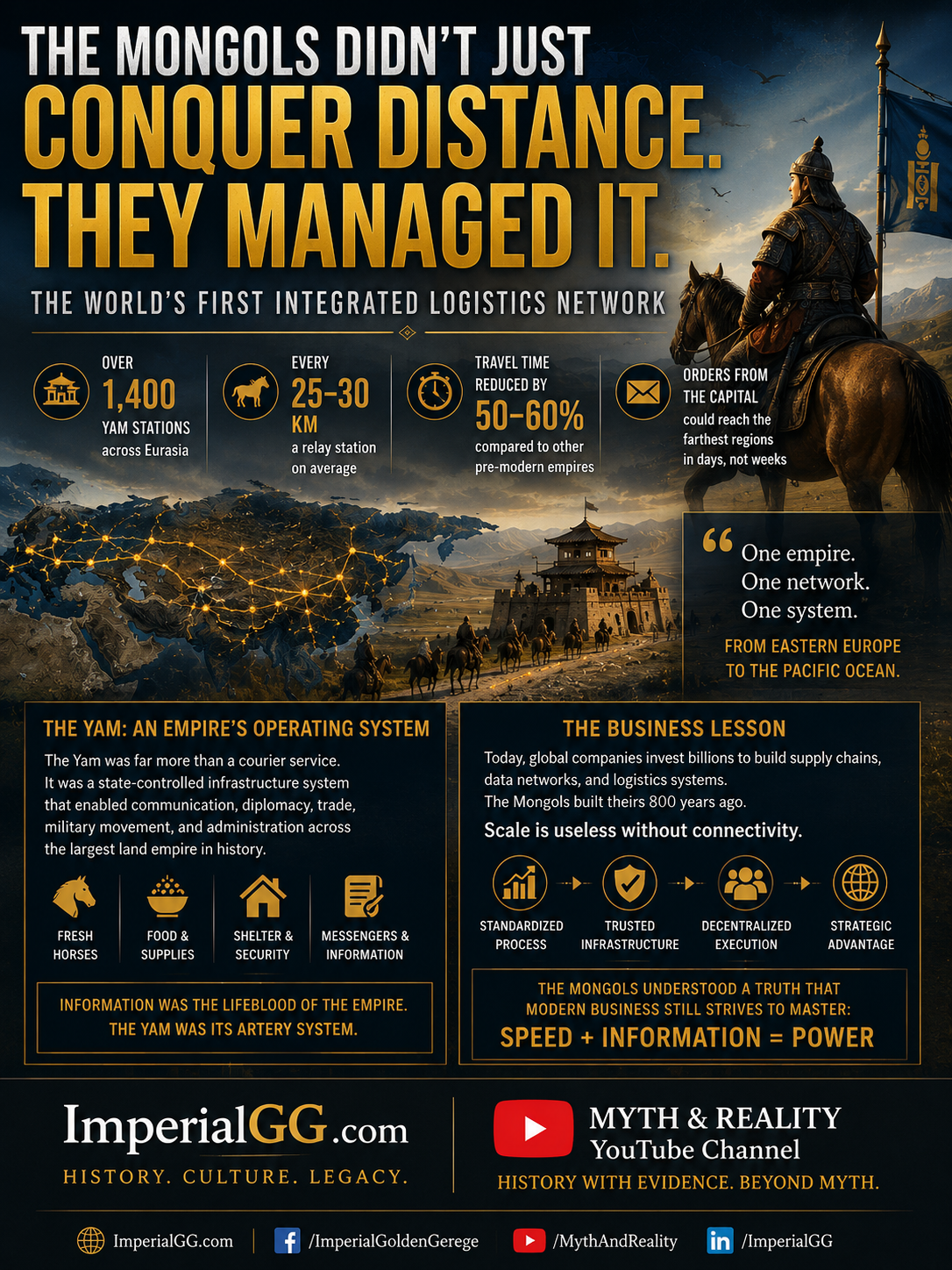
The Mongols Didn’t Just Conquer Distance. They Managed It.
By Altanbagana Baatar
DBA Candidate| Independent Historian
ImperialGG Historical Research Seriers
19 July 2026
How the Yam Relay System Became the Communication and Logistics Infrastructure of the Mongol Empire
The extraordinary territorial expansion of the Mongol Empire is usually explained through military mobility, cavalry warfare, strategic discipline, and the leadership of its khans. These factors were undoubtedly important, but conquest alone cannot explain how an empire extending across much of Eurasia could continue to function after the armies had moved on. The greater the empire became, the more difficult it was to transmit orders, receive intelligence, move officials, coordinate distant territories, and maintain political authority across thousands of kilometers.
This created a problem familiar to large organizations even today: growth increases not only power, but complexity. An expanding organization must develop systems capable of connecting its increasingly distant parts. The Mongols confronted this challenge on a continental scale, and one of their most important institutional responses was the imperial relay network commonly known as the Yam.
The Yam was not simply a medieval postal service. It formed part of a broader administrative infrastructure through which official communications, envoys, authorized travelers, and information could move across the empire. Relay stations established along important routes provided horses and various forms of logistical support, allowing official travelers to continue their journeys without depending entirely on a single mount or on improvised arrangements at every stage. The effectiveness of the network rested not merely on the speed of Mongol horses, but on the organization behind them.
This distinction is important. A fast horse can carry a messenger quickly for a limited distance, but a continental communication system requires something more sophisticated. It requires routes, relay points, supplies, administrative authority, access privileges, local responsibilities, and procedures that can be repeated across different regions. The Mongols transformed these separate resources into an interconnected system.
From Military Expansion to Administrative Connectivity
As Mongol rule expanded during the thirteenth century, imperial authorities increasingly governed territories that differed enormously in geography, economy, language, religion, and political tradition. The pastoral regions of Inner Asia, the agricultural and urban economies of northern China, the commercial centers of Central Asia, the Islamic lands farther west, and territories extending toward Eastern Europe could not be governed as though they were a single homogeneous region.
Distance therefore became more than a geographical problem. It became an administrative and economic problem.
Orders issued by the imperial court had to reach distant commanders and governors. Reports from frontier regions had to travel in the opposite direction. Diplomatic missions needed to move between courts, while officials required a reliable means of traveling through territories where local conditions could differ dramatically. Information concerning political unrest, military threats, taxation, or regional developments could lose much of its strategic value if it arrived too late.
The Yam helped reduce this friction by providing a recognized network through which imperial communication could move. In this sense, the system strengthened the ability of Mongol rulers to convert territorial expansion into functioning political authority.
The Yam as Infrastructure
From a modern economic perspective, infrastructure becomes valuable when it reduces the cost, uncertainty, and time required to move people, goods, or information. Roads, ports, railways, telecommunications networks, warehouses, and digital platforms differ technologically, but all perform variations of this basic function.
The Yam belonged to a very different historical world, yet its institutional logic can be understood in similar terms. By providing organized relay facilities along major routes, the Mongol state reduced some of the logistical difficulties associated with long-distance official travel and communication.
Its importance therefore did not lie in any single relay station. The real value came from the network.
A station operating in isolation could serve only a local purpose. When numerous stations were linked along established routes and supported by imperial authority, however, they became components of a larger communications infrastructure. An official messenger could move from one point to another, change horses, obtain necessary support, and continue toward the next station. Repetition made the system scalable.
This is one reason the Yam can be interpreted as an important element of the empire’s administrative architecture rather than merely as a courier service.
Communication Had Economic Consequences
The Mongol Empire encompassed regions containing some of the most important commercial centers of medieval Eurasia. Merchants, craftsmen, diplomats, religious figures, physicians, administrators, and other specialists traveled across these territories, while commodities and technologies circulated between regions that had previously belonged to different political systems.
The Yam should not be confused with the entirety of this commercial network, nor should it be described as a modern public transportation system available equally to everyone. Its primary functions were closely associated with imperial administration and authorized movement. Nevertheless, the wider political and logistical environment created under Mongol rule contributed to the increased connectivity of Eurasia.
Reliable communication mattered economically because commerce does not depend solely on the physical movement of merchandise. Markets also depend on information. Merchants need knowledge of conditions along routes, political authorities need information about taxation and security, and governments need functioning channels through which decisions can reach distant administrative centers.
The Mongol experience therefore illustrates an important relationship between political infrastructure and economic integration. Military conquest could open routes, but maintaining connections required institutions.
Managing Scale
This aspect of Mongol history has an interesting parallel with modern business organizations. Companies frequently celebrate growth: more customers, more markets, more employees, more offices, and greater geographical reach. Yet every expansion also creates additional complexity. Communication becomes slower, supply chains become longer, management becomes more difficult, and local operations can become disconnected from central strategy.
The Mongols encountered a medieval version of the same structural problem. Their empire had expanded so widely that distance itself threatened administrative efficiency. Their response was not simply to demand that messengers ride faster. They created an institutional framework that allowed communication to operate through a sequence of organized nodes.
The lesson is not that the Mongol Empire invented the modern supply chain. Relay systems existed before the Mongols, and medieval imperial administration cannot simply be equated with contemporary corporate management. The more meaningful comparison concerns the organizational principle involved: large systems require reliable networks if they are to remain integrated.
The Yam demonstrates that scale alone does not produce efficiency. In fact, scale without adequate infrastructure can produce the opposite result. The larger an organization becomes, the more important its internal connections become.
Standardization and Decentralized Execution
Another important characteristic of networked systems is that central authority does not need to perform every individual operation itself. Instead, the center establishes rules and responsibilities while individual nodes perform their functions locally.
The Mongol relay system depended on this combination of imperial authority and distributed execution. Stations existed in different environments and relied upon resources provided or maintained within those regions, yet they participated in a system serving wider imperial objectives.
Modern organizations would recognize the logic immediately. Standardization makes repeated operations predictable, while decentralization allows those operations to occur across large geographical areas. The headquarters does not personally deliver every package, operate every warehouse, or manage every local transaction. Instead, the organization establishes a system within which distributed units perform coordinated functions.
The technology of the Yam was medieval, but the administrative challenge it addressed was universal: how can a large political organization make distant regions function as parts of a connected whole?
Information as a Strategic Resource
Perhaps the most important economic lesson of the Yam concerns information.
Modern economies invest enormous resources in telecommunications, data centers, enterprise software, logistics platforms, satellite systems, and digital networks because information has measurable strategic value. A company that receives accurate information earlier can respond more quickly to changing conditions. A government capable of communicating effectively with distant regions possesses advantages over one whose decisions move slowly through unreliable channels.
The Mongols operated without any modern communications technology, yet they understood that the speed with which information moved could influence political and military power. Their relay network helped shorten the practical distance between the imperial center and distant territories.
For this reason, the Yam should be understood as more than transportation infrastructure. It was part of the information infrastructure of the empire.
The Economics of Distance
The history of the Yam ultimately reveals something fundamental about the Mongol achievement. The Mongols did not eliminate the enormous distances of Eurasia. They developed institutions that made those distances more manageable.
This distinction helps explain why logistics and communication deserve a more prominent place in discussions of the Mongol Empire. Cavalry mobility was essential during conquest, but governing conquered territories required a different type of mobility: the regular movement of officials, orders, intelligence, and administrative information.
The Mongol Empire became the largest contiguous land empire in history, but territorial size by itself was not its greatest organizational accomplishment. The more difficult challenge was creating mechanisms capable of connecting territories separated by mountains, deserts, grasslands, cities, languages, and political traditions.
Seen from this perspective, the Yam represents one component of a larger Mongol solution to the economics of distance.
Modern global businesses confront the same fundamental problem through very different technologies. They build supply chains, communications networks, logistics hubs, digital platforms, and information systems because expansion without connectivity eventually becomes inefficient.
Eight centuries separate the Mongol relay station from the modern data center, distribution hub, or global logistics platform. The technologies are incomparable, but the underlying organizational principle remains recognizable:
The power of a large system depends not only on how far it reaches, but on how effectively its parts remain connected.
That may be one of the most relevant economic lessons of the Mongol Empire for the modern world.
SEO Title: The Mongol Yam: How the Mongol Empire Managed Distance and Built a Eurasian Logistics Network
Meta Description: The Mongol Empire’s Yam relay system was more than a postal network. It became an essential infrastructure for communication, administration, and connectivity across medieval Eurasia.
URL Slug: mongol-yam-logistics-network
Category: Mongol Empire / Economic History / Trade & Infrastructure
Featured Image Title: The Mongols Didn’t Just Conquer Distance. They Managed It.