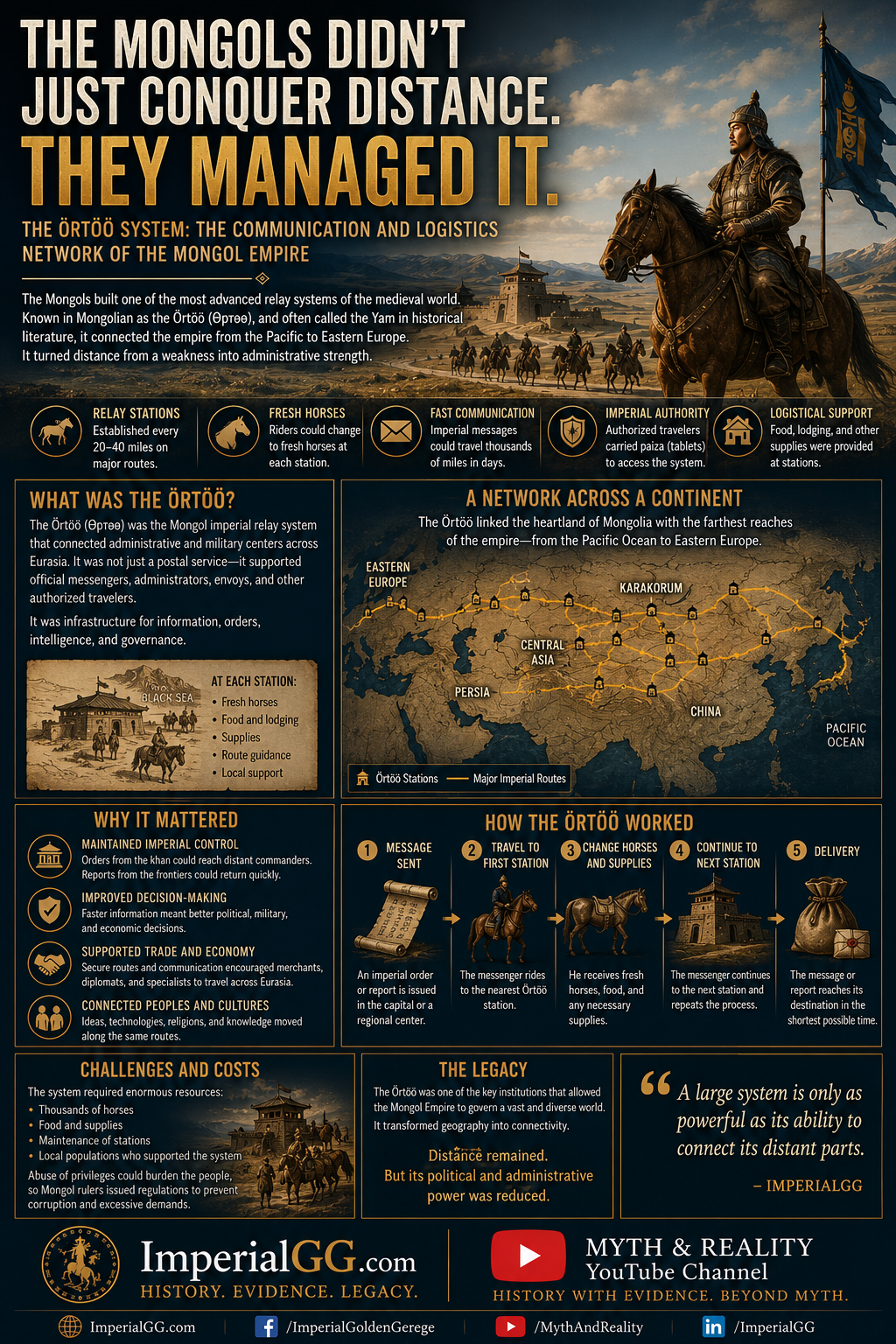
The Mongols Didn’t Just Conquer Distance. They Managed It.
By Altanbagana Baatar
DBA Candidate| Independent Historian
ImperialGG Historical Research Seriers
31 July 2026
The Örtöö System: How the Mongol Empire Built a Communication and Logistics Network Across Eurasia
The Mongol Empire is often remembered for the extraordinary speed of its armies. Mounted forces crossed immense distances, campaigns unfolded across several regions of Eurasia, and within only a few generations the Mongols created the largest contiguous land empire in recorded history. Yet conquest presents only one side of the problem. Once territories had been conquered, an even more difficult question emerged: how could an empire of such enormous geographical scale actually be governed?
The Mongol answer included one of the most important administrative institutions of the imperial period: the Örtöö (Өртөө), the organized relay system that connected the political and administrative centers of the empire with distant territories.
In English-language historical literature, this institution is also frequently called the Yam, a term ultimately associated with the postal and relay terminology used across the Mongol imperial world and especially familiar through later Russian usage. For a history centered on the Mongol imperial tradition, however, Örtöö is the more appropriate Mongolian term. It also has the advantage of emphasizing that this was not merely a “postal service” in the modern sense. It was a system of relay stations, horses, provisions, authorized movement, and administrative obligations designed to overcome one of the greatest problems facing a continental empire: distance.
Conquest Created Territory; Administration Had to Connect It
The Mongol conquests brought extraordinarily different regions under related imperial authorities. The grasslands of Mongolia, the cities and agricultural economies of northern China, the oasis networks of Central Asia, the Iranian world, the Caucasus, the Rus’ principalities, and other regions of Eurasia were separated not only by thousands of kilometers but also by mountains, deserts, languages, religions, political traditions, and economic systems. Military victory could establish authority over these territories, but military victory alone could not maintain communication between them.
Imperial orders had to reach commanders and administrators. Reports from distant territories had to return to political centers. Envoys needed to move between courts. Intelligence concerning military threats or political unrest had to travel rapidly enough to remain useful. Officials traveling on imperial business required horses, provisions, accommodation, and recognized authority to obtain assistance along their routes. The larger the empire became, the more serious these problems became. The Örtöö provided an institutional solution.
Instead of treating every long-distance journey as an independent expedition, the Mongols developed a chain of relay stations along strategically important routes. Authorized travelers could reach a station, obtain fresh horses and necessary support, and continue toward the next station. The essential innovation was therefore not simply the horse. It was the network connecting the horses.
What Was the Örtöö?
The Örtöö can be understood as an imperial relay infrastructure composed of stations positioned along major communication routes. Depending on period and region, these stations could provide fresh mounts, food, lodging, and other logistical support required by official travelers. Access to the network was regulated. Imperial messengers and other authorized persons could carry official credentials—most famously forms of the paiza, or tablet of authority—which demonstrated their right to receive particular services.
This transformed travel from a largely improvised undertaking into an institutional process. A messenger did not necessarily have to depend upon the endurance of the same horses across an enormous journey. Fresh mounts could be obtained as the traveler progressed through successive stations. Supplies did not have to be carried for the entire distance when logistical support could be provided along the route. The result was a system in which movement could be repeated across great distances according to an established structure. For a thirteenth-century empire, this had enormous political significance.
The Örtöö Was More Than a Postal Service
Describing the Örtöö simply as a “postal system” risks imposing a modern concept on a medieval institution. Its purpose extended beyond carrying letters. The network supported imperial messengers, administrators, envoys, and other authorized travelers. It therefore formed part of the infrastructure through which the political system itself operated.
This distinction becomes clearer if we imagine what would happen without such a network. An imperial order might be issued in one political center, but its practical authority would diminish if it required months of uncertain travel to reach a distant province. Likewise, a ruler could claim sovereignty over a frontier region, but that sovereignty would remain fragile if information from the frontier could not return efficiently. The Örtöö reduced this informational distance.
Geographical distance remained unchanged. Karakorum did not become physically closer to Central Asia, northern China, Iran, or the western regions of the empire. But administratively, those distances became more manageable. This is why the Örtöö should be considered part of the institutional history of the Mongol Empire rather than merely a curiosity of medieval transportation.
An Empire Runs on Information
Military history often emphasizes weapons, armies, and commanders. Economic history emphasizes production, taxation, markets, and trade. Political history emphasizes rulers and institutions.
Behind all three lies another resource that is sometimes less visible: information.
A government needs to know what is happening in the territories it governs. Military commanders need intelligence. Administrators need instructions. Diplomatic messages must move between courts. Political decisions made at the center must eventually reach the people responsible for implementing them. Information that arrives too late can become economically or strategically worthless.
The Mongols lived centuries before telegraphs, railways, telephones, satellites, or digital communications. Their fastest large-scale communication technology was still fundamentally dependent upon animals and human riders. Yet they could improve the system surrounding that technology.
This is one of the most important lessons of the Örtöö. The Mongols did not invent a faster animal. They organized infrastructure that allowed the existing technology of mounted travel to operate more effectively across continental distances. In modern business terminology, they improved the network rather than the individual unit.
The Economic Importance of Connectivity
The Örtöö was primarily an imperial institution, and it should not simply be equated with the commercial Silk Roads. Nevertheless, efficient administration and communication had important economic consequences.
The Mongol imperial world encompassed regions producing very different goods and possessing different forms of expertise. Chinese manufacturing centers, Central Asian trading cities, Iranian commercial networks, steppe pastoral economies, and numerous regional markets became connected within the wider political geography created by Mongol expansion.
Merchants still faced substantial dangers and costs, and the celebrated idea of a completely peaceful “Pax Mongolica” should not be exaggerated. Nevertheless, periods of political integration under Mongol rule facilitated remarkable movements of merchants, diplomats, craftsmen, religious figures, technologies, commodities, and knowledge across Eurasia. Infrastructure mattered because commerce requires more than goods. Commerce requires information, political security, predictable procedures, and communication. In this broader environment, the Örtöö contributed to the administrative connectivity upon which imperial economic life depended.
Standardization Made Scale Possible
The most interesting feature of the Örtöö from a modern organizational perspective is not simply speed. It is standardization. Large systems become difficult to manage when every local unit operates according to entirely different expectations. Repeated procedures reduce uncertainty. A network becomes useful when a traveler can move from one node to another and expect the system to continue functioning. This principle is familiar to every modern logistics company.
A distribution center does not create a global supply chain by itself. A truck does not create a logistics network. A server does not create a digital platform. The value emerges when individual components operate according to a coordinated system.
The same basic logic applied to the Örtöö. Stations, horses, provisions, routes, credentials, and local obligations became more valuable when organized as parts of an imperial network. The Mongols had therefore transformed a basic technology—the mounted messenger—into something institutionally much more powerful.
Central Authority, Local Execution
The Örtöö also illustrates another problem faced by every geographically large organization: the relationship between central coordination and local execution. An imperial court thousands of kilometers away could not personally manage every horse or every relay station. The system necessarily depended upon resources and responsibilities distributed across the territories through which it passed.
This created a form of administrative decentralization within a wider framework of imperial authority. The principle remains familiar today. Global organizations establish standards, routes, procedures, and objectives centrally, while actual operations occur through regional offices, warehouses, contractors, transportation hubs, data centers, and local employees. The historical contexts are entirely different, but the structural problem is similar.
How does a large organization remain integrated without requiring its center to perform every task directly?
The Örtöö was one Mongol answer.
The Cost of the System
An efficient network was not free. Maintaining relay horses, provisions, stations, and personnel imposed obligations upon local populations and administrative units. The system could also be abused when travelers claimed privileges beyond those legitimately required for imperial service. This became a serious enough problem that Mongol rulers attempted at different times to regulate access and control excessive demands placed upon the population.
This aspect is important because it prevents us from romanticizing the Örtöö as an effortless technological triumph. Infrastructure always has a cost. Someone must provide the horses. Someone must maintain the stations. Someone must supply food. Someone must pay, directly or indirectly, for the system to continue functioning.
The Mongol experience therefore reveals both sides of infrastructure: networks can dramatically increase the power and efficiency of a large organization, but poorly controlled access can also create waste and impose heavy burdens on the people supporting them. That lesson is as relevant to modern economics as the system’s advantages.
From the Örtöö to the Modern Logistics Problem
It would be historically misleading to call the Örtöö a medieval version of FedEx, Amazon, or the internet. The objectives, technologies, institutions, and economic environments are too different. The more useful comparison lies at a deeper level.
Modern global corporations invest enormous amounts of capital in supply chains, transportation hubs, communications infrastructure, cloud computing, enterprise software, and data networks because geographical scale creates organizational complexity. The Mongols confronted the same fundamental relationship between scale and connectivity, although with the technologies available in the thirteenth century.
The larger their political world became, the more important communication infrastructure became. Expansion without connectivity would have produced fragmentation. The Örtöö helped counter that tendency.
Managing Distance Was Part of the Mongol Achievement
The military achievements of the Mongol Empire remain extraordinary, but military history alone cannot explain the functioning of the empire. Conquest answered the question of how the Mongols acquired territory. Institutions such as the Örtöö help answer the more difficult question of how they attempted to govern it.
The significance of the system therefore lies not merely in the speed of its riders but in the organizational thinking behind it. The Mongols recognized that vast distances could not be eliminated, but their political consequences could be reduced through infrastructure, standardization, delegated responsibility, and reliable channels of communication. Seen in this way, the Örtöö was one of the mechanisms that transformed Mongol military expansion into a functioning imperial network.
Eight centuries later, the technology has changed completely. Horses have been replaced by aircraft, fiber-optic cables, satellites, trucks, servers, and global digital networks. The organizational problem remains remarkably familiar. A large system is only as powerful as its ability to connect its distant parts.
The Mongols did not simply conquer distance. Through the Örtöö, they learned how to manage it.